1 Corinthians 12:24

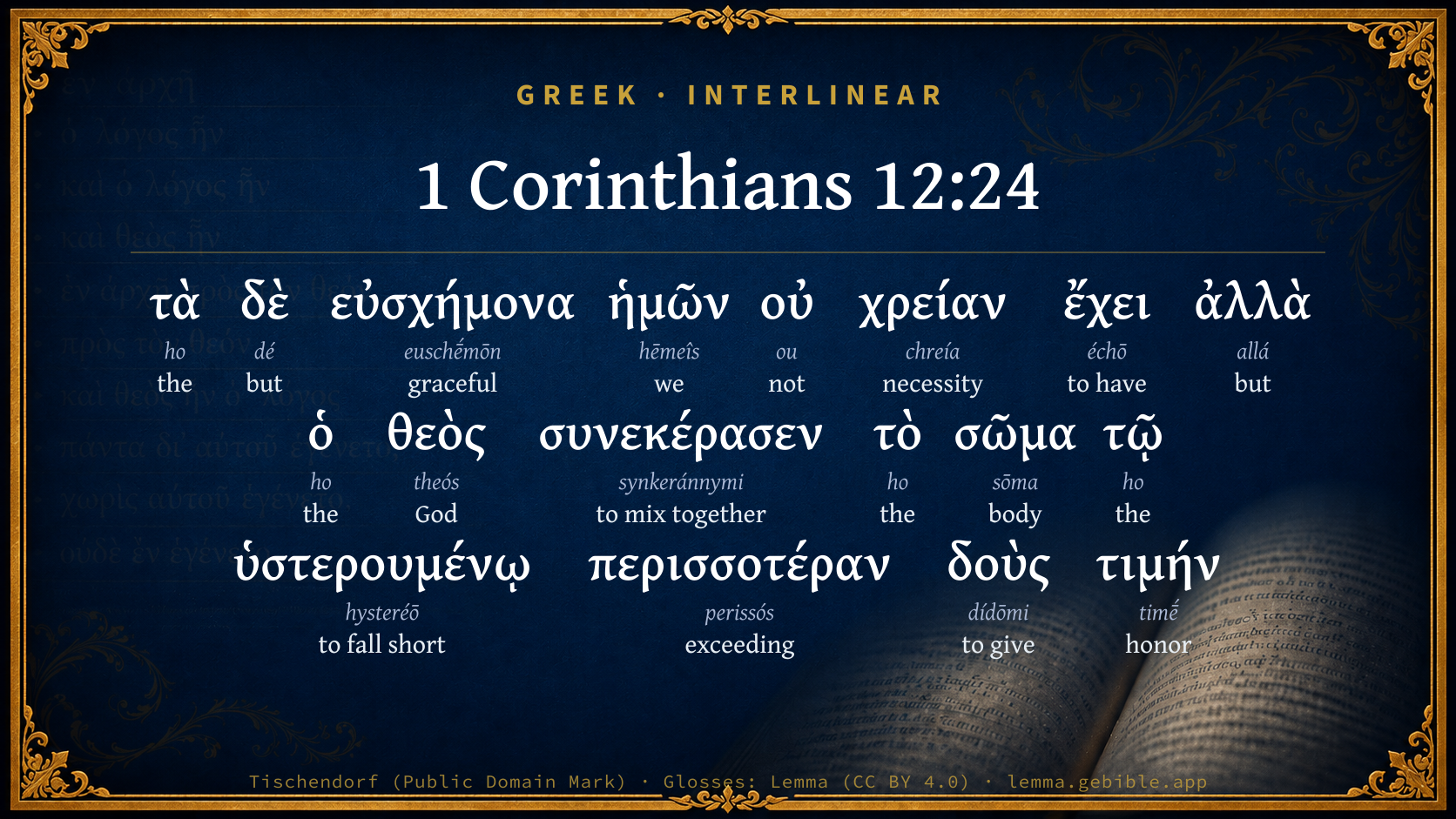
Greek (Tischendorf 8th ed.) 1 Corinthians 12:24 appears in the Greek New Testament. The text above is from the Tischendorf 8th edition. Each word links to its Strong’s number and a concise gloss. Click any word for its full Thayer’s Greek Lexicon entry.
Download image
Cite this verse

1 Corinthians 12:24 (World English Bible). Public Domain. Lemma interlinear Bible study tool, https://lemma.gebible.app/v/1-corinthians/12/24.

Show BibTeX & RIS
BibTeX
RIS
English Translation
whereas our presentable parts have no such need. But God composed the body together, giving more abundant honor to the inferior part,
World English Bible · Public Domain
Highlights
  • 1 first appearance in the Greek New Testament
Full analysis ↓
Download a study sheet

One document with this verse’s original text, its word-by-word gloss line, the meaning frame, cross-references with their text, attributed commentary, and full source and license credits — printable, and it pastes into notes with its structure intact.

This verse Autodidact and up

Study sheet (.html) Plain text (.txt)

A passage Seminary Student

Up to 50 verses in one chapter. A passage sheet keeps up to 6 commentary sources and 12 cross-references per verse, in the order this page ranks them, and says so on the sheet whenever that leaves anything out. Ask for a single verse and you get the Autodidact verse sheet above.

Everything on this page stays free to read, with no account — the sheet is a download of what is already on screen, not access to it.

Want to remove ads? Support Godless Engineer
Compare translations 3

The same verse in 3 English versions, stacked beneath the original-language interlinear above. Click any original word for its lexicon entry.

Each is an independent rendering of the whole verse — the interlinear is not word-aligned to these translations.

Highlighted words mark where these versions differ — a whole-verse word diff, not a word-by-word alignment.

  • World English Bible Public Domain
    whereas our presentable parts have no such need. But God composed the body together, giving more abundant honor to the inferior part,
  • King James Version Public Domain
    For our comely parts have no need: but God hath tempered the body together, having given more abundant honour to that part which lacked.
  • unfoldingWord Literal Text CC BY-SA 4.0
    but our presentable members do not have need. But God has combined the body together, giving more honor to the one lacking

unfoldingWord Literal Text — © unfoldingWord, licensed CC BY-SA 4.0. Word-aligned USFM3 via Door43 (git.door43.org/unfoldingWord/en_ult).

Versions to compare (up to 4)

3 of 4 selected

Show all 19 translations

Every available English version of this verse, each an independent rendering of the whole verse.

  • World English Bible Public Domain
    whereas our presentable parts have no such need. But God composed the body together, giving more abundant honor to the inferior part,
  • Berean Standard Bible Public Domain
    whereas our presentable parts have no such need. But God has composed the body and has given greater honor to the parts that lacked it,
  • Majority Standard Bible Public Domain
    whereas our presentable parts have no such need. But God has composed the body and has given greater honor to the parts that lacked it,
  • King James Version Public Domain
    For our comely parts have no need: but God hath tempered the body together, having given more abundant honour to that part which lacked.
  • American Standard Version (1901) Public Domain
    whereas our comely `parts' have no need: but God tempered the body together, giving more abundant honor to that `part' which lacked;
  • Revised Version (1885) Public Domain
    whereas our comely parts have no need: but God tempered the body together, giving more abundant honour to that part which lacked;
  • Geneva Bible (1599) Public Domain
    For our comely partes neede it not: but God hath tempered the body together, and hath giuen the more honour to that part which lacked,
  • Douay-Rheims (1899) Public Domain
    But our comely parts have no need: but God hath tempered the body together, giving to that which wanted the more abundant honour,
  • Young's Literal Translation Public Domain
    and our seemly things have no need; but God did temper the body together, to the lacking part having given more abundant honour,
  • Literal Standard Version CC BY-SA 4.0
    and our seemly things have no need; but God tempered the body together, having given more abundant honor to the lacking part,
  • Unlocked Literal Bible CC BY-SA 4.0
    Now our presentable members have no need to be treated with dignity, for they already have dignity. But God has joined all the members together, and he gave more honor to those that lacked it.
  • unfoldingWord Literal Text CC BY-SA 4.0
    but our presentable members do not have need. But God has combined the body together, giving more honor to the one lacking
  • Darby Bible Public Domain
    but our comely [parts] have not need. But God has tempered the body together, having given more abundant honour to [the part] that lacked;
  • World Messianic Bible Public Domain
    while our presentable parts have no such need. But God composed the body together, giving more abundant honor to the inferior part,
  • Webster's Bible Public Domain
    For our comely parts have no need: but God hath tempered the body together, having given more abundant honor to that part which lacked:
  • Free Bible Version CC BY-SA 4.0
    What's presentable doesn't need such covering up. God has so arranged the body that more honor is given to the parts that are less presentable.
  • Bible in Basic English Public Domain
    But those parts of the body which are beautiful have no need of such care: and so the body has been joined together by God in such a way as to give more honour to those parts which had need of it;
  • Text-Critical English NT CC BY 4.0
    but our presentable parts have no need of it. Instead, God has put the body together, giving more abundant honor to the part that lacked it,
  • Tyndale New Testament (1534) Public Domain
    For oure honest members nede it not. But God hath so disposed the body ad hath geven most honoure to that parte which laked

Literal Standard Version (2020), Covenant Press — licensed CC BY-SA 4.0. Text via the HelloAO Bible API (eBible.org). Unlocked Literal Bible (unfoldingWord) — licensed CC BY-SA 4.0. Text via the HelloAO Bible API (eBible.org). unfoldingWord Literal Text — © unfoldingWord, licensed CC BY-SA 4.0. Word-aligned USFM3 via Door43 (git.door43.org/unfoldingWord/en_ult). Free Bible Version, Dr. Jonathan Gallagher — licensed CC BY-SA 4.0. Text via the HelloAO Bible API (eBible.org).

Word by word

More ways to search: Search by grammar → Find every occurrence → Compare this word →

Practice this passage: Drill this verse → Learn its vocabulary →

συνεκέρασεν
synkeránnymi
G4786
“to mix together”
Verb, Aorist, Active, Indicative, 3rd person, Singular
Part of Speech
Verb
Tense
Aorist
Voice
Active
Mood
Indicative
Person
3rd person
Number
Singular
Full Thayer's Definition

Origin: from G4862 and G2767

TDNT: None

1. to mix together, commingle 2. to unite a. caused the several parts to combine into an organic structure, which is the body b. to unite one thing to another
  1. τὰ ho G3588 “the” Article, Nominative, Plural, Neuter
  2. δὲ dé G1161 “but” Conjunction
  3. εὐσχήμονα euschḗmōn G2158 “graceful” Adjective, Nominative, Plural, Neuter
  4. ἡμῶν hēmeîs G2249 “we” Personal pronoun, 1st person, Genitive, Plural
  5. οὐ ou G3756 “not” Particle, Negative
  6. χρείαν chreía G5532 “necessity” Noun, Accusative, Singular, Feminine
  7. ἔχει échō G2192 “to have” Verb, Present, Active, Indicative, 3rd person, Singular
  8. ἀλλὰ allá G235 “but” Conjunction
  9. ὁ ho G3588 “the” Article, Nominative, Singular, Masculine
  10. θεὸς theós G2316 “God” Noun, Nominative, Singular, Masculine
  11. τὸ ho G3588 “the” Article, Accusative, Singular, Neuter
  12. σῶμα sōma G4983 “body” Noun, Accusative, Singular, Neuter
  13. τῷ ho G3588 “the” Article, Dative, Singular, Masculine
  14. ὑστερουμένῳ hysteréō G5302 “to fall short” Verb, Present, Passive, Participle, Dative, Singular, Masculine
  15. περισσοτέραν perissós G4053 “exceeding” Adjective, Accusative, Singular, Feminine, Comparative
  16. δοὺς dídōmi G1325 “to give” Verb, Aorist, Active, Participle, Nominative, Singular, Masculine
  17. τιμήν timḗ G5092 “honor” Noun, Accusative, Singular, Feminine

About this verse

These counts appear in no published source. They are computed here, from the morphology-tagged text and Lemma’s own curated glosses. What Lemma adds →

18
words
15
distinct lemmas
Pauline Epistles
section

Notable vocabulary

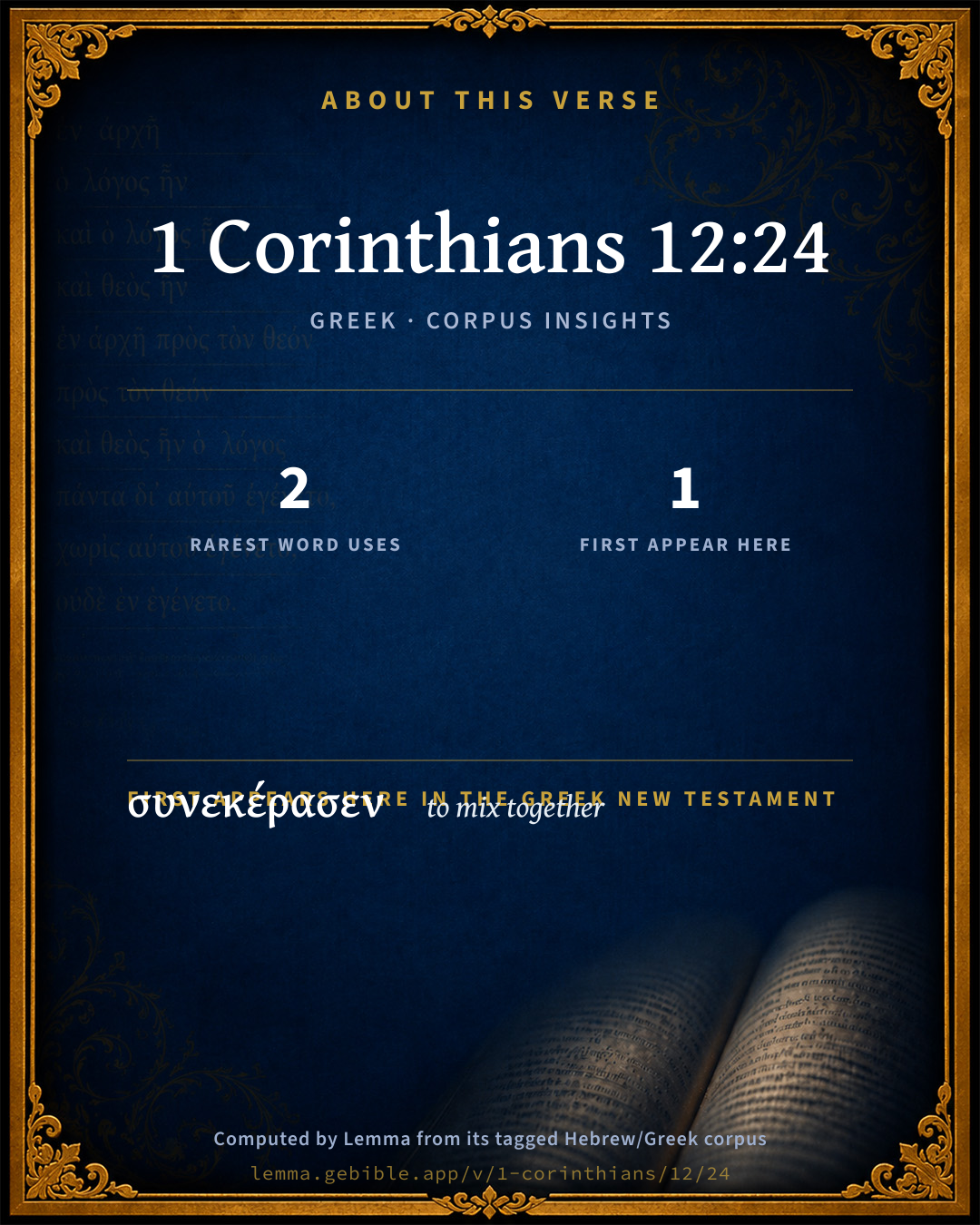
The rarest word here is συνεκέρασεν to mix together G4786 — appearing just 2 times in the whole Greek New Testament.

First appearance in Scripture

This word makes its first canonical appearance in the Greek New Testament here:

  • συνεκέρασεν to mix together G4786

Shared distinctive vocabulary

συνεκέρασεν to mix together G4786 occurs in 2 verses of the Greek New Testament. Also found in:

Repetition

A word recurs within this verse:

Cross-references

2

Topical passages linked to 1 Corinthians 12:24 in the Treasury of Scripture Knowledge — connected by theme and wording, ordered by reader-vote popularity; previews shown in the World English Bible.

  • Genesis 2:25 They were both naked, the man and his wife, and were not ashamed.
  • Genesis 3:11 God said, "Who told you that you were naked? Have you eaten from the tree that I commanded you not to eat from?"

Cross-references courtesy of OpenBible.info (CC BY 4.0).

Commentary

Notes on 1 Corinthians 12:24 from classic Christian and Jewish commentators (each source and its license shown beneath its notes). The classic Christian expositions comment on the surrounding passage and are grouped to its opening verse, so a note may address several verses; the Jewish commentaries on the Tanakh (Rashi and others) are per-verse, so they appear only where the commentator wrote on this verse.

Lemma curates 59 commentaries, every one of them public domain or Creative Commons licensed, each selected and text-cleaned for this edition rather than reprinted as found. About our sources →

Joseph Benson's Commentary

1Co 12:24-26. For our comely and graceful parts have no need — Of being so adorned, as they appear to greater advantage uncovered; but God hath tempered the body together — Συνεκερασε, hath attempered and united in just proportions the several parts thereof; having given — To such as are naturally weak and without beauty; more abundant honour — Through their greater efficacy in the nourishment and preservation of the body, and by causing them to be cared for and served by the noblest parts. That there should be no schism in the body — No division of separate interests; but that the members should have the same care one for another — As being each an important part of the whole. And whether one member suffer, all the members — In consequence of their close union with, and dependance on each other, should suffer with it — As losing the assistance of the disabled member, and concerned to remove the cause of its suffering. Or one member be honoured — Clothed and gratified; all the members should rejoice with it — Deriving advantage from its welfare, and the ornament of one part being looked upon as that of the whole. “By comparing schism in the church to schism in the body, we are taught that it consists in a natural want of affection in some of the members toward their fellow-members, whereby contentions and animosities are produced. Further, by showing that the members of the body are so united as to be necessary to each other’s existence, the apostle hath taught us that there should be no envy nor strife among the disciples of Christ; but that each, by the right exercise of his proper gift, should assist his neighbour, and rejoice when his welfare is promoted.”

Joseph Benson's Commentary on the Old and New Testaments (1811–1818) — public domain. Text from a community e-Sword module.

Bengel's Gnomon

Johann Albrecht Bengel

1Co 12:24. Οὐ χρείαν ἔχει have no need) Why then is it necessary to adorn smooth cheeks with patches?[112]—ΣΥΝΕΚΈΡΑΣΕ) hath tempered together.—τιμήν, honour) comp. 1Co 12:23, at the beginning.

[112] As was the custom, in Bengel’s days, among fops.—ED.

Bengel's Gnomon of the New Testament — English translation (T&T Clark, Edinburgh, 1860) — public domain. Text from a community e-Sword module.

Meyer's Critical & Exegetical Commentary

Heinrich August Wilhelm Meyer

1Co_12:24. Τὰ δὲ εὐσχήμ. ἡμ. οὐ χρ. ἔχ.] which should be separated from what precedes it only by a comma, is not designed to set aside an objection (Chrysostom, Theophylact), but it appertains to the completeness of the subject that, after the ἀσχήμονα have been spoken of, the remark in question should be added regarding the εὐσχήμονα also, in order to let nothing be wanting in the exhibition of the adjustment which takes place in connection with the variety of relation subsisting between the members. Εὐσχημοσύνην περισσ. ἔχειν naturally supplies itself from the foregoing context to οὐ χρείαν ἔχει. All the less ground is there for connecting ἡμῶν with οὐ χρ. ἔχ. (Hofmann, comp Osiander), which would give the thought: they stand in no need of us, which is too general, and which would still need to be limited again by what precedes it.

ἀλλʼ ὁ Θεὸς Κ.Τ.Λ[2000]] cannot be antithesis to the foregoing negative (Hofmann), which would bring the special subordinate thought οὐ χρείαν ἔχει into a connection quite disproportionately grand and far transcending it. There should, on the contrary, be a full stop placed before ἀλλʼ, so as to mark the beginning of a new sentence; and ἀλλʼ rather breaks off (at, see Baeumlein, Partik. p. 15) the delineation of the mutual relations of the members, which has been hitherto given, in order now to raise the readers to the higher point of view from which this relationship is to be regarded, that of the divine appointment and destination.

συνεκέρασε] He has mingled together, i.e. united into one whole out of differently constituted parts.

τῷ ὑστεροῦντι] to that which stands after, remaining back behind others, 1Co_1:7, 1Co_8:8; Plato, Pol. vii. p. 539 E, Epin. p. 987 D (see also on Mat_19:20), i.e. to the part which, according to human estimation, is meaner than others.[2001]

περισσ. δοὺς τιμ.] ΔΟΎς is contemporaneous with συνεκέρασε: so that He gave, namely, when He granted to them, according to 1Co_12:22-23, respectively their greater necessity and the destination of being clad in a more honourable and more seemly way.

[2000] .τ.λ. καὶ τὰ λοιπά.

[2001] In how far, is stated in vv. 22, 23. By a very arbitrary importation of ideas, Hofmann holds that to τὸ ὑστεροῦν means the loins and genitals, a part of the body which, while falling behind the rest in honour, is distinguished by the honour of serving for the self-propagation of man. Neither that specific reference in itself, nor this more precise definition of the greater honour referred to,out of place as it is in this connection,could ever have been guessed by a reader from ver. 22 f.

Meyer — Critical and Exegetical Commentary on the New Testament — English translation by Peter Christie, edited by Frederick Crombie (T&T Clark, 1880) — public domain. Text from a community e-Sword module.

Hodge's Commentary on Romans, Ephesians & First Corinthians

Charles Hodge

1Co_12:24

For our comely (parts) have no need: but God hath tempered the body together, having given more abundant honor to that (part) which lacked:

Our comely parts have no need, i.e. of being thus adorned. The face is uncovered, the feet are clothed and decked. The former needs no adorning, the latter does. God hath tempered the body together, i.e. he has so adjusted it and combined its several members, as to secure the result that more abundant honor should be given to those which lacked. By making the uncomely parts essential to the well-being of the rest, and by diffusing a common life through all the members, he has made the body a harmonious whole.

Charles Hodge — Commentary on Romans (1835), First Corinthians (1857), and Ephesians (1856) — public domain. Text from a community e-Sword module.

Jamieson, Fausset & Brown

Robert Jamieson, A. R. Fausset & David Brown

tempered . . . together--on the principle of mutual compensation.

to that part which lacked--to the deficient part [ALFORD], (Co1 12:23).

Jamieson, Fausset & Brown — Commentary Critical and Explanatory on the Whole Bible (1871) — public domain (CC PDM 1.0). Text via the HelloAO Bible API.

Adam Clarke's Commentary

Verse 24. For our comely parts have no need] It would be easy to go into great detail in giving an anatomical description of the different members and parts to which the apostle refers, but it would not probably answer the end of general edification; and to explain every allusion made by the apostle, would require a minuteness of description which would not be tolerated except in a treatise on the anatomy of the human body. My readers will therefore excuse my entering into this detail.

Adam Clarke's Commentary on the Bible (1810–1826) — public domain. Text from a community e-Sword/MySword module.

John Calvin's Commentaries

24. But God hath tempered the body together He again repeats, what he had stated once before, (1 Corinthians 12:18,) but more explicitly, — that God has appointed this symmetry, and that with a view to the advantage of the whole body, because it cannot otherwise maintain its standing. “For whence comes it, that all the members are of their own accord concerned for the honor of a less comely member, and agree together to conceal its shame? This inclination has been implanted in them by God, because without this adjustment a schism in the body would quickly break out. Hence it appears that the body is not merely shattered, and the order of nature perverted, but the authority of God is openly set at naught, whenever any one assumes more than belongs to him.”

John Calvin's Commentaries (1540-1563) — public domain. Text from the Calvin Translation Society English edition (1840s-50s) via the Christian Classics Ethereal Library (ccel.org). Calvin's coverage is partial (roughly two-thirds of the Bible); uncommented books and verses are honest gaps, never fabricated. The 19th-century editor's footnotes and remarks are omitted so the notes are faithfully Calvin's own voice.

Ellicott's Commentary for English Readers

(24) For our comely parts have no need.—These words (better, and our comely parts have no need) conclude the former verse. The words, “But God hath tempered,” commence a new sentence, in which the natural practice of covering parts of the body is stated to be in harmony with God’s evident intention.

A Bible Commentary for English Readers, edited by Charles John Ellicott (1878–1897) — public domain. Text from a community e-Sword module.

The Cambridge Bible for Schools and Colleges

gen. ed. J. J. S. Perowne

24. tempered] So Wiclif. Disposed, Tyndale. Temperavit, Vulgate. Literally, mingled together.

The Cambridge Bible for Schools and Colleges (gen. ed. J. J. S. Perowne; Cambridge University Press, 1878–1918) — public domain. Text from a community e-Sword module.

John Gill's Exposition

For our comely parts have no need,.... As the face, eyes, nose, lips, cheeks, &c. which stand in no need of an external covering, of any outward ornament: so such as are blessed with the bounties of nature and providence, with the gifts of the Holy Spirit, and are eminent for grace and holiness, and are enabled to walk worthy of their calling, and to have their conversations as become the Gospel of Christ, holding the mystery of the faith in a pure conscience, these have no need of such a covering, as the former have, to hide and conceal them from the world:

but God hath tempered the body together; he hath composed it in such a forth, constituted it in such an order, mixed and united all its parts in such a manner, as that they are all beneficial to each other; and such is the harmonious contexture of the whole, that it is a most beautiful structure:

having given more abundant honour to that part which lacked; or, as the Syriac version renders it, "which is the least"; and such is the temperament and constitution of the church, having mixed rich and poor persons, of greater and lesser gifts, together, for mutual good.

John Gill's Exposition of the Whole Bible (1746–1763) — public domain (CC PDM 1.0). Text via the HelloAO Bible API.

Trapp's Complete Commentary

John Trapp

24 For our comely parts have no need: but God hath tempered the body together, having given more abundant honour to that part which lacked:

Ver. 24. For our comely parts] A fair face needs no dress, is its own testimonial, a bait without a hook, said Socrates, δελεαρ ανευ αγκιστρου..

John Trapp, A Commentary or Exposition upon All the Books of the Old and New Testament (1647–1656) — public domain. Text from a community e-Sword module.

Albert Barnes' Notes on the Bible

For our comely parts - The face, etc. “Have no need.” No need of clothing or ornament.

But God hath tempered the body together - Literally, “mingled” or mixed; that is, has made to coalesce, or strictly and closely joined. He has formed a strict union; he has made one part dependent on another, and necessary to the harmony and proper action of another. Every part is useful, and all are suited to the harmonious action of the whole. God has so arranged it, in order to produce harmony and equality in the body, that those parts which are less comely by nature should be more adorned and guarded by apparel.

Having given more abundant honour ... - By making it necessary that we should labor in order to procure for it the needful clothing; thus making it more the object of our attention and care. We thus bestow more abundant honor upon those parts of the body which a suitable protection from cold, and heat, and storms, and the sense of comeliness, requires us to clothe and conceal. The “more abundant honor,” therefore, refers to the greater attention, labor, and care which we bestow on those parts of the body.

Albert Barnes' Notes on the Bible (1834–1885) — public domain. Text from a community e-Sword/MySword module.

Haydock's Catholic Bible Commentary

Cicero, in his 1st liber de Off. speaking of the human body, says, Natura quæ formam nostram atque figuram, in qua esset species honesta, eam posuit in promptu; quæ partes autem corporis ad naturæ necessitatem datæ, aspectum essent deformem habituræ atque turpem, eas contexit atque abdidit. (Calmet)

George Leo Haydock (1774–1849), Haydock's Catholic Family Bible and Commentary, 1859 edition — public domain. Excludes Psalms (Douay-Rheims chapter numbering differs from Protestant) and Deuterocanonical books (Catholic canon only).

Matthew Poole's English Annotations

God hath, in the wisdom of his providence, so ordered it, that as we have some parts of our body which are judged uncomely, and not for those noble uses that others are; so we have other parts that are, for use, more noble, yet in common repute more ignoble and uncomely: and the same wise God hath so built the body of man, as of both these to make a temperament so as they all concur in the composition of the same body, and more abundant honour in covering and clothing them is given to those parts, that, in the judgment of men, seemed most to lack honour, that their uncomeliness might by some artificial means be taken away.

Matthew Poole's English Annotations on the Holy Bible (1683–1685) — public domain. Text from a community e-Sword/MySword module.

Whedon's Commentary on the Bible

Daniel D. Whedon

24. Comely… no need—The ruling parts of the body in active life, the head, the hands, and sometimes the feet, need no concealments nor ornamental dress.

Tempered—Adjusted.

Daniel D. Whedon (gen. ed.), Commentary on the Old and New Testaments (1874–1909) — public domain. Text from a community e-Sword module.

John Wesley's Explanatory Notes

Giving more abundant honour to that which lacked - As being cared for and served by the noblest parts.

John Wesley, Explanatory Notes Upon the Whole Bible (1754–1765) — public domain. Text via the GEBible commentary corpus.

Kretzmann's Popular Commentary

Paul E. Kretzmann

The application of the figure:

v. 24. For our comely parts have no need; but God hath, tempered the body together, having given more abundant honor to that part which lacked,

v. 25. that there should be no schism in the body, but that the members should have the same care one for another.

v. 26. And whether one member suffer, all the members suffer with it; or one member be honored, all the members rejoice with it.

In the covering and adorning of the dishonorable, indecorous parts of the body we do not include the seemly parts, the head and the face, unless we wish to display barbarous tendencies. Their distinction is so evident that any ornament jars upon the beholder. But God caused to mix together, He compounded the members of the body, having assigned more honor to the part which is in need of it. The Greek word signifies the mixing of ingredients as it is done in the laboratory, and indicates "such a mutual adjustment of the parts in the body as shall counterbalance differences, so that one part shall qualify another. " It is not thus that the fine and honorable members are all in one place and the ignoble and indecorous in another, but that there is a complete harmony in appearance and in function of the body, together with an agreeable manifoldness and interchange. And the object is: that there be no schisms, no divisions, in the body, but that the members may have the same care for one another. If the chief organs of the body should refuse to perform their work properly so long as the dishonorable members were still connected with the body, obviously the entire body would suffer. It is the will of the Creator that every part should contribute something to the general proportion, symmetry, and beauty of the body. It will also follow, quite naturally: And if one member should suffer, all the members suffer with it, and if one member is glorified, all the members rejoice with it. Here is an illustration of the unselfish care and solicitude of the members of the body for one another. So closely are they all united in the one organism of the body that the pain of any one organ is normally felt by the whole body as such; and, on the other hand, a special honor shown to any one member, especially to the comely members, causes the whole body to be filled with gladness, the attitude of the mind being reflected in the pose, in the gestures, in every lineament of the body.

Paul E. Kretzmann, Popular Commentary of the Bible (1921–1924) — public domain. Text from a community e-Sword module.

McGarvey & Pendleton's Commentaries

J. W. McGarvey

whereas our comely parts have no need: but God tempered the body together, giving more abundant honor to that part which lacked ;

J. W. McGarvey (with Philip Y. Pendleton), Commentaries on the New Testament (The Fourfold Gospel, 1914; Acts; and the epistles) — public domain. Text from a community e-Sword/MySword module.

Cambridge Greek Testament for Schools and Colleges

24. ὑστερουμένῳ אABC. ὑστεροῦντι DEFG.

24. συνεκέρασεν. Literally, mingled together.

ὑστερουμένῳ, which comes short of any other.

Cambridge Greek Testament for Schools and Colleges (Cambridge University Press, 1896; 21 vols, various authors incl. Carr, Maclear, Plummer, Farrar, Lumby, Moule, M. R. James, Simcox) — public domain. Text from a community e-Sword module.

Alford’s Greek Testament

Henry Alford

24.] The comely parts are in some measure neglected, not needing to be covered or adorned: but (opposed to χρείαν ἔχει) God (at the creation) tempered the body together (compounded it of members on a principle of mutual compensation),—to the deficient part giving more abundant honour,

Henry Alford, The Greek Testament (1849–1861) — public domain. Text from a community e-Sword module.

International Critical Commentary

24. ἀλλὰ ὁ Θεὸς συνεκέρασεν τὸ σῶμα. The nominative is emphatic. ‘But the fact is, it was God who compounded (blended) the body together, by giving to that which feeleth lack more abundant honour.’ The two aorists are contemporaneous, δούς with συνεκέρασεν: in giving, or by giving, He tempered; and in tempering, or by tempering, He gave. In the LXX and N.T. συγκεραννύναι is rare (Dan 2:43; Dan_2 Mac. 15:39; Heb 4:2), but it is common in class. Grk. Comp. the speech of Alcibiades (Thuc. vi. xviii. 6); νομίσατε νεότητα μὲν καὶ γῆρας ἄνευ ἀλλήλων μηδὶν δύνασθαι, ὁμοῦ δὶ τό τε φαῦλον καὶ τὸ μέσον καὶ τὸ πάνυ ἀκριβὲς ἂν ξυγκραθὲν μάλιστʼ ἂν ἰσχύειν: also σύγκρασίς τίς ἐστιν ἐν πᾶσιν (Clem. Rom. Cor. 37). In v. 23 the Apostle shows how men, led by a natural instinct, equalize the dignity of their members. Here he shows that it is in reality God who blends and balances the whole by endowing men with this instinctive sense of propriety. What is in accordance with the common feelings of mankind is evidence of what is right (11:14).

We should read τῷ ὑστερουμένῳ (א A B C) rather than τῷ ὑστεροῦντι (D E F G K L). The former expresses the member’s sense of inferiority.

International Critical Commentary — older volumes (1896–1929), various authors — public domain. Text from a community e-Sword module.

Vincent's Word Studies in the New Testament

Marvin R. Vincent

Tempered together [συνεκρασεν] . Only here and Heb 4:2. Lit., mixed together. Here the idea of mutual adjustment is added to that of mingling. Compare Plato on God 's creating the soul and body. "He made her out of the following elements, and on this manner. Of the unchangeable and indivisible, and also of the divisible and corporeal He made (xunekerasato compounded) a third sort of intermediate essence, partaking of the same and of the other, or diverse" (see the whole passage, "Timaeus," 35).

Marvin R. Vincent, Word Studies in the New Testament (1887–1900) — public domain. Text from a community e-Sword/MySword module.

Godet's Commentaries

Frédéric Louis Godet

Vv. 24a. But, as to functions which of themselves honour those who fill them, there is nothing to add to this intrinsic honour. They resemble the beautiful parts of the body, which would be wronged were they covered. Transparent as the meaning of this parable is applied to the Church, the apostle does not go beyond the figure, as we still find in what follows.

Vers. 24b, 25. “But God hath tempered the body together, having given more abundant honour to that which lacked: 25. that there should be no schism in the body; but that all the members should have the same care one for another.”

The δέ, but, seems to me to be well explained by Holsten: “But as to this contrast which meets the eyes of men God gives the solution of it by the end which He had in view in creating it.” God has intermingled feeble members with strong in the human body, comely parts with others not comely, that the latter might be the objects of particular care and attention on the part of the others, and that thus the body might not present the spectacle of two orders of members, the one glorious and the other despicable, which would destroy the harmony of the whole and would even impair the favourable effect produced by the first. God has thus succeeded in making every member have an interest in the comely and honourable appearance of all the others. Love on their part thus becomes a matter of rightly understood self-interest. The singular σχίσμα, schism, is certainly the true reading; the plural σχίσματα, schisms, has been substituted for it, because it was thought there was an allusion here to the divisions in the Church of Corinth. There must not be the contrast between parts beautiful and ugly, glorious and vile, in the masterpiece of creation. — The τὸ αὐτὸ μεριμνᾶν signifies: to have a common care, to be all concerned about one result. This common end is the harmonious beauty of the whole.

By adding ὑπὲρ ἀλλήλων, one for another, the apostle means that all should be watchful for the honour of all in order to the dignity of the whole. Those members which are of themselves less honourable thus turn out to be the objects of the special interest of all, that there may be procured for them the nobility which they had not naturally. For this end it is that God has established between them all such a close solidarity. And indeed, as the following verse says, there is between them an instinctive sympathy of satisfaction or shame which impels each to provide for the honour of all.

Frédéric Louis Godet — Commentaries on Luke, John, Romans, and 1 Corinthians — English translation (T&T Clark, Edinburgh, 1870s–1890s) — public domain. Text from a community e-Sword module.

Lesson kit

Teaching starters — assembled from the data on this page, not authored interpretation. Every prompt links to the verse data it draws on. Edit before teaching.

1 Corinthians, in the Pauline Epistles, opens this verse with 18 words (15 distinct Greek lemmas). Its most distinctive word is synkeránnymi (“to mix together”). A historical commentator’s framing appears above. Read the whole chapter for the surrounding context.

Discussion questions

  1. The word synkeránnymi carries the sense “to mix together.” How does it shape the verse?
  2. The word “to mix together” first appears here in Scripture. What is being introduced at this debut?
  3. Hebrews 4:2 shares the word «to mix together» with this verse. How do the two illuminate each other?
  4. “the” occurs 4× in this one verse. What is the effect of the repetition?
  5. The translations on this page render this verse differently — a whole-verse word diff, not a word-by-word alignment. What might account for the different wordings?
  6. Reading how Joseph Benson's Commentary and Bengel's Gnomon read this verse, where do the two commentators agree and where do they part?

Things to notice

  • 1 word makes its first canonical appearance in Scripture here.
  • These translations choose different wording for 23 words in this verse.
  • “the” occurs 4× in this single verse.
  • 15 distinct Greek lemmas span 18 words in this verse.

Reading settings

Reading text

Shown beneath each verse's original-language words.

Old Testament
Old Testament edition

Read the OT as the Masoretic Hebrew (MT) or the Greek Septuagint (LXX).

English shown for the Greek Septuagint (in the Hebrew ↔ Greek comparison).

Comparing translations? Open the Compare panel on any verse page to stack up to four side by side.