
1 Corinthians 6:18

Greek (Tischendorf 8th ed.) 1 Corinthians 6:18 appears in the Greek New Testament. The text above is from the Tischendorf 8th edition. Each word links to its Strong’s number and a concise gloss. Click any word for its full Thayer’s Greek Lexicon entry.
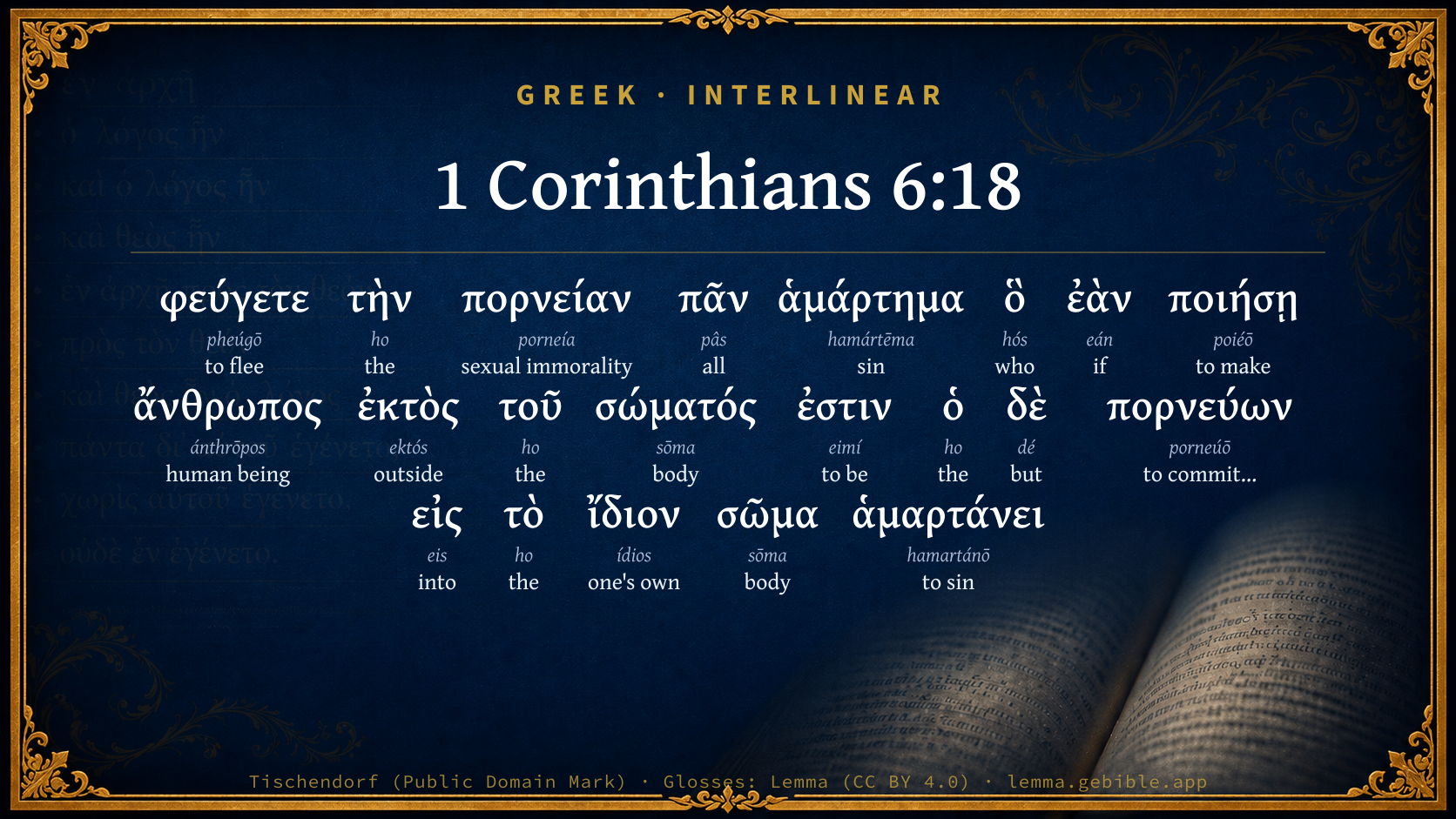
Download image
Cite this verse

1 Corinthians 6:18 (World English Bible). Public Domain. Lemma interlinear Bible study tool, https://lemma.gebible.app/v/1-corinthians/6/18.

Show BibTeX & RIS
BibTeX
RIS
English Translation
Flee sexual immorality! "Every sin that a man does is outside the body," but he who commits sexual immorality sins against his own body.
World English Bible · Public Domain
Highlights
  • 1 first appearance in the Greek New Testament
Full analysis ↓
Download a study sheet

One document with this verse’s original text, its word-by-word gloss line, the meaning frame, cross-references with their text, attributed commentary, and full source and license credits — printable, and it pastes into notes with its structure intact.

This verse Autodidact and up

Study sheet (.html) Plain text (.txt)

A passage Seminary Student

Up to 50 verses in one chapter. A passage sheet keeps up to 6 commentary sources and 12 cross-references per verse, in the order this page ranks them, and says so on the sheet whenever that leaves anything out. Ask for a single verse and you get the Autodidact verse sheet above.

Everything on this page stays free to read, with no account — the sheet is a download of what is already on screen, not access to it.

Want to remove ads? Support Godless Engineer
Compare translations 3

The same verse in 3 English versions, stacked beneath the original-language interlinear above. Click any original word for its lexicon entry.

Each is an independent rendering of the whole verse — the interlinear is not word-aligned to these translations.

Highlighted words mark where these versions differ — a whole-verse word diff, not a word-by-word alignment.

  • World English Bible Public Domain
    Flee sexual immorality! "Every sin that a man does is outside the body," but he who commits sexual immorality sins against his own body.
  • King James Version Public Domain
    Flee fornication. Every sin that a man doeth is without the body; but he that committeth fornication sinneth against his own body.
  • unfoldingWord Literal Text CC BY-SA 4.0
    Flee from sexual immorality! Every sin that a man might commit is outside the body, but the one being sexually immoral sins against his own body.

unfoldingWord Literal Text — © unfoldingWord, licensed CC BY-SA 4.0. Word-aligned USFM3 via Door43 (git.door43.org/unfoldingWord/en_ult).

Versions to compare (up to 4)

3 of 4 selected

Show all 19 translations

Every available English version of this verse, each an independent rendering of the whole verse.

  • World English Bible Public Domain
    Flee sexual immorality! "Every sin that a man does is outside the body," but he who commits sexual immorality sins against his own body.
  • Berean Standard Bible Public Domain
    Flee from sexual immorality. Every other sin a man can commit is outside his body, but he who sins sexually sins against his own body.
  • Majority Standard Bible Public Domain
    Flee from sexual immorality. Every other sin a man can commit is outside his body, but he who sins sexually sins against his own body.
  • King James Version Public Domain
    Flee fornication. Every sin that a man doeth is without the body; but he that committeth fornication sinneth against his own body.
  • American Standard Version (1901) Public Domain
    Flee fornication. Every sin that a man doeth is without the body; but he that committeth fornication sinneth against his own body.
  • Revised Version (1885) Public Domain
    Flee fornication. Every sin that a man doeth is without the body; but he that committeth fornication sinneth against his own body.
  • Geneva Bible (1599) Public Domain
    Flee fornication: euery sinne that a man doeth, is without the bodie: but hee that committeth fornication, sinneth against his owne bodie.
  • Douay-Rheims (1899) Public Domain
    Fly fornication. Every sin that a man doth, is without the body; but he that committeth fornication, sinneth against his own body.
  • Young's Literal Translation Public Domain
    flee the whoredom; every sin -- whatever a man may commit -- is without the body, and he who is committing whoredom, against his own body doth sin.
  • Literal Standard Version CC BY-SA 4.0
    flee the whoredom; every sin—whatever a man may commit—is outside the body, and he who is committing whoredom sins against his own body.
  • Unlocked Literal Bible CC BY-SA 4.0
    Run away from sexual immorality! Every other sin that a person commits is outside the body, but the sexually immoral person sins against his own body.
  • unfoldingWord Literal Text CC BY-SA 4.0
    Flee from sexual immorality! Every sin that a man might commit is outside the body, but the one being sexually immoral sins against his own body.
  • Darby Bible Public Domain
    Flee fornication. Every sin which a man may practise is without the body, but he that commits fornication sins against his own body.
  • World Messianic Bible Public Domain
    Flee sexual immorality! “Every sin that a man does is outside the body,” but he who commits sexual immorality sins against his own body.
  • Webster's Bible Public Domain
    Flee lewdness. Every sin that a man doeth, is without the body; but he that committeth lewdness, sinneth against his own body.
  • Free Bible Version CC BY-SA 4.0
    Stay away from sexual immorality! All other sins that people commit are outside of the body, but sexual immorality is a sin against your own body.
  • Bible in Basic English Public Domain
    Keep away from the desires of the flesh. Every sin which a man does is outside of the body; but he who goes after the desires of the flesh does evil to his body.
  • Text-Critical English NT CC BY 4.0
    Flee fornication. Every other sin that a person commits is outside the body, but he who commits fornication sins against his own body.
  • Tyndale New Testament (1534) Public Domain
    Fle fornicacion. All synnes that a man dothe are with out the body. But he that is a fornicator synneth agaynst his awne body.

Literal Standard Version (2020), Covenant Press — licensed CC BY-SA 4.0. Text via the HelloAO Bible API (eBible.org). Unlocked Literal Bible (unfoldingWord) — licensed CC BY-SA 4.0. Text via the HelloAO Bible API (eBible.org). unfoldingWord Literal Text — © unfoldingWord, licensed CC BY-SA 4.0. Word-aligned USFM3 via Door43 (git.door43.org/unfoldingWord/en_ult). Free Bible Version, Dr. Jonathan Gallagher — licensed CC BY-SA 4.0. Text via the HelloAO Bible API (eBible.org).

Word by word

More ways to search: Search by grammar → Find every occurrence → Compare this word →

Practice this passage: Drill this verse → Learn its vocabulary →

ἁμάρτημα
hamártēma
G265
“sin”
Noun, Nominative, Singular, Neuter
Part of Speech
Noun
Case
Nominative
Number
Singular
Gender
Neuter
Full Thayer's Definition

Origin: from G264

TDNT: 05:27,4

1. sin, evil deed
  1. φεύγετε pheúgō G5343 “to flee” Verb, Present, Active, Imperative, 2nd person, Plural
  2. τὴν ho G3588 “the” Article, Accusative, Singular, Feminine
  3. πορνείαν porneía G4202 “sexual immorality” Noun, Accusative, Singular, Feminine
  4. πᾶν pâs G3956 “all” Adjective, Nominative, Singular, Neuter
  5. ὃ hós G3739 “who” Relative pronoun, Accusative, Singular, Neuter
  6. ἐὰν eán G1437 “if” Conditional
  7. ποιήσῃ poiéō G4160 “to make” Verb, Aorist, Active, Subjunctive, 3rd person, Singular
  8. ἄνθρωπος ánthrōpos G444 “human being” Noun, Nominative, Singular, Masculine
  9. ἐκτὸς ektós G1622 “outside” Adverb
  10. τοῦ ho G3588 “the” Article, Genitive, Singular, Neuter
  11. σώματός sōma G4983 “body” Noun, Genitive, Singular, Neuter
  12. ἐστιν eimí G1510 “to be” Verb, Present, Active, Indicative, 3rd person, Singular
  13. ὁ ho G3588 “the” Article, Nominative, Singular, Masculine
  14. δὲ dé G1161 “but” Conjunction
  15. πορνεύων porneúō G4203 “to commit immorality” Verb, Present, Active, Participle, Nominative, Singular, Masculine
  16. εἰς eis G1519 “into” Preposition
  17. τὸ ho G3588 “the” Article, Accusative, Singular, Neuter
  18. ἴδιον ídios G2398 “one's own” Adjective, Accusative, Singular, Neuter
  19. σῶμα sōma G4983 “body” Noun, Accusative, Singular, Neuter
  20. ἁμαρτάνει hamartánō G264 “to sin” Verb, Present, Active, Indicative, 3rd person, Singular

About this verse

These counts appear in no published source. They are computed here, from the morphology-tagged text and Lemma’s own curated glosses. What Lemma adds →

21
words
17
distinct lemmas
Pauline Epistles
section

Notable vocabulary

The rarest word here is ἁμάρτημα sin G265 — appearing just 5 times in the whole Greek New Testament.

First appearance in Scripture

This word makes its first canonical appearance in the Greek New Testament here:

  • πορνεύων to commit immorality G4203

Shared distinctive vocabulary

ἁμάρτημα sin G265 occurs in 5 verses of the Greek New Testament. Also found in:
Repetition

Words recur within this verse:

  • σώματός body G4983 ×2
  • τὴν the G3588 ×4

Cross-references

17

Topical passages linked to 1 Corinthians 6:18 in the Treasury of Scripture Knowledge — connected by theme and wording, ordered by reader-vote popularity; previews shown in the World English Bible.

  • 1 Peter 2:11 Beloved, I beg you as foreigners and pilgrims, to abstain from fleshly lusts, which war against the soul;
  • 1 Thessalonians 4:3 For this is the will of God: your sanctification, that you abstain from sexual immorality,
  • Colossians 3:5 Put to death therefore your members which are on the earth: sexual immorality, uncleanness, depraved passion, evil desire, and covetousness, which is idolatry;
  • Romans 6:12–13 Therefore don't let sin reign in your mortal body, that you should obey it in its lusts.
  • 2 Timothy 2:22 Flee from youthful lusts; but pursue righteousness, faith, love, and peace with those who call on the Lord out of a pure heart.
  • Hebrews 13:4 Let marriage be held in honor among all, and let the bed be undefiled: but God will judge the sexually immoral and adulterers.
  • 1 Corinthians 6:9 Or don't you know that the unrighteous will not inherit the Kingdom of God? Don't be deceived. Neither the sexually immoral, nor idolaters, nor adulterers, nor male prostitutes, nor homosexuals,
  • Ephesians 5:3 But sexual immorality, and all uncleanness, or covetousness, let it not even be mentioned among you, as becomes saints;
  • Proverbs 6:24–32 To keep you from the immoral woman, From the flattery of the wayward wife's tongue.
  • 1 Thessalonians 4:5 not in the passion of lust, even as the Gentiles who don't know God;
  • 2 Corinthians 12:21 that again when I come my God would humble me before you, and I would mourn for many of those who have sinned before now, and not repented of the uncleanness and sexual immorality and lustfulness which they committed.
  • Proverbs 5:3–15 For the lips of an adulteress drip honey. Her mouth is smoother than oil,
  • Genesis 39:12–18 She caught him by his garment, saying, "Lie with me!" He left his garment in her hand, and ran outside.
  • Proverbs 2:16–19 To deliver you from the strange woman, Even from the foreigner who flatters with her words;
  • Proverbs 7:5–27 That they may keep you from the strange woman, From the foreigner who flatters with her words.
  • Proverbs 9:16–18 "Whoever is simple, let him turn in here." As for him who is void of understanding, she says to him,
  • Romans 1:24 Therefore God also gave them up in the lusts of their hearts to uncleanness, that their bodies should be dishonored among themselves,

Cross-references courtesy of OpenBible.info (CC BY 4.0).

Commentary

Notes on 1 Corinthians 6:18 from classic Christian and Jewish commentators (each source and its license shown beneath its notes). The classic Christian expositions comment on the surrounding passage and are grouped to its opening verse, so a note may address several verses; the Jewish commentaries on the Tanakh (Rashi and others) are per-verse, so they appear only where the commentator wrote on this verse.

Lemma curates 59 commentaries, every one of them public domain or Creative Commons licensed, each selected and text-cleaned for this edition rather than reprinted as found. About our sources →

Tyndale Open Study Notes

Tyndale Open Resources

6:18-20 For Christians, the body is the temple of the Holy Spirit (see study note on 3:16-17; cp. 2 Cor 6:16). Sexual sin violates this sacred sanctuary and the divine presence. • You do not belong to yourself: Christians can no longer claim their bodies as their own, as they have been bought . . . with a high price, the blood of Christ (cp. 1 Cor 7:23; Rev 5:9), and every part of their lives has been claimed by Christ for God’s glory (see Rom 14:7-9; 2 Cor 5:14-15).

Tyndale Open Study Notes — © Tyndale Open Resources, licensed CC BY-SA 4.0. Text via the HelloAO Bible API.

Bengel's Gnomon

Johann Albrecht Bengel

1Co 6:18. Φεύγετε τὴν πορνείαν, flee fornication) Severity with disgust; flee, for danger is near.—πᾶν ἁμάρτημα, every sin) even gluttony and drunkenness; comp. 1Co 5:13; even self-murder [even idolatry, however much more grievous the sin may otherwise be.—V. g.] It is a more serious matter to abuse the members of Christ, than food or wine, and the belly: and the body of a fornicator is more debased by the agency of a flagitious deed, than the carcase even of the man who has perished by his own hand. The comparison at Pro 6:30, etc., is not unlike this.—ἐκτὸς, without) a man indeed sins with the body and by the body, but not εἰς against the body; the sin is not terminated in his body; and he certainly injures, but does not alienate the body, he rather sins against the κοιλίαν, belly, than against the body, as the apostle makes the distinction. Such moral sentiments are not to be harshly pushed to extremes, nor in their utmost ἀκρίβειᾳ, strictness. The viscera, which stand in a peculiar relation to the animal economy, seem likely to be destroyed permanently, and not to be restored at the resurrection. The Scripture refers much to the bones, as to the solid parts, in respect of good and evil, of punishment and reward; whence it is no vain conjecture, that the most intense pain, and so also the most intense degree of joy and pleasure, will be in the bones.

Bengel's Gnomon of the New Testament — English translation (T&T Clark, Edinburgh, 1860) — public domain. Text from a community e-Sword module.

Meyer's Critical & Exegetical Commentary

Heinrich August Wilhelm Meyer

1Co_6:18. Φεύγετε τὴν πορν.] Inferred from the foregoing verses (1317), but expressed in all the more lively way from not being linked to them by any connective particle. Severitas cum fastidio, Bengel.

πᾶν ἁμάρτημα κ.τ.λ[997]] asyndetic corroboration of the preceding prohibition. Paul does not say anything here incapable of being maintained in its full stringency of meaning (Rückert, de Wette), nor is there any reason for taking πᾶν, with Michaelis, Flatt, Pott, and others, in a popular sense, as equivalent to almost all (comp Theodore of Mopsuestia and Melanchthon: cum quodam candore accipiatur de iis, quae saepius accidunt); but the truth of his words is based on the fact that every other sinful act (ἁμάρτημα), if it has to do at all with the body, works upon it from without, and consequently holds a position in reference to the body external to the same. The sinner makes that which is not of the body, but outside of it, as e.g. food and drink, to be the instrument of his immoral act, whereby the ἁμάρτημα, viewed in its relation to the body, comes to stand ἘΚΤῸς ΤΟῦ ΣΏΜΑΤΟς, and has there the sphere of its occurrence and consummation. This holds true even in the case of the suicide, whose act is in fact a sinful use of external things, the instance of a mans voluntarily starving himself not excepted (against Hofmanns objection), for this is accomplished by the abuse of abstinence from food (which is equally an external relationship), and therefore ἘΚΤῸς ΤΟῦ ΣΏΜΑΤΟς. How entirely different from the case of all such other sinful acts stands the state of things with unchasteness, where there is sin, not ἘΚΤῸς Τ. ΣΏΜΑΤΟς, but ΕἸς ΤῸ ἼΔΙΟΝ ΣῶΜΑ! See below. In connection with this passage, expositors indulge in many arbitrary and sometimes very odd interpretations[999] and saving clauses. Among these must be reckoned the exposition of Calvin and others, by way of comparison: secundum plus et minus. Neander, too, imports a meaning which is not in the words, that fornication desecrates the body in its very highest and most enduring significance (namely, as the sum of the personality). According to Chr. F. Fritzsche (Nova Opusc. p. 249 f.), what is meant is that all other sins do not separate the body of the Christian from the body of Christ, this taking place only through fornication (1Co_6:15). But the general and local expression ἐκτὸς τ. σώματός ἐστιν does not correspond with this special and ethical reference, nor are we warranted in attributing to one of such ethical strictness as the apostle the conception that no other sin separates from the body of Christ, 1Co_6:9 f.; Rom_8:9, al[1000]

Ὃ ἘᾺΝ Κ.Τ.Λ[1001]] which in any case whatever (Hermann, a[1002] Viger. p. 819) a man shall have committed. Respecting ἐάν, instead of ἄν, after relatives, see Winer, p. 291 [E. T. 390].

ἐκτὸς τ. σώμ. ἐστιν] inasmuch as the sinful deed done has been one brought about outside of the body.

εἰς τὸ ἴδιον σῶμα] For his own bodily frame is the immediate object which he affects in a sinful way, whose moral purity and honour he hurts and wounds by his action. Comp on εἰς, Luk_15:18. He dishonours his own body, which is the organ and object of his sin. Comp Beza. The apostle says nothing at all here of the weakening effect upon the body itself (Athanasius in Oecumenius, and others).

[997] .τ.λ. καὶ τὰ λοιπά.

[999] Chrysostom, Theophylact, Erasmus, al., single out as the characteristic pointcontrary to the literal tenor of the passagethe defilement of the whole body by fornication, on which ground a bath is taken subsequently. This latter point Theodoret also lays stress upon, explaining, however, the expression by the fact that the man who commits other sins οὐ τοσαύτην αἴσθησιν λαμβάνει τῆς ἁμαρτίας, while the profligate, on the other hand, εὐθὺς μετὰ τὴν ἁμαρτίαν αἰσθάνεται τοῦ κακοῦ καὶ αὐτὸ τὸ σῶμα βδελύττεται. Chrysostoms interpretation of the whole body has been taken up again by Baur (in the theol. Jahrb. 1852, p. 540 f.). The body in its totality, he holds, is meant, inasmuch as it is one body with the harlot, and in virtue of this unity the fornicator has the object of his sin not without himself, but in himself, and sins against the body identified with his own self. But all this is not in the text, and no reader could read it into the text. Hofmann, too, imports what is neither expressed in the words themselves nor suggested by the antithesis,the obscure notion, namely, that, as in the case of the glutton, after completing the deed the thing of his sin does not remain with him (?)

[1000] l. and others; and other passages; and other editions.

[1001] .τ.λ. καὶ τὰ λοιπά.

[1002] d refers to the note of the commentator or editor named on the particular passage.

1Co_6:18-20. Direct prohibition of fornication, strengthened by description of it as a sin against ones own body, which is in fact the temple of the Holy Spirit, etc.

Meyer — Critical and Exegetical Commentary on the New Testament — English translation by Peter Christie, edited by Frederick Crombie (T&T Clark, 1880) — public domain. Text from a community e-Sword module.

Expositor's Greek Testament

ed. W. Robertson Nicoll

1Co 6:18 . With vehement abruptness P. turns from exposition to exhortation. “ Flee fornication” other sins may be combated; this must be fled , as by Joseph in Potiphar’s house. φεύγετε the opposite of κολλᾶσθαι (1Co 6:16 ). The parl [987] φεύγετε ἀπὸ τ . εἰδωλολατρείας of 1Co 10:14 shows “the connexion in Cor [988] between impurity and idolatry” (Ed [989] : cf. the lists of sins in 1Co 6:9 and 1Co 5:11 .) Ἡ πορνεία contradicts Christ’s rights in the body (1Co 6:13-17 ) and severs the committer from Him; P. has now to say that this is a sin against the nature of the human body: “Every act of sin ( ἁμάρτημα ) which a man may possibly do, is outside of the body; but the fornicator ( ὁ πορνεύων ) sins against his own body”. The point of this saying lies in the contrasted prepositions ἐκτὸς and εἰς : all bodily sins “defile the flesh” (2Co 7:1 ), but other vices those of the κοιλία , e.g. look outside the body; this in its whole essence lies within our physical nature, so that, while it appropriates the person of another (1Co 6:16 ), it is a self-violation . Hence transgressions of the Seventh Commandment are “sins of the flesh” and “of the passions” par éminence . They engage and debauch the whole person; they “enter into the heart,” for “they proceed out of the heart” and touch the springs of being; in the highest degree they “defile the man” (Mar 7:20 ff.). That inchastity is extreme dishonour is realised in the one sex; Christianity makes it equally so in the other.

[987] parallel.

[988] Corinth, Corinthian or Corinthians.

[989] T. C. Edwards’ Commentary on the First Ep. to the Corinthians . 2

The Expositor's Greek Testament, edited by W. Robertson Nicoll (1897–1910) — public domain. Text from a community e-Sword module.

Hodge's Commentary on Romans, Ephesians & First Corinthians

Charles Hodge

1Co_6:18

Flee fornication. Every sin that a man doeth, is without the body; but he that committeth fornication, sinneth against his own body.

This does not teach that fornication is greater than any other sin; but it does teach that it is altogether peculiar in its effects upon the body; not so much in its physical as in its moral and spiritual effects. The idea runs through the Bible that there is something mysterious in the commerce of the sexes, and in the effects which flow from it. Every other sin, however degrading and ruinous to the health, even drunkenness, is external to the body, that is, external to its life. But fornication, involving as it does a community of life, is a sin against the body itself, because incompatible, as the Apostle had just taught, with the design of its creation, and with its immortal destiny.

Charles Hodge — Commentary on Romans (1835), First Corinthians (1857), and Ephesians (1856) — public domain. Text from a community e-Sword module.

Geneva Bible (1599)

Geneva Bible translators

Another argument why fornication is to be eschewed, because it defileth the body with a peculiar kind of filthiness.

Geneva Bible (1599) marginal notes — public domain. Text via Bolls.life.

Jamieson, Fausset & Brown

Robert Jamieson, A. R. Fausset & David Brown

Flee--The only safety in such temptations is flight (Gen 39:12; Job 31:1).

Every sin--The Greek is forcible. "Every sin whatsoever that a man doeth." Every other sin; even gluttony, drunkenness, and self-murder are "without," that is, comparatively external to the body (Mar 7:18; compare Pro 6:30-32). He certainly injures, but he does not alienate the body itself; the sin is not terminated in the body; he rather sins against the perishing accidents of the body (as the "belly," and the body's present temporary organization), and against the soul than against the body in its permanent essence, designed "for the Lord." "But" the fornicator alienates that body which is the Lord's, and makes it one with a harlot's body, and so "sinneth against his own body," that is, against the verity and nature of his body; not a mere effect on the body from without, but a contradiction of the truth of the body, wrought within itself [ALFORD].

Jamieson, Fausset & Brown — Commentary Critical and Explanatory on the Whole Bible (1871) — public domain (CC PDM 1.0). Text via the HelloAO Bible API.

Adam Clarke's Commentary

Verse 18. Flee fornication.] Abominate, detest, and escape from every kind of uncleanness. Some sins, or solicitations to sin, may be reasoned with; in the above cases, if you parley you are undone; reason not, but FLY!

Sinneth against his own body.] Though sin of every species has a tendency to destroy life, yet none are so mortal as those to which the apostle refers; they strike immediately at the basis of the constitution. By the just judgment of God, all these irregular and sinful connections are married to death. Neither prostitutes, whoremongers, nor unclean persons of any description, can live out half their days. It would be easy to show, and prove also, how the end of these things, even with respect to the body, is death; but I forbear, and shall finish the subject with the words of the prophet: The show of their countenance doth witness against them, and they declare their sin as Sodom, they hide it not; wo unto their soul, for they have rewarded evil unto themselves.

Adam Clarke's Commentary on the Bible (1810–1826) — public domain. Text from a community e-Sword/MySword module.

John Calvin's Commentaries

18. Flee fornication Every sin, etc. Having set before us honorable conduct, he now shows how much we ought to abhor fornication, setting before us the enormity of its wickedness and baseness. Now he shows its greatness by comparison — that this sin alone, of all sins, puts a brand of disgrace upon the body. The body, it is true, is defiled also by theft, and murder, and drunkenness, in accordance with those statements —

Your hands are defiled with blood. (Isaiah 1:15.)

You have yielded your members instruments of iniquity unto sin, (Romans 6:19,)

and the like. Hence some, in order to avoid this inconsistency, understand the words rendered against his own body, as meaning against us, as being connected with Christ; but this appears to me to be more ingenious than solid. Besides, they do not escape even in this way, because that same thing, too, might be affirmed of idolatry equally with fornication. For he who prostrates himself before an idol, sins against connection with Christ. Hence I explain it in this way, that he does not altogether deny that there are other vices, in like manner, by which our body is dishonored and disgraced, but that his meaning is simply this — that defilement does not attach itself to our body from other vices in the same way as it does from fornication My hand, it is true, is defiled by theft or murder, my tongue by evil speaking, or perjury, and the whole body by drunkenness; but fornication leaves a stain impressed upon the body, such as is not impressed upon it from other sins. According to this comparison, or, in other words, in the sense of less and more, other sins are said to be without the body — not, however, as though they do not at all affect the body, viewing each one by itself.

John Calvin's Commentaries (1540-1563) — public domain. Text from the Calvin Translation Society English edition (1840s-50s) via the Christian Classics Ethereal Library (ccel.org). Calvin's coverage is partial (roughly two-thirds of the Bible); uncommented books and verses are honest gaps, never fabricated. The 19th-century editor's footnotes and remarks are omitted so the notes are faithfully Calvin's own voice.

Ellicott's Commentary for English Readers

(18) Flee fornication.—These last three verses of the chapter contain a solemn exhortation to purity, arising out of the previous argument.

Without the body.—The word “body” is still to be understood as used of the whole “human nature,” which is spoken of in 1Co_6:19 as the temple of the Holy Ghost. Other sins may profane only outer courts of the temple; this sin penetrates with its deadly foulness into the very holy of holies—

“It hardens a’ within, and petrifies the feelings.”

There is a deep significance and profound truth in the solemn words of the Litany, “From fornication, and all other deadly sin, good Lord, deliver us.”

A Bible Commentary for English Readers, edited by Charles John Ellicott (1878–1897) — public domain. Text from a community e-Sword module.

The Cambridge Bible for Schools and Colleges

gen. ed. J. J. S. Perowne

18. Every sin that a man doeth is without the body] That is, every other sinful act which affects the body approaches it from without and affects particular members. But this sin takes the body itself as a whole and makes it an instrument of sin. For it is a violation of the fundamental law impressed upon man from the beginning, whereby it is decreed that a man shall cleave to his wife, and to her alone, and they twain shall be, or rather, become one flesh, Gen_2:24. This view is confirmed by the fact that the word here translated sinneth, means “to go astray,” “to miss the mark;” so that the words ‘sinneth against his own body’ imply the running counter to the objects for which the body is created. If this be the correct interpretation of the passage, the practice of polygamy is here condemned.

sinneth against his own body] Cf. Rom_1:24.

The Cambridge Bible for Schools and Colleges (gen. ed. J. J. S. Perowne; Cambridge University Press, 1878–1918) — public domain. Text from a community e-Sword module.

John Gill's Exposition

Flee fornication,.... As that which is hurtful, scandalous, and unbecoming Christians; avoid it, and all the occasions of it, that may lead unto it, and be incentives of it:

every sin that a man doth is without the body not but that other sins are committed by the body, and by the members of it as instruments; they are generally committed by the abuse of other things that are without, and do not belong to the body; and so do not bring that hurt unto and reproach upon the body, as fornication does:

but he that committeth fornication, sinneth against his own body; not meaning his wife, which is as his own body; but his proper natural body, which is not only the instrument by which this sin is committed, but the object against which it is committed; and which is defiled and dishonoured by it; and sometimes its strength and health are impaired, and it is filled with nauseous diseases hereby.

John Gill's Exposition of the Whole Bible (1746–1763) — public domain (CC PDM 1.0). Text via the HelloAO Bible API.

Trapp's Complete Commentary

John Trapp

18 Flee fornication. Every sin that a man doeth is without the body; but he that committeth fornication sinneth against his own body.

Ver. 18. Flee fornication] φευγετε. With post haste flee it.

" Laeta venire Venus, tristis abire solet."

Be not of those men that are called Borboritae of their miry filthiness, whom Epiphanius and Oecumenius speak of.

John Trapp, A Commentary or Exposition upon All the Books of the Old and New Testament (1647–1656) — public domain. Text from a community e-Sword module.

Albert Barnes' Notes on the Bible

Flee fornication - A solemn command of God - as explicit as any that thundered from Mount Sinai. None can disregard it with impunity - none can violate it without being exposed to the awful vengeance of the Almighty. There is force and emphasis in the word “flee” φεύγατε pheugate. Man should escape from it; he should not stay to reason about it; to debate the matter; or even to contend with his propensities, and to try the strength of his virtue. There are some sins which a man can resist; some about which he can reason without danger of pollution. But this is a sin where a man is safe only when he flies; free from pollution only when he refuses to entertain a thought of it; secure when he seeks a victory by flight, and a conquest by retreat. Let a man turn away from it without reflection on it and he is safe. Let him think, and reason, and he may be ruined. “The very passage of an impure thought through the mind leaves pollution behind it.” An argument on the subject often leaves pollution; a description ruins; and even the presentation of motives against it may often fix the mind with dangerous inclination on the crime. There is no way of avoiding the pollution but in the manner prescribed by Paul; there is no man safe who will not follow his direction. How many a young man would be saved from poverty, want, disease, curses, tears, and hell, could these two words be made to blaze before him like the writing before the astonished eyes of Belshazzar Dan. 5, and could they terrify him from even the momentary contemplation of the crime.

Every sin ... - This is to be taken comparatively. Sins in general; the common sins which people commit do not immediately and directly affect the body, or waste its energies, and destroy life. Such is the case with falsehood, theft, malice, dishonesty, pride, ambition, etc. They do not immediately and directly impair the constitution amid waste its energies.

Is without the body - Does not immediately and directly affect the body. The more immediate effect is on the mind; but the sin under consideration produces an immediate and direct effect on the body itself.

Sinneth against his own body - This is the FourTH argument against indulgence in this vice; and it is more striking and forcible. The sense is, “It wastes the bodily energies; produces feebleness, weakness, and disease; it impairs the strength, enervates the man, and shortens life.” Were it proper, this might be proveD to the satisfaction of every man by an examination of the effects of licentious indulgence. Those who wish to see the effects stated may find them in Dr. Rush on the Diseases of the Mind. Perhaps no single sin has done so much to produce the most painful and dreadful diseases, to weaken the constitution, and to shorten life as this. Other vices, as gluttony and drunkenness, do this also, and all sin has some effect in destroying the body, but it is true of this sin in an eminent degree.

Albert Barnes' Notes on the Bible (1834–1885) — public domain. Text from a community e-Sword/MySword module.

Matthew Poole's English Annotations

The apostle cometh to a new argument, by which he presseth them to flee the sin of uncleanness. It is observed by some, that this sin is peculiarly to be resisted, not so much by resisting it, and pondering arguments against it, as by flying from it, avoiding all occasions of it, and not suffering our thoughts to feed upon it; but the apostle’s argument is, because other sins are

without the body, that is, the body hath not such a blemish and note or mark of infamy laid upon it by any other sin as by this: in drunkenness the liquor, in gluttony the meat, in other sins something without a man’s self is that which is abused, but the body itself is the thing which is abused in this filthy sin. So he that is guilty of it,

sinneth not only against his wife, with whom he is one flesh, but against his body, which he abuseth in this vile and sinful act, and upon which he imprints a mark of infamy and disgrace, a blot not to be washed out but with the blood of Christ. So as though by other sins men may sin against their own bodies, yet by no sin so eminently as by this sin. Other sins have their seat in the mind and soul; the body, and commonly some particular member of the body, is but the servant of the soul in the execution and committing of them; but lust, though indeed it ariseth from the heart, yet it is committed more in the body than any other sin is.

Matthew Poole's English Annotations on the Holy Bible (1683–1685) — public domain. Text from a community e-Sword/MySword module.

Whedon's Commentary on the Bible

Daniel D. Whedon

18. The apostle now breaks out in direct address, Flee, O ye Corinthians, your destroying vice, fornication.

Flee—As Joseph fled from the wife of his master; for, as St. Anselm says, “other vices are best conquered by fighting, this by running away.”

Without the body—Extra of the body. That is, every sin is really committed by the soul, through the will, and the body is only the instrument.

Against—Rather, into. Fornication differs not from other sins touching its being committed by the soul; but pre-eminently of all it pours the sin into and throughout the body. And this striking of this sin through the whole body consists not merely in its withering, and wasting, and destroying power upon the body, but in something deeper, more awful, and more truly eternal. As the whole being is satanically unified with the harlot, so the whole body becomes, in its uncleanness, the perfect opposite of the pure person of Jesus the pure. How awfully incapable, then, of coming into mystic oneness with him. And from these views it would seem to follow that lawless love is really more truly opposite to Christ than even lawless hate. Our Corinthians may now infer how detestable is that religion with which their city so abounded, and of which debauchery was one of the consecrated rites.

Daniel D. Whedon (gen. ed.), Commentary on the Old and New Testaments (1874–1909) — public domain. Text from a community e-Sword module.

The Pulpit Commentary

Flee fornication. In the battle against sensual sins, there is no victory except in absolute flight, for the reason which immediately follows, namely, that these sins have their dwelling in that body which is part of our being, and which yet they tend to destroy. They make a man his own deadliest enemy. Every sin... is without the body. Some have supposed that this cannot apply to gluttony and drunkenness, which they therefore class with fornication; but even in those sins, as in suicide, the cause of and incentive to the sin is external, whereas the source of uncleanness is in the heart and in the thoughts, which come from within, and so defile the man. Other sins may be with and by means of the body, and may injure the body; but none are so directly against the sanctity of the whole bodily being as fornication. Sinneth against his own body. By alienating it from the service of him to whom it belongs; by incorporating it with the degradation of another; by staining the flesh and the body; (Pro_5:8-11 Pro_6:24-32 Pro_7:24-27) by subtly poisoning the inmost sanctities of his own being. St. Paul is here thinking mainly, however, if not exclusively, of the moral injury and defilement.

The Pulpit Commentary (1880–1919), ed. H.D.M. Spence-Jones & Joseph S. Exell — public domain. Text from a community e-Sword module.

John Wesley's Explanatory Notes

Flee fornication - All unlawful commerce with women, with speed, with abhorrence, with all your might. Every sin that a man commits against his neighbour terminates upon an object out of himself, and does not so immediately pollute his body, though it does his soul. But he that committeth fornication, sinneth against his own body - Pollutes, dishonours, and degrades it to a level with brute beasts.

John Wesley, Explanatory Notes Upon the Whole Bible (1754–1765) — public domain. Text via the GEBible commentary corpus.

Burkitt's Expository Notes on the New Testament

William Burkitt

Flee fornication.

Note, 1. The apostle’s advice to escape fornication; and that is, to flee it, namely, by shunning all occasions of it, all temptations leading to it, all incentives and provocations of it, not suffering our eye to wander, or our thoughts to muse, much less to dwell, upon any unlawful or ensnaring object.

Flee fornication.

Note, 2. The argument our apostle uses to flee fornication; because other sins are without the body.

Quest. But how is the apostle to be understood when he says, all other sins are without the body?

Ans. Thus, though all other outward sins, as drunkenness, murder, theft, &c. have the body as an instrument for committing them; yet in this sin of uncleanness the body is not only the instrument, but the object also, for the unclean person doth not only sin with his body, but he sins against his body.

Uncleanness leaves that blot and brand of ignominy and baseness upon the body which no other sin doth: degrading it from that excellent honour whereunto God advanced it in its natural condition, by making it the member of an harlot.

William Burkitt's Expository Notes on the New Testament (1700–1703) — public domain. Text from a community e-Sword module.

Godbey's Commentary on the New Testament

William B. Godbey

18. “Every sin which a man may do is without the body: and he that committeth fornication sinneth against his own body.” Here the apostle forever sweeps away that Gnostic heresy, recognizing sin resident in the body after the soul is made pure; involving that awful and fatal heresy that your body must commit sin so long as it lives. Of course it is the very doctrine of the bottomless pit, concocted by Satan for the damnation of souls, because every one acquiescent in this transparent sophistry is actually committing sin and hastening to his own damnation, vainly gulled by the silly delusion that he will leave his sins in his body when he dies. Here we have the case settled forever that the sin is not in the body, except in the sense that the soul lives in the body, but all sin is really spiritual and immaterial, the work of the devil, who has no body, and homogenous with his nature. Consequently it is utterly impossible for sin to be materialistic, however it may involve material entities. While the body is as incapable of committing sin as the tree by the roadside, it is frequently instrumental in the commission of sin; and, as a rule, instead of committing the sin, it only suffers thereby, as Paul here specifies, “He that committeth fornication, sinneth against his own body.” So here you see even in case of fornication the body does not commit the sin, but on the contrary is sinned against.

William B. Godbey, Commentary on the New Testament (1896–1900) — public domain. Text from a community e-Sword module.

McGarvey & Pendleton's Commentaries

J. W. McGarvey

Flee fornication . [As Joseph did-- Gen_39:12 ] Every sin that a man doeth is without the body; but he that committeth fornication sinneth against his own body . [Paul notes the mutual adaptation or correlation between the belly and food, but asserts that this correlation is transient, and will be demolished by death. A subservient correlation also exists between husband and wife, for they twain become one flesh, and the innocency of their union does not interfere with the relation of either to God, which is the body's supreme correlation. But there is no lawful correlation between the body of the Christian and that of the harlot, and such a correlation can not be subservient to the body's supreme correlation, but is repugnant to it. The correlation between the stomach and food is transient, ending at death; but that between the body and the Lord is made eternal by the resurrection. Now, other sins, even drunkenness and gluttony, are sins without the body; i. e., sins against those parts of the body that shall not inhere to it in the future state ( Rev_7:16 ), and hence do not strike directly at that future state; but fornication joins the whole body in sinful union to a body of death, so that it becomes one flesh with the condemned harlot, thereby wholly severing itself from the mystical body of life in Christ, and thus it does strike directly at the body's future state.]

J. W. McGarvey (with Philip Y. Pendleton), Commentaries on the New Testament (The Fourfold Gospel, 1914; Acts; and the epistles) — public domain. Text from a community e-Sword/MySword module.

The People's New Testament

B. W. Johnson

18–20. Flee fornication. The sin must be fled. The way to avoid it is to avoid temptation. We must conquer by running away. Thus it was that Joseph prevailed. Every sin … is without the body. The temptations come from without and assail the man through the senses. This is the rule in the case of sin. It is not said of fornication that it is not stimulated without, or that it, alone of sins, assails the body, but that it is peculiarly a sin against the body. It defiles a body which is designed to be a member of Christ, and a temple of the Holy Spirit; separates it from the union with Christ, and unites it with a harlot. The grievousness of the sin is in the desecration to such an unholy purpose of a body which has become a member of Christ, a part of the temple of God.

B. W. Johnson's The People's New Testament with Notes (1889–1891) — public domain. Electronic text from the Christian Classics Ethereal Library (CCEL) ThML edition.

unfoldingWord translationNotes

Door43 World Missions Community

Run away from

Paul speaks of a person rejecting sexual sin as if that person were running away from danger. AT: "Get away from" (See: Metaphor)

immorality! Every other sin that a person commits is outside the body, but

Possible meanings are 1) Paul is showing that sexual sin is especially bad because it is not only against others but against the sinner's own body or 2) Paul is quoting what some Corinthians were thinking. AT: "immorality! Some of you are saying, 'Every sin that a person commits is outside the body,' but I say that" (See: Assumed Knowledge and Implicit Information)

sin that a person commits

"evil deed that a person does"

translationWords

run

sexual immorality

sin

body

unfoldingWord translationNotes — © Distant Shores Media and the Door43 World Missions Community, licensed CC BY-SA 4.0. Source: git.door43.org/Door43/en_tn.

Cambridge Greek Testament for Schools and Colleges

18. πᾶν ἁμάρτημα. This word signifies some particular error, ἁμαρτία the general tendency to error. See Arist. Nic. Eth. 1Co 6:8, VI. 8. It is remarkable that ἁμάρτημα is common in classical, rare in Biblical Greek. Precisely the reverse is the case with ἁμαρτία. And this because both the Law and the Gospel recognized sin as a principle. See 1Jn 3:4; 1Jn 5:17.

ἐκτὸς τοῦ σώματος. That is, every other sinful act which affects the body approaches it from without or affects particular members. But this sin takes the body itself as a whole and makes it an instrument of sin.

εἰς τὸ ἴδιον σῶμα ἁμαρτάνει. The precise meaning of ἁμαρτάνω is to miss the mark. Thus what is meant here is that one guilty of this sin runs counter to the fundamental laws impressed on the human body from the first. The sexes were created simply and solely with a view to the Divine institution of the family. The mutual affection of parents is absolutely necessary to the welfare of the family, and this, again, can only be secured by the exclusive and permanent character of the marriage relation. See Gen 2:24. The formation, therefore, of any physical ties between the sexes, short of this exclusive and permanent one, is a violation of the first principles of human society. The Divine anger is therefore plainly manifested against those who do such things. See Rom 1:24; Rom 1:27-32. In particular, history shews abundantly that no sin has such power as licentiousness to dissolve the very framework of society, by loosening the bonds of mutual confidence and mutual respect on which that framework reposes.

Cambridge Greek Testament for Schools and Colleges (Cambridge University Press, 1896; 21 vols, various authors incl. Carr, Maclear, Plummer, Farrar, Lumby, Moule, M. R. James, Simcox) — public domain. Text from a community e-Sword module.

Alford’s Greek Testament

Henry Alford

18-20.] Direct prohibition of fornication, and its grounds.

18.] φεύγετε might be followed by οὖν, but is more forcible in this disconnected form.

πᾶν ἁμάρτ.] The assertion, which has surprised many of the Commentators, is nevertheless strictly true. Drunkenness and gluttony, e.g. are sins done in and by the body, and are sins by abuse of the body,—but they are still ἐκτὸς τοῦ σώματος—introduced from without, sinful not in their act, but in their effect, which effect it is each man’s duty to foresee and avoid. But fornication is the alienating that body which is the Lord’s, and making it a harlot’s body—it is sin against a man’s own body, in its very nature,—against the verity and nature of his body; not an effect on the body from participation of things without, but a contradiction of the truth of the body, wrought within itself. When man and wife are one in the Lord,—united by His ordinance,—no such alienation of the body takes place, and consequently no sin.

Henry Alford, The Greek Testament (1849–1861) — public domain. Text from a community e-Sword module.

International Critical Commentary

18. φεύγετε τὴν πορνείαν. ‘Do not stop to dispute about it: make a practice (pres. imperat.) of flying at once.’ So also of idolatry, which was so closely allied with impurity, 10:14. The asyndeton marks the urgency. Cf. 1Th 4:3.

πᾶν ἁμάτημα κ.τ.λ. The difficulty of this passage lies in the distinction drawn between ἐκτὸς τ. σώματος, the predicate of ‘every sin that a man doeth,’ and εἰς τ. ἴδιον σῶμα, as marking the distinctive sin of the fornicator. Commentators differ greatly as to the explanation of ἐκτὸς τ. σώματος, which is the specially difficult expression. But the general meaning of vv. 13b-18 is plain. The body has an eternal destiny, τὸ σῶμα τῷ Κυρίῳ. Fornication takes the body away from the Lord and robs it of its glorious future, of which the presence of the Spirit is the present guarantee (cf. Rom 8:9-11). In v. 18 we have the sharply cut practical issue, ‘Flee fornication.’ Clearly the words that follow are meant to strengthen the severitas cum fastidio of the abrupt imperative: they are not an anti-climax. Any exegesis which fails to satisfy this elementary requirement may be set aside; and for this reason the explanations of Evans, Meyer, and Heinrici may be passed over.

It is obvious that ἐκτός and εἰς are related as opposites. The meaning of either will help to determine the meaning of the other; and the meaning of εἰς τ. ἴδιον σῶμα ἁμαρτάνει is fairly certain. For ἁμαρτάνειν εἰς, by the common usage of secular and Biblical Greek, means ‘to sin against.’ It cannot mean ‘sin in,’ or ‘sin by means of,’ or ‘involve in sin.’ What then does ‘to sin against one’s own body’ mean? The axiom, τὸ σῶμα τῷ Κυρίῳ, καὶ ὁ Κύριος τῷ σώματι, answers this question. To sin against one’s own body is to defraud it of its part in Christ, to cut it off from its eternal destiny. This is what fornication does in a unique degree.* While fornication is εἰς τὸ ἴδον ς., other sins are ἐκτὸς τοῦ ς. The one phrase is the opposite of the other. What St Paul asserts of fornication he denies of every other sin.

In what sense does he deny of all other sins that they are sins against a man’s own body? If pressed and made absolute, the denial becomes a paradox. He has just told us (vv. 9, 10) thatthere are many sins which exclude their doer from the Kingdom, and which therefore deprive the body of its future life in Christ. Obviously, he is here speaking relatively, and by way of comparison. All other sins are ἐκτὸς τοῦ ς., in the sense that they do not, as directly as fornication does, alienate the body from Christ, its Life and its Goal.

This explanation gains in clearness if we compare the words of our Lord (Mat 12:31), πᾶσα ἁμαρτία καὶ βλασφημία ἀφεθή σεται τοῖς ἀνθρώποις· ἡ δὲ τοῦ Πνεύματος βλασφημία οὐκ ἀφεθήσεται, κ.τ.λ. There too the language may be comparative. We know abundantly from Scripture that there is forgiveness for every sin, if rightly sought. In the first clause the Saviour does not proclaim an absolute indiscriminate amnesty for every other sin any sin, unrepented and unabsolved, is an αἰώνιον ἀμάρτημα (Mar 3:29). Neither clause is to be pressed beyond its purpose to an absolute sense. But sin against the Spirit is so incomparably less pardonable than any other, that, by comparison with it, they may be regarded as venial. He who sins against the Spirit is erecting a barrier, insuperable to a unique degree, against his own forgiveness. In like manner, the words ἐκτὸς τοῦ ς. ἐστι are not absolutely nor unconditionally predicated of ‘every sin which a man doeth’:* they merely assert that other sins “stop short of the baleful import of sensual sin” with its direct onslaught on the dominant principle, τὸ σῶμα τῷ Κυρίῳ Cf. Hos 6:6, ‘I will have mercy, and not sacrifice,’ which does not mean that sacrifice is forbidden, but that mercy is greatly superior. Luk 10:20, Luk 10:14:12, Luk 10:13, Luk 10:23:28 are similar. Cf. 9:10, 10:24, 33.

International Critical Commentary — older volumes (1896–1929), various authors — public domain. Text from a community e-Sword module.

Vincent's Word Studies in the New Testament

Marvin R. Vincent

Flee. See Gen 39:12. Socrates, in Plato's "Republic," relates how the poet Sophocles, in answer to the question "How does love suit with are?" replied : "Most gladly have I escaped that, and I feel as if I had escaped from a mad and furious master" (329).

Sin [αμαρτημα] . See on Rom 3:25.

Without the body [εκτος του σωματος] . Lit., outside. The body is not the instrument, but the subject. But in fornication the body is the instrument of the sin, and "inwardly as well as outwardly is made over to another."

Marvin R. Vincent, Word Studies in the New Testament (1887–1900) — public domain. Text from a community e-Sword/MySword module.

Godet's Commentaries

Frédéric Louis Godet

Vv. 18. “Flee fornication! Every sin that a man doeth is without his body; but he that committeth fornication sinneth against his body.” — Anselm has well expressed the meaning of the first sentence of the verse: “If we must fight against other sins, we must flee from fornication;” witness Joseph’s example.

The asyndeton betrays the apostle’s emotion.

Thus far (1Co 6:13-17) the thought developed by Paul had been that of the dependence arising from impure intercourse: “I shall not make myself the slave of anything” (1Co 6:12 b). For a man to give to a degraded person a right over him by such a union, is not this to place himself in the most ignoble kind of dependence? From this point Paul passes to the development of the first thought of 1Co 6:12 : “All things are not expedient,” and he shows the injury which the fornicator inflicts on his own body.

He here enunciates a distinction between fornication and other sins, which it is difficult to understand. How are passion, falsehood, intemperance, suicide, sins committed without the body, while fornication is one in the body? Rückert and de Wette acknowledge their inability to find a meaning for this contrast; Calvin and Neander see in it no other idea than that of the greater guiltiness which attaches to the sin of fornication. According to Meyer, Paul means that in other sins some external matter is necessary, while fornication proceeds entirely from within. Hofmann, after criticising those different explanations, gives one which is stranger still, and almost unintelligible: The man who commits any other sin does not keep in his body the matter of his sin (the drunkard, the suicide); while the impure person makes his very body the subject of his sin, and continues in his bodily life identified with the being to which he has given himself.

It seems to me that the contrast stated by Paul is to be explained only from the point of view at which 1Co 6:13 placed us. The apostle means to speak of the body strictly so called, of the body in the body; he contrasts this living and life-giving organism with the external and purely physical organism. We possess a material body, the matter of which is being perpetually renewed; but under this changing body there exists a permanent type, which constitutes its identity. In chap. 1Co 15:50, where Paul is teaching the resurrection of the body, he declares that “flesh and blood cannot inherit the kingdom of God.” He therefore distinguishes between the organism composed of flesh and blood, which forms the outward wrapping of the man, and the body strictly so called, one with the person which animates this wrapping. It is the same distinction as we have found in 1Co 6:13-14 of our chapter. Now it is to this inner body that the sin of the fornicator penetrates; it is by and against this inner organism that he sins, while other sins only reach its wrapping, the external body. The εἰς, in so far as it is contrasted with the prep. ἐκτός, outside of, ought to signify in; but it differs nevertheless from the simple ἐν, in, in that it also denotes the injury which the body receives from it; hence the meaning of against which is added to that of in. Thus we understand the οὐ συμφέρει of 1Co 6:1. Yet bodily injury is not the thing of which Paul is thinking. The sequel shows in what the punishment consists. The body thus profaned had a sublime destiny, and of this it is deprived by the violence done to it.

Frédéric Louis Godet — Commentaries on Luke, John, Romans, and 1 Corinthians — English translation (T&T Clark, Edinburgh, 1870s–1890s) — public domain. Text from a community e-Sword module.

Lesson kit

Teaching starters — assembled from the data on this page, not authored interpretation. Every prompt links to the verse data it draws on. Edit before teaching.

1 Corinthians, in the Pauline Epistles, opens this verse with 21 words (17 distinct Greek lemmas). Its most distinctive word is hamártēma (“sin”). A historical commentator’s framing appears above. Read the whole chapter for the surrounding context.

Discussion questions

  1. How does “sin” (hamártēma) shape what this verse is saying?
  2. The word “to commit immorality” first appears here in Scripture. What is being introduced at this debut?
  3. Mark 3:28 shares the word «sin» with this verse. How do the two illuminate each other?
  4. “body” occurs 2× in this one verse. What is the effect of the repetition?
  5. The translations on this page render this verse differently — a whole-verse word diff, not a word-by-word alignment. What might account for the different wordings?
  6. Reading how Tyndale Open Study Notes and Bengel's Gnomon read this verse, where do the two commentators agree and where do they part?

Things to notice

  • 1 word makes its first canonical appearance in Scripture here.
  • These translations choose different wording for 18 words in this verse.
  • “body” occurs 2× in this single verse.
  • 17 distinct Greek lemmas span 21 words in this verse.

Reading settings

Reading text

Shown beneath each verse's original-language words.

Old Testament
Old Testament edition

Read the OT as the Masoretic Hebrew (MT) or the Greek Septuagint (LXX).

English shown for the Greek Septuagint (in the Hebrew ↔ Greek comparison).

Comparing translations? Open the Compare panel on any verse page to stack up to four side by side.