1 Corinthians 6:17

Greek (Tischendorf 8th ed.) 1 Corinthians 6:17 appears in the Greek New Testament. The text above is from the Tischendorf 8th edition. Each word links to its Strong’s number and a concise gloss. Click any word for its full Thayer’s Greek Lexicon entry.
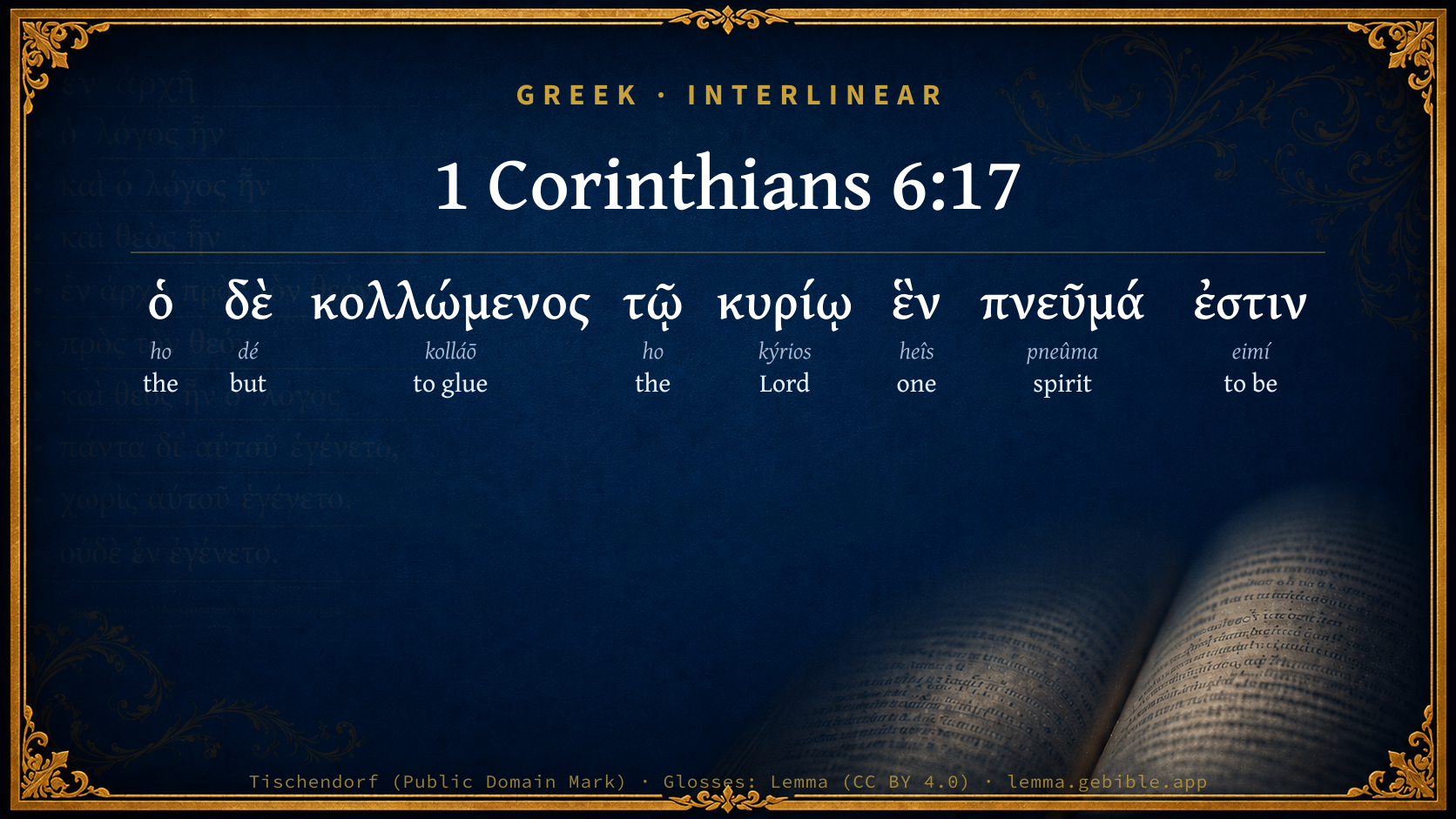
Download image
Cite this verse

1 Corinthians 6:17 (World English Bible). Public Domain. Lemma interlinear Bible study tool, https://lemma.gebible.app/v/1-corinthians/6/17.

Show BibTeX & RIS
BibTeX
RIS
English Translation
But he who is joined to the Lord is one spirit.
World English Bible · Public Domain
Download a study sheet

One document with this verse’s original text, its word-by-word gloss line, the meaning frame, cross-references with their text, attributed commentary, and full source and license credits — printable, and it pastes into notes with its structure intact.

This verse Autodidact and up

Study sheet (.html) Plain text (.txt)

A passage Seminary Student

Up to 50 verses in one chapter. A passage sheet keeps up to 6 commentary sources and 12 cross-references per verse, in the order this page ranks them, and says so on the sheet whenever that leaves anything out. Ask for a single verse and you get the Autodidact verse sheet above.

Everything on this page stays free to read, with no account — the sheet is a download of what is already on screen, not access to it.

Want to remove ads? Support Godless Engineer
Compare translations 3

The same verse in 3 English versions, stacked beneath the original-language interlinear above. Click any original word for its lexicon entry.

Each is an independent rendering of the whole verse — the interlinear is not word-aligned to these translations.

Highlighted words mark where these versions differ — a whole-verse word diff, not a word-by-word alignment.

  • World English Bible Public Domain
    But he who is joined to the Lord is one spirit.
  • King James Version Public Domain
    But he that is joined unto the Lord is one spirit.
  • unfoldingWord Literal Text CC BY-SA 4.0
    But the one being joined to the Lord is one spirit.

unfoldingWord Literal Text — © unfoldingWord, licensed CC BY-SA 4.0. Word-aligned USFM3 via Door43 (git.door43.org/unfoldingWord/en_ult).

Versions to compare (up to 4)

3 of 4 selected

Show all 19 translations

Every available English version of this verse, each an independent rendering of the whole verse.

  • World English Bible Public Domain
    But he who is joined to the Lord is one spirit.
  • Berean Standard Bible Public Domain
    But he who unites himself with the Lord is one with Him in spirit.
  • Majority Standard Bible Public Domain
    But he who unites himself with the Lord is one with Him in spirit.
  • King James Version Public Domain
    But he that is joined unto the Lord is one spirit.
  • American Standard Version (1901) Public Domain
    But he that is joined unto the Lord is one spirit.
  • Revised Version (1885) Public Domain
    But he that is joined unto the Lord is one spirit.
  • Geneva Bible (1599) Public Domain
    But hee that is ioyned vnto the Lord, is one spirite.
  • Douay-Rheims (1899) Public Domain
    But he who is joined to the Lord, is one spirit.
  • Young's Literal Translation Public Domain
    And he who is joined to the Lord is one spirit;
  • Literal Standard Version CC BY-SA 4.0
    And he who is joined to the LORD is one spirit;
  • Unlocked Literal Bible CC BY-SA 4.0
    But he who is joined to the Lord becomes one spirit with him.
  • unfoldingWord Literal Text CC BY-SA 4.0
    But the one being joined to the Lord is one spirit.
  • Darby Bible Public Domain
    But he that [is] joined to the Lord is one Spirit.
  • World Messianic Bible Public Domain
    But he who is joined to the Lord is one spirit.
  • Webster's Bible Public Domain
    But he that is joined to the Lord is one spirit.
  • Free Bible Version CC BY-SA 4.0
    But whoever is joined to the Lord is one with him in spirit!
  • Bible in Basic English Public Domain
    But he who is united to the Lord is one spirit.
  • Text-Critical English NT CC BY 4.0
    But he who is joined to the Lord is one with him in spirit.
  • Tyndale New Testament (1534) Public Domain
    But he that is ioyned vnto the Lorde is one sprete.

Literal Standard Version (2020), Covenant Press — licensed CC BY-SA 4.0. Text via the HelloAO Bible API (eBible.org). Unlocked Literal Bible (unfoldingWord) — licensed CC BY-SA 4.0. Text via the HelloAO Bible API (eBible.org). unfoldingWord Literal Text — © unfoldingWord, licensed CC BY-SA 4.0. Word-aligned USFM3 via Door43 (git.door43.org/unfoldingWord/en_ult). Free Bible Version, Dr. Jonathan Gallagher — licensed CC BY-SA 4.0. Text via the HelloAO Bible API (eBible.org).

Word by word

More ways to search: Search by grammar → Find every occurrence → Compare this word →

Practice this passage: Drill this verse → Learn its vocabulary →

About this verse

These counts appear in no published source. They are computed here, from the morphology-tagged text and Lemma’s own curated glosses. What Lemma adds →

8
words
7
distinct lemmas
Pauline Epistles
section

Notable vocabulary

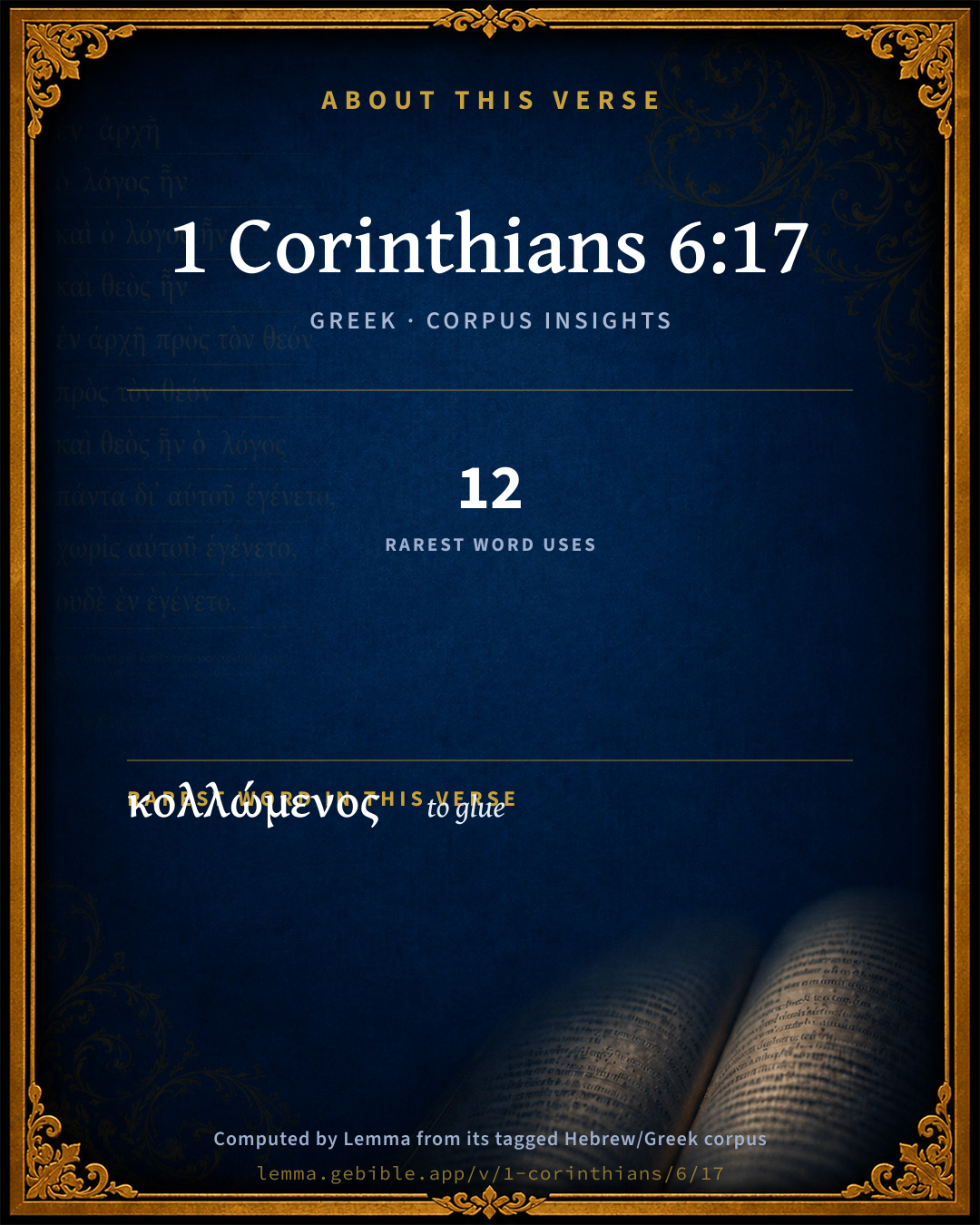
The rarest word here is κολλώμενος to glue G2853 — appearing just 12 times in the whole Greek New Testament.

Shared distinctive vocabulary

κολλώμενος to glue G2853 occurs in 12 verses of the Greek New Testament. Also found in:

Repetition

A word recurs within this verse:

Cross-references

7

Topical passages linked to 1 Corinthians 6:17 in the Treasury of Scripture Knowledge — connected by theme and wording, ordered by reader-vote popularity; previews shown in the World English Bible.

  • John 17:21–23 that they may all be one; even as you, Father, are in me, and I in you, that they also may be one in us; that the world may believe that you sent me.
  • Galatians 2:20 I have been crucified with Christ, and it is no longer I that live, but Christ living in me. That life which I now live in the flesh, I live by faith in the Son of God, who loved me, and gave himself up for me.
  • 1 Corinthians 12:13 For in one Spirit we were all baptized into one body, whether Jews or Greeks, whether bond or free; and were all given to drink into one Spirit.
  • John 3:6 That which is born of the flesh is flesh. That which is born of the Spirit is spirit.
  • Ephesians 4:3–4 being eager to keep the unity of the Spirit in the bond of peace.
  • Ephesians 5:30 because we are members of his body, of his flesh and bones.
  • Philippians 2:5 Have this in your mind, which was also in Christ Jesus,

Cross-references courtesy of OpenBible.info (CC BY 4.0).

Commentary

Notes on 1 Corinthians 6:17 from classic Christian and Jewish commentators (each source and its license shown beneath its notes). The classic Christian expositions comment on the surrounding passage and are grouped to its opening verse, so a note may address several verses; the Jewish commentaries on the Tanakh (Rashi and others) are per-verse, so they appear only where the commentator wrote on this verse.

Lemma curates 59 commentaries, every one of them public domain or Creative Commons licensed, each selected and text-cleaned for this edition rather than reprinted as found. About our sources →

The Biblical Illustrator

Joseph S. Exell

1Co_6:17

He that is joined unto the Lord is one spirit.

--The apostle was wont to associate the commonest duties with the highest motives. In dissuading from the sin of impurity, he might have adduced considerations drawn from physical laws and social conditions; instead of this he appeals to the loftiest principles of Christianity. Note

I. The bond which unites believers to their Lord is a bond of--

1. Faith, Whom having not seen, &c. Christians receive with cordiality the gospel concerning Christ; they receive Christ Himself to dwell in their hearts by faith.

2. Love. They are joined to Him as the bride to the bridegroom, in a spiritual affection, in love stronger than death.

3. Affinity. Drawn to Jesus as sinners to the Saviour, they remain with Him as friends, congenial in character, disposition and aims.

II. The consequent unity between Christians and their Lord.

1. They are in a spirit of subjection to the Father, whose will and law are authoritative and supreme.

2. They are one in the love of all that is holy and morally admirable. The sympathy that exists regards the principles that animate and the aims that dignify the moral life.

3. They are one in the bonds of an immortal fellowship. That they may be with Me where I am.

III. The practical proofs of this unity.

1. Repugnance to all which is repugnant to Christ; as, e.g., those vices to which allusion is made in the context.

2. Cultivation of the spirit of brotherly love. The one spirit must needs be a spirit of true love, linking together the members of the mystical body of Christ, and disposing them to a sympathetic and harmonious action. (Prof. J. R. Thomson.)

The saint one with his Saviour

Note--

I. A mysterious deep.

1. There is a joining to the Lord--

(1) In election. We were chosen in Christ from before the foundation of the world.

(2) In covenant, when Jesus became of old the Head of His Church.

(3) In the incarnation. All this makes up a glorious joining unto the Lord, but the union taught here is vital and spiritual which is wrought in us when we are born again.

2. But what does that word one spirit mean? The union between Christ and His people is described by--

(1) The marriage union. It is said, These twain shall be one flesh; but to take off the carnal edge of the metaphor one spirit is here substituted.

(a) Christ and His people have one spirit. The Holy Spirit who quickens us anointed Him. The foot is baptized into the same spirit as the head.

(b) We are of one spirit with Him, i.e., we come to think and feel as Jesus does.

(c) Yet the text saith not that we are of one spirit, but we are one spirit. This is a matter to be understood only by the spiritual mind, and not to be expounded in words. I in them and Thou in Me, that they may be made perfect in one. We have known on earth friends who have become one spirit; intimacy and mutual admiration have ripened friendship into unity, till the one seemed to be the complement of the other; one soul in two bodies.

(2) The branch and the stem, which are one vine, and are nothing separated from each other, their life one and their design one.

(3) The member and the body. If there be life in this finger, it is identically the same life that is in the head; and so in the whole Church the life and Spirit of Christ are the life and spirit of His people.

II. A manifest grace.

1. To be one spirit with Christ much more is needed than--

(1) To bear the Christian name. Call a poppy a rose and you will not thereby give it perfume.

(2) Mere outward profession. Ye may be baptized in water, but unless ye are baptized into the Holy Ghost, ye know not what union with Christ is, for Simon Magus though baptized had no part nor lot in the matter.

(3) The performance of some apparently good actions and the use of religious words in conversation. The superficial, the nominal, and the outward will not suffice. Deep down in the very vitals of our being must this union with Jesus Christ most eminently reside.

2. As an illustration of what unity of spirit is take that rare conjugal union of those who realise the highest ideal of the married life founded in pure love and cemented in mutual esteem. Their wishes blend, their hearts are indivisible. By degrees they come very much to think the same thoughts. Intimate association creates conformity. So the true Christian grows to think as Christ thinks till the teachings of Jesus are plain to him. Blessed consummation when their hearts at last are all wrapped up in Jesus, even as the bush at Horeb was all on fire with God!

3. Where such union exists, what does it produce? They who are thus one spirit with Christ live--

(1) For the same end--Gods glory.

(2) For the same reason--the love of the Father.

(3) By the same means. By the conversion of souls: not by being made a king, not by being called rabbi.

(4) By the use of the same modes-teaching, preaching, living, suffering, and dying. Some nowadays seem tired of Christs plans, and hunt up more rapid methods. Jesus never strained after effect by animal excitement.

(5) With the same emotions. Oh that we felt as He did the weight of souls, the guilt of sin, the terror of the wrath to come, and the tenderness of Divine mercy!

4. Let me add that if we are fully joined to our Lord, and of one spirit with Him, we shall have--

(1) The same tastes. What He loves will charm us, what He hates we shall loathe.

(2) The same will.

(3) Oneness of aim in our service of God. We have a dozen aims now, but if we were of one spirit with Jesus we should have but one object in life.

(4) Great force and fervour. Our prayers would be very different from what they are, and our public service of God would never be so sleepy as it now is.

(5) Abiding pertinacity. Defeated in one place we should try in another.

(6) Wonderful serenity of spirit. We should not be disturbed with little, petty remarks of men, nor should we even be moved by great calamities.

Conclusion:

1. A word of rebuke. We have been joined to Christ, but have we been manifestly one spirit with Him? Angry--was that Christs spirit? Worldly--was that Christs spirit?

2. A word of hope. We want to have the same spirit as Christ. Well, our hope is that we shall have it, for we are joined to the Lord, and he that is joined to the Lord is one spirit. (C. H. Spurgeon.)

The true believers union with Christ

I. The explication of this truth.

1. Who are true believers?

(1) Not such as are united unto Christ by a mere external profession, sacramental admission, or presumptuous persuasion (Joh_2:23-24). These are dead branches (Joh_15:2). sapless stakes in the Churchs hedge, wooden legs of Christs body (2Ti_3:5; Rev_3:1).

(2) But such as are united unto Christ by internal implantation. Living, fruit-bearing branches (Joh_15:5); so that now Christ is in them, and they in Christ (Joh_17:21; Joh_17:23).

2. What kind of union is this?

(1) Negatively.

(a) Not a ,corporeal union. Christ is in heaven (Act_1:11; Act_3:21), we on earth.

(b) Not a hypostatical, personal union; such as that of the Divine and human natures in the person of Christ. Believers make not one person with Christ, but one body (1Co_12:13); and that not one body natural, but mystical.

(c) Not an essential, substantial union; not such an union as makes believers in any wise partakers of the substance of Christs Godhead.

(d) Not such an union as mounts up believers to an equality with Christ in any respect. In all things He hath, and must have, the pre-eminence (Col_1:18).

(2) Positively.

(a) A spiritual union.

(b) A mystical, profound union (Eph_5:32; Joh_17:20).

(c) And yet a true, real union. Not a fancy only (Eph_5:30). As the head communicates real influences to the body, so Christ communicates to us His Spirit and graces (Joh_1:16).

(d) An intimate union. Like that of the food with the body which it nourisheth (Joh_6:54).

(e) A perpetual, indissoluble union (Rom_8:35).

3. What are the efficient causes of this union? They are--

(1) Principal. This great work ascribed--

(a) To the whole Godhead (chap. 1:9: 1Pe_5:10; Joh_6:44-45; Eph_2:6-7).

(b) But more especially to the Spirit of God. He it is that knits this marriage-knot (1Co_12:13; Tit_3:5).

(2) Less principal, or the means or instruments of union.

(a) Outward. Generally all the ordinances of God (Zec_4:12). More especially--First, the word read, preached, meditated on, believed, improved. Second, the sacraments. Those spiritual seals and labels which God hath fixed to His covenant of grace.

(b) Inward faith. Not a bare historical, dead faith; but a living, working, justifying, saving faith (Eph_3:17; Joh_1:12; 1Co_6:56; Gal_2:20).

II. Confirmation. That there is such a union appears--

1. From those many equivalent expressions whereby the Scriptures hold forth this union.

(1) Christ is said to be in believers (Col_1:27; Rom_8:10), to dwell in them (Eph_3:17), to walk in them (2Co_6:16).

(2) Believers are said to abide in Christ (Joh_15:7), to dwell in Christ (Joh_6:56; 1Jn_4:16), to put on Christ (Gal_3:27).

2. From those several similitudes by which the Scriptures shadow out this union. Believers are said to be--

(1) Lively stones (1Pe_2:4-6), Christ, the living foundation, the chief corner-stone, on which they are built (Eph_2:20-21).

(2) Branches of Christ, the true vine, into whom they are engrafted, and in whom they bring forth fruit (Joh_15:1; Joh_15:5).

(3) The loyal, affectionate spouse of Christ (Eph_5:31-32; Son_2:16; Son_5:1).

(4) Christs body (Eph_1:23; Eph_5:30), Christ being the believers Head (1Co_1:22). In a word, the Head and mystical body are called Christ (1Co_12:12).

3. From that communion which there is betwixt Christ and true believers.

(1) Believers communicate with Christ--

(a) In His fulness (Joh_1:16).

(b) In His merits (2Co_5:21).

(c) In His life and graces (1Co_1:2).

(d) In His privileges and dignities. Is He a King, a Priest? So are believers (Rev_1:6; 1Pe_2:9). Is He a Son, an Heir, by nature? Saints are so by adoption (Rom_8:17).

(e) In His victories (Rom_8:37).

(f) In His triumphs and glory; they share with Him in His throne. All that believers are, is from the grace of Christ (1Co_15:10; Php_4:13), so that they do not so properly live, as Christ in them (Gal_2:20).

(2) Christ communicates in the believers graces. All that they are is from Christ; and therefore all that they have is to Christ; what they receive in mercy they return in duty.

III. Application. Information. Are believers thus closely united unto Christ? Hence see--

(1) The crimson dye of their sin, who oppose and persecute them. In touching them, they touch the apple of His eye (Zec_2:8).

(2) The quality of Christs love to them beyond and above all others (Eph_3:18-19).

(3) The high honour which Christ casts upon them--an honour not vouchsafed to heavens courtiers, the angels. They are Christs servants, subjects; not His members.

(4) Their stability and perseverance in their estate of grace.

(5) A cogent and conclusive argument for their resurrection (chap. 15:12-23). If the Head be got above, surely the body shall not always lie under, water.

2. Examination. To ascertain whether there be such a union betwixt our souls and Christ, let us ask--

(1) Hath Christ given unto you His Holy Spirit (Rom_8:9; 1Jn_3:24). Now this Spirit is--

(a) A praying Spirit (Zec_12:10).

(b) A mourning Spirit.

(c) A sanctifying Spirit (1Co_6:11; 1Pe_1:2).

(2) Doth Christ dwell in thy heart by faith? (Eph_3:17.) Namely, by such a faith as purifies the heart, works by love and overcomes the world.

(3) Dost thou crucify the flesh with its affections and lusts? They that are united unto Christ do so (Gal_5:24; Rom_8:13).

(4) Art thou a new creature? He that is in Christ is so (2Co_5:17). Hast thou a new head, heart, lip, life?

(5) Dost thou bring forth fruit? Every branch in Christ is a fruit-bearing branch (Joh_15:5; Php_1:11).

3. Consolation.

(1) With relation to Christ, to whom believers are united. On their union with Him, there redounds to them a peculiar interest--

(a) In Christs person. Christ Himself is theirs (Jer_32:38; Isa_9:6).

(b) In Christs properties. Has Christ an arm of power? It is for your protection. Has He an eye of knowledge? It is for your direction. Has He a stock, a treasury, of perfect righteousness? It is for your justification, &c.

(c) In Christs promises (2Pe_1:4). Which are the believers Magna Charta, to the confirmation whereof God has been pleased to add both His oath and blood for seals (Heb_6:17-18).

(d) in all Christs providences (Rom_8:28).

(e) In all (1Co_3:22-23).

(2) With respect to believers themselves. In a threefold regard; namely, of their persons, graces, duties.

4. Exhortation.

(1) To sinners, that are as yet without Christ, God, hope in this world (Eph_2:12). Be persuaded to give your eyes no sleep till you are united to Christ! Consider--

(a) The dreadful, dismal danger of thy present estate. A soul not united unto Christ lies open to all danger imaginable.

(b) Christs condescending willingness to be united to thee.

(2) To saints that are united to Christ.

(a) Be very fearful of that which may in any sort weaken your union with Christ.

(b) Wisely improve it.

(c) Labour for a frame of spirit suitable to it.

(d) Walk worthy of it. (T. Lye, A. M.)

The Biblical Illustrator, edited by Joseph S. Exell (c. 1880s–1900s) — public domain. Text from a community e-Sword module.

Bengel's Gnomon

Johann Albrecht Bengel

1Co 6:17. Τῷ Κυρίῳ, to the Lord) Christ. It is the same syllepsis [the Lord and he who is joined to Him are, etc.]—ἓν πνεῦμα, one spirit) so closely, as husband and wife are one body. Make this your experience.

Bengel's Gnomon of the New Testament — English translation (T&T Clark, Edinburgh, 1860) — public domain. Text from a community e-Sword module.

Meyer's Critical & Exegetical Commentary

Heinrich August Wilhelm Meyer

1Co_6:17. Weighty contrast to ὁ κολλώμ. τῇ πόρνῃ ἓν σῶμά ἐστι, no longer dependent on ὅτι.

κολλᾶσθαι τῷ Κυρίῳ, an expression of close attachment to Jehovah, which is very common in the O. T. (Jer_13:11; Deu_10:20; Deu_11:22; 2Ki_18:6; Sir_2:3, al[991]). It denotes here, inward union of life with Christ, and is selected to be set against the κολλ. τῇ πόρνῃ in 1Co_6:16, inasmuch as in both cases an intima conjunctio takes place, in the one fleshly, in the other spiritual. We are not to assume that Paul was thinking here, as in Eph_5:23 ff. (comp 2Co_11:2; Rom_5:4), of the union with Christ as a marriage (Piscator, Olshausen, comp also Osiander); for in that mystical marriage-union Christ is the Bridegroom, filling the mans place, and hence the contrast to κολλ. τῇ πόρνῃ would be an unsuitable one. Olshausens additional conjecture, that when the apostle spoke of τῇ πόρνῃ there floated before his mind a vision of the great whore who sitteth upon many waters (Rev_17:1), is an empty fancy.

ἓν πνεῦμά ἐστι] conceived of as the analogue to ἓν σῶμα. Comp 2Co_3:17. This is the same Unio mystica which Jesus Himself so often demands in the Gospel of John, and in which no ethical diversity exists between the πνεῦμα of the believing man and the πνεῦμα of Christ which fills it; Christ lives in the believer, Gal_2:20, as the believer in Christ, Gal_3:27, Col_3:17, this being brought about by Christs communicating Himself to the human spirit through the power of the Holy Spirit, Rom_8:9-11. Now, be it observed how, by fleshly union with a harlot, this high and holy unity is not simply put in hazard (Hofmann), but excluded altogether as a moral impossibility! Comp the idea of the impossibility of serving two masters (Rom_6:16), of fellowship with Christ and Belial, and the like. It is unnecessary to say that this has no application to union in marriage, seeing that it is ordained of God, ob verbum, quo actus concubialis sanctificatur, Calovius. Comp Weiss, bibl. Theol. p. 421.

[991] l. and others; and other passages; and other editions.

Meyer — Critical and Exegetical Commentary on the New Testament — English translation by Peter Christie, edited by Frederick Crombie (T&T Clark, 1880) — public domain. Text from a community e-Sword module.

Expositor's Greek Testament

ed. W. Robertson Nicoll

1Co 6:17 . ὁ δὲ κολλώμενος τῳ Κυρίῳ κ . τ . λ .: “But he who cleaves to the Lord is one spirit (with Him)”. Adhesion by the act of faith (1Co 1:21 , etc.) to Christ (as Lord, cf. 1Co 12:3 , etc.) establishes a spiritual communion of the man with Him as real and close as the other, bodily communion (“tam arcte quam conjuges sunt unum corpus,” Bg [986] ), and as much more influential and enduring as the spirit is above the flesh. “ The Spirit” is the uniting bond (1Co 3:16 , Rom 8:8 f., etc.), but the Ap. is thinking of the nature and sphere of this union; hence the anarthrous, generic πνεῦμα , contrasted with σάρξ (1Co 6:16 ). In 2Co 3:17 “the Lord” is identified with “the Spirit.” and believers are repeatedly said to be ἐν Πνεύματι ; so that between them and Christ there exists a κοινωνία Πνεύματος (1Co 1:9 , 2Co 13:13 ; Joh 16:14 , etc.). For the intimacy of this association of members with the Head, see Gal 2:20 , Eph 2:5 f., 1Co 3:16 f., Col 2:10 ; Col 3:1 ff., Joh 15:1 ff; Joh 17:23 ff., etc.

[986] Bengel’s Gnomon Novi Testamenti.

The Expositor's Greek Testament, edited by W. Robertson Nicoll (1897–1910) — public domain. Text from a community e-Sword module.

Hodge's Commentary on Romans, Ephesians & First Corinthians

Charles Hodge

1Co_6:17

But he that is joined unto the Lord is one Spirit.

That is, has one Spirit with him. This does not mean has the same disposition or state of mind, but the same principle of life, 1Co_6:12, the Holy Spirit. The Holy Spirit is given without measure unto Christ, and from him is communicated to all his people who are thereby brought into a common life with him, Rom_8:9, Rom_8:10; 1Co_12:13; Joh_17:21, Joh_17:23; Eph_4:4; Eph_5:30. This being the case, it imposes the highest conceivable obligation not to act inconsistently with this intimate and exalting relationship.

Charles Hodge — Commentary on Romans (1835), First Corinthians (1857), and Ephesians (1856) — public domain. Text from a community e-Sword module.

Jamieson, Fausset & Brown

Robert Jamieson, A. R. Fausset & David Brown

one spirit--with Him. In the case of union with a harlot, the fornicator becomes one "body" with her (not one "spirit," for the spirit which is normally the organ of the Holy Spirit in man, is in the carnal so overlaid with what is sensual that it is ignored altogether). But the believer not only has his body sanctified by union with Christ's body, but also becomes "one spirit" with Him (Joh 15:1-7; Joh 17:21; Pe2 1:4; compare Eph 5:23-32; Joh 3:6).

Jamieson, Fausset & Brown — Commentary Critical and Explanatory on the Whole Bible (1871) — public domain (CC PDM 1.0). Text via the HelloAO Bible API.

Adam Clarke's Commentary

Verse 17. Is one spirit.] He who is united to God, by faith in Christ Jesus, receives his Spirit, and becomes a partaker of the Divine nature. Who can change such a relationship for communion with a harlot; or for any kind of sensual gratification? He who can must be far and deeply fallen!

Adam Clarke's Commentary on the Bible (1810–1826) — public domain. Text from a community e-Sword/MySword module.

John Calvin's Commentaries

17. He that is joined to the Lord. He has added this to show that our connection with Christ is closer than that of a husband and wife, and that the former, accordingly, must be greatly preferred before the latter, so that it must be maintained with the utmost chastity and fidelity. For if he who is joined to a woman in marriage ought not to have illicit connection with an harlot, much more heinous were this crime in believers, who are not merely one flesh with Christ, but also one spirit Thus there is a comparison between greater and less.

John Calvin's Commentaries (1540-1563) — public domain. Text from the Calvin Translation Society English edition (1840s-50s) via the Christian Classics Ethereal Library (ccel.org). Calvin's coverage is partial (roughly two-thirds of the Bible); uncommented books and verses are honest gaps, never fabricated. The 19th-century editor's footnotes and remarks are omitted so the notes are faithfully Calvin's own voice.

Ellicott's Commentary for English Readers

(17) One spirit.—The union betwixt Christ and each member of His Church is a spiritual one. This explains the sense in which we are the Lord’s body, and intensifies the argument against any degradation of one who shares so holy and intimate a union.

A Bible Commentary for English Readers, edited by Charles John Ellicott (1878–1897) — public domain. Text from a community e-Sword module.

The Cambridge Bible for Schools and Colleges

gen. ed. J. J. S. Perowne

17. he that is joined unto the Lord is one spirit] Literally, cleaveth to the Lord. No words, save perhaps those in St John 17, could more forcibly express the closeness of the union between Christ and His faithful disciple.

The Cambridge Bible for Schools and Colleges (gen. ed. J. J. S. Perowne; Cambridge University Press, 1878–1918) — public domain. Text from a community e-Sword module.

John Gill's Exposition

He that is joined unto the Lord,.... As every elect person is; his whole person, soul and body, is united to the Lord Jesus Christ, to his whole person, as God-man and Mediator; even as Adam and Eve, whose marriage was a representation of the marriage between Christ and his church, were personally united, and were called by the same name; and as the whole human nature of Christ, consisting of a true body and a reasonable soul, was united to the person of the Son of God; and as appears from the influence that union with Christ has upon the redemption, sanctification, and resurrection of the body. The ground, foundation, and bond of which union is, not the Spirit on Christ's part; for the Spirit being received as a spirit of regeneration, sanctification, &c. is a fruit of union to Christ, and an evidence of it; nor faith on our part, which as a grace is not ours, but the gift of God, and is a fruit of union; nor is it of an uniting nature, but is a grace of communion; and the foundation of all its acts, as seeing Christ, going to him, receiving of him, walking on in him; &c. is a previous union to Christ; but it is the everlasting and unchangeable love of Christ to them, shown in his choice of them, in his covenant with his Father on their behalf, in his engaging for them as a surety, in assuming their nature, and acting, both in time and eternity, as the representative of them, which is the bond and cement of their union, and from which there can be no separation. This union is first discovered in the effectual calling, and will be more manifest hereafter. Now he that is in this sense united to Christ,

is one spirit; for this union is a spiritual one; it is complete and perfect; near and indissoluble; by virtue and in consequence of it, God's chosen ones come to have and enjoy the same spirit in measure, which Christ their head and Mediator has without measure: hence they have the Spirit of God, as a spirit of illumination and conversion, of faith and holiness, of adoption, and as the earnest, pledge, and seal of their future glory. And since so it is, fornication, which makes them one flesh with an harlot, ought studiously to be abstained from.

John Gill's Exposition of the Whole Bible (1746–1763) — public domain (CC PDM 1.0). Text via the HelloAO Bible API.

Trapp's Complete Commentary

John Trapp

17 But he that is joined unto the Lord is one spirit.

Ver. 17. Is one spirit] That is, one spiritual body: while Christ lays hold on us by his Spirit, we lay hold on him by faith. Hence the Church is called Christ, 1Co 12:12, and the fulness of Christ, Eph 1:23. We have the honour of making Christ perfect, as the members do the body.

John Trapp, A Commentary or Exposition upon All the Books of the Old and New Testament (1647–1656) — public domain. Text from a community e-Sword module.

Albert Barnes' Notes on the Bible

But he that is joined to the Lord - The true Christian, united by faith to the Lord Jesus; see Joh 15:1 ff.

Is one spirit - That is, in a sense similar to that in which a man and his wife are one body. It is not to be taken literally; but the sense is, that there is a close and intimate union; they are united in feeling, spirit, intention, disposition. The argument is beautiful. It is, “As the union of souls is more important than that of bodies; as that union is more lasting, dear, and enduring than any union of body with body can be, and as our union with him is with a Spirit pure and holy, it is improper that we should sever that tie, and break that sacred bond, by being joined to a harlot. The union with Christ is more intimate, entire, and pure than that can be between a man and woman; and that union should be regarded as sacred and inviolable.” O, if all Christians felt and regarded this as they should, how would they shrink from the connections which they often form on earth! Compare Eph 4:4.

Albert Barnes' Notes on the Bible (1834–1885) — public domain. Text from a community e-Sword/MySword module.

Matthew Poole's English Annotations

This phrase joined unto the Lord, is thought to be taken out of Deu 10:20; To him shalt thou cleave. He that hath attained to that mystical union which is between Christ and every one that is a true believer, is not essentially, but spiritually and mystically, one spirit with Christ; his spirit is united to the Spirit of Christ, and he is one by him in faith and love, and by obedience, Christ and he have one will, and he is ruled and governed by Christ: therefore you must take heed what you do in making your bodies the members of harlots, which they cannot be, and the members of Christ also.

Matthew Poole's English Annotations on the Holy Bible (1683–1685) — public domain. Text from a community e-Sword/MySword module.

Whedon's Commentary on the Bible

Daniel D. Whedon

17. One spirit—With the Lord.

Daniel D. Whedon (gen. ed.), Commentary on the Old and New Testaments (1874–1909) — public domain. Text from a community e-Sword module.

The Pulpit Commentary

That is joined unto the Lord. This phrase, indicating the closest possible union, is found in Deu_10:20; 2Ki_18:6. Is one spirit. There is a "mystical union," not only "betwixt Christ and his Church," but also between Christ and the holy soul Hence, to St. Paul, spiritual life meant the indwelling of Christ in the heart the life "in Christ;" so that he could say, "It is no more I that live, but Christ that liveth in me". (Gal_2:20 Gal_3:27; Col_3:17)

Christ and his people are one.

It was the wont of the apostle to associate the commonest duties of life with the highest motives drawn from spiritual realities and relations, in dissuading from the sin of impurity, he might have adduced considerations drawn from physical laws or from social conditions; but it is more in harmony with his convictions and habits to appeal to the loftiest principles of the Christian religion.

I THE BOND WHICH UNITES CHRISTIANS TO THEIR LORD. It is a personal relation which is here asserted, and evidently not one of mere external association, but of vital and spiritual union.

1. It is a bond of faith. "Whom not having seen," etc. Christians receive with cordiality the gospel concerning Christ; they receive Christ himself to dwell in their hearts by faith.

2. It is a bond of love. They are joined to him as the bride to the bridegroom, in a spiritual affection, in love "stronger than death.

3. It is a bond of affinity. Drawn to Jesus as sinners to the Saviour, they remain with him as friends congenial in character, in disposition, and in aims.

II THE CONSEQUENT UNITY BETWEEN CHRISTIANS AND THEIR LORD. They are "one spirit.

1. They are in a spirit of subjection to the Father, whose will and law are authoritative and supreme.

2. They are one in the love of all that is holy and morally admirable. The sympathy that exists is sympathy with regard to matters of the highest moment, with regard to the principles that animate and the aims that dignify the moral life.

3. They are one in the bonds of an immortal fellowship. Christ"s prayer for his people was, "That they may be with me where I am a prayer which the Father is graciously and constantly answering.

III THE PRACTICAL PROOFS OF THIS UNITY.

1. A repugnance on the part of Christians to all which is repugnant to their Lord; as e.g. those vices to which allusion is made in the context, practised by the heathen, but hateful to those who name the Name of Christ.

2. A cultivation of the spirit of brotherly love. The "one spirit" must needs be a spirit of true love, linking together the members of the mystical body of Christ, and disposing them to a sympathetic and harmonious action. T.

The Pulpit Commentary (1880–1919), ed. H.D.M. Spence-Jones & Joseph S. Exell — public domain. Text from a community e-Sword module.

John Wesley's Explanatory Notes

But he that is joined to the Lord - By faith. Is one spirit with him - And shall he make himself one flesh with an harlot?

John Wesley, Explanatory Notes Upon the Whole Bible (1754–1765) — public domain. Text via the GEBible commentary corpus.

McGarvey & Pendleton's Commentaries

J. W. McGarvey

But he that is joined unto the Lord is one spirit . [Having closest spiritual union with Christ-- Gal_2:20 ; Gal_3:27 ; Col_3:17 ]

J. W. McGarvey (with Philip Y. Pendleton), Commentaries on the New Testament (The Fourfold Gospel, 1914; Acts; and the epistles) — public domain. Text from a community e-Sword/MySword module.

The People's New Testament

B. W. Johnson

17. He that is joined to the Lord, etc. There is one life and one spirit until severed from Christ.

B. W. Johnson's The People's New Testament with Notes (1889–1891) — public domain. Electronic text from the Christian Classics Ethereal Library (CCEL) ThML edition.

Cambridge Greek Testament for Schools and Colleges

17. ὁ κολλώμενος τῷ κυρίῳ. Literally, cleaveth to the Lord. No words, save perhaps those in John 17, could more forcibly express the closeness of the union between Christ and His faithful disciple. The use, moreover, of the identical word in this verse with that which in the last verse is used of a very different kind of union is intended to intensify the contrast.

Cambridge Greek Testament for Schools and Colleges (Cambridge University Press, 1896; 21 vols, various authors incl. Carr, Maclear, Plummer, Farrar, Lumby, Moule, M. R. James, Simcox) — public domain. Text from a community e-Sword module.

Alford’s Greek Testament

Henry Alford

17.] Union to God, His service, and His ways, is often expressed by this word (κολλ.) in the LXX (reff.): but here that inner union with Christ in spirit is meant, which is the normal state of every believer, and of which it may be said that he ἓν πν. ἐστιν with Christ. See Joh 17:21, and the parable of Joh 15:1-7. Meyer rightly remarks, that the mystical marriage between Christ and His Church must not (as Olsh. from Eph 5:23 ff.) be pressed here, as the relations of the compared are not correspondent. Still, however, the inner verity of that mystical relation is the ground of both passages.

Henry Alford, The Greek Testament (1849–1861) — public domain. Text from a community e-Sword module.

Lesson kit

Teaching starters — assembled from the data on this page, not authored interpretation. Every prompt links to the verse data it draws on. Edit before teaching.

1 Corinthians, in the Pauline Epistles, opens this verse with 8 words (7 distinct Greek lemmas). Its most distinctive word is kolláō (“to glue”). A historical commentator’s framing appears above. Read the whole chapter for the surrounding context.

Discussion questions

  1. The word kolláō carries the sense “to glue.” How does it shape the verse?
  2. How does Matthew 19:5, which shares the word «to glue», read alongside this verse?
  3. What does the repetition of “the” (2× in this one verse) do in this verse?
  4. These translations render this verse differently; the difference is in the English rendering, not the original. What questions does that raise?
  5. Compare how The Biblical Illustrator and Bengel's Gnomon read this verse. Where do they agree or differ?

Things to notice

  • These translations choose different wording for 2 words in this verse.
  • “the” occurs 2× in this single verse.
  • 7 distinct Greek lemmas span 8 words in this verse.

Reading settings

Reading text

Shown beneath each verse's original-language words.

Old Testament
Old Testament edition

Read the OT as the Masoretic Hebrew (MT) or the Greek Septuagint (LXX).

English shown for the Greek Septuagint (in the Hebrew ↔ Greek comparison).

Comparing translations? Open the Compare panel on any verse page to stack up to four side by side.