
1 Corinthians 12:8

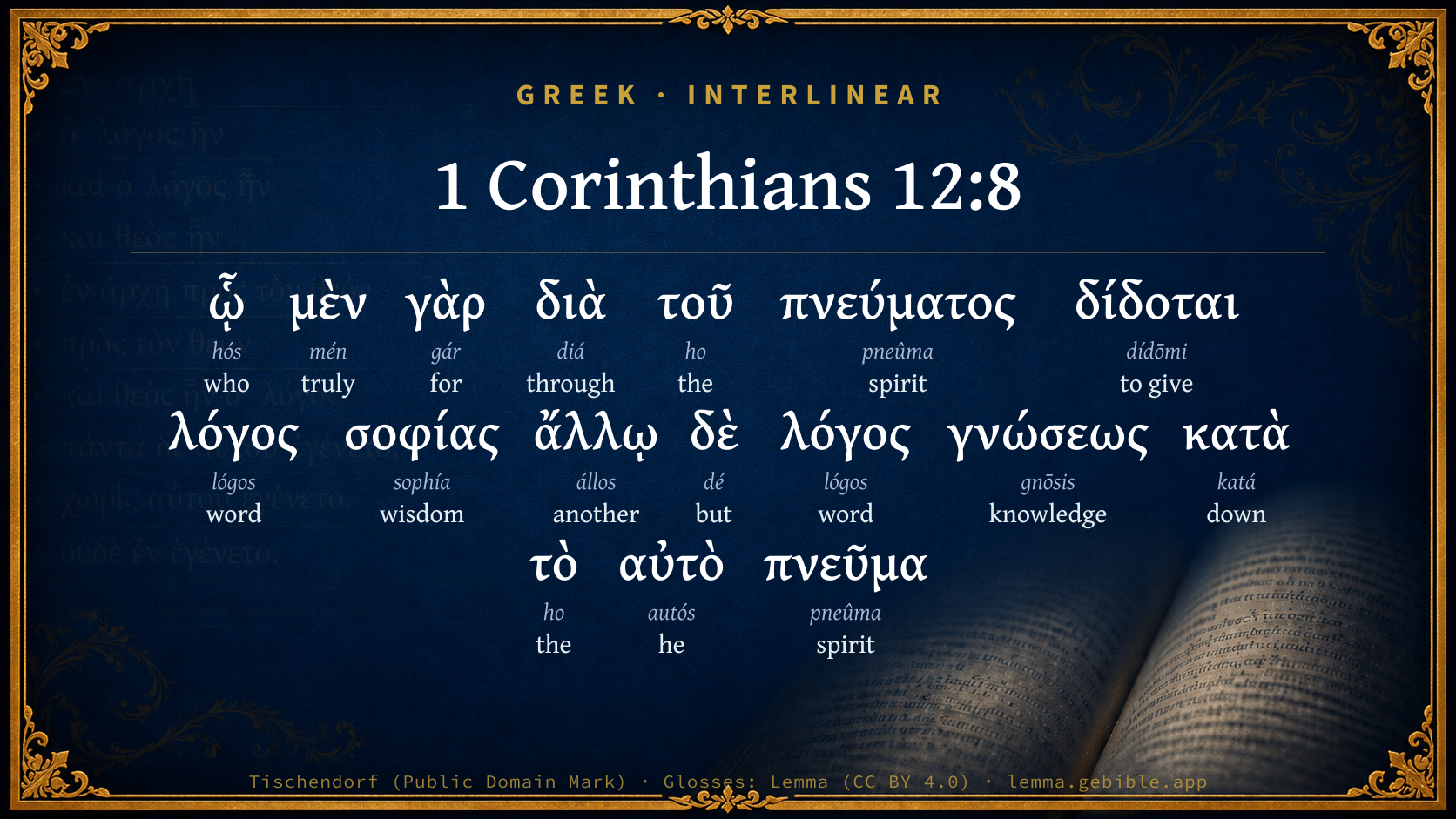
Greek (Tischendorf 8th ed.) 1 Corinthians 12:8 appears in the Greek New Testament. The text above is from the Tischendorf 8th edition. Each word links to its Strong’s number and a concise gloss. Click any word for its full Thayer’s Greek Lexicon entry.
Download image
Cite this verse

1 Corinthians 12:8 (World English Bible). Public Domain. Lemma interlinear Bible study tool, https://lemma.gebible.app/v/1-corinthians/12/8.

Show BibTeX & RIS
BibTeX
RIS
English Translation
For to one is given through the Spirit the word of wisdom, and to another the word of knowledge, according to the same Spirit;
World English Bible · Public Domain
Download a study sheet

One document with this verse’s original text, its word-by-word gloss line, the meaning frame, cross-references with their text, attributed commentary, and full source and license credits — printable, and it pastes into notes with its structure intact.

This verse Autodidact and up

Study sheet (.html) Plain text (.txt)

A passage Seminary Student

Up to 50 verses in one chapter. A passage sheet keeps up to 6 commentary sources and 12 cross-references per verse, in the order this page ranks them, and says so on the sheet whenever that leaves anything out. Ask for a single verse and you get the Autodidact verse sheet above.

Everything on this page stays free to read, with no account — the sheet is a download of what is already on screen, not access to it.

Want to remove ads? Support Godless Engineer
Compare translations 3

The same verse in 3 English versions, stacked beneath the original-language interlinear above. Click any original word for its lexicon entry.

Each is an independent rendering of the whole verse — the interlinear is not word-aligned to these translations.

Highlighted words mark where these versions differ — a whole-verse word diff, not a word-by-word alignment.

  • World English Bible Public Domain
    For to one is given through the Spirit the word of wisdom, and to another the word of knowledge, according to the same Spirit;
  • King James Version Public Domain
    For to one is given by the Spirit the word of wisdom; to another the word of knowledge by the same Spirit;
  • unfoldingWord Literal Text CC BY-SA 4.0
    For to one is given by the Spirit a word of wisdom, and to another, a word of knowledge according to the same Spirit;

unfoldingWord Literal Text — © unfoldingWord, licensed CC BY-SA 4.0. Word-aligned USFM3 via Door43 (git.door43.org/unfoldingWord/en_ult).

Versions to compare (up to 4)

3 of 4 selected

Show all 19 translations

Every available English version of this verse, each an independent rendering of the whole verse.

  • World English Bible Public Domain
    For to one is given through the Spirit the word of wisdom, and to another the word of knowledge, according to the same Spirit;
  • Berean Standard Bible Public Domain
    To one there is given through the Spirit the message of wisdom, to another the message of knowledge by the same Spirit,
  • Majority Standard Bible Public Domain
    To one there is given through the Spirit the message of wisdom, to another the message of knowledge by the same Spirit,
  • King James Version Public Domain
    For to one is given by the Spirit the word of wisdom; to another the word of knowledge by the same Spirit;
  • American Standard Version (1901) Public Domain
    For to one is given through the Spirit the word of wisdom; and to another the word of knowledge, according to the same Spirit:
  • Revised Version (1885) Public Domain
    For to one is given through the Spirit the word of wisdom; and to another the word of knowledge, according to the same Spirit:
  • Geneva Bible (1599) Public Domain
    For to one is giuen by the Spirit the word of wisdome: and to an other the word of knowledge, by the same Spirit:
  • Douay-Rheims (1899) Public Domain
    To one indeed, by the Spirit, is given the word of wisdom: and to another, the word of knowledge, according to the same Spirit;
  • Young's Literal Translation Public Domain
    for to one through the Spirit hath been given a word of wisdom, and to another a word of knowledge, according to the same Spirit;
  • Literal Standard Version CC BY-SA 4.0
    for to one through the Spirit has been given a word of wisdom, and to another a word of knowledge, according to the same Spirit;
  • Unlocked Literal Bible CC BY-SA 4.0
    For to one is given by the Spirit the word of wisdom, and to another the word of knowledge by the same Spirit.
  • unfoldingWord Literal Text CC BY-SA 4.0
    For to one is given by the Spirit a word of wisdom, and to another, a word of knowledge according to the same Spirit;
  • Darby Bible Public Domain
    For to one, by the Spirit, is given [the] word of wisdom; and to another [the] word of knowledge, according to the same Spirit;
  • World Messianic Bible Public Domain
    For to one is given through the Spirit the word of wisdom, and to another the word of knowledge according to the same Spirit,
  • Webster's Bible Public Domain
    For to one is given by the Spirit the word of wisdom; to another, the word of knowledge by the same Spirit;
  • Free Bible Version CC BY-SA 4.0
    One person is given by the Spirit the ability to speak words of wisdom. Another is given a message of knowledge by the same Spirit.
  • Bible in Basic English Public Domain
    For to one are given words of wisdom through the Spirit; and to another words of knowledge through the same Spirit:
  • Text-Critical English NT CC BY 4.0
    To one person there is given a word of wisdom through the Spirit, to another a word of knowledge according to the same Spirit,
  • Tyndale New Testament (1534) Public Domain
    To one is geven thorow the spirite the vtteraunce of wisdome? To another is geven the vtteraunce of knowledge by ye same sprete.

Literal Standard Version (2020), Covenant Press — licensed CC BY-SA 4.0. Text via the HelloAO Bible API (eBible.org). Unlocked Literal Bible (unfoldingWord) — licensed CC BY-SA 4.0. Text via the HelloAO Bible API (eBible.org). unfoldingWord Literal Text — © unfoldingWord, licensed CC BY-SA 4.0. Word-aligned USFM3 via Door43 (git.door43.org/unfoldingWord/en_ult). Free Bible Version, Dr. Jonathan Gallagher — licensed CC BY-SA 4.0. Text via the HelloAO Bible API (eBible.org).

Word by word

More ways to search: Search by grammar → Find every occurrence → Compare this word →

Practice this passage: Drill this verse → Learn its vocabulary →

γνώσεως
gnōsis
G1108
“knowledge”
Noun, Genitive, Singular, Feminine
Part of Speech
Noun
Case
Genitive
Number
Singular
Gender
Feminine
Full Thayer's Definition

Origin: from G1097

TDNT: 12:29,1

1. knowledge signifies in general intelligence, understanding a. the general knowledge of Christian religion b. the deeper more perfect and enlarged knowledge of this religion, such as belongs to the more advanced c. esp. of things lawful and unlawful for Christians d. moral wisdom, such as is seen in right living
  1. ᾧ hós G3739 “who” Relative pronoun, Dative, Singular, Masculine
  2. μὲν mén G3303 “truly” Particle
  3. γὰρ gár G1063 “for” Conjunction
  4. διὰ diá G1223 “through” Preposition
  5. τοῦ ho G3588 “the” Article, Genitive, Singular, Neuter
  6. πνεύματος pneûma G4151 “spirit” Noun, Genitive, Singular, Neuter
  7. δίδοται dídōmi G1325 “to give” Verb, Present, Passive, Indicative, 3rd person, Singular
  8. λόγος lógos G3056 “word” Noun, Nominative, Singular, Masculine
  9. σοφίας sophía G4678 “wisdom” Noun, Genitive, Singular, Feminine
  10. ἄλλῳ állos G243 “another” Adjective, Dative, Singular, Masculine
  11. δὲ dé G1161 “but” Conjunction
  12. λόγος lógos G3056 “word” Noun, Nominative, Singular, Masculine
  13. κατὰ katá G2596 “down” Preposition
  14. τὸ ho G3588 “the” Article, Accusative, Singular, Neuter
  15. αὐτὸ autós G846 “he” Personal pronoun, Accusative, Singular, Neuter
  16. πνεῦμα pneûma G4151 “spirit” Noun, Accusative, Singular, Neuter

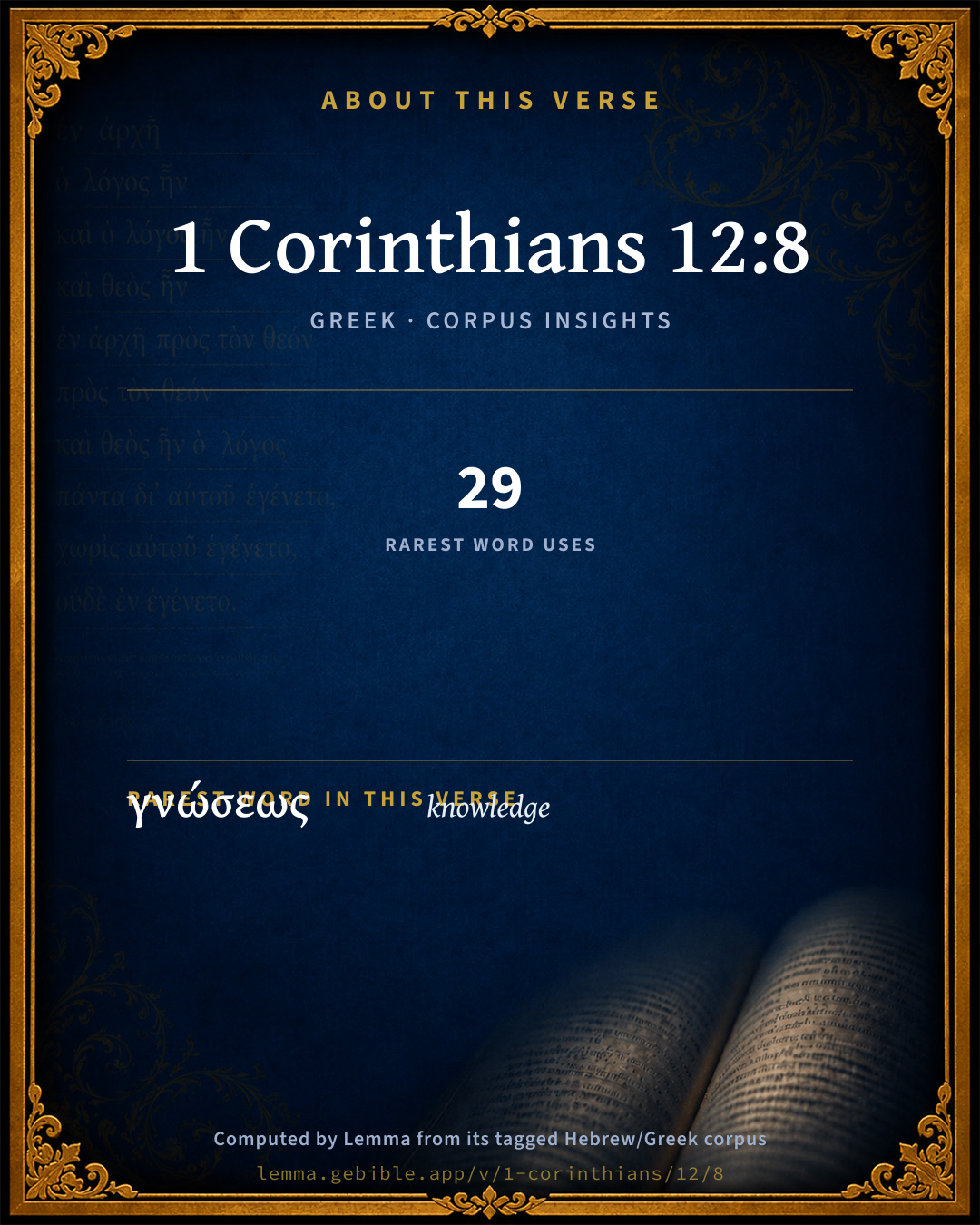
About this verse

These counts appear in no published source. They are computed here, from the morphology-tagged text and Lemma’s own curated glosses. What Lemma adds →

17
words
14
distinct lemmas
Pauline Epistles
section

Shared distinctive vocabulary

γνώσεως knowledge G1108 occurs in 28 verses of the Greek New Testament. Also found in:
Repetition

Words recur within this verse:

  • πνεύματος spirit G4151 ×2
  • λόγος word G3056 ×2
  • τοῦ the G3588 ×2

Cross-references

20

Topical passages linked to 1 Corinthians 12:8 in the Treasury of Scripture Knowledge — connected by theme and wording, ordered by reader-vote popularity; previews shown in the World English Bible.

  • Proverbs 2:6 For Yahweh gives wisdom. Out of his mouth comes knowledge and understanding.
  • 1 Corinthians 2:6–10 We speak wisdom, however, among those who are full grown; yet a wisdom not of this world, nor of the rulers of this world, who are coming to nothing.
  • Ephesians 1:17–18 that the God of our Lord Jesus Christ, the Father of glory, may give to you a spirit of wisdom and revelation in the knowledge of him;
  • Psalms 143:10 Teach me to do your will, For you are my God. Your Spirit is good. Lead me in the land of uprightness.
  • 1 Corinthians 1:5 that in everything you were enriched in him, in all speech and all knowledge;
  • 2 Corinthians 8:7 But as you abound in everything, in faith, utterance, knowledge, all earnestness, and in your love to us, see that you also abound in this grace.
  • Genesis 41:38–39 Pharaoh said to his servants, "Can we find such a one as this, a man in whom is the Spirit of God?"
  • Nehemiah 9:20 You gave also your good Spirit to instruct them, and didn't withhold your manna from their mouth, and gave them water for their thirst.
  • Isaiah 11:2–3 The Spirit of Yahweh shall rest on him, the spirit of wisdom and understanding, the spirit of counsel and might, the spirit of knowledge and of the fear of Yahweh.
  • 1 Corinthians 1:30 But of him, you are in Christ Jesus, who was made to us wisdom from God, and righteousness and sanctification, and redemption:
  • Exodus 31:3 and I have filled him with the Spirit of God, in wisdom, and in understanding, and in knowledge, and in all manner of workmanship,
  • 1 Kings 3:5–12 In Gibeon Yahweh appeared to Solomon in a dream by night; and God said, Ask what I shall give you.
  • Job 32:8 But there is a spirit in man, And the breath of the Almighty gives them understanding.
  • Isaiah 50:4 The Lord Yahweh has given me the tongue of those who are taught, that I may know how to sustain with words him who is weary: he wakens morning by morning, he wakens my ear to hear as those who are taught.
  • Isaiah 59:21 As for me, this is my covenant with them, says Yahweh: my Spirit who is on you, and my words which I have put in your mouth, shall not depart out of your mouth, nor out of the mouth of your seed, nor out of the mouth of your seed's seed, says Yahweh, from henceforth and forever.
  • Daniel 2:21 He changes the times and the seasons; he removes kings, and sets up kings; he gives wisdom to the wise, and knowledge to those who have understanding;
  • Matthew 13:11 He answered them, "To you it is given to know the mysteries of the Kingdom of Heaven, but it is not given to them.
  • 1 Corinthians 13:8 Love never fails. But where there are prophecies, they will be done away with. Where there are various languages, they will cease. Where there is knowledge, it will be done away with.
  • 1 Corinthians 13:2 If I have the gift of prophecy, and know all mysteries and all knowledge; and if I have all faith, so as to remove mountains, but don't have love, I am nothing.
  • Acts 6:3 Therefore select from among you, brothers, seven men of good report, full of the Holy Spirit and of wisdom, whom we may appoint over this business.

Cross-references courtesy of OpenBible.info (CC BY 4.0).

Commentary

Notes on 1 Corinthians 12:8 from classic Christian and Jewish commentators (each source and its license shown beneath its notes). The classic Christian expositions comment on the surrounding passage and are grouped to its opening verse, so a note may address several verses; the Jewish commentaries on the Tanakh (Rashi and others) are per-verse, so they appear only where the commentator wrote on this verse.

Lemma curates 59 commentaries, every one of them public domain or Creative Commons licensed, each selected and text-cleaned for this edition rather than reprinted as found. About our sources →

Adam Clarke's Commentary

Verse 8. Word of wisdom] In all these places I consider that the proper translation of λογος is doctrine, as in many other places of the New Testament. It is very difficult to say what is intended here by the different kinds of gifts mentioned by the apostle: they were probably all supernatural, and were necessary at that time only for the benefit of the Church. On the 8th, 9th, and 10th verses, much may be seen in Lightfoot, Whitby, Pearce, and others. 1Co 12:8-10

By doctrine of wisdom we may understand, as Bp. Pearce and Dr. Whitby observe, the mystery of our redemption, in which the wisdom of God was most eminently conspicuous: see 1Co 2:7; 1Co 2:10; and which is called the manifold wisdom of God, Eph 3:10. Christ, the great teacher of it, is called the wisdom of God, 1Co 1:24; and in him are said to be contained all the treasures of wisdom and knowledge, Col 2:3. The apostles to whom this doctrine was committed are called σοφοι, wise men; (Mt 23:34;) and they are said to teach this Gospel according to the wisdom given them, 2Pe 3:15.

2. By the doctrine of knowledge we may understand either a knowledge of the types, c., in the Old Testament or what are termed mysteries; the calling of the Gentiles, the recalling of the Jews, the mystery of iniquity, of the beast, c., and especially the mystical sense or meaning of the Old Testament, with all its types, rites, ceremonies, c., &c.

3. By faith, 1Co 12:9, we are to understand that miraculous faith by which they could remove mountains, 1Co 13:2 or a peculiar impulse, as Dr: Whitby calls it, that came upon the apostles when any difficult matter was to be performed, which inwardly assured them that God's power would assist them in the performance of it. Others think that justifying faith, received by means of Gospel teaching, is what is intended.

4. Gifts of healing simply refers to the power which at particular times the apostles received from the Holy Spirit to cure diseases; a power which was not always resident in them; for Paul could not cure Timothy, nor remove his own thorn in the flesh; because it was given only on extraordinary occasions, though perhaps more generally than many others.

5. The working of miracles, ενεργηματα δυναμεων, 1Co 12:10. This seems to refer to the same class as the operations, ενεργηματων, 1Co 12:6, as the words are the same; and to signify those powers by which they were enabled at particular times to work miraculously on others; ejecting demons, inflicting punishments or judgments, as in the cases mentioned under 1Co 12:6. It is a hendyadis for mighty operations.

6. Prophecy. This seems to import two things: 1st, the predicting future events, such as then particularly concerned the state of the Church and the apostles; as the dearth foretold by Agabus, Ac 11:28; and the binding of St. Paul, and delivering him to the Romans, Ac 21:10, c. and St. Paul's foretelling his own shipwreck on Malta, Ac 27:25, c. And 2dly, as implying the faculty of teaching or expounding the Scriptures, which is also a common acceptation of the word.

7. Discerning of spirits. A gift by which the person so privileged could discern a false miracle from a true one or a pretender to inspiration from him who was made really partaker of the Holy Ghost. It probably extended also to the discernment of false professors from true ones, as appears in Peter in the case of Ananias and his wife.

8. Divers kinds of tongues. γενη γλωσσων, Different languages, which they had never learned, and which God gave them for the immediate instruction of people of different countries who attended their ministry.

9. Interpretation of tongues. It was necessary that while one was speaking the deep things of God in a company where several were present who did not understand, though the majority did, there should be a person who could immediately interpret what was said to that part of the congregation that did not understand the language. This power to interpret was also an immediate gift of God's Spirit, and is classed here among the miracles.

Adam Clarke's Commentary on the Bible (1810–1826) — public domain. Text from a community e-Sword/MySword module.

Ellicott's Commentary for English Readers

(8) For to one is given by the Spirit.—1Co_12:8-10 illustrate the former statements as to varieties of endowments for the object of the manifestation of the Spirit, still, however, emphasising the unity of their origin, viz., the Holy Spirit. The following division (Meyer’s) of the gifts which are here mentioned is, perhaps, the best approach to a classification which can be made. In the Greek the genera (so to speak) are divided by the word hetero, the species by allo, both words being rendered in the English by the one word “another “:—

I. Gifts which have reference to intellectual power.

(1) The word of wisdom.

(2) The word of knowledge.

II. Gifts which depend upon special energy of faith.

(1) The faith itself.

(2) Operating in deeds.

(a) Healings.

(b) Miracles.

A Bible Commentary for English Readers, edited by Charles John Ellicott (1878–1897) — public domain. Text from a community e-Sword module.

Tyndale Open Study Notes

Tyndale Open Resources

12:8-10 This list of nine spiritual gifts is a representative rather than complete list (cp. 12:28-30; Rom 12:6-8; Eph 4:11).

12:8 God’s Spirit gives supernatural wisdom or knowledge to some believers. • gives a message of special knowledge: cp. 1:5; 8:1; 13:2, 8.

Tyndale Open Study Notes — © Tyndale Open Resources, licensed CC BY-SA 4.0. Text via the HelloAO Bible API.

Bengel's Gnomon

Johann Albrecht Bengel

1Co 12:8-10. ᾡ· ἑτέρῳ· ἑτέρῳ, to one, to another, to another) Three Genera: comp. ch. 1Co 13:8, and among these the expression, to another, denotes many species, each one under its own genus. So also 1Co 15:39-41. ἄλλος in turn is used for distinguishing the species; ἕτερος, the genera. By a change, ἄλλος is used to distinguish genera, ἕτερος, species: Heb 11:35. Prophecy is put here under the second genus, rather than under the first, because under the second such things are stated, as are more applicable to those, that are without, viz., to unbelievers, than to such as are stated under the first genus, viz., to believers.—διὰ, by) presently after follows κατὰ, according to; ἐν, in; which are severally used with great propriety. [The Engl. Vers, loses this nice distinction by translating the διὰ, κατὰ, and ἐν all alike ‘by’.]—λόγος, the word) Both wisdom and knowledge are set forth in the church by the word.—σοφίας—γνώσεως, of wisdom, of knowledge) Paul in various ways mentions knowledge, especially to the Corinthians, either by itself, 2Co 6:6, or with things closely connected with it; in word [utterance] and knowledge, 1Co 1:5; comp. 2Co 11:6; in faith and utterance and knowledge and in all diligence, 2Co 8:7; prophecy (concerning mysteries) and knowledge, tongues being added, 1Co 13:2; 1Co 13:8; either by revelation or by knowledge, or by prophesying, or by doctrine, ch. 1Co 14:6: and here of wisdom and knowledge; Col 2:3; Eph 1:17; Eph 3:19. He speaks as of things, which are of daily occurrence among the Corinthians; at present we are in doubt as to the meaning and distinction of the words themselves. This is certain, that when they are ascribed to God, they differ only in their objects: see Rom 11:33, note; when they are attributed to believers, wisdom penetrates the length, the breadth, the depth and height, more than knowledge. Knowledge is, so to speak, sight; wisdom is sight coupled with taste.[109] Knowledge relates to things that are to be done; wisdom, to things eternal; hence also wisdom is not said to pass away; ch. 1Co 13:8, and knowledge is of more frequent occurrence; so Paul does not so much predicate the former as the latter concerning the Corinthians, ch. 1Co 8:1, 1Co 2:6. Prophecy belongs to the prophets; wisdom to the wise; what is left, viz., knowledge, to the scribes, Mat 23:34; Luk 11:52.—τὸ αὐτὸ) the same, by whom the word of wisdom is given.

[109] ‘Sapor,’ akin to sapientia.—ED.

Bengel's Gnomon of the New Testament — English translation (T&T Clark, Edinburgh, 1860) — public domain. Text from a community e-Sword module.

Meyer's Critical & Exegetical Commentary

Heinrich August Wilhelm Meyer

1Co_12:8 ff. Now one man may receive one, and another another endowment from the same Spirit. The following nine charismata, enumerated in a preliminary way up to 1Co_12:10 (besides which, others are afterwards mentioned, 1Co_12:28), are divided into three classes, which cannot, however, correspond to the three διαιρέσεις, 1Co_12:4-6, because there each sentence comprises all charismata. The external division is distinctly marked by Paul himself in this way, namely, that he notes the transition to a new category by ἑτέρῳ[1938] (while for subdivision within the classes he uses ἄλλῳ), thus: (1) 1Co_12:8, by ᾯ ΜΈΝ; (2) 1Co_12:9, by ἙΤΈΡῼ ΔΈ; (3) 1Co_12:10, by ἙΤΈΡῼ ΔΈ. The logical division again, although not rigidly carried out, presents itself without constraint as follows:

[1938] Whether after ἑτέρῳ, vv. 9 and 10, we read δέ or not (which Lachmann brackets in ver. 9 and deletes in ver. 10) makes no difference at all as regards the marking of the divisions (in opposition to Hofmann); the divisions mark themselves by the way in which the ἑτέρῳ stands out from the many repetitions of ἄλλῳ. In several cases the δέ too, after ἄλλῳ, is wanting in important witnesses.

I. Charismata which have reference to intellectual power:

1. λόγος σοφίας.

2. λόγος γνώσεως.

II. Charismata which depend upon special energy of faith:

1. The πίστις itself.

2. Its agency in deeds, namely,

a. ἰάματα.

b. δυνάμεις.

3. Its agency in words, namely, the προφητεία.

4. Its critical agency, the διάκρισις πνευμ.

III. Charismata which have reference to the γλῶσσαι:

1. Speaking with tongues.

2. Interpretation of tongues.[1939]

[1939] Other modes of division may be seen in Kling, Stud. u. Krit. 1839, p. 477 ff.; Englmann, von d. Charismen, 1848, who, however, divides them into official and non-official, which does not correspond with the conception and nature of the gifts; Krumm, l.c., who bases his division on the categories πνεῦμα, καρδία, νοῦς; de Wette renounces any arrangement; Hofmann divides according to the categories of the cognitive faculty (λόγ. σοφ. and λόγ. γνώσεως), of the volitional faculty (πίστις, ἰάματα, δυνάμεις), and of the power of the Holy Spirit (προφητεία κ.τ.λ.). Bengel puts it aptly: ᾧ· ἑτέρῳ· ἑτέρῳ: huic, alteri, alteri,genera tria.The distinction between II. and III. arises from the fact that the γλῶσσαι were an entirely peculiar χάρισμα, in connection with which the agency of the νοῦς was absent. In ver. 28 also the glossolalia is ranked in a class by itself.

1Co_12:8. Ὧ μέν] This is followed by ἄλλῳ δέ instead of ᾧ δέ. An unexact expression, as in 1Co_12:28. Comp Xen. Anab. iii. 1. 35; Hermes in Stob. Ecl. phys. 52, p. 1082.

λόγος σοφίας] Discourse of wisdom, discourse the contents of which are ΣΟΦΊΑ. The distinction drawn by many (including Schulz, Neander, Billroth, Olshausen, comp also Froschammer, von d. Charismen, 1850, p. 28 ff.) between this and λόγος γνώσεως, according to which the former is a more practical, the latter a more theoretical method of teaching (Bengel, Storr, Rosenmüller, Flatt reverse it, comp Cornelius a Lapide), is an unlikely one, seeing that the separation between theory and practice is not in keeping with the nature of inspired discourse. The more correct view is indicated by 1Co_2:6 f. compared with 1Co_13:2; ΣΟΦΊΑ, namely, is the higher Christian wisdom (see on 1Co_2:6, comp Eph_1:17) in and by itself, so that discourse, which enunciates its doctrines (mysteries), elucidates, applies them, etc., is ΛΌΓΟς ΣΟΦΊΑς. This, however, does not yet imply the deep and thorough knowledge of these doctrines, the speculative insight into, and apprehension and elaboration of, their connection, of their grounds, of their deeper ideas, of their proofs, of their ends, etc., and a discourse which treats of these matters is λόγος γνώσεως.[1944] Accordingly the σοφία cannot cease at the Parousia, but the γνῶσις ceases, 1Co_13:8, because it belongs to the category of imperfect temporal things. Others interpret otherwise. Chrysostom,[1945] Theodoret, Oecumenius, Theophylact are wrong in holding that the possession or the want of the teaching faculty makes the difference between σοφία and ΓΝῶΣΙς. See, on the contrary, 1Co_13:8; 2Co_11:6. Baur makes ΓΝῶΣΙς refer to the unfolding of the deeper meaning of Scripture chiefly through allegorical exegesis, which is totally without proof. De Wette gives no explanation: Osiander explains as we do. Hofmann makes ΣΟΦΊΑ a property of the subject (see in opposition to this, 1Co_2:6 : σοφίαν λαλοῦμεν), one, namely, which qualifies for right judgment in general; ΓΝῶΣΙς, again, a relation to an object, namely, the thorough mastery of it in the particular instance in hand. But in that case the γνῶσις would only be the application of the σοφία in concreto, and Paul would thus not be adducing two χαρίσματα distinct in character from each other.

ΚΑΤᾺ ΤῸ ΑὐΤῸ ΠΝΕῦΜΑ] according to the same Spirit. Comp 1Co_12:11, and the classical ΚΑΤᾺ ΘΕΌΝ, according to divine destination (Valckenaer, a[1947] Herod. iii. 153). The prepositions ΔΙΆ, ΚΑΤΆ, ἘΝ, are not equivalent in meaning (Rückert), but they so express the relation of the Spirit to the divine bestowal (ΔΊΔΟΤΑΙ), according to the different aspects of His participation therein, as to show that He is medians, normans, or continens, with respect to the different gifts in question.

[1944] According to Ewald, λόγος σοφίας embraces more the intelligent explanation and establishment of recognised truths, with a view to profit in life; λόγος γνώσεως, more the treatment of obscurer and more hidden portions of knowledge. But 1Co_2:6 ff. shows that the latter also are included under the σοφία.

[1945] Paul and John, he says, had the λόγος σοφίας; the λόγος γνώσεως was possessed by οἱ πολλοὶ τῶν πιστῶν, γνῶσιν μὲν ἔχοντες, διδάσκειν δὲ οὕτως οὐ δυνάμενοι. In like manner now Krumm asserts, γνώσεως, proprietatem in argumentis, σοφίας, in forma positam esse.

[1947] d refers to the note of the commentator or editor named on the particular passage.

Meyer — Critical and Exegetical Commentary on the New Testament — English translation by Peter Christie, edited by Frederick Crombie (T&T Clark, 1880) — public domain. Text from a community e-Sword module.

Expositor's Greek Testament

ed. W. Robertson Nicoll

1Co 12:8-10 exhibit by way of example ( γάρ ) nine chief manifestations in which the Holy Spirit was displayed: word of wisdom, word of knowledge, faith, healings, powers, prophecy, discernings of spirits, kinds of tongues, interpreting of tongues . The fourth and fifth are specially marked as χαρίσματα and ἐνεργήματα respectively; the first is said to be given “through,” the second “according to,” the third and fourth “in the same” (or “the one) Spirit,” whose operation in the whole is collectively reaffirmed in 1Co 12:12 . In distinguishing the recipients, P. begins with the colourless ᾧ μέν (for the rel [1851] pr [1852] in this use, cf. 1Co 11:21 ); but in continuation ἄλλῳ δέ ( to another ) is varied with ἑτέρῳ ( to some one else ); the latter seems to mark a more specific, qualitative difference: cf. the interchange in 1Co 15:39 ff., also in 2Co 11:4 , and ἕτερος in 1Co 14:21 , Rom 7:23 ; ἕτερος moreover dispenses with the contrastive δέ , as conveying its own antithesis (Hn [1853] however, against Mr [1854] , takes the prons. to be used indifferently). Accordingly, the third ( faith ) and eighth ( tongues ) in the chain of gifts indicate points of transition, in the writer’s thought, from one sort of endowment to another; and the nine thus fall into three divisions, of two, fire, and two members respectively, with λόγος , πίστις , γλῶσσαι for their titles, the first of which exhibits the Πνεῦμα working through the νοῦς , the second i n distinction from the νοῦς , and the third in supersession of the νοῦς : for this basis of discrimination, cf. 1Co 14:14-20 ; also 1Co 13:8 , where the like threefold distinction appears in another order. The above arrangement is that of Mr [1855] ; Ed [1856] gives a more elaborate and somewhat diff [1857] analysis. ( a ) λόγος σοφίας and γνώσεως were the charisms most abounding at Cor [1858] : see 1Co 1:5 , and the relevant notes on 1Co 1:17 ; 1Co 1:30 , 1Co 2:1 , “Wisdom” is the larger acquisition, the truth of God wrought into the man; “knowledge” is that truth intellectually apprehended and objectified: see Ed [1859] ad loc [1860] , who says, “The παρέκβασις of σοφία is mysticism, of γνώσεως is rationalism”. Expressed in λόγος , both gifts serve the Church πρὸς τὸ συμφέρον (1Co 12:7 ); they are the qualifications of pastor and teacher respectively. “The Spirit” is the channel ( διά ) conveying Wisdom; “the same Spirit” is the standard ( κατά ) regulating Knowledge. ( b ) πίστις impresses its character on the whole second series: standing alone, with emphasis, it implies an energy and demonstrativeness of faith ( cf. πᾶσα πίστις 1Co 13:2 ), ein Glaubensheroismus (Mr [1861] ): ἰάματα and δυνάμεις are operations of such faith in the material sphere, by way of miracle; προφητεία and διάκρισις πνευμάτων , in the purely spiritual sphere, by way of revelation. Faith however may be exhibited in conspicuous degree apart from these particular demonstrations ( cf. Mat 17:20 ; Mat 21:21 , Mar 16:17 f.). The first two of the five are imparted “in ( i.e. , grounded upon, exercised in the sphere of) the same (the one) Spirit”; what is said of these is understood of the other three ( cf. ἐν in 1Co 12:3 ): “in the same Spirit” dwell the endowments of a fruitful understanding and of a potent faith; “in the one Spirit” in His power and bestowment alone all “gifts of healings” lie ( cf. Mar 3:28 ff.). The ἰάματα ( acts of healing ; see parls.) are χαρίσματα by eminence gracious acts ( cf. Luk 7:21 , ἐχαρίσατο ): the δυναμεις ( powers ; see parls.) display strength rather than grace, e.g ., in the sentence of 1Co 5:5 above, or that contemplated in 2Co 13:2 ff., 2Co 13:10 ; they are “acts of energy”. Προφητεία , as an edifying gift of speech, is akin to the λόγος graces of ( a ); it is contrasted with γλῶσσαι ( c ) in 14, as being an intelligent exercise. But prophecy, while employing the νοῦς , has a deeper seat; it is no branch of σοφία or γνῶσις as though coming by rational insight, but an ἀποκάλυψις of hidden things of God realised through a peculiar clearness and intensity of faith (2Co 4:13 f; Heb 11:1 ; Heb 11:13 ; Luk 10:2 f., etc.), and is in line therefore with the miraculous powers preceding; hence “the prophet” is regularly distinguished from “the teacher”. “Discernment of spirits” is the counterpart and safeguard of “prophesying,” demanding the like super-rational penetration; the true critic may not have originative faculty, but his mind moves in the same region with that of the originator and tracks his steps. διακρίσεις , pl [1862] , for this gift had many and various occasions of exercise: see parls., also for διακρίνω , 1Co 6:5 , etc.; as to the power itself and the need for its exercise; cf. 1Th 5:20 ff., 2Th 2:2 ; 2Th 2:9 ff., 1Jn 2:18 ff; 1Jn 4:1-6 , Mat 24:11 f. P. exhibits this διάκρισις admirably in 1Co 12:3 above; it displays itself in Act 13:8 ff., along with ἐνέργημα δυνάμεως ; cf. Act 5:1-11 . ( c ) The “kinds of tongues,” with their attendant “interpretation,” constitute the third order of specific charisms; in this exercise the intelligence of the speaker is suspended. The γλῶσσαι , ranked first by the Cor [1863] because of their sensational character, P. enumerates last in regard of “profiting” (1Co 12:7 ); ch. 14 will justify this relative depreciation. The “tongues” of this Ep. cannot have signified the power to speak strange languages in missionary preaching, as many have inferred from the terms used in the account of the manifestation of the Day of Pentecost; see notes on Act 2:4-11 . γένη implies that this ecstatic phenomenon was far from uniform; the “ new tongues” of Mar 16:17 , together with the indications of Mar 16:1 , and 1Co 12:14 of this Ep., point to the breaking out of an exalted and mystical utterance differing from all recognised human speech; this utterance varied at diff [1864] times and places in its mode and attendant conditions, and in the impression it produced on the hearers; it is regularly spoken of in the pl [1865] The necessity of ἑρμηνεία for the extraction of any benefit to the Church from the Tongues will be shown in ch. 14; sometimes the possessor of the Tongue became interpreter also (1Co 14:13 ). On the γλῶσσαι generally, see Ed [1866] , ad loc [1867] ; also Hn [1868]

[1851] relative pronoun.

[1852] present tense.

[1853] C. F. G. Heinrici’s Erklärung der Korintherbriefe (1880), or 1 Korinther in Meyer’s krit.-exegetisches Kommentar (1896).

[1854] Meyer’s Critical and Exegetical Commentary (Eng. Trans.).

[1855] Meyer’s Critical and Exegetical Commentary (Eng. Trans.).

[1856] T. C. Edwards’ Commentary on the First Ep. to the Corinthians . 2

[1857] difference, different, differently.

[1858] Corinth, Corinthian or Corinthians.

[1859] T. C. Edwards’ Commentary on the First Ep. to the Corinthians . 2

[1860] ad locum , on this passage.

[1861] Meyer’s Critical and Exegetical Commentary (Eng. Trans.).

[1862] plural.

[1863] Corinth, Corinthian or Corinthians.

[1864] difference, different, differently.

[1865] plural.

[1866] T. C. Edwards’ Commentary on the First Ep. to the Corinthians . 2

[1867] ad locum , on this passage.

[1868] C. F. G. Heinrici’s Erklärung der Korintherbriefe (1880), or 1 Korinther in Meyer’s krit.-exegetisches Kommentar (1896).

The Expositor's Greek Testament, edited by W. Robertson Nicoll (1897–1910) — public domain. Text from a community e-Sword module.

Hodge's Commentary on Romans, Ephesians & First Corinthians

Charles Hodge

1Co_12:8

For to one is given by the Spirit the word of wisdom; to another the word of knowledge by the same Spirit;

In 1Co_12:7, he had said, To each one is given a manifestation of the Spirit, for to one is given one gift, and to another, another. What follows, therefore, is the illustration and confirmation of what precedes. The point to be illustrated is the diversity of forms in which the same Spirit manifests himself in different individuals. To one is given the word of wisdom, to another the word of knowledge. The word of wisdom, is the gift of speaking or communicating wisdom; and the word of knowledge is the gift of communicating knowledge. As to the difference, however, between wisdom and knowledge, as here used, it is not easy to decide. Some say the former is practical, and the latter speculative. Others, just the reverse; and passages may be cited in favor of either view. Others say that wisdom refers to what is perceived by intuition, i.e. what is apprehended (as they say) by the reason; and knowledge what is perceived by the understanding. The effect of the one is spiritual discernment; of the other, scientific knowledge; i.e. the logical nature and relations of the truths discerned. Others say that wisdom is the gospel, the whole system of revealed truth, and the word of wisdom is the gift of revealing that esteem as the object of faith. In favor of this view are these obvious considerations,

1. That Paul frequently uses the word in this sense. In ch. 2 he says, we speak wisdom, the wisdom of God, the hidden wisdom which the great of this world never could discover, but which God has revealed by his Spirit.

2. That gift stands first as the most important, and as the characteristic gift of the apostles, as may be inferred from 1Co_12:28, where the arrangement of offices to a certain extent corresponds with the arrangement of the gifts here presented. Among the gifts, the first is the word of wisdom; and among the offices, the first is that of the apostles. It is perfectly natural that this correspondence should: be observed at the beginning, even if it be not carried out. This gift in its full measure belonged to the apostles alone; partially, however, also, to the prophets of the New Testament. Hence apostles and prophets are often associated as possessing the same gift, although in different degrees. Built on the foundation of the apostles and prophets, Eph_2:20. As now revealed unto the holy apostles and prophets by the Spirit, Eph_3:5; see also Eph_4:11.

The characteristic difference between these classes of officers was, that the former were endowed with permanent and plenary, the latter with occasional and partial, inspiration. By the word of knowledge, as distinguished from the word of wisdom, is probably to be understood the gift which belonged to teachers. Accordingly, they follow the apostles and prophets in the enumeration given in 1Co_12:28. The word of knowledge was the gift correctly to understand and properly to exhibit the truths revealed by the apostles and prophets. This agrees with 1Co_13:8, where the gift of knowledge is represented as pertaining to the present state of existence. By the same Spirit, literally, according to the same Spirit, i.e. according to his will, or as he sees fit; see 1Co_12:11. The Spirit is not only the author, but the distributor of these gifts. And therefore sometimes they are said to be given (διά) by, and sometimes (κατά) according to, the Spirit.

Charles Hodge — Commentary on Romans (1835), First Corinthians (1857), and Ephesians (1856) — public domain. Text from a community e-Sword module.

Geneva Bible (1599)

Geneva Bible translators

Wisdom is a most excellent gift, very requisite, not only for them which teach, but also for them that exhort and comfort, which thing is proper to the Pastor’s office, as the word of knowledge agreeth to the Doctors.

He declareth this manifold diversity, and reckoneth up the chiefest gifts, beating that into their heads, which he said before, to wit, that all these things proceeded from one selfsame Spirit.

Geneva Bible (1599) marginal notes — public domain. Text via Bolls.life.

Jamieson, Fausset & Brown

Robert Jamieson, A. R. Fausset & David Brown

Three classes of gifts are distinguished by a distinct Greek word for "another" (a distinct class), marking the three several genera: allo marks the species, hetero the genera (compare Greek, Co1 15:39-41). I. Gifts of intellect, namely, (1) wisdom; (2) knowledge. II. Gifts dependent on a special faith, namely, that of miracles (Mat 17:20): (1) healings; (2) workings of miracles; (3) prophecy of future events; (4) discerning of spirits, or the divinely given faculty of distinguishing between those really inspired, and those who pretended to inspiration. III. Gifts referring to the tongues: (1) diverse kinds of tongues; (2) interpretation of tongues. The catalogue in Co1 12:28 is not meant strictly to harmonize with the one here, though there are some particulars in which they correspond. The three genera are summarily referred to by single instances of each in Co1 13:8. The first genus refers more to believers; the second, to unbelievers.

by . . . by . . . by--The first in Greek is, "By means of," or "through the operation of"; the second is, "according to" the disposing of (compare Co1 12:11); the third is, "in," that is, under the influence of (so the Greek, Mat 22:43; Luk 2:27).

word of wisdom--the ready utterance of (for imparting to others, Eph 6:19) wisdom, namely, new revelations of the divine wisdom in redemption, as contrasted with human philosophy (Co1 1:24; Co1 2:6-7; Eph 1:8; Eph 3:10; Col 2:3).

word of knowledge--ready utterance supernaturally imparted of truths ALREADY REVEALED (in this it is distinguished from "the word of wisdom," which related to NEW revelations). Compare Co1 14:6, where "revelation" (answering to "wisdom" here) is distinguished from "knowledge" [HENDERSON]. Wisdom or revelation belonged to the "prophets"; knowledge, to the "teachers." Wisdom penetrates deeper than knowledge. Knowledge relates to things that are to be done. Wisdom, to things eternal: hence, wisdom is not, like knowledge, said to "pass away" (Co1 13:8), [BENGEL].

Jamieson, Fausset & Brown — Commentary Critical and Explanatory on the Whole Bible (1871) — public domain (CC PDM 1.0). Text via the HelloAO Bible API.

John Calvin's Commentaries

8. To one is given He now subjoins an enumeration, or, in other words, specifies particular kinds — not indeed all of them, but such as are sufficient for his present purpose. “Believers,” says he, “are endowed with different gifts, but let every one acknowledge, that he is indebted for whatever he has to the Spirit of God, for he pours forth his gifts as the sun scatters his rays in every direction. As to the difference between these gifts, knowledge (or understanding) and wisdom are taken in different senses in the Scriptures, but here I take them in the way of less and greater, as in Colossians 2:3, where they are also joined together, when Paul says, that in Christ are hid all the treasures of wisdom and knowledge. Knowledge, therefore, in my opinion, means acquaintance with sacred things — Wisdom, on the other hand, means the perfection of it. Sometimes prudence is put, as it were, in the middle place between these two, and in that case it denotes skill in applying knowledge to some useful purpose. They are, it is true, very nearly allied; but still you observe a difference when they are put together. Let us then take knowledge as meaning ordinary information, and wisdom, as including revelations that are of a more secret and sublime order.

The term faith is employed here to mean a special faith, as we shall afterwards see from the context. A special faith is of such a kind as does not apprehend Christ wholly, for redemption, righteousness, and sanctification, but only in so far as miracles are performed in his name. Judas had a faith of this kind, and he wrought miracles too by means of it. Chrysostom distinguishes it in a somewhat different manner, calling it the faith of miracles, not of doctrines. This, however, does not differ much from the interpretation previously mentioned. By the gift of healings every one knows what is meant.

As to the workings of powers, or, as some render it, the operations of influences, there is more occasion for doubt. I am inclined, however, to think, that what is meant is the influence which is exercised against devils, and also against hypocrites. When, therefore, Christ and his Apostles by authority restrained devils, or put them to flight, that was ἐνέργημα, (powerful working,) and, in like manner, when Paul smote the sorcerer with blindness, (Acts 13:11,) and when Peter struck Ananias and Sapphira dead upon the spot with a single word. The gifts of healing and of miracles, therefore, serve to manifest the goodness of God, but this last, his severity for the destruction of Satan.

By prophecy, I understand the singular and choice endowment of unfolding the secret will of God, so that a Prophet is a messenger, as it were, between God and man. My reason for taking this view will be explained more fully afterwards.

The discerning of spirits, was a clearness of perception in forming a judgment as to those who professed to be something. (Acts 5:36.) I speak not of that natural wisdom, by which we are regulated in judging. It was a special illumination, with which some were endowed by the gift of God. The use of it was this: that they might not be imposed upon by masks, of mere pretences, but might by that spiritual judgment distinguish, as by a particular mark, the true ministers of Christ from the false.

There was a difference between the knowledge of tongues, and the interpretation of them, for those who were endowed with the former were, in many cases, not acquainted with the language of the nation with which they had to deal. The interpreters rendered foreign tongues into the native language. These endowments they did not at that time acquire by labor or study, but were put in possession of them by a wonderful revelation of the Spirit.

John Calvin's Commentaries (1540-1563) — public domain. Text from the Calvin Translation Society English edition (1840s-50s) via the Christian Classics Ethereal Library (ccel.org). Calvin's coverage is partial (roughly two-thirds of the Bible); uncommented books and verses are honest gaps, never fabricated. The 19th-century editor's footnotes and remarks are omitted so the notes are faithfully Calvin's own voice.

The Cambridge Bible for Schools and Colleges

gen. ed. J. J. S. Perowne

8. the word of wisdom] Rather, discourse of wisdom, i.e. discourse characterized by and disseminating wisdom. See note on ch. 1Co_2:7. I have ventured to regard wisdom as the direct effect of intuition, knowledge as the result of a process. See ch. 1Co_8:1. This was the view taken by St Paul’s contemporary Philo, and by the Gnostics who immediately succeeded him. Wisdom, according to Philo, was the highest of the Divine attributes, and human wisdom a reflection of the Divine. Wisdom, according to the Gnostics, was an Æon or emanation from Divinity; Gnosis or knowledge the process whereby man attained to the comprehension of things Divine. Clement of Alexandria, however, reverses the definition. Knowledge, according to him, comes directly from God, wisdom is the result of teaching. Stromata vii: 10. St Chrysostom takes the view which has been taken above.

the word of knowledge] See last note. See also ch. 1Co_13:2, where knowledge is distinguished from the perception of mysteries. For other interpretations consult Alford’s note.

The Cambridge Bible for Schools and Colleges (gen. ed. J. J. S. Perowne; Cambridge University Press, 1878–1918) — public domain. Text from a community e-Sword module.

John Gill's Exposition

For to one is given by the Spirit,.... Now follows a distinct and particular enumeration of the operations of the Spirit, though not all of them, yet as many as the apostle thought necessary; and which are called the manifestation of him, and which most clearly show him to be the author of them to different persons;

the word of wisdom: by which is meant "the manifold wisdom of God"; the wonderful scheme of salvation through the incarnation, sufferings, and death of Christ, in which God has "abounded in all wisdom and prudence"; together with all other deep, mysterious, and sublime doctrines of the Gospel, the knowledge of which were peculiarly given to the apostles in the first place, who have the first office or ministry in the church, by "the spirit of wisdom"; and which they had a faculty, a gift of declaring, opening, and explaining unto others.

To another the word of knowledge by the same Spirit; meaning either knowledge of future events; or an universal knowledge of the Scriptures of truth, and the doctrines contained in them, of the whole mind and will of God therein, which is a distinct thing from saving grace: see Co1 13:2 and is what was given to the prophets, the second office in the church, by him who is the spirit of prophecy, and by whom the prophetical writings were dictated; and therefore he is the best interpreter of them, and who only can lead into the true knowledge thereof.

John Gill's Exposition of the Whole Bible (1746–1763) — public domain (CC PDM 1.0). Text via the HelloAO Bible API.

Trapp's Complete Commentary

John Trapp

8 For to one is given by the Spirit the word of wisdom; to another the word of knowledge by the same Spirit;

Ver. 8. The word of wisdom] "The tongue of the learned," to time a word, Isa 50:4, to set it upon its circumferences, Pro 25:11, to declare unto man his righteousness, when not one of a thousand can do it like him, Job 33:23.

The word of knowledge] This, say some, is the doctor’s office, as the former word of wisdom is the pastor’s (Mr Edwards). But the essential difference between pastors and doctors in each congregation is much denied by many learned and good divines. Others by "the word of wisdom" will have understood knowledge infused by divine revelation; as by "the word of knowledge," that knowledge that is acquired by study and industry. (Barlow. Taylor upon Titus.)

John Trapp, A Commentary or Exposition upon All the Books of the Old and New Testament (1647–1656) — public domain. Text from a community e-Sword module.

Albert Barnes' Notes on the Bible

For to one is given - In order to show what endowments he refers to, the apostle here particularizes the various gifts which the Holy Spirit imparts in the church.

By the Spirit - By the Holy Spirit; by his agency on the mind and heart.

The word of wisdom - One he has endowed with wisdom, or has made distinguished for wise, and prudent, and comprehensive views of the scheme of redemption, and with a faculty of clearly explaining it to the apprehension of people. It is not certain that the apostle meant to say that this was the most important or most elevated endowment because he places it first in order. His design does not seem to be to observe the order of importance and value, but to state, as it occurred to him, the fact that these various endowments had been conferred on different people in the church. The sense is, that one man would be prominent and distinguished as a wise man - a prudent counsellor, instructor, and adviser.

To another the word of knowledge - Another would be distinguished for knowledge. He would be learned; would have a clear view of the plan of salvation, and of the doctrines and duties of religion. The same variety is observed in the ministry at all times. One man is eminent as a wise man; another as a man of intelligence and knowledge; and both may be equally useful in their place in the church.

By the same Spirit - All is to be traced to the same Spirit; all, therefore, may be really useful and necessary; and the one should not pride himself in his endowments above the other.

Albert Barnes' Notes on the Bible (1834–1885) — public domain. Text from a community e-Sword/MySword module.

Haydock's Catholic Bible Commentary

Word of wisdom, which differs from that of knowledge, inasmuch as wisdom is a more eminent and sublime knowledge. These are numbered among the gifts of the Holy Ghost. (Isaias, chap. xi.) --- To another faith, by which, confidence of working miracles, grounded on faith, and on the power and goodness of God. --- The same Spirit worketh, dividing to every one according as he will; by which words, they that valued themselves on the gifts of prophesying, and speaking tongues, are put in mind, that all these were purely the gifts of God, to whom alone the honour is due. (Witham)

George Leo Haydock (1774–1849), Haydock's Catholic Family Bible and Commentary, 1859 edition — public domain. Excludes Psalms (Douay-Rheims chapter numbering differs from Protestant) and Deuterocanonical books (Catholic canon only).

Matthew Poole's English Annotations

There are different apprehensions as to the particular gifts here enumerated, and it is no wonder, these extraordinary gifts being ceased, if we be now at a loss to determine what is to be understood by the terms whereby they are expressed. Some by

the word of wisdom, here, understand a faculty to deliver grave sentences; others, an ability to open the deep mysteries of religion; others, a singular knowledge of spiritual things, joined with a great authority, &c.; others, an ability to explain the deep wisdom of God. But it is most probable, that he meaneth by it what we ordinarily understand by wisdom, viz. a faculty, from a good judgment of the circumstances of actions, to do them at the best time, and in the best manner, wherein they may be serviceable to their ends. It is as uncertain, whether by

the word of knowledge he meaneth a capacity to comprehend things in our knowledge, or to communicate it to others, or the actual communication of it by preaching, which was the work of the pastors and teachers; or the prophetical knowledge of future contingencies; or an ability to speak of spiritual things doctrinally, without any great faculty of applying them.

Matthew Poole's English Annotations on the Holy Bible (1683–1685) — public domain. Text from a community e-Sword/MySword module.

Whedon's Commentary on the Bible

Daniel D. Whedon

8. Word of wisdom… knowledge—Our knowledge is the amount we know; that is, the mass of facts and principles embraced in our memory. Or, wisdom is the capacity for applying our knowledge in judgments or practice. The word of knowledge would draw from the stores laid up in the mind of the Christ-history and the Old Testament records, with the whole mass of Christian truths. Wisdom would unfold itself in profound maxims, and sagacious counsels, plans, and courses of conduct.

Daniel D. Whedon (gen. ed.), Commentary on the Old and New Testaments (1874–1909) — public domain. Text from a community e-Sword module.

The Pulpit Commentary

The word of wisdom the word of knowledge. In modern usage, "knowledge" is the learning which we by use and effort acquire; "wisdom" is the insight which gradually dawns upon us from thought and experience. In the language of the New Testament, the distinction between the two words is not so clearly marked, but" wisdom" seems to belong more to the human spirit, and "knowledge "to the intellect. The "discourse of wisdom" would be that which sets forth the truth of the gospel persuasively to work conversion; (1Co_2:6, 1Co_2:7) the "discourse of knowledge" would be that which enters into the speculative and theoretical elaboration of systematic theology. The first might find its illustration in the "Imitatio Christi;" the second in the "Summa Theologiae."

The Pulpit Commentary (1880–1919), ed. H.D.M. Spence-Jones & Joseph S. Exell — public domain. Text from a community e-Sword module.

John Wesley's Explanatory Notes

The word of wisdom - A power of understanding and explaining the manifold wisdom of God in the grand scheme of gospel salvation. The word of knowledge - Perhaps an extraordinary ability to understand and explain the Old Testament types and prophecies.

John Wesley, Explanatory Notes Upon the Whole Bible (1754–1765) — public domain. Text via the GEBible commentary corpus.

Godbey's Commentary on the New Testament

William B. Godbey

KNOWLEDGE

8. This gift was so prominent in the apostolic age, that one of the first sects ever founded when the apostasy began to prevail was named for this gift, i. e., the Gnostics, who like all other sectarians soon digressed into fanaticism and heresy. The meaning of the Greek word gnosis, translated “knowledge,” is insight into Divine truth. Therefore this is the gift which we all need to understand the Bible. It qualifies us to read the precious Word and look down into the deep interior of revealed truth, and see not the lexical definition but the spiritual meaning. It was this gift that made Bob Burkes a powerful exegete before he learned his alphabet, his sister reading the Scripture and he expounding it. I have known illiterate old colored people in the South, full of the Holy Ghost, enjoying this gift so wonderfully that they were better exponents of Divine truth than the most learned theologians without it. Early in the Holiness Movement, when the doctrine was new and strange, an illiterate old Ethiopian entered into Beulah land. When the curious multitude called on him to define sanctification, he responded: “It is just to go limber in de han’s of de Lord.” A very devout colored man in Texas, getting wonderfully baptized with the Holy Ghost and fire, responsive to the kind invitation of a highly cultured metropolitan pastor to come to his church, that he might preach all of that foolery out of him, was a patient auditor in the gallery. After the benediction the pastor, beckoning to him to tarry until he can have a word with him, says: “Ben, how did you like my sermon?” “I likes it well, boss, it was a good sermon; but I tell you, boss, you did not go furd enough; you said dar’ was no sanctification; you stop too soon; you had ought to go furder and say, ‘ not dat you knows of, ‘ but me knows dar is, for I’se got it, glory to God!” When an ignorant boy, listening to my preaching father, I received a call, trembled under the Divine voice and responded, “Amen.” I was utterly ignorant of spiritual experience, therefore I took it for granted that I had to learn the Bible from others, oral and written. When I graduated at college, feeling that I then had the golden key with which to unlock the world’s learning, sacred and secular, hidden away in the dead languages, consequently I ransacked all the world for books, not only American resources, but bringing many from the old world, especially from Germany and England, meanwhile having preached fifteen years. Then God in His great mercy poured on me the baptism of the Holy Ghost and fire, sanctifying me to Himself, soul, mind and body, for time and eternity, giving me the Apocalyptic wings, which I could not forbear to spread, flying to the ends of the earth and blowing the silver trumpet, proclaiming the wonders of full salvation. That was thirty years ago. Of course I flew away from my great library, which subsequently at different times I have given away to young preacher’s, especially those identified with my own household. When I reached bottom-rock consecration, of course I laid the preacher on the altar, turning over all of my clerical aspirations, and sinking away into God, utterly losing sight of self and glad to be anything or nothing for Christ’s sake; of course, giving up all idea of ever knowing the Bible, for I thought I had to learn it from those books for which I had ransacked the libraries of the ages, and was delighted with the simple privilege of being a soul-saver in the most humble capacity. The years rolling on, I am constant on the battlefield, preaching day and night, and witnessing the mighty works of God. Behold! I find myself in the great Holiness camps, surrounded by hundreds and thousands of the Lord’s bright pilgrims, clerical and laity, with their open Bibles, pencil and paper, and your humble servant standing in their midst, reading and expounding the Scriptures in the inspired original. This I have done from ocean to ocean, from the Gulf to the Lakes, working in the cities during the winter and the camps in the summer, to my own unutterable surprise, teaching God’s precious Word. What is the solution? To God be all the glory! It is because the blessed Holy Spirit gives me the benefit of this unutterable gift, “knowledge,” i. e.. , insight into the deep spiritual meaning of His precious Word. I have used the Greek constantly and exclusively, from the same fact that this gift in my case is on the very Word which the Holy Ghost revealed, in that beautiful and inimitable Greek. For this reason I would be at sea without it. Of course, the Holy Ghost is just as willing to impart this gift on the Scriptures in other languages, e. g., your own beautiful English, as it is my privilege, in the good Providence of God, to read the identical words which the Holy Ghost revealed, unadulterated by uninspired translators. I am not surprised that this gift in my case is identified with the Greek. It is your glorious privilege to enjoy this wonderful gift of the Holy Ghost, enabling you to read God’s precious Word and see the deep, sweet and beautiful spiritual truth there revealed, and hear the voice of God talking to you. You need not expect this gift unless you utterly and eternally die to all of your creeds, confessions, dogmatisms, and preconceived notions and hereditary intuitions. Though I have been a Methodist preacher all my life, I am as dead to Methodism as to Romanism or Mormonism. You must say like little Samuel, “Speak, Lord, thy servant heareth.” The reason why preacher’s are abandoned by the Holy Ghost and left to paddle their own canoe, shamefully ignorant of the Bible, is because they want to bend it to their creed, and the Holy Ghost will not be bent to anything. If they would only die out to everything but God’s truth and sink away into Christ, the Holy Ghost would teach them more in a minute than men can teach them in a year. Long ago when I was in the howling wilderness preaching the best I could, I heard an old Methodist bishop make this statement. I did not believe it; but the time came when I knew it was so. Ever and anon the Holy Spirit has flashed a whole sermon into my mind in a minute, utterly new and before unheard of, and yet as true and real as Jehovah’s throne.

William B. Godbey, Commentary on the New Testament (1896–1900) — public domain. Text from a community e-Sword module.

McGarvey & Pendleton's Commentaries

J. W. McGarvey

For to one is given through the Spirit the word of wisdom; and to another the word of knowledge, according to the same Spirit:

J. W. McGarvey (with Philip Y. Pendleton), Commentaries on the New Testament (The Fourfold Gospel, 1914; Acts; and the epistles) — public domain. Text from a community e-Sword/MySword module.

The People's New Testament

B. W. Johnson

8. To one is given by the Spirit the word of wisdom. The ability to reveal divine truth, such as possessed by the apostles. To another, the word of knowledge. The aptitude to teach unerringly what had been revealed to the apostles and prophets.

B. W. Johnson's The People's New Testament with Notes (1889–1891) — public domain. Electronic text from the Christian Classics Ethereal Library (CCEL) ThML edition.

Cambridge Greek Testament for Schools and Colleges

8. λόγος σοφίας … γνώσεως. λόγος seems to be used here of the capacity for speaking in a certain way. Thus λόγος σοφίας means discourse prompted by wisdom, λόγος γνώσεως discourse characterized by knowledge. Wisdom I venture to regard as the power of insight into principles, knowledge the result of a process, the comprehension of facts. See ch. 1Co 8:1. This was the view taken by St Paul’s contemporary Philo, and by the Gnostics who immediately succeeded him. Wisdom, according to Philo, was the highest of the Divine attributes, and human wisdom a reflection of the Divine. καὶ γὰρ ἀρχὴν καὶ εἰκόνα καὶ ὅρασιν θεοῦ κέκληκε· ταύτης δὲ ὡς ἂν ἀρχετύπον μίμημα τὴν ἐπίγειον σοφίαν νυνί παρίστησι διὰ τῆς τοῦ παραδείσου φυτουργίας. Sacr. Leg. Alleg. Bk I. So also Quis Rer. Div. Haer. [ed. Mangey, vol. I. p. 498]. In his De Praem. et Poen. [ed. Mangey, vol. II. p. 420], he distinguishes between σοφία and φρόνησις. The former, he says, relates to the service of God: the latter to the problems of human life. Wisdom, according to the Gnostics, was an Aeon or emanation from Divinity; Gnosis or knowledge the process whereby man attained to the comprehension of things Divine. Clement of Alexandria, however, reverses the definition. Knowledge, according to him, comes directly from God, wisdom is the result of teaching. Stromata VII. 10. Chrysostom takes the view which has been taken above. It is supported by the following considerations. (1) σοφία is spoken of as an attribute of God (as in Pro 8:22). γνῶσις has never been so dignified, although of course He possesses it. (2) γνῶσις is described by St Paul as coming to nought (ch. 1Co 13:8: see note). Wisdom is never so spoken of. Aristotle (Nic. Eth. VI. 7) defines it as a compound of νοῦς and ἐπιστήμη, and describes the σοφός as one who must not only εἰδέναι but also ἀληθεύειν περὶ τὰς ἀρχάς, so that σοφία is ἡ ἀκριβεστάτη τῶν ἐπιστημῶν. Bishop Lightfoot takes a somewhat different view on Col 2:3. With him ‘γνῶσις is intuitive, σοφία ratiocinative also.’ ‘γνῶσις applies chiefly to the apprehension of truths, σοφία superadds the power of reasoning about them and tracing their relations.’ The definition of σοφία given above does not exclude the ratiocinative faculty—the power of following principles to their results—but regards its action as descending from the higher to the lower, whereas γνῶσις ascends from the lower to the higher. In other words σοφία in exercise is deductive, γνῶσις inductive. The one applies principles it has intuitively perceived, the other rises to principles from facts it has gathered. Man’s wisdom (see ch. 1Co 2:7) would be the same faculty in relation to human affairs, quickness of apprehension in regard to them. Of course it is not to be supposed that perfect wisdom or knowledge is given to any one (see ch. 1Co 13:9), but that there are those who have a special measure of either, as God sees fit. See ch. 1Co 1:30; Eph 3:10. The first of these passages is worth noting. Jesus Christ is said to have ‘become to us wisdom.’ He could hardly be said to have become to us knowledge, though this also we receive from Him.

λόγος γνώσεως. See last note. See also ch. 1Co 13:2, where knowledge is distinguished from the perception of mysteries. For other interpretations consult Alford’s note.

Cambridge Greek Testament for Schools and Colleges (Cambridge University Press, 1896; 21 vols, various authors incl. Carr, Maclear, Plummer, Farrar, Lumby, Moule, M. R. James, Simcox) — public domain. Text from a community e-Sword module.

Alford’s Greek Testament

Henry Alford

8-10.] It has been disputed, whether or not any studied arrangement of the gifts of the Spirit is here found. The most recent and best advocates of the two views are Meyer and De Wette. Meyer gives the following arrangement: grounding it mainly on what he believes to be the intentional use of ἑτέρῳ δέ as distinguished from ἄλλῳ δέ, and pointing out a new category:—I. gifts having reference to intellectual power: (1) λόγος σοφίας. (2) λόγος γνώσεως. II. (ἑτέρῳ δέ) gifts, whose condition is an exalted faith (glaubens-heroismus): (1) faith itself. (2) practical workings of the same, viz. (a) ἰάματα. (b) δυνάμεις. (3) oral working of the same, viz. προφητεία. (4) critical working of the same, the διάκρισις πνευμάτων. III. gifts having reference to the γλῶσσαι: (1) speaking with tongues: (2) interpretation of tongues.

To this De Wette objects, (1) that ᾧ μέν, ἑτέρῳ δέ, ἑτέρῳ δέ, do not stand with any reference to one another, but ἑτέρῳ δέ is in each case opposed to the ἄλλῳ δέ which immediately precedes it, and followed by an ἄλλῳ δέ similarly opposed to it: therefore neither can the one betoken the genus, nor the other the species. (2) If any thing could be relied on as marking a division, it would be the repeated κατὰ τὸ αὐτὸ πν., ἐν τῷ αὐτ. πν., and the concluding πάντα δὲ ταῦτα ver. 11: but even thus we get no satisfactory partition, for in ver. 10 dissimilar gifts are classed together. (3) We must not look for a classification, for the catalogue is incomplete, see ver. 28. (4) The classification given is objectionable. Speaking with tongues is plainly more nearly allied to προφητεία than προφ. to gifts of healing: and the two, tongues and prophesying, are subsequently treated of together. Besides which, Kling (Stud. u. Krit. 1839, p. 482) rightly remarks, that both διάκρισις πν. and ἑρμηνεία γλ. have reference to the understanding.

I am inclined to think that De W.’s objections are valid, as applied to a rigorous arrangement like Meyer’s; but that at the same time there is a sort of arrangement, brought about not so much designedly, as by the falling together of similar terms,—λόγος σοφ., λόγος γν.,—γένη γλωσσῶν, ἑρμ. γλωσσῶν. Unquestionably, any arrangement must be at fault, which proceeding on psychological grounds, classes together the speaking with tongues and the interpretation of tongues: the working of miracles, and the discernment of spirits. I believe too that Meyer’s distinction between ἑτέρῳ δέ and ἄλλῳ δέ is imaginary: see Mat 16:14; Heb 11:35, Heb 11:36.

8.] γάρ appeals to matter of fact, as the ground of the assertion in ver. 7, both as to the δίδοται and as to the πρὸς τὸ συμφέρον.

ᾧ μὲν … ἄλλῳ δέ, a loose construction, as in ver. 28.

λόγος σοφίας … λόγος γνώσεως] What is the distinction? According to Neander, σοφία is the skill, which is able to reduce the whole practical Christian life into its due order in accordance with its foundation principles (see Pfl. u. Leit. p. 247);—γνῶσις, the theoretical insight into divine things: and similarly Olsh. and Billroth. But Bengel, al., take them conversely, γνώσ. for the practical, σοφ. for the theoretical. Both, as De W. remarks, have their grounds in usage: σοφία is practical Col 1:9, as is γνῶσις Rom 15:14, but they are theoretical respectively in ch. 1:17 ff. and 8:1. Estius explains λόγος σοφίας, ‘gratiam de iis quæ ad doctrinam religionis ac pietatis spectant disserendi ex causis supremis,’—as ch. 2:6 f.:—and λόγ. γνώσεως, he says, “gratia est disserendi de rebus Christianæ religionis, ex iis quæ sunt humanæ scientiæ vel experientiæ.” Meyer says, “σοφία is the higher Christian wisdom (see on ch. 2:6) in and of itself;—so that discourse which expresses its truths, makes them clear, applies them, &c. is λόγος σοφίας. But this does not necessarily imply the speculative penetration of these truths,—the philosophical treatment of them by deeper and more scientific investigation, in other words, γνῶσις: and discourse which aims at this is λόγος γνώσεως.” This last view is most in accordance with the subsequently recognized meaning of γνῶσις and γνωστικός, and with the Apostle’s own use of σοφία in the passage referred to, ch. 2:6.

κατὰ τ. αὐ. πν.] according to the disposition (see ver. 11) of the same Spirit.

Henry Alford, The Greek Testament (1849–1861) — public domain. Text from a community e-Sword module.

International Critical Commentary

8-11. The details of the continual giving are now stated. It is by no means certain that St Paul is consciously classifying the nine gifts which he mentions; still less is it certain that the ἑτέρῳ in vv. 9 and 10 marks the beginning of a new class. The change to ἑτέρῳ may be made merely to break the intolerable monotony of ἄλλῳ eight times in succession; and we might render the first ἑτέρῳ ‘to a third,’ and the second ‘to an eighth’. Comp. ἄλλῳ … ἄλλῳ … ἑτέρῳ … ἄλλῳ in Hom. Il. xiii. 730-2. Nevertheless, if we take each ἐτέρῳ as marking a new division, we get an intelligible result. Of the three classes thus made, the first is connected with the intellect, the second with faith, and the third with the Tongues. Note that the Tongues come last. For Origen’s comment, see JTS. x. 37, p. 31.

8. ᾧ μὲν … λόγος σοφίας, ἄλλῳ δὲ λόγος γνώσεως. In each case it is the λόγος which is divinely imparted, the power of communicating to others: the σοφία and the γνῶσις may come from above, or from human study or instruction. The λόγος σοφίας is discourse which expounds the mysteries of God’s counsels and makes known the means of salvation. It is a higher gift than λόγος γνώσεως, and hence is placed first, and is given by the instrumentality (διὰ τοῦ) of the Spirit, whereas the latter is given in accordance with (κατὰ τό) the Spirit. Commentators differ as to the exact differences between σοφία and γνῶσις; but ς. is the more comprehensive term. By it we know the true value of things through seeing what they really are; it is spiritual insight and comprehension (Eph 1:17; Eph_2 Esdras 14:22, 25). By γν. we have an intelligent grasp of the principles of the Gospel; by ς. a comprehensive survey of their relations to one another and to other things. Contrast the shallow σοφία λόγου, so valued at Corinth (1:17). In itself, γν. may be the result of instruction guided by reason, and it requires no special illumination; but the use of this knowledge, in accordance with the Spirit, for the edification of others, is a special gift. But our ignorance of the situation makes our distinctions between the two words precarious: to the Corinthians, among whom these two gifts were of common occurrence, the difference between ς. and γν. would be clear enough.

8. γένη γλωσσῶν 8. γένη γλωσσῶν 8. γλώσσαις λαλεῖν

International Critical Commentary — older volumes (1896–1929), various authors — public domain. Text from a community e-Sword module.

Godet's Commentaries

Frédéric Louis Godet

Vv. 8-10. “For to the one is given by the Spirit the word of wisdom; to the other the word of knowledge according to the same Spirit; 9. to another faith by the same Spirit; to the other the gifts of healing by the same Spirit; 10. to the other the workings of miracles; to the other prophecy; to the other discerning of spirits; to another divers kinds of tongues; to the other the interpretation of tongues.”

Most moderns think it impossible to discover any psychological or logical order in the following enumeration, and think even that there is no force to be ascribed in this respect to the change of the pronoun ἄλλῳ into ἑτέρῳ (once in 1Co 12:9, a second time in 1Co 12:10). Meyer is not of this opinion, and rightly, as it seems to me; for there is nothing arbitrary in Paul’s style, and everybody knows that ἄλλος expresses a difference of individual, but ἕτερος a difference of quality. Thus we have the expression in Greek ἕτερος γίνεσθαι, to become other, to change one’s opinion, while ἄλλος γίνεσθαι, to become a different individual, would have no meaning. It cannot therefore be without an object that Paul has twice introduced in this enumeration the stronger adjective instead of the weaker. Before the first ἑτέρῳ, to a different, we find the indication of two gifts, which, as has always been remarked, relate principally to the faculty of intelligence, and thus form a first homogeneous group. It is easy to understand the reason why Paul assigns to it at this stage the first place. We shall see that the Corinthians were disposed to regard the most extraordinary manifestations, the most ecstatic, as much more really Divine than those which leave man in full possession of his reason. Now the apostle places these very manifestations in the foreground to sweep away this false judgment.

The two terms wisdom and knowledge have been very variously distinguished. According to Neander and others, wisdom has a practical character, and knowledge indicates something more speculative; according to Bengel, inversely. This last view is evidently false; gnosis (knowledge) bears of course on theory. But no more can Neander’s view be maintained in the face of chap. 1, where the term sophia, wisdom, is applied to the profounder exposition of the mysteries embraced in the Divine plan (1Co 2:6 seq.). Hofmann understands wisdom as applying to the general view of the whole domain of spiritual life, and knowledge as referring to profound insight into certain particular points in this domain. Heinrici takes wisdom as the simple knowledge of salvation (as it is explained, for example, by the catechism), knowledge as the reasoned understanding of the gospel, as it is given in a course of dogmatic. According to Edwards, gnosis is a degree of Christian knowledge inferior to wisdom, which is the prerogative of mature Christians. There is a measure of truth in these different points of view, but there is something arbitrary about them all. If we start from the meaning of the two substantives, as it seems to follow from the form of the two Greek terminations (σις and ια), we shall rather see in gnosis a notion of effort, investigation, discovery (comp. 1Co 13:2, where this term is connected with the idea of knowing all mysteries), and in sophia, on the contrary, the idea of a calm possession of truth already acquired, as well as of its practical applications. Gnosis makes the teacher; wisdom, the preacher and pastor. When corrupted, the former becomes gnosticism, the speculation of the intellectualist; the latter, dead orthodoxy.

It should be remarked, with Hofmann, that the apostle speaks neither of wisdom nor of knowledge in themselves, but of a word, discourse of wisdom or of knowledge; for he seizes the gift in action at the moment when it is to serve the edification of the Church.

The use of the two different prepositions διά, by means of, and κατά, according to the standard of, applied, the former to wisdom, the latter to knowledge, is not arbitrary. Knowledge advances by means of subjective and deliberate study, which, if it is not to deviate from the straight line of Divine truth, must be carried on according to the light of the Spirit; whereas the edifying discourses of wisdom are produced in the heart by the Spirit, agreeably to the wants of the given situation. Moreover, Eph 4:11 shows how the two gifts, as well as the two offices connected with them (pastor and teacher), are in close affinity.

Frédéric Louis Godet — Commentaries on Luke, John, Romans, and 1 Corinthians — English translation (T&T Clark, Edinburgh, 1870s–1890s) — public domain. Text from a community e-Sword module.

Lesson kit

Teaching starters — assembled from the data on this page, not authored interpretation. Every prompt links to the verse data it draws on. Edit before teaching.

1 Corinthians, in the Pauline Epistles, opens this verse with 17 words (14 distinct Greek lemmas). Its most distinctive word is gnōsis (“knowledge”). A historical commentator’s framing appears above. Read the whole chapter for the surrounding context.

Discussion questions

  1. How does “knowledge” (gnōsis) shape what this verse is saying?
  2. Luke 1:77 shares the word «knowledge» with this verse. How do the two illuminate each other?
  3. “spirit” occurs 2× in this one verse. What is the effect of the repetition?
  4. These translations render this verse differently. What is at stake in choosing one wording over another?
  5. Reading how Adam Clarke's Commentary and Ellicott's Commentary for English Readers read this verse, where do the two commentators agree and where do they part?

Things to notice

  • These translations choose different wording for 2 words in this verse.
  • “spirit” occurs 2× in this single verse.
  • 14 distinct Greek lemmas span 17 words in this verse.

Reading settings

Reading text

Shown beneath each verse's original-language words.

Old Testament
Old Testament edition

Read the OT as the Masoretic Hebrew (MT) or the Greek Septuagint (LXX).

English shown for the Greek Septuagint (in the Hebrew ↔ Greek comparison).

Comparing translations? Open the Compare panel on any verse page to stack up to four side by side.