
1 Corinthians 15:39

Greek (Tischendorf 8th ed.) 1 Corinthians 15:39 appears in the Greek New Testament. The text above is from the Tischendorf 8th edition. Each word links to its Strong’s number and a concise gloss. Click any word for its full Thayer’s Greek Lexicon entry.
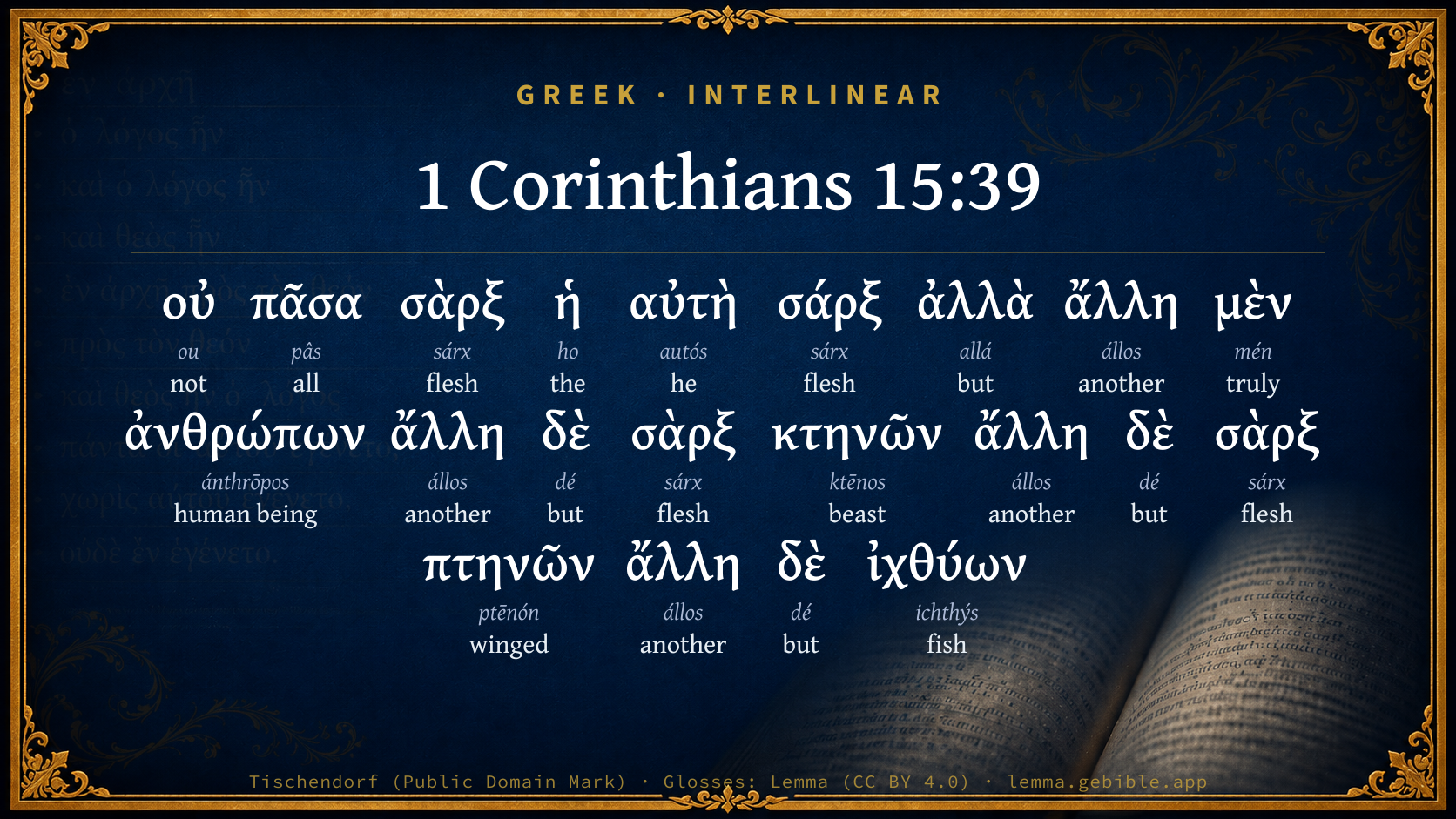
Download image
Cite this verse

1 Corinthians 15:39 (World English Bible). Public Domain. Lemma interlinear Bible study tool, https://lemma.gebible.app/v/1-corinthians/15/39.

Show BibTeX & RIS
BibTeX
RIS
English Translation
All flesh is not the same flesh, but there is one flesh of men, another flesh of animals, another of fish, and another of birds.
World English Bible · Public Domain
Highlights
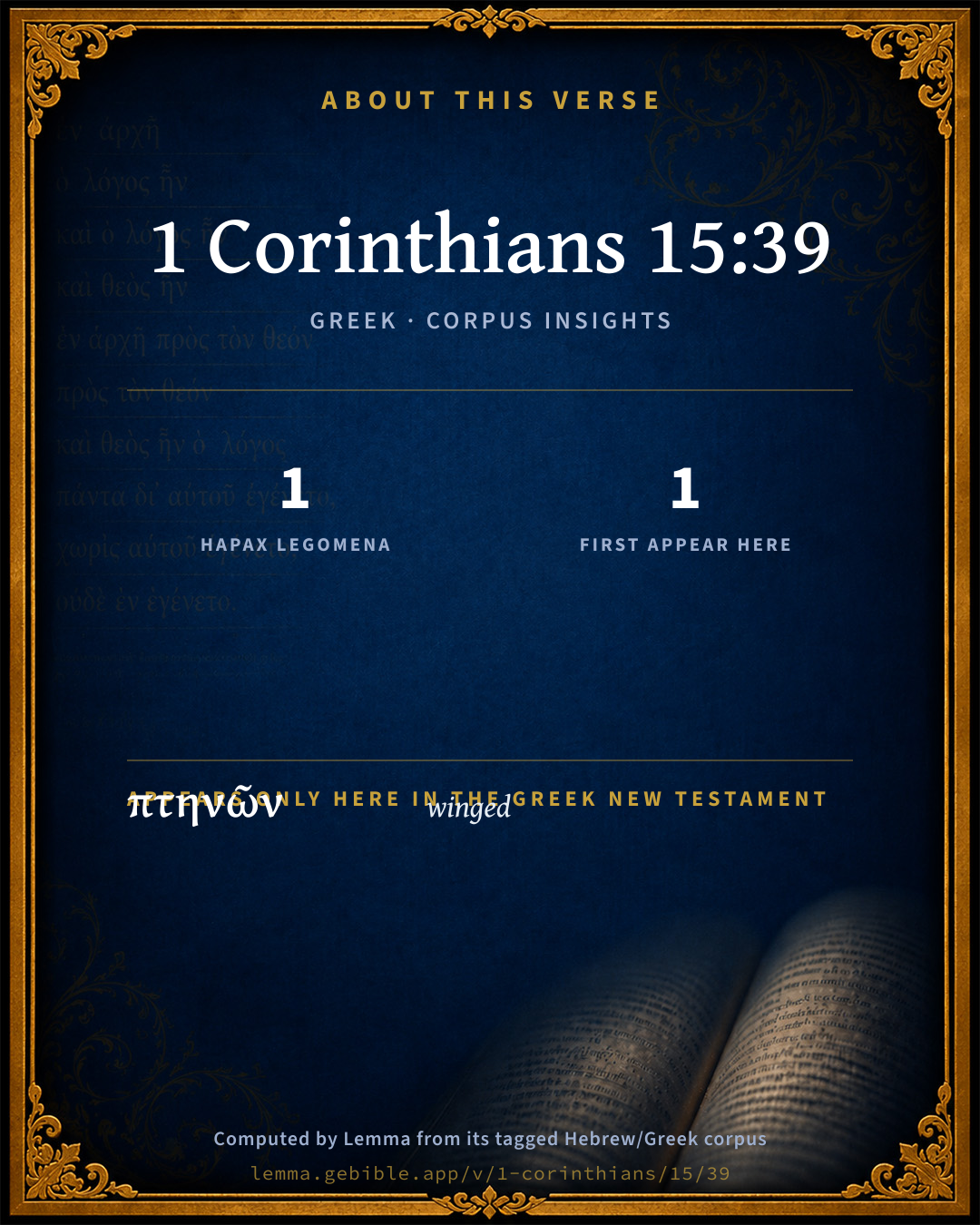
  • 1 hapax legomenon — only here in the Greek New Testament
  • 1 first appearance in the Greek New Testament
Full analysis ↓
Download a study sheet

One document with this verse’s original text, its word-by-word gloss line, the meaning frame, cross-references with their text, attributed commentary, and full source and license credits — printable, and it pastes into notes with its structure intact.

This verse Autodidact and up

Study sheet (.html) Plain text (.txt)

A passage Seminary Student

Up to 50 verses in one chapter. A passage sheet keeps up to 6 commentary sources and 12 cross-references per verse, in the order this page ranks them, and says so on the sheet whenever that leaves anything out. Ask for a single verse and you get the Autodidact verse sheet above.

Everything on this page stays free to read, with no account — the sheet is a download of what is already on screen, not access to it.

Want to remove ads? Support Godless Engineer
Compare translations 3

The same verse in 3 English versions, stacked beneath the original-language interlinear above. Click any original word for its lexicon entry.

Each is an independent rendering of the whole verse — the interlinear is not word-aligned to these translations.

Highlighted words mark where these versions differ — a whole-verse word diff, not a word-by-word alignment.

  • World English Bible Public Domain
    All flesh is not the same flesh, but there is one flesh of men, another flesh of animals, another of fish, and another of birds.
  • King James Version Public Domain
    All flesh is not the same flesh: but there is one kind of flesh of men, another flesh of beasts, another of fishes, and another of birds.
  • unfoldingWord Literal Text CC BY-SA 4.0
    Not all flesh the same flesh. Instead, one of men, and another flesh of animals, and another flesh of birds, and another of fish.

unfoldingWord Literal Text — © unfoldingWord, licensed CC BY-SA 4.0. Word-aligned USFM3 via Door43 (git.door43.org/unfoldingWord/en_ult).

Versions to compare (up to 4)

3 of 4 selected

Show all 19 translations

Every available English version of this verse, each an independent rendering of the whole verse.

  • World English Bible Public Domain
    All flesh is not the same flesh, but there is one flesh of men, another flesh of animals, another of fish, and another of birds.
  • Berean Standard Bible Public Domain
    Not all flesh is the same: Men have one kind of flesh, animals have another, birds another, and fish another.
  • Majority Standard Bible Public Domain
    Not all flesh is the same: Men have one kind of flesh, animals have another, fish another, and birds another.
  • King James Version Public Domain
    All flesh is not the same flesh: but there is one kind of flesh of men, another flesh of beasts, another of fishes, and another of birds.
  • American Standard Version (1901) Public Domain
    All flesh is not the same flesh: but there is one `flesh' of men, and another flesh of beasts, and another flesh of birds, and another of fishes.
  • Revised Version (1885) Public Domain
    All flesh is not the same flesh: but there is one flesh of men, and another flesh of beasts, and another flesh of birds, and another of fishes.
  • Geneva Bible (1599) Public Domain
    All flesh is not the same flesh, but there is one flesh of men, and another flesh of beastes, and another of fishes, and another of birdes.
  • Douay-Rheims (1899) Public Domain
    All flesh is not the same flesh: but one is the flesh of men, another of beasts, another of birds, another of fishes.
  • Young's Literal Translation Public Domain
    All flesh `is' not the same flesh, but there is one flesh of men, and another flesh of beasts, and another of fishes, and another of birds;
  • Literal Standard Version CC BY-SA 4.0
    All flesh [is] not the same flesh, but there is one flesh of men, and another flesh of beasts, and another of fishes, and another of birds;
  • Unlocked Literal Bible CC BY-SA 4.0
    Not all flesh is the same. Instead, there is one flesh of human beings, and another flesh for animals, and another flesh for birds, and another for fish.
  • unfoldingWord Literal Text CC BY-SA 4.0
    Not all flesh the same flesh. Instead, one of men, and another flesh of animals, and another flesh of birds, and another of fish.
  • Darby Bible Public Domain
    Every flesh [is] not the same flesh, but one [is] of men, and another flesh of beasts, and another [flesh] of birds, and another of fishes.
  • World Messianic Bible Public Domain
    All flesh is not the same flesh, but there is one flesh of men, another flesh of animals, another of fish, and another of birds.
  • Webster's Bible Public Domain
    All flesh is not the same flesh; but there is one kind of flesh of men, another flesh of beasts, another of fishes, and another of fowls.
  • Free Bible Version CC BY-SA 4.0
    What living things are made from is not the same. Human beings have one kind of body tissue, while animals have another, birds another, and fish another.
  • Bible in Basic English Public Domain
    All flesh is not the same flesh: but there is one flesh of men, another of beasts, another of birds, and another of fishes.
  • Text-Critical English NT CC BY 4.0
    Not all flesh is the same flesh, but there is one kind for humans, another for animals, another for fish, and another for birds.
  • Tyndale New Testament (1534) Public Domain
    All flesshe is not one manner of flesshe: but ther is one maner flesshe of men another maner flesshe of beastes another maner flesshe of fysshes and another of byrdes.

Literal Standard Version (2020), Covenant Press — licensed CC BY-SA 4.0. Text via the HelloAO Bible API (eBible.org). Unlocked Literal Bible (unfoldingWord) — licensed CC BY-SA 4.0. Text via the HelloAO Bible API (eBible.org). unfoldingWord Literal Text — © unfoldingWord, licensed CC BY-SA 4.0. Word-aligned USFM3 via Door43 (git.door43.org/unfoldingWord/en_ult). Free Bible Version, Dr. Jonathan Gallagher — licensed CC BY-SA 4.0. Text via the HelloAO Bible API (eBible.org).

Word by word

More ways to search: Search by grammar → Find every occurrence → Compare this word →

Practice this passage: Drill this verse → Learn its vocabulary →

πτηνῶν
ptēnón
G4421
“winged”
Adjective, Genitive, Plural, Neuter
Part of Speech
Adjective
Case
Genitive
Number
Plural
Gender
Neuter
Full Thayer's Definition

Origin: contraction for G4071

TDNT: None

1. furnished with wings 2. winged, flying a. of birds
  1. οὐ ou G3756 “not” Particle, Negative
  2. πᾶσα pâs G3956 “all” Adjective, Nominative, Singular, Feminine
  3. σὰρξ sárx G4561 “flesh” Noun, Nominative, Singular, Feminine
  4. ἡ ho G3588 “the” Article, Nominative, Singular, Feminine
  5. αὐτὴ autós G846 “he” Personal pronoun, Nominative, Singular, Feminine
  6. σάρξ sárx G4561 “flesh” Noun, Nominative, Singular, Feminine
  7. ἀλλὰ allá G235 “but” Conjunction
  8. ἄλλη állos G243 “another” Adjective, Nominative, Singular, Feminine
  9. μὲν mén G3303 “truly” Particle
  10. ἀνθρώπων ánthrōpos G444 “human being” Noun, Genitive, Plural, Masculine
  11. ἄλλη állos G243 “another” Adjective, Nominative, Singular, Feminine
  12. δὲ dé G1161 “but” Conjunction
  13. σὰρξ sárx G4561 “flesh” Noun, Nominative, Singular, Feminine
  14. κτηνῶν ktēnos G2934 “beast” Noun, Genitive, Plural, Neuter
  15. ἄλλη állos G243 “another” Adjective, Nominative, Singular, Feminine
  16. δὲ dé G1161 “but” Conjunction
  17. σὰρξ sárx G4561 “flesh” Noun, Nominative, Singular, Feminine
  18. ἄλλη állos G243 “another” Adjective, Nominative, Singular, Feminine
  19. δὲ dé G1161 “but” Conjunction
  20. ἰχθύων ichthýs G2486 “fish” Noun, Genitive, Plural, Masculine

About this verse

These counts appear in no published source. They are computed here, from the morphology-tagged text and Lemma’s own curated glosses. What Lemma adds →

21
words
13
distinct lemmas
Pauline Epistles
section

Notable vocabulary

1 hapax legomenon — a word that appears only here in the entire Greek New Testament:

  • πτηνῶν winged G4421

First appearance in Scripture

This word makes its first canonical appearance in the Greek New Testament here:

  • πτηνῶν winged G4421

Shared distinctive vocabulary

κτηνῶν beast G2934 occurs in 4 verses of the Greek New Testament. Also found in:
Repetition

Words recur within this verse:

  • σὰρξ flesh G4561 ×4
  • ἄλλη another G243 ×4
  • δὲ but G1161 ×3

Cross-references

1

Topical passages linked to 1 Corinthians 15:39 in the Treasury of Scripture Knowledge — connected by theme and wording, ordered by reader-vote popularity; previews shown in the World English Bible.

  • Genesis 1:20–26 God said, "Let the waters swarm with swarms of living creatures, and let birds fly above the earth in the open expanse of sky."

Cross-references courtesy of OpenBible.info (CC BY 4.0).

Commentary

Notes on 1 Corinthians 15:39 from classic Christian and Jewish commentators (each source and its license shown beneath its notes). The classic Christian expositions comment on the surrounding passage and are grouped to its opening verse, so a note may address several verses; the Jewish commentaries on the Tanakh (Rashi and others) are per-verse, so they appear only where the commentator wrote on this verse.

Lemma curates 59 commentaries, every one of them public domain or Creative Commons licensed, each selected and text-cleaned for this edition rather than reprinted as found. About our sources →

Joseph Benson's Commentary

1Co 15:39-41. All flesh, &c. — As if he had said, There is an immense variety in the works of God, even in those which fall under the inspection of our senses, feeble and limited as they are, while we dwell in flesh and blood. For we see even earthy bodies differ from earthy, and heavenly bodies from heavenly. What wonder then if heavenly bodies differ from earthy? or the bodies which rise from those that lie in the grave? “As in the preceding verse,” says the author last quoted, “the apostle directs us to consider the greatness of the power of God, displayed in the production of that endless variety of vegetable substances for food to man and beast, with which we are surrounded; so in this verse he directs our attention to the same power of God displayed in that wonderful diversity of animal substances, which it hath formed into different sorts of organized bodies, each with members properly adapted to the instincts of its inhabitant, and to the manner of life for which it is designed;” men, beasts, fishes, fowls. There are also celestial bodies, &c. — As if he had said, The greatness of his power God hath likewise showed, in the formation of other bodies which are inanimate, both celestial, as the sun, moon, and stars, and terrestrial, such as fossils and minerals. But the glory of the celestial is one, &c. — Different indeed is the glory of the one from that of the other, and the brightest lustre which the terrestrial can have, falls very short of that of the celestial. There is one glory of the sun, &c. — Yea, and the heavenly bodies themselves differ from each other. From the whole of these principles, the apostle draws this conclusion; — that since God’s power has been so “gloriously manifested in the greatness and variety of the material substances which he has already formed, and in the diversity of their configuration, that person must be a fool indeed, (1Co 15:36,) who takes upon him to affirm that God cannot raise up bodies for his saints at the last day, in form and use similar to their present bodies, and perfectly adapted to the faculties of their minds, and to the new world in which they are to live.” This last observation is peculiarly worthy the reader’s attention. Our new bodies, what qualities soever they may possess, will doubtless be perfectly adapted to the faculties of our minds, and to the new world in which we shall be placed: as our present bodies are adapted to the faculties we now possess, and to the world in which we now live; and as we see the bodies of all creatures are suited to the instincts God hath given them, and to the element or place in which they have their abode, whether fish in the water, fowls in the air, or cattle and creeping things on or within the dry land. Accordingly, when any living creature is destined to change the place of its abode, it receives a new body, adapted to its new situation: as, for example, the silk-worm, when it is no longer to be confined to the leaves of the mulberry-tree, but to have the freedom and pleasure of roaming at large in the spacious regions of the air, is furnished with a new and winged body, adapted to its new state and element. And here arises a question: Is it not probable that at least one important reason why we are to receive new bodies, and are not always to remain disimbodied spirits, (as we shall be in the intermediate state between death and judgment,) is, because we are destined to remove into a new world, far more perfect and glorious than this fallen and disordered one in which we now are? — a world in which there will be no more curse, but the throne of God and of the Lamb shall be in it, and his servants shall serve him, and shall see his face. In this new world, God, who never sinks, but always rises to higher and higher perfection in his works, will certainly make a far more glorious display of his wisdom, power, and goodness, and other attributes, than he has done in this present world; and it is therefore necessary that we should have bodies furnished with senses and other members adapted to that world, and enabling us to hold connection and intercourse with it, and to apprehend, enjoy, and be instructed in the further knowledge of our glorious Creator, by the excellences of it, so superior to any we had witnessed in this present earth, the abode of our infancy and childhood. But suffice it at present to have given a hint of this.

Joseph Benson's Commentary on the Old and New Testaments (1811–1818) — public domain. Text from a community e-Sword module.

Bengel's Gnomon

Johann Albrecht Bengel

1Co 15:39. Οὐ πᾶσα, all not) This is a universal negative. Every kind of flesh is different from the others. Paul shows, that terrestrial bodies differ from terrestrial, and celestial from celestial, 1Co 15:41: but in such a way as to make each of these refer to the further illustration of the difference of the body from its seed, and of celestial bodies from those that are terrestrial; for in the apodosis he lays down nothing respecting the degrees of glory, but leaves it as it were in an enigma to be considered by wise men, while he accounts it sufficient to have openly asserted the glory of the resurrection bodies.—ἄλλη ἀνθρώπων, one kind of flesh of men) He elegantly omits the word flesh, when he places the flesh of brutes in opposition to that of man. κτήνη here is applied to all quadrupeds; for fishes and birds are opposed to them.—ἰχθύων, of fishes) Therefore those, who eat fishes, eat flesh, and that too the more sumptuously, as it is a delicate variety.

Bengel's Gnomon of the New Testament — English translation (T&T Clark, Edinburgh, 1860) — public domain. Text from a community e-Sword module.

Meyer's Critical & Exegetical Commentary

Heinrich August Wilhelm Meyer

1Co_15:39-41. In order to make it conceivable that the same body need not come forth again, further reference is now made to the manifold diversity of organic forms in nature; so also faith in the resurrection cannot be bound up with the assumption of the sameness of the present and the future bodily organism. Very diverse are, namely: (1) the kinds of animal flesh (1Co_15:39); (2) the heavenly and earthly bodies (1Co_15:40); and (3) the lustre of the sun, of the moon, and of the stars (1Co_15:41).

σὰρξ κτηνῶν] flesh of cattle, i.e. not quadrupedum generally (so de Wette and Osiander, following older interpreters), but also not simply jumentorum (van Hengel), but pecorum (Vulgate), which are kept for household use and for burden-bearing; Plato, Crit. p. 109 B; Herod. ii. 41; Xen. Anab. iii. 1. 19, 1Co_4:7; 1Co_4:17; Luk_10:34; Act_23:24.

σώματα ἐπουράνια] heavenly bodies, i.e. bodies to be found in heaven. Comp. on Joh_3:12; Php_2:10. The bodies of the angels are meant by this (Mat_22:30; Luk_20:36; Phil. l.c.). So, too, de Wette.[73] Were we to understand by these words, as is usually done (so, among others, Hofmann; Hahn, Theol. d. N. Test. I. p. 265; Delitzsch, Psychol. p. 66; Philippi, Glaubensl. II. p. 292 f.), the heavenly bodies (sun, moon, and stars), we should be attributing to the apostle either our modern use of language, or the non-biblical mode of regarding the stars as living beings (see Galen, de usu part. 17 in Wetstein[74]), which is not to be proved even from Job_38:7. The same holds in opposition to Billroth, who understands the words as meaning heavenly organisms generally and indefinitely, from which sun, moon, and stars are then named by way of example. Sun, moon, and stars are not comprehended at all under σώματα ἐπουρ., and are first adduced in 1Co_15:41 as a third analogue, and that simply in reference to their manifold δόξα. The whole connection requires that ΣΏΜΑΤΑ should be bodies as actual organs of life, not inorganic things and materials; as, for instance, stones (Lucian, vitt. auct. 25), water (Stob. fl. app. ii. 3), and material things generally (Plato, Polit. p. 288 D) are designated in Greek writersnot, however, in the New Testamentby σῶμα. Had Paul meant heavenly bodies in the modern sense, he would in that case, by describing them as bodies, have committed a μετάβασις εἰς ἄλλο γένος; whereas, on the contrary, the bodies of the angels, especially when we consider the similarity of those who are raised up to the angels, which was taught by Jesus Himself, were essentially included as relevant to the subject in the list of the diversities of bodily organization here enumerated (in opposition to Hofmanns objection). He then, 1Co_15:41, brings forward in addition the heavenly bodies only in respect of the diversitynot of their bodies, butof the lustre of their light.

σώματα ἐπίγεια] bodies to be found on earth, that is, the bodies of men and beasts.

Both kinds of bodies, the heavenly and earthly, are of different sorts of peculiar glory,the former encompassed with a heavenly radiancy (Mat_28:3; Act_12:7, al.), the latter manifesting strength, grace, beauty, skilful construction, and the like in their outward appearance. Notice that in 1Co_15:40 ἑτέρα is used, because the subjects are of specifically different kinds and qualities. It is otherwise in 1Co_15:41, comp. 1Co_15:39.1Co_15:41. Sun-lustre is one thing, and moon-lustre another, and lustre of stars another (i.e. another than solar and lunar lustre). Paul uses, however, ἀστέρων, not ἈΣΤΈΡΟς, because the stars too among themselves have not one and the same lustre; hence he adds by way of explanation: for star differs from star in lustre. Διαφέρει is thus simply differt (Vulgate), not excellit (Mat_6:26; Mat_10:31; Mat_12:12), which the context does not suggest. Regarding ἐν with ΔΙΑΦΈΡΕΙ, comp. Plato, Pol. viii. p. 568 A; Dem. 291, 17; Bremi, ad Isocr. I. p. 169. The accusative or dative of more precise definition is more usual (Lobeck, ad Phryn. p. 394). The design of 1Co_15:4 is not to allude to the different degrees of glory of the bodies of the saints (Chrysostom, Oecumenius, Theodoret, Calovius, Estius, al.), which is neither indicated in what precedes nor adverted to in the application 1Co_15:42 ff., and hence has no foundation in the context; but Calvin rightly remarks: Non disputat, qualis futura sit conditionis differentia inter sanctos post resurrectionem, sed quid nunc different corpora nostra ab iis, quae olim recipiemus … ac si diceret: nihil in resurrectione futurum doceo, quod non subjectum sit jam omnium oculis. Comp. also Krauss.

Generally, let us beware of forcing upon the individual points in 1Co_15:39-41 different individual references also,[75] contrary to the application which the apostle himself makes in 1Co_15:42-44.

[73] Comp. also Kurtz, Bibel u. Astron. p. 157; Holsten, z. Ev. d. Paul. u. Petr. p.72f.

[74] Chrysostom and Theophylact (comp. also Theodoret) go entirely astray, supposing that σώμ. ἐπουρ. denotes the pious, and σώμ. ἐπίγεια the godless, in spite of the δόξα which is attributed to both.

[75] Tertullian, de resurr. 52, may serve as a warning; he says on ver. 39: Alia caro hominis, i.e. servi Dei; alia jumenti, i.e. ethnici; alia volucrum, i.e. martyrum; alia piscium, i.e. quibus aqua baptismatis sufficit. On ver. 41, again: alia solis gloria, i.e. Christi; alia lunae, i.e. ecclesiae; et alia stellarum, i.e. seminis Abrahae.

Meyer — Critical and Exegetical Commentary on the New Testament — English translation by Peter Christie, edited by Frederick Crombie (T&T Clark, 1880) — public domain. Text from a community e-Sword module.

Expositor's Greek Testament

ed. W. Robertson Nicoll

1Co 15:39 . The rest of the § goes to sustain 1Co 15:38 b , showing the inexhaustible variety of organic forms in the Divine economy of nature and the fitness of each for the life it clothes. This is manifest, to begin with, in the varied types of animal life: οὐ πᾶσα σὰρξ ἡ αὐτὴ σάρξ , “All flesh is not the same flesh” in the zoological realm there is no uniformity, but endless differentiation. (Ed [2493] makes πᾶσα σὰρξ predicate “the same flesh is not all flesh,” i.e. , physical assimilation means differentiation getting out of the sentence a physiological idea obscure in itself and not very relevant to the context). Instead of men, cattle, birds, fishes , with their heterogeneous natures, being lodged in the same kind of corporeity, their frame and organs vary with their inner constitution and needs. If God can find a body for beast and fish, in the lower range, no less than for man, why not, in the higher range, for man immortal no less than for man mortal? κτῆνος (from κτάομαι ), denoting cattle as beasts of purchase in the first instance, is applied to four-footed beasts at large: cf. Gen 1:25 ff; Gen 2:20 .

[2493] T. C. Edwards’ Commentary on the First Ep. to the Corinthians . 2

The Expositor's Greek Testament, edited by W. Robertson Nicoll (1897–1910) — public domain. Text from a community e-Sword module.

Hodge's Commentary on Romans, Ephesians & First Corinthians

Charles Hodge

1Co_15:39

All flesh (is) not the same flesh: but (there is) one (kind of) flesh of men, another flesh of beasts, another of fishes, (and) another of birds.

If even here, where the general conditions of life are the same, we see such diversity in animal organizations, flesh and blood appearing in so many forms, why should it be assumed that the body hereafter must be the same cumbrous vehicle of the soul that it is now?

Charles Hodge — Commentary on Romans (1835), First Corinthians (1857), and Ephesians (1856) — public domain. Text from a community e-Sword module.

Jamieson, Fausset & Brown

Robert Jamieson, A. R. Fausset & David Brown

Illustrations of the suitability of bodies, however various, to their species: the flesh of the several species of animals; bodies celestial and terrestrial; the various kinds of light in the sun, moon, and stars, respectively.

flesh--animal organism [DE WETTE]. He implies by the word that our resurrection bodies shall be in some sense really flesh, not mere phantoms of air [ESTIUS]. So some of the oldest creeds expressed it, "I believe in the resurrection of the flesh." Compare as to Jesus' own resurrection body, Luk 24:39; Joh 20:27; to which ours shall be made like, and therefore shall be flesh, but not of animal organism (Phi 3:21) and liable to corruption. But Co1 15:50 below implies, it is not "flesh and blood" in the animal sense we now understand them; for these "shall not inherit the kingdom of God."

not the same--not flesh of the same nature and excellency. As the kinds of flesh, however widely differing from one another, do not cease to be flesh, so the kinds of bodies, however differing from one another, are still bodies. All this is to illustrate the difference of the new celestial body from its terrestrial seed, while retaining a substantial identity.

beasts--quadrupeds.

another of fishes . . . another of birds--Most of the oldest manuscripts read thus, "another FLESH of birds . . . another of fishes": the order of nature.

Jamieson, Fausset & Brown — Commentary Critical and Explanatory on the Whole Bible (1871) — public domain (CC PDM 1.0). Text via the HelloAO Bible API.

Adam Clarke's Commentary

Verse 39. All flesh is not the same flesh] Though the organization of all animals is, in its general principles, the same, yet there are no two different kinds of animals that have flesh of the same flavour, whether the animal be beast, fowl, or fish. And this is precisely the same with vegetables.

In opposition to this general assertion of St. Paul, there are certain people who tell us that fish is not flesh; and while their religion prohibits, at one time of the year, the flesh of quadrupeds and fowls, it allows them to eat fish, fondly supposing that fish is not flesh: they might as well tell us that a lily is not a vegetable, because it is not a cabbage. There is a Jewish canon pronounced by Schoettgen which my readers may not be displeased to find inserted here: Nedarim, fol. 40:

הנודר מן הבשר יהא אסור בבור רגים והגים

He who is bound by a vow to abstain from flesh, is bound to abstain from the flesh of fish and of locusts.

From this it appears that they acknowledged that there was one flesh of beasts and another of fishes, and that he was religiously bound to abstain from the one, who was bound to abstain from the other.

Adam Clarke's Commentary on the Bible (1810–1826) — public domain. Text from a community e-Sword/MySword module.

Ellicott's Commentary for English Readers

(39) All flesh is not the same flesh.—Better, There is no flesh the same flesh. All organisms have the same basis; there is a “structural unit” in all animal life; but God gives this a vast variety of form in man, in beast, in fish. The same divine prescience which gives to all flesh here the form suited to its condition and surroundings can give hereafter another form to it suitable to the new conditions and surroundings in which it will then be placed. If we had only seen flesh in the form of an animal, and were told that “flesh” could live in the sea, we might have equally argued, “How, with what body?” but seeing as we do that there is a variety of bodies, we feel no such difficulty.

A Bible Commentary for English Readers, edited by Charles John Ellicott (1878–1897) — public domain. Text from a community e-Sword module.

The Cambridge Bible for Schools and Colleges

gen. ed. J. J. S. Perowne

39. All flesh is not the same flesh] The same principle is now applied to animate which has been applied to inanimate nature. There are different varieties and forms of bodily life (σάρξ). The Apostle in this and the two following verses lays down the doctrine (see note on 1Co_15:42) that the life hereafter will depend in every way upon the life here; that the body raised will correspond to the body sown; that the character impressed upon it during this life will remain with it throughout eternity. And this not merely in the broad general distinction between good and bad (see Gal_6:7-8) but in the minuter shades of individual character. Recent editors, following the best MSS. and versions, place fishes in their proper place, last in the text, as in zoological order.

The Cambridge Bible for Schools and Colleges (gen. ed. J. J. S. Perowne; Cambridge University Press, 1878–1918) — public domain. Text from a community e-Sword module.

John Gill's Exposition

So also is the resurrection of the dead,.... This will be the case and condition of risen bodies, they will be as different from what they now are, though they will be the same in substance, as a stalk of wheat in its blade and ear, and full corn in the ear, is from the naked grain, when cast into the earth; or as the flesh of men is from the flesh of beasts, fishes, and birds; or as celestial bodies from terrestrial ones; or as the glory of the sun differs from the glory of the moon and stars; or as one star differs from another star in glory; that this is the apostle's sense is clear from the induction of particulars following, by which he explains in clear terms what he before signified by similitudes:

it is sown in corruption; it should be observed, that the word sown, in this and the following verses, does not merely relate to the interment of the body, but also to its generation; and includes its state, condition, and character, during life; as well as points out what it is at death, and its sepulture in the earth: it is from first to last a corruptible body; it is born frail and mortal, and liable to corruption and death; it is corrupted with sin, and so a vile body; there is a world of iniquity in one of its members, the tongue, and what then must there be in all its parts? but besides this moral corruption, in which it is during the present state, it is liable to a natural one; from the crown of the head to the sole of the foot, it may be covered with wounds, bruises, and putrefying sores; a right arm may be dried up and withered away, and a leg may corrupt and mortify, and so any other part; the whole is supported by corruptible things, by meat that perisheth; and which if it did not corrupt and perish, would not be nourishing; and as meats are for the belly, and the belly for meats, in a short time God will destroy both it and them; the whole frame and texture of the body will be dissolved by death, and be brought to worms, corruption, and dust; and in this case will lie in the grave till the resurrection morn:

it is raised in incorruption: the very same body that was sown, generated, lived, and died, shall be raised again, but different from what it was; it will be incorruptible; its parts will be no more subject to corruption; it will not be supported by corruptible things; it will be immortal, and never die more, and will be clear of all its moral corruption; it will no more be a vile body, but fashioned like to the holy and glorious body of Christ.

John Gill's Exposition of the Whole Bible (1746–1763) — public domain (CC PDM 1.0). Text via the HelloAO Bible API.

Trapp's Complete Commentary

John Trapp

39 All flesh is not the same flesh: but there is one kind of flesh of men, another flesh of beasts, another of fishes, and another of birds.

Ver. 39. All flesh is not the same] This is another answer to the epicure, who might haply reply, and say, If man’s flesh, when rotted, shall revive, why not likewise the flesh of other creatures? The apostle answereth, "All flesh is not the same," &c. Man’s flesh only is informed by a reasonable and immortal soul, not so the flesh of other creatures: and hence the difference.

John Trapp, A Commentary or Exposition upon All the Books of the Old and New Testament (1647–1656) — public domain. Text from a community e-Sword module.

Albert Barnes' Notes on the Bible

All flesh is not the same flesh - This verse and the following are designed to answer the question 1Co 15:35, “with what bodies do they come?” And the argument here is, that there are many kinds of bodies; that all are not alike; that while they are bodies, yet they partake of different qualities, forms, and properties; and that, therefore, it is not absurd to suppose that God may transform the human body into a different form, and cause it to be raised up with somewhat different properties in the future world. Why, the argument is, why should it be regarded as impossible? Why is it to be held that the human body may not undergo a transformation, or that it will be absurd to suppose that it may be different in some respects from what it is now? Is it not a matter of fact that there is a great variety of bodies even on the earth? The word flesh here is used to denote body, as it often is. 1Co 5:5; 2Co 4:11; 2Co 7:1; Phi 1:22, Phi 1:24; Col 2:5; 1Pe 4:6.

The idea here is, that although all the bodies of animals may be composed essentially of the same elements, yet God has produced a wonderful variety in their organization, strength, beauty, color, and places of abode, as the air, earth, and water. It is not necessary, therefore, to suppose that the body that shall be raised shall be precisely like that which we have here. It is certainly possible that there may be as great a difference between that and our present body, as between the most perfect form of the human frame here and the lowest repthe. It would still be a body, and there would be no absurdity in the transformation. The body of the worm; the chrysalis, and the butterfly is the same. It is the same animal still. Yet how different the gaudy and frivilous butterfly from the creeping and offensive caterpillar! So there may be a similar change in the body of the believer, and yet be still the same. Of a sceptic on this subject we would ask, whether, if there had been a revelation of the changes which a caterpillar might undergo before it became a butterfly - a new species of existence adapted to a new element, requiring new food, and associated with new and other beings - if he had never seen such a transformation, would it not be attended with all the difficulty which now encompasses the doctrine of the resurrection? The sceptic would no more have believed it on the authority of revelation than he will believe the doctrine of the resurrection of the dead. And no infidel can prove that the one is attended with any more difficulty or absurdity than the other.

Albert Barnes' Notes on the Bible (1834–1885) — public domain. Text from a community e-Sword/MySword module.

Matthew Poole's English Annotations

Flesh is a kind of body, but it is of various degrees of dignity and excellency, in respect of the qualities of it: the flesh of men is of a differing excellency from the flesh of beasts; and there is a difference in natural qualities between the corporeal substances of beasts, and of fishes, and birds; yet they are all bodies, they are all flesh; our distinction between flesh and fish, is but according to our idiom or propriety of speaking; we read of the flesh of fish, Lev 11:10,11.

Matthew Poole's English Annotations on the Holy Bible (1683–1685) — public domain. Text from a community e-Sword/MySword module.

Whedon's Commentary on the Bible

Daniel D. Whedon

39-41. As the necessary corruptness of all matter, and therefore the necessary corruptness of all bodies, here or hereafter, is the ground assumption of the Gnostical objector against the possibility of the resurrection, Paul now enlarges on the varieties of body, and the various glories which material bodies are made by God to assume. These are all to illustrate the difference between the dying body and the resurrection body.

39. All… not… same flesh—All are alike matter and flesh; but God’s power is competent to clothe the same matter with varied properties.

Daniel D. Whedon (gen. ed.), Commentary on the Old and New Testaments (1874–1909) — public domain. Text from a community e-Sword module.

The Pulpit Commentary

All flesh is not the same flesh. In other words, animal organisms differ from each other, just as do the vegetable. Another of beasts. "The germinal power of the plant transmutes the fixed air and the elementary base of water into grass or leaves, and on these the organic principle in the ox or the elephant exercises an alchemy still more stupendous. As the unseen agency weaves its magic eddies, the foliage becomes indifferently the bone and its marrow, the pulpy brain and the solid ivory. That which you see is blood, is flesh, is itself the work, or shall I say the translucence of the invisible energy which soon surrenders or abandons them to inferior powers (for there is no pause nor chasm in the activities of nature) which repeat a similar metamorphosis according to their kind: these are not fancies, conjectures, or even hypotheses, but facts" (Coleridge, "Aids to Reflection").

Vers. 39-44.

Enlarged conceptions of the term "body.

The general idea of "body" is a material form so set in relation to a material world, by its senses and sensibilities, that a spiritual being using such form, or body, can dwell in the material world. Then there can be all sorts of bodies, according to the relation which has to be borne in this material world, or the relation which has to be borne in other worlds which we may call material or spiritual. We only suggest points of thought, scarcely venturing to set them in order for public homily or sermon.

1. Within our present earth sphere the term "body" is comprehensive. The apostle speaks of bodies of bird, fish, beast, men, in all cases the body being determined by the relation to the material world which is desired; but we can properly speak of distinct body, or form, in relation to intellectually moral or spiritual life. These are within the bodily form, but can be conceived as distinct, from it.

2. There is no necessary reason for limiting the term "body" to our earthly sphere. Wherever any spirit is, if it desires relation with any form of created existence, it must have a form, a body, for the purposes of that relation. The various conceptions we may have of body beyond our earth sphere need careful study. It may further be shown how the diversities of body, and bodily capacity, help us to understand the possibility of different degrees of glory, and yet in each case a fulness of glory. Happiness is here varied and limited by capacity. It must be thus varied and limited anywhere. How the term "spiritual" can be applied to body we may be helped to apprehend by three things:

1. the angelophanies of the Old Testament;

2. the incarnation of the Son of God;

3. the forty days which our Lord spent in the resurrection body. R.T.

Vers. 55-57.

Death"s sting and strength.

Death, as being the worst, is regarded as the representative of all human woes. Give the common and familiar sentiments about death, its sadness, its bitterness, its hopelessness, its terrible forms, its lasting separations, which prevail amongst men and even among Christians. And yet, what is death, but the soul putting aside on the shelf the tool which it has long used, but now has done with, because its work is finished? Still, philosophize as we may; get up on a high Christian platform as we ought; win the keen spiritual insight if we will; the fact remains that death has its sting, and we all feel it and live in the fear of it.

I WHAT IS THIS STING? It is the conscience of sin; the fear of our just deserts; the conviction that due avengements of wrong doing must come in the life beyond.

II WHAT IS THE STRENGTH OF THIS STING? It is the revealed Law of God, which, we are sure, has its sanctions. It must take cognizance of our sin. Its punishments cannot have earthly limitations. Show that the redemption in Christ Jesus plucks death"s sting away, because it quiets and satisfies the Law, and forgives and removes the sin. R.T.

The Pulpit Commentary (1880–1919), ed. H.D.M. Spence-Jones & Joseph S. Exell — public domain. Text from a community e-Sword module.

John Wesley's Explanatory Notes

All flesh - As if he had said, Even earthy bodies differ from earthy, and heavenly bodies from heavenly. What wonder then, if heavenly bodies differ from earthy? or the bodies which rise from those that lay in the grave?

John Wesley, Explanatory Notes Upon the Whole Bible (1754–1765) — public domain. Text via the GEBible commentary corpus.

Burkitt's Expository Notes on the New Testament

William Burkitt

St. Paul here proceeds farther to answer the question which the philosophers at Corinth put, namely, with what bodies do persons come forth out of the grave? He tells them, they shall be vastly different in qualities from what they are at present; and this he illustrates by similitude.

As, says he, there is difference in bodies here below, some more excellent, as the flesh of men, others less excellent, as the flesh of beasts and birds; and as there is a difference between celestial and terrestrial bodies, yea, a difference between celestial bodies among themselves, one excelling another in glory, as the sun excels the moon, and one star excels another; so will it be in the resurrection, the bodies that rise will vastly differ from those that died.

Here note, That all this is to be understood of the resurrection of the righteous, since it is their bodies alone that shall undergo this happy change, which in the next words the apostle describes.

William Burkitt's Expository Notes on the New Testament (1700–1703) — public domain. Text from a community e-Sword module.

McGarvey & Pendleton's Commentaries

J. W. McGarvey

All flesh is not the same flesh: but there is one flesh of men, and another flesh of beasts, and another flesh of birds, and another of fishes .

J. W. McGarvey (with Philip Y. Pendleton), Commentaries on the New Testament (The Fourfold Gospel, 1914; Acts; and the epistles) — public domain. Text from a community e-Sword/MySword module.

The People's New Testament

B. W. Johnson

39. All flesh is not the same. All the different animals have bodies unlike, and suited to their conditions.

B. W. Johnson's The People's New Testament with Notes (1889–1891) — public domain. Electronic text from the Christian Classics Ethereal Library (CCEL) ThML edition.

Cambridge Greek Testament for Schools and Colleges

39. [σάρξ] before ἀνθρώπων rec. with Peshito. Om. אABDEFG Vetus Lat. Vulg.

σάρξ before πτηνῶν אBDEFG and some copies of Vulg. Om. rec. with A Peshito and Vulg. (auth.). אABDE Vulg. Peshito have πτηνῶν before ἰχθύων. Rec. reverses the order with FG.

39. οὐ πᾶσα σάρξ. The same principle is now applied to animate which has been applied to inanimate nature. There are different varieties and forms of bodily life (σάρξ). The Apostle in this and the two following verses lays down the doctrine (see note on 1Co 15:42) that the life hereafter will depend in every way upon the life here; that the body raised will correspond to the body sown; that the character impressed upon it during this life will remain with it throughout eternity. And this not merely in the broad general distinction between good and bad (see Gal 6:7-8), but in the minuter shades of individual character.

Cambridge Greek Testament for Schools and Colleges (Cambridge University Press, 1896; 21 vols, various authors incl. Carr, Maclear, Plummer, Farrar, Lumby, Moule, M. R. James, Simcox) — public domain. Text from a community e-Sword module.

Alford’s Greek Testament

Henry Alford

39-41.] And the more,—because we have examples from analogy of various kinds of bodies; viz. (1) in the flesh of animals (ver. 39): (2) in celestial and terrestrial bodies (ver. 40): (3) in the various characters of light given by the sun, moon, and stars.

σάρξ] animal organism (De W.). Dean Stanley’s former rendering (corrected in his 3rd edn.) of οὐ πᾶσα σάρξ, ἡ αὐτὴ σάρξ, ‘no flesh is the same flesh,’ is contrary to the usage of the passages which he alleged to defend it, where the negative is always attached to the verb; οὐ δικαιωθήσεται πᾶσα σάρξ, Rom 3:20; Gal 2:16. See Mat 24:22 ; Act 10:14; ch. 1:29; 1Jn 3:15; Rev 7:16; Rev 9:4. On the other hand, where the negative is attached to πᾶς, as here, the sentence is a particular negative, not an universal: e.g. Rom 10:16, ἀλλʼ οὐ πάντες ὑπήκουσαν: 9:6, 7; Heb 3:16; Mat 7:21, οὐ πᾶς ὁ λέγων μοι κύριε κύριε εἰσελεύσεται εἰς τὴν βασιλείαν τῶν οὐρανῶν,—where the rendering in question would involve portentous consequences indeed. I observe that Conyb, also, although disapproving on the ground of the sense, adds, “the words of the Greek text no doubt admit of such a rendering.”

κτηνῶν] properly (κτέανος, κτάομαι) animals possessed by man: but used in a wider sense for quadrupeds in general.

Henry Alford, The Greek Testament (1849–1861) — public domain. Text from a community e-Sword module.

International Critical Commentary

39. οὐ πᾶσα σὰρξ ἡ αὐτὴ σάρξ. ‘Not all flesh is the same flesh.’ The difference between our present body and our risen body may be greater than that between a seed and the plant which springs from it. It may be greater than that between men and fishes. In Gen 1:20-27 fishes are mentioned before fowls, and we have an ascending scale, fishes, birds, beasts, man; here we have a descending one. The use of κτηνῶν rather than τετραπόδων (Rom 1:23; Act 10:12, Act 11:6), and of πτηνῶν (here only) rather than πετεινῶν (ibid. et saepe), is for the sake of alliteration, of which St Paul is fond (2Co 7:4, 2Co 8:22, 2Co 9:5, 2Co 10:6, 2Co 13:2).

T R inserts σάρξ after ἄλλη μέν with many cursives and some versions, and AV. follows: אA B D E F etc. omit. A K L P omit σάρξ before πτηνῶν: א B D E F G insert. D* F G correct πτηνῶν to the more usual πετεινῶν. F K L transpose πτηνῶν and ὶχθύων, perhaps influenced by the order in Gen 1:20, and AV. follows. Already in Gen 1:25, Gen 2:20 κτῆνος is used of beasts generally, and not morely such as are acquired and possessed (κτᾶσθαι) by men; it need not be restricted to cattle, pecorum (Vulg.), still less to beasts of burden, jumentorum (d).

International Critical Commentary — older volumes (1896–1929), various authors — public domain. Text from a community e-Sword module.

Vincent's Word Studies in the New Testament

Marvin R. Vincent

All flesh is not the same flesh. Still arguing that it is conceivable that the resurrection - body should be organized differently from the earthly body, and in a way which cannot be inferred from the shape of the earthly body. There is a great variety of organization among bodies which we know : it may fairly be inferred that there may be a new and different organization in those which we do not know. Flesh is the body of the earthly, living being, including the bodily form. See on Rom 7:5, sec. 3.

Marvin R. Vincent, Word Studies in the New Testament (1887–1900) — public domain. Text from a community e-Sword/MySword module.

Godet's Commentaries

Frédéric Louis Godet

Vv. 39. “All flesh is not the same flesh; but the flesh of men is one, the flesh of beasts another, that of birds another, that of fish another.”

Σάρξ, flesh, denotes the substance of the organism, and not merely its external form. In this series of examples, man is placed at the head; for, while belonging by his body to the animal kingdom, he alone of all living beings possesses the capacity of reaching a higher existence.

Κτήνη, strictly: cattle; a word coming from κτάομαι, to acquire, possess; here, no doubt, denoting all quadrupeds, among which cattle form the class nearest to man.

Πτηνά, birds; this class follows the preceding, perhaps by way of alliteration, the names of the two classes differing very little in Greek.

Fishes are put last, as being lowest in the scale.

These four classes may be united in a single group, that of terrestrial beings, to be contrasted with a higher group, celestial bodies. These latter differ from the former both in substance and splendour.

Frédéric Louis Godet — Commentaries on Luke, John, Romans, and 1 Corinthians — English translation (T&T Clark, Edinburgh, 1870s–1890s) — public domain. Text from a community e-Sword module.

Lesson kit

Teaching starters — assembled from the data on this page, not authored interpretation. Every prompt links to the verse data it draws on. Edit before teaching.

1 Corinthians, in the Pauline Epistles, opens this verse with 21 words (13 distinct Greek lemmas). Its most distinctive word is ptēnón (“winged”). A historical commentator’s framing appears above. Read the whole chapter for the surrounding context.

Discussion questions

  1. How does “winged” (ptēnón) shape what this verse is saying?
  2. 1 word here appears nowhere else in the Greek New Testament. Why might the author reach for such rare wording?
  3. This is the first place “winged” appears in Scripture (first appears here). What does its debut here establish?
  4. How does Luke 10:34, which shares the word «beast», read alongside this verse?
  5. What does the repetition of “flesh” (4× in this one verse) do in this verse?
  6. These translations render this verse differently; the difference is in the English rendering, not the original. What questions does that raise?
  7. Compare how Joseph Benson's Commentary and Bengel's Gnomon read this verse. Where do they agree or differ?

Things to notice

  • 1 word in this verse appears nowhere else in the Greek New Testament.
  • 1 word makes its first canonical appearance in Scripture here.
  • These translations choose different wording for 7 words in this verse.
  • “flesh” occurs 4× in this single verse.
  • 13 distinct Greek lemmas span 21 words in this verse.

Reading settings

Reading text

Shown beneath each verse's original-language words.

Old Testament
Old Testament edition

Read the OT as the Masoretic Hebrew (MT) or the Greek Septuagint (LXX).

English shown for the Greek Septuagint (in the Hebrew ↔ Greek comparison).

Comparing translations? Open the Compare panel on any verse page to stack up to four side by side.