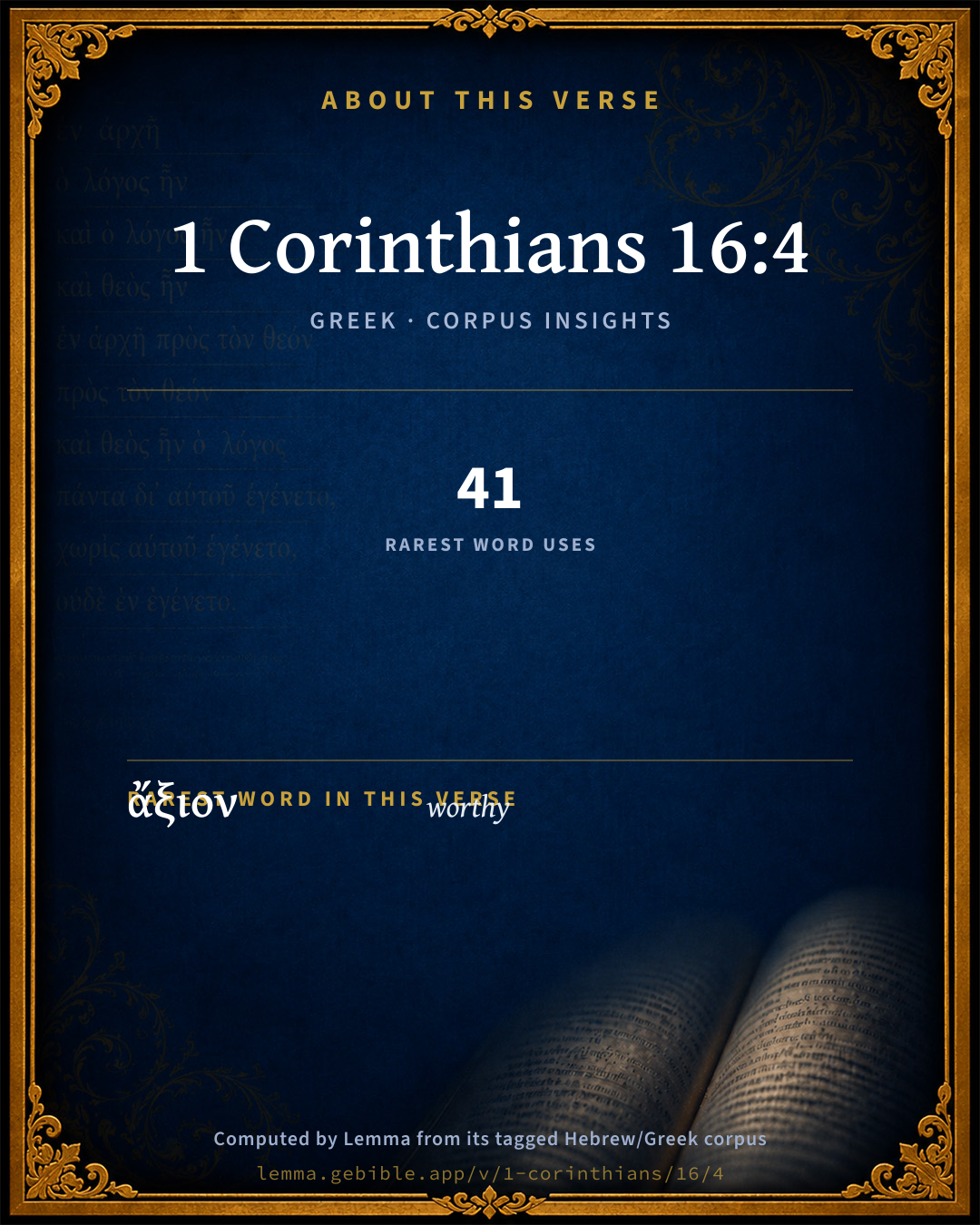
1 Corinthians 16:4

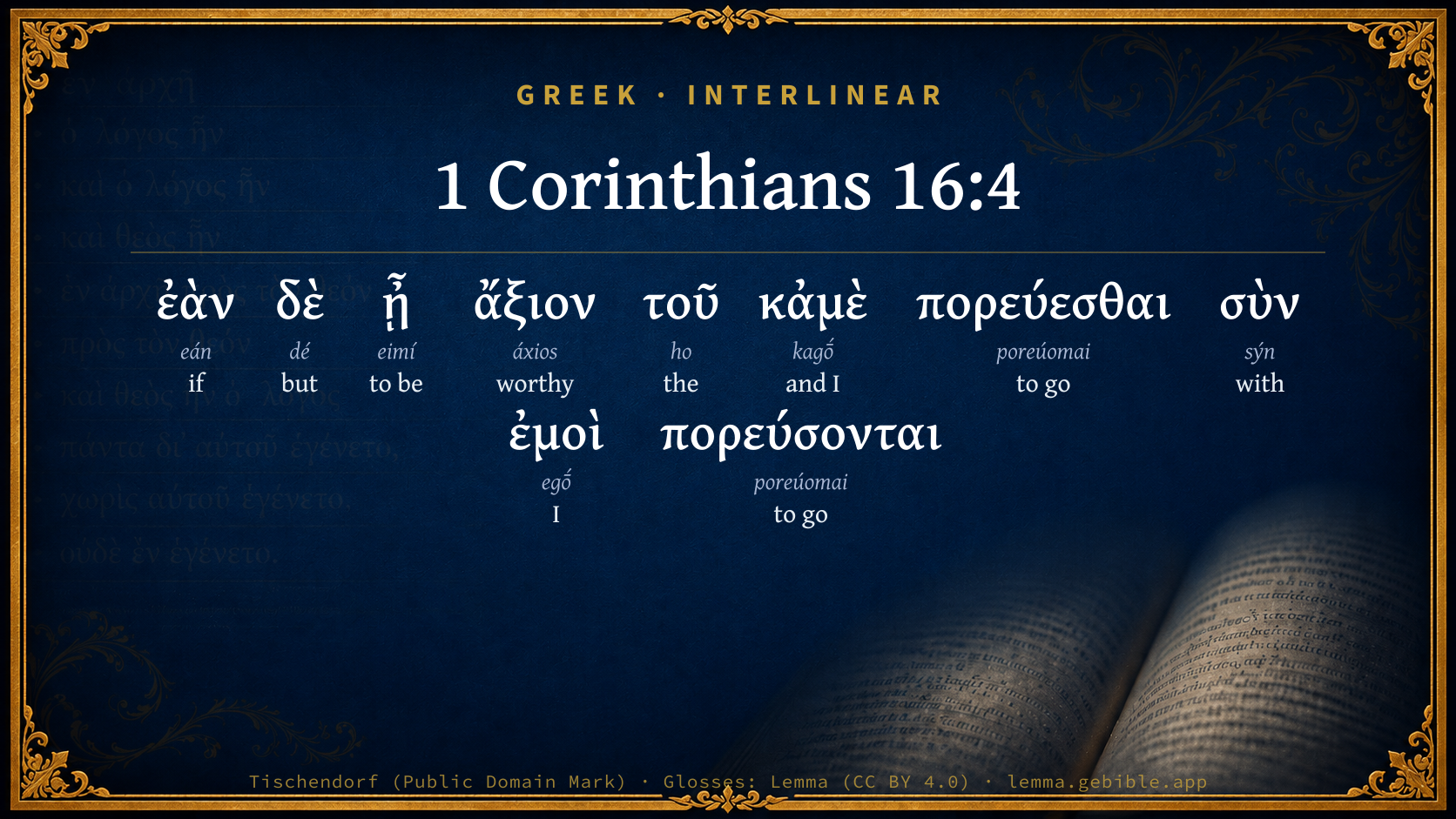
Greek (Tischendorf 8th ed.) 1 Corinthians 16:4 appears in the Greek New Testament. The text above is from the Tischendorf 8th edition. Each word links to its Strong’s number and a concise gloss. Click any word for its full Thayer’s Greek Lexicon entry.
Download image
Cite this verse

1 Corinthians 16:4 (World English Bible). Public Domain. Lemma interlinear Bible study tool, https://lemma.gebible.app/v/1-corinthians/16/4.

Show BibTeX & RIS
BibTeX
RIS
English Translation
If it is appropriate for me to go also, they will go with me.
World English Bible · Public Domain
Download a study sheet

One document with this verse’s original text, its word-by-word gloss line, the meaning frame, cross-references with their text, attributed commentary, and full source and license credits — printable, and it pastes into notes with its structure intact.

This verse Autodidact and up

Study sheet (.html) Plain text (.txt)

A passage Seminary Student

Up to 50 verses in one chapter. A passage sheet keeps up to 6 commentary sources and 12 cross-references per verse, in the order this page ranks them, and says so on the sheet whenever that leaves anything out. Ask for a single verse and you get the Autodidact verse sheet above.

Everything on this page stays free to read, with no account — the sheet is a download of what is already on screen, not access to it.

Want to remove ads? Support Godless Engineer
Compare translations 3

The same verse in 3 English versions, stacked beneath the original-language interlinear above. Click any original word for its lexicon entry.

Each is an independent rendering of the whole verse — the interlinear is not word-aligned to these translations.

Highlighted words mark where these versions differ — a whole-verse word diff, not a word-by-word alignment.

  • World English Bible Public Domain
    If it is appropriate for me to go also, they will go with me.
  • King James Version Public Domain
    And if it be meet that I go also, they shall go with me.
  • unfoldingWord Literal Text CC BY-SA 4.0
    But if it is appropriate for me to go also, they will go with me.

unfoldingWord Literal Text — © unfoldingWord, licensed CC BY-SA 4.0. Word-aligned USFM3 via Door43 (git.door43.org/unfoldingWord/en_ult).

Versions to compare (up to 4)

3 of 4 selected

Show all 19 translations

Every available English version of this verse, each an independent rendering of the whole verse.

  • World English Bible Public Domain
    If it is appropriate for me to go also, they will go with me.
  • Berean Standard Bible Public Domain
    And if it is advisable for me to go also, they can travel with me.
  • Majority Standard Bible Public Domain
    And if it is advisable for me to go also, they can travel with me.
  • King James Version Public Domain
    And if it be meet that I go also, they shall go with me.
  • American Standard Version (1901) Public Domain
    and if it be meet for me to go also, they shall go with me.
  • Revised Version (1885) Public Domain
    and if it be meet for me to go also, they shall go with me.
  • Geneva Bible (1599) Public Domain
    And if it be meete that I goe also, they shall goe with me.
  • Douay-Rheims (1899) Public Domain
    And if it be meet that I also go, they shall go with me.
  • Young's Literal Translation Public Domain
    and if it be meet for me also to go, with me they shall go.
  • Literal Standard Version CC BY-SA 4.0
    and if it be worthy for me also to go, with me they will go.
  • Unlocked Literal Bible CC BY-SA 4.0
    If it is appropriate for me to go also, they will go with me.
  • unfoldingWord Literal Text CC BY-SA 4.0
    But if it is appropriate for me to go also, they will go with me.
  • Darby Bible Public Domain
    and if it be suitable that *I* also should go, they shall go with me.
  • World Messianic Bible Public Domain
    If it is appropriate for me to go also, they will go with me.
  • Webster's Bible Public Domain
    And if it be proper that I should go also, they shall go with me.
  • Free Bible Version CC BY-SA 4.0
    If it works out for me to go too, they can come with me.
  • Bible in Basic English Public Domain
    And if it is possible for me to go there, they will go with me.
  • Text-Critical English NT CC BY 4.0
    If it is advisable for me to go as well, they can travel with me.
  • Tyndale New Testament (1534) Public Domain
    And yf it be mete that I goo they shall go with me.

Literal Standard Version (2020), Covenant Press — licensed CC BY-SA 4.0. Text via the HelloAO Bible API (eBible.org). Unlocked Literal Bible (unfoldingWord) — licensed CC BY-SA 4.0. Text via the HelloAO Bible API (eBible.org). unfoldingWord Literal Text — © unfoldingWord, licensed CC BY-SA 4.0. Word-aligned USFM3 via Door43 (git.door43.org/unfoldingWord/en_ult). Free Bible Version, Dr. Jonathan Gallagher — licensed CC BY-SA 4.0. Text via the HelloAO Bible API (eBible.org).

Word by word

More ways to search: Search by grammar → Find every occurrence → Compare this word →

Practice this passage: Drill this verse → Learn its vocabulary →

About this verse

These counts appear in no published source. They are computed here, from the morphology-tagged text and Lemma’s own curated glosses. What Lemma adds →

10
words
9
distinct lemmas
Pauline Epistles
section

Shared distinctive vocabulary

ἄξιον worthy G514 occurs in 39 verses of the Greek New Testament. Also found in:

Repetition

A word recurs within this verse:

  • πορεύεσθαι to go G4198 ×2

Cross-references

3

Topical passages linked to 1 Corinthians 16:4 in the Treasury of Scripture Knowledge — connected by theme and wording, ordered by reader-vote popularity; previews shown in the World English Bible.

  • Romans 15:25 But now, I say, I am going to Jerusalem, serving the saints.
  • 2 Corinthians 8:4 begging us with much entreaty to receive this grace and the fellowship in the service to the saints.
  • 2 Corinthians 8:19 Not only so, but who was also appointed by the assemblies to travel with us in this grace, which is served by us to the glory of the Lord himself, and to show our readiness.

Cross-references courtesy of OpenBible.info (CC BY 4.0).

Commentary

Notes on 1 Corinthians 16:4 from classic Christian and Jewish commentators (each source and its license shown beneath its notes). The classic Christian expositions comment on the surrounding passage and are grouped to its opening verse, so a note may address several verses; the Jewish commentaries on the Tanakh (Rashi and others) are per-verse, so they appear only where the commentator wrote on this verse.

Lemma curates 59 commentaries, every one of them public domain or Creative Commons licensed, each selected and text-cleaned for this edition rather than reprinted as found. About our sources →

Adam Clarke's Commentary

Verse 4. And if it be meet, c.] If it be a business that requires my attendance, and it be judged proper for me to go to Jerusalem, I will take those persons for my companions. On the delicacy with which St. Paul managed the business of a collection for the poor, Archdeacon Paley makes the following appropriate remarks:-

"The following observations will satisfy us concerning the purity of our apostle's conduct in the suspicious business of a pecuniary contribution.

"1st. He disclaims the having received any inspired authority for the directions which he is giving: 'I speak not by commandment, but by occasion of the forwardness of others, and to prove the sincerity of your love.' (2Co 8:8.) Who, that had a sinister purpose to answer by the recommending of subscriptions, would thus distinguish, and thus lower the credit of his own recommendation?

"2d. Although he asserts the general right of Christian ministers to a maintenance from their ministry, yet he protests against the making use of this right in his own person: 'Even so hath the Lord ordained, that they who preach the Gospel should live of the Gospel but I have used none of these things; neither have I written these things that it should be so done unto me; for it were better for me to die, than that any man should make my glorying, i.e. my professions of disinterestedness, void.' (1Co 9:14; 1Co 9:15.)

"3d. He repeatedly proposes that there should be associates with himself in the management of the public bounty; not colleagues of his own appointment, but persons elected for that purpose by the contributors themselves. 'And when I come, whomsoever ye shall approve by your letters, them will I send to bring your liberality unto Jerusalem; and if it be meet that I go also, they shall go with me.' (1Co 16:3; 1Co 16:4.) And in the second epistle, what is here proposed we find actually done, and done for the very purpose of guarding his character against any imputation that might be brought upon it in the discharge of a pecuniary trust: 'And we have sent with him the brother, whose praise is in the Gospel throughout all the Churches; and not that only, but who was also chosen of the Churches to travel with us with this grace, (gift,) which is administered by us to the glory of the same Lord, and the declaration of your ready mind: avoiding this, that no man should blame us in this abundance which is administered by us; providing for things honest, not only in the sight of the Lord, but also in the sight of men:' i.e. not resting in the consciousness of our own integrity, but, in such a subject, careful also to approve our integrity to the public judgment. (2Co 8:18-21.") Horae Paulinae, page 95.

Adam Clarke's Commentary on the Bible (1810–1826) — public domain. Text from a community e-Sword/MySword module.

Tyndale Open Study Notes

Tyndale Open Resources

16:4 Paul did in fact deliver the gift to Jerusalem (Rom 15:25-26).

Tyndale Open Study Notes — © Tyndale Open Resources, licensed CC BY-SA 4.0. Text via the HelloAO Bible API.

Bengel's Gnomon

Johann Albrecht Bengel

1Co 16:4. Ἄξιον, worthy) meet, if it shall be worth while for me to carry it myself. He invites them to be liberal.—κᾀμὲ, that even I) a just estimate of one’s self is not pride, 2Co 1:19. Paul mentions himself in the first place.—σὺν ἐμοὶ, with me) so that all suspicion may be obviated, 2Co 8:20-21.

Bengel's Gnomon of the New Testament — English translation (T&T Clark, Edinburgh, 1860) — public domain. Text from a community e-Sword module.

Meyer's Critical & Exegetical Commentary

Heinrich August Wilhelm Meyer

1Co_16:4. In case, however, of it (what is being spoken of, i.e. the result of the collection) being worthy that I too should journey (to Jerusalem),[105] then they shall journey with me. The genitive τοῦ πορεύεσθαι depends upon ἄξιον. Comp. Fritzsche, ad Matth. p. 845; Winer, p. 304 [E. T. 408].

Paul makes his own journeying thither dependent upon the issue of the collection, not, of course, for the sake of safety in its conveyance, nor yet because, in the event of a considerable sum being realized, he desired to be independent in connection with the application of it, butwhich alone results from ἄξιον without arbitrarinessbecause a scanty sum would have been disproportionate to an extraordinary mission. Consideration for the decorum attaching to the apostolic rank underlies his procedure, not the prudential motive: in order, on this opportunity, to fulfil his purpose of going to Jerusalem (Act_19:21), and to prepare for himself there a good reception (de Wette), or in order by this journey to heal the breach between the Jewish and Gentile Christians (Baur). Bengel says well: Justa aestimatio sui non est superbia. At the same time, he will not undertake this charge alone; see 2Co_8:20.

[105] It is clear from κᾀμὲ πορ. that he will not make the journey at any rate. (Hofmann), but that he makes it dependent on the above-named circumstance whether he also shall journey thither. What a strange state of things, too, would be the result, if he were resolved to journey at any rate, but the messengers, in the event of the collection proving a small one, were to make the journey not in his company, but alone! Paul assuredly did not contemplate anything so paltry.

Meyer — Critical and Exegetical Commentary on the New Testament — English translation by Peter Christie, edited by Frederick Crombie (T&T Clark, 1880) — public domain. Text from a community e-Sword module.

Hodge's Commentary on Romans, Ephesians & First Corinthians

Charles Hodge

1Co_16:4

And if it be meet that I go also, they shall go with me.

And if it is deserving of my going; that is, if the collection be of an amount to make it proper for the also to go with it to Jerusalem, your messengers shall go with me. According to Act_19:21, Paul purposed, after visiting Macedonia and Achaia, to go to Jerusalem. But whether he would go at the time the contribution of the Corinthians was sent, depended on its amount. He would not modify his plans for the sake of having charge of the distribution of an inconsiderable sum.

Charles Hodge — Commentary on Romans (1835), First Corinthians (1857), and Ephesians (1856) — public domain. Text from a community e-Sword module.

Geneva Bible (1599)

Geneva Bible translators

The residue of the Epistle is spent in writing of familiar matters, yet so that all things be referred to his purposed mark, that is to say, to the glory of God, and the edifying of the Corinthians.

Geneva Bible (1599) marginal notes — public domain. Text via Bolls.life.

Jamieson, Fausset & Brown

Robert Jamieson, A. R. Fausset & David Brown

meet--"worth while." If your collections be large enough to be worth an apostle's journey (a stimulus to their liberality), I will accompany them myself instead of giving them letters credential (Co1 16:3; compare Act 20:1-4).

with me--to guard against all possible suspicion of evil (Co2 8:4, Co2 8:19-21).

Jamieson, Fausset & Brown — Commentary Critical and Explanatory on the Whole Bible (1871) — public domain (CC PDM 1.0). Text via the HelloAO Bible API.

The Cambridge Bible for Schools and Colleges

gen. ed. J. J. S. Perowne

4. they shall go with me] Under no circumstances would St Paul take charge of the money himself. It was, moreover, fitting that members of the Corinthian Church should have the pleasure, as well as the credit, of presenting their bounty in person to those who were to be the recipients of it. Cf. 2Co_8:19-20.

The Cambridge Bible for Schools and Colleges (gen. ed. J. J. S. Perowne; Cambridge University Press, 1878–1918) — public domain. Text from a community e-Sword module.

John Gill's Exposition

And if it be meet that I go also,.... If it should be convenient for me to go, or it should be thought proper and expedient that I should go; or, as the Syriac version renders it, "if this work should be worthy that I should go"; and the Arabic version, "if the thing should be worthy to go with me"; that is, their beneficence; if so large a collection should be made, that it will be worthy of an apostle to go along with it, hereby artfully pressing them to a good collection:

they shall go with me; that is, those brethren whom the church shall approve and send; for he would not go alone, nor propose it, to remove all suspicion of converting any money to his own use.

John Gill's Exposition of the Whole Bible (1746–1763) — public domain (CC PDM 1.0). Text via the HelloAO Bible API.

Trapp's Complete Commentary

John Trapp

4 And if it be meet that I go also, they shall go with me.

Ver. 4. That I go also] And go he did, Rom 15:25; Act 24:17. The very angels hold not themselves too good to serve the saints.

John Trapp, A Commentary or Exposition upon All the Books of the Old and New Testament (1647–1656) — public domain. Text from a community e-Sword module.

Albert Barnes' Notes on the Bible

And if it be meet ... - If it be judged desirable and best. If my presence can further the object; or will satisfy you better; or will be deemed necessary to guide and aid those who may be sent, I will be willing to go also. For some appropriate and valuable remarks in regard to the apostle Paul’s management of pecuniary matters, so as not to excite suspicion, and to preserve a blameless reputation, see Paley’s Horae Paulinae, chapter iv. No. 1, 3. Note.

Albert Barnes' Notes on the Bible (1834–1885) — public domain. Text from a community e-Sword/MySword module.

Matthew Poole's English Annotations

To encourage them to the more free and liberal contribution, he promiseth them himself to go along with those that carried it, if it were thought meet. Whether Paul, according to this promise, did go to Corinth, some question, because of what we read, 2Co 1:15,16. But others think, that he speaketh there of another journey, which he intended thither; and that he did go in a fulfilling of this promise, because we read, Act 20:1-38, that he went into Greece, and spent there a considerable time; during which it is very probable that he did not omit to visit the church of Corinth.

Matthew Poole's English Annotations on the Holy Bible (1683–1685) — public domain. Text from a community e-Sword/MySword module.

Whedon's Commentary on the Bible

Daniel D. Whedon

4. Meet—Worth the while; of sufficient importance to require my so doing. The journey, their reception at Jerusalem, and the sad results to Paul, are narrated by Luke, Act_20:3; Act_21:30. Touching Luke’s saying nothing about the money part of that mission to Jerusalem, see note, Act_24:17.

Daniel D. Whedon (gen. ed.), Commentary on the Old and New Testaments (1874–1909) — public domain. Text from a community e-Sword module.

The Pulpit Commentary

If it be meet that I go also. Unless the collection were a substantial proof of the generosity of the Gentile Churches, it would be hardly worth while (a]xion) for St. Paul to go too. With me. St. Paul would not take this money himself. His "religious" enemies were many, bitter, and unscrupulous, and he would give them no possibility of a handle against him. He makes such arrangements as should place him above suspicion. (2Co_8:20) It turned out that the subscription was an adequate one, and St. Paul accompanied the Corinthian delegates (Rom_15:25; Act_20:4) The thought that they might visit Jerusalem and see some of the twelve would act as an incentive to the Corinthians.

The Pulpit Commentary (1880–1919), ed. H.D.M. Spence-Jones & Joseph S. Exell — public domain. Text from a community e-Sword module.

John Wesley's Explanatory Notes

They shall go with me - To remove any possible suspicion.

John Wesley, Explanatory Notes Upon the Whole Bible (1754–1765) — public domain. Text via the GEBible commentary corpus.

McGarvey & Pendleton's Commentaries

J. W. McGarvey

and if it be meet for me to go also, they shall go with me . [Paul does not ask to be made custodian of the offering. He directs the church to appoint its own messengers to carry it, thus raising himself above all suspicion of misappropriation, and giving the church a new incentive to make a liberal offering, for it would afford the church a new joy and profit to have in its membership those who had been to Jerusalem and seen the apostles. Paul, as an apostle, and as one personally acquainted with the Jerusalem church, promises to give the bearers of the fund letters of introduction and commendation to the apostles and elders at Jerusalem; and, should the greatness of the collection and the dignity of the occasion require it, he agrees to accompany the bounty himself. The collection proved large enough to justify this, and Paul accompanied the delegates. For the names of those who left Greece with Paul, see Act_20:4 ]

J. W. McGarvey (with Philip Y. Pendleton), Commentaries on the New Testament (The Fourfold Gospel, 1914; Acts; and the epistles) — public domain. Text from a community e-Sword/MySword module.

The People's New Testament

B. W. Johnson

4. If it be meet that I go. He did not then know whether he would go or not. In the outcome he did go (Acts 19:21; 20:3)

B. W. Johnson's The People's New Testament with Notes (1889–1891) — public domain. Electronic text from the Christian Classics Ethereal Library (CCEL) ThML edition.

Cambridge Greek Testament for Schools and Colleges

4. τοῦ κἀμὲ πορεύεσθαι. See Mr Carr’s note on Mat 2:13. Not only would St Paul avoid all possibility of accusation, but it was fitting that those who had collected the money should have the satisfaction of presenting it. Such minute touches as these display to us the tact and polish of the true Christian gentleman, a character unknown to the world until the Word made Flesh came among us. See 2Co 8:19-20.

Cambridge Greek Testament for Schools and Colleges (Cambridge University Press, 1896; 21 vols, various authors incl. Carr, Maclear, Plummer, Farrar, Lumby, Moule, M. R. James, Simcox) — public domain. Text from a community e-Sword module.

Alford’s Greek Testament

Henry Alford

4.] But if it (the occasion,—dependent on the magnitude of your collection) be worthy of my also taking the journey (i.e. if your collection be large enough to warrant an apostolic mission in order to carry it,—not said for security,—nor to procure himself a fair reception at Jerusalem,—but with a sense of the dignity of an apostolic mission: “justa æstimatio sui non est superbia,” Bengel), they shall go in my company (σὺν ἐμοὶ π. contrast to διʼ ἐπιστολῶν πέμψω, and observing the same order). This did apparently take place, see Act 20:4 ff.

Henry Alford, The Greek Testament (1849–1861) — public domain. Text from a community e-Sword module.

International Critical Commentary

4. ἐὰν δὲ ἄξιον ᾖ τοῦ κἀμὲ πορεύεσθαι. ‘But if it be fit that I also should go.’ The ἄξιον is purposely put without a substantive, and πορεύεσθαι is used in its common sense of going on a mission, going with a purpose, with a work to be done: see Westcott on Joh 7:33. ‘If the amount collected makes it worth while for me also to go on this business’ is another possible meaning. He could not abandon other work in order to present a paltry sum; and an Apostle could not take the lead in so unworthy a mission. It would look like approving miggardliness. There is no pride of office here, but proper respect for himself and them. It is with consciousness of his authority that he says, ‘they shall go with me,’ not ‘I will go with them.’

Were the Corinthians niggardly, or at least somewhat backward in giving? One is inclined to think so by the doubt expressed here: see also 9:11, 12; 2Co 11:8, 2Co 11:9, 2Co 11:12:13. No Corinthian delegates are mentioned Act 20:4. That might mean that the Corinthians sent their contribution independently. But it might mean that they were not represented because their contribution was so small. St Paul twice went to Jerusalem with money for the poor (Act 11:29, Act 11:30, Act 11:24:17). It was perhaps because he was known to have charge of such funds that he was expected by Felix to pay for his release (24:26).

International Critical Commentary — older volumes (1896–1929), various authors — public domain. Text from a community e-Sword module.

Vincent's Word Studies in the New Testament

Marvin R. Vincent

Meet for me to go [αξιον του καμε πορευεσθαι] . Lit., if it be worthy of my going, i e., if the gift be sufficiently large to warrant an apostolic journey to Jerusalem. This is better than if it be becoming.

Marvin R. Vincent, Word Studies in the New Testament (1887–1900) — public domain. Text from a community e-Sword/MySword module.

Lesson kit

Teaching starters — assembled from the data on this page, not authored interpretation. Every prompt links to the verse data it draws on. Edit before teaching.

1 Corinthians, in the Pauline Epistles, opens this verse with 10 words (9 distinct Greek lemmas). Its most distinctive word is áxios (“worthy”). A historical commentator’s framing appears above. Read the whole chapter for the surrounding context.

Discussion questions

  1. What does “worthy” (áxios) contribute to the verse as a whole?
  2. Matthew 3:8 shares the word «worthy» with this verse. How do the two illuminate each other?
  3. “to go” occurs 2× in this one verse. What is the effect of the repetition?
  4. The translations on this page render this verse differently — a whole-verse word diff, not a word-by-word alignment. What might account for the different wordings?
  5. Reading how Adam Clarke's Commentary and Tyndale Open Study Notes read this verse, where do the two commentators agree and where do they part?

Things to notice

  • These translations choose different wording for 5 words in this verse.
  • “to go” occurs 2× in this single verse.
  • 9 distinct Greek lemmas span 10 words in this verse.

Reading settings

Reading text

Shown beneath each verse's original-language words.

Old Testament
Old Testament edition

Read the OT as the Masoretic Hebrew (MT) or the Greek Septuagint (LXX).

English shown for the Greek Septuagint (in the Hebrew ↔ Greek comparison).

Comparing translations? Open the Compare panel on any verse page to stack up to four side by side.