1 Corinthians 9:17

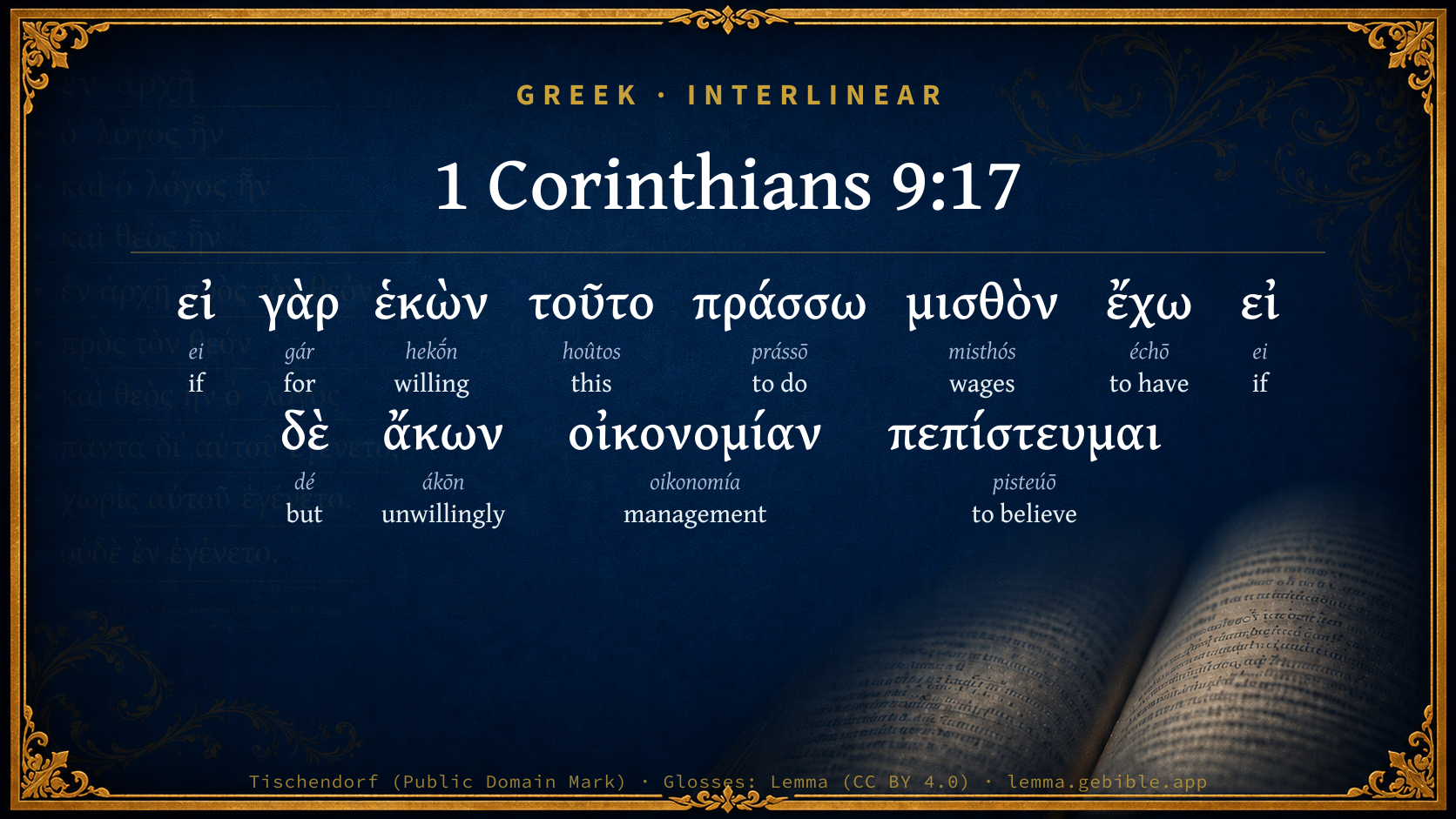
Greek (Tischendorf 8th ed.) 1 Corinthians 9:17 appears in the Greek New Testament. The text above is from the Tischendorf 8th edition. Each word links to its Strong’s number and a concise gloss. Click any word for its full Thayer’s Greek Lexicon entry.
Download image
Cite this verse

1 Corinthians 9:17 (World English Bible). Public Domain. Lemma interlinear Bible study tool, https://lemma.gebible.app/v/1-corinthians/9/17.

Show BibTeX & RIS
BibTeX
RIS
English Translation
For if I do this of my own will, I have a reward. But if not of my own will, I have a stewardship entrusted to me.
World English Bible · Public Domain
Highlights
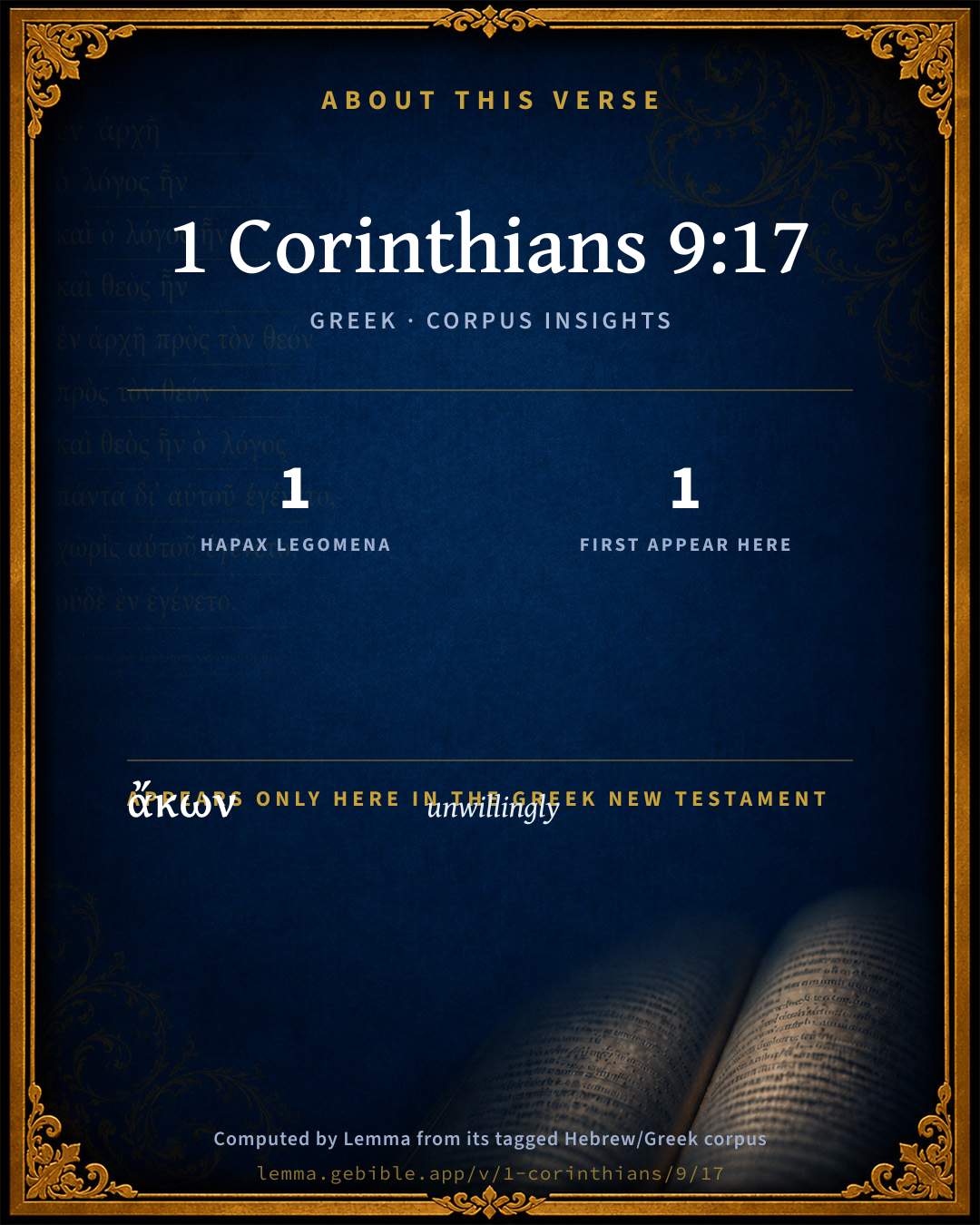
  • 1 hapax legomenon — only here in the Greek New Testament
  • 1 first appearance in the Greek New Testament
Full analysis ↓
Download a study sheet

One document with this verse’s original text, its word-by-word gloss line, the meaning frame, cross-references with their text, attributed commentary, and full source and license credits — printable, and it pastes into notes with its structure intact.

This verse Autodidact and up

Study sheet (.html) Plain text (.txt)

A passage Seminary Student

Up to 50 verses in one chapter. A passage sheet keeps up to 6 commentary sources and 12 cross-references per verse, in the order this page ranks them, and says so on the sheet whenever that leaves anything out. Ask for a single verse and you get the Autodidact verse sheet above.

Everything on this page stays free to read, with no account — the sheet is a download of what is already on screen, not access to it.

Want to remove ads? Support Godless Engineer
Compare translations 3

The same verse in 3 English versions, stacked beneath the original-language interlinear above. Click any original word for its lexicon entry.

Each is an independent rendering of the whole verse — the interlinear is not word-aligned to these translations.

Highlighted words mark where these versions differ — a whole-verse word diff, not a word-by-word alignment.

  • World English Bible Public Domain
    For if I do this of my own will, I have a reward. But if not of my own will, I have a stewardship entrusted to me.
  • King James Version Public Domain
    For if I do this thing willingly, I have a reward: but if against my will, a dispensation of the gospel is committed unto me.
  • unfoldingWord Literal Text CC BY-SA 4.0
    For if I do this willingly, I have a reward. But if unwillingly, I have been entrusted with a stewardship.

unfoldingWord Literal Text — © unfoldingWord, licensed CC BY-SA 4.0. Word-aligned USFM3 via Door43 (git.door43.org/unfoldingWord/en_ult).

Versions to compare (up to 4)

3 of 4 selected

Show all 19 translations

Every available English version of this verse, each an independent rendering of the whole verse.

  • World English Bible Public Domain
    For if I do this of my own will, I have a reward. But if not of my own will, I have a stewardship entrusted to me.
  • Berean Standard Bible Public Domain
    If my preaching is voluntary, I have a reward. But if it is not voluntary, I am still entrusted with a responsibility.
  • Majority Standard Bible Public Domain
    If my preaching is voluntary, I have a reward. But if it is not voluntary, I am still entrusted with a responsibility.
  • King James Version Public Domain
    For if I do this thing willingly, I have a reward: but if against my will, a dispensation of the gospel is committed unto me.
  • American Standard Version (1901) Public Domain
    For if I do this of mine own will, I have a reward: but if not of mine own will, I have a stewardship intrusted to me.
  • Revised Version (1885) Public Domain
    For if I do this of mine own will, I have a reward: but if not of mine own will, I have a stewardship intrusted to me.
  • Geneva Bible (1599) Public Domain
    For if I do it willingly, I haue a reward, but if I do it against my will, notwithstanding the dispensation is committed vnto me.
  • Douay-Rheims (1899) Public Domain
    For if I do this thing willingly, I have a reward: but if against my will, a dispensation is committed to me:
  • Young's Literal Translation Public Domain
    for if willing I do this, I have a reward; and if unwillingly -- with a stewardship I have been entrusted!
  • Literal Standard Version CC BY-SA 4.0
    for if I do this willingly, I have a reward; and if unwillingly—I have been entrusted with a stewardship!
  • Unlocked Literal Bible CC BY-SA 4.0
    For if I do this willingly, I have a reward. But if not willingly, I still have a responsibility that was entrusted to me.
  • unfoldingWord Literal Text CC BY-SA 4.0
    For if I do this willingly, I have a reward. But if unwillingly, I have been entrusted with a stewardship.
  • Darby Bible Public Domain
    For if I do this voluntarily, I have a reward; but if not of my own will, I am entrusted with an administration.
  • World Messianic Bible Public Domain
    For if I do this of my own will, I have a reward. But if not of my own will, I have a stewardship entrusted to me.
  • Webster's Bible Public Domain
    For if I do this thing willingly, I have a reward: but if against my will, a dispensation of the gospel is committed to me.
  • Free Bible Version CC BY-SA 4.0
    If I'm doing this work because of my own choice, then I have a reward. But if it wasn't my choice, and an obligation was placed on me,
  • Bible in Basic English Public Domain
    But if I do it gladly, I have a reward; and if not, I am under orders to do it.
  • Text-Critical English NT CC BY 4.0
    If I do this voluntarily, I have a reward; but if I do it under compulsion, it is because I have been entrusted with a responsibility.
  • Tyndale New Testament (1534) Public Domain
    If I do it with a good will I have a rewarde. But yf I do it agaynst my will an office is committed vnto me.

Literal Standard Version (2020), Covenant Press — licensed CC BY-SA 4.0. Text via the HelloAO Bible API (eBible.org). Unlocked Literal Bible (unfoldingWord) — licensed CC BY-SA 4.0. Text via the HelloAO Bible API (eBible.org). unfoldingWord Literal Text — © unfoldingWord, licensed CC BY-SA 4.0. Word-aligned USFM3 via Door43 (git.door43.org/unfoldingWord/en_ult). Free Bible Version, Dr. Jonathan Gallagher — licensed CC BY-SA 4.0. Text via the HelloAO Bible API (eBible.org).

Word by word

More ways to search: Search by grammar → Find every occurrence → Compare this word →

Practice this passage: Drill this verse → Learn its vocabulary →

About this verse

These counts appear in no published source. They are computed here, from the morphology-tagged text and Lemma’s own curated glosses. What Lemma adds →

12
words
11
distinct lemmas
Pauline Epistles
section

Notable vocabulary

1 hapax legomenon — a word that appears only here in the entire Greek New Testament:

  • ἄκων unwillingly G210

First appearance in Scripture

This word makes its first canonical appearance in the Greek New Testament here:

  • ἄκων unwillingly G210

Shared distinctive vocabulary

ἑκὼν willing G1635 occurs in 2 verses of the Greek New Testament. Also found in:

Repetition

A word recurs within this verse:

Cross-references

28

Topical passages linked to 1 Corinthians 9:17 in the Treasury of Scripture Knowledge — connected by theme and wording, ordered by reader-vote popularity; previews shown in the World English Bible.

  • Galatians 2:7 but to the contrary, when they saw that I had been entrusted with the Gospel for the uncircumcision, even as Peter with the Gospel for the circumcision
  • 1 Corinthians 3:8 Now he who plants and he who waters are the same, but each will receive his own reward according to his own labor.
  • 1 Chronicles 28:9 You, Solomon my son, know the God of your father, and serve him with a perfect heart and with a willing mind; for Yahweh searches all hearts, and understands all the imaginations of the thoughts: if you seek him, he will be found of you; but if you forsake him, he will cast you off forever.
  • Matthew 10:41 He who receives a prophet in the name of a prophet will receive a prophet's reward: and he who receives a righteous man in the name of a righteous man will receive a righteous man's reward.
  • Colossians 1:25 of which I was made a servant, according to the stewardship of God which was given me toward you, to fulfill the word of God,
  • 1 Chronicles 29:5 of gold for the [things of] gold, and of silver for the [things of] silver, and for all manner of work [to be made] by the hands of artificers. Who then offers willingly to consecrate himself this day to Yahweh?
  • 1 Chronicles 29:9 Then the people rejoiced, because they offered willingly, because with a perfect heart they offered willingly to Yahweh: and David the king also rejoiced with great joy.
  • Nehemiah 11:2 The people blessed all the men who willingly offered themselves to dwell in Jerusalem.
  • Isaiah 6:8 I heard the Lord's voice, saying, "Whom shall I send, and who will go for us?" Then I said, "Here I am. Send me!"
  • Jeremiah 20:9 If I say, I will not make mention of him, nor speak any more in his name, then there is in my heart as it were a burning fire shut up in my bones, and I am weary with forbearing, and I can't [contain].
  • Ezekiel 3:14 So the Spirit lifted me up, and took me away; and I went in bitterness, in the heat of my spirit; and the hand of Yahweh was strong on me.
  • 1 Corinthians 3:14 If any man's work remains which he built on it, he will receive a reward.
  • 1 Corinthians 4:1 So let a man think of us as Christ's servants, and stewards of God's mysteries.
  • 1 Thessalonians 2:4 But even as we have been approved by God to be entrusted with the Gospel, so we speak; not as pleasing men, but God, who tests our hearts.
  • 1 Peter 5:2–4 Shepherd the flock of God which is among you, exercising the oversight, not under compulsion, but voluntarily, not for dishonest gain, but willingly;
  • Exodus 4:13–14 He said, "Oh, Lord, please send someone else."
  • Jonah 1:3 But Jonah rose up to flee to Tarshish from the presence of Yahweh. He went down to Joppa, and found a ship going to Tarshish; so he paid its fare, and went down into it, to go with them to Tarshish from the presence of Yahweh.
  • Jonah 4:1–3 But it displeased Jonah exceedingly, and he was angry.
  • Malachi 1:10 "Oh that there were one among you who would shut the doors, that you might not kindle fire on my altar in vain! I have no pleasure in you," says Yahweh of hosts, "neither will I accept an offering at your hand.
  • Matthew 24:25 "Behold, I have told you beforehand.
  • Luke 12:42 The Lord said, "Who then is the faithful and wise steward, whom his lord will set over his household, to give them their portion of food at the right times?
  • 1 Corinthians 9:16 For if I preach the Gospel, I have nothing to boast about; for necessity is laid on me; but woe is to me, if I don't preach the Gospel.
  • 2 Corinthians 8:12 For if the readiness is there, it is acceptable according to what you have, not according to what you don't have.
  • Ephesians 3:2–8 if it is so that you have heard of the administration of that grace of God which was given me toward you;
  • Philippians 1:16–17 The former insincerly preach Christ from selfish ambition, thinking that they add affliction to my chains;
  • 1 Timothy 1:11–13 according to the Gospel of the glory of the blessed God, which was committed to my trust.
  • Philemon 1:14 But I was willing to do nothing without your consent, that your goodness would not be as of necessity, but of free will.
  • 1 Chronicles 29:14 But who am I, and what is my people, that we should be able to offer so willingly as this? For all things come of you, and of your own have we given you.

Cross-references courtesy of OpenBible.info (CC BY 4.0).

Commentary

Notes on 1 Corinthians 9:17 from classic Christian and Jewish commentators (each source and its license shown beneath its notes). The classic Christian expositions comment on the surrounding passage and are grouped to its opening verse, so a note may address several verses; the Jewish commentaries on the Tanakh (Rashi and others) are per-verse, so they appear only where the commentator wrote on this verse.

Lemma curates 59 commentaries, every one of them public domain or Creative Commons licensed, each selected and text-cleaned for this edition rather than reprinted as found. About our sources →

The Biblical Illustrator

Joseph S. Exell

1Co_9:17-19

For if I do this thing willingly I have a reward.

Purity of motive required in every Christian minister

I. Wherein it consists.

1. A willing service.

2. Without respect to fee or reward.

3. He may receive but must not bargain for it.

II. Its importance.

1. If pure, Christ will reward him.

2. If impure, his service is merely professional and has its reward.

III. Its present recompense.

1. Freedom from all imputation of mercenary motives.

2. The free dispensation of the gospel.

3. The consciousness of his own integrity. (J. Lyth, D. D.)

Aspects of St. Pauls ministry

His preaching was no ground of boasting (1Co_9:16). If he preached willingly, i.e., if it were optional with him to preach or not to preach, then it would be a ground of boasting; but if he did it unwillingly, i.e., if it were not optional with him (as was in fact the case), he was only discharging an official duty, and had nothing to boast of. That Paul preached the gospel willingly, that he esteemed it his highest joy and glory, is abundantly evident (Rom_1:5; Rom_11:13; Rom_15:15-16; 1Co_15:9-10; Gal_1:15-16; Eph_3:8). The difference, therefore, here expressed between willing and unwilling, is not the difference between cheerfully and reluctantly, but between optional and obligatory. He says he had a dispensation or stewardship committed to him. Stewards were commonly slaves. There is a great difference between what a slave does in obedience to a command, and what a man volunteers to do of his own accord. And this is the difference to which the apostle refers. So Paul was commanded to preach the gospel, and he did it with his whole heart; but he was not commanded to refuse to receive a support from the churches. The former, therefore, was not a ground of boasting, not a thing for which he could claim the reward of special confidence; the latter was. He could appeal to it as a proof, not only of his obedience, but of the purity of the motive which prompted that obedience. A physician may attend the sick from the highest motives, though he receives a remuneration for his services. But when he attends the poor gratuitously, though the motives may be no higher, the evidence of their purity is placed beyond question. Pauls ground of glorying, therefore, was not preaching, for that was a matter of obligation; but his preaching gratuitously, which was altogether optional. He gained something by it. He gained the confidence even of his enemies. But as preaching was not optional but obligatory, he did not gain confidence by it. The principle on which the apostles argument is founded is recognised by our Lord in Luk_17:10. (C. Hodge, D. D.)

Ministers and wealth

Rev. T. Hancocks, of Chatham, formerly a Pastors College student, relates the following reminiscence of Mr. Spurgeon, introduced by the late president into one of his lectures to his students, and which is particularly interesting in the light of his last will and testament: Men sometimes say, Spurgeons making a good thing of it. To which I reply, You are perfectly right, for I serve a Master who is no niggard, but who rewards me daily with both hands. But if they mean that I am saving money--well, they will know when Im gone. I give away all I can get, and could wisely use more.

For though I be free from all men, yet have I made myself servant unto all, that I might gain the more.--

True ministerial independence

I. Its nature. Freedom--

1. As far as possible from personal obligation.

2. In the declaration of Divine truth.

3. In the conscientious discharge of duty.

II. Its use. In the service of all--

1. By patient toil.

2. By forbearance.

3. By Christian compliances.

III. Its motive.

1. Christs honour.

2. In the gain of souls. (J. Lyth, D. D.)

The highest service of man earth

The services of men on earth embrace a large variety. There is the service of the agriculturist, the mechanic, the mariner, the merchant, the scientist, the legislator, the king, &c. Men esteem these services as differing widely in respectability and honour; but the service referred to in the text stands infinitely above all. Four thoughts are suggested concerning this service.

I. It is a service for the gaining of men. That I might gain the more. The more what? Not the gaining the more wealth, fame, or pleasure; but the gaining of men. Christ says, Thou hast gained thy brother. There is a way of winning a man. Morally man is lost. No work in the universe is higher than this--to gain a man, to recover him to the true spirit and mission of life.

II. It is a service independent of men. Though I be free from all men, yet have I made myself servant unto all. Oh, how this high service has been degraded by the crowds of craven and mercenary souls that have pushed themselves into it! I am free from all men, says Paul. I made myself servant. I was not made by human authority, I was not pushed into it by others, I made myself. A man by Gods grace must make himself for the work.

III. It is a service for universal man. Unto all. All men, not to any particular tribe, sect, or nation, but to all, rich and poor, high and low, cultured and rude. (D. Thomas, D. D.)

The Biblical Illustrator, edited by Joseph S. Exell (c. 1880s–1900s) — public domain. Text from a community e-Sword module.

Bengel's Gnomon

Johann Albrecht Bengel

1Co 9:17. Ἑκὼν, willingly) This is here used instead of gratuitously, whence I have a reward makes an oxymoron;[76] moreover he defines the reward and gain in the following verses. Paul often, when speaking of his own affairs, uses increase and diminution [αὔξησις and ΜΕΊΩΣΙς], not unlike a catachresis, and suitable to express his self-abnegation. He might have willingly preached the Gospel, and yet have received a reward from the Corinthians; but if he should receive a reward, he considers that as equivalent to his preaching unwillingly; so in the following verse the use of his legitimate ‘power’ might be without abuse; but he considers in his case the former in the light of the latter;[77] comp. Rom 15:15; 2Co 11:8-9; 2Co 1:24; 2Co 2:5; 2Co 7:2-3.—οἰκονομίαν πεπίστευμαι, a dispensation of the Gospel is committed to me) I cannot withdraw myself, although I should fail of my reward. Again, the language is exclusive, as in 1Co 9:16.

[76] See Appendix. The pointed combination of contraries. “Gratuitously, yet I have a reward.”—ED.

[77] i.e. He would regard his using his power as if it were an abuse.—ED.

Bengel's Gnomon of the New Testament — English translation (T&T Clark, Edinburgh, 1860) — public domain. Text from a community e-Sword module.

Meyer's Critical & Exegetical Commentary

Heinrich August Wilhelm Meyer

1Co_9:17 f. The sentence immediately preceding this verse, οὐαὶ γὰρ … εὐαγγ., was merely a thought interposed, a logical parenthesis, to the contents of which Paul does not again refer in what follows. In 1Co_9:17 f., accordingly, with its γάρ, the reference is not to this preceding sentence οὐαὶ κ.τ.λ[1473], so as to establish it by way of dilemma (which was my former interpretation), but to ἈΝΆΓΚΗ ΜΟΙ ἘΠΊΚΕΙΤΑΙ, 1Co_9:16 (comp de Wette, Osiander, Hofmann), and that indeed in so far as these latter words were set down to confirm the previous assertion, ἐὰν εὐαγγελίζωμαι, οὐκ ἐστί μοι καύχημα. The correctnesss of this reference of the ΓΆΡ which introduces 1Co_9:17 f., is confirmed by the fact that the leading conceptions in the argument of 1Co_9:17 f., to wit, ἙΚΏΝ and ἌΚΩΝ, are correlative to the conception of ἈΝΆΓΚΗ in 1Co_9:16. The ΓΆΡ in 1Co_9:17 thus serves to justify the second ΓΆΡ in 1Co_9:16, as we often find, both in Greek writers and in the N. T., ΓΆΡ repeated in such a significant correlation as we find here (see Fritzsche, a[1475] Rom. II. p. 110 f.). In order to prove that he has rightly established his previous statement ἐὰν … καύχημα by adding ἈΝΆΓΚΗ ΓΆΡ ΜΟΙ ἘΠΊΚΕΙΤΑΙ, the apostle argues, starting now from the opposite of that ἈΝΆΓΚΗ, and therefore e contrario, as follows: For supposing that I carry on my preaching (τοῦτο πράσσω) of free self-determination, then I have a reward, of which, consequently, I can glory; but if I do it not of my own free will (and this, in point of fact, was the case with the apostle), then it is a stewardship with which I am entrusted, which therefore (this is the purport of the interrogatory clause whitch follows, τίς οὖν Κ.Τ.Λ[1476]) involves no reward for me.

From this simple course of thoughtin which the μισθὸν ἔχω refers to the certain possession hereafter of the Messianic reward,[1477] and is conceived as the more specially defined contents of the καύχημα in 1Co_9:16,it will be seen that the apodosis of the second half of 1Co_9:17 is ΟἸΚΟΝΟΜΊΑΝ ΠΕΠΊΣΤΕΥΜΑΙ, that these words, consequently, should neither be put in a parenthesis nor attached to the protasis (so Knatchbull, Semler, Hofmanncomp also his Schriftbeweis, II. 2, p. 332) by reading εἰ δὲ ἄκων οἰκον. πεπίστευμαι together, to which ΤΊς ΟὖΝ Κ.Τ.Λ[1479] would then become the apodosis;[1480]a view under which the significant bearing of the purposely chosen phrase οἰκον. πεπίστευμαι is entirely lost sight of. Billroth, failing to recognise how essential εἰ δὲ ἄκων, οἰκ. πεπίστ. is to the argument, makes it parenthetical, and understands ἄκων (with Bengel, Zachariae, and Schulz) as meaning non gratis, which is contrary to the signification of the word. Many expositors render ἑκών and ἄκων by with joy and gladness and with reluctance (so Calovius, Piscator, Estius, Kypke, Rosenmüller, Flatt, Pott, al[1481]; comp also Ewald); but this runs counter to the fact that, as τίς οὖν … μισθός shows, the apostles own case is not the first, but the last of the two cases supposed by him, and that he found himself indeed in the official position of a preacher without having chosen it of his own free will,being rather apprehended (Php_2:12), and, through his call (Act_9:22; Act_9:26), as it were constrained by Christ (ἐξ ἀνάγκης ἄκων, Plato, Legg. v. 734 B),but, notwithstanding, pursued his work with heart and hand.

οἰκονομίαν πεπίστ.] οἰκον. has significant emphasis; as to the construction, comp Rom_3:2; Gal_2:7. If I preach ἄκων, so Paul holds, then the apostleship, with which I am put in trust, stands in the relation of the stewardship of a household (1Co_4:1); for that, too, a man receives not from his own free choice, but by the masters will, which he has to obey; and hence it follows (οὖν) that no reward awaits me (this being the negative sense of τίς … μισθός; comp Mat_5:46; Rom_6:21; 1Co_15:32); for a stewardconceived of as a slave[1485]can but do his duty (Luk_17:10), whereas one who works of his own free will does more than he is bound to do, and so labours in a sense worthy of reward. The meanings which some expositors find in ΟἸΚ. ΠΕΠ. are inserted by themselves; thus Pott explains, nihilosecius peragendum est, comp Schulz, Rosenmüller, Flatt, Schrader, Neander, and older interpreters; while Grotius makes it, ratio mihi reddenda est impositi muneris. The words convey nothing more than just their simple literal meaning. What, again, is inferred from them, Paul himself tells us by beginning a new sentence with τίς οὖν. To suppose a middle clause omitted before this sentence (with Neander, who would insert, How am I now to prove that I do it of my own free will?) is to make a purely arbitrary interruption in the passage.

Ὁ ΜΙΣΘΌς] the befitting reward. Neither here nor in the first clause is μισθός the same as ΚΑΎΧΗΜΑ (Pott, Rückert, Ewald, al[1487]); but it is viewed as standing in the relation of the inducing cause to that ἐστί μοι καύχημα, supposing the latter to take place. This also applies against Baur in the theol. Jahrb. 1852, p. 541 ff., who, moreover, pronounces the apostles argument an unsound one. The distinction which Paul here makes is, in his opinion, at variance with the absolute ground of obligation in the moral consciousness, and is either purely a piece of dialectics, or has for its real basis the idea of the opera supererogationis. In point of fact, neither the one nor the other is the case; but Paul is speaking of the apostolic reward hereafter, concerning which he was persuaded that it was not to be procured for him by his apostolic labour in itself, seeing that he had not, in truth, come to the apostleship of his own free will; rather, in his case, must the element of free self-determination come in in another way, namely, by his labouring without receiving anything in return. In so far, accordingly, he must do something more than the other apostles in order that he might receive the reward. He had recognised this to be his peculiar duty of love, incumbent upon him also with a view to avert all ground of offence, but not as implying surplus merit. The latter notion is discovered in the text by Cornelius a Lapide and others.

[1473] .τ.λ. καὶ τὰ λοιπά.

[1475] d refers to the note of the commentator or editor named on the particular passage.

[1476] .τ.λ. καὶ τὰ λοιπά.

[1477] On μισθὸν ἔχειν, comp. Mat_6:1. It is the opposite of οὐαί μοι ἐστίν, and hence μισθός cannot mean the reward which lies in the very action itself, namely, the self-satisfaction to which it gives rise (Hofmann).

[1479] .τ.λ. καὶ τὰ λοιπά.

[1480] As regards the σὖν of the apodosis, see on Rom_2:17-24. It would have been exceedingly uncalled for after such a short and perfectly simple protasis as that in the text. In Herodotus ix. 48, which Hofmann adduces (also Hartung, Partik. II. p. 22), it is otherwise (οἱ δʼ ὦν κ.τ.λ.). Moreover, it is a special peculiarity of Herodotus to put οὖν before the apodosis; whereas, with Paul, it occurs only in Romans loc. cit., where it comes in after an accumulated series of protases and, as an epanalepsis, was quite appropriate.

[1481] l. and others; and other passages; and other editions.

[1485] This is not an arbitrary assumption (as Hofmann objects), since it is well enough known that the οἰκονόμοι were, as a rule, slaves.

[1487] l. and others; and other passages; and other editions.

Meyer — Critical and Exegetical Commentary on the New Testament — English translation by Peter Christie, edited by Frederick Crombie (T&T Clark, 1880) — public domain. Text from a community e-Sword module.

Expositor's Greek Testament

ed. W. Robertson Nicoll

1Co 9:17 completes a chain of four explanatory γάρ s ( cf. 1Co 1:17-21 ). To make his position clearer, P. puts two further contrasted hypotheses, the former imaginary, the latter suggesting the fact: ( a ) “For if I am engaged on this (work) of my own free will ( ἑκών ), I have reward ( mercedem habeo )” sc . the supposed καύχημα of 1Co 9:16 , the right to credit his work to himself ( cf. Rom 4:2 ; Rom 4:4 ); not the future Messianic reward (so Mr [1360] and others), for ἔχω implies attained possession (see parls.), much as ἀπέχω ) in Mat 6:2 , etc. For πράσσω , see note on 1Co 9:2 . ( b ). “But” the contrasted matter of fact “if against my will ( ἄκων = ἀνάγκῃ , 1Co 9:16 ), with a stewardship I have been entrusted”; cf. 1Co 4:1 f., 1Ti 1:12 , etc. The οἰκονόμος (see note, 1Co 4:1 ), however highly placed, is a slave whose work is chosen for him and whose one merit is faithful obedience. In Paul’s consciousness of stewardship there mingled submission to God, gratitude for the trust bestowed, and independence of human control ( cf. 1Co 9:19 , 1Co 4:3 f). The use πιστεύω in pass [1361] with personal subject and acc [1362] of thing (imitating vbs. of double acc .), is confined to Paul in N.T.; see Wr [1363] , pp. 287, 326. To οἰκονομίαν πεπίστευμαι one tacitly adds, from the contrasted clause, καὶ μισθὸν οὐκ ἔχω : “Christ’s bondman, I claim no hire for my stewardship; God’s truth is enough for me”.

[1360] Meyer’s Critical and Exegetical Commentary (Eng. Trans.).

[1361] passive voice.

[1362] accusative case.

[1363] Winer-Moulton’s Grammar of N.T. Greek (8th ed., 1877).

The Expositor's Greek Testament, edited by W. Robertson Nicoll (1897–1910) — public domain. Text from a community e-Sword module.

Hodge's Commentary on Romans, Ephesians & First Corinthians

Charles Hodge

1Co_9:17

For if I do this thing willingly, I have a reward: but if against my will, a dispensation (of the gospel) is committed unto me.

This is the proof that preaching was no ground of boasting. If he preached willingly, i.e. if it were optional with him to preach or not to preach, then it would be a ground of boasting; but if he did it unwillingly, i.e. if it was not optional with him, (as was in fact the case), he was only discharging an official duty, and had nothing to boast of. That Paul preached the gospel willingly, that he esteemed it his highest joy and glory, is abundantly evident from his history and his writings. Rom_1:5; Rom_11:13; Rom_15:15, Rom_15:16; 1Co_15:9, 1Co_15:10. Gal_1:15, Gal_1:16. Eph_3:8. The difference, therefore, here expressed between (ἑκών and ἄκων), willing and unwilling, is not the difference between cheerfully and reluctantly, but between optional and obligatory. He says he had a dispensation or stewardship (οἰκονομία) committed to him. These stewards (οἱκονόμοι) were commonly slaves. There is a great difference between what a slave does in obedience to a command, and what a man volunteers to do of his own accord. And this is the precise difference to which the apostle here refers. The slave may feel honored by the command of his master, and obey him gladly, still it is but a service. So Paul was commanded to preach the gospel, and he did it with his whole heart; but he was not commanded to refuse to receive a support from the churches. The former, therefore, was not a ground of boasting, not a thing for which he could claim the reward of special confidence; the latter was. He could appeal to it as a proof, not only of his obedience, but of the purity of the motive which prompted that obedience. A physician may attend the sick from the highest motives, though he receives a remuneration for his services. But when he attends the poor gratuitously, though the motives may be no higher, the evidence of their purity is placed beyond question. Pauls ground of glorying, therefore, was not preaching, for that was a matter of obligation; but his preaching gratuitously, which was altogether optional. If, says he, my preaching is optional, I have a reward; not in the sense of merit in the sight of God, but in the general sense of recompense. He gained something by it. He gained the confidence even of his enemies. But as preaching was not optional but obligatory, he did not gain confidence by it. Mere preaching, therefore, was not a (καύχημα) ground of boasting, but preaching gratuitously was. A dispensation of the gospel is committed to me; in the Greek it is simply, I am entrusted with a stewardship (comp. Gal_2:7 i.e. an office), which I am bound to discharge. I am in this matter a mere servant. The principle on which the apostles argument is founded is recognized by our Lord, when he said, When ye shall have done all those things which are commanded you, say, We are unprofitable servants: we have done that which was our duty to do, Luk_17:10.

Charles Hodge — Commentary on Romans (1835), First Corinthians (1857), and Ephesians (1856) — public domain. Text from a community e-Sword module.

Jamieson, Fausset & Brown

Robert Jamieson, A. R. Fausset & David Brown

Translate, "If I be doing this (that is, preaching) of my own accord (which I am not, for the 'necessity' is laid on me which binds a servant to obey his master), I have a reward; but if (as is the case) involuntarily (Act 9:15; Act 22:15; Act 26:16); not of my own natural will, but by the constraining grace of God; (Rom 9:16; Ti1 1:13-16), I have had a dispensation (of the Gospel) entrusted to me" (and so can claim no "reward," seeing that I only "have done that which was my duty to do," Luk 17:10, but incur the "woe," Co1 9:16, if I fail in it).

Jamieson, Fausset & Brown — Commentary Critical and Explanatory on the Whole Bible (1871) — public domain (CC PDM 1.0). Text via the HelloAO Bible API.

Adam Clarke's Commentary

Verse 17. For if I do this thing willingly] If I be a cordial co-operator with God, I have a reward, an incorruptible crown, 1Co 9:25. Or, if I freely preach this Gospel without being burthensome to any, I have a special reward; but if I do not, I have simply an office to fulfil, into which God has put me, and may fulfil it conscientiously, and claim my privileges at the same time; but then I lose that special reward which I have in view by preaching the Gospel without charge to any.

This and the 18th verse have been variously translated: Sir Norton Knatchhull and, after him, Mr. Wakefield translate the two passages thus: For if I do this willingly, I have a reward; but if I am intrusted with an office without my consent? what is my reward then? to make the Gospel of Christ, whilst I preach it, without charge, in not using to the utmost my privileges in the Gospel.

Others render the passage thus: But if I do it merely because I am obliged to it, I only discharge an office that is committed to me, 1Co 9:18. For what then shall I be rewarded? It is for this, that, preaching the Gospel of Christ, I preach it freely, and do not insist on a claim which the Gospel itself gives me.

Adam Clarke's Commentary on the Bible (1810–1826) — public domain. Text from a community e-Sword/MySword module.

John Calvin's Commentaries

17. For if I do this thing willingly By reward here is meant what the Latins term operae pretium, recompense for labor, and what he had previously termed glorying Others, however, interpret it otherwise — as meaning that a reward is set before all who discharge their duty faithfully and heartily. But, for my part, I understand the man who does this thing willingly, to be the man who acts with such cheerfulness, that, being intent upon edifying, as his one object of desire, he declines nothing that he knows will be profitable to the Church; as, on the other hand, he terms those unwilling, who in their actings submit, indeed, to necessity, but act grudgingly, because it is not from inclination. For it always happens that the man who undertakes any business with zeal, is also prepared of his own accord to submit to everything, which, if left undone, would hinder the accomplishment of the work. Thus Paul, being one that acted willingly, did not teach in a mere perfunctory manner, but left nothing undone that he knew to be fitted to promote and further his doctrine. This then was his recompense for labor, and this his ground of glorying — that he did with readiness of mind forego his right in respect of his applying himself to the discharge of his office willingly and with fervent zeal.

But if unwillingly, a dispensation is committed to me. In whatever way others explain these words, the natural meaning, in my opinion, is this — that God does not by any means approve of the service done by the man who performs it grudgingly, and, as it were, with a reluctant mind. Whenever, therefore, God has enjoined anything upon us, we are mistaken, if we think that we have discharged it aright, when we perform it grudgingly; for the Lord requires that his servants be cheerful, (2 Corinthians 9:7,) so as to delight in obeying him, and manifest their cheerfulness by the promptitude with which they act. In short, Paul means, that he would act in accordance with his calling, only in the event of his performing his duty willingly and cheerfully.

John Calvin's Commentaries (1540-1563) — public domain. Text from the Calvin Translation Society English edition (1840s-50s) via the Christian Classics Ethereal Library (ccel.org). Calvin's coverage is partial (roughly two-thirds of the Bible); uncommented books and verses are honest gaps, never fabricated. The 19th-century editor's footnotes and remarks are omitted so the notes are faithfully Calvin's own voice.

Ellicott's Commentary for English Readers

(17) For if I do this thing willingly, I have a reward.—The previous words, “Yea, woe is unto me if I preach not the gospel,” are a parenthesis; and now the writer proves the truth of his assertion—that the necessity of preaching the gospel deprives the mere act itself of any grounds of boasting—by showing that if there were no necessity there would be a ground of boasting. The argument is this:—Suppose it to be otherwise, and that there is no such necessity, then, by voluntarily undertaking it, I have a reward. The undertaking it of my own free will would entitle me to a reward. But if (as is the case) not of my free will, but of necessity, then I am merely a steward—a slave doing his duty (1Co_4:1; Luk_17:7-10).

A dispensation of the gospel is committed unto me.—Better, I am entrusted with a stewardship.

A Bible Commentary for English Readers, edited by Charles John Ellicott (1878–1897) — public domain. Text from a community e-Sword module.

The Cambridge Bible for Schools and Colleges

gen. ed. J. J. S. Perowne

17. For if I do this thing willingly] Whether St Paul did his work willingly or unwillingly, he could not escape his responsibility. He had been chosen (Act_9:15; Act_13:2; Rom_1:5; Rom_15:16; Gal_1:15-16; 1Ti_2:7; 2Ti_1:2) to bear the good tidings to the Gentiles, and ho man can disobey God and be guiltless. If he willingly obeyed God, he had a reward in the consciousness of having done his duty (1Co_9:18); if not, he still had been entrusted with the task. Cf. St Luk_17:10.

reward] Rather, wages. Cf. St Joh_4:36; St Mat_20:8, and St Luk_10:7, where the same word is used.

dispensation] Literally, stewardship, the work of one who has to dispense provisions or stores. The original meaning of the word dispensation, which is akin to spend, is the giving forth, as out of a store. So Dr Woodward, in his Natural Philosophy, writes, “This perpetual circulation is constantly promoted by a dispensation of water promiscuously to all parts of the earth.” And Latimer writes, “I pray you, what is to be looked for in a dispensour? This, surely; that he be found faithful, and that he truly dispense and lay out the goods of the Lord.” Sermon on the Unjust Steward, preached before Convocation, June 6th, 1536. Hence it came to have the meaning of a course, or order, of God’s providence, distributed or appointed by Him to man. But this is not the meaning here. Wiclif renders dispending is bitaken to me. Tyndale, office.

The Cambridge Bible for Schools and Colleges (gen. ed. J. J. S. Perowne; Cambridge University Press, 1878–1918) — public domain. Text from a community e-Sword module.

John Gill's Exposition

What is my reward then?.... None at all, I have none to expect, hope for, or claim, in a way of debt; I am a servant intrusted by my Lord with the Gospel, and an unprofitable one I am; I do, at most and best, but what is my duty, and for that I can claim no reward: all the reward that remains is only this,

verily, that when I preach the Gospel, which I am obliged to do,

I may make the Gospel of Christ without charge; to them that hear it, as he did to the Corinthians, which was his glorying in Co1 9:15 and is the same with his reward here; for this means not any reward from God, but his glorying among men, and against the false teachers; that when he preached the word at Corinth, he was not chargeable to any, nor would he ever be: his reason for it is,

that I abuse not my power in the Gospel; his right of having a maintenance, whilst he was preaching the Gospel; to have made use of which would have been an abuse of it, since it would have given occasion to the false apostles to reproach and calumniate, and might have been an hinderance to the Gospel of Christ, and a stumbling to some weak minds.

John Gill's Exposition of the Whole Bible (1746–1763) — public domain (CC PDM 1.0). Text via the HelloAO Bible API.

Trapp's Complete Commentary

John Trapp

17 For if I do this thing willingly, I have a reward: but if against my will, a dispensation of the gospel is committed unto me.

Ver. 17. I have a reward] Yet not earned, but of free grace, God crowning his own works in us. He was a proud Papist that said, Caelum gratis non accipiam, I will not have heaven for nought. (Vega.) And he another, that said, Opera bona mercatura regni caelestis, Good works are the price of heaven. (Bellarm.) God will cast all such merit merchants out of his temple.

But if against my will] Virtus nolentium, nulla est. God will strain upon no man. All his servants are a free people, Psa 110:3. All his soldiers volunteers. They fly to their colours as the doves to their windows, Isa 60:8.

John Trapp, A Commentary or Exposition upon All the Books of the Old and New Testament (1647–1656) — public domain. Text from a community e-Sword module.

Albert Barnes' Notes on the Bible

For if I do this thing willingly - If I preach so as to show that my heart is in it; that I am not compelled, If I pursue such a course as to show that I prefer it to all other employments. If Paul took a compensation for his services, he could not well do this; if he did not, he showed that his heart was in it, and that he preferred the work to all others. Even though he had been in a manner compelled to engage in that work, yet he so acted in the work as to show that it had his hearty preference. This was done by his submitting to voluntary self-denials and sacrifices in order to spread the Saviour’s name.

I have a reward - I shall meet with the approbation of my Lord, and shall obtain the reward in the world to come, which is promised to those who engage heartily, and laboriously, and successfully in turning sinners to God; Pro 11:30; Dan 12:3; Mat 13:43; Mat 25:21-23; Jam 5:20.

But if against my will - (ἄκων akōn). “If under a necessity 1Co 9:16; if by the command of another” (Grotius); if I do it by the fear of punishment, or by any strong necessity which is laid on me.

A dispensation of the gospel is committed unto me - I am entrusted with (πεπίστευμαι pepisteumai) this dispensation, office, economy (οἰκονομίαν oikonomian) of the gospel. It has been laid upon me; I have been called to it; I must engage in this work; and if I do it from mere compulsion or in such a way that my will shall not acquiesce in it, and concur with it, I shall have no distinguished reward. The work must be done; I must preach the gospel; and it becomes me so to do it as to show that my heart and will entirely concur; that it is not a matter of compulsion, but of choice. This he proposed to do by so denying himself, and so foregoing comforts which he might lawfully enjoy, and so subjecting himself to perils and toils in preaching the gospel, as to show that his heart was in the work, and that he truly loved it.

Albert Barnes' Notes on the Bible (1834–1885) — public domain. Text from a community e-Sword/MySword module.

Haydock's Catholic Bible Commentary

But if against my will. That is, if I do not do it with alacrity and zeal, but instigated by the sole motive of punishment, woe unto me, as he says in the preceding verse, if I am instigated by this motive alone; still the dispensation of the gospel is entrusted to me, and I must comply with that obligation, either with the zeal and alacrity of a son, of for fear of punishment, as a slave. (Estius)

George Leo Haydock (1774–1849), Haydock's Catholic Family Bible and Commentary, 1859 edition — public domain. Excludes Psalms (Douay-Rheims chapter numbering differs from Protestant) and Deuterocanonical books (Catholic canon only).

Matthew Poole's English Annotations

For if I do this thing willingly, I have a reward; if I who have a liberty to take a maintenance for my labour in the gospel, yet notwithstanding preach it freely, out of a free and cheerful mind, desirous to promote the honour and glory of Christ, I then may expect a reward:

but if against my will, a dispensation of the gospel is committed unto me; but if I only preach the gospel because there is a necessity laid upon me, all that can be said of me is, that there is such a dispensation committed to me. The strength of the apostle’s argument seems to lie here: That no man can reasonably expect thanks, or any extraordinary reward, for doing what he is obliged by his snperior’s command under a great penalty to do. The apostle was obliged by such a precept, and under such penalties, to preach the gospel; therefore he desired not only to do it, but to do it willingly and readily, a greater testimony of which could not be, than for him to do it without desiring or expecting any reward for his pains, but what God of his free grace should give him; this made this matter of glorying to him, which he desired might not be in vain. So that though the word εκων here be truly translated

willingly, and opposed to ακων, which is as truly translated unwillingly, yet it seems to comprehend without charge, and taking nothing for his pains, as a demonstration of his willingness to and cheerful performance of his work; which being a thing as to which God had laid him under no necessity by any precept, was matter of glorying to him against the false apostles, who did otherwise; and also a ground for him to expect a greater reward from God, than those who, though they did the same work, yet did it not from the like free and cheerful spirit.

Matthew Poole's English Annotations on the Holy Bible (1683–1685) — public domain. Text from a community e-Sword/MySword module.

Whedon's Commentary on the Bible

Daniel D. Whedon

17. For—Literally translated—For if willing I do this, I have a reward; if unwilling, with a stewardship am I intrusted.

By willing, here, is meant a willingness not enforced by the necessity and the woe, but free and enterprising, ready to sacrifice rights and perquisites. By unwilling, is meant a reluctant and obligated consent from fear of penalty.

A reward—For the heartiness and the sacrifices resulting.

A dispensation—A stewardship; an obligation sustained by penalty to discharge the sacred office remains, with a correspondent low blessing upon him.

Daniel D. Whedon (gen. ed.), Commentary on the Old and New Testaments (1874–1909) — public domain. Text from a community e-Sword module.

The Pulpit Commentary

If I do this thing willingly. The word rather means "spontaneously;" "without compulsion." He was preaching willingly, but still it was in obedience to an irresistible behest. (Act_9:6, Act_9:15) I have a reward. The reward (or rather, "wage") of such self chosen work would be the power to fulfil it. (comp. Mat_6:1) Against my will; rather, involuntarily, "under Divine constraint." A dispensation. He was appointed a "steward" or "dispenser" of the gospel, and could only regard himself at the best as "an unprofitable slave," who had done merely what it was his bare duty to do. (Luk_17:10) There is no merit in yielding to a must.

The Pulpit Commentary (1880–1919), ed. H.D.M. Spence-Jones & Joseph S. Exell — public domain. Text from a community e-Sword module.

John Wesley's Explanatory Notes

Willingly - He seems to mean, without receiving anything. St. Paul here speaks in a manner peculiar to himself. Another might have preached willingly, and yet have received a maintenance from the Corinthians. But if he had received anything from them, he would have termed it preaching unwillingly. And so, in the next verse, another might have used that power without abusing it. But his own using it at all, he would have termed abusing it. A dispensation is intrusted to me - Therefore I dare not refrain.

John Wesley, Explanatory Notes Upon the Whole Bible (1754–1765) — public domain. Text via the GEBible commentary corpus.

Godbey's Commentary on the New Testament

William B. Godbey

17. “For if I do this voluntarily, I have a reward; but if involuntarily, I am entrusted with a dispensation.” This verse settles the problem of gospel preaching. It is no human enterprise, to be taken up as a desirable and lucrative employment. It is not a profession, it is a calling. We have no right to enter upon it, pursuant to our own choice or volition. If God does not call us, and put us in the work, we have no right to embark in evangelistic enterprises. The present condition of a hireling ministry presents a wide- open door of temptation to young men, to enterprise the pulpit precisely as they would the bar, or the medical profession. This is all out of harmony with the Divine economy. God distinctly calls the true preacher of the gospel, causing him to realize, “Woe is unto me if I preach not.”

William B. Godbey, Commentary on the New Testament (1896–1900) — public domain. Text from a community e-Sword module.

McGarvey & Pendleton's Commentaries

J. W. McGarvey

For if I do this of mine own will, I have a reward: but if not of mine own will, I have a stewardship intrusted to me . [He was commanded to preach the gospel. He could not glory therefore in doing it, for he did not do it of his own free will or choice (however cheerfully and willingly he might do it), but because it was a stewardship which he was obliged to discharge ( Luk_17:10 ). Had he been free to preach the gospel or not, he might have gloried in preaching it. But as it was, he had to seek glory elsewhere.]

J. W. McGarvey (with Philip Y. Pendleton), Commentaries on the New Testament (The Fourfold Gospel, 1914; Acts; and the epistles) — public domain. Text from a community e-Sword/MySword module.

The People's New Testament

B. W. Johnson

17. If I do this thing willingly. If he preached voluntarily, he might then claim an earthly reward. But if against my will. If I do this as a servant of Christ upon whom the service is laid; then he has a stewardship. (See Revision.) In that case he has the obligations of a steward. It is his duty to feed the Master's servants.

B. W. Johnson's The People's New Testament with Notes (1889–1891) — public domain. Electronic text from the Christian Classics Ethereal Library (CCEL) ThML edition.

unfoldingWord translationNotes

Door43 World Missions Community

if I do this willingly

"if I preach willingly" or "if I preach because I want to"

But if not willingly

The words "I do this" are understood from the previous phrase. AT: "But if I do this unwillingly" or "But if I do this even though I do not want to" or "But if I do this because I was forced to do it" (See: Ellipsis)

I still have a responsibility that was entrusted to me

This can be stated in active form. AT: "I must do this work that God trusted me to complete" (See: Active or Passive)

What then is my reward?

Paul is preparing them for the new information he is going to give them. AT: "This is my reward." (See: Rhetorical Question)

That when I preach, I may offer the gospel without charge

"My reward for preaching is that I can preach without receiving payment"

offer the gospel

"preach the gospel"

so not take full use of my right in the gospel

"so not ask people to support me as I travel and preach"

translationWords

reward

preach

good news

unfoldingWord translationNotes — © Distant Shores Media and the Door43 World Missions Community, licensed CC BY-SA 4.0. Source: git.door43.org/Door43/en_tn.

Cambridge Greek Testament for Schools and Colleges

17. εἰ γὰρ ἑκών. Whether St Paul did his work willingly or unwillingly, he could not escape his responsibility. He had been chosen (Act 9:15; Act 13:2; Rom 1:5; Rom 15:16; Gal 1:15-16; 1Ti 2:7; 2Ti 1:11, also ch. 1Co 1:1) to bear the good tidings to the Gentiles, and no man can disobey God and be guiltless. If he willingly obeyed God, he had a reward in the consciousness of having done his duty (1Co 9:18); if not, he still had been entrusted with the task. Cf. Luk 17:10.

μισθόν. Wages. Cf. Joh 4:36; Mat 20:8, and Luk 10:7, where the same word is used.

οἰκονομίαν πεπίστευμαι. I have been entrusted with a stewardship. See note on 1Co 4:1. οἰκονομία came to be used in the sense of any work of practical utility. See Marcus Aurelius, Meditations IV. 19 τί ὁ ἔπαινος πλὴν ἄρα δι’ οἰκονομίαν τινά; and cf. our translation dispensation, which means a giving forth to others. For this use of the accusative, cf. Rom 3:2; Gal 2:7; 1Ti 1:11. See Winer Gr. Gram. § 32.

Cambridge Greek Testament for Schools and Colleges (Cambridge University Press, 1896; 21 vols, various authors incl. Carr, Maclear, Plummer, Farrar, Lumby, Moule, M. R. James, Simcox) — public domain. Text from a community e-Sword module.

Alford’s Greek Testament

Henry Alford

17.] For (illustration and confirmation of οὐαὶ γὰρ κ.τ.λ. above) if I am doing this (preaching) of mine own accord (as a voluntary undertaking, which in Paul’s case was not so, as Chrys., τὸ ἑκὼν κ. ἄκων ἐπὶ τοῦ ἐγκεχειρίσθαι καὶ μὴ ἐγκεχειρίσθαι λαμβάνων: not, as E. V., al., willingly, for this was so), I have a reward (i.e. if of mine own will I took up the ministry, it might be conceivable that a μισθός might be due to me. That this was not the case, and never could be, is evident, and the μισθός therefore only hypothetical): but if involuntarily (which was the case, see Act 9:15; Act 22:14; Act 26:16), with a stewardship (οἰκ. emphatic) have I been entrusted (and therefore from the nature of things, in this respect I have no μισθός for merely doing what is my bounden duty, see Luk 17:7-10: but an οὐαί, if I fail in it. Chrys. observes well: οὐδὲ γὰρ εἶπεν, εἰ δὲ ἄκων, οὐκ ἔχω μισθόν, ἀλλʼ οἰκ. πεπίστ. δεικνὺς ὅτι καὶ οὕτως ἔχει μισθόν, ἀλλὰ τοιοῦτον, οἷον ὁ τὸ ἐπιταχθὲν ἐξανύσας, οὐχ οἷον ἐκεῖνος ὁ ἐκ τῶν ἑαυτοῦ φιλοτιμησάμενος κ. ὑπερβὰς τὸ ἐπίταγμα. p. 194).

The above interpretation, which is in the main that of Chrys., Theophyl., Œcum. (altern.) al., Meyer, and De Wette, is the only one which seems to me to satisfy, easily and grammatically, all the requirements of the sentence, and at the same time to suit the logical structure of the context. The other Commentators go in omnia alia, and adopt various forced and arbitrary constructions of the verse.

Henry Alford, The Greek Testament (1849–1861) — public domain. Text from a community e-Sword module.

International Critical Commentary

17, 18. Various explanations have been given of these rather obscure verses, and it is not worth while to discuss them all. The following is close to the Greek and fits the context. ‘For if by my own choice I make a business of this (as other teachers do), I get a reward (as they do).’ As a matter of fact the Apostle does not do this; he preaches because he must, and does not make a business of it or take any reward. But in order to make the argument complete, he states an alternative which might be a fact. He then states what is a fact. ‘If, however, it is not of my own choice, then it is a stewardship that has been entrusted to me. What, then, is the reward that comes to me? Why, that in preaching the Gospel I shall render the Gospel free of charge, so as not to use to the uttermost my privilege in the Gospel.’ Or we may explain thus: (1) St Paul had a μισθός (v. 18); therefore εἰ γὰρ ἑκών … is not a rejected alternative; (2) his μισθός is practically the same as his καύχημα (v. 15). Thus the alternatives of v. 17 are both true. He preached of obligation, but also in a way he was not obliged to adopt, i.e. without pay. The latter, not the former, secured him a reward. If he wished to exercise his privilege as an Apostle for all that it was worth (καταχρήσασθαι), he would insist upon full maintenance as his μισθός. But the μισθός which he prefers and gets is the delight of preaching without pay, of giving the Glad-tidings for nought, and taking no money for them. The idea of his μισθός being the commendation which he will receive at the Day of Judgment is quite foreign to the passage. Some editors carry the interrogation on to εὐαγγελίῳ. This makes a question of awkward length, and leaves the question to answer itself. To put the question at ὁ μισθός, and make what follows the answer to it, is more pointed. ‘What is the pay that I get? Why, the pleasure of refusing pay.’ An οἰκονόμος was often a slave (Luk 12:42). With πεπίστευμαι compare Gal 2:7 and Lukyn Williams’ note there; also 1Ti 1:11; Tit 1:3; and see Deissmann, Light, P. 379. Nowhere else in the Bible does ἀδάπανον occur, and nowhere else in N.T. does ἄκων occur. See on 7:31 for καταχρήσασθαι.

μοι ἐστίν (א 3 B L P) rather than ἐστίν μοι (D3 E), or μου ἐστίν (א A C K), or ἔσται μοι (D* F G). After τὸ εὐαγγέλιον, D 2 E F G K L P, Syrr. add τοῦ Χριστοῦ: א A B C D*, Vulg. Copt. Arm. Aeth. omit.

19.Ἐλεύθερος γὰρ ὤν. ‘For although I am free from all, yet I made myself a bondservant to all, in order that I might gain the more.’* He is about to show other ways in which he, waives his rights, in order to serve others and help the spread of the Gospel. Others take these verses (19-23) as explaining the ways in which he gets his recompense by refusing recompense. But ἐλεύθερος ὤν seems to look back to v. 1 and to prepare the way for further instances of his forgoing his ἐλευθερία. Note the emphatic juxtaposition of πάντων πᾶσιν by chiasmus. Both πάντων and πᾶσιν are ambiguous as regards gender; but πᾶσιν is almost certainly masculine, and that makes it almost certain that πάντων is masculine; ‘all men’ (AV., RV.); jedermann (Luther); so also Calvin, though he regards the neuter as possible. Origen adopts the neuter as if it were certain. “To be free ἐκ πάντων,” he says, “is the mark of a perfect Apostle. A man may be free from unchastity but be a slave to anger, free from avarice but a slave to vanity; he may be free from one sin but a slave to another sin. But to say, ‘Although I am free from all,’ is the mark of a perfect Apostle and such was Paul.” Strange that Origen should suppose that the Apostle would make any such claim. He rightly points out that there was no harm in Paul’s going to Jewish synagogues and observing Jewish customs, for he did not do this deceitfully, ἀλλὰ θηρεύων τινὰς ἐξ αὐτῶν. In interpreting, Origen inserts the article before νόμον, and each time writes οἱ ὑπὸ τὸν νόμον. He says that people asked what was the difference between οἱ Ἰουδαῖοι and οἱ ὑπὸ τὸν νόμον, and he thinks that the latter refers to such people as the Samaritans. But, in quoting, he omits the article. He points out that St Paul does not say μὴ ὢν Ἰουδαῖος, for he was a Jew, although οὐκέτι ἐν τῷ φανερῷ: but he does say μὴ ὢν ὑπό νόμον, for he was not a Samaritan. The meaning of it all is, that he could find in all men something with which he could sympathize, and he used this to win them. This was hard work for one with so strong and pronounced an individuality as he had.

τοὺς πλείονας. He could not expect to win all; but τούς πλείονας does not mean ‘the majority of mankind,’ nor ‘more than any other Apostle,’ but ‘more than I should have gained if I had not made myself a slave to all.’ This is best expressed by ‘the more’ (AV., RV.). With κερδήσω Cf. Mat 18:15; 1Pe 3:1.*

International Critical Commentary — older volumes (1896–1929), various authors — public domain. Text from a community e-Sword module.

Vincent's Word Studies in the New Testament

Marvin R. Vincent

For if l do this thing willingly, etc. The exact line of Paul 's thought is a matter of much discussion, and must be determined if we are to understand the force of the several words. It appears to be as follows : He has been speaking of the fact that he preaches at his own cost. He so glories in this that he would rather die than surrender this ground of boasting Compare 2Co 11:7 - 12; 2Co 12:13 - 16. For it is the only ground of boasting that is possible to him. The preaching of the Gospel in itself furnishes no such ground, for one cannot boast of what he needs must do; and the necessity to preach the Gospel is laid on him under penalty of a "woe" if he refuse. He goes on to show, in two propositions, why and how there is no cause for boasting in preaching under necessity. 1 Supposing there were no necessity, but that he preached of free will, like the twelve who freely accepted the apostleship at Christ 's call, then he would rightfully have a reward, as a free man entering freely upon service; and so would have some ground of glorying. 2. But supposing I became an apostle under constraint, as was the fact, then I am not in the position of a free man who chooses at will, but of a slave who is made household steward by his master's will, without his own choice, and consequently I have no claim for reward and no ground of boasting. What, then, is my reward ? What ground of boasting have I? Only this : to make the Gospel without charge. In this I may glory.

Willingly - against my will [εκων - ακων] . These words are not to be explained of the spirit in which Paul fulfilled his ministry; but of his attitude toward the apostolic charge when it was committed to him. He was seized upon by Christ (Phi 2:12); constrained by His call on the way to Damascus. Rev., of mine own will - not of mine own will. Reward. Correlative with the second kauchma something to glory of, in ver. 16.

A dispensation is committed unto me [οικονομιαν πεπιστυμαι] . Lit., I am entrusted with a stewardship. For a similar construction see Rom 3:2. Stewards belonged to the class of slaves. See Luk 12:42, 43, and note oijkonomov steward in ver. 42, and doulov ejkeinov that bond - servant in ver. 43. Paul is not degrading the gospel ministry to a servile office. He is only using the word to illustrate a single point - the manner of his appointment.

Marvin R. Vincent, Word Studies in the New Testament (1887–1900) — public domain. Text from a community e-Sword/MySword module.

Godet's Commentaries

Frédéric Louis Godet

Vv. 17. “For if I do this thing willingly, I have a reward: but if against my will, it is a dispensation which is committed unto me.”

The γάρ, for, signifies that the second part of 1Co 9:16 really proves the affirmation enunciated in the first, to wit, that Paul has no cause of glorying in the act of preaching, if he does so by constraint.

The first of the two propositions contains a simple supposition, stated in passing to form a contrast with the second, which alone expresses the real fact. As Heinrici well says: “If I preach the gospel willingly—which is not the case

I have a reward.” The second proposition signifies, on the contrary: “But if I do so by constraint—as is really the case—it is a dispensation committed...” In the first proposition the apostle could have used the optative πράσσοιμι ἄν: If I should do so of good-will...He has preferred the indicative πράσσω, if I do so, probably because he knows that this case, denied so far as he is concerned, is in fact realized in the case of others: “If, like those who freely became preachers (the Twelve, 1Co 9:5), I preach of my own good-will.” The words μισθὸν ἔχω signify: “I have right in this case to a recompense.” This term recompense, μισθός, is correlative to καύχημα, cause of glorying. The second denotes Paul’s action, whereby he can give to his work a character of freedom; the other, the advantage which should accrue to him from it. We shall see in 1Co 9:18 what this advantage is.

The two terms ἑκών and ἄκων (willing and unwilling) do not refer, as some have thought, to the subjective disposition with which the apostle usually filled this ministry: “If I preach with ardour...or if I preach against my will.” Thus understood, the two propositions of the verse would not fall into the context where the subject is preaching gratuitously. Paul is speaking of the manner in which he was charged with the apostleship. As the term ἑκών alludes to an apostleship freely accepted, the term ἄκων refers to the constraint which characterized the origin of his, the ἀνάγκη of 1Co 9:16.

The last words, οἰκονομίαν πεπίστευμαι, literally: it is a stewardship with which I am charged, signify: I must by all means fulfil it. The construction is the same as Rom 3:2. These words contrast the situation of a slave with that of the freeman. Among the ancients, stewards belonged to the class of slaves (Luk 12:42-43). Now a slave, after completing his task, has no recompense to expect; he would simply have been punished had he not done it. The sense is therefore: “I do slave’s work, nothing more.” Such was the position made for Paul by the mode of his calling to the apostleship; and it would remain what it is, servile, if he were content to preach the gospel like the other apostles. But this is precisely the position which he will not have, and to which he would prefer death itself. He would feel himself related to his Lord, not as a slave, but as a freeman, a friend; and hence it is that because this element of free-will had been lacking in the origin of his apostleship, he introduces it afterwards; how? This is what is explained in 1Co 9:18.

Frédéric Louis Godet — Commentaries on Luke, John, Romans, and 1 Corinthians — English translation (T&T Clark, Edinburgh, 1870s–1890s) — public domain. Text from a community e-Sword module.

Lesson kit

Teaching starters — assembled from the data on this page, not authored interpretation. Every prompt links to the verse data it draws on. Edit before teaching.

1 Corinthians, in the Pauline Epistles, opens this verse with 12 words (11 distinct Greek lemmas). Its most distinctive word is ákōn (“unwillingly”). A historical commentator’s framing appears above. Read the whole chapter for the surrounding context.

Discussion questions

  1. What does “unwillingly” (ákōn) contribute to the verse as a whole?
  2. This verse holds 1 word here found nowhere else in the Greek New Testament. What might the rare word draw attention to?
  3. The word “unwillingly” first appears here in Scripture. What is being introduced at this debut?
  4. Romans 8:20 shares the word «willing» with this verse. How do the two illuminate each other?
  5. “if” occurs 2× in this one verse. What is the effect of the repetition?
  6. These translations render this verse differently. What is at stake in choosing one wording over another?
  7. Reading how The Biblical Illustrator and Bengel's Gnomon read this verse, where do the two commentators agree and where do they part?

Things to notice

  • 1 word in this verse appears nowhere else in the Greek New Testament.
  • 1 word makes its first canonical appearance in Scripture here.
  • These translations choose different wording for 13 words in this verse.
  • “if” occurs 2× in this single verse.
  • 11 distinct Greek lemmas span 12 words in this verse.

Reading settings

Reading text

Shown beneath each verse's original-language words.

Old Testament
Old Testament edition

Read the OT as the Masoretic Hebrew (MT) or the Greek Septuagint (LXX).

English shown for the Greek Septuagint (in the Hebrew ↔ Greek comparison).

Comparing translations? Open the Compare panel on any verse page to stack up to four side by side.