1 Corinthians 14:38

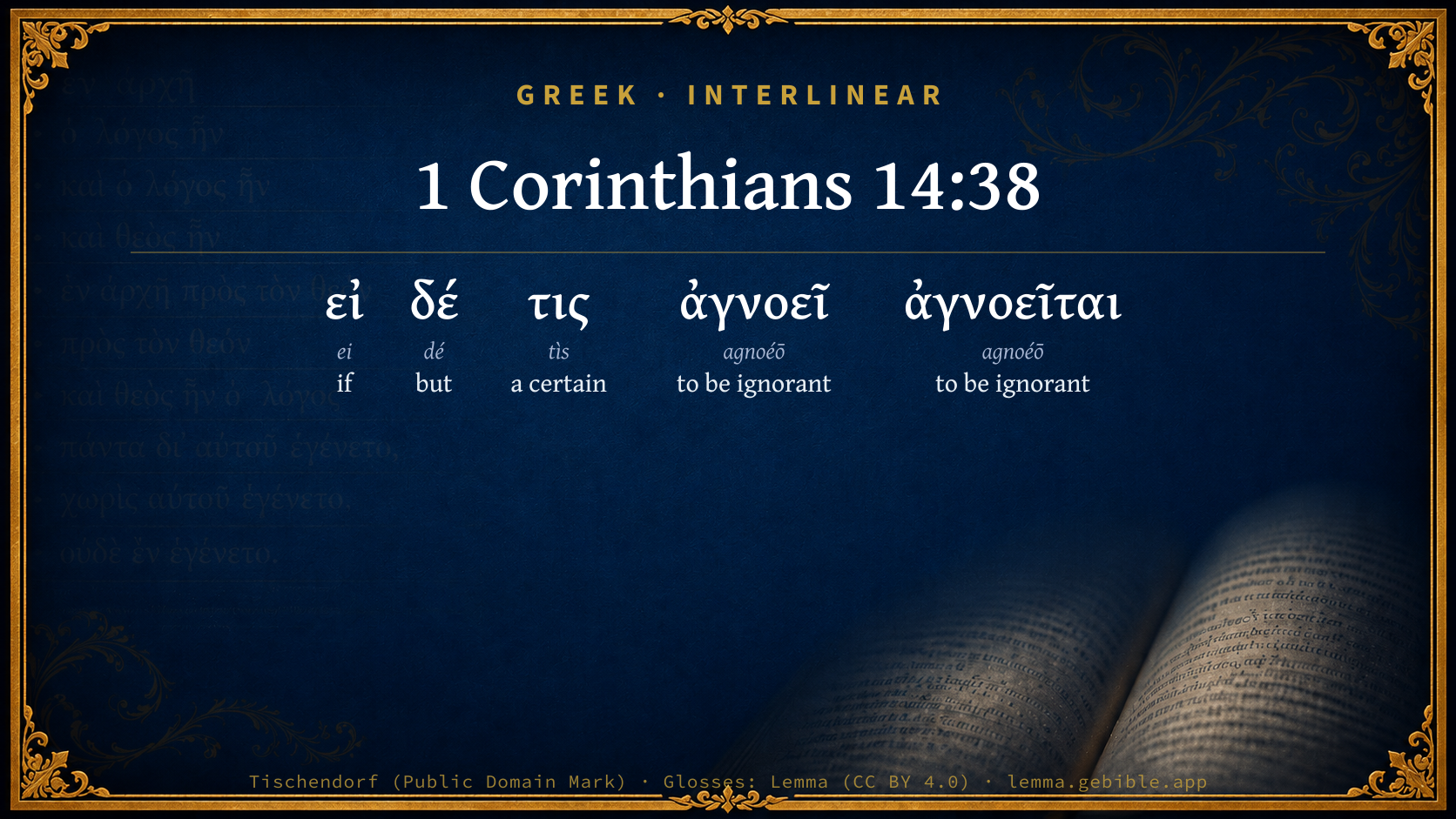
Greek (Tischendorf 8th ed.) 1 Corinthians 14:38 appears in the Greek New Testament. The text above is from the Tischendorf 8th edition. Each word links to its Strong’s number and a concise gloss. Click any word for its full Thayer’s Greek Lexicon entry.
Download image
Cite this verse

1 Corinthians 14:38 (World English Bible). Public Domain. Lemma interlinear Bible study tool, https://lemma.gebible.app/v/1-corinthians/14/38.

Show BibTeX & RIS
BibTeX
RIS
English Translation
But if anyone is ignorant, let him be ignorant.
World English Bible · Public Domain
Download a study sheet

One document with this verse’s original text, its word-by-word gloss line, the meaning frame, cross-references with their text, attributed commentary, and full source and license credits — printable, and it pastes into notes with its structure intact.

This verse Autodidact and up

Study sheet (.html) Plain text (.txt)

A passage Seminary Student

Up to 50 verses in one chapter. A passage sheet keeps up to 6 commentary sources and 12 cross-references per verse, in the order this page ranks them, and says so on the sheet whenever that leaves anything out. Ask for a single verse and you get the Autodidact verse sheet above.

Everything on this page stays free to read, with no account — the sheet is a download of what is already on screen, not access to it.

Want to remove ads? Support Godless Engineer
Compare translations 3

The same verse in 3 English versions, stacked beneath the original-language interlinear above. Click any original word for its lexicon entry.

Each is an independent rendering of the whole verse — the interlinear is not word-aligned to these translations.

Highlighted words mark where these versions differ — a whole-verse word diff, not a word-by-word alignment.

  • World English Bible Public Domain
    But if anyone is ignorant, let him be ignorant.
  • King James Version Public Domain
    But if any man be ignorant, let him be ignorant.
  • unfoldingWord Literal Text CC BY-SA 4.0
    But if anyone is ignorant, let him be ignorant.

unfoldingWord Literal Text — © unfoldingWord, licensed CC BY-SA 4.0. Word-aligned USFM3 via Door43 (git.door43.org/unfoldingWord/en_ult).

Versions to compare (up to 4)

3 of 4 selected

Show all 19 translations

Every available English version of this verse, each an independent rendering of the whole verse.

  • World English Bible Public Domain
    But if anyone is ignorant, let him be ignorant.
  • Berean Standard Bible Public Domain
    But if anyone ignores this, he himself will be ignored.
  • Majority Standard Bible Public Domain
    But if anyone is ignorant, let him be ignorant.
  • King James Version Public Domain
    But if any man be ignorant, let him be ignorant.
  • American Standard Version (1901) Public Domain
    But if any man is ignorant, let him be ignorant.
  • Revised Version (1885) Public Domain
    But if any man is ignorant, let him be ignorant.
  • Geneva Bible (1599) Public Domain
    And if any man be ignorant, let him be ignorant.
  • Douay-Rheims (1899) Public Domain
    But if any man know not, he shall not be known.
  • Young's Literal Translation Public Domain
    and if any one is ignorant -- let him be ignorant;
  • Literal Standard Version CC BY-SA 4.0
    and if anyone is ignorant—let him be ignorant;
  • Unlocked Literal Bible CC BY-SA 4.0
    But if anyone does not recognize this, let him not be recognized.
  • unfoldingWord Literal Text CC BY-SA 4.0
    But if anyone is ignorant, let him be ignorant.
  • Darby Bible Public Domain
    But if any be ignorant, let him be ignorant.
  • World Messianic Bible Public Domain
    But if anyone is ignorant, let him be ignorant.
  • Webster's Bible Public Domain
    But if any man is ignorant, let him be ignorant.
  • Free Bible Version CC BY-SA 4.0
    Those who ignore this will themselves be ignored.
  • Bible in Basic English Public Domain
    But if any man is without knowledge, let him be so.
  • Text-Critical English NT CC BY 4.0
    But if anyone ignores this, let him be ignorant.
  • Tyndale New Testament (1534) Public Domain
    But and yf eny man be ignorant let him be ignorant.

Literal Standard Version (2020), Covenant Press — licensed CC BY-SA 4.0. Text via the HelloAO Bible API (eBible.org). Unlocked Literal Bible (unfoldingWord) — licensed CC BY-SA 4.0. Text via the HelloAO Bible API (eBible.org). unfoldingWord Literal Text — © unfoldingWord, licensed CC BY-SA 4.0. Word-aligned USFM3 via Door43 (git.door43.org/unfoldingWord/en_ult). Free Bible Version, Dr. Jonathan Gallagher — licensed CC BY-SA 4.0. Text via the HelloAO Bible API (eBible.org).

Word by word

More ways to search: Search by grammar → Find every occurrence → Compare this word →

Practice this passage: Drill this verse → Learn its vocabulary →

About this verse

These counts appear in no published source. They are computed here, from the morphology-tagged text and Lemma’s own curated glosses. What Lemma adds →

5
words
4
distinct lemmas
Pauline Epistles
section

Notable vocabulary

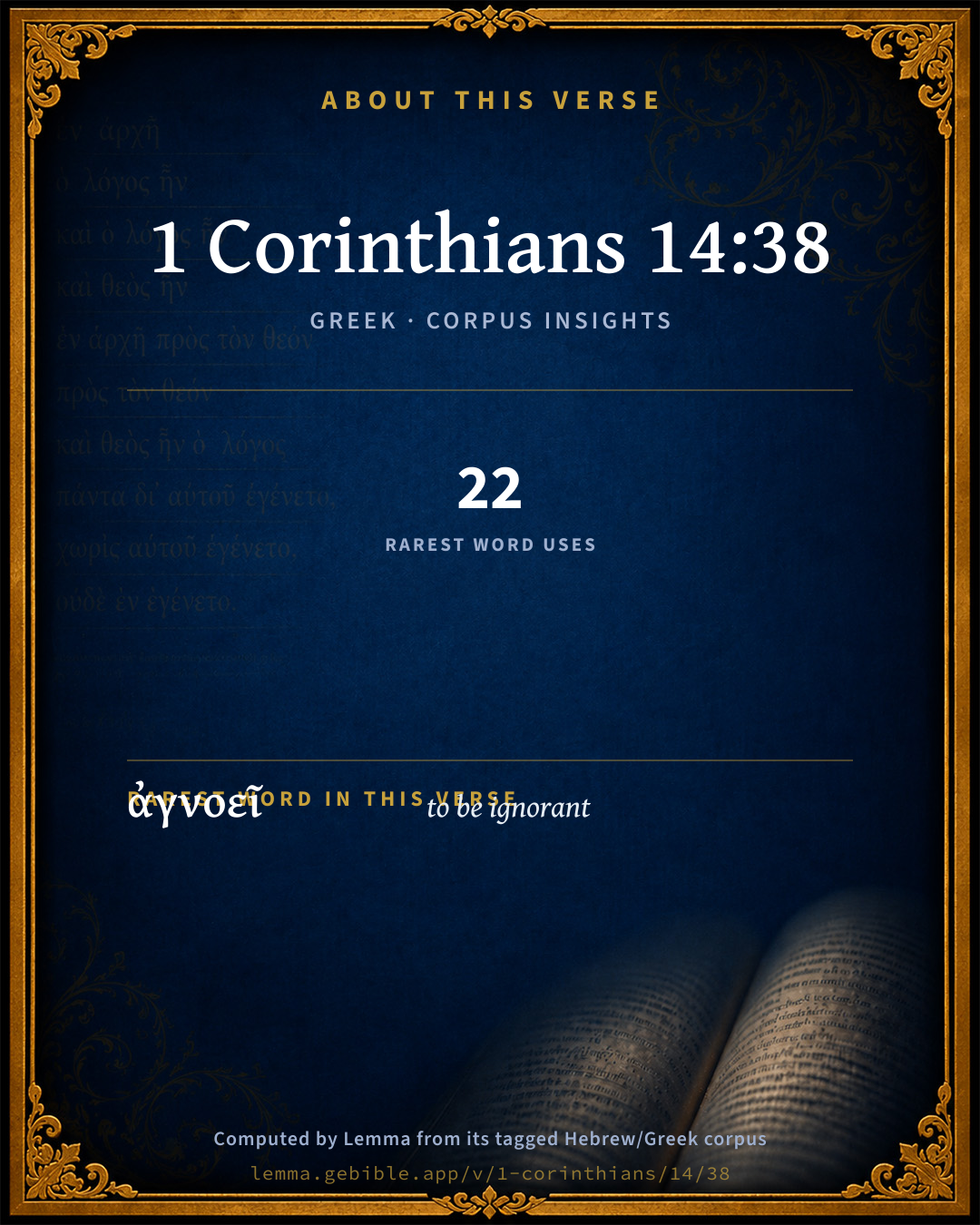
The rarest word here is ἀγνοεῖ to be ignorant G50 — appearing just 22 times in the whole Greek New Testament.

Shared distinctive vocabulary

ἀγνοεῖ to be ignorant G50 occurs in 21 verses of the Greek New Testament. Also found in:

Repetition

A word recurs within this verse:

  • ἀγνοεῖ to be ignorant G50 ×2

Cross-references

6

Topical passages linked to 1 Corinthians 14:38 in the Treasury of Scripture Knowledge — connected by theme and wording, ordered by reader-vote popularity; previews shown in the World English Bible.

  • 2 Timothy 4:3–4 For the time will come when they will not listen to the sound doctrine, but, having itching ears, will heap up for themselves teachers after their own lusts;
  • Matthew 7:6 "Don't give that which is holy to the dogs, neither throw your pearls before the pigs, lest perhaps they trample them under their feet, and turn and tear you to pieces.
  • 1 Timothy 6:3–5 If anyone teaches a different doctrine, and doesn't consent to sound words, the words of our Lord Jesus Christ, and to the doctrine which is according to godliness,
  • Revelation 22:11–12 He who acts unjustly, let him act unjustly still. He who is filthy, let him be filthy still. He who is righteous, let him do righteousness still. He who is holy, let him be holy still."
  • Hosea 4:17 Ephraim is joined to idols. Leave him alone!
  • Matthew 15:14 Leave them alone. They are blind guides of the blind. If the blind guide the blind, both will fall into a pit."

Cross-references courtesy of OpenBible.info (CC BY 4.0).

Commentary

Notes on 1 Corinthians 14:38 from classic Christian and Jewish commentators (each source and its license shown beneath its notes). The classic Christian expositions comment on the surrounding passage and are grouped to its opening verse, so a note may address several verses; the Jewish commentaries on the Tanakh (Rashi and others) are per-verse, so they appear only where the commentator wrote on this verse.

Lemma curates 59 commentaries, every one of them public domain or Creative Commons licensed, each selected and text-cleaned for this edition rather than reprinted as found. About our sources →

Bengel's Gnomon

Johann Albrecht Bengel

1Co 14:38. Εἰ δέ τις ἀγνοεῖ, But if any man be ignorant) So that he has not the capacity to perceive [acknowledge]. If any one knows not, he says, or pretends not to know. This is an argument which would have weight with the Corinthians, who were very desirous of knowledge.—ἀγνοείτω, let him be ignorant) which means, we cannot cast away all things for the sake of such a man; let him keep it to himself. Those, who are thus left to themselves, repent more readily, than if you were to teach them against their will.

Bengel's Gnomon of the New Testament — English translation (T&T Clark, Edinburgh, 1860) — public domain. Text from a community e-Sword module.

Meyer's Critical & Exegetical Commentary

Heinrich August Wilhelm Meyer

1Co_14:38. Ἀγνοεῖ] namely, ἃ γράφω ὑμῖν, ὅτι κ.τ.λ., 1Co_14:37. His not being willing to know, or the attitude of wrongly knowing (Hofmann), is not conveyed in the word, but is presupposed.

ἀγνοείτω] permissive, denotes the renunciation of all endeavours to instruct such an one who lets himself be puffed up. It is the opposite of the ἐπιγινώσκειν, 1Co_14:37. Estius puts it well: Sibi suaeque ignorantiae relinquendos esse censeo. Comp. 1Co_11:16.

Meyer — Critical and Exegetical Commentary on the New Testament — English translation by Peter Christie, edited by Frederick Crombie (T&T Clark, 1880) — public domain. Text from a community e-Sword module.

Hodge's Commentary on Romans, Ephesians & First Corinthians

Charles Hodge

1Co_14:38

But if any man be ignorant, let him be ignorant.

That is, if any man be ignorant or refuses to acknowledge the divine authority of my instructions, let him be ignorant. Paul would neither attempt to convince him, nor waste time in disputing the point. Where the evidence of any truth is abundant and has been clearly presented, those who reject it should be left to act on their own responsibility. Further disputation can do no good.

Charles Hodge — Commentary on Romans (1835), First Corinthians (1857), and Ephesians (1856) — public domain. Text from a community e-Sword module.

Geneva Bible (1599)

Geneva Bible translators

The Church ought not to care for such as be stubbornly ignorant, and will not abide to be taught, but to go forward notwithstanding in those things which are right.

Geneva Bible (1599) marginal notes — public domain. Text via Bolls.life.

Jamieson, Fausset & Brown

Robert Jamieson, A. R. Fausset & David Brown

if any man be ignorant--wilfully; not wishing to recognize these ordinances and my apostolic authority in enjoining them.

let him be ignorant--I leave him to his ignorance: it will be at his own peril; I feel it a waste of words to speak anything further to convince him. An argument likely to have weight with the Corinthians, who admired "knowledge" so much.

Jamieson, Fausset & Brown — Commentary Critical and Explanatory on the Whole Bible (1871) — public domain (CC PDM 1.0). Text via the HelloAO Bible API.

Adam Clarke's Commentary

Verse 38. But if any man be ignorant] If he affect to be so, or pretend that he is ignorant; let him be ignorant-let him be so at his peril.

Adam Clarke's Commentary on the Bible (1810–1826) — public domain. Text from a community e-Sword/MySword module.

John Calvin's Commentaries

38. But if any man be ignorant The old translation reads thus: He that knows not this, will be unknown; but this is a mistake. For Paul had it in view to cut off every handle from contentious persons, who make no end of disputing, and that, under the pretense of inquiring — as if the matter were not yet clear; or at least he intimates in general terms, that he regarded as of no account any one that would call in question what he said. “If any one is ignorant, I do not stop to take notice of his doubts, for the certainty of my doctrine is not at all impaired thereby. Let him go then, whoever he may be. As for you, do not the less on that account give credit to Christ, as speaking by me.” In fine, he intimates, that sceptics, contentious persons, and subtle disputants; do not by the questions they raise diminish, in any degree, the authority of sound doctrine, and of that truth as to which believers ought to feel assured, and at the same time he admonishes us, not to allow their doubts to be any hindrance in our way. That elevation of mind, however, which despises all human judgments, ought to be founded on ascertained truth. Hence, as it would be the part of perverse rashness, either to maintain pertinaciously, in opposition to the views of all others, an opinion that has once been taken up, or audaciously to cling to it, while others are in doubt, so, on the other hand, when we have felt assured that it is God that speaks, let us fearlessly break through all human impediments and all difficulties.

John Calvin's Commentaries (1540-1563) — public domain. Text from the Calvin Translation Society English edition (1840s-50s) via the Christian Classics Ethereal Library (ccel.org). Calvin's coverage is partial (roughly two-thirds of the Bible); uncommented books and verses are honest gaps, never fabricated. The 19th-century editor's footnotes and remarks are omitted so the notes are faithfully Calvin's own voice.

Ellicott's Commentary for English Readers

(38) But if any man be ignorant.—There are here two readings in the Greek, for each of which there is strong evidence. The passage may run, either, as in the English, if any man does not know this, let him not know it: then the words would mean that a person who could not recognise such an evident and simple truth must be of a perverse mind—his opposition would give the Apostle no further concern. The other reading is, if any man knows not this, he is himself not known: this would signify that any man who knows not this truth is not known of God (as in 1Co_8:2-3; 1Co_13:12).

A Bible Commentary for English Readers, edited by Charles John Ellicott (1878–1897) — public domain. Text from a community e-Sword module.

The Cambridge Bible for Schools and Colleges

gen. ed. J. J. S. Perowne

38. But if any man be ignorant, let him be ignorant] Some editors read ‘he is ignored’ instead of ‘let him be ignorant.’ If we take the reading in the text, which seems preferable, the sense is that St Paul will give himself no further trouble about one whose insubordination proves him to be no real prophet of God; if the reading which some would substitute for it, the signification is that God will neglect him who neglects the commandments of His Apostle. Cf. ch. 1Co_8:3. The Vulgate renders ignorabitur; and Wiclif, he schal be unknowe; Tyndale renders as in the text.

The Cambridge Bible for Schools and Colleges (gen. ed. J. J. S. Perowne; Cambridge University Press, 1878–1918) — public domain. Text from a community e-Sword module.

John Gill's Exposition

Let all things be done decently and in order. Which may refer not only to what is said in this chapter, but in the foregoing part of the epistle; go not to law before the unbelievers; let not a believing yokefellow depart from an unbelieving one; let not him that has knowledge sit in an idol's temple, and eat meat there; let not a man pray with his head covered, and a woman with hers uncovered; come not to the house of God to eat and drink intemperately, thereby reflecting dishonour and scandal on the ordinance of the Lord's supper; let not any speak in an unknown tongue in the church, without an interpreter, as if he was a madman, nor suffer women to teach in public; all which are very unbecoming, and contrary to the rules of decency: do not encourage animosities, factions, and parties; despise not the faithful ministers of the word, but honour and obey them in the Lord; neglect not the discipline of the church, lay on censures, and pass the sentence of excommunication on such as deserve them; keep the ordinances as they have been delivered, particularly that of the Lord's supper; observe the rules prescribed for prophesying and speaking with tongues, and so all these things will be done according to the order of the Gospel: and the words may be considered as a general rule for the decent and orderly management of all things relating to the worship of God, and discipline of his house; that in all things a good decorum, and strict order, be observed, that nothing be done contrary to the rules of decency, and the laws and commandments of Christ.

Next: 1 Corinthians Chapter 15

John Gill's Exposition of the Whole Bible (1746–1763) — public domain (CC PDM 1.0). Text via the HelloAO Bible API.

Trapp's Complete Commentary

John Trapp

38 But if any man be ignorant, let him be ignorant.

Ver. 38. But if any man be ignorant, &c.] If stubbornly ignorant and uncounsellable; let him take his own course. I have cleared the truth in things now controverted, and there I rest me. Who so blind as he that will not see? such put not light under a bushel, but under a dunghill, and shall give a heavy account of it to God. When I hear men (saith Lord Kemp) under all the means that we enjoy, yet think that their ignorance shall excuse them, it makes me think of the answer of the agent of Charles V, emperor to the ambassador of Sienna. The Siennois having rebelled against the emperor, sent their ambassador to excuse it; who when he could find no other excuse, thought in a jest to put it off thus: What, saith he, shall not we of Sienna be excused, seeing we are known to be all fools? the agent replied, Even that shall excuse you, but upon the condition which is fit for fools, which is, to be kept bound and enchained.

John Trapp, A Commentary or Exposition upon All the Books of the Old and New Testament (1647–1656) — public domain. Text from a community e-Sword module.

Albert Barnes' Notes on the Bible

But if any be ignorant ... - If anyone affects to be ignorant of my authority, or whether I have a right to command. If he affects to doubt whether I am inspired, and whether what I utter is in accordance with the will of God.

Let him be ignorant - At his own peril, let him remain so, and abide the consequences. I shall not take any further trouble to debate with him. I have stated my authority. I have delivered the commands of God. And now, if he disregards them, and still doubts whether all this is said by divine authority, let him abide the consequences of rejecting the law of God. I have given full proof of my divine commission. I have nothing more to say on that head. And now, if he chooses to remain in ignorance or incredulity, the fault is his own, and he must answer for it to God.

Albert Barnes' Notes on the Bible (1834–1885) — public domain. Text from a community e-Sword/MySword module.

Matthew Poole's English Annotations

If any one will pretend ignorance in this, he is wilfully ignorant; for my own part, I will concern myself no further about him, but leave myself and him also to the judgment of God;

let him be ignorant. In some copies it is, he shall not be known: in the day of judgment Christ shalt say unto him: Depart from me, I know you not.

Matthew Poole's English Annotations on the Holy Bible (1683–1685) — public domain. Text from a community e-Sword/MySword module.

Whedon's Commentary on the Bible

Daniel D. Whedon

38. If—A second if antithetic to the first if of 1Co_14:37. If any man be spiritual, let him acknowledge my words; if, on the other hand, he be not spiritual, but so refractory as to ignore what I say, let him be left to his ignoring as incorrigible and unworthy further labour. Here the ignorance is held to lie in the will, and is, therefore, impervious to argument. Another, but not well-authorized reading would be, let him be ignored.

Daniel D. Whedon (gen. ed.), Commentary on the Old and New Testaments (1874–1909) — public domain. Text from a community e-Sword module.

The Pulpit Commentary

Let him be ignorant. The formula seems to fall under the idiom which refuses to say anything more about a subject ("If I perish, I perish;" "What I have written, I have written;" "He that is filthy, let him be filthy still," etc.). The readings vary considerably ("He is ignored;" "He has been ignored;" "He shall be ignored;" "Let him be ignored"). These other readings would be a statement of retribution in kind of God "sprinkling penal blindnesses on forbidden lusts." But the reading of our translation is on the whole the best supported, and means that to invincible bigotry and ignorant obstinacy St. Paul will have no more to say (Mat_15:14; 1Ti_6:3-5)

Abandonment to ignorance.

Paul was a man who humbled himself but magnified his office. For himself, he was less than the least of all saints; but officially and in apostolic influence and authority, he was not behind the chiefest of the apostles. Of course there were in the primitive Churches men who acknowledged neither his authority nor the authority of any other than themselves. And when the apostle gave utterance to his judgment, it was with the knowledge that his judgment would not pass unchallenged. There is something of indignation and something of sarcasm in his reference to those who resisted his opinions and decisions. And there is wisdom as well as an admirable display of just impatience in his language: "If any man is ignorant, let him be ignorant.

I OPINIONATEDNESS AND IGNORANCE OFTEN GO TOGETHER. A little experience convinces us that those who cling the most tenaciously to their own opinions, their own habits, are not always men of the soundest judgment. To resist evidence and authority is no sign of soundness of mind and power of intellect. Some are obstinate because they are blind to all testimony and evidence but that which is acceptable to their own prejudices.

II THERE ARE THOSE WHOM NO EVIDENCE CAN CONVINCE AND NO AUTHORITY OVERAWE. If all men were candid and dispassionate, and habituated to follow the clear white light of reason, human life and human society would be very different from what they actually are. Our Lord Jesus was forbearing and patient with those who opposed themselves to him; but even he confessed that there were those who loved darkness rather than light because their deeds were evil. Young and sanguine ministers of religion often begin their work with an inward persuasion that they have only to place the truth fairly and fully before men, in order to their conviction and conversion. But experience teaches them that it is not so; that there is a moral obduracy which is proof against all efforts.

III IT MAY BE WISE TO ABANDON TO THEIR LOVED IGNORANCE THOSE WHO WILL NOT BE ENLIGHTENED. An affectionate and benevolent mind will be very slow to adopt such a course. And it cannot be adopted without the hope and prayer that, when ordinary and human methods have failed, it may please God to employ some methods unknown to finite wisdom, to secure the wished for result. Even the Creator himself seems to act upon the principle here exemplified, at all events for a season and a purpose: "Ephraim is joined unto idols: let him alone.

IV THERE IS BETTER EMPLOYMENT FOR THE TIME OF CHRISTIAN LABOURERS THAN THE ENDEAVOURS TO ENLIGHTEN THE INVINCIBLY IGNORANT. There are the young, the ardent inquirers for truth, the candid and open minded, the earnest and prayerful, all anxious for more light, for lessons of truth, counsels of wisdom, encouragement, and admonition. In such directions there is abundant scope for effort, with the confidence that labour will not be in vain. Why spend years in tilling the rock or sowing the iceberg, when virgin soil awaits the plough and promises to reward the toil of the spiritual husbandman?

V THERE IS A PROBATION AND A JUDGMENT APPOINTED BY GOD, TO WHICH SUCH CHARACTERS MUST NEEDS BE LEFT. It must be remembered by the Christian labourer that he is not one of the governors of the world. This reflection will not harden his heart against the unbelieving; he will leave such in the hands of One who is far more wise and far more merciful than the wisest and the most merciful of men. T.

The Pulpit Commentary (1880–1919), ed. H.D.M. Spence-Jones & Joseph S. Exell — public domain. Text from a community e-Sword module.

John Wesley's Explanatory Notes

Let him be ignorant - Be it at his own peril.

John Wesley, Explanatory Notes Upon the Whole Bible (1754–1765) — public domain. Text via the GEBible commentary corpus.

Godbey's Commentary on the New Testament

William B. Godbey

38. “If any one ignores, he is ignored.” This verse evidently was not understood by King James’ translators. At least, they have utterly failed to bring out the matter of fact here revealed, which is simple, clear and unmistakable; i. e., that the Word of God is authoritative, not only on all doctrinal lines, but in all church discipline; so that there is no apology for making rules and regulations. The New Testament is a plain book, quite as plain as any rules and regulations we can make. In the first place, we do not need anything else in the way of doctrine or discipline, because God’s Word covers all the ground. In the second place, though you formulate a creed as voluminous as the Westminster Confession, and make ever so many rules and regulations, after all they are utterly invalid except so far as they are in harmony with the Word of God, while even in that case it is much better to go to headquarters, where matters are simple, clear and free from human complications. This verse settles the matter. You have a right to enforce the order laid down in the New Testament throughout your church; meanwhile every member who does not recognize this authority, and walk accordingly, simply forfeits membership thereby. It is no trouble whatever to find perfect disciplinary authority, as well as all the doctrines of grace, in the New Testament. A true church has no creed but God’s Word, and knows no other rules and regulations. While they are true to the New Testament, their only creed and discipline, positively, they are also true to it negatively, recognizing no one as a bona fide member whose experience and life are not in harmony with God’s revealed Word. If this code of doctrine and collation of disciplinary rules and regulations were enforced in the churches of Christendom, how statistics and salaries would suddenly fall from hundreds down to tens!

William B. Godbey, Commentary on the New Testament (1896–1900) — public domain. Text from a community e-Sword module.

McGarvey & Pendleton's Commentaries

J. W. McGarvey

But if any man is ignorant, let him be ignorant . [Since Paul's words were dictated by the Spirit of God, any one filled with that Spirit would be guided to recognize his words as of divine authority, for the Spirit would not say one thing to one man and another to another. But if any man was so incorrigibly obstinate as to refuse to be enlightened by what the Spirit spoke through the apostle, there was no further appeal to be made to him ( Mat_15:14 ; 1Ti_6:3-5 ). Paul's test is still of force. Whoso professes to be inspired, yet contradicts what the Spirit of God has already said in the New Testament, is self-convicted. These verses mark the division between Catholics and Protestants. The former say in effect that the Spirit-filled prophets at Corinth could modify, alter, and even deny what was spoken by the Spirit-filled Paul; for they hold that the pope can change the Scriptures to suit himself. But Protestants hold that a man shows himself to be led of the Spirit of God when he assents and conforms to that which has been spoken by men of undoubted inspiration.]

J. W. McGarvey (with Philip Y. Pendleton), Commentaries on the New Testament (The Fourfold Gospel, 1914; Acts; and the epistles) — public domain. Text from a community e-Sword/MySword module.

The People's New Testament

B. W. Johnson

38. If any man be ignorant. If he will be ignorant and obstinate, let him remain so.

B. W. Johnson's The People's New Testament with Notes (1889–1891) — public domain. Electronic text from the Christian Classics Ethereal Library (CCEL) ThML edition.

Cambridge Greek Testament for Schools and Colleges

38. ἀγνοείτω BE, Peshito. ἀγνοεῖται אADFG Vulg. Tischendorf thinks that ἀγνοείτω, as the easier reading, has been introduced as a correction. He cites Origen in favour of his reading, but Origen’s text is doubtful.

38. ἀγνοείτω. The explanation of this passage is to be sought in Gal 4:9. If any man does not recognize St Paul’s mission from the Lord, it is a clear proof that God knows nothing of him. The text is a correction owing to the corrector having failed to grasp the Apostle’s meaning, but it gives a poor and frigid sense beside that which ἀγνοεῖται gives. So Origen explains, οὔκουν ὁ ἁμαρτωλὸς ἀγνοεῖται ὑπὸ τοῦ θεοῦ; (Hom. I. in Jeremiam). The whole character of St Paul’s remarks from 1Co 14:34 onward shews that St Paul has reason to apprehend special difficulties on this point. See note on 1Co 6:16.

Cambridge Greek Testament for Schools and Colleges (Cambridge University Press, 1896; 21 vols, various authors incl. Carr, Maclear, Plummer, Farrar, Lumby, Moule, M. R. James, Simcox) — public domain. Text from a community e-Sword module.

Alford’s Greek Testament

Henry Alford

38. ἀγνοείτω] implying both the hopelessness of reclaiming such an one, and the little concern which his opposition gave the Apostle. The other reading, ἀγνοεῖται, gives a passable sense—‘he is ignored,’ scil. by God: cf. ch. 8:2, 3; 13:12; Gal 4:9.

Henry Alford, The Greek Testament (1849–1861) — public domain. Text from a community e-Sword module.

Vincent's Word Studies in the New Testament

Marvin R. Vincent

Let him be ignorant [αγνοειτω] . Let him remain ignorant. The text is doubtful. Some read ajgnoeitai he is not known; i e., he is one whom God knows not.

Marvin R. Vincent, Word Studies in the New Testament (1887–1900) — public domain. Text from a community e-Sword/MySword module.

Godet's Commentaries

Frédéric Louis Godet

Vv. 38. There is more than indifference, there are severity and threatening in these words; they are addressed to the persons whose folly was characterized by the word δοκεῖ in the previous verse. “If there are among you people who reckon their ideas superior to mine, let them follow them!” Of course such speaking is not addressed to people with whom one is on good terms. We have to bear in mind the first chapters of the Epistle, where the apostle once and again alluded to the disrespectful sentiments of a party in the Church toward him; comp. also 1Co 7:40.

The reading ἀγνοείτω, let him be ignorant, is the only admissible one. After all he has said, the apostle no longer seeks to convince those who think themselves wiser than he is; he abandons them at once to their inexperience and their responsibility. The reading ἀγνοεῖται, he is ignored, preferred by some commentators, and again recently by Heinrici, would signify: “Willing to be ignorant of God, he is ignored (rejected) by Him.” Edwards regards ἀγνοεῖται as a future indicative middle: “he will be ignored (at the judgment).” Comp. 1Co 8:3. It is difficult to explain the origin of this variant (see Meyer’s attempt). But the threat of perdition for refusal to accept directions so external in their nature as those which precede would be rather severe. The reading ἀγνοείτω: “Let him be ignorant at his risk and peril!” is the only one worthy of the apostle, and really natural.

Paul closes with a very precise statement of his conclusion:

Frédéric Louis Godet — Commentaries on Luke, John, Romans, and 1 Corinthians — English translation (T&T Clark, Edinburgh, 1870s–1890s) — public domain. Text from a community e-Sword module.

Lesson kit

Teaching starters — assembled from the data on this page, not authored interpretation. Every prompt links to the verse data it draws on. Edit before teaching.

1 Corinthians, in the Pauline Epistles, opens this verse with 5 words (4 distinct Greek lemmas). Its most distinctive word is agnoéō (“to be ignorant”). A historical commentator’s framing appears above. Read the whole chapter for the surrounding context.

Discussion questions

  1. How does “to be ignorant” (agnoéō) shape what this verse is saying?
  2. How does Mark 9:32, which shares the word «to be ignorant», read alongside this verse?
  3. What does the repetition of “to be ignorant” (2× in this one verse) do in this verse?
  4. These translations render this verse differently. What is at stake in choosing one wording over another?
  5. Compare how Bengel's Gnomon and Meyer's Critical & Exegetical Commentary read this verse. Where do they agree or differ?

Things to notice

  • These translations choose different wording for 3 words in this verse.
  • “to be ignorant” occurs 2× in this single verse.
  • 4 distinct Greek lemmas span 5 words in this verse.

Reading settings

Reading text

Shown beneath each verse's original-language words.

Old Testament
Old Testament edition

Read the OT as the Masoretic Hebrew (MT) or the Greek Septuagint (LXX).

English shown for the Greek Septuagint (in the Hebrew ↔ Greek comparison).

Comparing translations? Open the Compare panel on any verse page to stack up to four side by side.