1 Corinthians 14:22

Greek (Tischendorf 8th ed.) 1 Corinthians 14:22 appears in the Greek New Testament. The text above is from the Tischendorf 8th edition. Each word links to its Strong’s number and a concise gloss. Click any word for its full Thayer’s Greek Lexicon entry.
Download image
Cite this verse

1 Corinthians 14:22 (World English Bible). Public Domain. Lemma interlinear Bible study tool, https://lemma.gebible.app/v/1-corinthians/14/22.

Show BibTeX & RIS
BibTeX
RIS
English Translation
Therefore other languages are for a sign, not to those who believe, but to the unbelieving; but prophesying is for a sign, not to the unbelieving, but to those who believe.
World English Bible · Public Domain
Download a study sheet

One document with this verse’s original text, its word-by-word gloss line, the meaning frame, cross-references with their text, attributed commentary, and full source and license credits — printable, and it pastes into notes with its structure intact.

This verse Autodidact and up

Study sheet (.html) Plain text (.txt)

A passage Seminary Student

Up to 50 verses in one chapter. A passage sheet keeps up to 6 commentary sources and 12 cross-references per verse, in the order this page ranks them, and says so on the sheet whenever that leaves anything out. Ask for a single verse and you get the Autodidact verse sheet above.

Everything on this page stays free to read, with no account — the sheet is a download of what is already on screen, not access to it.

Want to remove ads? Support Godless Engineer
Compare translations 3

The same verse in 3 English versions, stacked beneath the original-language interlinear above. Click any original word for its lexicon entry.

Each is an independent rendering of the whole verse — the interlinear is not word-aligned to these translations.

Highlighted words mark where these versions differ — a whole-verse word diff, not a word-by-word alignment.

  • World English Bible Public Domain
    Therefore other languages are for a sign, not to those who believe, but to the unbelieving; but prophesying is for a sign, not to the unbelieving, but to those who believe.
  • King James Version Public Domain
    Wherefore tongues are for a sign, not to them that believe, but to them that believe not: but prophesying serveth not for them that believe not, but for them which believe.
  • unfoldingWord Literal Text CC BY-SA 4.0
    So then, the tongues are for a sign, not to the ones believing, but to the unbelievers; but prophecy not to the unbelievers, but to the ones believing.

unfoldingWord Literal Text — © unfoldingWord, licensed CC BY-SA 4.0. Word-aligned USFM3 via Door43 (git.door43.org/unfoldingWord/en_ult).

Versions to compare (up to 4)

3 of 4 selected

Show all 19 translations

Every available English version of this verse, each an independent rendering of the whole verse.

  • World English Bible Public Domain
    Therefore other languages are for a sign, not to those who believe, but to the unbelieving; but prophesying is for a sign, not to the unbelieving, but to those who believe.
  • Berean Standard Bible Public Domain
    Tongues, then, are a sign, not for believers, but for unbelievers. Prophecy, however, is for believers, not for unbelievers.
  • Majority Standard Bible Public Domain
    Tongues, then, are a sign, not for believers, but for unbelievers. Prophecy, however, is for believers, not for unbelievers.
  • King James Version Public Domain
    Wherefore tongues are for a sign, not to them that believe, but to them that believe not: but prophesying serveth not for them that believe not, but for them which believe.
  • American Standard Version (1901) Public Domain
    Wherefore tongues are for a sign, not to them that believe, but to the unbelieving: but prophesying `is for a sign', not to the unbelieving, but to them that believe.
  • Revised Version (1885) Public Domain
    Wherefore tongues are for a sign, not to them that believe, but to the unbelieving: but prophesying is for a sign, not to the unbelieving, but to them that believe.
  • Geneva Bible (1599) Public Domain
    Wherefore strange tongues are for a signe, not to them that beleeue, but to them that beleeue not: but prophecying serueth not for them that beleeue not, but for them which beleeue.
  • Douay-Rheims (1899) Public Domain
    Wherefore tongues are for a sign, not to believers, but to unbelievers; but prophecies not to unbelievers, but to believers.
  • Young's Literal Translation Public Domain
    so that the tongues are for a sign, not to the believing, but to the unbelieving; and the prophesy `is' not for the unbelieving, but for the believing,
  • Literal Standard Version CC BY-SA 4.0
    so that the tongues are for a sign, not to the believing, but to the unbelieving; and the prophecy [is] not for the unbelieving, but for the believing.
  • Unlocked Literal Bible CC BY-SA 4.0
    So then, tongues are a sign, not to believers, but to unbelievers. But prophesying is for a sign, not for unbelievers, but for believers.
  • unfoldingWord Literal Text CC BY-SA 4.0
    So then, the tongues are for a sign, not to the ones believing, but to the unbelievers; but prophecy not to the unbelievers, but to the ones believing.
  • Darby Bible Public Domain
    So that tongues are for a sign, not to those who believe, but to unbelievers; but prophecy, not to unbelievers, but to those who believe.
  • World Messianic Bible Public Domain
    Therefore other languages are for a sign, not to those who believe, but to the unbelieving; but prophesying is for a sign, not to the unbelieving, but to those who believe.
  • Webster's Bible Public Domain
    Wherefore languages are for a sign, not to them that believe, but to them that believe not: but prophesying serveth not for them that believe not, but for them who believe.
  • Free Bible Version CC BY-SA 4.0
    Speaking in tongues is a sign, not to believers, but those who don't believe. Speaking God's prophetic message is the opposite: it is not for those who don't believe, but for believers.
  • Bible in Basic English Public Domain
    For this reason tongues are for a sign, not to those who have faith, but to those who have not: but the prophet's word is for those who have faith, and not for the rest who have not.
  • Text-Critical English NT CC BY 4.0
    So then, tongues are a sign not for believers but for unbelievers, while prophecy is a sign not for unbelievers but for believers.
  • Tyndale New Testament (1534) Public Domain
    Wherfore tonges are for a signe not to them that beleve: but to them that beleve not. Contrary wyse prophesyinge serveth not for them that beleve not: but for them which beleve.

Literal Standard Version (2020), Covenant Press — licensed CC BY-SA 4.0. Text via the HelloAO Bible API (eBible.org). Unlocked Literal Bible (unfoldingWord) — licensed CC BY-SA 4.0. Text via the HelloAO Bible API (eBible.org). unfoldingWord Literal Text — © unfoldingWord, licensed CC BY-SA 4.0. Word-aligned USFM3 via Door43 (git.door43.org/unfoldingWord/en_ult). Free Bible Version, Dr. Jonathan Gallagher — licensed CC BY-SA 4.0. Text via the HelloAO Bible API (eBible.org).

Word by word

More ways to search: Search by grammar → Find every occurrence → Compare this word →

Practice this passage: Drill this verse → Learn its vocabulary →

προφητεία
prophēteía
G4394
“prophecy”
Noun, Nominative, Singular, Feminine
Part of Speech
Noun
Case
Nominative
Number
Singular
Gender
Feminine
Full Thayer's Definition

Origin: "from G4396 ("prophecy")"

TDNT: 19:02,0

1. prophecy a. a discourse emanating from divine inspiration and declaring the purposes of God, whether by reproving and admonishing the wicked, or comforting the afflicted, or revealing things hidden; esp. by foretelling future events b. Used in the NT of the utterance of OT prophets 1. of the prediction of events relating to Christ's kingdom and its speedy triumph, together with the consolations and admonitions pertaining to it, the spirit of prophecy, the divine mind, to which the prophetic faculty is due 2. of the endowment and speech of the Christian teachers called prophets 3. the gifts and utterances of these prophets, esp. of the predictions of the works of which, set apart to teach the gospel, will accomplish for the kingdom of Christ
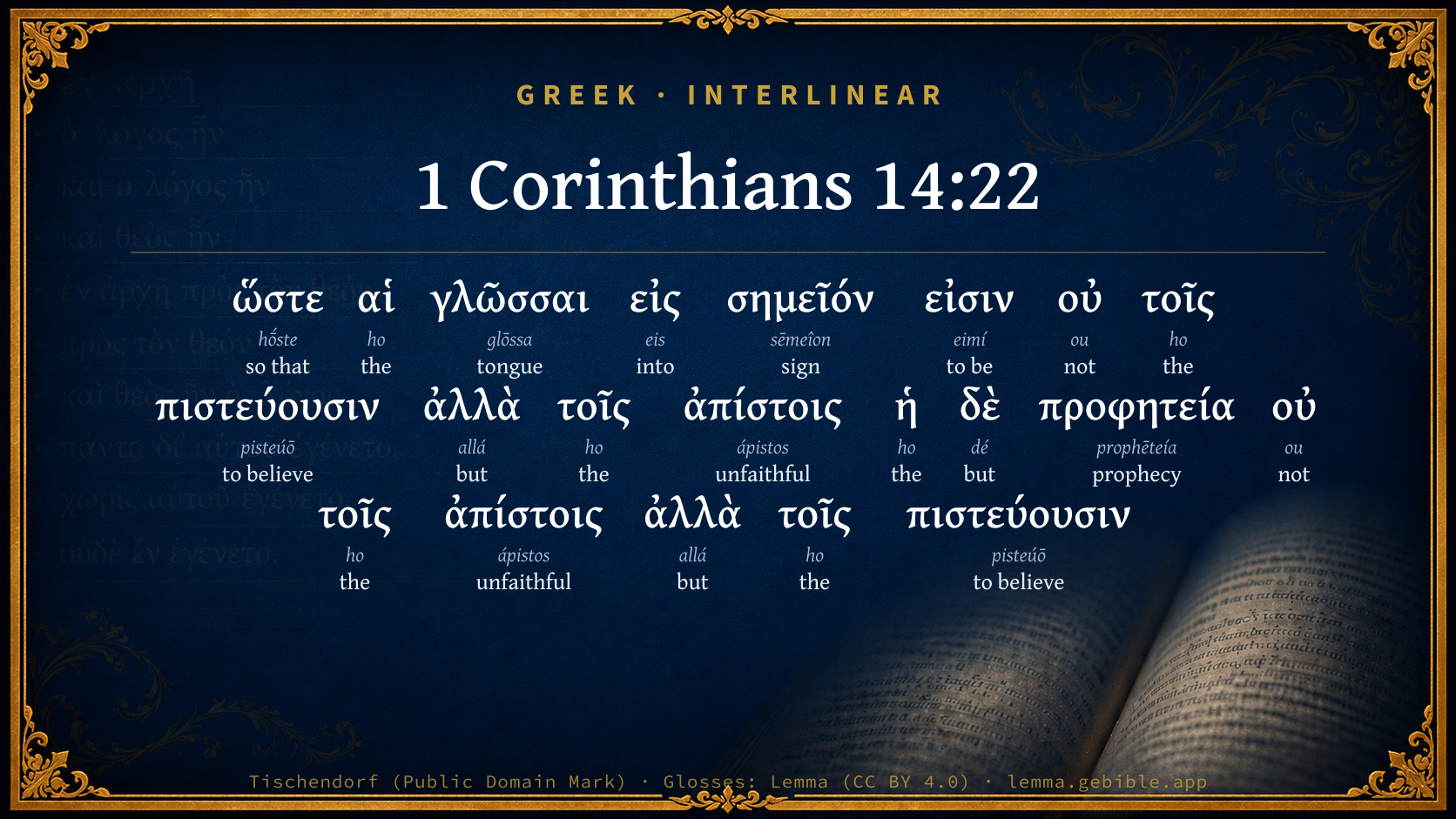
  1. ὥστε hṓste G5620 “so that” Conjunction
  2. αἱ ho G3588 “the” Article, Nominative, Plural, Feminine
  3. γλῶσσαι glōssa G1100 “tongue” Noun, Nominative, Plural, Feminine
  4. εἰς eis G1519 “into” Preposition
  5. σημεῖόν sēmeîon G4592 “sign” Noun, Accusative, Singular, Neuter
  6. εἰσιν eimí G1510 “to be” Verb, Present, Active, Indicative, 3rd person, Plural
  7. οὐ ou G3756 “not” Particle, Negative
  8. τοῖς ho G3588 “the” Article, Dative, Plural, Masculine
  9. πιστεύουσιν pisteúō G4100 “to believe” Verb, Present, Active, Participle, Dative, Plural, Masculine
  10. ἀλλὰ allá G235 “but” Conjunction
  11. τοῖς ho G3588 “the” Article, Dative, Plural, Masculine
  12. ἀπίστοις ápistos G571 “unfaithful” Adjective, Dative, Plural, Masculine
  13. ἡ ho G3588 “the” Article, Nominative, Singular, Feminine
  14. δὲ dé G1161 “but” Conjunction
  15. οὐ ou G3756 “not” Particle, Negative
  16. τοῖς ho G3588 “the” Article, Dative, Plural, Masculine
  17. ἀπίστοις ápistos G571 “unfaithful” Adjective, Dative, Plural, Masculine
  18. ἀλλὰ allá G235 “but” Conjunction
  19. τοῖς ho G3588 “the” Article, Dative, Plural, Masculine
  20. πιστεύουσιν pisteúō G4100 “to believe” Verb, Present, Active, Participle, Dative, Plural, Masculine

About this verse

These counts appear in no published source. They are computed here, from the morphology-tagged text and Lemma’s own curated glosses. What Lemma adds →

21
words
12
distinct lemmas
Pauline Epistles
section

Notable vocabulary

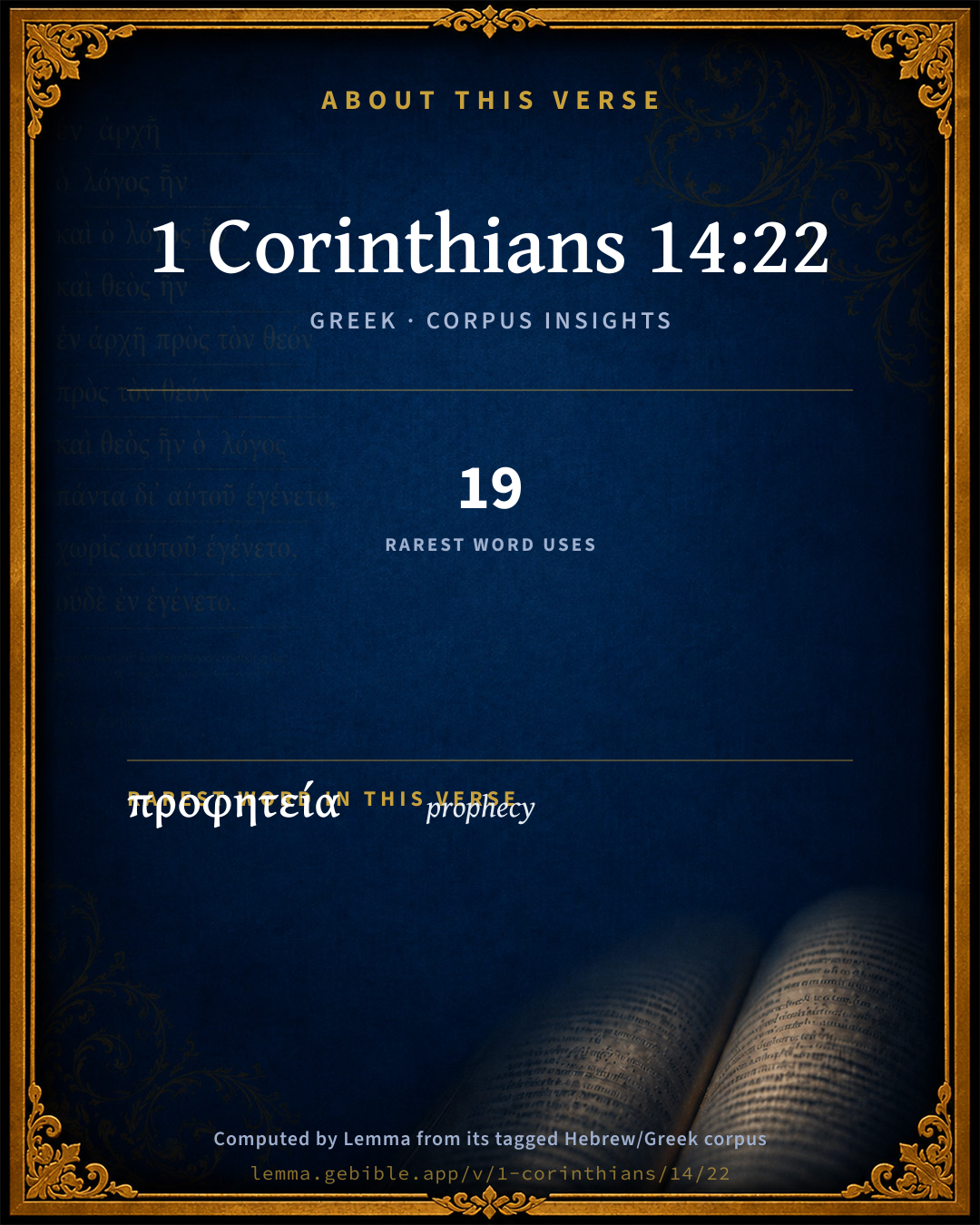
The rarest word here is προφητεία prophecy G4394 — appearing just 19 times in the whole Greek New Testament.

Shared distinctive vocabulary

προφητεία prophecy G4394 occurs in 19 verses of the Greek New Testament. Also found in:

Repetition

Words recur within this verse:

  • πιστεύουσιν to believe G4100 ×2
  • ἀπίστοις unfaithful G571 ×2
  • αἱ the G3588 ×6
  • οὐ not G3756 ×2
  • ἀλλὰ but G235 ×2

Cross-references

5

Topical passages linked to 1 Corinthians 14:22 in the Treasury of Scripture Knowledge — connected by theme and wording, ordered by reader-vote popularity; previews shown in the World English Bible.

  • Acts 2:6–12 When this sound was heard, the multitude came together, and were bewildered, because everyone heard them speaking in his own language.
  • Mark 16:17 These signs will accompany those who believe: in my name they will cast out demons; they will speak with new languages;
  • 1 Timothy 1:9 as knowing this, that law is not made for a righteous man, but for the lawless and insubordinate, for the ungodly and sinners, for the unholy and profane, for murderers of fathers and murderers of mothers, for manslayers,
  • Acts 2:32–36 This Jesus God raised up, to which we all are witnesses.
  • 1 Corinthians 14:1 Follow after love, and earnestly desire spiritual gifts, but especially that you may prophesy.

Cross-references courtesy of OpenBible.info (CC BY 4.0).

Commentary

Notes on 1 Corinthians 14:22 from classic Christian and Jewish commentators (each source and its license shown beneath its notes). The classic Christian expositions comment on the surrounding passage and are grouped to its opening verse, so a note may address several verses; the Jewish commentaries on the Tanakh (Rashi and others) are per-verse, so they appear only where the commentator wrote on this verse.

Lemma curates 59 commentaries, every one of them public domain or Creative Commons licensed, each selected and text-cleaned for this edition rather than reprinted as found. About our sources →

Joseph Benson's Commentary

1Co 14:22. Wherefore — Since this was formerly threatened by God as a punishment, you should not so admire or magnify it, especially since tongues are for a sign, not to them that believe — Not to convince, edify, or comfort the faithful; but to them that believe not — To unbelievers, to whom ye speak in their own language, Act 2:8; namely, to engage their attention to the gospel, and to convince them that what is delivered is the truth of God. But prophesying — Preaching the word, discoursing on divine things; serveth not so much for them that believe not — Who cannot know that you are inspired in prophesying, and have no proof that your doctrine is true; but for them which believe — For their confirmation in the faith, and their edification in holiness and righteousness.

Joseph Benson's Commentary on the Old and New Testaments (1811–1818) — public domain. Text from a community e-Sword module.

Whedon's Commentary on the Bible

Daniel D. Whedon

b. Illustration of the inferiority of tongues to prophecy, 1Co_14:22-25.

22. Wherefore—In peculiar conformity with this type.

Tongues… a sign… to them that believe not—Their miraculous and startling character rendered them a sign for the conviction of unbelievers; just as the Assyrian tongues were for the bringing Israel to repentance. For the conviction of unbelievers were the charismatic tongues intended, and this they would often effect if rightly exercised. The notion of some commentators, that Paul teaches that tongues are a sign of judgment upon incorrigible unbelievers, is contrary to the whole history and character of that charism and entirely unsustained by Paul’s words. The pentecostal tongues, though rejected by the mockers, were intended to convert all who heard them, and did effect the object to a glorious extent. The charism, by its very nature, points to a reception of the gospel by the nations. If they are an adumbration of the one tongue of Paradise, they are a cheerful and glorious image. By their appealing to the ear of the foreigner in his own home dialect, as well as by their thrilling, supernatural impressiveness, they were a sign most convincing to the unbeliever; just as Paul says the signs of an apostle were wrought by him for the conversion of the Corinthians themselves. Yet all happy results depended upon their proper use, otherwise unbelievers would reject those displaying them as mad; as in next verse.

Daniel D. Whedon (gen. ed.), Commentary on the Old and New Testaments (1874–1909) — public domain. Text from a community e-Sword module.

Bengel's Gnomon

Johann Albrecht Bengel

1Co 14:22. Εἰς σημεῖον) for a sign, by which unbelievers may be allured and hear [give ear to] the word; but οὐδʼ οὕτως, not even thus do they hear [alluding to Isa 28:12, see last note].—εἰσὶν, have their existence) The accent has the effect of making the word emphatic.—ἡ δὲ προφητεία, but prophecy) namely, is for a sign, or simply is; comp. 1Co 6:3.—τοῖς πιστεύουσιν, to them that believe) This must be taken as an instance of the figure Amplificatio;[126] inasmuch as prophecy makes believers of unbelievers; the speaking tongue leaves the unbeliever to himself [still an unbeliever]. The expression of Paul is indefinite. Unbelievers, generally, when tongues fall upon them, continue to be unbelievers, but prophecy makes believers of unbelievers, and gives spiritual nourishment to them, that believe.

[126] See Append. The taking of the denomination of a thing, not so much from what it now is, as from what it is about to be. As here, “Prophecy is a sign to those who thereby are made believers.” This seems Bengel’s meaning.—ED.

Bengel's Gnomon of the New Testament — English translation (T&T Clark, Edinburgh, 1860) — public domain. Text from a community e-Sword module.

Meyer's Critical & Exegetical Commentary

Heinrich August Wilhelm Meyer

1Co_14:22. Ὥστε] Accordingly, namely, in accordance with this οὐδʼ οὕτως εἰσακούσ. μου.

εἰς σημεῖον κ.τ.λ.] The phenomenon of the speaking with tongues is destined for a (divine) sign, not for the believers, but for the unbelievers, i.e. to make those to whom the glossolalia goes forth be recognised as unbelievers. This view alone corresponds to the express οὐδʼ οὕτως εἰσακούσ. μου from which the inference is drawn, as well as to what is further inferred in 1Co_14:23. At variance, on the other hand, with both stands the interpretation which has been the ordinary one since Chrysostom (and which has hitherto been my own), that the speaking with tongues is called a sign for the unbelievers, because it was intended to arrest and move them so that they should reflect and become believers. Equally unsuitable is it that Chrysostom, Theophylact, and others, including Hofmann, only half carry out this traditional interpretation, and stop short at the impression of something astounding and amazing, whereby the γλῶσσαι are to be a σημεῖον to the unbelievers, which, moreover, in presence of the notion of a divine σημεῖον, could only appear as a means to an ulterior end. We must keep the οὐδʼ οὕτως εἰσακούσ. μου sharply before us in order to determine accurately the notion of the σημεῖον κ.τ.λ. Billroth, moreover (comp. Beza, Vatablus, Calovius, Cornelius a Lapide, and others), is in error in holding that σημεῖον is a penal sign, or a sign of divine judgment; comp. also Hilgenfeld, p. 21; Rossteuscher, p. 77. This, in fact, is not at all implied in 1Co_14:21, where, on the contrary, the glossolalia appears as a last extraordinary measure remaining likewise without result, which will at length make full exposure of the disobedience of the persons in question, but not as a sign of wrath. And had Paul thought of irae signum, he must have expressed the irae too, and, in fact, brought it emphatically forward.[13] Again Storr, Flatt, Baur, and Dav. Schulz (Geistesg. pp. 78, 176) are wrong in saying that the prevalence of the glossolalia in the church was a sign of their unbelief. This is unsuitable for this reason, that according to 1Co_14:21; 1Co_14:23 we are to conceive as the ἄπιστοι not those who speak γλώσσαις, but those who are spoken to in γλ.

τοῖς ἀπίστοις] Dative of the reference in view, as is also τοῖς πιστεύουσιν. The conception of the ἄπιστοι, however, is, by virtue of this very antithesis (and see also 1Co_14:23-24), simply the non-believing, the unbelievers,a conception which is neither to be softened down to that of non-genuine Christians or the like (Flatt, David Schulz), nor intensified to that of obstinate unbelievers, those wholly unsusceptible of faith, infideles privative (Neander, Billroth, Rückert). Hirzel in the Stud. u. Krit. 1840, p. 120 ff. (who is followed in substance by de Wette, Osiander, Maier, Engelmann, and see Bengels hints of earlier date), understands by the ἀπίστοις those who do not wish to believe, and by the πιστεύουσιν those who wish to believe.[14] Comp. de Wette: They are not heard by such as let themselves be moved thereby to believe, but by such as remain unbelieving. This is conclusively negatived by the prevailing use of οἱ πιστεύοντες and οἱ ἄπιστοι, to which any such artificial pregnancy of meaning is quite alien (see immediately, 1Co_14:23-24).

ἡ δὲ προφητεία κ.τ.λ.] a contrast, which is not intended to be inferred from that passage of Scripture,which in truth says nothing whatever about the προφητεύειν,but the truth of which was self-evident to the readers in virtue of an argumentum e contrario. We are not, however, to supply the simple ἐστί, so that the meaning would be: not to the unbelievers, but to the believers, is the prophetic address to be directed (my own view hitherto), but rather εἰς σημεῖόν ἐστιν, for Paul has not written ἐστιν at all, and therefore leaves the predicate of the first half of the verse to operate still in virtue of the antithesis. Consequently: prophecy is designed to be a sign not for the unbelievers, but for the believers, i.e. in order to make those to whom the prophetic address is directed known as believers; see 1Co_14:24, where this statement of the apostle is verified by the fact that such as come into the Christian assembly as unbelievers, being won over by the overpowering impression of the prophetic addresses, submit themselves to Christianity and declare themselves believers. Erasmus, Grotius, and Bleek are wrong in holding that οὐ means non tantum. The negation is absolute, as in the preceding clause. Comp. Fritzsche, ad Matth. p. 784. According to Hirzel (de Wette and Osiander), the meaning here also is alleged to be: prophecy is given not for such as do not wish to believe, but for such as wish to believe.

[13] According to Billroths view, namely, Paul warns the Corinthians that they should not thoughtlessly foster among themselves a thing which is called in the O. T. a sign of punishment. Comp. Beza and Cornelius a Lapide, also Calovius. Upon this view, Paul must have absolutely disapproved of the glossolalia. It would have been a tempting of God by the abuse of a divine sign of curse.

[14] Hofmann also understands by τοῖς ἀπίστοις those indisposed to believe. As if Paul would not have known how to express this conception! Hofmann even conceives two classes to be comprehended under τοῖς πιστεύουσιν, namely, those already standing in faith and those who are becoming believers, and holds that on this account Paul did not write τοῖς πιστοῖς. As if οἱ πιστεύοντες were not with the apostle quite the usual expression for the believers (1Co_1:21; Rom_1:16; Rom_3:22; Rom_10:4; Gal_3:22; Eph_1:19, al.), who are such, but not for those, or so as to include those, who are only becoming such. The πιστεύοντες are not at all different from the πιστοῖς (2Co_6:15; Eph_1:1; Col_1:2).

Meyer — Critical and Exegetical Commentary on the New Testament — English translation by Peter Christie, edited by Frederick Crombie (T&T Clark, 1880) — public domain. Text from a community e-Sword module.

Expositor's Greek Testament

ed. W. Robertson Nicoll

1Co 14:22 . The real point of the above citation from Isaiah comes out in ὥστε αἱ γλῶσσαι εἰς σημεῖόν κ . τ . λ ., “And so the tongues are for a sign not to the believing, but to the unbelievers” sc . to “those who will not hear,” who having rejected other modes of instruction find their unbelief confirmed, and even justified (1Co 14:23 b ), by this phenomenon. This interpretation ( cf. Mat 16:4 ; and for εἰς σημεῖον in the judicial sense, Isa 8:18 ) is dictated by the logical connexion of 1Co 14:21-22 , which forbids the thought of a convincing and saving sign , read into this passage by Cm [2130] and many others. P. desires to quench rather than stimulate the Cor [2131] ardour for Tongues. ἡ δὲ προφητεία κ . τ . λ ., “while prophecy on the other hand” ( δέ ) serves the opposite purpose it “(is for a sign) not to the unbelievers, but to the believing”. οἱ πιστεύοντες implies the act continued into a habit ( cf. 1Co 1:21 ); οἱ ἄπιστοι , the determinate character. For ὥστε with ind [2132] , see note on 1Co 3:7 .

[2130] John Chrysostom’s Homiliœ († 407).

[2131] Corinth, Corinthian or Corinthians.

[2132] indicative mood.

The Expositor's Greek Testament, edited by W. Robertson Nicoll (1897–1910) — public domain. Text from a community e-Sword module.

Godet's Commentaries

Frédéric Louis Godet

Vv. 22. “Wherefore tongues are for a sign, not to them that believe, but to them that believe not: but prophesying serveth not for them that believe not, but for them which believe.”

At the first glance one might be disposed to take the former part of the verse as indicating the salutary effect which glossolalia should produce in those who hitherto had not been able to believe (ἀπίστοις), through the wonder and amazement which such a gift will cause them (Chrysostom, Calvin hesitatingly, Grotius, Meyer in his first editions). But this meaning would be contrary to the words: And yet for all that will they not hear; and the example quoted in 1Co 14:23, instead of justifying, would belie this affirmation. Others, on the contrary, have thought that the language points to a sign announcing to unbelievers their near judgment, irae signum (Beza, Billroth). This is also Edwards’ view: “The ecstatic cries in the midst of the assembled Church were intended by God to show unbelievers (the heathen of Corinth) that the day of the Lord was near.” In this sense, the ἄπιστοι are not merely people who have not yet believed; they are confirmed unbelievers. Without saying precisely that judgment is announced, we think that tongues are a testimony of unbelief made to the people to whom God thus speaks. God speaks to them unintelligibly only because they are deaf to His clear revelation. We find an analogous fact, Matthew 13, at the date when Jesus adopts speaking in parables as His habitual method of teaching (1Co 14:11-12). After seeking in vain to awake the conscience of the people by His previous teaching (Sermon on the Mount, for example), when Jesus comes to the time when He must reveal to His own the nature and laws of the kingdom which they are to labour to found, He uses the language of parable, which they alone can understand. It is a sign of His growing breach with the mass of the nation. So it is with tongues. Glossolalia is neither a means of conversion, nor a sign of approaching judgment on unbelievers. It is a demonstration given to their own conscience of the state of unbelief which God sees them to have reached. Would a God of light manifest Himself in the midst of His own by unintelligible sounds? Here there is a sign of severance which is gradually carried out.

It is wholly otherwise with prophetic exhortations. These are a sign of faith or of the disposition to believe which already exists in those to whom God thus speaks. It should be remarked that in opposition to ἀπίστοις, unbelievers, the apostle does not here say πιστοῖς, believers, as would seem natural, but πιστεύουσιν, those who at this moment are in the act of believing. This present participle denotes equally the state of a man who has just reached faith, and the state of him who already possesses it. Hence the general principle laid down here agrees with the result described in 1Co 14:24, where an ἄπιστος is brought to faith by prophecy. The man is so called only as not yet believing, and because of his state when he came; he is nevertheless a πιστεύων in respect of what takes place in him, in the course of the meeting.

Critics discuss the question whether the words εἰς σημεῖον, in sign of, used in the former clause, should be understood in the latter. It matters very little for the sense. Grammatically the ellipsis seems natural. But the meaning of the word sign is modified of course in passing from the one clause of the sentence to the other. In the former, the sign is one of displeasure, implying a charge of unbelief; in the latter, it is one of pity, powerfully calling the man to repentance and faith. Such an appeal is not directed to one already confirmed in unbelief (the ἄπιστοι of 1Co 14:22); but it is made to men such as the ἄπιστος of 1Co 14:23. Erasmus and Bleek have tried to resolve the difficulties of this verse by taking οὐ, not, both times in the sense of οὐ μόνον, not only. But why not say οὐ μόνον, if this had been his thought?

The apostle now supposes two cases fitted to impress by way of extreme examples the truth of the law which he has just stated:

Frédéric Louis Godet — Commentaries on Luke, John, Romans, and 1 Corinthians — English translation (T&T Clark, Edinburgh, 1870s–1890s) — public domain. Text from a community e-Sword module.

Hodge's Commentary on Romans, Ephesians & First Corinthians

Charles Hodge

1Co_14:22

Wherefore tongues are for a sign, not to them that believe, but to them that believe not: but prophesying (serveth) not for them that believe not, but for them which believe.

There are two inaccuracies in this version which obscure the sense. The first is the introduction of the word serveth after prophesying. The clauses are parallel. Tongues are for a sign to one class, and prophesying to another. Nothing need be supplied; what is implied is, that prophesying is for a sign. The introduction of the word serveth is not only unnecessary, but contrary to the context. The second inaccuracy is expressing the force of the datives (πιστεύουσι and ἀπίστοις) by to in the first member of the verse, and by for in the second member. There is no reason for this change. The relation expressed is the same in both cases. Tongues are for the one, prophesying are for the other; or, Tongues are for a sign to the one, and prophesying to the other. The connection between this verse and what precedes is indicated by the word wherefore, or so that. The inference may be drawn either from the immediately preceding clause, viz., For all that they will not hear me, saith the Lord; or from the historical fact referred to in the whole verse. If the former, then the design of the apostle is to show that as teaching the Hebrews by men of other tongues did not render them obedient; so speaking in other tongues would not profit the Corinthians. If the latter, then the design is to show, that as sending foreigners among the Hebrews was a mark of Gods displeasure, so speaking in the Christian assemblies in foreign languages would be a curse and not a blessing. The latter view is demanded by the whole context.

The inference from the preceding verse is that tongues are a sign not to the believing but to the unbelieving, and prophesying just the reverse. This difficult verse is variously explained.

1. The word sign is taken in the sense of mark or proof, as when it is said, the signs of an apostle, 2Co_12:12, that is, the tokens by which an apostle may be known. Comp. Luk_2:12; 2Th_3:17. The meaning of the passage would then be, Tongues are a proof that those among whom they are used are not believers, but unbelievers; and prophesying is a proof that they are believers, and not unbelievers. But when the word is used in this sense, the thing of which it is a sign is put in the genitive. It is a sign of, not to or for.

2. It may mean a prodigy or wonder. This is a very common sense of the word, as in the familiar phrase, signs and wonders. The meaning is then commonly made to be, Tongues are a wonder designed not for the benefit of believers, but for unbelievers; and on the other hand, prophesy is a wonder designed not for the benefit of unbelievers, but for the benefit of believers. But this is neither true nor in accordance with 1Co_14:24. It is not true that the gift of tongues was designed exclusively for the conversion of unbelievers. Why should not that gift be exercised for the edification, as well as for the conversion of men? Their conversion would not enable them to understand the native language of the apostles. Much less is it true that prophecy was designed exclusively for the edification of believers. The prophets and apostles were sent forth for the conversion of the world. And in 1Co_14:24 the conversion of unbelievers is specified as the very effect to be anticipated from the use of this gift. A still more decisive objection to this interpretation is, that it does not give the true conclusion from the preceding verse. The nature of the premises must decide the nature of the inference. It is not a fair inference from the fact that although God sent foreigners to teach the Hebrews they still continued disobedient, that foreign tongues were designed for the conversion of unbelievers. The very opposite conclusion would naturally follow from that fact.

3. Sign may here mean a warning or sign of punishment. Tongues are a warning, designed not for believers, but for unbelievers, who are understood to be, not those merely without faith, but positive infidels, or obstinate rejectors of the truth. To this, however, it may be objected, that the word unbeliever (ἄπιστος) is used in 1Co_14:24 for those without faith, and that to assume a change of meaning in the same context is most unnatural. A still more serious objection is, that this interpretation cannot be carried out. It cannot be said that prophecy is a warning designed for believers. The two members of the sentence are so related that whatever is said of the gift of tongues, must be true, mutandis mutatis, of prophecy. If the one be a punishment designed for unbelievers, the other must be a punishment designed for believers.

4. The most satisfactory explanation is to take sign in the general sense of any indication of the divine presence. Tongues are a manifestation of God, having reference, not to believers, but to unbelievers; and prophecy is a similar manifestation, having reference, not to unbelievers, but to believers. By tongues, however, is not to be understood the gift of tongues, but, as 1Co_14:21 requires, foreign languages, i.e. languages unknown to the hearers. The meaning is, that when a people are disobedient, God sends them teachers whom they cannot understand; when they are obedient, he sends them prophets speaking their own language. This is the natural conclusion from the premises contained in 1Co_14:21. When the Hebrews were disobedient God sent foreigners among them; when obedient, he sent them prophets. Wherefore, i.e. hence it follows, that unintelligible teachers are for the unbelieving; those who can be understood are for the believing.

This view is also consistent with what follows, which is designed to show that speaking in a language which those who hear cannot understand is the cause of evil; whereas speaking intelligibly is the source of good. It must be remembered that it is not the gift of tongues of which the apostle speaks, but speaking to people in a language which they do not understand. And therefore this interpretation does not imply any disparagement of the gift in question. When used aright, that is, when employed in addressing those to whom the language used was intelligible, it was prophecy. The obscurity of the passage arises in a great measure from the ambiguity of the expression to speak with tongues. It means to speak in foreign or unknown languages. But a language may be said to be unknown either in reference to the speaker or to the hearer. It is said to be unknown to the speaker, if not previously acquired; and it is said to be unknown to the hearers if they do not understand it. The apostle uses the expression sometimes in one sense and sometimes in the other. When it is said that the apostles, on the day of Pentecost, spake with tongues, it means that they used languages which they had never learned; but when Paul says he would rather speak five words intelligibly than ten thousand words with a tongue, he means in a language unknown to the hearers. Speaking with tongues in the one sense, was a grace and a blessing; in the other sense, it was a folly and a curse. It was of speaking with tongues in the latter sense the apostle treats in these verses.

Charles Hodge — Commentary on Romans (1835), First Corinthians (1857), and Ephesians (1856) — public domain. Text from a community e-Sword module.

Geneva Bible (1599)

Geneva Bible translators

The conclusion: Therefore the gift of tongues serveth to punish the unfaithful and unbelievers, unless it be referred to prophecy (that is to say, to the interpretation of Scripture) and that that which is spoken, be by the means understood of the hearers.

Geneva Bible (1599) marginal notes — public domain. Text via Bolls.life.

Jamieson, Fausset & Brown

Robert Jamieson, A. R. Fausset & David Brown

Thus from Isaiah it appears, reasons Paul, that "tongues" (unknown and uninterpreted) are not a sign mainly intended for believers (though at the conversion of Cornelius and the Gentiles with him, tongues were vouchsafed to him and them to confirm their faith), but mainly to be a condemnation to those, the majority, who, like Israel in Isaiah's day, reject the sign and the accompanying message. Compare "yet . . . will they not hear Me" (Co1 14:21). "Sign" is often used for a condemnatory sign (Eze 4:3-4; Mat 12:39-42). Since they will not understand, they shall not understand.

prophesying . . . not for them that believe not, but . . . believe--that is, prophesying has no effect on them that are radically and obstinately like Israel (Isa 28:11-12), unbelievers, but on them that are either in receptivity or in fact believers; it makes believers of those not wilfully unbelievers (Co1 14:24-25; Rom 10:17), and spiritually nourishes those that already believe.

Jamieson, Fausset & Brown — Commentary Critical and Explanatory on the Whole Bible (1871) — public domain (CC PDM 1.0). Text via the HelloAO Bible API.

Adam Clarke's Commentary

Verse 22. Wherefore tongues are for a sign] The miraculous gift of tongues was never designed for the benefit of those who have already believed, but for the instruction of unbelievers, that they might see from such a miracle that this is the work of God; and so embrace the Gospel. But as, in the times of the prophet, the strange Babylonish tongues came in the way of punishment, and not in the way of mercy; take heed that it be not the case now: that, by dwelling on the gift, ye forget the Giver; and what was designed for you as a blessing, may prove to you to be a curse. For if, because ye have the gift of tongues, ye will choose for your own aggrandizement to use them in the public congregation where none understands them, God may curse your blessings.

Prophesying] Teaching the things of God in a known language is of infinitely more consequence than speaking in all the foreign tongues in the universe.

Adam Clarke's Commentary on the Bible (1810–1826) — public domain. Text from a community e-Sword/MySword module.

John Calvin's Commentaries

22. Therefore tongues are for a sign This passage may be explained in two ways, by considering the word therefore as referring merely to the preceding sentence, or as having a bearing generally on the whole of the foregoing discussion. If it is a particular inference, the meaning will be — “You see, brethren, that what you so eagerly desire is not a blessing bestowed by God upon believers, but a punishment, by which he inflicts vengeance upon unbelievers.” In this way, Paul would not be viewed as taking in the use of tongues under all circumstances, but simply as touching upon what had in one instance occurred. Should any one, however, prefer to extend it to the whole discussion, I have no objection, though I do not dislike the former interpretation.

Taking it in a general way, the meaning will be “Tongues, in so far as they are given for a sign — that is, for a miracle — are appointed not properly for believers, but for unbelievers.” The advantages derived from tongues were various. They provided against necessity — that diversity of tongues might not prevent the Apostles from disseminating the gospel over the whole world: there was, consequently, no nation with which they could not hold fellowship. They served also to move or terrify unbelievers by the sight of a miracle — for the design of this miracle, equally with others, was to prepare those who were as yet at a distance from Christ for rendering obedience to him. Believers, who had already devoted themselves to his doctrine, did not stand so much in need of such preparation. Hence, the Corinthians brought forward that gift improperly and out of its right place, allowing prophecy in the meantime to be neglected, which was peculiarly and specially set apart for believers, and ought, therefore, to be familiar to them, for in tongues they looked to nothing farther than the miracle.

John Calvin's Commentaries (1540-1563) — public domain. Text from the Calvin Translation Society English edition (1840s-50s) via the Christian Classics Ethereal Library (ccel.org). Calvin's coverage is partial (roughly two-thirds of the Bible); uncommented books and verses are honest gaps, never fabricated. The 19th-century editor's footnotes and remarks are omitted so the notes are faithfully Calvin's own voice.

Ellicott's Commentary for English Readers

(22) Wherefore tongues are for a sign, not to them that believe.—This is not an interpretation of the prophecy alluded to in the previous verse, but St. Paul now returns to the gift of “tongues” as existing in the Church, and introduces a thought regarding this gift suggested by the fact mentioned, viz., that in Israel unintelligible tongues, uttered in their hearing, were for a sign to unbelieving Jews. Tongues should not be exalted in estimation above prophecy—inasmuch as the function of the latter is really grander than that of the former. Tongues were useful to arrest the attention of unbelievers, and, if rightly used, to arouse their convictions; but prophecy is in the highest sense useful for believers.

A Bible Commentary for English Readers, edited by Charles John Ellicott (1878–1897) — public domain. Text from a community e-Sword module.

The Cambridge Bible for Schools and Colleges

gen. ed. J. J. S. Perowne

22. Wherefore tongues are for a sign, not to them that believe, but to them that believe not] The passage here quoted has been regarded as a prophecy either (1) of the Day of Pentecost, or (2) of the Babylonish captivity. The latter is more probable, and in that case it becomes not an argument, but an illustration. The occupation of Judæa by the Assyrian and Babylonian troops had been a sign to God’s people of their unbelief and its punishment, and the unwonted speech they had been doomed to hear was to them a call to repentance, especially when viewed in the light of the prophecy of Moses in Deu_28:49. In a similar manner the miraculous gift of tongues was still (see next verse), as at the Day of Pentecost, a call to the outside world to examine and inquire into this new thing which had come to pass, to acknowledge in it the finger of God, and to “repent and be baptized for the remission of sins.” Cf. Act_2:7-12; Act_2:41.

The Cambridge Bible for Schools and Colleges (gen. ed. J. J. S. Perowne; Cambridge University Press, 1878–1918) — public domain. Text from a community e-Sword module.

John Gill's Exposition

If therefore the whole church,.... The whole congregation of believers incorporated together in a Gospel church state, consisting of its officers and private members; the church at Corinth is particularly designed:

be come together in one place; to worship God, to pray unto him, sing his praise, preach and hear the word, as were usually done. Hence may be observed the custom of the primitive churches to meet together, in some certain place, for divine worship; nor did the members of them in common forsake the assembling of themselves together on that account, though it was the evil practice of some of them; the whole church, all the members of it, met together: and it may be seen from hence, that the church, and the place where it met, are two different things:

and all speak with tongues; divers tongues, languages not understood; meaning, not that all that came together spoke with tongues; but that as many as did speak, should they speak with such, and without an interpreter.

And there come in those that are unlearned, or unbelievers; either private Christians, who, though they have learned Christ, and understand the doctrines of the Gospel, yet are ignorant of languages; or rather the same persons with unbelievers, Heathens that have no knowledge of Christ, nor faith in him, and who also understood no other language but the Greek: if any such persons should come into the place where the church was met together, and should hear him or them that spoke, speak in a language they understood not, and which they were very well assured was equally unknown to the whole congregation, and so could be of no service to them:

will they not say ye are mad? act like men in a frenzy, that have not the use of their reason; since speaking in a strange language to a congregation that know not one word of what is said, is speaking to the air, and to no profit at all to them that hear; and who but a madman would do this? The apostle here argues from the scandal and contempt that would be poured upon them by such a practice; and the rather he mentions this, because it seems as if their governing view was the glory and applause of men, in which, he suggests, they would be sadly disappointed.

John Gill's Exposition of the Whole Bible (1746–1763) — public domain (CC PDM 1.0). Text via the HelloAO Bible API.

Trapp's Complete Commentary

John Trapp

22 Wherefore tongues are for a sign, not to them that believe, but to them that believe not: but prophesying serveth not for them that believe not, but for them which believe.

Ver. 22. But for them which believe] To confirm and comfort believers; this is the chief end of preaching. Let this comfort those that cannot say they have converted any by their ministry.

John Trapp, A Commentary or Exposition upon All the Books of the Old and New Testament (1647–1656) — public domain. Text from a community e-Sword module.

Albert Barnes' Notes on the Bible

Wherefore - Thus, (Ὥστε Hōste), or wherefore. The apostle does not mean to say that what he was about to state was a direct conclusion from the passage of Scripture which he had quoted, but that it followed from all that he had said, and from the whole view of the subject. “The true statement or doctrine is, that tongues are for a sign,” etc.

Tongues - The power of speaking foreign languages.

Are for a sign - An “indication,” an evidence, or a proof that God has imparted this power, and that he attends the preaching of the gospel with his approbation. It is a “sign,” or a “miracle,” which, like all other miracles, may be designed to convince the unbelieving world that the religion is from God.

Not to them that believe - Not to Christians. They are already convinced of the truth of religion, and they would not be benefited by that which was spoken in a language which they could not understand,

But to them that believe not - It is a miracle designed to convince them of the truth of the Christian religion. God alone could confer the power of thus speaking; and as it was conferred expressly to aid in the propagation of the gospel, it proved that it was from God; see the note on Act 2:1-15.

But prophesying - Speaking in a calm, connected, didactic manner, in language intelligible to all under the influence of inspiration; see notes on 1Co 14:1.

For them that believe not - Is not particularly intended for them; but is intended mainly for the edifying of the church. It is not so striking, so replete with proofs of the divine presence and power as the gift of tongues. Though it may be really under the influence of the Holy Spirit, and may be really by inspiration, yet it is not so evidently such as is the power of speaking foreign languages. It was, therefore, better adapted to edify the church than to convince gainsayers. At the same time the “truths” conveyed by it, and the consolations administered by it, might be as clear evidence to the church of the attending power, and presence, and goodness of God, as the power of speaking foreign languages might be to infidels.

Albert Barnes' Notes on the Bible (1834–1885) — public domain. Text from a community e-Sword/MySword module.

Matthew Poole's English Annotations

Wherefore tongues are for a sign, &c.; that is, an eminent product of Divine providence for the confirmation of the truth of the doctrine of the gospel; signifying that the doctrine which was so delivered in every nation’s language, must be from heaven, from whence the first ministers must have their power so to speak; yet, doubtless, they were not only for a sign, being also a means, by which the knowledge of the gospel was conveyed unto those who could not have understood what the apostles and first ministers of the gospel said, had they not spoken to them in the language of the hearers. When he saith,

prophesying serveth not for them that believe not, the meaning is, not only for them that believe not; for prophesying is certainly of use to them that believe not, for their conversion, as well as

for them that believe, for their edification.

Matthew Poole's English Annotations on the Holy Bible (1683–1685) — public domain. Text from a community e-Sword/MySword module.

The Pulpit Commentary

Wherefore. In accordance with this illustration. Not to them that believe. Because their belief depends on other and far deeper grounds. Serveth. This word is wrongly supplied; it should be, is for a sign. Not for them that believe not. Because there is nothing necessarily startling in preaching. It might, indeed, produce conviction in the unbelieving (ver. 25), but it was not a special "sign" "The unbelieving" are those who used to drop in at the Christian services out of curiosity.

The Pulpit Commentary (1880–1919), ed. H.D.M. Spence-Jones & Joseph S. Exell — public domain. Text from a community e-Sword module.

John Wesley's Explanatory Notes

Tongues are intended for a sign to unbelievers - To engage their attention, and convince them the message is of God. Whereas prophecy is not so much for unbelievers, as for the confirmation of them that already believe.

John Wesley, Explanatory Notes Upon the Whole Bible (1754–1765) — public domain. Text via the GEBible commentary corpus.

Godbey's Commentary on the New Testament

William B. Godbey

A NORMAL GOSPEL MEETING

22-25. “So tongues are for a sign, not to the believers, but to the unbelievers, and prophecy is not for the unbelievers, but for the believers.” These spiritual gifts are quite latitudinous in their signification and sphere of operation. Limitation is the prevailing error in Biblical interpretation, arising from the fact that we are so apt to expound the Bible like other books which finite men have made, forgetting that the illimitable and incomprehensible God is the Author of the Scriptures. Hence it is a great mistake to lay upon the Bible the restrictions and disabilities peculiar to human productions.

Here we see, evidently, a phase of this gift of tongues, peculiar to the normal gospel meetings under the leadership of the Holy Ghost in the apostolic ministry. New experiences invariably confer new language. When the sinner passes through the crucible of regeneration and sweeps triumphantly into the kingdom of God, if the work is genuinely wrought by the Holy Ghost, and not simply by human manipulation, he at once begins to speak a new language never before heard nor used. It is the language currently spoken by the members of God’s family, and utterly novel to the man who has spent all his life among the children of the devil and speaking the shibboleth of Hell. When the Canaan-bound pilgrim passes through the retreating floods of the divided Jordan into Beulah land he immediately adopts the language of Canaan, which to him is utterly new, as he never heard it in the howling wilderness. I have a thousand times seen this Scripture verified in revival work. A lot of people get blessed and all begin to shout and speak vociferously in the new languages of their newly found joy; every sinner that hears the uproarious shouts not only runs to the scene of conflict, but brings with him all his neighbors, crowding the house to overflowing. “Therefore if the whole church may come together and all may speak with tongues, and the idiots or infidels may come in, will they not say, that you are gone mad?” When the power falls and the people all get happy and shout aloud, speaking the newly received language of their newly found joy, that is the very thing to arouse and attract the idiots, i. e., the poor, lost people who are utterly idiotic to the mysteries of Christian experience, whether regeneration or sanctification, and the infidels, i. e., the people who do not believe in any Christian profession, hear them, they all come running, actuated by sheer curiosity. When they arrive at the scene of sweeping revival power, and see sinners who have been gloriously converted leaping, and hear them speaking words and phrases to them utterly new and strange, and using a language they had never before heard, and Christians, flooded with the baptism of the Holy Ghost and fire, shouting uproariously the language of Canaan, so unlike that of old Ashdod, the effect of their new experiences and their shouting testimonies in their new languages, and perhaps foreign languages then conferred on them to qualify them to preach the gospel in the “regions beyond”; even though the idiots and infidels pronounce them crazy, yet these new tongues and uproarious shouts have brought them together where the people of God can have access to them with the message of truth. “But if all may prophesy, [i. e., preach, exhort and testify] and some idiot or infidel may come in, he is convicted by all, he is discerned by all,

William B. Godbey, Commentary on the New Testament (1896–1900) — public domain. Text from a community e-Sword module.

McGarvey & Pendleton's Commentaries

J. W. McGarvey

Wherefore tongues are for a sign, not to them that believe, but to the unbelieving: but prophesying is for a sign, not to the unbelieving, but to them that believe . [The Old Testament generally is often called the Law by New Testament writers ( Joh_10:34 ; Joh_12:34 ; Rom_3:20 ). Therefore the reference here is not to the Pentateuch, but to Isa_28:11-12 . There the prophet tells how Israel murmured at the quality of the teaching which God gave them, and states that as a consequence God would soon teach them by the tongue of foreigners; i. e., the Assyrians would lead them away captive and they should be instructed by the hardships of captivity. When the captivity came, the necessity to understand and speak a strange tongue was a sign that God was teaching them, and yet a sign which they did not heed. From this incident Paul apparently draws several conclusions. 1. It was no especial mark of divine favor to have teachers who spoke an unknown tongue. 2. Tongues were for unbelievers and prophecy for believers. 3. Tongues were a sign that God was teaching, but the teaching itself was better than the sign. 4. Tongues, unless understood, had never been profitable; i. e., had not produced conversion. It must be remembered that Paul has in mind the abuse rather than the proper use of tongues. He illustrates his meaning by a hypothetical case.]

J. W. McGarvey (with Philip Y. Pendleton), Commentaries on the New Testament (The Fourfold Gospel, 1914; Acts; and the epistles) — public domain. Text from a community e-Sword/MySword module.

The People's New Testament

B. W. Johnson

22. Wherefore tongues, etc. They are a sign to unbelievers, who are moved when they hear the gospel spoken in their tongue by men who have never learned it and do not understand it.

B. W. Johnson's The People's New Testament with Notes (1889–1891) — public domain. Electronic text from the Christian Classics Ethereal Library (CCEL) ThML edition.

unfoldingWord translationNotes

Door43 World Missions Community

Connecting Statement:

Paul gives specific instructions on an orderly way to use gifts in the church.

not for unbelievers, but for believers

This can be expressed positively and combined with the other positive statement. AT: "only for believers" (See: Double Negatives and Parallelism)

would they not say that you are insane?

This can be a statement. AT: "they would say that you are insane." (See: Rhetorical Question)

translationWords

tongue

miracle

believe

believe

prophet

church

unfoldingWord translationNotes — © Distant Shores Media and the Door43 World Missions Community, licensed CC BY-SA 4.0. Source: git.door43.org/Door43/en_tn.

Cambridge Greek Testament for Schools and Colleges

22. εἰς σημεῖον. The passage here quoted has been regarded as a prophecy either (1) of the Day of Pentecost, or (2) of the Babylonish captivity. The latter is more probable, and in that case it becomes not an argument, but an illustration. The occupation of Judaea by the Assyrian and Babylonian troops had been a sign to God’s people of their unbelief and its punishment, and the unwonted speech they had been doomed to hear was to them a call to repentance, especially when viewed in the light of the prophecy of Moses in Deu 28:49. In a similar manner the miraculous gift of tongues was still (see next verse), as at the Day of Pentecost, a call to the outside world to examine and inquire into this new thing which had come to pass, to acknowledge in it the finger of God, and to ‘repent and be baptized for the remission of sins.’ Cf. Act 2:7-12; Act 2:41.

Cambridge Greek Testament for Schools and Colleges (Cambridge University Press, 1896; 21 vols, various authors incl. Carr, Maclear, Plummer, Farrar, Lumby, Moule, M. R. James, Simcox) — public domain. Text from a community e-Sword module.

Alford’s Greek Testament

Henry Alford

22.] ὥστε,—viz. according to the words of the foregoing prophetic passage.

αἱ γλ.] the tongues, in the then acceptation of the term. He is not interpreting the prophecy, nor alluding to the tongues there spoken of, but returns back to the subject in hand—the tongues about which his argument was concerned.

εἰς σημ. εἰσίν] are for a sign: but there is no emphasis on the words,—the meaning being much the same as if εἰς σημεῖον were omitted, and it stood ὥστε αἱ γλ. εἰσὶν οὐ τοῖς π. Not seeing this, Commentators have differed widely about the meaning of σημεῖον. So Chrys. (Hom. xxxvi. p. 335): εἰς σημεῖον, τουτέστιν, εἰς ἔκπληξιν:—Bengel: ‘quo allecti auscultare debebant:’—Calvin: ‘linguæ, quatenus in signum datæ sunt:’ &c. &c. All dwelling on the word σημεῖου would introduce an element foreign to the argument, which is, that tongues are (a sign) for the unbelieving, not for the believing.

οὐ τ. πιστ.] not to men who believe, but to unbelievers, i.e. ‘men who do not believe:’ not, as Neander, Billroth, Rückert, and in substance De Wette, ‘men who will not believe:’ ἄπιστος must be kept to the same sense through this whole passage, and plainly by ver. 23 it is not one who will not believe, but an unbeliever open to conviction. The mistake has been occasioned by regarding those to whom the prophecy was directed, and interpreting Paul by Isaiah, instead of by himself.

ἡ δὲ προφ.] scil. ἐστίν, as Meyer, or εἰς σημ. ἐστίν, as De Wette: it seems to me to import little which we supply, seeing that εἰς σημ. is of so very slight weight in the preceding clause. If emphatic meaning had been attached to σημεῖον as belonging to αἱ γλ., we must not have supplied it here: but if it be a mere indifferent word, to be interpreted according to the sense in which αἱ γλ. and ἡ προφ. were σημεῖα, there can be no objection to it here: and the uniformity of construction seems to require it.

Both here and above, τοῖς ἀπίστ. and the other are datives commodi—for, not ‘to,’ the unbelieving. ἡ προφητεία was a sign to the unbelieving, see vv. 24, 25.

Prophecy, i.e. inspired and intelligent exposition of the word and doctrine, was eminently for believers, but, as below, would be also profitable to unbelievers, furnishing a token that God was truly among his assembled servants.

Henry Alford, The Greek Testament (1849–1861) — public domain. Text from a community e-Sword module.

International Critical Commentary

22. ὥστε. ‘So then (i.e. in harmony with this passage of Scripture), the Tongues are for a sign to men who do not believe.’ He does not say that they are a sign, but that they are intended to serve as such—εἰς σημεῖον: Gen 9:13; Num 16:38, Num 16:17:10; Deu 6:8, Deu 11:18, etc. Nor does he say what kind of a sign, but the context shows that it is for judgment rather than for salvation: comp. εἰς μαρτύριον (Mar 1:44, Mar 6:11, etc.), which is equally indefinite. No εἰς ση. after προφητεία.

International Critical Commentary — older volumes (1896–1929), various authors — public domain. Text from a community e-Sword module.

Lesson kit

Teaching starters — assembled from the data on this page, not authored interpretation. Every prompt links to the verse data it draws on. Edit before teaching.

1 Corinthians, in the Pauline Epistles, opens this verse with 21 words (12 distinct Greek lemmas). Its most distinctive word is prophēteía (“prophecy”). A historical commentator’s framing appears above. Read the whole chapter for the surrounding context.

Discussion questions

  1. What does “prophecy” (prophēteía) contribute to the verse as a whole?
  2. Matthew 13:14 shares the word «prophecy» with this verse. How do the two illuminate each other?
  3. “to believe” occurs 2× in this one verse. What is the effect of the repetition?
  4. The translations on this page render this verse differently — a whole-verse word diff, not a word-by-word alignment. What might account for the different wordings?
  5. Reading how Joseph Benson's Commentary and Whedon's Commentary on the Bible read this verse, where do the two commentators agree and where do they part?

Things to notice

  • These translations choose different wording for 15 words in this verse.
  • “to believe” occurs 2× in this single verse.
  • 12 distinct Greek lemmas span 21 words in this verse.

Reading settings

Reading text

Shown beneath each verse's original-language words.

Old Testament
Old Testament edition

Read the OT as the Masoretic Hebrew (MT) or the Greek Septuagint (LXX).

English shown for the Greek Septuagint (in the Hebrew ↔ Greek comparison).

Comparing translations? Open the Compare panel on any verse page to stack up to four side by side.