1 Corinthians 14:24

Greek (Tischendorf 8th ed.) 1 Corinthians 14:24 appears in the Greek New Testament. The text above is from the Tischendorf 8th edition. Each word links to its Strong’s number and a concise gloss. Click any word for its full Thayer’s Greek Lexicon entry.
Download image
Cite this verse

1 Corinthians 14:24 (World English Bible). Public Domain. Lemma interlinear Bible study tool, https://lemma.gebible.app/v/1-corinthians/14/24.

Show BibTeX & RIS
BibTeX
RIS
English Translation
But if all prophesy, and someone unbelieving or unlearned comes in, he is reproved by all, and he is judged by all.
World English Bible · Public Domain
Download a study sheet

One document with this verse’s original text, its word-by-word gloss line, the meaning frame, cross-references with their text, attributed commentary, and full source and license credits — printable, and it pastes into notes with its structure intact.

This verse Autodidact and up

Study sheet (.html) Plain text (.txt)

A passage Seminary Student

Up to 50 verses in one chapter. A passage sheet keeps up to 6 commentary sources and 12 cross-references per verse, in the order this page ranks them, and says so on the sheet whenever that leaves anything out. Ask for a single verse and you get the Autodidact verse sheet above.

Everything on this page stays free to read, with no account — the sheet is a download of what is already on screen, not access to it.

Want to remove ads? Support Godless Engineer
Compare translations 3

The same verse in 3 English versions, stacked beneath the original-language interlinear above. Click any original word for its lexicon entry.

Each is an independent rendering of the whole verse — the interlinear is not word-aligned to these translations.

Highlighted words mark where these versions differ — a whole-verse word diff, not a word-by-word alignment.

  • World English Bible Public Domain
    But if all prophesy, and someone unbelieving or unlearned comes in, he is reproved by all, and he is judged by all.
  • King James Version Public Domain
    But if all prophesy, and there come in one that believeth not, or one unlearned, he is convinced of all, he is judged of all:
  • unfoldingWord Literal Text CC BY-SA 4.0
    But if they all would prophesy, but some unbeliever or ungifted person might come in, he is convicted by all, he is examined by all,

unfoldingWord Literal Text — © unfoldingWord, licensed CC BY-SA 4.0. Word-aligned USFM3 via Door43 (git.door43.org/unfoldingWord/en_ult).

Versions to compare (up to 4)

3 of 4 selected

Show all 19 translations

Every available English version of this verse, each an independent rendering of the whole verse.

  • World English Bible Public Domain
    But if all prophesy, and someone unbelieving or unlearned comes in, he is reproved by all, and he is judged by all.
  • Berean Standard Bible Public Domain
    But if an unbeliever or uninstructed person comes in while everyone is prophesying, he will be convicted and called to account by all,
  • Majority Standard Bible Public Domain
    But if an unbeliever or uninstructed person comes in while everyone is prophesying, he will be convicted and called to account by all,
  • King James Version Public Domain
    But if all prophesy, and there come in one that believeth not, or one unlearned, he is convinced of all, he is judged of all:
  • American Standard Version (1901) Public Domain
    But if all prophesy, and there come in one unbelieving or unlearned, he is reproved by all, he is judged by all;
  • Revised Version (1885) Public Domain
    But if all prophesy, and there come in one unbelieving or unlearned, he is reproved by all, he is judged by all;
  • Geneva Bible (1599) Public Domain
    But if all prophecie, and there come in one that beleeueth not, or one vnlearned, hee is rebuked of all men, and is iudged of all,
  • Douay-Rheims (1899) Public Domain
    But if all prophesy, and there come in one that believeth not, or an unlearned person, he is convinced of all, he is judged of all.
  • Young's Literal Translation Public Domain
    and if all may prophecy, and any one may come in, an unbeliever or unlearned, he is convicted by all, he is discerned by all,
  • Literal Standard Version CC BY-SA 4.0
    And if all may prophesy, and anyone may come in, an unbeliever or commoner, he is convicted by all, he is discerned by all,
  • Unlocked Literal Bible CC BY-SA 4.0
    But if you all were prophesying and an unbeliever or an outsider came in, he would be convicted by all he hears. He would be judged by all that is said.
  • unfoldingWord Literal Text CC BY-SA 4.0
    But if they all would prophesy, but some unbeliever or ungifted person might come in, he is convicted by all, he is examined by all,
  • Darby Bible Public Domain
    But if all prophesy, and some unbeliever or simple [person] come in, he is convicted of all, he is judged of all;
  • World Messianic Bible Public Domain
    But if all prophesy, and someone unbelieving or unlearned comes in, he is reproved by all, and he is judged by all.
  • Webster's Bible Public Domain
    But if all prophesy, and there come in one that believeth not, or one unlearned, he is convinced by all, he is judged by all:
  • Free Bible Version CC BY-SA 4.0
    But if everyone is speaking God's message, and someone comes in who isn't a believer, or someone who doesn't understand, they will be convinced and called to account by everyone's words.
  • Bible in Basic English Public Domain
    But if all are teaching as prophets, and a man without faith or knowledge comes in, he is tested by all, he is judged by all;
  • Text-Critical English NT CC BY 4.0
    But if an unbeliever or outsider comes in while everyone is prophesying, he will be convicted by all and called to account by all.
  • Tyndale New Testament (1534) Public Domain
    But and yf all prophesy and ther come in one that beleveth not or one vnlearned he is rebuked of all men and is iudged of every man:

Literal Standard Version (2020), Covenant Press — licensed CC BY-SA 4.0. Text via the HelloAO Bible API (eBible.org). Unlocked Literal Bible (unfoldingWord) — licensed CC BY-SA 4.0. Text via the HelloAO Bible API (eBible.org). unfoldingWord Literal Text — © unfoldingWord, licensed CC BY-SA 4.0. Word-aligned USFM3 via Door43 (git.door43.org/unfoldingWord/en_ult). Free Bible Version, Dr. Jonathan Gallagher — licensed CC BY-SA 4.0. Text via the HelloAO Bible API (eBible.org).

Word by word

More ways to search: Search by grammar → Find every occurrence → Compare this word →

Practice this passage: Drill this verse → Learn its vocabulary →

ἰδιώτης
idiṓtēs
G2399
“private person”
Noun, Nominative, Singular, Masculine
Part of Speech
Noun
Case
Nominative
Number
Singular
Gender
Masculine
Full Thayer's Definition

Origin: from G2398

TDNT: 06:35,3

1. a private person as opposed to a magistrate, ruler, king 2. a common soldier, as opposed to a military officer 3. a writer of prose as opposed to a poet 4. in the NT, an unlearned, illiterate, man as opposed to the learned and educated: one who is unskilled in any art
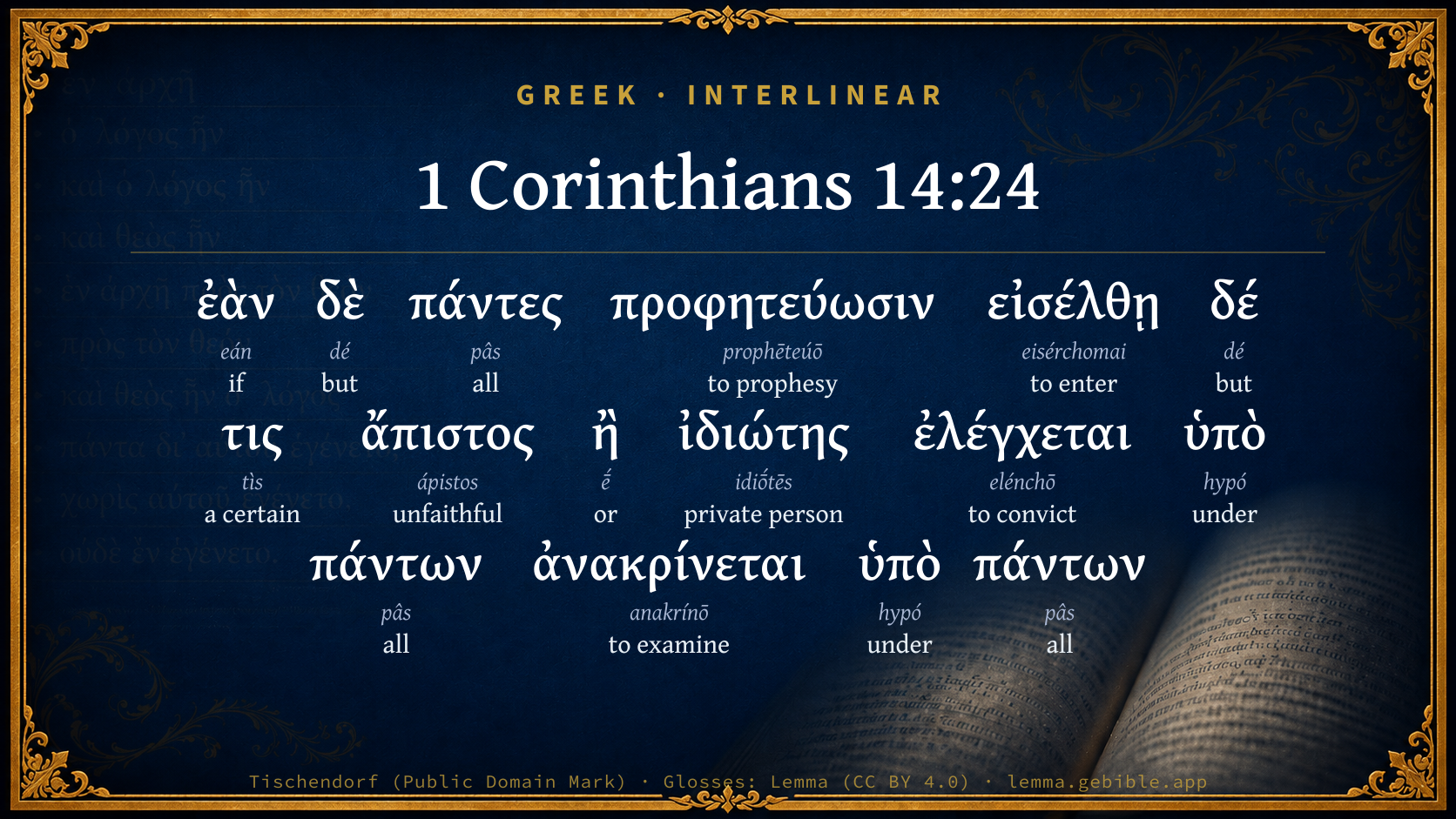
  1. ἐὰν eán G1437 “if” Conditional
  2. δὲ dé G1161 “but” Conjunction
  3. πάντες pâs G3956 “all” Adjective, Nominative, Plural, Masculine
  4. προφητεύωσιν prophēteúō G4395 “to prophesy” Verb, Present, Active, Subjunctive, 3rd person, Plural
  5. εἰσέλθῃ eisérchomai G1525 “to enter” Verb, Aorist, Active, Subjunctive, 3rd person, Singular
  6. δέ dé G1161 “but” Conjunction
  7. τις tìs G5100 “a certain” Indefinite pronoun, Nominative, Singular, Masculine
  8. ἄπιστος ápistos G571 “unfaithful” Adjective, Nominative, Singular, Masculine
  9. ἢ ḗ G2228 “or” Particle
  10. ἐλέγχεται elénchō G1651 “to convict” Verb, Present, Passive, Indicative, 3rd person, Singular
  11. ὑπὸ hypó G5259 “under” Preposition
  12. πάντων pâs G3956 “all” Adjective, Genitive, Plural, Masculine
  13. ἀνακρίνεται anakrínō G350 “to examine” Verb, Present, Passive, Indicative, 3rd person, Singular
  14. ὑπὸ hypó G5259 “under” Preposition
  15. πάντων pâs G3956 “all” Adjective, Genitive, Plural, Masculine

About this verse

These counts appear in no published source. They are computed here, from the morphology-tagged text and Lemma’s own curated glosses. What Lemma adds →

16
words
12
distinct lemmas
Pauline Epistles
section

Notable vocabulary

The rarest word here is ἰδιώτης private person G2399 — appearing just 5 times in the whole Greek New Testament.

Shared distinctive vocabulary

ἰδιώτης private person G2399 occurs in 5 verses of the Greek New Testament. Also found in:

Repetition

Words recur within this verse:

Cross-references

5

Topical passages linked to 1 Corinthians 14:24 in the Treasury of Scripture Knowledge — connected by theme and wording, ordered by reader-vote popularity; previews shown in the World English Bible.

  • Acts 2:37 Now when they heard this, they were cut to the heart, and said to Peter and the rest of the apostles, "Brothers, what shall we do?"
  • Hebrews 4:12–13 For the word of God is living, and active, and sharper than any two-edged sword, and piercing even to the dividing of soul and spirit, of both joints and marrow, and is able to discern the thoughts and intentions of the heart.
  • John 4:29 "Come, see a man who told me everything that I did. Can this be the Christ?"
  • 1 Corinthians 2:15 But he who is spiritual discerns all things, and he himself is judged by no one.
  • John 1:47–49 Jesus saw Nathanael coming to him, and said about him, "Behold, an Israelite indeed, in whom is no deceit!"

Cross-references courtesy of OpenBible.info (CC BY 4.0).

Commentary

Notes on 1 Corinthians 14:24 from classic Christian and Jewish commentators (each source and its license shown beneath its notes). The classic Christian expositions comment on the surrounding passage and are grouped to its opening verse, so a note may address several verses; the Jewish commentaries on the Tanakh (Rashi and others) are per-verse, so they appear only where the commentator wrote on this verse.

Lemma curates 59 commentaries, every one of them public domain or Creative Commons licensed, each selected and text-cleaned for this edition rather than reprinted as found. About our sources →

John Calvin's Commentaries

24. But if all prophesy As he had previously showed them, how much more advantageous prophecy is to those that are of the household of faith (Galatians 6:10) than the gift of tongues, so he now shows that it would be useful also to those that are without. (1 Corinthians 5:13.) This is a most powerful consideration for showing the Corinthians their error. For what a base part it is to depreciate a gift that is most useful both within and without, and to be wholly taken up with another gift which is useless to those that are within the house; and, in addition to this, gives occasion of offense to those that are without. He sets before them this advantage of prophecy, that it summons the consciences of the wicked to the tribunal of God, and strikes them with a lively apprehension of divine judgment in such a manner, that he who before in utter regardlessness despised sound doctrine, is constrained to give glory to God.

We shall find it, however, much easier to understand this passage, if we compare it with another that occurs in the Epistle to the Hebrews (Hebrews 4:12.)

The Word of God is quick and powerful, and sharper than any two-edged sword; piercing to the dividing asunder of soul and spirit, and of the joints and marrow — a discerner of the thoughts of the heart.

For in both passages, it is the same kind of efficacy of the Word of God that is spoken of: only in that other passage it is spoken of more fully and distinctly. So far as the passage before us is concerned, it is not difficult to understand now, what is meant by being convinced and judged. The consciences of men are in a torpid state, and are not touched with any feeling of dissatisfaction on account of their sins, so long as they are enveloped in the darkness of ignorance. In short, unbelief is like a lethargy that takes away feeling. But the Word of God penetrates even to the farthest recesses of the mind, and by introducing, as it were, a light, dispels darkness, and drives away that deadly torpor. Thus, then, unbelievers are convinced, inasmuch as they are seriously affected and alarmed, on coming to know that they have to do with God; and, in like manner, they are judged in this respect, that whereas they were previously involved in darkness, and did not perceive their own wretchedness and baseness, they are now brought into the light of day, and are constrained to bear witness against themselves.

When he says, that they are judged and convinced by all, you must understand him as meaning all that prophesy; for he had said a little before, If ye all prophesy, (1 Corinthians 14:24.) He has expressly made use of a general term, with the view of removing the dislike that they felt for prophecy. The unbeliever, I say, is convinced — not as if the Prophet pronounced a judgment upon him either silently in the mind, or openly with the mouth, but because the conscience of the hearer apprehends from the doctrine his own judgment. He is judged, inasmuch as he descends into himself, and, after thorough examination, comes to know himself, while previously he was unmindful of himself. To the same purpose, too, is that saying of Christ:

The Spirit, when he is come, will convince the world of sin, (John 16:8;)

and this is what he immediately adds — that the secrets of his heart are made manifest For he does not mean, in my opinion, that it becomes manifest to others what sort of person he is, but rather that his own conscience is aroused, so that he perceives his sins, which previously lay hid from his view.

Here again Chrysostom asks, how it comes to pass that prophecy is so effectual for arousing unbelievers, while Paul had said a little before that it was not given to them. He answers, that it was not given to them as a useless sign, but for the purpose of instructing them. For my part, however, I think that it will be simpler, and therefore more suitable, to say that it was not given to unbelievers, who perish, whose hearts

Satan has blinded, that they may not see the light which shines forth from it. (2 Corinthians 4:3, 4.)

It will also suit better to connect this statement with the prophecy of Isaiah (Isaiah 28:11,12,) because the Prophet speaks of unbelievers, among whom prophecy is of no profit or advantage.

John Calvin's Commentaries (1540-1563) — public domain. Text from the Calvin Translation Society English edition (1840s-50s) via the Christian Classics Ethereal Library (ccel.org). Calvin's coverage is partial (roughly two-thirds of the Bible); uncommented books and verses are honest gaps, never fabricated. The 19th-century editor's footnotes and remarks are omitted so the notes are faithfully Calvin's own voice.

The Biblical Illustrator

Joseph S. Exell

1Co_14:24-25

But if all prophesy, and there come in one that believeth not, or one unlearned, he is convinced of all.

Prophesying in the primitive Church

I. Its nature.

1. Not the prediction of future events (1Co_14:3), nor ordinarily the discussion of Scripture, since the New Testament was not yet written.

2. But the preaching of New Testament truth already learnt from the apostles and others, under the direct impulse of the Spirit (1Co_14:30), which was liberally bestowed upon the members of the Church (1Co_14:24).

II. Its effects.

1. The edification of the Church.

2. The conviction of the ignorant and unbelieving--producing awakening of conscience, confession of sin, and the acknowledgment of Gods presence.

III. Its relation to modern preaching.

1. The direct communications of the Holy Spirit are superseded by the completed canon of Scripture, which must be carefully studied by persons properly qualified, and appointed.

2. Yet it were well if there were less of human art and method and much more of the Spirits unction and power. (J. Lyth, D. D.)

The awakening of the sinner

I. How he enters the Christian assembly.

1. Unbelieving.

2. Ignorant.

II. What he hears.

1. The voice of the preacher.

2. The proclamation of truth.

3. The awakenings of conscience.

III. What he Does.

1. Confesses his sin.

2. Worships God.

3. Bears testimony to His presence and power. (J. Lyth, D. D.)

Conviction of sin

I. Preaching the gospel is an ordinance of God, and was constantly used in the primitive Church (Mat_28:19). Believing in Christ is necessary to salvation; and preaching the gospel is generally necessary to believing (Rom_10:14; 1Co_1:21).

II. Curiosity frequently led persons to the Christian assemblies. The religion of Christ made a great stir in the world. Some were greatly prejudiced against it. But when they saw miracles performed before their eyes; when they saw some of their neighbours forsake the altars of their idols, and become moral and lovely in their conduct, they were forced to stop and consider how these things could be, and some of them would, of course, go and hear for themselves. Our text supposes such a thing. God often overruled this kind of curiosity for good. Zaccheus wanted to gratify his curiosity; but Christ, in mercy, called and converted him. And it is happy for many that they did not suffer their own prejudices, or the fear of man, to prevent their judging for themselves.

III. Primitive preaching had a tendency to convince men of their guilt and danger.

1. The unbeliever, coming into the assembly, is convinced; whoever preached, his doctrine had this tendency, to convince the man of sin. This is done by the power of the Spirit, going along with the Word (Joh_16:8).

2. He is judged of all; tried, and condemned. The consideration of his own sin is brought home to his conscience, as when Nathan said to David, Thou art the man! He receives the sentence of death in himself. It is the office of an enlightened conscience to anticipate the judgment of the great day. Most men have such a notion of the mercy of God as to forget His justice and holiness; but when a person is convinced of sin he sees that God is holy and just; and he cannot but dread these terrible attributes, till he learns from the gospel how God is at once a just God and a Saviour (Isa_45:21; Rom_3:36).

IV. Preaching the word tends to disclose the secret workings of the heart, which were unobserved before. Most men are so busied in worldly affairs, or stupefied with worldly pleasures, that they are great strangers to themselves. But the faithful preaching of Gods Word has a tendency to rouse men from their supineness. The Word of God is a mirror that shows men their hearts. Persons who have not been used to hear the gospel are frequently surprised, when they sit under a powerful ministry, to hear their own case and character so exactly described. This is the proper effect of the Word of God, which carries with it a mighty and convincing argument of its truth, as being the Word of Him who searcheth the heart and trieth the reins (Jer_17:10).

V. When a man is converted to God he always begins to pray. This was the symptom of Pauls own conversion: Behold, he prayeth! It is sad to think that so many people never pray. A short form of words, always the same, and always unfelt. Behold here, a man so overpowered with a sense of the majesty and justice of God; so deeply affected with his danger as a sinner, and so eagerly desirous of pardoning mercy, that be forgets he is surrounded by mortals, and falls down before his God with the publicans petition (Luk_18:13). So have I seen a condemned criminal at a human bar, when the sentence of death has been pronounced, fall down on his knees, and, regardless of the gazing throng, implore the favour of the judge. So have I seen dying persons, expecting soon to appear before God, cry aloud for mercy, without considering who surrounded their beds. The place, or the posture of prayer, is of little consequence. It might disturb the public worship, yet when a person is greatly affected, it will be difficult to conceal his emotions. He will lift up his heart, if not his voice to God.

VI. Converted persons drop all there prejudices against the people of God, and speak honourably of them. He will report that God is in you of a truth. Profane people treat them with contempt and scorn. But no sooner does a man come to himself, and see things as they are, than he forms a very different opinion of godly persons. He sees that they are the excellent of the earth, the children of God, and heirs of eternal glory. (G. Burder.)

Conversion prepared for

I. Conversion effected by means.

1. The door of the sanctuary should be an open one (1Co_14:23). Restrictions should be swept away. Non-church-goers are often such through the action of church-goers.

2. Means should constantly be employed in the sanctuary. The gospel should be preached. The presence of unbelievers and unlearned should be borne in mind.

II. Probable means of conversion.

1. Order and propriety in the sanctuary. The building is not unimportant, for there are some churches in which it is difficult to be converted. The services should be decorous, or the stranger may think we are mad. But dulness and coldness are not decorous.

2. Worship. Song and prayer have won not a few--but both may hinder.

3. Preaching should be--

(1) Intelligible--not over the heads of the people.

(2) Sensible--not under their heads.

(3) Direct (1Co_14:24), so that the hearer may feel that it is meant for him.

(4) Searching--manifesting the secrets of the heart.

(5) Scriptural.

III. Tests of the suitability of the means.

1. What do the unbelieving and ignorant think of them? Some will scoff; but what will the common-sense and sincere think? What ought they to think?

2. What results will follow? Are they those of 1Co_14:25? If not something is amiss. Is it the want of the Holy Spirit? (E. Hurndall, M. A.)

Faithful preaching

I. Will be a power on unbelievers, for--

1. It is the exertion of spiritual power.

2. It will arouse and liberate the conscience.

3. It must include the aspects of truth directly suited to reach the unbeliever.

II. Will exert a particular kind of power on unbelievers.

1. Impression, He is convinced of all.

2. Knowledge of self, Secrets of heart made manifest.

3. Sense of God (1Co_14:25). (R. Tuck, B. A.)

And thus are the secrets of his heart made manifest.

The secrets of the heart

I. The heart is the depository of many secrets. The assumption of knowledge is one of our most besetting and perilous weaknesses; how little we really know of the world around us! We know far less of that within. Note some of the secrets of the heart of an unbelieving man.

1. There is hidden within him an immense amount of ignorance and conceit of which he knows nothing. He has no true knowledge of himself as a sinner. Had he such knowledge he would apply at once for salvation, and not pharisaically congratulate himself that he is not as other men.

2. A deep and inexhaustible depravity which alienates him from God. Of this he knows nothing, or the knowledge would be such a misery as would give him no rest until a remedy was discovered.

3. Many unremembered and unthought-of sins. Sin unknowingly committed as well as those willingly forgotten lie buried deep in the memory till the hour of revival.

4. Numerous latent fears. The child that is happy in the broad daylight knows nothing of those fears which the dark and lonely night will awaken. Even in this world the unbelievers fears may emerge from the caverns in which they lie concealed; but in the hereafter who can prognosticate the fears which will be awakened by the consciousness of unforgiven guilt?

5. A sense of God, right, truth, and immortality. No one is so utterly degraded as to have no traces of those radical principles. Not that we are born with any positive ideas of them, but we are born with certain capacities which infallibly secure to us impressions of the invisible, infinite, and eternal. And there will come a time when these will be the grand all-absorbing truths.

II. The manifestation of those secrets. Ignorant as we are of the depths of our own nature there is a limited but sufficient knowledge that we may obtain of ourselves. By the light of Gods Word and the teaching of His Spirit we may learn so much as to see the necessity and suitableness of Gods provision for our salvation. And oftentimes it pleases God--as in the case before us--to lead the unbeliever to the assembly of His people, and by the truth published and the Spirit given there, to shed light into the heart. As psalm and prayer uprise, as the Scriptures are read and explained, new and surprising revelations are vouchsafed. The slumbering conscience is aroused, memory is quickened, the consciousness of God, judgment, and eternity becomes vivid, and the once unbeliever is overpowered, and confesses to the Divine revelation made to his heart. Conclusion: If you have not seen any of these things, consider--

1. Your fearful and benighted ignorance.

2. The danger of this revelation when it will be of no avail.

3. The necessity of the prayer, Lord, that I may receive my sight. (W. T. Bull, B. A.)

The nature of spiritual gifts, and some directions for their use

1. A. spiritual gift is the faculty in each in which the Holy Spirit reveals Himself. Every man has some such, in which his chief force lies.

2. There are certain creative epochs when intense feelings elevate all the powers preternaturally. Such, e.g., was the close of the last century, when the revolutionary spirit created a preternatural abundance of military talent. Such, too, was the first age of Christianity. The Holy Spirit was poured out largely, and whatever it touched it vivified. The Holy Ghost may mingle with man in three ways--with his body, and then you have a miracle; with his spirit, and then you have that exalted feeling which finds vent in tongues; or with his intellect, and then you have prophecy.

I. In the case of prophecy, cultivated minds were themselves able by the understanding to convey to the understanding what the Spirit meant.

1. But the essential in all this was the Divine element of life. Just as when rain falls on dry ground, the resultant greenness and vigour are simply the outward manifestation of invisible life--so the new life penetrated the whole man, and gave force to every faculty.

2. Consider what this gift must have done in developing the Church! Men came into Christian assemblies for once, and were astonished by the flood of luminous and irresistible truth which passed from the prophetic lips: it became an instrument of conversion.

3. In versee 29 we learn that private inspiration was always to be judged by the general inspiration--i.e., it was not to be taken for granted because spoken. Inspiration is one thing, infallibility is another. God the Holy Ghost, as a sanctifying Spirit, dwells in human beings with partial sin. Did He not do so, He could not dwell with man at all. Therefore, St. Paul says that the spirits of the prophets are to be subject to the prophets. Neglect of this has been a fruitful cause of fanaticism. The afflatus was not irresistible; a man was not to be borne away by his gift, but to be master of it, and responsible for it.

II. Respecting tongues, note the following directions.

1. Repression of feeling in public. This state of ecstacy was so pleasurable, and the admiration awarded to it so easy to be procured, that numbers, instead of steady well-doing, spent life in showing off. The American camp meetings, etc., show how uncontrolled religious feeling may overpower reason--mere animal feeling mingling with the movements of Divine life. There is great danger in this, and just in proportion as feelings are strong do they require discipline. When religious life degenerates into mere indulgence of feeling, life wastes away, and the man or woman becomes weak, instead of strong. What a lesson! These Divine high feelings in Corinth--to what had they degenerated! A stranger coming in would pronounce the speakers mad!

2. Forbid not to speak with tongues. A common man would have said, All this is wild fanaticism; away with it! St. Paul said, It is not all fanaticism: part is true, part is error. The true is Gods Spirit. Learn, then, to sympathise with deep feeling. There are cold, intellectual men, who frown on every manifestation of feeling; whereas only the Spirit can interpret the Spirit.

3. To prefer gifts which are useful to others, rather than those which draw admiration to ourselves. And yet there are few who would not rather be the gifted singer, at whose strains breathless multitudes melt into tears, than some nurse of a hospital, soothing pain, or a Dorcas making garments for the poor. It is better to be useful than brilliant.

4. The real union of the human race lies in oneness of heart. This gift was not a gift of foreign languages; a Greek might be speaking in the Spirit, and another Greek might not understand him; but a Roman or a Mesopotamian might, and this by a gift of sympathy. The world is craving for unity; it may be centuries before it comes; still it is something to be on the right track. Christianity casts aside all human plans and speculations as utterly insufficient. It does not look to political economy, to ecclesiastical drill, nor to the absorption of all languages into one; but it looks to the eternal Spirit of God, which proceeds from the eternal Son. One heart, and then many languages will be no barrier. One spirit, and man will understand man. Conclusion: There are gifts which draw admiration to a mans self, others which solace and soothe him personally, and a third class which benefit others. The world and the Bible are at issue on the comparative worth of these. A gifted singer soon makes a fortune, and men give their guineas ungrudgingly for a mornings enjoyment. An humble teacher in a school, or a missionary, can often but only just live. Only remember that, in the sight of the Everlasting Eye, the one is creating sounds which perish with the hour that gave them birth, the other is building for the eternal world an immortal human spirit. (F. W. Robertson, M. A.)

The Biblical Illustrator, edited by Joseph S. Exell (c. 1880s–1900s) — public domain. Text from a community e-Sword module.

Bengel's Gnomon

Johann Albrecht Bengel

1Co 14:24. Πάντες, all) one by one, 1Co 14:31.—εἰσέλθῃ, there come in) We have an example of this at 1Sa 19:20-21.—ἄπιστος, one that believeth not) To this word we refer is convinced, comp. Joh 16:9.—ἰδιώτης, an unlearned person) to this word we refer is judged: comp. 1Co 2:15. That conviction of unbelief, and that judgment of unlearned rudeness is accomplished by the power of this very prophecy, although this be done without application to individuals. And these are two successive steps; the third follows, the secrets, etc.

1Co 14:24-25. Ἐλέγχεται ὑπὸ πάντων, (καὶ οὕτω[127]) τὰ κρυπτἀ τῆς καρδίας αὐτοῦ φανερὰ γὶνεται· καὶ οὕτω πεσὼν ἐπὶ πρόσωπον πρόσκυνἡσει τῷ Θεῳ, ἀπαγγέλλων ὅτι ὁ Θεὸς ὄντως ἐν ὑμῖν ἐστι) The first καὶ οὕτω is spurious; for the present of the verb γίνεται indicates that this clause, τὰ κρυπτὰ—γίνεται, is more closely connected with the preceding words, where the discourse runs in the present tense, than with the following, which have the future προσκυνἡσει.—ὑπὸ πάντων, by all) partly speaking, partly assenting.

[127] ABD corrected later, Gfg Vulg. omit καὶ οὕτω. The later Syr. and some later uncial MSS., support the words with Rec. Text.—ED.

Bengel's Gnomon of the New Testament — English translation (T&T Clark, Edinburgh, 1860) — public domain. Text from a community e-Sword module.

Meyer's Critical & Exegetical Commentary

Heinrich August Wilhelm Meyer

1Co_14:24-25. How wholly different, on the other hand, will the effect of general prophetic speaking be upon such persons! Arrested and humbled before God, they will declare themselves believer.

ἐὰν δὲ πάντες προφ.] is to be completed in accordance with 1Co_14:23 : ἐὰν δὲ συνέλθῃ ἡ ἐκκλ. ὅλη ἐπὶ τὸ αὐτὸ κ. πάντες προφ.

ἰδιώτης] according to the context: one not prophetically gifted, and, indeed, coming likewise from an extraneous church. Comp. on 1Co_14:23.

Prophecy, from its nature, was generally intelligible; but whoever had not its χάρισμα could not speak prophetically, and such a one was in presence of this gift an idiotes.

ἐλέγχεται ὑπὸ πάντ.] The characteristic power of prophecy (1Co_14:22), by which you all mutually edify yourselves, thus exercises such an overmastering influence upon his mind, that he is convinced by all, i.e. brought to a consciousness of the guilt of his sins. Comp. Joh_16:9. All produce this impression upon him, because each speaks prophetically, and the fundamental character of prophetic addressthe penetrating into the depths of the human heart for wholesome admonition (comp. 1Co_14:3)is alike in all.

After the first aggregate impression of the ἔλεγξις, he experiences and is conscious of the moral sifting and unveiling of his innermost life. A striking clima.

ἀνακρίνεται] for in the judgment of the human heart, which the prophets deliver, he hears a judgment upon his own heart and his own moral conditio.

τὰ κρυπτὰ τῆς καρδίας κ.τ.λ.] i.e. the moving springs, inclinations, plans, etc., of his whole inner active life, which had been hitherto known to no other, are brought to light, inasmuch as the prophets depict the hidden thoughts and strivings of the human spirit, with apocalyptically enlightened depth of insight, so truly and strikingly, that the listener sees the secrets of his own heart laid bare before all who are there presen.

καὶ οὕτω] result: and in such form, namely, convinced, judged, and made manifest, as has been just sai.

ἀπαγγέλλων] announcing, i.e. declaring aloud, and not first at home (Beza).

ὄντως] really, opposite of what is merely pretended or semblance. Comp. Mar_11:32; Gal_3:21, al.

ἐν ὑμῖν] in animis vestris, in which He works this enlightenment and spiritual power. Argumentum pro veritate religionis ex operationibus divinis efficacissimum (Bengel). Through this presence of God in the individuals (by means of the Spirit) He dwells in the church, which thereby is His temple (1Co_3:16; 2Co_6:16; Eph_2:20 f.).

Meyer — Critical and Exegetical Commentary on the New Testament — English translation by Peter Christie, edited by Frederick Crombie (T&T Clark, 1880) — public domain. Text from a community e-Sword module.

Expositor's Greek Testament

ed. W. Robertson Nicoll

1Co 14:24-25 . How diff [2136] ( δέ ) and how blessed the result, “if all should be prophesying and there should enter some unbeliever or stranger to Christianity ( ἰδιώτης : see previous note), he is convicted by all, he is searched by all, the secret things of his heart become manifest; and so he will fall on his face and worship God, reporting that verily God is among you!” This brings out two further notes of eminence in the charism of Prophecy when compared with Tongues: (1) The former edifies the Church (1Co 14:3 ff.); (2) it employs a man’s rational powers (1Co 14:14-19 ); (3) it can be exercised safely by the whole Church , and (4) to the conversion of sinners . That “all” should “prophesy” is a part of the Messianic ideal, the earnest of which was given in the descent of the Spirit at Pentecost: see Num 11:23-29 , Joe 2:28 , Act 2:4 ; Act 2:15 ff.; the speaking of Pentecost Peter identifies with prophesying, whereas P. emphatically distinguishes the Cor [2137] Glossolalia therefrom. Prophecy is an inspired utterance proceeding from a supernatural intuition, which penetrates “the things of the man,” “the secrets of his heart,” no less than “the things of God” (1Co 2:10 ff.): the light of heart searching knowledge and speech, proceeding from every believer, is concentrated on the unconverted man as he enters the assembly. His conscience is probed on all sides; he is pierced and overwhelmed with the sense of his sin ( cf. Joh 4:29 , also Joh 1:48 , 1Co 8:9 , Act 8:18 ff; Act 25:25 ). This form of Prophecy abides in the Church, as the normal instrument for “convicting the world of sin” (Joh 16:8 ff.); it belongs potentially to “all” Christians, and is in fact the reaction of the Spirit of Christ in them upon the unregenerate ( cf. Joh 20:22 f.); ἐλέγχεται is the precise word of Joh 16:8 . Ἀνακρίνω (see 1Co 2:14 and parls.) denotes not to judge , but to put on trial, to sift judicially . God alone, through Christ, is the judge of “the heart’s secrets” (1Co 4:5 , Rom 2:16 ); but the God-taught word of man throws a searching light into these recesses. In 1Co 14:24 the ἄπιστος precedes the ἰδιώτης ( cf. 1Co 14:23 ), since in his case the arresting effect of Prophecy is the more signal. προσκυνήσει and ὄντως ὁ Θεὸς κ . τ . λ . are a reminiscence of Isa 45:14 , following the Heb. txt. rather than the LXX ( cf. note on 1Co 14:21 ). ἀπ - αγγέλλων , “taking word away,” reporting, proclaiming abroad ( cf. parls.), thus diffusing the impression he has received ( cf. Joh 4:29 ). ὄντως ( revera , Cv [2138] ), really, in very deed contradicts denials of God’s working in Christianity, such as the ἄπιστος himself formerly had made. πεσών (aor [2139] ptp [2140] , of an act leading up to that of principal vb [2141] and forming part of the same movement) indicates the prostration of a soul suddenly overpowered by the Divine presence. To convince men that “God is in the midst of her” is the true success of the Church.

[2136] difference, different, differently.

[2137] Corinth, Corinthian or Corinthians.

[2138] Calvin’s In Nov. Testamentum Commentarii .

[2139] aorist tense.

[2140] participle

[2141] verb

The Expositor's Greek Testament, edited by W. Robertson Nicoll (1897–1910) — public domain. Text from a community e-Sword module.

Hodge's Commentary on Romans, Ephesians & First Corinthians

Charles Hodge

1Co_14:24, 1Co_14:25

But if all prophesy, and there come in one that believeth not, or (one) unlearned, he is convinced of all, he is judged of all: and thus are the secrets of his heart made manifest; and so falling down on (his) face he will worship God, and report that God is in you of a truth.

This is another part of the inference from what was said in 1Co_14:21, 1Co_14:22. Speaking in languages unknown to the hearers is not adapted to do good; speaking intelligibly is suited to produce the happiest effects. If all prophesy, i.e. if all the speakers speak under the guidance of the Spirit in a language which the hearers can understand. If one that believeth not, or one unlearned. From these words it is manifest that the unlearned were not Christians as distinguished from Jews or Gentiles here called unbelievers, for the same effect is said to be produced on both. The unlearned were therefore as much the subjects of conversion as the unbelieving. The meaning is, if any person, either ignorant or destitute of faith, should come in, he would be convinced by all. That is, what he heard from all would carry conviction to his mind. He would be convinced of the truth of what he heard; convinced of sin, of righteousness and of judgment, Joh_16:8; convinced that Jesus is the Christ, the Son of the living God, Act_9:20, Act_9:22; and that it is a faithful saying, and worthy of all acceptation, that Jesus Christ is come into the world to save sinners, 1Ti_1:15. He is judged of all, i.e. examined, searched into (ἀνακρίνεται); for the word of God is a discerner (κριτικός) of the thoughts and intents of the heart, Heb_4:12. The result of this searching examination is, that the secrets of his heart are made manifest; that is, they are revealed to himself. His real character and moral state, with regard to which he was before ignorant, are made known to him. The effect of this is humility, contrition, self-condemnation, and turning unto God. This is expressed by saying, so i.e. in this condition of a convinced sinner who has been brought to the knowledge of himself, falling down on his face, he will worship God. The first step in religion is entire self-abasement; such a conviction of sin, i.e. of guilt and pollution, as shall lead to self-condemnation and self-abhorrence, and to a complete renunciation of all dependence on our own righteousness and strength. When the soul is thus humbled God reveals himself sooner or later, in mercy, manifesting himself as reconciled in Jesus Christ; and then we worship him. This expresses reverence, love and confidence. It is the return of the soul to the favor and fellowship of God. One who has had such an experience cannot keep it to himself. The apostle therefore describes the convert as declaring, i.e. proclaiming aloud that God is in you of a truth. With the heart man believeth unto righteousness, and with the mouth confession is made unto salvation, Rom_10:10. It is not enough to believe the truth, it must be publicly professed; because confession is the natural fruit of faith. When there is a proper apprehension of the value of the truth, and a sincere appropriation of the promises of God to ourselves, there will be the desire to acknowledge his goodness and to proclaim the truth to others. The thing acknowledged is, that God is in you, i.e. that Christianity is divine; that Christians are not deluded fanatics, but the true children of God, in whom he dwells by his Spirit. The convert therefore joins himself to them to share their fate, to take part in whatever of reproach or persecution falls to their lot. This confession is made with confidence. Declaring that God is in you of a truth. It is not a mere conjecture, but a firm conviction, founded on experience, i.e. on the demonstration of the Spirit, 1Co_2:4.

Charles Hodge — Commentary on Romans (1835), First Corinthians (1857), and Ephesians (1856) — public domain. Text from a community e-Sword module.

Jamieson, Fausset & Brown

Robert Jamieson, A. R. Fausset & David Brown

all--one by one (Co1 14:31).

prophesy--speak the truth by the Spirit intelligibly, and not in unintelligible tongues.

one--"anyone." Here singular; implying that this effect, namely, conviction by all, would be produced on anyone, who might happen to enter. In Co1 14:23 the plural is used; "unlearned or unbelievers"; implying that however many there might be, not one would profit by the tongues; yea, their being many would confirm them in rejecting the sign, as many unbelieving men together strengthen one another in unbelief; individuals are more easily won [BENGEL].

convinced--convicted in conscience; said of the "one that believeth not" (Joh 16:8-9).

judged--His secret character is opened out. "Is searched into" [ALFORD]. Said of the "one unlearned" (compare Co1 2:15).

Jamieson, Fausset & Brown — Commentary Critical and Explanatory on the Whole Bible (1871) — public domain (CC PDM 1.0). Text via the HelloAO Bible API.

Adam Clarke's Commentary

Verse 24. But if all prophecy] If all those who teach do it in the tongue which all understand; if an unbeliever, or one who knows nothing of the sacred language, come in and hear things just suited to his own state, he is convicted by all, and he is judged by all.

Adam Clarke's Commentary on the Bible (1810–1826) — public domain. Text from a community e-Sword/MySword module.

Ellicott's Commentary for English Readers

(24) But if all prophesy.—There is no danger of exaggeration regarding this gift. Each one uttering prophecy, telling forth the gospel truth, and revealing the mind of God, will have a message that will be useful to the unbeliever. As one after another they utter the words of divine truth, they each send something that pierces into his soul. By all of them he is convicted in his own conscience of some sin. He is condemned in his own eyes, a searching light is turned upon his heart. The secrets of his heart are made manifest, and he makes terrible discoveries of his guilt (Heb_4:12-13).

A Bible Commentary for English Readers, edited by Charles John Ellicott (1878–1897) — public domain. Text from a community e-Sword module.

The Cambridge Bible for Schools and Colleges

gen. ed. J. J. S. Perowne

24. he is convinced of all] Rather, he is convinced by all, i.e. the prophets whose discourses he hears. The word signifies (1) to prove by argument, and comes therefore to be used (2) of the conviction produced by argument. Cf. St Joh_16:8, where the word however is rendered reprove. For an instance of the word ‘of’ in the sense of ‘by’ see Shakspeare, Much Ado about Nothing, Act i. Scene 1, ‘I am loved of all, only you excepted.’

he is judged of all] Rather, he is examined by all. The exhortations of the preacher place him, as it were, upon his trial. For the word here used see ch. 1Co_2:14-15, 1Co_4:3-4, 1Co_9:3, 1Co_10:25; 1Co_10:27, and notes.

The Cambridge Bible for Schools and Colleges (gen. ed. J. J. S. Perowne; Cambridge University Press, 1878–1918) — public domain. Text from a community e-Sword module.

John Gill's Exposition

And thus are the secrets of his heart made manifest,.... Not to the prophets, or preachers, or to the rest of the congregation, but to himself; the word preached being in the hands, and trader the influence, direction, and application of the Spirit of God, a discerner of the thoughts and intents of the heart; showing the plague and naughtiness of it, discovering the lusts that are in it, detecting the errors of the mind, and filling the conscience with a sense of guilt, and a consciousness of deserved punishment; so that the person looks upon himself as particularly spoken to, and as if the person speaking had knowledge of all that was within him, and adapted his discourse on purpose to him, and delivered it for his sake alone; concluding, that there is, and must be, something more than human in it:

and so falling down on his face: either publicly before the whole congregation; or when retired, as one ashamed of his sins and errors, and not able to look either God, or good men, in the face; and being in an adoration posture; or however, being truly humbled before God under a sense of his iniquities,

he will worship God; pray unto him, and earnestly entreat he would be merciful to him a sinner, and blot out all his transgressions, and forgive him all his sins; and will ever after acknowledge him to be the true God, embrace his Gospel, submit to his ordinances, and attend his service:

and report: or "declare", freely and openly to the church, to all men, to the world, and to his company from whence he came, and to whom he belonged,

that God is in you of a truth: that the Spirit of God, who is truly God, and searches the deep things of God, and reveals them, and the deep things of men, and makes them manifest, is in the prophets and preachers, otherwise they would never be able to make manifest the secrets of the heart as they do; and that the presence of God is in the church, and the power of God goes along with the ministration of the word: hereby, now many valuable ends are answered, a sinner is converted, God is worshipped and glorified, credit is brought to religion, the church of Christ is spoken well of, and prophets or preachers are honoured; wherefore prophesying, seeing it is both for the edification of believers, and conversion of sinners, ought to be desired, and made use of before speaking with tongues.

John Gill's Exposition of the Whole Bible (1746–1763) — public domain (CC PDM 1.0). Text via the HelloAO Bible API.

Trapp's Complete Commentary

John Trapp

24 But if all prophesy, and there come in one that believeth not, or one unlearned, he is convinced of all, he is judged of all:

Ver. 24. He is convinced of all] God smiteth the earth with the rod of his mouth, and with the breath of his lips doth he slay the wicked, Isa 11:4. By his word he telleth a man (as he did the Samaritaness, Joh 4:16-17; Joh 4:39) all that ever he did.

John Trapp, A Commentary or Exposition upon All the Books of the Old and New Testament (1647–1656) — public domain. Text from a community e-Sword module.

Albert Barnes' Notes on the Bible

But if all prophesy - See the note at 1Co 14:1. If all, in proper order and time, shall utter the truths of religion in a language intelligible to all.

Or one unlearned - One unacquainted with the nature of Christianity, or the truths of the gospel.

He is convinced of all - He will be convinced by all that speak. He will understand what is said; he will see its truth and force, and be will be satisfied of the truth of Christianity. The word here rendered “convinced” (ἐλέγχετἀι elengchetai) is rendered “reprove” in Joh 16:8, “And when he is come, he will reprove the world of sin,” etc. Its proper meaning is to “convict,” to show one to be wrong; and then to rebuke, reprove, admonish, etc. Here it means, evidently, that the man would be convicted, or convinced of his error and of his sin; he would see that his former opinions and practice had been wrong; he would see and acknowledge the force and truth of the Christian sentiments which should be uttered, and would acknowledge the error of his former opinions and life. The following verse shows that the apostle means something more than a mere convincing of the understanding, or a mere conviction that his opinions had been erroneous. He evidently refers to what is now known also as “conviction” for sin; that is, a deep sense of the depravity of the heart, of the errors and follies of the past life, accompanied with mental anxiety, distress, and alarm. The force of truth, and the appeals which should be made, and the observation of the happy effects of religion, would convince him that he was a sinner, and show him also his need of a Saviour.

He is judged by all - By all that speak; by all that they say. The “effect” of what they say shall be, as it were, to pass a “judgment” on his former life; or to condemn him. What is said will be approved by his own conscience, and will have the effect to condemn him in his own view as a lost sinner. This is now the effect of faithful preaching, to produce deep self-condemnation in the minds of sinners.

Albert Barnes' Notes on the Bible (1834–1885) — public domain. Text from a community e-Sword/MySword module.

Matthew Poole's English Annotations

But if all prophesy: all here certainly is not to be understood of every one in the assembly, for all were not prophets, 1Co 12:29, nor could the speaking of a great number be judged orderly by the light of nature: it here must signify any, one or more, successively, interpret or apply the Holy Scriptures.

He is convinced of all; the heathens will see an order in this, and will stand still to hear and be convinced.

He is judged of all; seeing their wicked life and false religion judged and condemned by all those that so prophesy.

Matthew Poole's English Annotations on the Holy Bible (1683–1685) — public domain. Text from a community e-Sword/MySword module.

Whedon's Commentary on the Bible

Daniel D. Whedon

24. If all prophesy—If a strain of inspired preaching continue through the whole meeting, then intelligent thought is produced and conviction of sinners follows.

Convinced—Literally, detected, or convicted. That is, he is detected to himself as a transgressor, a sinner beneath the eye of God. His sins are brought before his own view. The word for judged signifies to cross-examine, as a judge or lawyer, with probing questions. The truth searchingly questions the man as to his character before God. He is like a culprit under the inquisition of his judge.

Of all—Of or by all the prophecies. Not that they directly question him in person; but the truths they deliver do compel his conscience to question himself.

Daniel D. Whedon (gen. ed.), Commentary on the Old and New Testaments (1874–1909) — public domain. Text from a community e-Sword module.

The Pulpit Commentary

All prophesy. If one after another speak the word of spiritual exhortation. He is convinced of all, he is judged of all; literally, he is being convicted by all, he is being examined by all; in other words, each address is calculated to awaken conviction in him and to search his heart. Thus the address of St. Peter pierced the consciences of his hearers, when the glossolaly even of Pentecost produced no effect beyond that of irreverent wonder. (Act_2:37) It is easy to see that the style and method of worship in the assemblies of Christians at this early epoch resembled that now prevalent among Quakers. The teaching was not left to recognized pastors, but any Christian might speak who had gifts which moved him to address his brethren. The externals of worship are of no eternal signifiance, but are best left to be moulded by the requirements of time and place, with reference to the teachings of past experience. No doubt St. Paul"s depreciation of glossolaly led to its rapid disappearance when it had done its work of being "a sign to unbelievers." But if ancient modes of worship were too independent of rigid conditions, modern modes are, on the other hand, too stereotyped and inelastic.

Vers. 24, 25. The conviction of the unbeliever.

In estimating the gifts of intelligent prophecy on the one hand, and the gifts of tongues on the other, the apostle tests their respective value by their practical utility. It could not be denied that one great end of the existence of the Christian Church was, as it still is, the instruction of the ignorant and the reformation of the sinful. It is clear that at Corinth, and at other places where Christian communities existed in the first age, there was already a constant intercourse between the Church and the world. Attracted by curiosity, or driven by spiritual wants and hopes, the unbelieving heathen and Jews would sometimes attend the Christian assemblies. This being so, Paul asks, What must be the effect upon such persons, first of such an exhibition of supernatural powers such as the Corinthians delighted in, and secondly of the proclamation of the truths and promises of the gospel? His own answer is that, whilst the speaking with tongues may amaze, it will probably be set down as ranting; whilst the utterance of God"s Word will sometimes issue in the enlightenment, conviction, and salvation of the sinner. Surely a sufficient and decisive test!

I THE MEANS OF THE UNBELIEVER"S CONVERSION. This is represented as prophecy, i.e. the uttering forth by man, as God"s messenger, of God"s mind and will. And in the case supposed by the apostle, evidently the declaration concerns the sinful state and the spiritual needs of man, the merciful purposes of God, the provision of pardon, renewal, and eternal life, through the Saviour Jesus Christ. Prophecy, so understood, has never ceased in the Church of the Lord Jesus. His ministers prophesy when they give witness to him, when they publish the gospel and its gracious invitations.

II THE PROCESS OF THE UNBELIEVER"S CONVERSION. The question arises How does the Christian prophecy affect the mind and heart of the ignorant and unbelieving hearer? According to the representation of the apostle, the word evinces its own divinity by making the sinner known to himself. And there can be no more generally convincing and conclusive evidence of the authority of religion than is afforded by the fact. that the preaching of the gospel reveals man to himself in his true state and position. The truths of the gospel are the utterances of him who formed the human heart. The candle of the Lord searches even the dark places of man"s nature, and that which is hidden is brought forth to light. The conscience stricken sinner realizes his guilt and danger, and his need of a Divine Deliverer. He is convinced, examined, judged, by the several messages which penetrate his nature. The secrets of his heart, his iniquities, his sorrow and penitence, his aspirations for a better life, are all made manifest.

III THE RESULTS AND SIGNS OF THE UNBELIEVER"S CONVERSION.

1. His enmity to God and to God"s truth is utterly vanquished. He falls down, contrite and submissive, like him Who cried, "God, be merciful to me a sinner.

2. His enmity is exchanged for reverence and worship. Before, he may have adored the false gods whom he has been trained to revere; now and henceforth there is for him but one God, the Saviour of all men.

3. He acknowledges the Divine presence in the Church. Had he listened only to "tongues," he would have deemed the speakers to have raved. But listening to words of grace and truth, the convert acknowledges that in meeting e he has met with God, and their assembly has become to him, as it has God"s people he has met with God, and their assembly has become to him, as it has become to multitudes, "the house of God, and the gate of heaven. T.

Preaching to unbelievers.

Previously the apostle had shown that the proper sphere of the Christian prophet was the teaching of the Church, so that its members might be edified, exhorted, and comforted. Now he intimates that this is not the only influence exerted by Christian prophesying; it has its power also on the "unbeliever" and the "unlearned." In the early Church the claims of worship were met by attendance on the temple and synagogue services, and the Christian meetings were, at first, simply gatherings for edification, and prayer; so preaching and teaching were the prominent features of them. Gradually worship and edification became united in the Christian meetings, and a Christian cult, as well as Christian doctrine, was formulated. Then a greater publicity was given to the meetings; unbelievers were allowed to come in, and the preaching came to bear direct relation to them. We observe that

I A FAITHFUL MINISTRY WILL BE A POWER ON UNBELIEVERS. It may seem that a ministry adapted to believers is not suited for the arresting, convincing, and converting of the impenitent; and this is made a complaint against those who occupy the pastoral office. It may be advisable that for this particular work a class of evangelists, or missioners, should be raised up, but it may fairly be urged that in the regular Church ministry there should be, and may be, a real converting power. For:

1. Faithful preaching is the exertion of spiritual power; and this all must feel and respond to, in greater or less degree. When God speaks to men by tempests, plague, or famine, every one must feel it more or less; all must hear the voice. An assembled congregation is for the time shut in with God, and all must feel, in some degree, caught by the power of God. We have many cases, in history and within experience, in which the results have been much grander than the means used could indicate. Illustrate by the day of Pentecost, times of revival, seasons of hallowed emotion in Christian services. These are times of spiritual power which all must feel, times of life or of death to men.

2. Faithful preaching wilt liberate and arouse the human conscience. The preaching which fills believers with a new sense of God will arouse the conscience of unbelievers to the conviction of his existence and claims. The preaching that reveals the deep horror, the moral helplessness, and the final ruin of the sinner, will stir the conscience of all who hear it. The things that lull the Christian conscience to sleep are the very things which lull to sleep the sinner"s conscience. Men"s "refuges of lies," from which they have to be driven, are much the same.

3. Faithful preaching must include the aspects of truth directly suited to reach the unbeliever. He who would "declare the whole counsel of God" must be often dealing with the simplest foundation truths. He speaks to many weak, unlearned believers, who cannot bear "strong meat," and so he must be very often laying down the groundwork of hope; and every sermon may thus gain its helpful adaptation to unbelievers. We have to be constantly presenting such great first principles as these: "All have sinned, and come short of the glory of God." God is the Father of all the human race. He finds expression for his Fatherhood in a gracious redemption of his erring children. The Divine Spirit is the source of all goodness in man. Jesus is the only, but he is the all sufficient Saviour. Apart, then, from those direct appeals which ministers may be at times constrained to make, their whole preaching should prove a power unto salvation.

II A FAITHFUL MINISTRY WILL EXERT A PARTICULAR KIND OF POWER ON UNBELIEVERS. Vers. 24, 25, speak of three things:

(1) impression;

(2) knowledge of self;

(3) sense of God.

1. Impression. "He is convinced of all." He is interested, seized, held to thought, even, it may be, against his will. The trifles that agitated him are gone; his purpose in coming is forgotten; he is impressed, held by the force of preached truth. Illustrate by scenes in the itinerant labours of George Whitefield or John Wesley.

2. Knowledge of self. "Secrets of heart made manifest." Sometimes the minister seems to us as if he knew all about us. He brings to memory our wrong doings, he reveals to us our bad motives, our heart wrongness. We see the corruptness of our inclinations and purposes. We feel convicted of the master sin of ungodliness.

3. Sense of God. (Ver. 25.) The merely shadowy thought of God becomes substance, the idea becomes reality. In the sanctuary God seems to come out of the dim distance and look us in the face. God"s claims and relations go searchingly through our souls. God"s love and redemption seem to be great glories far up out of our reach. The minister"s sense of God is borne in upon us, compelling us to say, "God! What is God to me?" So sabbath preaching is the savour of life or of death to us all. Under its influence are we being won to God? If not, what shall we say? O guilty will, that decides not for Christ! O mournful worldliness, that plucks men back from the very threshold of life! R.T.

The Pulpit Commentary (1880–1919), ed. H.D.M. Spence-Jones & Joseph S. Exell — public domain. Text from a community e-Sword module.

John Wesley's Explanatory Notes

He is convicted by all - who speak in their turns, and speak to the heart of the hearers. He is judged by all - Everyone says something to which his conscience bears witness.

John Wesley, Explanatory Notes Upon the Whole Bible (1754–1765) — public domain. Text via the GEBible commentary corpus.

McGarvey & Pendleton's Commentaries

J. W. McGarvey

But if all prophesy, and there come in one unbelieving or unlearned, he is reproved by all, he is judged [literally, cross-examined] by all;

J. W. McGarvey (with Philip Y. Pendleton), Commentaries on the New Testament (The Fourfold Gospel, 1914; Acts; and the epistles) — public domain. Text from a community e-Sword/MySword module.

The People's New Testament

B. W. Johnson

24. But if all prophesy. Those speaking would then speak what would be understood, and, speaking under the divine impulse, would convict. He is judged. His state and character are laid bare by the speakers.

B. W. Johnson's The People's New Testament with Notes (1889–1891) — public domain. Electronic text from the Christian Classics Ethereal Library (CCEL) ThML edition.

unfoldingWord translationNotes

Door43 World Missions Community

he would be convicted by all he hears. He would be judged by all that is said

Paul says basically the same thing twice for emphasis. AT: "he would realize that he is guilty of sin because he hears what you are saying" (See: Parallelism)

The secrets of his heart would be revealed

Here "heart" is a metonym for a person's thoughts. This can be stated in active form. AT: "God would reveal to him the secrets of his heart" or "He would recognize his own private inner thoughts" (See: Metonymy and Active or Passive)

he would fall on his face and worship God

"Fall on his face" here is an idiom, meaning to bow down. AT: "He would bow down and worship God" (See: Idiom)

translationWords

prophet

believe

judge

heart

reveal

worship

God

unfoldingWord translationNotes — © Distant Shores Media and the Door43 World Missions Community, licensed CC BY-SA 4.0. Source: git.door43.org/Door43/en_tn.

Cambridge Greek Testament for Schools and Colleges

24. ἄπιστος ἢ ἰδιώτης. The distinction here is between active unbelief in Christianity and the absence of any information on the subject.

ἐλέγχεται ὑπὸ πάντων. He is convicted in his own conscience by all of the speakers. The word ἐλέγχω signifies (1) to prove by argument, and comes therefore to be used (2) of the conviction produced by argument. Cf. Joh 16:8, where the word however is rendered reprove.

ἀνακρίνεται ὑπὸ πάντων. He is examined by all. The exhortations of the preachers place him, as it were, upon his trial. For the word here used see ch. 1Co 2:14-15, 1Co 4:3-4, 1Co 9:3, 1Co 10:25; 1Co 10:27, and notes.

Cambridge Greek Testament for Schools and Colleges (Cambridge University Press, 1896; 21 vols, various authors incl. Carr, Maclear, Plummer, Farrar, Lumby, Moule, M. R. James, Simcox) — public domain. Text from a community e-Sword module.

Alford’s Greek Testament

Henry Alford

24.] But if all (see above) prophesy (i.e. intelligibly lay forth, in the power of the Spirit, the Christian word and doctrine) and there enter any (singular now, setting forth that this would be the effect in any case: plural before, to shew that however many there might be, not one could appreciate the gift) unbeliever or plain man (ἄπιστος first now, because the great stress is on the power of prophecy in its greatest achievement, the conversion of the unbeliever; but ἰδιῶται was first before, because the stress there was on the unprofitableness of tongues, not only to the ἄπιστοι, but to the ἰδιῶται), he is convicted by all (the inspired discourse penetrating, as below, into the depths of his heart,—by all, i.e. by each in turn), he is searched into by all (each inspired speaker opening to him his character), the hidden things of his heart become manifest (those things which he had never before seen are revealed,—his whole hitherto unrecognized personal character laid out. Instances of such revelations of a man to himself by powerful preaching have often occurred, even since the cessation of the prophetic gift): and thus (thus convicted, searched, revealed to himself:—in such a state of mind) having fallen on his face, he will worship God, announcing (by that his act, which is a public submission to the divine Power manifest among you: or, but not so well, aloud, by declaration of it in words) that of a truth (implying that previously he had regarded the presence of God among them as an idle tale; or, if a plain Christian, had not sufficiently realized it) God is among you (or in each of you: by His Spirit). In this last description the ἰδιώτης is thrown into the background, and (see above) the greater achievement of prophecy, the conviction and conversion of the ἄπιστος, is chiefly in view. “For a similar effect of the disclosure of a man’s secret self to himself, compare the fascination described as exercised by Socrates over his hearers by the ‘conviction’ and ‘judgment’ of his questions in the Athenian market-place. Grote’s Hist. of Greece, viii. 609-611.” Stanley.

Henry Alford, The Greek Testament (1849–1861) — public domain. Text from a community e-Sword module.

International Critical Commentary

24. ἐὰν δὲ πάντες προφητεύωσιν. ‘Whereas, if all should be prophesying, and there should come in some unbeliever or ungifted person.’ The change to the singular and the change of order have point. A good effect would be more probable in the case of an individual than of a group; and if the ἄπιστος was deeply moved by what he heard, a fortiori the ἰδιώτης would be. In the former case the argument is the other way: if ἰδιῶται said that they were demented, still more would ἄπιστοι do so. Speaking with Tongues infidelem sibi relinquit; inspired preaching ex infidelibus credentes facit, et fideles pascit (Beng.).

ἐλέγχεται ὑπὸ πάντων. ‘He is convicted by all’; by all the inspired speakers, whose preaching arouses his conscience (Heb 4:12). ‘He is convinced of all’ (AV.) is ambiguous and misleading. ‘Convince’ formerly = ‘convict’ or ‘refute’ (Joh 8:46; Job 32:12). For ‘of’ = ‘by’ see 11:32; Php 3:12; Mat 6:1; Luk 14:8; and “may of Thee be plenteously rewarded.”

ἀνακρίνεται ὑπὸ πάντων. ‘He is searched into by all’; 9:3, 10:25, 27; Luk 23:14, etc. There are three stages in the process of conversion: (1) he is convinced of his sinful condition; (2) he is put upon his trial, and the details of his condition are investigated; (3) the details are made plain to him. On the unsatisfactory renderings of κρίνω and its compounds in the AV. see Lightfoot, On Revision, pp. 69 f.

International Critical Commentary — older volumes (1896–1929), various authors — public domain. Text from a community e-Sword module.

Vincent's Word Studies in the New Testament

Marvin R. Vincent

Convinced [ελεγχεται] . Of his sins. See on tell him his fault, Mt 18:15; convinced, Jas 2:9; reproved, Joh 3:20. Rev., reproved : convicted in margin.

Judged [ανακρινεται] . Examined and judged. The word implies inquiry rather than sentence. Each inspired speaker, in his heart - searching utterances, shall start questions which shall reveal the hearer to himself. See on discerned, ch. 2 14. On the compounds of krinw, see on ch. 1Co 11:29, 31, 32.

Marvin R. Vincent, Word Studies in the New Testament (1887–1900) — public domain. Text from a community e-Sword/MySword module.

Godet's Commentaries

Frédéric Louis Godet

Vv. 24, 25. “But if all prophesy, and there come in one that believeth not, or a novice, he is convinced of all, he is judged of all; 25. the secrets of his heart are made manifest; and so falling down on his face he will worship God, and report that God is in you of a truth.”

We have just seen the effect of tongues without prophecy; now, on the contrary, we have what prophecy will do without tongues.

The novice and the unbeliever enter, as in 1Co 14:23, during the meeting. Paul here uses the singular instead of the plural (1Co 14:23); no doubt because the fact he is about to describe will have a purely individual character. It may be thought with Hofmann, that if ἄπιστος is here placed first, the effect is: the unbeliever, and à fortiori, the novice. The latter, indeed, was already better prepared to feel the power of prophetic speech, while at 1Co 14:23 it was the reverse: the novice, and à fortiori, the unbeliever. Three effects are ascribed to prophecy: conviction, ἔλεγχος; examination, ἀνάκρισις; manifestation, φανέρωσις. — The word ἐλέγχειν signifies to convince of error or sin. Every utterance of a prophet is like a flash, lighting up the heart of the hearer and discovering to him in a general way his guilt and defilement.

The word ἀνακρίνεσθαι is not fully rendered by the translation; is judged; the Greek term rather denotes the detailed inquiry than the sentence pronounced. His whole inner man is searched, so to speak, by the words of the prophets.

Frédéric Louis Godet — Commentaries on Luke, John, Romans, and 1 Corinthians — English translation (T&T Clark, Edinburgh, 1870s–1890s) — public domain. Text from a community e-Sword module.

Lesson kit

Teaching starters — assembled from the data on this page, not authored interpretation. Every prompt links to the verse data it draws on. Edit before teaching.

1 Corinthians, in the Pauline Epistles, opens this verse with 16 words (12 distinct Greek lemmas). Its most distinctive word is idiṓtēs (“private person”). A historical commentator’s framing appears above. Read the whole chapter for the surrounding context.

Discussion questions

  1. What does “private person” (idiṓtēs) contribute to the verse as a whole?
  2. Acts 4:13 shares the word «private person» with this verse. How do the two illuminate each other?
  3. “all” occurs 3× in this one verse. What is the effect of the repetition?
  4. The translations on this page render this verse differently — a whole-verse word diff, not a word-by-word alignment. What might account for the different wordings?
  5. Reading how John Calvin's Commentaries and The Biblical Illustrator read this verse, where do the two commentators agree and where do they part?

Things to notice

Reading settings

Reading text

Shown beneath each verse's original-language words.

Old Testament
Old Testament edition

Read the OT as the Masoretic Hebrew (MT) or the Greek Septuagint (LXX).

English shown for the Greek Septuagint (in the Hebrew ↔ Greek comparison).

Comparing translations? Open the Compare panel on any verse page to stack up to four side by side.