1 Corinthians 15:27

Greek (Tischendorf 8th ed.) 1 Corinthians 15:27 appears in the Greek New Testament. The text above is from the Tischendorf 8th edition. Each word links to its Strong’s number and a concise gloss. Click any word for its full Thayer’s Greek Lexicon entry.
Download image
Cite this verse

1 Corinthians 15:27 (World English Bible). Public Domain. Lemma interlinear Bible study tool, https://lemma.gebible.app/v/1-corinthians/15/27.

Show BibTeX & RIS
BibTeX
RIS
English Translation
For, "He put all things in subjection under his feet." But when he says, "All things are put in subjection," it is evident that he is excepted who subjected all things to him.
World English Bible · Public Domain
Download a study sheet

One document with this verse’s original text, its word-by-word gloss line, the meaning frame, cross-references with their text, attributed commentary, and full source and license credits — printable, and it pastes into notes with its structure intact.

This verse Autodidact and up

Study sheet (.html) Plain text (.txt)

A passage Seminary Student

Up to 50 verses in one chapter. A passage sheet keeps up to 6 commentary sources and 12 cross-references per verse, in the order this page ranks them, and says so on the sheet whenever that leaves anything out. Ask for a single verse and you get the Autodidact verse sheet above.

Everything on this page stays free to read, with no account — the sheet is a download of what is already on screen, not access to it.

Want to remove ads? Support Godless Engineer
Compare translations 3

The same verse in 3 English versions, stacked beneath the original-language interlinear above. Click any original word for its lexicon entry.

Each is an independent rendering of the whole verse — the interlinear is not word-aligned to these translations.

Highlighted words mark where these versions differ — a whole-verse word diff, not a word-by-word alignment.

  • World English Bible Public Domain
    For, "He put all things in subjection under his feet." But when he says, "All things are put in subjection," it is evident that he is excepted who subjected all things to him.
  • King James Version Public Domain
    For he hath put all things under his feet. But when he saith all things are put under him, it is manifest that he is excepted, which did put all things under him.
  • unfoldingWord Literal Text CC BY-SA 4.0
    For “he has put everything under his feet.” But when it says, “he has put everything,” clear that the one having put everything in subjection to him excepted.

unfoldingWord Literal Text — © unfoldingWord, licensed CC BY-SA 4.0. Word-aligned USFM3 via Door43 (git.door43.org/unfoldingWord/en_ult).

Versions to compare (up to 4)

3 of 4 selected

Show all 19 translations

Every available English version of this verse, each an independent rendering of the whole verse.

  • World English Bible Public Domain
    For, "He put all things in subjection under his feet." But when he says, "All things are put in subjection," it is evident that he is excepted who subjected all things to him.
  • Berean Standard Bible Public Domain
    For “God has put everything under His feet.” Now when it says that everything has been put under Him, this clearly does not include the One who put everything under Him.
  • Majority Standard Bible Public Domain
    For “God has put everything under His feet.” Now when it says that everything has been put under Him, this clearly does not include the One who put everything under Him.
  • King James Version Public Domain
    For he hath put all things under his feet. But when he saith all things are put under him, it is manifest that he is excepted, which did put all things under him.
  • American Standard Version (1901) Public Domain
    For, He put all things in subjection under his feet. But when he saith, All things are put in subjection, it is evident that he is excepted who did subject all things unto him.
  • Revised Version (1885) Public Domain
    For, He put all things in subjection under his feet. But when he saith, All things are put in subjection, it is evident that he is excepted who did subject all things unto him.
  • Geneva Bible (1599) Public Domain
    For he hath put downe all things vnder his feete. (And when he saith that all things are subdued to him, it is manifest that he is excepted, which did put downe all things vnder him.)
  • Douay-Rheims (1899) Public Domain
    All things are put under him; undoubtedly, he is excepted, who put all things under him.
  • Young's Literal Translation Public Domain
    for all things He did put under his feet, and, when one may say that all things have been subjected, `it is' evident that He is excepted who did subject the all things to him,
  • Literal Standard Version CC BY-SA 4.0
    For He put all things under His feet, and when one may say that all things have been subjected, [it is] evident that He is excepted who subjected all things to Him,
  • Unlocked Literal Bible CC BY-SA 4.0
    For “he has put everything under his feet.” But when it says “he has put everything,” it is clear that this does not include the one who put everything in subjection to himself.
  • unfoldingWord Literal Text CC BY-SA 4.0
    For “he has put everything under his feet.” But when it says, “he has put everything,” clear that the one having put everything in subjection to him excepted.
  • Darby Bible Public Domain
    For he has put all things in subjection under his feet. But when he says that all things are put in subjection, [it is] evident that [it is] except him who put all things in subjection to him.
  • World Messianic Bible Public Domain
    For, “He put all things in subjection under his feet.” But when he says, “All things are put in subjection”, it is evident that he is excepted who subjected all things to him.
  • Webster's Bible Public Domain
    For he hath put all things under his feet. But when he saith, all things are put under him, it is manifest that he is excepted who did put all things under him.
  • Free Bible Version CC BY-SA 4.0
    As Scripture says, “He put everything under his feet.” (Of course when it says “everything” is put under him it's obvious this doesn't refer to God who placed everything under Christ's authority.)
  • Bible in Basic English Public Domain
    For, as it says, He has put all things under his feet. But when he says, All things are put under him, it is clear that it is not said about him who put all things under him.
  • Text-Critical English NT CC BY 4.0
    For God “has put everything in subjection under his feet.” Now when it says that “everything has been put in subjection,” it is evident that it does not include God himself, who put everything in subjection to Christ.
  • Tyndale New Testament (1534) Public Domain
    For he hath put all thinges vnder his fete. But when he sayth all thinges are put vnder him it is manyfest that he is excepted which dyd put all thinges vnder him.

Literal Standard Version (2020), Covenant Press — licensed CC BY-SA 4.0. Text via the HelloAO Bible API (eBible.org). Unlocked Literal Bible (unfoldingWord) — licensed CC BY-SA 4.0. Text via the HelloAO Bible API (eBible.org). unfoldingWord Literal Text — © unfoldingWord, licensed CC BY-SA 4.0. Word-aligned USFM3 via Door43 (git.door43.org/unfoldingWord/en_ult). Free Bible Version, Dr. Jonathan Gallagher — licensed CC BY-SA 4.0. Text via the HelloAO Bible API (eBible.org).

Word by word

More ways to search: Search by grammar → Find every occurrence → Compare this word →

Practice this passage: Drill this verse → Learn its vocabulary →

δῆλον
dēlos
G1212
“clear”
Adjective, Nominative, Singular, Neuter
Part of Speech
Adjective
Case
Nominative
Number
Singular
Gender
Neuter
Full Thayer's Definition

Origin: of uncertain derivation

TDNT: None

1. clear, evident, manifest
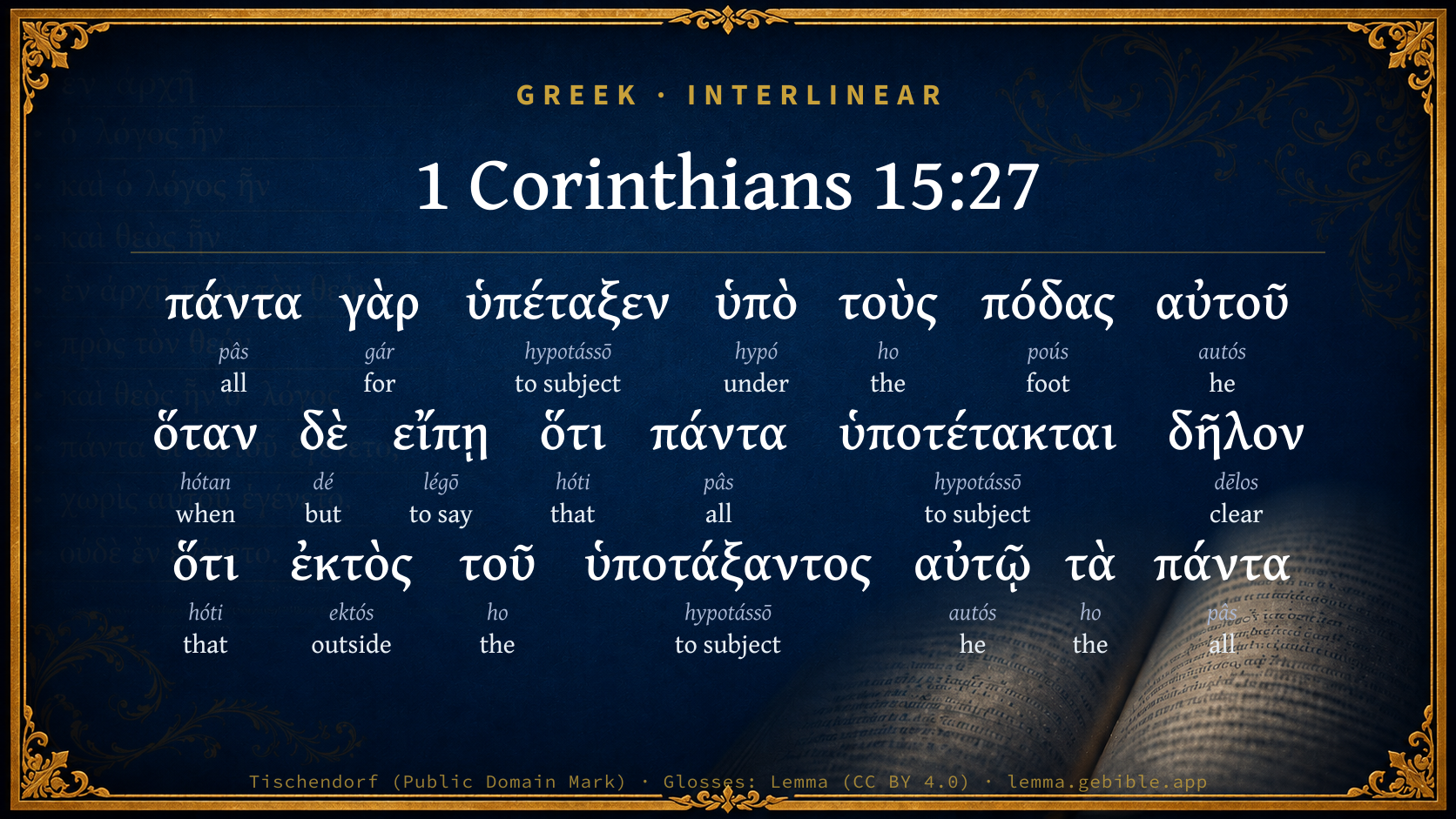
  1. πάντα pâs G3956 “all” Adjective, Accusative, Plural, Neuter
  2. γὰρ gár G1063 “for” Conjunction
  3. ὑπέταξεν hypotássō G5293 “to subject” Verb, Aorist, Active, Indicative, 3rd person, Singular
  4. ὑπὸ hypó G5259 “under” Preposition
  5. τοὺς ho G3588 “the” Article, Accusative, Plural, Masculine
  6. πόδας poús G4228 “foot” Noun, Accusative, Plural, Masculine
  7. αὐτοῦ autós G846 “he” Personal pronoun, Genitive, Singular, Masculine
  8. ὅταν hótan G3752 “when” Conjunction
  9. δὲ dé G1161 “but” Conjunction
  10. εἴπῃ légō G3004 “to say” Verb, Aorist, Active, Subjunctive, 3rd person, Singular
  11. ὅτι hóti G3754 “that” Conjunction
  12. πάντα pâs G3956 “all” Adjective, Nominative, Plural, Neuter
  13. ὑποτέτακται hypotássō G5293 “to subject” Verb, Perfect, Passive, Indicative, 3rd person, Singular
  14. ὅτι hóti G3754 “that” Conjunction
  15. ἐκτὸς ektós G1622 “outside” Adverb
  16. τοῦ ho G3588 “the” Article, Genitive, Singular, Masculine
  17. ὑποτάξαντος hypotássō G5293 “to subject” Verb, Aorist, Active, Participle, Genitive, Singular, Masculine
  18. αὐτῷ autós G846 “he” Personal pronoun, Dative, Singular, Masculine
  19. τὰ ho G3588 “the” Article, Accusative, Plural, Neuter
  20. πάντα pâs G3956 “all” Adjective, Accusative, Plural, Neuter

About this verse

These counts appear in no published source. They are computed here, from the morphology-tagged text and Lemma’s own curated glosses. What Lemma adds →

21
words
13
distinct lemmas
Pauline Epistles
section

Notable vocabulary

The rarest word here is δῆλον clear G1212 — appearing just 3 times in the whole Greek New Testament.

Shared distinctive vocabulary

δῆλον clear G1212 occurs in 3 verses of the Greek New Testament. Also found in:

Repetition

Words recur within this verse:

  • πάντα all G3956 ×3
  • ὑπέταξεν to subject G5293 ×3
  • τοὺς the G3588 ×3
  • αὐτοῦ he G846 ×2
  • ὅτι that G3754 ×2

Cross-references

12

Topical passages linked to 1 Corinthians 15:27 in the Treasury of Scripture Knowledge — connected by theme and wording, ordered by reader-vote popularity; previews shown in the World English Bible.

  • Psalms 8:6 You make him ruler over the works of your hands. You have put all things under his feet:
  • Hebrews 2:8 You have put all things in subjection under his feet." For in that he subjected all things to him, he left nothing that is not subject to him. But now we don't see all things subjected to him, yet.
  • Matthew 28:18 Jesus came to them and spoke to them, saying, "All authority has been given to me in heaven and on earth.
  • Matthew 11:27 All things have been delivered to me by my Father. No one knows the Son, except the Father; neither does anyone know the Father, except the Son, and he to whom the Son desires to reveal him.
  • Ephesians 1:22 He put all things in subjection under his feet, and gave him to be head over all things for the assembly,
  • John 13:3 Jesus, knowing that the Father had given all things into his hands, and that he came forth from God, and was going to God,
  • John 3:35 The Father loves the Son, and has given all things into his hand.
  • Philippians 2:9–11 Therefore God also highly exalted him, and gave to him the name which is above every name;
  • 1 Peter 3:22 who is at the right hand of God, having gone into heaven, angels and authorities and powers being made subject to him.
  • Revelation 1:18 and the Living one. I was dead, and behold, I am alive forevermore. Amen. I have the keys of Death and of Hades.
  • Hebrews 1:13 But of which of the angels has he said at any time, "Sit at my right hand, Until I make your enemies the footstool of your feet?"
  • Hebrews 10:12 but he, when he had offered one sacrifice for sins for ever, sat down on the right hand of God;

Cross-references courtesy of OpenBible.info (CC BY 4.0).

Commentary

Notes on 1 Corinthians 15:27 from classic Christian and Jewish commentators (each source and its license shown beneath its notes). The classic Christian expositions comment on the surrounding passage and are grouped to its opening verse, so a note may address several verses; the Jewish commentaries on the Tanakh (Rashi and others) are per-verse, so they appear only where the commentator wrote on this verse.

Lemma curates 59 commentaries, every one of them public domain or Creative Commons licensed, each selected and text-cleaned for this edition rather than reprinted as found. About our sources →

Tyndale Open Study Notes

Tyndale Open Resources

15:27 “God has put all things under his authority”: See Ps 8:6; cp. Matt 22:44.

Tyndale Open Study Notes — © Tyndale Open Resources, licensed CC BY-SA 4.0. Text via the HelloAO Bible API.

Bengel's Gnomon

Johann Albrecht Bengel

1Co 15:27. Πάντα γὰρ, for all things) not even excepting death. The Psalm [8:] might seem by this syllable, כל, all things, merely to indicate animals and stars, which it expressly names; but the apostle teaches us, that it has a much more extended application. Good things are made subject to Him in a most joyous condition; bad things in a most sorrowful one: for these latter are destroyed, and are made His footstool.—ὑπέταξεν, subjected) viz. God even the Father; comp. at ὑποταγῆν, Eph 1:22; Php 3:21; Heb 2:8; 1Pe 3:22. He will subject all things, in His own time; He has already subjected them, because He hath said it.—ὑπὸ τοὺς πόδας αὐτοῦ) not only enemies, but also all other things are put under His feet, Eph 1:22. This phrase is a synecdoche; all things are made subject to Him: and those things, which oppose themselves to Him, and do not wish to be subject, are altogether thrust down under His feet, as a footstool. There is a clear distinction between the expressions being put under His feet and being given into His hands. The former however need not be understood in so harsh a sense as the expression might seem to imply: otherwise, there would be no room for the exception of Him, who subjected them.—εἴπῃ, saith) viz. the prophet, Heb 2:6.—δῆλον, manifest) For the Father is not subject to the Son; but (δὲ, 1Co 15:28) the Son is subject to the Father. The apostle with great power and wisdom points out the sum [the main issue] of all things, from the Psalm.

Bengel's Gnomon of the New Testament — English translation (T&T Clark, Edinburgh, 1860) — public domain. Text from a community e-Sword module.

Meyer's Critical & Exegetical Commentary

Heinrich August Wilhelm Meyer

1Co_15:27. Πάντα γὰρ … αὐτοῦ] Proof that death also must be done away. This enemy cannot remain in subsistence, for otherwise God would not have all things, etc. The point of the proof lies in πάντα, as in Heb_2:8.

The words are those of Psa_8:7, which, as familiar to the reader (comp. on Rom_9:7; Gal_3:11), Paul makes his own, and in which he, laying out of account their historical sense, which refers to the rule of man over the earth, recognises, as is clear from ὅταν δὲ εἴπῃ κ.τ.λ., a typical declaration of God, which has its antitypical fulfilment in the completed rule of the Messiah (the δεύτερος ἄνθρωπος, 1Co_15:47). Comp. Eph_1:22; Heb_2:8.

The subject of ὑπέταξε (which expresses the subjection ordained by God in the word of God) is God, as was obvious of itself to the reader from the familiar passage of the psalm. If God has in that passage of Psalms 8 subjected all to the might of Christ, then death also must be subdued by Him; otherwise it is plain that one power would be excepted from that divine subjection of all things to Christ, and the πάντα would not be warrante.

ὅταν δὲ εἴπῃ κ.τ.λ.] δέ leading on, namely, to the confirmation of the giving over of the kingdom to God, for which proof is still to be adduced: but, when He shall have said that the whole is subjected, then without doubt He will be excepted from this state of subjection, who has subjected the whole to Him. The subject of εἴπῃ is not ἡ γραφή (de Wette, al.), but neither is it Christ (Hofmann), but the same as with ὑπέταξεν, therefore God, whose word that passage of the psalm adduced is not as regards its historical connection, but is so simply as a word of Scripture. Comp. on 1Co_6:16. The aorist εἴπῃ is to be taken regularly, not, with Luther and the majority of interpreters: when He says, but, like 1Co_15:24; 1Co_15:28, as futurum exactum: dixerit (Irenaeus, Hilary). So, too, Hofmann rightly.[55] Comp. Luk_6:26. Plato, Parm. p. 143 C; Ion. p. 535 B; also ἐὰν εἴπῃ, 1Co_10:28, 1Co_12:15. The point of time of the quando, ὅταν, is that at which the now still unexecuted ΠΆΝΤΑ ὙΠΈΤΑΞΕΝ shall be executed and completed; hence, also, not again the aorist, but the perfect ὑποτέτακται. The progress of the thought is therefore: But when God, who in Psa_8:7 has ordained the ὙΠΌΤΑΞΙς, shall have once uttered the declaration, that it be accomplishedthis ὑπόταξις. This form of presenting it was laid to the apostles hand by the fact that he had just expressed himself in the words of a saying of Scripture (a saying of God). In Heb_1:6 also the aorist is not to be understood as a present, but (πάλιν) as a futurum exactum. See Lünemann in loc.

δῆλον ὅτι] Adverbial, in the sense of manifestly, assuredly; therefore: it (namely, the πάντα ὑποτέτακται) will clearly take place with the exception of Him, who, etc. See regarding this use of δῆλον ὅτι, which has to be analysed by means of supplying the preceding predicate, Matthiae, p. 1494; Sturz, Lex. Xen. I. p. 661 f.; Buttmann, ad Plat. Crit. p. 53 A (p. 106). According to Hofmann, δῆλον ὅτι is meant as, namely, as it is used likewise in Greek writers, and especially often in grammarians (not Gal_3:11); from δῆλον to ΠΆΝΤΑ is only an explanation interposed, after which the former ὍΤΑΝ ΔῈ ΕἼΠῌ Κ.Τ.Λ. is shortly resumed by ὍΤΑΝ ΔῈ ὙΠΟΤΑΓῇ Κ.Τ.Λ., 1Co_15:28. See regarding ΔΈ after parentheses or interruptions, Hartung, Partik. I. p. 172 f. But, in the first place, δῆλον ὅτι κ.τ.λ. is a very essential point, no mere parenthetic thought in the course of the argument; and, secondly, the resumption after so short and plain an intercalation would be alike uncalled for, and, through the change in the mode of expression (not again with ΕἼΠῌ), obscur.

ἘΚΤῸς ΤΟῦ ὙΠΟΤΆΞ.] i.e. with the exception of God; but Paul designates God as the subjecting subject: quo clarius in oculos incurreret, rem loqui ipsam, van Hengel.

[55] Who, however, with his reference of εἴπῃ to Christ as its subject gains the conception: As Christ at the end of His obedience on earth said: τετέλεσται, so shall He at the end of His reign within the world say: πάντα ὑποτέτακται. But with what difficulty could a reader light upon the analogy of that τετέλεσται! How naturally, on the contrary, would he be led to think of the subject of ὑπέταξεν, consequently God, as the speaker also in εἵπῃ! This applies also in opposition to Luthardt, l.c. p. 131.

Meyer — Critical and Exegetical Commentary on the New Testament — English translation by Peter Christie, edited by Frederick Crombie (T&T Clark, 1880) — public domain. Text from a community e-Sword module.

Expositor's Greek Testament

ed. W. Robertson Nicoll

1Co 15:27-28 are a supplement to 1Co 15:20-26 . They reaffirm, in new words of Scripture, the unlimited dominion assigned to Christ (1Co 15:25-27 a ), in order to reassert more impressively the truth that only through His absolute victory can the kingdom of God be consummated (24 a , 28 b ). The opening γὰρ adduces, by way of comment, a prophecy parl [2387] to that cited in 1Co 15:25 and specifically applied in 1Co 15:26 . Psa 8 promised to man complete rule over his domain ( cf. Heb 2:5 ff.); as man Christ here stands forth the countertype of Adam (1Co 15:21 f.) who forfeited our estate, winning for Himself and His own the deliverance from death (Heb 2:9 ; Heb 2:14 f.) which seals His conquest and sets “all things under His feet”. But ( δὲ … δέ ) this subjection of all things to Christ is no infringement of God’s sovereignty nor alienation of His rights; on the contrary, it is the means to their perfect realisation. Such is the purport of the two ὅταν sentences, the second of which repeats in another way, after the interposed δῆλον ὅτι clause, what the first has announced, τότε αὐτὸς ὁ υἱὸς furnishing their common apodosis ( cf. 54); so Hf [2388] , R.V. marg., after the Vg [2389] and Lat. interpreters. The two vv. then read as follows: “For ‘all things did He put in subjection under His feet’. But when He hath said, ‘All things are brought to subjection’ (manifestly, with the exception of Him that put all things in subjection to Him) yea, when all things have become subject to Him, then shall (also) the Son Himself become subject to Him that made subject to Him all things, to the end that God may be all in all”. God is the tacit subject of ὑπέταξεν , as supplied by the familiar Ps. and brought out by the ptps. in 1Co 15:27 b , 1Co 15:28 b ; but Christ is subject to εἴπῃ not God speaking in Scr., or at the end of the world (so Mr [2390] , Ed [2391] , El [2392] , etc.), nor ἡ γραφή (D.W [2393] , and others), nor propheta (Bg [2394] ). “All things are subdued!” is the joyful announcement by the Son that the grand promise recorded in the 8th Psalm is fulfilled; “the ὑπέταξεν of God affirms the purpose, the ὑποτέτακται of Christ attests its accomplishment” (Hf [2395] , Hn [2396] ). Thus ὅταν εἴπῃ is simultaneous with ὅταν καταργήσῃ (1Co 15:24 ) and ὅταν θῇ ὑπὸ τ . πόδας (1Co 15:25 ): Christ proclaims the victory at last achieved; He reports that, with the abolition of death, His commission is ended and the travail of His soul satisfied. For anticipatory sayings of His, giving an earnest of this crowning word, see Mat 11:27 ; Mat 28:18 , Joh 3:35 . ὅταν ὑποταγῇ κ . τ . λ . (1Co 15:28 ) reassumes objectively, as matter of fact, what was given subjectively in ὅταν εἴπῃ κ . τ . λ . as the verdict of Christ upon His own finished work. Those who read δῆλον ὅτι κ . τ . λ . as a principal sentence, the apodosis to the first ὅταν clause (A.V., Mr [2397] , El [2398] , etc.), borrow from the protasis πάντα ὑποτέτακται more strictly ὑποτετάξεται or (by zeugma) ἔσται , after the virtually fut [2399] εἴπῃ ( cf. 28 b , 54 b ); this, however, makes a halting sentence: “But when He [God] says, ‘All things have been made subject,’ it is evident [that this will be, or that all things will be subjected] with the exception of Him, etc.” an affirmation of quite subsidiary importance, on which the writer has no need to dwell. The non-inclusion of God in the category of “things subjected” is rather a self-evident assumption made by the way, and serving to prepare for and throw into relief the real apodosis, “then shall the Son Himself also become subject, etc.,” to which both the ὅταν clauses press forward. The advl [2400] use of δῆλον ὅτι (perhaps better written δηλονότι = δηλαδή ), signifying manifestly or to wit (sine dubio , Vg [2401] ), is familiar in Attic Gr [2402] ; no other certain instance occurs in the N.T. The remark that He who gave dominion is not Himself under it, reserves behind the Messianic reign the absolute supremacy of God, to which Christ will conform at the plenitude of His kingship. τὰ πάντα (equivalent to “the universe”) gathers into a totality the πάντα otherwise separate and diverse: cf. Col 1:17 , τὰ πάντα ἐν αὐτῷ συνέστηκεν . ὑποταγήσεται (mid [2403] in force, like the 2nd aor [2404] pass [2405] in Rom 10:3 , in consistency with the initiative ascribed to Christ throughout) has often been explained away, to avoid Arian or Sabellian inferences from the text; it affirms no other subjection of the Son than is involved in Sonship (see note on 24). This implies no inferiority of nature, no extrusion from power, but the free submission of love ( αὐτὸς ὁ υἱός , “the Son of His own accord will subject Himself” not in addition to, but in distinction from the πάντα ), which is the essence of the filial spirit that actuated Christ from first to last ( cf. Joh 8:29 ; Joh 12:27 , etc.). Whatsoever glory He gains is devoted to the glory and power of the Father (Joh 17:2 , etc.), who glorifies Him in turn (Joh 17:5 ; Phi 2:9 ff.). ὑποταγήσεται speaks the closing word of Christ’s mission, as Ἰδοὺ ἥκω τοῦ ποιῆσαι τὸ θέλημά σου was its opening word (Heb 10:7 ). It is hard to say whether ζνα ᾖ ὁ Θεὸς κ . τ . λ . is dependent on ὁ υἱὸς ὑποταγήσεται (so most commentt.) or on τ . ὑποτάξαντι (so Hf [2406] , and some others). This solemn conclusion most fitly attaches to the princ. vb [2407] ; it expresses the loyal purpose of the Son in His self-subjection, whose submission exhibits the unity of the Godhead ( cf. Joh 10:30-36 ; Joh 17:23 ), and constitutes itself the focus and uniting bond of a universe in which God’s will is everywhere regnant and His being everywhere immanent. πᾶσιν neuter , like πάντα .

[2387] parallel.

[2388] J. C. K. von Hofmann’s Die heilige Schrift N.T. untersucht , ii. 2 (2te Auflage, 1874).

[2389] Latin Vulgate Translation.

[2390] Meyer’s Critical and Exegetical Commentary (Eng. Trans.).

[2391] T. C. Edwards’ Commentary on the First Ep. to the Corinthians . 2

[2392] C. J. Ellicott’s St. Paul’s First Epistle to the Corinthians .

[2393].W. De Wette’s Handbuch z. N. T.

[2394] Bengel’s Gnomon Novi Testamenti.

[2395] J. C. K. von Hofmann’s Die heilige Schrift N.T. untersucht , ii. 2 (2te Auflage, 1874).

[2396] C. F. G. Heinrici’s Erklärung der Korintherbriefe (1880), or 1 Korinther in Meyer’s krit.-exegetisches Kommentar (1896).

[2397] Meyer’s Critical and Exegetical Commentary (Eng. Trans.).

[2398] C. J. Ellicott’s St. Paul’s First Epistle to the Corinthians .

[2399] future tense.

[2400]dvl. adverbial

[2401] Latin Vulgate Translation.

[2402] Greek, or Grotius’ Annotationes in N.T.

[2403] middle voice.

[2404] aorist tense.

[2405] passive voice.

[2406] J. C. K. von Hofmann’s Die heilige Schrift N.T. untersucht , ii. 2 (2te Auflage, 1874).

[2407] verb

The Expositor's Greek Testament, edited by W. Robertson Nicoll (1897–1910) — public domain. Text from a community e-Sword module.

Cambridge Greek Testament for Schools and Colleges

27. πάντα γὰρ ὑπέταξεν. This is an almost literal quotation from the LXX. of Psa 8:6. This fact settles the meaning of the passage. To Christ, as the Man, God has subjected all things on earth. In Him these words of the Psalmist, in their highest possible sense, are fulfilled.

ὅταν δὲ εἴπῃ. But whensoever He shall have said. There is a difficulty here, (1) the A. and R.V. rendered when he saith. But this would surely require ὅτε λέγει. (2) To interpret it, with Meyer and Alford, of God, would involve great awkwardness. For then we must explain as follows, ‘Whensoever God shall have said “All things have been subjected,” it is manifest that this is to be understood to the exclusion of Him who has so subjected them’; a very circuitous way of expressing what St Paul would surely have written ‘It is manifest that He Himself is not included.’ The only remaining alternative is to supply αὐτός from the last sentence, i.e. Christ, Who is thus introduced as announcing the subjugation of all things to Him to Whom it is owing.

δῆλον ὅτι. This passage must be compared with the similar one in Heb 2:7-9. Each of these supplies what is wanting in the other. In the one we have the Son, the manifestation of the Father’s glory and love, bringing everything in this lower world, which the Father has put under Him, into the most complete subjection to, and the most entire union with, His Heavenly Father. In the other we see the Eternal Father, while permitting, for His own wise purposes, the humiliation and suffering of Christ, doing so in order that all things should finally be put in subjection to ‘His Beloved Son, in Whom He was well pleased.’

APPENDIX I

CH. 1Co 15:27-28

IT may not be amiss to add a few more interpretations of this important and difficult passage by distinguished Divines of various periods. First of all Irenaeus (Contr. Haer. 1Co 15:36) says, on the authority of the Presbyters who had been disciples of the Apostles (i.e., had been taught by them orally), ‘esse adordinationem et dispositionem eorum qui salvantur, et per hujusmodi gradus proficere, et per Spiritum quidem [ad] Filium, per Filium autem ascendere ad Patrem, Filio deinceps cedente Patri opus suum, quemadmodum et ab Apostolo dictum est, “quoniam oportet regnare eum” &c.’ The passage is not extant in the Greek.

Tertullian, Adv. Praxeam 4, arguing for the Monarchy, or sole and single rule of God, says, ‘Videmus igitur non obesse monarchiae Filium, etsi hodie apud Filium est, quia et suo statu est apud Filium, et cum suo statu restituetur Patri a Filio. Ita eam nemo hoc nomine destruet, (si) Filium admittat, cui et traditam eam a Patre et a quo quandoque restituendam Patri constat.’

Origen, De Principiis III. 7, says, ‘Verum nescio quo pacto haeretici non intelligentes Apostoli sensum … subjectionis in filio nomen infamant … Sermo namque Apostoli, secundum quod isti volunt, hoc videtur ostendere; ut quasi is qui nunc patri subjectus non sit, subjectus futurus sit hinc cum prius pater ei universa subjecerit. Sed miror quomodo hoc intelligi possit, ut is qui nondum sibi subjectis omnibus non est ipse subjectus, hinc, cum subjecta fuerint sibi omnia, cum rex omnium fuerit, et potestatem tenuerit universorum, hinc eum subjiciendum putant, cum subjectus ante non fuerit, non intelligentes quod subjectio Christi ad patrem beatitudinem nostrae perfectionis ostendit … cum non solum regendi ac regnandi summam quam in universam emendaverit creaturam, verum etiam obedientiae et subjectionis correcta reparataque humani generis patri offerat instituta.’ Cf. Hom. 2 on Psalms 36; and in Tom. XX. in Joan. 7, he writes, ζητήσαις δ’ ἂν εἰ ἔσται ποτε, ὅτε οἱ ἄγγελοι αὐτοὶ ὄψονται τὰ παρὰ τῷ πατρί, οὐκέτι διὰ μεσίτου καὶ ὑπηρέτου βλέποντες αὐτά. ὅτε μὲν ὁ ἑωρακὼς τὸν υἱὸν ἑώρακε τὸν πατέρα τὸν πέμψαντα αὐτόν, ἐν υἱῷ τις ὁρᾷ τὸν πατέρα, ὅτε δὲ ὡς ὁ υἱὸς ὁρᾷ τὸν πατέρα, καὶ τὰ παρὰ τῷ πατρὶ ὄψεταί τις, οἱονεὶ ὁμοίως τῷ υἱῷ αὐτοπτὴς ἔσται τοῦ πατρός, καὶ τῶν τοῦ πατρός, οὐκέτι ἀπὸ τῆς εἰκόνος ἐννοῶν τὰ περὶ τούτου οὗ ἡ εἰκών ἐστι. καὶ νομίζω γε τοῦτο εἷναι τὸ τέλος, ὅταν παραδίδωσι κ.τ.λ.

Athanasius explains it of Christ as a representative of mankind, αὐτὸς ὑποταγήσεται τῷ πατρί, ὡς κεφαλὴ ὑπὲρ τῶν ἰδίων μελῶν, De Hum. Nat. Suscept. In his Unum Esse Christum he rejects the explanation of Marcellus and Paul of Samosata, which would regard the words of the subjection of the man Christ Jesus to the Divinity which had taken him into Itself. Theodoret in loc. regards the words as being added lest the heathen should imagine something in the Christian scheme corresponding to the fables of Saturn being dethroned by Jupiter and the like. And he explains it in much the same way as Athanasius above. Cyril of Alexandria (De Sacros. Trin. 25) denies that Jesus, as God, was in any way subject to the Father, but regards the words as spoken κατ ̓ οἰκείωσιν καὶ ἀναφοράν.

Aug., De Trinitate, lib. I., ch. 8, says that this was written to guard against the idea that Christ’s manhood would ever be converted into His Divinity. And he adds that we must not suppose that Christ delivers up the kingdom to His Father in such sort as that He takes it away from Himself. Again, he says, Octoginta Quaestiones 69, ‘Non ergo absurde sic intelligimus, Tunc et ipse filius subjectus erit ei qui illi subjecit omnia; et Filium non solum caput Ecclesiae, sed omnes cum eo sanctos intelligamus, qui sunt unum in Christo, unum semen Abrahae. Subjectum autem secundum contemplationem sempiternae veritatis, ad obtinendam beatitudinem, nullo motu animi, nulla parte corporis resistente, ut in illa vita nemine amante propriam potestatem, sit Deus omnia in omnibus.’

Anselm in loc. explains that Christ is subject ‘secundum humanitatem, ne quis putaret humanam naturam quam assumpsit in naturam divinitatis commutandam ut fieret aequalis patri, non subjecta.’

Aquinas in loc. says, ‘Et subjectus est nunc etiam Christus secundum quod homo patri, sed hoc tunc manifestius erit. Et ratio hujus subjectionis est “ut sit Deus omnia in omnibus,” id est ut anima hominis totaliter requiescat in Deo, et solus Deus sit beatitudo.’

Luther’s explanation in his exposition of this passage is as follows; God’s kingdom is so called when it is no longer hidden but clear before all creatures, and when faith shall cease. To hand over the kingdom to the Father is to present us and the whole Christian world openly before the Father, in His eternal brightness and majesty, in which He reigns without a veil. Since the Church is governed through Christ’s Word and Sacraments, it is called His kingdom. But at the last day He will give Himself up with His whole kingdom to the Father. Henceforth men will perceive and enjoy openly that Sacred Trinity in which they have believed, and for which they have waited.

Calvin’s explanation is, ‘Sed ideo testatur Scriptura Christum nunc vice Patris caeli et terrae imperium obtinere; ne quem alium gubernatorem, dominum, tutorem, judicemve mortuorum et vivorum cogitemus; sed defixi sumus in solo ejus intuitu. Deum quidem agnoscimus rectorem, sed in facie hominis Christi. Tunc autem restituet Christus quod accepit regnum ut perfecte adhaereamus Deo. Neque hoc modo regnum a se abdicabit, sed ab humanitate sua ad gloriosam divinitatem quodammodo traducet; quia tunc patebit accessus, quo nunc infirmitas noster nos arcet. Sic ergo Christus subjicietur patri; quia tunc remoto velo palam cernemus Deum in sua majestate regnantem, neque amplius media erit Christi humanitas quae nos ab ulteriore Dei conspectu cohibeat.’

Hooker’s explanation has been given above. Pearson’s is subjoined (On the Creed, Art. II. ‘Our Lord’), ‘Now as all the power given unto Christ as man had not the same beginning in respect of the use and possession, so neither, when begun, shall it all have the same duration. For part of it, being merely economical, aiming at a certain end, shall then cease and determinate, when that end for which it was given shall be accomplished; part, being either due upon the union of the human nature with the Divine, or upon covenant, as a reward for sufferings endured in that nature, must be coeval with that union and that nature which so suffered, and consequently must be eternal.’ Of the first part of that dominion, he adds, is the Apostle speaking here.

Thus in the history of the exegesis of this passage by some of the greatest minds in Christendom, we find three main lines of interpretation; (1) that the Son is subject to the Father as man; (2) that He offers to the Father, as the Head of the Church, the submission of all its members; (3) that there will come a time in the far distant future when His mediatorial office will no longer be needed, when His kingdom over mankind, as man, will cease, and when each of us will enjoy for himself, through the Mediator’s completed work, the blessing of immediate access to the Father. The right method of interpretation may be to include all three meanings. It is no true principle of explanation of a thing so infinite as the revelation of God in His Word to suppose that one contribution to the elucidation of a Divine mystery of necessity shuts out another. But we should miss the point of this deep passage if we left out the last of these three explanations. The truth is that Christ’s Divinity does not come within the scope of this passage at all. It deals simply with Christ’s mediatorial work. That mediatorial work, in man’s present condition, is absolutely necessary in order to bring us to God. He is so far above us, that we cannot conceive of Him, except as revealed in the shape of one of ourselves. But there will come a time, the Apostle dimly hints, when the intermediate action of Christ’s Manhood between us and God will be no longer necessary. Man’s development does not cease with death, but will go on in a constantly ascending process until he becomes sufficiently spiritualized to see God for Himself. Then, when the work of reconciliation and restoration is finally and completely accomplished, when every thought of man’s heart is brought into obedience to the law of Christ, when death and hell are cast into the lake of fire, when the God-Man sees all enemies at His Feet, then shall Christ, as Man, no longer reign: even His humanity will cease to be the necessary link between God and man, for sin, the only barrier between the two, shall have been finally destroyed, and God shall be all in all.

Cambridge Greek Testament for Schools and Colleges (Cambridge University Press, 1896; 21 vols, various authors incl. Carr, Maclear, Plummer, Farrar, Lumby, Moule, M. R. James, Simcox) — public domain. Text from a community e-Sword module.

Godet's Commentaries

Frédéric Louis Godet

Vv. 27. “For He hath put all things under His feet; now when He saith all things are subjected to Him, it is manifest that He is excepted who subjected all things to Him.”

The first proposition is laid down as an indisputable truth; because it is taken from Scripture, Psa 8:7. In the Old Testament it relates to man in general, at the time of his creation. But as the destiny of man thus declared is not realized, because of the fall, in any one save in the person of the Son of man, the normal man, the Messiah, it is with good right applied to Him in the New Testament; comp. Eph 1:22; Heb 2:8.

The subject of ὑπέταξεν, subjected, can only be God, as in the Psalm. The verb in the past refers to the Divine decree appointing Christ sovereign of the universe; of course the execution of the decree does not take place without His own co-operation. — But why does the apostle insist on expressing the exception relating to God? Who could suppose that God formed part of those: all things, which were to be subjected to the Messiah? In the state of exaltation which prevailed among the Corinthians, had some one advanced the idea that God, considered as the impersonal force which animates the universe, would one day be wholly subject to the Messiah, as the supreme representative of the world? We met in 1Co 12:3 with an opposite eccentricity which is not more startling. But perhaps this remark, introduced by the apostle in the second part of our verse, is meant only to pave the way for the idea of the subordination of Christ to the Father (1Co 15:28).

The subject of εἴπῃ seems to me to be simply: God, by the Scripture. Meyer thought that the εἴπῃ should rather be applied to the declaration which God will make when the decree subjecting all things to Christ shall be realized, and God shall have proclaimed the fact in the ears of the whole universe. The δῆλον ὅτι would require in this case to be regarded as an adverbial form, in the sense of evidently: “When God shall have declared that all is subjected to Him, evidently He will Himself remain outside of this universal subjection.” But the connection between the two propositions would not be logical; what would be needed would not be: When God shall have said that..., but: When the fact itself shall have taken place. The second proposition gives the impression of a principle, as well as the first, and seems in no wise to refer to a particular time. As to the δῆλον ὅτι, Meyer’s meaning is admissible, but not necessary. We mention only as an exegetical curiosity the explanation of Hofmann, who makes the two propositions beginning with ὅταν, when (1Co 15:27-28), two parallel propositions, the principal one beginning at the τότε, then, of 1Co 15:28. The δῆλον ὅτι signifies, according to him, that is to say, and the proposition depending on it is a parenthesis!

The evident fact which Paul wishes to express is, that at the time when all shall be subjected to Christ, voluntarily or involuntarily, only two powers will remain in existence: that of Christ, a power visible and universal, and that of the Father, who gave the Son this sovereign position. But this duality will last only for an instant; it will be immediately terminated by the free act of the Son which will close the development of things:

Frédéric Louis Godet — Commentaries on Luke, John, Romans, and 1 Corinthians — English translation (T&T Clark, Edinburgh, 1870s–1890s) — public domain. Text from a community e-Sword module.

Hodge's Commentary on Romans, Ephesians & First Corinthians

Charles Hodge

1Co_15:27

For he hath put all things under his feet. But when he saith, All things are put under (him, it is) manifest that he is excepted, which did put all things under him.

The proof that death is finally to be destroyed is derived from the 8th Psalm, where the subjection of all things to the Messiah is predicted. There are two passages of the Old Testament frequently quoted in the New Testament as foretelling the absolutely universal dominion of the Messiah, Psa_110:1-7 and Psa_8:1-9. The former is quoted, or its language appropriated, in 1Co_15:25. Mat_22:44. Act_2:34. Eph_1:22. Heb_1:13; Heb_10:12, Heb_10:13, 1Pe_3:22. In this there is no difficulty, as that Psalm clearly refers to the Messiah and to none else. The 8th Psalm is quoted and applied to Christ in this passage, and in Eph_1:22. Heb_2:8 and 1Pe_3:22. As this Psalm has no apparent reference to the Messiah, but is a thanksgiving to God for his goodness to man, the use made of it in the New Testament is to be understood as an inspired exposition of its hidden meaning. That is, when the Psalmist said, Thou madest him to have dominion over the works of thy hands, thou hast put all things under his feet, we learn from the New Testament that the Spirit of God intended by these words far more than that man was invested with dominion over the beasts of the field. There is no limit to the all things here intended. Heb_2:8. Man is clothed with dominion over the whole universe, over all principalities and powers, and every name that is named, not only in this world but also in that which is to come. This is fulfilled in the man Christ Jesus, into whose hands all power in heaven and earth has been committed. This may be called the hidden meaning of the Psalm, because it never would have been discovered without a further revelation such as we find in the exposition given by the inspired apostles,. When he saith, ὅταν εἴπῃ, This may mean either, when the Scripture saith, or when God saith. The latter is better on account of what follows. The verb is not to be translated as in the present tense, but, as the better commentators agree, in the past future, see 1Co_15:24. Heb_1:6. When God shall have said. That is, when God shall have declared his purpose to subject all things to Christ accomplished, it will then be manifest that all things are subject to him, God only excepted.

Charles Hodge — Commentary on Romans (1835), First Corinthians (1857), and Ephesians (1856) — public domain. Text from a community e-Sword module.

Jamieson, Fausset & Brown

Robert Jamieson, A. R. Fausset & David Brown

all things--including death (compare Eph 1:22; Phi 3:21; Heb 2:8; Pe1 3:22). It is said, "hath put," for what God has said is the same as if it were already done, so sure is it. Paul here quotes Psa 8:6 in proof of his previous declaration, "For (it is written), 'He hath put all things under His feet.'"

under his feet--as His footstool (Psa 110:1). In perfect and lasting subjection.

when he--namely, God, who by His Spirit inspired the Psalmist.

Jamieson, Fausset & Brown — Commentary Critical and Explanatory on the Whole Bible (1871) — public domain (CC PDM 1.0). Text via the HelloAO Bible API.

Adam Clarke's Commentary

Verse 27. For he hath put all things under his feet] The Father hath put all things under the feet of Christ according to the prophecy, Ps 110:1-7.

He is excepted] i.e. The Father, who hath put all things under him, the Son. This observation seems to be introduced by the apostle to show that he does not mean that the Divine nature shall be subjected to the human nature. Christ, as Messiah, and Mediator between God and man, must ever be considered inferior to the Father: and his human nature, however dignified in consequence of its union with the Divine nature, must ever be inferior to God. The whole of this verse should be read in a parenthesis.

Adam Clarke's Commentary on the Bible (1810–1826) — public domain. Text from a community e-Sword/MySword module.

Ellicott's Commentary for English Readers

(27) For he hath put all things under his feet.—1Co_15:26 is a parenthesis, and the “for” with which this verse commences goes back to 1Co_15:25. The connection is, Christ must reign until he has put all enemies under his feet. Christ must triumph, for according to the statement in Psa_8:6 (see also Psa_110:1), God hath put all things under man, and in a higher sense under the Son of Man. (For a similar application of Old Testament statement regarding man to Christ as the Son of Man, see Mat_21:16; Heb_2:7.) But when God says that all things are put under Him, He evidently is excepted who did put all things under Him. This leads up logically to the complete triumph of God the Father, expressed in the following verse, which is an expansion of 1Co_15:24, on which see Note there.

A Bible Commentary for English Readers, edited by Charles John Ellicott (1878–1897) — public domain. Text from a community e-Sword module.

The Cambridge Bible for Schools and Colleges

gen. ed. J. J. S. Perowne

27. For he hath put all things under his feet] Here the meaning clearly is (see Psa_8:6, and the rest of this verse) that the Father hath put all things under the feet of the Son. “All things are put under His feet,” says Cyril of Alexandria, “because He made all things.” St Joh_1:3; Joh_1:10; Eph_3:9; Col_1:16; Heb_1:1.

it is manifest that he is excepted, which did put all things under him] This passage ought to be compared with the analogous one in Heb_2:7-9. Each of these supplies what is wanting in the other. In the one we have the Son, the manifestation of the Father’s glory and love, bringing everything in this lower world, which the Father has put under Him, into the most complete subjection to, and the most entire union with, His Heavenly Father. In the other we see the Eternal Father, while permitting, for His own wise purposes, the humiliation and suffering of Christ, doing so in order that all things should finally be put in subjection to ‘His Beloved Son, in Whom He was well pleased.’

The Cambridge Bible for Schools and Colleges (gen. ed. J. J. S. Perowne; Cambridge University Press, 1878–1918) — public domain. Text from a community e-Sword module.

John Gill's Exposition

Else what shall they do which are baptized for the dead,.... The apostle here returns to his subject, and makes use of new arguments to prove the doctrine of the resurrection of the dead, and reasons for it from the baptism of some persons; but what is his sense, is not easy to be understood, or what rite and custom, or thing, or action he refers to; which must, be either Jewish baptism, or Christian baptism literally taken, or baptism in a figurative and metaphorical sense. Some think that he refers to some one or other of the divers baptisms of the Jews; see Heb 9:10 and particularly to the purification of such who had touched a dead body, which was done both by the ashes of the red heifer burnt, and by bathing himself in water; and which, the Jews say (l), intimated , "the resurrection of the dead": wherefore such a right was needless, if there is no resurrection; to strengthen this sense, a passage in Ecclesiasticus 34:25 is produced, , "he that washeth himself after the touching of a dead body, if he touch it again, what availeth his washing?" but the phrase there used is different; it is not said, he that baptizeth or washeth himself for the dead, but from the dead, to cleanse himself from pollution received by the touch of a dead body: it is also observed, that the Jews, as well as other nations, have used various rites and ceremonies about their dead, and among the rest, the washing of dead bodies before interment; see Act 9:37 and this by some is thought to be what is here referred to; and the reasoning is, if there is no resurrection of the dead, why all this care of a dead body? why this washing of it? it may as well be put into the earth as it is, since it will rise no more; but how this can be called a baptism for the dead, I see not: rather therefore Christian baptism, or the ordinance of water baptism is here respected; and with regard to this, interpreters go different ways: some think the apostle has in view a custom of some, who when their friends died without baptism, used to be baptized in their room; this is said to be practised by the Marcionites in Tertullian's time, and by the Corinthians in the times of the Apostle John; but it does not appear to have been in use in the times of the Apostle Paul; and besides, if it had been, as it was a vain and superstitious one, he would never have mentioned it without a censure, and much less have argued from it; nor would his argument be of any weight, since it might be retorted, that whereas such persons were mistaken in using such a practice, they might be also in the doctrine of the resurrection of the dead: others are of opinion that such persons are intended, called Clinics, who deferred their baptism till they came upon their death beds, and then had it administered to them; but as this practice was not in being in the apostle's time, and was far from being a laudable one; and though the persons to whom it was administered were upon the point of death, and nearer the dead than the living, and were as good as dead, and might be intended by them, for their advantage, when dead and not living; yet it must be a great force and strain on words and things, to reckon this a being baptized for the dead: others would have the words rendered, "over the dead"; and suppose that reference is had to the Christians that had their "baptisteries" in their places of burial, and by being baptized here, testified their faith and hope of the resurrection of the dead; but this was rather a being baptized among the dead, than over them, or for them; and moreover it is not certain, that they did make use of such places to baptize in; to which may be added, that the primitive Christians had not so early burying grounds of their own: others would have the meaning to be, that they were baptized for their dead works, their sins, to wash them away; but this baptism does not of itself, and no otherwise than by leading the faith of persons to the blood of Christ, which alone cleanses from sin, original and actual; nor is this appropriate to the apostle's argument. Others imagine, that he intends such as were baptized, and added to the church, and so filled up the places of them that were dead; but the reason from hence proving the resurrection of the dead is not very obvious: those seem to be nearer the truth of the matter, who suppose that the apostle has respect to the original practice of making a confession of faith before baptism, and among the rest of the articles of it, the doctrine of the resurrection of the dead, upon the belief of which being baptized, they might be said to be baptized for the dead; that is, for, or upon, or in the faith and profession of the resurrection of the dead, and therefore must either hold this doctrine, or renounce their baptism administered upon it; to which may be added another sense of the words, which is, that baptism performed by immersion, as it was universally in those early times, was a lively emblem and representation of the resurrection of Christ from the dead, and also both of the spiritual and corporeal resurrection of the saints. Now if there is no resurrection, why is such a symbol used? it is useless and insignificant; I see nothing of moment to be objected to these two last senses, which may be easily put together, but this; that the apostle seems to point out something that was done or endured by some Christians only; whereas baptism, upon a profession of faith in Christ, and the resurrection from the dead, and performed by immersion, as an emblem of it, was common to all; and therefore he would rather have said, what shall we do, or we all do, who are baptized for the dead? I am therefore rather inclined to think that baptism is used here in a figurative and metaphorical sense, for afflictions, sufferings, and martyrdom, as in Mat 20:22 and it was for the belief, profession, and preaching of the doctrine of the resurrection of the dead, both of Christ and of the saints, that the apostles and followers of Christ endured so much as they did; the first instance of persecution after our Lord's ascension was on this account. The Apostles Peter and John, were laid hold on and put in prison for preaching this doctrine; the reproach and insult the Apostle Paul met with at Athens were by reason of it; and it was for this that he was called in question and accused of the Jews; nor was there anyone doctrine of Christianity more hateful and contemptible among the Heathens than this was. Now the apostle's argument stands thus, what is, or will become of those persons who have been as it were baptized or overwhelmed in afflictions and sufferings, who have endured so many and such great injuries and indignities, and have even lost their lives for asserting this doctrine,

if the dead rise not at all? how sadly mistaken must such have been!

why are they then baptized for the dead? how imprudently have they acted! and what a weak and foolish part do they also act, who continue to follow them! in what a silly manner do they expose themselves to danger, and throw away their lives, if this doctrine is not true! which sense is confirmed by what follows: the Alexandrian copy, and some others, read, "for them", and so the Vulgate Latin version; and the Ethiopic in both clauses reads, "why do they baptize?"

(l) R. Bechai & Zohar apud Lightfoot in loc.

John Gill's Exposition of the Whole Bible (1746–1763) — public domain (CC PDM 1.0). Text via the HelloAO Bible API.

Trapp's Complete Commentary

John Trapp

27 For he hath put all things under his feet. But when he saith all things are put under him, it is manifest that he is excepted, which did put all things under him.

Ver. 27. All things under his feet] This, Psa 8:7-8, spoken of man in general, is properly applied to the man Christ Jesus; in whom also it extendeth to the saints, who are therefore more glorious than heaven, earth, or any creature, and shall have power over all, Rev 2:26. (Cameron. de Eccles.)

John Trapp, A Commentary or Exposition upon All the Books of the Old and New Testament (1647–1656) — public domain. Text from a community e-Sword module.

Albert Barnes' Notes on the Bible

For he hath put - God has put by promise, purpose, or decree.

All things under his feet - He has made all things subject to him; or has appointed him to be head over all things; compare Mat 28:18; Joh 17:2; Eph 1:20-22. It is evident that Paul here refers to some promise or prediction respecting the Messiah, though he does not expressly quote any passage, or make it certain to what he refers. The “words” “hath put all things under his feet” are found in Psa 8:6, as applicable to “man,” and as designed to show the dignity and dominion of man. Whether the psalm has any reference to the Messiah, has been made a question. Those who are disposed to see an examination of this question, may find it in Stuart on the Hebrews, on Heb 2:6-8; and in Excurses ix. of the same work, pp. 568-570. Ed. 1833. In the passage before us, it is not “necessary” to suppose that Paul meant to say that the psalm had a particular reference to the Messiah. All that is implied is, that it was the intention of God to subdue all things to him; this was the general strain of the prophecies in regard to him; this was the purpose of God; and this idea is accurately expressed in the words of the psalm; or these words will convey the “general sense” of the prophetic writings in regard to the Messiah. It may be true, also, that although the passage in Psa 8:1-9 has no immediate and direct reference to the Messiah, yet it includes him as one who possessed human nature.

The psalm may be understood as affirming that all things were subjected to “human nature;” that is, human nature had dominion and control over all. But this was more particularly and eminently true of the Messiah than of any other man. In all other cases, great as was the dignity of man, yet his control over “all things” was limited and partial. In the Messiah it was to be complete and entire. His dominion, therefore, was a complete fulfillment, that is, “filling up” (πλήρωμα plērōma) of the words in the psalm. Under him alone was there to be an entire accomplishment of what is there said; and as that psalm was to be fulfilled, as it was to be true that it might be said of man that all things were subject to him, it was to be fulfilled mainly in the person of the Messiah, whose human nature was to be exalted above all things; compare Heb 2:6-9

But when he saith - When God says, or when it is said; when that promise is made respecting the Messiah.

It is manifest - It must be so; it must be so understood and interpreted.

That he is excepted ... - That God is excepted; that it cannot mean that the appointing power is to be subject to him. Paul may have made this remark for several reasons. Perhaps:

(1) To avoid the possibility of cavil, or misconstruction of the phrase, “all things,” as if it meant that God would be included, and would be subdued to him; as among the pagan, Jupiter is fabled to have expelled his father Saturn from his throne and from heaven.

(2) It might be to prevent the supposition, from what Paul had said of the extent of the Son’s dominion, that he was in any respect superior to the Father. It is implied by this exception here, that when the necessity for the special mediatorial kingdom of the Son should cease, there would be a resuming of the authority and dominion of the Father, in the manner in which it subsisted before the incarnation.

(3) The expression may also be regarded as intensive or emphatic; as denoting, in the most absolute sense, that there was nothing in the universe, but God, which was not subject to him. God was the only exception; and his dominion, therefore, was absolute over all other beings and things.

Albert Barnes' Notes on the Bible (1834–1885) — public domain. Text from a community e-Sword/MySword module.

Matthew Poole's English Annotations

The apostle referreth to Psa 8:6, where the psalmist adoreth God for the privileges given man in his creation; amongst which this is one, that God had put all things under his feet: the psalmist afterward expounds that universal particle, Psa 8:7,8, by all sheep and oxen, yea, and the beasts of the field, the fowls of the air, and the fish of the sea. But that that psalm, or some passages at least in it, are to be understood of Christ, appeareth from Heb 2:6-8, where the penman applieth it to him, as doth the apostle here; under whose feet all things are put in a much larger sense, and therefore the apostle expounds the affirmative, Heb 2:8, by a negative, he left nothing that is not put under him. But lest men of perverse minds should conclude, that then the Father also is put under Christ, the apostle addeth, that when he saith, he hath put all things under his feet, the Father himself, who is the person that put all things under him, is not to be included.

Matthew Poole's English Annotations on the Holy Bible (1683–1685) — public domain. Text from a community e-Sword/MySword module.

Whedon's Commentary on the Bible

Daniel D. Whedon

27. He (God) hath put all things under his (Christ’s) feet—This is a quotation from Psa_8:6; words which are spoken by the psalmist of man as in the earthly image of God; and are applied here, as in Heb_2:8, to Jesus as the representative man in his highest state.

But—These words may be thus paraphrased: When, at the consummation, God shall have pronounced that all things have actually become subjected to Christ, (in accordance with Psa_8:6,) it is clear that he (God) who so put all things under Christ is excepted; so that he puts not himself under Christ. As Grotius says, this is that figure of exception mentioned by Greek rhetoricians as necessary in some instances, and is exemplified by the sentence, the sky covers all things, of course excepting the sky itself. This exception, Wordsworth thinks, Paul expressly makes in order to guard his Greek readers against the error of their own mythology, which makes Jupiter subject his own father, Saturn, to himself. Let the reader mark, that at the completion of this verse all things are under Christ, and Christ under the Father. The restoration of the mediatorial kingdom takes not all things from under Christ, as the coming home of the king’s eldest son, and the surrendry of his special temporal viceroyalty, does not diminish his perpetual rank and supremacy over all others, his father excepted. Rather is he higher, in the peaceful order and harmony of the home kingdom, for his temporary absence and victorious expedition. Christ’s kingdom is, therefore, “without end.”

Daniel D. Whedon (gen. ed.), Commentary on the Old and New Testaments (1874–1909) — public domain. Text from a community e-Sword module.

The Pulpit Commentary

But when he saith. The "he" refers to God. This indirect method of quotation is common in the rabbis. The reference is to Psa_8:7 (LXX), and the words, spoken of man in general, are here Messianically transferred to the federal Head of humanity, the ideal and perfect God Man, Jesus Christ. (For the fuller explanation of the matter, (Heb_2:5-10) He is excepted, which did put all things under him. So our Lord says, "All things are delivered unto me of my Father. (Mat_11:7) The universal dominion of Christ is also insisted on in Eph_1:20-22 1Pe_3:22.

The Pulpit Commentary (1880–1919), ed. H.D.M. Spence-Jones & Joseph S. Exell — public domain. Text from a community e-Sword module.

John Wesley's Explanatory Notes

Under him - Under the Son. Psalm viii, 6, 7

John Wesley, Explanatory Notes Upon the Whole Bible (1754–1765) — public domain. Text via the GEBible commentary corpus.

Burkitt's Expository Notes on the New Testament

William Burkitt

Our apostle here proceeds in the argument which he begun at the 24th and 25th verses, that Christ must continue as Mediator to reign till all things are subject to him, and all enemies subdued by him.

This the apostle here proves, because God the Father has put all things, and all persons, under his Son’s feet, as Mediator, himself only excepted; God the Father having reserved to himself his own sovereign empire and supreme authority; he being excepted from this subjection himself, who gave it to his Son. And when all things shall be thus subdued to Christ, then his mediatorial kingdom shall be delivered up to his Father, from whom he received it; yea, the Son himself, as Mediator and Head of the church, shall be subject to the Deity, that God the Father, Son and Holy Ghost, may be all in all by a full communication to, and intimate union with, the saints.

Learn hence, 1. That the mediatorial kingdom of Christ was given to him by God the Father, as a reward for his sufferings, He became obedient to the death, wherefore God hath highly exalted him. Php 2:8-9.

2. That this mediatorial kingdom was given to Christ only according to his human nature; seeing the human nature only suffered, and the divine nature is capable of no such exaltation or new dominion, he was thus exalted, because he was the Son of man, Joh 5:27.

Learn, 3. That during the continuance of the mediatorial kingdom of Christ, the Father judges no man, but commits all judgment unto his Son, giving him full power and authority to punish and reward according to his own wisdom, will, and pleasure: and as Lord of all, he gives laws to all.

4. That this mediatorial kingdom, Christ shall certainly lay down; when all things are subdued unto him, the exercise of his kingly power shall cease then; and as Christ is now all in all with relation to his church, the Godhead then will be all in all; and Christ himself, as man, will be subject to his Father, as well as saints and angels are subject to him.

From those words, God shall be all in all, we learn, That all the saints shall be abundantly satisfied in heaven, with the fruition of the Deity alone; there is enough in God alone eternally to fill and satisfy all the blessed souls in heaven, without the addition of any creature comfort. God is complete satisfaction to his children in the absence (I must not say want) of all other enjoyments; we shall want none of them at our journey’s end, for there God will be all in all: as in heaven we shall see God, so we shall there eye nothing but God.

William Burkitt's Expository Notes on the New Testament (1700–1703) — public domain. Text from a community e-Sword module.

Godbey's Commentary on the New Testament

William B. Godbey

27. “For He subordinated all things beneath His feet;” i. e., Christ, our glorious mediatorial King, with a single act of His omnipotence, as indicated by the Greek aorist, put his feet on the devil, sin and the whole problem of rebellion in the Divine empire. This He did the very moment He assumed the mediatorial kingdom, though centuries and ages elapse in the consummation. “But when He may say that all things have been subordinated, it is evident that He who subordinated all things is excepted;” i. e., as Christ Himself is the omnipotent mediatorial Conqueror who subdues “all rule, authority and power,” human and Satanic, antagonistical to the Divine administration, of course the consummation of the subordination of all the enemies of the Almighty does not include Himself, as He is really a party in the Divine administration.

William B. Godbey, Commentary on the New Testament (1896–1900) — public domain. Text from a community e-Sword module.

McGarvey & Pendleton's Commentaries

J. W. McGarvey

For [saith the Psalmist], He put all things in subjection under his feet. But when he saith, All things are put in subjection [ Psa_8:6 ; Psa_110:1 ; Psa_2:6-9 ], it is evident that he [the Father] is excepted who did subject all things unto him .

J. W. McGarvey (with Philip Y. Pendleton), Commentaries on the New Testament (The Fourfold Gospel, 1914; Acts; and the epistles) — public domain. Text from a community e-Sword/MySword module.

The People's New Testament

B. W. Johnson

27. For he put all things under his feet. Quoted from Psalm 8:6; a statement that Christ is Lord of all and that God has subjected all to him. He is excepted who, etc. God gave Christ the power, and hence he is excepted. The Father is not subject to the Son.

B. W. Johnson's The People's New Testament with Notes (1889–1891) — public domain. Electronic text from the Christian Classics Ethereal Library (CCEL) ThML edition.

unfoldingWord translationNotes

Door43 World Missions Community

he has put everything under his feet

Kings who won wars would put their feet on the necks of those whom they had defeated. See how "put ... under his feet" is translated in 1 Corinthians 15:25. AT: "God has completely destroyed all of Christ's enemies" (See: Idiom)

all things are subjected to him

This can stated as active. AT: "God has made all things subject to Christ" (See: Active or Passive)

the Son himself will be subjected

This can stated as active. AT: "the Son himself will become subject" (See: Active or Passive)

the Son himself

In the previous verses he was referred to as "Christ." AT: "Christ, that is, the Son himself"

Son

This is an important title that describes the relationship between Jesus and God. (See: Translating Son and Father)

translationWords

subject

God the Father

unfoldingWord translationNotes — © Distant Shores Media and the Door43 World Missions Community, licensed CC BY-SA 4.0. Source: git.door43.org/Door43/en_tn.

Alford’s Greek Testament

Henry Alford

27.] Scriptural proof of the above declaration.

ὑπέταξ. viz., from the Psalm,—God, the Father.

See on the Psalm itself, Heb 2:6 ff. notes.

εἴπῃ, scil. ὁ θεός, the same subject as ὑπέταξεν. Meyer alone, as it seems to me, gives the right construction of ὅταν … ὑποτέτακται. “The aor. εἴπῃ must be rendered regularly, not in the present sense, but as a futurum exactum: see Luk 6:26: Plato, Parm. p. 143, c (τί δʼ ὅταν εἴπω οὐσία τε καὶ ἕν, ἆρα οὐκ ἀμφοτέρω;),—Ion, p. 535, b (ὅταν εὖ εἴπῃς ἔπη καὶ ἐκπλήξῃς μάλιστα τοὺς θεωμένους). The time referred to, is that when the as yet unfulfilled πάντα ὑπέταξεν shall be fulfilled and completed: hence it is no longer the aor., but the perf. ὑποτέτακται. The meaning then is: ‘when God, who in Psa 8:6 has announced the ὑπόταξις, shall hereafter have declared that this ὑπόταξις is come to pass,’ … This form of expression was suggested to the Apostle by his having already expressed himself in the words of a saying of God.” I render then, But when God shall have declared that all things have been subjected to Him, it is evident that they have been subjected (ellipsis of the predicate of the foregoing sentence after δῆλον ὅτι and οἶδʼ ὅτι is common; so Plato, Gorg. p. 475, c, ‘οὐκοῦν κακῷ ὑπερβάλλον τὸ ἀδικεῖν κάκιον ἂν εἴη τοῦ ἀδικεῖσθαι,’—‘δῆλον δὴ ὅτι,’—scil. κάκιον ἂν εἴη. Kühner, § 852, d) with the exception of Him who subjected all things to Him.

Henry Alford, The Greek Testament (1849–1861) — public domain. Text from a community e-Sword module.

International Critical Commentary

27. πάντα γὰρ ὑπέταξεν. The first word is emphatic. ‘For all things (and therefore Death among them) did God put under Christ’s feet.’ The aorist points to some remote past, and should not be made a perfect, as ‘hath put’ (AV.). The meaning cannot be that God put all things under Death’s feet; for this is not true, and is not the meaning of Psa 8:4-7, which tells of man’s marvellous dignity as God’s vice-gerent in the universe (Gen 1:26, Gen 1:28). This dignity the first Adam and his descendants lost through disobedience, but the Second Adam, through His obedience, has it in untold fulness, and at the Second Advent it will be complete.*

ὅταν δὲ εἴπῃ ὅτι πάντα ὐποτέτακται. Strict grammar requires that the nominative to ὑπέταξεν be the nominative to εἴπῃ, and this on other grounds is probable. It also requires that εἴπῃ be treated as the futurum exactum: ‘when God shall have said’ at some time in the future. Quando autem dixerit, omnia subjecta sunt (Iren. 5:36:2); when the End shall have come and God shall have proclaimed, ‘All things have been brought into subjection.’ Others refer the εἴπῃ to God’s declaration by the mouth of the Psalmist; cum autem dicat (Vulg.), ‘But when He hath thus said’ (Ellicott), which is much the same as ‘But when He saith’ (AV., RV.), quum autem dicit (Beza). Those who make ‘Christ’ the nominative to εἴπῃ, must make the verb refer to His final triumph; ‘When Christ shall have said,’ as He will say at some time in the unknown future. The change from ὑπέταξεν to ὑποτέτακται is in favour of the reference to a future declaration rather than to what is said in the Psalm: ‘have been subjected and remain in subjection.’ In that case, after δῆλον ὅτι we must supply πάντα ὑποτετάξεται, ‘it is manifest that (all will be subjected) with the exception of Him (God) who subjected the all to Him (Christ)’; or, more simply, ‘of course with the exception,’ etc.

The ὅτι before πάντα ὑποτέτακται is of doubtful authority: B, Vulg. and other Latin texts omit. The αὐτῷ, ‘under Him’ (AV.), after ὑποτέτακται has very little authority.

International Critical Commentary — older volumes (1896–1929), various authors — public domain. Text from a community e-Sword module.

Vincent's Word Studies in the New Testament

Marvin R. Vincent

When He saith [οταν ειπη] . God, speaking through the Psalmist (Psa 8:6). Some, however, give a future force to the verb, and render but when He shall have said; i e., when, at the end, God shall have said, "All things are put under Him. The subjection is accomplished." See Rev., margin.

Marvin R. Vincent, Word Studies in the New Testament (1887–1900) — public domain. Text from a community e-Sword/MySword module.

Lesson kit

Teaching starters — assembled from the data on this page, not authored interpretation. Every prompt links to the verse data it draws on. Edit before teaching.

1 Corinthians, in the Pauline Epistles, opens this verse with 21 words (13 distinct Greek lemmas). Its most distinctive word is dēlos (“clear”). A historical commentator’s framing appears above. Read the whole chapter for the surrounding context.

Discussion questions

  1. How does “clear” (dēlos) shape what this verse is saying?
  2. Matthew 26:73 shares the word «clear» with this verse. How do the two illuminate each other?
  3. “all” occurs 3× in this one verse. What is the effect of the repetition?
  4. The translations on this page render this verse differently — a whole-verse word diff, not a word-by-word alignment. What might account for the different wordings?
  5. Reading how Tyndale Open Study Notes and Bengel's Gnomon read this verse, where do the two commentators agree and where do they part?

Things to notice

Reading settings

Reading text

Shown beneath each verse's original-language words.

Old Testament
Old Testament edition

Read the OT as the Masoretic Hebrew (MT) or the Greek Septuagint (LXX).

English shown for the Greek Septuagint (in the Hebrew ↔ Greek comparison).

Comparing translations? Open the Compare panel on any verse page to stack up to four side by side.