1 Corinthians 8:9

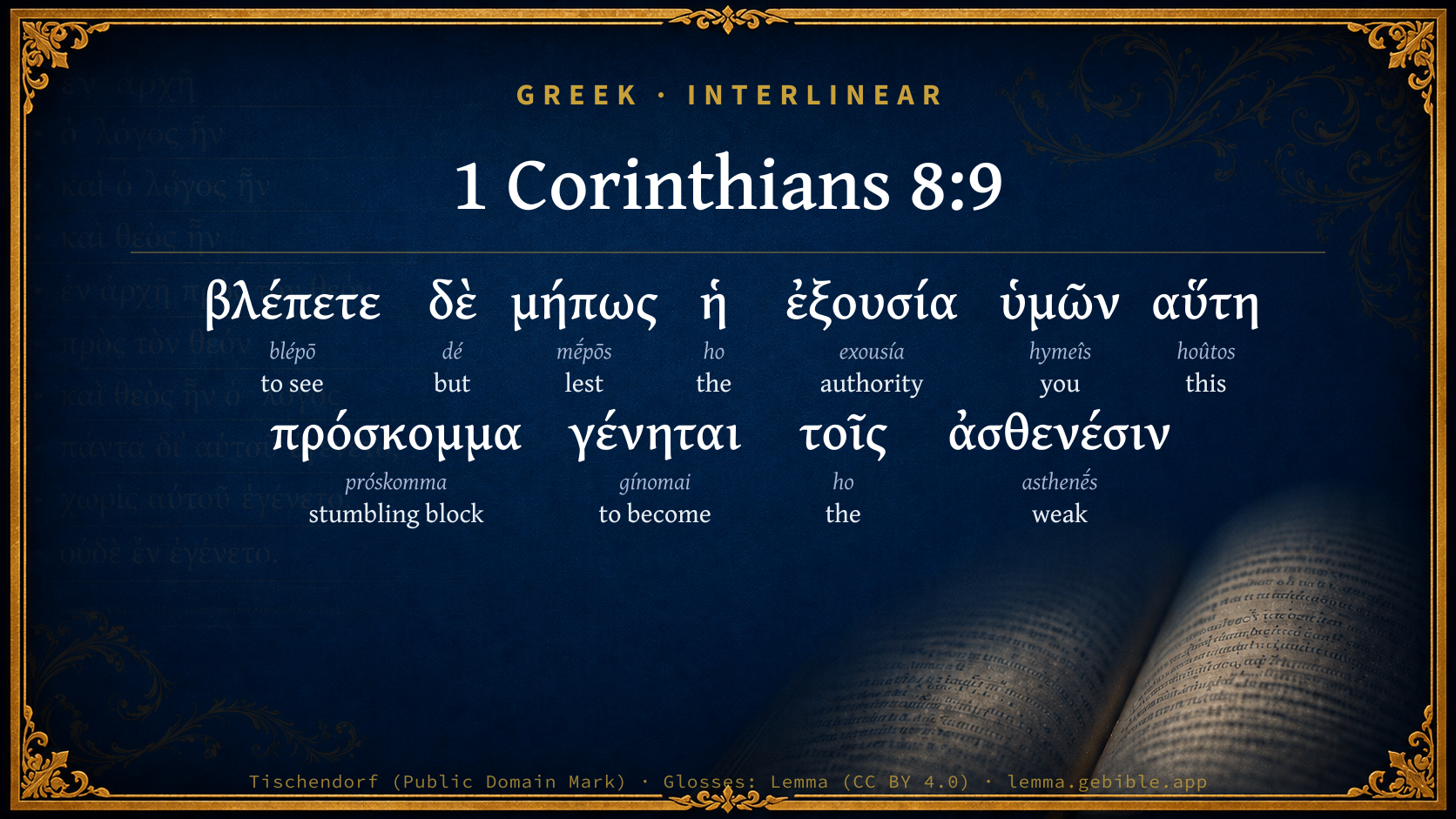
Greek (Tischendorf 8th ed.) 1 Corinthians 8:9 appears in the Greek New Testament. The text above is from the Tischendorf 8th edition. Each word links to its Strong’s number and a concise gloss. Click any word for its full Thayer’s Greek Lexicon entry.
Download image
Cite this verse

1 Corinthians 8:9 (World English Bible). Public Domain. Lemma interlinear Bible study tool, https://lemma.gebible.app/v/1-corinthians/8/9.

Show BibTeX & RIS
BibTeX
RIS
English Translation
But be careful that by no means does this liberty of yours become a stumbling block to the weak.
World English Bible · Public Domain
Highlights
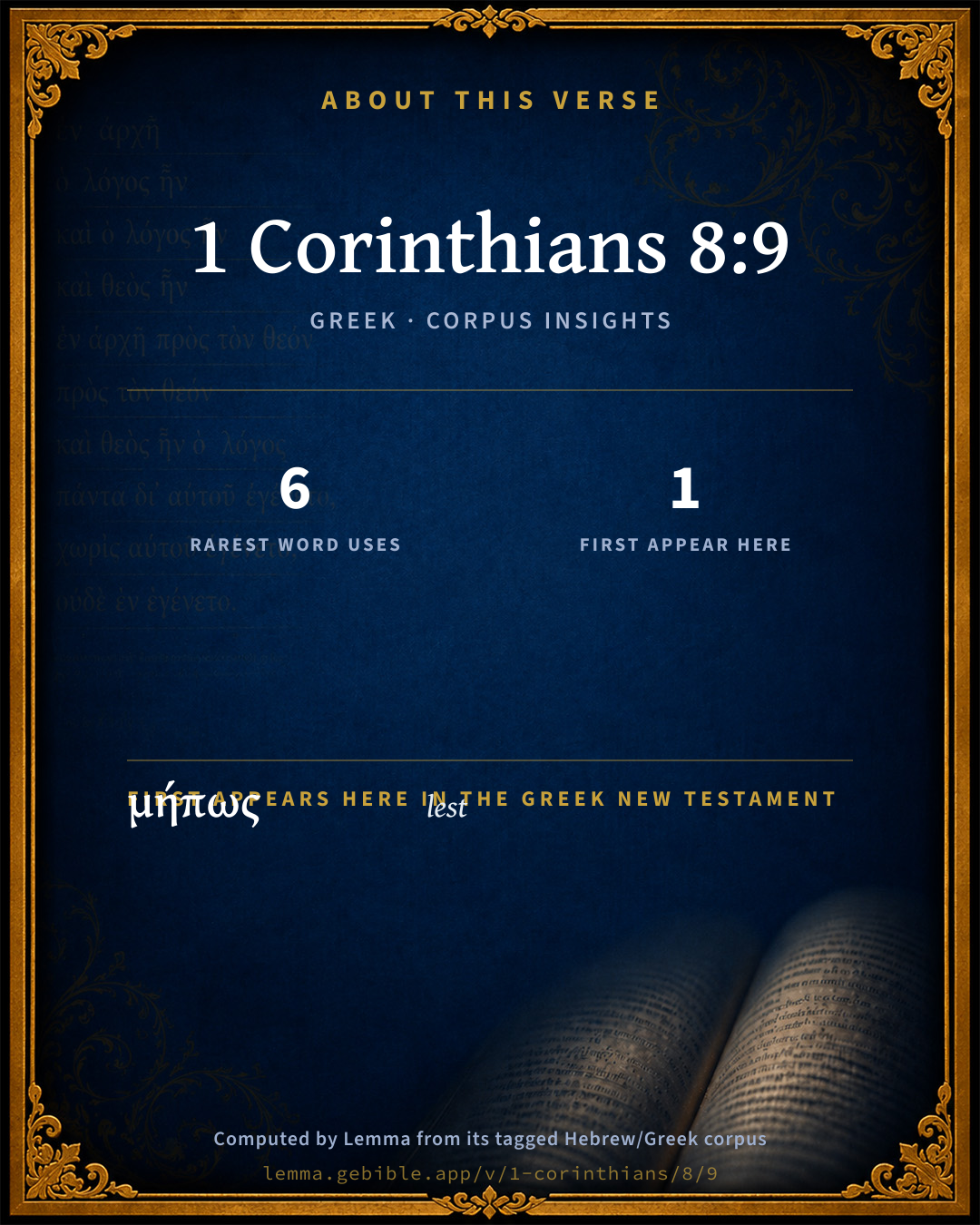
  • 1 first appearance in the Greek New Testament
Full analysis ↓
Download a study sheet

One document with this verse’s original text, its word-by-word gloss line, the meaning frame, cross-references with their text, attributed commentary, and full source and license credits — printable, and it pastes into notes with its structure intact.

This verse Autodidact and up

Study sheet (.html) Plain text (.txt)

A passage Seminary Student

Up to 50 verses in one chapter. A passage sheet keeps up to 6 commentary sources and 12 cross-references per verse, in the order this page ranks them, and says so on the sheet whenever that leaves anything out. Ask for a single verse and you get the Autodidact verse sheet above.

Everything on this page stays free to read, with no account — the sheet is a download of what is already on screen, not access to it.

Want to remove ads? Support Godless Engineer
Compare translations 3

The same verse in 3 English versions, stacked beneath the original-language interlinear above. Click any original word for its lexicon entry.

Each is an independent rendering of the whole verse — the interlinear is not word-aligned to these translations.

Highlighted words mark where these versions differ — a whole-verse word diff, not a word-by-word alignment.

  • World English Bible Public Domain
    But be careful that by no means does this liberty of yours become a stumbling block to the weak.
  • King James Version Public Domain
    But take heed lest by any means this liberty of your's become a stumblingblock to them that are weak.
  • unfoldingWord Literal Text CC BY-SA 4.0
    But take care lest this authority of yours might become a stumbling block for the weak.

unfoldingWord Literal Text — © unfoldingWord, licensed CC BY-SA 4.0. Word-aligned USFM3 via Door43 (git.door43.org/unfoldingWord/en_ult).

Versions to compare (up to 4)

3 of 4 selected

Show all 19 translations

Every available English version of this verse, each an independent rendering of the whole verse.

  • World English Bible Public Domain
    But be careful that by no means does this liberty of yours become a stumbling block to the weak.
  • Berean Standard Bible Public Domain
    Be careful, however, that your freedom does not become a stumbling block to the weak.
  • Majority Standard Bible Public Domain
    Be careful, however, that your freedom does not become a stumbling block to the weak.
  • King James Version Public Domain
    But take heed lest by any means this liberty of your's become a stumblingblock to them that are weak.
  • American Standard Version (1901) Public Domain
    But take heed lest by any means this liberty of yours become a stumblingblock to the weak.
  • Revised Version (1885) Public Domain
    But take heed lest by any means this liberty of yours become a stumblingblock to the weak.
  • Geneva Bible (1599) Public Domain
    But take heede lest by any meanes this power of yours be an occasion of falling, to them that are weake.
  • Douay-Rheims (1899) Public Domain
    But take heed lest perhaps this your liberty become a stumblingblock to the weak.
  • Young's Literal Translation Public Domain
    but see, lest this privilege of yours may become a stumbling-block to the infirm,
  • Literal Standard Version CC BY-SA 4.0
    but see, lest this privilege of yours may become a stumbling-block to the weak,
  • Unlocked Literal Bible CC BY-SA 4.0
    But take care that your freedom does not become a reason for someone who is weak in faith to stumble.
  • unfoldingWord Literal Text CC BY-SA 4.0
    But take care lest this authority of yours might become a stumbling block for the weak.
  • Darby Bible Public Domain
    But see lest anywise this your right [to eat] itself be a stumbling-block to the weak.
  • World Messianic Bible Public Domain
    But be careful that by no means does this liberty of yours become a stumbling block to the weak.
  • Webster's Bible Public Domain
    But take heed lest by any means this liberty of yours should become a stumbling-block to them that are weak.
  • Free Bible Version CC BY-SA 4.0
    Just take care not to use this freedom you have to eat food sacrificed to idols to become offensive to those with a weaker attitude.
  • Bible in Basic English Public Domain
    But take care that this power of yours does not give cause for trouble to the feeble.
  • Text-Critical English NT CC BY 4.0
    But be careful that this right of yours does not somehow become a stumbling block to the weak.
  • Tyndale New Testament (1534) Public Domain
    But take hede that youre libertie cause not the weake to faule.

Literal Standard Version (2020), Covenant Press — licensed CC BY-SA 4.0. Text via the HelloAO Bible API (eBible.org). Unlocked Literal Bible (unfoldingWord) — licensed CC BY-SA 4.0. Text via the HelloAO Bible API (eBible.org). unfoldingWord Literal Text — © unfoldingWord, licensed CC BY-SA 4.0. Word-aligned USFM3 via Door43 (git.door43.org/unfoldingWord/en_ult). Free Bible Version, Dr. Jonathan Gallagher — licensed CC BY-SA 4.0. Text via the HelloAO Bible API (eBible.org).

Word by word

More ways to search: Search by grammar → Find every occurrence → Compare this word →

Practice this passage: Drill this verse → Learn its vocabulary →

About this verse

These counts appear in no published source. They are computed here, from the morphology-tagged text and Lemma’s own curated glosses. What Lemma adds →

11
words
10
distinct lemmas
Pauline Epistles
section

Notable vocabulary

The rarest word here is πρόσκομμα stumbling block G4348 — appearing just 6 times in the whole Greek New Testament.

First appearance in Scripture

This word makes its first canonical appearance in the Greek New Testament here:

Shared distinctive vocabulary

πρόσκομμα stumbling block G4348 occurs in 6 verses of the Greek New Testament. Also found in:

Repetition

A word recurs within this verse:

Cross-references

22

Topical passages linked to 1 Corinthians 8:9 in the Treasury of Scripture Knowledge — connected by theme and wording, ordered by reader-vote popularity; previews shown in the World English Bible.

  • Galatians 5:13 For you, brothers, were called for freedom. Only don't use your freedom for gain to the flesh, but through love be servants to one another.
  • Romans 14:20–21 Don't overthrow God's work for food's sake. All things indeed are clean, however it is evil for that man who creates a stumbling block by eating.
  • 1 Peter 2:16 as free, and not using your freedom for a cloak of wickedness, but as bondservants of God.
  • 2 Peter 2:19 promising them liberty, while they themselves are bondservants of corruption; for by whom a man is overcome, by the same is he also brought into bondage.
  • Romans 14:1–2 Now receive one who is weak in faith, but not for disputes over opinions.
  • 1 Corinthians 10:24 Let no one seek his own, but each one his neighbor's good.
  • Romans 14:13–15 Therefore let's not judge one another any more, but judge this rather, that no man put a stumbling block in his brother's way, or an occasion for falling.
  • 1 Corinthians 8:12 Thus, sinning against the brothers, and wounding their conscience when it is weak, you sin against Christ.
  • 1 Corinthians 10:32 Give no occasions for stumbling, either to Jews, or to Greeks, or to the assembly of God;
  • 1 Corinthians 8:10 For if a man sees you who have knowledge sitting in an idol's temple, won't his conscience, if he is weak, be emboldened to eat things sacrificed to idols?
  • 1 Corinthians 9:22 To the weak I became as weak, that I might gain the weak. I have become all things to all men, that I may by all means save some.
  • Luke 17:1–2 He said to the disciples, "It is impossible that no occasions of stumbling should come, but woe to him through whom they come!
  • Leviticus 19:14 "'You shall not curse the deaf, nor put a stumbling block before the blind; but you shall fear your God. I am Yahweh.
  • Isaiah 35:3 Strengthen you the weak hands, and confirm the feeble knees.
  • Isaiah 57:14 He will say, Cast up, cast up, prepare the way, take up the stumbling-block out of the way of my people.
  • Ezekiel 14:3 Son of man, these men have taken their idols into their heart, and put the stumbling block of their iniquity before their face: should I be inquired of at all by them?
  • Romans 15:1 Now we who are strong ought to bear the weaknesses of the weak, and not to please ourselves.
  • 1 Corinthians 10:29 Conscience, I say, not your own, but the other's conscience. For why is my liberty judged by another conscience?
  • 2 Corinthians 11:21 I speak by way of disparagement, as though we had been weak. Yet however any is bold (I speak in foolishness), I am bold also.
  • Revelation 2:14 But I have a few things against you, because you have there some who hold the teaching of Balaam, who taught Balak to throw a stumbling block before the children of Israel, to eat things sacrificed to idols, and to commit sexual immorality.
  • Matthew 18:6–7 but whoever causes one of these little ones who believe in me to stumble, it would be better for him that a huge millstone should be hung around his neck, and that he should be sunk in the depths of the sea.
  • Matthew 18:10 See that you don't despise one of these little ones, for I tell you that in heaven their angels always see the face of my Father who is in heaven.

Cross-references courtesy of OpenBible.info (CC BY 4.0).

Commentary

Notes on 1 Corinthians 8:9 from classic Christian and Jewish commentators (each source and its license shown beneath its notes). The classic Christian expositions comment on the surrounding passage and are grouped to its opening verse, so a note may address several verses; the Jewish commentaries on the Tanakh (Rashi and others) are per-verse, so they appear only where the commentator wrote on this verse.

Lemma curates 59 commentaries, every one of them public domain or Creative Commons licensed, each selected and text-cleaned for this edition rather than reprinted as found. About our sources →

Joseph Benson's Commentary

1Co 8:9-13. But take heed lest this liberty of yours — To eat indifferently of such meats; become a stumbling-block — An occasion of doing what they judge unlawful; to them that are weak — Uninformed in the truth, or unsettled as to their knowledge of it. For if any man see thee — Whom he believes to have more knowledge than himself, and who really hast this knowledge, that an idol is nothing; sit at meat in the idol’s temple — To an entertainment there; shall not the conscience of him that is weak — Scrupulous; be imboldened — Encouraged by thy example; to eat those things which are offered to idols — Though with a doubting, or perhaps condemning conscience. And through thy knowledge — Thy abuse and unseasonable discovery of thy knowledge; shall the weak brother perish — Be drawn into sin, which is the way to destruction; for whom Christ died — And for whom thou wilt not lose a meal’s meat: so far art thou from laying down thy life for him! We see Christ died even for them that perish. Observe this, reader. But when ye sin so — Act so uncharitably and contrary to your duty; against the brethren — Who, as well as you, are the children and heirs of God, and joint-heirs with Christ; and wound their weak conscience — Their ill-informed and scrupulous consciences, leading them into guilt, and hazarding their salvation; ye sin against Christ — Whose members they are, and who had such regard for their souls, that he died in ignominy and torture to redeem them, and hath done all that example or precept could do, to make his followers enter into such humane and compassionate views. Wherefore — For a conclusion, I lay down this general rule, that all things indifferent in their own nature are to be forborne, when the use of them would be a cause of scandal, or an occasion of falling to others, of turning them out of the right way, or hindering them therein; yea, though such things may have a great deal of apparent expediency in them. So that if meat — Of what sort soever it be; make my brother to offend — Lead him into sin, and cause him to contract guilt, and wound his conscience — I will eat no flesh while the world standeth — But live entirely on vegetables; lest I make my brother to offend — That I may not scandalize and insnare him in evil, if there be no other way of avoiding it. Of such importance do I esteem the preservation of one endangered soul: and in this, and other things of a similar nature, I pray that God may incline you to use the like self-denial for your own sakes, and for the peace and honour of the Christian Church. But who will follow this example? What preacher or private Christian will abstain from any thing and every thing, lawful in itself, when it offends a weak brother?

Joseph Benson's Commentary on the Old and New Testaments (1811–1818) — public domain. Text from a community e-Sword module.

Tyndale Open Study Notes

Tyndale Open Resources

8:9-10 Believers must be careful that what they do (such as eating sacrificial meat) does not cause others . . . to stumble (cp. Rom 14:13, 20-21; Gal 5:13).

Tyndale Open Study Notes — © Tyndale Open Resources, licensed CC BY-SA 4.0. Text via the HelloAO Bible API.

Bengel's Gnomon

Johann Albrecht Bengel

1Co 8:9. Ἡ ἐξουσία, lawful power [liberty]) a word frequently used for power and liberty in this discussion, 1Co 9:1; 1Co 9:4, etc.: comp. 1Co 6:12.—ὑμῶν, of yours) which you so eagerly uphold, 1Co 8:11.

Bengel's Gnomon of the New Testament — English translation (T&T Clark, Edinburgh, 1860) — public domain. Text from a community e-Sword module.

Expositor's Greek Testament

ed. W. Robertson Nicoll

1Co 8:9 . “Beware, however, lest this right of yours” sc . to eat the idolothyta, for which many of the Cor [1261] are contending, and probably in the Church Letter (1Co 8:1 ). For ἐξουσία in this use, cf. 1Co 9:4 ff., 1Co 9:12 , also ἔξεστιν in 1Co 6:12 , 1Co 10:23 . The Jerus. Council (Act 15:29 ), to whose decree P. was a party, had not denied in principle the lawfulness of using idolothyta; it forbade such use to the mixed Judæo-Gentile Churches within a certain area, in deference to Jewish feeling. Paul comes in effect to the same conclusion, though he advises instead of commanding. The πρόσκομμα is an obstacle thrown in the way of “the weak,” over which they may stumble into a moral fall, not having the strength either to overcome their scruples or to disregard an example contrary to their conscience.

[1261] Corinth, Corinthian or Corinthians.

The Expositor's Greek Testament, edited by W. Robertson Nicoll (1897–1910) — public domain. Text from a community e-Sword module.

Hodge's Commentary on Romans, Ephesians & First Corinthians

Charles Hodge

1Co_8:9

But take heed lest by any means this liberty of yours become a stumblingblock to them that are weak.

Admitting you have the right to eat of these sacrifices, take care lest your eating become an occasion of sin to your weaker brethren. Your liberty. The word (εσξουσία) means,

1. Ability or power.

2. Lawful power or right.

3. Authority; Who gave thee this authority?

4. Power over others, dominion or rule.

Here the second sense is the one in which the word is to be taken. Stumblingblock, (πρόσκομμα) elsewhere rendered offense, in a moral sense is that which is an occasion to sin, or which causes men to fall. In the same sense the word (σκάνδαλον, literally, a trap-stick,) scandal is used, Luk_17:1. Rom_14:13; 1Jo_2:10. The weak are the doubting, the undecided, those not having knowledge, as is implied in the next verse.

Charles Hodge — Commentary on Romans (1835), First Corinthians (1857), and Ephesians (1856) — public domain. Text from a community e-Sword module.

Jamieson, Fausset & Brown

Robert Jamieson, A. R. Fausset & David Brown

this liberty of yours--the watchword for lax Corinthians. The very indifference of meats, which I concede, is the reason why ye should "take heed" not to tempt weak brethren to act against their conscience (which constitutes sin, Rom 14:22-23).

Jamieson, Fausset & Brown — Commentary Critical and Explanatory on the Whole Bible (1871) — public domain (CC PDM 1.0). Text via the HelloAO Bible API.

Adam Clarke's Commentary

Verse 9. But take heed] Lest by frequenting such feasts and eating things offered to idols, under the conviction that an idol is nothing, and that you may eat those things innocently, this liberty of yours should become a means of grievously offending a weak brother who has not your knowledge, or inducing one who respects you for your superior knowledge to partake of these things with the conscience, the persuasion and belief, that an idol is something, and to conclude, that as you partake of such things, so he may also, and with safety. He is not possessed of your superior information on this point, and he eats to the idol what you take as a common meal.

Adam Clarke's Commentary on the Bible (1810–1826) — public domain. Text from a community e-Sword/MySword module.

John Calvin's Commentaries

9. Take heed that your liberty He leaves their liberty untouched, but moderates the use of it thus far — that it may not give occasion of stumbling to the weak. And he expressly desires that regard be had to the weak, that is, to those who are not, yet thoroughly confirmed in the doctrine of piety, for as they are wont to be regarded with contempt, it is the will and command of the Lord, that regard should be had to them. In the meantime, he hints that strong giants, who may be desirous tyrannically to subject our liberty to their humor, may safely be let alone, because we need not fear giving offense to those who are not drawn into sin through infirmity, but eagerly catch at something to find fault with. What he means by an occasion, of stumbling we shall see herelong.

John Calvin's Commentaries (1540-1563) — public domain. Text from the Calvin Translation Society English edition (1840s-50s) via the Christian Classics Ethereal Library (ccel.org). Calvin's coverage is partial (roughly two-thirds of the Bible); uncommented books and verses are honest gaps, never fabricated. The 19th-century editor's footnotes and remarks are omitted so the notes are faithfully Calvin's own voice.

Ellicott's Commentary for English Readers

(9) But take heed.—On this very account, because the matter is one which is indifferent, because there is no right or wrong in it, you must look elsewhere for your guide as to how you ought to act. In things which are not indifferent, right or wrong is the sole test of action. In things indifferent you must look for some other guide, and you must regulate your conduct by the effect it may have on others. Your liberty, which arises from the bare fact of the indifferent nature of the thing, may become a stumbling-block to others, may be the cause of their taking a false step in the Christian course.

A Bible Commentary for English Readers, edited by Charles John Ellicott (1878–1897) — public domain. Text from a community e-Sword module.

The Cambridge Bible for Schools and Colleges

gen. ed. J. J. S. Perowne

9. this liberty of yours] Rather, right. Under ordinary circumstances we have a right to act upon our rational convictions. But this right has its limits, see ch. 1Co_6:12, and note. We are bound to respect the scruples of the conscientious, though perhaps unenlightened man. In this particular case there are those who conscientiously regard an idol as having a real existence, and anything offered in sacrifice to it as its property, and therefore as unfit to be partaken of by Christians. The perceptions of such persons may be far from clear, but their motives are pure and worthy of respect We may be wiser than they, but we must be careful that we do not by our wisdom betray them into sin.

become a stumblingblock to them that are weak] “What reality is there in your religion if you look at men struggling in darkness, and are content to congratulate yourselves that you are m the light?… Slaves—idolaters—superstitious—alas! is that all that we have to say?” Robertson.

The Cambridge Bible for Schools and Colleges (gen. ed. J. J. S. Perowne; Cambridge University Press, 1878–1918) — public domain. Text from a community e-Sword module.

John Gill's Exposition

But take heed lest by any means,.... This is either a reply to the instance of such as argued in favour of eating things offered to idols; or a limitation and explanation of the apostle's own concession, that it made a man, with respect to the favour of God, neither better nor worse: yet care should be taken, lest

this liberty of yours become a stumblingblock to them that are weak; he owns they had a liberty, or a right, or power, as the word may be rendered, of eating, or not eating, as they pleased; but then they ought to be cautious, lest they should be the means of offending, or causing to offend, such who were weak in the faith, and had not that knowledge of Christian liberty they had: not the use of their power and liberty is here denied, but the abuse of it is guarded against; for though the action itself was indifferent, yet as it might be used, it might be sinful, being attended with very bad consequences, such as hereafter mentioned.

John Gill's Exposition of the Whole Bible (1746–1763) — public domain (CC PDM 1.0). Text via the HelloAO Bible API.

Trapp's Complete Commentary

John Trapp

9 But take heed lest by any means this liberty of yours become a stumblingblock to them that are weak.

Ver. 9. True, it is indifferent, so it prove not a stumblingblock to the unresolved. For in such a case thou must suspend thy liberty, and forbear to exercise it.

John Trapp, A Commentary or Exposition upon All the Books of the Old and New Testament (1647–1656) — public domain. Text from a community e-Sword module.

Albert Barnes' Notes on the Bible

But take heed - This is the reply of Paul to the argument of the Corinthians in 1Co 8:8. “Though all that you say should be admitted to be true, as it must be; though a man is neither morally better nor worse for partaking of meat or abstaining from it; yet the grand principle to be observed is, so to act as not to injure your brethren. Though you may be no better or worse for eating or not eating, yet if your conduct shall injure others, and lead them into sin, that is a sufficient guide to determine you what to do in the case. You should abstain entirely. It is of far more importance that your brother should not be led into sin, than it is that you should partake of meat which you acknowledge 1Co 8:8 is in itself of no importance.”

Lest by any means - μή πως mē pōs. You should be careful that by no conduct of yours your brother be led into sin. This is a general principle that is to regulate Christian conduct in all matters that are in themselves indifferent.

This liberty of yours - This which you claim as a right; this power which you have, and the exercise of which is in itself lawful. The “liberty” or power ἐξουσία exousia here referred to was that of partaking of the meat that was offered in sacrifice to idols; 1Co 8:8. A man may have a right abstractly to do a thing, but it may not be prudent or wise to exercise it.

Become a stumbling-block - An occasion of sin; see the note at Mat 5:29; also see the note at Rom 14:13. See that it be not the occasion of leading others to sin, and to abandon their Christian profession; 1Co 8:10.

To them that are weak - To those professing Christians who are not fully informed or instructed in regard to the true nature of idolatry, and who still may have a superstitious regard for the gods whom their fathers worshipped.

Albert Barnes' Notes on the Bible (1834–1885) — public domain. Text from a community e-Sword/MySword module.

Matthew Poole's English Annotations

The word εξουσια is here well translated liberty, though it also signifieth right, and seems in either sense rather to signify a supposed than a real liberty or right; for we shall see in the next verse, that the apostle is here speaking of their eating in the idol’s temple, which, 1Co 10:21, he determineth to be a having a communion with devils, and therefore could not be lawful; the apostle therefore seemeth here only to suppose (as they pretended) that in their eating simply in the idol’s temple they did not sin, because by eating men are not made the worse; yet, as we shall see afterwards, he declareth their action was not free from guilt, as it was a violation of that brotherly love which they were obliged to show to their neighbour.

Matthew Poole's English Annotations on the Holy Bible (1683–1685) — public domain. Text from a community e-Sword/MySword module.

Whedon's Commentary on the Bible

Daniel D. Whedon

9. But—Nevertheless; there is still a drawback.

Take heed—Paul’s reply to the Corinthian statement of the last verse.

Liberty—Εξουσια, right, prerogative. Paul grants the existence of the intrinsic right to eat.

Daniel D. Whedon (gen. ed.), Commentary on the Old and New Testaments (1874–1909) — public domain. Text from a community e-Sword module.

The Pulpit Commentary

Lest this liberty of yours become a stumbling block; rather, this power or right of yours. To lead any one to do that which he thinks to be wrong is to place a stone of stumbling in his way, even if we do not think the act to be wrong. For we make men worse if by our example we teach them to act in contradiction of their conscience. "Let your motto be forbearance, not privilege, and your watchword charity, not knowledge. Never flaunt your knowledge, seldom use your privilege" (Evans).

Our dealings with weak brethren.

Our liberty may become a stumbling block to others, and against this we must be constantly on our guard. There will always be around us some "weak brethren.

1. They may be intellectually weak, really unable to grasp more than the simplicities of the truth, and readily thinking that what they can neither understand nor appreciate must be error. There is also such a thing as mental bias, which prevents men from appreciating or receiving more than some particular side of truth. And this mental bias is often the affliction of men who are otherwise intelligent; and it becomes the occasion of much religious bigotry.

2. They may be weak in conscience. Instead of firmly attesting what is right and what is wrong, their conscience may only present scruples and questions and doubts. It is the same thing to say that they have little power of decision; and feel restless and uncertain, and weakly full of fears, when a decision is made.

3. They may be weak through the relics of old habits. A man cannot immediately separate himself from all his surroundings; and it was very difficult for Gentile Christians to shake off their heathen notions. Missionaries now, in heathen lands, are gravely perplexed by the lingering sentiments and habits of their converts. And in Corinth many could not get out of the idea that meat offered to an idol must be defiled and unfit for their eating Christians. So it may be shown that there are "weak brethren" with us still; some who are offended with higher truths, which they are intellectually unable to reach; others who have scruples about what is permissible to Christians in social life, and yet others who fix narrow limits to the observance of the sabbath, and other details of Christian conduct. Now, St. Paul lays down some of the principles on which we should deal with these "weak brethren.

I THE PRINCIPLE OF FIRMNESS. More especially if our brother"s weakness in any way imperils the truth. Concessions to our weaker brethren may go to the fullest length so long as they concern only our personal relations with them. But we may concede nothing if our brother"s weakness puts in peril vital truth. Then we must be firm and stand our ground, and claim our full liberty to receive whatever truth God may be pleased to give us. And it is even found, in practical life, that our brother"s weakness in matters of detail is best met by a firm and intelligent resistance. We need to be especially careful that our dealings with our brethren shall in no way foster and encourage their weakness. Modes of keeping sabbath, or relations of Christians to public amusements, will furnish necessary illustrations.

II THE PRINCIPLE OF HELPFULNESS; wherever we stand in such relations to the "weak brethren" as may give us a power of influence upon them. If we condescend to them, it can only be that we may lift them out of their weakness into strength. Such helpful influence we may exert

(1) by direct teachings;

(2) by our own personal example. Others may see that what they call "our liberty" in no way injures our spiritual life, and seeing that may best help them to correct their mistakes.

III THE PRINCIPLE OF SELF SACRIFICING CHARITY. Actually depriving ourselves of pleasures, and what we think to be both permissible and good things, in order that we may be no hindrance or injury to others. Illustrate in the case with which St. Paul is dealing here; and show how many good Christians nowadays abstain from such things as balls and theatres because they are anxious not to set a stumbling block in the way of others. Our practical difficulties in life apply to things indifferent; and in such matters it is proper that we should regulate our conduct by the effects which it may have on others. The true Christian spirit would lead us to say, "Rather let me suffer by abstaining from what I should enjoy, and could do without any personal injury, than let my brother suffer, either by the judgment which he would form of my doings, or by his imitating my example to his own serious hurt. R.T.

The Pulpit Commentary (1880–1919), ed. H.D.M. Spence-Jones & Joseph S. Exell — public domain. Text from a community e-Sword module.

Kretzmann's Popular Commentary

Paul E. Kretzmann

A warning against the reckless use of Christian liberty:

v. 9. But take heed lest by any means this liberty of yours become a stumbling-block to them that are weak.

v. 10. For if any man see thee which hast knowledge sit at meat in the idol’s temple, shall not the conscience of him which is weak be emboldened to eat those things which are offered to idols,

v. 11. and through thy knowledge shall the weak brother perish, for whom Christ died?

v. 12. But when ye sin so against the brethren and wound their weak conscience, ye sin against Christ.

v. 13. Wherefore, if meat make my brother to offend, I will eat no flesh while the world standeth, lest I make my brother to offend.

The connection between this passage and the foregoing one is the following. Paul, writing about defilement of conscience in the case of weak brethren, v. 7, intercepts the objection on the part of the stronger Christians: "You say that the conscience of the weaker brother is defiled by eating of idol sacrifices. But how? We have been taught that God will not judge us on account of such trifling external matters. " This Paul shows to be true, but he now adds a word of caution and rebukes the attitude of the stronger Christians with a very serious reference to the consequences of their uncharitable behavior: See to it, beware, lest this your right become an obstacle to the weak. It was true enough that they had the liberty of choice in the matter in itself; they were right in contending that there was nothing sinful in their partaking of meat offered to idols. But this right ceased to be a matter of Christian liberty, a thing indifferent, when indulging in it proved an obstacle to their weak brother over which he stumbled, when their eating gave occasion to their weak brother to sin.

Paul now explains in detail: For if anyone should see you, a person that has knowledge, that is proud of his right understanding of Christian liberty, reclining at a table in an idol’s temple, would not his conscience, while he is still weak, before he has overcome his peculiar prejudices, be edified to the point that he will eat of the idol sacrifices? To such extremes, then, the stronger brethren in the congregation at Corinth went that they freely accepted invitations to banquets in the temples of the heathen gods. In doing so, they probably had the idea that this was the most effective way of persuading the weak of their foolish position. But that was a questionable edification, and could result in only one thing, namely, in harm to the weak. Without having really understood and conceded the matter properly, the latter would also accept such invitations, with the result that their consciences would be defiled. The behavior of the strong was thus the very opposite of charitableness, it was selfish presumption. Instead of building up and strengthening the weak brother, therefore, there perishes the weak person on the ground of thy knowledge, the brother for whom Christ died. The appeal to Christ’s work is to the strongest motives which can compel a Christian: brotherly love and loyalty to Christ. The strong Christian should remember that his brother cannot be brought to better knowledge by such inconsiderate behavior; on the contrary, the very object of Christ’s death in the case of the weaker brother is frustrated by such thoughtless behavior. Christ died to bring redemption to all men; His salvation is actually ready before the whole world, and it is His intention that it be realized in the case of every person. But here the weak Christian is tempted by the strong to partake in a meal which he regards as sinful, and thus defiles his conscience, loses his faith, and is placed on the road to perdition, all on account of the heartless folly of the Christian that makes it a point to boast of his knowledge and to insist upon the exercise of his Christian liberty.

The apostle now describes the further result of such conduct: In so sinning against the brethren and in striking their weak conscience a blow, you are sinning against Christ. So it is not only the weak brother that sins in such a case by his yielding, but the stronger Christian that tempted him sins as well. And his is the greater damnation; for not only does he strike the conscience of the weaker a blow that dazes him in his spiritual life, shocks and deranges it, renders it useless, but he sins directly against Christ. See Mat 18:6; Mat 25:40-45. It is here that the act reaches its climax and exhibits the height of its guiltiness, since the purpose of the Savior’s death cannot be realized on its account. Every offense by which we sin against the brethren is offered to Christ, and to strike the weak conscience of a brother is all the more reprehensible since it is done with the pretext of working in his interest, although the offender meanwhile fatuously displays his own selfishness.

All the more strongly, by way of contrast, the self-denial of Paul stands out: Therefore verily, if food offends my brother, I will surely not eat meat forever, lest my brother be offended. Note that he says "my brother," with special emphasis. For the sake of brotherly love and in the interest of weaker brethren, the apostle is ready to yield even more of his liberty; he will give up even other foods about which another may still be in doubt, not only the food offered to sacrifices. So the principle which must regulate the use of things indifferent at all times and under all circumstances is that of love.

Summary.In discussing the question of partaking of foods which have been sacrificed to idols, Paul shows that regard for the spiritual welfare of the weaker brother must be the motive which regulates the behavior of the stronger Christians in things indifferent.

Paul E. Kretzmann, Popular Commentary of the Bible (1921–1924) — public domain. Text from a community e-Sword module.

McGarvey & Pendleton's Commentaries

J. W. McGarvey

But take heed lest by any means this liberty of yours become a stumblingblock to the weak .

J. W. McGarvey (with Philip Y. Pendleton), Commentaries on the New Testament (The Fourfold Gospel, 1914; Acts; and the epistles) — public domain. Text from a community e-Sword/MySword module.

The People's New Testament

B. W. Johnson

9. Take heed lest … this liberty of yours, etc. The meat itself made one neither better nor worse (verse 8), but if those who “had knowledge” ate it, it might prove a stumbling-block, the occasion of the fall of those who were not so well informed and were weaker.

B. W. Johnson's The People's New Testament with Notes (1889–1891) — public domain. Electronic text from the Christian Classics Ethereal Library (CCEL) ThML edition.

Cambridge Greek Testament for Schools and Colleges

9. ἐξουσία. See note on ch. 1Co 7:4. Under ordinary circumstances we have a right to act upon our rational convictions. See ch. 1Co 10:29. But this right has its limits, see ch. 1Co 6:12, and note. We are bound to respect the scruples of the conscientious, though perhaps unenlightened man. In this particular case there are those who conscientiously regard the deity symbolized by an idol as having a real existence, and anything offered in sacrifice to it as formally dedicated to it, and therefore as unfit to be partaken of by those who have renounced all fellowship with it. The perceptions of such persons may be far from clear, but their motives are pure and worthy of respect. We may be wiser than they, but we must be careful that we do not by our wisdom betray them into sin.

πρόσκομμα. ‘What reality is there in your religion if you look at men struggling in darkness, and are content to congratulate yourselves that you are in the light?… Slaves—idolaters—superstitious—alas! is that all that we have to say?’ Robertson. For πρόσκομμα see Rom 9:32. Also LXX. Exo 23:33; Isa 8:14.

Cambridge Greek Testament for Schools and Colleges (Cambridge University Press, 1896; 21 vols, various authors incl. Carr, Maclear, Plummer, Farrar, Lumby, Moule, M. R. James, Simcox) — public domain. Text from a community e-Sword module.

Alford’s Greek Testament

Henry Alford

9.] δέ—q. d. “I acknowledge this indifference—this licence to eat or not to eat; but it is on that very account, because it is a matter indifferent, that ye must take heed,” &c.

The particular πρόσκομμα in this case would be, the tempting them to act against their conscience:—a practice above all others dangerous to a Christian, see below, ver. 11.

Henry Alford, The Greek Testament (1849–1861) — public domain. Text from a community e-Sword module.

International Critical Commentary

9. Βλέπετε δὲ μή πωσἡ ἐξονσία ὑμῶν. ‘Take heed, however, lest this liberty of yours prove a stumbling-block to the weak.’ It is lawful for those whose consciences are enlightened to do as they like about it (ἐξουσίαν as in 7:37, 9:4, and as ἔξεστιν in 6:12); their eating will not do them any harm. But it may do harm to others, and thus may bring the eaters into a worse position before God. See notes on Rom 14:13, Rom 14:20: excepting the quotation in 1Pe 2:8, πρόσκομμα in N.T. is confined to this passage and Romans; in LXX it is not rare. It is that against which the man with weak sight stumbles; it is no obstacle to the man who sees his way; but the weak-sighted must be considered.*

ἀσθενέσιν (א A B D E F, etc.), as in v. 7; ἀσθενοῦσιν (L, Chrys. Thdrt.) perhaps from v. 11. P has ἡμῶν.

International Critical Commentary — older volumes (1896–1929), various authors — public domain. Text from a community e-Sword module.

Vincent's Word Studies in the New Testament

Marvin R. Vincent

Stumbling - block [προσκομμα] . See on Rom 14:13.

Marvin R. Vincent, Word Studies in the New Testament (1887–1900) — public domain. Text from a community e-Sword/MySword module.

Lesson kit

Teaching starters — assembled from the data on this page, not authored interpretation. Every prompt links to the verse data it draws on. Edit before teaching.

1 Corinthians, in the Pauline Epistles, opens this verse with 11 words (10 distinct Greek lemmas). Its most distinctive word is próskomma (“stumbling block”). A historical commentator’s framing appears above. Read the whole chapter for the surrounding context.

Discussion questions

  1. How does “stumbling block” (próskomma) shape what this verse is saying?
  2. The word “lest” first appears here in Scripture. What is being introduced at this debut?
  3. Romans 9:32 shares the word «stumbling block» with this verse. How do the two illuminate each other?
  4. “the” occurs 2× in this one verse. What is the effect of the repetition?
  5. These translations render this verse differently; the difference is in the English rendering, not the original. What questions does that raise?
  6. Reading how Joseph Benson's Commentary and Tyndale Open Study Notes read this verse, where do the two commentators agree and where do they part?

Things to notice

  • 1 word makes its first canonical appearance in Scripture here.
  • These translations choose different wording for 16 words in this verse.
  • “the” occurs 2× in this single verse.
  • 10 distinct Greek lemmas span 11 words in this verse.

Reading settings

Reading text

Shown beneath each verse's original-language words.

Old Testament
Old Testament edition

Read the OT as the Masoretic Hebrew (MT) or the Greek Septuagint (LXX).

English shown for the Greek Septuagint (in the Hebrew ↔ Greek comparison).

Comparing translations? Open the Compare panel on any verse page to stack up to four side by side.