1 Corinthians 10:6

Greek (Tischendorf 8th ed.) 1 Corinthians 10:6 appears in the Greek New Testament. The text above is from the Tischendorf 8th edition. Each word links to its Strong’s number and a concise gloss. Click any word for its full Thayer’s Greek Lexicon entry.
Download image
Cite this verse

1 Corinthians 10:6 (World English Bible). Public Domain. Lemma interlinear Bible study tool, https://lemma.gebible.app/v/1-corinthians/10/6.

Show BibTeX & RIS
BibTeX
RIS
English Translation
Now these things were our examples, to the intent we should not lust after evil things, as they also lusted.
World English Bible · Public Domain
Highlights
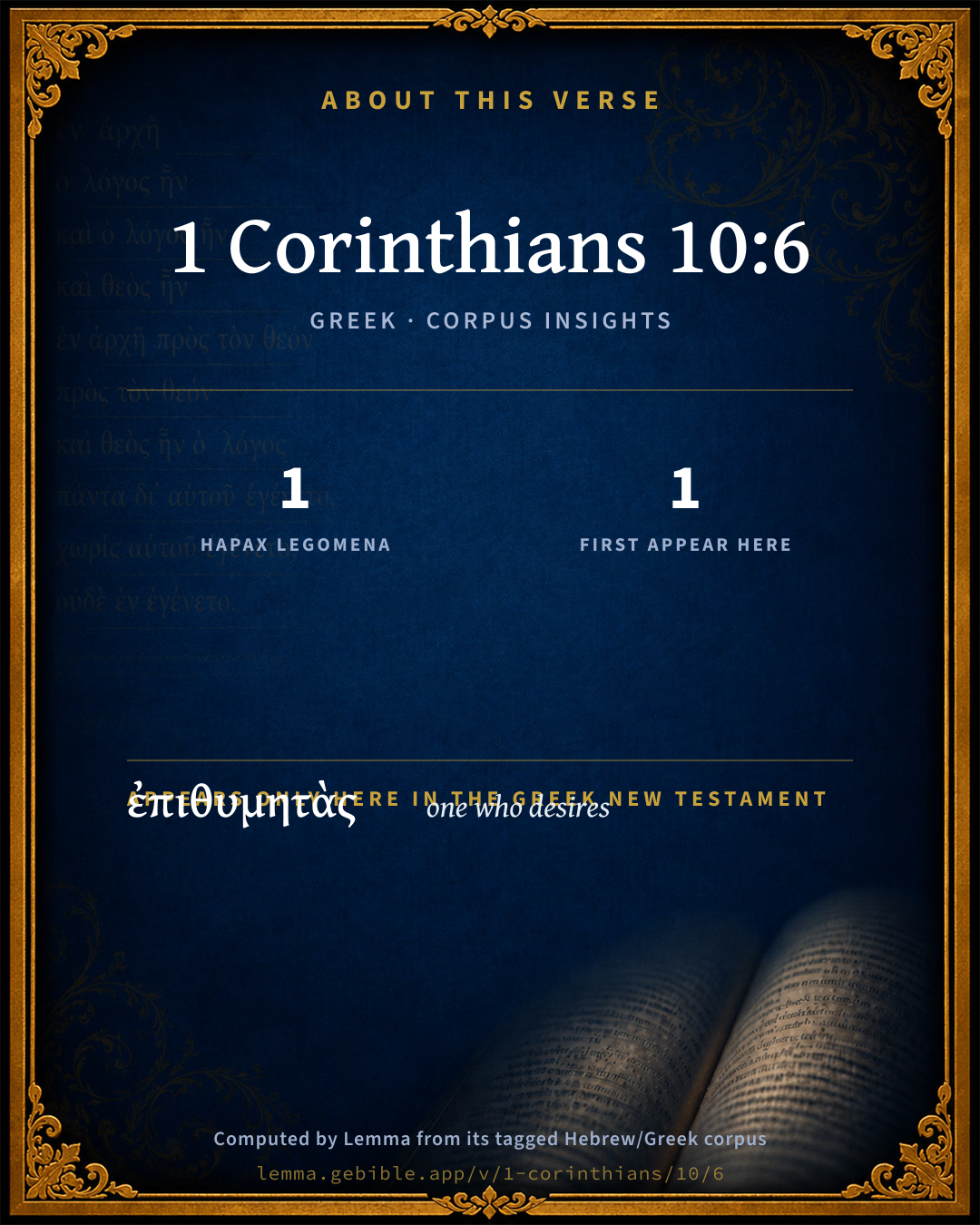
  • 1 hapax legomenon — only here in the Greek New Testament
  • 1 first appearance in the Greek New Testament
Full analysis ↓
Download a study sheet

One document with this verse’s original text, its word-by-word gloss line, the meaning frame, cross-references with their text, attributed commentary, and full source and license credits — printable, and it pastes into notes with its structure intact.

This verse Autodidact and up

Study sheet (.html) Plain text (.txt)

A passage Seminary Student

Up to 50 verses in one chapter. A passage sheet keeps up to 6 commentary sources and 12 cross-references per verse, in the order this page ranks them, and says so on the sheet whenever that leaves anything out. Ask for a single verse and you get the Autodidact verse sheet above.

Everything on this page stays free to read, with no account — the sheet is a download of what is already on screen, not access to it.

Want to remove ads? Support Godless Engineer
Compare translations 3

The same verse in 3 English versions, stacked beneath the original-language interlinear above. Click any original word for its lexicon entry.

Each is an independent rendering of the whole verse — the interlinear is not word-aligned to these translations.

Highlighted words mark where these versions differ — a whole-verse word diff, not a word-by-word alignment.

  • World English Bible Public Domain
    Now these things were our examples, to the intent we should not lust after evil things, as they also lusted.
  • King James Version Public Domain
    Now these things were our examples, to the intent we should not lust after evil things, as they also lusted.
  • unfoldingWord Literal Text CC BY-SA 4.0
    Now these things became examples for us so that we would not be ones desiring evil things, just as they also desired.

unfoldingWord Literal Text — © unfoldingWord, licensed CC BY-SA 4.0. Word-aligned USFM3 via Door43 (git.door43.org/unfoldingWord/en_ult).

Versions to compare (up to 4)

3 of 4 selected

Show all 19 translations

Every available English version of this verse, each an independent rendering of the whole verse.

  • World English Bible Public Domain
    Now these things were our examples, to the intent we should not lust after evil things, as they also lusted.
  • Berean Standard Bible Public Domain
    These things took place as examples to keep us from craving evil things as they did.
  • Majority Standard Bible Public Domain
    These things took place as examples to keep us from craving evil things as they did.
  • King James Version Public Domain
    Now these things were our examples, to the intent we should not lust after evil things, as they also lusted.
  • American Standard Version (1901) Public Domain
    Now these things were our examples, to the intent we should not lust after evil things, as they also lusted.
  • Revised Version (1885) Public Domain
    Now these things were our examples, to the intent we should not lust after evil things, as they also lusted.
  • Geneva Bible (1599) Public Domain
    Nowe these things are our ensamples, to the intent that we should not lust after euil things as they also lusted.
  • Douay-Rheims (1899) Public Domain
    Now these things were done in a figure of us, that we should not covet evil things as they also coveted.
  • Young's Literal Translation Public Domain
    and those things became types of us, for our not passionately desiring evil things, as also these did desire.
  • Literal Standard Version CC BY-SA 4.0
    and those things became types of us, for our not passionately desiring evil things, as also these desired.
  • Unlocked Literal Bible CC BY-SA 4.0
    Now these things were examples for us, so we would not long for evil things as they did.
  • unfoldingWord Literal Text CC BY-SA 4.0
    Now these things became examples for us so that we would not be ones desiring evil things, just as they also desired.
  • Darby Bible Public Domain
    But these things happened [as] types of us, that we should not be lusters after evil things, as they also lusted.
  • World Messianic Bible Public Domain
    Now these things were our examples, to the intent we should not lust after evil things as they also lusted.
  • Webster's Bible Public Domain
    Now these things were our examples, to the intent we should not lust after evil things, as they also lusted.
  • Free Bible Version CC BY-SA 4.0
    Now these experiences are examples to us to show us we should not desire what is evil, as they did.
  • Bible in Basic English Public Domain
    Now these things were for an example to us, so that our hearts might not go after evil things, as they did.
  • Text-Critical English NT CC BY 4.0
    Now these things happened as examples for us, so that we would not crave evil things as they did.
  • Tyndale New Testament (1534) Public Domain
    These are ensamples to vs that we shuld not lust after evyll thinges as they lusted.

Literal Standard Version (2020), Covenant Press — licensed CC BY-SA 4.0. Text via the HelloAO Bible API (eBible.org). Unlocked Literal Bible (unfoldingWord) — licensed CC BY-SA 4.0. Text via the HelloAO Bible API (eBible.org). unfoldingWord Literal Text — © unfoldingWord, licensed CC BY-SA 4.0. Word-aligned USFM3 via Door43 (git.door43.org/unfoldingWord/en_ult). Free Bible Version, Dr. Jonathan Gallagher — licensed CC BY-SA 4.0. Text via the HelloAO Bible API (eBible.org).

Word by word

More ways to search: Search by grammar → Find every occurrence → Compare this word →

Practice this passage: Drill this verse → Learn its vocabulary →

ἐπιθυμητὰς
epithymētḗs
G1938
“one who desires”
Noun, Accusative, Plural, Masculine
Part of Speech
Noun
Case
Accusative
Number
Plural
Gender
Masculine
Full Thayer's Definition

Origin: from G1937

TDNT: 05:52,3

1. one who longs for, a craver, lover, one eager for
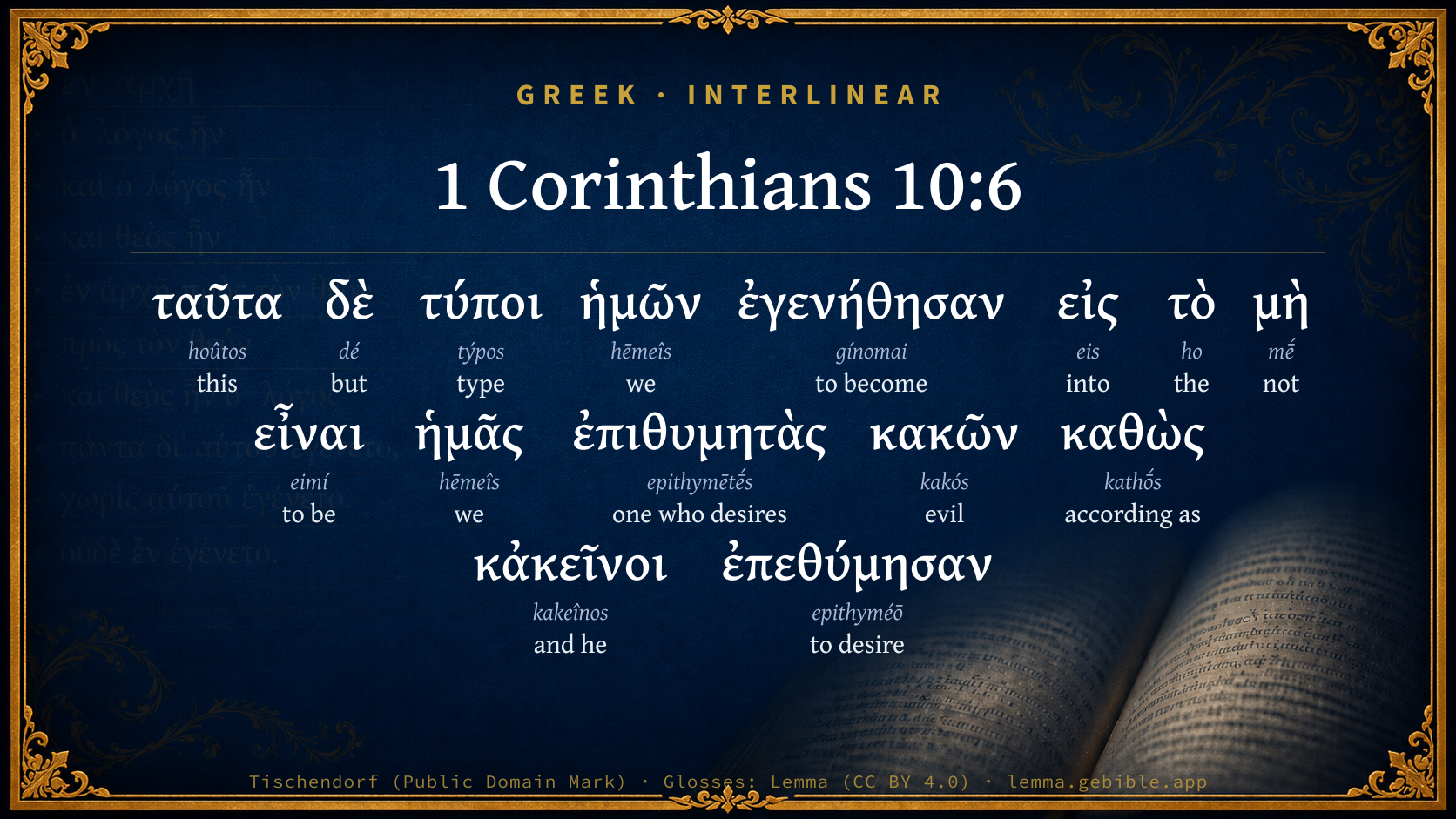
  1. ταῦτα hoûtos G3778 “this” Demonstrative pronoun, Nominative, Plural, Neuter
  2. δὲ dé G1161 “but” Conjunction
  3. τύποι týpos G5179 “type” Noun, Nominative, Plural, Masculine
  4. ἡμῶν hēmeîs G2249 “we” Personal pronoun, 1st person, Genitive, Plural
  5. ἐγενήθησαν gínomai G1096 “to become” Verb, Aorist, Passive deponent, Indicative, 3rd person, Plural
  6. εἰς eis G1519 “into” Preposition
  7. τὸ ho G3588 “the” Article, Accusative, Singular, Neuter
  8. μὴ mḗ G3361 “not” Particle, Negative
  9. εἶναι eimí G1510 “to be” Verb, Present, Active, Infinitive
  10. ἡμᾶς hēmeîs G2249 “we” Personal pronoun, 1st person, Accusative, Plural
  11. κακῶν kakós G2556 “evil” Adjective, Genitive, Plural, Neuter
  12. καθὼς kathṓs G2531 “according as” Adverb
  13. κἀκεῖνοι kakeînos G2548 “and he” Demonstrative pronoun, Nominative, Plural, Masculine, Aramaic form
  14. ἐπεθύμησαν epithyméō G1937 “to desire” Verb, Aorist, Active, Indicative, 3rd person, Plural

About this verse

These counts appear in no published source. They are computed here, from the morphology-tagged text and Lemma’s own curated glosses. What Lemma adds →

15
words
14
distinct lemmas
Pauline Epistles
section

Notable vocabulary

1 hapax legomenon — a word that appears only here in the entire Greek New Testament:

  • ἐπιθυμητὰς one who desires G1938

First appearance in Scripture

This word makes its first canonical appearance in the Greek New Testament here:

  • ἐπιθυμητὰς one who desires G1938

Shared distinctive vocabulary

τύποι type G5179 occurs in 15 verses of the Greek New Testament. Also found in:

Repetition

A word recurs within this verse:

  • ἡμῶν we G2249 ×2

Cross-references

12

Topical passages linked to 1 Corinthians 10:6 in the Treasury of Scripture Knowledge — connected by theme and wording, ordered by reader-vote popularity; previews shown in the World English Bible.

  • Jude 1:7 Even as Sodom and Gomorrah, and the cities around them, having, in the same way as these, given themselves over to sexual immorality and gone after strange flesh, are set forth as an example, suffering the punishment of eternal fire.
  • 1 Corinthians 10:11 Now all these things happened to them by way of example, and they were written for our admonition, on whom the ends of the ages have come.
  • 2 Peter 2:6 and turning the cities of Sodom and Gomorrah into ashes, condemned them to destruction, having made them an example to those who would live ungodly;
  • Hebrews 4:11 Let us therefore give diligence to enter into that rest, lest anyone fall after the same example of disobedience.
  • Numbers 11:4 The mixed multitude that was among them lusted exceedingly: and the children of Israel also wept again, and said, Who shall give us flesh to eat?
  • Zephaniah 3:6–7 I have cut off nations. Their battlements are desolate. I have made their streets waste, so that no one passes by. Their cities are destroyed, so that there is no man, so that there is no inhabitant.
  • Numbers 11:31–34 There went forth a wind from Yahweh, and brought quails from the sea, and let them fall by the camp, about a day's journey on this side, and a day's journey on the other side, round about the camp, and about two cubits above the surface of the earth.
  • Psalms 106:14–15 But gave in to craving in the desert, And tested God in the wasteland.
  • 1 Peter 3:21 This is a symbol of baptism, which now saves you-- not the putting away of the filth of the flesh, but the answer of a good conscience toward God, through the resurrection of Jesus Christ,
  • Psalms 78:27–31 He rained also flesh on them as the dust; Winged birds as the sand of the seas.
  • Romans 5:14 Nevertheless death reigned from Adam until Moses, even over those whose sins weren't like Adam's disobedience, who is a foreshadowing of him who was to come.
  • Hebrews 9:24 For Christ hasn't entered into holy places made with hands, which are representations of the true, but into heaven itself, now to appear in the presence of God for us;

Cross-references courtesy of OpenBible.info (CC BY 4.0).

Commentary

Notes on 1 Corinthians 10:6 from classic Christian and Jewish commentators (each source and its license shown beneath its notes). The classic Christian expositions comment on the surrounding passage and are grouped to its opening verse, so a note may address several verses; the Jewish commentaries on the Tanakh (Rashi and others) are per-verse, so they appear only where the commentator wrote on this verse.

Lemma curates 59 commentaries, every one of them public domain or Creative Commons licensed, each selected and text-cleaned for this edition rather than reprinted as found. About our sources →

Matthew Henry's Commentary

The apostle, having recited their privileges, proceeds here to an account of their faults and punishments, their sins and plagues, which are left upon record for an example to us, a warning against the like sins, if we would escape the like punishments. We must not do as they did, lest we suffer as they suffered.

I. Several of their sins are specified as cautions to us; as, 1. We should shun inordinate desires after carnal objects: Not lust after evil things, as they lusted, Co1 10:6. God fed them with manna, but they must have flesh, Num 11:4. They had food for their supply, but, not content with this, they asked meat for their lusts, Psa 106:14. Carnal desires get head by indulgence, and therefore should be observed and checked in their first rise: if once they prevail, and bear sway in us, we know not whither they will carry us. This caution stands first, because carnal appetites indulged are the root and source of much sin. 2. He warns against idolatry (Co1 10:7): Neither be you idolaters, as were some of them; as it is written, The people sat down to eat and drink, and rose up to play. The sin of the golden calf is referred to, Exo 32:6. They first sacrificed to their idol, then feasted on the sacrifices, and then danced before it. Though only eating and drinking are mentioned here, yet the sacrifice is supposed. The apostle is speaking to the case of the Corinthians, who were tempted to feast on the heathen sacrifices, things offered to idols, though they do not seem to have been under any temptation to offer sacrifice themselves. Even eating and drinking of the sacrifices before the idol, and as things sacrificed, was idolatry, which, by the example of the Israelites, they should be warned to avoid. 3. He cautions against fornication, a sin to which the inhabitants of Corinth were in a peculiar manner addicted. They had a temple among them dedicated to Venus (that is, to lust), with above a thousand priestesses belonging to it, all common prostitutes. How needful was a caution against fornication to those who lived in so corrupt a city, and had been used to such dissolute manners, especially when they were under temptations to idolatry too! and spiritual whoredom did in many cases lead to bodily prostitution. Most of the gods whom the heathens served were represented as patterns of lewdness; and much lewdness was committed in the very worship of many of them. Many of the Jewish writers, and many Christians after them, think that such worship was paid to Baal-Peor; and that fornication was committed with the daughters of Moab in the worship of that idol. They were enticed by these women both to spiritual and corporal whoredom; first to feast on the sacrifice, if not to do more beastly acts, in honour of the idol, and then to defile themselves with strange flesh (Num. 25), which brought on a plague, that in one day slew twenty-three thousand, besides those who fell by the hand of public justice. Note, Whoremongers and adulterers God will judge, in whatever external relation they may stand to him, and whatever outward privileges he may bestow upon them. Let us fear the sins of Israel, if we would shun their plagues. 4. He warns us against tempting Christ (as some of them tempted, and were destroyed of serpents, Co1 10:9), or provoking him to jealousy, Co1 10:22. He was with the church in the wilderness; he was the angel of the covenant, who went before them. But he was greatly grieved and provoked by them in many ways: They spoke against him and Moses, Wherefore have you brought us out of Egypt to die in the wilderness? for which reason God sent fiery serpents among them (Num 21:5, Num 21:6), by which many of them were stung mortally. And it is but just to fear that such as tempt Christ under the present dispensation will be left by him in the power of the old serpent. 5. He warns against murmuring: Neither murmur you as some of them also murmured, and were destroyed of the destroyer (Co1 10:10), by a destroying angel, an executioner of divine vengeance. They quarrelled with God, and murmured against Moses his minister, when any difficulties pressed them. When they met with discouragements in the way to Canaan, they were very apt to fly in the face of their leaders, were for displacing them, and going back to Egypt under the conduct of others of their own choosing. Something like this seems to have been the case of the Corinthians; they murmured against Paul, and in him against Christ, and seem to have set up other teachers, who would indulge and soothe them in their inclinations, and particularly in a revolt to idolatry. Rather let them feast on idol sacrifices than bear the reproach, or expose themselves to the ill-will, of heathen neighbours. Such conduct was very provoking to God, and was likely to bring upon them swift destruction, as it did on the Israelites, Num 14:37. Note, Murmuring against divine disposals and commands is a sin that greatly provokes, especially when it grows to such a head as to issue in apostasy, and a revolt from him and his good ways.

II. The apostle subjoins to these particular cautions a more general one (Co1 10:11): All these things happened to them for ensamples, and were written for our admonition. Not only the laws and ordinances of the Jews, but the providences of God towards them, were typical. Their sins against God, and backslidings from him, were typical of the infidelity of many under the gospel. God's judgments on them were types of spiritual judgments now. Their exclusion from the earthly Canaan typified the exclusion of many under the gospel out of the heavenly Canaan, for their unbelief. Their history was written, to be a standing monitor to the church, even under the last and most perfect dispensation: To us, on whom the end of the world is come, the concluding period of God's gracious government over men. Note, Nothing in scripture is written in vain. God had wise and gracious purposes towards us in leaving the Jewish history upon record; and it is our wisdom and duty to receive instruction from it. Upon this hint the apostle grounds a caution (Co1 10:12): Let him that thinketh he standeth take heed lest he fall. Note, The harms sustained by others should be cautious to us. He that thinks he stands should not be confident and secure, but upon his guard. Others have fallen, and so may we. And then we are most likely to fall when we are most confident of our own strength, and thereupon most apt to be secure, and off our guard. Distrust of himself, putting him at once upon vigilance and dependence on God, is the Christian's best security against all sin. Note, He who thinks he stands is not likely to keep his footing, if he fears no fall, nor guards against it. God has not promised to keep us from falling, if we do not look to ourselves: his protection supposes our own care and caution.

III. But to this word of caution he adds a word of comfort, Co1 10:13. Though it is displeasing to God for us to presume, it is not pleasing to him for us to despair. If the former be a great sin, the latter is far from being innocent. Though we must fear and take heed lest we fall, yet should we not be terrified and amazed; for either our trials will be proportioned to our strength, or strength will be supplied in proportion to our temptations. We live indeed in a tempting world, where we are compassed about with snares. Every place, condition, relation, employment, and enjoyment, abounds with them; yet what comfort may we fetch from such a passage! For, 1. "No temptation," says the apostle, "hath yet taken you, but such as is common to man, what is human; that is, such as you may expect from men of such principles as heathens, and such power; or else such as is common to mankind in the present state; or else such as the spirit and resolution of mere men may bear you through." Note, The trials of common Christians are but common trials: others have the like burdens and the like temptations; what they bear up under, and break through, we may also. 2. God is faithful. Though Satan be a deceiver, God is true. Men may be false, and the world may be false; but God is faithful, and our strength and security are in him. He keepeth his covenant, and will never disappoint the filial hope and trust of his children. 3. He is wise as well as faithful, and will proportion our burden to our strength. He will not suffer us to be tempted above what we are able. He knows what we can bear, and what we can bear up against; and he will, in his wise providence, either proportion our temptations to our strength or make us able to grapple with them. He will take care that we be not overcome, if we rely upon him, and resolve to approve ourselves faithful to him. We need not perplex ourselves with the difficulties in our way when God will take care that they shall not be too great for us to encounter, especially. 4. When he will make them to issue well. He will make a way to escape, either the trial itself, or at least the mischief of it. There is no valley so dark but he can find a way through it, no affliction so grievous but he can prevent, or remove, or enable us to support it, and in the end overrule it to our advantage.

IV. And upon this argument he grounds another caution against idolatry: Wherefore, my dearly beloved, flee from idolatry. Observe, 1. How he addresses them: My dearly beloved. It is out of tender affection to them that he presses this advice upon them. 2. The matter of his advice: "Flee idolatry; shun it, and all approaches towards it." Idolatry is the most heinous injury and affront to the true God; it is transferring his worship and honour to a rival. 3. The ground of this advice: "Seeing you have such encouragement to trust God, and to be faithful, do you approve yourselves men, be not shaken by any discouragements your heathen enemies may lay before you. God will succour and assist, help you in your trials, and help you out of them; and therefore be not guilty of any idolatrous compliances." Note, We have all the encouragement in the world to flee sin and prove faithful to God. We cannot fall by a temptation if we cleave fast to him.

Matthew Henry's Commentary on the Whole Bible (1708–1710) — public domain (CC PDM 1.0). Text via the HelloAO Bible API.

Tyndale Open Study Notes

Tyndale Open Resources

10:6 evil things: see Num 11:4-6, 34.

Tyndale Open Study Notes — © Tyndale Open Resources, licensed CC BY-SA 4.0. Text via the HelloAO Bible API.

Bengel's Gnomon

Johann Albrecht Bengel

1Co 10:6. Ταῦτα, these) benefits, which the people received, and the sins which they at the same time committed.—τύποι, examples) by which we may be instructed, from which we may learn, what punishments, we must expect, if, receiving such benefits, we should sin in a similar manner.—εἰς τὸ μὴ, that not) The benefits are put down in the order, in which they are arranged by Moses, in the different chapters of Exodus; the offences, with their punishments, in a different order. The fundamental principle, from which the offences proceed, is concupiscence: afterwards, the mention of idolatry most of all serves his purpose, 1Co 10:7; 1Co 10:4: fornication was usually joined with idolatry, 1Co 10:8: temptation with murmuring; see the following verses. Those offences are chiefly mentioned, which relate to the admonition of the Corinthians.—ἐπιθύμητας) The LXX. have this verbal noun.—κακῶν, after evil things) Rom 14:20.—ἐπεθύμησαν, lusted) Num 11:4.

Bengel's Gnomon of the New Testament — English translation (T&T Clark, Edinburgh, 1860) — public domain. Text from a community e-Sword module.

Meyer's Critical & Exegetical Commentary

Heinrich August Wilhelm Meyer

1Co_10:6. The typical reference of what is adduced in 1Co_10:1-5 to the Christians: These things (while they so fell out) became types of us, i.e. historical transactions of the O. T., guided and shaped by God, and designed by Him figuratively to represent the corresponding relation and experience on the part of Christians. See regarding τύπος, on Rom_5:14.

ἐγενήθησαν] The plural is by attraction from the predicate τύποι. See Kühner, II. p. 53 f.; Krüger, § lxiii. 6. Hofmann (comp 1Co_6:11) takes the Israelites as the subject: They became this as types of us; but the recurrence of the ταῦτα in 1Co_10:11 should have been enough of itself to preclude such a view.

ἘΠΙΘΥΜΗΤ. ΚΑΚῶΝ] quite general in its reference: desirers (Herod. vii. 6; Dem. 661 ult., and often in Plato) of evil things (Rom_1:30). To restrict it to the Corinthios epulatores (Grotius) is arbitrary; for it is equally so to confine the καθὼς κἀκεῖνοι ἐπεθ. which follows solely (Rückert, de Wette, Osiander, Neander), or particularly (Hofmann), to the desire of the Israelites for flesh (Num_11:4), whereas in truth the words refer generally to the evil lusts which they manifested so often and in so many ways upon their journey, that particular desire not excluded.

Meyer — Critical and Exegetical Commentary on the New Testament — English translation by Peter Christie, edited by Frederick Crombie (T&T Clark, 1880) — public domain. Text from a community e-Sword module.

Expositor's Greek Testament

ed. W. Robertson Nicoll

1Co 10:6-14 . § 32. THE MORAL CONTAGION OF IDOLATRY. The fall of the Israel of the Exodus was due to the very temptations now surrounding the Cor [1423] Church to the allurements of idolatry and its attendant impurity (1Co 10:6 ff.), and to the cherishing of discontent and presumption (1Co 10:9 f.). Their fate may prove our salvation, if we lay it to heart; the present trial, manifestly, is nothing new; and God who appoints it will keep it within our strength, and will provide us with means of escape (1Co 10:11 ff.). The whole is summed up in one word, “Flee from idolatry!” (1Co 10:14 ).

[1423] Corinth, Corinthian or Corinthians.

1Co 10:6 . ταῦτα τύποι ἡμῶν ἐγενήθησαν may mean ( a ) “These things have been made our examples,” typi nobis (Cv [1424] ) sc . exx. for our use; ( b ) “In these things (acc [1425] of specification ) they proved types of us” figurœ nostri (Vg [1426] , Bz [1427] , Mr [1428] , Bt [1429] , R.V. marg.); or ( c ) “As types of us they became such” (so Hf [1430] : cf. ταῦτα … ἦτε , 1Co 6:11 ) a construction clashing with that of the parl [1431] 1Co 10:11 . ( a ) best suits the application of ταῦτα in the sequel ( cf. 1Pe 5:3 ); to make the fallen Israelites prophetic “types” of the Cor [1432] would be to presume the ruin of the latter! ἐγενήθησαν is pl [1433] despite the neut . pl [1434] subject ταῦτα , through the attraction of the predicate: so πάντα ταῦτα κακουργίαι ἦσαν in Xenophon; the incidents included are distinctly viewed. For the deterrent “example,” cf. Heb 4:11 . With ἐπιθυμ . κακῶν cf. ἐφευρετὰς κακῶν , Rom 1:30 : the double ἐπιθυμητὰς … ἐπεθύμησαν recalls Num 11:4 (LXX); in alluding to the old “lusting” for the diet of Egypt, the Ap. hints at the attraction of the Cor [1435] idol-feasts; but his dehortation applies to all κακά ( cf. 2Co 13:7 , 1Th 5:15 , etc.). The general admonition is specialised in four particulars, with repeated μηδὲ idolatry, fornication, tempting of the Lord, murmuring based on the analogy furnished by 1Co 10:1-5 .

[1424] Calvin’s In Nov. Testamentum Commentarii .

[1425] accusative case.

[1426] Latin Vulgate Translation.

[1427] Beza’s Nov. Testamentum: Interpretatio et Annotationes (Cantab., 1642).

[1428] Meyer’s Critical and Exegetical Commentary (Eng. Trans.).

[1429] J. A. Beet’s St. Paul’s Epp. to the Corinthians (1882).

[1430] J. C. K. von Hofmann’s Die heilige Schrift N.T. untersucht , ii. 2 (2te Auflage, 1874).

[1431] parallel.

[1432] Corinth, Corinthian or Corinthians.

[1433] plural.

[1434] plural.

[1435] Corinth, Corinthian or Corinthians.

The Expositor's Greek Testament, edited by W. Robertson Nicoll (1897–1910) — public domain. Text from a community e-Sword module.

Hodge's Commentary on Romans, Ephesians & First Corinthians

Charles Hodge

1Co_10:6

Now these things were our examples, to the intent we should not lust after evil things, as they also lusted.

These things were our examples; literally, our types. A type is an impression; any thing produced by blows; then an impression which has a resemblance to something else; then a model to which some other person or thing should be, or in point of fact would be, conformed. The Israelites and the facts of their history were our types, because we shall be conformed to them if we do not exercise caution. Our doom will correspond to theirs. They therefore stand as warnings to us. The particular thing against which their fate was designed to warn us, is lusting after evil. According to Num_11:4 the people lusted after, i.e. they inordinately longed for, the fleshpots of Egypt, and said, Who shall give us flesh to eat? God gave them their desire but while the flesh was yet between their teeth, he smote them with a great plague, and the place was called the graves of lust, for there they buried the people that lusted, Num_11:34. Comp. Psa_78:27-31 and Psa_105:14, Psa_105:15. This was a perpetual warning against the indulgence of inordinate desires for forbidden objects. It was specially appropriate as a warning to the Corinthians not to desire participation in the sacrificial feasts of the heathen in which they had been accustomed to indulge.

Charles Hodge — Commentary on Romans (1835), First Corinthians (1857), and Ephesians (1856) — public domain. Text from a community e-Sword module.

Geneva Bible (1599)

Geneva Bible translators

An amplifying of the example against them which are carried away with their lusts beyond the bounds which God has measured out. For this is the beginning of all evil, as of idolatry (which hath gluttony a companion unto it) fornication, rebelling against Christ, murmuring, and such like, which God punished most sharply in that old people, to the end that we which succeed them, and have a more full declaration of the will of God, might by that means take better heed.

Some read figures: which signified our sacraments: for circumcision was to the Jews a seal of righteousness, and to us a lively pattern of Baptism, and so in the other Sacraments.

Geneva Bible (1599) marginal notes — public domain. Text via Bolls.life.

Jamieson, Fausset & Brown

Robert Jamieson, A. R. Fausset & David Brown

were--Greek, "came to pass as."

our examples--samples to us of what will befall us, if we also with all our privileges walk carelessly.

lust--the fountain of all the four other offenses enumerated, and therefore put first (Jam 1:14-15; compare Psa 106:14). A particular case of lust was that after flesh, when they pined for the fish, leeks, &c., of Egypt, which they had left (Num 11:4, Num 11:33-34). These are included in the "evil things," not that they are so in themselves, but they became so to the Israelites when they lusted after what God withheld, and were discontented with what God provided.

Jamieson, Fausset & Brown — Commentary Critical and Explanatory on the Whole Bible (1871) — public domain (CC PDM 1.0). Text via the HelloAO Bible API.

Adam Clarke's Commentary

Verse 6. These things were our examples] The punishments which God inflicted on them furnish us with evidences of what God will inflict upon us, if we sin after the similitude of those transgressors.

We should not lust after evil things] It is most evident that the apostle refers here to the history in Nu 11:4, c.: And the mixed multitude fell a lusting, and said, Who shall give us flesh to eat? Into the same spirit the Corinthians had most evidently fallen they lusted after the flesh in the idol feasts, and therefore frequented them to the great scandal of Christianity. The apostle shows them that their sin was of the same nature as that of the murmuring rebellious Israelites whom God so severely punished; and if he did not spare the natural branches, there was no likelihood that he should spare them.

Adam Clarke's Commentary on the Bible (1810–1826) — public domain. Text from a community e-Sword/MySword module.

John Calvin's Commentaries

6. Now these things were types to us. He warns us in still more explicit terms, that we have to do with the punishment that was inflicted upon them, so that they are a lesson to us, that we may not provoke the anger of God as they did. “God,” says he, “in punishing them has set before us, as in a picture, his severity, that, instructed by their example, we may learn to fear.” Of the term type I shall speak presently. Only for the present I should wish my readers to know, that it is not without consideration that I have given a different rendering from that of the old translation, and of Erasmus. For they obscure Paul’s meaning, or at least they do not bring out with sufficient clearness this idea — that God has in that people presented a picture for our instruction.

That we might not lust after evil things. He now enumerates particular instances, or certain examples, that he may take occasion from this to reprove some vices, as to which it was proper that the Corinthians should be admonished. I am of opinion, that the history that is here referred to is what is recorded in Numbers 11:4, etc., though others refer it to what is recorded in Numbers 26:64. The people, after having been for some time fed with manna, at length took a dislike to it, and began to desire other kinds of food, which they had been accustomed to partake of in Egypt. Now they sinned in two ways, for they despised the peculiar gift of God, and they eagerly longed after a variety of meats and delicacies, contrary to the will of God. The Lord, provoked by this lawless appetite, inflicted upon the people a grievous blow. Hence the place was called the

graves of lust, because there they buried those whom the Lord had smitten. (Numbers 11:34.)

The Lord by this example testified how much he hates those lusts that arise from dislike of his gifts, and from our lawless appetite, for whatever goes beyond the measure that God has prescribed is justly reckoned evil and unlawful.

John Calvin's Commentaries (1540-1563) — public domain. Text from the Calvin Translation Society English edition (1840s-50s) via the Christian Classics Ethereal Library (ccel.org). Calvin's coverage is partial (roughly two-thirds of the Bible); uncommented books and verses are honest gaps, never fabricated. The 19th-century editor's footnotes and remarks are omitted so the notes are faithfully Calvin's own voice.

Ellicott's Commentary for English Readers

(6) Now these things were our examples.—Better, Now these things were types of us. “Now” introduces the contrast between the physical Israel and the spiritual Israel, between the physical death which befell the majority of the former, and the spiritual death which, if privileges be neglected or abused, must befall the latter.

To the intent.—St. Paul regards everything that has happened in history as having a divine purpose of blessing for others. All this material suffering on their part will not be in vain if it teaches us the spiritual lesson which God would have us learn from it.

We should not lust after evil things.—The Apostle now sets forth the causes with which the majority of the Israelities neutralised the great advantages in which all had shared. The lusting after evil things must be taken as applying to their general conduct (evidenced especially in the circumstances mentioned in Num_11:4; Num_11:18). “As they also” directly connects the sins which the Corinthians were in danger of with the sins which led to the overthrow of the Israelites. The idolatry and eating and drinking and committing fornication all refer to kinds of sin which the Corinthians were liable to commit if they did not keep themselves perfectly distinct from the heathen. (See 1Co_6:12.)

A Bible Commentary for English Readers, edited by Charles John Ellicott (1878–1897) — public domain. Text from a community e-Sword module.

The Cambridge Bible for Schools and Colleges

gen. ed. J. J. S. Perowne

6. Now these things were our examples] Literally, types of us. In figure of us, Wiclif. The word here used is derived from τύπτω, to strike, and signifies (1) a mark, stroke of any kind, impressed or engraven, ‘print,’ St Joh_20:25; (2) an image, figure, as in Act_7:43; (3) an example, pattern, Act_7:44 (where the word is rendered fashion), cf. Heb_8:5; (4) type, in the recognized sense of the word, that of a person or circumstance designed by God to foreshadow some other person or circumstance in the future, Rom_5:14; (5) as equivalent to purport, substance of a letter or address, Act_23:25; (6) form, outline, substance, as of a system of doctrine or morals (like the derived word ὑποτύπωσις in 2Ti_1:13); Rom_6:17; (7) Example in the matter of conduct, for imitation or warning, Php_3:17; 1Th_1:7; 1Ti_4:12, &c. Either this, as in our version, or (4) is the meaning here, or it may include both meanings. God impressed such a character upon the Jewish history—or rather perhaps it was the natural result of the similar position in which Christians now stand to that occupied by the Jews under the law—that it foreshadowed the history of the Christian Church. This idea is carried out more fully than in this Epistles in reference to the Old Testament generally, in the Epistles to the Galatians and Hebrews. Here it is simply used to point out the way in which the warnings of the Jewish history are valuable to Christians.

as they also lusted] St Paul gives five instances of the Israelites’ sin. First the desire for food other than God had given them, Num_11:4; Num_11:33-34.

The Cambridge Bible for Schools and Colleges (gen. ed. J. J. S. Perowne; Cambridge University Press, 1878–1918) — public domain. Text from a community e-Sword module.

John Gill's Exposition

Now these things were our examples,.... Or "types"; that is, these punishments which were inflicted on these persons for their sins, were designed as instructions for others to avoid the like sins, that they may escape the same punishment; just as the cities of Sodom and Gomorrah, being condemned with an overthrow, as these men were, were made ensamples to all that should hereafter live such vicious lives and conversations; and in a very lively manner, as in a type or print, these exhibited the displeasure of God against sin, what such must expect who commit it; so men are called out of Babylon, lest, partaking of her sins, they also receive of her plagues. The Jews have a common saying (s) "that what happened to the fathers is a sign unto the children"; to which the apostle may have respect:

to the intent that we should not lust after evil things. The apostle proceeds to enter into particular instances, in which these things were examples, teaching us to avoid sin, and so punishment; and begins with lust, which is the root and foundation of all sin; all the evil in the world arises from it, and the world itself is full of it, and is in God's account the same as action: and here he particularly strikes at those Corinthians, that lusted after the feasts in the idols' temples; and hints that that arose rather from a carnal sensual appetite, which ought not to be indulged, than from any other principle:

as they also lusted; that is, after evil things, the fish, the cucumbers, the melons, the leeks, onions, and garlic of Egypt, Num 11:4 which though they were not evil in themselves, yet the Israelites sinned in lusting after them, in not being content with the manna, the food which God had prepared for them; and besides, their desire after these things did not arise from want, but from a sensual appetite, and was attended with murmuring against the Lord and his servants, and was highly resented; for though the Lord gave them flesh according to their desire, yet while it was between their teeth, he sent a plague among them, by which multitudes were taken off, and the name of the place was called , "Kibroth Hataavah, the graves of lusts"; the people that lusted being buried there, Num 11:34.

(s) Tzeror Hammor, fol. 77. 4.

John Gill's Exposition of the Whole Bible (1746–1763) — public domain (CC PDM 1.0). Text via the HelloAO Bible API.

Trapp's Complete Commentary

John Trapp

6 Now these things were our examples, to the intent we should not lust after evil things, as they also lusted.

Ver. 6. Were our examples] Worthily are they made examples, that will not take them. Alterius perditio tua sit cautio. The destruction of others should be a terror to us, that we may wash our feet in the blood of the wicked, Psa 52:6. It is a just presage and desert of ruin, not to be warned.

As they also lusted] As at Kibroth Hattaavah, where by a hasty testament they bequeathed a new name to the place of their burial.

John Trapp, A Commentary or Exposition upon All the Books of the Old and New Testament (1647–1656) — public domain. Text from a community e-Sword module.

Albert Barnes' Notes on the Bible

Now these things - The judgments inflicted on them by God for their sins.

Were our examples - Greek: “types” (τύποι tupoi). Margin, “figures.” They were not designed to be types of us, but they are to be held up as furnishing an admonition to us, or a warning that we do not sin in the same way. The same God directs our affairs that ordered theirs; and if we sin as they did, we also must expect to be punished, and excluded from the favor of God, and from heaven.

Lust after evil things - Desire those things which are forbidden, and which would be injurious. They lusted after flesh, and God granted them their desires, and the consequence was a plague, and the destruction of multitudes Exo 11:4. So Paul infers that the Corinthian Christians should not lust after, or desire the meat offered in sacrifice to idols, lest it should lead them also to sin and ruin.

Albert Barnes' Notes on the Bible (1834–1885) — public domain. Text from a community e-Sword/MySword module.

Haydock's Catholic Bible Commentary

In a figure of us. That is, this was done and written to teach us, what we may expect, if we imitate the murmurs, infidelities, ingratitude, and disobedience of the Hebrew people. Unless we renounce our irregular desires, unless we mortify our passions, baptism and communion will prove our greater condemnation. The greatest graces are but subjects of alarm, unless our life correspond with them.

George Leo Haydock (1774–1849), Haydock's Catholic Family Bible and Commentary, 1859 edition — public domain. Excludes Psalms (Douay-Rheims chapter numbering differs from Protestant) and Deuterocanonical books (Catholic canon only).

Matthew Poole's English Annotations

Our examples; our types or patterns (as the Greek word signifies): we may, by God’s dispensations to them, learn what God will be to us: as they were patterns to us, of persons enjoying great spiritual privileges; so they are also examples or patterns to show us what we may expect from God, and to deter us from such practices, as brought the vengeance of God upon them; which were their sinful lustings or desirings of things which God had forbidden, as they did the flesh-pots, and onions, and garlic of Egypt, and to return thither again, Num 11:4,5,33; 14:2-4.

Matthew Poole's English Annotations on the Holy Bible (1683–1685) — public domain. Text from a community e-Sword/MySword module.

Whedon's Commentary on the Bible

Daniel D. Whedon

6-13. Thus far the apostle has typically endowed the Old Church with the sacraments, from Christ, of the New; he will now warn the New to beware of the typical sins, apostasies, and deaths, of the Old. Here note, 1. The sins specified by Paul are, first, that general lust from which proceed 1) idolatry, 2) fornication, 3) presumption, 4) murmurs. 2. This enumeration of sins is rightly interpreted as those peculiarly besetting the Church at Corinth. 3. They are to be interpreted as sins through which apostasy and destruction were likely to result. Hence Paul warns them (1Co_10:12) against a fall, yet assures them (1Co_10:13) that God ever makes apostasy unnecessitated. 4. For all their sins, falls, and deaths, the Corinthians may find in the wilderness-history of Israel, as in a mirror, the warning types.

6. Examples—Literal Greek, types. Yet not divinely-established types, to which we are to conform; but figures of wrongs which we should avoid.

Lust—As the mental source whence sins, especially of the sensuous kind, proceed. Literal Greek, That we be not lusters of evil things. It was to these sensuous sins, especially, that Christians in the licentious, idolatrous, and heaven-daring city of Corinth were liable.

Daniel D. Whedon (gen. ed.), Commentary on the Old and New Testaments (1874–1909) — public domain. Text from a community e-Sword module.

The Pulpit Commentary

These things were our examples. If this rendering be adopted, perhaps "examples" is the best equivalent of the original tupoi, as in. Php_3:17, "Walk so as ye have us for an example. (tupelo) It may, however, mean "types," i.e. foreshadowing symbols, as in Rom_5:14, where Adam is the "figure" (tupos) of Christ. But, in spite of Alford"s decisive rejection of it, the rendering, "Now in these things they proved to be figures of us," is at least equally probable. To the intent. Of course, the events had their own immediate instruction, but the example which they involved was the ulterior purpose of their being so ordained by the providence of God. As they also lusted. . (For quails, Num_11:4, Num_11:33; and see Psa_95:7-11)

Our examples.

The force of example, both to encourage and to deter, is familiar and admitted. The principle is used. in education, in the arts, in government and law. It is justly believed that a readier and deeper impression is produced by living characters and. real events than by abstract propositions. The principle is employed by religion. The Bible is full of examples of sin, punishment, repentance, virtue, reward. The Old Testament has been termed the picture book accompanying and illustrating the lessons of the New Testament. The text assumes the special applicability of the history of Israel in the wilderness to the spiritual instruction, first of the Corinthians, and. then also of all professed Christians. Paul points and emphasizes his appeals to diligence, purity, cheerfulness, etc., by referring to the well known incidents of the journey of Israel from Egypt to the land of promise.

I ISRAEL IN THE WILDERNESS IS AN EXAMPLE OF WARNING.

1. Against murmuring, which, it is to be feared, never appears to many Christians to be of the nature of sin, and. against which accordingly many are not upon their guard. But murmuring is against Divine appointment, and is therefore against God himself.

2. Against sensuality. Into these it was not surprising that Israel should fall, having only just escaped from Egypt, and being surrounded by the licentious heathen. And what more important and necessary than a caution against defiling and destroying the temple of the Holy Ghost?

3. Against rebellion. Israel again and again rebelled against Moses the servant of God, and against Jehovah himself. And Christians need. to be reminded that to violate God"s Law, to defy the authority of God"s inspired apostles, to resist the Divine message of God"s ministers, is treason, and. cannot go unpunished.

4. Against unbelief. This was the sin which lay at the root of the others, as is shown in the Epistle to the Hebrews. It contrasts with that childlike faith which is becoming in the privileged people of the Lord. All such conduct, as we may learn from the Old Testament narrative referred to, is observed, disapproved, and. censured by the omniscient Ruler. It is tempting Christ. We are reminded of the possibility and of the culpability of such sin.

II ISRAEL IN THE WILDERNESS IS AN EXAMPLE OF ENCOURAGEMENT. If we look at the human side, the lesson is one of warning; but if we regard the Divine side, there we see much to cheer, animate, and inspire us. We remark:

1. Divine guidance. As Israel was led by the pillar of cloud and of fire, so will all who look up and commit their way unto the Lord, experience his directing grace.

2. Divine care, bounty, and goodness. As Israel ate of the manna from heaven and drank of the streams from the rock, so that, when earth failed, heaven interposed, in like manner will the beneficence of God satisfy the wants of all who in necessity and straits call upon him.

3. Divine protection. As Israel"s foes were discomfited, as threatening dangers were averted, so shall a way of escape and a door of deliverance be provided for all who trust in a gracious and redeeming God. The arm of flesh may fail, but the arm of Omnipotence shall prove ready and victorious.

4. The final possession of the promises. God led his people to the land he promised to their fathers; not immediately, not by a way they knew, not without difficulties, hardships, contests, yet surely, safely, victoriously. Those who are "on their way to God" may well be animated by such recollections, and by the light they cast upon the position and the hopes of the Christian. Heaven may seem to us "the land which is very far off;" yet faith can bring it near and make it ours even now.

E"en now by faith I see thee, E"en now thy walls discern, To thee my thoughts are kindled, And strive and pant and yearn.

The Pulpit Commentary (1880–1919), ed. H.D.M. Spence-Jones & Joseph S. Exell — public domain. Text from a community e-Sword module.

John Wesley's Explanatory Notes

Now these things were our examples - Showing what we are to expect if, enjoying the like benefits, we commit the like sins. The benefits are set down in the same order as by Moses in Exodus; the sins and punishments in a different order; evil desire first, as being the foundation of all; next, idolatry, ver. 7, 14; then fornication, which usually accompanied it, ver. 8; the tempting and murmuring against God, in the following verses. As they desired - Flesh, in contempt of manna. Num. xi, 4

John Wesley, Explanatory Notes Upon the Whole Bible (1754–1765) — public domain. Text via the GEBible commentary corpus.

Kretzmann's Popular Commentary

Paul E. Kretzmann

Warning against the corruption of idolatry and related sins:

v. 6. Now these things were our examples, to the intent we should not lust after evil things, as they also lusted.

v. 7. Neither be ye idolaters, as were some of them; as it is written, The people sat down to eat and drink and rose up to play.

v. 8. Neither let us commit fornication, as some of them committed, and fell in one day three and twenty thousand.

v. 9. Neither let us tempt Christ, as some of them also tempted, and were destroyed of serpents.

v. 10. Neither murmur ye, as some of them also murmured, and were destroyed of the destroyer.

The apostle substantiates his warning by referring to a number of incidents that happened in the wilderness, showing why the displeasure of God struck the children of Israel: Now these things, these judgments, are recorded in Scriptures as types or examples of warning; they represent to us our lot if we do not heed the voice of God in the history of the wilderness. We should not be lusters after evil things, we should not be eager to perform that which displeases the Lord, as they also lusted. Hardly had the Israelites been saved from the hands of Pharaoh and the Egyptians, when they were dissatisfied with their journey in the desert and longed after the flesh-pots of Egypt, Exo 16:3. Ever and again, as they continued their journey, they would raise their voices in rebellious murmurings and demand further gifts from the kindness and goodness of the Lord, Num 11:5-20. And ever and again their revolt took the form of special sins of unfaithfulness, of offenses peculiarly hateful in the eyes of God.

A few of the occasions coming under this heading are now enumerated: And do not become idolaters as some of them, as it is written, The people sat down to eat and to drink and arose to sport in dancing. This behavior was but an outward manifestation of the apostasy of their hearts, Exo 32:18-19. They deliberately prepared a sacrificial meal for the golden calf which Aaron had made upon their demand, and they gave expression to their idolatrous feelings by their singing and dancing around the idol fashioned by a man’s hands. "It was a scene of wild, careless merriment, shocking under the circumstances and most perilous, that Moses witnessed as he descended, bearing the tables of the Law. " Undoubtedly there were such also in the Corinthian congregation has tried to excuse their partaking of banquets in the heathen temples with the plea that they had in mind only the honor of God; but by the very fact that they placed themselves on a level with the idolatrous enjoyments, they had become guilty of idolatry. A second offense: Neither let us commit fornication, as some of them committed fornication, and fell in one day twenty-three thousand, Num 25:1-18. In accordance with the malicious advice of Balaam, Num 31:16, the Moabites and Midianites invited the Israelites to their festivals, at which the most shameless immorality was practiced in honor of their gods. The result was a corruption and pollution which spread throughout the children of Israel and resulted in God’s punishment upon them, with twenty-three thousand slain in one day. Note: There is no discrepancy between this passage and the text in Numbers, since Paul expressly gives the figures for one day, while the historical account mentions the total number of dead. The warning was especially appropriate in the case of the Corinthians, who were exposed to the shameless practices connected with the cult of Venus in their city. Let none of them think that he was immune against such immoral vices, if he deliberately joined the heathen in their festivals. And let none of the Christians of the present time think himself secure against the blandishments and wiles of the world, if he makes it a practice to sit in the places where the sins of immorality are presented in a more or less hidden form.

A third offense: Neither let us tempt the Lord, as some of them tempted and were destroyed by the serpents, Num 21:5-6. By saying of the bread which the Lord gave them daily from heaven that their soul loathed that light bread, they dared God, they committed the sin of presumption, they challenged His judgments. Their dissatisfaction with the food furnished by God was due to their unbelief, and this unbelief was punished through the fiery serpents sent by God. The same sin, that of presuming upon the divine forbearance and patience, is committed by Christians that are not satisfied with the solid and nourishing food given them in Gospel-preaching, but insist upon frequenting the places of the world’s idolatry in the hope of obtaining food which suits their jaded appetites better. Such a conduct is tempting Christ and will be punished accordingly. A fourth offense: Neither indulge in murmuring, even as some of them murmured, and perished by the destroyer, by the angel of God that executes the commands of God, 2Sa 24:16; Isa 37:36. The entire history of the journey in the wilderness is one of murmurings, but several occasions stand out most prominently, notably the revolt of Korah and his friends, and the subsequent uprising of the entire congregation, Num 16:1-50. If it had not been for the standing of Moses between the dead and the living at that time, the entire people might have been wiped out. The lesson should be applied by the Corinthians in time, for they were disposed to manifest opposition against the teachers given them by God, an opposition which struck directly at the Lord Himself. And in our days we need but refer to the general discontent and dissatisfaction with God’s ways and government in both Church and State. It is time that we recall what the Lord says Lam 3:39.

Paul E. Kretzmann, Popular Commentary of the Bible (1921–1924) — public domain. Text from a community e-Sword module.

Burkitt's Expository Notes on the New Testament

William Burkitt

Observe here, 1. The sin charged upon the Israelites in the wilderness: They lusted; that is, after the flesh-pots of Egypt, and to return thither again. They had manna for forty years together; but being tied to it, (though angels’ food, that is, most excellent food,) they grew weary of it.

Lord! how exceedingly indebted are we to thy liberality and bounty, in that plenty and variety of creature refreshments which thou affordest us! The beasts of the field, the fowls of the air, and the fishes in the sea, are freely given us, not barely for necessity, but delight, and do all administer to our support and comfort.

Observe, 2. How the apostle calls upon us to improve examples that we may not be made examples. These things, that is, their sufferings, were our examples; they were for our caution to receive warning by them, not to walk in those soul-defiling ways in which they have walked, fallen, and perished.

A wise Christian may receive much good by observing the dealings of God with them that are evil; for God is unchangeable, just, and holy, and will not favour that in one person which he punishes in another: These things were our examples.

As if the apostle had said, O ye Corinthians, look upon the dead bodies of the Israelites which are cast upon the shore of the scriptures for a warning to you; follow not the same course, lest you meet with the same curse; if you tread the same path, expect the same punishment, for God is as righteous now as he was then; he hates, and will punish sin in you, as much as he did in them: These things were our examples, to the intent we should not lust after evil things, as they lusted.

William Burkitt's Expository Notes on the New Testament (1700–1703) — public domain. Text from a community e-Sword module.

Godbey's Commentary on the New Testament

William B. Godbey

6. “And these things became our types, that we should not covet evil things as they also lusted after them.” The national life of Israel, from Egypt to Canaan, typifies the experience of individual Christians in our dispensation.

William B. Godbey, Commentary on the New Testament (1896–1900) — public domain. Text from a community e-Sword module.

McGarvey & Pendleton's Commentaries

J. W. McGarvey

Now these things were our examples, to the intent we should not lust after evil things, as they also lusted . [Having shown that the Israelites lost their inheritance despite the fact that they were prepared, sustained and strengthened by the same Christ and practically the same ordinances enjoyed by the Christian, Paul proceeds to show their perfectness as examples to the Corinthians in that they fell by the five sins, viz.: lust, idolatry, fornication, tempting Christ, murmuring, which were the besetting sins of the Corinthians--and of all succeeding generations. In the case of Israel the punishment was directly and visibly connected with the sin, that their history might be used to instruct future generations; for in this life punishment is not, as a rule, summarily and immediately meted out to sinners. In fact, if we judge by appearances only, we might sometimes even think that God rewarded crime and set a premium on sin. The Scripture records show that such appearances are deceptive, and that God's punishments are sure, though they may be long delayed. Israel lusted for what God withheld and murmured at what he provided ( Num_11:4, 33-34 ). As Israel looked back with regret on the flesh and the fish, the cucumbers, melons, leeks, onions and garlic which they had left behind in Egypt, so the Corinthians were disposed to go back into the old life and heap up to themselves philosophical teachers, attend idolatrous feasts, etc.]

J. W. McGarvey (with Philip Y. Pendleton), Commentaries on the New Testament (The Fourfold Gospel, 1914; Acts; and the epistles) — public domain. Text from a community e-Sword/MySword module.

The People's New Testament

B. W. Johnson

6–10. Now these things were our examples. Beacon lights to Christians. The Israelites were led astray by “lusting after evil things.” Let all beware of this source of destruction.

B. W. Johnson's The People's New Testament with Notes (1889–1891) — public domain. Electronic text from the Christian Classics Ethereal Library (CCEL) ThML edition.

Cambridge Greek Testament for Schools and Colleges

6. τύποι. Literally, types of us. In figure of us, Wiclif. τύπος signifies (1) a mark, stroke of any kind, impressed or engraven, ‘print,’ Joh 20:25; (2) an image, figure, as in Act 7:43; (3) an example, pattern, Act 7:44 (where the word is rendered fashion), cf. Heb 8:5 (though Chrysostom interprets examples of punishment); (4) type, in the recognized sense of the word, that of a person or circumstance designed by God to foreshadow some other person or circumstance in the future, Rom 5:14; (5) as equivalent to purport, substance of a letter or address, Act 23:25; (6) form, outline, substance, as of a system of doctrine or morals (like the derived word ὑποτύπωσις in 2Ti 1:13); Rom 6:17; (7) example, in the matter of conduct, for imitation or warning, Php 3:17; 1Th 1:7; 1Ti 4:12, &c. ἐγενήθησαν supports (7). Either this or (4) is the meaning here, or it may include both meanings. God impressed such a character upon the Jewish history—or rather perhaps it was the natural result of the similar position in which Christians now stand to that occupied by the Jews under the law—that it foreshadowed the history of the Christian Church. This idea is carried out more fully in reference to the Old Testament generally, in the Epistles to the Galatians and Hebrews than in this Epistle. Here it is simply used to point out the way in which the warnings of the Jewish history are valuable to Christians.

καθὼς κἀκεῖνοι. St Paul gives five instances of the Israelites’ sin. First the desire for food other than God had given them, Num 11:4; Num 11:33-34.

Cambridge Greek Testament for Schools and Colleges (Cambridge University Press, 1896; 21 vols, various authors incl. Carr, Maclear, Plummer, Farrar, Lumby, Moule, M. R. James, Simcox) — public domain. Text from a community e-Sword module.

Alford’s Greek Testament

Henry Alford

6.] Now (δέ transitional; the contrast being, between the events themselves, and their application to us) these things happened as figures (not ‘types’ as we now use the word, meaning by type and antitype, the material representation, and the ultimate spiritual reality,—but figures, as one imperfect ceremonial polity may figure forth a higher spiritual polity, but still this latter may not itself be the ultimate antitype) of us (the spiritual Israel as distinguished from the literal),—in order that we might not be (God’s purpose in the τύποι: of course an ulterior purpose, for they had their own immediate purpose as regards the literal Israel) lusters [the use of the substantive forcibly depicts the habit] after evil things (generally: no special reference yet to the Corinthian feasters, as Grot. supposes. So Theophyl. rightly: καθολικῶς περὶ πάσης κακίας λέγει, ἐπειδὴ καὶ πᾶσα κακία ἐξ ἐπιθυμίας. εἶτα καὶ κατʼ εἶδος τίθησι τὰς κακίας. Similarly Chrys.) as they also (καί, i.e. supposing us to be like them) lusted. The construction (ταῦτα … ἐγενήθησαν) may be a verb substantive attracted into the plur. (or sing.) by the predicate,—one often found: so Herod. i. 93, ἡ μὲν περίοδος, … εἰσὶ στάδιοι ἕξ: and ii. 15, αἱ Θῆβαι Αἴγυπτος ἐκαλέετο: so in Latin, Ter. iii. 3. 23, ‘Amantium iræ amoris integratio est:’ see many other examples in Kühner, § 429: or, which is perhaps better, as in ver. 11, where see note.

The rendering, ‘Now in these things they were figures of us’ (I know not by whom suggested, but I find it in Dr. Peile’s notes on the Epistles), is inconsistent both with the arrangement of the words,—in which ταῦτα has the primary emphasis,—and with ἐγενήθησαν, which should be ἦσαν.

Henry Alford, The Greek Testament (1849–1861) — public domain. Text from a community e-Sword module.

International Critical Commentary

6. Ταῦτα δὲ τύποι ἡμῶν ἐγενήθησαν. ‘Now these things came to pass as examples for us to possess.’ The examples were of two kinds; beneficia quae populus accepit et peccata quae idem admisit (Beng.). The one kind was being followed; the Corinthians had sacraments and spiritual gifts: they must take care that the other kind was avoided. This is better than understanding τύποι in the sense of types, the Israelites being types and the Corinthians antitypes; in which case ἡμῶν would be the subjective genitive.* Origen understands it in the sense of examples to warn us. The transition from τύπος (τύπτω) as ‘the mark of a blow’ (Joh 20:25) to ‘the stamp of a die,’ and thence to any ‘copy,’ is easy. But a ‘copy’ may be a thing to be copied, and hence τύπος comes to mean ‘pattern’ or ‘example.’ See Milligan on 1Th 1:7. Deus, inquit, illos puniendo tanquanm in tabula nobis severitatem suam repraesentavit, ut inde edocti timere discamus (Calv.). Ea potissimum delicta memorantur, quae ad Corinthios admonendos pertinent (Beng.). See Weinel, St Paul, pp. 58, 59.

εἰς τὸ μὴ εἶναι. This confirms the view that τύπος does not mean ‘types,’ but examples for guidance, ‘to the intent that we should not be.’ In saying εἶναι ἐπιθυμητάς rather than ἐπιθυμεῖν he is probably thinking of ἐκεῖ ἔθαψαν τὸν λαὸν τὸν ἐπιθυμητήν (Num 11:34). The substantive occurs nowhere else in N.T.

καθὼς κἀκεῖνοι ἐπεθύμησαν. ‘Even as they also lusted.’ The καί is not logical, and perhaps ought to be omitted in translation; it means ‘they as well as you,’ which assumes that the Corinthians have done what they are here charged not to do: cf. 1Th 4:13. Longing for past heathen pleasures may be meant.

International Critical Commentary — older volumes (1896–1929), various authors — public domain. Text from a community e-Sword module.

Vincent's Word Studies in the New Testament

Marvin R. Vincent

Examples [τυποι] . See on 1Pe 5:3. The word may mean either an example, as 1Ti 4:12, or a type of a fact or of a spiritual truth. Heb 9:24; Rom 5:14.

We should not lust [μη ειναι ημας επιθυμητας] . Lit., should not be desirers. Epiqumhthv desirer, lover, only here in the New Testament. Frequent in the classics. The sins of the Israelites are connected with those of the Corinthians.

Marvin R. Vincent, Word Studies in the New Testament (1887–1900) — public domain. Text from a community e-Sword/MySword module.

Godet's Commentaries

Frédéric Louis Godet

Vv. 6-11. From these facts the apostle derives this lesson: The greatest blessings may issue in the greatest judgments.

Vv. 6. “Now these things were our examples, to the intent we should not lust after evil things, as they also lusted.”

These things: this rejection, this curse after such blessings. — Examples for us; strictly: examples of us, that is to say, of what will happen to ourselves if we follow their example. — The use of the plural (ἐγενήθησαν) follows by attraction from the predicate τύποι. — The word τύπος, type, which comes from τύπτω, to strike, strictly denotes an impression in which an already existing image is reproduced. But, strange to say, in the history of the kingdom of God, the figure which serves to produce the impression does not appear till after the impression itself; it has indeed a pre-existence relatively to it, but only in the Divine mind. In history, the derived impression appears first, on one of the lower stages of revelation, and the model figure does not appear till a more advanced epoch of the kingdom of God.

That we should not lust after...Literally: “that we should not be lusters of evil things.” The noun (ἐπιθυμητής) denotes the permanent disposition, the inward vice, while the particular acts are denoted by the verb in the aorist (ἐπεθύμησαν).

The word ἐπιθυμία, lust, expresses, as is shown by its composition, the motion of the soul (θυμός) toward (ἐπί) a good thing which God does not give, egoistical and discontented aspiration.

By evil things are to be understood the enjoyments which God does not grant, either because they are evil in themselves, or because, perfectly legitimate as they are, God requires them to be sacrificed in the service of love or for the sake of watchfulness. The phrase: desirous of evil things, includes all the following sins, and reveals their common cause, just as the phrase to be overthrown sums up all the judgments which are about to be enumerated.

These examples are four in number; two refer to pleasures which God refuses, 1Co 10:7-8; two to the feelings of irritation and rebellion excited by this refusal, 1Co 10:8-9.

Frédéric Louis Godet — Commentaries on Luke, John, Romans, and 1 Corinthians — English translation (T&T Clark, Edinburgh, 1870s–1890s) — public domain. Text from a community e-Sword module.

Lesson kit

Teaching starters — assembled from the data on this page, not authored interpretation. Every prompt links to the verse data it draws on. Edit before teaching.

1 Corinthians, in the Pauline Epistles, opens this verse with 15 words (14 distinct Greek lemmas). Its most distinctive word is epithymētḗs (“one who desires”). A historical commentator’s framing appears above. Read the whole chapter for the surrounding context.

Discussion questions

  1. The word epithymētḗs carries the sense “one who desires.” How does it shape the verse?
  2. This verse holds 1 word here found nowhere else in the Greek New Testament. What might the rare word draw attention to?
  3. The word “one who desires” first appears here in Scripture. What is being introduced at this debut?
  4. John 20:25 shares the word «type» with this verse. How do the two illuminate each other?
  5. “we” occurs 2× in this one verse. What is the effect of the repetition?
  6. These translations render this verse differently. What is at stake in choosing one wording over another?
  7. Reading how Matthew Henry's Commentary and Tyndale Open Study Notes read this verse, where do the two commentators agree and where do they part?

Things to notice

  • 1 word in this verse appears nowhere else in the Greek New Testament.
  • 1 word makes its first canonical appearance in Scripture here.
  • These translations choose different wording for 12 words in this verse.
  • “we” occurs 2× in this single verse.
  • 14 distinct Greek lemmas span 15 words in this verse.

Reading settings

Reading text

Shown beneath each verse's original-language words.

Old Testament
Old Testament edition

Read the OT as the Masoretic Hebrew (MT) or the Greek Septuagint (LXX).

English shown for the Greek Septuagint (in the Hebrew ↔ Greek comparison).

Comparing translations? Open the Compare panel on any verse page to stack up to four side by side.