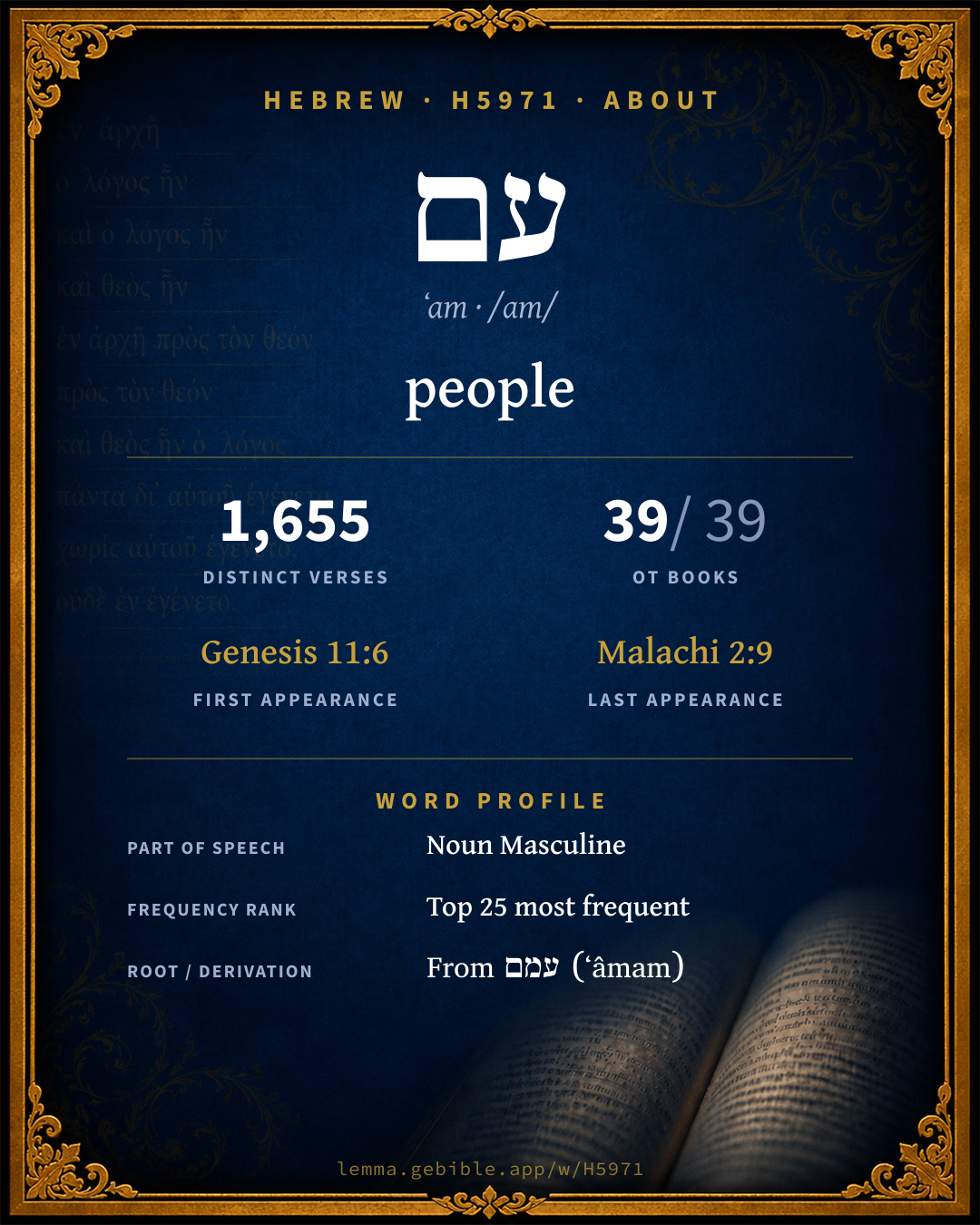
עַם
people
‘people’ is one of 2 main senses fuller range ↓
Full lexicon entry — Brown-Driver-Briggs (BDB)
From Brown-Driver-Briggs (BDB)
Where this word appears
See every Absolute-state word in the Hebrew Bible →
Grammar key — what these labels mean
Part of speech
- Noun
- A naming word — a person, place, thing, or idea.
Noun type
- Common
- A common noun — a general class of person, place, or thing (“king,” “city,” “water”), not a specific name.
- Proper
- A name of a specific person, place, or people (e.g. Abraham, Zion, Israel).
State
- Absolute
- The independent form of a noun, not bound to a following word.
- Construct
- A noun bound to a following noun in a possessive / “of” relationship (the construct chain).
Gender
- Masculine
- Grammatically masculine.
Number
- Singular
- One.
- Plural
- More than one (in Hebrew, generally three or more).
71 verses where H5971 appears in the Absolute state in the Book of 2 Samuel. Filtered view — show all forms. Click any verse to open its interlinear word-by-word view. Verse text shown in the World English Bible for context — . Each verse’s Hebrew form is shown with its reference; the English is not keyword-highlighted, since the data carries no word-level English alignment. Use “Compare translations” on any verse to read it across multiple English versions. This concordance covers the Hebrew Bible; Septuagint (Greek Old Testament) occurrences are not indexed here.
2 Samuel
- 2 Samuel 1:4 הָ/עָ֜ם הָ/עָם֙ ptcl def.art + n c ms ptcl def.art + n c ms David said to him, How went the matter? Please tell me. He answered, The people are fled from the battle, and many of the people also are fallen and dead; and Saul and Jonathan his son are dead also.
- 2 Samuel 2:26 לָ/עָ֔ם prep det + n c ms Then Abner called to Joab, and said, "Shall the sword devour forever? Don't you know that it will be bitterness in the latter end? How long shall it be then, before you bid the people return from following their brothers?"
- 2 Samuel 2:27 הָ/עָ֔ם ptcl def.art + n c ms Joab said, As God lives, if you had not spoken, surely then in the morning the people had gone away, nor followed everyone his brother.
- 2 Samuel 2:28 הָ/עָ֔ם ptcl def.art + n c ms So Joab blew the trumpet; and all the people stood still, and pursued after Israel no more, neither fought they any more.
- 2 Samuel 2:30 הָ/עָ֑ם ptcl def.art + n c ms Joab returned from following Abner: and when he had gathered all the people together, there lacked of David's servants nineteen men and Asahel.
- 2 Samuel 3:31 הָ/עָ֣ם ptcl def.art + n c ms David said to Joab, and to all the people who were with him, Tear your clothes, and gird you with sackcloth, and mourn before Abner. King David followed the bier.
- 2 Samuel 3:32 הָ/עָֽם ptcl def.art + n c ms They buried Abner in Hebron: and the king lifted up his voice, and wept at the grave of Abner; and all the people wept.
- 2 Samuel 3:34 הָ/עָ֖ם ptcl def.art + n c ms Your hands were not bound, nor your feet put into fetters: As a man falls before the children of iniquity, so did you fall. All the people wept again over him.
- 2 Samuel 3:35 הָ/עָ֗ם ptcl def.art + n c ms All the people came to cause David to eat bread while it was yet day; but David swore, saying, God do so to me, and more also, if I taste bread, or anything else, until the sun be down.
- 2 Samuel 3:36 הָ/עָ֣ם הָ/עָ֖ם ptcl def.art + n c ms ptcl def.art + n c ms All the people took notice of it, and it pleased them; as whatever the king did pleased all the people.
- 2 Samuel 3:37 הָ/עָ֛ם ptcl def.art + n c ms So all the people and all Israel understood that day that it was not of the king to kill Abner the son of Ner.
- 2 Samuel 6:2 הָ/עָם֙ ptcl def.art + n c ms David arose, and went with all the people who were with him, from Baale Judah, to bring up from there the ark of God, which is called by the Name, even the name of Yahweh of Hosts who sits [above] the cherubim.
- 2 Samuel 6:18 הָ/עָ֔ם ptcl def.art + n c ms When David had made an end of offering the burnt offering and the peace-offerings, he blessed the people in the name of Yahweh of Hosts.
- 2 Samuel 6:19 הָ/עָ֜ם הָ/עָ֖ם ptcl def.art + n c ms ptcl def.art + n c ms He dealt among all the people, even among the whole multitude of Israel, both to men and women, to everyone a cake of bread, and a portion [of flesh], and a cake of raisins. So all the people departed everyone to his house.
- 2 Samuel 7:23 כְ/עַמְּ/ךָ֙ לְ/עָ֜ם עַמְּ/ךָ֗ prep + n c ms cs + sfx pers 2ms prep + n c ms n c ms cs + sfx pers 2ms What one nation in the earth is like your people, even like Israel, whom God went to redeem to himself for a people, and to make him a name, and to do great things for you, and awesome things for your land, before your people, whom you redeem to you out of Egypt, [from] the nations and their gods?
- 2 Samuel 7:24 עַמְּ/ךָ֨ לְ/עָ֖ם n c ms cs + sfx pers 2ms prep + n c ms You did establish to yourself your people Israel to be a people to you forever; and you, Yahweh, became their God.
- 2 Samuel 10:10 הָ/עָ֔ם ptcl def.art + n c ms The rest of the people he committed into the hand of Abishai his brother; and he put them in array against the children of Ammon.
- 2 Samuel 10:13 וְ/הָ/עָם֙ conj + ptcl def.art + n c ms So Joab and the people who were with him drew near to the battle against the Syrians: and they fled before him.
- 2 Samuel 11:7 הָ/עָ֔ם ptcl def.art + n c ms When Uriah was come to him, David asked of him how Joab did, and how the people fared, and how the war prospered.
- 2 Samuel 11:17 הָ/עָ֖ם ptcl def.art + n c ms The men of the city went out, and fought with Joab: and there fell some of the people, even of the servants of David; and Uriah the Hittite died also.
- 2 Samuel 12:28 הָ/עָ֔ם ptcl def.art + n c ms Now therefore gather the rest of the people together, and encamp against the city, and take it; lest I take the city, and it be called after my name.
- 2 Samuel 12:29 הָ/עָ֖ם ptcl def.art + n c ms David gathered all the people together, and went to Rabbah, and fought against it, and took it.
- 2 Samuel 12:31 הָ/עָ֨ם הָ/עָ֖ם ptcl def.art + n c ms ptcl def.art + n c ms He brought forth the people who were therein, and put them under saws, and under harrows of iron, and under axes of iron, and made them pass through the brick kiln: and thus did he to all the cities of the children of Ammon. David and all the people returned to Jerusalem.
- 2 Samuel 13:34 עַם n c ms But Absalom fled. The young man who kept the watch lifted up his eyes, and looked, and, behold, there came much people by the way of the hill-side behind him.
- 2 Samuel 14:15 הָ/עָ֑ם ptcl def.art + n c ms Now therefore seeing that I have come to speak this word to my lord the king, it is because the people have made me afraid: and your handmaid said, I will now speak to the king; it may be that the king will perform the request of his servant.
- 2 Samuel 15:12 וְ/הָ/עָ֛ם conj + ptcl def.art + n c ms Absalom sent for Ahithophel the Gilonite, David's counselor, from his city, even from Giloh, while he was offering the sacrifices. The conspiracy was strong; for the people increased continually with Absalom.
- 2 Samuel 15:17 הָ/עָ֖ם ptcl def.art + n c ms The king went forth, and all the people after him; and they stayed in Beth Merhak.
- 2 Samuel 15:23 הָ/עָ֖ם הָ/עָם֙ ptcl def.art + n c ms ptcl def.art + n c ms All the country wept with a loud voice, and all the people passed over: the king also himself passed over the brook Kidron, and all the people passed over, toward the way of the wilderness.
- 2 Samuel 15:24 הָ/עָ֖ם ptcl def.art + n c ms Behold, Zadok also [came], and all the Levites with him, bearing the ark of the covenant of God; and they set down the ark of God; and Abiathar went up, until all the people had done passing out of the city.
- 2 Samuel 15:30 הָ/עָ֣ם ptcl def.art + n c ms David went up by the ascent of the [Mount of] Olives, and wept as he went up; and he had his head covered, and went barefoot: and all the people who were with him covered every man his head, and they went up, weeping as they went up.
- 2 Samuel 16:6 הָ/עָם֙ ptcl def.art + n c ms He cast stones at David, and at all the servants of king David: and all the people and all the mighty men were on his right hand and on his left.
- 2 Samuel 16:14 הָ/עָ֥ם ptcl def.art + n c ms The king, and all the people who were with him, came weary; and he refreshed himself there.
- 2 Samuel 16:15 הָ/עָם֙ ptcl def.art + n c ms Absalom, and all the people, the men of Israel, came to Jerusalem, and Ahithophel with him.
- 2 Samuel 16:18 וְ/הָ/עָ֥ם conj + ptcl def.art + n c ms Hushai said to Absalom, No; but whom Yahweh, and this people, and all the men of Israel have chosen, his will I be, and with him will I abide.
- 2 Samuel 17:2 הָ/עָ֣ם ptcl def.art + n c ms and I will come on him while he is weary and weak-handed, and will make him afraid; and all the people who are with him shall flee; and I will strike the king only;
- 2 Samuel 17:3 הָ/עָ֖ם הָ/עָ֖ם ptcl def.art + n c ms ptcl def.art + n c ms and I will bring back all the people to you: the man whom you seek is as if all returned: [so] all the people shall be in peace.
- 2 Samuel 17:8 הָ/עָֽם ptcl def.art + n c ms Hushai said moreover, You know your father and his men, that they are mighty men, and they are fierce in their minds, as a bear robbed of her cubs in the field; and your father is a man of war, and will not lodge with the people.
- 2 Samuel 17:9 בָּ/עָ֕ם prep det + n c ms Behold, he is hid now in some pit, or in some [other] place: and it will happen, when some of them are fallen at the first, that whoever hears it will say, There is a slaughter among the people who follow Absalom.
- 2 Samuel 17:16 הָ/עָ֖ם ptcl def.art + n c ms Now therefore send quickly, and tell David, saying, Don't lodge this night at the fords of the wilderness, but by all means pass over; lest the king be swallowed up, and all the people who are with him.
- 2 Samuel 17:22 הָ/עָם֙ ptcl def.art + n c ms Then David arose, and all the people who were with him, and they passed over the Jordan: by the morning light there lacked not one of them who had not gone over the Jordan.
- 2 Samuel 17:29 וְ/לָ/עָ֥ם הָ/עָ֗ם conj + prep det + n c ms ptcl def.art + n c ms and honey, and butter, and sheep, and cheese of the herd, for David, and for the people who were with him, to eat: for they said, The people are hungry, and weary, and thirsty, in the wilderness.
- 2 Samuel 18:1 הָ/עָ֖ם ptcl def.art + n c ms David numbered the people who were with him, and set captains of thousands and captains of hundreds over them.
- 2 Samuel 18:2 הָ/עָ֗ם הָ/עָ֔ם ptcl def.art + n c ms ptcl def.art + n c ms David sent forth the people, a third part under the hand of Joab, and a third part under the hand of Abishai the son of Zeruiah, Joab's brother, and a third part under the hand of Ittai the Gittite. The king said to the people, I will surely go forth with you myself also.
- 2 Samuel 18:3 הָ/עָ֜ם ptcl def.art + n c ms But the people said, You shall not go forth: for if we flee away, they will not care for us; neither if half of us die, will they care for us: but you are worth ten thousand of us; therefore now it is better that you are ready to help us out of the city.
- 2 Samuel 18:4 הָ/עָם֙ ptcl def.art + n c ms The king said to them, What seems you best I will do. The king stood by the gate-side, and all the people went out by hundreds and by thousands.
- 2 Samuel 18:5 הָ/עָ֣ם ptcl def.art + n c ms The king commanded Joab and Abishai and Ittai, saying, Deal gently for my sake with the young man, even with Absalom. All the people heard when the king gave all the captains charge concerning Absalom.
- 2 Samuel 18:6 הָ/עָ֛ם ptcl def.art + n c ms So the people went out into the field against Israel: and the battle was in the forest of Ephraim.
- 2 Samuel 18:8 בָּ/עָ֔ם prep det + n c ms For the battle was there spread over the surface of all the country; and the forest devoured more people that day than the sword devoured.
- 2 Samuel 18:16 הָ/עָ֔ם הָ/עָֽם ptcl def.art + n c ms ptcl def.art + n c ms Joab blew the trumpet, and the people returned from pursuing after Israel; for Joab held back the people.
- 2 Samuel 19:2 הָ/עָ֑ם הָ/עָ֗ם ptcl def.art + n c ms ptcl def.art + n c ms The victory that day was turned into mourning to all the people; for the people heard say that day, The king grieves for his son.
- 2 Samuel 19:3 הָ/עָ֛ם הָ/עָם֙ ptcl def.art + n c ms ptcl def.art + n c ms The people got them by stealth that day into the city, as people who are ashamed steal away when they flee in battle.
- 2 Samuel 19:8 הָ/עָ֞ם הָ/עָם֙ ptcl def.art + n c ms ptcl def.art + n c ms Then the king arose, and sat in the gate. They told to all the people, saying, Behold, the king is sitting in the gate: and all the people came before the king. Now Israel had fled every man to his tent.
- 2 Samuel 19:9 הָ/עָם֙ ptcl def.art + n c ms All the people were at strife throughout all the tribes of Israel, saying, The king delivered us out of the hand of our enemies, and he saved us out of the hand of the Philistines; and now he is fled out of the land from Absalom.
- 2 Samuel 19:39 הָ/עָ֛ם ptcl def.art + n c ms All the people went over the Jordan, and the king went over: and the king kissed Barzillai, and blessed him; and he returned to his own place.
- 2 Samuel 20:12 הָ/עָ֗ם ptcl def.art + n c ms Amasa lay wallowing in his blood in the midst of the highway. When the man saw that all the people stood still, he carried Amasa out of the highway into the field, and cast a garment over him, when he saw that everyone who came by him stood still.
- 2 Samuel 20:15 הָ/עָם֙ ptcl def.art + n c ms They came and besieged him in Abel of Beth Maacah, and they cast up a mound against the city, and it stood against the rampart; and all the people who were with Joab battered the wall, to throw it down.
- 2 Samuel 20:22 הָ/עָ֜ם ptcl def.art + n c ms Then the woman went to all the people in her wisdom. They cut off the head of Sheba the son of Bichri, and threw it out to Joab. He blew the trumpet, and they were dispersed from the city, every man to his tent. Joab returned to Jerusalem to the king.
- 2 Samuel 22:28 עַ֥ם n c ms The afflicted people you will save; But your eyes are on the haughty, that you may bring them down.
- 2 Samuel 22:44 עַמִּ֑/י עַ֥ם n c ms cs + sfx pers 1cs n c ms You also have delivered me from the strivings of my people; You have kept me to be the head of the nations: A people whom I have not known shall serve me.
- 2 Samuel 22:48 עַמִּ֖ים n c mp Even the God who executes vengeance for me, Who brings down peoples under me,
- 2 Samuel 23:10 וְ/הָ/עָ֛ם conj + ptcl def.art + n c ms He arose, and struck the Philistines until his hand was weary, and his hand froze to the sword; and Yahweh worked a great victory that day; and the people returned after him only to take spoil.
- 2 Samuel 23:11 וְ/הָ/עָ֥ם conj + ptcl def.art + n c ms After him was Shammah the son of Agee a Hararite. The Philistines were gathered together into a troop, where was a plot of ground full of lentils; and the people fled from the Philistines.
- 2 Samuel 24:2 הָ/עָ֑ם הָ/עָֽם ptcl def.art + n c ms ptcl def.art + n c ms The king said to Joab the captain of the host, who was with him, Go now back and forth through all the tribes of Israel, from Dan even to Beersheba, and number you the people, that I may know the sum of the people.
- 2 Samuel 24:3 הָ/עָ֜ם ptcl def.art + n c ms Joab said to the king, Now Yahweh your God add to the people, however many they may be, one hundred times; and may the eyes of my lord the king see it: but why does my lord the king delight in this thing?
- 2 Samuel 24:4 הָ/עָ֖ם ptcl def.art + n c ms Notwithstanding, the king's word prevailed against Joab, and against the captains of the host. Joab and the captains of the host went out from the presence of the king, to number the people of Israel.
- 2 Samuel 24:9 הָ/עָ֖ם ptcl def.art + n c ms Joab gave up the sum of the numbering of the people to the king: and there were in Israel eight hundred thousand valiant men who drew the sword; and the men of Judah were five hundred thousand men.
- 2 Samuel 24:10 הָ/עָ֑ם ptcl def.art + n c ms David's heart struck him after that he had numbered the people. David said to Yahweh, I have sinned greatly in that which I have done: but now, Yahweh, put away, I beg you, the iniquity of your servant; for I have done very foolishly.
- 2 Samuel 24:15 הָ/עָ֗ם ptcl def.art + n c ms So Yahweh sent a pestilence on Israel from the morning even to the time appointed; and there died of the people from Dan even to Beersheba seventy thousand men.
- 2 Samuel 24:16 בָּ/עָם֙ prep det + n c ms When the angel stretched out his hand toward Jerusalem to destroy it, Yahweh repented him of the evil, and said to the angel who destroyed the people, It is enough; now stay your hand. The angel of Yahweh was by the threshing floor of Araunah the Jebusite.
- 2 Samuel 24:17 בָ/עָ֗ם prep det + n c ms David spoke to Yahweh when he saw the angel who struck the people, and said, Behold, I have sinned, and I have done perversely; but these sheep, what have they done? Please let your hand be against me, and against my father's house.
- 2 Samuel 24:21 הָ/עָֽם ptcl def.art + n c ms Araunah said, Why is my lord the king come to his servant? David said, To buy the threshing floor of you, to build an altar to Yahweh, that the plague may be stayed from the people.
About this entry
At a glance — auto-summarized from this page’s data, not written by a person. Every figure links to its source below. This summary describes the numbers; it doesn’t interpret them.
עם — transliterated ʻam — is a Hebrew noun carrying the sense “people.” Its earliest occurrence is Genesis 11:6. It appears 1,655 verses across 39 books of the Hebrew Bible, among its most common vocabulary. The lexicon spreads it across several senses; see its full sense range. It shares a root with עמם, עם and עמה. Each statement above links to its evidence; the full detail follows below.
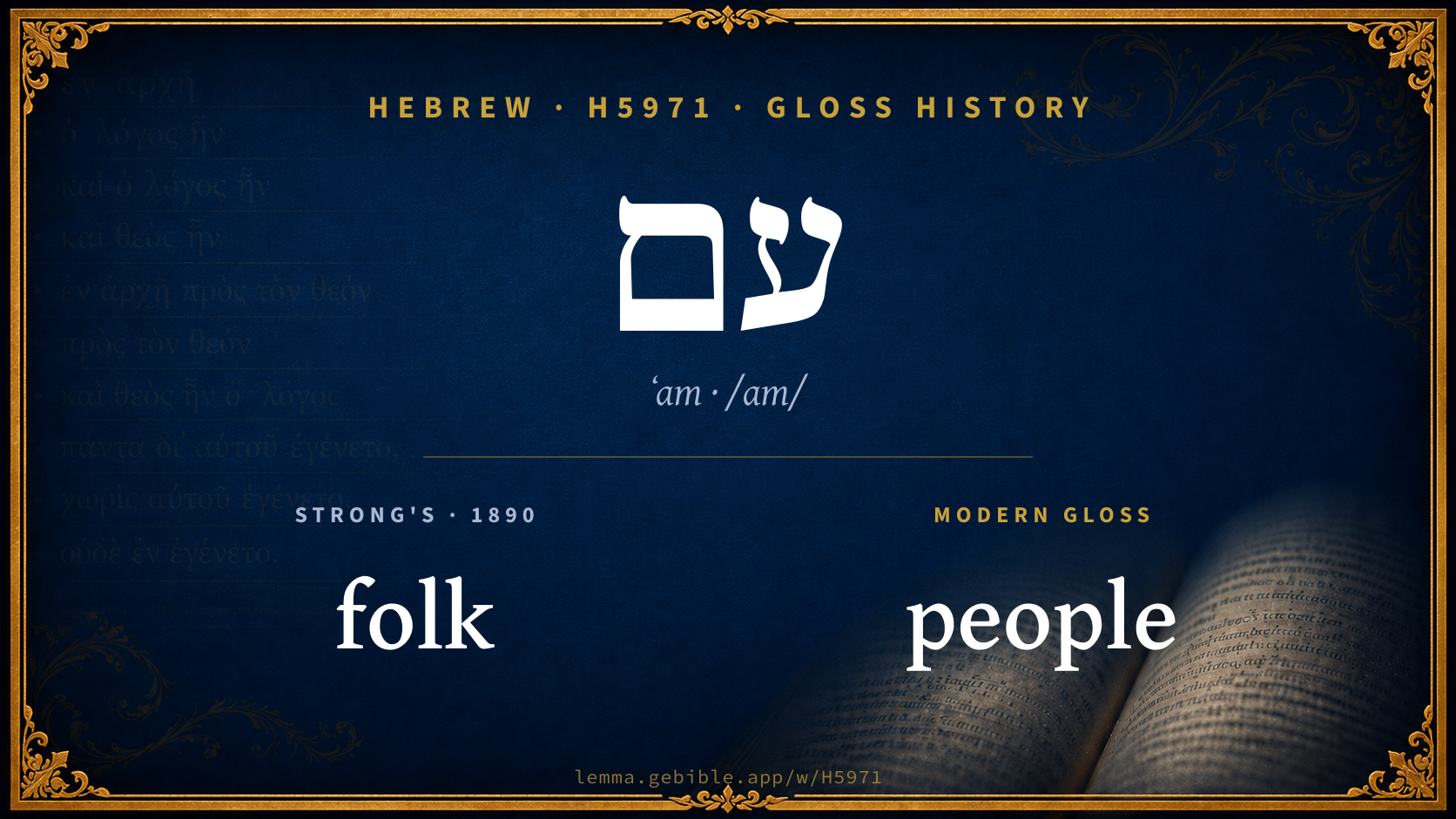
Gloss history
Strong's 1890 vs modern scholarship
About this word
Strong's H5971 catalogs a Hebrew word from the Hebrew Old Testament.
These counts are not copied from any lexicon or concordance. They are computed here, from the morphology-tagged Hebrew Old Testament. What Lemma adds →
- 1,655
- distinct verses
- The word appears in 1,655 distinct verses.
- 39 / 39
- OT books
- The word appears in 39 of 39 Old Testament books.
- #24
- by frequency
- Top 25 most frequent Hebrew words (rank 24 of 8,640 Hebrew words by occurrence).
View all 1,655 occurrences in the concordance →
By section of the Old Testament
By traditional corpus
Conventional, traditional groupings — biblical authorship is debated, so this is a traditional corpus grouping, not an authorship claim. Each share is this word’s portion of its verses in that division of the Hebrew canon. Each figure is a share of the word’s 1,655 distinct verses.
- Prophets (Nevi'im) 874 verses · 53%
- Torah (Pentateuch) 393 verses · 24%
- Writings (Ketuvim) 388 verses · 23%
How translations render this word
Counts come from each version’s own published word-to-Strong’s tagging or interlinear alignment — an approximate guide to how each version renders this word, not a word-level alignment the data otherwise carries. Because each total is that version’s own tagged count, the per-version totals vary from one another and need not match the appearance or distinct-verse counts above. These counts may also differ from a printed concordance because Lemma counts each distinctly tagged rendering and does not collapse phrase taggings into a single head-word total. This is a fixed set of word-tagged versions (KJV, ASV, BSB, ULT) and does not change with the reading translation you choose elsewhere. Each version’s license is shown beside its name below (and on Sources).
BDB lists this Strong’s number as 3 distinct words (homographs). Each count above pools all of them and is not split by sense — see the Senses section below. A low-frequency rendering may belong to a different one of those words, not the primary meaning.
- King James Version†: People 1,181×, All the people 214×, Among the people 24×
- American Standard Version†: People 987×, All the people 192×, Peoples 95×
- Berean Standard Bible†: People 1,246×, Peoples 103×, Troops 83×
- unfoldingWord Literal Text†: People 1,394×, Peoples 144×, People of 83×
King James Version Public Domain
Renders H5971 across 1,857† tagged occurrences — most commonly:
Plus other, less common renderings. Plus 216 renderings that appear only once — usually multi-word phrases or single function words the recovered tagging swept in, not distinct renderings. Not rendered by a distinct English word in 5 further occurrences.
American Standard Version Public Domain
Renders H5971 across 1,857† tagged occurrences — most commonly:
Plus other, less common renderings. Plus 273 renderings that appear only once — usually multi-word phrases or single function words the recovered tagging swept in, not distinct renderings.
Berean Standard Bible Public Domain
Renders H5971 across 1,748† tagged occurrences — most commonly:
Plus other, less common renderings. Plus 86 renderings that appear only once — usually multi-word phrases or single function words the recovered tagging swept in, not distinct renderings. Not rendered by a distinct English word in 116 further occurrences.
unfoldingWord Literal Text CC BY-SA 4.0
Renders H5971 across 1,856† tagged occurrences — most commonly:
Plus other, less common renderings. Plus 58 renderings that appear only once — usually multi-word phrases or single function words the recovered tagging swept in, not distinct renderings.
18 senses and sub-senses in the full BDB
What do BDB’s symbols mean?
BDB uses these scholarly abbreviations:
| Symbol | Meaning |
|---|---|
| 𝔊 | the Septuagint (the ancient Greek translation, LXX) |
| 𝔙 | the Vulgate (the Latin translation) |
| 𝔖 | the Syriac version (the Peshitta) |
| 𝔗 | the Targum (the Aramaic translation) |
| ψ | the Psalms |
| √ | root (the underlying root or stem) |
| ‖ | parallel passage (a synonymous or contrasted parallel) |
| † | the dagger: every passage where the word occurs is cited |
The 18 senses and sub-senses the full Brown-Driver-Briggs lexicon distinguishes for this word, in lexicon order (not ranked by frequency), with BDB’s own verbatim wording and sub-sense lettering. Shown in Hebrew script with BDB’s own scholarly abbreviations. The condensed entry is in the Lexicon Entry tab. See also the Forms in the corpus table below.
עם I
- 1. a people, nation (sometimes ‖ גּוֹי), n. coll. (sg. Ex 21:8 Jos 17:14, 15, 17; 2 S 17:29 + often, or pl. Ex 20:15; 24:2; Je 5:31 + often, or both in same clause Ex 1:20; 2 S 13:24): עַם אֶחָד = all mankind Gn 11:6 (J); peoples in gen. 27:29 (J; ‖ לְאֻמִּים), Ex 19:5 (E), Dt 2:25; 4:6 + often Dt, Ne 13:24 + often; קְהַל עַמִּים Gn 28:3 (P) an assembly (multitude) of peoples, 48:4 (P), Ez 23:24; 32:3 (+ דַבִּים); one’s own people Je 46:16 ψ 45:11; Ru 1:10, 15, 16(×2) + (on עַמִּי נָדִיב Ct 6:12 v. especially Bu); particular peoples, Egypt Gn 41:40 (E), Ex 1:22 (E), Ne 9:10 +; עַם־אֲרָם Am 1:5; עַם־כְּמוֹשׁ (i.e. Moab) Nu 21:29 (JE), Je 48:46; but especially Isr. Ex 1:20 (E) + often; עַם־בְּנֵי יִשׂ׳ v 9 (J); called ע׳ יהוה Nu 11:29 (E), 1 S 2:24 +, and (by י׳) עַמִּי Ex 3:7; 5:1 (J) + often (all periods); קְהַל עַם־הָאֱלֹהִים Ju 20:2, עַם־הַקָּהָל Lv 16:33 (P), קְהַל עָם ψ 107:32; especially הָעָם הַזֶּה (often in contempt or disgust) Nu 11:1, 12, 13 +; fig. of ants Pr 30:25, the shaphan v 26, locusts Jo 2:2, cf. לְעַם לְצִיִּים ψ 74:14 (where read לְעַם צִיִּים Hup-Now).—On Ju 1:16 v. עֲמָלֵקִי. e.g. Exodus 21:8
- 2. = smaller units, e.g.
- a. inhab. of a city Gn 19:4 (J), 1 S 9:12, 13; Je 29:16, 25; 2 Ch 31:4 + (Je 8:5 del. יְרוּשׁ׳ 𝔊 Gie Co Rothst). e.g. Genesis 19:4
- b. inhab. of a locality Je 37:12 [appar. not = tribe, Dt 33:3 read עַמּוֹ 𝔊 Di Dr, Ho 10:14; Ju 5:8, 14 read בְּעָרֶיךָ We Now; v. sub d]. e.g. Jeremiah 37:12
- c. retainers, followers Gn 14:16; 32:8; 33:15; 35:6; Ju 3:18; 8:5; 2 S 15:17; Je 41:13, 14 +. e.g. Genesis 14:16
- d. people bearing arms 1 S 11:11; 1 K 20:10 +; ע׳ כָּבֵד Nu 20:20 (JE), i.e. a powerful force; עַם הַצָּבָא Nu 31:32 (P), ע׳ הַמִּלְחָמָה Jos 8:1, 3, 11; 10:7; 11:7 (all JE); so prob. Ju 5:8 a (fighting) band; perhaps also v 14 (read sg.? v. GFM Bu). e.g. 1 Samuel 11:11
- 3. = common people Je 21:7; 22:4, Lv 4:27 (opp. ruler v 22), Ne 5:1 (opp. יְהוּדִים), 7:5 (opp. rulers). e.g. Jeremiah 21:7
- 4. people in gen., persons Gn 50:20 (E), so appar. כָּל־הָעָם אֲשֵׁר וגו׳ Ex 33:16 (J), Nu 11:34 (J), Jos 5:5(×2) (D), Ju 9:36 (as sg.), v 37 (as pl.), Je 36:9; persons labouring 1 K 9:23; superior persons Jb 12:2 (iron.); עַם עוֹלָם Ez 26:20 people of long ago (now in Sheʾôl). e.g. Genesis 50:20
- 5. phrases are:
- a. (עַמָּהּ, עַמִּי, עַמְּךָ) כְּנֵי עַמּוֹ members of one’s people, compatriots, fellow-countrymen, etc. Nu 22:5 (E), Gn 23:11 (P) Lv 19:18 (H), Ju 14:16, 17; Ez 33:2, 12 +. e.g. Numbers 22:5
- b. בְּנֵי הָעָם = common people (v. 3) 2 K 23:6; Je 26:23 +; people in gen. שַׁעַר בְּנֵי הָעָם Je 17:19 i.e. public gate 2 Ch 35:5, 12. e.g. 2 Kings 23:6
- c. עַם הָאָרֶץ the people at large, as a body 2 K 11:14, 18, 19, 20; 15:5; 16:15; 21:24(×2) +, Je 37:2; 44:21 Lv 20:2 (H), Gn 23:7, 12, 13 (P); common people Je 34:19, cf. דַּלַּת ע׳ הא׳ 2 K 24:14; disting. from prince Ez 45:22; 46:3, 9, from priests Hg 2:4 Zc 7:5; = Canaanites Nu 14:9 (JE), cf. עַמֵּי הָאָרֶץ 1 Ch 5:25; mixed post-exil. population Ezr 4:4. e.g. 2 Kings 11:14
- d. עַמֵּי הָאָרֶץ usually peoples of the earth Jos 4:24 (D), 2 Ch 32:19 +; of heathen peoples about and in Pal. after exile Ezr 10:2, 11; traders Ne 10:31; עַמֵּי הָאֲרָצוֹת 9:30; 10:29; 2 Ch 32:13. e.g. Joshua 4:24
- e. מִשְׁפְּחוֹת עַמִּים ψ 96:7 = 1 Ch 16:28 (cf. ψ 22:23). e.g. Psalms 96:7
- f. בַּת־עַמִּי = people personif. Is 22:4; Je 4:11 + 7 times Je + 6:14 (van d. H.; om. בַּת Baer Gi), La 2:11; 3:48; 4:3, 6, 10; בְּתוּלַת בַּת־עַמִּי Je 14:17. e.g. Isaiah 22:4
- g. designations of Isr. are: עַם־קָדוֹשׁ Dt 7:6 + 3 times, ע׳ קְדוֹשִׁים Dn 8:24, ע׳ (ה)קֹדֶשׁ Is 62:12; 63:18; Dn 12:7; ע׳ סְגֻלָּה Dt 7:6; 14:2; 26:18. e.g. Deuteronomy 7:6
- h. of foreign (non-Isr.) peoples: ע׳ נָכְרִי Ex 21:8 (E), ע׳ אַחֵר Dt 28:32, and especially from language, ע׳ עִמְקֵי שָׂפָה Ez 3:5 cf. v 6, כִּלְשׁוֹן עַם וָעָם Ne 13:24 cf. Est 1:22(×2); 3:12, ע׳ לֹעֵג ψ 114:1. e.g. Exodus 21:8
- i. עַם עֶבְרָתִי Is 10:6, ע׳ חֶרְמִי 34:11, ע׳־מִבְחָרָיו Dn 11:15, עַמֵּי תּוֹעֵבוֹת הָאֵלָּה Ezr 9:14; לֹא עַם בִּינוֹת Is 27:11.—For עַם־עוֹלָם Is 44:7 read (אֹתִיּוֹת) מֵעוֹלָם (מִי הִשְׁמִי)עַ Oort Du Kit CheHpt cf. PerlesAnal. 40, 64. e.g. Isaiah 10:6
עם II [m.] kinsman* kinsman, later development of i. עַם RSK 58
Senses from the full Brown-Driver-Briggs lexicon (Brown, Driver, Briggs; Oxford 1906 — public domain), digitized via Sefaria, supplemented by the OpenScriptures HebrewLexicon (CC BY 4.0). Full attribution on Sources.
Word origin
II. n.m. Gn 11:6 (v. infr.) people (NH id., plebeian, common man; 𝔗 עַמָּא people, pl. peoples, tribes, etc.; Syriac ܥܰܡܳܐ; Arabic عَمٌّ v. supr.; orig. meaning prob. those united, connected, related, cf. WeGGN 1893, 480);—abs. עַם Gn 11:6 +, עַם Ju 9:36 +, הָעָם Jos 8:11 +; cstr. עַם Nu 21:29 +; sf. עַמִּי Ex 3:7 +, עַמְּךָ 22:27 +, etc.; pl. עַמִּים Is 2:3 +, עֲמָמִים (cf. Biblical Aramaic) Ne 9:22; cstr. עַמֵּי 1 K 8:43 +, עַמְמֵי Ne 9:24; pl. c. sf. v. ii. עַם;—(Thes cites foll. as f. וְחָטָאת עַמֶּ֑ךָ Ex 5:16 [but corrupt and unintellig.; read perhaps וְחַטָאתָ לְע׳, so 𝔊 𝔖 Di]; Ju 18:7 [but ישֶׁבֶת must agree with lost word city, or the like, v. GFM]; Je 8:5 [but read שׁוֹבַב for שׁוֹבְבָה Gie]);—
III. n.[m.] kinsman* kinsman, later development of i. עַם RSK 58; 2nd ed. 72. (on father’s side) (Arabic عَمٌّ paternal uncle, etc. v. I. עמם; cf. perhaps TelAm. ammu, kinsmen (?); on Nab. עם ancestor cf. Lzb151, 499; v. also especially NesEg 187, ZAW xvi (1896), 322 f. Krenkelib. viii (1888), 280–84);—sf. עַמִּי in בֶּן־עַמִּי (q.v.), and n.pr. sqq.; elsewhere pl. sf. עַמֶּיךָ Nu 27:13; 31:2 (Lv 19:16 read עַמְּךָ 𝔊 Sam), + (poss.) עֲמָמֶיךָ Ju 5:14; עַמָּיו Gn 25:8 + 15 times, עַמֶּיהָ 17:14 + 3 times; read עַמַּי (for MT עַמִּי, 1עַם; cf. Krenkell.c. 281) Gn 49:29 and perhaps Ju 14:3 (cf. Lv 21:14); according to Buhl Kit also 2 K 4:13;—father’s kinsmen: וַיֵּאָסֵף אֶל־עַמָּיו Gn 25:8 (of joining kinsmen in Sheʾôl), so v 17; 35:29; 49:33; Nu 20:24; Dt 32:50, cf. Gn 49:29 (v. supr.), Nu 27:13; 31:2; Dt 32:50 (all P); וְנִכְרְתָה הַנֶּפֶשׁ מֵעַמֶּיהָ Gn 17:14 (severed from living kinsmen), so Lv 7:20, 21, 25, 27; 19:8; 23:29; Nu 9:13, מִקֶּרֶב עַמֶּיהָ Ex 31:14, cf. 30:33, 38; Lv 17:9 (all PH); מֵעַמָּיו יִקַּח אִשָּׁה 21:14 (H), and perhaps Ju 14:3 (sim. 1עַם: [ם—ָ, הּ—ָ] מִקֶּרֶב עַמּוֹ Lv 17:4, 10; 18:29 +); other combin. Ju 5:14 (si vera l., read perhaps בְּעַמֶּ֑ךָ, v. 1.עַם 2 d), Lv 21:1, 4, 15 (H), Ez 18:18 and (perhaps) 2 K 4:13.—בֶּן־עַמִּי (v. p. 122 b) perhaps = son of my kinsman; on n.pr. c. עַם v. GrayProp. N. 41 ff..
— Brown-Driver-Briggs (Oxford 1906, public domain), digitized via Sefaria, supplemented by the OpenScriptures HebrewLexicon (CC BY 4.0). See Sources.
Derived from עמם (ʻâmam) (H6004) — to darken.
Jastrow Dictionary
A second Hebrew/Aramaic lexicon for comparison, covering Aramaic and post-biblical (Talmudic, Targumic, Midrashic) usage that the biblical-Hebrew BDB does not. Matched by lemma rather than by Strong’s number, so a lemma may carry more than one Jastrow headword (shown separately below), and the entries cover usage well beyond the Bible.
עִם
- v. עַם) junction; (prep.) with, near. Sabb. I, 8 עם השמש with the sun, i.e. as long as the sun shines, before sunset. Ib. II, 7 עם חשיכה, v. חֲשֵׁיכָה. Ber. 7ᵃ ותתנהג עם בניך וכ׳ and deal with thy children mercifully. Snh. 23ᵃ מי חותם עִמָּהֶן who is to sign as witness with them; a. fr.
עִם ²
- Targ. O. Gen. XXV, 11. Targ. Ps. LIV, 2 עִימָּנָא Ms. (ed. גַּבָּן). Targ. Job XXXII, 6 עִימְּכוֹן Ms. (ed. יַתְכוֹן); a. fr.
עַם
- עמם to press, crowd, join) gathering, crowd, people. Snh. 94ᵇ, v. עָיֵף. Men. 53ᵇ יבא זח … לעם זו let ‘this one’ (Moses) come and receive ‘this’ (the Law) … for ‘this people’ (Israel); a. fr.—עם הארץ, v. אֶרֶץ.—Pl. עַמִּים gentiles. Sabb. 14ᵇ, a. fr. על ארץ הע׳ concerning (importations from) heathen countries. Y. Shebi. VI, 36ᵇ bot.; a. fr.—V. עֲמָם.
עַם ²
- Targ. Gen. XII, 2. Targ. Ez. XLV, 16. Targ. Cant. VI, 5; a. v. fr.—Erub. 14ᵇ, a. e. מאי ע׳ דבר, v. דְּבַר. Y. Kil. V, 29ᵈ bot. כל ע׳; Y. Yeb. XIII, beg. 13ᵇ כל עַמָּה, a. fr., v. כּוֹל. Sot. IX, 15 ע׳ דארעא = עם הארץ, ignorant people; a. fr.—Pl., v. עֲמַם II.
A Dictionary of the Targumim, the Talmud Babli and Yerushalmi, and the Midrashic Literature (Marcus Jastrow; London, Luzac, 1903) — Public Domain. Digitized via Sefaria. Digitized via Sefaria. Full attribution on Sources.
Forms in the corpus
The 348 distinct written forms H5971 takes in the Hebrew Bible, most frequent first — each parse links to that state’s occurrences in the concordance. Hebrew forms include their vowel points and cantillation, so a single lemma takes many written forms.
The 60 most common forms are shown; 288 rarer forms follow in the full concordance.
Same root — word family
Other BDB entries built from the same root as H5971, grouped by Strong’s listed origin. These share a root / origin per the lexicon — not necessarily a shared meaning. Each links to that word’s own entry.
Derives from
Shares the same root
Derived from this word
Proper names from this root
People and places named from this root — a name, not an additional meaning of the word.
- עמון ʻAmmôwn H5983 Ammon
- עמיאל ʻAmmîyʼêl H5988 Ammiel
- עמיהוד ʻAmmîyhûwd H5989 Ammihud
- עמיזבד ʻAmmîyzâbâd H5990 Ammizabad
- עמיחור ʻAmmîychûwr H5991 Ammihur
- עמינדב ʻAmmîynâdâb H5992 Amminadab
- עמי נדיב ʻAmmîy Nâdîyb H5993 Amminadib
- עמישדי ʻAmmîyshadday H5996 Ammishaddai
- עמעד ʻAmʻâd H6008 Amad
- עמרם ʻAmrâm H6019 Amram
Compare all same-root words → Showing 4 of 15 — not the complete family. 10 of the same-root words are proper names (people or places). They share a root, not necessarily a meaning.
Septuagint verse parallels
This word appears in 1,549 verses that also exist in the Greek Old Testament (Septuagint), out of the 1,655 Hebrew verses it occurs in. You can read those verses in Greek by switching the Old Testament edition to the Septuagint.
Read these verses in the Septuagint
- Genesis 11:6
- Exodus 1:9
- Leviticus 4:3
- Numbers 5:21
- Deuteronomy 1:28
- Joshua 1:2
- Judges 1:16
- Ruth 1:6
- 1 Samuel 2:13
- 2 Samuel 1:4
- 1 Kings 1:39
- 2 Kings 3:7
This is a verse-level parallel only — the same verses exist in both the Hebrew and Greek Old Testaments. No word-level Hebrew↔Greek correspondence is claimed: the data carries no such alignment, so no Greek word is shown as this Hebrew word’s translation. Coverage is not total — the Septuagint omits the deuterocanon and renumbers the Psalms, so some Hebrew verses have no direct Greek parallel.