Jeremiah 37:12

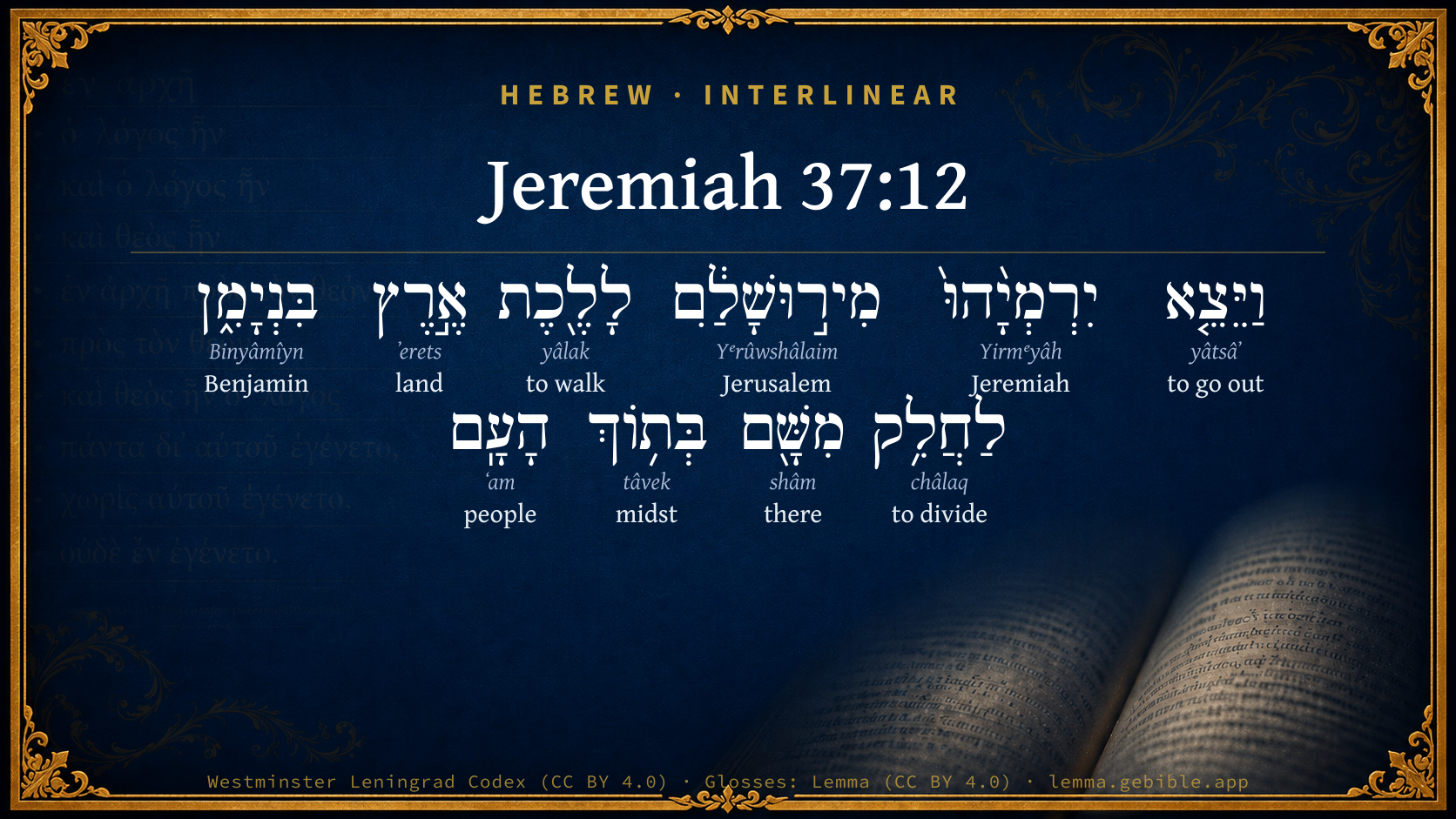
Hebrew (Westminster Leningrad Codex) Jeremiah 37:12 appears in the Hebrew Old Testament. The text above is from the Westminster Leningrad Codex. Each word links to its Strong’s number, a concise gloss, and parsing drawn from the Open Scriptures Hebrew Bible morphology. Click any word for its full Brown-Driver-Briggs (BDB) entry.
Download image
Cite this verse

Jeremiah 37:12 (World English Bible). Public Domain. Lemma interlinear Bible study tool, https://lemma.gebible.app/v/jeremiah/37/12.

Show BibTeX & RIS
BibTeX
RIS
English Translation
then Jeremiah went forth out of Jerusalem to go into the land of Benjamin, to receive his portion there, in the midst of the people.
World English Bible · Public Domain
Download a study sheet

One document with this verse’s original text, its word-by-word gloss line, the meaning frame, cross-references with their text, attributed commentary, and full source and license credits — printable, and it pastes into notes with its structure intact.

This verse Autodidact and up

Study sheet (.html) Plain text (.txt)

A passage Seminary Student

Up to 50 verses in one chapter. A passage sheet keeps up to 6 commentary sources and 12 cross-references per verse, in the order this page ranks them, and says so on the sheet whenever that leaves anything out. Ask for a single verse and you get the Autodidact verse sheet above.

Everything on this page stays free to read, with no account — the sheet is a download of what is already on screen, not access to it.

Want to remove ads? Support Godless Engineer
Compare translations 3

The same verse in 3 English versions, stacked beneath the original-language interlinear above. Click any original word for its lexicon entry.

Each is an independent rendering of the whole verse — the interlinear is not word-aligned to these translations.

Highlighted words mark where these versions differ — a whole-verse word diff, not a word-by-word alignment.

  • World English Bible Public Domain
    then Jeremiah went forth out of Jerusalem to go into the land of Benjamin, to receive his portion there, in the midst of the people.
  • King James Version Public Domain
    Then Jeremiah went forth out of Jerusalem to go into the land of Benjamin, to separate himself thence in the midst of the people.
  • unfoldingWord Literal Text CC BY-SA 4.0
    then Jeremiah went out from Jerusalem to go to the land of Benjamin. He wanted to take possession of a tract of land there among his people.

unfoldingWord Literal Text — © unfoldingWord, licensed CC BY-SA 4.0. Word-aligned USFM3 via Door43 (git.door43.org/unfoldingWord/en_ult).

Versions to compare (up to 4)

3 of 4 selected

Show all 18 translations

Every available English version of this verse, each an independent rendering of the whole verse.

  • World English Bible Public Domain
    then Jeremiah went forth out of Jerusalem to go into the land of Benjamin, to receive his portion there, in the midst of the people.
  • Berean Standard Bible Public Domain
    Jeremiah started to leave Jerusalem to go to the land of Benjamin to claim his portion there among the people.
  • Majority Standard Bible Public Domain
    Jeremiah started to leave Jerusalem to go to the land of Benjamin to claim his portion there among the people.
  • King James Version Public Domain
    Then Jeremiah went forth out of Jerusalem to go into the land of Benjamin, to separate himself thence in the midst of the people.
  • American Standard Version (1901) Public Domain
    then Jeremiah went forth out of Jerusalem to go into the land of Benjamin, to receive his portion there, in the midst of the people.
  • Revised Version (1885) Public Domain
    then Jeremiah went forth out of Jerusalem to go into the land of Benjamin, to receive his portion there, in the midst of the people.
  • Geneva Bible (1599) Public Domain
    Then Ieremiah went out of Ierusalem to goe into the land of Beniamin, separating himselfe thence from among the people.
  • Douay-Rheims (1899) Public Domain
    And when he was come to the gate of Benjamin, the captain of the gate, who I was there in his turn, was one named Jerias, the son of Selemias, the son of Hananias: and he took hold of Jeremias the prophet, saying: Thou art fleeing to the Chaldeans.
  • Young's Literal Translation Public Domain
    that Jeremiah goeth out from Jerusalem to go `to' the land of Benjamin, to receive a portion thence in the midst of the people.
  • Literal Standard Version CC BY-SA 4.0
    that Jeremiah goes out from Jerusalem to go [to] the land of Benjamin, to receive a portion there in the midst of the people.
  • Unlocked Literal Bible CC BY-SA 4.0
    then Jeremiah went out from Jerusalem to go to the land of Benjamin. He wanted to take possession of a tract of land there among his people.
  • unfoldingWord Literal Text CC BY-SA 4.0
    then Jeremiah went out from Jerusalem to go to the land of Benjamin. He wanted to take possession of a tract of land there among his people.
  • Darby Bible Public Domain
    that Jeremiah went forth out of Jerusalem to go into the land of Benjamin, to have his portion there among the people.
  • World Messianic Bible Public Domain
    then Jeremiah went out of Jerusalem to go into the land of Benjamin, to receive his portion there, in the middle of the people.
  • Webster's Bible Public Domain
    Then Jeremiah went out of Jerusalem to go into the land of Benjamin, to separate himself thence in the midst of the people.
  • Free Bible Version CC BY-SA 4.0
    Jeremiah was on his way out of Jerusalem to go to his home in the territory of Benjamin to claim his share of his family's property.
  • Bible in Basic English Public Domain
    Jeremiah went out of Jerusalem to go into the land of Benjamin, with the purpose of taking up his heritage there among the people.
  • JPS Tanakh (1917) Public Domain
    then Jeremiah went forth out of Jerusalem to go into the land of Benjamin, to receive his portion there, in the midst of the people.

Literal Standard Version (2020), Covenant Press — licensed CC BY-SA 4.0. Text via the HelloAO Bible API (eBible.org). Unlocked Literal Bible (unfoldingWord) — licensed CC BY-SA 4.0. Text via the HelloAO Bible API (eBible.org). unfoldingWord Literal Text — © unfoldingWord, licensed CC BY-SA 4.0. Word-aligned USFM3 via Door43 (git.door43.org/unfoldingWord/en_ult). Free Bible Version, Dr. Jonathan Gallagher — licensed CC BY-SA 4.0. Text via the HelloAO Bible API (eBible.org).

Word by word

More ways to search: Search by grammar → Find every occurrence → Compare this word →

Practice this passage: Drill this verse → Learn its vocabulary →

לַחֲלִ֥ק
châlaq
H2505
“to divide”
Preposition + Verb, Hiphil, Infinitive Construct
Part of Speech
Preposition + Verb
Stem
Hiphil
Form
Infinitive Construct
Full BDB Definition

Origin: a primitive root

TWOT: 669

to divide, share, plunder, allot, apportion, assign - (Qal) - to divide, apportion - to assign, distribute - to assign, impart - to share - to divide up, plunder - (Niphal) - to divide oneself - to be divided - to assign, distribute - (Piel) - to divide, apportion - to assign, distribute - to scatter - (Pual) to be divided - (Hiphil) to receive a portion or part - (Hithpael) to divide among themselves - to be smooth, slippery, deceitful - (Qal) to be smooth, slippery - (Hiphil) - to be smooth - to flatter
  1. וַיֵּצֵ֤א yâtsâʼ H3318 “and · to go out” Conjunction + Verb, Qal, Sequential Imperfect, 3rd Person, Masculine, Singular
  2. יִרְמְיָ֨הוּ֙ Yirmᵉyâh H3414 “Jeremiah” Noun, Proper
  3. מִיר֣וּשָׁלִַ֔ם Yᵉrûwshâlaim H3389 “from · Jerusalem” Preposition + Noun, Proper
  4. לָלֶ֖כֶת yâlak H3212 “to walk” Preposition + Verb, Qal, Infinitive Construct
  5. אֶ֣רֶץ ʼerets H776 “land of” Noun, Common, Both, Singular, Construct
  6. בִּנְיָמִ֑ן Binyâmîyn H1144 “Benjamin” Noun, Proper
  7. מִשָּׁ֖ם shâm H8033 “from · there” Preposition + Adverb
  8. בְּת֥וֹךְ tâvek H8432 “in/at · midst of” Preposition + Noun, Common, Masculine, Singular, Construct
  9. הָעָֽם ʻam H5971 “the · people” Particle, Definite Article + Noun, Common, Masculine, Singular, Absolute

About this verse

These counts appear in no published source. They are computed here, from the morphology-tagged text and Lemma’s own curated glosses. What Lemma adds →

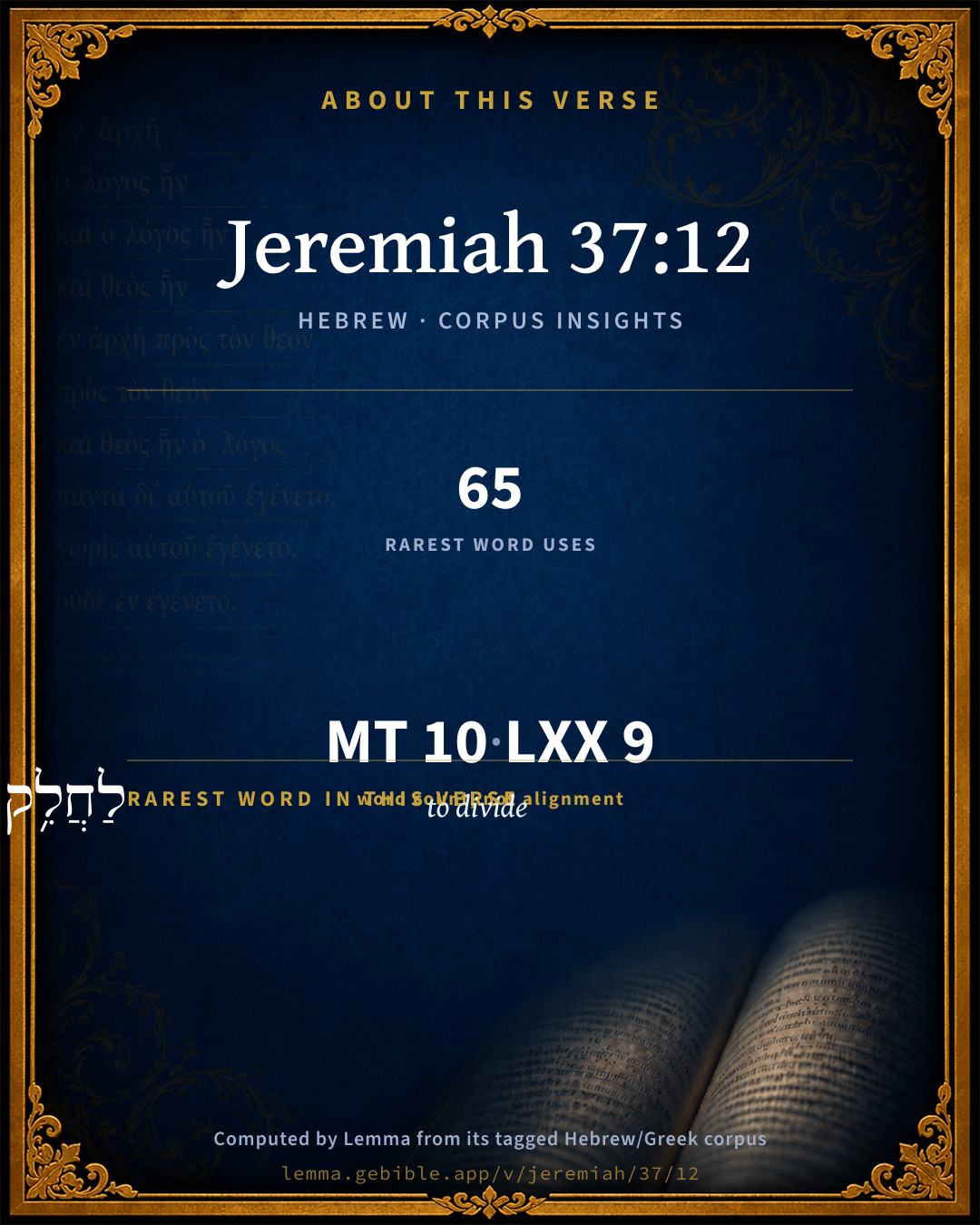
10
words
10
distinct lemmas
Prophets
section

Grammatical profile

  • 3 verbs
  • 6 nouns
  • 1 adverb

Verb forms

  • וַיֵּצֵ֤א Qal · Sequential Imperfect
  • לָלֶ֖כֶת Qal · Infinitive Construct
  • לַחֲלִ֥ק Hiphil · Infinitive Construct

Hebrew & Septuagint length

In the original languages it is 10 Hebrew tokens and 9 Greek tokens — but the two are counted differently (Hebrew bundles its prefixes and suffixes into one token; the Greek is in lemma form), so that isn’t a like-for-like length.

Cross-references

9

Topical passages linked to Jeremiah 37:12 in the Treasury of Scripture Knowledge — connected by theme and wording, ordered by reader-vote popularity; previews shown in the World English Bible.

  • Jeremiah 1:1 The words of Jeremiah the son of Hilkiah, of the priests who were in Anathoth in the land of Benjamin:
  • Joshua 21:17–18 Out of the tribe of Benjamin, Gibeon with its suburbs, Geba with its suburbs,
  • 1 Kings 19:3 When he saw that, he arose, and went for his life, and came to Beersheba, which belongs to Judah, and left his servant there.
  • 1 Kings 19:9 He came there to a cave, and lodged there; and, behold, the word of Yahweh came to him, and he said to him, What are you doing here, Elijah?
  • 1 Chronicles 6:60 and out of the tribe of Benjamin, Geba with its suburbs, and Allemeth with its suburbs, and Anathoth with its suburbs. All their cities throughout their families were thirteen cities.
  • Nehemiah 6:11 I said, Should such a man as I flee? and who is there that, being such as I, would go into the temple to save his life? I will not go in.
  • Jeremiah 32:8–9 So Hanamel my uncle's son came to me in the court of the guard according to the word of Yahweh, and said to me, Please buy my field that is in Anathoth, which is in the land of Benjamin; for the right of inheritance is yours, and the redemption is yours; buy it for yourself. Then I knew that this was the word of Yahweh.
  • Matthew 10:23 But when they persecute you in this city, flee into the next, for most assuredly I tell you, you will not have gone through the cities of Israel, until the Son of Man has come.

Cross-references courtesy of OpenBible.info (CC BY 4.0).

Hebrew and Greek witnesses Masoretic Hebrew ↔ Greek Septuagint

The same verse in the two great witnesses to the Old Testament, shown verse-for-verse.

These are two independent witnesses, not word-aligned to each other, and the Septuagint is shown in lemma (dictionary) form.

Hebrew Jeremiah 37:12 Masoretic · Westminster Leningrad Codex

וַיֵּצֵ֤א יִרְמְיָ֨הוּ֙ מִיר֣וּשָׁלִַ֔ם לָלֶ֖כֶת אֶ֣רֶץ בִּנְיָמִ֑ן לַחֲלִ֥ק מִשָּׁ֖ם בְּת֥וֹךְ הָעָֽם

then Jeremiah went forth out of Jerusalem to go into the land of Benjamin, to receive his portion there, in the midst of the people.

World English Bible · Public Domain

Greek LXX Structure differs

In the Septuagint, Jeremiah is about an eighth shorter than the Hebrew and arranges its material differently — the Oracles Against the Nations (Hebrew chapters 46–51) appear in the middle of the Greek book, after 25:13. Because the chapter and verse boundaries do not line up, a verse-for-verse comparison with the Hebrew is not shown.

A verse-for-verse comparison isn’t shown here because the chapters and verses don’t line up. Switch to the LXX edition with the MT / LXX toggle above to read the Greek directly.

On this verse, Whedon's Commentary on the Bible discusses the Septuagint’s reading. Read the note in Commentary ↓

Hebrew: Westminster Leningrad Codex (CC BY 4.0). Greek: Septuagint (public domain); English from a public-domain English Septuagint. How the Septuagint differs from the Hebrew →

Targum (Aramaic paraphrase)

1

The Targum is the ancient Jewish Aramaic paraphrase of the Hebrew Scriptures — an interpretive translation, not the Hebrew text itself. Onkelos (literal) and Pseudo-Jonathan (expansive) render the Torah, and Jonathan the Prophets. Coverage is partial: where no permissively-licensed English translation exists for a verse, only the Aramaic is shown. This is verse-level text, not a word-by-word alignment to the Hebrew.

  1. Targum Jonathan Prophets (Joshua–Malachi)
    וּנְפַק יִרְמְיָה מִירוּשְׁלֵם לְמֵיזַל לְאַרְעָא שִׁבְטָא בִּנְיָמִין לְפַלְגָא אַחְסַנְתָּא דְאִית לֵיהּ תַּמָן בְּגוֹ עַמָא:

    (no public-domain English translation for this verse)

    Targum Jonathan — Aramaic: “Mikraot Gedolot” (public domain). English: “Sefaria Community Translation” (CC0 1.0 (public-domain dedication)); “London "Chaldee Paraphrase," 1871” (public domain). Text via Sefaria.

Commentary

Notes on Jeremiah 37:12 from classic Christian and Jewish commentators (each source and its license shown beneath its notes). The classic Christian expositions comment on the surrounding passage and are grouped to its opening verse, so a note may address several verses; the Jewish commentaries on the Tanakh (Rashi and others) are per-verse, so they appear only where the commentator wrote on this verse.

Lemma curates 59 commentaries, every one of them public domain or Creative Commons licensed, each selected and text-cleaned for this edition rather than reprinted as found. About our sources →

Trapp's Complete Commentary

John Trapp

Jer 37:12 Then Jeremiah went forth out of Jerusalem to go into the land of Benjamin, to separate himself thence in the midst of the people.

Ver. 12. Then Jeremiah went forth out of Jerusalem.] Where he saw there was so little good to be done by his ministry. This, some think, was an infirmity in him. Mr Greenham, upon such a ground as this, was persuaded to leave his charge at Dry Drayton, in Cambridgeshire, and to go to live at London, where he died of the plague; and, as some reported, repented on his death bed of having so done.

To go into the land of Benjamin.] To Anathoth, his own home; and if he went thither for his own safety or convenience sake, why might he not?

To separate himself thence in the midst of the people.] Ut lubricificaret exinde in medio populi; { a} that he might slide or slip away thence in the throng undiscerned.

{a} Pagnin., Vatab.

John Trapp, A Commentary or Exposition upon All the Books of the Old and New Testament (1647–1656) — public domain. Text from a community e-Sword module.

Joseph Benson's Commentary

Jer 37:12. Then Jeremiah went forth, &c., to go into the land of Benjamin — Jeremiah, having no further revelation from God to communicate, and knowing the city would soon be taken, resolves to go to his own country to Anathoth. To separate himself thence, &c. — The Hebrew, בתוךְ העם

לחלק משׁם, is rendered by Houbigant, “That he might have there a possession for himself with the people;” by Dr. Waterland, “To take rents from thence,” &c.; and by Blaney, “To receive a portion thereof among the people.” “This,” says the last-mentioned critic, “seems a more natural interpretation of the words, than to understand them, as our translators seem to have done, of the prophet’s withdrawing himself, or slipping away, (as it is expressed in the margin,) for fear of being shut up again in the city, on the renewal of the blockade. For the case appears to have been this, Jeremiah had been cut off from his patrimony in the land of Benjamin, by the Chaldeans having been masters there. But, upon their retreat, he meant to return, with a view of coming in for a share of the produce of the land with the rest of his neighbours. For that he was likely to want some means for his support is evident from his having been obliged to be subsisted in prison afterward upon a public allowance.”

Joseph Benson's Commentary on the Old and New Testaments (1811–1818) — public domain. Text from a community e-Sword module.

Geneva Bible (1599)

Geneva Bible translators

As some think, to go to Anathoth his own town.

Geneva Bible (1599) marginal notes — public domain. Text via Bolls.life.

Jamieson, Fausset & Brown

Robert Jamieson, A. R. Fausset & David Brown

Benjamin--to his own town, Anathoth.

to separate himself--Margin translates, "to slip away," from a Hebrew root, "to be smooth," so, to slip away as a slippery thing that cannot be held. But it is not likely the prophet of God would flee in a dishonorable way; and "in the midst of the people" rather implies open departure along with others, than clandestine slipping away by mixing with the crowd of departing people. Rather, it means, to separate himself, or to divide his place of residence, so as to live partly here, partly there, without fixed habitation, going to and fro among the people [LUDOVICUS DE DIEU]. MAURER translates, "to take his portion thence," to realize the produce of his property in Anathoth [HENDERSON], or to take possession of the land which he bought from Hanameel [MAURER].

Jamieson, Fausset & Brown — Commentary Critical and Explanatory on the Whole Bible (1871) — public domain (CC PDM 1.0). Text via the HelloAO Bible API.

Adam Clarke's Commentary

Verse 12. Jeremiah went forth] At the time that Nebuchadnezzar had raised the siege, and gone to meet the Egyptian army.

Go into the land of Benjamin] To Anathoth, his native city.

To separate himself thence] "To receive a portion thereof among the people;" - Blayney: who supposes that Jeremiah went to receive a portion of the proceeds of his patrimony at Anathoth, which had, previously to the siege, been in the hands of the Chaldeans. The siege being now raised, he thought of looking thus after his own affairs. The Chaldee is to the same sense. "He went that he might divide the inheritance which he had there among the people."

Dahler translates, 'He went to withdraw himself from the siege, as many others of the inhabitants." I believe he went to withdraw himself from a city devoted to destruction, and in which he could no longer do any good.

Adam Clarke's Commentary on the Bible (1810–1826) — public domain. Text from a community e-Sword/MySword module.

John Calvin's Commentaries

Here Jeremiah tells us how, and on what occaision, he was cast into prison. He had said shortly before, that he was in the middle of the people, or among them; but now he gives an account of the cruelty of the princes, that they not only cast him into prison, but even into a grave, for they put him, as we shall see, in a dungeon, so that it was a miracle that he did not die there; and this was not done only once; but we shall hereafter see, before the end of the chapter, that he was unhumanly treated, so that he was afraid to return to the same place, lest it should prove fatal to him. He mentions the time when this was done, that is, when the Chaldean army went forth to meet the Egyptians. He was then free to leave the city: no one before could have gone out, because the gates were closed, and the city was also surrounded by enemies. It was then, he says, that he went out, that he might go to the land of Benjamin, where, as it has elsewhere appeared, he was born.

John Calvin's Commentaries (1540-1563) — public domain. Text from the Calvin Translation Society English edition (1840s-50s) via the Christian Classics Ethereal Library (ccel.org). Calvin's coverage is partial (roughly two-thirds of the Bible); uncommented books and verses are honest gaps, never fabricated. The 19th-century editor's footnotes and remarks are omitted so the notes are faithfully Calvin's own voice.

Ellicott's Commentary for English Readers

(12) Then Jeremiah went forth out of Jerusalem . . .—The prophet’s motive in leaving the city may well have been his apprehension that the answer he had sent would move the king’s anger, and lead, as it actually led, to an order for his arrest. The fact that the Chaldæans had raised the siege gave him free egress.

To separate himself thence in the midst of the people.—More accurately, to take a share from thence in the midst of the people. This gives probably the ostensible reason of his journey. As a priest belonging to Anathoth, he had property (like that which he afterwards bought of his uncle, Jeremiah 32) in the land of Benjamin, and he now went to look after it, either in the way of ploughing and sowing, or to receive his share of its produce during his sojourn in Jerusalem. If, as seems probable from Jer_34:8-16, this was a Sabbatical year, the former, assuming the siege to have been raised when the year was over, would be the more probable alternative, and would better explain, as in Rth_4:2; Rth_4:9, the addition of the clause “in the midst of the people,” as showing that there was nothing clandestine in his proceedings. Other meanings that have been given to the words, “to buy bread,” “to till a field,” “to separate a field,” “to conciliate,” “to divide the spoil,” are less satisfactory. At such a time all the owners of land would be eager to take advantage of the opportunity presented by the departure of the Chaldæan army to transact any business connected with it.

A Bible Commentary for English Readers, edited by Charles John Ellicott (1878–1897) — public domain. Text from a community e-Sword module.

The Cambridge Bible for Schools and Colleges

gen. ed. J. J. S. Perowne

12. the land of Benjamin] presumably to Anathoth.

to receive his portion] The Heb. is obscure, but probably his object was in some way connected with his purchase as related ch. Jer_32:9 ff. Other conjectures are, to secure his share in a re-allotment of communal lands, or, to get his portion of the produce of the priests’ lands at Anathoth.

The Cambridge Bible for Schools and Colleges (gen. ed. J. J. S. Perowne; Cambridge University Press, 1878–1918) — public domain. Text from a community e-Sword module.

John Gill's Exposition

Then Jeremiah went forth out of Jerusalem,.... At least he attempted to do so, taking the opportunity of the siege of the city being broke up: what were his reasons for it are not certain; whether that he might not be put into prison, which he might fear for what he had just prophesied of concerning the return of the Chaldean army, that should take the city, and burn it; or to save himself from the destruction which he was sure would come upon it; or because he found he could do no good by his preaching and prophesying in it: however his view was

to go into the land of Benjamin; his native country, the tribe he belonged to; and very likely to Anathoth in that tribe, where he was born, and had lived. Josephus (e) is express for it, which he says was twenty furlongs from Jerusalem:

to separate himself thence in the midst of the people: or, "to slip away thence in the midst of the people" (f); the siege being raised, the people that had fled to Jerusalem for safety crowded out again to go into their own countries, which the prophet thought to take the advantage of, and slip away in a crowd unobserved; though the words may be rendered, "to take part from thence in the midst of the people" (g); either to take part of the spoil left there by the Chaldean army; or with the priests there, of what belonged to them, of whose number he was, Jer 1:1. The Targum is,

"to divide an inheritance which he had there in the midst of the people;''

and to the same sense are the Vulgate Latin and Syriac versions (h).

(e) Antiqu. l. 10. c. 7. sect. 3. (f) "ad lubrificandum seipsum", Montanus; "ad delabendum", Junius & Tremellius; "elabendo", Piscator; "ut subduecret se", Grotius. (g) "Ut partem acciperet ibi in medio populi", Schmidt. (h) Vid. Gloss. in T. Bab. Sota, fol. 42. 1. & Pesikta apud Yalkut in loc.

John Gill's Exposition of the Whole Bible (1746–1763) — public domain (CC PDM 1.0). Text via the HelloAO Bible API.

Albert Barnes' Notes on the Bible

To separate himself thence ... - To receive a share thence. When the siege was temporarily raised, the first object would be food, and, accordingly, Jeremiah accompanied by others, who, like himself, had a right to share in the produce of the priests’ lands at Anathoth, started there to see whether any stores remained which might be available for their common use.

Albert Barnes' Notes on the Bible (1834–1885) — public domain. Text from a community e-Sword/MySword module.

Matthew Poole's English Annotations

The word we translate

separate signifieth to divide, soften, or make slippery, which hath made interpreters vary in the exposition of it. But the general use of it, especially in Pihel, (the conjugation in which it is here used,) being to signify a dividing or separating, and the latter signification being secondary, it seemeth most reasonably here translated to separate, or to withdraw. Jeremiah had no further revelation from God which he was under an obligation to communicate; and knowing the city would suddenly be taken, and that he could be no further useful to the people, taking advantage of the withdrawing of the Chaldean army, resolves to provide for himself, designing to go to his own country, to Anathoth, which was in the land of Benjamin; and because he was a noted person, who might probably be stopped (as he was) if known, he attempts to slip out in the crowd of people that were going out. This seemeth to me the most probable sense.

Matthew Poole's English Annotations on the Holy Bible (1683–1685) — public domain. Text from a community e-Sword/MySword module.

Whedon's Commentary on the Bible

Daniel D. Whedon

12. To separate himself — Neither this nor the translation, to slip away, which stands in the margin, is correct. The better approved sense is, to receive a portion thence. The Vulgate, Chaldee, and Syriac Versions agree in translating, to receive an inheritance, and the Septuagint, to purchase thence, but the more exact sense is as above. The probable meaning is, that Jeremiah had gone back to the fields in which he had an interest to obtain the much needed supplies of food.

Daniel D. Whedon (gen. ed.), Commentary on the Old and New Testaments (1874–1909) — public domain. Text from a community e-Sword module.

The Pulpit Commentary

As soon as communication with the outside world was possible, Jeremiah took the opportunity of going to his native country, to obtain something or other which he could only obtain "thence." The Authorized Version says that his object was to separate himself thence. But

(1) the rendering is linguistically untenable; and

(2) the assumed object is incongruous with the circumstances and Character of Jeremiah, who was neither inclined to seek safety in isolation nor had any motive at present for doing so. The only safe rendering is, to claim his share thence. Whether there was just then a reallotment of communal lands must be left undecided; this would, however, be the most plausible hypothesis, if we could be sure that the present was a sabbatical year. The additional words, in the midst of the people, would then acquire a special significance. The "people" would be the representatives of families who had an equal right to allotments with Jeremiah.

The Pulpit Commentary (1880–1919), ed. H.D.M. Spence-Jones & Joseph S. Exell — public domain. Text from a community e-Sword module.

John Wesley's Explanatory Notes

Went forth - Jeremiah knowing the city would suddenly be taken, and that he could be no farther useful to the people, taking advantage of the withdrawing of the Chaldean army, resolves to go to his own country, to Anathoth, in the crowd of people that were going out.

John Wesley, Explanatory Notes Upon the Whole Bible (1754–1765) — public domain. Text via the GEBible commentary corpus.

Rashi

Rabbi Shlomo Yitzchaki (Rashi)

to share [land] from there among the people Jonathan [renders]: To share his inheritance among the people, and as long as the Chaldeans were besieging it, he did not leave it, for he prayed that it should not be taken.

Rashi on the Tanakh — English translations: “The Judaica Press complete Tanach with Rashi, translated by A. J. Rosenberg” (CC BY 4.0); “Pentateuch with Rashi's commentary by M. Rosenbaum and A.M. Silbermann, 1929-1934” (public domain); “The Metsudah Tanach series, Lakewood, N.J” (CC BY 4.0); and “The Book of Joshua, Metsudah Publications, 1997” (CC BY 4.0). Text via Sefaria.

Lesson kit

Teaching starters — assembled from the data on this page, not authored interpretation. Every prompt links to the verse data it draws on. Edit before teaching.

Jeremiah, in the Prophets, opens this verse with 10 words (10 distinct Hebrew lemmas). Its most distinctive word is châlaq (“to divide”). A historical commentator’s framing appears above. Read the whole chapter for the surrounding context.

Discussion questions

  1. What does “to divide” (châlaq) contribute to the verse as a whole?
  2. Jeremiah 1:1 shares this passage’s theme. How do the two illuminate each other?
  3. The translations on this page render this verse differently — a whole-verse word diff, not a word-by-word alignment. What might account for the different wordings?
  4. The verb «וַיֵּצֵ֤א» is Qal Sequential Imperfect. How does its form color the action?
  5. Reading how Trapp's Complete Commentary and Joseph Benson's Commentary read this verse, where do the two commentators agree and where do they part?

Things to notice

Reading settings

Reading text

Shown beneath each verse's original-language words.

Old Testament
Old Testament edition

Read the OT as the Masoretic Hebrew (MT) or the Greek Septuagint (LXX).

English shown for the Greek Septuagint (in the Hebrew ↔ Greek comparison).

Comparing translations? Open the Compare panel on any verse page to stack up to four side by side.