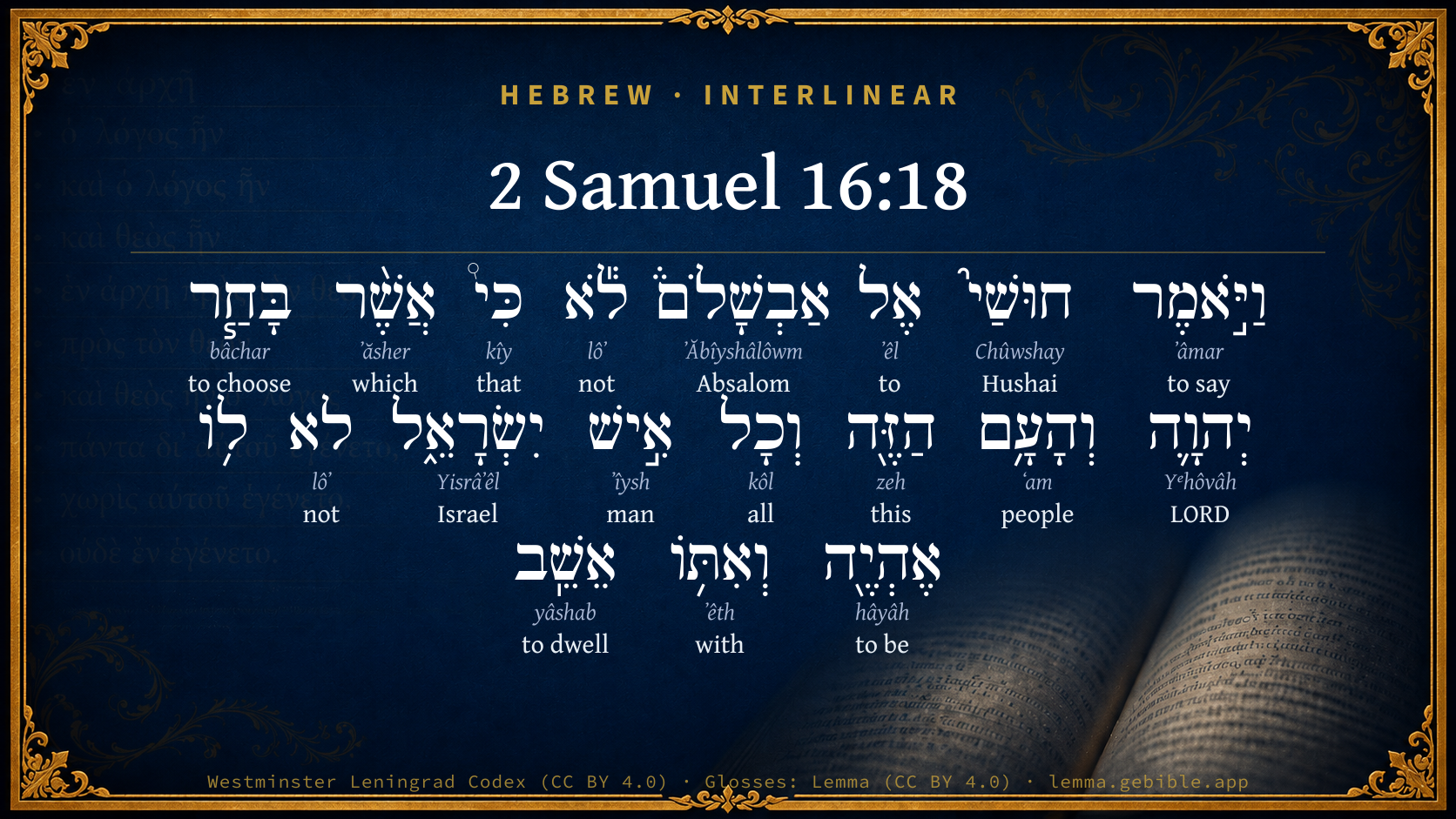
2 Samuel 16:18

Hebrew (Westminster Leningrad Codex) 2 Samuel 16:18 appears in the Hebrew Old Testament. The text above is from the Westminster Leningrad Codex. Each word links to its Strong’s number, a concise gloss, and parsing drawn from the Open Scriptures Hebrew Bible morphology. Click any word for its full Brown-Driver-Briggs (BDB) entry.
Download image
Cite this verse

2 Samuel 16:18 (World English Bible). Public Domain. Lemma interlinear Bible study tool, https://lemma.gebible.app/v/2-samuel/16/18.

Show BibTeX & RIS
BibTeX
RIS
English Translation
Hushai said to Absalom, No; but whom Yahweh, and this people, and all the men of Israel have chosen, his will I be, and with him will I abide.
World English Bible · Public Domain
Download a study sheet

One document with this verse’s original text, its word-by-word gloss line, the meaning frame, cross-references with their text, attributed commentary, and full source and license credits — printable, and it pastes into notes with its structure intact.

This verse Autodidact and up

Study sheet (.html) Plain text (.txt)

A passage Seminary Student

Up to 50 verses in one chapter. A passage sheet keeps up to 6 commentary sources and 12 cross-references per verse, in the order this page ranks them, and says so on the sheet whenever that leaves anything out. Ask for a single verse and you get the Autodidact verse sheet above.

Everything on this page stays free to read, with no account — the sheet is a download of what is already on screen, not access to it.

Want to remove ads? Support Godless Engineer
Compare translations 3

The same verse in 3 English versions, stacked beneath the original-language interlinear above. Click any original word for its lexicon entry.

Each is an independent rendering of the whole verse — the interlinear is not word-aligned to these translations.

Highlighted words mark where these versions differ — a whole-verse word diff, not a word-by-word alignment.

  • World English Bible Public Domain
    Hushai said to Absalom, No; but whom Yahweh, and this people, and all the men of Israel have chosen, his will I be, and with him will I abide.
  • King James Version Public Domain
    And Hushai said unto Absalom, Nay; but whom the LORD, and this people, and all the men of Israel, choose, his will I be, and with him will I abide.
  • unfoldingWord Literal Text CC BY-SA 4.0
    And Hushai said to Absalom, “No, but whom Yahweh has chosen, and this people, and every man of Israel, to him I will be, and with him I will stay.

unfoldingWord Literal Text — © unfoldingWord, licensed CC BY-SA 4.0. Word-aligned USFM3 via Door43 (git.door43.org/unfoldingWord/en_ult).

Versions to compare (up to 4)

3 of 4 selected

Show all 18 translations

Every available English version of this verse, each an independent rendering of the whole verse.

  • World English Bible Public Domain
    Hushai said to Absalom, No; but whom Yahweh, and this people, and all the men of Israel have chosen, his will I be, and with him will I abide.
  • Berean Standard Bible Public Domain
    “Not at all,” Hushai answered. “For the one chosen by the LORD, by the people, and by all the men of Israel—his I will be, and with him I will remain.
  • Majority Standard Bible Public Domain
    “Not at all,” Hushai answered. “For the one chosen by the LORD, by this people, and by all the men of Israel—his I will be, and with him I will remain.
  • King James Version Public Domain
    And Hushai said unto Absalom, Nay; but whom the LORD, and this people, and all the men of Israel, choose, his will I be, and with him will I abide.
  • American Standard Version (1901) Public Domain
    And Hushai said unto Absalom, Nay; but whom Jehovah, and this people, and all the men of Israel have chosen, his will I be, and with him will I abide.
  • Revised Version (1885) Public Domain
    And Hushai said unto Absalom, Nay; but whom the LORD, and this people, and all the men of Israel have chosen, his will I be, and with him will I abide.
  • Geneva Bible (1599) Public Domain
    Hushai then answered vnto Absalom, Nay, but whome the Lord, and this people, and all the men of Israel chuse, his will I be, and with him will I dwell.
  • Douay-Rheims (1899) Public Domain
    And Chusai answered Absalom: Nay: for I will be his, whom the Lord hath chosen, and all this people, and all Israel, and with him will I abide.
  • Young's Literal Translation Public Domain
    And Hushai saith unto Absalom, `Nay, for he whom Jehovah hath chosen, and this people, even all the men of Israel, his I am, and with him I abide;
  • Literal Standard Version CC BY-SA 4.0
    And Hushai says to Absalom, “No, for he whom YHWH has chosen, and this people, even all the men of Israel, I am his, and I abide with him;
  • Unlocked Literal Bible CC BY-SA 4.0
    Hushai said to Absalom, “No! Instead, the one whom Yahweh and this people and all the men of Israel have chosen, that is the man to whom I will belong, and I will stay with him.
  • unfoldingWord Literal Text CC BY-SA 4.0
    And Hushai said to Absalom, “No, but whom Yahweh has chosen, and this people, and every man of Israel, to him I will be, and with him I will stay.
  • Darby Bible Public Domain
    And Hushai said to Absalom, No; but whom Jehovah, and this people, and all the men of Israel choose, his will I be, and with him will I abide.
  • World Messianic Bible Public Domain
    Hushai said to Absalom, “No; but whomever the LORD and this people and all the men of Israel have chosen, I will be his, and I will stay with him.
  • Webster's Bible Public Domain
    And Hushai said to Absalom, Nay; but whom the LORD, and this people, and all the men of Israel choose, his will I be, and with him will I abide.
  • Free Bible Version CC BY-SA 4.0
    “Certainly not!” Hushai replied. “I'm on the side of the one chosen by the Lord, by the army, and by all the people of Israel. I will remain loyal to him.
  • Bible in Basic English Public Domain
    And Hushai said to Absalom, Not so; I am for that man whom the Lord and this people and all the men of Israel have taken as king, and I will take my place with him.
  • JPS Tanakh (1917) Public Domain
    And Hushai said unto Absalom: 'Nay; but whom the LORD, and this people, and all the men of Israel have chosen, his will I be, and with him will I abide.

Literal Standard Version (2020), Covenant Press — licensed CC BY-SA 4.0. Text via the HelloAO Bible API (eBible.org). Unlocked Literal Bible (unfoldingWord) — licensed CC BY-SA 4.0. Text via the HelloAO Bible API (eBible.org). unfoldingWord Literal Text — © unfoldingWord, licensed CC BY-SA 4.0. Word-aligned USFM3 via Door43 (git.door43.org/unfoldingWord/en_ult). Free Bible Version, Dr. Jonathan Gallagher — licensed CC BY-SA 4.0. Text via the HelloAO Bible API (eBible.org).

Word by word

More ways to search: Search by grammar → Find every occurrence → Compare this word →

Practice this passage: Drill this verse → Learn its vocabulary →

חוּשַׁי֮
Chûwshay
H2365
“Hushai”
Noun, Proper
Part of Speech
Noun
Type
Proper
Full BDB Definition

Origin: from H2363

TWOT: None

Hushai = "hasting" - an Archite, a friend of David - the father of Baana, an officer of Solomon; probably the same as 1
  1. וַיֹּ֣אמֶר ʼâmar H559 “and · to say” Conjunction + Verb, Qal, Sequential Imperfect, 3rd Person, Masculine, Singular
  2. אֶל ʼêl H413 “to” Preposition
  3. אַבְשָׁלֹם֒ ʼĂbîyshâlôwm H53 “Absalom” Noun, Proper
  4. לֹ֕א lôʼ H3808 “not” Particle, Negative
  5. כִּי֩ kîy H3588 “that” Conjunction
  6. אֲשֶׁ֨ר ʼăsher H834 “which” Particle, Relative
  7. בָּחַ֧ר bâchar H977 “to choose” Verb, Qal, Perfect, 3rd Person, Masculine, Singular
  8. יְהוָ֛ה Yᵉhôvâh H3068 “LORD” Noun, Proper
  9. וְהָעָ֥ם ʻam H5971 “and · the · people” Conjunction + Particle, Definite Article + Noun, Common, Masculine, Singular, Absolute
  10. הַזֶּ֖ה zeh H2088 “the · this” Particle, Definite Article + Pronoun, Demonstrative, Masculine, Singular
  11. וְכָל kôl H3605 “and · all of” Conjunction + Noun, Common, Masculine, Singular, Construct
  12. אִ֣ישׁ ʼîysh H376 “man of” Noun, Common, Masculine, Singular, Construct
  13. יִשְׂרָאֵ֑ל Yisrâʼêl H3478 “Israel” Noun, Proper
  14. לא lôʼ H3808 “not” Particle, Negative
  15. אֶהְיֶ֖ה hâyâh H1961 “to be” Verb, Qal, Imperfect, 1st Person, Common, Singular
  16. וְאִתּ֥וֹ ʼêth H854 “and · with · him” Conjunction + Preposition + Suffix, Personal, 3rd Person, Masculine, Singular
  17. אֵשֵֽׁב yâshab H3427 “to dwell” Verb, Qal, Imperfect, 1st Person, Common, Singular

About this verse

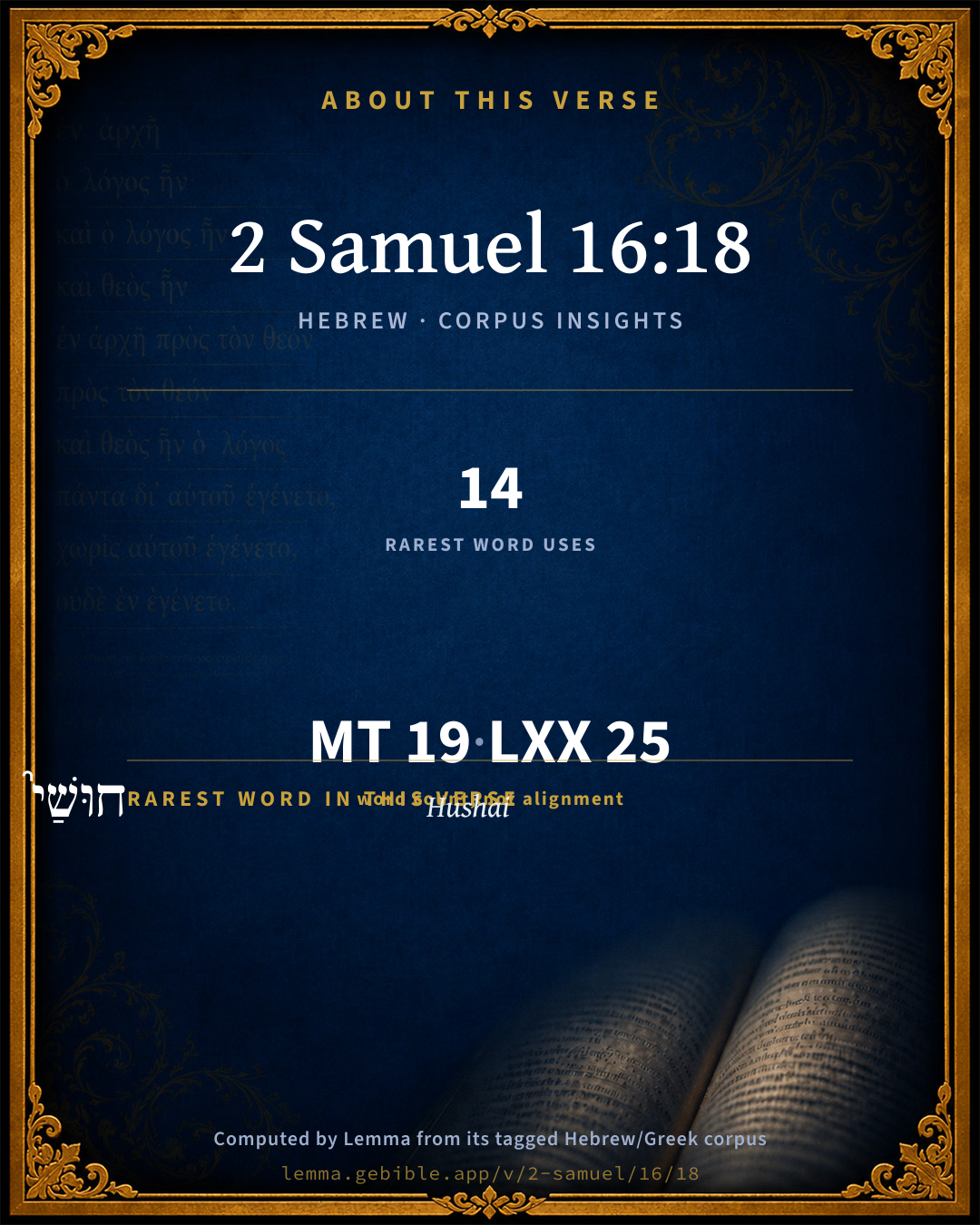
These counts appear in no published source. They are computed here, from the morphology-tagged text and Lemma’s own curated glosses. What Lemma adds →

19
words
17
distinct lemmas
Historical
section

Notable vocabulary

The rarest word here is חוּשַׁי֮ Hushai H2365 — appearing just 14 times in the whole Hebrew Bible.

Shared distinctive vocabulary

חוּשַׁי֮ Hushai H2365 occurs in 13 verses of the Hebrew Bible. Also found in:

Grammatical profile

  • 4 verbs
  • 7 nouns
  • 1 pronoun
  • 3 prepositions
  • 1 conjunction
  • 3 particles

Verb forms

  • וַיֹּ֣אמֶר Qal · Sequential Imperfect
  • בָּחַ֧ר Qal · Perfect
  • אֶהְיֶ֖ה Qal · Imperfect
  • אֵשֵֽׁב Qal · Imperfect

Repetition

A word recurs within this verse — often emphatic in Hebrew:

Hebrew & Septuagint length

In English translation the verse runs 29 words from the Hebrew and 29 from the Septuagint (LXX English) — the same length.

A rough comparison of the two English renderings, which tokenize alike — not a word-level alignment.

Word counts can differ between the Hebrew and the Greek without any difference in meaning — e.g. the Hebrew direct-object marker אֵת has no separate Greek word, and Greek often adds the article ὁ.

In the original languages it is 19 Hebrew tokens and 25 Greek tokens — but the two are counted differently (Hebrew bundles its prefixes and suffixes into one token; the Greek is in lemma form), so that isn’t a like-for-like length.

Cross-references

2

Topical passages linked to 2 Samuel 16:18 in the Treasury of Scripture Knowledge — connected by theme and wording, ordered by reader-vote popularity; previews shown in the World English Bible.

  • 1 Samuel 16:13 Then Samuel took the horn of oil, and anointed him in the midst of his brothers: and the Spirit of Yahweh came mightily on David from that day forward. So Samuel rose up, and went to Ramah.
  • 2 Samuel 5:1–3 Then came all the tribes of Israel to David to Hebron, and spoke, saying, Behold, we are your bone and your flesh.

Cross-references courtesy of OpenBible.info (CC BY 4.0).

Hebrew and Greek witnesses Masoretic Hebrew ↔ Greek Septuagint

The same verse in the two great witnesses to the Old Testament, shown verse-for-verse.

These are two independent witnesses, not word-aligned to each other, and the Septuagint is shown in lemma (dictionary) form.

Hebrew 2 Samuel 16:18 Masoretic · Westminster Leningrad Codex

וַיֹּ֣אמֶר חוּשַׁי֮ אֶל אַבְשָׁלֹם֒ לֹ֕א כִּי֩ אֲשֶׁ֨ר בָּחַ֧ר יְהוָ֛ה וְהָעָ֥ם הַזֶּ֖ה וְכָל אִ֣ישׁ יִשְׂרָאֵ֑ל לא ל֥וֹ אֶהְיֶ֖ה וְאִתּ֥וֹ אֵשֵֽׁב

Hushai said to Absalom, No; but whom Yahweh, and this people, and all the men of Israel have chosen, his will I be, and with him will I abide.

World English Bible · Public Domain

Greek LXX 2 Samuel 16:18 Septuagint · lemma form

καί εἶπον χουσι πρός αβεσσαλωμ οὐ ἀλλά κατόπισθεν ὅς ἐκλέγω κύριος καί ὁ λαός οὗτος καί πᾶς ἀνήρ ἰσραήλ αὐτός εἰμί καί μετά αὐτός καταἵημι

And Chusi said to Abessalom, Nay, but following whom the Lord, and this people, and all Israel have chosen, —his will I be, and with him I will dwell.

LXX2012 (modern English Septuagint) · Public Domain

Hebrew: Westminster Leningrad Codex (CC BY 4.0). Greek: Septuagint (public domain); English from LXX2012 (modern English Septuagint) (Public Domain). How the Septuagint differs from the Hebrew →

Targum (Aramaic paraphrase)

1

The Targum is the ancient Jewish Aramaic paraphrase of the Hebrew Scriptures — an interpretive translation, not the Hebrew text itself. Onkelos (literal) and Pseudo-Jonathan (expansive) render the Torah, and Jonathan the Prophets. Coverage is partial: where no permissively-licensed English translation exists for a verse, only the Aramaic is shown. This is verse-level text, not a word-by-word alignment to the Hebrew.

  1. Targum Jonathan Prophets (Joshua–Malachi)
    וַאֲמַר חוּשַׁי לְאַבְשָׁלוֹם לָא אֱלָהֵין דְאִתְרְעֵי יְיָ וְעַמָא הָדֵין וְכָל אֱנַשׁ יִשְׂרָאֵל דִי לֵיהּ אֱהֵי וְעִמֵיהּ אָתִיב:

    (no public-domain English translation for this verse)

    Targum Jonathan — Aramaic: “Mikraot Gedolot” (public domain). English: “Sefaria Community Translation” (CC0 1.0 (public-domain dedication)); “London "Chaldee Paraphrase," 1871” (public domain). Text via Sefaria.

Commentary

Notes on 2 Samuel 16:18 from classic Christian and Jewish commentators (each source and its license shown beneath its notes). The classic Christian expositions comment on the surrounding passage and are grouped to its opening verse, so a note may address several verses; the Jewish commentaries on the Tanakh (Rashi and others) are per-verse, so they appear only where the commentator wrote on this verse.

Lemma curates 59 commentaries, every one of them public domain or Creative Commons licensed, each selected and text-cleaned for this edition rather than reprinted as found. About our sources →

Trapp's Complete Commentary

John Trapp

2Sa 16:18 And Hushai said unto Absalom, Nay; but whom the LORD, and this people, and all the men of Israel, choose, his will I be, and with him will I abide.

Ver. 18. His will I be, and with him will I abide.] His argument had been good, saith Martyr, if David had been dead, and the state had generally accepted of Absalom for their king: thus the Romans obeyed Julius Caesar, and the whole empire Phocas. But here it was otherwise.

John Trapp, A Commentary or Exposition upon All the Books of the Old and New Testament (1647–1656) — public domain. Text from a community e-Sword module.

Joseph Benson's Commentary

2Sa 16:18. Hushai said, Nay, but whom the Lord, &c. — Hushai gave him to understand, that his allegiance was governed by other principles than those of private friendship; that the appointment of God and the election of his people determined him in the object of his duty: and what should hinder him from serving the son with as much fidelity as he had served the father? The attentive reader will observe that this salutation and whole apology are evidently as evasive, and as well calculated to delude, as art could contrive them; for he neither prays personally for Absalom, nor professes allegiance to him; yet the bait took, and Absalom’s self-sufficiency, gross as the delusion was, swallowed it whole. — Delaney.

Joseph Benson's Commentary on the Old and New Testaments (1811–1818) — public domain. Text from a community e-Sword module.

Adam Clarke's Commentary

Verse 18. Whom the Lord and this people - choose] Here is an equivocation; Hushai meant in his heart that God and all the people of Israel had chosen David; but he spake so as to make Absalom believe that he spoke of him: for whatever of insincerity may appear in this, Hushai is alone answerable. What he says afterwards may be understood in the same way.

Adam Clarke's Commentary on the Bible (1810–1826) — public domain. Text from a community e-Sword/MySword module.

John Gill's Exposition

And Hushai said to Absalom,.... In answer to his questions:

nay, but whom the Lord, and his people, and all the men of Israel choose: here again he speaks very ambiguously; for this circumlocution, or descriptive character of the king of Israel, better agrees with David, whom he might bear in mind, than with Absalom; for the Lord had chosen David, and he was anointed by his order, and all the people of Israel had chosen and anointed him likewise; but as for Absalom, it was only a part of them that had declared for him, nor was there any evidence of the Lord's choosing him; though Hushai undoubtedly would be under stood of him, and as interpreting the voice of the people to be the voice of God:

his will I be, and with him will I abide; though he designed no such thing, which was a great piece of dissimulation and hypocrisy; and if he meant David, it was a piece of deceit and equivocation: there is a various reading in the first clause; we follow the marginal reading, "to him" or "his", but the textual reading is "not": and both may be taken in by rendering the words by an interrogation, "shall I, or should I not be his" (d)? I will; that is, be his servant, faithfully obey his commands, be closely attached to him, and continue with him as a loyal subject.

(d) "non ero", Montanus; "non essem ejus?" Junius & Tremellius.

John Gill's Exposition of the Whole Bible (1746–1763) — public domain (CC PDM 1.0). Text via the HelloAO Bible API.

Haydock's Catholic Bible Commentary

Chosen. (Vox populi, vox Dei) Private people are not commonly able, or allowed, to judge of the right, which the prince has to the throne. But here Absalom was manifestly an usurper; and many still adhered to David. (Calmet) --- Chusai assumes the character of a courtier, and flatters the prince; (Salien) who ought to have been on his guard. See chap. xv. 34. (Calmet)

George Leo Haydock (1774–1849), Haydock's Catholic Family Bible and Commentary, 1859 edition — public domain. Excludes Psalms (Douay-Rheims chapter numbering differs from Protestant) and Deuterocanonical books (Catholic canon only).

Matthew Poole's English Annotations

Though as a private person I owed and paid friendship to David whilst he was king; yet I must make all my obligations give place to the authority of God, who putteth down and setteth up kings at this pleasure; and to the common sense and decree of the whole body of the nation. But Hushai expresseth himself very cautiously; for though he would be thought to understand Absalom, yet in truth this character did not agree to him, whom neither God nor all the people had chosen, bout only a part, and that the worst part of them.

Matthew Poole's English Annotations on the Holy Bible (1683–1685) — public domain. Text from a community e-Sword/MySword module.

Whedon's Commentary on the Bible

Daniel D. Whedon

18. This people — Referring to the multitudes that accompanied Absalom into Jerusalem. He professes that with him the voice of the people is the voice of Jehovah. It can hardly be said that the words of Hushai are equivocal, and so put that he could have meant David as well as Absalom, for in the next verse he plainly pledges himself to serve the prince as he had done his father. He used deceit and falsehood; but in his case it was a stratagem of war, and is to be regarded as any other strategic military measure designed to deceive an enemy. See note on 2Sa_15:34.

Daniel D. Whedon (gen. ed.), Commentary on the Old and New Testaments (1874–1909) — public domain. Text from a community e-Sword module.

The Pulpit Commentary

The men of Israel. Here and in ver. 15 the men of Israel are not contrasted with the men of Judah, but include them. (see 2Sa_15:10) Absalom"s rebellion began at Hebron, in Judaea, and the selection of Amasa, a first cousin both of David and Joab, as commander-in-chief, suggests the conclusion that Absalom"s chief strength lay in David"s own tribe, though men from all the tribes on the west of the Jordan had also flocked to his standard. Besides them, Hushai speaks of this people, that is, the citizens of Jerusalem. For, while there had been general lamentation at David"s departure, (2Sa_15:23) yet the citizens had admitted Absalom without a struggle, and submitted to him. David"s adherents are also constantly called "the people," because they did not belong to any special tribe, but were drawn indifferently from them all.

The Pulpit Commentary (1880–1919), ed. H.D.M. Spence-Jones & Joseph S. Exell — public domain. Text from a community e-Sword module.

Lesson kit

Teaching starters — assembled from the data on this page, not authored interpretation. Every prompt links to the verse data it draws on. Edit before teaching.

2 Samuel, in the Historical, opens this verse with 19 words (17 distinct Hebrew lemmas). Its most distinctive word is Chûwshay (“Hushai”). A historical commentator’s framing appears above. Read the whole chapter for the surrounding context.

Discussion questions

  1. The word Chûwshay carries the sense “Hushai.” How does it shape the verse?
  2. How does 2 Samuel 15:32, which shares the word «Hushai», read alongside this verse?
  3. What does the repetition of “not” (2× in this one verse) do in this verse?
  4. These translations render this verse differently. What is at stake in choosing one wording over another?
  5. «וַיֹּ֣אמֶר» is a Qal Sequential Imperfect verb. How does that grammatical form shape the action described?
  6. Compare how Trapp's Complete Commentary and Joseph Benson's Commentary read this verse. Where do they agree or differ?

Things to notice

Reading settings

Reading text

Shown beneath each verse's original-language words.

Old Testament
Old Testament edition

Read the OT as the Masoretic Hebrew (MT) or the Greek Septuagint (LXX).

English shown for the Greek Septuagint (in the Hebrew ↔ Greek comparison).

Comparing translations? Open the Compare panel on any verse page to stack up to four side by side.