
2 Samuel 19:2

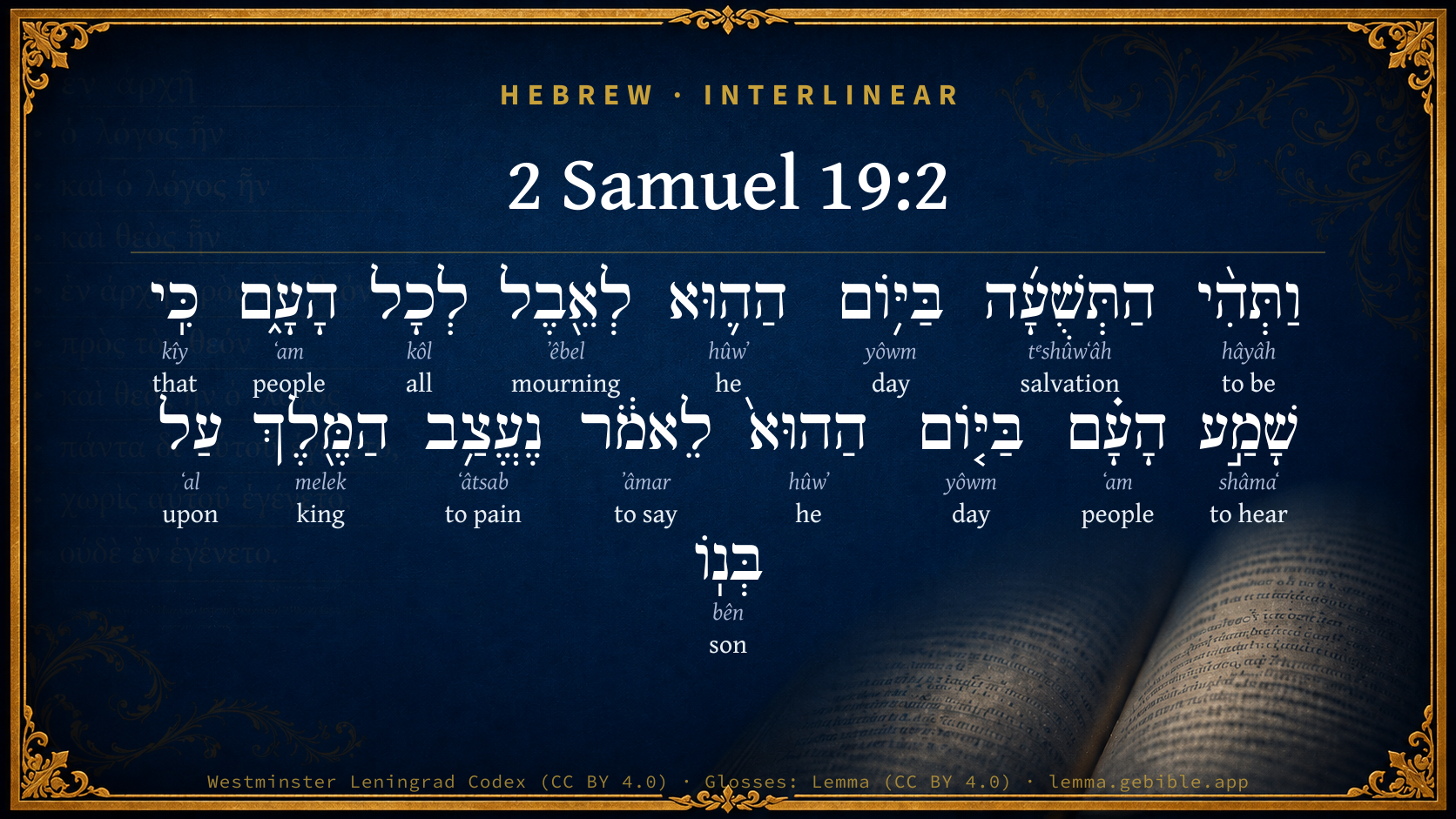
Hebrew (Westminster Leningrad Codex) 2 Samuel 19:2 appears in the Hebrew Old Testament. The text above is from the Westminster Leningrad Codex. Each word links to its Strong’s number, a concise gloss, and parsing drawn from the Open Scriptures Hebrew Bible morphology. Click any word for its full Brown-Driver-Briggs (BDB) entry.
Download image
Cite this verse

2 Samuel 19:2 (World English Bible). Public Domain. Lemma interlinear Bible study tool, https://lemma.gebible.app/v/2-samuel/19/2.

Show BibTeX & RIS
BibTeX
RIS
English Translation
The victory that day was turned into mourning to all the people; for the people heard say that day, The king grieves for his son.
World English Bible · Public Domain
Download a study sheet

One document with this verse’s original text, its word-by-word gloss line, the meaning frame, cross-references with their text, attributed commentary, and full source and license credits — printable, and it pastes into notes with its structure intact.

This verse Autodidact and up

Study sheet (.html) Plain text (.txt)

A passage Seminary Student

Up to 50 verses in one chapter. A passage sheet keeps up to 6 commentary sources and 12 cross-references per verse, in the order this page ranks them, and says so on the sheet whenever that leaves anything out. Ask for a single verse and you get the Autodidact verse sheet above.

Everything on this page stays free to read, with no account — the sheet is a download of what is already on screen, not access to it.

Want to remove ads? Support Godless Engineer
Compare translations 3

The same verse in 3 English versions, stacked beneath the original-language interlinear above. Click any original word for its lexicon entry.

Each is an independent rendering of the whole verse — the interlinear is not word-aligned to these translations.

Highlighted words mark where these versions differ — a whole-verse word diff, not a word-by-word alignment.

  • World English Bible Public Domain
    The victory that day was turned into mourning to all the people; for the people heard say that day, The king grieves for his son.
  • King James Version Public Domain
    And the victory that day was turned into mourning unto all the people: for the people heard say that day how the king was grieved for his son.
  • unfoldingWord Literal Text CC BY-SA 4.0
    And the victory on that day became mourning for all of the people, for the people heard on that day, saying, “The king is grieved because of his son.”

unfoldingWord Literal Text — © unfoldingWord, licensed CC BY-SA 4.0. Word-aligned USFM3 via Door43 (git.door43.org/unfoldingWord/en_ult).

Versions to compare (up to 4)

3 of 4 selected

Show all 18 translations

Every available English version of this verse, each an independent rendering of the whole verse.

  • World English Bible Public Domain
    The victory that day was turned into mourning to all the people; for the people heard say that day, The king grieves for his son.
  • Berean Standard Bible Public Domain
    And that day’s victory was turned into mourning for all the people, because on that day they were told, “The king is grieving over his son.”
  • Majority Standard Bible Public Domain
    And that day’s victory was turned into mourning for all the people, because on that day they were told, “The king is grieving over his son.”
  • King James Version Public Domain
    And the victory that day was turned into mourning unto all the people: for the people heard say that day how the king was grieved for his son.
  • American Standard Version (1901) Public Domain
    And the victory that day was turned into mourning unto all the people; for the people heard say that day, The king grieveth for his son.
  • Revised Version (1885) Public Domain
    And the victory that day was turned into mourning unto all the people: for the people heard say that day, The king grieveth for his son.
  • Geneva Bible (1599) Public Domain
    Therefore the victorie of that day was turned into mourning to all the people: for the people heard say that day, The King soroweth for his sonne.
  • Douay-Rheims (1899) Public Domain
    And the victory that day was turned into mourning unto all the people: for the people heard say that day: The king grieveth for his son.
  • Young's Literal Translation Public Domain
    and the salvation on that day becometh mourning to all the people, for the people hath heard on that day, saying, `The king hath been grieved for his son.'
  • Literal Standard Version CC BY-SA 4.0
    and the salvation on that day becomes mourning to all the people, for the people have heard on that day, saying, “The king has been grieved for his son.”
  • Unlocked Literal Bible CC BY-SA 4.0
    So the victory that day was turned into mourning for all the army, for the army heard it said that day, “The king is mourning for his son.”
  • unfoldingWord Literal Text CC BY-SA 4.0
    And the victory on that day became mourning for all of the people, for the people heard on that day, saying, “The king is grieved because of his son.”
  • Darby Bible Public Domain
    And the victory that day was [turned] into mourning for all the people; for the people heard say that day, The king is grieved for his son.
  • World Messianic Bible Public Domain
    The victory that day was turned into mourning among all the people, for the people heard it said that day, “The king grieves for his son.”
  • Webster's Bible Public Domain
    And the victory that day was turned into mourning to all the people: for the people heard it said that day how the king was grieved for his son.
  • Free Bible Version CC BY-SA 4.0
    Victory that day was turned into mourning for the whole army, because they were told, “The king is grieving for his son.”
  • Bible in Basic English Public Domain
    And the salvation of that day was changed to sorrow for all the people: for it was said to the people, The king is in bitter grief for his son.
  • JPS Tanakh (1917) Public Domain
    (19-3) And the victory that day was turned into mourning unto all the people; for the people heard say that day: 'The king grieveth for his son.'

Literal Standard Version (2020), Covenant Press — licensed CC BY-SA 4.0. Text via the HelloAO Bible API (eBible.org). Unlocked Literal Bible (unfoldingWord) — licensed CC BY-SA 4.0. Text via the HelloAO Bible API (eBible.org). unfoldingWord Literal Text — © unfoldingWord, licensed CC BY-SA 4.0. Word-aligned USFM3 via Door43 (git.door43.org/unfoldingWord/en_ult). Free Bible Version, Dr. Jonathan Gallagher — licensed CC BY-SA 4.0. Text via the HelloAO Bible API (eBible.org).

Word by word

More ways to search: Search by grammar → Find every occurrence → Compare this word →

Practice this passage: Drill this verse → Learn its vocabulary →

נֶעֱצַ֥ב
ʻâtsab
H6087
“to pain”
Verb, Niphal, Perfect, 3rd Person, Masculine, Singular
Part of Speech
Verb
Stem
Niphal
Form
Perfect
Person
3rd Person
Gender
Masculine
Number
Singular
Full BDB Definition

Origin: a primitive root

TWOT: 1666 , 1667

to hurt, pain, grieve, displease, vex, wrest - (Qal) to hurt, pain - (Niphal) to be in pain, be pained, be grieved - (Piel) to vex, torture - (Hiphil) to cause pain - (Hithpael) to feel grieved, be vexed - to shape, fashion, make, form, stretch into shape, (TWOT) worship - (Piel) to shape, form - (Hiphil) to form, copy, fashion
  1. וַתְּהִ֨י hâyâh H1961 “and · to be” Conjunction + Verb, Qal, Sequential Imperfect, 3rd Person, Feminine, Singular
  2. הַתְּשֻׁעָ֜ה tᵉshûwʻâh H8668 “the · salvation” Particle, Definite Article + Noun, Common, Feminine, Singular, Absolute
  3. בַּיּ֥וֹם yôwm H3117 “in/at the · day” Preposition, Determined + Noun, Common, Masculine, Singular, Absolute
  4. הַה֛וּא hûwʼ H1931 “the · he” Particle, Definite Article + Pronoun, Personal, 3rd Person, Masculine, Singular
  5. לְאֵ֖בֶל ʼêbel H60 “to/for · mourning” Preposition + Noun, Common, Masculine, Singular, Absolute
  6. לְכָל kôl H3605 “to/for · all of” Preposition + Noun, Common, Masculine, Singular, Construct
  7. הָעָ֑ם ʻam H5971 “the · people” Particle, Definite Article + Noun, Common, Masculine, Singular, Absolute
  8. כִּֽי kîy H3588 “that” Conjunction
  9. שָׁמַ֣ע shâmaʻ H8085 “to hear” Verb, Qal, Perfect, 3rd Person, Masculine, Singular
  10. הָעָ֗ם ʻam H5971 “the · people” Particle, Definite Article + Noun, Common, Masculine, Singular, Absolute
  11. בַּיּ֤וֹם yôwm H3117 “in/at the · day” Preposition, Determined + Noun, Common, Masculine, Singular, Absolute
  12. הַהוּא֙ hûwʼ H1931 “the · he” Particle, Definite Article + Pronoun, Personal, 3rd Person, Masculine, Singular
  13. לֵאמֹ֔ר ʼâmar H559 “to say” Preposition + Verb, Qal, Infinitive Construct
  14. הַמֶּ֖לֶךְ melek H4428 “the · king” Particle, Definite Article + Noun, Common, Masculine, Singular, Absolute
  15. עַל ʻal H5921 “upon” Preposition
  16. בְּנֽוֹ bên H1121 “son · his” Noun, Common, Masculine, Singular, Construct + Suffix, Personal, 3rd Person, Masculine, Singular

About this verse

These counts appear in no published source. They are computed here, from the morphology-tagged text and Lemma’s own curated glosses. What Lemma adds →

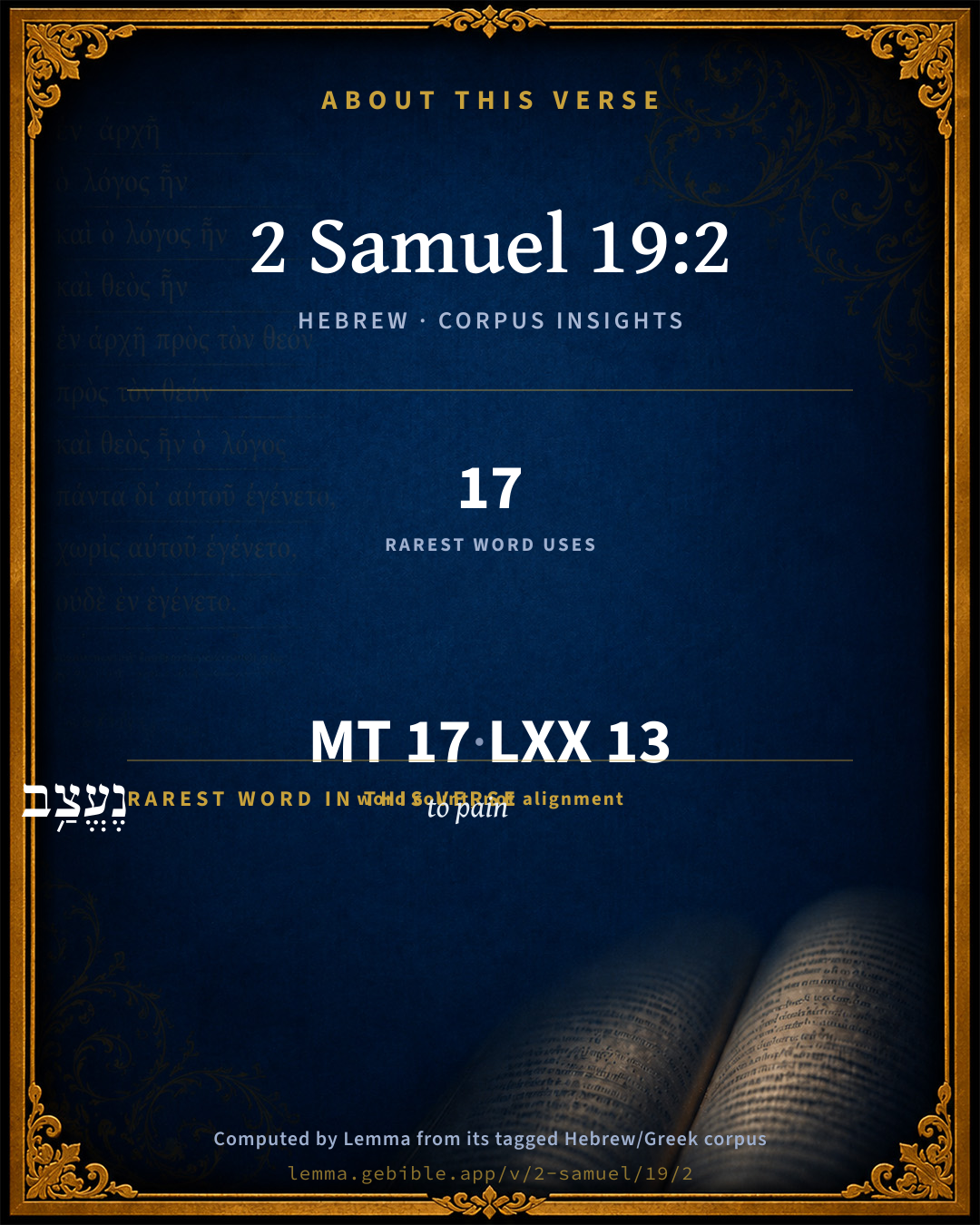
17
words
14
distinct lemmas
Historical
section

Notable vocabulary

The rarest word here is נֶעֱצַ֥ב to pain H6087 — appearing just 17 times in the whole Hebrew Bible.

Shared distinctive vocabulary

נֶעֱצַ֥ב to pain H6087 occurs in 17 verses of the Hebrew Bible. Also found in:

Grammatical profile

  • 4 verbs
  • 9 nouns
  • 2 pronouns
  • 1 preposition
  • 1 conjunction

Verb forms

  • וַתְּהִ֨י Qal · Sequential Imperfect
  • שָׁמַ֣ע Qal · Perfect
  • לֵאמֹ֔ר Qal · Infinitive Construct
  • נֶעֱצַ֥ב Niphal · Perfect

Repetition

Words recur within this verse — often emphatic in Hebrew:

  • בַּיּ֥וֹם day H3117 ×2
  • הָעָ֑ם people H5971 ×2
  • הַה֛וּא he H1931 ×2

Hebrew & Septuagint length

In English translation the verse runs 25 words from the Hebrew and 26 from the Septuagint (LXX English) — closely comparable.

A rough comparison of the two English renderings, which tokenize alike — not a word-level alignment.

Word counts can differ between the Hebrew and the Greek without any difference in meaning — e.g. the Hebrew direct-object marker אֵת has no separate Greek word, and Greek often adds the article ὁ.

In the original languages it is 17 Hebrew tokens and 13 Greek tokens — but the two are counted differently (Hebrew bundles its prefixes and suffixes into one token; the Greek is in lemma form), so that isn’t a like-for-like length.

Cross-references

2

Topical passages linked to 2 Samuel 19:2 in the Treasury of Scripture Knowledge — connected by theme and wording, ordered by reader-vote popularity; previews shown in the World English Bible.

  • Proverbs 16:15 In the light of the king's face is life. His favor is like a cloud of the spring rain.
  • Proverbs 19:12 The king's wrath is like the roaring of a lion, But his favor is like dew on the grass.

Cross-references courtesy of OpenBible.info (CC BY 4.0).

Hebrew and Greek witnesses Masoretic Hebrew ↔ Greek Septuagint

The same verse in the two great witnesses to the Old Testament, shown verse-for-verse.

These are two independent witnesses, not word-aligned to each other, and the Septuagint is shown in lemma (dictionary) form.

Hebrew 2 Samuel 19:2 Masoretic · Westminster Leningrad Codex

וַתְּהִ֨י הַתְּשֻׁעָ֜ה בַּיּ֥וֹם הַה֛וּא לְאֵ֖בֶל לְכָל הָעָ֑ם כִּֽי שָׁמַ֣ע הָעָ֗ם בַּיּ֤וֹם הַהוּא֙ לֵאמֹ֔ר נֶעֱצַ֥ב הַמֶּ֖לֶךְ עַל בְּנֽוֹ

The victory that day was turned into mourning to all the people; for the people heard say that day, The king grieves for his son.

World English Bible · Public Domain

Greek LXX 2 Samuel 19:2 Septuagint · lemma form

καί ἀναἀγγέλλω ὁ ιωαβ λέγω ἰδού ὁ βασιλεύς κλαίω καί πενθέω ἐπί αβεσσαλωμ

And the victory was turned that day into mourning to all the people, for the people heard say that day, The king grieves after his son.

LXX2012 (modern English Septuagint) · Public Domain

Hebrew: Westminster Leningrad Codex (CC BY 4.0). Greek: Septuagint (public domain); English from LXX2012 (modern English Septuagint) (Public Domain). How the Septuagint differs from the Hebrew →

Targum (Aramaic paraphrase)

1

The Targum is the ancient Jewish Aramaic paraphrase of the Hebrew Scriptures — an interpretive translation, not the Hebrew text itself. Onkelos (literal) and Pseudo-Jonathan (expansive) render the Torah, and Jonathan the Prophets. Coverage is partial: where no permissively-licensed English translation exists for a verse, only the Aramaic is shown. This is verse-level text, not a word-by-word alignment to the Hebrew.

  1. Targum Jonathan Prophets (Joshua–Malachi)
    וְאִתְחָוָאָה לְיוֹאָב הָא מַלְכָּא בָכֵי וּמִתְאַבֵּל עַל אַבְשָׁלוֹם:

    (no public-domain English translation for this verse)

    Targum Jonathan — Aramaic: “Mikraot Gedolot” (public domain). English: “Sefaria Community Translation” (CC0 1.0 (public-domain dedication)); “London "Chaldee Paraphrase," 1871” (public domain). Text via Sefaria.

Commentary

Notes on 2 Samuel 19:2 from classic Christian and Jewish commentators (each source and its license shown beneath its notes). The classic Christian expositions comment on the surrounding passage and are grouped to its opening verse, so a note may address several verses; the Jewish commentaries on the Tanakh (Rashi and others) are per-verse, so they appear only where the commentator wrote on this verse.

Lemma curates 59 commentaries, every one of them public domain or Creative Commons licensed, each selected and text-cleaned for this edition rather than reprinted as found. About our sources →

Trapp's Complete Commentary

John Trapp

2Sa 19:2 And the victory that day was [turned] into mourning unto all the people: for the people heard say that day how the king was grieved for his son.

Ver. 2. Was turned into mourning unto all the people.] Nullos habitura triumphos, as the poet saith of the civil wars of Rome.

The king was grieved.] This marred all the mirth of that day.

John Trapp, A Commentary or Exposition upon All the Books of the Old and New Testament (1647–1656) — public domain. Text from a community e-Sword module.

The Biblical Illustrator

Joseph S. Exell

2Sa_19:2

And the victory of that day was turned into mourning unto all the people.

Victory turned into mourning

The victory spoken of is a victory that was longed for, and yet when it came it was as intolerable as the sting of an adder. How is it that we are always wanting things, and often when we get them they are bitterness itself? David wanted to be rid of his enemies--he was in this case challenged to vindicate his own throne. This was no fight of his own forcing--he was obliged to meet the insubordination and the revolt of his own son. David, mighty king--you wanted to be rid of your enemies: they are dead: how now? Yes, said he, I wanted to be rid of my enemies, but not in that way. There it is again--it is always in some other way that we want our desire granted. You want to get clear of that son of yours? You dont. And you have said how much you would give if he were only out of the way. But all the while you made a great fatherly reservation when you said so, and a great motherly emphasis unexpressed was in your heart when you talked about his being out of the way. You meant somewhere--more comfortable, more useful, more happy. You did not mean out of the way in any tragic sense. O strange man--wild, tumultuous life. We want, and we dont want; we pray, and we dont want the answer, at least, not so--but thus, a crooked answer to a straight request. We are all trying for victory. See if that be not true. Every man, even the poorest, is aiming at some kind of victory in life. Think if this be not so, father, mother, child, man of business, man of letters, boy challenging schoolmate to a marble encounter--through and through life, every section of it, we are trying in some way to get the promised end. But we are taught here that there are occasions upon which the victory is not worth winning. Is that not so in most cases? What do men want? One says: Riches. He heapeth up riches and knoweth not who shall gather them--is the victory worth the winning? Another says: Well, I want to conquer that human heart, and make it mine--mans heart, womans heart--saith the young. Is it worth doing? It may be, it may not be. I want that apple on the bough above--not that one, but the one higher. Is it worth fetching a ladder for? Try: you get it, but the worm had it first, and you spurn it with keen disappointment from your hand. It is well, therefore, for men, before they go out to battle, to answer the question--if I win, is it worth doing?--because there are victories that are defeats, there are triumphs that are stings, there are achievements that have nothing in them but graves and horrors and mockeries. Shall we say, without any desire to be too gloomy, that there is nothing upon earth out of God, out of Christ, that is worth doing, worth having? Are there any victories that cannot be turned into mourning? Blessed be God, there are victories that are followed by no compunction, no humiliation--blessings that have no sorrow in them. What is your complaint before God? What is the disease that is poisoning your blood, and burning in your marrow, and consuming your soul--your own peculiar diseases? Jealousy? Conquer it by the Spirit of God, pray about it, shut thyself up long months and have it out with heaven. It will be a victory for ever, unimpaired, complete, full of joyous self-content. What is thy disease, thou who dost say that jealousy is no element in thy constitution--what is thy plague? Self-indulgence, self-gratification, self-delight--self, self, self, morning, noon, and night. I alone, I am the world, think of me, comfort me, let me have my way, satisfy my want--is the key of thy life so struck, Conquer thyself. If any man would be my disciple, saith Christ, let him deny himself, and take up his cross daily, not periodically, not with occasional heroism, but with steady, constant self-crucifixion, and let him follow Me. You have gone out to the battle. Hast thou won that battle? There is no other battle to be won; fight yourself--beat your-self--set the standard of a new being upon the fortresses and citadels of your own obstinacy, and then you may beat your sword into a ploughshare, and make a pruning-hook of your spear, for in your case there is no more war to be done. How is all this to be accomplished? The answer is as complete as the question is earnest and emphatic. This is the victory that overcometh the world, even our faith. We sometimes celebrate a mourning that shall be turned into victory, even the mourning of Christ the crucified Man, who said, My soul is troubled, even unto death. Father, if it be possible, let this cup pass from me. My God, my God, why hast Thou forsaken me? These are the words of mourning. All power is given unto me in heaven and in earth--Go ye, therefore, and teach all nations. These are the words of victory. Weeping may endure for a night, but joy cometh in the morning. Blessed are they that mourn: for they shall be comforted. Unless we have known the bitterness of this mourning we never can know the joy of true victory. (J. Parker, D. D.)

Mourning in a revival

In the spiritual kingdom of God there are experiences akin to those recorded in the text; times when, amid victories that send a thrill of joy through heaven and may well excite hallelujahs in the Church below, the sacramental host feel like putting on sackcloth and sitting down to weep between the porch and the altar. Such is the case often in times of revival, when Gods spirit is poured out, and sinners are convicted and converted. Although it be an occasion for rejoicing and thanksgiving on the part of Gods people, it is equally an occasion for humiliation and weeping. What are some of the reasons for mourning on the part of the Church in the midst of revival scenes?

1. That so few of Gods professed friends enter actively into the work. The Spirits presence in extraordinary power is a day of glorious opportunity, both for the Church and for sinners without. It is Gods set time to favour Zion. He then waits to be gracious. It is harvest time. Prayer has power to prevail. Souls are pressing into the kingdom.

2. That so many sinners are passed by and left in their sins, even in the day of special merciful visitation. We have witnessed and laboured in many revivals; seen a whole community shaken as by a rushing mighty wind, and hundreds convicted and made to cry out, What must we do to be saved? And yet many were unmoved--only looked on and wondered or scoffed. And the Spirit passed by, and they were farther than ever before from salvation!

3. That so many are convicted who are not converted; wounded, but not healed. In times of revival, it is common for many sinners to be deeply interested, and even brought under conviction of sin, who never get farther.

4. That, in all probability, a large proportion of those who are not reached and rescued in a revival will finally perish in their sins! We dare not limit the power of God. But there is a world of fact to bear out the remark. The grace of God is at flood-tide in revival seasons: what hope when the ebb comes? (Homiletic Review.)

The Biblical Illustrator, edited by Joseph S. Exell (c. 1880s–1900s) — public domain. Text from a community e-Sword module.

Joseph Benson's Commentary

2Sa 19:2. The victory was turned into mourning to all the people — They had so great a regard to their prince, that, when they heard of his distress, they were afflicted with him; and instead of triumphing, they also made lamentations.

Joseph Benson's Commentary on the Old and New Testaments (1811–1818) — public domain. Text from a community e-Sword module.

Geneva Bible (1599)

Geneva Bible translators

Hebrew, salvation, or deliverance.

Geneva Bible (1599) marginal notes — public domain. Text via Bolls.life.

Adam Clarke's Commentary

Verse 2. The victory - was turned into mourning] Instead of rejoicing that a most unnatural and ruinous rebellion had been quashed, the people mourned over their own success, because they saw their king so immoderately afflicted for the loss of his worthless son.

Adam Clarke's Commentary on the Bible (1810–1826) — public domain. Text from a community e-Sword/MySword module.

John Gill's Exposition

And the victory that day was turned into mourning unto all the people,.... They also mourned too, instead of expressing joy upon the occasion:

for the people heard say that day how the king was grieved for his son; this report was spread among them, which damped their joy, and hindered them from giving any tokens of it, as were usual at such times.

John Gill's Exposition of the Whole Bible (1746–1763) — public domain (CC PDM 1.0). Text via the HelloAO Bible API.

Haydock's Catholic Bible Commentary

Mourning, as is commonly the case in civil wars. The king being oppressed with grief, a triumph was out of season. (Menochius)

George Leo Haydock (1774–1849), Haydock's Catholic Family Bible and Commentary, 1859 edition — public domain. Excludes Psalms (Douay-Rheims chapter numbering differs from Protestant) and Deuterocanonical books (Catholic canon only).

Whedon's Commentary on the Bible

Daniel D. Whedon

2. The victory… into mourning — The people were saddened to see their king so bitterly afflicted.

Daniel D. Whedon (gen. ed.), Commentary on the Old and New Testaments (1874–1909) — public domain. Text from a community e-Sword module.

Lesson kit

Teaching starters — assembled from the data on this page, not authored interpretation. Every prompt links to the verse data it draws on. Edit before teaching.

2 Samuel, in the Historical, opens this verse with 17 words (14 distinct Hebrew lemmas). Its most distinctive word is ʻâtsab (“to pain”). A historical commentator’s framing appears above. Read the whole chapter for the surrounding context.

Discussion questions

  1. What does “to pain” (ʻâtsab) contribute to the verse as a whole?
  2. How does Genesis 6:6, which shares the word «to pain», read alongside this verse?
  3. What does the repetition of “day” (2× in this one verse) do in this verse?
  4. The translations on this page render this verse differently — a whole-verse word diff, not a word-by-word alignment. What might account for the different wordings?
  5. «וַתְּהִ֨י» is a Qal Sequential Imperfect verb. How does that grammatical form shape the action described?
  6. Compare how Trapp's Complete Commentary and The Biblical Illustrator read this verse. Where do they agree or differ?

Things to notice

Reading settings

Reading text

Shown beneath each verse's original-language words.

Old Testament
Old Testament edition

Read the OT as the Masoretic Hebrew (MT) or the Greek Septuagint (LXX).

English shown for the Greek Septuagint (in the Hebrew ↔ Greek comparison).

Comparing translations? Open the Compare panel on any verse page to stack up to four side by side.