
Job 12:2

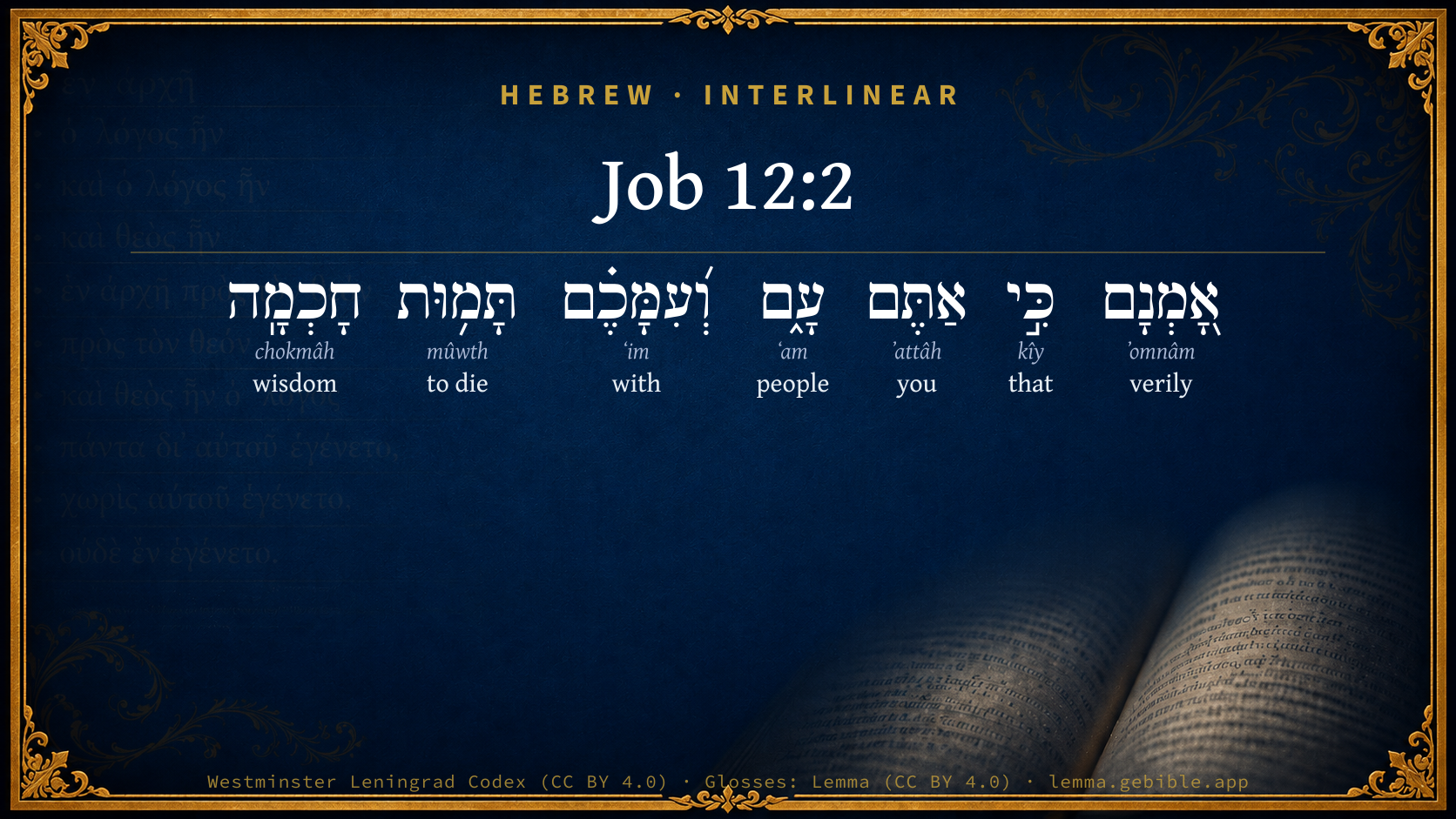
Hebrew (Westminster Leningrad Codex) Job 12:2 appears in the Hebrew Old Testament. The text above is from the Westminster Leningrad Codex. Each word links to its Strong’s number, a concise gloss, and parsing drawn from the Open Scriptures Hebrew Bible morphology. Click any word for its full Brown-Driver-Briggs (BDB) entry.
Download image
Cite this verse

Job 12:2 (World English Bible). Public Domain. Lemma interlinear Bible study tool, https://lemma.gebible.app/v/job/12/2.

Show BibTeX & RIS
BibTeX
RIS
English Translation
"No doubt, but you are the people, And wisdom shall die with you.
World English Bible · Public Domain
Download a study sheet

One document with this verse’s original text, its word-by-word gloss line, the meaning frame, cross-references with their text, attributed commentary, and full source and license credits — printable, and it pastes into notes with its structure intact.

This verse Autodidact and up

Study sheet (.html) Plain text (.txt)

A passage Seminary Student

Up to 50 verses in one chapter. A passage sheet keeps up to 6 commentary sources and 12 cross-references per verse, in the order this page ranks them, and says so on the sheet whenever that leaves anything out. Ask for a single verse and you get the Autodidact verse sheet above.

Everything on this page stays free to read, with no account — the sheet is a download of what is already on screen, not access to it.

Want to remove ads? Support Godless Engineer
Compare translations 3

The same verse in 3 English versions, stacked beneath the original-language interlinear above. Click any original word for its lexicon entry.

Each is an independent rendering of the whole verse — the interlinear is not word-aligned to these translations.

Highlighted words mark where these versions differ — a whole-verse word diff, not a word-by-word alignment.

  • World English Bible Public Domain
    "No doubt, but you are the people, And wisdom shall die with you.
  • King James Version Public Domain
    No doubt but ye are the people, and wisdom shall die with you.
  • unfoldingWord Literal Text CC BY-SA 4.0
    “Truly, then, you the people, and wisdom will die with you.

unfoldingWord Literal Text — © unfoldingWord, licensed CC BY-SA 4.0. Word-aligned USFM3 via Door43 (git.door43.org/unfoldingWord/en_ult).

Versions to compare (up to 4)

3 of 4 selected

Show all 18 translations

Every available English version of this verse, each an independent rendering of the whole verse.

  • World English Bible Public Domain
    "No doubt, but you are the people, And wisdom shall die with you.
  • Berean Standard Bible Public Domain
    “Truly then you are the people with whom wisdom itself will die!
  • Majority Standard Bible Public Domain
    “Truly then you are the people with whom wisdom itself will die!
  • King James Version Public Domain
    No doubt but ye are the people, and wisdom shall die with you.
  • American Standard Version (1901) Public Domain
    No doubt but ye are the people, And wisdom shall die with you.
  • Revised Version (1885) Public Domain
    No doubt but ye are the people, and wisdom shall die with you.
  • Geneva Bible (1599) Public Domain
    In deede because that ye are the people onely, wisedome must dye with you.
  • Douay-Rheims (1899) Public Domain
    Are you then men alone, and shall wisdom die with you?
  • Young's Literal Translation Public Domain
    Truly -- ye `are' the people, And with you doth wisdom die.
  • Literal Standard Version CC BY-SA 4.0
    “Truly—you [are] the people, and wisdom dies with you.
  • Unlocked Literal Bible CC BY-SA 4.0
    “No doubt you are the people; wisdom will die with you.
  • unfoldingWord Literal Text CC BY-SA 4.0
    “Truly, then, you the people, and wisdom will die with you.
  • Darby Bible Public Domain
    Truly ye are the people, and wisdom shall die with you!
  • World Messianic Bible Public Domain
    “No doubt, but you are the people, and wisdom will die with you.
  • Webster's Bible Public Domain
    No doubt but ye are the people, and wisdom shall die with you.
  • Free Bible Version CC BY-SA 4.0
    “You really think you're special people, don't you? Obviously when you die, wisdom will die with you!
  • Bible in Basic English Public Domain
    No doubt you have knowledge, and wisdom will come to an end with you.
  • JPS Tanakh (1917) Public Domain
    No doubt but ye are the people, and wisdom shall die with you.

Literal Standard Version (2020), Covenant Press — licensed CC BY-SA 4.0. Text via the HelloAO Bible API (eBible.org). Unlocked Literal Bible (unfoldingWord) — licensed CC BY-SA 4.0. Text via the HelloAO Bible API (eBible.org). unfoldingWord Literal Text — © unfoldingWord, licensed CC BY-SA 4.0. Word-aligned USFM3 via Door43 (git.door43.org/unfoldingWord/en_ult). Free Bible Version, Dr. Jonathan Gallagher — licensed CC BY-SA 4.0. Text via the HelloAO Bible API (eBible.org).

Word by word

More ways to search: Search by grammar → Find every occurrence → Compare this word →

Practice this passage: Drill this verse → Learn its vocabulary →

About this verse

These counts appear in no published source. They are computed here, from the morphology-tagged text and Lemma’s own curated glosses. What Lemma adds →

7
words
7
distinct lemmas
Wisdom
section

Notable vocabulary

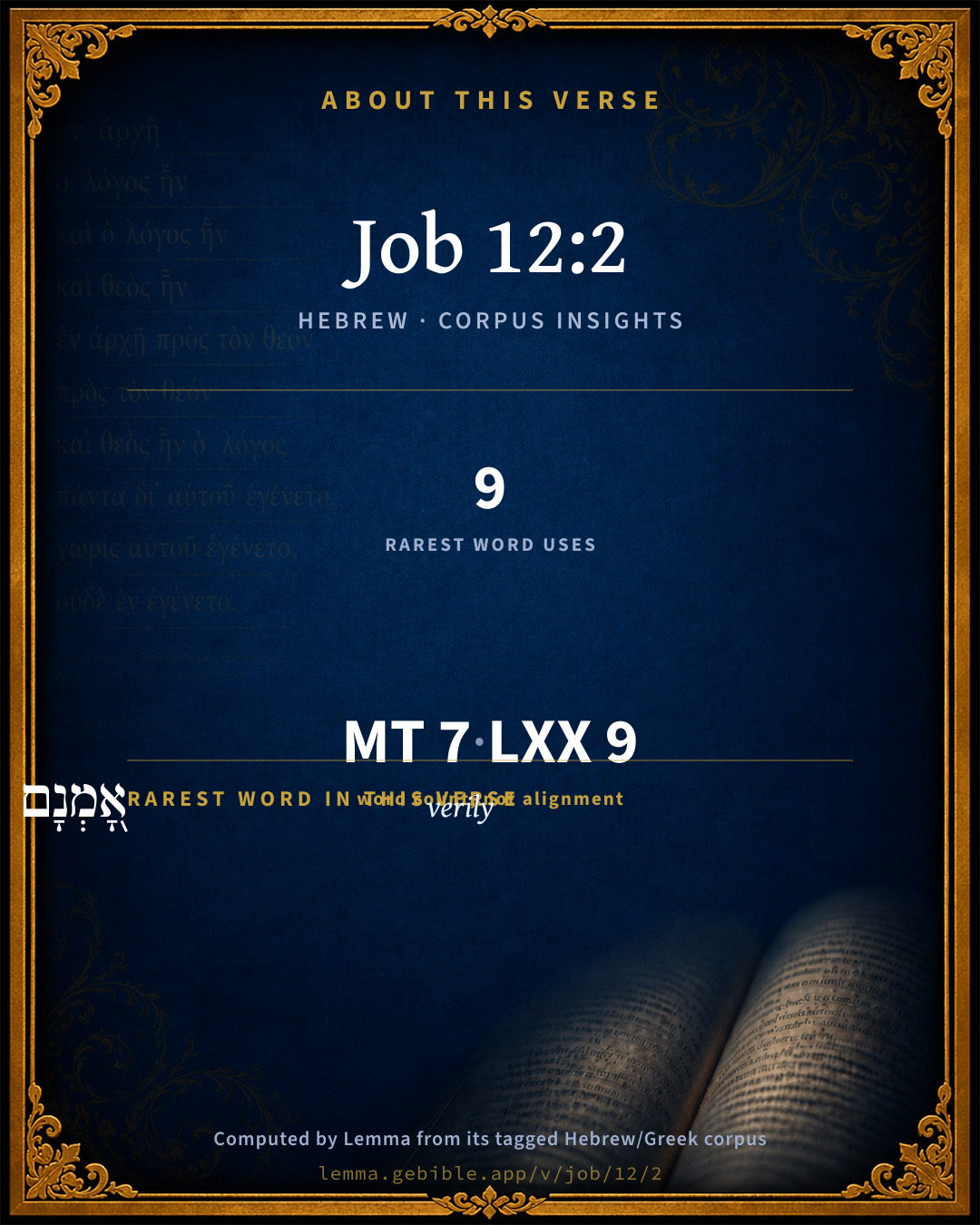
The rarest word here is אָ֭מְנָם verily H551 — appearing just 9 times in the whole Hebrew Bible.

Shared distinctive vocabulary

אָ֭מְנָם verily H551 occurs in 9 verses of the Hebrew Bible. Also found in:

Grammatical profile

  • 1 verb
  • 2 nouns
  • 1 pronoun
  • 1 preposition
  • 1 conjunction
  • 1 adverb

Verb forms

  • תָּמ֥וּת Qal · Imperfect

Hebrew & Septuagint length

In English translation the verse runs 13 words from the Hebrew and 12 from the Septuagint (LXX English) — closely comparable.

A rough comparison of the two English renderings, which tokenize alike — not a word-level alignment.

Word counts can differ between the Hebrew and the Greek without any difference in meaning — e.g. the Hebrew direct-object marker אֵת has no separate Greek word, and Greek often adds the article ὁ.

In the original languages it is 7 Hebrew tokens and 9 Greek tokens — but the two are counted differently (Hebrew bundles its prefixes and suffixes into one token; the Greek is in lemma form), so that isn’t a like-for-like length.

Cross-references

14

Topical passages linked to Job 12:2 in the Treasury of Scripture Knowledge — connected by theme and wording, ordered by reader-vote popularity; previews shown in the World English Bible.

  • Isaiah 5:21 Woe to those who are wise in their own eyes, And prudent in their own sight!
  • Job 6:24–25 "Teach me, and I will hold my peace; Cause me to understand wherein I have erred.
  • Job 8:8–10 "Please inquire of past generations, Find out about the learning of their fathers.
  • Job 11:2 "Shouldn't the multitude of words be answered? Should a man full of talk be justified?
  • Job 11:6 That he would show you the secrets of wisdom! For true wisdom has two sides. Know therefore that God exacts of you less than your iniquity deserves.
  • Job 11:12 But vain man can become wise If a man can be born as a wild donkey's colt.
  • Job 15:2 "Should a wise man answer with vain knowledge, And fill himself with the east wind?
  • Job 17:4 For you have hidden their heart from understanding, Therefore shall you not exalt them.
  • Job 17:10 But as for you all, come on now again; I shall not find a wise man among you.
  • Job 20:3 I have heard the reproof which puts me to shame; The spirit of my understanding answers me.
  • Job 32:7–13 I said, 'Days should speak, And multitude of years should teach wisdom.'
  • Proverbs 28:11 The rich man is wise in his own eyes; But the poor who has understanding sees through him.
  • 1 Corinthians 4:10 We are fools for Christ's sake, but you are wise in Christ. We are weak, but you are strong. You have honor, but we have dishonor.
  • 1 Corinthians 6:5 I say this to move you to shame. Isn't there even one wise man among you who would be able to decide between his brothers?

Cross-references courtesy of OpenBible.info (CC BY 4.0).

Hebrew and Greek witnesses Masoretic Hebrew ↔ Greek Septuagint

The same verse in the two great witnesses to the Old Testament, shown verse-for-verse.

These are two independent witnesses, not word-aligned to each other, and the Septuagint is shown in lemma (dictionary) form.

Hebrew Job 12:2 Masoretic · Westminster Leningrad Codex

אָ֭מְנָם כִּ֣י אַתֶּם עָ֑ם וְ֝עִמָּכֶ֗ם תָּמ֥וּת חָכְמָֽה

"No doubt, but you are the people, And wisdom shall die with you.

World English Bible · Public Domain

Greek LXX Job 12:2 Septuagint · lemma form

εἶτα σύ εἰμί ἄνθρωπος ἦ μετά σύ τελευτάω σοφία

So then you⌃ alone are men, and wisdom shall die with you?

LXX2012 (modern English Septuagint) · Public Domain

On this verse, Haydock's Catholic Bible Commentary discusses the Septuagint’s reading. Read the note in Commentary ↓

Hebrew: Westminster Leningrad Codex (CC BY 4.0). Greek: Septuagint (public domain); English from LXX2012 (modern English Septuagint) (Public Domain). How the Septuagint differs from the Hebrew →

Commentary

Notes on Job 12:2 from classic Christian and Jewish commentators (each source and its license shown beneath its notes). The classic Christian expositions comment on the surrounding passage and are grouped to its opening verse, so a note may address several verses; the Jewish commentaries on the Tanakh (Rashi and others) are per-verse, so they appear only where the commentator wrote on this verse.

Lemma curates 59 commentaries, every one of them public domain or Creative Commons licensed, each selected and text-cleaned for this edition rather than reprinted as found. About our sources →

Trapp's Complete Commentary

John Trapp

Job 12:2 No doubt but ye [are] the people, and wisdom shall die with you.

Ver. 2. No doubt but ye are the people] The select peculiar people, the only ones, as a man is put for a good man, Jer 5:1, a wife for a good wife, Pro 18:22, a name for a good name, Ecc 7:1. As Athens was said to be the Greece of Greece, and as one promising to show his friend all Athens at once, showed him Solon; or as the Latin poet, saying of Fabius Maximus,

Hic patria est, murique urbis stant pectore in uno (Silius).

So saith Job by a holy jeer (not to disgrace his friends, but to bring them to more modesty and moderation, if it might be), Certes, ye are not one or two men, but specimen totius orbis, an epitome of the world, or at least the representative of some whole people (Vatablus); ye have got away all the wit from myself and others, whom ye look upon as so many wild ass’s colts in comparison of yourselves. Thus the pope (Simon Magus like) pretends to be some great thing, Act 8:9, even the Church virtual; and that in his breast, as in Noah’s ark, is comprehended all wisdom and worth. Ye know nothing at all, saith he (Caiaphas-like), to all others, Joh 11:49. So do his janizaries, the Jesuits, who will needs be taken for the only scholars, politicians, and orators of the world. The Church, say they, is the soul of the world; the clergy, of the Church; and we, of the clergy; the empire of learning is ours, &c.

And wisdom shall die with you] As being locked up in your bosoms. Suetonius telleth us of Palaemon, the grammarian, that he was heard to say that learning was born with him, and would die with him. The Gnostics would needs be held the only knowing men; Illuminates, in Spain, the only spiritual men; Swenkfeldians, in Germany, styled themselves the confessors of the glory of Christ; our Antinomians, the hearers of the gospel, and of free grace. But what saith Solomon? "Let another man praise thee, and not thine own mouth," Pro 27:2. And that which had been much to a man’s commendation if from another, soundeth very slenderly from himself, saith Pliny. Aben Ezra and Rabbi Levi set another sense upon this verse, as if it were no irony, but a plain assertion to this effect: Questionless you are to be counted among the common sort of people. See Joh 7:49. Neither is there in you anything excellent or extraordinary, that ye should be looked upon as drained from the dregs or sifted from the brans of the very vulgar; your wisdom, if ever you had any, is even dead and decayed with you, and you have outlived your prime, &c.

John Trapp, A Commentary or Exposition upon All the Books of the Old and New Testament (1647–1656) — public domain. Text from a community e-Sword module.

Joseph Benson's Commentary

Job 12:2. No doubt but ye are the people — You, of all people, are the most eminent for wisdom; the only men living of distinguished knowledge and prudence. You have engrossed all the reason of mankind, and each of you has as much wisdom as a whole people put together. And wisdom shall die with you — All the wisdom which is in the world lives in you, and will be utterly lost when you die. When wise and good men die, it is a comfort to think that wisdom and goodness do not die with them: it is folly to think that there will be a great, irreparable loss of us when we are gone, since God has the residue of the Spirit, and can raise up others more fit to do his work.

Joseph Benson's Commentary on the Old and New Testaments (1811–1818) — public domain. Text from a community e-Sword module.

Whedon's Commentary on the Bible

Daniel D. Whedon

Section 1: SARCASTIC COMMENDATION OF THAT WISDOM WHICH FAILS TO RECOGNIZE THE SECURITY OF THE WICKED, Job_12:2-12.

a. Piety in straits is an object of derision; while robbers (such as the Sabeans and Chaldaeans) are at peace, Job_12:2-6.

2. Wisdom shall die with you — The people of the East take great pleasure in irony, and some of their satirical sayings are very cutting. When a sage intimates that he has superior wisdom, of when he is disposed to rally another for his meagre attainments, he says, “Yes, yes; you are the man! Your wisdom is like the sea.… When you die, whither will wisdom go!… When gone, alas! what will become of wisdom?” — ROBERTS’S Oriental Illustrations. Moschus thus laments the death of Bion: —

“Bion, the swain, and all with him, is dead;

Song lives no more, the Doric muse is fled.”

Daniel D. Whedon (gen. ed.), Commentary on the Old and New Testaments (1874–1909) — public domain. Text from a community e-Sword module.

Geneva Bible (1599)

Geneva Bible translators

Because you feel not that which you speak, you think the whole standeth in words, and so flatter yourselves as though none knew anything, or could know but you.

Geneva Bible (1599) marginal notes — public domain. Text via Bolls.life.

Adam Clarke's Commentary

Verse 2. No doubt but ye are the people] Doubtless ye are the wisest men in the world; all wisdom is concentrated in you; and when ye die, there will no more be found on the face of the earth! This is a strong irony.

Adam Clarke's Commentary on the Bible (1810–1826) — public domain. Text from a community e-Sword/MySword module.

The Cambridge Bible for Schools and Colleges

gen. ed. J. J. S. Perowne

2. ye are the people] Sarcastic admiration of the wisdom of his three friends, cf. ch. Job_11:6. “The people” does not seem to mean the right people, persons worthy of the name of “people;” rather “the people” is used as three other persons, well known to history, employed it, when they said, “We, the people of England.” It means the whole people; hence Job adds, “Wisdom will die with you.”

The Cambridge Bible for Schools and Colleges (gen. ed. J. J. S. Perowne; Cambridge University Press, 1878–1918) — public domain. Text from a community e-Sword module.

John Gill's Exposition

But I have understanding as well as you,.... A natural understanding, or an understanding of natural things, which distinguishes a man from a brute; and a spiritual understanding, an understanding enlightened by the spirit of God, which is naturally dark as to divine things; but he had an understanding given him, to know himself, his state and condition by nature; to know God, his love and grace to men, and, as his covenant God, to know Christ his living Redeemer, who should stand on the earth in the latter day, both to be his Redeemer and his Judge; to know his interest in him, and in the blessings of grace and glory by him: or, "I have an heart as well as you" (d); a wise and an understanding one; a new heart, and a right spirit; an heart to fear and serve the Lord, a sincere and upright one, and devoid of hypocrisy and deceit; and as good an one as theirs:

I am not inferior unto you: he was indeed as to estate and substance, being now reduced; though he had been, in that sense, the greatest man in all the east; but in wisdom and knowledge, in gifts and grace: thus a modest man, when oppressed and insulted by the speeches of overbearing men, may be obliged and see it necessary to say some things of himself, in his own vindication, which he otherwise would not; see Co2 11:15; or, "I am not falling before you"; or "by you" (e); as one intimidated, conquered, and yielding; I stand my ground, and will not gave way or submit to you, or allow you to have the superiority of me: or, "I am falling no more than you"; they took him for an apostate from God, and the fear of him, and the true religion he had professed, which Job denies; he held fast his integrity; and though he was fallen into calamities and afflictions, he was not fallen from God; from his fear of him, faith in him, and love and obedience to him; he was a holy, good man, a persevering saint; and though he had slips and falls in common with good men, yet fell not finally and totally, or was an apostate from the faith:

yea, who knoweth not such things as these? or, "with whom are not as these" (f)? the things you have been discoursing of, which you would fain have pass for the secrets of wisdom, deep and mysterious things, hid from vulgar eyes, which none have and know but yourselves, are common things, what everyone is possessed of, and understands as well as you; that there is a God that has made the world, and governs it; that he himself is unsearchable, infinite and incomprehensible; a sovereign Being that does according to his will and pleasure, and sees and knows all things, and does all things well and wisely, and according to the counsel of his will: though some think Job has reference not to what Zophar had been discoursing concerning the infinity and wisdom of God, but to the thing or things in dispute between them, or to the assertions of his friends; that it is always well with good men, and ill with bad men, or that wicked men only are punished and afflicted, and particularly what Zophar concluded his speech with, Job 11:20. Now these were vulgar notions, which the common people had taken up, and were vulgar errors, as he proves in the following verses, by giving instances of good men, being afflicted, and of bad men being in prosperity.

(d) "etiam mihi cor sicut vobis", Pagninus, Montanus, Mercerus, Schmidt, Michaelis, Schultens; so Broughton. (e) "non cadens ego a vobis", Montanus, Vatablus, Bolducius, Beza, Mercerus, Michaelis; "prae vobis", Schmidt. (f) "et cum quo non sicut haec?" Pagninus, Montanus, Bolducius, Mercerus; and to the same sense Junius & Tremellius, Piscator, Cocceius, Schultens.

John Gill's Exposition of the Whole Bible (1746–1763) — public domain (CC PDM 1.0). Text via the HelloAO Bible API.

Albert Barnes' Notes on the Bible

No doubt but ye are the people - That is, the only wise people. You have engrossed all the wisdom of the world, and all else are to be regarded as fools. This is evidently the language of severe sarcasm; and it shows a spirit fretted and chafed by their reproaches. Job felt contempt for their reasoning. and meant to intimate that their maxims, on which they placed so much reliance, were common-place, and such as every one was familar with.

And wisdom shall die with you - This is ironical, but it is language such as is common perhaps every where. “The people of the East,” says Roberts, “take great pleasure in irony, and some of their satirical sayings are very cutting. When a sage intimates that he has superior wisdom or when he is disposed to rally another for his meagrc attainments, he says, ‘Yes, yes, you are the man! ‘ ‘Your wisdom is like the sea.’ ‘When you die, whither will wisdom go?’” In a serious sense, language like this is used by the Classical writers to describe the death of eminently great or good men. They speak of wisdom, bravery, piety, or music, as dying with them. Thus, Moschus, Idyll. iii. 12.

Ὅττι βίων τέθνηκεν ὁ βώκολος, ἔττι σὺν αὐτῷ

Καὶ τὸ μέλος τέθνακε, καὶ ὤλετο Δωρίς ἀειδός.

Hotti biōn tethnēken ho bōkolos, esti sun autō

Kai to melos tethnake, kai ōleto Dōris aeidos.

“Bion the swain is dead, and with him song

Has died, and the Doric muse has perished.”

Expressions like these are common. Thus, in the “Pleasures of Hope” it is said:

And Freedom shrieked when Kosciusko fell.

Albert Barnes' Notes on the Bible (1834–1885) — public domain. Text from a community e-Sword/MySword module.

Haydock's Catholic Bible Commentary

You. Hebrew, "truly you are the people, and wisdom will die with you!" This irony is very sharp. (Calmet) --- "Are you alone men? or shall?" &c. (Septuagint; Syriac)

George Leo Haydock (1774–1849), Haydock's Catholic Family Bible and Commentary, 1859 edition — public domain. Excludes Psalms (Douay-Rheims chapter numbering differs from Protestant) and Deuterocanonical books (Catholic canon only).

Matthew Poole's English Annotations

Ye are the people; you three, and you only, are the people, i.e. people of all people for eminency of wisdom, the only company of reasonable creatures; all others are but fools or beasts: you have engrossed all the reason of mankind; and each of you have as much wisdom as a whole people put together. It is an ironical expression, as the next verse showeth.

Wisdom shall die with you; all the wisdom and knowledge of Divine things which is in the world lives in you, and will die and be utterly lost when you die. This you think of yourselves; and this makes you so confidently and peremptorily deliver your opinions, and give laws to me and all mankind, and even to God himself.

Matthew Poole's English Annotations on the Holy Bible (1683–1685) — public domain. Text from a community e-Sword/MySword module.

The Pulpit Commentary

HOMILIES BY W.F. ADENEY Ver. 2. Irony.

I IRONY IS TO BE FOUND IN SCRIPTURE. There is great variety in the style of Scripture. Almost every modification of language is to be found in the Bible, consecrated to some holy purpose. Even the faculty of humour is utilized, as in the incident of Balaam"s ass, (Num_22:28-30) and in St. Paul"s recommendation that the woman who will not wear a veil had better complete the exposure of her head by being shorn. (1Co_11:6) The prophets abound in irony. Christ used irony in the parable of the rich fool. (Luk_12:16-20)

II THERE IS A PLACE FOR IRONY IN DISCOURSE. Some evils can be best met just by being exposed. Now, irony is a method of showing a thing in an unexpected light, so that, while admitting all its claims, we make it apparent that those very claims are absurd. Slight failings will be best castigated with simple ridicule; more serious ones, if they are not great sins, with grave irony.

III PRETENTIOUSNESS ESPECIALLY PROVOKES IRONY. Each of Job"s three friends has now spoken. Though they were not alike in attainments nor in natural dispositions, they agreed in their dogmas and in their judgment of Job. A tone of conscious superiority and irritating censoriousness rings through all their speeches. This not only vexes Job; it prompts an ironical retaliation. It is dangerous to make grand pretensions. Humility is a great security, and when humility is lost, we lay ourselves open to attack on the ground of our assumptions. Pretentiousness does not only thus provoke ironical replies; it best meets its merited castigation by these replies, which humiliate it in a most unanswerable manner.

IV IRONY IS A DANGEROUS WEAPON FOR A CHRISTIAN TO WIELD. It may be a lawful weapon- There are times when it can be used in the cause of righteousness with tremendous effect. But there is great danger lest the employment of it should destroy "the greatest thing in the world love. There is always a tendency to push it too far, and to go beyond wholesome rebuke in the direction of cruel scorn. This is distinctly unchristian. Moreover, as Job"s friends did not understand him, possibly he did not understand them. If so, his irony may have been too severe for justice. We should be careful that we are in no error before we venture to use irony against our brother. Even then, zeal for righteousness should be tempered by brotherly kindness.

V GOD DISPLAYS IRONY IN PROVIDENCE. The Greek tragedians saw irony in fate. Man"s greatness was shown to be a very small thing, and his boasted success a mere bubble. The old classical idea was dark and hard, for it did not take into account the Fatherhood of God. But within God"s infinite purpose of love there is room for irony. By the slow unrolling of the course of events, the boasting of the pretentious ends in confusion. God humbles his creatures in their pride and vanity, giving them sudden falls, by means of which they cannot but feel their helplessness and littleness. The monarch is choked by a fly. Such things are not done vindictively, or in scorn; but because we are mined by boasting and saved in our humiliation. Thus the ugly weapon of irony may prepare us for the healing grace of the gospel. W.F.A.

The Pulpit Commentary (1880–1919), ed. H.D.M. Spence-Jones & Joseph S. Exell — public domain. Text from a community e-Sword module.

John Wesley's Explanatory Notes

Ye - You have engrossed all the reason of mankind; and each of you has as much wisdom as an whole people put together. All the wisdom which is in the world, lives in you, and will be utterly lost when you die. When wise and good men die, it is a comfort to think that wisdom and goodness do not die with them: it is folly to think, that there will be a great, irreparable loss of us when we are gone, since God has the residue of the spirit, and can raise up others more fit to do his work.

John Wesley, Explanatory Notes Upon the Whole Bible (1754–1765) — public domain. Text via the GEBible commentary corpus.

Rashi

Rabbi Shlomo Yitzchaki (Rashi)

wisdom shall perish When you die, all wisdom shall perish with you because all wisdom is in you, but I too have intelligence like you.

Rashi on the Tanakh — English translations: “The Judaica Press complete Tanach with Rashi, translated by A. J. Rosenberg” (CC BY 4.0); “Pentateuch with Rashi's commentary by M. Rosenbaum and A.M. Silbermann, 1929-1934” (public domain); “The Metsudah Tanach series, Lakewood, N.J” (CC BY 4.0); and “The Book of Joshua, Metsudah Publications, 1997” (CC BY 4.0). Text via Sefaria.

Lesson kit

Teaching starters — assembled from the data on this page, not authored interpretation. Every prompt links to the verse data it draws on. Edit before teaching.

Job, in the Wisdom, opens this verse with 7 words (7 distinct Hebrew lemmas). Its most distinctive word is ʼomnâm (“verily”). A historical commentator’s framing appears above. Read the whole chapter for the surrounding context.

Discussion questions

  1. The word ʼomnâm carries the sense “verily.” How does it shape the verse?
  2. Ruth 3:12 shares the word «verily» with this verse. How do the two illuminate each other?
  3. The translations on this page render this verse differently — a whole-verse word diff, not a word-by-word alignment. What might account for the different wordings?
  4. The verb «תָּמ֥וּת» is Qal Imperfect. How does its form color the action?
  5. Reading how Trapp's Complete Commentary and Joseph Benson's Commentary read this verse, where do the two commentators agree and where do they part?

Things to notice

Reading settings

Reading text

Shown beneath each verse's original-language words.

Old Testament
Old Testament edition

Read the OT as the Masoretic Hebrew (MT) or the Greek Septuagint (LXX).

English shown for the Greek Septuagint (in the Hebrew ↔ Greek comparison).

Comparing translations? Open the Compare panel on any verse page to stack up to four side by side.