Amos 9:10

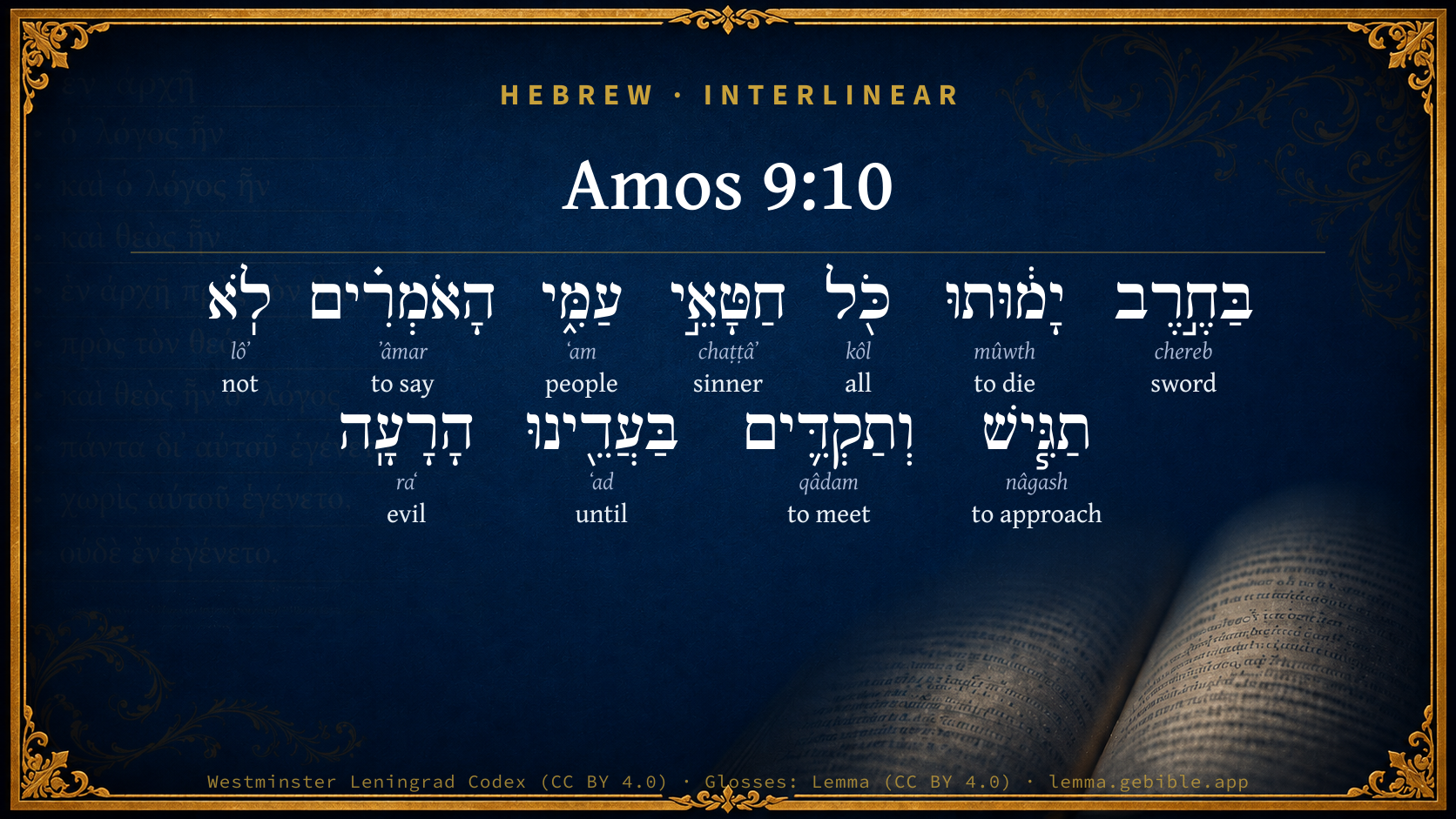
Hebrew (Westminster Leningrad Codex) Amos 9:10 appears in the Hebrew Old Testament. The text above is from the Westminster Leningrad Codex. Each word links to its Strong’s number, a concise gloss, and parsing drawn from the Open Scriptures Hebrew Bible morphology. Click any word for its full Brown-Driver-Briggs (BDB) entry.
Download image
Cite this verse

Amos 9:10 (World English Bible). Public Domain. Lemma interlinear Bible study tool, https://lemma.gebible.app/v/amos/9/10.

Show BibTeX & RIS
BibTeX
RIS
English Translation
All the sinners of my people will die by the sword, who say, 'Evil won't overtake nor meet us.'
World English Bible · Public Domain
Download a study sheet

One document with this verse’s original text, its word-by-word gloss line, the meaning frame, cross-references with their text, attributed commentary, and full source and license credits — printable, and it pastes into notes with its structure intact.

This verse Autodidact and up

Study sheet (.html) Plain text (.txt)

A passage Seminary Student

Up to 50 verses in one chapter. A passage sheet keeps up to 6 commentary sources and 12 cross-references per verse, in the order this page ranks them, and says so on the sheet whenever that leaves anything out. Ask for a single verse and you get the Autodidact verse sheet above.

Everything on this page stays free to read, with no account — the sheet is a download of what is already on screen, not access to it.

Want to remove ads? Support Godless Engineer
Compare translations 3

The same verse in 3 English versions, stacked beneath the original-language interlinear above. Click any original word for its lexicon entry.

Each is an independent rendering of the whole verse — the interlinear is not word-aligned to these translations.

Highlighted words mark where these versions differ — a whole-verse word diff, not a word-by-word alignment.

  • World English Bible Public Domain
    All the sinners of my people will die by the sword, who say, 'Evil won't overtake nor meet us.'
  • King James Version Public Domain
    All the sinners of my people shall die by the sword, which say, The evil shall not overtake nor prevent us.
  • unfoldingWord Literal Text CC BY-SA 4.0
    All the sinners of my people will die by the sword, those who say, ‘Disaster will not overtake or meet us.’

unfoldingWord Literal Text — © unfoldingWord, licensed CC BY-SA 4.0. Word-aligned USFM3 via Door43 (git.door43.org/unfoldingWord/en_ult).

Versions to compare (up to 4)

3 of 4 selected

Show all 18 translations

Every available English version of this verse, each an independent rendering of the whole verse.

  • World English Bible Public Domain
    All the sinners of my people will die by the sword, who say, 'Evil won't overtake nor meet us.'
  • Berean Standard Bible Public Domain
    All the sinners among My people will die by the sword—all those who say, ‘Disaster will never draw near or confront us.’”
  • Majority Standard Bible Public Domain
    All the sinners among My people will die by the sword—all those who say, ‘Disaster will never draw near or confront us.’”
  • King James Version Public Domain
    All the sinners of my people shall die by the sword, which say, The evil shall not overtake nor prevent us.
  • American Standard Version (1901) Public Domain
    All the sinners of my people shall die by the sword, who say, The evil shall not overtake nor meet us.
  • Revised Version (1885) Public Domain
    All the sinners of my people shall die by the sword, which say, The evil shall not overtake nor prevent us.
  • Geneva Bible (1599) Public Domain
    But all the sinners of my people shall dye by the sword, which say, The euill shall not come, nor hasten for vs.
  • Douay-Rheims (1899) Public Domain
    All the sinners of my people shall fall by the sword: who say: The evils shall not approach, and shall not come upon us.
  • Young's Literal Translation Public Domain
    By sword die do all sinners of My people, Who are saying, `Not overtake, or go before, For our sakes, doth evil.'
  • Literal Standard Version CC BY-SA 4.0
    By sword all sinners of My people die, || Who are saying, || Evil does not overtake, or go before, || For our sakes.
  • Unlocked Literal Bible CC BY-SA 4.0
    All the sinners of my people will die by the sword, those who say, 'Disaster will not overtake or meet us.'
  • unfoldingWord Literal Text CC BY-SA 4.0
    All the sinners of my people will die by the sword, those who say, ‘Disaster will not overtake or meet us.’
  • Darby Bible Public Domain
    All the sinners of my people shall die by the sword, who say, Evil shall not overtake nor befall us.
  • World Messianic Bible Public Domain
    All the sinners of my people will die by the sword, who say, ‘Evil won’t overtake nor meet us.’
  • Webster's Bible Public Domain
    All the sinners of my people shall die by the sword, who say, The evil shall not overtake nor fall upon us.
  • Free Bible Version CC BY-SA 4.0
    All the sinners of my people will be killed by the sword—all those who say, “Nothing bad is going to happen; no disaster will fall on us.”
  • Bible in Basic English Public Domain
    All those sinners among my people will be put to the sword who say, Evil will not overtake us or come face to face with us.
  • JPS Tanakh (1917) Public Domain
    All the sinners of My people shall die by the sword, that say: 'The evil shall not overtake nor confront us.'

Literal Standard Version (2020), Covenant Press — licensed CC BY-SA 4.0. Text via the HelloAO Bible API (eBible.org). Unlocked Literal Bible (unfoldingWord) — licensed CC BY-SA 4.0. Text via the HelloAO Bible API (eBible.org). unfoldingWord Literal Text — © unfoldingWord, licensed CC BY-SA 4.0. Word-aligned USFM3 via Door43 (git.door43.org/unfoldingWord/en_ult). Free Bible Version, Dr. Jonathan Gallagher — licensed CC BY-SA 4.0. Text via the HelloAO Bible API (eBible.org).

Word by word

More ways to search: Search by grammar → Find every occurrence → Compare this word →

Practice this passage: Drill this verse → Learn its vocabulary →

חַטָּאֵ֣י
chaṭṭâʼ
H2400
“sinner of”
Adjective, Adjective, Masculine, Plural, Construct
Part of Speech
Adjective
Type
Adjective
Gender
Masculine
Number
Plural
State
Construct
Full BDB Definition

Origin: intensively from H2398

TWOT: 638b

sinners (noun masculine) - sinful (adjective) - exposed to condemnation, reckoned as offenders (adjective)
  1. בַּחֶ֣רֶב chereb H2719 “in/at the · sword” Preposition, Determined + Noun, Common, Feminine, Singular, Absolute
  2. יָמ֔וּתוּ mûwth H4191 “to die” Verb, Qal, Imperfect, 3rd Person, Masculine, Plural
  3. כֹּ֖ל kôl H3605 “all of” Noun, Common, Masculine, Singular, Construct
  4. עַמִּ֑י ʻam H5971 “people · my” Noun, Common, Masculine, Singular, Construct + Suffix, Personal, 1st Person, Common, Singular
  5. הָאֹמְרִ֗ים ʼâmar H559 “the · saying” Particle, Definite Article + Verb, Qal, Participle Active, Masculine, Plural, Absolute
  6. לֹֽא lôʼ H3808 “not” Particle, Negative
  7. תַגִּ֧ישׁ nâgash H5066 “to approach” Verb, Hiphil, Imperfect, 3rd Person, Feminine, Singular
  8. וְתַקְדִּ֛ים qâdam H6923 “and · to meet” Conjunction + Verb, Hiphil, Imperfect, 3rd Person, Feminine, Singular
  9. בַּעֲדֵ֖ינוּ ʻad H5704 “until · us” Preposition + Suffix, Personal, 1st Person, Common, Plural
  10. הָרָעָֽה raʻ H7451 “the · evil” Particle, Definite Article + Noun, Common, Feminine, Singular, Absolute

About this verse

These counts appear in no published source. They are computed here, from the morphology-tagged text and Lemma’s own curated glosses. What Lemma adds →

11
words
11
distinct lemmas
Prophets
section

Notable vocabulary

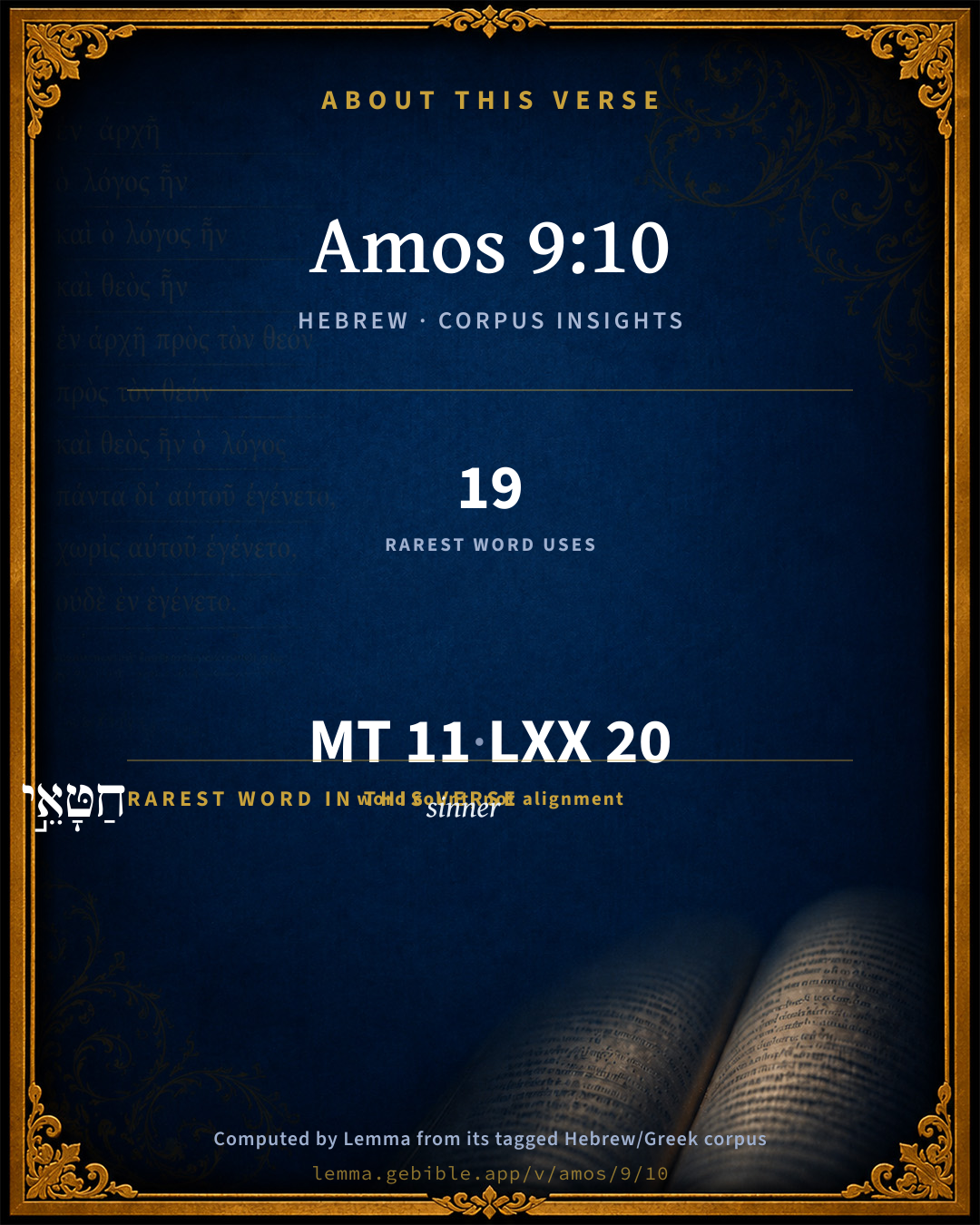
The rarest word here is חַטָּאֵ֣י sinner H2400 — appearing just 19 times in the whole Hebrew Bible.

Shared distinctive vocabulary

חַטָּאֵ֣י sinner H2400 occurs in 19 verses of the Hebrew Bible. Also found in:

Grammatical profile

  • 4 verbs
  • 4 nouns
  • 1 adjective
  • 1 preposition
  • 1 particle

Verb forms

  • יָמ֔וּתוּ Qal · Imperfect
  • הָאֹמְרִ֗ים Qal · Participle Active
  • תַגִּ֧ישׁ Hiphil · Imperfect
  • וְתַקְדִּ֛ים Hiphil · Imperfect

Hebrew & Septuagint length

In English translation the verse runs 19 words from the Hebrew and 23 from the Septuagint (LXX English) — closely comparable.

A rough comparison of the two English renderings, which tokenize alike — not a word-level alignment.

Word counts can differ between the Hebrew and the Greek without any difference in meaning — e.g. the Hebrew direct-object marker אֵת has no separate Greek word, and Greek often adds the article ὁ.

In the original languages it is 11 Hebrew tokens and 20 Greek tokens — but the two are counted differently (Hebrew bundles its prefixes and suffixes into one token; the Greek is in lemma form), so that isn’t a like-for-like length.

Cross-references

19

Topical passages linked to Amos 9:10 in the Treasury of Scripture Knowledge — connected by theme and wording, ordered by reader-vote popularity; previews shown in the World English Bible.

  • Amos 6:3 Those who put far away the evil day, And cause the seat of violence to come near;
  • Isaiah 33:14 The sinners in Zion are afraid; trembling has seized the godless ones: Who among us can dwell with the devouring fire? who among us can dwell with everlasting burning?
  • Matthew 13:49–50 So will it be in the end of the world. The angels will come forth, and separate the wicked from among the righteous,
  • Psalms 10:11 He says in his heart, "God has forgotten. He hides his face. He will never see it."
  • Ecclesiastes 8:11 Because sentence against an evil work is not executed speedily, therefore the heart of the sons of men is fully set in them to do evil.
  • Isaiah 5:19 Who say, "Let him make speed, let him hasten his work, that we may see it; And let the counsel of the Holy One of Israel draw near and come, That we may know it!"
  • Isaiah 28:14–15 Why hear the word of Yahweh, you scoffers, that rule this people that is in Jerusalem:
  • Isaiah 56:12 Come you, [say they], I will get wine, and we will fill ourselves with strong drink; and tomorrow shall be as this day, [a day] great beyond measure.
  • Jeremiah 18:18 Then said they, Come, and let us devise devices against Jeremiah; for the law shall not perish from the priest, nor counsel from the wise, nor the word from the prophet. Come, and let us strike him with the tongue, and let us not give heed to any of his words.
  • Ezekiel 34:16–17 I will seek that which was lost, and will bring back that which was driven away, and will bind up that which was broken, and will strengthen that which was sick: but the fat and the strong I will destroy; I will feed them in justice.
  • Amos 6:1 Woe to those who are at ease in Zion, And to those who are secure on the mountain of Samaria, The notable men of the chief of the nations, To whom the house of Israel come!
  • Zephaniah 3:11–13 In that day you will not be disappointed for all your doings, in which you have transgressed against me; for then I will take away out of the midst of you your proudly exulting ones, and you will no more be haughty in my holy mountain.
  • Zechariah 13:8–9 It shall happen that in all the land," says Yahweh, Two parts in it will be cut off and die; But the third will be left in it.
  • Malachi 3:2–5 "But who can endure the day of his coming? And who will stand when he appears? For he is like a refiner's fire, and like launderer's soap;
  • Malachi 3:15 Now we call the proud happy; yes, those who work wickedness are built up; yes, they tempt God, and escape.'
  • Malachi 4:1 "For, behold, the day comes, it burns as a furnace; and all the proud, and all who work wickedness, will be stubble; and the day that comes will burn them up," says Yahweh of Hosts, "that it shall leave them neither root nor branch.
  • Matthew 3:10–12 "Even now the axe lies at the root of the trees. Therefore, every tree that doesn't bring forth good fruit is cut down, and cast into the fire.
  • Matthew 13:41–42 The Son of Man will send out his angels, and they will gather out of his Kingdom all things that cause stumbling, and those who do iniquity,
  • Ezekiel 20:38 and I will purge out from among you the rebels, and those who disobey against me; I will bring them forth out of the land where they sojourn, but they shall not enter into the land of Israel: and you shall know that I am Yahweh.

Cross-references courtesy of OpenBible.info (CC BY 4.0).

Hebrew and Greek witnesses Masoretic Hebrew ↔ Greek Septuagint

The same verse in the two great witnesses to the Old Testament, shown verse-for-verse.

These are two independent witnesses, not word-aligned to each other, and the Septuagint is shown in lemma (dictionary) form.

Hebrew Amos 9:10 Masoretic · Westminster Leningrad Codex

בַּחֶ֣רֶב יָמ֔וּתוּ כֹּ֖ל חַטָּאֵ֣י עַמִּ֑י הָאֹמְרִ֗ים לֹֽא תַגִּ֧ישׁ וְתַקְדִּ֛ים בַּעֲדֵ֖ינוּ הָרָעָֽה

All the sinners of my people will die by the sword, who say, 'Evil won't overtake nor meet us.'

World English Bible · Public Domain

Greek LXX Amos 9:10 Septuagint · lemma form

ἐν ῥομφαία τελευτάω πᾶς ἁμαρτωλός λαός ἐγώ ὁ λέγω οὐ μή ἐγγίζω οὐδέ οὐ μή γίγνομαι ἐπί ἐγώ ὁ κακός

All the sinners of my people shall die by the sword, who say, Calamities shall certainly not draw near, nor come upon us.

LXX2012 (modern English Septuagint) · Public Domain

Hebrew: Westminster Leningrad Codex (CC BY 4.0). Greek: Septuagint (public domain); English from LXX2012 (modern English Septuagint) (Public Domain). How the Septuagint differs from the Hebrew →

Targum (Aramaic paraphrase)

1

The Targum is the ancient Jewish Aramaic paraphrase of the Hebrew Scriptures — an interpretive translation, not the Hebrew text itself. Onkelos (literal) and Pseudo-Jonathan (expansive) render the Torah, and Jonathan the Prophets. Coverage is partial: where no permissively-licensed English translation exists for a verse, only the Aramaic is shown. This is verse-level text, not a word-by-word alignment to the Hebrew.

  1. Targum Jonathan Prophets (Joshua–Malachi)
    בְּחַרְבָּא יִתְקַטְלוּן כָּל חַיָבֵי עַמִי דְאָמְרִין לָא תֵיתֵי וְתוֹחִי עֲלָנָא בִישְׁתָּא:

    (no public-domain English translation for this verse)

    Targum Jonathan — Aramaic: “Mikraot Gedolot” (public domain). English: “Sefaria Community Translation” (CC0 1.0 (public-domain dedication)); “London "Chaldee Paraphrase," 1871” (public domain). Text via Sefaria.

Commentary

Notes on Amos 9:10 from classic Christian and Jewish commentators (each source and its license shown beneath its notes). The classic Christian expositions comment on the surrounding passage and are grouped to its opening verse, so a note may address several verses; the Jewish commentaries on the Tanakh (Rashi and others) are per-verse, so they appear only where the commentator wrote on this verse.

Lemma curates 59 commentaries, every one of them public domain or Creative Commons licensed, each selected and text-cleaned for this edition rather than reprinted as found. About our sources →

Trapp's Complete Commentary

John Trapp

Amo 9:10 All the sinners of my people shall die by the sword, which say, The evil shall not overtake nor prevent us.

Ver. 10. All the sinners of my people shall die by the sword] The flagitious, presumptuous persons, that bless themselves when I curse them, saying, We shall have peace, though we walk every man in the imagination of his heart, and take his full swing in sin, Deu 29:19. Such sinners in Zion, Isa 33:14, such sacrificing Sodomites, Isa 1:10, such profligate professors shall die by the sword; either by the hand of the enemy, or, which is worse, gladio spiritali, saith Mercer, by the spiritual sword, being blinded and rejected by God; so that their preservation is but a reservation to a greater mischief. Whereas, on the other side, some of God’s elect might in a common calamity perish by the sword, but then (Josiah-like) they died in peace, though they fell in battle; their death was right precious in the sight of the Lord, and a plentiful amends made them in heaven.

Which say, The evil shall not overtake nor prevent us] Or, for our sakes, by our default, Begnadenu propter nos. If affliction do find us out, yet we have not deserved it; common occurrences we cannot be against. Thus the wicked man "flattereth himself in his own eyes, until his iniquity be found to be hateful," Psa 36:2. "In all my labours they shall find none iniquity in me that were sin," Hos 12:8. "Yet thou sayest, Because I am innocent, surely his anger shall turn from me. Behold, I will plead with thee, because thou sayest, I have not sinned," Jer 2:35.

John Trapp, A Commentary or Exposition upon All the Books of the Old and New Testament (1647–1656) — public domain. Text from a community e-Sword module.

Jamieson, Fausset & Brown

Robert Jamieson, A. R. Fausset & David Brown

All the sinners--answering to the chaff in the image in Amo 9:9, which falls on the earth, in opposition "to the grain" that does not "fall."

overtake . . . us--"come on us from behind" [MAURER].

Jamieson, Fausset & Brown — Commentary Critical and Explanatory on the Whole Bible (1871) — public domain (CC PDM 1.0). Text via the HelloAO Bible API.

Adam Clarke's Commentary

Verse 10. All the sinners of my people] Those who are the boldest and most incredulous; especially they who despise my warnings, and say the evil day shall not overtake nor prevent us; they shall die by the sword. It is no evidence of a man's safety that he is presumptuously fearless. There is a blessing to him who trembles at God's word.

Adam Clarke's Commentary on the Bible (1810–1826) — public domain. Text from a community e-Sword/MySword module.

John Calvin's Commentaries

Amos goes on with the same subject, — that God without any measure of cruelty would execute extreme vengeance on a reprobate people: Die, he says, by the sword all the wicked of my people. In naming the wicked of the people, he meant no doubt to include the whole people; though if any one thinks that the elect are by implication excepted, who were mixed with the ungodly, I do not object: this is probable; but yet the Prophet speaks here of the people generally. He says that the wicked of the people would perish by the sword: for it was not the sin of a few that Amos here refers to, but the sin which prevailed among the whole nation. Then all the wicked of my people shall die by the sword. He points out what sort of people they were, or at least he mentions the chief mark by which their impiety might be discovered, — they obstinately despised all the judgments of God, They say, It will not draw near; nor lay hold on our account, the evil.

Security then, which of itself ever generates a contempt of God, is here mentioned as the principal mark of impiety. And doubtless the vices of men reach a point that is past hope, when they are touched neither by fear nor shame, but expect God’s judgments without any concern or anxiety. Since then they thus drove far away from themselves all threatening, while at the same time they were ill at ease with themselves, and as it were burying themselves in deep caverns, and seeking false peace to their consciences, they were in a torpor, or rather stupor, incapable of any remedy. It is, therefore, no wonder that the Prophet lays down here this mark of security, when he is showing that there was no remnant of a sound mind in this people. Die then shall all the wicked by the sword, even those who say, It will not draw near; nor anticipate us, on our account, the evil: for we can not explain the word הקדים, ekodim, in any other way than by referring it to the threatening. For the Prophets, we know, commonly declared that the day of the Lord was at hand, that his hand was already armed, that it had already seized the sword. As then the Prophets, in order to smite despisers with fear, were wont to threaten a near punishment; so the Prophet does here; wishing to expose the impious stupor of the people, he says, “You think that there will not be such haste as is foretold to you by the Prophets; but this sheer perverseness will be the cause of your ruin.”

As to the expression, It will not come on our account, from a regard to us, it deserves to be noticed. Though hypocrites confess in general, that they cannot escape the hand of God, yet they still separate themselves from the common class, as if they are secured by some peculiar privilege. They therefore set up something in opposition to God, that they may not be blended with others. This folly the Prophet indirectly condemns by saying, that hypocrites are in a quiet and tranquil state, because they think that there will be to them no evil in common with the rest, as also they say in Isaiah 28:15, ‘The scourge, if it passes, will not yet reach us.’ We now then see what the Prophet has hitherto taught, and the meaning of these four verses which we have just explained. Now follows the promise —

John Calvin's Commentaries (1540-1563) — public domain. Text from the Calvin Translation Society English edition (1840s-50s) via the Christian Classics Ethereal Library (ccel.org). Calvin's coverage is partial (roughly two-thirds of the Bible); uncommented books and verses are honest gaps, never fabricated. The 19th-century editor's footnotes and remarks are omitted so the notes are faithfully Calvin's own voice.

The Cambridge Bible for Schools and Colleges

gen. ed. J. J. S. Perowne

10. which say, The evil shall not draw near, or come in front about us] i.e. shall not meet us in any direction. The sinners whom the prophet has here specially in view are those who, trusting to the fact that they were members of the chosen people (cf. Amo_3:2), or relying upon their zeal in an external ceremonial (Amo_5:21 ff.), deemed themselves secure, and declared that misfortune could never overtake them (cf. Amo_6:3). Their false security, says Amos, should be the cause of their destruction. Cf. similar expressions of security, uttered in defiance of the prophets’ warnings, Isa_5:19; Mic_3:11; Jer_23:17; Eze_12:22; Eze_12:27. Overtake (A.V., R.V.) may be a legitimate emendation (תשׂיג for תגישׁ[202]; cf. Deu_28:2; Deu_28:15, in the Hebrew), but it is no rendering of the existing text. Prevent (A.V., R.V.) is, of course, used in its old sense of come before, which it has in such passages as Psa_18:5 (A.V.), Psa_59:10 (A.V., R.V.), Psa_119:147-148 (A.V., R.V.).

[202] Or rather, as should no doubt be read (the Hiphil conj. being elsewhere transitive), תִּלֹשׁ (Psa_91:7).

The Cambridge Bible for Schools and Colleges (gen. ed. J. J. S. Perowne; Cambridge University Press, 1878–1918) — public domain. Text from a community e-Sword module.

John Gill's Exposition

All the sinners of my people shall die by the sword,.... By the sword of the Assyrians, and of others, into whose countries they shall flee for shelter, Amo 9:1; even all such who are notorious sinners, abandoned to their lusts, obstinate and incorrigible; live in sin, and continue therein; repent not of sin, disbelieve the prophets of the Lord, and defy his threatenings, and put away the evil day far from them:

which say, the evil shall not overtake nor prevent us; the evil threatened by the prophet, the sword of the enemy, the desolation of their land, and captivity in a foreign land; these evils, if they came at all, which they gave little credit to, yet would not in their days; they would never come so near them, or so close to their heels as to overtake them, and seize them, or to get before them, and stop them fleeing from them; they promised themselves impunity, and were in no pain about the judgments threatened them; so daring and impudent, so irreligious and atheistical, were they in their thoughts, words, and actions; and therefore should all and everyone of them be destroyed.

John Gill's Exposition of the Whole Bible (1746–1763) — public domain (CC PDM 1.0). Text via the HelloAO Bible API.

Albert Barnes' Notes on the Bible

All the sinners of My people shall perish - At the last, when the longsuffering of God has been despised to the uttermost, His Providence is exact in His justice, as in His love. As not “one grain should fall to the earth,” so not one sinner should escape. Jerome: “Not because they sinned aforetime, but because they persevered in sin until death. The Aethiopians are changed into sons of God, if they repent; and the sons of God pass away into Aethiopians, if they fall into the depth of sin.”

Which say, The evil shall not overtake nor prevent us - Their security was the cause of their destruction. They perished the more miserably, being buoyed up by the false confidence that they should not perish. So it was in both destructions of Jerusalem. Of the first, Jeremiah says to the false prophet Hananiah, “Thus saith the Lord, Thou hast broken the yokes of wood; but thou shalt make for them yokes of iron” Jer 28:13; and to Zedekiah, “Obey, I beseech thee, the voice of the Lord, which I speak unto thee; so shall it be well unto thee, and thy soul shall live. But if thou refuse to go forth - thou shalt not escape out of their hand, but shalt be taken by the hand of the king of Babylon, and thou shalt burn this city with fire” (Jer 38:20, Jer 38:23; add Jer 27:9-10, Jer 27:19). At the second, while thee Christians (mindful of our Lord’s words) fled to Pella, the Jews were, to the last, encouraged by their false prophets to resist. “The cause of this destruction,” at the burning of the temple, says their own historian , “was a false prophet, who on that day proclaimed to those in the city, ‘God commands to go up to the temple, to receive the signs of deliverance.’ There were too, at that time, among the people many prophets suborned by the tyrants, bidding them await the help from God, that they might not desert, and that hope might prevail with those, who were above fear and restraint. Man is soon persuaded in calamity. And when the deceiver promises release from the evils which are upon him, the sufferer gives himself wholly up to hope. These dcceivers then and liars against God at this time mispersuaded the wretched people, so that they neither regarded, nor believed, the plain evident prodigies, which foretokened the coming desolation, but, like men stupefied, who had neither eyes nor mind, disobeyed the warnings of God.” Then, having related some of the prodigies which occurred, he adds ; “But of these signs’ some they interpreted after their own will, some they despised, until they were convicted of folly by the capture of their country and their own destruction.”

So too now, none are so likely to perish forever, as they “who say, The evil shall not overtake us.” “I will repent hereafter.” “I will make my peace with God before I die.” “There is time enough yet.” “Youth is for pleasure, age for repentance.” “God will forgive the errors of youth, and the heat of our passions.” “Any time will do for repentance; health and strength promise long life;” “I cannot do without this or that now.” “I will turn to God, only not yet.” “God is merciful and full of compassion.” Because Satan thus deludes thousands upon thousands to their destruction, God cuts away all such vain hopes with His word, “All the sinners of My people shall die which say, the evil shall not overtake nor come upon us.”

Albert Barnes' Notes on the Bible (1834–1885) — public domain. Text from a community e-Sword/MySword module.

Haydock's Catholic Bible Commentary

Us. Such infidels delayed repentance, (Haydock) or laughed at the menaces of impending ruin, chap. v. 18. (Calmet)

George Leo Haydock (1774–1849), Haydock's Catholic Family Bible and Commentary, 1859 edition — public domain. Excludes Psalms (Douay-Rheims chapter numbering differs from Protestant) and Deuterocanonical books (Catholic canon only).

Matthew Poole's English Annotations

All the sinners of my people, the great, notorious sinners, idolaters, oppressors, perverters of law and equity, cruel and inhuman judges and others, shall die by the sword; either at home in the wars, or abroad by barbarous men that captivate them; as Amo 9:4.

Which say; in their hearts thinking or hoping, or in their words discoursing, the impossibility of what Amos did foretell.

The evil, the sad, miserable, and desolating end, shall not overtake nor prevent us; as a pursuing enemy, we will flee from it: see Amo 9:1. It is far off, we shall die first, and be safe in the grave; a kingdom in its prosperity, and well settled, as this kingdom was in Jeroboam’s time, cannot soon be brought to such confusion; we shall never see it. This savoured rank of their atheism, and these shall certainly fall and perish, and never rise.

Matthew Poole's English Annotations on the Holy Bible (1683–1685) — public domain. Text from a community e-Sword/MySword module.

The Pulpit Commentary

Ver. 10. If any are to be saved, it will not be the sinners; they need not flatter themselves that their wilful blindness shall secure them. The evil shall not overtake. They lulled themselves into a false security, and shut their cars against the warnings of the prophets; but that would avail them nothing. Prevent; come upon suddenly, surprise.

The folly of self-confidence.

The conduct of these Israelites, and their fate, may well stand as a beacon of warning to all who have heard the Word of God with indifference and unbelief.

I THE REASONS WHICH SHOULD PROMPT THE SINNER TO CONCERN.

1. The voice of his own conscience assures him of guilt and ill desert.

2. The warnings of Scripture should not be lost upon him, and revelationabounds with such warnings uttered upon the highest authority.

3. The examples of the impenitent who have been overtaken by judgmentand destruction enforce the faithful admonitions of Holy Writ.

II THE EXPLANATIONS OF THE SINNER"S SELF-CONFIDENCE AND PRESUMPTION. It is unquestionable that there are many who say, "The evil shall not reach nor overtake us." How can this be accounted for?

1. The voice of conscience may be silenced or unheeded.

2. The warnings of Scripture may be utterly disregarded.

3. The sinner may think rather of those instances in which judgment hasbeen delayed than of those in which it has been hastened and fulfilled.

III THE WISDOM AND DUTY OF IMMEDIATE REPENTANCE.

1. God"s Word will certainly be verified.

2. No human power can save the impenitent.

3. The time of probation is short, and may nearly have expired. T.

The Pulpit Commentary (1880–1919), ed. H.D.M. Spence-Jones & Joseph S. Exell — public domain. Text from a community e-Sword module.

John Wesley's Explanatory Notes

All the sinners - The great, notorious sinners. The evil - Is far off, we shall die first, and be safe in the grave.

John Wesley, Explanatory Notes Upon the Whole Bible (1754–1765) — public domain. Text via the GEBible commentary corpus.

Rashi

Rabbi Shlomo Yitzchaki (Rashi)

“The evil shall not soon come upon us.”—Because of our iniquities, the evil shall not hasten to approach and to come.

Rashi on the Tanakh — English translations: “The Judaica Press complete Tanach with Rashi, translated by A. J. Rosenberg” (CC BY 4.0); “Pentateuch with Rashi's commentary by M. Rosenbaum and A.M. Silbermann, 1929-1934” (public domain); “The Metsudah Tanach series, Lakewood, N.J” (CC BY 4.0); and “The Book of Joshua, Metsudah Publications, 1997” (CC BY 4.0). Text via Sefaria.

Lesson kit

Teaching starters — assembled from the data on this page, not authored interpretation. Every prompt links to the verse data it draws on. Edit before teaching.

Amos, in the Prophets, opens this verse with 11 words (11 distinct Hebrew lemmas). Its most distinctive word is chaṭṭâʼ (“sinner”). A historical commentator’s framing appears above. Read the whole chapter for the surrounding context.

Discussion questions

  1. What does “sinner” (chaṭṭâʼ) contribute to the verse as a whole?
  2. Genesis 13:13 shares the word «sinner» with this verse. How do the two illuminate each other?
  3. These translations render this verse differently. What is at stake in choosing one wording over another?
  4. The verb «יָמ֔וּתוּ» is Qal Imperfect. How does its form color the action?
  5. Reading how Trapp's Complete Commentary and Jamieson, Fausset & Brown read this verse, where do the two commentators agree and where do they part?

Things to notice

Reading settings

Reading text

Shown beneath each verse's original-language words.

Old Testament
Old Testament edition

Read the OT as the Masoretic Hebrew (MT) or the Greek Septuagint (LXX).

English shown for the Greek Septuagint (in the Hebrew ↔ Greek comparison).

Comparing translations? Open the Compare panel on any verse page to stack up to four side by side.