Exodus 22:25

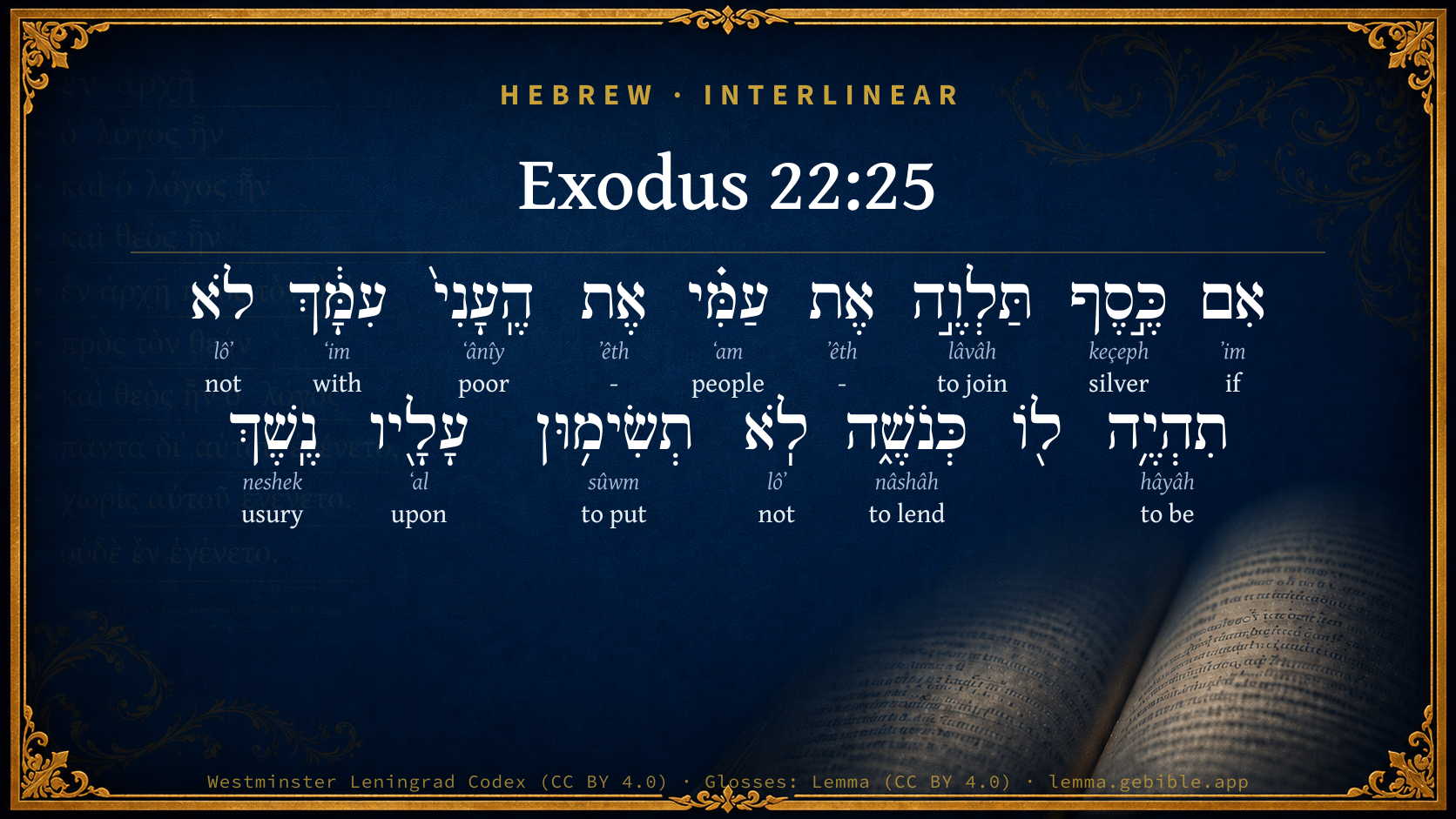
Hebrew (Westminster Leningrad Codex) Exodus 22:25 appears in the Hebrew Old Testament. The text above is from the Westminster Leningrad Codex. Each word links to its Strong’s number, a concise gloss, and parsing drawn from the Open Scriptures Hebrew Bible morphology. Click any word for its full Brown-Driver-Briggs (BDB) entry.
Download image
Cite this verse

Exodus 22:25 (World English Bible). Public Domain. Lemma interlinear Bible study tool, https://lemma.gebible.app/v/exodus/22/25.

Show BibTeX & RIS
BibTeX
RIS
English Translation
"If you lend money to any of my people with you who is poor, you shall not be to him as a creditor; neither shall you charge him interest.
World English Bible · Public Domain
Highlights
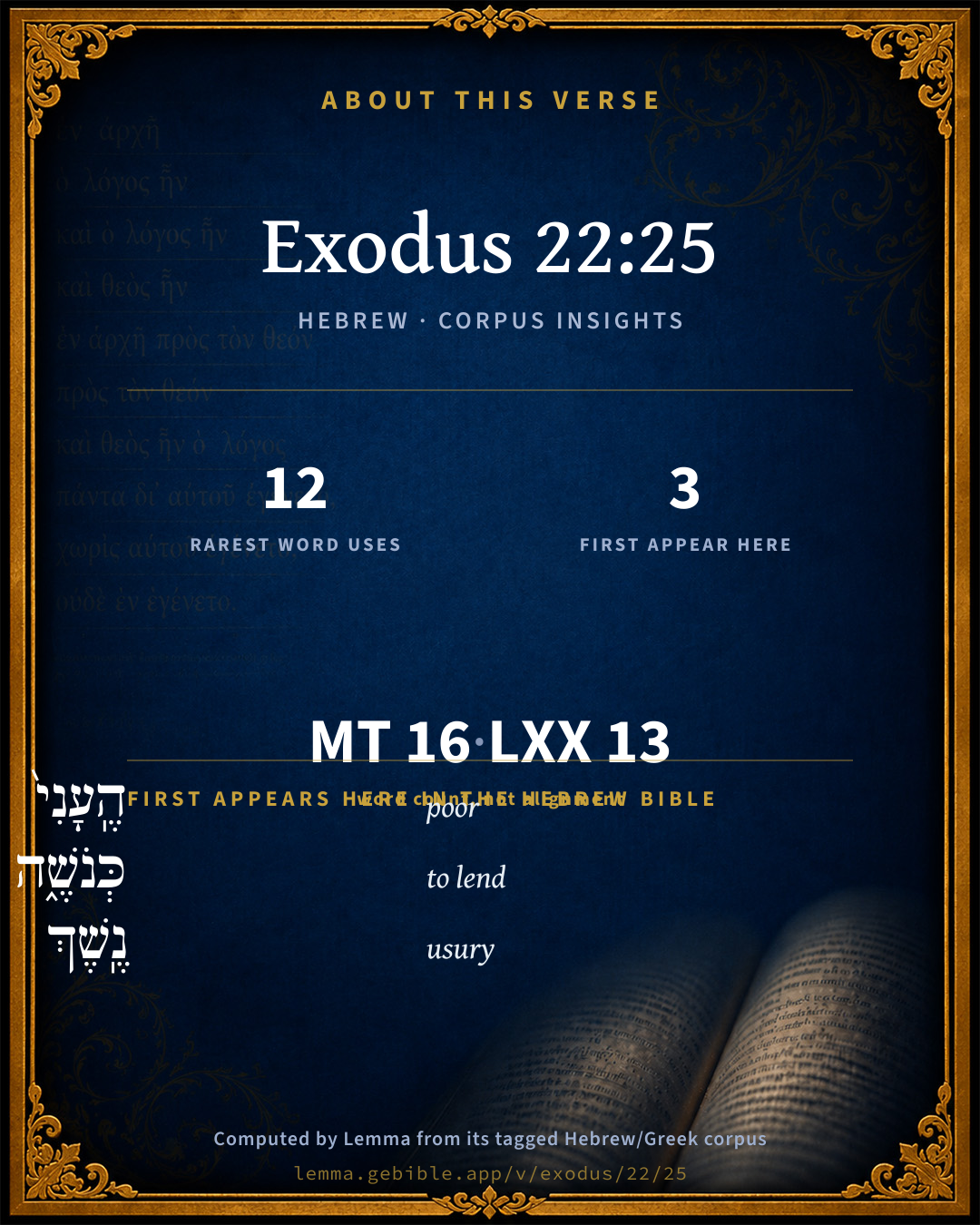
  • 3 first appearances in the Hebrew Bible
Full analysis ↓
Download a study sheet

One document with this verse’s original text, its word-by-word gloss line, the meaning frame, cross-references with their text, attributed commentary, and full source and license credits — printable, and it pastes into notes with its structure intact.

This verse Autodidact and up

Study sheet (.html) Plain text (.txt)

A passage Seminary Student

Up to 50 verses in one chapter. A passage sheet keeps up to 6 commentary sources and 12 cross-references per verse, in the order this page ranks them, and says so on the sheet whenever that leaves anything out. Ask for a single verse and you get the Autodidact verse sheet above.

Everything on this page stays free to read, with no account — the sheet is a download of what is already on screen, not access to it.

Want to remove ads? Support Godless Engineer
Compare translations 3

The same verse in 3 English versions, stacked beneath the original-language interlinear above. Click any original word for its lexicon entry.

Each is an independent rendering of the whole verse — the interlinear is not word-aligned to these translations.

Highlighted words mark where these versions differ — a whole-verse word diff, not a word-by-word alignment.

  • World English Bible Public Domain
    "If you lend money to any of my people with you who is poor, you shall not be to him as a creditor; neither shall you charge him interest.
  • King James Version Public Domain
    If thou lend money to any of my people that is poor by thee, thou shalt not be to him as an usurer, neither shalt thou lay upon him usury.
  • unfoldingWord Literal Text CC BY-SA 4.0
    If you lend silver to my people, the poor with you, you shall not be like a creditor to him—you shall not put interest on him.

unfoldingWord Literal Text — © unfoldingWord, licensed CC BY-SA 4.0. Word-aligned USFM3 via Door43 (git.door43.org/unfoldingWord/en_ult).

Versions to compare (up to 4)

3 of 4 selected

Show all 18 translations

Every available English version of this verse, each an independent rendering of the whole verse.

  • World English Bible Public Domain
    "If you lend money to any of my people with you who is poor, you shall not be to him as a creditor; neither shall you charge him interest.
  • Berean Standard Bible Public Domain
    If you lend money to one of My people among you who is poor, you must not act as a creditor to him; you are not to charge him interest.
  • Majority Standard Bible Public Domain
    If you lend money to one of My people among you who is poor, you must not act as a creditor to him; you are not to charge him interest.
  • King James Version Public Domain
    If thou lend money to any of my people that is poor by thee, thou shalt not be to him as an usurer, neither shalt thou lay upon him usury.
  • American Standard Version (1901) Public Domain
    If thou lend money to any of my people with thee that is poor, thou shalt not be to him as a creditor; neither shall ye lay upon him interest.
  • Revised Version (1885) Public Domain
    If thou lend money to any of my people with thee that is poor, thou shalt not be to him as a creditor; neither shall ye lay upon him usury.
  • Geneva Bible (1599) Public Domain
    If thou lende money to my people, that is, to the poore with thee, thou shalt not bee as an vsurer vnto him: yee shall not oppresse him with vsurie.
  • Douay-Rheims (1899) Public Domain
    If thou lend money to any of my people that is poor, that dwelleth with thee, thou shalt not be hard upon them as an extortioner, nor oppress them with usuries.
  • Young's Literal Translation Public Domain
    `If thou dost lend My poor people with thee money, thou art not to him as a usurer; thou dost not lay on him usury;
  • Literal Standard Version CC BY-SA 4.0
    If you lend money [to] My poor people [who are] with you, you are not as a usurer to him; you do not lay usury on him;
  • Unlocked Literal Bible CC BY-SA 4.0
    If you lend money to any of my people among you who are poor, you must not be like a moneylender to him or charge him interest.
  • unfoldingWord Literal Text CC BY-SA 4.0
    If you lend silver to my people, the poor with you, you shall not be like a creditor to him—you shall not put interest on him.
  • Darby Bible Public Domain
    -- If thou lend money to my people, the poor with thee,thou shalt not be to him as a usurer: ye shall charge him no interest.
  • World Messianic Bible Public Domain
    “If you lend money to any of my people with you who is poor, you shall not be to him as a creditor. You shall not charge him interest.
  • Webster's Bible Public Domain
    If thou shalt lend money to any of my people that is poor by thee, thou shalt not be to him as a usurer, neither shalt thou lay upon him usury.
  • Free Bible Version CC BY-SA 4.0
    If you lend money to any of my people because they're poor, you must not behave as a moneylender to them. You must not charge them any interest.
  • Bible in Basic English Public Domain
    If you let any of the poor among my people have the use of your money, do not be a hard creditor to him, and do not take interest.
  • JPS Tanakh (1917) Public Domain
    (22-24) If thou lend money to any of My people, even to the poor with thee, thou shalt not be to him as a creditor; neither shall ye lay upon him interest.

Literal Standard Version (2020), Covenant Press — licensed CC BY-SA 4.0. Text via the HelloAO Bible API (eBible.org). Unlocked Literal Bible (unfoldingWord) — licensed CC BY-SA 4.0. Text via the HelloAO Bible API (eBible.org). unfoldingWord Literal Text — © unfoldingWord, licensed CC BY-SA 4.0. Word-aligned USFM3 via Door43 (git.door43.org/unfoldingWord/en_ult). Free Bible Version, Dr. Jonathan Gallagher — licensed CC BY-SA 4.0. Text via the HelloAO Bible API (eBible.org).

Word by word

More ways to search: Search by grammar → Find every occurrence → Compare this word →

Practice this passage: Drill this verse → Learn its vocabulary →

נֶֽשֶׁךְ
neshek
H5392
“usury”
Noun, Common, Masculine, Singular, Absolute
Part of Speech
Noun
Type
Common
Gender
Masculine
Number
Singular
State
Absolute
Full BDB Definition

Origin: from H5391

TWOT: 1430a

interest, usury
  1. אִם ʼim H518 “if” Conjunction
  2. כֶּ֣סֶף keçeph H3701 “silver” Noun, Common, Masculine, Singular, Absolute
  3. תַּלְוֶ֣ה lâvâh H3867 “to join” Verb, Hiphil, Imperfect, 2nd Person, Masculine, Singular
  4. אֶת ʼêth H853 “-” Particle, Direct Object
  5. עַמִּ֗י ʻam H5971 “people · my” Noun, Common, Masculine, Singular, Construct + Suffix, Personal, 1st Person, Common, Singular
  6. אֶת ʼêth H853 “-” Particle, Direct Object
  7. הֶֽעָנִי֙ ʻânîy H6041 “the · poor” Particle, Definite Article + Adjective, Adjective, Masculine, Singular, Absolute
  8. עִמָּ֔ךְ ʻim H5973 “with · you” Preposition + Suffix, Personal, 2nd Person, Feminine, Singular
  9. לֹא lôʼ H3808 “not” Particle, Negative
  10. תִהְיֶ֥ה hâyâh H1961 “to be” Verb, Qal, Imperfect, 2nd Person, Masculine, Singular
  11. כְּנֹשֶׁ֑ה nâshâh H5383 “like/as · lending” Preposition + Verb, Qal, Participle Active, Masculine, Singular, Absolute
  12. לֹֽא lôʼ H3808 “not” Particle, Negative
  13. תְשִׂימ֥וּן sûwm H7760 “to put” Verb, Qal, Imperfect, 2nd Person, Masculine, Plural + Suffix, n
  14. עָלָ֖יו ʻal H5921 “upon · him” Preposition + Suffix, Personal, 3rd Person, Masculine, Singular

About this verse

These counts appear in no published source. They are computed here, from the morphology-tagged text and Lemma’s own curated glosses. What Lemma adds →

16
words
13
distinct lemmas
Pentateuch
section

Notable vocabulary

The rarest word here is נֶֽשֶׁךְ usury H5392 — appearing just 12 times in the whole Hebrew Bible.

First appearance in Scripture

These words make their first canonical appearance in the Hebrew Bible here:

  • הֶֽעָנִי֙ poor H6041
  • כְּנֹשֶׁ֑ה to lend H5383
  • נֶֽשֶׁךְ usury H5392

Shared distinctive vocabulary

נֶֽשֶׁךְ usury H5392 occurs in 10 verses of the Hebrew Bible. Also found in:

Grammatical profile

  • 4 verbs
  • 3 nouns
  • 1 adjective
  • 3 prepositions
  • 1 conjunction
  • 4 particles

Verb forms

  • תַּלְוֶ֣ה Hiphil · Imperfect
  • תִהְיֶ֥ה Qal · Imperfect
  • כְּנֹשֶׁ֑ה Qal · Participle Active
  • תְשִׂימ֥וּן Qal · Imperfect

Repetition

A word recurs within this verse — often emphatic in Hebrew:

Hebrew & Septuagint length

In English translation the verse runs 29 words from the Hebrew and 28 from the Septuagint (LXX English) — closely comparable.

A rough comparison of the two English renderings, which tokenize alike — not a word-level alignment.

Word counts can differ between the Hebrew and the Greek without any difference in meaning — e.g. the Hebrew direct-object marker אֵת has no separate Greek word, and Greek often adds the article ὁ.

In the original languages it is 16 Hebrew tokens and 13 Greek tokens — but the two are counted differently (Hebrew bundles its prefixes and suffixes into one token; the Greek is in lemma form), so that isn’t a like-for-like length.

Cross-references

16

Topical passages linked to Exodus 22:25 in the Treasury of Scripture Knowledge — connected by theme and wording, ordered by reader-vote popularity; previews shown in the World English Bible.

  • Leviticus 25:35–37 "'If your brother has become poor, and his hand can't support him among you; then you shall uphold him. As a stranger and a sojourner he shall live with you.
  • Psalms 15:5 He who doesn't lend out his money for usury, Nor take a bribe against the innocent. He who does these things shall never be shaken.
  • Deuteronomy 23:19–20 You shall not lend on interest to your brother; interest of money, interest of food, interest of anything that is lent on interest:
  • Ezekiel 18:8 he who has not given forth on interest, neither has taken any increase, who has withdrawn his hand from iniquity, has executed true justice between man and man,
  • Nehemiah 5:7 Then I consulted with myself, and contended with the nobles and the rulers, and said to them, You exact usury, everyone of his brother. I held a great assembly against them.
  • Proverbs 28:8 He who increases his wealth by excessive interest Gathers it for one who has pity on the poor.
  • Ezekiel 18:17 who has withdrawn his hand from the poor, who has not received interest nor increase, has executed my ordinances, has walked in my statutes; he shall not die for the iniquity of his father, he shall surely live.
  • 2 Kings 4:1 Now there cried a certain woman of the wives of the sons of the prophets to Elisha, saying, Your servant my husband is dead; and you know that your servant did fear Yahweh: and the creditor is come to take to him my two children to be bondservants.
  • 2 Kings 4:7 Then she came and told the man of God. He said, Go, sell the oil, and pay your debt, and live you and your sons of the rest.
  • Nehemiah 5:2–5 For there were that said, We, our sons and our daughters, are many: let us get grain, that we may eat and live.
  • Nehemiah 5:10–11 I likewise, my brothers and my servants, do lend them money and grain. Please let us leave off this usury.
  • Jeremiah 15:10 Woe is me, my mother, that you have borne me a man of strife and a man of contention to the whole earth! I have not lent, neither have men lent to me; [yet] everyone of them does curse me.
  • Ezekiel 18:13 has given forth on interest, and has taken increase; shall he then live? he shall not live: he has done all these abominations; he shall surely die; his blood shall be on him.
  • Ezekiel 22:12 In you have they taken bribes to shed blood; you have taken interest and increase, and you have greedily gained of your neighbors by oppression, and have forgotten me, says the Lord Yahweh.
  • Matthew 25:27 You ought therefore to have deposited my money with the bankers, and at my coming I should have received back my own with interest.
  • Luke 19:23 Then why didn't you deposit my money in the bank, and at my coming, I might have earned interest on it?'

Cross-references courtesy of OpenBible.info (CC BY 4.0).

Hebrew and Greek witnesses Masoretic Hebrew ↔ Greek Septuagint

The same verse in the two great witnesses to the Old Testament, shown verse-for-verse.

These are two independent witnesses, not word-aligned to each other, and the Septuagint is shown in lemma (dictionary) form.

Hebrew Exodus 22:25 Masoretic · Westminster Leningrad Codex

אִם כֶּ֣סֶף תַּלְוֶ֣ה אֶת עַמִּ֗י אֶת הֶֽעָנִי֙ עִמָּ֔ךְ לֹא תִהְיֶ֥ה ל֖וֹ כְּנֹשֶׁ֑ה לֹֽא תְשִׂימ֥וּן עָלָ֖יו נֶֽשֶׁךְ

"If you lend money to any of my people with you who is poor, you shall not be to him as a creditor; neither shall you charge him interest.

World English Bible · Public Domain

Greek LXX Exodus 22:25 Septuagint · lemma form

ἐάν δέ ἐνεχύρασμα ἐνεχυράζω ὁ ἱμάτιον ὁ πλησίον πρό δυσμή ἥλιος ἀποδίδωμι αὐτός

And if you should lend money to your poor brother who is by you, you shall not be hard upon him you shall not exact usury of him.

LXX2012 (modern English Septuagint) · Public Domain

On this verse, The Preacher's Complete Homiletical Commentary discusses the Septuagint’s reading. Read the note in Commentary ↓

Hebrew: Westminster Leningrad Codex (CC BY 4.0). Greek: Septuagint (public domain); English from LXX2012 (modern English Septuagint) (Public Domain). How the Septuagint differs from the Hebrew →

Targum (Aramaic paraphrase)

2

The Targum is the ancient Jewish Aramaic paraphrase of the Hebrew Scriptures — an interpretive translation, not the Hebrew text itself. Onkelos (literal) and Pseudo-Jonathan (expansive) render the Torah, and Jonathan the Prophets. Coverage is partial: where no permissively-licensed English translation exists for a verse, only the Aramaic is shown. This is verse-level text, not a word-by-word alignment to the Hebrew.

  1. Targum Onkelos Torah (Genesis–Deuteronomy)
    אִם מַשְׁכּוֹנָא תִסַב כְּסוּתָא דְחַבְרָךְ עַד מֵעַל שִׁמְשָׁא תְּתִיבִנֵהּ לֵהּ:

    (no public-domain English translation for this verse)

    Targum Onkelos — Aramaic: “Onkelos Genesis” (public domain); “Onkelos Exodus” (public domain); “Onkelos Leviticus” (public domain); “Onkelos Numbers” (public domain); “Onkelos Deuteronomy” (public domain). English: “Sefaria Community Translation” (CC0 1.0 (public-domain dedication)); “J.W. Etheridge. The Targums of Onkelos and Jonathan Ben Uzziel on the Pentateuch. London: Longmans, Green, 1862” (public domain). Text via Sefaria.

  2. Targum Pseudo-Jonathan Torah (Genesis–Deuteronomy)
    אִין מְמַשְׁכְּנָא תְמַשְׁכַּן כְּסוּתָא דְחַבְרָךְ עַד לָא יִטְמוֹעַ שִׁמְשָׁא תְּתָבִינֵיהּ לֵיהּ

    If thou take (at all) for a pledge the garment of thy neighbour, thou shalt restore it to him before sunset;

    Targum Pseudo-Jonathan — Aramaic: “Targum Jonathan on Genesis” (public domain); “Targum Jonathan on Exodus” (public domain); “Targum Jonathan on Leviticus” (public domain); “Targum Jonathan on Numbers” (public domain); “Targum Jonathan on Deuteronomy” (public domain). English: “The Targum of Jonathan ben Uzziel, trans. J. W. Etheridge, London, 1862” (public domain). Text via Sefaria.

Commentary

Notes on Exodus 22:25 from classic Christian and Jewish commentators (each source and its license shown beneath its notes). The classic Christian expositions comment on the surrounding passage and are grouped to its opening verse, so a note may address several verses; the Jewish commentaries on the Tanakh (Rashi and others) are per-verse, so they appear only where the commentator wrote on this verse.

Lemma curates 59 commentaries, every one of them public domain or Creative Commons licensed, each selected and text-cleaned for this edition rather than reprinted as found. About our sources →

Matthew Henry's Commentary

Here is, I. A law against extortion in lending. 1. They must not receive use for money from any that borrowed for necessity (Exo 22:25), as in that case, Neh 5:5, Neh 5:7. And such provision the law made for the preservation of estates to their families by the year of jubilee that a people who had little concern in trade could not be supposed to borrow money but for necessity, and therefore it is generally forbidden among themselves; but to a stranger, whom yet they might not oppress, they were allowed to lend upon usury: this law, therefore, in the strictness of it, seems to have been peculiar to the Jewish state; but, in the equity of it, it obliges us to show mercy to those of whom we might take advantage, and to be content to share, in loss as well as profit, with those we lend to, if Providence cross them; and, upon this condition, it seems as lawful to receive interest for my money, which another takes pains with and improves, but runs the hazard of, in trade, as it is to receive rent for my land, which another takes pains with and improves, but runs the hazard of, in husbandry. 2. They must not take a poor man's bed-clothes in pawn; but, if they did, must restore them by bed-time, Exo 22:26, Exo 22:27. Those who lie soft and warm themselves should consider the hard and cold lodgings of many poor people, and not do any thing to make bad worse, or to add affliction to the afflicted.

II. A law against the contempt of authority (Exo 22:28): Thou shalt not revile the gods, that is, the judges and magistrates, for their executing these laws; they must do their duty, whoever suffer by it. Magistrates ought not to fear the reproach of men, nor their revilings, but to despise them as long as they keep a good conscience; but those that do revile them for their being a terror to evil works and workers reflect upon God himself, and will have a great deal to answer for another day. We find those under a black character, and a heavy doom, that despise dominion, and speak evil of dignities, Jde 1:8. Princes and magistrates are our fathers, whom the fifth commandment obliges us to honour and forbids us to revile. St. Paul applies this law to himself, and owns that he ought not to speak evil of the ruler of his people; no, not though the ruler was then his most unrighteous persecutor, Act 23:5; see Ecc 10:20.

III. A law concerning the offering of their first-fruits to God, Exo 22:29, Exo 22:30. It was appointed before (ch. 13), and it is here repeated: The firstborn of thy sons shalt thou give unto me; and much more reason have we to give ourselves, and all we have, to God, who spared not his own Son, but delivered him up for us all. The first ripe of their corn they must not delay to offer. There is danger, if we delay our duty, lest we wholly omit it; and by slipping the first opportunity, in expectation of another, we suffer Satan to cheat us of all our time. Let not young people delay to offer to God the first-fruits of their time and strength, lest their delays come, at last, to be denials, through the deceitfulness of sin, and the more convenient season they promise themselves never arrive. Yet it is provided that the firstlings of their cattle should not be dedicated to God till they were past seven days old, for then they began to be good for something. Note, God is the first and best, and therefore must have the first and best.

IV. A distinction put between the Jews and all other people: You shall be holy men unto me; and one mark of that honourable distinction is appointed in their diet, which was, that they should not eat any flesh that was torn of beasts (Exo 22:31), not only because it was unwholesome, but because it was paltry, and base, and covetous, and a thing below those who were holy men unto God, to eat the leavings of the beasts of prey. We that are sanctified to God must not be curious in our diet; but we must be conscientious, not feeding ourselves without fear, but eating and drinking by rule, the rule of sobriety, to the glory of God.

Matthew Henry's Commentary on the Whole Bible (1708–1710) — public domain (CC PDM 1.0). Text via the HelloAO Bible API.

Trapp's Complete Commentary

John Trapp

Exo 22:25 If thou lend money to [any of] my people [that is] poor by thee, thou shalt not be to him as an usurer, neither shalt thou lay upon him usury.

Ver. 25. Thou shalt not be to him as a usurer.] Heb., As an exacting creditor, Qui nullum diem gratis occidere creditori permittit. The usurer’s money is to necessity, like cold water to a hot ague, that for a time refresheth, but prolongeth the disease.

Lay upon him usury.] Heb., Biting usury. Usurer’s are men eaters. {Psa 14:4} Like pickrels in a pond, or sharks in the sea, that devour the lesser fishes. These ostriches can digest any metal, especially money. Aristotle in one page condemneth the usurer and the dicer; {a} and yet some Christians blush at neither.

{a} Arist., Ethic, lib. iv. cap. 1.

John Trapp, A Commentary or Exposition upon All the Books of the Old and New Testament (1647–1656) — public domain. Text from a community e-Sword module.

Joseph Benson's Commentary

Exo 22:25. If thou lend — 1st, They must not receive use for money from any Israelite that borrowed for necessity. And such provision the law made for the preserving estates to their families by the years of jubilee, that a people who had little concern in trade could not be supposed to borrow money but for necessity; therefore it was generally forbidden among themselves; but to a stranger they were allowed to lend upon usury. 2d, They must not take a poor man’s bed-clothes in pawn; but if they did, must restore them by bed-time.

Joseph Benson's Commentary on the Old and New Testaments (1811–1818) — public domain. Text from a community e-Sword module.

The Preacher's Complete Homiletical Commentary

Joseph S. Exell (gen. ed.)

CRITICAL NOTES.—

Exo_22:31. And ye shall be holy men.] This seemingly abrupt clause is to be taken in a relation of strict sequence with all that has gone before. As much as to say: “And so—namely, by your observance of all these instructions—ye shall be (or become) holy men.” It is true that these words are introduced simply by the conjunction vav; the part, however, which this small word plays in Hebrew syntax is beginning to be more rightly appreciated. Its strong sequential force is, no doubt, more commonly noticed when it is construed with a verb, in which case it very frequently requires to be translated “and then,” “and so,” “so,” “so that;” but it “can also denote the sequence of thought before any other word (and was in that case originally spoken with a tone peculiar to itself)” (Ewald, “Intro. Heb. Gram.,” sec. 348). And so it may have this force With a noun as here. This very example is a strong proof of such a usage; since thereby alone does the fitness of these words to their place appear. The thought evolved by this legitimate recognition of their fitness is one of which the earnest teacher of God’s people may make a most fruitful use. The end of redemption is holiness; the rule and guide of holiness is the revealed will of the Thrice Holy One.

MAIN HOMILETICS OF THE PARAGRAPH.—Exo_22:25-31

THE DIVINE NATURE HAS TWO ASPECTS

The Almighty declares Himself gracious unto those who cry unto Him for succour; and in His provision He makes special regulations for the protection of those who might easily become the prey of the ungracious. “With the merciful man thou shalt thyself be merciful, and with the upright man thou shalt shew Thyself upright. With the pure thou wilt shew thyself pure; and with the froward Thou wilt shew Thyself unsavoury. And the afflicted people Thou wilt save; but Thine eyes are upon the haughty, that Thou mayest bring them down.” The haughty must not presume upon the Divine graciousness; but the afflicted people may reasonably hope in His salvation.

I. We must learn to deal tenderly with the poor. “Blessed is he that considereth the poor; the Lord will deliver him in time of trouble.” The cause of the poor is the cause of God. The Bible should be the poor man’s Book In no other ethical systems is their case fully considered, or are their claims urgently pressed. The subject of usury is difficult. We must find it hard to settle what is mere proper interest, and what is usury. Certainly the exigency of the poor must not be abused. In that early society, where money was not largely required, we may suppose that money was to be lent without interest. That it must be very small, at least, is evident from the fact that the poor man’s raiment, given for a pledge, must be returned to him before the sun has gone down. The mantle marks the extreme of poverty in general. The indigent Oriental covers himself at night in his outer garment. Great cruelty is characteristic of him who keeps in pledge the poor man’s protection from the cold of an Eastern night. How many are those who cry because of the advantage taken of their poverty! While God is gracious unto those who call for help, what will He be to the pitiless. Let men be gracious unto the poor that God may be gracious unto those who are indeed poor and needy, though rich in earthly possessions.

II. We must be respectful in our dealings with those in high estate. The word “gods” in Exo_22:28 is taken by some to mean the Deity. Thus the Israelites are commanded not to revile the deity. A more general way of dishonouring God than that of directly cursing Jehovah. And this view is supposed to be supported by the next sentence, “nor curse the ruler of thy people,” as God’s vicegerents, as the one next to, and placed in a position of authority by God. Certainly, he who dishonours “the powers that be” dishonours Him by whom the powers are appointed. Even Paul’s practical opposition to the powers is accompanied by wonderful Christian courtesy. We must not curse the rulers; and the rulers must not oppress—must not interfere with the authority of conscience. When rulers and consciences are opposed resistance must follow, but resistance may be courteous while it is firm. The highest style of gentleman is the Christian. Let us forbear cursing or reviling, lest we dishonour the Infinite Ruler.

III. We must be prompt in presenting our offerings. He gives twice who gives quickly. Delays are dangerous. Delay not to offer the first of thy ripe fruits, and of thy liquors. The fruit of all is to be presented as an offering to Him who is the first great cause of all productiveness. In these New Testament times we reverse the order. The first we give ourselves; and the last, if we can easily spare it, we give to God; and yet surely He has a greater claim. If under the law God could command the first of all, how much more under the Gospel! The God of revelation is the God of nature, we must not do unnecessary violence to nature even for the promotion of religion. Seven days must the sheep be with the dam before it is offered. A truly religious spirit will not interfere with natural productiveness and social prosperity.

IV. The glorious purpose of all Divine legislation. “And ye shall be holy men unto Me.” This is the great directing motive for all God’s movements with reference to His people. Holy men must have regard to the beauty and welfare of the temple when the spirit of holiness is enshrined. Ye shall not eat any flesh that is torn of beasts in the field; ye shall cast it to the dogs. Defile not the temple of God. The body is the soul’s temple. The purity of the temple promotes the purity of the worshipper.—W. Burrows, B.A.

CONCERNING LOANS.—Exo_22:25-27

While every one is liable to those fluctuations of fortune which entail temporary embarrassment or permanent poverty, the legitimacy and necessity of loans is apparent. The same remark applies to loans on security for purposes of trade. Loans are only illegitimate when applied to immoral purposes, or when they encourage indolence. The law before us provides—

I. That in a case of real distress the rules of an ordinary commercial transaction were to be set aside, and the loan decided on the principles of humanity (Lev_25:35-43; Deu_23:19).

II. That in a matter of business (presumably) when the loan is under some risk, but which is expected to yield the borrower some kind of profit; then, as in the case of mortgages and pawnbroking, a security is required. But this security, if a necessity of life, as, e.g., the loose outer robe used for a coverlet as well as a garment, was to be restored when wanted.

III. That the graciousness of God should be the motive of man’s conduct to his fellow in matters of obligation, and even business.

IV. That in this case, and in others which were to be decided on the principles of humanity, God took the consideration of the infraction of His law into His own hand.

Application.—i. Avoid borrowing or lending as far as possible. ii. When needful or in the way of business, let mercy and generosity enter into the transaction, as well as interest and justice. iii. God has been gracious to you, be gracious to your fellow (Mat_10:8). iv. Remember that God “executeth righteousness and judgment for all that are oppressed.”—J. W. Burn.

THE DIVINE RIGHT OF MAGISTRATES TO RESPECT.—Exo_22:28

There has been some controversy about the interpretation of the first clause, Thou shalt not revile Elohim.

1. Some understand it God, conformably with Gen_1:1 and general usage. (De Wette, Keil, Knobel, Speaker’s Com.,&c.)

2. Some (as A.V. LXX. Vulg. Luther, Cranmer, &c.) Gods. Philo and Josephus understand it as expressing liberality to gods of other nations. And

3. (The Targum, Syr, Saadia, Theod. Genevan, &c.) as the marg. judges. The second may be dismissed. The third is untenable, as in that case Elohim would have the article prefixed. The first is the ordinary translation, and as here employed, suggests that magistrates wield the delegated authority of God, rule by Divine right, and are therefore entitled to respect (Jos_4:14; Psa_21:6-7; Pro_24:21-22; Ecc_8:2-3).

I. That the powers that be are ordained of God (Rom_13:1-5; 1Pe_2:13-15).

II. That magistrates must be treated with respect, both their persons and their decisions (Jos_1:16-18).

1. Because they administer that which when it is law at all, is based on the will and authority of God (Rom_13:2).

2. Because they administer that which is the bulwark of national stability and personal safety (Rom_13:3).

III. That magistrates must receive respect, irrespective of the effect of their decision (Pro_17:26).

1. Because they are but the servants of the law.

2. Because if through human infirmities, justice should occasionally miscarry, it is better to suffer than to bring the law into disrepute (Pro_24:21-22).

3. But if their decisions violate conscience, then Act_4:19-20; Act_5:29.

IV. That magistrates must be secure against all hostile action (Pro_17:26; Job_34:17-18).

1. Fear will warp the judgment.

2. Fear will divert the course of justice.

V. That magistrates are not only entitled to respect, but to our sympathy and prayers (Psa_22:1-2; Ezr_6:10; 1Ti_2:2).

VI. That disrespect to magistrates is severely condemned (Jud_1:8).

Application.—Let magistrates, all who are in authority and all who administer law whether civil or domestic, whether in law courts, homes or houses of business, remember—i. That they are responsible to God (2Sa_23:3). Let them see

(1) that they accurately know the law, and

(2) that their administration is conscientious and courageous (Psalms 72; Psa_74:12-14). ii. That they are responsible to man. Upon their decisions depend the well-being of the citizen, and the stability of the realm. iii. That their title to sympathy and veneration is recognised by the people at large.—J. W. Burn.

CONSECRATION.—Exo_22:29-31

These laws are most appropriately interrupted by the revelation of God’s claims upon us and ours. This revelation teaches us—

I. That God’s law should lead us to consider our relation to the Lawgiver.

1. We are not slaves under the rigorous and iron rule of an inflexible despot (Joh_15:15; Rom_8:15).

2. But sons under the mild, free, and benignant rule of our Father in heaven (Num_11:12; Deu_22:6; Rom_8:15-16; Jas_1:25; Jas_2:12).

3. And should therefore disseminate and obey those laws which are for our Father’s glory and our brother’s good.

II. That this relation to the Lawgiver should lead to the practical acknowledgment of His claims upon the service of all we have.

1. He has claims upon our property. We are only stewards (1Co_4:7).

(1) Those claims upon part of it are literal and exclusive, and must be acknowledged by benevolence to the poor and the support of his ministers.

(2) Those claims are upon the whole of it, and must be acknowledged by the use of all our property in getting the will of God “done on earth as it is done in heaven.”

2. He has claims upon our children.

(1) We must be cautious how we abrogate this literal claim upon one of them. If, under the old dispensation, one was to be specially dedicated to His service, there are stronger reasons for the same under the new. While education for the ministry, as a mere profession, cannot be too strongly reprobated, yet when God comes to call at your house for “labourers for His harvest,” let Him find one at least of your children ready for that call. Let all parents, whether rich or poor, take heed to their privileges and duties in this direction.

(2) But as God has claims upon all of your children, see that they are dedicated to Him and “trained up in the nurture and admonition of the Lord.”

III. That God’s claims should be acknowledged first. “The first of thy ripe fruits,” &c.

1. Let God’s claims be acknowledged first in the order of time. The Jew embraced the first opportunity—as soon as the sheep could leave its dam, and the child its mother, God’s claim was recognised. Surely the Christian should not be behind the Jew. In God’s cause as well as man’s, “he pays twice who pays promptly.” Do not wait till the end of the quarter or the year before you pay your subscription. Let it be at the beginning.

2. Let God’s claims be acknowledged first in point of quality. “First of ripe fruits.” Other laws, based upon these claims, enact that the gifts shall be without blemish. God’s sacrifices were of the best of beasts, God’s house was the best in the land. How sad the contrast between this and Christian customs. Any scrap of money, or time, or prosperity, is good enough for God’s use, and any barn good enough for His worship. And when a noble spirit is awakened, it is met with the old and usual, “To what purpose is this waste?” Not that God is particular, whose is the earth and the fulness thereof! He can value the widow’s mite. But let them see to it, who live on the fat of the land and give a reluctant morsel to God’s cause; who can give the whole twenty-four hours to their own interest, and not as many minutes to God’s, and who sleep in palaces but worship in hovels (Hag_1:2).

3. Let God’s claims be recognised first in order of interest. If the rest of the flock died, this must be given to God. But now God’s interests are considered last. After having consulted the claims of self, family, business, then if anything is left it may be given to God. On the other hand, if there must be retrenchment then God’s interests are considered first—to be invaded and ignored, and the guinea dwindles down to half a sovereign, &c.

IV. That God’s claims should be acknowledged systematically. “First,” “on the eighth day.” God here demanded a definite amount at a definite time. God’s claims must not be considered more recklessly or haphazard than those of family and business. The Christian rule must not be repealed till God repeals it (1Co_16:1-2).

V. That our relation to the Divine Lawgiver should lead to the practical acknowledgment of His claims upon all we are, Exo_22:31. God’s claim is everywhere on ourselves. No proxies, as such, are permitted. There are many who acknowledge God’s claims on what they have that but practically repudiate them which are personal. But (1Co_6:20).

1. God demands personal holiness.

(1.) Separation from sin.

(2.) Separation to Himself. (See on Exo_19:10.) God’s command is, “Be ye holy, for I am holy,” “God’s will” is “even your sanctification.”

2. God demands a practical exhibition of that holiness in the dignity and nobility of our lives. The flesh that was torn by wild beasts was not forbidden as unclean, but because it was mean and paltry for those members of the “kingdom of priests” to eat their leavings. So the Christian, in his living and general conduct, must not condescend to practices which degrade his profession and dishonour his God.

Learn—

i. That all you have belongs to God.

1. How noble.

2. How safe are our possessions.

ii. That all we are belongs to God.

1. What dignity (Rev_1:5-6).

2. What promises (Mat_6:25-34; 2Co_6:16-18; 2Co_7:1; Rom_8:28). 3 What safety (Luk_12:32; Joh_10:28-29; Rom_8:31-39). And what glory (Rom_8:18; 1Jn_3:2), belong to the sons of God.

iii. “What manner of persons ought we to be?”—J. W. Burn.

ILLUSTRATIONS

BY

REV. WILLIAM ADAMSON

Divine Enactments! Exo_22:1-31.

(1) There is a world of difference between a stained glass window and a kaleidoscope. Their relative values are very different, and so is their structure. The pieces of variegated glass are flung anyhow, for the prism to arrange; whereas, those employed in the window are all arranged to give a beautiful, effective, and abiding impression. These separate enactments are not strung together haphazard. On the contrary, they are chords divinely arranged to produce harmony in the world, and give forth strains of Divine adoration in their observance.

(2) If one side of a tree grows, and the other does not, the tree acquires a crooked form. It may be fruitful, but it cannot be beautiful. God would have humanities and nationalities, theocracies and individualities, both rich in the beauties of holiness and the fruits of righteousness. The unequal growth of the Christian graces is undesirable; hence the numerous Divine precautions to make them alike fair, fragrant, and fruitful.

“Stern lawgiving! yet thou dost wear

The Godhead’s most benignant grace;

Flowers laugh before thee on their beds;

And fragrance in thy footing treads;

Thou dost preserve the stars from wrong.”

—Wordsworth.

Security Pledges! Exo_22:26-27. In all parts of Southern Africa the skin cloak is the covering of males and females by day and night. The Hottentot cloak is composed of sheepskins, retaining the wool on the inside of it; and in this he sleeps comfortably under a bush or tree. In the East, extreme heat of the day is often succeeded by extreme cold of the night. The Israelite encamping in the wilderness would probably be often content with such a cloak or mantle. No doubt in the Holy Land there would be many poor, who could afford no other raiment than this by night and day. The Red Indian has his blanket, in which he wraps himself when wandering in his vast native forests. The thoughtful and gracious care of God, therefore, shines out sweetly in this humane and considerate enactment. Man should follow the Divine example.

“Have love! Not love alone for one,

But man, as man, thy brothers call;

And scatter, like the circling sun,

Thy charities on all.”

—Schiller.

Gratitude-Gifts! Exo_22:29-30. St. Paul stamps the sin of ingratitude to God as peculiarly heinous, when he says of the heathen (Romans 1) that they were not thankful. Seneca—between whom and St. Paul some suppose that there was personal intercourse—says: “We are thankful to a friend for a few acres of land only, or for a little money; and yet for the possession of the whole earth, which God has given us, we care not to testify any grateful returns.” The English proverb declares a humiliating axiom: “The river passed, and God is forgotten.” The Italian form of it sounds a still sadder depth of ingratitude: “The peril passed, the saint mocked.” Mandrabulus the Samian, having vowed to the goddess Juno a golden ram if she disclosed to him a certain mine, the Greek story runs that under her auspices and direction he was the discoverer. Once in possession, however, his votive-offering of a golden ram dwindled down into a silver one; that again for a brass one; and at last nothing at all. God here lays down the law of Divine gratitude, in which are also involved the Divine rights of human self-consecration: “All that I have is Thine;” “I am my Beloved’s, and my Beloved is mine;” “Let my Beloved come into His garden, and eat His pleasant fruits.” But

“Man, the worldly, ingrate man can ever

Enjoy God’s gifts, but never mind the Giver;

And like the swine, though pampered with enough,

His eyes are never higher than the trough.”

—Quarles.

Cheerful Consecration! Exo_22:30. As fruits artificially raised or forced in the hothouse have not the exquisite flavour of those fruits which are grown naturally, and in their due season; so that obedience, which is enforced by the requirements of the law, wants the genuine flavour and sweetness of that obedience which springs from a heart warmed with the love of God in Christ. God loves a cheerful giver, for this among other reasons: The votive-fruits of such self-dedication are exceeding sweet to His taste. “How much better is thy love than wine! and the smell of thine ointments than all spices!” (Son_2:10).

“Come, bring thy gift. If blessings were as slow

As men’s returns, what would become of fools?”

—Herbert.

Legislation-Links! Exo_22:31. The study of the Mosaic laws will repay the students. “They will repay the historian,” says Hamilton; “for they will introduce him to a civilisation compared with which the Greek culture and Roman commonwealth are barbarisms. They will repay the jurist, for in the dividends and compensations—the doctrine of trespass and damage and malice prepense laid down by the Hebrew lawgiver, he will find the origin or earnest of much in our own British statute-book. And they will repay every student of morals and of mankind; for thoughts, says Wines, colonise as well as races; ideas, like families, have a genealogy and a propagation. The cradle of all codes is the law of Mosaic enactments.”

“These are the lessons God would write—

These laws as with a burning pen,

In traces of eternal light,

Upon the hearts of men.”

—Schiller.

The Preacher's Complete Homiletical Commentary (gen. ed. Joseph S. Exell; Funk & Wagnalls, c. 1892) — public domain (pre-1929). A full-Bible homiletical/sermon-outline anthology covering 65 of 66 books (2 John is absent from the source module). Text from a community e-Sword module.

Tyndale Open Study Notes

Tyndale Open Resources

22:25-27 Although interest could not be charged on a loan to another Israelite, collateral, or security, could be required. However, even the security had to be handled in a humane way. The requirements of the covenant mirrored the character of God.

Tyndale Open Study Notes — © Tyndale Open Resources, licensed CC BY-SA 4.0. Text via the HelloAO Bible API.

Adam Clarke's Commentary

Verse 25. Neither shalt thou lay upon him usury.] נשך neshech, from nashach, to bite, cut, or pierce with the teeth; biting usury. So the Latins call it usura vorax, devouring usury. "The increase of usury is called נשך neshech, because it resembles the biting of a serpent; for as this is so small as scarcely to be perceptible at first, but the venom soon spreads and diffuses itself till it reaches the vitals, so the increase of usury, which at first is not perceived nor felt, at length grows so much as by degrees to devour another's substance." - Leigh.

It is evident that what is here said must be understood of accumulated usury, or what we call compound interest only; and accordingly נשך neshech is mentioned with and distinguished from תרביה tarbith and מרביה marbith, interest or simple interest, Le 25:36-37; Pr 28:8; Eze 18:8, Eze 18:13, Eze 18:17, and Ex 22:12. - Parkhurst.

Perhaps usury may be more properly defined unlawful interest, receiving more for the loan of money than it is really worth, and more than the law allows. It is a wise regulation in the laws of England, that if a man be convicted of usury - taking unlawful interest, the bond or security is rendered void, and he forfeits treble the sum borrowed. Against such an oppressive practice the wisdom of God saw it essentially necessary to make a law to prevent a people, who were naturally what our Lord calls the Pharisees, φιλαργυροι, lovers of money, (Lu 16:14), from oppressing each other; and who, notwithstanding the law in the text, practise usury in all places of their dispersion to the present day.

Adam Clarke's Commentary on the Bible (1810–1826) — public domain. Text from a community e-Sword/MySword module.

Ellicott's Commentary for English Readers

(25) Usurer. . . . usury.—The Hebrew nûsheh and nĕshek have no sense of “excess” attached to them. They mean simply “interest,” and “the man who lends upon interest.”

(25-27) The Mosaic law of borrowing and lending was strange and peculiar. It was absolutely forbidden to exact any interest from those borrowers who were Israelites. The wording of the present passage, and of some others (Lev_25:35; Deu_15:7), construed strictly, prohibits interest only on loans to the poor; but, as in a primitive state of society only the poor wish to borrow, the qualifying expression lost its force, and to exact any interest of any Israelite was regarded as wrong. (See Psa_15:5; Pro_28:8; Neh_5:7; Neh_5:11; Eze_18:13; Eze_22:12.) And some prohibitions, as Deu_23:19, were expressed in the most general terms. On the other hand, the lending of money upon interest to foreigners was distinctly allowed (Deu_23:20), and no limit placed upon the amount of interest that might be taken.

A Bible Commentary for English Readers, edited by Charles John Ellicott (1878–1897) — public domain. Text from a community e-Sword module.

The Cambridge Bible for Schools and Colleges

gen. ed. J. J. S. Perowne

25. Interest not to be taken on money lent to the poor.

as a creditor] exacting and impatient: cf. 2Ki_4:1, Psa_109:11 (where the same word is rendered ‘extortioner’).

usury] interest. This was formerly the sense of ‘usury’ (Lat. usura, something paid for the use of money); but the word is now restricted to exorbitant interest; the rendering has consequently become misleading. The taking of interest is prohibited also in Lev_25:36 f. (H), and Deu_23:19 f.: it is referred to also with disapproval in Eze_18:8; Eze_18:13; Eze_18:17; Eze_22:12, Pro_28:8, Psa_15:5 (as what the model Israelite would not do). The same feeling against taking interest on money lent was entertained by Greek thinkers (see Plato, Legg. v. 742; Arist. Polit. i. 10. 5): it was also shared largely in the early Christian Church. Many good Christians, however, now put out their money on interest: what, then, is the cause of the change of feeling? The cause is to be found in the different purpose for which money is now lent. In modern times money is commonly lent for commercial purposes, to enable the borrower to increase his capital and develope his business: and it is as natural and proper that a reasonable payment should be made for the accommodation, as that it should be made for this loan (i.e. the hire) of a house, or any other commodity. But this use of loans is a modern development: in ancient times money was commonly lent for the relief of poverty brought about by misfortune or debt; it partook thus of the nature of a charity; and to take interest on money thus lent was felt to be making gain out of a neighbour’s need. The interest which ancient feeling condemned was thus not the interest taken on a commercial loan such as is taken habitually in the modern world, but the interest taken on a charitable loan, which only increases the borrower’s distress. Be the feeling with which the ancients regarded all interest is of course still rightly maintained against usurious interest, such as ‘money-lenders’ often exact from those whom need drives into their hands. Cf. the remarks of Grote, Hist. of Greece, Part II., ch. xi., in connexion with the measures adopted by Solon at Athens for the relief of those who had borrowed money on the security of their own persons (cf. 2Ki_4:1).

The Cambridge Bible for Schools and Colleges (gen. ed. J. J. S. Perowne; Cambridge University Press, 1878–1918) — public domain. Text from a community e-Sword module.

John Gill's Exposition

For that is his covering only,.... All that he has to cover him, the only covering he has when he lies down to sleep; and therefore should be restored to him by the time of sunset, at which time he returns from his labour; and after some refreshment retires to his bed for rest, when his covering will be necessary:

it is his raiment for his skin; which is next to his skin, and covers his naked body, as it is when he lies down to sleep; and therefore if not returned, he must lie naked without any covering, which to deprive him of would be cruel: Jarchi interprets this covering of his shirt, but it rather means his bed clothes: the Septuagint version calls it the clothes of his shame, what cover and hide the shame of nakedness:

wherein shall he sleep? what shall he have to sleep in if this is detained from him? nothing at all; or it may be read without an interrogation, wherein he should sleep, or was used to sleep:

and it shall come to pass, when he crieth unto me; and complains of ill usage, that he has nothing to cover him in the night season, when he lies down to sleep, which is very uncomfortable, as well as unhealthful and dangerous:

that I will hear; his cry and complaint, take notice of it, and resent the usage of him:

for I am gracious; or merciful; and therefore everything cruel and uncompassionate is disagreeable, and even abominable to him, and he will take care in his providence that the injured person shall be redressed and the injurer punished.

John Gill's Exposition of the Whole Bible (1746–1763) — public domain (CC PDM 1.0). Text via the HelloAO Bible API.

Albert Barnes' Notes on the Bible

See the notes at Lev 25:35-43; compare Deu 23:19.

Albert Barnes' Notes on the Bible (1834–1885) — public domain. Text from a community e-Sword/MySword module.

Haydock's Catholic Bible Commentary

Poor. Such are often most in want. Usury is not lawful, even with respect to the rich. The Hebrew terms it a bite. (Menochius) --- "What is usury, said Cato, but to kill a man." The Romans required thieves to restore double, but usurers were to render four times as much as they had taken. (Varro Rustic. i.) --- Restitution is prescribed, 2 Esdras v. 11. Some Calvinists have stood up in its defence, in opposition to the Scriptures, fathers, and Councils of the Catholic Church. Lend, hoping to gain nothing by it, Luke vi. 35. "Let him who loves money,.…lend (in the persons of the poor) to Him who says, Give, and it shall be given to you." (St. Leo, ser.) The Jews themselves have reprobated usury in any use. (Calmet)

George Leo Haydock (1774–1849), Haydock's Catholic Family Bible and Commentary, 1859 edition — public domain. Excludes Psalms (Douay-Rheims chapter numbering differs from Protestant) and Deuterocanonical books (Catholic canon only).

Matthew Poole's English Annotations

Any of my people, i.e. any Israelite; for it was permitted to take usury of the Gentiles, Deu 23:20.

That is poor: this seems to be added not by way of apposition, as if God’s people and the poor were all one, because such are commonly poor; but by way of restriction; for God had promised greatly to bless and enrich the generality of his people, if they by their wickedness did not hinder it, and that there should be few poor among them; yet some such there should be for the trial and exercise of their charity. See Lev 19:10; Deu 15:4,7,11.

Usury; the Hebrew word signifies biting; so usury is called, not by way of distinction, as if moderate usury were allowed in this case, which is manifestly false, because the borrower is here supposed to be poor, to whom not the use only, but ofttimes even the principal is to be remitted, Luk 6:34,35; but by way of explication, because all usury is of a biting or eating nature, which commonly consumes the person that pays it.

Matthew Poole's English Annotations on the Holy Bible (1683–1685) — public domain. Text from a community e-Sword/MySword module.

Whedon's Commentary on the Bible

Daniel D. Whedon

25. A usurer — Or, a creditor, here regarded as a rigid exacter of interest. The tenderness enjoined in regard to loans to the poor was adapted to cultivate compassion and brotherly feeling. But it was not designed to favour the indolent and vicious.

Daniel D. Whedon (gen. ed.), Commentary on the Old and New Testaments (1874–1909) — public domain. Text from a community e-Sword module.

The Pulpit Commentary

Vers. 25-27. The law of lending money and borrowing. It is peculiar to the Jewish law to forbid the lending of money at interest by citizen to citizen. In the present passage, and in some others (Lev_25:35; Deu_15:7) it might seem that interest was only forbidden in the case of a loan to one who was poor; but the general execration of usury (Job_24:9; Pro_28:8; Eze_18:13 Eze_22:12) and the description of the righteous man as "he that hath not given his money upon usury" (Psa_15:5; Eze_18:8) seem rather to imply that the practice, so far as Israelites were concerned, was forbidden altogether. On the other hand, it was distinctly declared (Deu_23:20) that interest might be taken from strangers. There does not seem to have been any rate of interest which was regarded as excessive, and "usurious," in the modern sense. In Scripture usury means simply interest.

Vers. 25-27. The treatment of the poor.

Here are two regulations, commanding not to be usurious in the lending of money to the poor, and not to retain the pledged garment over night. How forcibly they bring out the one crowning ill connected with poverty in the eyes of the world! The poor man is the man without money; and lack of money bars his way in only too many directions. Let him be ever so noble in character, ever so heroic, wise, and self-denying in action, it avails nothing. The poor wise man delivered the little city that was besieged by a great king; yet no man remembered that same poor man. These Israelites had gone out of Egypt with immense wealth, but probably even then it was very unequally distributed; and the tendency would be, as the tendency always is, for the inequality to become greater still. Hence in this regulation God was addressing those who from the inordinate feeling of desire which wealth inspires, would be peculiarly tempted to take advantage of the poor. God never shows any mercy to the rich man so far as his riches are concerned. Those riches are full of peril, and fuller of peril to their owner than to any one else. He who counselled, by his Son, to pluck out the right eye and cut off the right hand, is not likely to pay respect to a thing like wealth, even more external still. The chief matter in these regulations is how the poor and needy may be most advantaged, and whatever will do that most effectually is the thing to be done. Whether mere money be lost or gained is a matter of no consequence whatever.

I THESE PROVISIONS WITH RESPECT TO LENDING OBVIOUSLY DO NOT EXCLUDE GIVING. If thou lend money," etc. But God, in many instances, would be better pleased with giving than with lending. If only men were seeking with all their hearts to do his will, all these minute regulations would be unnecessary. The advantage of the poor, as we have just seen, was the main thing to be considered here. And it might be for the advantage of the receiver, and still more for the advantage of the giver in the highest sense of the word advantage, to give, hoping to receive nothing again. Just as money does untold harm when foolishly and wickedly spent, so when wisely spent it may do untold good. Lending may serve well, but giving may serve much better; and that is the wisest course which is judged to do the most good. Some would find it easier to give than to lend, being naturally generous, disposed to lavishness, shrinking from the risk of being thought stingy. And yet sometimes in giving they would be doing a very hurtful thing, for lending would be better.

II Nor is there anything like A FORBIDDING OF THE LOAN OF MONEY FOR COMMERCIAL PURPOSES. If one man lends to another a certain sum of money with which to trade, it is plain that he acts lawfully in getting interest for the use of it. For if he were not lending money to another, he would be using it himself, and the interest represents his profit, which is the same whoever uses the money. The trade of the world, and therefore the good of the world would be greatly limited and hampered but for the use of borrowed capital. It may be that the man who has the capital has neither the disposition nor ability to use it. Let him then, upon a fair consideration, lend the capital to the man who can use it.

III Chiefly we must strive to avoid THE TAKING SELFISH ADVANTAGE OF OUR NEIGHBOUR"S NECESSITIES. Rather we should rejoice to take advantage of these necessities to show beyond all dispute, that the love of God is indeed the ruling principle of our hearts. Man"s extremity, it has often been said, is God"s opportunity, and so it should be the Christian"s opportunity. By timely aid, if we have it to bestow, let us strive to deliver the poor from the clutches of the usurer, and especially let us give our aid to what may be devised for the curing of poverty"s disease altogether. Every alteration either in laws or customs which will tend to diminish Poverty let it have our strenuous support. Bear in mind that whatever each man has beyond a certain moderate share of this world"s goods can only come to him because others have less than reasonable comfort demands. We should ever be aiming by all methods that are reasonable, just, and practicable, to secure to each one neither poverty nor riches, but just that food which is convenient for him. God wishes every man to have his daily bread; and it is an awful thing that we by our selfishness do so much to make the question of daily bread the only one that many of our fellow-creatures have time or inclination to ask. It seems to take every hour and every energy to keep the wolf from the door. Y.

The Pulpit Commentary (1880–1919), ed. H.D.M. Spence-Jones & Joseph S. Exell — public domain. Text from a community e-Sword module.

John Wesley's Explanatory Notes

If thou lend - (1.) They must not receive use for money from any that borrowed for necessity. And such provision the law made for the preserving estates to their families by the year of Jubilee, that a people who had little concern in trade could not be supposed to borrow money but for necessity; therefore it was generally forbidden among themselves; but to a stranger they were allowed to lend upon usury. This law therefore in the strictness of it seems to have been peculiar to the Jewish state; but in the equity of it, it obligeth us to shew mercy to those we have advantage against, and to be content to share with those we lend to in loss as well as profit, if Providence cross them: and upon this condition it seems as lawful to receive interest for my money, which another takes pains with, and improves, as it is to receive rent for my land, which another takes pains with, and improves, for his own use. (2.) They must not take a poor man's bed-clothes in pawn; but if they did, must restore them by bed-time.

John Wesley, Explanatory Notes Upon the Whole Bible (1754–1765) — public domain. Text via the GEBible commentary corpus.

Keil & Delitzsch

C. F. Keil & F. Delitzsch

If a man should lend to one of the poor of his own people, he was not to oppress him by demanding interest; and if he gave his upper garment as a pledge, he was to give it him back towards sunset, because it was his only covering; as the poorer classes in the East use the upper garment, consisting of a large square piece of cloth, to sleep in. "It is his clothing for his skin:" i.e., it serves for a covering to his body. "Wherein shall he lie?" i.e., in what shall be wrap himself to sleep? (cf. Deu 24:6, Deu 24:10-13). - With Exo 22:28. God directs Himself at once to the hearts of the Israelites, and attacks the sins of selfishness and covetousness, against which the precepts in Exo 22:21-27 were directed in their deepest root, for the purpose of opposing all inward resistance to the promotion of His commands.

Keil & Delitzsch — Biblical Commentary on the Old Testament (1861–1891) — public domain (CC PDM 1.0). Text via the HelloAO Bible API. (Old Testament only.)

unfoldingWord translationNotes

Door43 World Missions Community

a moneylender

"one who lends money"

charge him interest

"charge him extra money for borrowing" or "charge him extra money for the loan"

garment in pledge

"coat as collateral" or "coat as a guarantee to repay the loan"

only covering

"only coat" or "only garment to keep him warm"

What else can he sleep in?

This question adds emphasis. You can translate it as a strong statement. AT: "He will have nothing to wear while he sleeps!" (See: Rhetorical Question)

translationWords

people of God

neighbor

pledge

compassion

unfoldingWord translationNotes — © Distant Shores Media and the Door43 World Missions Community, licensed CC BY-SA 4.0. Source: git.door43.org/Door43/en_tn.

Rashi

Rabbi Shlomo Yitzchaki (Rashi)

אם חבל תחבל IF THOU TAKE TO PLEDGE — The root חבל never signifies “taking a pledge” at the time when the loan is transacted, but it means taking the goods of the debtor when the date of payment arrives and he does not pay (Bava Metzia 114b). [חבל תחבל — Scripture bids you take the pledge repeatedly — even many times (that is, repeatedly to defer the time of payment). The Holy One, blessed be He, says as it were: “How much do you owe Me! See, your soul ascends night by night to Me and renders account of its doing and so becomes My debtor, and should be kept as a pledge; and yet I return it to you every morning. Thus, too, you should do: take the pledge and restore it, take it again and again restore it!”) (Midrash Tanchuma, Mishpatim 16)].

עד בא השמש תשיבנו לו RESTORE IT UNTO HIM TILL THE GOING DOWN OF THE SUN — Restore it unto him for the whole day until the sun-set, and at night-fall you may take it again till the day-break of the next morning. Scripture speaks here of garment which is worn during the day and which is not required during the night (Bava Metzia 114b).

Rashi on the Tanakh — English translations: “The Judaica Press complete Tanach with Rashi, translated by A. J. Rosenberg” (CC BY 4.0); “Pentateuch with Rashi's commentary by M. Rosenbaum and A.M. Silbermann, 1929-1934” (public domain); “The Metsudah Tanach series, Lakewood, N.J” (CC BY 4.0); and “The Book of Joshua, Metsudah Publications, 1997” (CC BY 4.0). Text via Sefaria.

Lesson kit

Teaching starters — assembled from the data on this page, not authored interpretation. Every prompt links to the verse data it draws on. Edit before teaching.

Exodus, in the Pentateuch, opens this verse with 16 words (13 distinct Hebrew lemmas). Its most distinctive word is neshek (“usury”). A historical commentator’s framing appears above. Read the whole chapter for the surrounding context.

Discussion questions

  1. What does “usury” (neshek) contribute to the verse as a whole?
  2. 3 words make their first appearance in Scripture here. What does this debut establish?
  3. How does Leviticus 25:36, which shares the word «usury», read alongside this verse?
  4. What does the repetition of “not” (2× in this one verse) do in this verse?
  5. These translations render this verse differently. What is at stake in choosing one wording over another?
  6. «תַּלְוֶ֣ה» is a Hiphil Imperfect verb. How does that grammatical form shape the action described?
  7. Compare how Matthew Henry's Commentary and Trapp's Complete Commentary read this verse. Where do they agree or differ?

Things to notice

Reading settings

Reading text

Shown beneath each verse's original-language words.

Old Testament
Old Testament edition

Read the OT as the Masoretic Hebrew (MT) or the Greek Septuagint (LXX).

English shown for the Greek Septuagint (in the Hebrew ↔ Greek comparison).

Comparing translations? Open the Compare panel on any verse page to stack up to four side by side.