Ezekiel 38:6

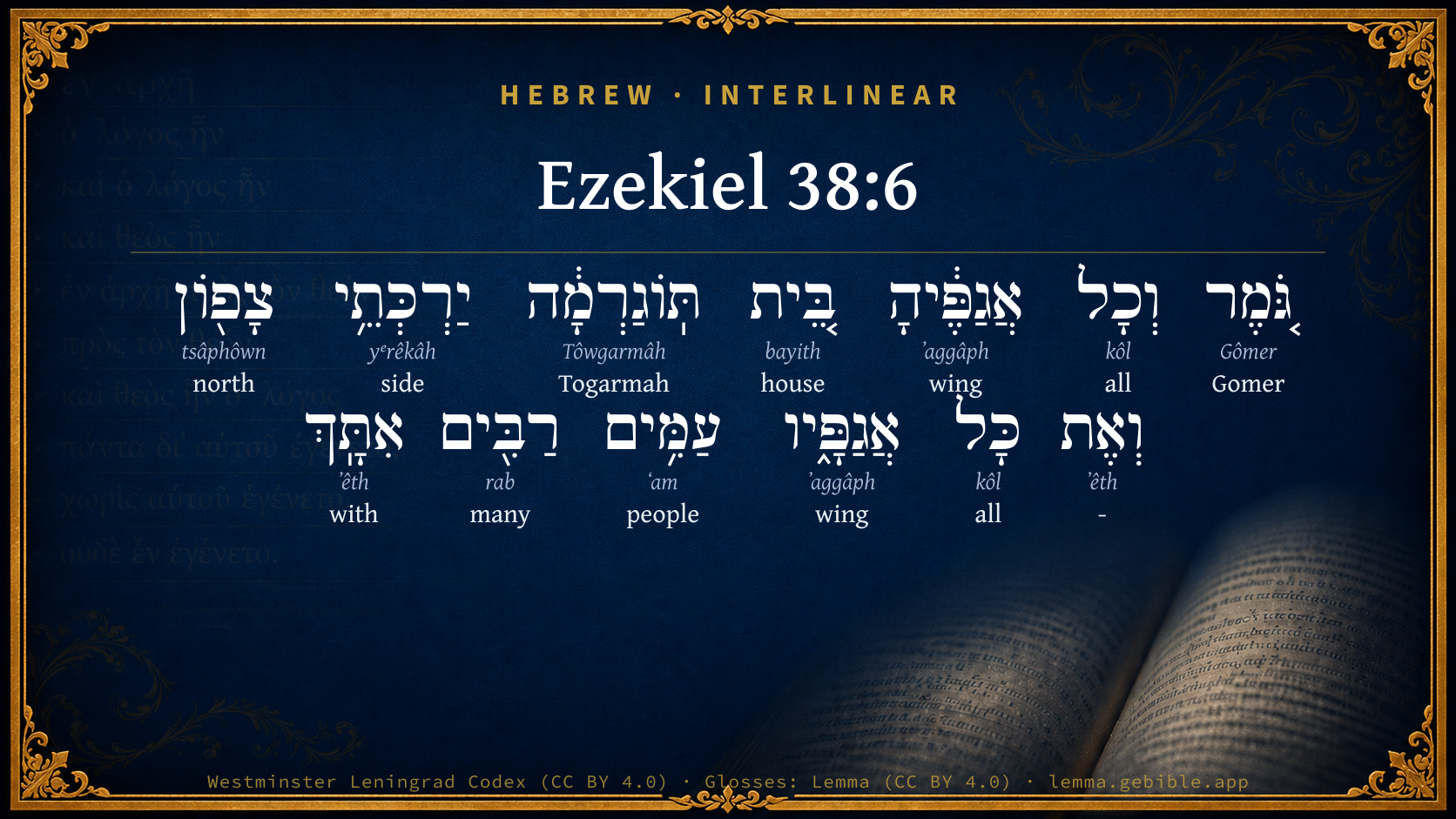
Hebrew (Westminster Leningrad Codex) Ezekiel 38:6 appears in the Hebrew Old Testament. The text above is from the Westminster Leningrad Codex. Each word links to its Strong’s number, a concise gloss, and parsing drawn from the Open Scriptures Hebrew Bible morphology. Click any word for its full Brown-Driver-Briggs (BDB) entry.
Download image
Cite this verse

Ezekiel 38:6 (World English Bible). Public Domain. Lemma interlinear Bible study tool, https://lemma.gebible.app/v/ezekiel/38/6.

Show BibTeX & RIS
BibTeX
RIS
English Translation
Gomer, and all his hordes; the house of Togarmah in the uttermost parts of the north, and all his hordes; even many peoples with you.
World English Bible · Public Domain
Download a study sheet

One document with this verse’s original text, its word-by-word gloss line, the meaning frame, cross-references with their text, attributed commentary, and full source and license credits — printable, and it pastes into notes with its structure intact.

This verse Autodidact and up

Study sheet (.html) Plain text (.txt)

A passage Seminary Student

Up to 50 verses in one chapter. A passage sheet keeps up to 6 commentary sources and 12 cross-references per verse, in the order this page ranks them, and says so on the sheet whenever that leaves anything out. Ask for a single verse and you get the Autodidact verse sheet above.

Everything on this page stays free to read, with no account — the sheet is a download of what is already on screen, not access to it.

Want to remove ads? Support Godless Engineer
Compare translations 3

The same verse in 3 English versions, stacked beneath the original-language interlinear above. Click any original word for its lexicon entry.

Each is an independent rendering of the whole verse — the interlinear is not word-aligned to these translations.

Highlighted words mark where these versions differ — a whole-verse word diff, not a word-by-word alignment.

  • World English Bible Public Domain
    Gomer, and all his hordes; the house of Togarmah in the uttermost parts of the north, and all his hordes; even many peoples with you.
  • King James Version Public Domain
    Gomer, and all his bands; the house of Togarmah of the north quarters, and all his bands: and many people with thee.
  • unfoldingWord Literal Text CC BY-SA 4.0
    Gomer and all her troops, and Beth Togarmah, from the far parts of the north, and all its troops! Many peoples are with you!

unfoldingWord Literal Text — © unfoldingWord, licensed CC BY-SA 4.0. Word-aligned USFM3 via Door43 (git.door43.org/unfoldingWord/en_ult).

Versions to compare (up to 4)

3 of 4 selected

Show all 18 translations

Every available English version of this verse, each an independent rendering of the whole verse.

  • World English Bible Public Domain
    Gomer, and all his hordes; the house of Togarmah in the uttermost parts of the north, and all his hordes; even many peoples with you.
  • Berean Standard Bible Public Domain
    as well as Gomer with all its troops, and Beth-togarmah from the far north with all its troops—the many nations with you.
  • Majority Standard Bible Public Domain
    as well as Gomer with all its troops, and Beth-togarmah from the far north with all its troops—the many nations with you.
  • King James Version Public Domain
    Gomer, and all his bands; the house of Togarmah of the north quarters, and all his bands: and many people with thee.
  • American Standard Version (1901) Public Domain
    Gomer, and all his hordes; the house of Togarmah in the uttermost parts of the north, and all his hordes; even many peoples with thee.
  • Revised Version (1885) Public Domain
    Gomer, and all his hordes; the house of Togarmah in the uttermost parts of the north, and all his hordes: even many peoples with thee.
  • Geneva Bible (1599) Public Domain
    Gomer and all his bands, and the house of Togarmah of the North quarters, and al his bands, and much people with thee.
  • Douay-Rheims (1899) Public Domain
    Gomer, and all his bands, the house of Thogorma, the northern parts and all his strength, and many peoples with thee.
  • Young's Literal Translation Public Domain
    Gomer and all its bands, The house of Togarmah of the sides of the north, And all its bands, many peoples with thee,
  • Literal Standard Version CC BY-SA 4.0
    Gomer and all its bands, || The house of Togarmah [from] the sides of the north, || And all its bands, many peoples with you,
  • Unlocked Literal Bible CC BY-SA 4.0
    Gomer and all her troops, and Beth Togarmah, from the far parts of the north, and all its troops! Many peoples are with you!
  • unfoldingWord Literal Text CC BY-SA 4.0
    Gomer and all her troops, and Beth Togarmah, from the far parts of the north, and all its troops! Many peoples are with you!
  • Darby Bible Public Domain
    Gomer, and all his bands; the house of Togarmah from the uttermost north, and all his bands; -- many peoples with thee.
  • World Messianic Bible Public Domain
    Gomer, and all his hordes; the house of Togarmah in the uttermost parts of the north, and all his hordes—even many peoples with you.
  • Webster's Bible Public Domain
    Gomer, and all his bands; the house of Togarmah of the north quarters, and all his bands: and many people with thee.
  • Free Bible Version CC BY-SA 4.0
    together with Gomer and all its armies, as well as Beth-togarmah from the distant places of the north with all its armies—and many other nations that join with you.
  • Bible in Basic English Public Domain
    Gomer and all her forces; the people of Togarmah in the inmost parts of the north, with all his forces: a great number of peoples with you.
  • JPS Tanakh (1917) Public Domain
    Gomer, and all his bands; the house of Togarmah in the uttermost parts of the north, and all his bands; even many peoples with thee.

Literal Standard Version (2020), Covenant Press — licensed CC BY-SA 4.0. Text via the HelloAO Bible API (eBible.org). Unlocked Literal Bible (unfoldingWord) — licensed CC BY-SA 4.0. Text via the HelloAO Bible API (eBible.org). unfoldingWord Literal Text — © unfoldingWord, licensed CC BY-SA 4.0. Word-aligned USFM3 via Door43 (git.door43.org/unfoldingWord/en_ult). Free Bible Version, Dr. Jonathan Gallagher — licensed CC BY-SA 4.0. Text via the HelloAO Bible API (eBible.org).

Word by word

More ways to search: Search by grammar → Find every occurrence → Compare this word →

Practice this passage: Drill this verse → Learn its vocabulary →

תּֽוֹגַרְמָ֔ה
Tôwgarmâh
H8425
“Togarmah”
Noun, Proper
Part of Speech
Noun
Type
Proper
Full BDB Definition

Origin: probably of foreign derivation

TWOT: None

Togarmah = "thou wilt break her" - son of Gomer, grandson of Japheth, and great grandson of Noah (noun proper masculine) - territory settled by the descendants of Togarmah (noun proper territory) - probably the area known as Armenia
  1. גֹּ֚מֶר Gômer H1586 “Gomer” Noun, Proper
  2. וְכָל kôl H3605 “and · all of” Conjunction + Noun, Common, Masculine, Singular, Construct
  3. אֲגַפֶּ֔יהָ ʼaggâph H102 “wings · her” Noun, Common, Masculine, Plural, Construct + Suffix, Personal, 3rd Person, Feminine, Singular
  4. בֵּ֚ית bayith H1004 “house of” Noun, Common, Masculine, Singular, Construct
  5. יַרְכְּתֵ֥י yᵉrêkâh H3411 “sides of” Noun, Common, Feminine, Dual, Construct
  6. צָפ֖וֹן tsâphôwn H6828 “north” Noun, Common, Feminine, Singular, Absolute
  7. וְאֶת ʼêth H853 “and · -” Conjunction + Particle, Direct Object
  8. כָּל kôl H3605 “all of” Noun, Common, Masculine, Singular, Construct
  9. אֲגַפָּ֑יו ʼaggâph H102 “wings · his” Noun, Common, Masculine, Plural, Construct + Suffix, Personal, 3rd Person, Masculine, Singular
  10. עַמִּ֥ים ʻam H5971 “peoples” Noun, Common, Masculine, Plural, Absolute
  11. רַבִּ֖ים rab H7227 “many” Adjective, Adjective, Masculine, Plural, Absolute
  12. אִתָּֽךְ ʼêth H854 “with · you” Preposition + Suffix, Personal, 2nd Person, Feminine, Singular

About this verse

These counts appear in no published source. They are computed here, from the morphology-tagged text and Lemma’s own curated glosses. What Lemma adds →

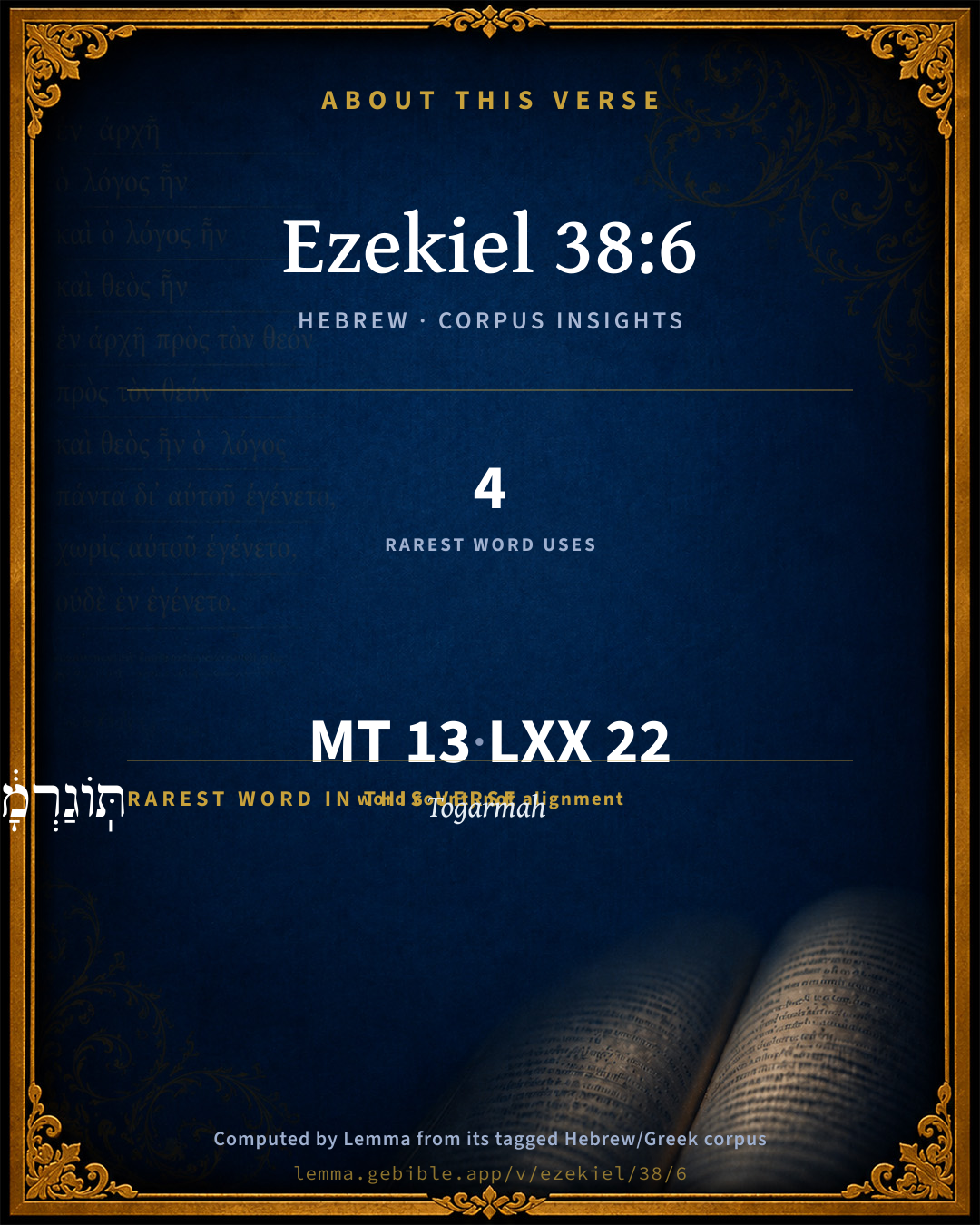
13
words
11
distinct lemmas
Prophets
section

Notable vocabulary

The rarest word here is תּֽוֹגַרְמָ֔ה Togarmah H8425 — appearing just 4 times in the whole Hebrew Bible.

Shared distinctive vocabulary

תּֽוֹגַרְמָ֔ה Togarmah H8425 occurs in 4 verses of the Hebrew Bible. Also found in:

Grammatical profile

  • 10 nouns
  • 1 adjective
  • 1 preposition
  • 1 particle

Repetition

Words recur within this verse — often emphatic in Hebrew:

  • וְכָל all H3605 ×2
  • אֲגַפֶּ֔יהָ wing H102 ×2

Hebrew & Septuagint length

In English translation the verse runs 25 words from the Hebrew and 26 from the Septuagint (LXX English) — closely comparable.

A rough comparison of the two English renderings, which tokenize alike — not a word-level alignment.

Word counts can differ between the Hebrew and the Greek without any difference in meaning — e.g. the Hebrew direct-object marker אֵת has no separate Greek word, and Greek often adds the article ὁ.

In the original languages it is 13 Hebrew tokens and 22 Greek tokens — but the two are counted differently (Hebrew bundles its prefixes and suffixes into one token; the Greek is in lemma form), so that isn’t a like-for-like length.

Cross-references

4

Topical passages linked to Ezekiel 38:6 in the Treasury of Scripture Knowledge — connected by theme and wording, ordered by reader-vote popularity; previews shown in the World English Bible.

  • Genesis 10:2–3 The sons of Japheth: Gomer, Magog, Madai, Javan, Tubal, Meshech, and Tiras.
  • Ezekiel 27:14 They of the house of Togarmah traded for your wares with horses and war-horses and mules.
  • 1 Chronicles 1:5–6 The sons of Japheth: Gomer, and Magog, and Madai, and Javan, and Tubal, and Meshech, and Tiras.
  • Daniel 11:40 At the time of the end shall the king of the south contend with him; and the king of the north shall come against him like a whirlwind, with chariots, and with horsemen, and with many ships; and he shall enter into the countries, and shall overflow and pass through.

Cross-references courtesy of OpenBible.info (CC BY 4.0).

Hebrew and Greek witnesses Masoretic Hebrew ↔ Greek Septuagint

The same verse in the two great witnesses to the Old Testament, shown verse-for-verse.

These are two independent witnesses, not word-aligned to each other, and the Septuagint is shown in lemma (dictionary) form.

Hebrew Ezekiel 38:6 Masoretic · Westminster Leningrad Codex

גֹּ֚מֶר וְכָל אֲגַפֶּ֔יהָ בֵּ֚ית תּֽוֹגַרְמָ֔ה יַרְכְּתֵ֥י צָפ֖וֹן וְאֶת כָּל אֲגַפָּ֑יו עַמִּ֥ים רַבִּ֖ים אִתָּֽךְ

Gomer, and all his hordes; the house of Togarmah in the uttermost parts of the north, and all his hordes; even many peoples with you.

World English Bible · Public Domain

Greek LXX Ezekiel 38:6 Septuagint · lemma form

γομερ καί πᾶς ὁ περί αὐτός οἶκος ὁ θεργαμα ἀπό ἔσχατος βορέας καί πᾶς ὁ περί αὐτός καί ἔθνος πολύς μετά σύ

Gomer, and all belonging to him; the house of Thorgama, from the end of the north, and all belonging to him; and many nations with you.

LXX2012 (modern English Septuagint) · Public Domain

Hebrew: Westminster Leningrad Codex (CC BY 4.0). Greek: Septuagint (public domain); English from LXX2012 (modern English Septuagint) (Public Domain). How the Septuagint differs from the Hebrew →

Targum (Aramaic paraphrase)

1

The Targum is the ancient Jewish Aramaic paraphrase of the Hebrew Scriptures — an interpretive translation, not the Hebrew text itself. Onkelos (literal) and Pseudo-Jonathan (expansive) render the Torah, and Jonathan the Prophets. Coverage is partial: where no permissively-licensed English translation exists for a verse, only the Aramaic is shown. This is verse-level text, not a word-by-word alignment to the Hebrew.

  1. Targum Jonathan Prophets (Joshua–Malachi)
    גוֹמֶר וְכָל מַשִׁרְיָתָהָא מְדִינַת גַרְמַמְיָא סְיָפֵי צִפּוּנָא וְיַת כָּל מַשִׁרְיָתְהוֹן עַמְמִין סַגִיאִין דִי עִמָךְ:

    (no public-domain English translation for this verse)

    Targum Jonathan — Aramaic: “Mikraot Gedolot” (public domain). English: “Sefaria Community Translation” (CC0 1.0 (public-domain dedication)); “London "Chaldee Paraphrase," 1871” (public domain). Text via Sefaria.

Commentary

Notes on Ezekiel 38:6 from classic Christian and Jewish commentators (each source and its license shown beneath its notes). The classic Christian expositions comment on the surrounding passage and are grouped to its opening verse, so a note may address several verses; the Jewish commentaries on the Tanakh (Rashi and others) are per-verse, so they appear only where the commentator wrote on this verse.

Lemma curates 59 commentaries, every one of them public domain or Creative Commons licensed, each selected and text-cleaned for this edition rather than reprinted as found. About our sources →

Trapp's Complete Commentary

John Trapp

Eze 38:6 Gomer, and all his bands; the house of Togarmah of the north quarters, and all his bands: [and] many people with thee.

Ver. 6. Gomer, and all his bands.] The Cimbrians or Cimmerians, saith Melanchthon; the Galatians, saith Theodoret.

The house of Togarmah.] The Phrygians, as some; the Armenians, as others will. Of antichrist’s great power, see Rev 9:1-20; Rev 20:8. See on Eze 27:14.

John Trapp, A Commentary or Exposition upon All the Books of the Old and New Testament (1647–1656) — public domain. Text from a community e-Sword module.

Geneva Bible (1599)

Geneva Bible translators

Gomer was Japheth’s son, and Togarmah the son of Gomer, and are thought to be they that inhabit Asia Minor.

Geneva Bible (1599) marginal notes — public domain. Text via Bolls.life.

Jamieson, Fausset & Brown

Robert Jamieson, A. R. Fausset & David Brown

Gomer--the Celtic Cimmerians of Crim-Tartary.

Togarmah--the Armenians of the Caucasus, south of Iberia.

Jamieson, Fausset & Brown — Commentary Critical and Explanatory on the Whole Bible (1871) — public domain (CC PDM 1.0). Text via the HelloAO Bible API.

Adam Clarke's Commentary

Verse 6. Gomer, and all his bands; the house of Togarmah] The Cimmerians and Turcomanians, and other northern nations.-Calmet.

Adam Clarke's Commentary on the Bible (1810–1826) — public domain. Text from a community e-Sword/MySword module.

Ellicott's Commentary for English Readers

(6) Gomer . . . Togarmah.—Again the address turns to the extreme north. Gomer, like Magog, a people descended from Japheth (Gen_10:2; 1Ch_1:5), is identified with the Cimmerians; and for the house of Togarmah, the Armenians, see Note on 27:14. In the last clause of the verse, people should be in the plural. This was to be a general gathering of the strength of the world against the Church of God.

A Bible Commentary for English Readers, edited by Charles John Ellicott (1878–1897) — public domain. Text from a community e-Sword module.

The Cambridge Bible for Schools and Colleges

gen. ed. J. J. S. Perowne

6. Cf. Eze_27:14; Gen_10:2. His “bands,” Eze_12:14.

north quarters] lit. sides of the north, i.e. the furthest north, Isa_14:13. Gomer, Assyr. Gimir, is usually identified in name with the Kimmerians. Schrader (KAT. in loc.) and others understand Cappadocia.

The Cambridge Bible for Schools and Colleges (gen. ed. J. J. S. Perowne; Cambridge University Press, 1878–1918) — public domain. Text from a community e-Sword module.

John Gill's Exposition

Be thou prepared, and prepare for thyself,.... All warlike stores and provisions: this is ironically said; and suggests that he would do so, and yet all would be in vain, and to no purpose:

thou and all thy company, that are assembled unto thee; or all thine armies, as the Targum, gathered out of his dominions, and made up of his auxiliaries and allies; let them all be furnished with arms, and everything proper for the expedition designed:

and be thou a guard unto them; the general of them; let them observe and obey thy word of command; guide and direct, guard and protect them in their march; and take care of them when entered the land of Judea, that they are not exposed to any unnecessary danger, or cut off by any stratagem or ambush: this is also sarcastically said; signifying that let him use all the care and caution that a wise and prudent general can do, yet he and his army should perish.

John Gill's Exposition of the Whole Bible (1746–1763) — public domain (CC PDM 1.0). Text via the HelloAO Bible API.

Matthew Poole's English Annotations

Gomer; inhabitants of Galatia, called formerly Gallograeci, Phrygians, and Bithynians, also these descended of Gomer.

Togarmah; Paphlagonia and Cappadocia: see Eze 27:14.

Of the north quarters: it might be read in apposition, and leave out

of, so it will bring in many more to assist Gog; beside all those mentioned, the more northern people, the numerous Tartars, shall with all their bands fight for Gag.

Many people; great, and mighty of stature, and strength, and courage, as well as many in numbers.

Matthew Poole's English Annotations on the Holy Bible (1683–1685) — public domain. Text from a community e-Sword/MySword module.

Whedon's Commentary on the Bible

Daniel D. Whedon

6. For Gomer see note Eze_38:2; for Togarmah, Eze_27:14; for people read “peoples,” as also Eze_38:8-9; Eze_38:15; Eze_38:22.

Daniel D. Whedon (gen. ed.), Commentary on the Old and New Testaments (1874–1909) — public domain. Text from a community e-Sword module.

John Wesley's Explanatory Notes

Gomer - Inhabitants of Galatia. Togarmah - Paphlagonia, and Cappadocia. The north quarters - The more northern people, the numerous Tartars.

John Wesley, Explanatory Notes Upon the Whole Bible (1754–1765) — public domain. Text via the GEBible commentary corpus.

Scofield Reference Notes

C. I. Scofield

Gomer, and all his

(See Scofield "Gen 10:2").

The Scofield Reference Bible (1917 edition), notes by C. I. Scofield — public domain. Text from a community e-Sword module.

Rashi

Rabbi Shlomo Yitzchaki (Rashi)

and all its wings And all those around it.

Rashi on the Tanakh — English translations: “The Judaica Press complete Tanach with Rashi, translated by A. J. Rosenberg” (CC BY 4.0); “Pentateuch with Rashi's commentary by M. Rosenbaum and A.M. Silbermann, 1929-1934” (public domain); “The Metsudah Tanach series, Lakewood, N.J” (CC BY 4.0); and “The Book of Joshua, Metsudah Publications, 1997” (CC BY 4.0). Text via Sefaria.

Lesson kit

Teaching starters — assembled from the data on this page, not authored interpretation. Every prompt links to the verse data it draws on. Edit before teaching.

Ezekiel, in the Prophets, opens this verse with 13 words (11 distinct Hebrew lemmas). Its most distinctive word is Tôwgarmâh (“Togarmah”). A historical commentator’s framing appears above. Read the whole chapter for the surrounding context.

Discussion questions

  1. How does “Togarmah” (Tôwgarmâh) shape what this verse is saying?
  2. Genesis 10:3 shares the word «Togarmah» with this verse. How do the two illuminate each other?
  3. “all” occurs 2× in this one verse. What is the effect of the repetition?
  4. These translations render this verse differently. What is at stake in choosing one wording over another?
  5. Reading how Trapp's Complete Commentary and Geneva Bible (1599) read this verse, where do the two commentators agree and where do they part?

Things to notice

Reading settings

Reading text

Shown beneath each verse's original-language words.

Old Testament
Old Testament edition

Read the OT as the Masoretic Hebrew (MT) or the Greek Septuagint (LXX).

English shown for the Greek Septuagint (in the Hebrew ↔ Greek comparison).

Comparing translations? Open the Compare panel on any verse page to stack up to four side by side.