
2 Samuel 15:17

Hebrew (Westminster Leningrad Codex) 2 Samuel 15:17 appears in the Hebrew Old Testament. The text above is from the Westminster Leningrad Codex. Each word links to its Strong’s number, a concise gloss, and parsing drawn from the Open Scriptures Hebrew Bible morphology. Click any word for its full Brown-Driver-Briggs (BDB) entry.
Download image
Cite this verse

2 Samuel 15:17 (World English Bible). Public Domain. Lemma interlinear Bible study tool, https://lemma.gebible.app/v/2-samuel/15/17.

Show BibTeX & RIS
BibTeX
RIS
English Translation
The king went forth, and all the people after him; and they stayed in Beth Merhak.
World English Bible · Public Domain
Highlights
  • 1 first appearance in the Hebrew Bible
Full analysis ↓
Download a study sheet

One document with this verse’s original text, its word-by-word gloss line, the meaning frame, cross-references with their text, attributed commentary, and full source and license credits — printable, and it pastes into notes with its structure intact.

This verse Autodidact and up

Study sheet (.html) Plain text (.txt)

A passage Seminary Student

Up to 50 verses in one chapter. A passage sheet keeps up to 6 commentary sources and 12 cross-references per verse, in the order this page ranks them, and says so on the sheet whenever that leaves anything out. Ask for a single verse and you get the Autodidact verse sheet above.

Everything on this page stays free to read, with no account — the sheet is a download of what is already on screen, not access to it.

Want to remove ads? Support Godless Engineer
Compare translations 3

The same verse in 3 English versions, stacked beneath the original-language interlinear above. Click any original word for its lexicon entry.

Each is an independent rendering of the whole verse — the interlinear is not word-aligned to these translations.

Highlighted words mark where these versions differ — a whole-verse word diff, not a word-by-word alignment.

  • World English Bible Public Domain
    The king went forth, and all the people after him; and they stayed in Beth Merhak.
  • King James Version Public Domain
    And the king went forth, and all the people after him, and tarried in a place that was far off.
  • unfoldingWord Literal Text CC BY-SA 4.0
    And the king went out, and all of the people at his feet. And they stopped the farthest house.

unfoldingWord Literal Text — © unfoldingWord, licensed CC BY-SA 4.0. Word-aligned USFM3 via Door43 (git.door43.org/unfoldingWord/en_ult).

Versions to compare (up to 4)

3 of 4 selected

Show all 18 translations

Every available English version of this verse, each an independent rendering of the whole verse.

  • World English Bible Public Domain
    The king went forth, and all the people after him; and they stayed in Beth Merhak.
  • Berean Standard Bible Public Domain
    So the king set out with all the people following him. He stopped at the last house,
  • Majority Standard Bible Public Domain
    So the king set out with all the people following him. He stopped at the last house,
  • King James Version Public Domain
    And the king went forth, and all the people after him, and tarried in a place that was far off.
  • American Standard Version (1901) Public Domain
    And the king went forth, and all the people after him; and they tarried in Beth-merhak.
  • Revised Version (1885) Public Domain
    And the king went forth, and all the people after him; and they tarried in Beth-merhak.
  • Geneva Bible (1599) Public Domain
    And the King went forth and all the people after him, and taried in a place farre off.
  • Douay-Rheims (1899) Public Domain
    And the king going forth and all Israel on foot, stood afar off from the house:
  • Young's Literal Translation Public Domain
    And the king goeth out, and all the people at his feet, and they stand still at the farthest off house.
  • Literal Standard Version CC BY-SA 4.0
    And the king goes out, and all the people at his feet, and they stand still at the farthest off house.
  • Unlocked Literal Bible CC BY-SA 4.0
    After the king went out and all the people after him, they stopped at the last house.
  • unfoldingWord Literal Text CC BY-SA 4.0
    And the king went out, and all of the people at his feet. And they stopped the farthest house.
  • Darby Bible Public Domain
    And the king went forth, and all the people after him, and stayed at the remote house.
  • World Messianic Bible Public Domain
    The king went out, and all the people after him; and they stayed in Beth Merhak.
  • Webster's Bible Public Domain
    And the king went forth, and all the people after him, and tarried in a place that was far off.
  • Free Bible Version CC BY-SA 4.0
    The king left with all his soldiers following him. He stopped at the last house,
  • Bible in Basic English Public Domain
    And the king went out, and all his servants went after him, and made a stop at the Far House.
  • JPS Tanakh (1917) Public Domain
    And the king went forth, and all the people after him; and they tarried in Beth-merhak.

Literal Standard Version (2020), Covenant Press — licensed CC BY-SA 4.0. Text via the HelloAO Bible API (eBible.org). Unlocked Literal Bible (unfoldingWord) — licensed CC BY-SA 4.0. Text via the HelloAO Bible API (eBible.org). unfoldingWord Literal Text — © unfoldingWord, licensed CC BY-SA 4.0. Word-aligned USFM3 via Door43 (git.door43.org/unfoldingWord/en_ult). Free Bible Version, Dr. Jonathan Gallagher — licensed CC BY-SA 4.0. Text via the HelloAO Bible API (eBible.org).

Word by word

More ways to search: Search by grammar → Find every occurrence → Compare this word →

Practice this passage: Drill this verse → Learn its vocabulary →

בֵּ֥ית
Bêyth ham-Merchâq
H1023
“Beth Ham-merchaq of”
Noun, Common, Masculine, Singular, Construct
Part of Speech
Noun
Type
Common
Gender
Masculine
Number
Singular
State
Construct
Full BDB Definition

Origin: from H1004 and H4801 with the article interposed

TWOT: None

Beth Ham-merchaq = "remote house" - house or settlement on the bank of Kidron
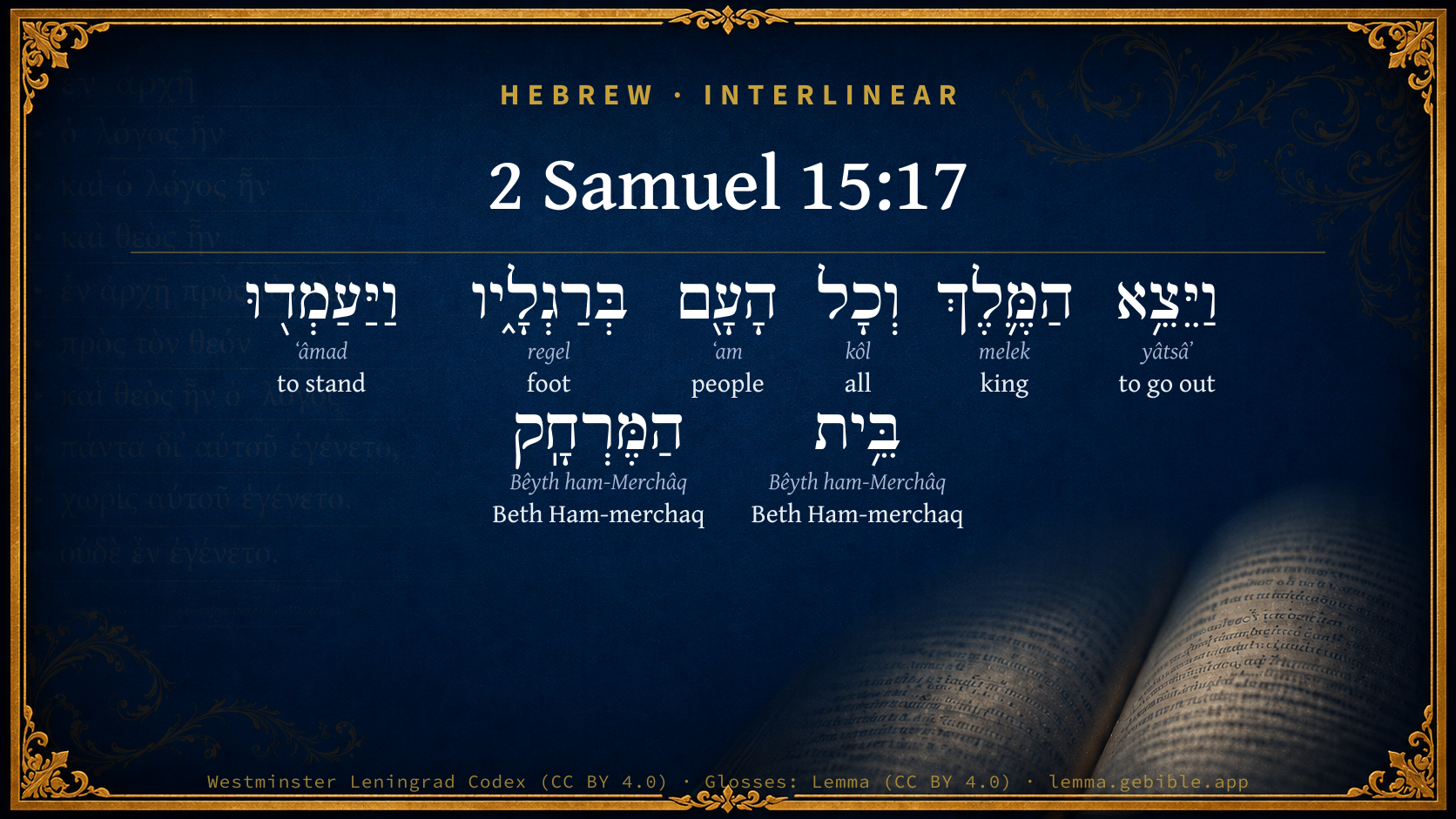
  1. וַיֵּצֵ֥א yâtsâʼ H3318 “and · to go out” Conjunction + Verb, Qal, Sequential Imperfect, 3rd Person, Masculine, Singular
  2. הַמֶּ֛לֶךְ melek H4428 “the · king” Particle, Definite Article + Noun, Common, Masculine, Singular, Absolute
  3. וְכָל kôl H3605 “and · all of” Conjunction + Noun, Common, Masculine, Singular, Construct
  4. הָעָ֖ם ʻam H5971 “the · people” Particle, Definite Article + Noun, Common, Masculine, Singular, Absolute
  5. בְּרַגְלָ֑יו regel H7272 “in/at · feet · his” Preposition + Noun, Common, Feminine, Dual, Construct + Suffix, Personal, 3rd Person, Masculine, Singular
  6. וַיַּעַמְד֖וּ ʻâmad H5975 “and · to stand” Conjunction + Verb, Qal, Sequential Imperfect, 3rd Person, Masculine, Plural
  7. הַמֶּרְחָֽק Bêyth ham-Merchâq H1023 “the · Beth Ham-merchaq” Particle, Definite Article + Noun, Common, Masculine, Singular, Absolute

About this verse

These counts appear in no published source. They are computed here, from the morphology-tagged text and Lemma’s own curated glosses. What Lemma adds →

8
words
7
distinct lemmas
Historical
section

Notable vocabulary

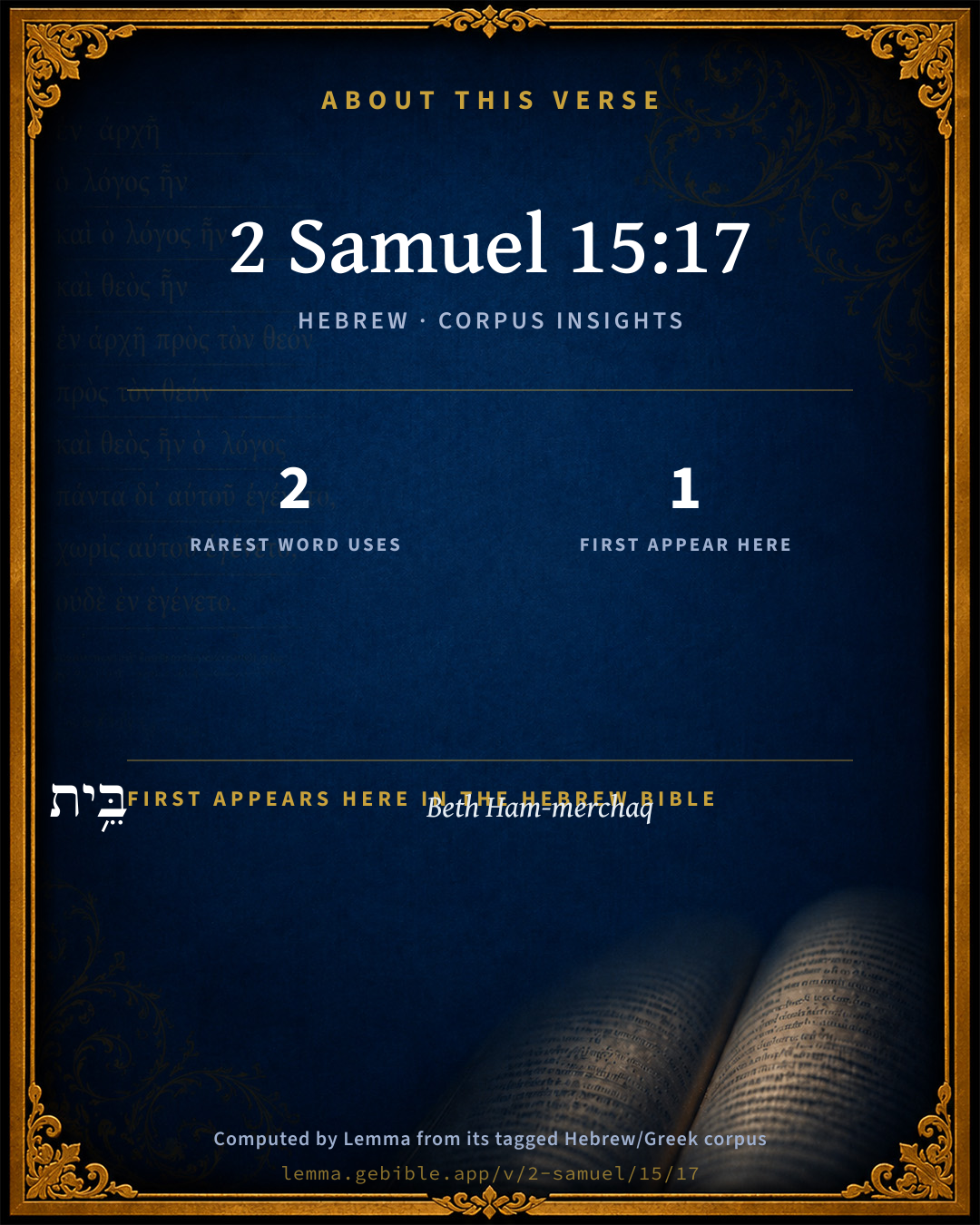
The rarest word here is בֵּ֥ית Beth Ham-merchaq H1023 — appearing just 2 times in the whole Hebrew Bible.

First appearance in Scripture

This word makes its first canonical appearance in the Hebrew Bible here:

  • בֵּ֥ית Beth Ham-merchaq H1023

Grammatical profile

  • 2 verbs
  • 6 nouns

Verb forms

  • וַיֵּצֵ֥א Qal · Sequential Imperfect
  • וַיַּעַמְד֖וּ Qal · Sequential Imperfect

Repetition

A word recurs within this verse — often emphatic in Hebrew:

  • בֵּ֥ית Beth Ham-merchaq H1023 ×2

Hebrew & Septuagint length

In English translation the verse runs 16 words from the Hebrew and 17 from the Septuagint (LXX English) — closely comparable.

A rough comparison of the two English renderings, which tokenize alike — not a word-level alignment.

Word counts can differ between the Hebrew and the Greek without any difference in meaning — e.g. the Hebrew direct-object marker אֵת has no separate Greek word, and Greek often adds the article ὁ.

Cross-references

3

Topical passages linked to 2 Samuel 15:17 in the Treasury of Scripture Knowledge — connected by theme and wording, ordered by reader-vote popularity; previews shown in the World English Bible.

  • Psalms 3:1–2 Yahweh, how my adversaries have increased! Many are those who rise up against me.
  • Psalms 66:12 You allowed men to ride over our heads. We went through fire and through water, But you brought us to the place of abundance.
  • Ecclesiastes 10:7 I have seen servants on horses, and princes walking like servants on the earth.

Cross-references courtesy of OpenBible.info (CC BY 4.0).

Hebrew and Greek witnesses Masoretic Hebrew ↔ Greek Septuagint

The same verse in the two great witnesses to the Old Testament, shown verse-for-verse.

These are two independent witnesses, not word-aligned to each other, and the Septuagint is shown in lemma (dictionary) form.

Hebrew 2 Samuel 15:17 Masoretic · Westminster Leningrad Codex

וַיֵּצֵ֥א הַמֶּ֛לֶךְ וְכָל הָעָ֖ם בְּרַגְלָ֑יו וַיַּעַמְד֖וּ בֵּ֥ית הַמֶּרְחָֽק

The king went forth, and all the people after him; and they stayed in Beth Merhak.

World English Bible · Public Domain

Greek LXX 2 Samuel 15:17 Septuagint · lemma form

καί ἐκἔρχομαι ὁ βασιλεύς καί πᾶς ὁ παῖς αὐτός πεζός καί ἵστημι ἐν οἶκος ὁ μακρός

And the king and all his servants went out on foot; and abode in a distant house.

LXX2012 (modern English Septuagint) · Public Domain

Hebrew: Westminster Leningrad Codex (CC BY 4.0). Greek: Septuagint (public domain); English from LXX2012 (modern English Septuagint) (Public Domain). How the Septuagint differs from the Hebrew →

Targum (Aramaic paraphrase)

1

The Targum is the ancient Jewish Aramaic paraphrase of the Hebrew Scriptures — an interpretive translation, not the Hebrew text itself. Onkelos (literal) and Pseudo-Jonathan (expansive) render the Torah, and Jonathan the Prophets. Coverage is partial: where no permissively-licensed English translation exists for a verse, only the Aramaic is shown. This is verse-level text, not a word-by-word alignment to the Hebrew.

  1. Targum Jonathan Prophets (Joshua–Malachi)
    וּנְפַק מַלְכָּא וְכָל אֱנַשׁ בֵּיתֵיהּ עִמֵיהּ וְקָמוּ בַּאֲתַר דְרָחִיק:

    (no public-domain English translation for this verse)

    Targum Jonathan — Aramaic: “Mikraot Gedolot” (public domain). English: “Sefaria Community Translation” (CC0 1.0 (public-domain dedication)); “London "Chaldee Paraphrase," 1871” (public domain). Text via Sefaria.

Commentary

Notes on 2 Samuel 15:17 from classic Christian and Jewish commentators (each source and its license shown beneath its notes). The classic Christian expositions comment on the surrounding passage and are grouped to its opening verse, so a note may address several verses; the Jewish commentaries on the Tanakh (Rashi and others) are per-verse, so they appear only where the commentator wrote on this verse.

Lemma curates 59 commentaries, every one of them public domain or Creative Commons licensed, each selected and text-cleaned for this edition rather than reprinted as found. About our sources →

Trapp's Complete Commentary

John Trapp

2Sa 15:17 And the king went forth, and all the people after him, and tarried in a place that was far off.

Ver. 17. And tarried in a place that was far off.] Aloof from the city; and yet not very far off neither, as appeareth by that which followeth.

John Trapp, A Commentary or Exposition upon All the Books of the Old and New Testament (1647–1656) — public domain. Text from a community e-Sword module.

The Biblical Illustrator

Joseph S. Exell

2Sa_15:17

And the king went forth and tarried in a place which was far off.

Expatriation

Far up and far back in the history of heaven there came a period when its Most Illustrious Citizen was about to absent Himself. He was not going to sail from beach to beach. He was not going to put out from one hemisphere to another hemisphere. But He was to sail from world to world, the spaces unexplored and the immensities untravelled. Out and out and out, and on and on and on, and down and down and down He sped, until one night, with only one to greet Him when He arrived, His disembarkation so unpretending, so quiet, that it was not known on earth until the excitement in the cloud gave intimation to the Bethlehem rustics that something grand and glorious had happened. Who comes there? From what port did He sail? Why was this the place of His destination? I question the shepherds. I question the camel-drivers. I question the angels. I have found out. He was an exile. But the world had plenty of exiles. Abraham, an exile from Haran; John, an exile from Ephesus; Koscinsko, an exile from Poland; Mazzini, an exile from Italy; Victor Hugo, an exile from France; Kossuth, an exile from Hungary. But this One of whom I speak had such resounding farewell, and came into such thrilling reception--for not even an ostler went out with his lantern to light Him in--that He is more to be celebrated than any other expatriated exile of earth or heaven.

1. I remark that Christ was an imperial exile. He gob down off a throne. He took off a tiara. He closed a palace gate behind Him. His family were princes and princesses. Vashti was turned out of the throne-room by Ahasuerus. David was dethroned by Absaloms infamy. The five kings were hurled into a cavern by Joshuas courage. Some of the Henrys of England and some of the Louises of France were jostled on their thrones by discontented subjects. But Christ was never more honoured, or more popular, or more loved than the day He left heaven. Exiles have suffered severely, but Christ turned himself out of throne-room into sheep-pen, and down from the top to the bottom. He was not pushed off. He was not manacled for foreign transportation. He was not put out because they no more wanted him in celestial domain, but by choice departing and descending into an exile five times as long as that of Napoleon at St. Helena, and a thousand times worse; the one exile suffering for that he had destroyed nations, the other exile suffering because He came to save a world. An imperial exile. King eternal.

2. But I go further, and tell you He was an exile on a barren island. Christ came to this small Patmos of a world. When exiles are sent out they are generally sent to regions that are sandy or cold or hot. Christ came as an exile to a world scorched with heat and bitten with cold, to deserts simoom-swept, to a howling wilderness. It was the backdoor yard, seemingly, of the universe.

3. I go further, and tell you that He was an exile in a hostile country. Turkey was never so much against Russia, France was never so much against Germany as this earth was against Christ. It took Him in through the door of a stable. It thrust Him out at the point of a spear.

4. I go further, and tell you that this exile was far from home. It is ninety-three million miles from here to the sun, and all astronomers agree in saying that our solar system is only one of the smaller wheels of the great machinery of the universe turning around some one great centre, the centre so far distant it is beyond all imagination and calculation, and if, as some think, that great centre in the distance is heaven, Christ came far from home when He came here. Have you ever thought of the homesickness of Christ?--I have read how the Swiss, when they are far away from their native country, at the sound of their national air get so homesick that they fall into melancholy and sometimes they die under the homesickness. But oh I the homesickness of Christ. You have often tried to measure the other pangs of Christ, but you have never tried to measure the magnitude and ponderosity of the Saviours homesickness.

5. I take a step further, and tell you that Christ was in an exile which He knew would end in assassination. Holman Hunt, the master painter, has a picture in which he represents Jesus Christ in the Nazarene carpenter-shop. Around Him are the saws, the hammers, the axes, the drills of carpentry. The picture represents Christ as rising from the car-pouters working-bench and wearily stretching out His arms as one will after being in contracted or uncomfortable posture, and the light of that picture is so arranged that the arms of Christ, wearily stretched forth, together with His body, throw on the wall the shadow of the cross. Oh! that shadow was on everything in Christs lifetime. Shadow of a cross on the Bethlehem swaddling clothes. Shadow of a cross on the road over which the three fugitives fled into Egypt. Shadow of a cross on Lake Galilee as Christ walked its mosaic floor of opal and emerald and crystal. Shadow of a cross on the road to Jerusalem. Shadow of a cross on the brook Kedron, and on the Temple, and on the side of Olivet. Shadow of a cross on sunrise and sunset. Constantine, marching with his army, saw just once a cross in the sky, but Christ saw the cross all the time. For this royal exile I bespeak the love and service of all the exiles here present, and, in one sense or the other, that includes all of us. All of us exiles. This is not our home. Heaven is our home. Oh, I am so glad when the royal exile went back lie left the gate ajar, or left it wide open! Going home! That is the dying exclamation of the majority of Christians. (T. De Witt Talmage, D. D.)

The Biblical Illustrator, edited by Joseph S. Exell (c. 1880s–1900s) — public domain. Text from a community e-Sword module.

Geneva Bible (1599)

Geneva Bible translators

Or, house.

To wit, from Jerusalem.

Geneva Bible (1599) marginal notes — public domain. Text via Bolls.life.

Adam Clarke's Commentary

Verse 17. And tarried in a place] He probably waited till he saw all his friends safely out of the city.

Adam Clarke's Commentary on the Bible (1810–1826) — public domain. Text from a community e-Sword/MySword module.

Ellicott's Commentary for English Readers

(17) Tarried in a place that was far off.—Better, halted at the far house, i.e., at a definite place known by this name, probably the last house on the outskirts of the city before the road crossed the Kidron. Here David mustered his forces and made the arrangements for his flight.

A Bible Commentary for English Readers, edited by Charles John Ellicott (1878–1897) — public domain. Text from a community e-Sword module.

The Cambridge Bible for Schools and Colleges

gen. ed. J. J. S. Perowne

17. tarried in a place that was far off] Better, halted at the Far House: the last house on the outskirts of the city, before the road crossed the Kidron. It seems to be used almost as a proper name—Beth-merchak—for the locality. Here David halted, while his troops passed in review before him, and crossed the Kidron.

The Cambridge Bible for Schools and Colleges (gen. ed. J. J. S. Perowne; Cambridge University Press, 1878–1918) — public domain. Text from a community e-Sword module.

John Gill's Exposition

And the king went forth,.... From Jerusalem; which is repeated, that it might be observed in what a hurry and fright he was:

and all the people after him; his family, court, and servants, and as many of the people of Jerusalem as chose to go with him:

and tarried at a place that was afar off; when they had got at some distance from the city, they stopped and stayed a while; it could not be a great way from it, for they had not as yet passed over the brook Kidron, Sa2 15:23.

John Gill's Exposition of the Whole Bible (1746–1763) — public domain (CC PDM 1.0). Text via the HelloAO Bible API.

Haydock's Catholic Bible Commentary

House, or palace, (Haydock) at the foot of the walls, (Calmet) that all who were well disposed, might join the king’s standard. Hebrew, "in a place that was far off;" (Haydock) or, "this house of flight (this family of David, in flight) stopped." (Calmet)

George Leo Haydock (1774–1849), Haydock's Catholic Family Bible and Commentary, 1859 edition — public domain. Excludes Psalms (Douay-Rheims chapter numbering differs from Protestant) and Deuterocanonical books (Catholic canon only).

Matthew Poole's English Annotations

Either to rest and refresh themselves a little; or rather, in expectation of others who should or would come after him, that they might march away in a considerable body, which might both defend the king, and invite others to come in to their assistance.

A place that was far off; at some convenient distance, but not very far.

Matthew Poole's English Annotations on the Holy Bible (1683–1685) — public domain. Text from a community e-Sword/MySword module.

Whedon's Commentary on the Bible

Daniel D. Whedon

17. A place that was far off — Literally, a house of the distance. A place outside of the city in the Kidron valley.

Daniel D. Whedon (gen. ed.), Commentary on the Old and New Testaments (1874–1909) — public domain. Text from a community e-Sword module.

The Pulpit Commentary

And tarried in a place that was far off; Revised Version, in Beth-merhak. "The Far House so we may translate this proper name was probably not a dwelling, but a pavilion overlooking the Kidron valley; and here David halted his household until all were assembled, and arrangements made for their journey. Here, too, the bodyguard would gather, and they would cross the Kidron only when everything was ready for their orderly progress. Confusion at such a time would breed a panic and invite an attack.

The Pulpit Commentary (1880–1919), ed. H.D.M. Spence-Jones & Joseph S. Exell — public domain. Text from a community e-Sword module.

John Wesley's Explanatory Notes

Far off - At some convenient distance, tho' not very far.

John Wesley, Explanatory Notes Upon the Whole Bible (1754–1765) — public domain. Text via the GEBible commentary corpus.

Keil & Delitzsch

C. F. Keil & F. Delitzsch

When outside the city the king and all the people in his suite (i.e., the royal family and their servants) halted at "the house of the distance." המּרחק is probably a proper name given to a house in the neighbourhood of the city and on the road to Jericho, which was called "the farthest house," viz., from the city.

Keil & Delitzsch — Biblical Commentary on the Old Testament (1861–1891) — public domain (CC PDM 1.0). Text via the HelloAO Bible API. (Old Testament only.)

Rashi

Rabbi Shlomo Yitzchaki (Rashi)

Far away. [Targum Yonasan translates:] "in a far away place."

Rashi on the Tanakh — English translations: “The Judaica Press complete Tanach with Rashi, translated by A. J. Rosenberg” (CC BY 4.0); “Pentateuch with Rashi's commentary by M. Rosenbaum and A.M. Silbermann, 1929-1934” (public domain); “The Metsudah Tanach series, Lakewood, N.J” (CC BY 4.0); and “The Book of Joshua, Metsudah Publications, 1997” (CC BY 4.0). Text via Sefaria.

Lesson kit

Teaching starters — assembled from the data on this page, not authored interpretation. Every prompt links to the verse data it draws on. Edit before teaching.

2 Samuel, in the Historical, opens this verse with 8 words (7 distinct Hebrew lemmas). Its most distinctive word is Bêyth ham-Merchâq (“Beth Ham-merchaq”). A historical commentator’s framing appears above. Read the whole chapter for the surrounding context.

Discussion questions

  1. How does “Beth Ham-merchaq” (Bêyth ham-Merchâq) shape what this verse is saying?
  2. This is the first place “Beth Ham-merchaq” appears in Scripture (first appears here). What does its debut here establish?
  3. How does Psalms 3:1–2, which shares this passage’s theme, read alongside this verse?
  4. What does the repetition of “Beth Ham-merchaq” (2× in this one verse) do in this verse?
  5. These translations render this verse differently. What is at stake in choosing one wording over another?
  6. «וַיֵּצֵ֥א» is a Qal Sequential Imperfect verb. How does that grammatical form shape the action described?
  7. Compare how Trapp's Complete Commentary and The Biblical Illustrator read this verse. Where do they agree or differ?

Things to notice

  • 1 word makes its first canonical appearance in Scripture here.
  • These translations choose different wording for 15 words in this verse.
  • “Beth Ham-merchaq” occurs 2× in this single verse.
  • 7 distinct Hebrew lemmas span 8 words in this verse.

Reading settings

Reading text

Shown beneath each verse's original-language words.

Old Testament
Old Testament edition

Read the OT as the Masoretic Hebrew (MT) or the Greek Septuagint (LXX).

English shown for the Greek Septuagint (in the Hebrew ↔ Greek comparison).

Comparing translations? Open the Compare panel on any verse page to stack up to four side by side.