
Judges 1:16

Hebrew (Westminster Leningrad Codex) Judges 1:16 appears in the Hebrew Old Testament. The text above is from the Westminster Leningrad Codex. Each word links to its Strong’s number, a concise gloss, and parsing drawn from the Open Scriptures Hebrew Bible morphology. Click any word for its full Brown-Driver-Briggs (BDB) entry.
Download image
Cite this verse

Judges 1:16 (World English Bible). Public Domain. Lemma interlinear Bible study tool, https://lemma.gebible.app/v/judges/1/16.

Show BibTeX & RIS
BibTeX
RIS
English Translation
The children of the Kenite, Moses' brother-in-law, went up out of the city of palm trees with the children of Judah into the wilderness of Judah, which is in the south of Arad; and they went and lived with the people.
World English Bible · Public Domain
Download a study sheet

One document with this verse’s original text, its word-by-word gloss line, the meaning frame, cross-references with their text, attributed commentary, and full source and license credits — printable, and it pastes into notes with its structure intact.

This verse Autodidact and up

Study sheet (.html) Plain text (.txt)

A passage Seminary Student

Up to 50 verses in one chapter. A passage sheet keeps up to 6 commentary sources and 12 cross-references per verse, in the order this page ranks them, and says so on the sheet whenever that leaves anything out. Ask for a single verse and you get the Autodidact verse sheet above.

Everything on this page stays free to read, with no account — the sheet is a download of what is already on screen, not access to it.

Want to remove ads? Support Godless Engineer
Compare translations 3

The same verse in 3 English versions, stacked beneath the original-language interlinear above. Click any original word for its lexicon entry.

Each is an independent rendering of the whole verse — the interlinear is not word-aligned to these translations.

Highlighted words mark where these versions differ — a whole-verse word diff, not a word-by-word alignment.

  • World English Bible Public Domain
    The children of the Kenite, Moses' brother-in-law, went up out of the city of palm trees with the children of Judah into the wilderness of Judah, which is in the south of Arad; and they went and lived with the people.
  • King James Version Public Domain
    And the children of the Kenite, Moses' father in law, went up out of the city of palm trees with the children of Judah into the wilderness of Judah, which lieth in the south of Arad; and they went and dwelt among the people.
  • unfoldingWord Literal Text CC BY-SA 4.0
    Now the sons of the Kenite, the father-in-law of Moses, went up from the City of Palms with the sons of Judah the wilderness of Judah that in the Negev of Arad. And he went and he dwelled with the people.

unfoldingWord Literal Text — © unfoldingWord, licensed CC BY-SA 4.0. Word-aligned USFM3 via Door43 (git.door43.org/unfoldingWord/en_ult).

Versions to compare (up to 4)

3 of 4 selected

Show all 18 translations

Every available English version of this verse, each an independent rendering of the whole verse.

  • World English Bible Public Domain
    The children of the Kenite, Moses' brother-in-law, went up out of the city of palm trees with the children of Judah into the wilderness of Judah, which is in the south of Arad; and they went and lived with the people.
  • Berean Standard Bible Public Domain
    Now the descendants of Moses’ father-in-law, the Kenite, went up with the men of Judah from the City of Palms to the Wilderness of Judah in the Negev near Arad. They went to live among the people.
  • Majority Standard Bible Public Domain
    Now the descendants of Moses’ father-in-law, the Kenite, went up with the men of Judah from the City of Palms to the Wilderness of Judah in the Negev near Arad. They went to live among the people.
  • King James Version Public Domain
    And the children of the Kenite, Moses' father in law, went up out of the city of palm trees with the children of Judah into the wilderness of Judah, which lieth in the south of Arad; and they went and dwelt among the people.
  • American Standard Version (1901) Public Domain
    And the children of the Kenite, Moses' brother-in-law, went up out of the city of palm-trees with the children of Judah into the wilderness of Judah, which is in the south of Arad; and they went and dwelt with the people.
  • Revised Version (1885) Public Domain
    And the children of the Kenite, Moses’ brother in law, went up out of the city of palm trees with the children of Judah into the wilderness of Judah, which is in the south of Arad; and they went and dwelt with the people.
  • Geneva Bible (1599) Public Domain
    And the childre of Keni Moses father in law went vp out of the citie of the palme trees with the children of Iudah, into the wildernesse of Iudah, that lieth in the South of Arad, and went and dwelt among the people.
  • Douay-Rheims (1899) Public Domain
    And the children of the Cinite, the kinsman of Moses, went up from the city of palms, with the children of Juda into the wilderness of his lot, which is at the south side of Arad, and they dwelt with him.
  • Young's Literal Translation Public Domain
    And the sons of the Kenite, father-in-law of Moses, have gone up out of the city of palms with the sons of Judah `to' the wilderness of Judah, which `is' in the south of Arad, and they go and dwell with the people.
  • Literal Standard Version CC BY-SA 4.0
    And the sons of the Kenite, father-in-law of Moses, have gone up out of the city of palms with the sons of Judah [to] the wilderness of Judah, which [is] in the south of Arad, and they go and dwell with the people.
  • Unlocked Literal Bible CC BY-SA 4.0
    The descendants of Moses' father-in-law the Kenite went up from the City of Palms with the people of Judah, into the wilderness of Judah, which is in the Negev, to live with the people of Judah near Arad.
  • unfoldingWord Literal Text CC BY-SA 4.0
    Now the sons of the Kenite, the father-in-law of Moses, went up from the City of Palms with the sons of Judah the wilderness of Judah that in the Negev of Arad. And he went and he dwelled with the people.
  • Darby Bible Public Domain
    And the descendants of the Ken'ite, Moses' father-in-law, went up with the people of Judah from the city of palms into the wilderness of Judah, which lies in the Negeb near Arad; and they went and settled with the people.
  • World Messianic Bible Public Domain
    The children of the Kenite, Moses’ brother-in-law, went up out of the city of palm trees with the children of Judah into the wilderness of Judah, which is in the south of Arad; and they went and lived with the people.
  • Webster's Bible Public Domain
    And the children of the Kenite, Moses's father-in-law, went up out of the city of palm-trees with the children of Judah into the wilderness of Judah, which lieth in the south of Arad; and they went and dwelt among the people.
  • Free Bible Version CC BY-SA 4.0
    The descendants of Moses' father-in-law, the Kenite, went with the people of Judah from the city of palms to the wilderness of Judah in the Negev near Arad where they settled among the people.
  • Bible in Basic English Public Domain
    Now Hobab the Kenite, Moses' father-in-law, had come up out of the town of palm-trees, with the children of Judah, into the waste land of Arad; and he went and was living among the Amalekites;
  • JPS Tanakh (1917) Public Domain
    And the children of the Kenite, Moses' father-in-law, went up out of the city of palm-trees with the children of Judah into the wilderness of Judah, which is in the south of Arad; and they went and dwelt with the people.

Literal Standard Version (2020), Covenant Press — licensed CC BY-SA 4.0. Text via the HelloAO Bible API (eBible.org). Unlocked Literal Bible (unfoldingWord) — licensed CC BY-SA 4.0. Text via the HelloAO Bible API (eBible.org). unfoldingWord Literal Text — © unfoldingWord, licensed CC BY-SA 4.0. Word-aligned USFM3 via Door43 (git.door43.org/unfoldingWord/en_ult). Free Bible Version, Dr. Jonathan Gallagher — licensed CC BY-SA 4.0. Text via the HelloAO Bible API (eBible.org).

Word by word

More ways to search: Search by grammar → Find every occurrence → Compare this word →

Practice this passage: Drill this verse → Learn its vocabulary →

עֲרָ֑ד
ʻĂrâd
H6166
“Arad”
Noun, Proper
Part of Speech
Noun
Type
Proper
Full BDB Definition

Origin: from an unused root meaning to sequester itself

TWOT: None

Arad = "a wild ass" - a Benjamite, son of Beriah, who drove out the inhabitants of Gath (noun proper masculine) - a royal city of the Canaanites north of the wilderness of Judah (noun proper locative)
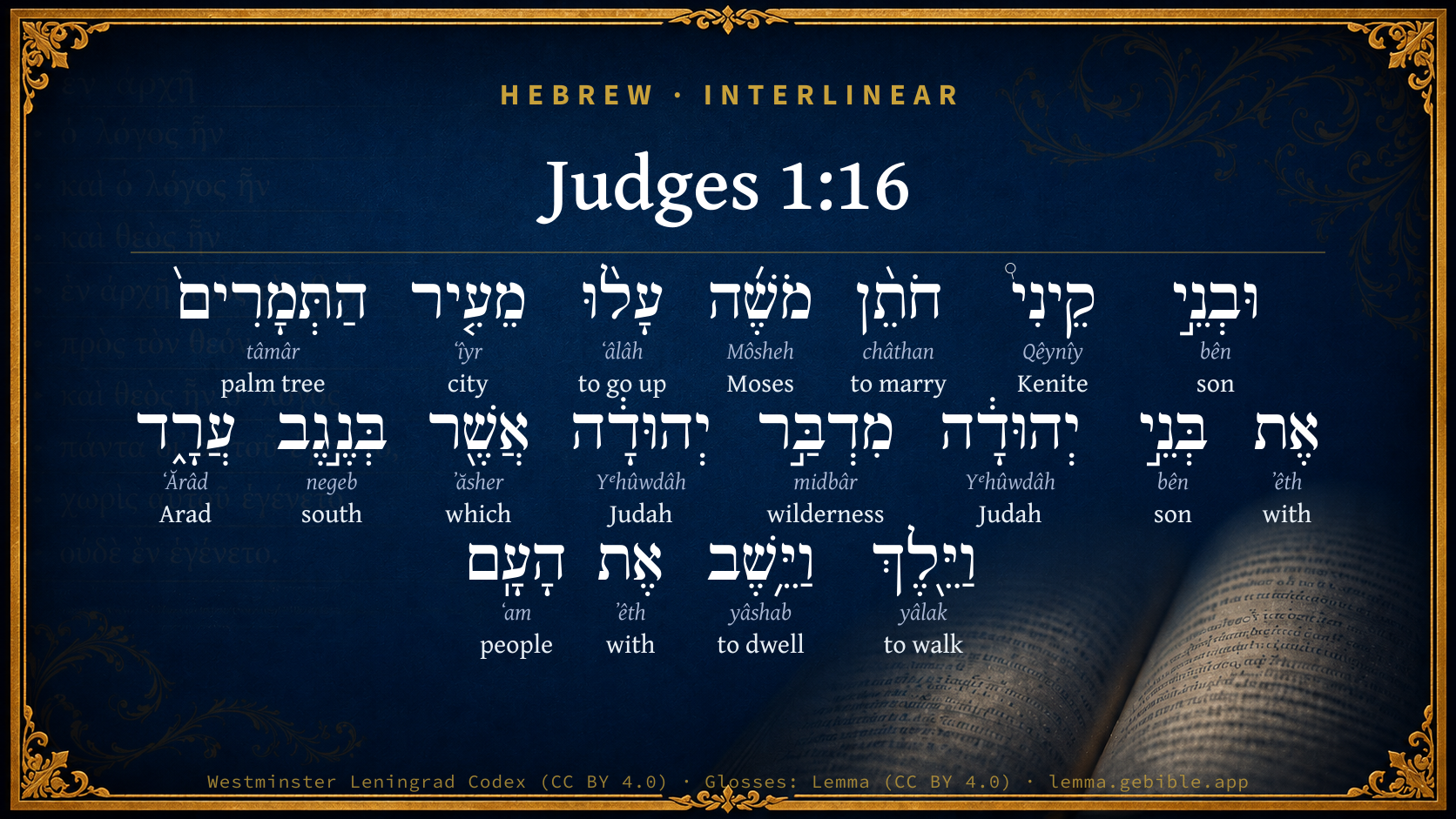
  1. וּבְנֵ֣י bên H1121 “and · sons of” Conjunction + Noun, Common, Masculine, Plural, Construct
  2. קֵינִי֩ Qêynîy H7017 “Kenite” Noun, Gentilic, Masculine, Singular, Absolute
  3. חֹתֵ֨ן châthan H2859 “marrying” Verb, Qal, Participle Active, Masculine, Singular, Construct
  4. מֹשֶׁ֜ה Môsheh H4872 “Moses” Noun, Proper
  5. עָל֨וּ ʻâlâh H5927 “to go up” Verb, Qal, Perfect, 3rd Person, Common, Plural
  6. מֵעִ֤יר ʻîyr H5892 “from · city of” Preposition + Noun, Common, Feminine, Singular, Construct
  7. הַתְּמָרִים֙ tâmâr H8558 “the · palm trees” Particle, Definite Article + Noun, Common, Masculine, Plural, Absolute
  8. אֶת ʼêth H854 “with” Preposition
  9. בְּנֵ֣י bên H1121 “sons of” Noun, Common, Masculine, Plural, Construct
  10. יְהוּדָ֔ה Yᵉhûwdâh H3063 “Judah” Noun, Proper
  11. מִדְבַּ֣ר midbâr H4057 “wilderness of” Noun, Common, Masculine, Singular, Construct
  12. יְהוּדָ֔ה Yᵉhûwdâh H3063 “Judah” Noun, Proper
  13. אֲשֶׁ֖ר ʼăsher H834 “which” Particle, Relative
  14. בְּנֶ֣גֶב negeb H5045 “in/at · south of” Preposition + Noun, Common, Masculine, Singular, Construct
  15. וַיֵּ֖לֶךְ yâlak H3212 “and · to walk” Conjunction + Verb, Qal, Sequential Imperfect, 3rd Person, Masculine, Singular
  16. וַיֵּ֥שֶׁב yâshab H3427 “and · to dwell” Conjunction + Verb, Qal, Sequential Imperfect, 3rd Person, Masculine, Singular
  17. אֶת ʼêth H854 “with” Preposition
  18. הָעָֽם ʻam H5971 “the · people” Particle, Definite Article + Noun, Common, Masculine, Singular, Absolute

About this verse

These counts appear in no published source. They are computed here, from the morphology-tagged text and Lemma’s own curated glosses. What Lemma adds →

19
words
16
distinct lemmas
Historical
section

Notable vocabulary

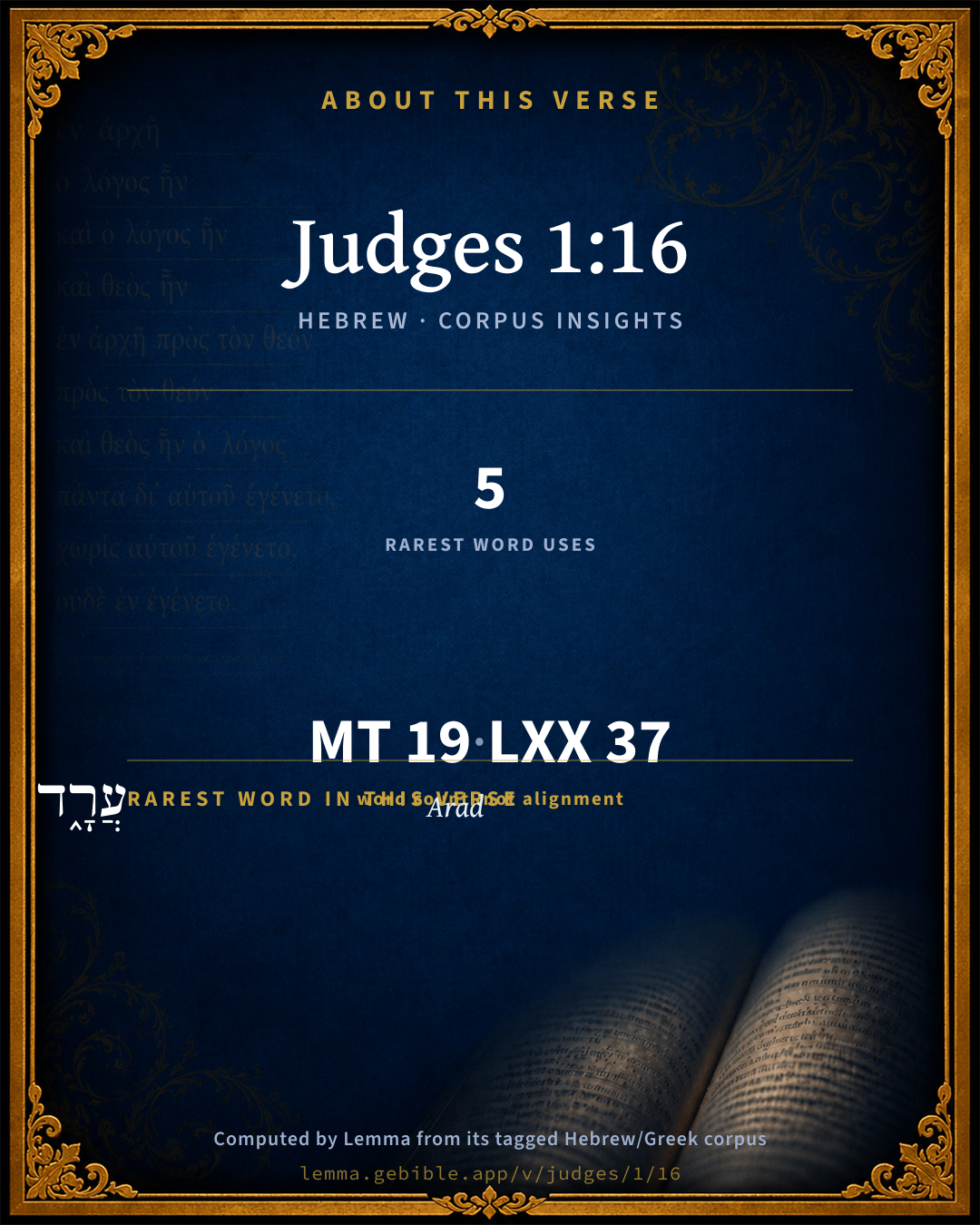
The rarest word here is עֲרָ֑ד Arad H6166 — appearing just 5 times in the whole Hebrew Bible.

Shared distinctive vocabulary

עֲרָ֑ד Arad H6166 occurs in 5 verses of the Hebrew Bible. Also found in:

Grammatical profile

  • 4 verbs
  • 12 nouns
  • 2 prepositions
  • 1 particle

Verb forms

  • חֹתֵ֨ן Qal · Participle Active
  • עָל֨וּ Qal · Perfect
  • וַיֵּ֖לֶךְ Qal · Sequential Imperfect
  • וַיֵּ֥שֶׁב Qal · Sequential Imperfect

Repetition

Words recur within this verse — often emphatic in Hebrew:

  • וּבְנֵ֣י son H1121 ×2
  • יְהוּדָ֔ה Judah H3063 ×2
  • אֶת with H854 ×2

Hebrew & Septuagint length

In English translation the verse runs 41 words from the Hebrew and 46 from the Septuagint (LXX English) — closely comparable.

A rough comparison of the two English renderings, which tokenize alike — not a word-level alignment.

Word counts can differ between the Hebrew and the Greek without any difference in meaning — e.g. the Hebrew direct-object marker אֵת has no separate Greek word, and Greek often adds the article ὁ.

In the original languages it is 19 Hebrew tokens and 37 Greek tokens — but the two are counted differently (Hebrew bundles its prefixes and suffixes into one token; the Greek is in lemma form), so that isn’t a like-for-like length.

Cross-references

19

Topical passages linked to Judges 1:16 in the Treasury of Scripture Knowledge — connected by theme and wording, ordered by reader-vote popularity; previews shown in the World English Bible.

  • Numbers 10:29–32 Moses said to Hobab, the son of Reuel the Midianite, Moses' father-in-law, We are journeying to the place of which Yahweh said, I will give it you: come you with us, and we will do you good; for Yahweh has spoken good concerning Israel.
  • Judges 4:11 Now Heber the Kenite had separated himself from the Kenites, even from the children of Hobab the brother-in-law of Moses, and had pitched his tent as far as the oak in Zaanannim, which is by Kedesh.
  • 1 Samuel 15:6 Saul said to the Kenites, Go, depart, get you down from among the Amalekites, lest I destroy you with them; for you shown kindness to all the children of Israel, when they came up out of Egypt. So the Kenites departed from among the Amalekites.
  • Numbers 21:1 The Canaanite, the king of Arad, who lived in the South, heard tell that Israel came by the way of Atharim; and he fought against Israel, and took some of them captive.
  • Deuteronomy 34:3 and the South, and the Plain of the valley of Jericho the city of palm trees, to Zoar.
  • Judges 3:13 He gathered to him the children of Ammon and Amalek; and he went and struck Israel, and they possessed the city of palm trees.
  • Judges 4:17 However Sisera fled away on his feet to the tent of Jael the wife of Heber the Kenite; for there was peace between Jabin the king of Hazor and the house of Heber the Kenite.
  • Exodus 3:1 Now Moses was keeping the flock of Jethro, his father-in-law, the priest of Midian, and he led the flock to the back of the wilderness, and came to God's mountain, to Horeb.
  • Exodus 4:18 Moses went and returned to Jethro his father-in-law, and said to him, "Please let me go and return to my brothers who are in Egypt, and see whether they are still alive." Jethro said to Moses, "Go in peace."
  • Exodus 18:1 Now Jethro, the priest of Midian, Moses' father-in-law, heard of all that God had done for Moses, and for Israel his people, how that Yahweh had brought Israel out of Egypt.
  • Exodus 18:7 Moses went out to meet his father-in-law, and bowed and kissed him. They asked each other of their welfare, and they came into the tent.
  • Exodus 18:12 Jethro, Moses' father-in-law, took a burnt offering and sacrifices for God. Aaron came with all of the elders of Israel, to eat bread with Moses' father-in-law before God.
  • Exodus 18:14–17 When Moses' father-in-law saw all that he did to the people, he said, "What is this thing that you do for the people? Why do you sit alone, and all the people stand around you from morning to evening?"
  • Exodus 18:27 Moses let his father-in-law depart, and he went his way into his own land.
  • Numbers 24:21–22 He looked at the Kenite, and took up his parable, and said, Strong is your dwelling-place, Your nest is set in the rock.
  • Joshua 12:14 the king of Hormah, one; the king of Arad, one;
  • 1 Chronicles 2:15 Ozem the sixth, David the seventh;
  • 2 Chronicles 28:16 At that time did king Ahaz send to the kings of Assyria to help him.
  • Jeremiah 35:2 Go to the house of the Rechabites, and speak to them, and bring them into the house of Yahweh, into one of the chambers, and give them wine to drink.

Cross-references courtesy of OpenBible.info (CC BY 4.0).

Hebrew and Greek witnesses Masoretic Hebrew ↔ Greek Septuagint

The same verse in the two great witnesses to the Old Testament, shown verse-for-verse.

These are two independent witnesses, not word-aligned to each other, and the Septuagint is shown in lemma (dictionary) form.

Hebrew Judges 1:16 Masoretic · Westminster Leningrad Codex

וּבְנֵ֣י קֵינִי֩ חֹתֵ֨ן מֹשֶׁ֜ה עָל֨וּ מֵעִ֤יר הַתְּמָרִים֙ אֶת בְּנֵ֣י יְהוּדָ֔ה מִדְבַּ֣ר יְהוּדָ֔ה אֲשֶׁ֖ר בְּנֶ֣גֶב עֲרָ֑ד וַיֵּ֖לֶךְ וַיֵּ֥שֶׁב אֶת הָעָֽם

The children of the Kenite, Moses' brother-in-law, went up out of the city of palm trees with the children of Judah into the wilderness of Judah, which is in the south of Arad; and they went and lived with the people.

World English Bible · Public Domain

Greek LXX Judges 1:16 Septuagint · lemma form

καί ὁ υἱός ιοθορ ὁ κιναῖος ὁ γαμβρός μωυσῆς ἀναβαίνω ἐκ πόλις ὁ φοῖνιξ μετά ὁ υἱός ιουδα εἰς ὁ ἔρημος ὁ εἰμί ἐν ὁ νότος ιουδα ὅς εἰμί ἐπί κατάβασις αραδ καί καταοἰκέω μετά ὁ λαός

And the children of Jothor the Kenite the father-in-law of Moses went up from the city of palm-trees with the children of Judas, to the wilderness that is in the south of Juda, which is at the descent of Arad, and they lived with the people.

LXX2012 (modern English Septuagint) · Public Domain

On this verse, The Cambridge Bible for Schools and Colleges discusses the Septuagint’s reading. Read the note in Commentary ↓

Hebrew: Westminster Leningrad Codex (CC BY 4.0). Greek: Septuagint (public domain); English from LXX2012 (modern English Septuagint) (Public Domain). How the Septuagint differs from the Hebrew →

Targum (Aramaic paraphrase)

1

The Targum is the ancient Jewish Aramaic paraphrase of the Hebrew Scriptures — an interpretive translation, not the Hebrew text itself. Onkelos (literal) and Pseudo-Jonathan (expansive) render the Torah, and Jonathan the Prophets. Coverage is partial: where no permissively-licensed English translation exists for a verse, only the Aramaic is shown. This is verse-level text, not a word-by-word alignment to the Hebrew.

  1. Targum Jonathan Prophets (Joshua–Malachi)
    וּבְנֵי שַׁלְמָאָה חָמוּהִי דְמֹשֶׁה סְלִיקוּ מִן קַרְתָּא יְרִיחוֹ עִם בְּנֵי יְהוּדָה מִדְבַּר יְהוּדָה דִי בְּדָרוֹם עֲרָד וַאֲזַלוּ וִיתַבוּ עִם עַמָא:

    (no public-domain English translation for this verse)

    Targum Jonathan — Aramaic: “Mikraot Gedolot” (public domain). English: “Sefaria Community Translation” (CC0 1.0 (public-domain dedication)); “London "Chaldee Paraphrase," 1871” (public domain). Text via Sefaria.

Commentary

Notes on Judges 1:16 from classic Christian and Jewish commentators (each source and its license shown beneath its notes). The classic Christian expositions comment on the surrounding passage and are grouped to its opening verse, so a note may address several verses; the Jewish commentaries on the Tanakh (Rashi and others) are per-verse, so they appear only where the commentator wrote on this verse.

Lemma curates 59 commentaries, every one of them public domain or Creative Commons licensed, each selected and text-cleaned for this edition rather than reprinted as found. About our sources →

Trapp's Complete Commentary

John Trapp

Jdg 1:16 And the children of the Kenite, Moses’ father in law, went up out of the city of palm trees with the children of Judah into the wilderness of Judah, which [lieth] in the south of Arad; and they went and dwelt among the people.

Ver. 16. And the children of the Kenite.] Elsewhere called Jethro, Hobab, Revel: his posterity followed the Israelites for religion’s sake, into the promised land, leaving their own country -

“ Omne sohm forti patria est. ” - Ovid., Fast.

These Kenites dwelt in tents, and had no settled habitation, as a kind of Nomads or Cosmopolites. They held the same of the world that a certain philosopher did of Athens - viz., that it was a pleasant place to travel through, but not safe to dwell in.

16 These are murmurers, complainers, walking after their own lusts; and their mouth speaketh great swelling words, having men’s persons in admiration because of advantage.

Ver. 16. These are murmurers] Ut porci saginati, saith Aretius, as boars in a frank, they grunt against God’s ways and worshippers, like so many Caii Grunnii Corocottae.

Complainers] Invalidum omne natura querulum, saith Seneca. Weak ones are never without their ailments.

After their own lusts] So many lusts, so many lords.

Great swelling words] Bubbles of words. See the note on 2Pe 2:18. The Syriac renders it, stupendous stuff. They amaze their hearers with sesquipedalian {a} words, and sublime businesses, big swollen fancies, &c.; they tell them they shall hear that which they never heard before, and therefore call upon them to mark; whereas the thing is either false, or if true, no more than ordinarily is taught by others: with as much confidence as ignorance they counsel the simple by portentous words and phrases abhorrent from Christian religion, truth, and sobriety; and which wise men lament while fools applaud and admire.

Having men’s persons] Licking up their spittle, as it were, and loading the mouse with the elephant’s praises. Ungunt pariter et emungunt.

{a} Of words and expressions (after Horace’s sesquipedalia verba ‘words a foot and a half long’, A.P. 97): Of many syllables. Ten dollar words! ŒD

John Trapp, A Commentary or Exposition upon All the Books of the Old and New Testament (1647–1656) — public domain. Text from a community e-Sword module.

Joseph Benson's Commentary

Jdg 1:16. The children of the Kenite — Jethro, Moses’s father-in-law, seems to have been called a Kenite from the people from whom he was descended, Num 24:21-22. His posterity, it appears, came into Canaan with the Israelites, and were settled there with them. Went up from the city of palm-trees — That is, from Jericho, so called, Deu 34:3; not indeed the city, which had been destroyed; but the territory belonging to it, where, it seems, they were seated in a most pleasant, fruitful, and safe place, according to the promise made by Moses to their father, Num 10:31-32; and whence they might remove either to avoid the neighbouring Canaanites, or out of love to the children of Judah. In the south of Arad — The southern part of the land of Canaan, where Arad was, Num 21:1. And dwelt among the people — Hebrew, that people; namely, those children of Judah that lived there.

Joseph Benson's Commentary on the Old and New Testaments (1811–1818) — public domain. Text from a community e-Sword module.

Whedon's Commentary on the Bible

Daniel D. Whedon

THE KENITES, Jdg_1:16.

16. Children of the Kenite — These were a nomadic tribe camping in Midian in the days of Moses’ flight from Egypt. They were of Amalekite, or primitive Arabian, stock, and by virtue of their relation by marriage to Moses, this tribe became an ally, or a protege of the Hebrews, dwelling first in the vicinity of Jericho, the city of palm trees, and subsequently following the victorious arms of their protectors to the extreme south of Judah’s lot, to the edge of the Idumean desert. Here they dwelt undisturbed, taking no part in the wars of those days, and indifferent to political changes, until Saul warned them to separate from the Amalekites, whom God had directed him to destroy. 1Sa_15:6. The Rechabites, a tribe of staunch temperance men, descended from them. 1Ch_2:55.

Arad — A Canaanite royal city in southern Palestine, twenty miles south of Hebron. Dr. Robinson identities it with Tell-Arad, a barren eminence rising above the surrounding country. The inhabitants of this city drove back the Israelites when they tried to enter Canaan from Kadesh-barnea. Num_21:1. They were subdued by Joshua forty years afterwards. Jos_12:14.

Dwelt among the people — That is, the people of the tribe of Judah; though Heber, the Kenite, was found in Naphtali, Jdg_4:17, having chosen to separate from his brethren and settle in the north of Palestine. It was proper that those who had befriended the Israelites in their weakness, when wandering through hostile lands, should enjoy their protection in the days of their triumph. “The sons of the Kenite adhered to Israel, not as Kenites, but as descendants of Jethro, the father-in-law of Moses. It is the constant aim of the historian of the conquest of Canaan by Israel to show that every promise was fulfilled, and that no one who at any time showed kindness failed of his promised reward. A reward had been promised to the sons of the Kenite, (Num_10:31,) and the fulfilment of the promise now takes place.” — Cassel.

Daniel D. Whedon (gen. ed.), Commentary on the Old and New Testaments (1874–1909) — public domain. Text from a community e-Sword module.

Lange's Commentary on the Holy Scriptures

The Kenites take up their abode in the territories of Judah

Jdg_1:16

16And the children [sons] of the Kenite, Moses’ father-in-law, went up out of [from] the city of palm-trees with the children [sons] of Judah into the wilderness of Judah, which lieth in the south of Arad; and they [he43] went and dwelt among44 the people.

TEXTUAL AND GRAMMATICAL

[1 Jdg_1:16.—He, i. e., the Kenite. The subject of וַיֵּלֶךְ is קֵינִי, the Kenite, collective term for the tribe.—Tr.]

[2 Jdg_1:16.—אֶת, with, near, the people, but still in settlements of their own, cf. Jdg_1:21. Dr. Cassel’s unter answers to the English among.—Tr.]

EXEGETICAL AND DOCTRINAL

Jdg_1:16. And the sons of the Kenite, Moses’ father-in-law. Kenite is the name of a heathen tribe, which in Gen_15:19 is enumerated among the nations hostile to Israel. In the vision of Balaam it is mentioned in connection with Amalek (Num_24:21). It is there said of the tribe, “In the rock hast thou put thy nest” (קִנֶּךָ, from קֵן, “nest”). “Strong,” indeed, “is their dwelling-place.” The Kenites were a tribe of the wilderness, troglodytes, who dwelt in the grottoes which abound everywhere in Palestine, but especially in its southern parts. Barth, in 1847, saw caves at the lower Jordan, “high up in the steep face of the precipitous rock, on the left, inhabited by human beings and goats, though it is impossible to see how they get there” (Ritter, xv. 465). At the Dead Sea, Lynch discovered grottoes in the rocks, the entrance to which, in spite of all proficiency in climbing, could not be found. The name of the tribe, Kenites, is doubtless derived from קֵן, which means an elevated hiding-place in the rocks, as well as a nest. The term troglodytes, likewise, comes from τρώγλη, “grotto,” and is applied to both birds and human beings. As Jeremiah (Jer_49:16) exclaims, “though thou shouldest make thy nest as high as the eagle,” so Æschylus (Choëphoroe, 249) calls the nest of the eagle’s brood, σκήνημα, “dwelling-place.”

It is from this passage, and from Jdg_4:11, that we first learn that Jethro, the father-in-law of Moses,45 belonged to one of the Kenite families. Moses, when a fugitive in the desert, found an asylum and a wife in the retirement of Jethro’s household. From that time, this family, without losing its independent and separate existence, was closely allied with all Israel. But it was only this family, and not the whole Kenite nation, that entered into this alliance. Else, how could the Kenite be named among enemies in the prophetic announcements of Genesis 15, and with Amalek in the vision of Balaam? Moreover, the text clearly intimates that the sons of the Kenite adhered to Israel, not as Kenites, but as descendants of Jethro, the father-in-law of Moses.46 It is the constant aim of the historian of the conquest of Canaan by Israel, to show that every promise was fulfilled, and that no one who at any time showed kindness failed of his promised reward. Caleb’s constancy and courage found their long-promised inheritance in Hebron. A recompense had also been promised to the sons of the Kenite. When Israel was on its journey through the desert (Num_10:31), and Hobab (on the name, see below, on Jdg_4:11) desired to return to his old place of abode, Moses said: “Leave us not; thou knowest our places of encampment in the desert, and hast been to us instead of eyes. If thou go with us, every good thing with which God blesses us, we will share with thee.” The fulfillment of this promise now takes place. The Kenites enter with the tribe of Judah into the inheritance of the latter, as into a domain in which they had always been at home. They share in the blessing bestowed by God on Israel.

They went up from the City of Palms. No other place than the plain of Jericho is ever called the City of Palms in the Scriptures. Although the city was destroyed, the palm-groves still existed. How was it possible to suppose,47 in the face of Deu_34:3 and Jdg_3:13, that here suddenly, without any preparatory notice, another City of Palms is referred to! The statement here made, so far from occasioning difficulties, only testifies to the exactness of the narrator. Judah’s camp was in Gilgal, whence they marched through Bezek against the enemy, and then to Hebron. Gilgal lay in the vicinity of Jericho. When the tribe decamped, the Kenite was unwilling to remain behind. On the march through the desert, their position as guides had of course always been in the van, and, therefore, with the tribe of Judah. They desire to enjoy their reward also in connection with this tribe, and hence the palms of overthrown Jericho cannot detain them. The region in which they were, can therefore be no other place of palms than that from which Judah broke up, namely, Jericho. In fact, the statement that they came from Jericho, proves the correctness of the view given above, that Gilgal was the place from which Judah set out to enter his territory.

Into the wilderness of Judah, which lieth in the south of Arad. But why is the narrative of the Kenite expedition here introduced? It is a peculiarity of Hebrew narrators, that they weave in episodes like this and that of Othniel and Achsah, whenever the progress of the history, coming into contact with the place or person with which they are associated, offers an occasion. Hence we already find events communicated in the 15th chapter of Joshua, which occurred at a later date, but of which the author was reminded while speaking of the division of the land. The history of the conquest of their territory by Judah is very brief. First, the mountain district of Hebron and the northeastern part of the territory was taken possession of. Then, according to the plan laid down Jdg_1:9, they turned to the south. Of this part of their undertaking no details are given; but as they were getting possession of the land in this direction, they came to Arad, where it pleased the Kenites to take up their abode, in close relations with Judah. A king formerly reigned at Arad, who attacked Israel when journeying in the desert (Num_21:1), and was defeated by Moses. A king of Arad was also conquered by Joshua (Jos_12:14). After its occupancy by the tribe of Judah, the Kenites resided there. The position48 of the place has been accurately determined by Robinson (Bib. Res. ii. 101, cf. Ritter, xiv. 121). Eusebius and Jerome had placed it twenty Roman miles, a camel’s journey of about eight hours, from Hebron. This accords well with the position of the present Tell ’Arâd, “a barren-looking eminence rising above the country around.” From this fragmentary notice of the place, we may perhaps infer what it was that specially attracted the Kenites. If these tribes were attached to the Troglodyte mode of life, the Arabs still told Robinson, of a “cavern” found there. The Kenites still held this region in the time of David; for from the vicinage of the places named in 1Sa_30:29 ff., especially Hormah, it appears that they are those to whom as friends he makes presents.49 It is true, that when the terrible war between Saul and Amalek raged in this region, Saul, lest he should strike friend with foe, caused them to remove (1Sa_15:6). After the victory, they must have returned again.

Footnotes:

[43][Jdg_1:16.—He, i. e., the Kenite. The subject of וַיֵּלֶךְ is קֵינִי, the Kenite, collective term for the tribe.—Tr.]

[44][Jdg_1:16.—אֶת, with, near, the people, but still in settlements of their own, cf. Jdg_1:21. Dr. Cassel’s unter answers to the English among.—Tr.]

[45]Earlier scholars (Le Clerc, Lightfoot, Opera, ii. 581) were already struck by the Targum’s constant substitution of שַׂלְמָאָה, Salmaah for Kenite. In this passage also it reads, “the sons of Salmaah.” Even Jewish authors were it a loss how to explain this. As it affords a specimen of the traditional exegesis of the Jews, already current in the Targum on this passage, I will here set down the explanation of this substitution: The Kenite of our passage is identified with the Kinim of 1Ch_2:55, who are there described as “the families of the Sopherim.” But how came the Kenites to hold this office, in after times so highly honored, and filled by men learned in the law (cf. Sanhedrin, p. 104 a and 106 a)? The father-in-law of Moses—(tradition makes him flee from the council of Pharaoh of which he was a member, Sota, 11 a)—is the Kenite who, when the latter wandered in the desert (Exo_2:20-21), gave him bread (lechem) and also, through his daughter, a house (beth). Now, the same chapter of 1Ch_1:51; 1Ch_1:54, names a certain Salma, and styles him the “father of Beth-lechem.” The father of this “Bread-house” is then identified with Jethro. Consequently, the sons of the Kenite are the sons of Salmaah, and thus their name itself indicates how they attained to the dignity accorded them. The Targum on Chronicles (ed. Wilna, 1836, p. 3, A) expresses it thus: “They were the sons of Zippora, who (in their capacity of Sopherim) enjoyed, together with the families of the Levites, the glory of having descended from Moses, the teacher of Israel.”

[46]This view does away with all those questions of which, after earlier expositors, Bertheau treats on pp. 24, 25.

[47]Into this error, Le Clerc has misled later expositors, and among them, Bertheau, p. 25. However, the wholly irrelevant passage of Diodorus (iii. 42), frequently cited to justify the assumption of another City of Palms, was already abandoned by Rosenmüller, p. 24.

[48]Ishak Chelo, the author of Les chemins de Jérusalem, in the 14th century, found Arad sparsely inhabited, by poor Arabs and Jews, who lived of their flocks. The Rabbi tends his sheep, and at the same time gives instruction to his pupils. Cf. Carmoly, Itinéraires de la Terre Sainte (Bruxelles, 1847), pp. 244, 245.

[49]Cf. 1Sa_27:10, where the same local position is assigned to the Kenites, and spoken of by David as the scene of his incursions, in order to make the suspicious Philistines believe that he injures the friends of Israel

Lange's Commentary on the Holy Scriptures (Critical, Doctrinal, and Homiletical), ed. John Peter Lange, English translation edited by Philip Schaff (1864–1880) — public domain. Text from a community e-Sword module.

Geneva Bible (1599)

Geneva Bible translators

This was one of the names of Moses’ father-in-law, read Num. 10:29.

Geneva Bible (1599) marginal notes — public domain. Text via Bolls.life.

Jamieson, Fausset & Brown

Robert Jamieson, A. R. Fausset & David Brown

the children of the Kenite, Moses' father-in-law, went up out of the city of palm trees with the children of Judah--called "the Kenite," as probably descended from the people of that name (Num 24:21-22). If he might not himself, his posterity did accept the invitation of Moses (Num 10:32) to accompany the Israelites to Canaan. Their first encampment was in the "city of palm trees"--not Jericho, of course, which was utterly destroyed, but the surrounding district, perhaps En-gedi, in early times called Hazezon-tamar (Gen 14:7), from the palm-grove which sheltered it. Thence they removed for some unknown cause, and associating themselves with Judah, joined in an expedition against Arad, in the southern part of Canaan (Num 21:1). On the conquest of that district, some of this pastoral people pitched their tents there, while others migrated to the north (Jdg 4:17).

Jamieson, Fausset & Brown — Commentary Critical and Explanatory on the Whole Bible (1871) — public domain (CC PDM 1.0). Text via the HelloAO Bible API.

Adam Clarke's Commentary

Verse 16. The children of the Kenite, Moses' father-in-law] For an account of Jethro, the father-in-law of Moses, see Ex 18:1-27; Nu 10:29, c.

The city of palm trees] This seems to have been some place near Jericho, which city is expressly called the city of palm trees, De 34:3 and though destroyed by Joshua, it might have some suburbs remaining where these harmless people had taken up their residence.

The Kenites, the descendants of Jethro, the father-in-law of Moses, were always attached to the Israelites: they remained with them, says Calmet, during their wanderings in the wilderness, and accompanied them to the promised land. They received there a lot with the tribe of Judah, and remained in the city of palm trees during the life of Joshua; but after his death, not contented with their portion, or molested by the original inhabitants, they united with the tribe of Judah, and went with them to attack Arad. After the conquest of that country, the Kenites established themselves there, and remained in it till the days of Saul, mingled with the Amalekites. When this king received a commandment from God to destroy the Amalekites, he sent a message to the Kenites to depart from among them, as God would not destroy them with the Amalekites. From them came Hemath, who was the father of the house of Rechab, 1Ch 2:55, and the Rechabites, of whom we have a remarkable account Jer 35:1, &c.

Adam Clarke's Commentary on the Bible (1810–1826) — public domain. Text from a community e-Sword/MySword module.

Ellicott's Commentary for English Readers

(16) The children of the Kenite, Moses’ father in law.—It is difficult to disentangle the names Jethro, Reuel, or Raguel, and Hobab (Jdg_4:11); but in my article on Jethro in Kitto’s Bible Cyclopœdia I have shown that Jethro and Reuel are identical, the latter name (“friend of God”) being his local title as a priest of Midian; and that he was the father of Zipporah and Hobab. When Jethro refused to stay with the Israelites (Exo_18:27), Hobab consented to accompany them as their hybeer or caravan-guide. He is well known in the Mohammedan legends as Schocib, but is confounded with Jethro.

The Kenites were the elder branch of the tribe of Midianites. They lived in the rocky district on the shores of the gulf of Akabah (Num_21:1; Num_24:21; 1Sa_15:6). They seem to have been named from a chieftain Kain (Gen_15:19; Num_24:22; Heb., where there is a play on Kenite and Kinneka, “thy rest”). They were originally a race of troglodytes or cave-dwellers. The Targum constantly reads Salmaa for Kenite, because the Kenites were identified with the Kinim of 1Ch_2:55. Jethro, they say. was a Kenite, who gave to Moses a house (Beth) and bread (lehem) (Exo_2:20-21). They identify Jethro with Salmaa, because in 1Ch_2:5 Salma is the father of Bethlehem. They also identify Rechab, the ancestor of the Rechabites—who were a branch of the Kenites—with Rechabiah, the son of Moses.

Went up.—Probably, in the first instance, in a warlike expedition.

The city of palm trees.—Probably Jericho (see Jdg_3:13; Deu_34:3; 2Ch_28:15). When Jericho was destroyed and laid under a curse, it would be quite in accordance with the Jewish feeling, which attached such “fatal force and fascination” to words, to avoid even the mention of the name. The Kenites would naturally attach less importance to the curse, or at any rate would not consider that they were braving it when they pitched their nomad tents among those beautiful groves of palms and balsams, which once made the soil “a divine country” (Jos. B. J. i. 6. §6; iv. 8, § 3; Antt. v. 1, § 22), though they have now entirely disappeared. Rabbinic tradition says that Jericho was assigned to Hobab. From the omission of the name Jericho, some have needlessly supposed that the reference is to Phaenico (a name which means “palm-grove”), an Arabian town mentioned by Diod Sic. iii. 41 (Le Clerc, Bertheau, Ewald); but there is no difficulty about the Kenites leaving Jericho when Judah left it.

The wilderness of Judah.—The Midbar—not a waste desert, but a plain with pasture—was a name applied to the lower Jordan valley and the southern hills of Judea (Gen_21:14; Mat_3:1; Mat_4:1; Luk_15:4). The Kenites, like all Bedouins, hated the life of cities, and never lived in them except under absolute necessity (Jer_35:6-7).

In the south of Arad.—Our E.V. has, in Num_21:1, King Arad; but more correctly, in Jos_15:14, “the king of Arad.” It was a city twenty miles from Hebron, on the road to Petra, and the site is still called Tell-Arad (Wilton, Negeb, p. 198). They may have been attracted by the caves in the neighbourhood, and, although they left it at the bidding of Saul (1Sa_15:6), they seem to have returned to it in the days of David (1Sa_30:29).

Among the people.—It seems most natural to interpret this of the Israelites of the tribe of Judah; hut it may mean “the people to which he belonged,” i.e., the Amalekites (Num_21:21), and this accords with 1Sa_15:21. For the only subsequent notices of this interesting people, see Jdg_4:11; 1Sa_15:6; 1Ch_2:55; Jeremiah 35. They formed a useful frontier-guard to the Holy Land.

A Bible Commentary for English Readers, edited by Charles John Ellicott (1878–1897) — public domain. Text from a community e-Sword module.

The Cambridge Bible for Schools and Colleges

gen. ed. J. J. S. Perowne

16. The text of this verse has been badly preserved, and some details of the restoration must remain doubtful.

the children of the Kenite, Moses’ brother in law] Marg. father in law, as O.T. usage requires. A proper name and the article (inserted by RV.) have fallen out before Kenite; LXX. cod. B restores Jethro, cod. A Hobab. The traditions differ as to the name of Moses’ father in law; in J it is Hobab, Num_10:29, cf. ch. Jdg_4:11; in E it is Jethro, Exo_3:1; Exo_4:18; Exo_18:1. As this chapter is related to J, the former is preferable: the children of Hobab the Kenite. The traditions differ again as to the tribe to which Moses’ father in law belonged; here and in Jdg_4:11 he is called a Kenite (see the note below), but in Exo_2:15 ff; Exo_3:1; Exo_18:1, Num_10:29 he is a Midianite. Common to both traditions is Moses’ connexion by marriage with an Arab tribe. The verb went up in clause a is plur.; in clause b went and dwelt are sing., and may be corrected to the plur. (with RV., LXX. B they dwelt). But the sing, verbs in clause b perhaps imply that the text originally ran And Hobab the Kenite … went up (sing.) … and went and dwelt, omitting the children of.

the city of palm trees] i.e. Jericho, cf. Jdg_3:13 n. and Deu_34:3, 2Ch_28:15. The order in which the stages of the invasion are mentioned, Jerusalem, Hebron, Debir, Arad, Zephath, seems to indicate a movement starting from the E. and advancing towards the S.; hence Jericho, in the neighbourhood of Gilgal (Jdg_2:1), may well have been the point of departure. On the theory that Judah came up from Kadesh in the southern desert, a ‘city of palm trees’ has been looked for in the S., and Tamar, i.e. ‘palm tree’ (Eze_47:19; Eze_48:28), in S.E. Palestine, is suggested as the place (Steuernagel, l.c. 75 ff.). The possibility that the Calebites and other clans which in time coalesced under the name of Judah, entered the land from the South has been noticed above, in Jdg_1:10.

the wilderness of Judah, which is in the south of Arad] in the Negeb of Arad. The wilderness, of Judah (Psalms 63 title, St Mat_3:1, cf. Jos_15:61) was the barren, rugged tract which descends from the Central Highlands eastwards to the Dead Sea. It is possible that the term may have included Arad = Tell ‘Arâd, 17 m. S.E. of Hebron (cf. on Jdg_1:9); yet the description of the ‘wilderness of Judah’ (properly in the E.) as within the Negeb (in the S.) is surprising. The text is certainly incorrect. The LXX. cod. A reads ‘into the desert of Judah, which is in the south, at the descent of Arad’; cod. B ‘into the desert which is in the south of Judah, which is at the descent of Arad.’ Both recensions of the LXX give the descent of Arad (cf. Jos_7:5; Jos_10:11 ‘the going down’) instead of the Negeb of Arad; in the neighbourhood of Tell ‘Arâd the Judaean hills descend to the Wadi Seyyal on the E. and the Wadi el-Milḥ on the W., and thence to the plains. Following the LXX. cod. B we might restore ‘into the desert which is in the Negeb of Judah in the descent of Arad,’ which would give excellent sense; but we cannot feel sure that the LXX represents the original text. Other emendations are: ‘the wilderness of Judah which is in the descent of Arad’ (Budde); ‘into the wilderness of Arad’ (Moore, omitting the rest as partly gloss and partly correction of the Hebr.); ‘the Kenites went up from the city of palm-trees which is in the Negeb with the children of Judah into the wilderness of Arad’ (Steuernagel). None of these is quite convincing.

with the people] gives no sense; read with the Amalekite, following a group of cursive MSS. of the LXX which have ‘with the people Amalek’; this agrees with 1Sa_15:6, Num_24:20-22. ‘While the main Judaean stock settled on the arable land and in cities, and intermarried with the Canaanites, the Kenites, true to their nomadic origin, turned into the wilderness of Judah, and dwelt with the Amalekites’ (G. A. Smith, Hist. Geogr., p. 277 f.). The Kenites, who were related to the Kenizzites (Gen_15:19; Gen_36:11; Gen_36:15), seem to have been a branch of the Amalekites (Num. l. c.); they continued to dwell near Judah in the Negeb 1Sa_27:10, on friendly terms ib. 1Sa_30:29. In Jdg_4:11 we find a family of them settled in the N., in the territory of Naphtali.

The Cambridge Bible for Schools and Colleges (gen. ed. J. J. S. Perowne; Cambridge University Press, 1878–1918) — public domain. Text from a community e-Sword module.

Albert Barnes' Notes on the Bible

The children of the Kenite - See Num 24:21 note.

The city of palm trees - Jericho (see the marginal reference). The rabbinical story is that Jericho, with 500 cubits square of land, was given to Hobab. The use of the phrase “city of palm trees” for “Jericho,” is perhaps an indication of the influence of Joshua’s curse Jos 6:26. Tbe very name of Jericho was blotted out. There are no palm trees at Jericho now, but Josephus mentions them repeatedly, as well as the balsam trees.

Albert Barnes' Notes on the Bible (1834–1885) — public domain. Text from a community e-Sword/MySword module.

Haydock's Catholic Bible Commentary

The Cinite. Jethro, the father-in-law of Moses, was called Cinæus, or the Cinite: and his children, who came along with the children of Israel, settled themselves among them in the land of Chanaan, embracing their worship and religion. From these the Rechabites sprang, of whom see Jeremias xxxv. ---The city of palms. Jericho, so called from the abundance of palm-trees, (Challoner) or rather Engaddi, which is sometimes called Hazazon-Thamar, on that account. It lies nearer to the Dead Sea. Jericho was not rebuilt till the reign of Achab. See Josue vi. 26. --- Arad was one of the most southern towns of Juda, near the country of the Amalecites. Saul ordered the descendants of Jethro to depart from among them, 1 Kings xv. 6. The Israelites had defeated the king of Arad long before, Nubmers xxi. 1. (Calmet) --- With him. Hebrew, "the people" of Israel, (Menochius) or of Arad. (Calmet)

George Leo Haydock (1774–1849), Haydock's Catholic Family Bible and Commentary, 1859 edition — public domain. Excludes Psalms (Douay-Rheims chapter numbering differs from Protestant) and Deuterocanonical books (Catholic canon only).

Matthew Poole's English Annotations

Children of the Kenite, i.e. of Jethro, so called from the people from whom he descended, Num 24:21,22. And whatsoever he did, it is evident that his posterity came into Canaan with the Israelites, and were there seated with them. See Jdg 4:11,17; 5:24; 1Sa 15:6; 1Ch 2:55.

Out of the city of palm trees, i.e. from Jericho, so called Deu 34:3; not the city, which was utterly destroyed; but the territory belonging to it, where it seems they were seated as in a most pleasant, and fruitful, and safe place, according to the promise made by Moses to their father, Num 10:31,32, and whence they might remove, either to avoid the society or molestation of the neighbouring Canaanites; or out of love to the children of Judah, whom they went to; or to avoid temptations to luxury, and exercise themselves in self-denial and contempt of the present evil world, and the lusts thereof; as may be thought from Jer 35:6, &c.; or for some other cause unknown to us at this distance.

In the south of Arad; in the southern part of the land of Canaan, where Arad was, Num 21:1.

They went, i.e. some of them, for others of them dwelt in the contrary quarter, in the most northern part of the land.

Among the people, Heb. that people, to wit, those children of Judah that lived there.

Matthew Poole's English Annotations on the Holy Bible (1683–1685) — public domain. Text from a community e-Sword/MySword module.

The Pulpit Commentary

The children of the Kenite, etc. It appears from this verse that the invitation given by Moses to his "father-in-law," or rather "brother-in-law," Hobab, to accompany him and the Israelites to the land of promise, though at first rejected, (Num_10:29, Num_10:30) was eventually accepted. Hobab and his tribe, a branch of the Midianites, called Kenites, from an unknown ancestor, Kain, at first settled in the city of palm trees, i.e. Jericho; (Deu_34:3) but it seems that when Judah started on his expedition with Simeon to conquer the south laud, the Kenites went with him. A subsequent migration of a portion of this nomadic tribe is mentioned. (Jud_1:4:11) Dwelt among the people, i.e. the people of Judah. For Arad see Num_21:1.

The Pulpit Commentary (1880–1919), ed. H.D.M. Spence-Jones & Joseph S. Exell — public domain. Text from a community e-Sword module.

John Wesley's Explanatory Notes

Moses's father-in-law - That is, of Jethro, so called from the people whom he descended, Num. xxiv, 21, 22. And, whatsoever he did, it is evident, that his posterity came into Canaan with the Israelites, and were there seated with them, see chap. iv, 11, 17; v, 24; 1 Sam. xv, 6; 1 Chron. ii, 1-54, 55. City of palm-trees - That is, from Jericho, so called, Deut. xxxiv, 3, not the city which was destroyed, but the territory belonging to it, where it seems they were seated, in a most pleasant, and fruitful, and safe place, according to the promise made by Moses to their father, Num. x, 29-32, and whence they might remove, either to avoid the neighbouring Canaanites; or out of love to the children of Judah. South of Arad - In the southern part of the land of Canaan, where Arad was, Num. xxi, 1. They went - That is some of them, for others of them dwelt in a contrary quarter, in the most northern part of the land. Among the people - Hebrew. that people, namely, those children of Judah that lived there.

John Wesley, Explanatory Notes Upon the Whole Bible (1754–1765) — public domain. Text via the GEBible commentary corpus.

Keil & Delitzsch

C. F. Keil & F. Delitzsch

The notice respecting the Kenites, that they went up out of the palm-city with the children of Judah into the wilderness of Judah in the south of Arad, and dwelt there with the Judaeans, is introduced here into the account of the wars of the tribe of Judah, because this migration of the Kenites belonged to the time between the conquest of Debir (Jdg 1:12.) and Zephath (Jdg 1:17); and the notice itself was of importance, as forming the intermediate link between Num 10:29., and the later allusions to the Kenites in Jdg 4:11; Jdg 5:24; Sa1 15:6; Sa1 27:10; Sa1 30:29. "The children of the Kenite," i.e., the descendants of Hobab, the brother-in-law of Moses (compare Jdg 4:11, where the name is given, but קין occurs instead of קיני, with Num 10:29), were probably a branch of the Kenites mentioned in Gen 15:19 along with the other tribes of Canaan, which had separated from the other members of its own tribe before the time of Moses and removed to the land of Midian, where Moses met with a hospitable reception from their chief Reguel on his flight from Egypt. These Kenites had accompanied the Israelites to Canaan at the request of Moses (Num 10:29.); and when the Israelites advanced into Canaan itself, they had probably remained as nomads in the neighbourhood of the Jordan near to Jericho, without taking any part in the wars of Joshua. But when the tribe of Judah had exterminated the Canaanites out of Hebron, Debir, and the neighbourhood, after the death of Joshua, they went into the desert of Judah with the Judaeans as they moved farther towards the south; and going to the south-western edge of this desert, to the district on the south of Arad (Tell Arad, see at Num 21:1), they settled there on the border of the steppes of the Negeb (Num 33:40). "The palm-city" was a name given to the city of Jericho, according to Jdg 3:13; Deu 34:3; Ch2 28:15. There is no ground whatever for thinking of some other town of this name in the desert of Arabia, near the palm-forest, φοινικών, of Diod. Sic. (iii. 42) and Strabo (p. 776), as Clericus and Bertheau suppose, even if it could be proved that there was any such town in the neighbourhood. ויּלך, "then he went (the branch of the Kenites just referred to) and dwelt with the people" (of the children of Judah), that is to say, with the people of Israel in the desert of Judah. The subject to ויּלך is קיני, the Kenite, as a tribe.

Keil & Delitzsch — Biblical Commentary on the Old Testament (1861–1891) — public domain (CC PDM 1.0). Text via the HelloAO Bible API. (Old Testament only.)

unfoldingWord translationNotes

Door43 World Missions Community

of Moses' father-in-law

"of the father of Moses' wife"

father-in-law the Kenite went up

"father-in-law, who was one of the Ken people, went up"

went up from the City of Palms ... into the wilderness

"left the City of Palms ... and went into the wilderness"

City of Palms

This is another name for the city of Jericho. (See: Assumed Knowledge and Implicit Information)

Arad

This is the name of a city in Canaan. (See: How to Translate Names)

the men of Simeon their brothers

Here "brothers" means relatives who were in another tribe of Israel.

Zephath

This is the name of a city in Canaan. (See: How to Translate Names)

The name of the city was called Hormah

After the Israelites destroyed Zephath, they changed its name to "Hormah." The name "Hormah" means "complete destruction." (See: Assumed Knowledge and Implicit Information and How to Translate Names)

translationWords

descend

Moses

palm

people group

kingdom of Judah

desert

Negev

Simeon

brother

Canaan

unfoldingWord translationNotes — © Distant Shores Media and the Door43 World Missions Community, licensed CC BY-SA 4.0. Source: git.door43.org/Door43/en_tn.

Rashi

Rabbi Shlomo Yitzchaki (Rashi)

From the city of dates. This refers to Yericho, as the fertile tract of Yericho by five hundred amohs. (Yalkut, 38.) was given to them for their consumption until the Beis HaMikdosh would be built. The one in whose portion the Beis HaMikdosh would be built would then receive it, so that all of Yisroel could share in the Beis HaMikdosh. It was given to the descendants of Yisro for four hundred and forty years. The scholars among them departed, and went to Asniel, the son of Kenaz, also known as Ya'avetz, to the wilderness of Yehudah south of Arad to study Torah.

He settled with the people. With the disciples who sat before him. He requested of the Holy One, blessed is He, that He furnish him with suitable disciples, as it said, "Ya'avetz cried out to Elohim…etc." He furnished him with these pious men.

Rashi on the Tanakh — English translations: “The Judaica Press complete Tanach with Rashi, translated by A. J. Rosenberg” (CC BY 4.0); “Pentateuch with Rashi's commentary by M. Rosenbaum and A.M. Silbermann, 1929-1934” (public domain); “The Metsudah Tanach series, Lakewood, N.J” (CC BY 4.0); and “The Book of Joshua, Metsudah Publications, 1997” (CC BY 4.0). Text via Sefaria.

Lesson kit

Teaching starters — assembled from the data on this page, not authored interpretation. Every prompt links to the verse data it draws on. Edit before teaching.

Judges, in the Historical, opens this verse with 19 words (16 distinct Hebrew lemmas). Its most distinctive word is ʻĂrâd (“Arad”). A historical commentator’s framing appears above. Read the whole chapter for the surrounding context.

Discussion questions

  1. What does “Arad” (ʻĂrâd) contribute to the verse as a whole?
  2. Numbers 21:1 shares the word «Arad» with this verse. How do the two illuminate each other?
  3. “son” occurs 2× in this one verse. What is the effect of the repetition?
  4. These translations render this verse differently. What is at stake in choosing one wording over another?
  5. The verb «חֹתֵ֨ן» is Qal Participle Active. How does its form color the action?
  6. Reading how Trapp's Complete Commentary and Joseph Benson's Commentary read this verse, where do the two commentators agree and where do they part?

Things to notice

Reading settings

Reading text

Shown beneath each verse's original-language words.

Old Testament
Old Testament edition

Read the OT as the Masoretic Hebrew (MT) or the Greek Septuagint (LXX).

English shown for the Greek Septuagint (in the Hebrew ↔ Greek comparison).

Comparing translations? Open the Compare panel on any verse page to stack up to four side by side.