

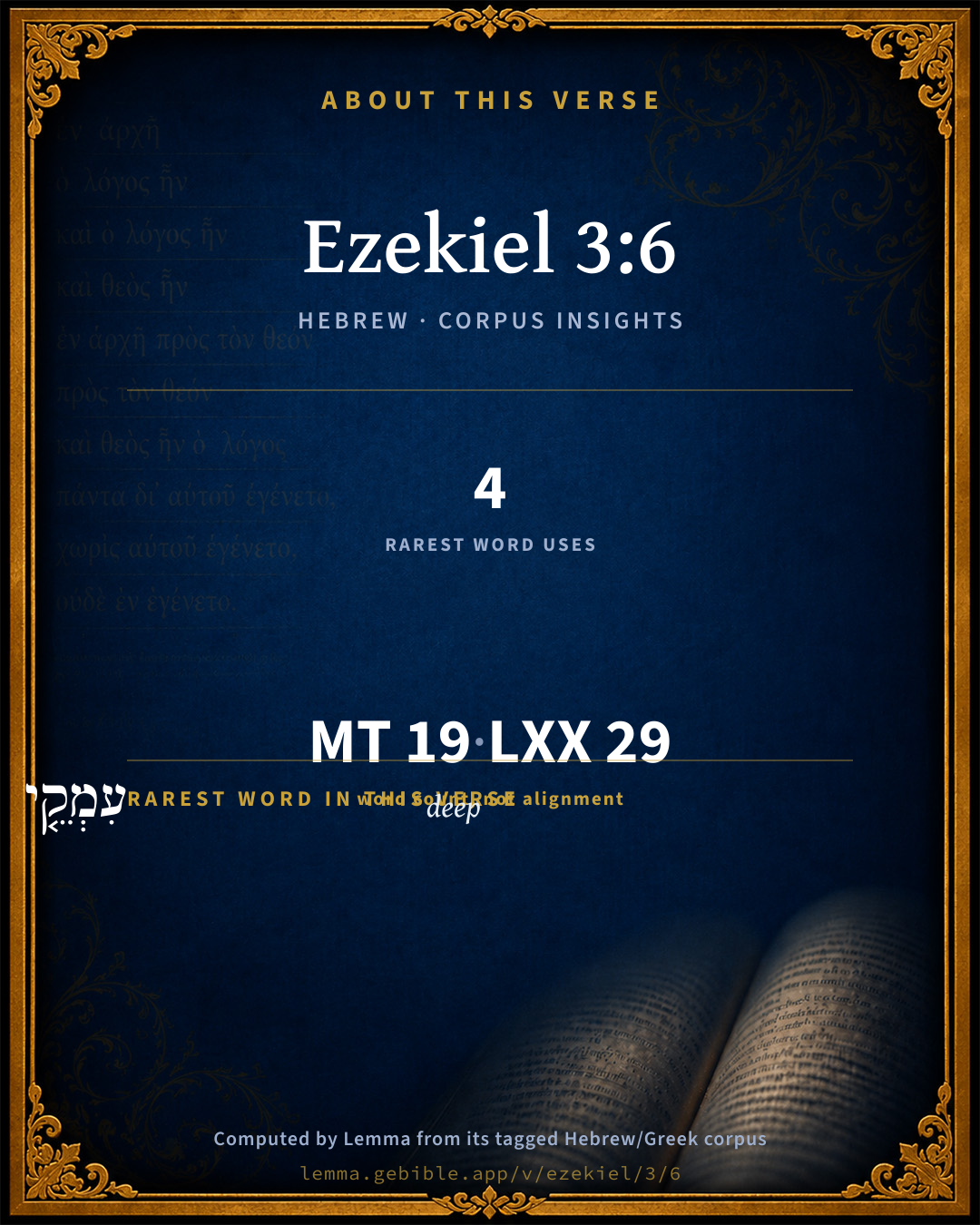
Ezekiel 3:6

Hebrew (Westminster Leningrad Codex) Ezekiel 3:6 appears in the Hebrew Old Testament. The text above is from the Westminster Leningrad Codex. Each word links to its Strong’s number, a concise gloss, and parsing drawn from the Open Scriptures Hebrew Bible morphology. Click any word for its full Brown-Driver-Briggs (BDB) entry.
Download image
Cite this verse

Ezekiel 3:6 (World English Bible). Public Domain. Lemma interlinear Bible study tool, https://lemma.gebible.app/v/ezekiel/3/6.

Show BibTeX & RIS
BibTeX
RIS
English Translation
not to many peoples of a strange speech and of a hard language, whose words you can not understand. Surely, if I sent you to them, they would listen to you.
World English Bible · Public Domain
Download a study sheet

One document with this verse’s original text, its word-by-word gloss line, the meaning frame, cross-references with their text, attributed commentary, and full source and license credits — printable, and it pastes into notes with its structure intact.

This verse Autodidact and up

Study sheet (.html) Plain text (.txt)

A passage Seminary Student

Up to 50 verses in one chapter. A passage sheet keeps up to 6 commentary sources and 12 cross-references per verse, in the order this page ranks them, and says so on the sheet whenever that leaves anything out. Ask for a single verse and you get the Autodidact verse sheet above.

Everything on this page stays free to read, with no account — the sheet is a download of what is already on screen, not access to it.

Want to remove ads? Support Godless Engineer
Compare translations 3

The same verse in 3 English versions, stacked beneath the original-language interlinear above. Click any original word for its lexicon entry.

Each is an independent rendering of the whole verse — the interlinear is not word-aligned to these translations.

Highlighted words mark where these versions differ — a whole-verse word diff, not a word-by-word alignment.

  • World English Bible Public Domain
    not to many peoples of a strange speech and of a hard language, whose words you can not understand. Surely, if I sent you to them, they would listen to you.
  • King James Version Public Domain
    Not to many people of a strange speech and of an hard language, whose words thou canst not understand. Surely, had I sent thee to them, they would have hearkened unto thee.
  • unfoldingWord Literal Text CC BY-SA 4.0
    not to many peoples of strange speech or a difficult language, whose words you cannot understand. Surely if I sent you to them, they would have listened to you.

unfoldingWord Literal Text — © unfoldingWord, licensed CC BY-SA 4.0. Word-aligned USFM3 via Door43 (git.door43.org/unfoldingWord/en_ult).

Versions to compare (up to 4)

3 of 4 selected

Show all 18 translations

Every available English version of this verse, each an independent rendering of the whole verse.

  • World English Bible Public Domain
    not to many peoples of a strange speech and of a hard language, whose words you can not understand. Surely, if I sent you to them, they would listen to you.
  • Berean Standard Bible Public Domain
    not to the many peoples of unfamiliar speech and difficult language whose words you cannot understand. Surely if I had sent you to them, they would have listened to you.
  • Majority Standard Bible Public Domain
    not to the many peoples of unfamiliar speech and difficult language whose words you cannot understand. Surely if I had sent you to them, they would have listened to you.
  • King James Version Public Domain
    Not to many people of a strange speech and of an hard language, whose words thou canst not understand. Surely, had I sent thee to them, they would have hearkened unto thee.
  • American Standard Version (1901) Public Domain
    not to many peoples of a strange speech and of a hard language, whose words thou canst not understand. Surely, if I sent thee to them, they would hearken unto thee.
  • Revised Version (1885) Public Domain
    not to many peoples of a strange speech and of an hard language, whose words thou canst not understand. Surely, if I sent thee to them, they would hearken unto thee.
  • Geneva Bible (1599) Public Domain
    Not to many people of an vnknowen tongue, or of an harde language, whose wordes thou canst not vnderstand: yet if I should sende thee to them, they would obey thee.
  • Douay-Rheims (1899) Public Domain
    Nor to many nations of a strange speech, and of an unknown tongue, whose words thou canst not understand: and if thou wert sent to them, they would hearken to thee.
  • Young's Literal Translation Public Domain
    not unto many peoples, deep of lip and heavy of tongue, whose words thou dost not understand. If I had not sent thee unto them -- they, they do hearken unto thee,
  • Literal Standard Version CC BY-SA 4.0
    not to many peoples, deep of lip and heavy of tongue, whose words you do not understand. If I had not sent you to them—they listen to you,
  • Unlocked Literal Bible CC BY-SA 4.0
    not to many peoples of strange speech or a difficult language, whose words you cannot understand. Surely if I sent you to them, they would have listened to you.
  • unfoldingWord Literal Text CC BY-SA 4.0
    not to many peoples of strange speech or a difficult language, whose words you cannot understand. Surely if I sent you to them, they would have listened to you.
  • Darby Bible Public Domain
    not to many peoples of strange language and of difficult speech, whose words thou canst not understand: had I sent thee to them, would they not hearken unto thee?
  • World Messianic Bible Public Domain
    not to many peoples of a strange speech and of a hard language, whose words you can’t understand. Surely, if I sent you to them, they would listen to you.
  • Webster's Bible Public Domain
    Not to many people of a strange speech and of a hard language, whose words thou canst not understand. Surely, had I sent thee to them, they would have hearkened to thee.
  • Free Bible Version CC BY-SA 4.0
    As I say, I'm not sending you to those whose language is foreign to you, to people that you don't know, whose words you don't understand. On the other hand, if I had sent you to foreigners, they would have listened to you.
  • Bible in Basic English Public Domain
    Not to a number of peoples whose talk is strange and whose language is hard and whose words are not clear to you. Truly, if I sent you to them they would give ear to you.
  • JPS Tanakh (1917) Public Domain
    not to many peoples of an unintelligible speech and of a slow tongue, whose words thou canst not understand. Surely, if I sent thee to them, they would hearken unto thee.

Literal Standard Version (2020), Covenant Press — licensed CC BY-SA 4.0. Text via the HelloAO Bible API (eBible.org). Unlocked Literal Bible (unfoldingWord) — licensed CC BY-SA 4.0. Text via the HelloAO Bible API (eBible.org). unfoldingWord Literal Text — © unfoldingWord, licensed CC BY-SA 4.0. Word-aligned USFM3 via Door43 (git.door43.org/unfoldingWord/en_ult). Free Bible Version, Dr. Jonathan Gallagher — licensed CC BY-SA 4.0. Text via the HelloAO Bible API (eBible.org).

Word by word

More ways to search: Search by grammar → Find every occurrence → Compare this word →

Practice this passage: Drill this verse → Learn its vocabulary →

עִמְקֵ֤י
ʻâmêq
H6012
“deep of”
Adjective, Adjective, Masculine, Plural, Construct
Part of Speech
Adjective
Type
Adjective
Gender
Masculine
Number
Plural
State
Construct
Full BDB Definition

Origin: from H6009

TWOT: 1644c

deep, unfathomable - unintelligible (of speech)
  1. לֹ֣א lôʼ H3808 “not” Particle, Negative
  2. אֶל ʼêl H413 “to” Preposition
  3. עַמִּ֣ים ʻam H5971 “peoples” Noun, Common, Masculine, Plural, Absolute
  4. רַבִּ֗ים rab H7227 “many” Adjective, Adjective, Masculine, Plural, Absolute
  5. שָׂפָה֙ sâphâh H8193 “lip” Noun, Common, Feminine, Singular, Absolute
  6. וְכִבְדֵ֣י kâbêd H3515 “and · heavy of” Conjunction + Adjective, Adjective, Masculine, Plural, Construct
  7. לָשׁ֔וֹן lâshôwn H3956 “tongue” Noun, Common, Both, Singular, Absolute
  8. אֲשֶׁ֥ר ʼăsher H834 “which” Particle, Relative
  9. לֹֽא lôʼ H3808 “not” Particle, Negative
  10. תִשְׁמַ֖ע shâmaʻ H8085 “to hear” Verb, Qal, Imperfect, 2nd Person, Masculine, Singular
  11. דִּבְרֵיהֶ֑ם dâbâr H1697 “words · their” Noun, Common, Masculine, Plural, Construct + Suffix, Personal, 3rd Person, Masculine, Plural
  12. אִם ʼim H518 “if” Conjunction
  13. לֹ֤א lôʼ H3808 “not” Particle, Negative
  14. אֲלֵיהֶם֙ ʼêl H413 “to · them” Preposition + Suffix, Personal, 3rd Person, Masculine, Plural
  15. שְׁלַחְתִּ֔יךָ shâlach H7971 “to send · you” Verb, Qal, Perfect, 1st Person, Common, Singular + Suffix, Personal, 2nd Person, Masculine, Singular
  16. הֵ֖מָּה hêm H1992 “they” Pronoun, Personal, 3rd Person, Masculine, Plural
  17. יִשְׁמְע֥וּ shâmaʻ H8085 “to hear” Verb, Qal, Imperfect, 3rd Person, Masculine, Plural
  18. אֵלֶֽיךָ ʼêl H413 “to · you” Preposition + Suffix, Personal, 2nd Person, Masculine, Singular

About this verse

These counts appear in no published source. They are computed here, from the morphology-tagged text and Lemma’s own curated glosses. What Lemma adds →

19
words
14
distinct lemmas
Prophets
section

Notable vocabulary

The rarest word here is עִמְקֵ֤י deep H6012 — appearing just 4 times in the whole Hebrew Bible.

Shared distinctive vocabulary

עִמְקֵ֤י deep H6012 occurs in 4 verses of the Hebrew Bible. Also found in:

Grammatical profile

  • 3 verbs
  • 4 nouns
  • 3 adjectives
  • 1 pronoun
  • 3 prepositions
  • 1 conjunction
  • 4 particles

Verb forms

  • תִשְׁמַ֖ע Qal · Imperfect
  • שְׁלַחְתִּ֔יךָ Qal · Perfect
  • יִשְׁמְע֥וּ Qal · Imperfect

Repetition

Words recur within this verse — often emphatic in Hebrew:

  • תִשְׁמַ֖ע to hear H8085 ×2
  • לֹ֣א not H3808 ×3
  • אֶל to H413 ×3

Hebrew & Septuagint length

In English translation the verse runs 31 words from the Hebrew and 34 from the Septuagint (LXX English) — closely comparable.

A rough comparison of the two English renderings, which tokenize alike — not a word-level alignment.

Word counts can differ between the Hebrew and the Greek without any difference in meaning — e.g. the Hebrew direct-object marker אֵת has no separate Greek word, and Greek often adds the article ὁ.

In the original languages it is 19 Hebrew tokens and 29 Greek tokens — but the two are counted differently (Hebrew bundles its prefixes and suffixes into one token; the Greek is in lemma form), so that isn’t a like-for-like length.

Cross-references

6

Topical passages linked to Ezekiel 3:6 in the Treasury of Scripture Knowledge — connected by theme and wording, ordered by reader-vote popularity; previews shown in the World English Bible.

  • Jonah 3:5–10 The people of Nineveh believed God; and they proclaimed a fast, and put on sackcloth, from the greatest of them even to the least of them.
  • Matthew 11:20–24 Then he began to denounce the cities in which most of his mighty works had been done, because they didn't repent.
  • Matthew 12:41–42 The men of Nineveh will stand up in the judgment with this generation, and will condemn it, for they repented at the preaching of Jonah; and behold, someone greater than Jonah is here.
  • Luke 11:30–32 For even as Jonah became a sign to the Ninevites, so will also the Son of Man be to this generation.
  • Romans 9:30–33 What shall we say then? That the Gentiles, who didn't follow after righteousness, attained to righteousness, even the righteousness which is of faith;
  • Acts 27:28 They took soundings, and found twenty fathoms. After a little while, they took soundings again, and found fifteen fathoms..

Cross-references courtesy of OpenBible.info (CC BY 4.0).

Hebrew and Greek witnesses Masoretic Hebrew ↔ Greek Septuagint

The same verse in the two great witnesses to the Old Testament, shown verse-for-verse.

These are two independent witnesses, not word-aligned to each other, and the Septuagint is shown in lemma (dictionary) form.

Hebrew Ezekiel 3:6 Masoretic · Westminster Leningrad Codex

לֹ֣א אֶל עַמִּ֣ים רַבִּ֗ים עִמְקֵ֤י שָׂפָה֙ וְכִבְדֵ֣י לָשׁ֔וֹן אֲשֶׁ֥ר לֹֽא תִשְׁמַ֖ע דִּבְרֵיהֶ֑ם אִם לֹ֤א אֲלֵיהֶם֙ שְׁלַחְתִּ֔יךָ הֵ֖מָּה יִשְׁמְע֥וּ אֵלֶֽיךָ

not to many peoples of a strange speech and of a hard language, whose words you can not understand. Surely, if I sent you to them, they would listen to you.

World English Bible · Public Domain

Greek LXX Ezekiel 3:6 Septuagint · lemma form

οὐδέ πρός λαός πολύς ἀλλόφωνος ἤ ἀλλόγλωσσος οὐδέ στιβαρός ὁ γλῶσσα εἰμί ὅς οὐ ἀκούω ὁ λόγος αὐτός καί εἰ πρός τοιοῦτος ἐκ ἀποστέλλω σύ οὗτος ἄν εἰςἀκούω σύ

neither to many nations of other speech and other tongues, nor of harsh language, whose words you would not understand: although if I had sent you to such, they would have listened to you.

LXX2012 (modern English Septuagint) · Public Domain

On this verse, John Gill's Exposition discusses the Septuagint’s reading. Read the note in Commentary ↓

Hebrew: Westminster Leningrad Codex (CC BY 4.0). Greek: Septuagint (public domain); English from LXX2012 (modern English Septuagint) (Public Domain). How the Septuagint differs from the Hebrew →

Targum (Aramaic paraphrase)

1

The Targum is the ancient Jewish Aramaic paraphrase of the Hebrew Scriptures — an interpretive translation, not the Hebrew text itself. Onkelos (literal) and Pseudo-Jonathan (expansive) render the Torah, and Jonathan the Prophets. Coverage is partial: where no permissively-licensed English translation exists for a verse, only the Aramaic is shown. This is verse-level text, not a word-by-word alignment to the Hebrew.

  1. Targum Jonathan Prophets (Joshua–Malachi)
    לָא לְוַת עַמְמַיָא סַגִיאִין תַּקִיפֵי מַמְלֵל וְיַקִירֵי לִישָׁן דְלָא תִשְׁמַע פִּתְגָמֵיהוֹן אִלּוּ לְוַתְהוֹן שְׁלַחְתָּךְ אִינוּן יְקַבְּלוּן מִנָךְ:

    (no public-domain English translation for this verse)

    Targum Jonathan — Aramaic: “Mikraot Gedolot” (public domain). English: “Sefaria Community Translation” (CC0 1.0 (public-domain dedication)); “London "Chaldee Paraphrase," 1871” (public domain). Text via Sefaria.

Commentary

Notes on Ezekiel 3:6 from classic Christian and Jewish commentators (each source and its license shown beneath its notes). The classic Christian expositions comment on the surrounding passage and are grouped to its opening verse, so a note may address several verses; the Jewish commentaries on the Tanakh (Rashi and others) are per-verse, so they appear only where the commentator wrote on this verse.

Lemma curates 59 commentaries, every one of them public domain or Creative Commons licensed, each selected and text-cleaned for this edition rather than reprinted as found. About our sources →

Trapp's Complete Commentary

John Trapp

Eze 3:6 Not to many people of a strange speech and of an hard language, whose words thou canst not understand. Surely, had I sent thee to them, they would have hearkened unto thee.

Ver. 6. Surely had I sent unto them, they would have hearkened.] Or, If I had sent thee to them, would they not have hearkened unto thee? It may seem by the Ninevites that they would, for they repented at the preaching of Jonah, {Mat 12:41} at one single sermon made by a mere stranger, who sang so doleful a ditty to them that their city should be shortly destroyed, &c. Vatablus rendereth this text, Dispeream nisi te audissent, ei ad cos te misissem. And couldst thou but skill of foreign languages, thou couldst not easily be without disciples. The punishment of strange language, saith a grave divine, {a} was a heavy punishment, next to our casting out of paradise and the flood.

{a} Mr Whatel. Prototyp.

John Trapp, A Commentary or Exposition upon All the Books of the Old and New Testament (1647–1656) — public domain. Text from a community e-Sword module.

Jamieson, Fausset & Brown

Robert Jamieson, A. R. Fausset & David Brown

many people--It would have increased the difficulty had he been sent, not merely to one, but to "many people" differing in tongues, so that the missionary would have needed to acquire a new tongue for addressing each. The after mission of the apostles to many peoples, and the gift of tongues for that end, are foreshadowed (compare Co1 14:21 with Isa 28:11).

had I sent thee to them, they would have hearkened-- (Mat 11:21, Mat 11:23).

Jamieson, Fausset & Brown — Commentary Critical and Explanatory on the Whole Bible (1871) — public domain (CC PDM 1.0). Text via the HelloAO Bible API.

John Calvin's Commentaries

Now he adds, not to many peoples Those who translate “many” by “great,” do not understand the Prophet’s meaning, for God had spoken in the singular number concerning all people, but now he uses the plural, as if he had said, I send thee neither to Egyptians, nor to Chaldeans, nor to any other remote nation, since the world is on all sides of thee, inhabited by peoples whose language thou dost not understand: to those therefore I do not send thee. The particle, if not, follows, and Jerome translates, “If I had sent thee unto them,” although the negative particle is interposed, literally, if not, but because this phrase appears harsh, some have supposed אם-לא, am-la, to have the sense of swearing, and interpret it affirmatively for כאמת, cameth, “truly,” or “surely.” But if we receive it so, the passage will be defective; for they understand אם, am, “again,” “afterwards:” for these two words, אם-לא, am-la, have the force of an oath interposed. What sense then shall we extract from the words, “truly I will send thee unto them, and they shall hear thee?” We see then this sense to be too forced. Some explain the passage thus: “If I had not sent thee unto them, they would have heard thee,” as if God here blamed the disposition of the people, because they rather sought vain and foolish prophecies:, than submitted themselves to the truth; just as if he had said, if any impostor should pour darkness upon them, they would immediately embrace his fables and lies, as they are so prone to foolishness. Since, therefore, I send thee, therefore they do not hear. But this explanation does not suit, because a little afterwards we shall see it in its own place. To me therefore this context is most probable, if I had not sent thee to them, these also would have heard thee, as if it had been said, unless a difference of speech had interposed, I had rather have used thine assistance with reference to foreign nations. In this way God signifies his displeasure, when he says, that he would rather send his Prophet hither and thither than to the Israelites, except through the want of a common language; for this difference of language presented the only boundary to the Prophet, so that he was confined to his own people. In this sense there is nothing forced. I do not, therefore, send thee to many peoples, profound in speech and strange in tongue, because thou wouldst not understand their language But if this had not been an obstacle, I would have sent thee, and they would have heard thee. We see then what I have just touched upon, that the Israelites are compared to foreign or uncircumcised tribes, because they rejected the instruction offered them, not through ignorance of the language, but through the hardness of their heart. Isaiah also says, (Isaiah 28:11, 13,) that the word of God would be deep and obscure to even the Jews themselves, but in another sense; he also compares his prophecies to a sealed book, since God had blinded them according to their deserts. Since therefore they were so given over to a reprobate mind, and were destitute of sound understanding, therefore he says, that his teaching would be like a closed and sealed book: then he says, that he would be a barbarian, as if he was using an unknown language. So God in this place clearly shows that the house of Israel were suffering no impediment in profiting by his word, except their own unwillingness to hear. (Isaiah 8:16; Isaiah 29:11.) For he says, that the heathen would be obedient, if they could be partakers of such a benefit. Unless therefore the language of the Prophet had been unknown to the profane and uncircumcised heathen, he had there found attentive and obedient disciples, as God testifies. How then comes it to pass that the house of Israel cannot hear! It now follows, But the house of Israel are unwilling to hear, that is, the house of Israel is unwilling to hear thee, because it will not hear me, says he.

John Calvin's Commentaries (1540-1563) — public domain. Text from the Calvin Translation Society English edition (1840s-50s) via the Christian Classics Ethereal Library (ccel.org). Calvin's coverage is partial (roughly two-thirds of the Bible); uncommented books and verses are honest gaps, never fabricated. The 19th-century editor's footnotes and remarks are omitted so the notes are faithfully Calvin's own voice.

The Cambridge Bible for Schools and Colleges

gen. ed. J. J. S. Perowne

6. many people] Rather: peoples, i.e. different foreign nations.

Surely, had I sent thee] More exactly: surely if I sent thee … they would hearken. There is some difficulty about the construction, but the sense is sufficiently clear. The heathen have a greater susceptibility for the truth than Israel, which has acted more wickedly than the nations (ch. Eze_5:6-7, Eze_16:48; Eze_16:51. Cf. Jer_2:10-11). Others would render: but I send thee to them (Israel), they will understand thee. The last words, however, cannot mean “understand thee;” they mean “hearken unto thee,” as Eze_3:7, where the phrase is the same.

The Cambridge Bible for Schools and Colleges (gen. ed. J. J. S. Perowne; Cambridge University Press, 1878–1918) — public domain. Text from a community e-Sword module.

John Gill's Exposition

Not to many people of a strange speech and of an hard language,.... The prophet was sent, not to different nations, of different languages; but to one nation of the same language; indeed several of his prophecies concern other nations, as the Ammonites, Moabites, Edomites, Tyrians, Philistines, Egyptians, and Assyrians; but then these had a relation to the, people of Israel, and were chiefly on their account; and therefore he was not sent to those nations to deliver his prophecies unto them, but to the people of Israel only; and so had no difficulty on his part concerning their language, which he would have had, had he been sent to the barbarous nations;

whose words, thou canst not understand: the prophet being, only used to the language of the Jews and not having the gift of speaking with and understanding divers tongues; as the apostles of Christ had, when they were sent to many people of different languages, and which is here tacitly intimates:

surely, had I sent thee to them, they would have hearkened unto thee; which is an aggravation of the obstinacy and disobedience of the people of Israel; that had the barbarous nations been favoured with the same means of instruction they were they would have been obedient; see Mat 11:21; for though they could not understand the prophet's language, nor he theirs; yet, as Kimchi observes, they would have sought for an interpreter to have explained the prophecy to them. The thing is very strongly affirmed, "surely", verily, "of a truth"; as the same Jewish writer interprets ; and both he and Jarchi take it to be the form of an oath. Some render the words, "if I had not sent thee to them, they would have hearkened unto thee" (i); and the sense is, either that if the Lord had not sent him to the Israelites, but to the peopled a strange speech, they, the people, would have hearkened to him: or, if the Lord had not sent the prophet, but he had gone of himself, as the false prophets in their own name, the Israelites would have hearkened to him; such was their perverseness and rebellion: others render the words, "if not", or had it not been for their strange speech and hard language, "I would have sent thee to them" (k), the barbarous nation, and "they would have hearkened unto thee"; but the first sense seems best; which is confirmed by the Targum, Septuagint, Vulgate Latin, and the Oriental versions.

(i) "si non ad eos misissem te", Vatablus; "si non misero te", Montanus; "si non mitterem", Pagninus. (k) "Si non misissem te ad eos", Calvin.

John Gill's Exposition of the Whole Bible (1746–1763) — public domain (CC PDM 1.0). Text via the HelloAO Bible API.

Albert Barnes' Notes on the Bible

To many people - To various nations using diverse languages.

Surely - The thought is that expressed by our Saviour Himself (margin reference). Some render it: “but I have sent thee unto these; they can hearken” etc.

Albert Barnes' Notes on the Bible (1834–1885) — public domain. Text from a community e-Sword/MySword module.

Haydock's Catholic Bible Commentary

Unknown. Hebrew, "heavy." (Calmet) --- Protestants, "hard." (Haydock) --- It is not above thy strength, Deuteronomy xxx. 12. --- To thee. He insinuates that the Gentiles would obey the apostles. (St. Jerome) --- But the time was not yet come. (Calmet) --- From this text and Matthew xi. 21., it appears that "the same grace" is accepted by some and rejected by others, as "more grace is added to the former, which was sufficient before, and by this....is made effectual" through God’s mercy, Romans ix. (Worthington) --- Those who reject the first grace, can blame only themselves, if they receive no more. The same grace falling on a heat better prepared by God, like seed on good soil, is more fruitful.

George Leo Haydock (1774–1849), Haydock's Catholic Family Bible and Commentary, 1859 edition — public domain. Excludes Psalms (Douay-Rheims chapter numbering differs from Protestant) and Deuterocanonical books (Catholic canon only).

Matthew Poole's English Annotations

This verse is much what the former, yet strengthens and illustrates what is laid down there.

Many people here may be, according to the comprehensiveness of the Hebrew word, either numerous, whose multitudes would be their pride, and tempt them to deride thee; or, mighty in valour and feats of war and policy, whose might would harden them; or, far off, who would wonder a stranger should come to tell them their destiny; or, divers nations, that thou shouldst need divers tongues, to speak to them all in their own language. This difficult work is reserved to those whom Shiloh will send, it is kept to the times when the Spirit poured forth shall enrich with the gift of tongues in gospel days.

Strange speech; deep lip, &c.: see Eze 3:5.

Whose words thou canst not understand: words are articulate and significant, and when understood they are words to the hearer, but whilst not understood they are but empty and barbarous sounds, as the apostle observes in 1Co 14.

Surely: in the Hebrew the words occasion difficulty and variety of translations, but all of no great moment. Some would refer it to the Jews, and make this sense, Hadst thou gone in any name but mine they would have heard; so parallel it with Joh 5:43; but it is better, and more agreeable with the text, to refer it to many nations mentioned, who would have heard what the house of Israel refused to hear, (of which Jonah’s Ninevites are pregnant proofs,) and to them I would have sent thee, (say some,) but that they did not understand thee: this is but a very slender guess, and ill consists with the power of God, which can give the tongue, if he would have sent the message, as he intimated to Moses, unwilling to go. Our version hath well read and referred the words; with that asseveration,

surely, they have expressed what some will have the Hebrew לא אם to be, a form of an oath. God assures the prophet the message is such that any men in their wits would hear; go therefore to thy people, try whether they will act like men and hear, especially when their condition is quite otherwise than that I now suggest of the nations, for the Jews are few, weak, reduced to this by neglecting to hear; in reason, they should now hear, repent, seek me, do my word, and live.

Matthew Poole's English Annotations on the Holy Bible (1683–1685) — public domain. Text from a community e-Sword/MySword module.

The Pulpit Commentary

Surely, if I sent thee to them, etc. The "surely" represents the Hebrew "if not" taken as a strong affirmation, just as "if" in Psa_95:11 represents a strong negation; compare the use of the fuller formula jurandi in 1Sa_3:17; 2Sa_3:35 2Sa_19:13; and of the same in Deu_1:35; Isa_62:8; and in Ezekiel himself. (Eze_17:19) The margin of the Authorized Version, If I had sent thee to them, would they not have hearkened, etc.? expresses the same meaning, but is less tenable as a translation. The thought in either case finds its analogue in our Lord"s reference to Sodom and Gomorrah, to Tyre and Sidon. (Mat_11:21-24; Luk_10:12-14) Israel was more hardened than the worst of the nations round her.

The Pulpit Commentary (1880–1919), ed. H.D.M. Spence-Jones & Joseph S. Exell — public domain. Text from a community e-Sword module.

John Wesley's Explanatory Notes

Many people - Divers nations, that thou shouldest need divers tongues, to speak to them all in their own language.

John Wesley, Explanatory Notes Upon the Whole Bible (1754–1765) — public domain. Text via the GEBible commentary corpus.

Rashi

Rabbi Shlomo Yitzchaki (Rashi)

had I sent you to them, etc. [lit. had I not sent you to them, they would hearken to you.] This is an expression of an oath: Had I sent you to themas I live, if they would not hearken to you! [i.e.,] this is a transposed verse.

Rashi on the Tanakh — English translations: “The Judaica Press complete Tanach with Rashi, translated by A. J. Rosenberg” (CC BY 4.0); “Pentateuch with Rashi's commentary by M. Rosenbaum and A.M. Silbermann, 1929-1934” (public domain); “The Metsudah Tanach series, Lakewood, N.J” (CC BY 4.0); and “The Book of Joshua, Metsudah Publications, 1997” (CC BY 4.0). Text via Sefaria.

Lesson kit

Teaching starters — assembled from the data on this page, not authored interpretation. Every prompt links to the verse data it draws on. Edit before teaching.

Ezekiel, in the Prophets, opens this verse with 19 words (14 distinct Hebrew lemmas). Its most distinctive word is ʻâmêq (“deep”). A historical commentator’s framing appears above. Read the whole chapter for the surrounding context.

Discussion questions

  1. The word ʻâmêq carries the sense “deep.” How does it shape the verse?
  2. Proverbs 9:18 shares the word «deep» with this verse. How do the two illuminate each other?
  3. “to hear” occurs 2× in this one verse. What is the effect of the repetition?
  4. The translations on this page render this verse differently — a whole-verse word diff, not a word-by-word alignment. What might account for the different wordings?
  5. The verb «תִשְׁמַ֖ע» is Qal Imperfect. How does its form color the action?
  6. Reading how Trapp's Complete Commentary and Jamieson, Fausset & Brown read this verse, where do the two commentators agree and where do they part?

Things to notice

Reading settings

Reading text

Shown beneath each verse's original-language words.

Old Testament
Old Testament edition

Read the OT as the Masoretic Hebrew (MT) or the Greek Septuagint (LXX).

English shown for the Greek Septuagint (in the Hebrew ↔ Greek comparison).

Comparing translations? Open the Compare panel on any verse page to stack up to four side by side.