2 Samuel 18:16

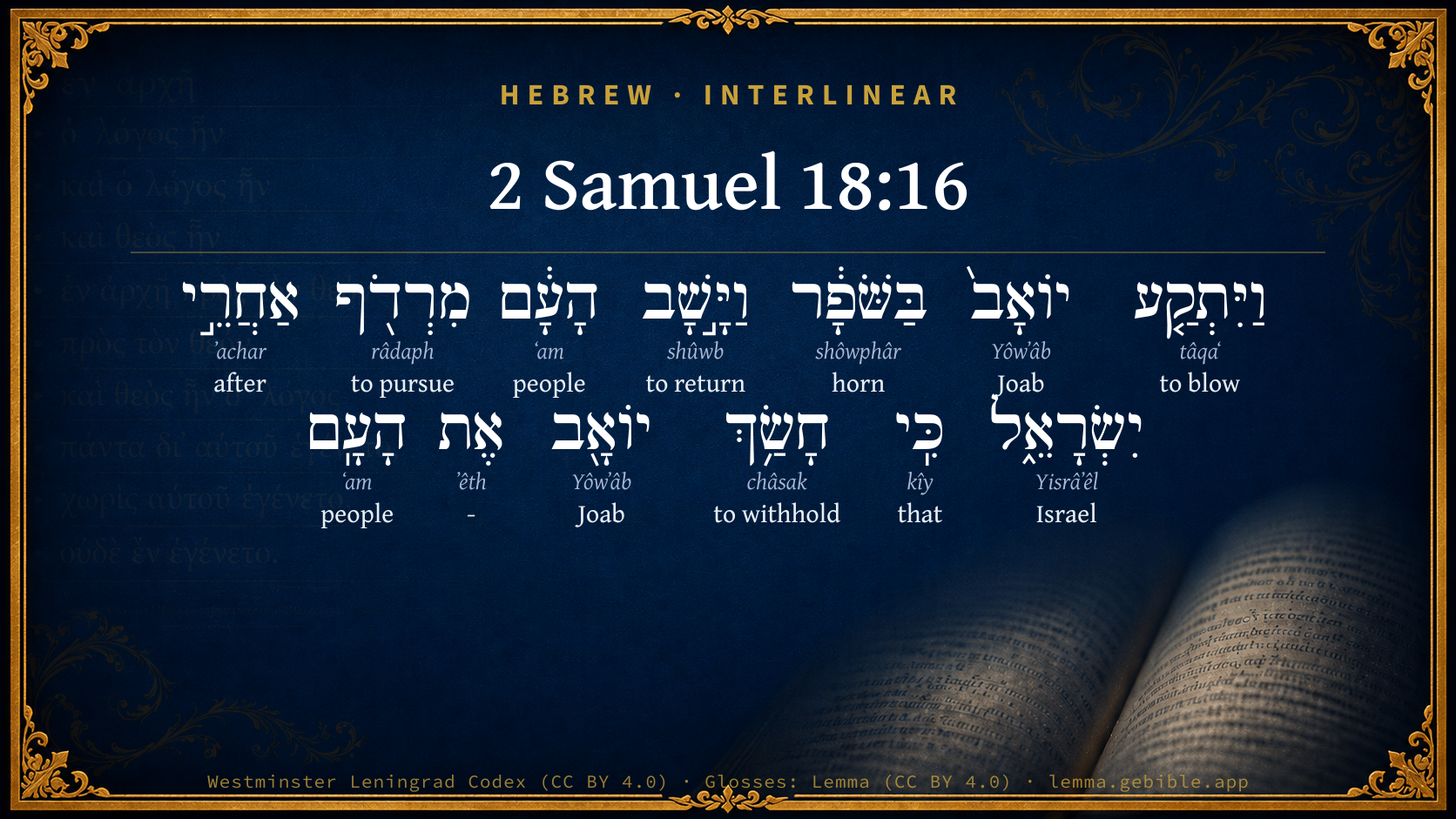
Hebrew (Westminster Leningrad Codex) 2 Samuel 18:16 appears in the Hebrew Old Testament. The text above is from the Westminster Leningrad Codex. Each word links to its Strong’s number, a concise gloss, and parsing drawn from the Open Scriptures Hebrew Bible morphology. Click any word for its full Brown-Driver-Briggs (BDB) entry.
Download image
Cite this verse

2 Samuel 18:16 (World English Bible). Public Domain. Lemma interlinear Bible study tool, https://lemma.gebible.app/v/2-samuel/18/16.

Show BibTeX & RIS
BibTeX
RIS
English Translation
Joab blew the trumpet, and the people returned from pursuing after Israel; for Joab held back the people.
World English Bible · Public Domain
Download a study sheet

One document with this verse’s original text, its word-by-word gloss line, the meaning frame, cross-references with their text, attributed commentary, and full source and license credits — printable, and it pastes into notes with its structure intact.

This verse Autodidact and up

Study sheet (.html) Plain text (.txt)

A passage Seminary Student

Up to 50 verses in one chapter. A passage sheet keeps up to 6 commentary sources and 12 cross-references per verse, in the order this page ranks them, and says so on the sheet whenever that leaves anything out. Ask for a single verse and you get the Autodidact verse sheet above.

Everything on this page stays free to read, with no account — the sheet is a download of what is already on screen, not access to it.

Want to remove ads? Support Godless Engineer
Compare translations 3

The same verse in 3 English versions, stacked beneath the original-language interlinear above. Click any original word for its lexicon entry.

Each is an independent rendering of the whole verse — the interlinear is not word-aligned to these translations.

Highlighted words mark where these versions differ — a whole-verse word diff, not a word-by-word alignment.

  • World English Bible Public Domain
    Joab blew the trumpet, and the people returned from pursuing after Israel; for Joab held back the people.
  • King James Version Public Domain
    And Joab blew the trumpet, and the people returned from pursuing after Israel: for Joab held back the people.
  • unfoldingWord Literal Text CC BY-SA 4.0
    Then Joab blew on the shofar, and the people returned from pursuing after Israel, for Joab restrained the people.

unfoldingWord Literal Text — © unfoldingWord, licensed CC BY-SA 4.0. Word-aligned USFM3 via Door43 (git.door43.org/unfoldingWord/en_ult).

Versions to compare (up to 4)

3 of 4 selected

Show all 18 translations

Every available English version of this verse, each an independent rendering of the whole verse.

  • World English Bible Public Domain
    Joab blew the trumpet, and the people returned from pursuing after Israel; for Joab held back the people.
  • Berean Standard Bible Public Domain
    Then Joab blew the ram’s horn, and the troops broke off their pursuit of Israel because Joab had restrained them.
  • Majority Standard Bible Public Domain
    Then Joab blew the ram’s horn, and the troops broke off their pursuit of Israel because Joab had restrained them.
  • King James Version Public Domain
    And Joab blew the trumpet, and the people returned from pursuing after Israel: for Joab held back the people.
  • American Standard Version (1901) Public Domain
    And Joab blew the trumpet, and the people returned from pursuing after Israel; for Joab held back the people.
  • Revised Version (1885) Public Domain
    And Joab blew the trumpet, and the people returned from pursuing after Israel: for Joab held back the people.
  • Geneva Bible (1599) Public Domain
    Then Ioab blewe the trumpet, and the people returned from pursuing after Israel: for Ioab helde backe the people.
  • Douay-Rheims (1899) Public Domain
    And Joab sounded the trumpet, and kept back the people from pursuing after Israel in their flight, being willing to spare he multitude.
  • Young's Literal Translation Public Domain
    And Joab bloweth with a trumpet, and the people turneth back from pursuing after Israel, for Joab hath kept back the people;
  • Literal Standard Version CC BY-SA 4.0
    And Joab blows with a horn, and the people turn back from pursuing after Israel, for Joab has kept back the people;
  • Unlocked Literal Bible CC BY-SA 4.0
    Then Joab blew the trumpet, and the army returned from pursuing Israel, for Joab held back the army.
  • unfoldingWord Literal Text CC BY-SA 4.0
    Then Joab blew on the shofar, and the people returned from pursuing after Israel, for Joab restrained the people.
  • Darby Bible Public Domain
    And Joab blew the trumpet, and the people returned from pursuing after Israel; for Joab kept back the people.
  • World Messianic Bible Public Domain
    Joab blew the shofar, and the people returned from pursuing after Israel; for Joab held the people back.
  • Webster's Bible Public Domain
    And Joab blew the trumpet, and the people returned from pursuing Israel: for Joab restrained the people.
  • Free Bible Version CC BY-SA 4.0
    Then Joab blew the ram's horn, and his men stopped chasing the Israelites because Joab had signaled them to stop.
  • Bible in Basic English Public Domain
    And Joab had the horn sounded, and the people came back from going after Israel, for Joab kept them back.
  • JPS Tanakh (1917) Public Domain
    And Joab blew the horn, and the people returned from pursuing after Israel; for Joab held back the people.

Literal Standard Version (2020), Covenant Press — licensed CC BY-SA 4.0. Text via the HelloAO Bible API (eBible.org). Unlocked Literal Bible (unfoldingWord) — licensed CC BY-SA 4.0. Text via the HelloAO Bible API (eBible.org). unfoldingWord Literal Text — © unfoldingWord, licensed CC BY-SA 4.0. Word-aligned USFM3 via Door43 (git.door43.org/unfoldingWord/en_ult). Free Bible Version, Dr. Jonathan Gallagher — licensed CC BY-SA 4.0. Text via the HelloAO Bible API (eBible.org).

Word by word

More ways to search: Search by grammar → Find every occurrence → Compare this word →

Practice this passage: Drill this verse → Learn its vocabulary →

חָשַׂ֥ךְ
châsak
H2820
“to withhold”
Verb, Qal, Perfect, 3rd Person, Masculine, Singular
Part of Speech
Verb
Stem
Qal
Form
Perfect
Person
3rd Person
Gender
Masculine
Number
Singular
Full BDB Definition

Origin: a primitive root

TWOT: 765

to withhold, restrain, hold back, keep in check, refrain - (Qal) - to withhold, keep back, keep for oneself, keep from, hold in check, refrain, spare, reserve - to restrain, check - (Niphal) to assuage, be spared
  1. וַיִּתְקַ֤ע tâqaʻ H8628 “and · to blow” Conjunction + Verb, Qal, Sequential Imperfect, 3rd Person, Masculine, Singular
  2. יוֹאָב֙ Yôwʼâb H3097 “Joab” Noun, Proper
  3. בַּשֹּׁפָ֔ר shôwphâr H7782 “in/at the · horn” Preposition, Determined + Noun, Common, Masculine, Singular, Absolute
  4. וַיָּ֣שָׁב shûwb H7725 “and · to return” Conjunction + Verb, Qal, Sequential Imperfect, 3rd Person, Masculine, Singular
  5. הָעָ֔ם ʻam H5971 “the · people” Particle, Definite Article + Noun, Common, Masculine, Singular, Absolute
  6. מִרְדֹ֖ף râdaph H7291 “from · to pursue” Preposition + Verb, Qal, Infinitive Construct
  7. אַחֲרֵ֣י ʼachar H310 “after” Preposition
  8. יִשְׂרָאֵ֑ל Yisrâʼêl H3478 “Israel” Noun, Proper
  9. כִּֽי kîy H3588 “that” Conjunction
  10. יוֹאָ֖ב Yôwʼâb H3097 “Joab” Noun, Proper
  11. אֶת ʼêth H853 “-” Particle, Direct Object
  12. הָעָֽם ʻam H5971 “the · people” Particle, Definite Article + Noun, Common, Masculine, Singular, Absolute

About this verse

These counts appear in no published source. They are computed here, from the morphology-tagged text and Lemma’s own curated glosses. What Lemma adds →

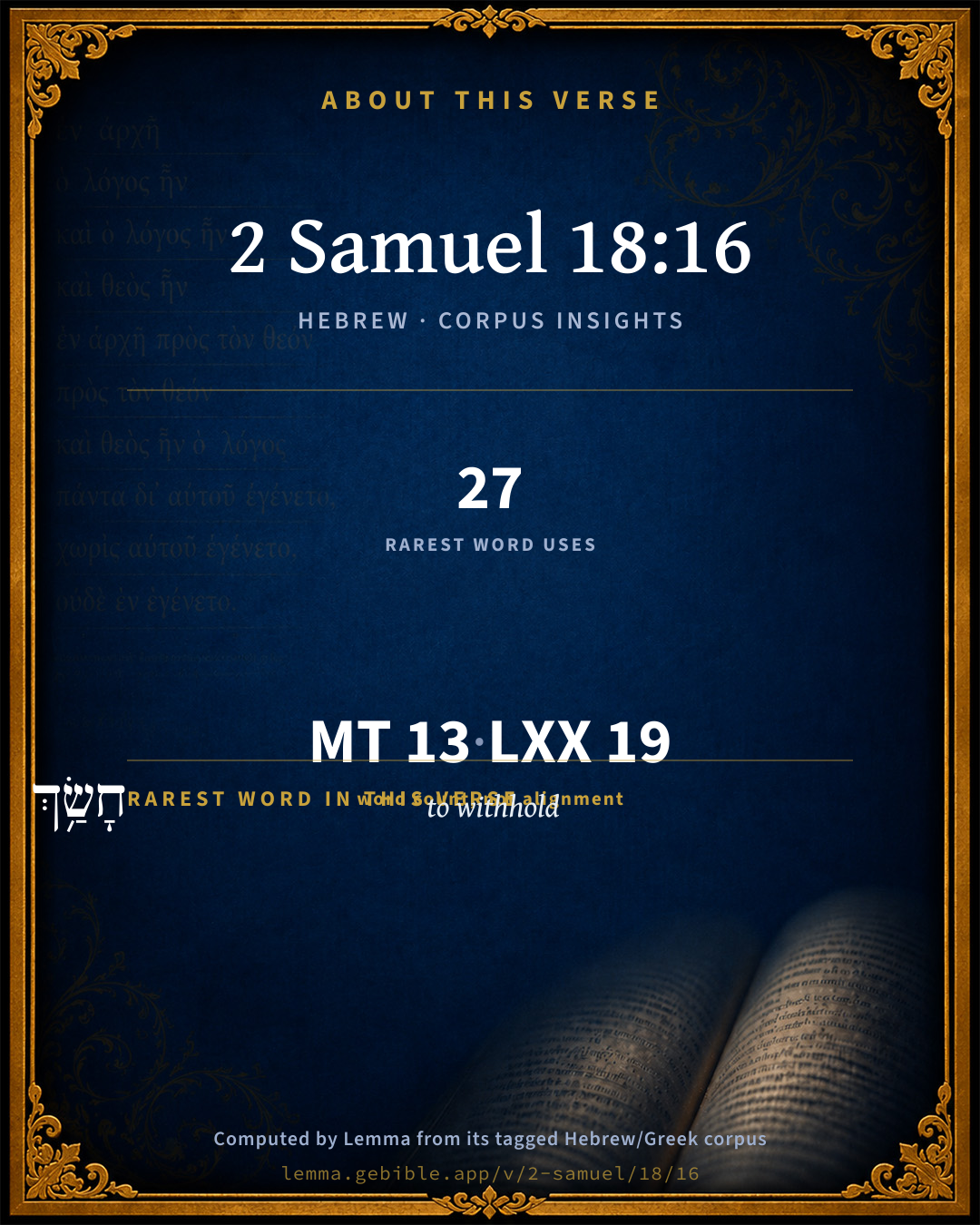
13
words
11
distinct lemmas
Historical
section

Shared distinctive vocabulary

חָשַׂ֥ךְ to withhold H2820 occurs in 27 verses of the Hebrew Bible. Also found in:

Grammatical profile

  • 4 verbs
  • 6 nouns
  • 1 preposition
  • 1 conjunction
  • 1 particle

Verb forms

  • וַיִּתְקַ֤ע Qal · Sequential Imperfect
  • וַיָּ֣שָׁב Qal · Sequential Imperfect
  • מִרְדֹ֖ף Qal · Infinitive Construct
  • חָשַׂ֥ךְ Qal · Perfect

Repetition

Words recur within this verse — often emphatic in Hebrew:

  • יוֹאָב֙ Joab H3097 ×2
  • הָעָ֔ם people H5971 ×2

Hebrew & Septuagint length

In English translation the verse runs 18 words from the Hebrew and 17 from the Septuagint (LXX English) — closely comparable.

A rough comparison of the two English renderings, which tokenize alike — not a word-level alignment.

Word counts can differ between the Hebrew and the Greek without any difference in meaning — e.g. the Hebrew direct-object marker אֵת has no separate Greek word, and Greek often adds the article ὁ.

In the original languages it is 13 Hebrew tokens and 19 Greek tokens — but the two are counted differently (Hebrew bundles its prefixes and suffixes into one token; the Greek is in lemma form), so that isn’t a like-for-like length.

Cross-references

4

Topical passages linked to 2 Samuel 18:16 in the Treasury of Scripture Knowledge — connected by theme and wording, ordered by reader-vote popularity; previews shown in the World English Bible.

  • 2 Samuel 2:28 So Joab blew the trumpet; and all the people stood still, and pursued after Israel no more, neither fought they any more.
  • 2 Samuel 20:22 Then the woman went to all the people in her wisdom. They cut off the head of Sheba the son of Bichri, and threw it out to Joab. He blew the trumpet, and they were dispersed from the city, every man to his tent. Joab returned to Jerusalem to the king.
  • Numbers 10:2–10 Make you two trumpets of silver; of beaten work shall you make them: and you shall use them for the calling of the congregation, and for the journeying of the camps.
  • 1 Corinthians 14:8 For if the trumpet gave an uncertain sound, who would prepare himself for war?

Cross-references courtesy of OpenBible.info (CC BY 4.0).

Hebrew and Greek witnesses Masoretic Hebrew ↔ Greek Septuagint

The same verse in the two great witnesses to the Old Testament, shown verse-for-verse.

These are two independent witnesses, not word-aligned to each other, and the Septuagint is shown in lemma (dictionary) form.

Hebrew 2 Samuel 18:16 Masoretic · Westminster Leningrad Codex

וַיִּתְקַ֤ע יוֹאָב֙ בַּשֹּׁפָ֔ר וַיָּ֣שָׁב הָעָ֔ם מִרְדֹ֖ף אַחֲרֵ֣י יִשְׂרָאֵ֑ל כִּֽי חָשַׂ֥ךְ יוֹאָ֖ב אֶת הָעָֽם

Joab blew the trumpet, and the people returned from pursuing after Israel; for Joab held back the people.

World English Bible · Public Domain

Greek LXX 2 Samuel 18:16 Septuagint · lemma form

καί σαλπίζω ιωαβ ἐν κερατίνη καί ἀποστρέφω ὁ λαός ὁ μή διώκω ὀπίσω ἰσραήλ ὅτι φείδομαι ιωαβ ὁ λαός

And Joab blew the trumpet, and the people returned from pursuing Israel, for Joab spared the people.

LXX2012 (modern English Septuagint) · Public Domain

Hebrew: Westminster Leningrad Codex (CC BY 4.0). Greek: Septuagint (public domain); English from LXX2012 (modern English Septuagint) (Public Domain). How the Septuagint differs from the Hebrew →

Targum (Aramaic paraphrase)

1

The Targum is the ancient Jewish Aramaic paraphrase of the Hebrew Scriptures — an interpretive translation, not the Hebrew text itself. Onkelos (literal) and Pseudo-Jonathan (expansive) render the Torah, and Jonathan the Prophets. Coverage is partial: where no permissively-licensed English translation exists for a verse, only the Aramaic is shown. This is verse-level text, not a word-by-word alignment to the Hebrew.

  1. Targum Jonathan Prophets (Joshua–Malachi)
    וּתְקַע יוֹאָב בְּשׁוֹפָרָא וְתַב עַמָא מִלְמִרְדַף בָּתַר יִשְׂרָאֵל אֲרֵי מְנַע יוֹאָב יַת עַמָא:

    (no public-domain English translation for this verse)

    Targum Jonathan — Aramaic: “Mikraot Gedolot” (public domain). English: “Sefaria Community Translation” (CC0 1.0 (public-domain dedication)); “London "Chaldee Paraphrase," 1871” (public domain). Text via Sefaria.

Commentary

Notes on 2 Samuel 18:16 from classic Christian and Jewish commentators (each source and its license shown beneath its notes). The classic Christian expositions comment on the surrounding passage and are grouped to its opening verse, so a note may address several verses; the Jewish commentaries on the Tanakh (Rashi and others) are per-verse, so they appear only where the commentator wrote on this verse.

Lemma curates 59 commentaries, every one of them public domain or Creative Commons licensed, each selected and text-cleaned for this edition rather than reprinted as found. About our sources →

Trapp's Complete Commentary

John Trapp

2Sa 18:16 And Joab blew the trumpet, and the people returned from pursuing after Israel: for Joab held back the people.

Ver. 16. For Joab held back the people.] From pursuing the rebels, as pitying their seduction: he knew as well how to use victory, as to get it, which Hannibal did not.

John Trapp, A Commentary or Exposition upon All the Books of the Old and New Testament (1647–1656) — public domain. Text from a community e-Sword module.

Joseph Benson's Commentary

2Sa 18:16. Joab blew the trumpet, and the people returned — He knew Absalom’s men had been drawn unthinkingly into this rebellion, and would return to their duty, now they had none to head them. For Joab held back the people — Who otherwise, being highly incensed against the rebels, would have hotly pursued, and made still greater slaughter among them. In this Joab acted like a wise and merciful man, who wished to stop the further effusion of Israelitish blood.

Joseph Benson's Commentary on the Old and New Testaments (1811–1818) — public domain. Text from a community e-Sword module.

Geneva Bible (1599)

Geneva Bible translators

For he had pity of the people, which was seduced by Absalom’s flattery.

Geneva Bible (1599) marginal notes — public domain. Text via Bolls.life.

Jamieson, Fausset & Brown

Robert Jamieson, A. R. Fausset & David Brown

Joab blew the trumpet, . . . and held back the people--Knowing that by the death of the usurper there was no occasion for further bloodshed, he put an end to the pursuit and thereby evinced the temperate policy of his conduct. However harsh and unfeeling to the king Joab may appear, there can be no doubt that he acted the part of a wise statesman in regarding the peace and welfare of the kingdom more than his master's private inclinations, which were opposed to strict justice as well as his own interests. Absalom deserved to die by the divine law (Deu 21:18, Deu 21:21), as well as being an enemy to his king and country; and no time was more fitting than when he met that death in open battle.

Jamieson, Fausset & Brown — Commentary Critical and Explanatory on the Whole Bible (1871) — public domain (CC PDM 1.0). Text via the HelloAO Bible API.

Adam Clarke's Commentary

Verse 16. Joab blew the trumpet] He knew that the rebellion was now extinguished by the death of Absalom; and was not willing that any farther slaughter should be made of the deluded people.

Adam Clarke's Commentary on the Bible (1810–1826) — public domain. Text from a community e-Sword/MySword module.

Ellicott's Commentary for English Readers

(16) Blew the trumpet.—Comp. 2Sa_2:28; 2Sa_20:22. With the death of Absalom the rebellion was at an end, and Joab would stop further slaughter.

A Bible Commentary for English Readers, edited by Charles John Ellicott (1878–1897) — public domain. Text from a community e-Sword module.

The Cambridge Bible for Schools and Colleges

gen. ed. J. J. S. Perowne

16. blew the trumpet] Sounded the recall to stop further pursuit. Cp. ch. 2Sa_2:28, 2Sa_20:22.

The Cambridge Bible for Schools and Colleges (gen. ed. J. J. S. Perowne; Cambridge University Press, 1878–1918) — public domain. Text from a community e-Sword module.

John Gill's Exposition

And Joab blew the trumpet,.... As the sign of a retreat:

and the people returned from pursuing after Israel; upon the sound of the trumpet, the meaning of which they understood:

for Joab held back the people: from shedding any more blood; the head of the conspiracy being removed, the thing would be crushed at once; and Joab neither chose to slay any more, nor take any prisoners, to be tried as traitors, being unawares, without thought, drawn into this rebellion.

John Gill's Exposition of the Whole Bible (1746–1763) — public domain (CC PDM 1.0). Text via the HelloAO Bible API.

Albert Barnes' Notes on the Bible

Blew the trumpet - To stop the pursuit and slaughter 2Sa 2:28; 2Sa 20:22.

Albert Barnes' Notes on the Bible (1834–1885) — public domain. Text from a community e-Sword/MySword module.

Matthew Poole's English Annotations

Who otherwise were highly incensed against the rebels, and hotly pursued them. But the head of the rebellion being cut off, and the danger thereby past, be puts a stop to the effusion of Israelitish blood.

Matthew Poole's English Annotations on the Holy Bible (1683–1685) — public domain. Text from a community e-Sword/MySword module.

Whedon's Commentary on the Bible

Daniel D. Whedon

HUSHAI’S MESSAGE TO DAVID, 2Sa_18:15-22.

16. Send quickly — Hushai seems to have feared that his counsel might not be followed, and so without delay apprizes the king of his danger.

The plains — Or, crossing places. See note on 2Sa_15:28.

Pass over — Cross the fords of the Jordan.

Swallowed up — Overwhelmed and destroyed by the numbers of the enemy that may speedily pursue.

16. Blew the trumpet — The signal for the people to come together: the death of Absalom virtually ending the rebellion.

Daniel D. Whedon (gen. ed.), Commentary on the Old and New Testaments (1874–1909) — public domain. Text from a community e-Sword module.

The Pulpit Commentary

Joab blew the trumpet. Stem and unscrupulous as he was, yet Joab is always statesmanlike. He had slain Absalom more for public than for private reasons, though he may have grimly remembered his own blazing barley field. But the rebellion being now crushed, further slaughter was impolitic, and would only cause sullen displeasure. The people, at the end of the verse, are those under Joab"s command, and a translation proposed by some, "Joab wished to spare the people," is to be rejected.

The Pulpit Commentary (1880–1919), ed. H.D.M. Spence-Jones & Joseph S. Exell — public domain. Text from a community e-Sword module.

Keil & Delitzsch

C. F. Keil & F. Delitzsch

Immediately afterwards Joab stopped any further pursuit, "for Joab spared the people," i.e., he wanted to spare them.

Keil & Delitzsch — Biblical Commentary on the Old Testament (1861–1891) — public domain (CC PDM 1.0). Text via the HelloAO Bible API. (Old Testament only.)

unfoldingWord translationNotes

Door43 World Missions Community

Then Joab blew the trumpet, and the army returned from pursuing Israel, for Joab held back the army

This describes what Joab commanded by blowing the trumpet. AT: "Then Joab blew the trumpet to call back the army, and the army returned from pursuing Israel" (See: Assumed Knowledge and Implicit Information)

returned from pursuing Israel

Here "Israel" refers to the Israelite army. AT: "returned from pursuing the Israelite army" (See: Synecdoche)

They took Absalom and threw him

"They took Absalom's body and threw it"

they buried his body under a very large pile of stones

After putting his body in the pit they covered it with a pile of stones. This can be stated more clearly. AT: "they covered his body with a huge pile of stones" (See: Assumed Knowledge and Implicit Information)

while all Israel fled

Here "all Israel" refers to the Israelite soldiers. The word "fled" means "ran away." AT: "while all the Israelite soldiers ran away" (See: Synecdoche)

translationWords

trumpet

pit

bury

body

unfoldingWord translationNotes — © Distant Shores Media and the Door43 World Missions Community, licensed CC BY-SA 4.0. Source: git.door43.org/Door43/en_tn.

Lesson kit

Teaching starters — assembled from the data on this page, not authored interpretation. Every prompt links to the verse data it draws on. Edit before teaching.

2 Samuel, in the Historical, opens this verse with 13 words (11 distinct Hebrew lemmas). Its most distinctive word is châsak (“to withhold”). A historical commentator’s framing appears above. Read the whole chapter for the surrounding context.

Discussion questions

  1. The word châsak carries the sense “to withhold.” How does it shape the verse?
  2. How does Genesis 20:6, which shares the word «to withhold», read alongside this verse?
  3. What does the repetition of “Joab” (2× in this one verse) do in this verse?
  4. These translations render this verse differently; the difference is in the English rendering, not the original. What questions does that raise?
  5. «וַיִּתְקַ֤ע» is a Qal Sequential Imperfect verb. How does that grammatical form shape the action described?
  6. Compare how Trapp's Complete Commentary and Joseph Benson's Commentary read this verse. Where do they agree or differ?

Things to notice

Reading settings

Reading text

Shown beneath each verse's original-language words.

Old Testament
Old Testament edition

Read the OT as the Masoretic Hebrew (MT) or the Greek Septuagint (LXX).

English shown for the Greek Septuagint (in the Hebrew ↔ Greek comparison).

Comparing translations? Open the Compare panel on any verse page to stack up to four side by side.