
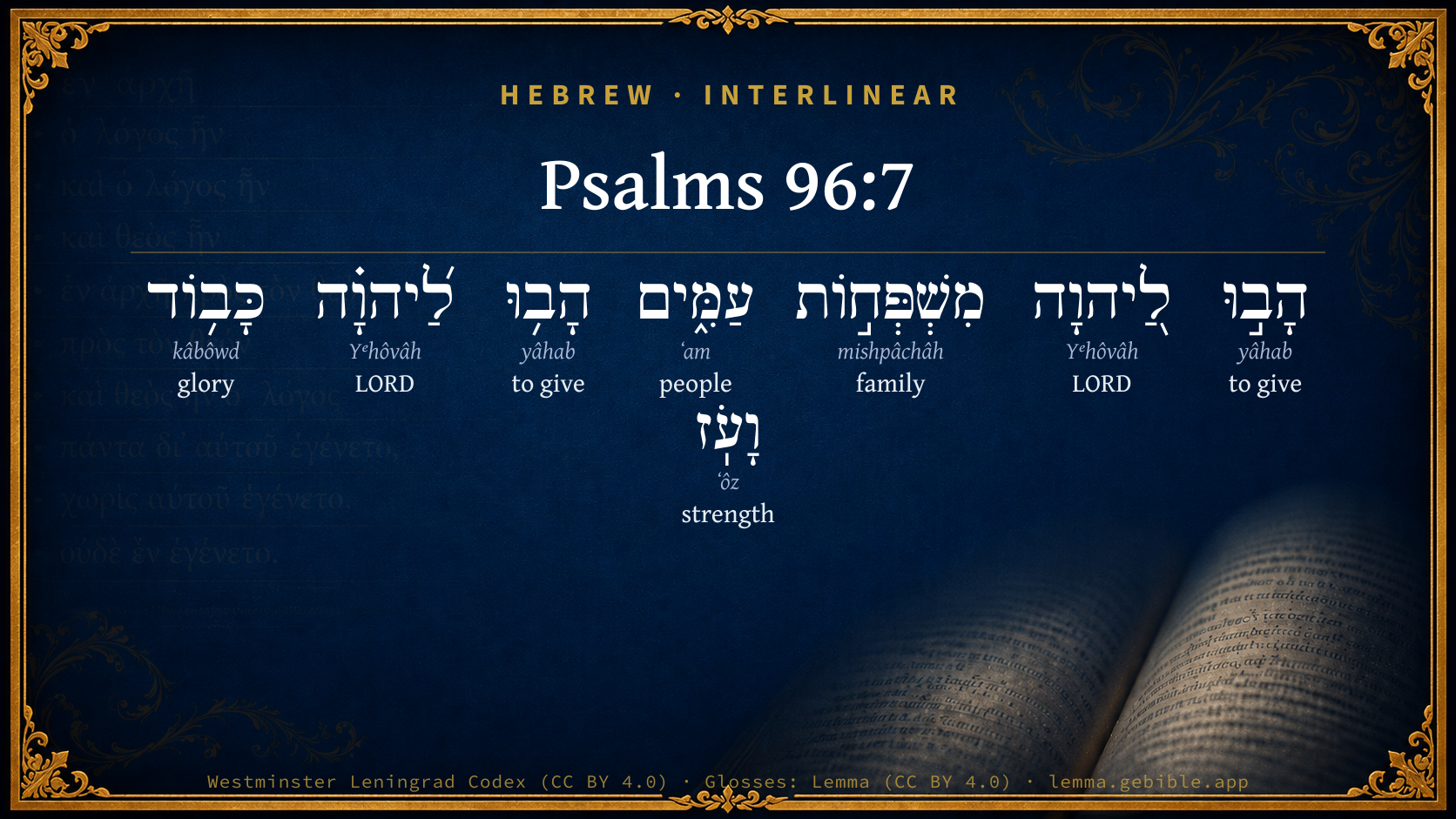
Psalms 96:7

Hebrew (Westminster Leningrad Codex) Psalms 96:7 appears in the Hebrew Old Testament. The text above is from the Westminster Leningrad Codex. Each word links to its Strong’s number, a concise gloss, and parsing drawn from the Open Scriptures Hebrew Bible morphology. Click any word for its full Brown-Driver-Briggs (BDB) entry.
Download image
Cite this verse

Psalms 96:7 (World English Bible). Public Domain. Lemma interlinear Bible study tool, https://lemma.gebible.app/v/psalms/96/7.

Show BibTeX & RIS
BibTeX
RIS
English Translation
Ascribe to Yahweh, you families of nations, Ascribe to Yahweh glory and strength.
World English Bible · Public Domain
Download a study sheet

One document with this verse’s original text, its word-by-word gloss line, the meaning frame, cross-references with their text, attributed commentary, and full source and license credits — printable, and it pastes into notes with its structure intact.

This verse Autodidact and up

Study sheet (.html) Plain text (.txt)

A passage Seminary Student

Up to 50 verses in one chapter. A passage sheet keeps up to 6 commentary sources and 12 cross-references per verse, in the order this page ranks them, and says so on the sheet whenever that leaves anything out. Ask for a single verse and you get the Autodidact verse sheet above.

Everything on this page stays free to read, with no account — the sheet is a download of what is already on screen, not access to it.

Want to remove ads? Support Godless Engineer
Compare translations 3

The same verse in 3 English versions, stacked beneath the original-language interlinear above. Click any original word for its lexicon entry.

Each is an independent rendering of the whole verse — the interlinear is not word-aligned to these translations.

Highlighted words mark where these versions differ — a whole-verse word diff, not a word-by-word alignment.

  • World English Bible Public Domain
    Ascribe to Yahweh, you families of nations, Ascribe to Yahweh glory and strength.
  • King James Version Public Domain
    Give unto the LORD, O ye kindreds of the people, give unto the LORD glory and strength.
  • unfoldingWord Literal Text CC BY-SA 4.0
    Ascribe to Yahweh, clans of peoples, ascribe to Yahweh glory and strength.

unfoldingWord Literal Text — © unfoldingWord, licensed CC BY-SA 4.0. Word-aligned USFM3 via Door43 (git.door43.org/unfoldingWord/en_ult).

Versions to compare (up to 4)

3 of 4 selected

Show all 18 translations

Every available English version of this verse, each an independent rendering of the whole verse.

  • World English Bible Public Domain
    Ascribe to Yahweh, you families of nations, Ascribe to Yahweh glory and strength.
  • Berean Standard Bible Public Domain
    Ascribe to the LORD, O families of the nations, ascribe to the LORD glory and strength.
  • Majority Standard Bible Public Domain
    Ascribe to the LORD, O families of the nations, ascribe to the LORD glory and strength.
  • King James Version Public Domain
    Give unto the LORD, O ye kindreds of the people, give unto the LORD glory and strength.
  • American Standard Version (1901) Public Domain
    Ascribe unto Jehovah, ye kindreds of the peoples, Ascribe unto Jehovah glory and strength.
  • Revised Version (1885) Public Domain
    Give unto the LORD, ye kindreds of the peoples, give unto the LORD glory and strength.
  • Geneva Bible (1599) Public Domain
    Giue vnto the Lord, ye families of the people: giue vnto the Lord glory and power.
  • Douay-Rheims (1899) Public Domain
    Bring ye to the Lord, O ye kindreds of the Gentiles, bring ye to the Lord glory and honour:
  • Young's Literal Translation Public Domain
    Ascribe to Jehovah, O families of the peoples, Ascribe to Jehovah honour and strength.
  • Literal Standard Version CC BY-SA 4.0
    Ascribe to YHWH, O families of the peoples, || Ascribe to YHWH glory and strength.
  • Unlocked Literal Bible CC BY-SA 4.0
    Ascribe to Yahweh, you clans of peoples, ascribe praise to Yahweh for his glory and strength.
  • unfoldingWord Literal Text CC BY-SA 4.0
    Ascribe to Yahweh, clans of peoples, ascribe to Yahweh glory and strength.
  • Darby Bible Public Domain
    Give unto Jehovah, ye families of peoples, give unto Jehovah glory and strength;
  • World Messianic Bible Public Domain
    Ascribe to the LORD, you families of nations, ascribe to the LORD glory and strength.
  • Webster's Bible Public Domain
    Give to the LORD, O ye kindreds of the people, give to the LORD glory and strength.
  • Free Bible Version CC BY-SA 4.0
    Give the Lord acclamation, nations of the world, acclaim him with glory and strength.
  • Bible in Basic English Public Domain
    Give to the Lord, O you families of the peoples, give to the Lord glory and strength.
  • JPS Tanakh (1917) Public Domain
    Ascribe unto the LORD, ye kindreds of the peoples, ascribe unto the LORD glory and strength.

Literal Standard Version (2020), Covenant Press — licensed CC BY-SA 4.0. Text via the HelloAO Bible API (eBible.org). Unlocked Literal Bible (unfoldingWord) — licensed CC BY-SA 4.0. Text via the HelloAO Bible API (eBible.org). unfoldingWord Literal Text — © unfoldingWord, licensed CC BY-SA 4.0. Word-aligned USFM3 via Door43 (git.door43.org/unfoldingWord/en_ult). Free Bible Version, Dr. Jonathan Gallagher — licensed CC BY-SA 4.0. Text via the HelloAO Bible API (eBible.org).

Word by word

More ways to search: Search by grammar → Find every occurrence → Compare this word →

Practice this passage: Drill this verse → Learn its vocabulary →

About this verse

These counts appear in no published source. They are computed here, from the morphology-tagged text and Lemma’s own curated glosses. What Lemma adds →

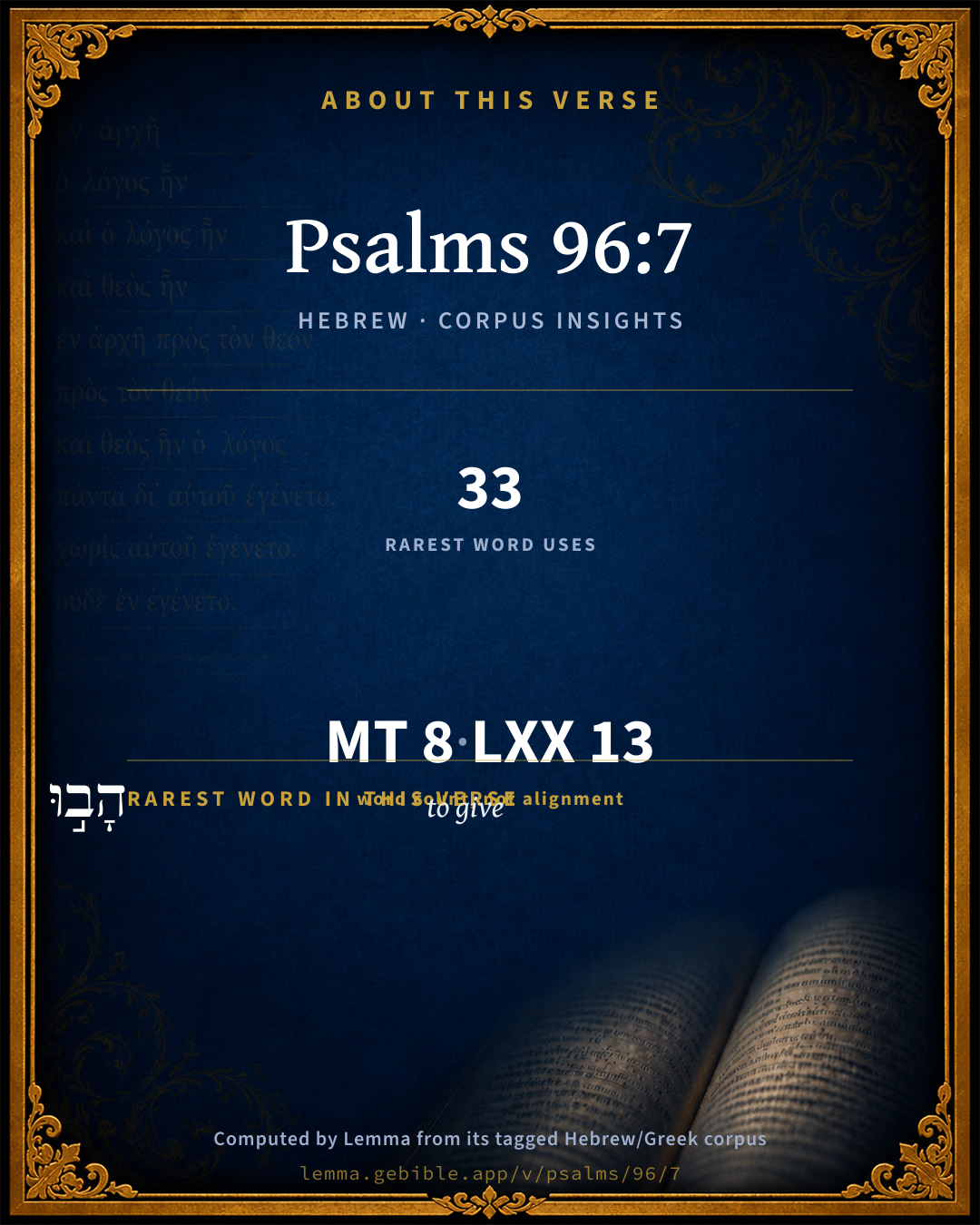
8
words
6
distinct lemmas
Wisdom
section

Shared distinctive vocabulary

הָב֣וּ to give H3051 occurs in 29 verses of the Hebrew Bible. Also found in:

Grammatical profile

  • 2 verbs
  • 6 nouns

Verb forms

  • הָב֣וּ Qal · Imperative
  • הָב֥וּ Qal · Imperative

Repetition

Words recur within this verse — often emphatic in Hebrew:

  • הָב֣וּ to give H3051 ×2
  • לַ֭יהוָה LORD H3068 ×2

Hebrew & Septuagint length

In English translation the verse runs 13 words from the Hebrew and 16 from the Septuagint (LXX English) — closely comparable.

A rough comparison of the two English renderings, which tokenize alike — not a word-level alignment.

Word counts can differ between the Hebrew and the Greek without any difference in meaning — e.g. the Hebrew direct-object marker אֵת has no separate Greek word, and Greek often adds the article ὁ.

In the original languages it is 8 Hebrew tokens and 13 Greek tokens — but the two are counted differently (Hebrew bundles its prefixes and suffixes into one token; the Greek is in lemma form), so that isn’t a like-for-like length.

Cross-references

17

Topical passages linked to Psalms 96:7 in the Treasury of Scripture Knowledge — connected by theme and wording, ordered by reader-vote popularity; previews shown in the World English Bible.

  • Revelation 19:1 After these things I heard something like a loud voice of a great multitude in heaven, saying, "Hallelujah! Salvation, power, and glory belong to our God:
  • Matthew 6:13 Bring us not into temptation, but deliver us from the evil one. For yours is the Kingdom, the power, and the glory forever. Amen.'
  • 1 Chronicles 29:11–13 Yours, Yahweh, is the greatness, the power, the glory, the victory, and the majesty: for all that is in the heavens and in the earth is yours. Yours is the kingdom, Yahweh, and you are exalted as head above all.
  • Revelation 5:9 They sang a new song, saying, "You are worthy to take the book, And to open its seals: For you were killed, And bought us for God with your blood, Out of every tribe, language, people, and nation,
  • Psalms 22:27 All the ends of the earth shall remember and turn to Yahweh. All the relatives of the nations shall worship before you.
  • Revelation 7:12 saying, "Amen! Blessing, glory, wisdom, thanksgiving, honor, power, and might, be to our God forever and ever! Amen."
  • Jude 1:24–25 Now to him who is able to keep them from stumbling, and to present you faultless before the presence of his glory in great joy,
  • Psalms 29:1–2 Ascribe to Yahweh, you sons of the mighty, Ascribe to Yahweh glory and strength.
  • Revelation 5:13 I heard every created thing which is in heaven, on the earth, under the earth, on the sea, and everything in them, saying, "To him who sits on the throne, and to the Lamb be the blessing, the honor, the glory, and the dominion, forever and ever! Amen!"
  • Psalms 67:3–4 Let the peoples praise you, God. Let all the peoples praise you.
  • Psalms 68:32–34 Sing to God, you kingdoms of the earth! Sing praises to the Lord! Selah.
  • Luke 2:14 "Glory to God in the highest, On earth peace, good will toward men."
  • Romans 15:9–10 and that the Gentiles might glorify God for his mercy. As it is written, "Therefore will I give praise to you among the Gentiles, And sing to your name."
  • 1 Peter 5:11 To him be the glory and the power forever and ever. Amen.
  • Revelation 14:7 He said with a loud voice, "Fear the Lord, and give him glory; for the hour of his judgment has come. Worship him who made the heaven, the earth, the sea, and the springs of waters!"
  • Revelation 19:6 I heard something like the voice of a great multitude, and like the voice of many waters, and like the voice of mighty thunders, saying, "Hallelujah! For the Lord our God, the Almighty, reigns!

Cross-references courtesy of OpenBible.info (CC BY 4.0).

Hebrew and Greek witnesses Masoretic Hebrew ↔ Greek Septuagint

The same verse in the two great witnesses to the Old Testament, shown verse-for-verse.

You’re reading Greek Psalm 95 (Hebrew Psalm 96). The Septuagint counts the superscription, so verse numbers can differ from the Hebrew — chapter-level alignment, not verse-by-verse. Numbering follows Rahlfs.

These are two independent witnesses, not word-aligned to each other, and the Septuagint is shown in lemma (dictionary) form.

Hebrew Psalms 96:7 Masoretic · Westminster Leningrad Codex

הָב֣וּ לַ֭יהוָה מִשְׁפְּח֣וֹת עַמִּ֑ים הָב֥וּ לַ֝יהוָ֗ה כָּב֥וֹד וָעֹֽז

Ascribe to Yahweh, you families of nations, Ascribe to Yahweh glory and strength.

World English Bible · Public Domain

Greek LXX Greek Psalm 95:7 Septuagint · lemma form

φέρω ὁ κύριος ὁ πατριά ὁ ἔθνος φέρω ὁ κύριος δόξα καί τιμή

Bring to the Lord, you⌃ families of the Gentiles, bring to the Lord glory and honor.

LXX2012 (modern English Septuagint) · Public Domain

On this verse, Keil & Delitzsch discusses the Septuagint’s reading. Read the note in Commentary ↓

Hebrew: Westminster Leningrad Codex (CC BY 4.0). Greek: Septuagint (public domain); English from LXX2012 (modern English Septuagint) (Public Domain). How the Septuagint differs from the Hebrew →

Commentary

Notes on Psalms 96:7 from classic Christian and Jewish commentators (each source and its license shown beneath its notes). The classic Christian expositions comment on the surrounding passage and are grouped to its opening verse, so a note may address several verses; the Jewish commentaries on the Tanakh (Rashi and others) are per-verse, so they appear only where the commentator wrote on this verse.

Lemma curates 59 commentaries, every one of them public domain or Creative Commons licensed, each selected and text-cleaned for this edition rather than reprinted as found. About our sources →

Trapp's Complete Commentary

John Trapp

Psa 96:7 Give unto the LORD, O ye kindreds of the people, give unto the LORD glory and strength.

Ver. 7. Give unto the Lord] See Psa 29:1-2. One rendereth it, Tribuite ponderose, unde יהב onus pondus portate; to show that our praises of God should be ponderous and substantial.

John Trapp, A Commentary or Exposition upon All the Books of the Old and New Testament (1647–1656) — public domain. Text from a community e-Sword module.

Joseph Benson's Commentary

Psa 96:7-9. Give unto the Lord, O ye kindreds of the people — O ye people, from whatsoever family ye come, or, O ye nations of the world, Give unto the Lord glory and strength — Ascribe to Jehovah that incomparable majesty, and supreme dominion and authority, which you have been wont to give to your imaginary gods. Give unto the Lord the glory due unto his name — Renouncing all your idols, acknowledge Jehovah alone to be the omnipotent king of all the world, and do him honour suitable to the excellence of his majesty. Bring an offering, and come into his courts — The courts of his house. Bring him an oblation, in token of your subjection to him; and humbly worship him in his temple. He speaks of the worship of the New Testament under the expressions of the Jewish worship, as the prophets elsewhere do: see Mal 1:11. O worship the Lord — O come and cast yourselves down before the Lord, in the beauty of holiness — In his sanctuary, where he hath fixed his glorious residence among us; or, rather, being clothed with all those holy ornaments, those gifts and graces, which are necessary and required in God’s worship. Fear before him, all the earth — Let all the people approach his presence with a holy fear and sacred reverence, standing in awe of, and dreading to offend, their sovereign Lord and King.

Joseph Benson's Commentary on the Old and New Testaments (1811–1818) — public domain. Text from a community e-Sword module.

J. A. Alexander on Psalms

Joseph Addison Alexander

7. (Psa 96:7) Give to Jehovah, ye families of nations, give to Jehovah glory and strength. Compare Psa 29:1. Here, as there, to give is to ascribe or recognise as belonging to him. The expression families of nations is Mosaic. See Gen 12:3. The parallel passage (1Ch 16:27) has, strength and joy (are) in his place.

Joseph Addison Alexander, The Psalms Translated and Explained (1850) — public domain. Text from a community e-Sword module.

Tyndale Open Study Notes

Tyndale Open Resources

96:7 nations of the world (literally families of the nations): Families and clans represent subdivisions of the nations (see Gen 12:3). • The nations must respond to the Lord’s glory (Pss 8:1; 19:1-4; 24:7).

Tyndale Open Study Notes — © Tyndale Open Resources, licensed CC BY-SA 4.0. Text via the HelloAO Bible API.

Geneva Bible (1599)

Geneva Bible translators

As by experience ye see that it is only due unto him.

Geneva Bible (1599) marginal notes — public domain. Text via Bolls.life.

Adam Clarke's Commentary

Verse 7. Ye kindreds of the people] Ye families, all the tribes of Israel in your respective divisions.

Adam Clarke's Commentary on the Bible (1810–1826) — public domain. Text from a community e-Sword/MySword module.

John Calvin's Commentaries

7 Give to Jehovah, etc. Since praise waited for God in Zion, (Psalm 65:1,) and that was the place devoted to the celebration of his worship, and the posterity of Abraham were alone invested with the privilege of priesthood, we cannot doubt that the Psalmist refers here to that great change which was to take place in the Church upon the advent of Christ. An opposition or distinction is intended between God’s ancient people and the Gentile tribes, which were to be afterwards adopted into the same fellowship. To declare his glory and strength, is the same with declaring the glory of his strength And to show that man can boast nothing of his own, and in refusing to celebrate God, impiously despoils him of his just honors, he subjoins, Give unto the Lord the glory of his name; an expression which denotes that God borrows nothing from without, but comprehends all that is worthy of praise in himself. He calls upon the Gentile nations in so many words to render unto God the same worship which the Jews did; not that we must worship God now according to the outward ritual which was prescribed under the Law, but he signifies that there would be one rule and form of religion in which all nations should accord. Now, unless the middle wall of partition had been broken down, the Gentiles could not have entered along with God’s children into the courts of the sanctuary. So that we have here a clear prediction of the calling of the Gentiles, who needed to have their uncleanness taken away before they could be brought into the holy assembly. The mincha, or oblation, was only one kind of sacrifice, but it is here taken to denote the whole worship of God, because it was a part of divine service more ordinarily practiced. We see from this, and other passages, that the inspired penmen describe the inward worship of God under symbols common in the age when they lived. God would not have meat-offerings presented to him after Christ had come; but the words which the Psalmist employs intimate that the doors of the temple, once shut, were now to be opened for the admission of the Gentiles. The Apostle, in his Epistle to the Hebrews, (Hebrews 13:15) tells us what are those sacrifices with which God will now be worshipped. Hence the absurdity of the Papists, who would adduce such passages in support of the mass and their other fooleries. We may very properly learn from the words, however, that we ought not to come empty-handed into the presence of God, enjoined as we are to present ourselves and all that we have as a reasonable service unto Him, (Romans 12:1; 1 Peter 2:5.)

John Calvin's Commentaries (1540-1563) — public domain. Text from the Calvin Translation Society English edition (1840s-50s) via the Christian Classics Ethereal Library (ccel.org). Calvin's coverage is partial (roughly two-thirds of the Bible); uncommented books and verses are honest gaps, never fabricated. The 19th-century editor's footnotes and remarks are omitted so the notes are faithfully Calvin's own voice.

Ellicott's Commentary for English Readers

(7-9) These verses are a relic of Psa_29:1-2, where see Notes, but instead of being addressed to the angels it is, in accordance with the world of new ideas and feelings in which Israel lived after the Captivity, addressed to all the people of the world. A truly Messianic character is thus impressed on the psalm.

A Bible Commentary for English Readers, edited by Charles John Ellicott (1878–1897) — public domain. Text from a community e-Sword module.

The Cambridge Bible for Schools and Colleges

gen. ed. J. J. S. Perowne

7. O ye kindreds of the people] Ye families of the peoples. Cp. Psa_22:27; Amo_3:2.

7–9. An appeal to the nations to acknowledge Jehovah. These verses are a free imitation of Psa_29:1-2.

The Cambridge Bible for Schools and Colleges (gen. ed. J. J. S. Perowne; Cambridge University Press, 1878–1918) — public domain. Text from a community e-Sword module.

John Gill's Exposition

Give unto the Lord, O ye kindreds of the people,.... Or families (p): the Targum is,

"give unto the Lord a song, ye families of the people;''

by whom are meant not the tribes and families of the people of Israel, but the Gentiles, the nations of the world, who were to be blessed in the seed of Abraham, the family of Egypt, and others; see Amo 3:2, Zac 14:17, even such as were chosen of them, taken out from among them for a people to his name; who were redeemed out of every kindred, tongue, people, and nation; and were taken, one of a city, and two of a family, and brought to Zion: give unto the Lord glory and strength; See Gill on Psa 29:1.

(p) "familiae", Pagninus, Montanus, Junius & Tremellius, Piscator, &c.

John Gill's Exposition of the Whole Bible (1746–1763) — public domain (CC PDM 1.0). Text via the HelloAO Bible API.

Albert Barnes' Notes on the Bible

Give unto the Lord - Ascribe unto the Lord - to Yahweh. This is extracted literally from 1Ch 16:28.

O ye kindreds of the people - Hebrew, “Families” of the people: people, as united by family ties. The idea is that of worship not merely as individuals, nor as a mere “aggregate” of individuals united by no common bonds, but as those united by strong ties; bound by blood and affection; constituted into communities. It is a call on such to worship God in their capacity as thus bound together; to come as families and to worship God. In other words, it is a call on families “as such” to acknowledge God. A family is a proper place where to honor God. When the same joy pervades all hearts in prosperity, and when all are alike made sorrowful in adversity, there is an evident fitness that all should unite in the same worship of God; and that, as in all other things they have common interests, sympathies, and affections, so they should have in religion - in the service of their Creator.

Give unto the Lord glory and strength - That is, Proclaim that these belong to God; or, worship him as a God of glory and power.

Albert Barnes' Notes on the Bible (1834–1885) — public domain. Text from a community e-Sword/MySword module.

Matthew Poole's English Annotations

O ye kindreds of the people; or, O ye families of the people of the world. And the word families may be understood either,

1. Strictly and properly; and so it may be intimated that this great blessing of salvation by Christ should not be imparted to whole nations, but only to some persons taken out of every people and nation, as it is expressed, Rev 5:9. Or,

2. More largely for nations, as it is taken, Gen 12:3; Jer 25:9; Zec 14:18; and so it may be implied that not only some few of the heathen people should be brought to the acknowledgment and worship of the true God, as was usual in the times of the Old Testament, but that whole nations should come in to the church of God together.

Give unto the Lord; ascribe to him, or acknowledge to be in him.

Matthew Poole's English Annotations on the Holy Bible (1683–1685) — public domain. Text from a community e-Sword/MySword module.

The Treasury of David

Charles H. Spurgeon

Ver. 7. The first six verses commenced with an exhortation to sing, three times repeated, with the name of the Lord thrice mentioned; here we meet with the expression

Give unto the Lord, used in the same triple manner. This is after the manner of those poets whose flaming sonnets have best won the ear of, the people, they reiterate choice words till they penetrate the soul and fire the heart. The invocation of the sweet singer is still addressed to all mankind, to whom he speaks as

Ye kindreds of the people. Divided into tribes and families, we are called in our courses and order to appear before him and ascribe to him all honour. "All worship be to God only, "is the motto of one of our City companies, and it may well be the motto of all the families upon earth. Family worship is peculiarly pleasing unto him who is the God of all the families of Israel.

Give unto the LORD glory and strength, that is to say, recognise the glory and power of Jehovah, and ascribe them unto him in your solemn hymns. Who is glorious but the Lord? Who is strong, save our God? Ye great nations who count yourselves both famous and mighty, cease your boastings! Ye monarchs, who are styled imperial and puissant, humble yourselves in the dust before the only Potentate. Glory and strength are nowhere to be found, save with the Lord, all others possess but the semblance thereof. Well did Massilion declare, "God alone is great."

Ver. 7 Ye kindreds of the people. There is a peculiar force, observes an early commentator Cassiodorus, in this phrase, "kindreds of the people, "much more than if we had the word "peoples" alone; for in every nation there are at all times strangers, aliens, sojourners abiding permanently or for a time, but not reckoned among the natives; while the phrase here includes all such, and provides that none shall be shut out because of his origin. Neale and Littledale.

Ver. 7. Ye kindreds of the people. He calls upon them to come in kindreds or families, in allusion to the Jewish custom of families coming by themselves, on the several festival days to worship in Jerusalem; and the Holy Ghost gives us here to understand that such custom was to serve as a model for Christians, whose families should unite in coming to the church to give glory and honour to God for all the wonderful things he accomplished in the redemption of man; for it was not by our own industry, or by our merits, that we have come to grace, and to be the adopted children of God, but through God's mercy, to whom, therefore, is due all honour and glory. Bellarmine.

Psalms 96:8*

Charles H. Spurgeon's The Treasury of David (1869–1885) — public domain. Psalms only. Text from a community e-Sword/MySword module.

Whedon's Commentary on the Bible

Daniel D. Whedon

7. Give… ye—The “give,” or ascribe, is uttered thrice, corresponding to “sing,” thrice repeated, (Psa_96:1-2,) expressive of the earnestness of the speaker. See Psa_29:1-2. The Chaldee has it, “Bring a new song to God.”

Kindreds of the people—Hebrew, Families of the nations. This accords with the breadth of the covenant. Compare “families of the earth,” (Gen_12:3; Gen_28:14,) which is the basis of the New Testament Church, as the family organization is also of the nation. The tendency of modern civilization and nationality is to restore the nations, according to the most ancient law, on the line of language and blood, see Gen_10:5; Gen_10:20; Gen_10:31-32, against the arbitrary combinations of ambition and conquest. Europe gives an example of this.

Daniel D. Whedon (gen. ed.), Commentary on the Old and New Testaments (1874–1909) — public domain. Text from a community e-Sword module.

The Pulpit Commentary

Give unto the Lord, O ye kindreds of the people; rather, O ye fatuities of the peoples. A renewed appeal to the heathen to join in the song of praise (comp. ver. 1). Give unto the Lord glory and strength. "Give" must be understood in the sense of "ascribe" (see Professor Cheyne"s translation, and compare the Prayer book Version). Both this and the next verse are echoes of Psa_29:1, Psa_29:2.

The Pulpit Commentary (1880–1919), ed. H.D.M. Spence-Jones & Joseph S. Exell — public domain. Text from a community e-Sword module.

Keil & Delitzsch

C. F. Keil & F. Delitzsch

Call to the families of the peoples to worship God, the One, living, and glorious God. הבוּ is repeated three times here as Psa 29:1-11, of which the whole strophe is an echo. Isaiah (ch. 60) sees them coming in with the gifts which they are admonished to bring with them into the courts of Jahve (in Chr. only: לפניו). Instead of בּהדרת קדשׁ here and in the chronicler, the lxx brings the courts (חצרת) in once more; but the dependence of the strophe upon Psa 29:1-11 furnishes a guarantee for the "holy attire," similar to the wedding garment in the New Testament parable. Instead of מפּניו, Psa 96:9, the chronicler has מלּפניו, just as he also alternates with both forms, Ch2 32:7, cf. Ch1 19:18.

Keil & Delitzsch — Biblical Commentary on the Old Testament (1861–1891) — public domain (CC PDM 1.0). Text via the HelloAO Bible API. (Old Testament only.)

unfoldingWord translationNotes

Door43 World Missions Community

Ascribe to Yahweh ... ascribe praise to Yahweh for his glory and strength

This can be restated to removed the abstract nouns "praise," "glory," and "strength." See how these words are translated in Psalms 29:1. AT: "Praise Yahweh ... praise Yahweh because he is glorious and strong" (See: Abstract Nouns)

Give to Yahweh the glory that his name deserves

The abstract noun "glory" can be stated as a verb or adjective. See how these words are translated in Psalms 29:2. AT: "Honor Yahweh just as his name deserves" or "Proclaim that Yahweh is glorious just as his name deserves" (See: Abstract Nouns)

his name deserves

Here "name" refers to the person of God. AT: "he deserves" (See: Metonymy)

his courts

the temple courtyard where the priests sacrificed animals to Yahweh

translationWords

clan

people group

glory

name

sacrifice

court

unfoldingWord translationNotes — © Distant Shores Media and the Door43 World Missions Community, licensed CC BY-SA 4.0. Source: git.door43.org/Door43/en_tn.

Rashi

Rabbi Shlomo Yitzchaki (Rashi)

Ascribe to the Lord, families of peoples And what shall you ascribe to Him? Ascribe to the Lord glory and might.

Rashi on the Tanakh — English translations: “The Judaica Press complete Tanach with Rashi, translated by A. J. Rosenberg” (CC BY 4.0); “Pentateuch with Rashi's commentary by M. Rosenbaum and A.M. Silbermann, 1929-1934” (public domain); “The Metsudah Tanach series, Lakewood, N.J” (CC BY 4.0); and “The Book of Joshua, Metsudah Publications, 1997” (CC BY 4.0). Text via Sefaria.

Lesson kit

Teaching starters — assembled from the data on this page, not authored interpretation. Every prompt links to the verse data it draws on. Edit before teaching.

Psalms, in the Wisdom, opens this verse with 8 words (6 distinct Hebrew lemmas). Its most distinctive word is yâhab (“to give”). A historical commentator’s framing appears above. Read the whole chapter for the surrounding context.

Discussion questions

  1. How does “to give” (yâhab) shape what this verse is saying?
  2. Genesis 11:3 shares the word «to give» with this verse. How do the two illuminate each other?
  3. “to give” occurs 2× in this one verse. What is the effect of the repetition?
  4. These translations render this verse differently. What is at stake in choosing one wording over another?
  5. The verb «הָב֣וּ» is Qal Imperative. How does its form color the action?
  6. Reading how Trapp's Complete Commentary and Joseph Benson's Commentary read this verse, where do the two commentators agree and where do they part?

Things to notice

Reading settings

Reading text

Shown beneath each verse's original-language words.

Old Testament
Old Testament edition

Read the OT as the Masoretic Hebrew (MT) or the Greek Septuagint (LXX).

English shown for the Greek Septuagint (in the Hebrew ↔ Greek comparison).

Comparing translations? Open the Compare panel on any verse page to stack up to four side by side.