
2 Samuel 18:2

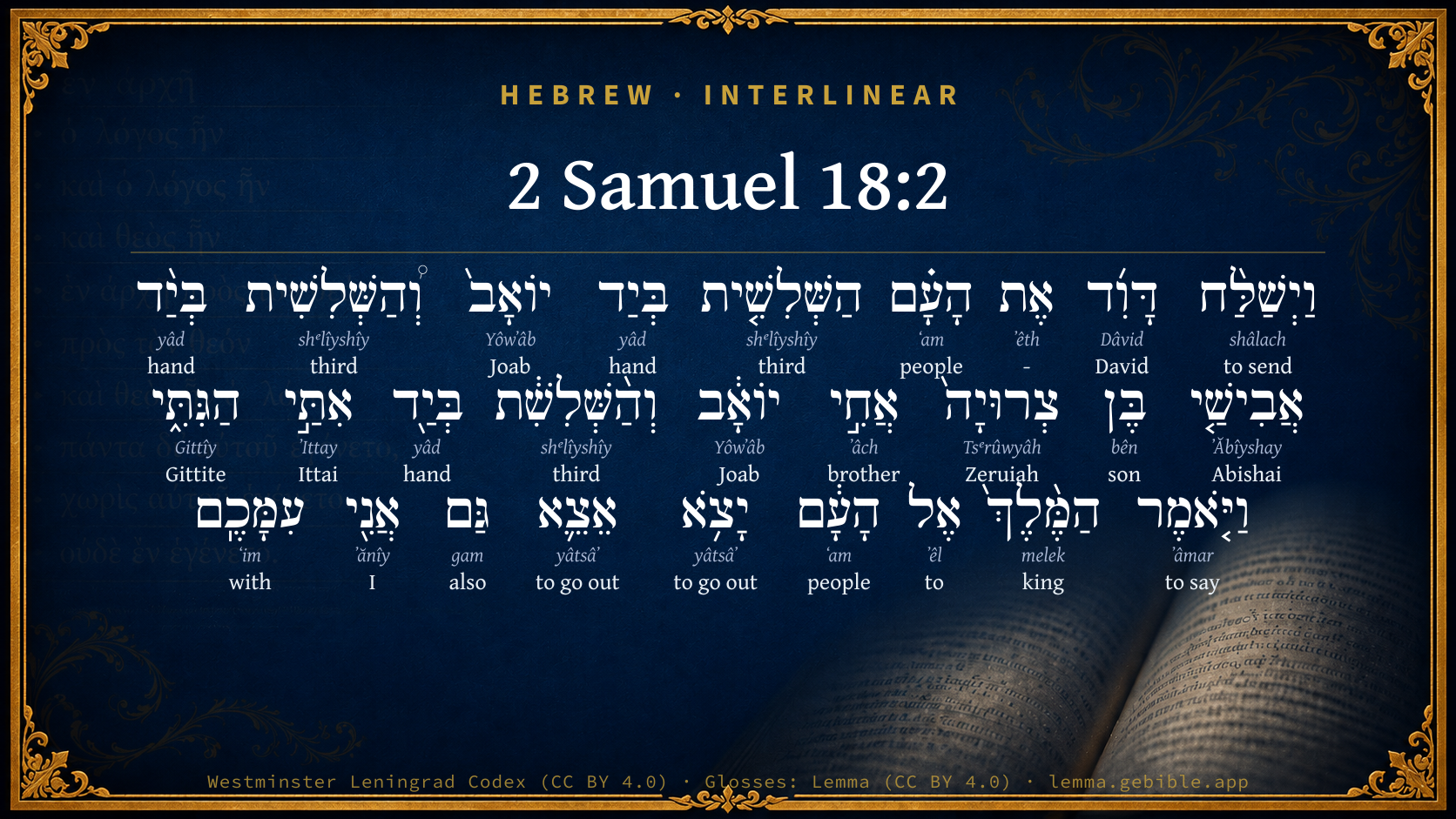
Hebrew (Westminster Leningrad Codex) 2 Samuel 18:2 appears in the Hebrew Old Testament. The text above is from the Westminster Leningrad Codex. Each word links to its Strong’s number, a concise gloss, and parsing drawn from the Open Scriptures Hebrew Bible morphology. Click any word for its full Brown-Driver-Briggs (BDB) entry.
Download image
Cite this verse

2 Samuel 18:2 (World English Bible). Public Domain. Lemma interlinear Bible study tool, https://lemma.gebible.app/v/2-samuel/18/2.

Show BibTeX & RIS
BibTeX
RIS
English Translation
David sent forth the people, a third part under the hand of Joab, and a third part under the hand of Abishai the son of Zeruiah, Joab's brother, and a third part under the hand of Ittai the Gittite. The king said to the people, I will surely go forth with you myself also.
World English Bible · Public Domain
Download a study sheet

One document with this verse’s original text, its word-by-word gloss line, the meaning frame, cross-references with their text, attributed commentary, and full source and license credits — printable, and it pastes into notes with its structure intact.

This verse Autodidact and up

Study sheet (.html) Plain text (.txt)

A passage Seminary Student

Up to 50 verses in one chapter. A passage sheet keeps up to 6 commentary sources and 12 cross-references per verse, in the order this page ranks them, and says so on the sheet whenever that leaves anything out. Ask for a single verse and you get the Autodidact verse sheet above.

Everything on this page stays free to read, with no account — the sheet is a download of what is already on screen, not access to it.

Want to remove ads? Support Godless Engineer
Compare translations 3

The same verse in 3 English versions, stacked beneath the original-language interlinear above. Click any original word for its lexicon entry.

Each is an independent rendering of the whole verse — the interlinear is not word-aligned to these translations.

Highlighted words mark where these versions differ — a whole-verse word diff, not a word-by-word alignment.

  • World English Bible Public Domain
    David sent forth the people, a third part under the hand of Joab, and a third part under the hand of Abishai the son of Zeruiah, Joab's brother, and a third part under the hand of Ittai the Gittite. The king said to the people, I will surely go forth with you myself also.
  • King James Version Public Domain
    And David sent forth a third part of the people under the hand of Joab, and a third part under the hand of Abishai the son of Zeruiah, Joab's brother, and a third part under the hand of Ittai the Gittite. And the king said unto the people, I will surely go forth with you myself also.
  • unfoldingWord Literal Text CC BY-SA 4.0
    And David sent out the people, a third in the hand of Joab and a third in the hand of Abishai, the son of Zeruiah, the brother of Joab, and a third in the hand of Ittai the Gittite. And the king said to the people, “Going out, I will go out, I too, with you.”

unfoldingWord Literal Text — © unfoldingWord, licensed CC BY-SA 4.0. Word-aligned USFM3 via Door43 (git.door43.org/unfoldingWord/en_ult).

Versions to compare (up to 4)

3 of 4 selected

Show all 18 translations

Every available English version of this verse, each an independent rendering of the whole verse.

  • World English Bible Public Domain
    David sent forth the people, a third part under the hand of Joab, and a third part under the hand of Abishai the son of Zeruiah, Joab's brother, and a third part under the hand of Ittai the Gittite. The king said to the people, I will surely go forth with you myself also.
  • Berean Standard Bible Public Domain
    He sent out the troops, a third under Joab, a third under Joab’s brother Abishai son of Zeruiah, and a third under Ittai the Gittite. And the king said to the troops, “I will surely march out with you as well.”
  • Majority Standard Bible Public Domain
    He sent out the troops, a third under Joab, a third under Joab’s brother Abishai son of Zeruiah, and a third under Ittai the Gittite. And the king said to the troops, “I will surely march out with you as well.”
  • King James Version Public Domain
    And David sent forth a third part of the people under the hand of Joab, and a third part under the hand of Abishai the son of Zeruiah, Joab's brother, and a third part under the hand of Ittai the Gittite. And the king said unto the people, I will surely go forth with you myself also.
  • American Standard Version (1901) Public Domain
    And David sent forth the people, a third part under the hand of Joab, and a third part under the hand of Abishai the son of Zeruiah, Joab's brother, and a third part under the hand of Ittai the Gittite. And the king said unto the people, I will surely go forth with you myself also.
  • Revised Version (1885) Public Domain
    And David sent forth the people, a third part under the hand of Joab, and a third part under the hand of Abishai the son of Zeruiah, Joab’s brother, and a third part under the hand of Ittai the Gittite. And the king said unto the people, I will surely go forth with you myself also.
  • Geneva Bible (1599) Public Domain
    And Dauid sent foorth the third part of the people vnder the hand of Ioab, and the thirde part vnder the hand of Abishai Ioabs brother the sonne of Zeruiah: and the other third part vnder the hand of Ittai the Gittite. and the King said vnto the people, I will go with you my selfe also.
  • Douay-Rheims (1899) Public Domain
    And sent forth a third part of the people under the hand of Joab, and a third part under the hand of Abisai the son of Sarvia Joab's brother, and a third part under the hand of Ethai, who was of Geth: and the king said to the people: I also will go forth with you.
  • Young's Literal Translation Public Domain
    and David sendeth the third of the people by the hand of Joab, and the third by the hand of Abishai, son of Zeruiah, brother of Joab, and the third by the hand of Ittai the Gittite, and the king saith unto the people, `I certainly go out -- I also -- with you.'
  • Literal Standard Version CC BY-SA 4.0
    and David sends the third of the people by the hand of Joab, and the third by the hand of Abishai, son of Zeruiah, brother of Joab, and the third by the hand of Ittai the Gittite, and the king says to the people, “I certainly go out—I also—with you.”
  • Unlocked Literal Bible CC BY-SA 4.0
    Then David sent out the army, one-third under the command of Joab, another third under the command of Abishai son of Zeruiah, Joab's brother, and still another third under the command of Ittai the Gittite. The king said to the army, “I will certainly go out with you myself, too.”
  • unfoldingWord Literal Text CC BY-SA 4.0
    And David sent out the people, a third in the hand of Joab and a third in the hand of Abishai, the son of Zeruiah, the brother of Joab, and a third in the hand of Ittai the Gittite. And the king said to the people, “Going out, I will go out, I too, with you.”
  • Darby Bible Public Domain
    And David sent forth the people, a third part under the hand of Joab, and a third part under the hand of Abishai the son of Zeruiah, Joab's brother, and a third part under the hand of Ittai the Gittite. And the king said to the people, I will surely go forth with you myself also.
  • World Messianic Bible Public Domain
    David sent the people out, a third part under the hand of Joab, and a third part under the hand of Abishai the son of Zeruiah, Joab’s brother, and a third part under the hand of Ittai the Gittite. The king said to the people, “I will also surely go out with you myself.”
  • Webster's Bible Public Domain
    And David sent forth a third part of the people under the hand of Joab, and a third part under the hand of Abishai the son of Zeruiah, Joab's brother, and a third part under the hand of Ittai the Gittite. And the king said to the people, I will surely go forth with you myself also.
  • Free Bible Version CC BY-SA 4.0
    David sent the army out divided into three sections. One third was commanded by Joab, one third was commanded by Abishai, son of Zeruiah, Joab's brother, and one third was commanded by Ittai the Gittite. The king told the men, “I myself will go out to battle with you.”
  • Bible in Basic English Public Domain
    And David sent the people out, a third of them under the orders of Joab, and a third under the orders of Abishai, son of Zeruiah, Joab's brother, and a third under Ittai the Gittite. And the king said to the people, And I myself will certainly go out with you.
  • JPS Tanakh (1917) Public Domain
    And David sent forth the people, a third part under the hand of Joab, and a third part under the hand of Abishai the son of Zeruiah, Joab's brother, and a third part under the hand of Ittai the Gittite. And the king said unto the people: 'I will surely go forth with you myself also.'

Literal Standard Version (2020), Covenant Press — licensed CC BY-SA 4.0. Text via the HelloAO Bible API (eBible.org). Unlocked Literal Bible (unfoldingWord) — licensed CC BY-SA 4.0. Text via the HelloAO Bible API (eBible.org). unfoldingWord Literal Text — © unfoldingWord, licensed CC BY-SA 4.0. Word-aligned USFM3 via Door43 (git.door43.org/unfoldingWord/en_ult). Free Bible Version, Dr. Jonathan Gallagher — licensed CC BY-SA 4.0. Text via the HelloAO Bible API (eBible.org).

Word by word

More ways to search: Search by grammar → Find every occurrence → Compare this word →

Practice this passage: Drill this verse → Learn its vocabulary →

אִתַּ֣י
ʼIttay
H863
“Ittai”
Noun, Proper
Part of Speech
Noun
Type
Proper
Full BDB Definition

Origin: from H854

TWOT: None

Ittai or Ithai = "with me" - a Gittite commander from Gath in David's army - one of David's 30 mighty warriors, a Benjamite
  1. וַיְשַׁלַּ֨ח shâlach H7971 “and · to send” Conjunction + Verb, Piel, Sequential Imperfect, 3rd Person, Masculine, Singular
  2. דָּוִ֜ד Dâvid H1732 “David” Noun, Proper
  3. אֶת ʼêth H853 “-” Particle, Direct Object
  4. הָעָ֗ם ʻam H5971 “the · people” Particle, Definite Article + Noun, Common, Masculine, Singular, Absolute
  5. הַשְּׁלִשִׁ֤ית shᵉlîyshîy H7992 “the · third” Particle, Definite Article + Noun, Common, Feminine, Singular, Absolute
  6. בְּיַד yâd H3027 “in/at · hand of” Preposition + Noun, Common, Both, Singular, Construct
  7. יוֹאָב֙ Yôwʼâb H3097 “Joab” Noun, Proper
  8. וְ֠הַשְּׁלִשִׁית shᵉlîyshîy H7992 “and · the · third” Conjunction + Particle, Definite Article + Noun, Common, Feminine, Singular, Absolute
  9. בְּיַ֨ד yâd H3027 “in/at · hand of” Preposition + Noun, Common, Both, Singular, Construct
  10. אֲבִישַׁ֤י ʼĂbîyshay H52 “Abishai” Noun, Proper
  11. בֶּן bên H1121 “son of” Noun, Common, Masculine, Singular, Construct
  12. צְרוּיָה֙ Tsᵉrûwyâh H6870 “Zeruiah” Noun, Proper
  13. אֲחִ֣י ʼâch H251 “brother of” Noun, Common, Masculine, Singular, Construct
  14. יוֹאָ֔ב Yôwʼâb H3097 “Joab” Noun, Proper
  15. וְהַ֨שְּׁלִשִׁ֔ת shᵉlîyshîy H7992 “and · the · third” Conjunction + Particle, Definite Article + Adjective, Ordinal number, Feminine, Singular, Absolute
  16. בְּיַ֖ד yâd H3027 “in/at · hand of” Preposition + Noun, Common, Both, Singular, Construct
  17. הַגִּתִּ֑י Gittîy H1663 “the · Gittite” Particle, Definite Article + Noun, Gentilic, Masculine, Singular, Absolute
  18. וַיֹּ֤אמֶר ʼâmar H559 “and · to say” Conjunction + Verb, Qal, Sequential Imperfect, 3rd Person, Masculine, Singular
  19. הַמֶּ֨לֶךְ֙ melek H4428 “the · king” Particle, Definite Article + Noun, Common, Masculine, Singular, Absolute
  20. אֶל ʼêl H413 “to” Preposition
  21. הָעָ֔ם ʻam H5971 “the · people” Particle, Definite Article + Noun, Common, Masculine, Singular, Absolute
  22. יָצֹ֥א yâtsâʼ H3318 “to go out” Verb, Qal, Infinitive Absolute
  23. אֵצֵ֛א yâtsâʼ H3318 “to go out” Verb, Qal, Imperfect, 1st Person, Common, Singular
  24. גַּם gam H1571 “also” Particle, Accusative
  25. אֲנִ֖י ʼănîy H589 “I” Pronoun, Personal, 1st Person, Common, Singular
  26. עִמָּכֶֽם ʻim H5973 “with · you” Preposition + Suffix, Personal, 2nd Person, Masculine, Plural

About this verse

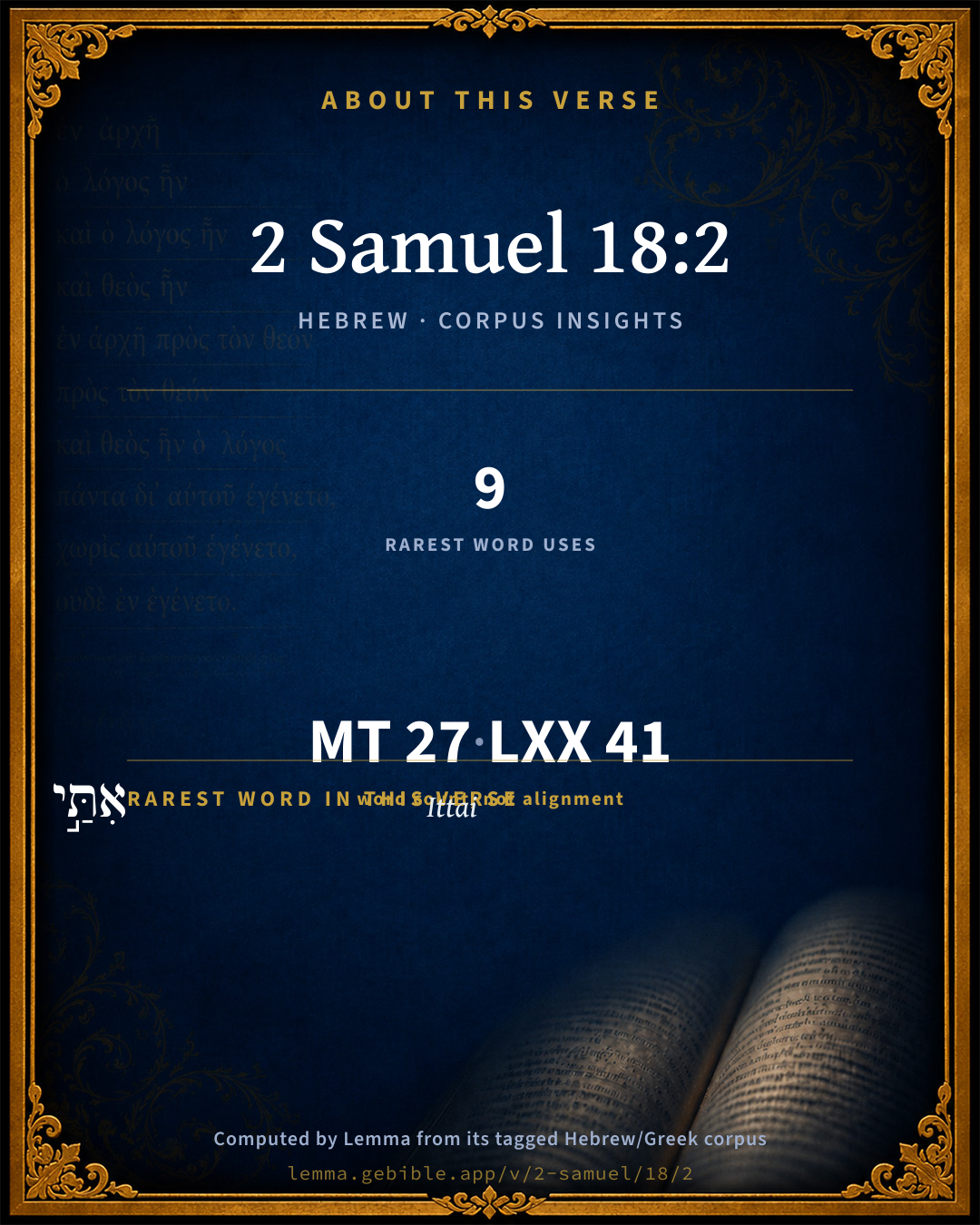
These counts appear in no published source. They are computed here, from the morphology-tagged text and Lemma’s own curated glosses. What Lemma adds →

27
words
20
distinct lemmas
Historical
section

Notable vocabulary

The rarest word here is אִתַּ֣י Ittai H863 — appearing just 9 times in the whole Hebrew Bible.

Shared distinctive vocabulary

אִתַּ֣י Ittai H863 occurs in 8 verses of the Hebrew Bible. Also found in:

Grammatical profile

  • 4 verbs
  • 17 nouns
  • 1 adjective
  • 1 pronoun
  • 2 prepositions
  • 2 particles

Verb forms

  • וַיְשַׁלַּ֨ח Piel · Sequential Imperfect
  • וַיֹּ֤אמֶר Qal · Sequential Imperfect
  • יָצֹ֥א Qal · Infinitive Absolute
  • אֵצֵ֛א Qal · Imperfect

Repetition

Words recur within this verse — often emphatic in Hebrew:

  • הַשְּׁלִשִׁ֤ית third H7992 ×3
  • בְּיַד hand H3027 ×3
  • הָעָ֗ם people H5971 ×2
  • יוֹאָב֙ Joab H3097 ×2
  • יָצֹ֥א to go out H3318 ×2

Hebrew & Septuagint length

In English translation the verse runs 54 words from the Hebrew and 56 from the Septuagint (LXX English) — closely comparable.

A rough comparison of the two English renderings, which tokenize alike — not a word-level alignment.

Word counts can differ between the Hebrew and the Greek without any difference in meaning — e.g. the Hebrew direct-object marker אֵת has no separate Greek word, and Greek often adds the article ὁ.

In the original languages it is 27 Hebrew tokens and 41 Greek tokens — but the two are counted differently (Hebrew bundles its prefixes and suffixes into one token; the Greek is in lemma form), so that isn’t a like-for-like length.

Cross-references

10

Topical passages linked to 2 Samuel 18:2 in the Treasury of Scripture Knowledge — connected by theme and wording, ordered by reader-vote popularity; previews shown in the World English Bible.

  • Judges 7:16 He divided the three hundred men into three companies, and he put into the hands of all of them trumpets, and empty pitchers, with torches within the pitchers.
  • 2 Samuel 15:19–22 Then said the king to Ittai the Gittite, Why go you also with us? return, and abide with the king: for you are a foreigner, and also an exile; [return] to your own place.
  • Judges 7:19 So Gideon, and the hundred men who were with him, came to the outermost part of the camp in the beginning of the middle watch, when they had but newly set the watch: and they blew the trumpets, and broke in pieces the pitchers that were in their hands.
  • Judges 9:43 He took the people, and divided them into three companies, and laid wait in the field; and he looked, and, behold, the people came forth out of the city; He rose up against them, and struck them.
  • 1 Samuel 11:11 It was so on the next day, that Saul put the people in three companies; and they came into the midst of the camp in the morning watch, and struck the Ammonites until the heat of the day: and it happened, that those who remained were scattered, so that no two of them were left together.
  • 2 Samuel 10:7–10 When David heard of it, he sent Joab, and all the host of the mighty men.
  • 2 Samuel 17:11 But I counsel that all Israel be gathered together to you, from Dan even to Beersheba, as the sand that is by the sea for multitude; and that you go to battle in your own person.
  • Psalms 3:6 I will not be afraid of tens of thousands of people Who have set themselves against me on every side.
  • Psalms 27:1–3 Yahweh is my light and my salvation. Whom shall I fear? Yahweh is the strength of my life. Of whom shall I be afraid?
  • Psalms 118:6–8 Yahweh is on my side. I will not be afraid. What can man do to me?

Cross-references courtesy of OpenBible.info (CC BY 4.0).

Hebrew and Greek witnesses Masoretic Hebrew ↔ Greek Septuagint

The same verse in the two great witnesses to the Old Testament, shown verse-for-verse.

These are two independent witnesses, not word-aligned to each other, and the Septuagint is shown in lemma (dictionary) form.

Hebrew 2 Samuel 18:2 Masoretic · Westminster Leningrad Codex

וַיְשַׁלַּ֨ח דָּוִ֜ד אֶת הָעָ֗ם הַשְּׁלִשִׁ֤ית בְּיַד יוֹאָב֙ וְ֠הַשְּׁלִשִׁית בְּיַ֨ד אֲבִישַׁ֤י בֶּן צְרוּיָה֙ אֲחִ֣י יוֹאָ֔ב וְהַ֨שְּׁלִשִׁ֔ת בְּיַ֖ד אִתַּ֣י הַגִּתִּ֑י וַיֹּ֤אמֶר הַמֶּ֨לֶךְ֙ אֶל הָעָ֔ם יָצֹ֥א אֵצֵ֛א גַּם אֲנִ֖י עִמָּכֶֽם

David sent forth the people, a third part under the hand of Joab, and a third part under the hand of Abishai the son of Zeruiah, Joab's brother, and a third part under the hand of Ittai the Gittite. The king said to the people, I will surely go forth with you myself also.

World English Bible · Public Domain

Greek LXX 2 Samuel 18:2 Septuagint · lemma form

καί ἀποστέλλω δαυίδ ὁ λαός ὁ τρίτος ἐν χείρ ιωαβ καί ὁ τρίτος ἐν χείρ αβεσσα υἱός σαρουιας ἀδελφός ιωαβ καί ὁ τρίτος ἐν χείρ εθθι ὁ γεθθαῖος καί εἶπον δαυίδ πρός ὁ λαός ἐκἔρχομαι ἐκἔρχομαι καί γέ ἐγώ μετά σύ

And David sent away the people, the third part under the hand of Joab, and the third part under the hand of Abessa the son of Saruia, the brother of Joab, and the third part under the hand of Ethi the Gittite. And David said to the people, I also will surely go out with you.

LXX2012 (modern English Septuagint) · Public Domain

Hebrew: Westminster Leningrad Codex (CC BY 4.0). Greek: Septuagint (public domain); English from LXX2012 (modern English Septuagint) (Public Domain). How the Septuagint differs from the Hebrew →

Targum (Aramaic paraphrase)

1

The Targum is the ancient Jewish Aramaic paraphrase of the Hebrew Scriptures — an interpretive translation, not the Hebrew text itself. Onkelos (literal) and Pseudo-Jonathan (expansive) render the Torah, and Jonathan the Prophets. Coverage is partial: where no permissively-licensed English translation exists for a verse, only the Aramaic is shown. This is verse-level text, not a word-by-word alignment to the Hebrew.

  1. Targum Jonathan Prophets (Joshua–Malachi)
    וּשְׁלַח דָוִד יַת עַמָא תִּלְתָּא בְיַד יוֹאָב וְתִלְתָּא בְּיַד אֲבִישַׁי בַּר צְרוּיָה אֲחוּהִי דְיוֹאָב וְתִלְתָּא בְּיַד אִתַּי גִתָּאָה וַאֲמַר מַלְכָּא לְעַמָא מִפַּק אֱפֹּק אַף אֲנָא עִמְכוֹן:

    (no public-domain English translation for this verse)

    Targum Jonathan — Aramaic: “Mikraot Gedolot” (public domain). English: “Sefaria Community Translation” (CC0 1.0 (public-domain dedication)); “London "Chaldee Paraphrase," 1871” (public domain). Text via Sefaria.

Commentary

Notes on 2 Samuel 18:2 from classic Christian and Jewish commentators (each source and its license shown beneath its notes). The classic Christian expositions comment on the surrounding passage and are grouped to its opening verse, so a note may address several verses; the Jewish commentaries on the Tanakh (Rashi and others) are per-verse, so they appear only where the commentator wrote on this verse.

Lemma curates 59 commentaries, every one of them public domain or Creative Commons licensed, each selected and text-cleaned for this edition rather than reprinted as found. About our sources →

Trapp's Complete Commentary

John Trapp

2Sa 18:2 And David sent forth a third part of the people under the hand of Joab, and a third part under the hand of Abishai the son of Zeruiah, Joab’s brother, and a third part under the hand of Ittai the Gittite. And the king said unto the people, I will surely go forth with you myself also.

Ver. 2. I will surely go forth with you myself also.] If he had done so when Joab went against Rabbah of the Ammonites, he had done well: for

“ Quaeritus Aeysthus quare sit factus adulter

In promptu causa est, desidiosus erat. ”

Nero, Commodus, Galienus, and other cowardly and voluptuous princes, are blamed for idling and rioting at home, when their armies were against the enemy. But it may well be thought, that this motion of David’s to go in person, was in favour of Absalom, and to see that he were not cut off by any of the army.

John Trapp, A Commentary or Exposition upon All the Books of the Old and New Testament (1647–1656) — public domain. Text from a community e-Sword module.

Ellicott's Commentary for English Readers

(2) Ittai the Gittite.—Comp. note on Jdg_15:19. The arrangement of the army in three divisions was common both among the Israelites (Jdg_7:16; Judg. 11:43; 1Sa_11:11) and their enemies (1Sa_13:17). Comp. also 2Ki_11:5-6; David proposed to take the chief command in person.

A Bible Commentary for English Readers, edited by Charles John Ellicott (1878–1897) — public domain. Text from a community e-Sword module.

The Cambridge Bible for Schools and Colleges

gen. ed. J. J. S. Perowne

2. sent forth … under the hand of Joab] Better, put … into the hand of Joab, i.e. under his command. The army does not take the field until 2Sa_18:6. The division of an army into three bodies seems to have been a common practice. See Jdg_7:16; Jdg_9:43; 1Sa_11:11. David intended to take the chief command in person.

The Cambridge Bible for Schools and Colleges (gen. ed. J. J. S. Perowne; Cambridge University Press, 1878–1918) — public domain. Text from a community e-Sword module.

John Gill's Exposition

And David sent forth a third part of the people under the hand of Joab,.... Very likely that which made the centre of the army, since Joab was the general of the army; though this distribution was made when David thought to have headed the army himself, and so made with respect to that:

and a third part under the hand of Abishai the son of Zeruiah, Joab's brother; who was next to Joab in the army, and fought with him against the Syrians and Ammonites, Sa2 10:10,

and a third part under the hand of Ittai the Gittite; of whom see Sa2 15:19; of these two parts consisted the right and left wings of the army:

and the king said unto the people; the soldiers, and particularly the officers:

I will surely go forth with you myself also; in which he seemed very resolute and peremptory; and this he proposed to do, not merely to animate the soldiers with his presence, and to show that he was willing to hazard his life with them, but chiefly for the sake of Absalom, to preserve his life, if possible.

John Gill's Exposition of the Whole Bible (1746–1763) — public domain (CC PDM 1.0). Text via the HelloAO Bible API.

Albert Barnes' Notes on the Bible

A third part - This seems to have been a favorite division with the Hebrew commanders (see Jdg 7:16; Jdg 9:43; 1Sa 11:11; 2Ki 11:5-6) and with the Philistines also 1Sa 13:17.

Albert Barnes' Notes on the Bible (1834–1885) — public domain. Text from a community e-Sword/MySword module.

Matthew Poole's English Annotations

Under the hand of Joab, to wit, for his especial conduct and management in the battle: otherwise Joab was the general of all the forces; nor had David yet taken away that power from him, nor was this a time to do it. But such distributions of forces are usual in battles.

I will surely go forth with you myself also, that by my presence I may put life and courage into my soldiers; and because it is fit I should run the same hazards with you, which you do for my sake.

Matthew Poole's English Annotations on the Holy Bible (1683–1685) — public domain. Text from a community e-Sword/MySword module.

Whedon's Commentary on the Bible

Daniel D. Whedon

2. Under the hand — Under the direction and generalship.

Ittai — Now rewarded for his loyalty with an important office. See on 2Sa_15:21.

Daniel D. Whedon (gen. ed.), Commentary on the Old and New Testaments (1874–1909) — public domain. Text from a community e-Sword module.

The Pulpit Commentary

A third part. Armies are usually divided into three divisions: a centre and two wings when drawn up for battle; a van, the main body. and a rearguard when on the march. But the Israelites had no settled rule upon the point, and. when occasion required, Joab divided his army into two. (2Sa_10:9, 2Sa_10:10) The reason of the threefold division in this case was that Ittai had brought his clan, or taf, with him, and as these would certainly not have fought under an Israelite leader, nor the Israelites under Ittai, David placed all foreigners under his command, while he gave his own nephews the command of the native troops. He thus avoided all jealousies; and Ittai"s men, honoured by being made a distinct portion of the army, would feel their reputation at stake, and would rival the Israelites in valour.

The Pulpit Commentary (1880–1919), ed. H.D.M. Spence-Jones & Joseph S. Exell — public domain. Text from a community e-Sword module.

Lesson kit

Teaching starters — assembled from the data on this page, not authored interpretation. Every prompt links to the verse data it draws on. Edit before teaching.

2 Samuel, in the Historical, opens this verse with 27 words (20 distinct Hebrew lemmas). Its most distinctive word is ʼIttay (“Ittai”). A historical commentator’s framing appears above. Read the whole chapter for the surrounding context.

Discussion questions

  1. How does “Ittai” (ʼIttay) shape what this verse is saying?
  2. 2 Samuel 15:19 shares the word «Ittai» with this verse. How do the two illuminate each other?
  3. “third” occurs 3× in this one verse. What is the effect of the repetition?
  4. The translations on this page render this verse differently — a whole-verse word diff, not a word-by-word alignment. What might account for the different wordings?
  5. The verb «וַיְשַׁלַּ֨ח» is Piel Sequential Imperfect. How does its form color the action?
  6. Reading how Trapp's Complete Commentary and Ellicott's Commentary for English Readers read this verse, where do the two commentators agree and where do they part?

Things to notice

Reading settings

Reading text

Shown beneath each verse's original-language words.

Old Testament
Old Testament edition

Read the OT as the Masoretic Hebrew (MT) or the Greek Septuagint (LXX).

English shown for the Greek Septuagint (in the Hebrew ↔ Greek comparison).

Comparing translations? Open the Compare panel on any verse page to stack up to four side by side.