2 Samuel 10:13

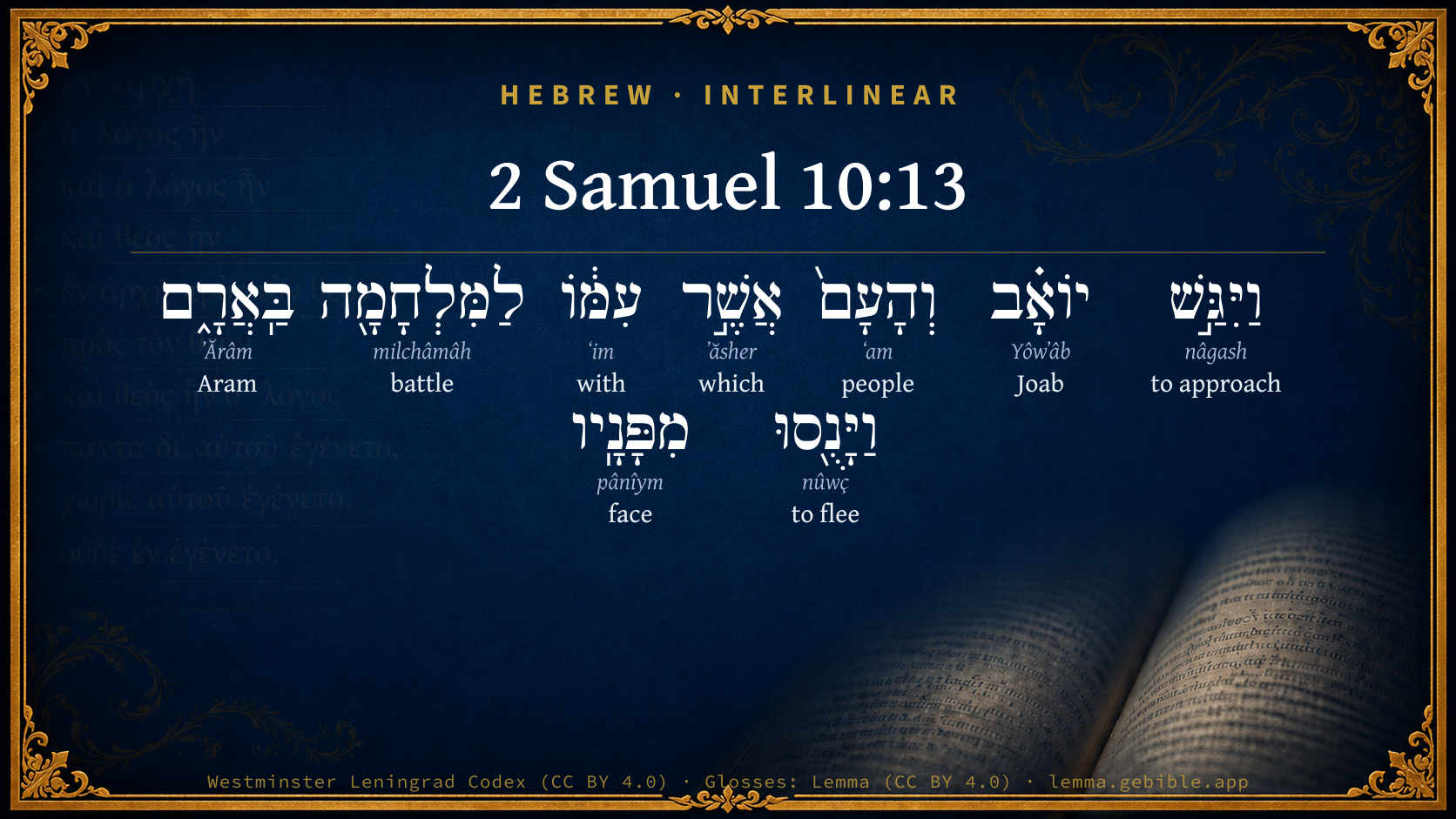
Hebrew (Westminster Leningrad Codex) 2 Samuel 10:13 appears in the Hebrew Old Testament. The text above is from the Westminster Leningrad Codex. Each word links to its Strong’s number, a concise gloss, and parsing drawn from the Open Scriptures Hebrew Bible morphology. Click any word for its full Brown-Driver-Briggs (BDB) entry.
Download image
Cite this verse

2 Samuel 10:13 (World English Bible). Public Domain. Lemma interlinear Bible study tool, https://lemma.gebible.app/v/2-samuel/10/13.

Show BibTeX & RIS
BibTeX
RIS
English Translation
So Joab and the people who were with him drew near to the battle against the Syrians: and they fled before him.
World English Bible · Public Domain
Download a study sheet

One document with this verse’s original text, its word-by-word gloss line, the meaning frame, cross-references with their text, attributed commentary, and full source and license credits — printable, and it pastes into notes with its structure intact.

This verse Autodidact and up

Study sheet (.html) Plain text (.txt)

A passage Seminary Student

Up to 50 verses in one chapter. A passage sheet keeps up to 6 commentary sources and 12 cross-references per verse, in the order this page ranks them, and says so on the sheet whenever that leaves anything out. Ask for a single verse and you get the Autodidact verse sheet above.

Everything on this page stays free to read, with no account — the sheet is a download of what is already on screen, not access to it.

Want to remove ads? Support Godless Engineer
Compare translations 3

The same verse in 3 English versions, stacked beneath the original-language interlinear above. Click any original word for its lexicon entry.

Each is an independent rendering of the whole verse — the interlinear is not word-aligned to these translations.

Highlighted words mark where these versions differ — a whole-verse word diff, not a word-by-word alignment.

  • World English Bible Public Domain
    So Joab and the people who were with him drew near to the battle against the Syrians: and they fled before him.
  • King James Version Public Domain
    And Joab drew nigh, and the people that were with him, unto the battle against the Syrians: and they fled before him.
  • unfoldingWord Literal Text CC BY-SA 4.0
    Then Joab and the people who with him approached for battle against Aram, and they fled from his face.

unfoldingWord Literal Text — © unfoldingWord, licensed CC BY-SA 4.0. Word-aligned USFM3 via Door43 (git.door43.org/unfoldingWord/en_ult).

Versions to compare (up to 4)

3 of 4 selected

Show all 18 translations

Every available English version of this verse, each an independent rendering of the whole verse.

  • World English Bible Public Domain
    So Joab and the people who were with him drew near to the battle against the Syrians: and they fled before him.
  • Berean Standard Bible Public Domain
    So Joab and his troops advanced to fight the Arameans, who fled before him.
  • Majority Standard Bible Public Domain
    So Joab and his troops advanced to fight the Arameans, who fled before him.
  • King James Version Public Domain
    And Joab drew nigh, and the people that were with him, unto the battle against the Syrians: and they fled before him.
  • American Standard Version (1901) Public Domain
    So Joab and the people that were with him drew nigh unto the battle against the Syrians: and they fled before him.
  • Revised Version (1885) Public Domain
    So Joab and the people that were with him drew nigh unto the battle against the Syrians: and they fled before him.
  • Geneva Bible (1599) Public Domain
    Then Ioab, and the people that was with him, ioyned in battel with the Aramites, who fled before him.
  • Douay-Rheims (1899) Public Domain
    And Joab and the people that were with him, began to fight against the Syrians: and they immediately fled before him.
  • Young's Literal Translation Public Domain
    And Joab draweth nigh, and the people who `are' with him, to battle against Aram, and they flee from his presence;
  • Literal Standard Version CC BY-SA 4.0
    And Joab draws near, and the people who [are] with him, to battle against Aram, and they flee from his presence;
  • Unlocked Literal Bible CC BY-SA 4.0
    So Joab and the soldiers of his army advanced to the battle against the Arameans, who were forced to flee before the army of Israel.
  • unfoldingWord Literal Text CC BY-SA 4.0
    Then Joab and the people who with him approached for battle against Aram, and they fled from his face.
  • Darby Bible Public Domain
    And Joab drew near, and the people that were with him, unto the battle against the Syrians; and they fled before him.
  • World Messianic Bible Public Domain
    So Joab and the people who were with him came near to the battle against the Syrians, and they fled before him.
  • Webster's Bible Public Domain
    And Joab and the people that were with him drew near to the battle against the Syrians: and they fled before him.
  • Free Bible Version CC BY-SA 4.0
    Joab attacked the Arameans with his forces and they ran away from him.
  • Bible in Basic English Public Domain
    Then Joab and the people with him went forward to the fight against the Aramaeans, and they went in flight before him.
  • JPS Tanakh (1917) Public Domain
    So Joab and the people that were with him drew nigh unto the battle against the Arameans; and they fled before him.

Literal Standard Version (2020), Covenant Press — licensed CC BY-SA 4.0. Text via the HelloAO Bible API (eBible.org). Unlocked Literal Bible (unfoldingWord) — licensed CC BY-SA 4.0. Text via the HelloAO Bible API (eBible.org). unfoldingWord Literal Text — © unfoldingWord, licensed CC BY-SA 4.0. Word-aligned USFM3 via Door43 (git.door43.org/unfoldingWord/en_ult). Free Bible Version, Dr. Jonathan Gallagher — licensed CC BY-SA 4.0. Text via the HelloAO Bible API (eBible.org).

Word by word

More ways to search: Search by grammar → Find every occurrence → Compare this word →

Practice this passage: Drill this verse → Learn its vocabulary →

וַיִּגַּ֣שׁ
nâgash
H5066
“and · to approach”
Conjunction + Verb, Qal, Sequential Imperfect, 3rd Person, Masculine, Singular
Part of Speech
Conjunction + Verb
Stem
Qal
Form
Sequential Imperfect
Person
3rd Person
Gender
Masculine
Number
Singular
Full BDB Definition

Origin: a primitive root

TWOT: 1297

to draw near, approach - (Qal) to draw or come near - of humans - of sexual intercourse - of inanimate subject - to approach one another - (Niphal) to draw near - (Hiphil) to cause to approach, bring near, bring - (Hophal) to be brought near - (Hithpael) to draw near
  1. יוֹאָ֗ב Yôwʼâb H3097 “Joab” Noun, Proper
  2. וְהָעָם֙ ʻam H5971 “and · the · people” Conjunction + Particle, Definite Article + Noun, Common, Masculine, Singular, Absolute
  3. אֲשֶׁ֣ר ʼăsher H834 “which” Particle, Relative
  4. עִמּ֔וֹ ʻim H5973 “with · him” Preposition + Suffix, Personal, 3rd Person, Masculine, Singular
  5. לַמִּלְחָמָ֖ה milchâmâh H4421 “to/for the · battle” Preposition, Determined + Noun, Common, Feminine, Singular, Absolute
  6. בַּֽאֲרָ֑ם ʼĂrâm H758 “in/at · Aram” Preposition + Noun, Proper
  7. וַיָּנֻ֖סוּ nûwç H5127 “and · to flee” Conjunction + Verb, Qal, Sequential Imperfect, 3rd Person, Masculine, Plural
  8. מִפָּנָֽיו pânîym H6440 “from · face(s) · his” Preposition + Noun, Common, Both, Plural, Construct + Suffix, Personal, 3rd Person, Masculine, Singular

About this verse

These counts appear in no published source. They are computed here, from the morphology-tagged text and Lemma’s own curated glosses. What Lemma adds →

9
words
9
distinct lemmas
Historical
section

Grammatical profile

  • 2 verbs
  • 5 nouns
  • 1 preposition
  • 1 particle

Verb forms

  • וַיִּגַּ֣שׁ Qal · Sequential Imperfect
  • וַיָּנֻ֖סוּ Qal · Sequential Imperfect

Hebrew & Septuagint length

In English translation the verse runs 22 words from the Hebrew and 18 from the Septuagint (LXX English) — closely comparable.

A rough comparison of the two English renderings, which tokenize alike — not a word-level alignment.

Word counts can differ between the Hebrew and the Greek without any difference in meaning — e.g. the Hebrew direct-object marker אֵת has no separate Greek word, and Greek often adds the article ὁ.

Cross-references

4

Topical passages linked to 2 Samuel 10:13 in the Treasury of Scripture Knowledge — connected by theme and wording, ordered by reader-vote popularity; previews shown in the World English Bible.

  • 1 Kings 20:13–21 Behold, a prophet came near to Ahab king of Israel, and said, Thus says Yahweh, Have you seen all this great multitude? behold, I will deliver it into your hand this day; and you shall know that I am Yahweh.
  • 1 Kings 20:28–30 A man of God came near and spoke to the king of Israel, and said, Thus says Yahweh, Because the Syrians have said, Yahweh is a god of the hills, but he is not a god of the valleys; therefore will I deliver all this great multitude into your hand, and you shall know that I am Yahweh.
  • 1 Chronicles 19:14–15 So Joab and the people who were with him drew near before the Syrians to the battle; and they fled before him.
  • 2 Chronicles 13:5–16 Ought you not to know that Yahweh, the God of Israel, gave the kingdom over Israel to David forever, even to him and to his sons by a covenant of salt?

Cross-references courtesy of OpenBible.info (CC BY 4.0).

Hebrew and Greek witnesses Masoretic Hebrew ↔ Greek Septuagint

The same verse in the two great witnesses to the Old Testament, shown verse-for-verse.

These are two independent witnesses, not word-aligned to each other, and the Septuagint is shown in lemma (dictionary) form.

Hebrew 2 Samuel 10:13 Masoretic · Westminster Leningrad Codex

וַיִּגַּ֣שׁ יוֹאָ֗ב וְהָעָם֙ אֲשֶׁ֣ר עִמּ֔וֹ לַמִּלְחָמָ֖ה בַּֽאֲרָ֑ם וַיָּנֻ֖סוּ מִפָּנָֽיו

So Joab and the people who were with him drew near to the battle against the Syrians: and they fled before him.

World English Bible · Public Domain

Greek LXX 2 Samuel 10:13 Septuagint · lemma form

καί προςἔρχομαι ιωαβ καί ὁ λαός αὐτός μετά αὐτός εἰς πόλεμος πρός συρία καί φεύγω ἀπό πρόσωπον αὐτός

And Joab and his people with him advanced to battle against Syria, and they fled from before him.

LXX2012 (modern English Septuagint) · Public Domain

Hebrew: Westminster Leningrad Codex (CC BY 4.0). Greek: Septuagint (public domain); English from LXX2012 (modern English Septuagint) (Public Domain). How the Septuagint differs from the Hebrew →

Targum (Aramaic paraphrase)

1

The Targum is the ancient Jewish Aramaic paraphrase of the Hebrew Scriptures — an interpretive translation, not the Hebrew text itself. Onkelos (literal) and Pseudo-Jonathan (expansive) render the Torah, and Jonathan the Prophets. Coverage is partial: where no permissively-licensed English translation exists for a verse, only the Aramaic is shown. This is verse-level text, not a word-by-word alignment to the Hebrew.

  1. Targum Jonathan Prophets (Joshua–Malachi)
    וּקְרֵיב יוֹאָב וְעַמָא דִי עִמֵיהּ לְאַגָחָא קְרָבָא בֶּאֱנַשׁ אֲרָם וְאַפִּיכוּ מִן קֳדָמוֹהִי:

    (no public-domain English translation for this verse)

    Targum Jonathan — Aramaic: “Mikraot Gedolot” (public domain). English: “Sefaria Community Translation” (CC0 1.0 (public-domain dedication)); “London "Chaldee Paraphrase," 1871” (public domain). Text via Sefaria.

Commentary

Notes on 2 Samuel 10:13 from classic Christian and Jewish commentators (each source and its license shown beneath its notes). The classic Christian expositions comment on the surrounding passage and are grouped to its opening verse, so a note may address several verses; the Jewish commentaries on the Tanakh (Rashi and others) are per-verse, so they appear only where the commentator wrote on this verse.

Lemma curates 59 commentaries, every one of them public domain or Creative Commons licensed, each selected and text-cleaned for this edition rather than reprinted as found. About our sources →

Trapp's Complete Commentary

John Trapp

2Sa 10:13 And Joab drew nigh, and the people that [were] with him, unto the battle against the Syrians: and they fled before him.

Ver. 13. And they fled before him.] As not able to endure so fierce an assault of those most warlike soldiers, the flower of the whole army, - no, not the first shock. How many of them were slain is not said: fight any longer they would not, and to flee they were better prepared by their chariots, than the Israelites were to pursue them.

John Trapp, A Commentary or Exposition upon All the Books of the Old and New Testament (1647–1656) — public domain. Text from a community e-Sword module.

The Biblical Illustrator

Joseph S. Exell

2Sa_10:13

And Joab drew near, and the people that were with him unto the battle.

Victory

It is one thing, when men may either fight or fly, and another when they must either fight or die. The Syrians in the battle referred to in the text had their option to fight or fly, for that otherwise they must either fight or die. Hard-pressed by the valour and obstinacy of the forces of Joab, they fled back into their own city Medeba, a town in their borders, before which they pitched to guard their coast. What was the result of the victory over the Syrians referred to in the text? What but the fulfilment of the promise made to Abraham (the fifteenth chapter of Genesis and the eighteenth verse), and repeated to Joshua (first chapter and the fourth verse) that the borders of Israel should extend to the river Euphrates? From the wilderness and this Lebanon, said God, even unto the great river, the river Euphrates, all the land of the Hittites, and unto the great sea toward the going down of the sun, shall be your coast. Little did the Syrians know, and little knew the Ammonites, and faintly also must David have known the purposes of the Almighty that were bound up in the war. Still those purposes were fixed, and the Lord in His own good time proved that Himself had gained the victory; for on the banks of the Euphrates, as by the sides of Jordan, were hallelujahs raised to the King of Israel, the King of kings and Lord of lords, who above all reigns and will reign omnipotent, making the wrath of man to praise Him. But the flight of the Syrians and their discomfiture at Medeba did not immediately, as we might imagine, result in peace. They were like most other barbarous and rapacious nations, dogged, infatuated, and obstinate to the last. We would have thought that the defeat they experienced, even in their own country and before their stronghold, would have taught them a lesson, and induced them to make overtures of peace. But no; they make a new attempt to recover their lost honour, and to check the progress of Davids victorious arms. The forces that were lately dispersed rallied again, and as we read in the fifteenth verse, gathered themselves together. Again, we have seen that Joab, before the battle, supposed the worst, that one of them should be obliged to give back; and in that case that the other, upon a given signal, should send a detachment to relieve it: If occasion be, thou shalt help me, and I will help thee. Here is an acknowledgment of mutual helplessness and mutual helpfulness. Are the soldiers of Christ strengthening one anothers hands in their spiritual warfare--the strong- succouring and helping the weak? Are those who through grace have been conquerors over temptation, counselling, comforting, and praying for those who are tempted? I have prayed for thee, said Christ to Peter, that thy faith fail not: and when thou art converted, strengthen thy brethren. (G. M. Irvine, M. A.)

.

The Biblical Illustrator, edited by Joseph S. Exell (c. 1880s–1900s) — public domain. Text from a community e-Sword module.

Joseph Benson's Commentary

2Sa 10:13-14. Joab drew nigh unto battle against the Syrians — He acted very wisely in assaulting the mercenary army first; for they that are hired to fight generally take great care to save themselves, having little regard to the cause for which they fight. Then fled they also — They seem not to have struck a stroke, but provided for their safety by retiring into the city, near to which their army was drawn up. So Joab returned — Here is no account of the number of the slain, who, probably, were few, because they did not fight, but flee. The year also seems to have been so far spent that it was not a fit season for laying siege to the city. See 2Sa 11:1.

Joseph Benson's Commentary on the Old and New Testaments (1811–1818) — public domain. Text from a community e-Sword module.

Ellicott's Commentary for English Readers

(13) Against the Syrians.—The attack was begun, not against both parts of the foe at once, but Joab threw the weight of his forces against the stronger division of the enemy while Abishai watched and held in check the Ammonites. His tactics were completely successful. The Syrians fled, and the Ammonites, seeing that the whole army of Israel could now be thrown upon them, retired precipitately into the city.

A Bible Commentary for English Readers, edited by Charles John Ellicott (1878–1897) — public domain. Text from a community e-Sword module.

The Cambridge Bible for Schools and Colleges

gen. ed. J. J. S. Perowne

13. they fled before him] “They that are hired to fight generally have a great care to save themselves, having no regard to the cause for which they fight.” Patrick.

The Cambridge Bible for Schools and Colleges (gen. ed. J. J. S. Perowne; Cambridge University Press, 1878–1918) — public domain. Text from a community e-Sword module.

John Gill's Exposition

And Joab drew nigh, and the people that were with him, unto the battle against the Syrians,.... Fell upon them; attacked them first, began the battle with them; rightly judging, that if they, being hired soldiers, were closely pressed, they would give way, which would discourage the Ammonites, who depended much upon them; and the fight, according to Josephus (x), lasted some little time, who says, that Joab killed many of them, and obliged the rest to turn their backs and flee, as follows:

and they fled before him: the Syriac and Arabic versions in this verse, and in all others in this chapter where the word "Syrians" is used, have "Edomites", reading "Edom" instead of "Aram", the letters "R" and "D" in the Hebrew tongue being very similar.

(x) Ut supra. (Antiqu. l. 7. c. 6. sect. 2.)

John Gill's Exposition of the Whole Bible (1746–1763) — public domain (CC PDM 1.0). Text via the HelloAO Bible API.

Haydock's Catholic Bible Commentary

CHAPTER X.

George Leo Haydock (1774–1849), Haydock's Catholic Family Bible and Commentary, 1859 edition — public domain. Excludes Psalms (Douay-Rheims chapter numbering differs from Protestant) and Deuterocanonical books (Catholic canon only).

Matthew Poole's English Annotations

He prudently falls upon them first, because they were but mercenaries, and not concerned so much in the success as the Ammonites were, all whose interest lay at stake; and therefore not likely to venture too far in their defence.

Matthew Poole's English Annotations on the Holy Bible (1683–1685) — public domain. Text from a community e-Sword/MySword module.

unfoldingWord translationNotes

Door43 World Missions Community

from Abishai

Here Abishai represents himself and his soldiers. AT: "from Abishai and his soldiers" (See: Synecdoche)

into the city

Here "the city" refers to Rabbah, the capital city of the Ammonites.

went back to Jerusalem

"returned to Jerusalem"

translationWords

Jerusalem

unfoldingWord translationNotes — © Distant Shores Media and the Door43 World Missions Community, licensed CC BY-SA 4.0. Source: git.door43.org/Door43/en_tn.

Lesson kit

Teaching starters — assembled from the data on this page, not authored interpretation. Every prompt links to the verse data it draws on. Edit before teaching.

2 Samuel, in the Historical, opens this verse with 9 words (9 distinct Hebrew lemmas). Its most distinctive word is nâgash (“to approach”). A historical commentator’s framing appears above. Read the whole chapter for the surrounding context.

Discussion questions

  1. What does “to approach” (nâgash) contribute to the verse as a whole?
  2. 1 Kings 20:13–21 shares this passage’s theme. How do the two illuminate each other?
  3. The translations on this page render this verse differently — a whole-verse word diff, not a word-by-word alignment. What might account for the different wordings?
  4. The verb «וַיִּגַּ֣שׁ» is Qal Sequential Imperfect. How does its form color the action?
  5. Reading how Trapp's Complete Commentary and The Biblical Illustrator read this verse, where do the two commentators agree and where do they part?

Things to notice

Reading settings

Reading text

Shown beneath each verse's original-language words.

Old Testament
Old Testament edition

Read the OT as the Masoretic Hebrew (MT) or the Greek Septuagint (LXX).

English shown for the Greek Septuagint (in the Hebrew ↔ Greek comparison).

Comparing translations? Open the Compare panel on any verse page to stack up to four side by side.