
Deuteronomy 10:11

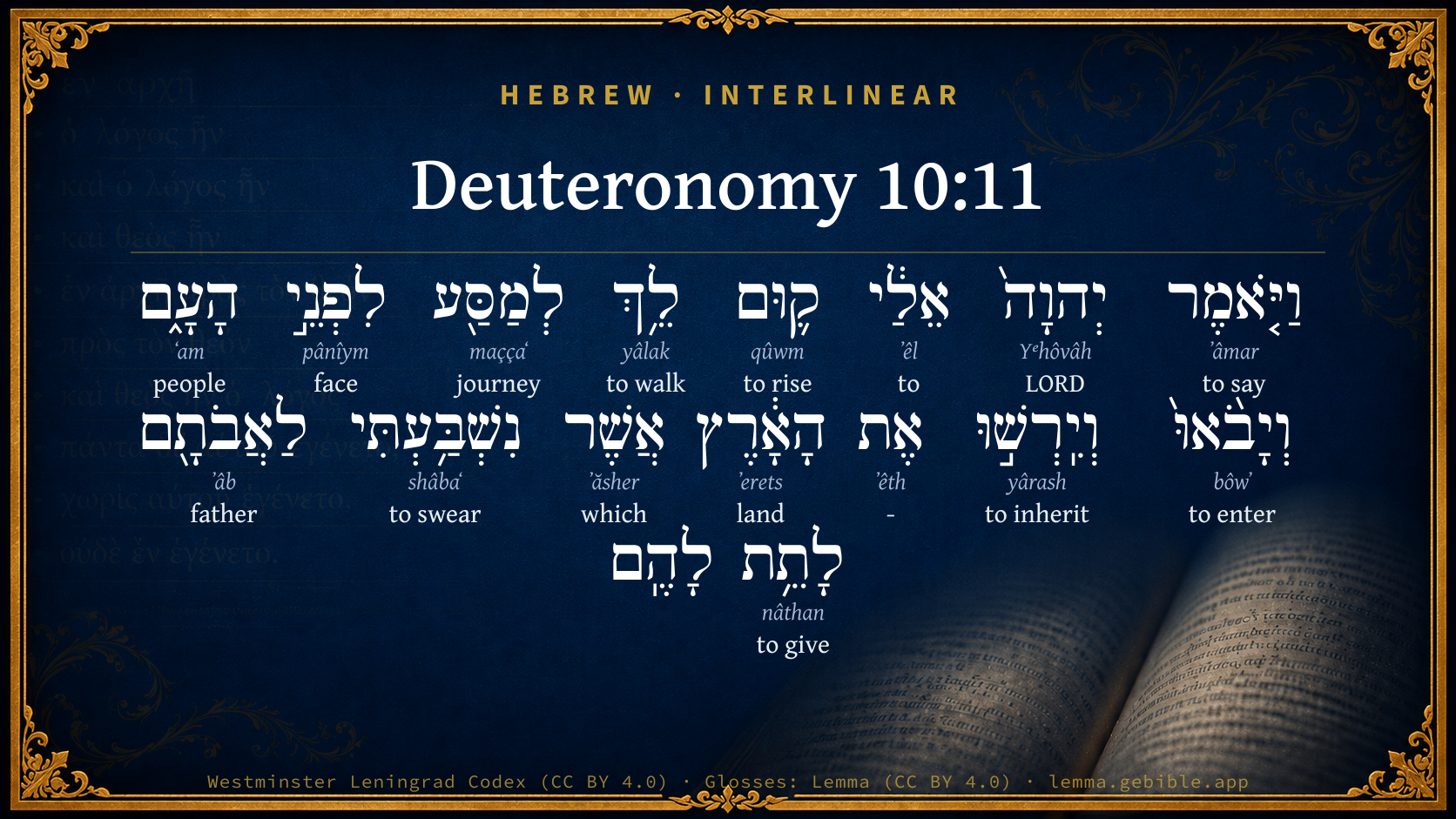
Hebrew (Westminster Leningrad Codex) Deuteronomy 10:11 appears in the Hebrew Old Testament. The text above is from the Westminster Leningrad Codex. Each word links to its Strong’s number, a concise gloss, and parsing drawn from the Open Scriptures Hebrew Bible morphology. Click any word for its full Brown-Driver-Briggs (BDB) entry.
Download image
Cite this verse

Deuteronomy 10:11 (World English Bible). Public Domain. Lemma interlinear Bible study tool, https://lemma.gebible.app/v/deuteronomy/10/11.

Show BibTeX & RIS
BibTeX
RIS
English Translation
Yahweh said to me, Arise, take your journey before the people; and they shall go in and possess the land, which I swore to their fathers to give to them.
World English Bible · Public Domain
Download a study sheet

One document with this verse’s original text, its word-by-word gloss line, the meaning frame, cross-references with their text, attributed commentary, and full source and license credits — printable, and it pastes into notes with its structure intact.

This verse Autodidact and up

Study sheet (.html) Plain text (.txt)

A passage Seminary Student

Up to 50 verses in one chapter. A passage sheet keeps up to 6 commentary sources and 12 cross-references per verse, in the order this page ranks them, and says so on the sheet whenever that leaves anything out. Ask for a single verse and you get the Autodidact verse sheet above.

Everything on this page stays free to read, with no account — the sheet is a download of what is already on screen, not access to it.

Want to remove ads? Support Godless Engineer
Compare translations 3

The same verse in 3 English versions, stacked beneath the original-language interlinear above. Click any original word for its lexicon entry.

Each is an independent rendering of the whole verse — the interlinear is not word-aligned to these translations.

Highlighted words mark where these versions differ — a whole-verse word diff, not a word-by-word alignment.

  • World English Bible Public Domain
    Yahweh said to me, Arise, take your journey before the people; and they shall go in and possess the land, which I swore to their fathers to give to them.
  • King James Version Public Domain
    And the LORD said unto me, Arise, take thy journey before the people, that they may go in and possess the land, which I sware unto their fathers to give unto them.
  • unfoldingWord Literal Text CC BY-SA 4.0
    And Yahweh said to me, ‘Get up, go on journey to the faces of the people. And they will go in and possess the land that I swore to their fathers to give to them.’

unfoldingWord Literal Text — © unfoldingWord, licensed CC BY-SA 4.0. Word-aligned USFM3 via Door43 (git.door43.org/unfoldingWord/en_ult).

Versions to compare (up to 4)

3 of 4 selected

Show all 18 translations

Every available English version of this verse, each an independent rendering of the whole verse.

  • World English Bible Public Domain
    Yahweh said to me, Arise, take your journey before the people; and they shall go in and possess the land, which I swore to their fathers to give to them.
  • Berean Standard Bible Public Domain
    Then the LORD said to me, “Get up. Continue your journey ahead of the people, that they may enter and possess the land that I swore to their fathers to give them.”
  • Majority Standard Bible Public Domain
    Then the LORD said to me, “Get up. Continue your journey ahead of the people, that they may enter and possess the land that I swore to their fathers to give them.”
  • King James Version Public Domain
    And the LORD said unto me, Arise, take thy journey before the people, that they may go in and possess the land, which I sware unto their fathers to give unto them.
  • American Standard Version (1901) Public Domain
    And Jehovah said unto me, Arise, take thy journey before the people; and they shall go in and possess the land, which I sware unto their fathers to give unto them.
  • Revised Version (1885) Public Domain
    And the LORD said unto me, Arise, take thy journey before the people; and they shall go in and possess the land, which I sware unto their fathers to give unto them.
  • Geneva Bible (1599) Public Domain
    But the Lord said vnto me, Arise, goe forth in the iourney before the people, that they may goe in and possesse the land, which I sware vnto their fathers to giue vnto them.
  • Douay-Rheims (1899) Public Domain
    And he said to me: Go, and walk before the people, that they may enter, and possess the land, which I swore to their fathers that I would give them.
  • Young's Literal Translation Public Domain
    `And Jehovah saith unto me, Rise, go to journey before the people, and they go in and possess the land which I have sworn to their fathers to give to them.
  • Literal Standard Version CC BY-SA 4.0
    And YHWH says to me, Rise, go to journey before the people, and they go in and possess the land which I have sworn to their fathers to give to them.
  • Unlocked Literal Bible CC BY-SA 4.0
    Yahweh said to me, 'Arise, go before the people to lead them on their journey; they will go in and possess the land that I swore to their ancestors to give to them.'
  • unfoldingWord Literal Text CC BY-SA 4.0
    And Yahweh said to me, ‘Get up, go on journey to the faces of the people. And they will go in and possess the land that I swore to their fathers to give to them.’
  • Darby Bible Public Domain
    And Jehovah said unto me, Rise up, take thy journey before the people, that they may enter in and possess the land, which I swore unto their fathers to give unto them.
  • World Messianic Bible Public Domain
    The LORD said to me, “Arise, take your journey before the people; and they shall go in and possess the land which I swore to their fathers to give to them.”
  • Webster's Bible Public Domain
    And the LORD said to me, Arise, take thy journey before the people, that they may go in and possess the land, which I swore to their fathers to give to them.
  • Free Bible Version CC BY-SA 4.0
    Then the Lord told me, “Get ready and continue your journey leading the people so they may enter and take over the land that I promised their forefathers to give them.”
  • Bible in Basic English Public Domain
    Then the Lord said to me, Get up and go on your journey before the people, so that they may go in and take the land which I said in my oath to their fathers that I would give them.
  • JPS Tanakh (1917) Public Domain
    And the LORD said unto me: 'Arise, go before the people, causing them to set forward, that they may go in and possess the land, which I swore unto their fathers to give unto them.'

Literal Standard Version (2020), Covenant Press — licensed CC BY-SA 4.0. Text via the HelloAO Bible API (eBible.org). Unlocked Literal Bible (unfoldingWord) — licensed CC BY-SA 4.0. Text via the HelloAO Bible API (eBible.org). unfoldingWord Literal Text — © unfoldingWord, licensed CC BY-SA 4.0. Word-aligned USFM3 via Door43 (git.door43.org/unfoldingWord/en_ult). Free Bible Version, Dr. Jonathan Gallagher — licensed CC BY-SA 4.0. Text via the HelloAO Bible API (eBible.org).

Word by word

More ways to search: Search by grammar → Find every occurrence → Compare this word →

Practice this passage: Drill this verse → Learn its vocabulary →

לְמַסַּ֖ע
maççaʻ
H4550
“to/for · journey”
Preposition + Noun, Common, Masculine, Singular, Absolute
Part of Speech
Preposition + Noun
Type
Common
Gender
Masculine
Number
Singular
State
Absolute
Full BDB Definition

Origin: from H5265

TWOT: 1380a

a pulling up (of stakes), breaking camp, setting out, journey - pulling up, breaking camp - setting out - station, stage, journey
  1. וַיֹּ֤אמֶר ʼâmar H559 “and · to say” Conjunction + Verb, Qal, Sequential Imperfect, 3rd Person, Masculine, Singular
  2. יְהוָה֙ Yᵉhôvâh H3068 “LORD” Noun, Proper
  3. אֵלַ֔י ʼêl H413 “to · me” Preposition + Suffix, Personal, 1st Person, Common, Singular
  4. ק֛וּם qûwm H6965 “rise” Verb, Qal, Imperative, 2nd Person, Masculine, Singular
  5. לֵ֥ךְ yâlak H3212 “walk” Verb, Qal, Imperative, 2nd Person, Masculine, Singular
  6. לִפְנֵ֣י pânîym H6440 “to/for · face(s) of” Preposition + Noun, Common, Both, Plural, Construct
  7. הָעָ֑ם ʻam H5971 “the · people” Particle, Definite Article + Noun, Common, Masculine, Singular, Absolute
  8. וְיָבֹ֨אוּ֙ bôwʼ H935 “and · to enter” Conjunction + Verb, Qal, Jussive, 3rd Person, Masculine, Plural
  9. וְיִֽרְשׁ֣וּ yârash H3423 “and · to inherit” Conjunction + Verb, Qal, Jussive, 3rd Person, Masculine, Plural
  10. אֶת ʼêth H853 “-” Particle, Direct Object
  11. הָאָ֔רֶץ ʼerets H776 “the · land” Particle, Definite Article + Noun, Common, Both, Singular, Absolute
  12. אֲשֶׁר ʼăsher H834 “which” Particle, Relative
  13. נִשְׁבַּ֥עְתִּי shâbaʻ H7650 “to swear” Verb, Niphal, Perfect, 1st Person, Common, Singular
  14. לַאֲבֹתָ֖ם ʼâb H1 “to/for · fathers · their” Preposition + Noun, Common, Masculine, Plural, Construct + Suffix, Personal, 3rd Person, Masculine, Plural
  15. לָתֵ֥ת nâthan H5414 “to give” Preposition + Verb, Qal, Infinitive Construct

About this verse

These counts appear in no published source. They are computed here, from the morphology-tagged text and Lemma’s own curated glosses. What Lemma adds →

17
words
16
distinct lemmas
Pentateuch
section

Notable vocabulary

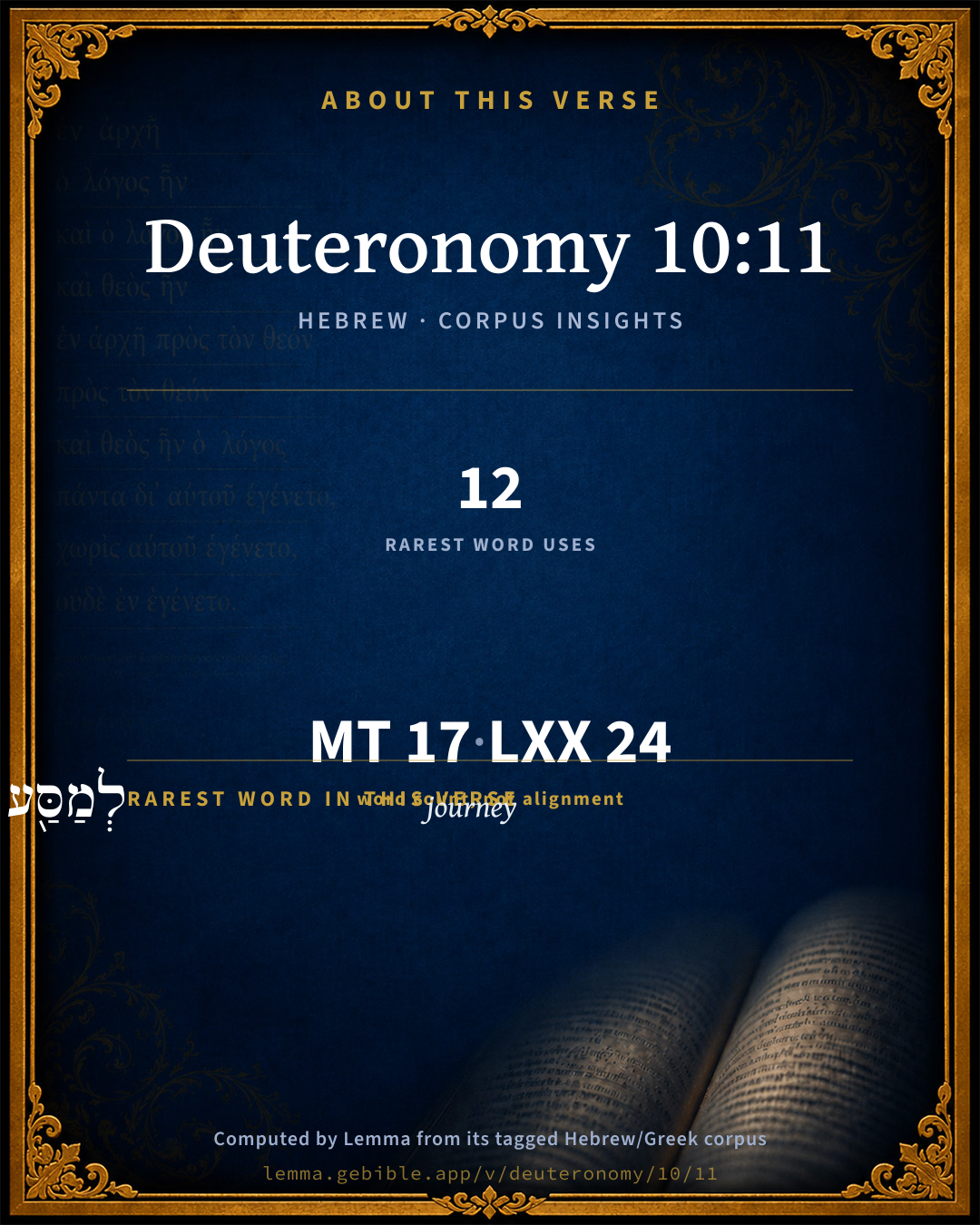
The rarest word here is לְמַסַּ֖ע journey H4550 — appearing just 12 times in the whole Hebrew Bible.

Shared distinctive vocabulary

לְמַסַּ֖ע journey H4550 occurs in 11 verses of the Hebrew Bible. Also found in:

Grammatical profile

  • 7 verbs
  • 6 nouns
  • 2 prepositions
  • 2 particles

Verb forms

  • וַיֹּ֤אמֶר Qal · Sequential Imperfect
  • ק֛וּם Qal · Imperative
  • לֵ֥ךְ Qal · Imperative
  • וְיָבֹ֨אוּ֙ Qal · Jussive
  • וְיִֽרְשׁ֣וּ Qal · Jussive
  • נִשְׁבַּ֥עְתִּי Niphal · Perfect
  • לָתֵ֥ת Qal · Infinitive Construct

Hebrew & Septuagint length

In English translation the verse runs 30 words from the Hebrew and 31 from the Septuagint (LXX English) — closely comparable.

A rough comparison of the two English renderings, which tokenize alike — not a word-level alignment.

Word counts can differ between the Hebrew and the Greek without any difference in meaning — e.g. the Hebrew direct-object marker אֵת has no separate Greek word, and Greek often adds the article ὁ.

In the original languages it is 17 Hebrew tokens and 24 Greek tokens — but the two are counted differently (Hebrew bundles its prefixes and suffixes into one token; the Greek is in lemma form), so that isn’t a like-for-like length.

Cross-references

2

Topical passages linked to Deuteronomy 10:11 in the Treasury of Scripture Knowledge — connected by theme and wording, ordered by reader-vote popularity; previews shown in the World English Bible.

  • Exodus 33:1 Yahweh spoke to Moses, "Depart, go up from here, you and the people that you have brought up out of the land of Egypt, to the land of which I swore to Abraham, to Isaac, and to Jacob, saying, 'I will give it to your seed.'
  • Exodus 32:34 Now go, lead the people to the place of which I have spoken to you. Behold, my angel shall go before you. Nevertheless in the day when I punish, I will punish them for their sin."

Cross-references courtesy of OpenBible.info (CC BY 4.0).

Hebrew and Greek witnesses Masoretic Hebrew ↔ Greek Septuagint

The same verse in the two great witnesses to the Old Testament, shown verse-for-verse.

These are two independent witnesses, not word-aligned to each other, and the Septuagint is shown in lemma (dictionary) form.

Hebrew Deuteronomy 10:11 Masoretic · Westminster Leningrad Codex

וַיֹּ֤אמֶר יְהוָה֙ אֵלַ֔י ק֛וּם לֵ֥ךְ לְמַסַּ֖ע לִפְנֵ֣י הָעָ֑ם וְיָבֹ֨אוּ֙ וְיִֽרְשׁ֣וּ אֶת הָאָ֔רֶץ אֲשֶׁר נִשְׁבַּ֥עְתִּי לַאֲבֹתָ֖ם לָתֵ֥ת לָהֶֽם

Yahweh said to me, Arise, take your journey before the people; and they shall go in and possess the land, which I swore to their fathers to give to them.

World English Bible · Public Domain

Greek LXX Deuteronomy 10:11 Septuagint · lemma form

καί εἶπον κύριος πρός ἐγώ βαδίζω ἀποαἴρω ἐναντίον ὁ λαός οὗτος καί εἰςπορεύομαι καί κληρονομέω ὁ γῆ ὅς ὄμνυμι ὁ πατήρ αὐτός δίδωμι αὐτός

And the Lord said to me, Go, set out before this people, and let them go in and inherit the land, which I swore to their fathers to give to them.

LXX2012 (modern English Septuagint) · Public Domain

Hebrew: Westminster Leningrad Codex (CC BY 4.0). Greek: Septuagint (public domain); English from LXX2012 (modern English Septuagint) (Public Domain). How the Septuagint differs from the Hebrew →

Targum (Aramaic paraphrase)

2

The Targum is the ancient Jewish Aramaic paraphrase of the Hebrew Scriptures — an interpretive translation, not the Hebrew text itself. Onkelos (literal) and Pseudo-Jonathan (expansive) render the Torah, and Jonathan the Prophets. Coverage is partial: where no permissively-licensed English translation exists for a verse, only the Aramaic is shown. This is verse-level text, not a word-by-word alignment to the Hebrew.

  1. Targum Onkelos Torah (Genesis–Deuteronomy)
    וַאֲמַר יְיָ לִי קוּם זִיל לְמִטוּל קֳדָם עַמָא וְיֵעֲלוּן וְיֵרְתוּן יָת אַרְעָא דִי קַיֵמִית לַאֲבָהָתְהוֹן לְמִתַּן לְהוֹן

    (no public-domain English translation for this verse)

    Targum Onkelos — Aramaic: “Onkelos Genesis” (public domain); “Onkelos Exodus” (public domain); “Onkelos Leviticus” (public domain); “Onkelos Numbers” (public domain); “Onkelos Deuteronomy” (public domain). English: “Sefaria Community Translation” (CC0 1.0 (public-domain dedication)); “J.W. Etheridge. The Targums of Onkelos and Jonathan Ben Uzziel on the Pentateuch. London: Longmans, Green, 1862” (public domain). Text via Sefaria.

  2. Targum Pseudo-Jonathan Torah (Genesis–Deuteronomy)
    וַאֲמַר יְיָ לִי קוּם אֱזִיל לְתַיֵיר קֳדָם עַמָּא וְיַעֲלוּן וְיֵרְתוּן יַת אַרְעָא דְקַיֵּימִית לְאַבְהַתְהוֹן לְמִתַּן לְהוֹן

    And the Lord said to me, Arise, go, lead forth the people, that they be brought in, and possess the land which I promised to their fathers to give them.

    Targum Pseudo-Jonathan — Aramaic: “Targum Jonathan on Genesis” (public domain); “Targum Jonathan on Exodus” (public domain); “Targum Jonathan on Leviticus” (public domain); “Targum Jonathan on Numbers” (public domain); “Targum Jonathan on Deuteronomy” (public domain). English: “The Targum of Jonathan ben Uzziel, trans. J. W. Etheridge, London, 1862” (public domain). Text via Sefaria.

Commentary

Notes on Deuteronomy 10:11 from classic Christian and Jewish commentators (each source and its license shown beneath its notes). The classic Christian expositions comment on the surrounding passage and are grouped to its opening verse, so a note may address several verses; the Jewish commentaries on the Tanakh (Rashi and others) are per-verse, so they appear only where the commentator wrote on this verse.

Lemma curates 59 commentaries, every one of them public domain or Creative Commons licensed, each selected and text-cleaned for this edition rather than reprinted as found. About our sources →

Joseph Benson's Commentary

Deu 10:11. The Lord said unto me, Arise — This is mentioned as a proof that God had hearkened to the intercession of Moses. Take thy journey before the people — It was fit that he, who had saved them from ruin by his intercession, should have the conduct and command of them. And herein he was a type of Christ, who, as he ever lives to make intercession for us, so has all power in heaven and on earth.

Joseph Benson's Commentary on the Old and New Testaments (1811–1818) — public domain. Text from a community e-Sword module.

Ellicott's Commentary for English Readers

(11) And the Lord said unto me, Arise, take thy journey before the people, that they may go in.—“Although ye had turned aside from following Him, and had erred in the (matter of the) calf, He said to me, Go, lead the people” (Rashi).

A Bible Commentary for English Readers, edited by Charles John Ellicott (1878–1897) — public domain. Text from a community e-Sword module.

John Gill's Exposition

And the Lord said unto me, arise, take thy journey before the people,.... Here Moses goes on with his relation of things at Mount Sinai, how that upon his supplication for the people, on account of the destruction they were threatened with for their idolatry, the Lord was graciously pleased not only to hear him and forgive the people, but ordered him to go before them, and lead them on towards the land of Canaan he had promised them, Exo 32:34,

that they may go in and possess the land, which I sware unto their fathers to give unto them; and which had it not been for their later murmurings and rebellions, they had been in the possession of it in a little time, especially after their departure from Sinai.

John Gill's Exposition of the Whole Bible (1746–1763) — public domain (CC PDM 1.0). Text via the HelloAO Bible API.

Matthew Poole's English Annotations

That they may go in: this shows that God was appeased and reconciled to the people, whom therefore he led forwards towards Canaan.

Matthew Poole's English Annotations on the Holy Bible (1683–1685) — public domain. Text from a community e-Sword/MySword module.

John Wesley's Explanatory Notes

Take thy journey before the people - 'Twas fit that he who had saved them from ruin by his intercession, should have the conduct and command of them. And herein he was a type of Christ, who, as he ever lives to make intercession for us, so has all power in heaven and in earth.

John Wesley, Explanatory Notes Upon the Whole Bible (1754–1765) — public domain. Text via the GEBible commentary corpus.

Rashi

Rabbi Shlomo Yitzchaki (Rashi)

ויאמר ה' אלי וגו׳ AND THE LORD SPAKE TO ME, [ARISE, GO ON THE JOURNEY BEFORE THE PEOPLE] — Although you had turned away from Him and had sinned by worshipping the golden calf, yet He said to me, (Exodus 32:34) “Go, lead the people”.

Rashi on the Tanakh — English translations: “The Judaica Press complete Tanach with Rashi, translated by A. J. Rosenberg” (CC BY 4.0); “Pentateuch with Rashi's commentary by M. Rosenbaum and A.M. Silbermann, 1929-1934” (public domain); “The Metsudah Tanach series, Lakewood, N.J” (CC BY 4.0); and “The Book of Joshua, Metsudah Publications, 1997” (CC BY 4.0). Text via Sefaria.

Lesson kit

Teaching starters — assembled from the data on this page, not authored interpretation. Every prompt links to the verse data it draws on. Edit before teaching.

Deuteronomy, in the Pentateuch, opens this verse with 17 words (16 distinct Hebrew lemmas). Its most distinctive word is maççaʻ (“journey”). A historical commentator’s framing appears above. Read the whole chapter for the surrounding context.

Discussion questions

  1. The word maççaʻ carries the sense “journey.” How does it shape the verse?
  2. Genesis 13:3 shares the word «journey» with this verse. How do the two illuminate each other?
  3. These translations render this verse differently; the difference is in the English rendering, not the original. What questions does that raise?
  4. The verb «וַיֹּ֤אמֶר» is Qal Sequential Imperfect. How does its form color the action?
  5. Reading how Joseph Benson's Commentary and Ellicott's Commentary for English Readers read this verse, where do the two commentators agree and where do they part?

Things to notice

Reading settings

Reading text

Shown beneath each verse's original-language words.

Old Testament
Old Testament edition

Read the OT as the Masoretic Hebrew (MT) or the Greek Septuagint (LXX).

English shown for the Greek Septuagint (in the Hebrew ↔ Greek comparison).

Comparing translations? Open the Compare panel on any verse page to stack up to four side by side.