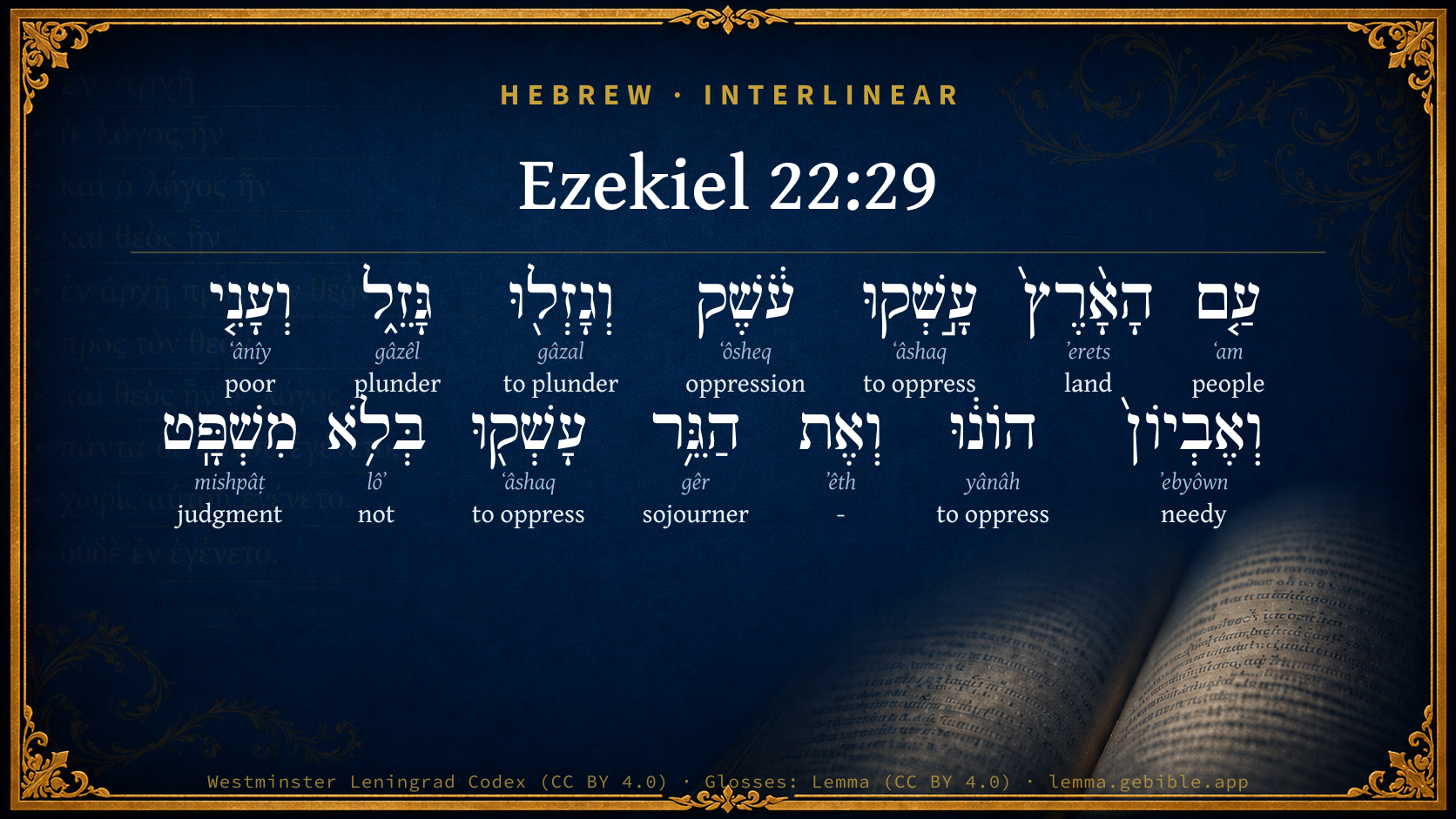
Ezekiel 22:29

Hebrew (Westminster Leningrad Codex) Ezekiel 22:29 appears in the Hebrew Old Testament. The text above is from the Westminster Leningrad Codex. Each word links to its Strong’s number, a concise gloss, and parsing drawn from the Open Scriptures Hebrew Bible morphology. Click any word for its full Brown-Driver-Briggs (BDB) entry.
Download image
Cite this verse

Ezekiel 22:29 (World English Bible). Public Domain. Lemma interlinear Bible study tool, https://lemma.gebible.app/v/ezekiel/22/29.

Show BibTeX & RIS
BibTeX
RIS
English Translation
The people of the land have used oppression, and exercised robbery; yes, they have vexed the poor and needy, and have oppressed the foreigner wrongfully.
World English Bible · Public Domain
Download a study sheet

One document with this verse’s original text, its word-by-word gloss line, the meaning frame, cross-references with their text, attributed commentary, and full source and license credits — printable, and it pastes into notes with its structure intact.

This verse Autodidact and up

Study sheet (.html) Plain text (.txt)

A passage Seminary Student

Up to 50 verses in one chapter. A passage sheet keeps up to 6 commentary sources and 12 cross-references per verse, in the order this page ranks them, and says so on the sheet whenever that leaves anything out. Ask for a single verse and you get the Autodidact verse sheet above.

Everything on this page stays free to read, with no account — the sheet is a download of what is already on screen, not access to it.

Want to remove ads? Support Godless Engineer
Compare translations 3

The same verse in 3 English versions, stacked beneath the original-language interlinear above. Click any original word for its lexicon entry.

Each is an independent rendering of the whole verse — the interlinear is not word-aligned to these translations.

Highlighted words mark where these versions differ — a whole-verse word diff, not a word-by-word alignment.

  • World English Bible Public Domain
    The people of the land have used oppression, and exercised robbery; yes, they have vexed the poor and needy, and have oppressed the foreigner wrongfully.
  • King James Version Public Domain
    The people of the land have used oppression, and exercised robbery, and have vexed the poor and needy: yea, they have oppressed the stranger wrongfully.
  • unfoldingWord Literal Text CC BY-SA 4.0
    The people of the land have oppressed through extortion and plundered through robbery, and they mistreat the poor and needy, and oppress the foreigner without justice.

unfoldingWord Literal Text — © unfoldingWord, licensed CC BY-SA 4.0. Word-aligned USFM3 via Door43 (git.door43.org/unfoldingWord/en_ult).

Versions to compare (up to 4)

3 of 4 selected

Show all 18 translations

Every available English version of this verse, each an independent rendering of the whole verse.

  • World English Bible Public Domain
    The people of the land have used oppression, and exercised robbery; yes, they have vexed the poor and needy, and have oppressed the foreigner wrongfully.
  • Berean Standard Bible Public Domain
    The people of the land have practiced extortion and committed robbery. They have oppressed the poor and needy and have exploited the foreign resident without justice.
  • Majority Standard Bible Public Domain
    The people of the land have practiced extortion and committed robbery. They have oppressed the poor and needy and have exploited the foreign resident without justice.
  • King James Version Public Domain
    The people of the land have used oppression, and exercised robbery, and have vexed the poor and needy: yea, they have oppressed the stranger wrongfully.
  • American Standard Version (1901) Public Domain
    The people of the land have used oppression, and exercised robbery; yea, they have vexed the poor and needy, and have oppressed the sojourner wrongfully.
  • Revised Version (1885) Public Domain
    The people of the land have used oppression, and exercised robbery; yea, they have vexed the poor and needy, and have oppressed the stranger wrongfully.
  • Geneva Bible (1599) Public Domain
    The people of the land haue violently oppressed by spoyling and robbing, and haue vexed the poore and the needy: yea, they haue oppressed the stranger against right.
  • Douay-Rheims (1899) Public Domain
    The people of the land have used oppression, and committed robbery: they afflicted the needy and poor, and they oppressed the stranger by calumny without judgment.
  • Young's Literal Translation Public Domain
    The people of the land have used oppression, And have taken plunder violently away, And humble and needy have oppressed, And the sojourner oppressed -- without judgment.
  • Literal Standard Version CC BY-SA 4.0
    The people of the land have used oppression, || And have taken plunder away violently, || And have oppressed humble and needy, || And oppressed the sojourner without judgment.
  • Unlocked Literal Bible CC BY-SA 4.0
    The people of the land have oppressed through extortion and plundered through robbery, and they mistreat the poor and needy, and oppress the foreigner without justice.
  • unfoldingWord Literal Text CC BY-SA 4.0
    The people of the land have oppressed through extortion and plundered through robbery, and they mistreat the poor and needy, and oppress the foreigner without justice.
  • Darby Bible Public Domain
    The people of the land use oppression and practise robbery; and they vex the poor and needy, and oppress the stranger wrongfully.
  • World Messianic Bible Public Domain
    The people of the land have used oppression and exercised robbery. Yes, they have troubled the poor and needy, and have oppressed the foreigner wrongfully.
  • Webster's Bible Public Domain
    The people of the land have used oppression, and exercised robbery, and have oppressed the poor and needy: yes, they have oppressed the stranger wrongfully.
  • Free Bible Version CC BY-SA 4.0
    The people of this country are extortioners and robbers. They mistreat the poor and those in need and exploit the foreigners, treating them totally unfairly.
  • Bible in Basic English Public Domain
    The people of the land have been acting cruelly, taking men's goods by force; they have been hard on the poor and those in need, and have done wrong to the man from a strange land.
  • JPS Tanakh (1917) Public Domain
    The people of the land have used oppression, and exercised robbery, and have wronged the poor and needy, and have oppressed the stranger unlawfully.

Literal Standard Version (2020), Covenant Press — licensed CC BY-SA 4.0. Text via the HelloAO Bible API (eBible.org). Unlocked Literal Bible (unfoldingWord) — licensed CC BY-SA 4.0. Text via the HelloAO Bible API (eBible.org). unfoldingWord Literal Text — © unfoldingWord, licensed CC BY-SA 4.0. Word-aligned USFM3 via Door43 (git.door43.org/unfoldingWord/en_ult). Free Bible Version, Dr. Jonathan Gallagher — licensed CC BY-SA 4.0. Text via the HelloAO Bible API (eBible.org).

Word by word

More ways to search: Search by grammar → Find every occurrence → Compare this word →

Practice this passage: Drill this verse → Learn its vocabulary →

גָּזֵ֑ל
gâzêl
H1498
“plunder”
Noun, Common, Masculine, Singular, Absolute
Part of Speech
Noun
Type
Common
Gender
Masculine
Number
Singular
State
Absolute
Full BDB Definition

Origin: from H1497

TWOT: 337a

robbery, something plundered
  1. עַ֤ם ʻam H5971 “people of” Noun, Common, Masculine, Singular, Construct
  2. הָאָ֨רֶץ֙ ʼerets H776 “the · land” Particle, Definite Article + Noun, Common, Both, Singular, Absolute
  3. עָ֣שְׁקוּ ʻâshaq H6231 “to oppress” Verb, Qal, Perfect, 3rd Person, Common, Plural
  4. עֹ֔שֶׁק ʻôsheq H6233 “oppression” Noun, Common, Masculine, Singular, Absolute
  5. וְגָזְל֖וּ gâzal H1497 “and · to plunder” Conjunction + Verb, Qal, Perfect, 3rd Person, Common, Plural
  6. וְעָנִ֤י ʻânîy H6041 “and · poor” Conjunction + Adjective, Adjective, Masculine, Singular, Absolute
  7. וְאֶבְיוֹן֙ ʼebyôwn H34 “and · needy” Conjunction + Adjective, Adjective, Masculine, Singular, Absolute
  8. הוֹנ֔וּ yânâh H3238 “to oppress” Verb, Hiphil, Perfect, 3rd Person, Common, Plural
  9. וְאֶת ʼêth H853 “and · -” Conjunction + Particle, Direct Object
  10. הַגֵּ֥ר gêr H1616 “the · sojourner” Particle, Definite Article + Noun, Common, Masculine, Singular, Absolute
  11. עָשְׁק֖וּ ʻâshaq H6231 “to oppress” Verb, Qal, Perfect, 3rd Person, Common, Plural
  12. בְּלֹ֥א lôʼ H3808 “in/at · not” Preposition + Particle, Negative
  13. מִשְׁפָּֽט mishpâṭ H4941 “judgment” Noun, Common, Masculine, Singular, Absolute

About this verse

These counts appear in no published source. They are computed here, from the morphology-tagged text and Lemma’s own curated glosses. What Lemma adds →

14
words
13
distinct lemmas
Prophets
section

Notable vocabulary

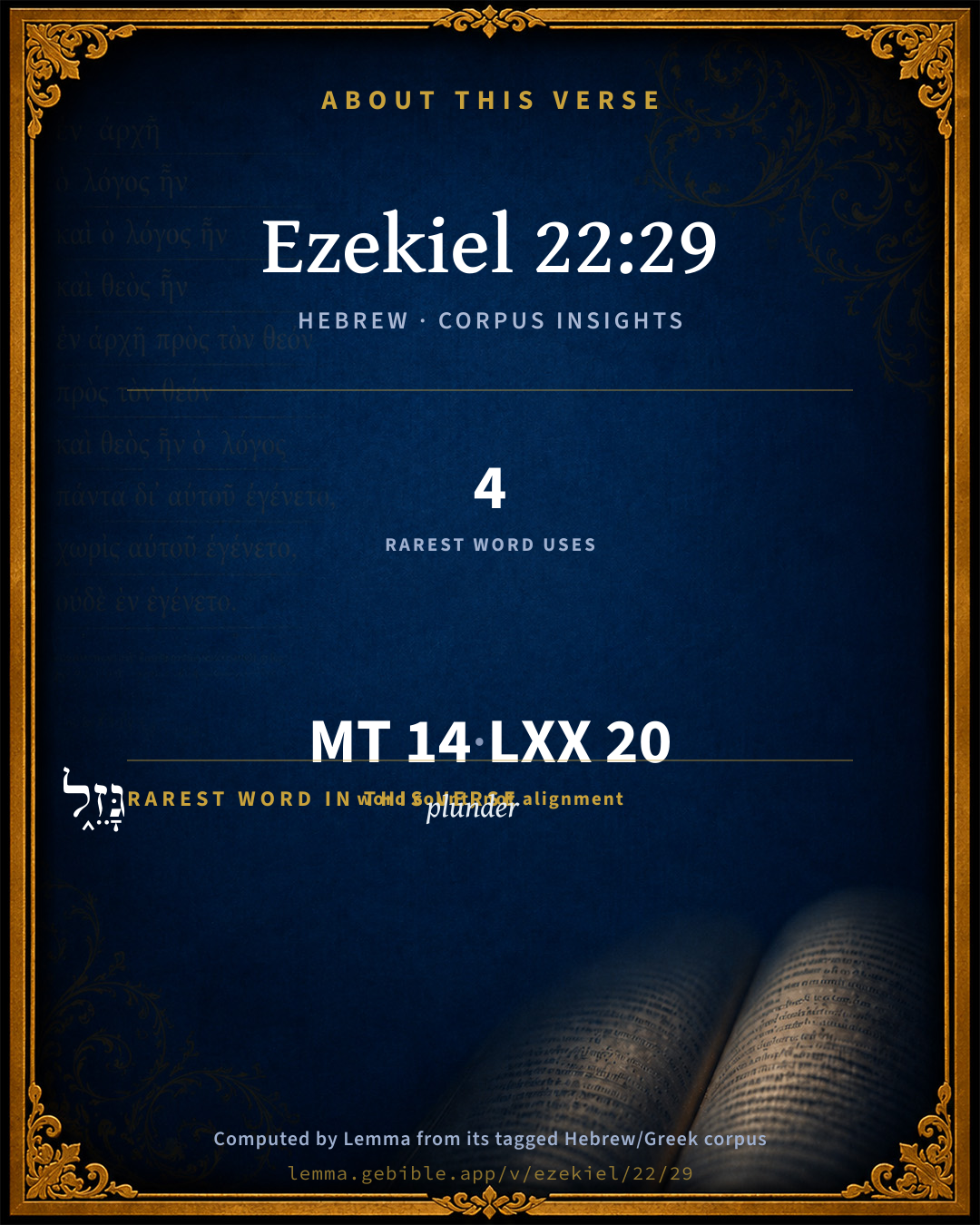
The rarest word here is גָּזֵ֑ל plunder H1498 — appearing just 4 times in the whole Hebrew Bible.

Shared distinctive vocabulary

גָּזֵ֑ל plunder H1498 occurs in 4 verses of the Hebrew Bible. Also found in:

Grammatical profile

  • 4 verbs
  • 6 nouns
  • 2 adjectives
  • 2 particles

Verb forms

  • עָ֣שְׁקוּ Qal · Perfect
  • וְגָזְל֖וּ Qal · Perfect
  • הוֹנ֔וּ Hiphil · Perfect
  • עָשְׁק֖וּ Qal · Perfect

Repetition

A word recurs within this verse — often emphatic in Hebrew:

  • עָ֣שְׁקוּ to oppress H6231 ×2

Hebrew & Septuagint length

In English translation the verse runs 25 words from the Hebrew and 25 from the Septuagint (LXX English) — the same length.

A rough comparison of the two English renderings, which tokenize alike — not a word-level alignment.

Word counts can differ between the Hebrew and the Greek without any difference in meaning — e.g. the Hebrew direct-object marker אֵת has no separate Greek word, and Greek often adds the article ὁ.

In the original languages it is 14 Hebrew tokens and 20 Greek tokens — but the two are counted differently (Hebrew bundles its prefixes and suffixes into one token; the Greek is in lemma form), so that isn’t a like-for-like length.

Cross-references

17

Topical passages linked to Ezekiel 22:29 in the Treasury of Scripture Knowledge — connected by theme and wording, ordered by reader-vote popularity; previews shown in the World English Bible.

  • Ezekiel 22:7 In you have they set light by father and mother; in the midst of you have they dealt by oppression with the foreigner; in you have they wronged the fatherless and the widow.
  • Exodus 23:9 "You shall not oppress an alien, for you know the heart of an alien, seeing you were aliens in the land of Egypt.
  • Exodus 22:21 "You shall not wrong an alien, neither shall you oppress him, for you were aliens in the land of Egypt.
  • Leviticus 19:33 "'If a stranger lives as a foreigner with you in your land, you shall not do him wrong.
  • Psalms 94:6 They kill the widow and the alien, And murder the fatherless.
  • Isaiah 5:7 For the vineyard of Yahweh of Hosts is the house of Israel, And the men of Judah his pleasant plant: And he looked for justice, but, behold, oppression; For righteousness, but, behold, a cry of distress.
  • Jeremiah 5:31 the prophets prophesy falsely, and the priests bear rule by their means; and my people love to have it so: and what will you do in the end of it?
  • Isaiah 10:2 to turn aside the needy from justice, and to rob the poor of my people of their right, that widows may be their spoil, and that they may make the fatherless their prey!
  • Amos 3:10 "Indeed they don't know to do right," says Yahweh, "Who hoard plunder and loot in their palaces."
  • Isaiah 59:3–7 For your hands are defiled with blood, and your fingers with iniquity; your lips have spoken lies, your tongue mutters wickedness.
  • Jeremiah 5:26–28 For among my people are found wicked men: they watch, as fowlers lie in wait; they set a trap, they catch men.
  • Jeremiah 6:13 For from the least of them even to the greatest of them everyone is given to covetousness; and from the prophet even to the priest everyone deals falsely.
  • Ezekiel 18:12 has wronged the poor and needy, has taken by robbery, has not restored the pledge, and has lifted up his eyes to the idols, has committed abomination,
  • Micah 2:2 They covet fields, and seize them; And houses, and take them away: And they oppress a man and his house, Even a man and his heritage.
  • Micah 3:3 Who also eat the flesh of my people, And flay their skin from off them, And break their bones, And chop them in pieces, as for the pot, And as flesh within the caldron.
  • Matthew 25:43 I was a stranger, and you didn't take me in; naked, and you didn't clothe me; sick, and in prison, and you didn't visit me.'
  • James 5:4 Behold, the wages of the laborers who mowed your fields, which you have kept back by fraud, cry out, and the cries of those who reaped have entered into the ears of the Lord of Hosts.

Cross-references courtesy of OpenBible.info (CC BY 4.0).

Hebrew and Greek witnesses Masoretic Hebrew ↔ Greek Septuagint

The same verse in the two great witnesses to the Old Testament, shown verse-for-verse.

These are two independent witnesses, not word-aligned to each other, and the Septuagint is shown in lemma (dictionary) form.

Hebrew Ezekiel 22:29 Masoretic · Westminster Leningrad Codex

עַ֤ם הָאָ֨רֶץ֙ עָ֣שְׁקוּ עֹ֔שֶׁק וְגָזְל֖וּ גָּזֵ֑ל וְעָנִ֤י וְאֶבְיוֹן֙ הוֹנ֔וּ וְאֶת הַגֵּ֥ר עָשְׁק֖וּ בְּלֹ֥א מִשְׁפָּֽט

The people of the land have used oppression, and exercised robbery; yes, they have vexed the poor and needy, and have oppressed the foreigner wrongfully.

World English Bible · Public Domain

Greek LXX Ezekiel 22:29 Septuagint · lemma form

λαός ὁ γῆ ἐκπιέζω ἀδικία καί διαἁρπάζω ἅρπαγμα πτωχός καί πένης καταδυναστεύω καί πρός ὁ προσήλυτος οὐ ἀναστρέφω μετά κρίμα

That sorely oppress the people of the land with injustice, and commit robbery; oppressing the poor and needy, and not dealing justly with the stranger.

LXX2012 (modern English Septuagint) · Public Domain

On this verse, John Gill's Exposition discusses the Septuagint’s reading. Read the note in Commentary ↓

Hebrew: Westminster Leningrad Codex (CC BY 4.0). Greek: Septuagint (public domain); English from LXX2012 (modern English Septuagint) (Public Domain). How the Septuagint differs from the Hebrew →

Targum (Aramaic paraphrase)

1

The Targum is the ancient Jewish Aramaic paraphrase of the Hebrew Scriptures — an interpretive translation, not the Hebrew text itself. Onkelos (literal) and Pseudo-Jonathan (expansive) render the Torah, and Jonathan the Prophets. Coverage is partial: where no permissively-licensed English translation exists for a verse, only the Aramaic is shown. This is verse-level text, not a word-by-word alignment to the Hebrew.

  1. Targum Jonathan Prophets (Joshua–Malachi)
    עַמָא דְאַרְעָא עֲשָׁקוּ עוּשְׁקָא וּגְזָלוּ גְזֵלָה וּמִסְכֵּן וַחֲשִׁיךְ אוֹנִיאוּ וּלְגִיוֹרָא אֵנָסוּ בְּלָא כִדְחֲזֵי:

    (no public-domain English translation for this verse)

    Targum Jonathan — Aramaic: “Mikraot Gedolot” (public domain). English: “Sefaria Community Translation” (CC0 1.0 (public-domain dedication)); “London "Chaldee Paraphrase," 1871” (public domain). Text via Sefaria.

Commentary

Notes on Ezekiel 22:29 from classic Christian and Jewish commentators (each source and its license shown beneath its notes). The classic Christian expositions comment on the surrounding passage and are grouped to its opening verse, so a note may address several verses; the Jewish commentaries on the Tanakh (Rashi and others) are per-verse, so they appear only where the commentator wrote on this verse.

Lemma curates 59 commentaries, every one of them public domain or Creative Commons licensed, each selected and text-cleaned for this edition rather than reprinted as found. About our sources →

Trapp's Complete Commentary

John Trapp

Eze 22:29 The people of the land have used oppression, and exercised robbery, and have vexed the poor and needy: yea, they have oppressed the stranger wrongfully.

Ver. 29. The people of the land have used oppression.] Or, Deceit. Eadem hodie fiunt: charitas refrixit; omnia iniuriis, calumniis, rapinis plena sunt.

John Trapp, A Commentary or Exposition upon All the Books of the Old and New Testament (1647–1656) — public domain. Text from a community e-Sword module.

Joseph Benson's Commentary

Eze 22:29-31. The people of the land — The common people; have used oppression — Have wronged each other by acts of fraud and violence, and have greatly and cruelly oppressed each other. And have vexed the poor and needy — By these frauds and oppressions, instead of relieving them, which they ought to have done. Yea, they have oppressed the strangers wrongfully — Without any colour of justice or reason. This was contrary to an express prohibition of God’s law, frequently repeated and enforced upon them, from the consideration, that they themselves were strangers in Egypt. And I sought — God speaks after the manner of men; for a man among them — Any one among the princes, prophets, priests, or people; that should make up the hedge — That should repair the breach, and prevent further mischief; and stand in the gap before me — That might interpose between a sinful people and their offended God; deprecate God’s wrath, and entreat for mercy, that the land might not be destroyed; but I found none — All were corrupted, and went on in sin without repentance. This general complaint must be understood with some restriction, such as is commonly understood in unlimited expressions. For we read, Eze 9:4, that there were some that sighed and cried to God (by way of deprecating his wrath) for the abominations done in Jerusalem; and they undoubtedly exhorted the people to repentance and reformation. Therefore have I poured out mine indignation upon them — Have given it full scope, that it might come upon them in a full stream; yet, whatever calamity God brings upon a sinful people, it is their own way that is therein recompensed upon their heads, and God punishes them not more, but much less, than their iniquity deserves.

Joseph Benson's Commentary on the Old and New Testaments (1811–1818) — public domain. Text from a community e-Sword module.

Jamieson, Fausset & Brown

Robert Jamieson, A. R. Fausset & David Brown

The people--put last, after the mention of those in office. Corruption had spread downwards through the whole community.

wrongfully--that is, "without cause," gratuitously, without the stranger proselyte giving any just provocation; nay, he of all others being one who ought to have been won to the worship of Jehovah by kindness, instead of being alienated by oppression; especially as the Israelites were commanded to remember that they themselves had been "strangers in Egypt" (Exo 22:21; Exo 23:9).

Jamieson, Fausset & Brown — Commentary Critical and Explanatory on the Whole Bible (1871) — public domain (CC PDM 1.0). Text via the HelloAO Bible API.

Adam Clarke's Commentary

Verse 29. The people] All that have power or authority have abused it; vexed and oppressed the poor, the needy, and the stranger.

Adam Clarke's Commentary on the Bible (1810–1826) — public domain. Text from a community e-Sword/MySword module.

Ellicott's Commentary for English Readers

(29) The people of the land,—i.e., the common people, not belonging to any of the above classes. In regard to their general corruption see Ezekiel 18

A Bible Commentary for English Readers, edited by Charles John Ellicott (1878–1897) — public domain. Text from a community e-Sword module.

The Cambridge Bible for Schools and Colleges

gen. ed. J. J. S. Perowne

29. people of the land] The phrase for the common people already, Jer_37:2, and common in Eze_7:27; Eze_12:19, &c. The “people of the land” is certainly subject here, cf. Eze_22:7, ch. Eze_18:12; Jer_23:34; Jer_26:7.

The Cambridge Bible for Schools and Colleges (gen. ed. J. J. S. Perowne; Cambridge University Press, 1878–1918) — public domain. Text from a community e-Sword module.

John Gill's Exposition

The people of the land have used oppression,.... The common people, the more powerful among them, such as were in greatest authority in cities and towns, in neighbourhoods and families, the richest among them; these oppressed the poor, and those that were under them, the servants of them, and tenants to them, and who were not able to defend themselves against them: the Septuagint and Syriac versions understand this of the prophets using the people of the land ill:

and exercised robbery; such who had not the power as others had, became thieves and robbers, went on the highway, and took men's money from them; broke up houses, and plundered them, and stole away their goods:

and have vexed the poor and needy; by their oppressions, rapines, and robberies, when they should rather have relieved them:

yea, they have oppressed the stranger wrongfully; or, "without right or judgment" (k); in a very unjust manner, contrary to the due course of law, against all equity and justice; which the Israelites were warned and ordered not to do, in many passages of Scripture; and for this reason, because they had been strangers in Egypt.

(k) "absque judicio", Pagninus, Montanus, Vatablus, "non in judicio", Cocceius.

John Gill's Exposition of the Whole Bible (1746–1763) — public domain (CC PDM 1.0). Text via the HelloAO Bible API.

Matthew Poole's English Annotations

The people of the land, the common people, have used oppression; greatly, continuedly, and cruelly oppressed one another, wronged each other by frauds and violence.

Exercised robbery; on every occasion turned downright thieves and robbers.

Have vexed, by these oppressions, the poor and needy: see Eze 18:7.

Wrongfully; without any colour of justice, reason, or so much as hearing him, as the phrase seems to import.

Matthew Poole's English Annotations on the Holy Bible (1683–1685) — public domain. Text from a community e-Sword/MySword module.

Whedon's Commentary on the Bible

Daniel D. Whedon

29. The common people naturally follow the example of the princes and captains, priests and prophets.

Daniel D. Whedon (gen. ed.), Commentary on the Old and New Testaments (1874–1909) — public domain. Text from a community e-Sword module.

The Pulpit Commentary

From the classes, the prophet turns to the masses. The people of the land, the common people, (2Ki_25:3, 2Ki_25:19) come under the same condemnation. Greed of gain, the oppression of the poor and the stranger, were seem everywhere.

The Pulpit Commentary (1880–1919), ed. H.D.M. Spence-Jones & Joseph S. Exell — public domain. Text from a community e-Sword module.

unfoldingWord translationNotes

Door43 World Missions Community

have oppressed ... and plundered

The understood words may be supplied. AT: "have oppressed people ... and plundered others" (See: Ellipsis)

extortion

This refers to when someone threatens or hurts another person in order to make them give him money.

the poor and needy

This refers to poor and needy people. AT: "those who are poor and needy" (See: Nominal Adjectives)

translationWords

people group

oppress

just

unfoldingWord translationNotes — © Distant Shores Media and the Door43 World Missions Community, licensed CC BY-SA 4.0. Source: git.door43.org/Door43/en_tn.

Lesson kit

Teaching starters — assembled from the data on this page, not authored interpretation. Every prompt links to the verse data it draws on. Edit before teaching.

Ezekiel, in the Prophets, opens this verse with 14 words (13 distinct Hebrew lemmas). Its most distinctive word is gâzêl (“plunder”). A historical commentator’s framing appears above. Read the whole chapter for the surrounding context.

Discussion questions

  1. The word gâzêl carries the sense “plunder.” How does it shape the verse?
  2. Leviticus 6:2 shares the word «plunder» with this verse. How do the two illuminate each other?
  3. “to oppress” occurs 2× in this one verse. What is the effect of the repetition?
  4. These translations render this verse differently; the difference is in the English rendering, not the original. What questions does that raise?
  5. The verb «עָ֣שְׁקוּ» is Qal Perfect. How does its form color the action?
  6. Reading how Trapp's Complete Commentary and Joseph Benson's Commentary read this verse, where do the two commentators agree and where do they part?

Things to notice

Reading settings

Reading text

Shown beneath each verse's original-language words.

Old Testament
Old Testament edition

Read the OT as the Masoretic Hebrew (MT) or the Greek Septuagint (LXX).

English shown for the Greek Septuagint (in the Hebrew ↔ Greek comparison).

Comparing translations? Open the Compare panel on any verse page to stack up to four side by side.