
2 Samuel 19:3

Hebrew (Westminster Leningrad Codex) 2 Samuel 19:3 appears in the Hebrew Old Testament. The text above is from the Westminster Leningrad Codex. Each word links to its Strong’s number, a concise gloss, and parsing drawn from the Open Scriptures Hebrew Bible morphology. Click any word for its full Brown-Driver-Briggs (BDB) entry.
Download image
Cite this verse

2 Samuel 19:3 (World English Bible). Public Domain. Lemma interlinear Bible study tool, https://lemma.gebible.app/v/2-samuel/19/3.

Show BibTeX & RIS
BibTeX
RIS
English Translation
The people got them by stealth that day into the city, as people who are ashamed steal away when they flee in battle.
World English Bible · Public Domain
Download a study sheet

One document with this verse’s original text, its word-by-word gloss line, the meaning frame, cross-references with their text, attributed commentary, and full source and license credits — printable, and it pastes into notes with its structure intact.

This verse Autodidact and up

Study sheet (.html) Plain text (.txt)

A passage Seminary Student

Up to 50 verses in one chapter. A passage sheet keeps up to 6 commentary sources and 12 cross-references per verse, in the order this page ranks them, and says so on the sheet whenever that leaves anything out. Ask for a single verse and you get the Autodidact verse sheet above.

Everything on this page stays free to read, with no account — the sheet is a download of what is already on screen, not access to it.

Want to remove ads? Support Godless Engineer
Compare translations 3

The same verse in 3 English versions, stacked beneath the original-language interlinear above. Click any original word for its lexicon entry.

Each is an independent rendering of the whole verse — the interlinear is not word-aligned to these translations.

Highlighted words mark where these versions differ — a whole-verse word diff, not a word-by-word alignment.

  • World English Bible Public Domain
    The people got them by stealth that day into the city, as people who are ashamed steal away when they flee in battle.
  • King James Version Public Domain
    And the people gat them by stealth that day into the city, as people being ashamed steal away when they flee in battle.
  • unfoldingWord Literal Text CC BY-SA 4.0
    And the people stole away on that day to enter the city, as ashamed people steal away when they flee in battle.

unfoldingWord Literal Text — © unfoldingWord, licensed CC BY-SA 4.0. Word-aligned USFM3 via Door43 (git.door43.org/unfoldingWord/en_ult).

Versions to compare (up to 4)

3 of 4 selected

Show all 18 translations

Every available English version of this verse, each an independent rendering of the whole verse.

  • World English Bible Public Domain
    The people got them by stealth that day into the city, as people who are ashamed steal away when they flee in battle.
  • Berean Standard Bible Public Domain
    So they returned to the city quietly that day, as people steal away in humiliation after fleeing a battle.
  • Majority Standard Bible Public Domain
    So they returned to the city quietly that day, as people steal away in humiliation after fleeing a battle.
  • King James Version Public Domain
    And the people gat them by stealth that day into the city, as people being ashamed steal away when they flee in battle.
  • American Standard Version (1901) Public Domain
    And the people gat them by stealth that day into the city, as people that are ashamed steal away when they flee in battle.
  • Revised Version (1885) Public Domain
    And the people gat them by stealth that day into the city, as people that are ashamed steal away when they flee in battle.
  • Geneva Bible (1599) Public Domain
    And the people went that day into the citie secretly, as people confounded hide them selues when they flee in battell.
  • Douay-Rheims (1899) Public Domain
    And the people shunned the going into the city that day as a people would do that hath turned their backs, and fled away from the battle.
  • Young's Literal Translation Public Domain
    And the people stealeth away, on that day, to go in to the city, as the people steal away, who are ashamed, in their fleeing in battle;
  • Literal Standard Version CC BY-SA 4.0
    And the people steals away, on that day, to go into the city, as the people steal away, who are ashamed, in their fleeing in battle;
  • Unlocked Literal Bible CC BY-SA 4.0
    The soldiers had to sneak quietly into the city that day, like people who are ashamed sneak away when they run from battle.
  • unfoldingWord Literal Text CC BY-SA 4.0
    And the people stole away on that day to enter the city, as ashamed people steal away when they flee in battle.
  • Darby Bible Public Domain
    And the people stole away that day into the city, as people steal away when ashamed of fleeing in battle.
  • World Messianic Bible Public Domain
    The people sneaked into the city that day, as people who are ashamed steal away when they flee in battle.
  • Webster's Bible Public Domain
    And the people withdrew by stealth that day into the city, as people being ashamed steal away when they flee in battle.
  • Free Bible Version CC BY-SA 4.0
    They stole back into town that day like defeated people steal in, ashamed of running away from the battle.
  • Bible in Basic English Public Domain
    And the people made their way back to the town quietly and secretly, as those who are shamed go secretly when they go in flight from the war.
  • JPS Tanakh (1917) Public Domain
    (19-4) And the people got them by stealth that day into the city, as people that are ashamed steal away when they flee in battle.

Literal Standard Version (2020), Covenant Press — licensed CC BY-SA 4.0. Text via the HelloAO Bible API (eBible.org). Unlocked Literal Bible (unfoldingWord) — licensed CC BY-SA 4.0. Text via the HelloAO Bible API (eBible.org). unfoldingWord Literal Text — © unfoldingWord, licensed CC BY-SA 4.0. Word-aligned USFM3 via Door43 (git.door43.org/unfoldingWord/en_ult). Free Bible Version, Dr. Jonathan Gallagher — licensed CC BY-SA 4.0. Text via the HelloAO Bible API (eBible.org).

Word by word

More ways to search: Search by grammar → Find every occurrence → Compare this word →

Practice this passage: Drill this verse → Learn its vocabulary →

הַנִּכְלָמִ֔ים
kâlam
H3637
“the · shamed”
Preposition + Verb, Niphal, Participle Passive, Masculine, Plural, Absolute
Part of Speech
Preposition + Verb
Stem
Niphal
Form
Participle Passive
Gender
Masculine
Number
Plural
State
Absolute
Full BDB Definition

Origin: a primitive root

TWOT: 987

to insult, shame, humiliate, blush, be ashamed, be put to shame, be reproached, be put to confusion, be humiliated - (Niphal) - to be humiliated, be ashamed - to be put to shame, be dishonoured, be confounded - (Hiphil) - to put to shame, insult, humiliate, cause shame to - to exhibit shame - (Hophal) - to be insulted, be humiliated - to be put to shame, be dishonoured, be confounded
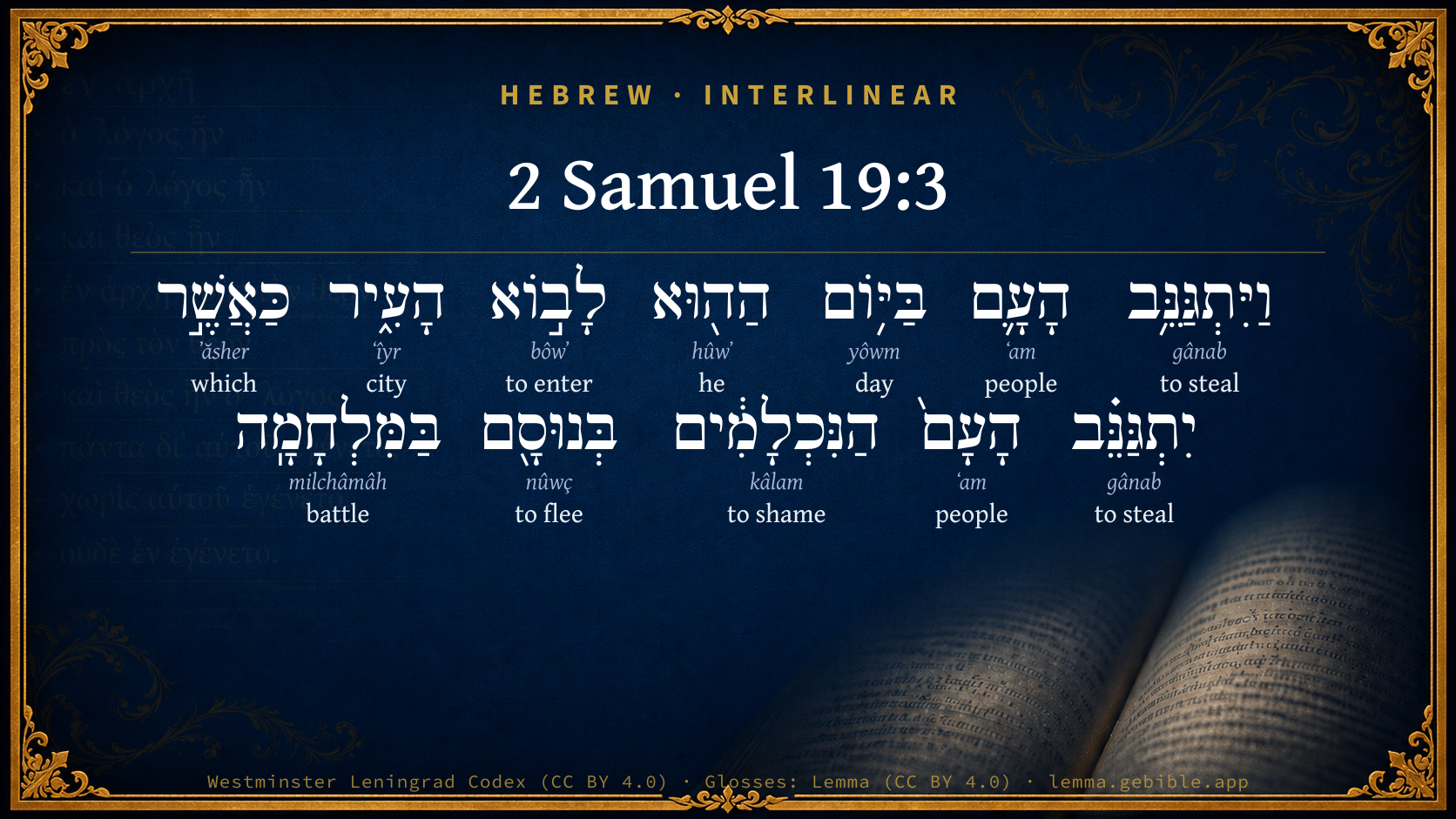
  1. וַיִּתְגַּנֵּ֥ב gânab H1589 “and · to steal” Conjunction + Verb, Hithpael, Sequential Imperfect, 3rd Person, Masculine, Singular
  2. הָעָ֛ם ʻam H5971 “the · people” Particle, Definite Article + Noun, Common, Masculine, Singular, Absolute
  3. בַּיּ֥וֹם yôwm H3117 “in/at the · day” Preposition, Determined + Noun, Common, Masculine, Singular, Absolute
  4. הַה֖וּא hûwʼ H1931 “the · he” Particle, Definite Article + Pronoun, Personal, 3rd Person, Masculine, Singular
  5. לָב֣וֹא bôwʼ H935 “to enter” Preposition + Verb, Qal, Infinitive Construct
  6. הָעִ֑יר ʻîyr H5892 “the · city” Particle, Definite Article + Noun, Common, Feminine, Singular, Absolute
  7. כַּאֲשֶׁ֣ר ʼăsher H834 “like/as · which” Preposition + Particle, Relative
  8. יִתְגַּנֵּ֗ב gânab H1589 “to steal” Verb, Hithpael, Imperfect, 3rd Person, Masculine, Singular
  9. הָעָם֙ ʻam H5971 “the · people” Particle, Definite Article + Noun, Common, Masculine, Singular, Absolute
  10. בְּנוּסָ֖ם nûwç H5127 “in/at · to flee · them” Preposition + Verb, Qal, Infinitive Construct + Suffix, Personal, 3rd Person, Masculine, Plural
  11. בַּמִּלְחָמָֽה milchâmâh H4421 “in/at the · battle” Preposition, Determined + Noun, Common, Feminine, Singular, Absolute

About this verse

These counts appear in no published source. They are computed here, from the morphology-tagged text and Lemma’s own curated glosses. What Lemma adds →

12
words
10
distinct lemmas
Historical
section

Shared distinctive vocabulary

הַנִּכְלָמִ֔ים to shame H3637 occurs in 38 verses of the Hebrew Bible. Also found in:

Grammatical profile

  • 5 verbs
  • 5 nouns
  • 1 pronoun
  • 1 particle

Verb forms

  • וַיִּתְגַּנֵּ֥ב Hithpael · Sequential Imperfect
  • לָב֣וֹא Qal · Infinitive Construct
  • יִתְגַּנֵּ֗ב Hithpael · Imperfect
  • הַנִּכְלָמִ֔ים Niphal · Participle Passive
  • בְּנוּסָ֖ם Qal · Infinitive Construct

Repetition

Words recur within this verse — often emphatic in Hebrew:

  • וַיִּתְגַּנֵּ֥ב to steal H1589 ×2
  • הָעָ֛ם people H5971 ×2

Hebrew & Septuagint length

In English translation the verse runs 23 words from the Hebrew and 26 from the Septuagint (LXX English) — closely comparable.

A rough comparison of the two English renderings, which tokenize alike — not a word-level alignment.

Word counts can differ between the Hebrew and the Greek without any difference in meaning — e.g. the Hebrew direct-object marker אֵת has no separate Greek word, and Greek often adds the article ὁ.

Cross-references

3

Topical passages linked to 2 Samuel 19:3 in the Treasury of Scripture Knowledge — connected by theme and wording, ordered by reader-vote popularity; previews shown in the World English Bible.

  • Genesis 31:27 Why did you flee secretly, and deceive me, and didn't tell me, that I might have sent you away with mirth and with songs, with tambourine and with harp;
  • 2 Samuel 17:24 Then David came to Mahanaim. Absalom passed over the Jordan, he and all the men of Israel with him.
  • 2 Samuel 19:32 Now Barzillai was a very aged man, even eighty years old: and he had provided the king with sustenance while he lay at Mahanaim; for he was a very great man.

Cross-references courtesy of OpenBible.info (CC BY 4.0).

Hebrew and Greek witnesses Masoretic Hebrew ↔ Greek Septuagint

The same verse in the two great witnesses to the Old Testament, shown verse-for-verse.

These are two independent witnesses, not word-aligned to each other, and the Septuagint is shown in lemma (dictionary) form.

Hebrew 2 Samuel 19:3 Masoretic · Westminster Leningrad Codex

וַיִּתְגַּנֵּ֥ב הָעָ֛ם בַּיּ֥וֹם הַה֖וּא לָב֣וֹא הָעִ֑יר כַּאֲשֶׁ֣ר יִתְגַּנֵּ֗ב הָעָם֙ הַנִּכְלָמִ֔ים בְּנוּסָ֖ם בַּמִּלְחָמָֽה

The people got them by stealth that day into the city, as people who are ashamed steal away when they flee in battle.

World English Bible · Public Domain

Greek LXX 2 Samuel 19:3 Septuagint · lemma form

καί γίγνομαι ὁ σωτηρία ἐν ὁ ἡμέρα ἐκεῖνος εἰς πένθος πᾶς ὁ λαός ὅτι ἀκούω ὁ λαός ἐν ὁ ἡμέρα ἐκεῖνος λέγω ὅτι λυπέω ὁ βασιλεύς ἐπί ὁ υἱός αὐτός

And the people stole away that day to go into the city, as people steal away when they are ashamed as they flee in the battle.

LXX2012 (modern English Septuagint) · Public Domain

Hebrew: Westminster Leningrad Codex (CC BY 4.0). Greek: Septuagint (public domain); English from LXX2012 (modern English Septuagint) (Public Domain). How the Septuagint differs from the Hebrew →

Targum (Aramaic paraphrase)

1

The Targum is the ancient Jewish Aramaic paraphrase of the Hebrew Scriptures — an interpretive translation, not the Hebrew text itself. Onkelos (literal) and Pseudo-Jonathan (expansive) render the Torah, and Jonathan the Prophets. Coverage is partial: where no permissively-licensed English translation exists for a verse, only the Aramaic is shown. This is verse-level text, not a word-by-word alignment to the Hebrew.

  1. Targum Jonathan Prophets (Joshua–Malachi)
    וַהֲוַת תְּשׁוּעֲתָא בְּיוֹמָא הַהוּא לְאֶבְלָא לְכָל עַמָא אֲרֵי שְׁמַע עַמָא בְּיוֹמָא הַהוּא לְמֵימַר אִתְנְסֵיס מַלְכָּא עַל בְּרֵיהּ:

    (no public-domain English translation for this verse)

    Targum Jonathan — Aramaic: “Mikraot Gedolot” (public domain). English: “Sefaria Community Translation” (CC0 1.0 (public-domain dedication)); “London "Chaldee Paraphrase," 1871” (public domain). Text via Sefaria.

Commentary

Notes on 2 Samuel 19:3 from classic Christian and Jewish commentators (each source and its license shown beneath its notes). The classic Christian expositions comment on the surrounding passage and are grouped to its opening verse, so a note may address several verses; the Jewish commentaries on the Tanakh (Rashi and others) are per-verse, so they appear only where the commentator wrote on this verse.

Lemma curates 59 commentaries, every one of them public domain or Creative Commons licensed, each selected and text-cleaned for this edition rather than reprinted as found. About our sources →

Trapp's Complete Commentary

John Trapp

2Sa 19:3 And the people gat them by stealth that day into the city, as people being ashamed steal away when they flee in battle.

Ver. 3. And the people gat them by stealth.] As if they had fled in the battle, and were ashamed of their cowardice; or like a dog that claps his tail between his legs, and getteth away as he can.

John Trapp, A Commentary or Exposition upon All the Books of the Old and New Testament (1647–1656) — public domain. Text from a community e-Sword module.

Joseph Benson's Commentary

2Sa 19:3. The people gat them by stealth into the city — Not openly and triumphantly, as conquerors use to do; but secretly, as if they thought themselves a kind of criminals, who had contravened the king’s command, and were, on that score, in disgrace with him, and, therefore, were afraid and ashamed lest he should see them and look upon them with an evil eye, as persons that had had a hand in killing his beloved son. As people steal away when they flee in battle — As if they had lost the day and not been victorious.

Joseph Benson's Commentary on the Old and New Testaments (1811–1818) — public domain. Text from a community e-Sword module.

Geneva Bible (1599)

Geneva Bible translators

Or, by stealth.

Geneva Bible (1599) marginal notes — public domain. Text via Bolls.life.

The Cambridge Bible for Schools and Colleges

gen. ed. J. J. S. Perowne

3. gat them by stealth, &c.] Out of respect for the king’s sorrow the army stole into the city silently in small parties, like disgraced fugitives, instead of entering in military order with shouts of triumph for the victory.

that day] Clearly the day of the battle, which must therefore have been fought in the neighbourhood of Mahanaim. See notes on ch. 2Sa_18:6.

as people, &c.] Better, as the people steal in who have disgraced themselves by fleeing in the battle.

The Cambridge Bible for Schools and Colleges (gen. ed. J. J. S. Perowne; Cambridge University Press, 1878–1918) — public domain. Text from a community e-Sword module.

John Gill's Exposition

And the people got them by stealth that day into the city,.... Did not march into it in companies, in a public and triumphant manner, as conquerors used to do; but entered in a private manner, one by one, or a very few together, not caring to be seen or known, at least by the king, as fearing they had incurred his displeasure: but

as people being ashamed steal away when they flee in battle; as if they had been conquered, and not conquerors; nay, had acted a cowardly part, and ran away; and so cared not to be seen, lest they should be reproached, or suffer for their cowardice.

John Gill's Exposition of the Whole Bible (1746–1763) — public domain (CC PDM 1.0). Text via the HelloAO Bible API.

Haydock's Catholic Bible Commentary

Shunned. Hebrew, "stole away," fearing to enter; though they did at last, in a clandestine manner, (Calmet) by another gate. (Menochius)

George Leo Haydock (1774–1849), Haydock's Catholic Family Bible and Commentary, 1859 edition — public domain. Excludes Psalms (Douay-Rheims chapter numbering differs from Protestant) and Deuterocanonical books (Catholic canon only).

Matthew Poole's English Annotations

Not openly, and orderly, and triumphantly, as conquerors use to do; but secretly, and disorderly, and asunder, as if they were afraid and ashamed, lest David should see them, and look upon them with an evil eye, as those that had a hand in the killing of his dearly beloved son.

Matthew Poole's English Annotations on the Holy Bible (1683–1685) — public domain. Text from a community e-Sword/MySword module.

Whedon's Commentary on the Bible

Daniel D. Whedon

3. Gat them by stealth… into the city — They entered not by the gate where David sat mourning, but, like thieves, climbed in some other way.

Daniel D. Whedon (gen. ed.), Commentary on the Old and New Testaments (1874–1909) — public domain. Text from a community e-Sword module.

John Wesley's Explanatory Notes

By stealth - Not openly and triumphantly, as conquerors use to do; but secretly, as if they were afraid and ashamed, lest David should see them, and look upon them with an evil eye, as those that had an hand in killing of his beloved son.

John Wesley, Explanatory Notes Upon the Whole Bible (1754–1765) — public domain. Text via the GEBible commentary corpus.

unfoldingWord translationNotes

Door43 World Missions Community

like people who are ashamed sneak away when they run from battle

The author compares the way that the soldiers had to sneak back into the city to the way that soldiers sneak away when they are running away from battle. This emphasizes that they were made to feel ashamed. AT: "in the same way that people who had run away from battle would sneak away because they were ashamed" (See: Simile)

sneak

move without being seen by others

The king covered his face

This is a way to express grief and mourning. AT: "The king showed his grief by covering his face" (See: Symbolic Action)

translationWords

shame

voice

unfoldingWord translationNotes — © Distant Shores Media and the Door43 World Missions Community, licensed CC BY-SA 4.0. Source: git.door43.org/Door43/en_tn.

Lesson kit

Teaching starters — assembled from the data on this page, not authored interpretation. Every prompt links to the verse data it draws on. Edit before teaching.

2 Samuel, in the Historical, opens this verse with 12 words (10 distinct Hebrew lemmas). Its most distinctive word is kâlam (“to shame”). A historical commentator’s framing appears above. Read the whole chapter for the surrounding context.

Discussion questions

  1. The word kâlam carries the sense “to shame.” How does it shape the verse?
  2. Numbers 12:14 shares the word «to shame» with this verse. How do the two illuminate each other?
  3. “to steal” occurs 2× in this one verse. What is the effect of the repetition?
  4. The translations on this page render this verse differently — a whole-verse word diff, not a word-by-word alignment. What might account for the different wordings?
  5. The verb «וַיִּתְגַּנֵּ֥ב» is Hithpael Sequential Imperfect. How does its form color the action?
  6. Reading how Trapp's Complete Commentary and Joseph Benson's Commentary read this verse, where do the two commentators agree and where do they part?

Things to notice

  • These translations choose different wording for 8 words in this verse.
  • “to steal” occurs 2× in this single verse.
  • 10 distinct Hebrew lemmas span 12 words in this verse.

Reading settings

Reading text

Shown beneath each verse's original-language words.

Old Testament
Old Testament edition

Read the OT as the Masoretic Hebrew (MT) or the Greek Septuagint (LXX).

English shown for the Greek Septuagint (in the Hebrew ↔ Greek comparison).

Comparing translations? Open the Compare panel on any verse page to stack up to four side by side.