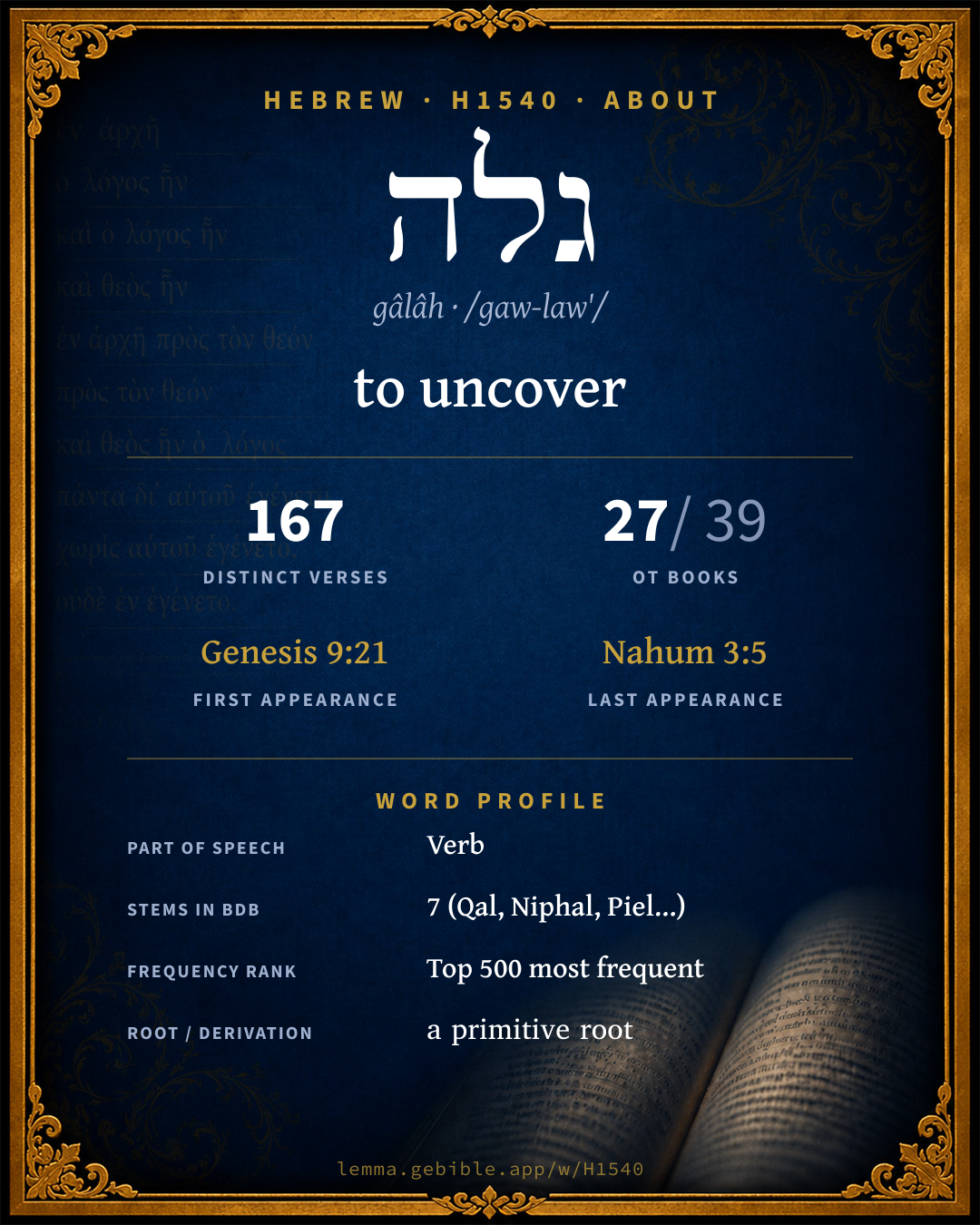
גָּלָה
to uncover
‘to uncover’ is one of 4 main senses fuller range ↓
Full lexicon entry — Brown-Driver-Briggs (BDB)
From Brown-Driver-Briggs (BDB)
Where this word appears
See every Piel verb in the Hebrew Bible →
Grammar key — what these labels mean
Part of speech
- Verb
- An action or state-of-being word.
Stem
- Piel
- An intensive or resultative active stem. Here: ‘uncover’
- Hiphil
- The causative active stem (“he caused / brought about”).
- Qal
- The basic, simple active stem — the plain form of the verb (“he wrote”). Here: ‘intr. remove’
- Niphal
- Usually the simple passive or reflexive of the Qal (“he was written”). Here: ‘refl.’
- Hophal
- The passive counterpart of the Hiphil (“he was caused to…”).
- Hithpael
- The reflexive or reciprocal stem (the subject acts on itself).
- Pual
- The passive counterpart of the Piel.
Form
- Imperfect
- An incomplete, ongoing, or future action (“he will / would write”).
- Perfect
- A completed action or state — Hebrew marks aspect (completeness) more than strict tense (“he wrote”).
- Sequential Imperfect
- An imperfect with prefixed waw — the standard past-narrative form (waw-consecutive imperfect).
- Infinitive Construct
- A bound verbal noun, frequently with prepositions (“to write / in writing”).
- Sequential Perfect
- A perfect with prefixed waw continuing a preceding imperfect or command (waw-consecutive perfect).
- Infinitive Absolute
- An unbound verbal noun, often intensifying or standing in for a finite verb.
- Participle Active
- A verbal adjective expressing ongoing or characteristic action (“writing / one who writes”).
- Participle Passive
- A verbal adjective expressing action received (“written”).
- Imperative
- A direct command (“write!”).
- Jussive
- A third- or second-person volitional form expressing wish or command (“let him write”).
State
- Absolute
- The independent form of a noun, not bound to a following word.
- Construct
- A noun bound to a following noun in a possessive / “of” relationship (the construct chain).
Person
- 2nd Person
- The one addressed (“you”).
- 3rd Person
- The one spoken about (“he / she / it / they”).
- 1st Person
- The speaker (“I / we”).
Gender
- Masculine
- Grammatically masculine.
- Feminine
- Grammatically feminine.
- Common
- Either gender — not distinguished for this form.
Number
- Singular
- One.
- Plural
- More than one (in Hebrew, generally three or more).
Grammatical forms 72 distinct
- Verb, Piel, Imperfect, 2nd Person, Masculine, Singular 14 times (8%)
- Verb, Hiphil, Perfect, 3rd Person, Masculine, Singular 13 times (7%)
- Verb, Piel, Perfect, 3rd Person, Masculine, Singular 10 times (5%)
- Verb, Qal, Perfect, 3rd Person, Masculine, Singular 8 times (4%)
- Verb, Qal, Imperfect, 3rd Person, Masculine, Singular 7 times (4%)
- Verb, Hiphil, Sequential Imperfect, 3rd Person, Masculine, Singular 7 times (4%)
- Verb, Niphal, Perfect, 3rd Person, Masculine, Singular 7 times (4%)
- Verb, Hiphil, Infinitive Construct 7 times (4%)
+64 more forms (113 occurrences)
Parsed forms decoded from the imported morphology (morphhb / Westminster Leningrad Codex — WLC text public domain, morphhb tagging CC BY 4.0), counted across 186 parsed occurrences — not distinct verses.
Every verse where H1540 appears — 167 distinct verses across 27 books. Click any verse to open its interlinear word-by-word view. Verse text shown in the World English Bible for context — . Each verse’s Hebrew form is shown with its reference; the English is not keyword-highlighted, since the data carries no word-level English alignment. Use “Compare translations” on any verse to read it across multiple English versions. This concordance covers the Hebrew Bible; Septuagint (Greek Old Testament) occurrences are not indexed here.
Genesis 2 verses
Exodus 1 verse
Leviticus 20 verses
- Leviticus 18:6 לְ/גַלּ֣וֹת prep + Piel inf.cs "'None of you shall approach anyone who are his close relatives, to uncover their nakedness: I am Yahweh.
- Leviticus 18:7 תְגַלֵּ֑ה תְגַלֶּ֖ה Piel impf 2ms Piel impf 2ms "'You shall not uncover the nakedness of your father, nor the nakedness of your mother: she is your mother. You shall not uncover her nakedness.
- Leviticus 18:8 תְגַלֵּ֑ה Piel impf 2ms "'You shall not uncover the nakedness of your father's wife: it is your father's nakedness.
- Leviticus 18:9 תְגַלֶּ֖ה Piel impf 2ms "'You shall not uncover the nakedness of your sister, the daughter of your father, or the daughter of your mother, whether born at home, or born abroad.
- Leviticus 18:10 תְגַלֶּ֖ה Piel impf 2ms "'You shall not uncover the nakedness of your son's daughter, or of your daughter's daughter, even their nakedness: for theirs is your own nakedness.
- Leviticus 18:11 תְגַלֶּ֖ה Piel impf 2ms "'You shall not uncover the nakedness of your father's wife's daughter, conceived by your father, since she is your sister. "'
- Leviticus 18:12 תְגַלֵּ֑ה Piel impf 2ms You shall not uncover the nakedness of your father's sister: she is your father's near kinswoman.
- Leviticus 18:13 תְגַלֵּ֑ה Piel impf 2ms "'You shall not uncover the nakedness of your mother's sister: for she is your mother's near kinswoman.
- Leviticus 18:14 תְגַלֵּ֑ה Piel impf 2ms "'You shall not uncover the nakedness of your father's brother, you shall not approach his wife: she is your aunt.
- Leviticus 18:15 תְגַלֵּ֑ה תְגַלֶּ֖ה Piel impf 2ms Piel impf 2ms "'You shall not uncover the nakedness of your daughter-in-law: she is your son's wife. You shall not uncover her nakedness.
- Leviticus 18:16 תְגַלֵּ֑ה Piel impf 2ms "'You shall not uncover the nakedness of your brother's wife: it is your brother's nakedness.
- Leviticus 18:17 תְגַלֵּ֑ה לְ/גַלּ֣וֹת Piel impf 2ms prep + Piel inf.cs "'You shall not uncover the nakedness of a woman and her daughter. You shall not take her son's daughter, or her daughter's daughter, to uncover her nakedness; they are near kinswomen: it is wickedness.
- Leviticus 18:18 לְ/גַלּ֧וֹת prep + Piel inf.cs "'You shall not take a wife to her sister, to be a rival, to uncover her nakedness, while her sister is yet alive.
- Leviticus 18:19 לְ/גַלּ֖וֹת prep + Piel inf.cs "'You shall not approach a woman to uncover her nakedness, as long as she is impure by her uncleanness.
- Leviticus 20:11 גִּלָּ֑ה Piel pf 3ms The man who lies with his father's wife has uncovered his father's nakedness: both of them shall surely be put to death; their blood shall be upon them.
- Leviticus 20:17 גִּלָּ֖ה Piel pf 3ms "'If a man takes his sister, his father's daughter, or his mother's daughter, and sees her nakedness, and she sees his nakedness; it is a shameful thing; and they shall be cut off in the sight of the children of their people: he has uncovered his sister's nakedness; he shall bear his iniquity.
- Leviticus 20:18 וְ/גִלָּ֤ה גִּלְּתָ֖ה conj + Piel pf 3ms Piel pf 3fs "'If a man lies with a woman having her monthly period, and uncovers her nakedness; he has made naked her fountain, and she has uncovered the fountain of her blood: and both of them shall be cut off from among their people.
- Leviticus 20:19 תְגַלֵּ֑ה Piel impf 2ms "'You shall not uncover the nakedness of your mother's sister, nor of your father's sister; for he has made naked his close relative: they shall bear their iniquity.
- Leviticus 20:20 גִּלָּ֑ה Piel pf 3ms If a man lies with his uncle's wife, he has uncovered his uncle's nakedness: they shall bear their sin; they shall die childless.
- Leviticus 20:21 גִּלָּ֖ה Piel pf 3ms "'If a man takes his brother's wife, it is an impurity: he has uncovered his brother's nakedness; they shall be childless.
Numbers 3 verses
- Numbers 22:31 וַ/יְגַ֣ל conj + Piel wimpf 3ms Then Yahweh opened the eyes of Balaam, and he saw the angel of Yahweh standing in the way, with his sword drawn in his hand; and he bowed his head, and fell on his face.
- Numbers 24:4 וּ/גְל֥וּי conj + Qal ptcp.pass ms cs He says, who hears the words of God, Who sees the vision of the Almighty, Falling down, and having his eyes open:
- Numbers 24:16 וּ/גְל֥וּי conj + Qal ptcp.pass ms cs He says, who hears the words of God, Knows the knowledge of the Most High, Who sees the vision of the Almighty, Falling down, and having his eyes open:
Deuteronomy 3 verses
- Deuteronomy 22:30 יְגַלֶּ֖ה Piel impf 3ms A man shall not take his father's wife, and shall not uncover his father's skirt.
- Deuteronomy 27:20 גִלָּ֖ה Piel pf 3ms Cursed be he who lies with his father's wife, because he has uncovered his father's skirt. All the people shall say, Amen.
- Deuteronomy 29:29 וְ/הַ/נִּגְלֹ֞ת conj + ptcl def.art + Niphal ptcp.act fp The secret things belong to Yahweh our God; but the things that are revealed belong to us and to our children forever, that we may do all the words of this law.
Judges 1 verse
Ruth 3 verses
- Ruth 3:4 וְ/גִלִּ֥ית conj + Piel wpf 2fs It shall be, when he lies down, that you shall mark the place where he shall lie, and you shall go in, and uncover his feet, and lay you down; and he will tell you what you shall do.
- Ruth 3:7 וַ/תְּגַ֥ל conj + Piel wimpf 3fs When Boaz had eaten and drunk, and his heart was merry, he went to lie down at the end of the heap of grain: and she came softly, and uncovered his feet, and laid her down.
- Ruth 4:4 אֶגְלֶ֧ה Qal impf 1cs I thought to disclose it to you, saying, Buy it before those who sit here, and before the elders of my people. If you will redeem it, redeem it: but if you will not redeem it, then tell me, that I may know; for there is none to redeem it besides you; and I am after you. He said, I will redeem it.
1 Samuel 13 verses
- 1 Samuel 2:27 הֲ/נִגְלֹ֤ה נִגְלֵ֨יתִי֙ ptcl inter + Niphal inf.abs Niphal pf 1cs There came a man of God to Eli, and said to him, Thus says Yahweh, Did I reveal myself to the house of your father, when they were in Egypt [in bondage] to Pharaoh's house?
- 1 Samuel 3:7 יִגָּלֶ֥ה Niphal impf 3ms Now Samuel didn't yet know Yahweh, neither was the word of Yahweh yet revealed to him.
- 1 Samuel 3:21 נִגְלָ֨ה Niphal pf 3ms Yahweh appeared again in Shiloh; for Yahweh revealed himself to Samuel in Shiloh by the word of Yahweh.
- 1 Samuel 4:21 גָּלָ֥ה Qal pf 3ms She named the child Ichabod, saying, The glory is departed from Israel; because the ark of God was taken, and because of her father-in-law and her husband.
- 1 Samuel 4:22 גָּלָ֥ה Qal pf 3ms She said, The glory is departed from Israel; for the ark of God is taken.
- 1 Samuel 9:15 גָּלָ֖ה Qal pf 3ms Now Yahweh had revealed to Samuel a day before Saul came, saying,
- 1 Samuel 14:8 וְ/נִגְלִ֖ינוּ conj + Niphal wpf 1cp Then said Jonathan, Behold, we will pass over to the men, and we will disclose ourselves to them.
- 1 Samuel 14:11 וַ/יִּגָּל֣וּ conj + Niphal wimpf 3mp Both of them disclosed themselves to the garrison of the Philistines: and the Philistines said, Behold, the Hebrews come forth out of the holes where they had hid themselves.
- 1 Samuel 20:2 יִגְלֶ֖ה Qal impf 3ms He said to him, "Far from it; you shall not die: behold, my father does nothing either great or small, but that he discloses it to me; and why should my father hide this thing from me? It is not so."
- 1 Samuel 20:12 וְ/גָלִ֖יתִי conj + Qal wpf 1cs Jonathan said to David, Yahweh, the God of Israel, [be witness]: when I have sounded my father about this time tomorrow, [or] the third day, behold, if there be good toward David, shall I not then send to you, and disclose it to you?
- 1 Samuel 20:13 וְ/גָלִ֨יתִי֙ conj + Qal wpf 1cs Yahweh do so to Jonathan, and more also, should it please my father to do you evil, if I don't disclose it to you, and send you away, that you may go in peace: and Yahweh be with you, as he has been with my father.
- 1 Samuel 22:8 גֹּלֶ֤ה וְ/גֹלֶ֣ה Qal ptcp.act ms conj + Qal ptcp.act ms that all of you have conspired against me, and there is none who discloses to me when my son makes a league with the son of Jesse, and there is none of you who is sorry for me, or discloses to me that my son has stirred up my servant against me, to lie in wait, as at this day?
- 1 Samuel 22:17 גָל֖וּ Qal pf 3cp The king said to the guard who stood about him, Turn, and kill the priests of Yahweh; because their hand also is with David, and because they knew that he fled, and didn't disclose it to me. But the servants of the king wouldn't put forth their hand to fall on the priests of Yahweh.
2 Samuel 4 verses
- 2 Samuel 6:20 נִגְלָ֤ה כְּ/הִגָּל֥וֹת נִגְל֖וֹת Niphal pf 3ms prep + Niphal inf.cs Niphal inf.cs Then David returned to bless his household. Michal the daughter of Saul came out to meet David, and said, How glorious was the king of Israel today, who uncovered himself today in the eyes of the handmaids of his servants, as one of the vain fellows shamelessly uncovers himself!
- 2 Samuel 7:27 גָּלִ֜יתָה Qal pf 2ms For you, Yahweh of Hosts, the God of Israel, have revealed to your servant, saying, I will build you a house: therefore has your servant found in his heart to pray this prayer to you.
- 2 Samuel 15:19 גֹּלֶ֥ה Qal ptcp.act ms Then said the king to Ittai the Gittite, Why go you also with us? return, and abide with the king: for you are a foreigner, and also an exile; [return] to your own place.
- 2 Samuel 22:16 יִגָּל֖וּ Niphal impf 3mp Then the channels of the sea appeared, The foundations of the world were laid bare, By the rebuke of Yahweh, At the blast of the breath of his nostrils.
2 Kings 14 verses
- 2 Kings 15:29 וַ/יַּגְלֵ֖/ם conj + Hiphil wimpf 3ms + sfx pers 3mp In the days of Pekah king of Israel came Tiglath Pileser king of Assyria, and took Ijon, and Abel Beth Maacah, and Janoah, and Kedesh, and Hazor, and Gilead, and Galilee, all the land of Naphtali; and he carried them captive to Assyria.
- 2 Kings 16:9 וַ/יַּגְלֶ֖/הָ conj + Hiphil wimpf 3ms + sfx pers 3fs The king of Assyria listened to him; and the king of Assyria went up against Damascus, and took it, and carried [the people of] it captive to Kir, and killed Rezin.
- 2 Kings 17:6 וַ/יֶּ֥גֶל conj + Hiphil wimpf 3ms In the ninth year of Hoshea the king of Assyria took Samaria, and carried Israel away to Assyria, and placed them in Halah, and on the Habor, the river of Gozan, and in the cities of the Medes.
- 2 Kings 17:11 הֶגְלָ֥ה Hiphil pf 3ms and there they burnt incense in all the high places, as did the nations whom Yahweh carried away before them; and they worked wicked things to provoke Yahweh to anger;
- 2 Kings 17:23 וַ/יִּ֨גֶל conj + Qal wimpf 3ms until Yahweh removed Israel out of his sight, as he spoke by all his servants the prophets. So Israel was carried away out of their own land to Assyria to this day.
- 2 Kings 17:26 הִגְלִ֨יתָ֙ Hiphil pf 2ms Therefore they spoke to the king of Assyria, saying, The nations which you have carried away, and placed in the cities of Samaria, don't know the law of the god of the land: therefore he has sent lions among them, and, behold, they kill them, because they don't know the law of the god of the land.
- 2 Kings 17:27 הִגְלִיתֶ֣ם Hiphil pf 2mp Then the king of Assyria commanded, saying, Carry there one of the priests whom you brought from there; and let them go and dwell there, and let him teach them the law of the god of the land.
- 2 Kings 17:28 הִגְלוּ֙ Hiphil pf 3cp So one of the priests whom they had carried away from Samaria came and lived in Bethel, and taught them how they should fear Yahweh.
- 2 Kings 17:33 הִגְל֥וּ Hiphil pf 3cp They feared Yahweh, and served their own gods, after the manner of the nations from among whom they had been carried away.
- 2 Kings 18:11 וַ/יֶּ֧גֶל conj + Hiphil wimpf 3ms The king of Assyria carried Israel away to Assyria, and put them in Halah, and on the Habor, the river of Gozan, and in the cities of the Medes,
- 2 Kings 24:14 וְ/הִגְלָ֣ה conj + Hiphil pf 3ms He carried away all Jerusalem, and all the princes, and all the mighty men of valor, even ten thousand captives, and all the craftsmen and the smiths; none remained, save the poorest sort of the people of the land.
- 2 Kings 24:15 וַ/יֶּ֥גֶל conj + Hiphil wimpf 3ms He carried away Jehoiachin to Babylon; and the king's mother, and the king's wives, and his officers, and the chief men of the land, carried he into captivity from Jerusalem to Babylon.
- 2 Kings 25:11 הֶגְלָ֕ה Hiphil pf 3ms The residue of the people who were left in the city, and those who fell away, who fell to the king of Babylon, and the residue of the multitude, did Nebuzaradan the captain of the guard carry away captive.
- 2 Kings 25:21 וַ/יִּ֥גֶל conj + Qal wimpf 3ms The king of Babylon struck them, and put them to death at Riblah in the land of Hamath. So Judah was carried away captive out of his land.
1 Chronicles 7 verses
- 1 Chronicles 5:6 הֶגְלָ֔ה Hiphil pf 3ms Beerah his son, whom Tilgath Pilneser king of Assyria carried away captive: he was prince of the Reubenites.
- 1 Chronicles 5:26 וַ/יַּגְלֵ/ם֙ conj + Hiphil wimpf 3ms + sfx pers 3mp The God of Israel stirred up the spirit of Pul king of Assyria, and the spirit of Tilgath Pilneser king of Assyria, and he carried them away, even the Reubenites, and the Gadites, and the half-tribe of Manasseh, and brought them to Halah, and Habor, and Hara, and to the river of Gozan, to this day.
- 1 Chronicles 6:15 בְּ/הַגְל֣וֹת prep + Hiphil inf.cs Jehozadak went [into captivity], when Yahweh carried away Judah and Jerusalem by the hand of Nebuchadnezzar.
- 1 Chronicles 8:6 וַ/יַּגְל֖וּ/ם conj + Hiphil wimpf 3mp + sfx pers 3mp These are the sons of Ehud: these are the heads of fathers' [houses] of the inhabitants of Geba, and they carried them captive to Manahath:
- 1 Chronicles 8:7 הֶגְלָ֑/ם Hiphil pf 3ms + sfx pers 3mp and Naaman, and Ahijah, and Gera, he carried them captive: and he became the father of Uzza and Ahihud.
- 1 Chronicles 9:1 הָגְל֥וּ Hophal pf 3cp So all Israel were reckoned by genealogies; and, behold, they are written in the book of the kings of Israel: and Judah was carried away captive to Babylon for their disobedience.
- 1 Chronicles 17:25 גָּלִ֨יתָ֙ Qal pf 2ms For you, my God, have revealed to your servant that you will build him a house: therefore has your servant found [in his heart] to pray before you.
2 Chronicles 1 verse
Ezra 1 verse
Nehemiah 1 verse
Esther 3 verses
- Esther 2:6 הָגְלָה֙ הָגְלְתָ֔ה הֶגְלָ֔ה Hophal pf 3ms Hophal pf 3fs Hiphil pf 3ms who had been carried away from Jerusalem with the captives who had been carried away with Jeconiah king of Judah, whom Nebuchadnezzar the king of Babylon had carried away.
- Esther 3:14 גָּל֖וּי Qal ptcp.pass ms A copy of the writing, that the decree should be given out in every province, was published to all the peoples, that they should be ready against that day.
- Esther 8:13 גָּל֖וּי Qal ptcp.pass ms A copy of the writing, that the decree should be given out in every province, was published to all the peoples, and that the Jews should be ready against that day to avenge themselves on their enemies.
Job 8 verses
- Job 12:22 מְגַלֶּ֣ה Piel ptcp.act ms He uncovers deep things out of darkness, And brings out to light the shadow of death.
- Job 20:27 יְגַלּ֣וּ Piel impf 3mp The heavens shall reveal his iniquity, The earth shall rise up against him.
- Job 20:28 יִ֭גֶל Qal impf 3ms The increase of his house shall depart; They shall rush away in the day of his wrath.
- Job 33:16 יִ֭גְלֶה Qal impf 3ms Then he opens the ears of men, And seals their instruction,
- Job 36:10 וַ/יִּ֣גֶל conj + Qal wimpf 3ms He also opens their ears to instruction, And commands that they return from iniquity.
- Job 36:15 וְ/יִ֖גֶל conj + Qal impf 3ms He delivers the afflicted by their affliction, And opens their ear in oppression.
- Job 38:17 הֲ/נִגְל֣וּ ptcl inter + Niphal pf 3cp Have the gates of death been revealed to you? Or have you seen the gates of the shadow of death?
- Job 41:13 גִ֭לָּה Piel pf 3ms Who can strip off his outer garment? Who shall come within his jaws?
Psalms 3 verses
- Psalms 18:15 וַֽ/יִּגָּלוּ֮ conj + Niphal wimpf 3mp Then the channels of waters appeared, The foundations of the world were laid bare at your rebuke, Yahweh, At the blast of the breath of your nostrils.
- Psalms 98:2 גִּלָּ֥ה Piel pf 3ms Yahweh has made known his salvation. He has openly shown his righteousness in the sight of the nations.
- Psalms 119:18 גַּל Piel impv 2ms Open my eyes, That I may see wondrous things out of your law.
Proverbs 7 verses
- Proverbs 11:13 מְגַלֶּה Piel ptcp.act ms One who brings gossip betrays a confidence, But one who is of a trustworthy spirit is one who keeps a secret.
- Proverbs 18:2 בְּ/הִתְגַּלּ֥וֹת prep + Hithpael inf.cs A fool has no delight in understanding, But only in revealing his own opinion.
- Proverbs 20:19 גּֽוֹלֶה Qal ptcp.act ms He who goes about as a tale-bearer reveals secrets; Therefore don't keep company with him who opens wide his lips.
- Proverbs 25:9 תְּגָֽל Piel juss 2ms Debate your case with your neighbor, And don't betray the confidence of another;
- Proverbs 26:26 תִּגָּלֶ֖ה Niphal impf 3fs His malice may be concealed by deception, But his wickedness will be exposed in the assembly.
- Proverbs 27:5 מְגֻלָּ֑ה Pual ptcp.pass fs Better is open rebuke Than hidden love.
- Proverbs 27:25 גָּלָ֣ה Qal pf 3ms The hay is removed, and the new growth appears, The grasses of the hills are gathered in.
Isaiah 16 verses
- Isaiah 5:13 גָּלָ֥ה Qal pf 3ms Therefore my people go into captivity for lack of knowledge; Their honorable men are famished, And their multitudes are parched with thirst.
- Isaiah 16:3 תְּגַלִּֽי Piel juss 2fs Give counsel, execute justice; make your shade as the night in the midst of the noonday; hide the outcasts; don't betray the fugitive.
- Isaiah 22:8 וַ/יְגַ֕ל conj + Piel wimpf 3ms He took away the covering of Judah; and you did look in that day to the armor in the house of the forest.
- Isaiah 22:14 וְ/נִגְלָ֥ה conj + Niphal pf 3ms Yahweh of Hosts revealed himself in my ears, Surely this iniquity shall not be forgiven you until you die, says the Lord, Yahweh of Hosts.
- Isaiah 23:1 נִגְלָה Niphal pf 3ms The burden of Tyre. Howl, you ships of Tarshish; for it is laid waste, so that there is no house, no entering in: from the land of Kittim it is revealed to them.
- Isaiah 24:11 גָּלָ֖ה Qal pf 3ms There is a crying in the streets because of the wine; all joy is darkened, the mirth of the land is gone.
- Isaiah 26:21 וְ/גִלְּתָ֤ה conj + Piel wpf 3fs For, behold, Yahweh comes forth out of his place to punish the inhabitants of the earth for their iniquity: the earth also shall disclose her blood, and shall no more cover her slain.
- Isaiah 38:12 וְ/נִגְלָ֛ה conj + Niphal pf 3ms My dwelling is removed, and is carried away from me as a shepherd's tent: I have rolled up, like a weaver, my life; he will cut me off from the loom: From day even to night will you make an end of me.
- Isaiah 40:5 וְ/נִגְלָ֖ה conj + Niphal wpf 3ms and the glory of Yahweh shall be revealed, and all flesh shall see it together; for the mouth of Yahweh has spoken it.
- Isaiah 47:2 גַּלִּ֨י גַּלִּי Piel impv 2fs Piel impv 2fs Take the millstones, and grind meal; remove your veil, strip off the train, uncover the leg, pass through the rivers.
- Isaiah 47:3 תִּגָּל֙ Niphal impf 3fs Your nakedness shall be uncovered, yes, your shame shall be seen: I will take vengeance, and will spare no man.
- Isaiah 49:9 הִגָּל֑וּ Niphal impv 2mp saying to those who are bound, Go forth; to those who are in darkness, Show yourselves. They shall feed in the ways, and on all bare heights shall be their pasture.
- Isaiah 49:21 גֹּלָ֣ה Qal ptcp.act fs Then shall you say in your heart, Who has conceived these for me, seeing I have been bereaved of my children, and am solitary, an exile, and wandering back and forth? and who has brought up these? Behold, I was left alone; these, where were they?
- Isaiah 53:1 נִגְלָֽתָה Niphal pf 3fs Who has believed our message? and to whom has the arm of Yahweh been revealed?
- Isaiah 56:1 לְ/הִגָּלֽוֹת prep + Niphal inf.cs Thus says Yahweh, Keep you justice, and do righteousness; for my salvation is near to come, and my righteousness to be revealed.
- Isaiah 57:8 גִּלִּ֣ית Piel pf 2fs Behind the doors and the posts have you set up your memorial: for you have uncovered [yourself] to another than me, and are gone up; you have enlarged your bed, and made you a covenant with them: you loved their bed where you saw it.
Jeremiah 25 verses
- Jeremiah 1:3 גְּל֥וֹת Qal inf.cs It came also in the days of Jehoiakim the son of Josiah, king of Judah, to the end of the eleventh year of Zedekiah, the son of Josiah, king of Judah, to the carrying away of Jerusalem captive in the fifth month.
- Jeremiah 11:20 גִּלִּ֥יתִי Piel pf 1cs But, Yahweh of Hosts, who judge righteously, who try the heart and the mind, I shall see your vengeance on them; for to you have I revealed my cause.
- Jeremiah 13:19 הָגְלָ֧ת הָגְלָ֥ת Hophal pf 3fs Hophal pf 3fs The cities of the South are shut up, and there is none to open them: Judah is carried away captive, all of it; it is wholly carried away captive.
- Jeremiah 13:22 נִגְל֥וּ Niphal pf 3cp If you say in your heart, Why are these things come on me? for the greatness of your iniquity are your skirts uncovered, and your heels suffer violence.
- Jeremiah 20:4 וְ/הִגְלָ֥/ם conj + Hiphil wpf 3ms + sfx pers 3mp For thus says Yahweh, Behold, I will make you a terror to yourself, and to all your friends; and they shall fall by the sword of their enemies, and your eyes shall see it; and I will give all Judah into the hand of the king of Babylon, and he shall carry them captive to Babylon, and shall kill them with the sword.
- Jeremiah 20:12 גִּלִּ֥יתִי Piel pf 1cs But, Yahweh of Hosts, who tests the righteous, who sees the heart and the mind, let me see your vengeance on them; for to you have I revealed my cause.
- Jeremiah 22:12 הִגְל֥וּ Hiphil pf 3cp But in the place where they have led him captive, there shall he die, and he shall see this land no more.
- Jeremiah 24:1 הַגְל֣וֹת Hiphil inf.cs Yahweh shown me, and, behold, two baskets of figs set before the temple of Yahweh, after that Nebuchadrezzar king of Babylon had carried away captive Jeconiah the son of Jehoiakim, king of Judah, and the princes of Judah, with the craftsmen and smiths, from Jerusalem, and had brought them to Babylon.
- Jeremiah 27:20 בַּ֠/גְלוֹת/וֹ prep + Hiphil inf.cs + sfx pers 3ms which Nebuchadnezzar king of Babylon didn't take, when he carried away captive Jeconiah the son of Jehoiakim, king of Judah, from Jerusalem to Babylon, and all the nobles of Judah and Jerusalem;
- Jeremiah 29:1 הֶגְלָ֧ה Hiphil pf 3ms Now these are the words of the letter that Jeremiah the prophet sent from Jerusalem to the residue of the elders of the captivity, and to the priests, and to the prophets, and to all the people, whom Nebuchadnezzar had carried away captive from Jerusalem to Babylon,
- Jeremiah 29:4 הִגְלֵ֥יתִי Hiphil pf 1cs Thus says Yahweh of Hosts, the God of Israel, to all the captivity, whom I have caused to be carried away captive from Jerusalem to Babylon:
- Jeremiah 29:7 הִגְלֵ֤יתִי Hiphil pf 1cs Seek the peace of the city where I have caused you to be carried away captive, and pray to Yahweh for it; for in the peace of it shall you have peace.
- Jeremiah 29:14 הִגְלֵ֥יתִי Hiphil pf 1cs I will be found by you, says Yahweh, and I will turn again your captivity, and I will gather you from all the nations, and from all the places where I have driven you, says Yahweh; and I will bring you again to the place from where I caused you to be carried away captive.
- Jeremiah 32:11 הַ/גָּלֽוּי ptcl def.art + Qal ptcp.pass ms So I took the deed of the purchase, both that which was sealed, containing the terms and conditions, and that which was open;
- Jeremiah 32:14 הַ/גָּלוּי֙ ptcl def.art + Qal ptcp.pass ms Thus says Yahweh of Hosts, the God of Israel: Take these deeds, this deed of the purchase which is sealed, and this deed which is open, and put them in an earthen vessel; that they may continue many days.
- Jeremiah 33:6 וְ/גִלֵּיתִ֣י conj + Piel wpf 1cs Behold, I will bring it health and cure, and I will cure them; and I will reveal to them abundance of peace and truth.
- Jeremiah 39:9 הֶגְלָ֛ה Hiphil pf 3ms Then Nebuzaradan the captain of the guard carried away captive into Babylon the residue of the people who remained in the city, the deserters also who fell away to him, and the residue of the people who remained.
- Jeremiah 40:1 הַ/מֻּגְלִ֖ים ptcl def.art + Hophal ptcp.pass mp The word which came to Jeremiah from Yahweh, after that Nebuzaradan the captain of the guard had let him go from Ramah, when he had taken him being bound in chains among all the captives of Jerusalem and Judah, who were carried away captive to Babylon.
- Jeremiah 40:7 הָגְל֖וּ Hophal pf 3cp Now when all the captains of the forces who were in the fields, even they and their men, heard that the king of Babylon had made Gedaliah the son of Ahikam governor in the land, and had committed to him men, and women, and children, and of the poorest of the land, of those who were not carried away captive to Babylon;
- Jeremiah 43:3 וּ/לְ/הַגְל֥וֹת conj + prep + Hiphil inf.cs but Baruch the son of Neriah sets you on against us, to deliver us into the hand of the Chaldeans, that they may put us to death, and carry us away captive to Babylon.
- Jeremiah 49:10 גִּלֵּ֨יתִי֙ Piel pf 1cs But I have made Esau bare, I have uncovered his secret places, and he shall not be able to hide himself: his seed is destroyed, and his brothers, and his neighbors; and he is no more.
- Jeremiah 52:15 הֶגְלָ֕ה Hiphil pf 3ms Then Nebuzaradan the captain of the guard carried away captive of the poorest of the people, and the residue of the people who were left in the city, and those who fell away, who fell to the king of Babylon, and the residue of the multitude.
- Jeremiah 52:27 וַ/יִּ֥גֶל conj + Qal wimpf 3ms The king of Babylon struck them, and put them to death at Riblah in the land of Hamath. So Judah was carried away captive out of his land.
- Jeremiah 52:28 הֶגְלָ֖ה Hiphil pf 3ms This is the people whom Nebuchadrezzar carried away captive: in the seventh year three thousand twenty-three Jews;
- Jeremiah 52:30 הֶגְלָ֗ה Hiphil pf 3ms in the three and twentieth year of Nebuchadrezzar Nebuzaradan the captain of the guard carried away captive of the Jews seven hundred forty-five persons: all the persons were four thousand and six hundred.
Lamentations 3 verses
- Lamentations 1:3 גָּֽלְתָ֨ה Qal pf 3fs Judah is gone into captivity because of affliction, and because of great servitude; She dwells among the nations, she finds no rest: All her persecutors overtook her within the straits.
- Lamentations 2:14 גִלּ֥וּ Piel pf 3cp Your prophets have seen for you false and foolish visions; They have not uncovered your iniquity, to bring back your captivity, But have seen for you false oracles and causes of banishment.
- Lamentations 4:22 לְ/הַגְלוֹתֵ֑/ךְ גִּלָּ֖ה prep + Hiphil inf.cs + sfx pers 2fs Piel pf 3ms The punishment of your iniquity is accomplished, daughter of Zion; he will no more carry you away into captivity: He will visit your iniquity, daughter of Edom; he will uncover your sins.
Ezekiel 12 verses
- Ezekiel 12:3 וּ/גְלֵ֥ה וְ/גָלִ֨יתָ conj + Qal impv 2ms conj + Qal wpf 2ms Therefore, you son of man, prepare you stuff for removing, and remove by day in their sight; and you shall remove from your place to another place in their sight: it may be they will consider, though they are a rebellious house.
- Ezekiel 13:14 וְ/נִגְלָ֣ה conj + Niphal wpf 3ms So will I break down the wall that you have daubed with whitewash, and bring it down to the ground, so that the foundation of it shall be uncovered; and it shall fall, and you shall be consumed in the midst of it: and you shall know that I am Yahweh.
- Ezekiel 16:36 וַ/תִּגָּלֶ֣ה conj + Niphal wimpf 3fs Thus says the Lord Yahweh, Because your filthiness was poured out, and your nakedness uncovered through your prostitution with your lovers; and because of all the idols of your abominations, and for the blood of your children, that you gave to them;
- Ezekiel 16:37 וְ/גִלֵּיתִ֤י conj + Piel wpf 1cs therefore see, I will gather all your lovers, with whom you have taken pleasure, and all those who you have loved, with all those who you have hated; I will even gather them against you on every side, and will uncover your nakedness to them, that they may see all your nakedness.
- Ezekiel 16:57 תִּגָּלֶ֣ה Niphal impf 3fs before your wickedness was uncovered, as at the time of the reproach of the daughters of Syria, and of all who are round about her, the daughters of the Philistines, who do despite to you round about.
- Ezekiel 21:24 בְּ/הִגָּל֣וֹת prep + Niphal inf.cs Therefore thus says the Lord Yahweh: Because you have made your iniquity to be remembered, in that your transgressions are uncovered, so that in all your doings your sins do appear; because you have come to memory, you shall be taken with the hand.
- Ezekiel 22:10 גִּלָּה Piel pf 3ms In you have they uncovered their fathers' nakedness; in you have they humbled her who was unclean in her impurity.
- Ezekiel 23:10 גִּלּ֣וּ Piel pf 3cp These uncovered her nakedness; they took her sons and her daughters; and her they killed with the sword: and she became a byword among women; for they executed judgments on her.
- Ezekiel 23:18 וַ/תְּגַל֙ וַ/תְּגַ֖ל conj + Piel wimpf 3fs conj + Piel wimpf 3fs So she uncovered her prostitution, and uncovered her nakedness: then my soul was alienated from her, like as my soul was alienated from her sister.
- Ezekiel 23:29 וְ/נִגְלָה֙ conj + Niphal wpf 3ms and they shall deal with you in hatred, and shall take away all your labor, and shall leave you naked and bare; and the nakedness of your prostitution shall be uncovered, both your lewdness and your prostitution.
- Ezekiel 39:23 גָּל֣וּ Qal pf 3cp The nations shall know that the house of Israel went into captivity for their iniquity; because they trespassed against me, and I hid my face from them: so I gave them into the hand of their adversaries, and they fell all of them by the sword.
- Ezekiel 39:28 בְּ/הַגְלוֹתִ֤/י prep + Hiphil inf.cs + sfx pers 1cs They shall know that I am Yahweh their God, in that I caused them to go into captivity among the nations, and have gathered them to their own land; and I will leave none of them any more there;
Daniel 1 verse
Hosea 3 verses
- Hosea 2:10 אֲגַלֶּ֥ה Piel impf 1cs Now I will uncover her lewdness in the sight of her lovers, And no one will deliver her out of my hand.
- Hosea 7:1 וְ/נִגְלָ֞ה conj + Niphal pf 3ms When I would heal Israel, Then the iniquity of Ephraim is uncovered, Also the wickedness of Samaria; For they commit falsehood, And the thief enters in, And the gang of robbers ravages outside.
- Hosea 10:5 גָלָ֥ה Qal pf 3ms The inhabitants of Samaria will be in terror for the calves of Beth Aven; For its people will mourn over it, Along with its priests who rejoiced over it, For its glory, because it has departed from it.
Amos 8 verses
- Amos 1:5 וְ/גָל֧וּ conj + Qal wpf 3cp I will break the bar of Damascus, And cut off the inhabitant from the valley of Aven, And him who holds the scepter from the house of Eden; And the people of Syria shall go into captivity to Kir," says Yahweh.
- Amos 1:6 הַגְלוֹתָ֛/ם Hiphil inf.cs + sfx pers 3mp Thus says Yahweh: "For three transgressions of Gaza, yes, for four, I will not turn away its punishment; Because they carried away captive the whole community, To deliver them up to Edom;
- Amos 3:7 גָּלָ֣ה Qal pf 3ms Surely the Lord Yahweh will do nothing, Unless he reveals his secret to his servants the prophets.
- Amos 5:5 גָּלֹ֣ה יִגְלֶ֔ה Qal inf.abs Qal impf 3ms But don't seek Bethel, Nor enter into Gilgal, And don't pass to Beersheba: For Gilgal shall surely go into captivity, And Bethel shall come to nothing.
- Amos 5:27 וְ/הִגְלֵיתִ֥י conj + Hiphil wpf 1cs Therefore will I cause you to go into captivity beyond Damascus," says Yahweh, whose name is the God of hosts.
- Amos 6:7 יִגְל֖וּ גֹּלִ֑ים Qal impf 3mp Qal ptcp.act mp Therefore they will now go captive with the first who go captive; And the feasting and lounging will end.
- Amos 7:11 גָּלֹ֥ה יִגְלֶ֖ה Qal inf.abs Qal impf 3ms For Amos says, 'Jeroboam will die by the sword, and Israel shall surely be led away captive out of his land.'"
- Amos 7:17 גָּלֹ֥ה יִגְלֶ֖ה Qal inf.abs Qal impf 3ms Therefore thus says Yahweh: 'Your wife shall be a prostitute in the city, and your sons and your daughters shall fall by the sword, and your land shall be divided by line; and you yourself shall die in a land that is unclean, and Israel shall surely be led away captive out of his land.'"
Micah 2 verses
- Micah 1:6 אֲגַלֶּֽה Piel impf 1cs Therefore I will make Samaria like a rubble heap of the field, Like places for planting vineyards; And I will pour down its stones into the valley, And I will uncover its foundations.
- Micah 1:16 גָל֖וּ Qal pf 3cp Shave your heads, And cut off your hair for the children of your delight. Enlarge your baldness like the vulture; For they have gone into captivity from you!
Nahum 2 verses
- Nahum 2:7 גֻּלְּתָ֣ה Pual pf 3fs It is decreed: she is uncovered, she is carried away; and her handmaids moan as with the voice of doves, beating on their breasts.
- Nahum 3:5 וְ/גִלֵּיתִ֥י conj + Piel pf 1cs "Behold, I am against you," says Yahweh of Hosts, "and I will lift your skirts over your face. I will show the nations your nakedness, and the kingdoms your shame.
About this entry
At a glance — auto-summarized from this page’s data, not written by a person. Every figure links to its source below. This summary describes the numbers; it doesn’t interpret them.
At its core, גלה (gâlâh) means “to uncover.” The King James Version usually renders it “thou shalt not uncover,” while modern versions prefer “have sexual relations with her” (Berean Standard Bible) — see the renderings breakdown. Spanning 167 verses in 27 books, it ranks among the common words of the Hebrew Bible. Scripture first uses it in Genesis 9:21. As a verb its force shifts by stem, across 7 stems (Qal, Niphal, and more). Each statement above links to its evidence; the full detail follows below.
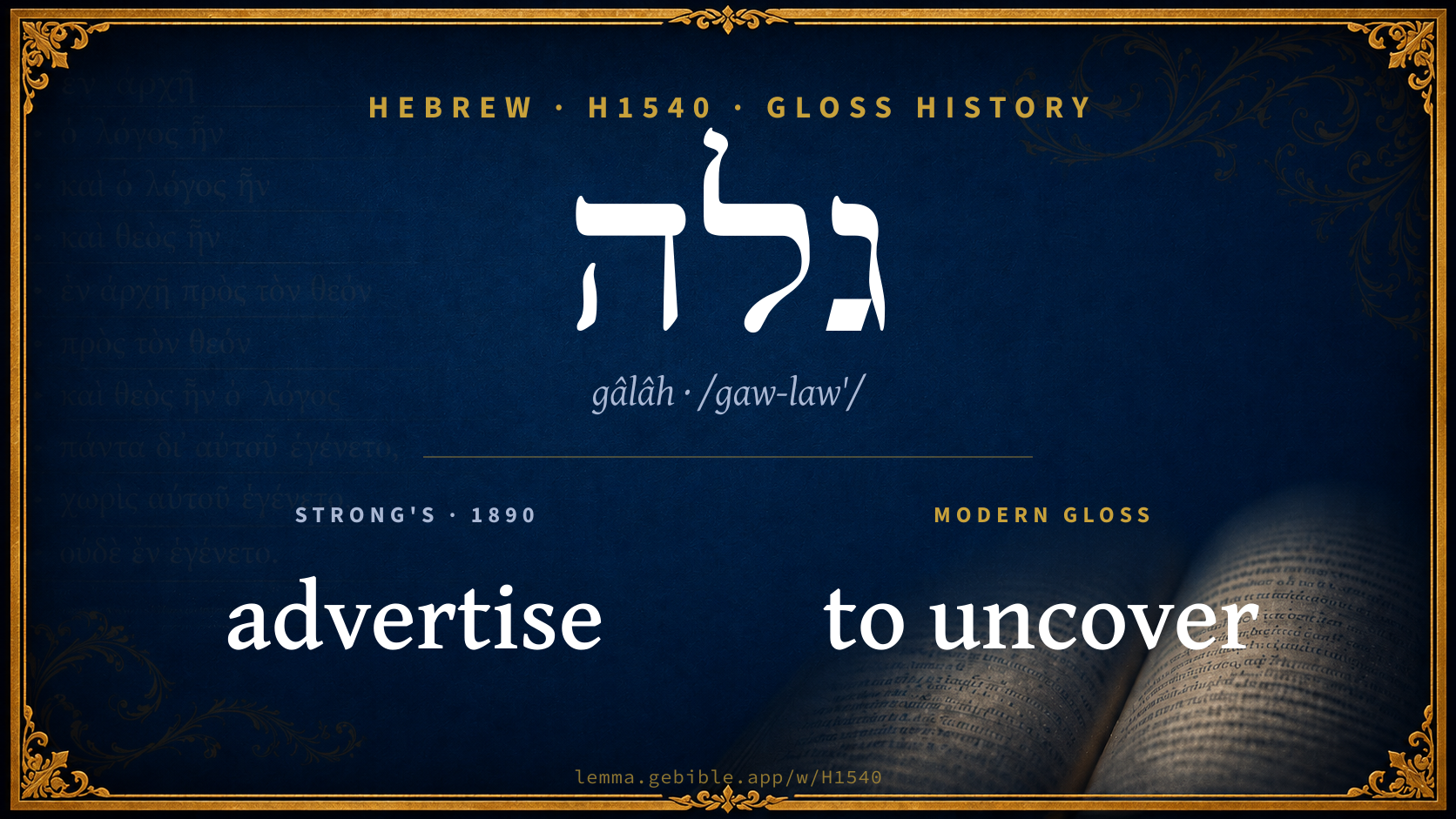
Gloss history
Strong's 1890 vs modern scholarship
About this word
Strong's H1540 catalogs a Hebrew word from the Hebrew Old Testament.
These counts are not copied from any lexicon or concordance. They are computed here, from the morphology-tagged Hebrew Old Testament. What Lemma adds →
- 167
- distinct verses
- The word appears in 167 distinct verses.
- 27 / 39
- OT books
- The word appears in 27 of 39 Old Testament books.
- #251
- by frequency
- Top 500 most frequent Hebrew words (rank 251 of 8,640 Hebrew words by occurrence).
View all 167 occurrences in the concordance →
By section of the Old Testament
By traditional corpus
Conventional, traditional groupings — biblical authorship is debated, so this is a traditional corpus grouping, not an authorship claim. Each share is this word’s portion of its verses in that division of the Hebrew canon. Each figure is a share of the word’s 167 distinct verses.
- Prophets (Nevi'im) 100 verses · 60%
- Writings (Ketuvim) 38 verses · 23%
- Torah (Pentateuch) 29 verses · 17%
How translations render this word
Counts come from each version’s own published word-to-Strong’s tagging or interlinear alignment — an approximate guide to how each version renders this word, not a word-level alignment the data otherwise carries. Because each total is that version’s own tagged count, the per-version totals vary from one another and need not match the appearance or distinct-verse counts above. These counts may also differ from a printed concordance because Lemma counts each distinctly tagged rendering and does not collapse phrase taggings into a single head-word total. This is a fixed set of word-tagged versions (KJV, ASV, BSB, ULT) and does not change with the reading translation you choose elsewhere. Each version’s license is shown beside its name below (and on Sources).
- King James Version: Thou shalt not uncover 12×, Uncover 7×, Carried away captive 5×
- American Standard Version: Thou shalt not uncover 12×, Uncovered 7×, Carried away captive 4×
- Berean Standard Bible: Have sexual relations with her 6×, Carried away 5×, Exile 5×
- unfoldingWord Literal Text: Uncover 26×, You shall 14×, And 8×
King James Version Public Domain
Renders H1540 across 190 tagged occurrences — most commonly:
Plus other, less common renderings. Plus 109 renderings that appear only once — usually multi-word phrases or single function words the recovered tagging swept in, not distinct renderings.
American Standard Version Public Domain
Renders H1540 across 187 tagged occurrences — most commonly:
Plus other, less common renderings. Plus 101 renderings that appear only once — usually multi-word phrases or single function words the recovered tagging swept in, not distinct renderings.
Berean Standard Bible Public Domain
Renders H1540 across 170 tagged occurrences — most commonly:
Plus other, less common renderings. Plus 102 renderings that appear only once — usually multi-word phrases or single function words the recovered tagging swept in, not distinct renderings. Not rendered by a distinct English word in 16 further occurrences.
unfoldingWord Literal Text CC BY-SA 4.0
Renders H1540 across 210 tagged occurrences — most commonly:
Plus other, less common renderings. Plus 86 renderings that appear only once — usually multi-word phrases or single function words the recovered tagging swept in, not distinct renderings.
25 senses and sub-senses in the full BDB
Hebrew verbs can shift meaning by stem (binyan): Qal is the basic action, Niphal is often passive or reflexive, Piel often intensifies or makes it factitive, and Hiphil is typically causative. The senses below are grouped under the stem BDB assigns to each. This entry also uses Pual (the passive of Piel), Hophal (the passive of Hiphil), and Hithpael (reflexive or reciprocal).
What do BDB’s symbols mean?
BDB uses these scholarly abbreviations:
| Symbol | Meaning |
|---|---|
| 𝔊 | the Septuagint (the ancient Greek translation, LXX) |
| 𝔙 | the Vulgate (the Latin translation) |
| 𝔖 | the Syriac version (the Peshitta) |
| 𝔗 | the Targum (the Aramaic translation) |
| ψ | the Psalms |
| √ | root (the underlying root or stem) |
| ‖ | parallel passage (a synonymous or contrasted parallel) |
| † | the dagger: every passage where the word occurs is cited |
The 25 senses and sub-senses the full Brown-Driver-Briggs lexicon distinguishes for this word, in lexicon order (not ranked by frequency), with BDB’s own verbatim wording and sub-sense lettering. Shown in Hebrew script with BDB’s own scholarly abbreviations. The condensed entry is in the Lexicon Entry tab. See also the Forms in the corpus table below.
Qal
- Pf. ג׳ etc. 1 S 4:21 + (18 t.times in all); Impf. יִגְלֶה 1 S 20:2 + 5 times וַיִּ֫גֶֽל 2 K 17:23 + 3 times, also juss. יִ֫גֶל Jb 20:28; 36:15; 3 mpl. יִגְלוּ Am 6:7; Imv. ms. גְּלֵה Ez 12:3; Inf. abs. גָּלֹה Am 5:5 + 2 times, cstr. גְּלוֹת Ju 18:30 Je 1:3; Pt. גּוֹלֶה 2 K 24:14, גֹּלֶה 1 S 22:8 + 3 times, f. גּוֹלָה Is 49:21; pass. גָּלוּי Est 3:14 + 2 times, cstr. גְּלוּי Nu 24:4, 16;— e.g. 1 Samuel 4:21
- 1. גָּלָה אֹזֶן uncover the ear of one, i.e. reveal to him 1 S 9:15; 20:2, 12, 13; 22:8(×2), 17 2 S 7:27 1 Ch 17:25 Ru 4:4 Jb 33:16; 36:10, 15; גְּלוּי עינים uncovered of eyes, having the eyes open Nu 24:4, 16; גָּלָה סוֹד reveal a secret Am 3:7 Pr 20:19; הגלוי the revealed opp. הֶחָתוּם Je 32:11; גָּלוּי לְ disclosed, published Est 3:14; 8:13. e.g. 1 Samuel 9:15
- 2. intr. remove, depart, גלה משׂושׂ הארץ the mirth of the land is departed Is 24:11; יגל יבול ביתו the increase of his house shall depart Jb 20:28; גלה חציר Pr 27:25. e.g. Isaiah 24:11
- 3. go into exile Ju 18:30 2 K 17:23; 25:21 Is 5:13 Je 1:3; 52:27 Ez 12:3; 39:23 Am 1:5; 5:5; 6:7; 7:11, 17 Mi 1:16 La 1:3; גלה כבוד 1 S 4:21, 22 Ho 10:5; pt. גֹּלֶה an exile 2 S 15:19 2 K 24:14 Is 49:21 Am 6:7. e.g. Judges 18:30
Niphal
- Pf. נִגְלָה 1 S 3:1 + 9 times, נִגְלָתָה Is 53:1, נִגְלֵתִי 1 S 2:27, נִגְלוּ Gn 35:7 + 2 times, נִגְלִינוּ 1 S 14:8; Impf. יִגָּלֶה, תִּגָּלֶה 1 S 3:7 + 4 times תִּגָּל Is 47:3, יִגָּלוּ 2 S 22:16 + 2 times; Imv. הִגָּלוּ Is 49:9; Inf. abs. נִגְלֹה 1 S 2:27; cstr. נִגְלוֹת 2 S 6:20, הִגָּלוֹת 2 S 6:20 + 2 times; Pt. pl. נִגְלֹת Dt 29:28;— e.g. 1 Samuel 3:1
- 1. refl.
- a. uncover oneself (one’s nakedness) 2 S 6:20. e.g. 2 Samuel 6:20
- b. discover or shew oneself Is 49:9, אֶל 1 S 14:8, 11. e.g. Isaiah 49:9
- c. reveal himself (of God), אֶל Gn 35:7 (E) 1 S 2:27; 3:21, באזני Is 22:14. e.g. Genesis 35:7
- 2. pass.
- a. be uncovered (one’s nakedness), ערוה Ex 20:26 (E) Is 47:3 Ez 16:36; 23:29, שׁולים Je 13:22. e.g. Exodus 20:23
- b. be disclosed, discovered, foundations 2 S 22:16 (= ψ 18:16) Ez 13:14; gates of death Jb 38:17, עון Ho 7:1, פשׁע Ez 21:29, רעה Pr 26:26 Ez 16:57. e.g. 2 Samuel 22:16
- c. be revealed כבוד י׳ Is 40:5, זרוע י׳ Is 53:1, דבר י׳ 1 S 3:7, צדקה Is 56:1; with לְ Is 23:1 Dn 10:1, הַנִּגְלֹת the things revealed Dt 29:28. e.g. Isaiah 40:5
- 3. be removed, דּוֹרִי נִסַּע וְנִגְלָה מִנִּי my habitation is plucked up and removed from me Is 38:12. e.g. Isaiah 38:12
Piel
- Pf. גִּלָּה Lv 20:11, גִּלִּית Is 57:8, גִּלֵּיתִי Je 33:6; Impf. יְגַלֶּה Dt 23:1, תְּגַל Pr 25:9; Imv. גַּל ψ 119:18, גַּלִּי Is 47:2; Inf. גַּלּוֹת Lv 18:6; Pt. מְגַלֶּה Jb 12:22;— e.g. Leviticus 20:11
- 1. uncover,
- a. nakedness (often = contract marriage, RSLagGN 1882, 408; JPh. ix. 94) Lv 18:6–19; 20:11–21 (H 23 times) Ez 22:10; cf. כנף אביו Dt 23:1; 27:20; of exposure, as a reproach, Ez 16:37; 23:10, cf. נבלת Ho 2:12, שׁולים Na 3:5; immodesty Ez 23:18, מקור דמיה Lv 20:18 (H), תזנותיה Ez 23:18; ג׳ alone Is 57:8 (all subj. fem.) e.g. Leviticus 18:6
- b. in gen.; feet Ru 3:4, 7, leg Is 47:2, veil v 2 (i.e. remove it) cf. 22:8, פני לבושׁו Jb 41:5, eyes Nu 22:31 (E) ψ 119:18 (open them so as to see). e.g. Ruth 3:4
- 2. disclose, discover, lay bare, secret places Je 49:10, deep places Jb 12:22, foundations Mi 1:6, blood Is 26:21, iniquity Jb 20:27, secret Pr 11:13; 25:9, a wanderer (betray) Is 16:3. e.g. Jeremiah 49:10
- 3. make known, shew, reveal, רִיב אֶל make known a cause unto Je 11:20; 20:12; with לְ Je 33:6; גִּלָּה צִדְקָתוֹ לעיני shew his righteousness in the eyes of ψ 98:2; with עַל: על עון, על חטאת make known concerning, iniquity, sin La 2:14; 4:22. e.g. Jeremiah 11:20
Pual
- Pf. גֻּלְּתָה be uncovered Na 2:8; Pt. תּוֹכַחַת מְגֻלָּה open rebuke Pr 27:5. e.g. Nahum 2:8
Hiphil
- Pf. הֶגְלָה 2 K 17:11 +, הִגְלָה 2 K 24:14, הֶגְלָם 1 Ch 8:7, הִגְלָם Je 20:4; Impf. וַיֶּגֶל 2 K 17:6 + 3 times; sf. וַיַּגְלֶהָ 2 K 16:9, וַיַּגְלֵם 2 K 15:29, 1 Ch 5:26, יַגְלוּם 1 Ch 8:6: Inf. הַגְלוֹת 1 Ch 5:41 + 5 times, בַּגְלוֹתוֹ Je 27:20;—carry away into exile, take into exile 2 K 15:29; 16:9; 17:6, 11, 26, 27, 28, 33; 18:11; 24:14, 15; 25:11 1 Ch 5:6, 26, 41; 8:6, 7 2 Ch 36:20 Ezr 2:1 Ne 7:6 Est 2:6 Je 20:4; 22:12; 24:1; 27:20; 20:1, 4, 7, 14; 39:9; 43:3; 52:15, 28, 29, 30 La 4:22 Ez 39:28 Am 1:6; 5:27. e.g. 2 Kings 17:11
Hophal
- Pf. הָגְלָה Est 2:6; f. הָגְלְתָה Est 2:6, הָגְלוּ 1 Ch 9:1 Je 40:7, הָגְלָת Je 13:19(×2) (Ges§ 75 m); Pt. pass. מֻגְלִים Je 40:1 carried into exile. e.g. Esther 2:6
Hithpael
- 1. Impf. וַיִּתְגַּל was uncovered (naked) Gn 9:21. e.g. Genesis 9:21
- 2. Inf. בְּהִתְגַּלּוֹת לִבּוֹ that his heart may reveal itself Pr 18:2. e.g. Proverbs 18:2
Senses from the full Brown-Driver-Briggs lexicon (Brown, Driver, Briggs; Oxford 1906 — public domain), digitized via Sefaria, supplemented by the OpenScriptures HebrewLexicon (CC BY 4.0). Full attribution on Sources.
Word origin
vb. uncover, remove (NH id., cf. Arabic جَلَا be or become clear, uncovered; display, reveal, declare; go forth, emigrate; cf. Ethiopic ገለወ obducere, velare, & 11: ገለየ in deriv. (rare) Di1141; Aramaic גְּלָא, ܓܠܴܐ reveal)—
— Brown-Driver-Briggs (Oxford 1906, public domain), digitized via Sefaria, supplemented by the OpenScriptures HebrewLexicon (CC BY 4.0). See Sources.
Origin: a primitive root
Jastrow Dictionary
A second Hebrew/Aramaic lexicon for comparison, covering Aramaic and post-biblical (Talmudic, Targumic, Midrashic) usage that the biblical-Hebrew BDB does not. Matched by lemma rather than by Strong’s number, so a lemma may carry more than one Jastrow headword (shown separately below), and the entries cover usage well beyond the Bible.
גִּלָּה
- (גלל, cmp. גַּל 3) a valve, folding. Y. Sabb. XII, beg. 13ᶜ מטה של ג׳ folding couch.—Pl. גִּלִּין. Bab. Sabb. 138ᵃ כסא ג׳ camp chair.
גֻּלָּה
- , v. גּוּלָּה
גָּלָה
- , v. גלי
גלי
- (b. h.)
- 1. to be uncovered. Tosef. Mikv. III, 1 a pit שגָּלַת ed. Zuck. which was left open.—Part. pass. גָּלוּי open, revealed. Sabb. 55ᵃ ג׳ וידוע וכ׳ it is open and known to me. Ber. 60ᵇ; a. fr. V. גָּלוּי.
- 2. (of a place) to become bare of inhabitants (v. Jud. XVIII, 30; Jer. I, 3); (of the inhabitants) to leave home, go into exile. Y. Taan. I, 64ᵃ top בכ"מ שגָּלוּ … גָּלַת וכ׳ whithersoever Israel went as exiles, the Divine Majesty went with them (ref. to נגלה, I Sam. II, 27); Meg. 29ᵃ; a. e.—Pesik. Haḥod. p. 48ᵃ אם ג׳ אחד מכם … כאילו גְּלִיתֶם כולכם if one of you is banished (by the Roman Government) to &c.: … as though ye all had been banished; Pesik. R. s. 15; Cant. R. to II, 8. Arakh. 12ᵃ; Meg. 11ᵇ גָּלוּ בשבע they were transported to Babylonia in the seventh year (after the subjection of Jojakim). Macc. II, 1 אלו הן הַגּוֹלִין the following (involuntary homicides) have to leave for the city of refuge. Ib. אינו גוֹלֶה is not bound to flee to &c. Ib. 3 האב גולה ע"י הבן a father is banished for killing his son; a. fr. e.g. Judges 18:30
- to banish, carry into captivity. Macc. 12ᵇ היו … מַגְלִין וכ׳ the Israelites executed the law of banishment in the desert. Num. R. s. 23, end. Ruth R. to I, 1 ומַגְלָם מארצם and is the cause of their exile &c.; a. fr.—Koh. R. to XII, 6 (play on גלת ib.) ‘the golden bowl’ is the gullet, שהיא מַגְלָה את הזהב ומריצה וכ׳ (not שהיה; Lev. R. s. 18 שמכלה, corr. acc.) which banishes the gold and makes the silver run, i.e. which impoverishes the glutton.
- to be discovered, exposed to view; to reveal one’s self, appear. Tanḥ. Sh’moth 19 נ׳ עליו בקולו וכ׳ He revealed Himself to Moses with the voice of Amram &c.; Ex. R. s. 3. Ex. R. s. 2, end בכ"מ שהשכינה נִגְלֵית wherever the Divine Glory appears. Snh. II, 1, v. כָּסָה II; a. fr.
- to uncover, remove; to discover, reveal, publish. Ex. R. s. 15, beg. גִּלּוּ הצדיקים וכ׳ the righteous uncovered their heads. Sot. V, 2; Gen. R. s. 21 מי יְגַלֶּה עפר וכ׳ Oh that one would remove the dust from over thy eyes, i.e. Oh, that thou wouldst resurrect!; Y. Ber. IX, 13ᵈ bot.—Sabb. 88ᵃ מי גי׳ וכ׳ who revealed this secret to my children? Meg. 3ᵃ; a. fr.—ג׳ משפחות to expose to suspicion the legitimacy of families. Tosef. Naz. I, 3; Kidd. 71ᵃ.—ג׳ פנים בתורה (שלא כהלכה) a) to interpret the Law in opposition to the adopted sense, tomisinterpret, pervert. Ab. III, 11; a. e. b) to put the Law to shame by treating its teachers irreverently. Snh. 99ᵃ; a. e.—ג׳ פנים (in gen.) to expose, put to shame. Pirké d’R. El. ch. XLIV, v. לָבַן II.—Part. pass. מְגוּלֶּה, f. מְגוּלָּה uncovered. Par. XI, 1; Ḥull. 9ᵇ; a. fr. Pl. מְגוּלִּין. Ib.; a. fr.
- to be revealed; to be exposed. Pirké d’R. El. ch. XXIII ונתגל בתוך האהל his nakedness was exposed &c. Yoma 9ᵇ נתג׳ עונם their sins were public (they did not hide them); נתג׳ קיצם the end of their captivity was revealed (through prophecy). Naz. 23ᵇ נ׳ קלונו his disgrace is published.—Pes. 119ᵃ; a. fr.—Tanḥ. Mishp. 6; Yalk. Prov. 956, v. גָּלַע.
A Dictionary of the Targumim, the Talmud Babli and Yerushalmi, and the Midrashic Literature (Marcus Jastrow; London, Luzac, 1903) — Public Domain. Digitized via Sefaria. Digitized via Sefaria. Full attribution on Sources.
Forms in the corpus
The 150 distinct written forms H1540 takes in the Hebrew Bible, most frequent first — each parse links to that stem’s occurrences in the concordance. Hebrew forms include their vowel points and cantillation, so a single lemma takes many written forms.
The 60 most common forms are shown; 90 rarer forms follow in the full concordance.
Same root — word family
Other BDB entries built from the same root as H1540, grouped by Strong’s listed origin. These share a root / origin per the lexicon — not necessarily a shared meaning. Each links to that word’s own entry.
Derived from this word
- גולה gôwlâh H1473 exile
- גלה gᵉlâh H1541 to reveal
- גלות gâlûwth H1546 exile
- גליון gillâyôwn H1549 table
Proper names from this root
People and places named from this root — a name, not an additional meaning of the word.
Compare all same-root words → Showing 4 of 8 — not the complete family. 3 of the same-root words are proper names (people or places). They share a root, not necessarily a meaning.
Septuagint verse parallels
This word appears in 159 verses that also exist in the Greek Old Testament (Septuagint), out of the 167 Hebrew verses it occurs in. You can read those verses in Greek by switching the Old Testament edition to the Septuagint.
Read these verses in the Septuagint
- Genesis 9:21
- Exodus 20:26
- Leviticus 18:6
- Numbers 22:31
- Deuteronomy 27:20
- Judges 18:30
- Ruth 3:4
- 1 Samuel 2:27
- 2 Samuel 6:20
- 2 Kings 15:29
- 1 Chronicles 5:6
- 2 Chronicles 36:20
This is a verse-level parallel only — the same verses exist in both the Hebrew and Greek Old Testaments. No word-level Hebrew↔Greek correspondence is claimed: the data carries no such alignment, so no Greek word is shown as this Hebrew word’s translation. Coverage is not total — the Septuagint omits the deuterocanon and renumbers the Psalms, so some Hebrew verses have no direct Greek parallel.