
Ezekiel 12:3

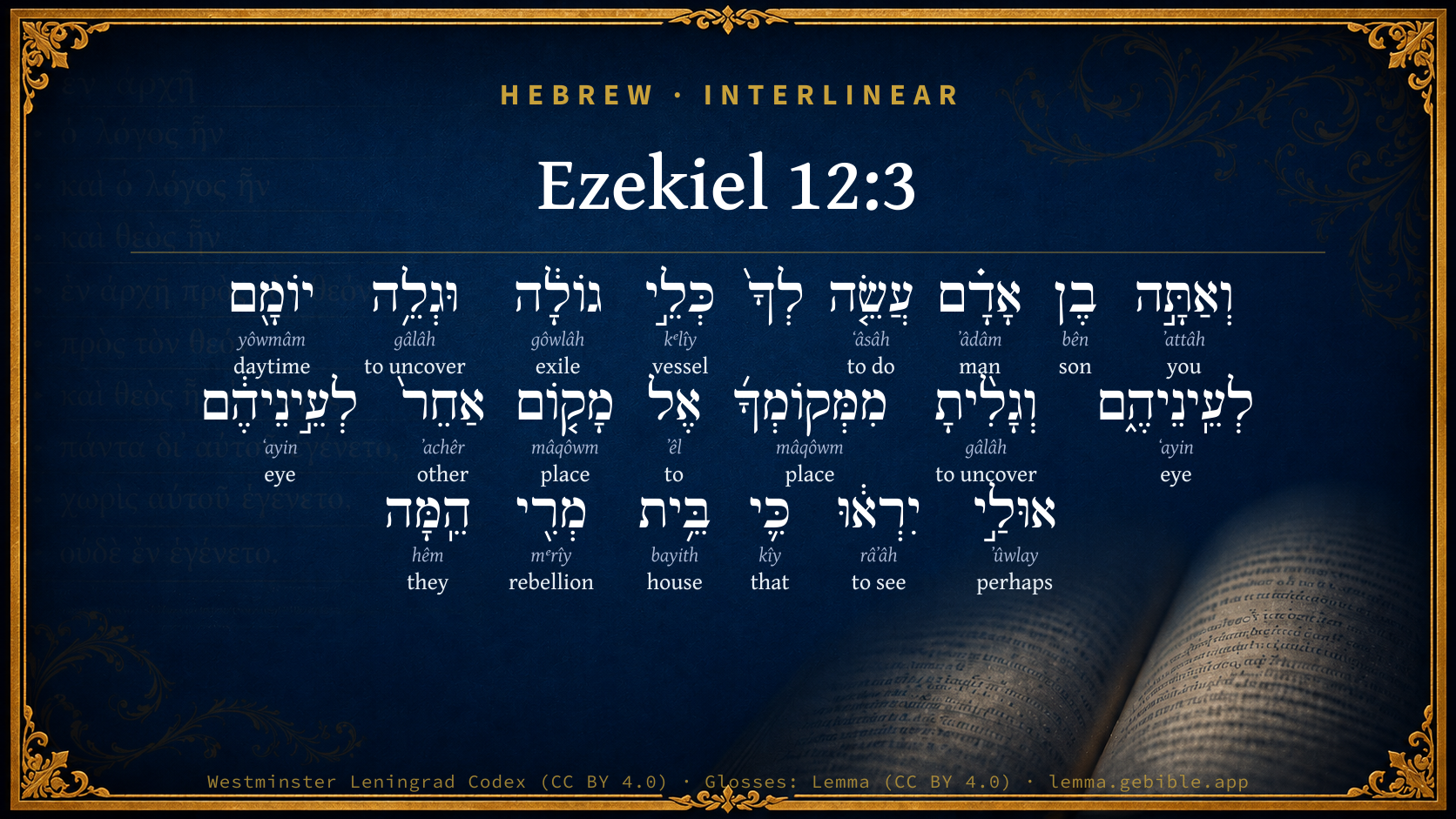
Hebrew (Westminster Leningrad Codex) Ezekiel 12:3 appears in the Hebrew Old Testament. The text above is from the Westminster Leningrad Codex. Each word links to its Strong’s number, a concise gloss, and parsing drawn from the Open Scriptures Hebrew Bible morphology. Click any word for its full Brown-Driver-Briggs (BDB) entry.
Download image
Cite this verse

Ezekiel 12:3 (World English Bible). Public Domain. Lemma interlinear Bible study tool, https://lemma.gebible.app/v/ezekiel/12/3.

Show BibTeX & RIS
BibTeX
RIS
English Translation
Therefore, you son of man, prepare you stuff for removing, and remove by day in their sight; and you shall remove from your place to another place in their sight: it may be they will consider, though they are a rebellious house.
World English Bible · Public Domain
Download a study sheet

One document with this verse’s original text, its word-by-word gloss line, the meaning frame, cross-references with their text, attributed commentary, and full source and license credits — printable, and it pastes into notes with its structure intact.

This verse Autodidact and up

Study sheet (.html) Plain text (.txt)

A passage Seminary Student

Up to 50 verses in one chapter. A passage sheet keeps up to 6 commentary sources and 12 cross-references per verse, in the order this page ranks them, and says so on the sheet whenever that leaves anything out. Ask for a single verse and you get the Autodidact verse sheet above.

Everything on this page stays free to read, with no account — the sheet is a download of what is already on screen, not access to it.

Want to remove ads? Support Godless Engineer
Compare translations 3

The same verse in 3 English versions, stacked beneath the original-language interlinear above. Click any original word for its lexicon entry.

Each is an independent rendering of the whole verse — the interlinear is not word-aligned to these translations.

Highlighted words mark where these versions differ — a whole-verse word diff, not a word-by-word alignment.

  • World English Bible Public Domain
    Therefore, you son of man, prepare you stuff for removing, and remove by day in their sight; and you shall remove from your place to another place in their sight: it may be they will consider, though they are a rebellious house.
  • King James Version Public Domain
    Therefore, thou son of man, prepare thee stuff for removing, and remove by day in their sight; and thou shalt remove from thy place to another place in their sight: it may be they will consider, though they be a rebellious house.
  • unfoldingWord Literal Text CC BY-SA 4.0
    Therefore as for you, son of man, prepare your things for exile, and begin going out by day in their sight, for I will exile you in their sight from your place to another place. Perhaps they will begin to see, though they are a rebellious house.

unfoldingWord Literal Text — © unfoldingWord, licensed CC BY-SA 4.0. Word-aligned USFM3 via Door43 (git.door43.org/unfoldingWord/en_ult).

Versions to compare (up to 4)

3 of 4 selected

Show all 18 translations

Every available English version of this verse, each an independent rendering of the whole verse.

  • World English Bible Public Domain
    Therefore, you son of man, prepare you stuff for removing, and remove by day in their sight; and you shall remove from your place to another place in their sight: it may be they will consider, though they are a rebellious house.
  • Berean Standard Bible Public Domain
    Therefore, son of man, pack your bags for exile. In broad daylight, set out from your place and go to another as they watch. Perhaps they will understand, though they are a rebellious house.
  • Majority Standard Bible Public Domain
    Therefore, son of man, pack your bags for exile. In broad daylight, set out from your place and go to another as they watch. Perhaps they will understand, though they are a rebellious house.
  • King James Version Public Domain
    Therefore, thou son of man, prepare thee stuff for removing, and remove by day in their sight; and thou shalt remove from thy place to another place in their sight: it may be they will consider, though they be a rebellious house.
  • American Standard Version (1901) Public Domain
    Therefore, thou son of man, prepare thee stuff for removing, and remove by day in their sight; and thou shalt remove from thy place to another place in their sight: it may be they will consider, though they are a rebellious house.
  • Revised Version (1885) Public Domain
    Therefore, thou son of man, prepare thee stuff for removing, and remove by day in their sight; and thou shalt remove from thy place to another place in their sight: it may be they will consider, though they be a rebellious house.
  • Geneva Bible (1599) Public Domain
    Therefore thou sonne of man, prepare thy stuffe to goe into captiuitie, and goe foorth by day in their sight: and thou shalt passe from thy place to another place in their sight, if it be possible that they may consider it: for they are a rebellious house.
  • Douay-Rheims (1899) Public Domain
    Thou, therefore, O son of man, prepare thee all necessaries for removing, and remove by day in their sight: and thou shalt remove out of thy place to another place in their sight, if so be they will regard it: for they are a provoking house.
  • Young's Literal Translation Public Domain
    And thou, son of man, make to thee vessels of removal, and remove by day before their eyes, and thou hast removed from thy place unto another place before their eyes, it may be they consider, for a rebellious house they `are'.
  • Literal Standard Version CC BY-SA 4.0
    And you, son of man, make your vessels of removal, and remove by day before their eyes, and you have removed from your place to another place before their eyes, it may be they consider, for they [are] a house of rebellion.
  • Unlocked Literal Bible CC BY-SA 4.0
    Therefore as for you, son of man, prepare your things for exile, and begin going out by day in their sight, for I will exile you in their sight from your place to another place. Perhaps they will begin to see, though they are a rebellious house.
  • unfoldingWord Literal Text CC BY-SA 4.0
    Therefore as for you, son of man, prepare your things for exile, and begin going out by day in their sight, for I will exile you in their sight from your place to another place. Perhaps they will begin to see, though they are a rebellious house.
  • Darby Bible Public Domain
    And thou, son of man, prepare thee a captive's baggage, and go captive by day in their sight; and thou shalt go captive from thy place to another place in their sight. It may be they will consider, though they are a rebellious house.
  • World Messianic Bible Public Domain
    “Therefore, you son of man, prepare your baggage for moving, and move by day in their sight. You shall move from your place to another place in their sight. It may be they will consider, though they are a rebellious house.
  • Webster's Bible Public Domain
    Therefore, thou son of man, prepare thee stuff for removing, and remove by day in their sight; and thou shalt remove from thy place to another place in their sight; it may be they will consider, though they are a rebellious house.
  • Free Bible Version CC BY-SA 4.0
    So, son of man, go and pack your bags as if you're going into exile. As people watch, get everything ready during the day so you can leave where you are and go somewhere else. Maybe they will realize what this means, even though they are rebellious people.
  • Bible in Basic English Public Domain
    And you, O son of man, by day, before their eyes, get ready the vessels of one who is taken away, and go away from your place to another place before their eyes: it may be that they will see, though they are an uncontrolled people.
  • JPS Tanakh (1917) Public Domain
    Therefore, thou son of man, prepare thee stuff for exile, and remove as though for exile by day in their sight; and thou shalt remove from thy place to another place in their sight; it may be they will perceive, for they are a rebellious house.

Literal Standard Version (2020), Covenant Press — licensed CC BY-SA 4.0. Text via the HelloAO Bible API (eBible.org). Unlocked Literal Bible (unfoldingWord) — licensed CC BY-SA 4.0. Text via the HelloAO Bible API (eBible.org). unfoldingWord Literal Text — © unfoldingWord, licensed CC BY-SA 4.0. Word-aligned USFM3 via Door43 (git.door43.org/unfoldingWord/en_ult). Free Bible Version, Dr. Jonathan Gallagher — licensed CC BY-SA 4.0. Text via the HelloAO Bible API (eBible.org).

Word by word

More ways to search: Search by grammar → Find every occurrence → Compare this word →

Practice this passage: Drill this verse → Learn its vocabulary →

מְרִ֖י
mᵉrîy
H4805
“rebellion”
Noun, Common, Masculine, Singular, Absolute
Part of Speech
Noun
Type
Common
Gender
Masculine
Number
Singular
State
Absolute
Full BDB Definition

Origin: from H4784

TWOT: 1242a

rebellion - rebellion - rebellious (in construct)
  1. וְאַתָּ֣ה ʼattâh H859 “and · you” Conjunction + Pronoun, Personal, 2nd Person, Masculine, Singular
  2. בֶן bên H1121 “son of” Noun, Common, Masculine, Singular, Construct
  3. אָדָ֗ם ʼâdâm H120 “man” Noun, Common, Masculine, Singular, Absolute
  4. עֲשֵׂ֤ה ʻâsâh H6213 “do” Verb, Qal, Imperative, 2nd Person, Masculine, Singular
  5. כְּלֵ֣י kᵉlîy H3627 “vessels of” Noun, Common, Masculine, Plural, Construct
  6. גוֹלָ֔ה gôwlâh H1473 “exile” Noun, Common, Feminine, Singular, Absolute
  7. וּגְלֵ֥ה gâlâh H1540 “and · uncover” Conjunction + Verb, Qal, Imperative, 2nd Person, Masculine, Singular
  8. יוֹמָ֖ם yôwmâm H3119 “daytime” Adverb
  9. לְעֵֽינֵיהֶ֑ם ʻayin H5869 “to/for · eyes · their” Preposition + Noun, Common, Both, Dual, Construct + Suffix, Personal, 3rd Person, Masculine, Plural
  10. וְגָלִ֨יתָ gâlâh H1540 “and · to uncover” Conjunction + Verb, Qal, Sequential Perfect, 2nd Person, Masculine, Singular
  11. מִמְּקוֹמְךָ֜ mâqôwm H4725 “from · place · your” Preposition + Noun, Common, Masculine, Singular, Construct + Suffix, Personal, 2nd Person, Masculine, Singular
  12. אֶל ʼêl H413 “to” Preposition
  13. מָק֤וֹם mâqôwm H4725 “place” Noun, Common, Masculine, Singular, Absolute
  14. אַחֵר֙ ʼachêr H312 “other” Adjective, Adjective, Masculine, Singular, Absolute
  15. לְעֵ֣ינֵיהֶ֔ם ʻayin H5869 “to/for · eyes · their” Preposition + Noun, Common, Both, Dual, Construct + Suffix, Personal, 3rd Person, Masculine, Plural
  16. אוּלַ֣י ʼûwlay H194 “perhaps” Adverb
  17. יִרְא֔וּ râʼâh H7200 “to see” Verb, Qal, Imperfect, 3rd Person, Masculine, Plural
  18. כִּ֛י kîy H3588 “that” Conjunction
  19. בֵּ֥ית bayith H1004 “house of” Noun, Common, Masculine, Singular, Construct
  20. הֵֽמָּה hêm H1992 “they” Pronoun, Personal, 3rd Person, Masculine, Plural

About this verse

These counts appear in no published source. They are computed here, from the morphology-tagged text and Lemma’s own curated glosses. What Lemma adds →

22
words
18
distinct lemmas
Prophets
section

Notable vocabulary

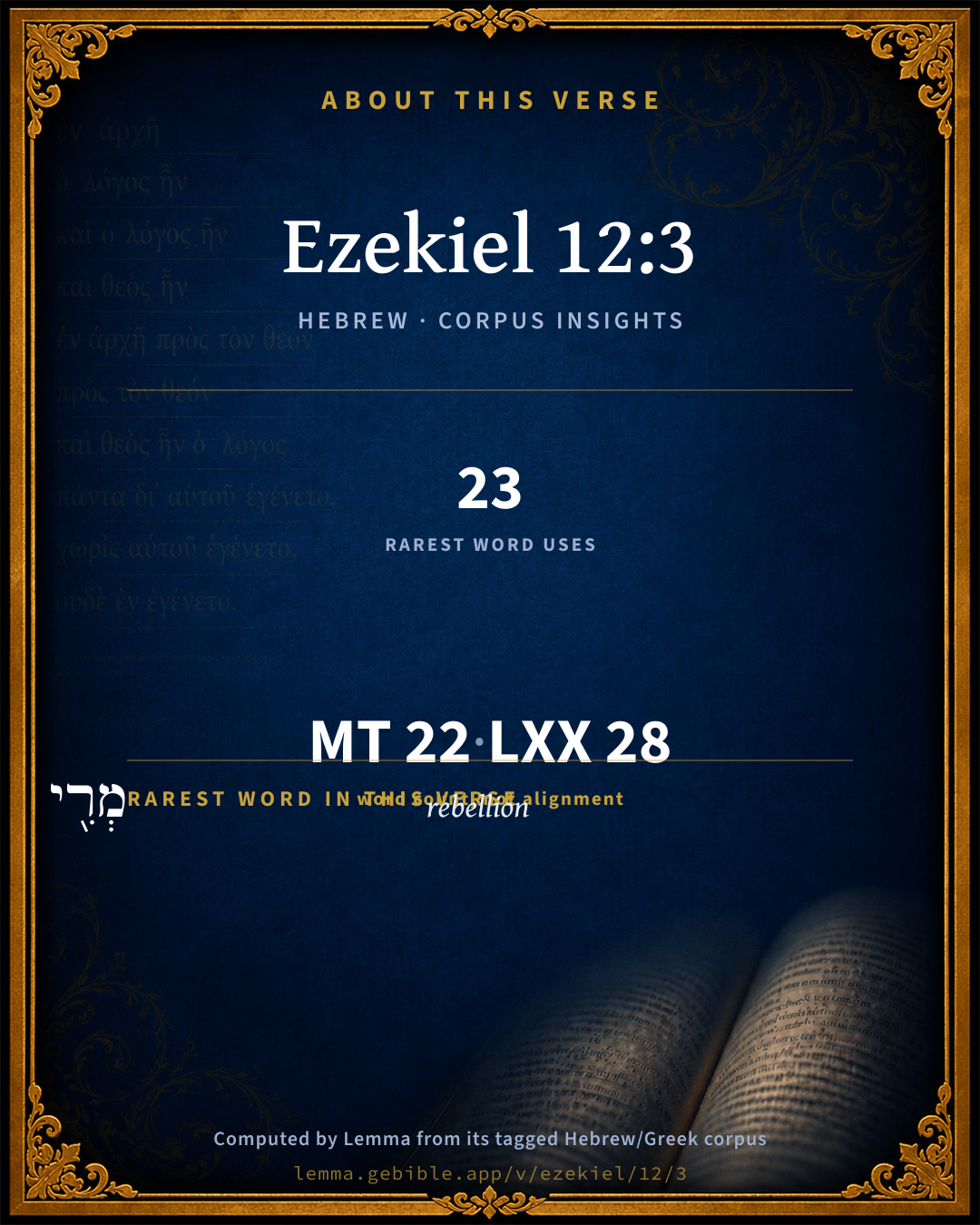
The rarest word here is מְרִ֖י rebellion H4805 — appearing just 23 times in the whole Hebrew Bible.

Shared distinctive vocabulary

מְרִ֖י rebellion H4805 occurs in 21 verses of the Hebrew Bible. Also found in:

Grammatical profile

  • 4 verbs
  • 10 nouns
  • 1 adjective
  • 2 pronouns
  • 2 prepositions
  • 1 conjunction
  • 2 adverbs

Verb forms

  • עֲשֵׂ֤ה Qal · Imperative
  • וּגְלֵ֥ה Qal · Imperative
  • וְגָלִ֨יתָ Qal · Sequential Perfect
  • יִרְא֔וּ Qal · Imperfect

Repetition

Words recur within this verse — often emphatic in Hebrew:

  • וּגְלֵ֥ה to uncover H1540 ×2
  • לְעֵֽינֵיהֶ֑ם eye H5869 ×2
  • מִמְּקוֹמְךָ֜ place H4725 ×2

Hebrew & Septuagint length

In English translation the verse runs 42 words from the Hebrew and 43 from the Septuagint (LXX English) — closely comparable.

A rough comparison of the two English renderings, which tokenize alike — not a word-level alignment.

Word counts can differ between the Hebrew and the Greek without any difference in meaning — e.g. the Hebrew direct-object marker אֵת has no separate Greek word, and Greek often adds the article ὁ.

In the original languages it is 22 Hebrew tokens and 28 Greek tokens — but the two are counted differently (Hebrew bundles its prefixes and suffixes into one token; the Greek is in lemma form), so that isn’t a like-for-like length.

Cross-references

18

Topical passages linked to Ezekiel 12:3 in the Treasury of Scripture Knowledge — connected by theme and wording, ordered by reader-vote popularity; previews shown in the World English Bible.

  • Jeremiah 36:3 It may be that the house of Judah will hear all the evil which I purpose to do to them; that they may return every man from his evil way; that I may forgive their iniquity and their sin.
  • Jeremiah 26:3 It may be they will listen, and turn every man from his evil way; that I may repent me of the evil which I purpose to do to them because of the evil of their doings.
  • 2 Timothy 2:25 in gentleness correcting those who oppose him: perhaps God may give them repentance leading to a full knowledge of the truth,
  • Jeremiah 36:7 It may be they will present their supplication before Yahweh, and will return everyone from his evil way; for great is the anger and the wrath that Yahweh has pronounced against this people.
  • Luke 20:13 The lord of the vineyard said, 'What shall I do? I will send my beloved son. It may be that seeing him, they will respect him.'
  • Deuteronomy 5:29 Oh that there were such a heart in them, that they would fear me, and keep all my commandments always, that it might be well with them, and with their children forever!
  • Deuteronomy 32:29 Oh that they were wise, that they understood this, That they would consider their latter end!
  • Psalms 81:13 Oh that my people would listen to me, That Israel would walk in my ways!
  • Jeremiah 13:1–11 Thus says Yahweh to me, Go, and buy you a linen belt, and put it on your loins, and don't put it in water.
  • Jeremiah 18:2–12 Arise, and go down to the potter's house, and there I will cause you to hear my words.
  • Jeremiah 19:1–15 Thus said Yahweh, Go, and buy a potter's earthen bottle, and [take] of the elders of the people, and of the elders of the priests;
  • Jeremiah 25:4–7 Yahweh has sent to you all his servants the prophets, rising up early and sending them, (but you have not listened, nor inclined your ear to hear),
  • Jeremiah 27:2 Thus says Yahweh to me: Make you bonds and bars, and put them on your neck;
  • Ezekiel 4:1–17 You also, son of man, take a tile, and lay it before you, and portray on it a city, even Jerusalem:
  • Ezekiel 12:10–12 Say you to them, Thus says the Lord Yahweh: This burden [concerns] the prince in Jerusalem, and all the house of Israel among whom they are.
  • Ezekiel 33:11 Tell them, As I live, says the Lord Yahweh, I have no pleasure in the death of the wicked; but that the wicked turn from his way and live: turn you, turn you from your evil ways; for why will you die, house of Israel?
  • Luke 13:8–9 He answered, 'Lord, leave it alone this year also, until I dig around it, and fertilize it.
  • Luke 13:34 "Jerusalem, Jerusalem, that kills the prophets, and stones those who are sent to her! How often I wanted to gather your children together, like a hen gathers her own brood under her wings, and you refused!

Cross-references courtesy of OpenBible.info (CC BY 4.0).

Hebrew and Greek witnesses Masoretic Hebrew ↔ Greek Septuagint

The same verse in the two great witnesses to the Old Testament, shown verse-for-verse.

These are two independent witnesses, not word-aligned to each other, and the Septuagint is shown in lemma (dictionary) form.

Hebrew Ezekiel 12:3 Masoretic · Westminster Leningrad Codex

וְאַתָּ֣ה בֶן אָדָ֗ם עֲשֵׂ֤ה לְךָ֙ כְּלֵ֣י גוֹלָ֔ה וּגְלֵ֥ה יוֹמָ֖ם לְעֵֽינֵיהֶ֑ם וְגָלִ֨יתָ מִמְּקוֹמְךָ֜ אֶל מָק֤וֹם אַחֵר֙ לְעֵ֣ינֵיהֶ֔ם אוּלַ֣י יִרְא֔וּ כִּ֛י בֵּ֥ית מְרִ֖י הֵֽמָּה

Therefore, you son of man, prepare you stuff for removing, and remove by day in their sight; and you shall remove from your place to another place in their sight: it may be they will consider, though they are a rebellious house.

World English Bible · Public Domain

Greek LXX Ezekiel 12:3 Septuagint · lemma form

καί σύ υἱός ἄνθρωπος ποιέω σεαυτοῦ σκεῦος αἰχμαλωσία ἡμέρα ἐνώπιον αὐτός καί αἰχμαλωτεύω ἐκ ὁ τόπος σύ εἰς ἕτερος τόπος ἐνώπιον αὐτός ὅπως ὁράω διότι οἶκος παραπικραίνω εἰμί

You therefore, son of man, prepare yourself baggage for going into captivity by day in their sight; and you shall be led into captivity from your place into another place in their sight; that they may see that it is a provoking house.

LXX2012 (modern English Septuagint) · Public Domain

On this verse, The Cambridge Bible for Schools and Colleges discusses the Septuagint’s reading. Read the note in Commentary ↓

Hebrew: Westminster Leningrad Codex (CC BY 4.0). Greek: Septuagint (public domain); English from LXX2012 (modern English Septuagint) (Public Domain). How the Septuagint differs from the Hebrew →

Targum (Aramaic paraphrase)

1

The Targum is the ancient Jewish Aramaic paraphrase of the Hebrew Scriptures — an interpretive translation, not the Hebrew text itself. Onkelos (literal) and Pseudo-Jonathan (expansive) render the Torah, and Jonathan the Prophets. Coverage is partial: where no permissively-licensed English translation exists for a verse, only the Aramaic is shown. This is verse-level text, not a word-by-word alignment to the Hebrew.

  1. Targum Jonathan Prophets (Joshua–Malachi)
    וְאַתְּ בַּר אָדָם אַתְקִין לָךְ מָנֵי גָלוּתָא וּגְלֵי בִימָם לְעֵינֵיהוֹן וְתִגְלֵי מֵאַתְרָךְ לַאֲתַר אוֹחֲרָן לְעֵינֵיהוֹן מָאִים יִדְחֲלוּן אֲרֵי עַם סַרְבָן אִינוּן:

    (no public-domain English translation for this verse)

    Targum Jonathan — Aramaic: “Mikraot Gedolot” (public domain). English: “Sefaria Community Translation” (CC0 1.0 (public-domain dedication)); “London "Chaldee Paraphrase," 1871” (public domain). Text via Sefaria.

Commentary

Notes on Ezekiel 12:3 from classic Christian and Jewish commentators (each source and its license shown beneath its notes). The classic Christian expositions comment on the surrounding passage and are grouped to its opening verse, so a note may address several verses; the Jewish commentaries on the Tanakh (Rashi and others) are per-verse, so they appear only where the commentator wrote on this verse.

Lemma curates 59 commentaries, every one of them public domain or Creative Commons licensed, each selected and text-cleaned for this edition rather than reprinted as found. About our sources →

The Cambridge Bible for Schools and Colleges

gen. ed. J. J. S. Perowne

3. stuff for removing] Lit. articles of exile, i.e. such articles as one carries with him when going as a fugitive into exile.

and remove by day] Lit. remove as into exile. The word is wanting in LXX., which reads: prepare for thyself articles of exile by day in their sight. This is more natural.

remove from thy place] The words seem to describe generally the whole symbolical action which the prophet is to perform.

though they be a rebellious] for they are.

3–7. Symbolical action, prefiguring the escape and capture of the fugitives

The details of the symbol seem to be as follows: First, the prophet prepares “stuff for removing”—such articles as one meaning to escape would carry with him. These things being prepared, he brings them out. It is not said where he deposits them; it would be in some place convenient to make his escape from, in the vicinity of the wall of the city. These things he does before the eyes of the people during daylight. His action represents the conduct of persons in a besieged city, whose movements are free within the city; hence this part of the action is done openly (Eze_12:3-4). Secondly, these preparations having been made by day, the prophet himself goes out in the even, in the darkness, and digs through the wall, making his escape at the opening, and carrying on his shoulder the articles which he had prepared to take with him in his flight. Besides doing this in the darkness he covers his face. In doing all this he is a “sign” to the house of Israel: in this way shall the king and those with him seek to escape into exile from the enemy when the city is about to fall into their hands (Eze_12:4-7).

The Cambridge Bible for Schools and Colleges (gen. ed. J. J. S. Perowne; Cambridge University Press, 1878–1918) — public domain. Text from a community e-Sword module.

Trapp's Complete Commentary

John Trapp

Eze 12:3 Therefore, thou son of man, prepare thee stuff for removing, and remove by day in their sight; and thou shalt remove from thy place to another place in their sight: it may be they will consider, though they [be] a rebellious house.

Ver. 3. Therefore, thou son of man,] i.e., Nevertheless do thou as thou art bidden, and let what thou doest and sayest be for a testimony against them, stick in their souls and flesh, as the envenomed arrows of the Almighty throughout eternity.

Prepare thee stuff for removing.] Heb., Instruments, or vessels. Convasa res tuas, collae sarcinas, pack up and away. See if this way thou canst work upon them.

It may be they will consider,] sc., By this express sign, though they profit not by thy plain preaching. Ministers must study their people’s souls; turn themselves into all forms and shapes, of spirit and of speech, to win upon them.

John Trapp, A Commentary or Exposition upon All the Books of the Old and New Testament (1647–1656) — public domain. Text from a community e-Sword module.

The Biblical Illustrator

Joseph S. Exell

Eze_12:3-7

Prepare thee stuff for removing.

A drama of exile

I. The vision in its historical fulfilment.

II. The vision in its practical lessons for the present.

1. The consequence of sin is moral exile. All evil, not only in act, but in thought and in wish, involves in greater or less degree a going away from the holy--is a self-exileship, not perhaps, as in the vision, from a holy place, but from the holy God.

2. This moral exile is awfully sad.

(1) This exile is burdensome. The man goes with the baggage of an emigrant. He carries as much as he can. And he who goes away from God into any sin goes burdened. Responsibility, an accusing conscience, a growing fear; these, as with Cain, load guilty souls.

(2) The exile was severed from social ties. With what solitariness of soul, as though he were utterly alone and in the dark, does each man have to say, I have sinned!

(3) The exile went out into wild uncertainties. Whither he should hurry when once beyond the city walls he could not tell. And into what unexplored regions of wrong-doing, or what abysses of consequent remorse a sinner may wander, who can tell?

3. This moral exile is stealthy. Not through a gate, but by a hole dug through the wall; not at noon, but at night, the exile gets away from the holy city. So with the beginnings of all sin. The excuses, the concealments, the artifices of the selfish, the impure, the mean, breathe the stealthy spirit of the father of lies. Evil chooses the dark first, and then gets blinded.

4. This moral exile is shameful. The exile, ashamed to look on the ground, is a true type of those who, first with blush of shame, and whitened lip, and trembling voice or hand, do wrong; and who at last will wake to shame and everlasting contempt. (Urijah R. Thomas.)

It may be they will consider.--

The Divine expectation

I. The subject to which this expectation refers.

1. Men do not consider that they are sinful creatures.

2. Nor that they are dying creatures.

3. Nor that they are immortal creatures.

II. The means employed for bringing about the expectation which is here expressed.

1. The Divine forbearance.

2. The afflictive dispensations of Divine Providence.

3. The ministry of the Gospel. (J. C. Gray.)

The Biblical Illustrator, edited by Joseph S. Exell (c. 1880s–1900s) — public domain. Text from a community e-Sword module.

Joseph Benson's Commentary

Eze 12:3-6. Therefore, prepare thee stuff for removing — Hebrew, כלי גולה, vessels, or instruments of removing, namely, such as were suited for that purpose. Get all thy goods together, and pack them up as those do that remove from one place to another. Do this openly, and at noon-day, that the people, among whom thou dwellest, may all see and take notice of it. The prophets often prophesied in this way by signs, as being of greater force and efficacy than words. Thou shalt bring forth thy stuff by day in their sight — Before it is quite night, that they, who ought to learn by this sign, may see and consider it. Thou shalt go forth at even — To signify that Zedekiah and his retinue should escape out of the city by night, 2Ki 25:4. Dig through the wall in their sight — To show that the king would make his escape by the same means. Carry it forth in the twilight — What the prophet was here commanded to carry out in the twilight, it seems, was something different from the goods he removed in the day-time; probably, necessary provision for his present subsistence may be intended. Thou shalt cover thy face that thou see not the ground — As Zedekiah shall do, that he may not be discovered. Or, as the prophet was now in Chaldea, this covering of his face, that he might not see the ground, might be intended to signify, that though Zedekiah should be brought into that country, yet he should never see it; as his eyes would be put out on the borders of Judea, as we read they were, Jeremiah 52. For I have set thee for a sign unto the house of Israel — I will show, by what thou dost, what shall happen to the Jewish nation, and particularly to their king.

Joseph Benson's Commentary on the Old and New Testaments (1811–1818) — public domain. Text from a community e-Sword module.

Geneva Bible (1599)

Geneva Bible translators

Hebrew, make thee vessels to go into captivity.

Geneva Bible (1599) marginal notes — public domain. Text via Bolls.life.

Jamieson, Fausset & Brown

Robert Jamieson, A. R. Fausset & David Brown

stuff for removing--rather, "an exile's outfit," the articles proper to a person going as an exile, a staff and knapsack, with a supply of food and clothing; so "instruments of captivity," Jer 46:19, Margin, that is, the needful equipments for it. His simple announcements having failed, he is symbolically to give them an ocular demonstration conveyed by a word-painting of actions performed in vision.

consider-- (Deu 32:29).

Jamieson, Fausset & Brown — Commentary Critical and Explanatory on the Whole Bible (1871) — public domain (CC PDM 1.0). Text via the HelloAO Bible API.

Adam Clarke's Commentary

Verse 3. Prepare thee stuff for removing] Get carriages to transport thy goods to another place; signifying by this the captivity that was at hand.

Adam Clarke's Commentary on the Bible (1810–1826) — public domain. Text from a community e-Sword/MySword module.

John Calvin's Commentaries

Now God instructs his Prophet in what he wishes him to do: he orders him to take vessels for journeying, that is, he orders him to prepare for a long journey, even for exile: for exile is the subject here. But he who is compelled to leave home to go into a foreign land, collects whatever he can carry with him, namely, his clothes, shoes, hat, scrip, and staff, and other things of that kind, if he have even a little money. Therefore the Prophet is advised to gird himself for his journey, by which he represents the character of those who were just about to be dragged into exile. For this reason he is ordered to prepare for himself vessels for traveling The Latins call garments as well as other goods “vessels:” whence proverbially to collect goods is to remove baggage in a military phrase, or to take away one’s stuff. But he orders this to be done in the day-time, that the Israelites may see what is done.

Then the Prophet is ordered to remove from one place to another As I have said, this might appear puerile. Cicero describes those legal fictions, how those who went to law about a field when called upon to plead, had, so to speak, an imaginary way of going to see it; for since it was too troublesome to the judge to mount his horse and ride over various fields, they retained an ancient and customary ceremony: the plaintiff said, the land which you say is yours, I claim for myself and say is mine, and if you wish to dispute with me legally, I summon you to the spot: the defendant replied, as you summon me there, I in return answer your summons. The judge then arose and moved from his place, and so an imaginary action took place. Cicero derides that by-play, and says it is unworthy of the gravity of a court of law. But such was the action of the Prophet; he took his hat, cloak, staff, and shoes, and other things, and changed his place as if he were moving. But he only went a short distance. But God previously had said, that he was dealing with a perverse nation, and so had need of such assistances. And we must remark the particle, if by chance they should see, because they are a rebellious house For here God as it were suspends the event of his teaching, when he says, if perhaps they should hear And the reason is added, because the hardness of the people was so great, that they could scarcely be turned to obedience by any discourses or signs. Meanwhile let us learn from this place, that we must still go on, although success does not answer to our labor, when we spend our strength for God. And this instruction is peculiarly necessary, because when God imposes on us any duty, we dispute with ourselves as to its result, and thus all energy flags, because we are seldom willing to put forth a finger unless we perceive a prosperous issue. Because, therefore, we are always too attentive to the fruit of our labor, hence this passage should be diligently regarded, when God sends his Prophet and yet adds, if by chance they should listen. Whatever may be the event, we must obey God; if our labor should not profit, yet God wishes us to obey him. It follows —

John Calvin's Commentaries (1540-1563) — public domain. Text from the Calvin Translation Society English edition (1840s-50s) via the Christian Classics Ethereal Library (ccel.org). Calvin's coverage is partial (roughly two-thirds of the Bible); uncommented books and verses are honest gaps, never fabricated. The 19th-century editor's footnotes and remarks are omitted so the notes are faithfully Calvin's own voice.

Ellicott's Commentary for English Readers

(3) Prepare thee stuff for removing.—The same words are translated in Jer_46:19, “Furnish thyself to go into captivity.” Stuff includes all that an emigrant would require, clothes, utensils, &c.; and “removing” is the same word as is translated captivity in Eze_12:4. The symbolical action was that of one preparing to leave his home to go into captivity. The prophet is to make his preparations during the day, and to carry forth his stuff (Eze_12:7), but not himself to go forth until even (Eze_12:4). The action seems to be that of one who must abandon his home, using the whole day to carry out all he can with the purpose of saving it, and then himself leaving the house when the day is done.

A Bible Commentary for English Readers, edited by Charles John Ellicott (1878–1897) — public domain. Text from a community e-Sword module.

John Gill's Exposition

Then shall thou bring forth thy stuff by day in their sight,.... Bring it forth, that they may be spectators of it; and "by day", that it might be manifest to them what was carried out; and this day by day, till all was removed:

as stuff for removing; that is intended to be removed from one place to another, and is carried away in the daytime, in the view of everyone:

and thou shall go forth at even in their sight; as a man, having removed his goods in the daytime, goes forth himself at evening: this denotes the flight of Zedekiah from Jerusalem in the night, Jer 39:4;

as they that go forth into captivity: with a sorrowful countenance, in a mournful habit, and with airs and gestures showing anger, anxiety, and distress; with a bundle on their shoulders, and a staff in their hands.

John Gill's Exposition of the Whole Bible (1746–1763) — public domain (CC PDM 1.0). Text via the HelloAO Bible API.

Albert Barnes' Notes on the Bible

Stuff - Raiment, vessels, and the like. The “removing” was to be of the kind that accompanied exile. The whole account of this transaction marks it as a real act. The prophet was to be “a sign” to his countrymen, and the “exiles” as well as those that remained in Judaea had need to be taught this lesson, for though themselves far away, they looked to Jerusalem as their home, and were scarcely less eager for its safety than the inhabitants themselves.

Albert Barnes' Notes on the Bible (1834–1885) — public domain. Text from a community e-Sword/MySword module.

Haydock's Catholic Bible Commentary

Removing. Literally, "vessels of transmigration," (Haydock) or bundles, (Calmet) and what was requisite for travelling, (Worthington) or in exile. (Haydock) --- All this, to chap. xx., happened five years before the fall of Jerusalem. (Calmet) --- See chap. viii. 1. (Haydock)

George Leo Haydock (1774–1849), Haydock's Catholic Family Bible and Commentary, 1859 edition — public domain. Excludes Psalms (Douay-Rheims chapter numbering differs from Protestant) and Deuterocanonical books (Catholic canon only).

Matthew Poole's English Annotations

Therefore; and.

Prepare thee; make ready in the sight of some of those which live about thee, that they may tell others.

Stuff for removing; vessels or instruments, wherein thou mayst put what is portable, and you, with leave from the conqueror, may carry for your conveniencies; pack up what thou canst that may be of use in thy captivity.

Remove; go thy way, leave that place wherein thou now art, and go to another, with thy pack upon thy back, not on horses or asses.

By day; at noon-tide, when the most may see what thou doest, and be instructed.

It may be; it is not impossible that some may inquire what is the import and meaning of all this uncouth and obscure matter.

Matthew Poole's English Annotations on the Holy Bible (1683–1685) — public domain. Text from a community e-Sword/MySword module.

Whedon's Commentary on the Bible

Daniel D. Whedon

3. Stuff for removing — Literally, traveling baggage for exile.

Remove by day — Literally, remove as into captivity. Ezekiel is to represent himself as among the besieged in Jerusalem getting ready for flight; attempting thus to make the people consider (literally, see) what lies in the immediate future.

Though they be — Literally, for they be.

Daniel D. Whedon (gen. ed.), Commentary on the Old and New Testaments (1874–1909) — public domain. Text from a community e-Sword module.

The Pulpit Commentary

Vers. 3-7. Prepare thee stuff for removing, etc.; better, equipment for a journey, with the implied thought that it is the journey of one going into exile. "Bag and baggage," all the household goods which an exile could take with him, (Exo_12:11, 34 may supply an illustration) were to be brought out in broad daylight and piled up opposite his door. Then in the twilight (Revised Version, in the dark, and so in vers. 7, 12) he was to go forth, not by the door of his house, but by breaking through the wall (with such walls as those of, (Eze_13:11 the process would not be difficult) as a man might do who was escaping secretly from a city through the gates of which he dared not pass (ver. 5), and was to start with his travelling chattels upon his shoulder. Lastly (ver. 6), as the strangest feature of all, he was to go forth with his face covered, as one who wished to avoid recognition, as one also who could not see one step of the way before him. This, it is intimated, would startle even the most careless, and in this way he would become, as he had been before in like symbolic acts, (Eze 4:, Eze_4:5) as Isaiah (Isa_20:2) and Jeremiah (Jer_27:2) had been before him, a sign unto the house of Israel.

HOMILIES BY J.R. THOMSON Ver. 3. Hope mingled with fear.

If we bear in mind that this language was employed by the Lord in directing Ezekiel how to deal with the house of Israel, we shall see what light it casts upon human liberty and responsibility. The prophet was to make use of certain symbolical means with the view of wakening his countrymen to a sense of their danger, and of inducing them to repent and to turn unto the Lord. Now, believing in the Divine omniscience and foreknowledge, we cannot but be assured that the Eternal foresaw what would be the result of the appeal which was to be made. Yet lie spoke to the prophet as if that result was uncertain. "It may be they will consider, though they be a rebellious house." Ezekiel did not and could not know what would be the issue of this ministry with which he was entrusted; and he was to do his work in a perfectly natural and human way, to act as believing in the liberty of those to whom he was sent, and as leaving the responsibility entirely with them. He experienced in his mind a conflict of emotions; hope was mingled with fear.

I A NATURAL EXPECTATION FOUNDED UPON EXPERIENCE. Ezekiel knew that he was sent to "a rebellious house," to "a stiffnecked people;" he could not possibly be blind to the character and disposition of those whom he knew so well. Every herald and messenger of God is sometimes sent to the unbelieving, the hard-hearted, the apparently unimpressible. Such characters have often been brought into contact with the Divine Word, and have as often spurned it. Judging by experience only, how can any servant of God go to such, taking with him a new message, or the old message with new arguments and persuasions to enforce it, without something of discouragement, something of foreboding? It is not possible. Habits are confirmed as days and years pass on; the hard heart is likely to grow harder instead of softer. Only the hammer can break, only the fire can melt it.

II A CONTRARY HOPE SPRINGING FROM BENEVOLENCE. Divine kindness addresses the rebellious and impenitent yet once again. "It may he they will consider." If this view is possible to God, surely it is possible to God"s human messenger. He knows, perhaps, that his own ignorance has been instructed, his own obduracy has been melted; and he hopes that in this the experience of others may resemble his own. If men will but consider, consideration may lead to repentance. And why should they not consider? Is not the message from God a message that deserves serious and patient attention? The good will which the Lord"s servant has towards his fellow men forbids him to despair of their salvation, to abandon labour on their behalf.

III THE APPOINTED MEANS HAVING BEEN USED BY GOD"S MESSENGER, THE RESPONSIBILITY MUST BE LEFT WITH THOSE ADDRESSED IN GOD"S NAME. The herald of God delivers his message, presents the offers and the requirements of Divine authority; he does this with mingled fear and hope; and he can do no more. The record has always been a record resembling that of Paul"s ministry at Rome: "Some believed, and some believed not." The minister of Christ preaches the gospel, whether men will hear or forbear. He delivers his soul. He cannot command results. He can simply repeat the admonition of his Master, "Take heed how ye hear!" And it is well that he should not discharge his ministry in a spirit of dejection and despondency. He must indeed face the possibility that those whose welfare he seeks may refuse to consider; they are free agents, and the competing voices of the world are powerful, attractive. Yet he should not forget that they may consider; and if they will only yield so far, he may reasonably hope that consideration may lead to repentance and to life eternal. T.

The Pulpit Commentary (1880–1919), ed. H.D.M. Spence-Jones & Joseph S. Exell — public domain. Text from a community e-Sword module.

John Wesley's Explanatory Notes

Stuff - Vessels or instruments, wherein thou mayest put what is portable.

John Wesley, Explanatory Notes Upon the Whole Bible (1754–1765) — public domain. Text via the GEBible commentary corpus.

unfoldingWord translationNotes

Door43 World Missions Community

General Information:

Yahweh is telling Ezekiel to act out another parable.

Therefore as for you

"So then, this is what I say to you"

in their sight

"as they watch"

Perhaps they will begin to see

People being able to understand Yahweh's message and what he is doing is spoken of as if the people were able physically to see. (See: Metaphor)

a rebellious house

The word "house" is a metonym for the family that lives in the house, in this case the Israelites, the descendants of Jacob over many years. See how you translated this in Ezekiel 2:5. AT: "a rebellious people" (See: Metonymy)

translationWords

Son of Man

exile

rebel

house

unfoldingWord translationNotes — © Distant Shores Media and the Door43 World Missions Community, licensed CC BY-SA 4.0. Source: git.door43.org/Door43/en_tn.

Rashi

Rabbi Shlomo Yitzchaki (Rashi)

implements for exile A vessel from which to drink and a small earthen bowl in which to knead a cake, as a sign for the house of Israel in Jerusalem to do likewise, so that they would not have to knead dough in a hole on the ground with the gravel going into it. But they did not heed him, and they had to do just that. This is what is written in the Book of Lamentations (3:16): “Indeed, He made my teeth grind on gravel.” In Midrash Lamentations.

and go into exile day by day Heb. יוֹמָם, from day to day, two or three days, behave like a man preparing his steps for exile, so that the people of the exile will see and ask what you are doing, and you shall tell them that it symbolizes Zedekiah and his people [in Jerusalem], and these people will send their messengers and inform their brothers and relatives who are there, according to everything they hear from your mouth. Likewise, every [occurrence of] יוֹמָם in Scripture is an expression denoting “day by day,” something that goes on [continually] for many days. This I heard in the name of Rabbi Menachem, and his words are true.

perhaps they will see Perhaps they will understand, apercevront in French, they will realize.

for a rebellious house are they Therefore, it is still a “perhaps.”

Rashi on the Tanakh — English translations: “The Judaica Press complete Tanach with Rashi, translated by A. J. Rosenberg” (CC BY 4.0); “Pentateuch with Rashi's commentary by M. Rosenbaum and A.M. Silbermann, 1929-1934” (public domain); “The Metsudah Tanach series, Lakewood, N.J” (CC BY 4.0); and “The Book of Joshua, Metsudah Publications, 1997” (CC BY 4.0). Text via Sefaria.

Lesson kit

Teaching starters — assembled from the data on this page, not authored interpretation. Every prompt links to the verse data it draws on. Edit before teaching.

Ezekiel, in the Prophets, opens this verse with 22 words (18 distinct Hebrew lemmas). Its most distinctive word is mᵉrîy (“rebellion”). A historical commentator’s framing appears above. Read the whole chapter for the surrounding context.

Discussion questions

  1. The word mᵉrîy carries the sense “rebellion.” How does it shape the verse?
  2. How does Numbers 17:10, which shares the word «rebellion», read alongside this verse?
  3. What does the repetition of “to uncover” (2× in this one verse) do in this verse?
  4. These translations render this verse differently. What is at stake in choosing one wording over another?
  5. «עֲשֵׂ֤ה» is a Qal Imperative verb. How does that grammatical form shape the action described?
  6. Compare how The Cambridge Bible for Schools and Colleges and Trapp's Complete Commentary read this verse. Where do they agree or differ?

Things to notice

Reading settings

Reading text

Shown beneath each verse's original-language words.

Old Testament
Old Testament edition

Read the OT as the Masoretic Hebrew (MT) or the Greek Septuagint (LXX).

English shown for the Greek Septuagint (in the Hebrew ↔ Greek comparison).

Comparing translations? Open the Compare panel on any verse page to stack up to four side by side.