
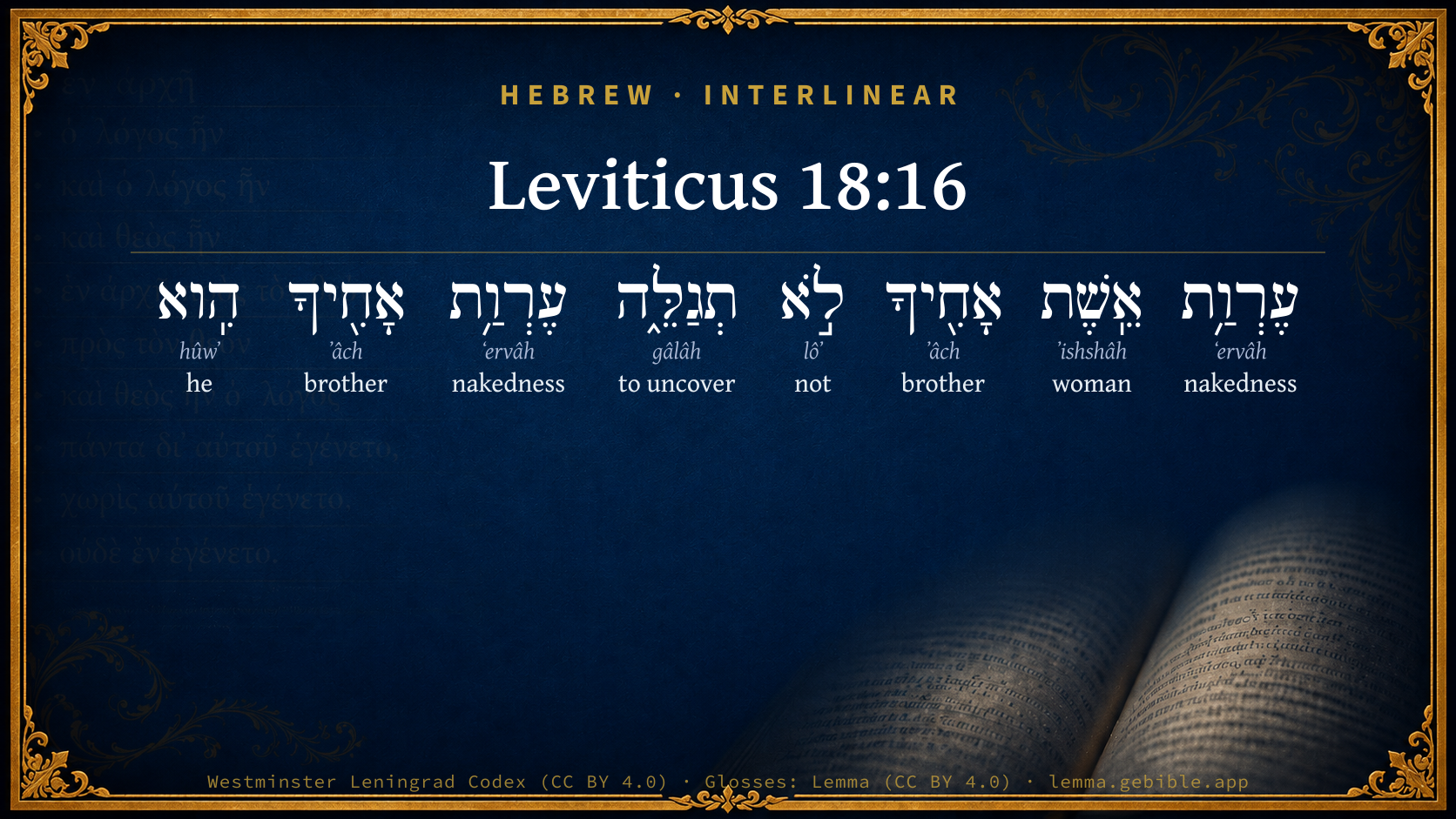
Leviticus 18:16

Hebrew (Westminster Leningrad Codex) Leviticus 18:16 appears in the Hebrew Old Testament. The text above is from the Westminster Leningrad Codex. Each word links to its Strong’s number, a concise gloss, and parsing drawn from the Open Scriptures Hebrew Bible morphology. Click any word for its full Brown-Driver-Briggs (BDB) entry.
Download image
Cite this verse

Leviticus 18:16 (World English Bible). Public Domain. Lemma interlinear Bible study tool, https://lemma.gebible.app/v/leviticus/18/16.

Show BibTeX & RIS
BibTeX
RIS
English Translation
"'You shall not uncover the nakedness of your brother's wife: it is your brother's nakedness.
World English Bible · Public Domain
Download a study sheet

One document with this verse’s original text, its word-by-word gloss line, the meaning frame, cross-references with their text, attributed commentary, and full source and license credits — printable, and it pastes into notes with its structure intact.

This verse Autodidact and up

Study sheet (.html) Plain text (.txt)

A passage Seminary Student

Up to 50 verses in one chapter. A passage sheet keeps up to 6 commentary sources and 12 cross-references per verse, in the order this page ranks them, and says so on the sheet whenever that leaves anything out. Ask for a single verse and you get the Autodidact verse sheet above.

Everything on this page stays free to read, with no account — the sheet is a download of what is already on screen, not access to it.

Want to remove ads? Support Godless Engineer
Compare translations 3

The same verse in 3 English versions, stacked beneath the original-language interlinear above. Click any original word for its lexicon entry.

Each is an independent rendering of the whole verse — the interlinear is not word-aligned to these translations.

Highlighted words mark where these versions differ — a whole-verse word diff, not a word-by-word alignment.

  • World English Bible Public Domain
    "'You shall not uncover the nakedness of your brother's wife: it is your brother's nakedness.
  • King James Version Public Domain
    Thou shalt not uncover the nakedness of thy brother's wife: it is thy brother's nakedness.
  • unfoldingWord Literal Text CC BY-SA 4.0
    The nakedness of the wife of your brother, you shall not uncover. She is the nakedness of your brother.

unfoldingWord Literal Text — © unfoldingWord, licensed CC BY-SA 4.0. Word-aligned USFM3 via Door43 (git.door43.org/unfoldingWord/en_ult).

Versions to compare (up to 4)

3 of 4 selected

Show all 18 translations

Every available English version of this verse, each an independent rendering of the whole verse.

  • World English Bible Public Domain
    "'You shall not uncover the nakedness of your brother's wife: it is your brother's nakedness.
  • Berean Standard Bible Public Domain
    You must not have sexual relations with your brother’s wife; that would shame your brother.
  • Majority Standard Bible Public Domain
    You must not have sexual relations with your brother’s wife; that would shame your brother.
  • King James Version Public Domain
    Thou shalt not uncover the nakedness of thy brother's wife: it is thy brother's nakedness.
  • American Standard Version (1901) Public Domain
    Thou shalt not uncover the nakedness of thy brother's wife: it is thy brother's nakedness.
  • Revised Version (1885) Public Domain
    Thou shalt not uncover the nakedness of thy brother’s wife: it is thy brother’s nakedness.
  • Geneva Bible (1599) Public Domain
    Thou shalt not discouer the shame of thy brothers wife. for it is thy brothers shame.
  • Douay-Rheims (1899) Public Domain
    Thou shalt not uncover the nakedness of thy brother's wife: because it is the nakedness of thy brother.
  • Young's Literal Translation Public Domain
    `The nakedness of thy brother's wife thou dost not uncover; it `is' thy brother's nakedness.
  • Literal Standard Version CC BY-SA 4.0
    You do not uncover the nakedness of your brother’s wife; it [is] your brother’s nakedness.
  • Unlocked Literal Bible CC BY-SA 4.0
    Do not sleep with your brother's wife; do not dishonor him in this way.
  • unfoldingWord Literal Text CC BY-SA 4.0
    The nakedness of the wife of your brother, you shall not uncover. She is the nakedness of your brother.
  • Darby Bible Public Domain
    The nakedness of thy brother's wife shalt thou not uncover: it is thy brother's nakedness.
  • World Messianic Bible Public Domain
    “‘You shall not uncover the nakedness of your brother’s wife. It is your brother’s nakedness.
  • Webster's Bible Public Domain
    Thou shalt not uncover the nakedness of thy brother's wife: it is thy brother's nakedness.
  • Free Bible Version CC BY-SA 4.0
    Don't have sex with your brother's wife and bring shame on your brother.
  • Bible in Basic English Public Domain
    You may not have sex relations with your brother's wife, for she is your brother's.
  • JPS Tanakh (1917) Public Domain
    Thou shalt not uncover the nakedness of thy brother's wife: it is thy brother's nakedness.

Literal Standard Version (2020), Covenant Press — licensed CC BY-SA 4.0. Text via the HelloAO Bible API (eBible.org). Unlocked Literal Bible (unfoldingWord) — licensed CC BY-SA 4.0. Text via the HelloAO Bible API (eBible.org). unfoldingWord Literal Text — © unfoldingWord, licensed CC BY-SA 4.0. Word-aligned USFM3 via Door43 (git.door43.org/unfoldingWord/en_ult). Free Bible Version, Dr. Jonathan Gallagher — licensed CC BY-SA 4.0. Text via the HelloAO Bible API (eBible.org).

Word by word

More ways to search: Search by grammar → Find every occurrence → Compare this word →

Practice this passage: Drill this verse → Learn its vocabulary →

About this verse

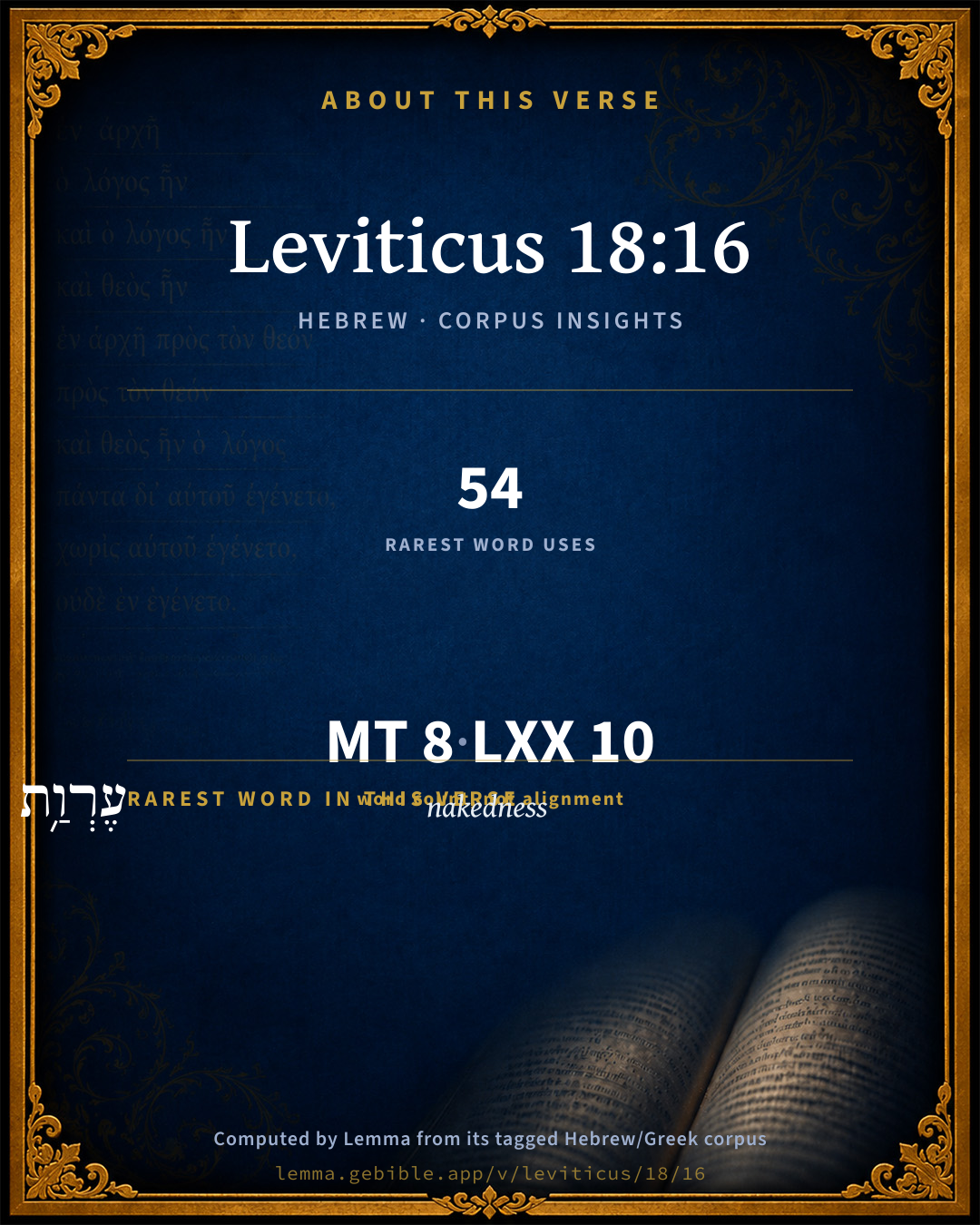
These counts appear in no published source. They are computed here, from the morphology-tagged text and Lemma’s own curated glosses. What Lemma adds →

8
words
6
distinct lemmas
Pentateuch
section

Shared distinctive vocabulary

עֶרְוַ֥ת nakedness H6172 occurs in 40 verses of the Hebrew Bible. Also found in:

Grammatical profile

  • 1 verb
  • 5 nouns
  • 1 pronoun
  • 1 particle

Verb forms

  • תְגַלֵּ֑ה Piel · Imperfect

Repetition

Words recur within this verse — often emphatic in Hebrew:

  • עֶרְוַ֥ת nakedness H6172 ×2
  • אָחִ֖יךָ brother H251 ×2

Hebrew & Septuagint length

In English translation the verse runs 15 words from the Hebrew and 15 from the Septuagint (LXX English) — the same length.

A rough comparison of the two English renderings, which tokenize alike — not a word-level alignment.

Word counts can differ between the Hebrew and the Greek without any difference in meaning — e.g. the Hebrew direct-object marker אֵת has no separate Greek word, and Greek often adds the article ὁ.

In the original languages it is 8 Hebrew tokens and 10 Greek tokens — but the two are counted differently (Hebrew bundles its prefixes and suffixes into one token; the Greek is in lemma form), so that isn’t a like-for-like length.

Cross-references

7

Topical passages linked to Leviticus 18:16 in the Treasury of Scripture Knowledge — connected by theme and wording, ordered by reader-vote popularity; previews shown in the World English Bible.

  • Leviticus 20:21 "'If a man takes his brother's wife, it is an impurity: he has uncovered his brother's nakedness; they shall be childless.
  • Deuteronomy 25:5 If brothers dwell together, and one of them die, and have no son, the wife of the dead shall not be married outside to a stranger: her husband's brother shall go in to her, and take her to him as wife, and perform the duty of a husband's brother to her.
  • Matthew 22:24 saying, "Teacher, Moses said, 'If a man dies, having no children, his brother shall marry his wife, and raise up seed for his brother.'
  • Mark 12:19 "Teacher, Moses wrote to us, 'If a man's brother dies, and leaves a wife behind him, and leaves no children, that his brother should take his wife, and raise up offspring for his brother.'
  • Matthew 14:3–4 For Herod had laid hold of John, and bound him, and put him in prison for the sake of Herodias, his brother Philip's wife.
  • Mark 6:17 For Herod himself had sent out and arrested John, and bound him in prison for the sake of Herodias, his brother Philip's wife, for he had married her.
  • Luke 3:19 but Herod the tetrarch, being reproved by him for Herodias, his brother's wife, and for all the evil things which Herod had done,

Cross-references courtesy of OpenBible.info (CC BY 4.0).

Hebrew and Greek witnesses Masoretic Hebrew ↔ Greek Septuagint

The same verse in the two great witnesses to the Old Testament, shown verse-for-verse.

These are two independent witnesses, not word-aligned to each other, and the Septuagint is shown in lemma (dictionary) form.

Hebrew Leviticus 18:16 Masoretic · Westminster Leningrad Codex

עֶרְוַ֥ת אֵֽשֶׁת אָחִ֖יךָ לֹ֣א תְגַלֵּ֑ה עֶרְוַ֥ת אָחִ֖יךָ הִֽוא

"'You shall not uncover the nakedness of your brother's wife: it is your brother's nakedness.

World English Bible · Public Domain

Greek LXX Leviticus 18:16 Septuagint · lemma form

ἀσχημοσύνη γυνή ἀδελφός σύ οὐ ἀποκαλύπτω ἀσχημοσύνη ἀδελφός σύ εἰμί

You shall not uncover the nakedness of your brother's wife: it is your brother's nakedness.

LXX2012 (modern English Septuagint) · Public Domain

Hebrew: Westminster Leningrad Codex (CC BY 4.0). Greek: Septuagint (public domain); English from LXX2012 (modern English Septuagint) (Public Domain). How the Septuagint differs from the Hebrew →

Targum (Aramaic paraphrase)

2

The Targum is the ancient Jewish Aramaic paraphrase of the Hebrew Scriptures — an interpretive translation, not the Hebrew text itself. Onkelos (literal) and Pseudo-Jonathan (expansive) render the Torah, and Jonathan the Prophets. Coverage is partial: where no permissively-licensed English translation exists for a verse, only the Aramaic is shown. This is verse-level text, not a word-by-word alignment to the Hebrew.

  1. Targum Onkelos Torah (Genesis–Deuteronomy)
    עֶרְיַת אִתַּת אֲחוּךְ לָא תְגַלֵי עֶרְיַת אֲחוּךְ הִיא

    (no public-domain English translation for this verse)

    Targum Onkelos — Aramaic: “Onkelos Genesis” (public domain); “Onkelos Exodus” (public domain); “Onkelos Leviticus” (public domain); “Onkelos Numbers” (public domain); “Onkelos Deuteronomy” (public domain). English: “Sefaria Community Translation” (CC0 1.0 (public-domain dedication)); “J.W. Etheridge. The Targums of Onkelos and Jonathan Ben Uzziel on the Pentateuch. London: Longmans, Green, 1862” (public domain). Text via Sefaria.

  2. Targum Pseudo-Jonathan Torah (Genesis–Deuteronomy)
    עֶרְיַית אִתַּת אָחוּךְ לָא תִבְזֵי בְּחַיֵי אָחוּךְ וּבָתַר מוֹתֵיהּ אִין אִית לֵיהּ בְּנִין עִירְיְיתָא דְאָחוּךְ הוּא

    The nakedness of thy brother's wife thou shalt not dishonour in the life-time of thy brother, or after his death, if he have children; for it is the nakedness of thy brother.

    Targum Pseudo-Jonathan — Aramaic: “Targum Jonathan on Genesis” (public domain); “Targum Jonathan on Exodus” (public domain); “Targum Jonathan on Leviticus” (public domain); “Targum Jonathan on Numbers” (public domain); “Targum Jonathan on Deuteronomy” (public domain). English: “The Targum of Jonathan ben Uzziel, trans. J. W. Etheridge, London, 1862” (public domain). Text via Sefaria.

Commentary

Notes on Leviticus 18:16 from classic Christian and Jewish commentators (each source and its license shown beneath its notes). The classic Christian expositions comment on the surrounding passage and are grouped to its opening verse, so a note may address several verses; the Jewish commentaries on the Tanakh (Rashi and others) are per-verse, so they appear only where the commentator wrote on this verse.

Lemma curates 59 commentaries, every one of them public domain or Creative Commons licensed, each selected and text-cleaned for this edition rather than reprinted as found. About our sources →

Trapp's Complete Commentary

John Trapp

Lev 18:16 Thou shalt not uncover the nakedness of thy brother’s wife: it [is] thy brother’s nakedness.

Ver. 16. Brother’s wife.] Except in that special case. {Deu 25:5} This was Herod’s sin {Mat 14:4} and our Henry VIII’s; whereupon was the divorce.

John Trapp, A Commentary or Exposition upon All the Books of the Old and New Testament (1647–1656) — public domain. Text from a community e-Sword module.

Joseph Benson's Commentary

Lev 18:16. Thy brother’s wife — Unless he died childless, for in that case God afterward commanded that a man should marry his brother’s widow, Deu 25:5. For the prohibiting of marriages in the more remote degrees of consanguinity, where other moral considerations are less obvious, there is this good reason to be assigned, namely, that marriage being one of the firmest bonds of friendship, it is proper, for the greater good of society, that men should seek to enlarge the ties of friendship and social affection, by uniting, not with those to whom they were before related, but with persons of different families.

Joseph Benson's Commentary on the Old and New Testaments (1811–1818) — public domain. Text from a community e-Sword module.

Tyndale Open Study Notes

Tyndale Open Resources

18:16 Sexual relations with your sister-in-law would be adulterous and disgrace your brother. The exception was the law of levirate marriage (see Deut 25:5-10), which called for a man to marry his brother’s widow in order to produce an heir who was considered the dead brother’s son.

Tyndale Open Study Notes — © Tyndale Open Resources, licensed CC BY-SA 4.0. Text via the HelloAO Bible API.

Geneva Bible (1599)

Geneva Bible translators

Because the idolaters, among whom God’s people had dwelt and should dwell, were given to these horrible incests, God chargeth his to beware of the same.

Geneva Bible (1599) marginal notes — public domain. Text via Bolls.life.

Adam Clarke's Commentary

Verse 16. Thy brother's wife] This was an illegal marriage, unless the brother died childless. In that case it was not only lawful for her to marry her brother-in-law, but he was obliged by the law, De 25:5, to take her to wife.

Adam Clarke's Commentary on the Bible (1810–1826) — public domain. Text from a community e-Sword/MySword module.

Ellicott's Commentary for English Readers

(16) The nakedness of thy brother’s wife.—Though alliance with a brother’s wife is here forbidden—the prohibition, according to the administrators of the law during the second Temple, extending to illicit commerce or marriage in case she is divorced from her husband during the lifetime of her husband—and though the offenders are threatened with the curse of childlessness (see Lev_20:21), yet the law on this point is by no means absolute. Under certain conditions the law enjoins it as a moral and civil duty for a man to marry his brother’s widow. If a brother dies without issue, it is incumbent upon each surviving brother in succession to marry the widow, and if the brother-in-law refused to perform the sacred duty, the widow made him pass through a ceremony in which she heaped upon him the greatest indignity. This clearly shows that the prohibition here could not be based upon the ground of incest, since that which is inherently incestuous the Divine law itself would under no circumstances have set aside. This duty the surviving brother-in-law had to perform to the widows of as many of his brothers as happened to die without issue. A striking illustration of this fact occurred whilst Jehudah the Holy was president of the Sanhedrin. Twelve widows appealed to their brother-in-law to perform the duty of Levir. He refused to marry them because he saw no prospect how to maintain such an additional number of wives, and possibly a large increase of children. The case came before the President of the Sanhedrin, who not only decided that he must marry them all, but promised that if he would do the duty enjoined upon him by the Law of Moses, he himself would maintain the family, and their children in case there should be any, every Sabbatical year, when no produce was got from the land, which was at rest. The offer was accepted by the Levir, and he accordingly married his twelve sisters-in-law. After three years these twelve wives appeared with thirty-six children before Jehudah the Holy, to claim the promised alimony, as it was the Sabbatical year, and they actually obtained it. To this day this law is in force among the orthodox Jews. When a man dies without issue, the widow ipso facto belongs to the surviving brother, and she is not allowed to marry any one else unless her brother-in-law has gone through the ceremony of publicly renouncing her, which is tantamount to a divorce. This will explain the rendering of the clause before us in the ancient Chaldee Version, “thou shalt not uncover the nakedness of thy brother’s wife in the lifetime of thy brother or after his death if he has children.”

A Bible Commentary for English Readers, edited by Charles John Ellicott (1878–1897) — public domain. Text from a community e-Sword module.

John Gill's Exposition

Thou shalt not uncover the nakedness of thy brother's wife,.... Neither debauch her nor after the death of the brother marry her, that is, unless he dies without issue; and then, by another law, he was obliged to marry her, Deu 25:5; hence the Targum of Jonathan adds; by way of explanation."in the life of thy brother, or after his death, if he has children,''but then that law was but an exception from this general rule, and so did not make it void in other respects, but bound it the more strongly; and besides, it was a special and peculiar law to the Jews, until the Messiah came to make it manifest of what tribe and family he came; and the reason of it ceasing, the law itself is ceased, and so neither binding on Jews nor Gentiles: hence John the Baptist boldly told Herod to his face, that it was not lawful for him to have his brother's wife Mat 14:3; and even such marriages were condemned by the very Heathens: Dionysius Halicarnassensis (n) relates, that Lucius Tarquinius, Superbus, his brother being removed by poison, took Tullia to wife, whom his brother Aruntus had before married; but the historian calls it , "an unholy marriage", and abominable both among Greeks and Barbarians: Plutarch also reports (o), that Marcus Crassus married the wife of his deceased brother; but such marriages are condemned by the same writer, as they are by the ancient Christians in their councils and canons (p); now by this same law, if it is not lawful for a man to have his brother's wife, then it is not lawful for her to have her sister's husband; or, in other words, if it is not lawful for a woman to marry two brothers, then it is not lawful for a man to marry two sisters: the case of Jacob will not countenance such a marriage, since he was imposed upon and deceived; and such marriages have also been disapproved of by the Heathens and Christians: Honorius the emperor married two daughters of Stilico, one after another, but the unhappy exit of both sisters showed that those marriages were not approved of by God, for they both died premature deaths, leaving no children (q):

it is thy brother's nakedness; that is, his wife is, being by marriage one flesh with him, and his brother being so to him, the relation is too near to intermarry, and more especially when there is issue by the first, which connects them strongly.

(n) Hist. l. 4. (o) In Vita M. Crassi. (p) Canon Apostol. can. 19. Concil. Neocaesar. can. 2. (q) Zonaras, l. 3. apud Zanchium de Sponsalibus, l. 4. c. 1. p. 786.

John Gill's Exposition of the Whole Bible (1746–1763) — public domain (CC PDM 1.0). Text via the HelloAO Bible API.

Albert Barnes' Notes on the Bible

Thy brother’s wife - That is, if she had children. See Deu 25:5. The law here expressed was broken by Antipas in his connection with Herodias Mat 14:3-4.

Albert Barnes' Notes on the Bible (1834–1885) — public domain. Text from a community e-Sword/MySword module.

Haydock's Catholic Bible Commentary

Brother; though she may be even divorced from him. (St. Augustine, q. 61.) If the brother were dead without offspring, the next relation was bound to marry her; (Deuteronomy xxv. 5) and the kinsman of Booz was accounted infamous for neglecting this duty, Ruth iv. 6.

George Leo Haydock (1774–1849), Haydock's Catholic Family Bible and Commentary, 1859 edition — public domain. Excludes Psalms (Douay-Rheims chapter numbering differs from Protestant) and Deuterocanonical books (Catholic canon only).

Matthew Poole's English Annotations

Neither in his lifetime, nor after his death, and therefore a woman might not marry her husband’s brother, nor might a man marry his wife’s sister, either before or after his wife’s death, for so all the prohibitions are to be understood; which will give light to Lev 18:18. But God, who can undoubtedly dispense with his own laws, did afterwards make one exception to this rule, of which see Deu 25:5.

Matthew Poole's English Annotations on the Holy Bible (1683–1685) — public domain. Text from a community e-Sword/MySword module.

Whedon's Commentary on the Bible

Daniel D. Whedon

16. Brother’s wife — This is supposed to refer either to a brother’s widow who has children, or to a woman put away from the brother by divorce, whose bill of divorcement permitted her to “go and be another man’s wife.” Deu_24:1-2. Keil advocates the first, and Haley the second theory.

Daniel D. Whedon (gen. ed.), Commentary on the Old and New Testaments (1874–1909) — public domain. Text from a community e-Sword module.

The Pulpit Commentary

The eighth ease of incest is intercourse with a brother"s wife. Yet this is commanded under certain circumstances in the Book of Deuteronomy, and was practiced in patriarchal times. (Gen_38:8) The following are the circumstances under which it is commanded. "If brethren dwell together, and one of them die, and have no child, the wife of the dead shall not marry without unto a stranger: her husband"s brother shall go in unto her, and take her to him to wife, and perform the duty of an husband"s brother unto her". (Deu_25:5) It has been asked, "How can the same thing be forbidden as immoral in Leviticus, and commanded as a duly in Deuteronomy?" Bishop Wordsworth replies, "In a special case, for a special reason applicable only to the Jews, God was pleased to dispense with that law, and in the plenitude of his omnipotence to change the prohibition into a command... God cannot command anything that is sinful. For sin is "transgression of the Law", (1Jn_3:4) and whatever he commands is right. But it would be presumptuous to say that we may dispense with God"s law concerning marriage, because he in one case dispensed with it; as it would be impious to affirm that murder is not immoral, and may be committed by us, bemuse God, who is the sole Arbiter of life and death, commanded Abraham to slay his son Isaac." The levirate marriage was not a concession to the desires of the second brother, but a duty enjoined for a family or tribal purpose, and it was plainly at all times must distasteful. Thus Onan refused to perform his duty to Er"s wife; (Gen_38:9) the legislation in Deuteronomy anticipates objection on the part of the brother, and institutes an in-suiting ceremony to be gone through by him if he declines to do his duty to his dead brother, (Deu_25:9, Deu_25:10) which we see carried out in some of its details in the case of Ruth"s kinsman. (Rth_4:7, Rth_4:10) Indeed, in such a marriage, the second husband seems rather to have been regarded as the continuation of the first husband than as having a substantive existence of his own as a married man. He performed a function in order "that the name of his brother which is dead may not be put out of Israel", (Deu_25:6) "to raise up the name of the dead upon his inheritance, that the name of the dead be not cut off from among his brethren". (Rth_3:10) The second husband"s position may be compared to that of the concubine presented by Rachel to her husband. "Behold my maid Bilhah, go in unto her; and she shall bear upon my knees, that I may also have children by her". (Gen_30:3) The whole object of the rule was that, as the elder brother could not keep up the flintily by begetting an heir, the younger brother should do it for him after his death.

The Pulpit Commentary (1880–1919), ed. H.D.M. Spence-Jones & Joseph S. Exell — public domain. Text from a community e-Sword module.

John Wesley's Explanatory Notes

Thy brother's wife - God afterwards commanded, that in one case, a man should marry his brother's widow.

John Wesley, Explanatory Notes Upon the Whole Bible (1754–1765) — public domain. Text via the GEBible commentary corpus.

Keil & Delitzsch

C. F. Keil & F. Delitzsch

Marriage with a brother's wife was a sin against the brother's nakedness, a sexual defilement, which God would punish with barrenness. This prohibition, however, only refers to cases in which the deceased brother had left children; for if he had died childless, the brother not only might, but was required to marry his sister-in-law (Deu 25:5).

Keil & Delitzsch — Biblical Commentary on the Old Testament (1861–1891) — public domain (CC PDM 1.0). Text via the HelloAO Bible API. (Old Testament only.)

Lesson kit

Teaching starters — assembled from the data on this page, not authored interpretation. Every prompt links to the verse data it draws on. Edit before teaching.

Leviticus, in the Pentateuch, opens this verse with 8 words (6 distinct Hebrew lemmas). Its most distinctive word is ʻervâh (“nakedness”). A historical commentator’s framing appears above. Read the whole chapter for the surrounding context.

Discussion questions

  1. The word ʻervâh carries the sense “nakedness.” How does it shape the verse?
  2. Genesis 9:22 shares the word «nakedness» with this verse. How do the two illuminate each other?
  3. “nakedness” occurs 2× in this one verse. What is the effect of the repetition?
  4. These translations render this verse differently; the difference is in the English rendering, not the original. What questions does that raise?
  5. The verb «תְגַלֵּ֑ה» is Piel Imperfect. How does its form color the action?
  6. Reading how Trapp's Complete Commentary and Joseph Benson's Commentary read this verse, where do the two commentators agree and where do they part?

Things to notice

Reading settings

Reading text

Shown beneath each verse's original-language words.

Old Testament
Old Testament edition

Read the OT as the Masoretic Hebrew (MT) or the Greek Septuagint (LXX).

English shown for the Greek Septuagint (in the Hebrew ↔ Greek comparison).

Comparing translations? Open the Compare panel on any verse page to stack up to four side by side.