Amos 5:27

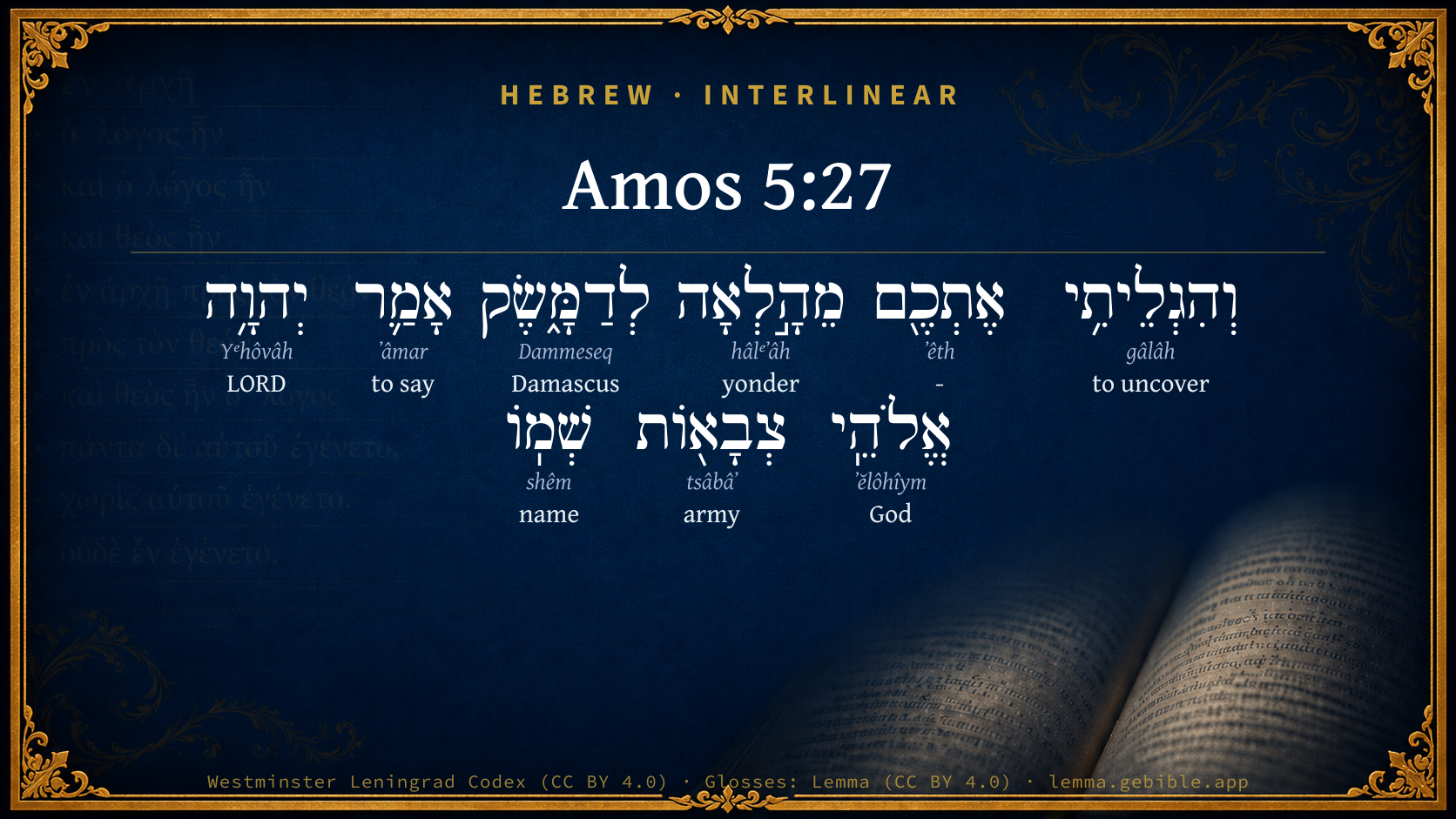
Hebrew (Westminster Leningrad Codex) Amos 5:27 appears in the Hebrew Old Testament. The text above is from the Westminster Leningrad Codex. Each word links to its Strong’s number, a concise gloss, and parsing drawn from the Open Scriptures Hebrew Bible morphology. Click any word for its full Brown-Driver-Briggs (BDB) entry.
Download image
Cite this verse

Amos 5:27 (World English Bible). Public Domain. Lemma interlinear Bible study tool, https://lemma.gebible.app/v/amos/5/27.

Show BibTeX & RIS
BibTeX
RIS
English Translation
Therefore will I cause you to go into captivity beyond Damascus," says Yahweh, whose name is the God of hosts.
World English Bible · Public Domain
Download a study sheet

One document with this verse’s original text, its word-by-word gloss line, the meaning frame, cross-references with their text, attributed commentary, and full source and license credits — printable, and it pastes into notes with its structure intact.

This verse Autodidact and up

Study sheet (.html) Plain text (.txt)

A passage Seminary Student

Up to 50 verses in one chapter. A passage sheet keeps up to 6 commentary sources and 12 cross-references per verse, in the order this page ranks them, and says so on the sheet whenever that leaves anything out. Ask for a single verse and you get the Autodidact verse sheet above.

Everything on this page stays free to read, with no account — the sheet is a download of what is already on screen, not access to it.

Want to remove ads? Support Godless Engineer
Compare translations 3

The same verse in 3 English versions, stacked beneath the original-language interlinear above. Click any original word for its lexicon entry.

Each is an independent rendering of the whole verse — the interlinear is not word-aligned to these translations.

Highlighted words mark where these versions differ — a whole-verse word diff, not a word-by-word alignment.

  • World English Bible Public Domain
    Therefore will I cause you to go into captivity beyond Damascus," says Yahweh, whose name is the God of hosts.
  • King James Version Public Domain
    Therefore will I cause you to go into captivity beyond Damascus, saith the LORD, whose name is The God of hosts.
  • unfoldingWord Literal Text CC BY-SA 4.0
    Therefore I will exile you beyond Damascus,” says Yahweh, whose name is the God of hosts.

unfoldingWord Literal Text — © unfoldingWord, licensed CC BY-SA 4.0. Word-aligned USFM3 via Door43 (git.door43.org/unfoldingWord/en_ult).

Versions to compare (up to 4)

3 of 4 selected

Show all 18 translations

Every available English version of this verse, each an independent rendering of the whole verse.

  • World English Bible Public Domain
    Therefore will I cause you to go into captivity beyond Damascus," says Yahweh, whose name is the God of hosts.
  • Berean Standard Bible Public Domain
    Therefore I will send you into exile beyond Damascus,” says the LORD, whose name is the God of Hosts.
  • Majority Standard Bible Public Domain
    Therefore I will send you into exile beyond Damascus,” says the LORD, whose name is the God of Hosts.
  • King James Version Public Domain
    Therefore will I cause you to go into captivity beyond Damascus, saith the LORD, whose name is The God of hosts.
  • American Standard Version (1901) Public Domain
    Therefore will I cause you to go into captivity beyond Damascus, saith Jehovah, whose name is the God of hosts.
  • Revised Version (1885) Public Domain
    Therefore will I cause you to go into captivity beyond Damascus, saith the LORD, whose name is the God of hosts.
  • Geneva Bible (1599) Public Domain
    Therefore wil I cause you to goe into captiuitie beyond Damascus, saith the Lord, whose Name is the God of hostes.
  • Douay-Rheims (1899) Public Domain
    And I will cause you to go into captivity beyond Damascus, saith the Lord, the God of hosts is his name.
  • Young's Literal Translation Public Domain
    And I removed you beyond Damascus, Said Jehovah, God of Hosts `is' His name.
  • Literal Standard Version CC BY-SA 4.0
    And I removed you beyond Damascus,” said YHWH—God of Hosts [is] His Name.
  • Unlocked Literal Bible CC BY-SA 4.0
    Therefore I will exile you beyond Damascus,” says Yahweh, whose name is the God of hosts.
  • unfoldingWord Literal Text CC BY-SA 4.0
    Therefore I will exile you beyond Damascus,” says Yahweh, whose name is the God of hosts.
  • Darby Bible Public Domain
    and I will cause you to go into captivity beyond Damascus, saith Jehovah, whose name is the God of hosts.
  • World Messianic Bible Public Domain
    Therefore I will cause you to go into captivity beyond Damascus,” says the LORD, whose name is the God of Hosts.
  • Webster's Bible Public Domain
    Therefore I will cause you to go into captivity beyond Damascus, saith the LORD, whose name is The God of hosts.
  • Free Bible Version CC BY-SA 4.0
    So I will send you into exile in a land beyond Damascus, says the Lord, whose name is the God of power.
  • Bible in Basic English Public Domain
    And I will send you away as prisoners farther than Damascus, says the Lord, whose name is the God of armies.
  • JPS Tanakh (1917) Public Domain
    Therefore will I cause you to go into captivity beyond Damascus, saith He, whose name is the LORD God of hosts.

Literal Standard Version (2020), Covenant Press — licensed CC BY-SA 4.0. Text via the HelloAO Bible API (eBible.org). Unlocked Literal Bible (unfoldingWord) — licensed CC BY-SA 4.0. Text via the HelloAO Bible API (eBible.org). unfoldingWord Literal Text — © unfoldingWord, licensed CC BY-SA 4.0. Word-aligned USFM3 via Door43 (git.door43.org/unfoldingWord/en_ult). Free Bible Version, Dr. Jonathan Gallagher — licensed CC BY-SA 4.0. Text via the HelloAO Bible API (eBible.org).

Word by word

More ways to search: Search by grammar → Find every occurrence → Compare this word →

Practice this passage: Drill this verse → Learn its vocabulary →

About this verse

These counts appear in no published source. They are computed here, from the morphology-tagged text and Lemma’s own curated glosses. What Lemma adds →

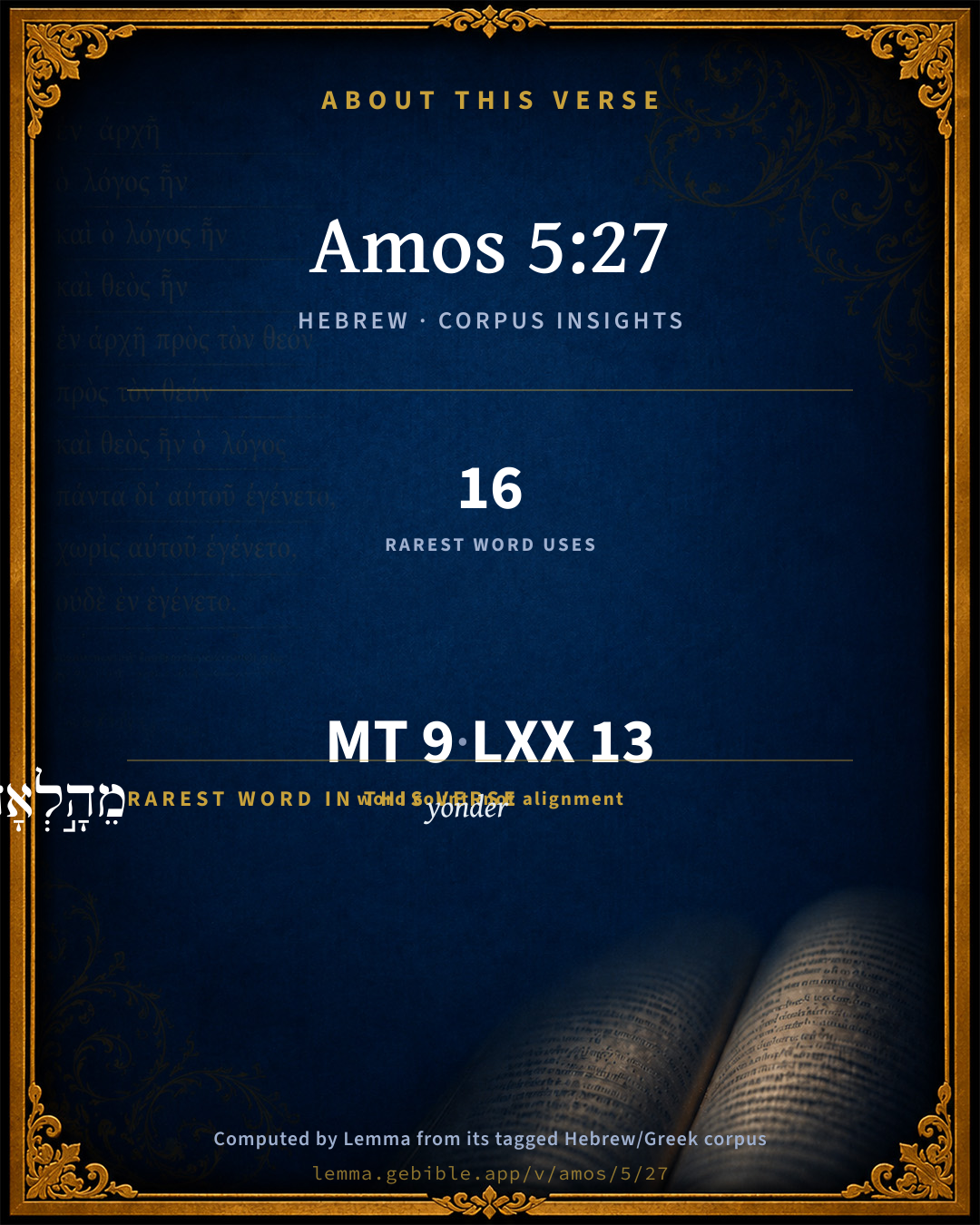
9
words
9
distinct lemmas
Prophets
section

Notable vocabulary

The rarest word here is מֵהָ֣לְאָה yonder H1973 — appearing just 16 times in the whole Hebrew Bible.

Shared distinctive vocabulary

מֵהָ֣לְאָה yonder H1973 occurs in 16 verses of the Hebrew Bible. Also found in:

Grammatical profile

  • 2 verbs
  • 5 nouns
  • 1 adverb
  • 1 particle

Verb forms

  • וְהִגְלֵיתִ֥י Hiphil · Sequential Perfect
  • אָמַ֛ר Qal · Perfect

Hebrew & Septuagint length

In English translation the verse runs 20 words from the Hebrew and 17 from the Septuagint (LXX English) — closely comparable.

A rough comparison of the two English renderings, which tokenize alike — not a word-level alignment.

Word counts can differ between the Hebrew and the Greek without any difference in meaning — e.g. the Hebrew direct-object marker אֵת has no separate Greek word, and Greek often adds the article ὁ.

In the original languages it is 9 Hebrew tokens and 13 Greek tokens — but the two are counted differently (Hebrew bundles its prefixes and suffixes into one token; the Greek is in lemma form), so that isn’t a like-for-like length.

Cross-references

4

Topical passages linked to Amos 5:27 in the Treasury of Scripture Knowledge — connected by theme and wording, ordered by reader-vote popularity; previews shown in the World English Bible.

  • 2 Kings 17:6 In the ninth year of Hoshea the king of Assyria took Samaria, and carried Israel away to Assyria, and placed them in Halah, and on the Habor, the river of Gozan, and in the cities of the Medes.
  • Acts 7:43 You took up the tent of Moloch, The star of your god Rephan, The figures which you made to worship. I will carry you away beyond Babylon.'
  • Amos 4:13 For, behold, he who forms the mountains, And creates the wind, And declares to man what is his thought; Who makes the morning darkness, And treads on the high places of the Earth: Yahweh, the God of hosts, is his name."
  • 2 Kings 15:29 In the days of Pekah king of Israel came Tiglath Pileser king of Assyria, and took Ijon, and Abel Beth Maacah, and Janoah, and Kedesh, and Hazor, and Gilead, and Galilee, all the land of Naphtali; and he carried them captive to Assyria.

Cross-references courtesy of OpenBible.info (CC BY 4.0).

Hebrew and Greek witnesses Masoretic Hebrew ↔ Greek Septuagint

The same verse in the two great witnesses to the Old Testament, shown verse-for-verse.

These are two independent witnesses, not word-aligned to each other, and the Septuagint is shown in lemma (dictionary) form.

Hebrew Amos 5:27 Masoretic · Westminster Leningrad Codex

וְהִגְלֵיתִ֥י אֶתְכֶ֖ם מֵהָ֣לְאָה לְדַמָּ֑שֶׂק אָמַ֛ר יְהוָ֥ה אֱלֹהֵֽי צְבָא֖וֹת שְׁמֽוֹ

Therefore will I cause you to go into captivity beyond Damascus," says Yahweh, whose name is the God of hosts.

World English Bible · Public Domain

Greek LXX Amos 5:27 Septuagint · lemma form

καί μεταοἰκίζω σύ ἐπέκεινα δαμασκός λέγω κύριος ὁ θεός ὁ παντοκράτωρ ὄνομα αὐτός

And I will carry you away beyond Damascus, says the Lord, the Almighty God is his name.

LXX2012 (modern English Septuagint) · Public Domain

Hebrew: Westminster Leningrad Codex (CC BY 4.0). Greek: Septuagint (public domain); English from LXX2012 (modern English Septuagint) (Public Domain). How the Septuagint differs from the Hebrew →

Targum (Aramaic paraphrase)

1

The Targum is the ancient Jewish Aramaic paraphrase of the Hebrew Scriptures — an interpretive translation, not the Hebrew text itself. Onkelos (literal) and Pseudo-Jonathan (expansive) render the Torah, and Jonathan the Prophets. Coverage is partial: where no permissively-licensed English translation exists for a verse, only the Aramaic is shown. This is verse-level text, not a word-by-word alignment to the Hebrew.

  1. Targum Jonathan Prophets (Joshua–Malachi)
    וְאַגְלֵי יַתְכוֹן מֵהָלְאָה לְדַמֶשֶׂק אֲמַר יְיָ אֱלֹהִים צְבָאוֹת שְׁמֵיהּ:

    (no public-domain English translation for this verse)

    Targum Jonathan — Aramaic: “Mikraot Gedolot” (public domain). English: “Sefaria Community Translation” (CC0 1.0 (public-domain dedication)); “London "Chaldee Paraphrase," 1871” (public domain). Text via Sefaria.

Commentary

Notes on Amos 5:27 from classic Christian and Jewish commentators (each source and its license shown beneath its notes). The classic Christian expositions comment on the surrounding passage and are grouped to its opening verse, so a note may address several verses; the Jewish commentaries on the Tanakh (Rashi and others) are per-verse, so they appear only where the commentator wrote on this verse.

Lemma curates 59 commentaries, every one of them public domain or Creative Commons licensed, each selected and text-cleaned for this edition rather than reprinted as found. About our sources →

Trapp's Complete Commentary

John Trapp

Amo 5:27 Therefore will I cause you to go into captivity beyond Damascus, saith the LORD, whose name [is] The God of hosts.

Ver. 27. Therefore will cause you] Idolatry is a land desolating sin.

Beyond Damascus] And not only so, but also beyond Babylon, Act 7:43, by the way of Damascus, by Tiglathpileser, sent for by Ahaz for that purpose, Isa 8:4 2Ki 15:29.

John Trapp, A Commentary or Exposition upon All the Books of the Old and New Testament (1647–1656) — public domain. Text from a community e-Sword module.

Joseph Benson's Commentary

Amo 5:27. Therefore will I cause you to go into captivity beyond Damascus, saith the Lord, whose name is, &c. — Ye shall be removed further from your own country, than when Hazael, king of Syria, carried away so many Israelites captives to Damascus, (see 2Ki 10:32-33,) and consequently shall have less hopes of returning home. The king of Assyria carried the ten tribes captive as far as Media, 2Ki 17:6. Therefore St. Stephen, in the passage above quoted, expressing rather the sense than the words, reads, I will carry you away beyond Babylon, Media being at a much greater distance than Babylon. Both readings imply, that the captivity of the ten tribes would be far worse than that of the two remaining, and likely to be of much longer duration.

Joseph Benson's Commentary on the Old and New Testaments (1811–1818) — public domain. Text from a community e-Sword module.

Jamieson, Fausset & Brown

Robert Jamieson, A. R. Fausset & David Brown

beyond Damascus--In Act 7:43 it is "beyond Babylon," which includes beyond Damascus. In Amos time, Damascus was the object of Israel's fear because of the Syrian wars. Babylon was not yet named as the place of their captivity. Stephen supplies this name. Their place of exile was in fact, as he states, "beyond Babylon," in Halah and Habor by the river Gozan, and in the cities of the Medes (Kg2 17:6; compare here Amo 1:5; Amo 4:3; Amo 6:14). The road to Assyria lay through "Damascus." It is therefore specified, that not merely shall they be carried captives to Damascus, as they had been by Syrian kings (Kg2 10:32-33; Kg2 13:7), but, beyond that, to a region whence a return was not so possible as from Damascus. They were led captive by Satan into idolatry, therefore God caused them to go captive among idolaters. Compare Kg2 15:29; Kg2 16:9; Isa 8:4, whence it appears Tiglath-pileser attacked Israel and Damascus at the same time at Ahaz' request (Amo 3:1).

Next: Amos Chapter 6

Jamieson, Fausset & Brown — Commentary Critical and Explanatory on the Whole Bible (1871) — public domain (CC PDM 1.0). Text via the HelloAO Bible API.

Adam Clarke's Commentary

Verse 27. Will I cause you to go into captivity beyond Damascus] That is, into Assyria, the way to which, from Judea, was by Damascus.

But St. Stephen says, Ac 7:43, beyond Babylon; because the Holy Spirit that was in him chose to extend the meaning of the original text to that great and final captivity of the Jews in general, when Zedekiah, their last king, and the people of Judea, were carried into Mesopotamia, Armenia, and Media; see 2Kg 17:7; 2Kg 17:24. This captivity happened after the time of Amos.

Adam Clarke's Commentary on the Bible (1810–1826) — public domain. Text from a community e-Sword/MySword module.

John Calvin's Commentaries

Here the Prophet at last denounces exile on the Israelites as though he had said that God would not suffer them any longer to contaminate the Holy Land, which had been given them as an heritage, on the condition that they acknowledged him as the only true God. God had now, for a long time, borne with the Israelites though they had never ceased to pollute his land with superstitions. He comes now to cleanse it. I will cause you, he says, to migrate beyond Damascus; for they thought that enemies were driven, by means of that fortress, from the whole country, and they took shelter there as in a quiet nest. The expression would have otherwise no meaning, and this is what interpreters have not noticed. They say, “I will cause you to migrate beyond Damascus” that is, to a far country; but why did the Prophet mention Damascus? This reason ought to be observed. It was because the Israelites thought that all the attacks of enemies would be prevented by having the city Damascus as their defense, which they supposed was impregnable. “That fortress,” the Lord says, “will not prevent me from taking you away, and removing you as far as the Assyrians.” We now see what the Prophet means, and why he expressly added the name of Damascus.

It follows, The God of hosts is his name Here the Prophet confirms his threatening, lest hypocrites should think that he did not speak in earnest: for we know how readily they flattered themselves; and when the Lord fulminated, they remained secure. Hence the Prophet, that he might strike terror, says, that the speaker is the God of hosts, as though he said, “Ye cannot hope to escape the vengeance which God now denounces on you; for his power is infinite, he is the Lord of hosts. See then that he is prepared to destroy you except ye timely repent.” This is the meaning. I will not now proceed farther.

John Calvin's Commentaries (1540-1563) — public domain. Text from the Calvin Translation Society English edition (1840s-50s) via the Christian Classics Ethereal Library (ccel.org). Calvin's coverage is partial (roughly two-thirds of the Bible); uncommented books and verses are honest gaps, never fabricated. The 19th-century editor's footnotes and remarks are omitted so the notes are faithfully Calvin's own voice.

John Gill's Exposition

Therefore will I cause you to go into captivity beyond Damascus,.... The chief city of Syria; and which, as Aben Ezra says, lay to the east of the land of Israel, and was a very strong and fortified place: and Syria being in alliance with Israel, the Israelites might think of fleeing thither for refuge, in the time of their distress; but they are here told that they should be taken captive, and be carried to places far more remote than that: Stephen says, "beyond Babylon"; as they were, for they were carried into Media, to Halah and Habor by the river of Gozan, to the cities of the Medes; their way to which lay through Syria and Babylon; See Gill on Act 7:43;

saith the Lord, whose name is the God of hosts; and therefore is able to do what he threatens; and it might be depended upon it would be certainly done, as it is clear, beyond all contradiction, it has been done; see Kg2 17:6.

Next: Amos Chapter 6

John Gill's Exposition of the Whole Bible (1746–1763) — public domain (CC PDM 1.0). Text via the HelloAO Bible API.

Albert Barnes' Notes on the Bible

Therefore - (And) this being so, such having been their way from the beginning until now, will I cause you to go into captivity beyond Damascus Syria was the most powerful enemy by whom God had heretofore chastened them 2Ki 13:7. From Syria He had recently, for the time, delivered them, and had given Damascus into their hands 2Ki 14:25, 2Ki 14:28. That day of grace had been wasted, and they were still rebellious. Now God would bring against them a mightier enemy. Damascus, the scene of their triumph, should be their pathway to captivity. God would “cause” them “to go into captivity,” not to “Damascus,” from where they might have easily returned, but “beyond” it, as He did, “into the cities of the Medes.” But Israel had, up to the time of Amos and beyond it, no enemy, no war, “beyond Damascus.” Jehu had probably paid tribute to Shalmanubar king of Assyria, to strengthen himself . The Assyrian monarch had warred against Israel’s enemies, and seemingly received some check from them (see the note above at Amo 1:3).

Against Israel he had shown no hostility. But for the conspiracy of one yet to be born in private life, one of the captains of Israel who by murder, became its sovereign, it might have continued on in its own land. The Assyrian monarchs needed tribute, not slaves; nor did they employ Israel as slaves. Exile was but a wholesale imprisonment of the nation in a large but safe prison-house. Had they been still, they were more profitable to Assyria, as tributaries in their own land. There was no temptation to remove them, when Amos prophesied. The temptation came with political intrigues which had not then commenced. The then Assyrian monarch, Shamasiva, defeated their enemies the Syrians, united with and aiding the Babylonians ; “they” had then had no share in the opposition to Assyria, but lay safe in their mountain-fastness.

It has been said , “Although the kingdom of Israel had, through Jeroboam, recovercd its old borders, yet careless insolence, luxury, unrighteousness, “must” bring the destruction of the kingdom which the prophet foretells. The prophet does but dimly forebode the superior power of Assyria.” Solomon had declared the truth, “Righteousness exalteth a nation, but sin is a reproach to any people” Pro 14:34. But there are many sorts of decay. Decay does not involve the transportation of a people. Nay, decay would not bring it, but the contrary. A mere luxurious people rots on its own soil, and would be left to rot there. It was the little remnant of energy, political cabaling, warlike spirit, in Israel, which brought its ruin from man. Idolatry, “insolence, luxury, unrighteousness,” bring down the displeasure of God, not of man. Yet Amos foretold, that God would bring the destruction through man.

They were, too, no worse than their neighbors, nor so bad; not so bad as the Assyrians themselves, except that, God having revealed Himself to them, they had more light. The sin then, the punishment the mode of punishment, belong to the divine revelation. Such sins and worse have existed in Christian nations. They were in part sins directly against God. God reserves to Himself, how and when He will punish. He has annexed no such visible laws of punishment to a nation’s sins that man could, of his own wisdom or observation of God’s ways, foresee it. They through whom Itc willed to inflict it, and whom Amos pointed out, were not provoked by “those” sins. There was no connection between Israel’s present sins, and Assyria’s future vengeance. No Eastern despot cares for the oppressions of his subjects, so that his own tribute is collected. See the whole range of Muslim rule now. As far too as we know, neither Assyria nor any other power had hitherto punished rebellious nations by transporting them ; and certainly Israel had not yet rebelled, or meditated rebellion. He only who controls the rebellious wills of people, and through their self-will works out His own all-wise Will and man’s punishment, could know the future of Israel and Assyria, and how through the pride of Assyria He would bring down the pride of Samaria.

It has been well said by a thoughtful observer of the world’s history, “Whosoever attempts to prophesy, not being inspired, is a fool.” We English know our own sins, many and grievous; we know of a vast reign of violence, murder, blasphemy, theft, uncleanness, covetousness, dishonest dealing, unrighteousness, and of the breach of every commandment of God: we know well now of an instrument in God’s Hands, not far off; like the Assyrian, but within two hours of our coast; armaments have been collected; a harbor is being formed; our own coast openly examined; iron-sheeted vessels prepared; night-signals provided; some of our own alienated population organized; with a view to our invasion. We recognize the likelihood of the invasion, fortify our coast, arm, not as a profession, but for security. Our preparations testify, how widespread is our expectation. No one scarcely doubts that it will be.

Yet who dare predict the issue? Will God permit that scourge to come? Will he prevail? What would be the extent of our sufferings or loss? How would our commerce or our Empire be impaired? Would it be dismembered? Since no man can affirm anything as to this which is close at hand, since none of us would dare to affirm in God’s Name, in regard to any one stage of all this future, that this or that would or would not happen, then let people have at least the modesty of the magicians of Egypt, and seeing in God’s prophets those absolute predictions of a future, such as their own wisdom, under circumstances far more favorable, could not dare to make, own; “This is the finger of God” Exo 8:19. Not we alone. We see all Europe shaken; we see powers of all sorts, heaving to and fro; we see the Turkish power ready to dissolve, stayed up, like a dead man, only by un-Christian jealousies of Christians. Some things we may partially guess at.

But with all our means of knowing what passes everywhere, with all our knowledge of the internal impulses of nations, hearing, as we do, almost every pulse which beats in the great European system, knowing the diseases which, here and there, threaten convulsion or dissolution, no one dare stake his human wisdom on any absolute prediction, like these of the shepherd of Tekoa as to Damascus (see the note above at Amo 1:5. pp. 160, 161) and Israel. To say the like in God’s Name, unless inspired, we should know to be blasphemy. God Himself set the alternative before men. “Let all the nations be gathered together, and let the people be assembled; who among them that can declare this, and show former things? Let them bring forth their witnesses, that they may be justified; or let them hear, and say,” It is “truth” Isa 43:9.

Stephen, in quoting this prophecy, substitutes, Babylon for Damascus, as indeed “the cities of the Medes” were further than Babylon. Perhaps he set the name, in order to remind them, that as God had brought Abraham “out of the land of the Chaldeans” Act 7:4, leaving the idols which his “fathers” had “served” Jos 24:14, to serve God only, so they, serving idols, were carried back, from where Abraham had come, forfeiting, with the faith of Abraham, the promises made to Abraham; aliens and outcasts.

Saith the Lord, the Lord of hosts - The Lord of the heavenly hosts for whose worship they forsook God; the Lord of the hosts on earth, whose ministry He employs to punish those who rebel against Him , “For He hath many hosts to execute His judgments, the hosts of the Assyrians, the Medes and Persians, the Greeks and Romans.” All creatures in heaven and in earth are, as He says of the holy Angels, “ministers of His, that do His pleasure” Psa 103:21.

Albert Barnes' Notes on the Bible (1834–1885) — public domain. Text from a community e-Sword/MySword module.

Haydock's Catholic Bible Commentary

Damacus, or Babylon, (Acts vii.) into Mesopotamia, &c. The sense is the same. (Calmet) --- When the apostles quote passages, "they do not consider the words but the sense." (St. Jerome) --- One Greek copy, however, has Damascus in the Acts. (Haydock)

George Leo Haydock (1774–1849), Haydock's Catholic Family Bible and Commentary, 1859 edition — public domain. Excludes Psalms (Douay-Rheims chapter numbering differs from Protestant) and Deuterocanonical books (Catholic canon only).

Matthew Poole's English Annotations

Therefore, for all your idolatry and other sins in which you have obstinately continued,

will I cause you to go into captivity; you shall certainly be subdued and captivated; and this shall be done so that my hand shall appear evidently in it.

Beyond Damascus, into Assyria, and into parts beyond Damascus: it is not certain into what corners of the world they were sent, but probably to those parts that lay about the Caspian Sea, more remote from their own country than ever to hope they may get back again. Or thus, You shall be carried into a captivity more grievous by Shalmaneser, than was the captivity of those whom Tiglathpileser led captive when he slew Resin, took Damascus, and wasted Israel in the days of Pekah, when some Israelites were carried captives; but this shall be a more grievous captivity.

Matthew Poole's English Annotations on the Holy Bible (1683–1685) — public domain. Text from a community e-Sword/MySword module.

The Pulpit Commentary

Therefore. The consequence of their continued alienation from God should be deportation to a foreign land, beyond Damascus, far away from the confines of the country once their own possession, (2Sa_8:6) thus dimly denoting As. syria, at that time not hostile, but known in the time of Tiglath-Pileser I. (see the accomplishment, 2Ki_15:29 2Ki_17:6) St. Stephen says, (Act_7:43) "beyond Babylon;" "Magis enim," observes Jerome, "intelligentiam quam verbum posuit;" and he is probably blending other prophecies with that of Amos, e.g. Jer_20:4.

The Pulpit Commentary (1880–1919), ed. H.D.M. Spence-Jones & Joseph S. Exell — public domain. Text from a community e-Sword module.

John Wesley's Explanatory Notes

Therefore - For all your idolatry and other sins, in which you have obstinately continued.

John Wesley, Explanatory Notes Upon the Whole Bible (1754–1765) — public domain. Text via the GEBible commentary corpus.

unfoldingWord translationNotes

Door43 World Missions Community

translationWords

exile

Damascus

Yahweh

Yahweh of hosts

unfoldingWord translationNotes — © Distant Shores Media and the Door43 World Missions Community, licensed CC BY-SA 4.0. Source: git.door43.org/Door43/en_tn.

Rashi

Rabbi Shlomo Yitzchaki (Rashi)

And I will exile you beyond Damascus—I.e, you shall not be exiled to your neighbors as heretofore, that you were delivered into the hands of the kings of Aram [In Nach Lublin-Edom, an obvious error] and they did not take you in captivity to a distant place, but to Damascus. From now on, I will deliver you into the hands of Sennacherib, and he shall exile you far away.

Rashi on the Tanakh — English translations: “The Judaica Press complete Tanach with Rashi, translated by A. J. Rosenberg” (CC BY 4.0); “Pentateuch with Rashi's commentary by M. Rosenbaum and A.M. Silbermann, 1929-1934” (public domain); “The Metsudah Tanach series, Lakewood, N.J” (CC BY 4.0); and “The Book of Joshua, Metsudah Publications, 1997” (CC BY 4.0). Text via Sefaria.

Lesson kit

Teaching starters — assembled from the data on this page, not authored interpretation. Every prompt links to the verse data it draws on. Edit before teaching.

Amos, in the Prophets, opens this verse with 9 words (9 distinct Hebrew lemmas). Its most distinctive word is hâlᵉʼâh (“yonder”). A historical commentator’s framing appears above. Read the whole chapter for the surrounding context.

Discussion questions

  1. How does “yonder” (hâlᵉʼâh) shape what this verse is saying?
  2. Genesis 19:9 shares the word «yonder» with this verse. How do the two illuminate each other?
  3. The translations on this page render this verse differently — a whole-verse word diff, not a word-by-word alignment. What might account for the different wordings?
  4. The verb «וְהִגְלֵיתִ֥י» is Hiphil Sequential Perfect. How does its form color the action?
  5. Reading how Trapp's Complete Commentary and Joseph Benson's Commentary read this verse, where do the two commentators agree and where do they part?

Things to notice

Reading settings

Reading text

Shown beneath each verse's original-language words.

Old Testament
Old Testament edition

Read the OT as the Masoretic Hebrew (MT) or the Greek Septuagint (LXX).

English shown for the Greek Septuagint (in the Hebrew ↔ Greek comparison).

Comparing translations? Open the Compare panel on any verse page to stack up to four side by side.