Micah 1:16

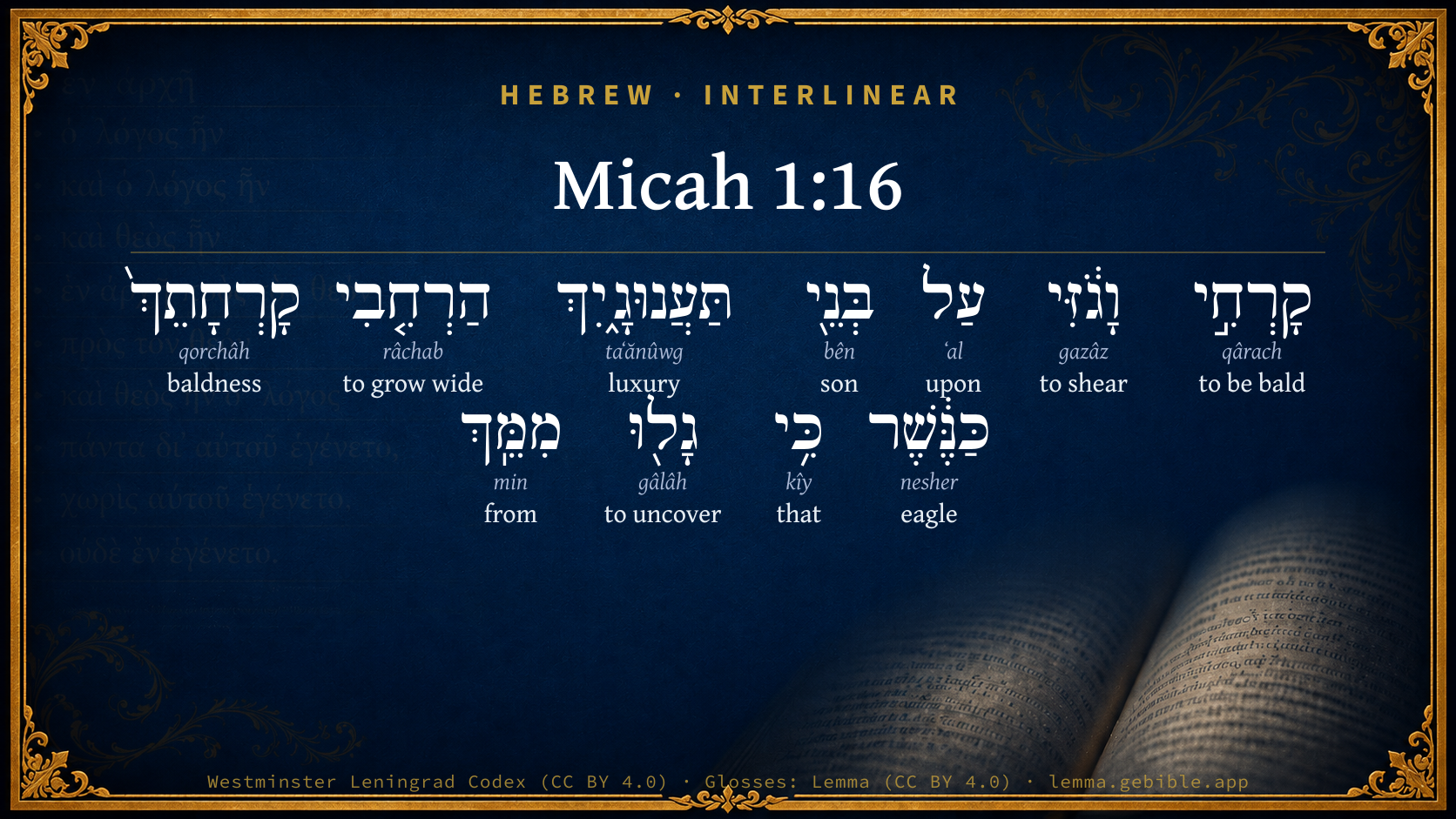
Hebrew (Westminster Leningrad Codex) Micah 1:16 appears in the Hebrew Old Testament. The text above is from the Westminster Leningrad Codex. Each word links to its Strong’s number, a concise gloss, and parsing drawn from the Open Scriptures Hebrew Bible morphology. Click any word for its full Brown-Driver-Briggs (BDB) entry.
Download image
Cite this verse

Micah 1:16 (World English Bible). Public Domain. Lemma interlinear Bible study tool, https://lemma.gebible.app/v/micah/1/16.

Show BibTeX & RIS
BibTeX
RIS
English Translation
Shave your heads, And cut off your hair for the children of your delight. Enlarge your baldness like the vulture; For they have gone into captivity from you!
World English Bible · Public Domain
Download a study sheet

One document with this verse’s original text, its word-by-word gloss line, the meaning frame, cross-references with their text, attributed commentary, and full source and license credits — printable, and it pastes into notes with its structure intact.

This verse Autodidact and up

Study sheet (.html) Plain text (.txt)

A passage Seminary Student

Up to 50 verses in one chapter. A passage sheet keeps up to 6 commentary sources and 12 cross-references per verse, in the order this page ranks them, and says so on the sheet whenever that leaves anything out. Ask for a single verse and you get the Autodidact verse sheet above.

Everything on this page stays free to read, with no account — the sheet is a download of what is already on screen, not access to it.

Want to remove ads? Support Godless Engineer
Compare translations 3

The same verse in 3 English versions, stacked beneath the original-language interlinear above. Click any original word for its lexicon entry.

Each is an independent rendering of the whole verse — the interlinear is not word-aligned to these translations.

Highlighted words mark where these versions differ — a whole-verse word diff, not a word-by-word alignment.

  • World English Bible Public Domain
    Shave your heads, And cut off your hair for the children of your delight. Enlarge your baldness like the vulture; For they have gone into captivity from you!
  • King James Version Public Domain
    Make thee bald, and poll thee for thy delicate children; enlarge thy baldness as the eagle; for they are gone into captivity from thee.
  • unfoldingWord Literal Text CC BY-SA 4.0
    Make yourself bald and shave for the sons of your delight. Enlarge your baldness like the eagle, for they have gone into exile from you.

unfoldingWord Literal Text — © unfoldingWord, licensed CC BY-SA 4.0. Word-aligned USFM3 via Door43 (git.door43.org/unfoldingWord/en_ult).

Versions to compare (up to 4)

3 of 4 selected

Show all 18 translations

Every available English version of this verse, each an independent rendering of the whole verse.

  • World English Bible Public Domain
    Shave your heads, And cut off your hair for the children of your delight. Enlarge your baldness like the vulture; For they have gone into captivity from you!
  • Berean Standard Bible Public Domain
    Shave yourselves bald and cut off your hair in mourning for your precious children; make yourselves as bald as an eagle, for they will go from you into exile.
  • Majority Standard Bible Public Domain
    Shave yourselves bald and cut off your hair in mourning for your precious children; make yourselves as bald as an eagle, for they will go from you into exile.
  • King James Version Public Domain
    Make thee bald, and poll thee for thy delicate children; enlarge thy baldness as the eagle; for they are gone into captivity from thee.
  • American Standard Version (1901) Public Domain
    Make thee bald, and cut off thy hair for the children of thy delight: enlarge thy baldness as the eagle; for they are gone into captivity from thee.
  • Revised Version (1885) Public Domain
    Make thee bald, and poll thee for the children of thy delight: enlarge thy baldness as the eagle; for they are gone into captivity from thee.
  • Geneva Bible (1599) Public Domain
    Make thee balde: and shaue thee for thy delicate children: enlarge thy baldenesse as the eagle, for they are gone into captiuity from thee.
  • Douay-Rheims (1899) Public Domain
    Make thee bald, and be polled for thy delicate children: enlarge thy baldness as the eagle: for they are carried into captivity from thee.
  • Young's Literal Translation Public Domain
    Make bald and shave, for thy delightful sons, Enlarge thy baldness as an eagle, For they have removed from thee!
  • Literal Standard Version CC BY-SA 4.0
    Make bald and shave, for your delightful sons, || Enlarge your baldness as an eagle, || For they have removed from you!
  • Unlocked Literal Bible CC BY-SA 4.0
    Shave your head and cut off your hair for the children in whom you delight. Make yourself as bald as eagles, for your children will go into exile from you.
  • unfoldingWord Literal Text CC BY-SA 4.0
    Make yourself bald and shave for the sons of your delight. Enlarge your baldness like the eagle, for they have gone into exile from you.
  • Darby Bible Public Domain
    Make thee bald, and poll thee for the children of thy delights; enlarge thy baldness as the eagle, for they are gone into captivity from thee.
  • World Messianic Bible Public Domain
    Shave your heads, and cut off your hair for the children of your delight. Enlarge your baldness like the vulture, for they have gone into captivity from you!
  • Webster's Bible Public Domain
    Make thee bald, and poll thee for thy delicate children; enlarge thy baldness as the eagle; for they are gone into captivity from thee.
  • Free Bible Version CC BY-SA 4.0
    Shave your heads, for the children you love will be taken away; make yourselves as bald as a vulture, for they will be exiled far away from you.
  • Bible in Basic English Public Domain
    Let your head be uncovered and your hair cut off in sorrow for the children of your delight: let the hair be pulled from your head like an eagle's; for they have been taken away from you as prisoners.
  • JPS Tanakh (1917) Public Domain
    Make thee bald, and poll thee for the children of thy delight; enlarge thy baldness as the vulture; for they are gone into captivity from thee.

Literal Standard Version (2020), Covenant Press — licensed CC BY-SA 4.0. Text via the HelloAO Bible API (eBible.org). Unlocked Literal Bible (unfoldingWord) — licensed CC BY-SA 4.0. Text via the HelloAO Bible API (eBible.org). unfoldingWord Literal Text — © unfoldingWord, licensed CC BY-SA 4.0. Word-aligned USFM3 via Door43 (git.door43.org/unfoldingWord/en_ult). Free Bible Version, Dr. Jonathan Gallagher — licensed CC BY-SA 4.0. Text via the HelloAO Bible API (eBible.org).

Word by word

More ways to search: Search by grammar → Find every occurrence → Compare this word →

Practice this passage: Drill this verse → Learn its vocabulary →

תַּעֲנוּגָ֑יִךְ
taʻănûwg
H8588
“luxuries · your”
Noun, Common, Masculine, Plural, Construct + Suffix, Personal, 2nd Person, Feminine, Singular
Part of Speech
Noun
Type
Common
Gender
Masculine
Number
Plural
State
Construct
Full BDB Definition

Origin: from H6026

TWOT: 1648c

daintiness, luxury, exquisite delight, pleasantness, delight, comfort - luxury - dainty - delight
  1. קָרְחִ֣י qârach H7139 “be bald” Verb, Qal, Imperative, 2nd Person, Feminine, Singular
  2. וָגֹ֔זִּי gazâz H1494 “and · shear” Conjunction + Verb, Qal, Imperative, 2nd Person, Feminine, Singular
  3. עַל ʻal H5921 “upon” Preposition
  4. בְּנֵ֖י bên H1121 “sons of” Noun, Common, Masculine, Plural, Construct
  5. הַרְחִ֤בִי râchab H7337 “grow wide” Verb, Hiphil, Imperative, 2nd Person, Feminine, Singular
  6. קָרְחָתֵךְ֙ qorchâh H7144 “baldness · your” Noun, Common, Feminine, Singular, Construct + Suffix, Personal, 2nd Person, Feminine, Singular
  7. כַּנֶּ֔שֶׁר nesher H5404 “like/as the · eagle” Preposition, Determined + Noun, Common, Masculine, Singular, Absolute
  8. כִּ֥י kîy H3588 “that” Conjunction
  9. גָל֖וּ gâlâh H1540 “to uncover” Verb, Qal, Perfect, 3rd Person, Common, Plural
  10. מִמֵּֽךְ min H4480 “from · you” Preposition + Suffix, Personal, 2nd Person, Feminine, Singular

About this verse

These counts appear in no published source. They are computed here, from the morphology-tagged text and Lemma’s own curated glosses. What Lemma adds →

11
words
11
distinct lemmas
Prophets
section

Notable vocabulary

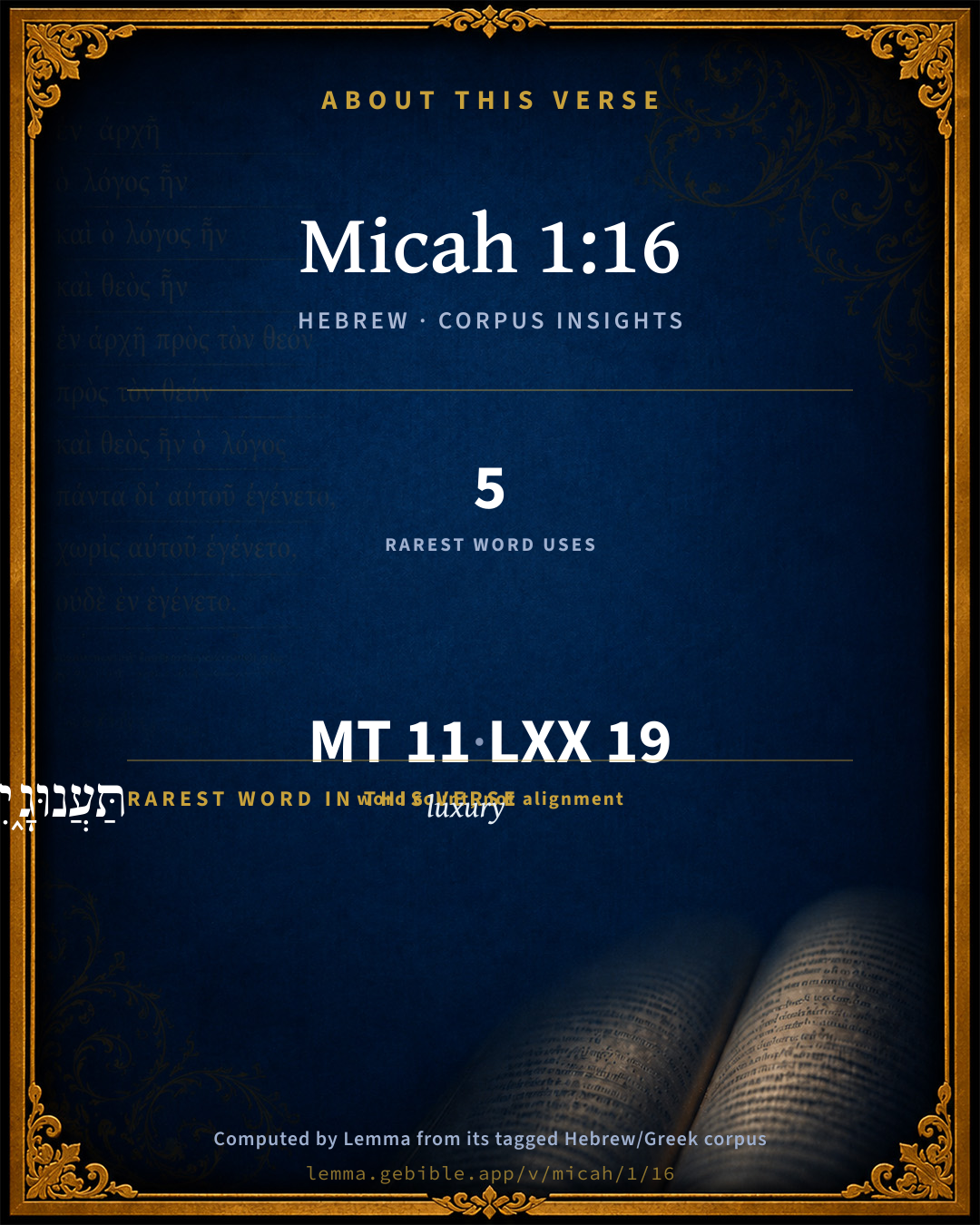
The rarest word here is תַּעֲנוּגָ֑יִךְ luxury H8588 — appearing just 5 times in the whole Hebrew Bible.

Shared distinctive vocabulary

תַּעֲנוּגָ֑יִךְ luxury H8588 occurs in 5 verses of the Hebrew Bible. Also found in:

Grammatical profile

  • 4 verbs
  • 4 nouns
  • 2 prepositions
  • 1 conjunction

Verb forms

  • קָרְחִ֣י Qal · Imperative
  • וָגֹ֔זִּי Qal · Imperative
  • הַרְחִ֤בִי Hiphil · Imperative
  • גָל֖וּ Qal · Perfect

Hebrew & Septuagint length

In English translation the verse runs 28 words from the Hebrew and 26 from the Septuagint (LXX English) — closely comparable.

A rough comparison of the two English renderings, which tokenize alike — not a word-level alignment.

Word counts can differ between the Hebrew and the Greek without any difference in meaning — e.g. the Hebrew direct-object marker אֵת has no separate Greek word, and Greek often adds the article ὁ.

In the original languages it is 11 Hebrew tokens and 19 Greek tokens — but the two are counted differently (Hebrew bundles its prefixes and suffixes into one token; the Greek is in lemma form), so that isn’t a like-for-like length.

Cross-references

13

Topical passages linked to Micah 1:16 in the Treasury of Scripture Knowledge — connected by theme and wording, ordered by reader-vote popularity; previews shown in the World English Bible.

  • Isaiah 22:12 In that day did the Lord, Yahweh of Hosts, call to weeping, and to mourning, and to baldness, and to girding with sackcloth:
  • Job 1:20 Then Job arose, and tore his robe, and shaved his head, and fell down on the ground, and worshiped.
  • Jeremiah 7:29 Cut off your hair, [Jerusalem], and cast it away, and take up a lamentation on the bare heights; for Yahweh has rejected and forsaken the generation of his wrath.
  • Jeremiah 16:6 Both great and small shall die in this land; they shall not be buried, neither shall men lament for them, nor cut themselves, nor make themselves bald for them;
  • Amos 8:10 I will turn your feasts into mourning, And all your songs into lamentation; And I will make you wear sackcloth on all your bodies, And baldness on every head. I will make it like the mourning for an only son, And the end of it like a bitter day.
  • Deuteronomy 28:41 You shall father sons and daughters, but they shall not be yours; for they shall go into captivity.
  • Deuteronomy 28:56–57 The tender and delicate woman among you, who would not adventure to set the sole of her foot on the ground for delicateness and tenderness, her eye shall be evil toward the husband of her bosom, and toward her son, and toward her daughter,
  • 2 Kings 17:6 In the ninth year of Hoshea the king of Assyria took Samaria, and carried Israel away to Assyria, and placed them in Halah, and on the Habor, the river of Gozan, and in the cities of the Medes.
  • Isaiah 3:16–26 Moreover Yahweh said, "Because the daughters of Zion are haughty, And walk with outstretched necks and flirting eyes, Walking to trip as they go, Jingling ornaments on their feet;
  • Isaiah 15:2 They are gone up to Bayith, and to Dibon, to the high places, to weep: Moab wails over Nebo, and over Medeba; on all their heads is baldness, every beard is cut off.
  • Isaiah 39:6–7 Behold, the days are coming, when all that is in your house, and that which your fathers have laid up in store until this day, shall be carried to Babylon: nothing shall be left, says Yahweh.
  • Jeremiah 6:26 Daughter of my people, gird you with sackcloth, and wallow yourself in ashes: make you mourning, as for an only son, most bitter lamentation; for the destroyer shall suddenly come on us.
  • Lamentations 4:5–8 Those who did feed delicately are desolate in the streets: Those who were brought up in scarlet embrace dunghills.

Cross-references courtesy of OpenBible.info (CC BY 4.0).

Hebrew and Greek witnesses Masoretic Hebrew ↔ Greek Septuagint

The same verse in the two great witnesses to the Old Testament, shown verse-for-verse.

These are two independent witnesses, not word-aligned to each other, and the Septuagint is shown in lemma (dictionary) form.

Hebrew Micah 1:16 Masoretic · Westminster Leningrad Codex

קָרְחִ֣י וָגֹ֔זִּי עַל בְּנֵ֖י תַּעֲנוּגָ֑יִךְ הַרְחִ֤בִי קָרְחָתֵךְ֙ כַּנֶּ֔שֶׁר כִּ֥י גָל֖וּ מִמֵּֽךְ

Shave your heads, And cut off your hair for the children of your delight. Enlarge your baldness like the vulture; For they have gone into captivity from you!

World English Bible · Public Domain

Greek LXX Micah 1:16 Septuagint · lemma form

ξυράω καί κείρω ἐπί ὁ τέκνον ὁ τρυφερός σύ ἐνπλατύνω ὁ χηρεία σύ ὡς ἀετός ὅτι αἰχμαλωτεύω ἀπό σύ

Shave your hair, and make yourself bald for your delicate children; increase your widowhood as an eagle; for your people are gone into captivity from you.

LXX2012 (modern English Septuagint) · Public Domain

Hebrew: Westminster Leningrad Codex (CC BY 4.0). Greek: Septuagint (public domain); English from LXX2012 (modern English Septuagint) (Public Domain). How the Septuagint differs from the Hebrew →

Targum (Aramaic paraphrase)

1

The Targum is the ancient Jewish Aramaic paraphrase of the Hebrew Scriptures — an interpretive translation, not the Hebrew text itself. Onkelos (literal) and Pseudo-Jonathan (expansive) render the Torah, and Jonathan the Prophets. Coverage is partial: where no permissively-licensed English translation exists for a verse, only the Aramaic is shown. This is verse-level text, not a word-by-word alignment to the Hebrew.

  1. Targum Jonathan Prophets (Joshua–Malachi)
    תְּלוּשִׁי וּרְמָא עַל בְּנֵי תַפְנוּקָיִךְ הָא כְּנִשְׁרָא דִנְתָרוּ גַדְפוֹהִי כֵּן אַסְגֵי מְרַט בְּרֵישַׁךְ עַל בָּנַיִךְ אֲרֵי גְלוֹ מִנָךְ:

    (no public-domain English translation for this verse)

    Targum Jonathan — Aramaic: “Mikraot Gedolot” (public domain). English: “Sefaria Community Translation” (CC0 1.0 (public-domain dedication)); “London "Chaldee Paraphrase," 1871” (public domain). Text via Sefaria.

Commentary

Notes on Micah 1:16 from classic Christian and Jewish commentators (each source and its license shown beneath its notes). The classic Christian expositions comment on the surrounding passage and are grouped to its opening verse, so a note may address several verses; the Jewish commentaries on the Tanakh (Rashi and others) are per-verse, so they appear only where the commentator wrote on this verse.

Lemma curates 59 commentaries, every one of them public domain or Creative Commons licensed, each selected and text-cleaned for this edition rather than reprinted as found. About our sources →

Trapp's Complete Commentary

John Trapp

Mic 1:16 Make thee bald, and poll thee for thy delicate children; enlarge thy baldness as the eagle; for they are gone into captivity from thee.

Ver. 16. Make thee bald and poll thee] i.e. Make most bitter lamentation. He alludes to a custom among the Easterlings, of tearing off the hair of their heads and beards in times of great heaviness. See Job 1:20 Isa 15:2 Jer 7:29 Ezr 9:3. In other cases baldness was forbidden Israel (lest they should symbolize with heathens), but in case of sorrow for sin they were called to it, Isa 22:12.

For thy delicate children] To whom thou hast been rather a parricide than a parent; dealing by them, as that false schoolmaster in Italy, that brought forth his scholars to Hannibal.

As the eagle] When he is old, and loseth his feathers; and with them not only his beauty, but also his swiftness and courage.

John Trapp, A Commentary or Exposition upon All the Books of the Old and New Testament (1647–1656) — public domain. Text from a community e-Sword module.

Joseph Benson's Commentary

Mic 1:16. Make thee bald — O Judah and Israel, tear off thy hair; and poll thee — Shave what thou canst not tear off; for thy delicate children, &c. — For the loss of them, some being slain, others starved or swept away by pestilence, and the residue carried into captivity. Cutting the hair, or shaving it close, were expressions of mourning and lamentation anciently used among most nations. Enlarge thy baldness as the eagle — When she moults her feathers; for they are gone into captivity, &c. — By these phrases the prophet signifies, that the calamity would be so great as to deserve the strongest expressions of grief.

Joseph Benson's Commentary on the Old and New Testaments (1811–1818) — public domain. Text from a community e-Sword module.

Tyndale Open Study Notes

Tyndale Open Resources

1:16 The people of Judah, including Jerusalem, were exiled and deported to distant lands in Babylonia in 605, 597, and 586 BC. Babylon was some 1,000 miles (1,700 kilometers) from Jerusalem. • shave your heads: This act of mourning and despair (see also Jer 41:5) could also signify purification (Lev 14:7-10; Num 6:10-11).

Tyndale Open Study Notes — © Tyndale Open Resources, licensed CC BY-SA 4.0. Text via the HelloAO Bible API.

Jamieson, Fausset & Brown

Robert Jamieson, A. R. Fausset & David Brown

Make thee bald, &c.--a token of deep mourning (Ezr 9:3; Job 1:20). Mourn, O land, for thy darling children.

poll--shave off thy hair.

enlarge thy baldness--Mourn grievously. The land is compared to a mother weeping for her children.

as the eagle--the bald eagle, or the dark-winged vulture. In the moulting season all eagles are comparatively bald (compare Psa 103:5).

Next: Micah Chapter 2

Jamieson, Fausset & Brown — Commentary Critical and Explanatory on the Whole Bible (1871) — public domain (CC PDM 1.0). Text via the HelloAO Bible API.

Adam Clarke's Commentary

Verse 16. Make thee bald] Cutting off the hair was a sign of great distress, and was practised on the death of near relatives; see Am 8:10. The desolation should be so great that Israel should feel it to her utmost extent; and the mourning should be like that of a mother for the death of her most delicate children.

Enlarge thy baldness as the eagle] Referring to the mounting of this bird, when in casting its feathers and breeding new ones, it is very sickly, and its strength wholly exhausted.

They are gone into captivity] This is a prediction of the captivity by Shalmaneser. Samaria, the chief city, is called on to deplore it, as then fast approaching.

Adam Clarke's Commentary on the Bible (1810–1826) — public domain. Text from a community e-Sword/MySword module.

John Calvin's Commentaries

The Prophet at length concludes that nothing remained for the people but lamentation; for the Lord had resolved to desolate and destroy the whole country. Now they were wont in mourning, as we have seen in other places, to shave and even tear off their hair: and some think that the verb קרחי, korechi, implies as much as though the Prophet said “Pluck, tear, pull off your hair.” When afterwards he adds רגזי, regizi, they refer it to shavings which is done by a razor. However this may be, the Prophet here means that the condition of the people would be so calamitous that nothing would be seen anywhere but mourning.

Make bald, he says, for the children of thy delicacies The Prophet here indirectly upbraids those perverse men, who after so many warnings had not repented, with the neglect of God’s forbearance: for whence did those delicacies proceed, except from the extreme kindness of God in long sparing the Israelites, notwithstanding their disobedience? The Prophet then shows here that they had very long abused the patience of God, while they each immersed themselves in their delicacies. Now, he says, Enlarge thy baldness as the eagle Eagles are wont to cast off their feathers; and hence he compares here bald men to eagles, as though he called them, Hairless. As then the eagles are for a certain time without feathers until they recover them; so also you shall be hairless, even on account of your mourning. He says, For they have migrated from thee He intimates that the Israelites would become exiles, that the land might remain desolate. Now follows —

John Calvin's Commentaries (1540-1563) — public domain. Text from the Calvin Translation Society English edition (1840s-50s) via the Christian Classics Ethereal Library (ccel.org). Calvin's coverage is partial (roughly two-thirds of the Bible); uncommented books and verses are honest gaps, never fabricated. The 19th-century editor's footnotes and remarks are omitted so the notes are faithfully Calvin's own voice.

Ellicott's Commentary for English Readers

(16) Make thee bald.—Joel appeals to the land of Judah to go into deep mourning by reason of the loss of her children, slain in war or carried into captivity. The shaving of the head as a token of grief was common amongst Eastern nations, and is distinct from the idolatrous custom of cutting the hair in a peculiar shape denounced by Jeremiah (Jer_9:26, margin), and forbidden by the Jewish Law (Lev_19:27-28).

As the eagle.—The Hebrew name for eagle includes the different kinds of vultures. Entire baldness is a marked feature of the vulture.

The terms in which Joel speaks of the entire desolation of the cities of Judah must refer to a more complete calamity than that inflicted by Sennacherib; they rather suit the period of the Babylonian captivity.

A Bible Commentary for English Readers, edited by Charles John Ellicott (1878–1897) — public domain. Text from a community e-Sword module.

The Cambridge Bible for Schools and Colleges

gen. ed. J. J. S. Perowne

16. Make thee bald] The prophet addresses the sorrowing mother, Judah, who sees her children go forth into exile. The injunction is to be understood poetically (see on Mic_1:13). Artificial baldness, as a sign of mourning, was against the Law (Lev_19:27-28, Deu_14:1), but this prohibition was apparently not recognized in the Shephélah. Micah speaks in the character of a man of the Shephélah.

as the eagle] The word for ‘eagle’ (nesher) seems, in common discourse, to have included the vulture (so also ἀετός, Mat_24:28), which is common in Egypt and Palestine.

The Cambridge Bible for Schools and Colleges (gen. ed. J. J. S. Perowne; Cambridge University Press, 1878–1918) — public domain. Text from a community e-Sword module.

John Gill's Exposition

Make thee bald, and poll thee for thy delicate children,.... Which is said, either with respect to Mareshah, or to Adullam, or to the whole land, as Kimchi observes; rather to the latter; and that either to Israel, or to Judah, or both; the prophecy in general being concerning them both, Mic 1:1; making baldness, whether by plucking off the hair, or by shaving it, was used in token of mourning, Job 1:20; and so it is designed to express it here: the inhabitants of the land are called to lamentation and weeping for their children taken from them, whom they dearly loved, and brought up in a delicate manner. The Targum is,

"pluck off thy hair, and cast it upon the children of thy delight;''

and Sanctius observes; that it was a custom with the Gentiles to cut off their hair, and cast it into the graves of their kindred and friends at their interment, to which be thinks the prophet alludes:

enlarge thy baldness as the eagle; when it moults, and cast off all its feathers, as it does in old age, and so renews its youth; to which the allusion seems to be in Psa 103:5; or every year, as birds of prey usually do at the beginning of the spring. The Jewish writers (y) say this happens to it every ten years; when, finding its feathers heavy and unfit for flying, it makes a tour to the sun with all its force it can, to get as near it as possible; and, having heated its plumage excessively, it casts itself into the sea for cooling, and then its feathers fall off, and new ones succeed; and this it does until it is a hundred years old; and to its then state of baldness, while it is moulting, is the allusion here; unless it can be thought any respect is had to that kind of eagle which is called the bald one. In Virginia (z) there are three sorts of eagles; one is the grey eagle, about the size of a kite; another the black eagle, resembling those in England; and a third the bald eagle, so called because the upper part of the neck and head are covered with a sort of white down: but the former sort of baldness seems to be intended, which is at certain stated times, and not what always is, and is only partial; for it denotes such an universal baldness to be made, as to take in all the parts of the body where any hair grows; as expressive of the general devastation that should be made, which would be the cause of this great mourning:

for they are gone into captivity from thee; that is, the delicate children of Israel and Judah, and so were as dead unto them, or worse: this was accomplished in Israel or the ten tribes, partly by Tiglathpileser, and more completely by Shalmaneser, king of Assyria, Kg2 15:29; and in Judah or the two tribes, when Sennacherib came and took their fenced cities; and doubtless some of the inhabitants and their children were carried captive by him, though not Jerusalem; and therefore cannot be addressed here, as some do interpret the words, unless the prophecy is to be extended to the destruction of Jerusalem by the Babylonians.

(y) Saadiah Gaon apud Kimchi & Ben Melech in Psal. ciii. 5. & lsa. xl. 31. (z) See Harris's Voyages and Travels, vol. 2. p. 229. Lowthorp's Philosoph. Transact. abridged, vol. 3. p. 589.

Next: Micah Chapter 2

John Gill's Exposition of the Whole Bible (1746–1763) — public domain (CC PDM 1.0). Text via the HelloAO Bible API.

Albert Barnes' Notes on the Bible

Make thee bald, poll - (literally, shear thee for thy delicate children Some special ways of cutting the hair were forbidden to the Israelites, as being idolatrous customs, such as the rounding the hair in front, cutting it away from the temples , or between the eyes Deu 14:1. All shearing of the hair was not forbidden ; indeed to the Nazarite it was commanded, at the close of his vow. The removal of that chief ornament of the countenance wasa natural expression of grief, which revolts at all personal appearance. It belonged, not to idolatry, but to nature . “Thy delicate children.” The change was the more bitter for those tended and brought up delicately. Moses from the first spoke of special miseries which should fall on the tender and very delicate. “Enlarge thy baldness;” outdo in grief what others do; for the cause of thy grief is more than that of others. The point of comparison in the Eagle might either be the actual baldness of the head, or its moulting. If it were the baldness of the head, the word translated eagle Unless nesher be the golden Eagle there is no Hebrew name for it, whereas it is still a bird of Palestine, and smaller eagles are mentioned in the same verse, Lev 11:13; namely, the ossifrage, פרס, and the black eagle, עזניה, so called from its strength, like the valeria, of which Pliny says, “the melanaetos or valeria, least in size, remarkable for strength, blackish in color.” x. 3. The same lint of unclean birds contains also the vulture, דיה, Deu 14:13, (as it must be, being a gregarious bird, Isa 34:15) in its different species Deu 14:13 the gier-eagle, (that is, Geyer) (vulture) eagle gypaetos, or vultur percnopterus, (Hasselquist, Forskal, Shaw, Bruce in Savigny p. 77.) partaking of the character of both, (רהם Lev 11:18; Deu 14:17 together with the falcon (דאה Lev 11:14 and hawk, with its subordinate species, (למינהו נץ) Lev 11:18; Deu 14:15.), although mostly used of the Eagle itself, might here comprehend the Vulture . For entire baldness is so marked a feature in the vulture, whereas the “bald-headed Eagle” was probably not a bird of Palestine . On the other hand, David, who lived so long among the rocks of Palestine, and Isaiah seem to have known of effects of moulting upon the Eagle in producing, (although in a less degree than in other birds,) a temporary diminution of strength, which have not in modern times been commonly observed.

For David says, “Thou shalt renew, like the eagle, thy youth, which speaks of fresh strength after temporary weakness” Psa 103:5; and Isaiah, “They that trust in the Lord shall put forth fresh strength; they shall put forth pinion-feathers like eagles” Isa 40:31, comparing the fresh strength which should succeed to that which was gone, to the eagle’s recovering its strong pinion-feathers. Bochart however says unhesitatingly , “At the beginning of spring, the rapacious birds are subject to shedding of their feathers which we call moulting.” If this be so, the comparison is yet more vivid, For the baldness of the vulture belongs to its matured strength, and could only be an external likeness. The moulting of the eagle involves some degree of weakness, with which he compares Judah’s mournful and weak condition amid the loss of their children, gone into captivity .

Thus closes the first general portion of the prophecy. The people had east aside its own Glory, God; now its sons, its pride and its trust, shall go away from it.

Lap.: “The eagle, laying aside its old feathers and taking new, is a symbol of penitence and of the penitents who lay aside their former evil habits, and become other and new men. True, but rare form of penitence!” Gregory the Great thus applies this to the siege of Rome by the Lombards. : “That happened to her which we know to have been foretold of Judea by the prophet, enlarge thy baldness like the eagle. For baldness befalls man in the head only, but the eagle in its whole body; for, when it is very old, its feathers and pinions fall from all its body. She lost her feathers, who lost her people. Her pinions too fell out, with which she was accustomed to fly to the prey; for all her mighty men, through whom she plundered others, perished. But this which we speak of, the breaking to pieces of the city of Rome, we know has been done in all the cities of the world. Some were desolated by pestilence, others devoured by the sword, others racked by famine, others swallowed by earthquakes. Despise we them with our whole heart, at least, when brought to nought; at least with the end of the world, let us end our eagerness after the world. Follow we, wherein we can, the deeds of the good.” One whose commentaries Jerome had read, thus applies this verse to the whole human race. “O soul of man! O city, once the mother of saints, which wast formerly in Paradise, and didst enjoy the delights of different trees, and wast adorned most beautifully, now being east down from thy place aloft, and brought down unto Babylon, and come into a place of captivity, and having lost thy glory, make thee bald and take the habit of a penitent; and thou who didst fly aloft like an eagle, mourn thy sons, thy offspring, which from thee is led captive.”

Albert Barnes' Notes on the Bible (1834–1885) — public domain. Text from a community e-Sword/MySword module.

Haydock's Catholic Bible Commentary

Eagle. When it loses its feathers, it becomes languid. (Theodoret) --- This verse should be joined with the next chapter, which regards the kingdom of Israel. (Calmet)

George Leo Haydock (1774–1849), Haydock's Catholic Family Bible and Commentary, 1859 edition — public domain. Excludes Psalms (Douay-Rheims chapter numbering differs from Protestant) and Deuterocanonical books (Catholic canon only).

Matthew Poole's English Annotations

Make thee bald; O Judea and Israel, in token of sorrow for these wasting judgments, tear off thy hair with thine own hands.

Poll thee; shave off with the razor and by others’ hand what thou canst not tear off.

For thy delicate children; for the loss of them, some being slain, others starved or swept away with pestilence, and the residue carried captive; express thy deep sorrow for these miseries conformably to the custom of bitter mourning, Job 1:20; Isa 3:24; 15:2; Jer 7:29.

Enlarge thy baldness; make thy baldness greater than usual, for the occasion does require and will justify it.

As the eagle; which loseth at once her strength, courage, and beauty, and languisheth in her baldness.

For they, thy delicate children,

are gone into captivity from thee; never to return more: or not till a long captivity expire.

Matthew Poole's English Annotations on the Holy Bible (1683–1685) — public domain. Text from a community e-Sword/MySword module.

The Pulpit Commentary

The prophet calls upon Zion to mourn for her captivity.

Make thee bald. The Hebrew word implies "to make the back of the head bald." Micah addressee Zion as the mother of the children who are to be led into captivity. Shaving the head in sign of mourning seems to have been retained as a traditionary custom in spite of the prohibition of the Law against certain forms which the practice assumed. (see Lev_19:27 Deu_14:1; and for the actual custom, comp. Isa_3:24 Jer_7:29; and the note on Amo_8:10) Poll thee. Cut off thy hair, nearly synonymous with the word in the former clause. Thy delicate children; literally, the children of thy delights; i.e. the children who are a joy and comfort to thee, the citizens of thy kingdom. (comp. Mic_2:9) As the eagle (nesher). The vulture is meant, either Vultur percnopterus, common in Egypt and Palestine, which is bald on the front of the head and neck, or more probably Vultur fulvus, the griffon vulture, whose whole head and neck are destitute of true feathers (see "Bible Educator," 2:247). Into captivity. This cannot refer exclusively to the Assyrian invasion, wherein very few captives were taken, but must look forward to the Babylonian deportation in Mic_4:10. The latter calamity alone is parallel to the destruction of Samaria announced in vers. 6, 7 of this chapter.

The Pulpit Commentary (1880–1919), ed. H.D.M. Spence-Jones & Joseph S. Exell — public domain. Text from a community e-Sword module.

John Wesley's Explanatory Notes

Thee - O Judea and Israel, tear off thy hair. Shave what thou canst not tear off. For thy children - For the loss of them, some being slain, others starved, or swept away with pestilence, and the residue carried captive. As the eagle - One species of which is entirely bald.

John Wesley, Explanatory Notes Upon the Whole Bible (1754–1765) — public domain. Text via the GEBible commentary corpus.

Rashi

Rabbi Shlomo Yitzchaki (Rashi)

Make bald—Make your head bald.

and crop—your hair. Cf. (Job 1:20) “And he cropped (וָיָּגָז) his hair.” This is an expression of pulling out the hair.

like an eagle—As the Targum renders. Like an eagle, whose feathers have fallen out. It is customary for an eagle to lose most of its feathers.

Rashi on the Tanakh — English translations: “The Judaica Press complete Tanach with Rashi, translated by A. J. Rosenberg” (CC BY 4.0); “Pentateuch with Rashi's commentary by M. Rosenbaum and A.M. Silbermann, 1929-1934” (public domain); “The Metsudah Tanach series, Lakewood, N.J” (CC BY 4.0); and “The Book of Joshua, Metsudah Publications, 1997” (CC BY 4.0). Text via Sefaria.

Lesson kit

Teaching starters — assembled from the data on this page, not authored interpretation. Every prompt links to the verse data it draws on. Edit before teaching.

Micah, in the Prophets, opens this verse with 11 words (11 distinct Hebrew lemmas). Its most distinctive word is taʻănûwg (“luxury”). A historical commentator’s framing appears above. Read the whole chapter for the surrounding context.

Discussion questions

  1. The word taʻănûwg carries the sense “luxury.” How does it shape the verse?
  2. Proverbs 19:10 shares the word «luxury» with this verse. How do the two illuminate each other?
  3. These translations render this verse differently; the difference is in the English rendering, not the original. What questions does that raise?
  4. The verb «קָרְחִ֣י» is Qal Imperative. How does its form color the action?
  5. Reading how Trapp's Complete Commentary and Joseph Benson's Commentary read this verse, where do the two commentators agree and where do they part?

Things to notice

Reading settings

Reading text

Shown beneath each verse's original-language words.

Old Testament
Old Testament edition

Read the OT as the Masoretic Hebrew (MT) or the Greek Septuagint (LXX).

English shown for the Greek Septuagint (in the Hebrew ↔ Greek comparison).

Comparing translations? Open the Compare panel on any verse page to stack up to four side by side.