
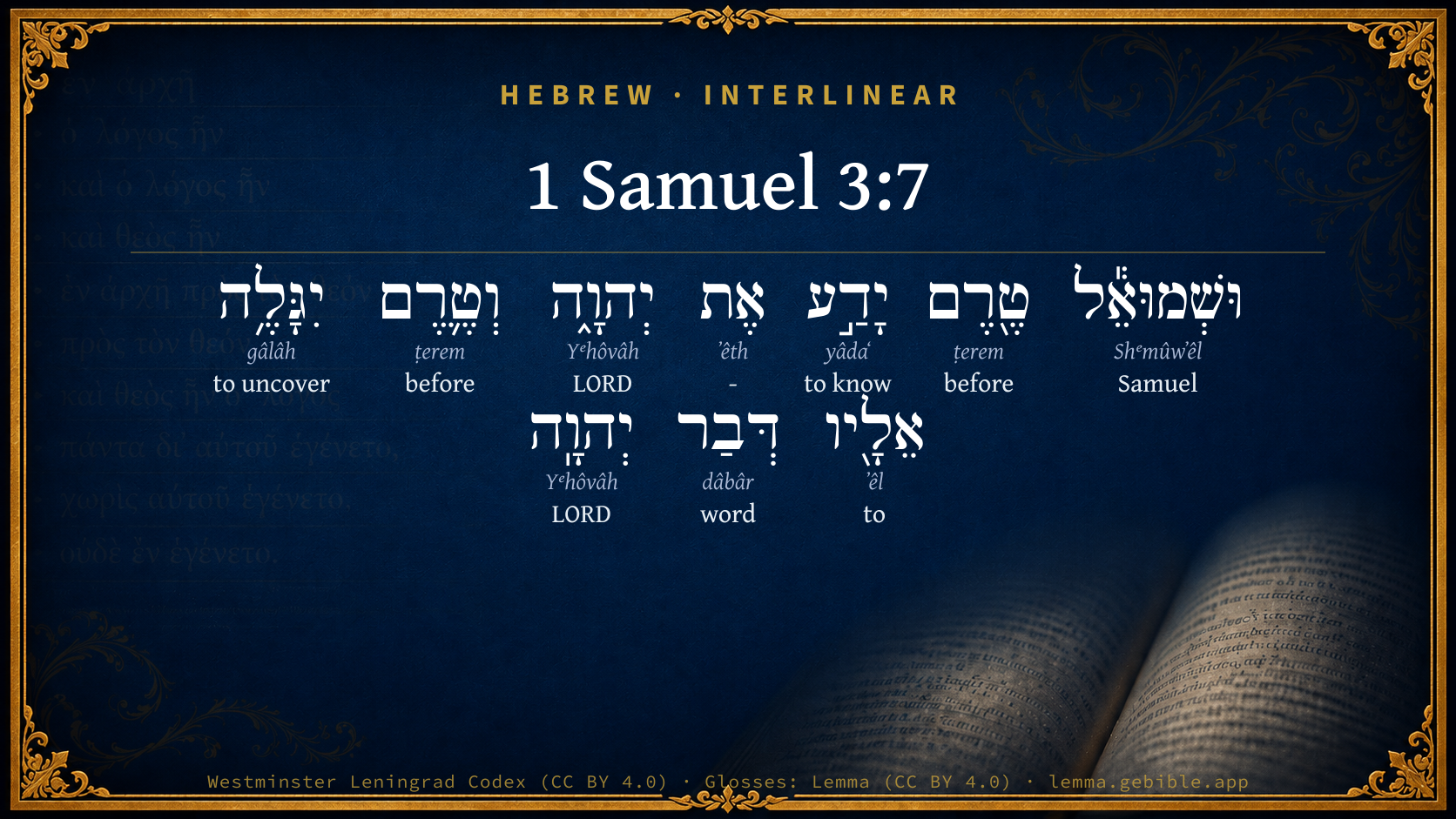
1 Samuel 3:7

Hebrew (Westminster Leningrad Codex) 1 Samuel 3:7 appears in the Hebrew Old Testament. The text above is from the Westminster Leningrad Codex. Each word links to its Strong’s number, a concise gloss, and parsing drawn from the Open Scriptures Hebrew Bible morphology. Click any word for its full Brown-Driver-Briggs (BDB) entry.
Download image
Cite this verse

1 Samuel 3:7 (World English Bible). Public Domain. Lemma interlinear Bible study tool, https://lemma.gebible.app/v/1-samuel/3/7.

Show BibTeX & RIS
BibTeX
RIS
English Translation
Now Samuel didn't yet know Yahweh, neither was the word of Yahweh yet revealed to him.
World English Bible · Public Domain
Download a study sheet

One document with this verse’s original text, its word-by-word gloss line, the meaning frame, cross-references with their text, attributed commentary, and full source and license credits — printable, and it pastes into notes with its structure intact.

This verse Autodidact and up

Study sheet (.html) Plain text (.txt)

A passage Seminary Student

Up to 50 verses in one chapter. A passage sheet keeps up to 6 commentary sources and 12 cross-references per verse, in the order this page ranks them, and says so on the sheet whenever that leaves anything out. Ask for a single verse and you get the Autodidact verse sheet above.

Everything on this page stays free to read, with no account — the sheet is a download of what is already on screen, not access to it.

Want to remove ads? Support Godless Engineer
Compare translations 3

The same verse in 3 English versions, stacked beneath the original-language interlinear above. Click any original word for its lexicon entry.

Each is an independent rendering of the whole verse — the interlinear is not word-aligned to these translations.

Highlighted words mark where these versions differ — a whole-verse word diff, not a word-by-word alignment.

  • World English Bible Public Domain
    Now Samuel didn't yet know Yahweh, neither was the word of Yahweh yet revealed to him.
  • King James Version Public Domain
    Now Samuel did not yet know the LORD, neither was the word of the LORD yet revealed unto him.
  • unfoldingWord Literal Text CC BY-SA 4.0
    (Now Samuel did not yet know Yahweh, for the word of Yahweh had not yet been revealed to him.)

unfoldingWord Literal Text — © unfoldingWord, licensed CC BY-SA 4.0. Word-aligned USFM3 via Door43 (git.door43.org/unfoldingWord/en_ult).

Versions to compare (up to 4)

3 of 4 selected

Show all 18 translations

Every available English version of this verse, each an independent rendering of the whole verse.

  • World English Bible Public Domain
    Now Samuel didn't yet know Yahweh, neither was the word of Yahweh yet revealed to him.
  • Berean Standard Bible Public Domain
    Now Samuel did not yet know the LORD, because the word of the LORD had not yet been revealed to him.
  • Majority Standard Bible Public Domain
    Now Samuel did not yet know the LORD, because the word of the LORD had not yet been revealed to him.
  • King James Version Public Domain
    Now Samuel did not yet know the LORD, neither was the word of the LORD yet revealed unto him.
  • American Standard Version (1901) Public Domain
    Now Samuel did not yet know Jehovah, neither was the word of Jehovah yet revealed unto him.
  • Revised Version (1885) Public Domain
    Now Samuel did not yet know the LORD, neither was the word of the LORD yet revealed unto him.
  • Geneva Bible (1599) Public Domain
    Thus did Samuel, before hee knewe the Lord, and before the word of the Lord was reueiled vnto him.
  • Douay-Rheims (1899) Public Domain
    Now Samuel did not yet know the Lord, neither had the word of the Lord been revealed to him.
  • Young's Literal Translation Public Domain
    And Samuel hath not yet known Jehovah, and the word of Jehovah is not yet revealed unto him.
  • Literal Standard Version CC BY-SA 4.0
    And Samuel has not yet known YHWH, and the word of YHWH is not yet revealed to him.
  • Unlocked Literal Bible CC BY-SA 4.0
    Now Samuel did not yet have any experience of Yahweh, nor had any message from Yahweh ever been revealed to him.
  • unfoldingWord Literal Text CC BY-SA 4.0
    (Now Samuel did not yet know Yahweh, for the word of Yahweh had not yet been revealed to him.)
  • Darby Bible Public Domain
    Now Samuel did not yet know Jehovah, neither had the word of Jehovah yet been revealed to him.
  • World Messianic Bible Public Domain
    Now Samuel didn’t yet know the LORD, neither was the LORD’s word yet revealed to him.
  • Webster's Bible Public Domain
    Now Samuel did not yet know the LORD, neither was the word of the LORD yet revealed to him.
  • Free Bible Version CC BY-SA 4.0
    (Samuel hadn't yet come to know the Lord and had not received any message from him.)
  • Bible in Basic English Public Domain
    Now at that time Samuel had no knowledge of the Lord, and the revelation of the word of the Lord had not come to him.
  • JPS Tanakh (1917) Public Domain
    Now Samuel did not yet know the LORD, neither was the word of the LORD yet revealed unto him.

Literal Standard Version (2020), Covenant Press — licensed CC BY-SA 4.0. Text via the HelloAO Bible API (eBible.org). Unlocked Literal Bible (unfoldingWord) — licensed CC BY-SA 4.0. Text via the HelloAO Bible API (eBible.org). unfoldingWord Literal Text — © unfoldingWord, licensed CC BY-SA 4.0. Word-aligned USFM3 via Door43 (git.door43.org/unfoldingWord/en_ult). Free Bible Version, Dr. Jonathan Gallagher — licensed CC BY-SA 4.0. Text via the HelloAO Bible API (eBible.org).

Word by word

More ways to search: Search by grammar → Find every occurrence → Compare this word →

Practice this passage: Drill this verse → Learn its vocabulary →

About this verse

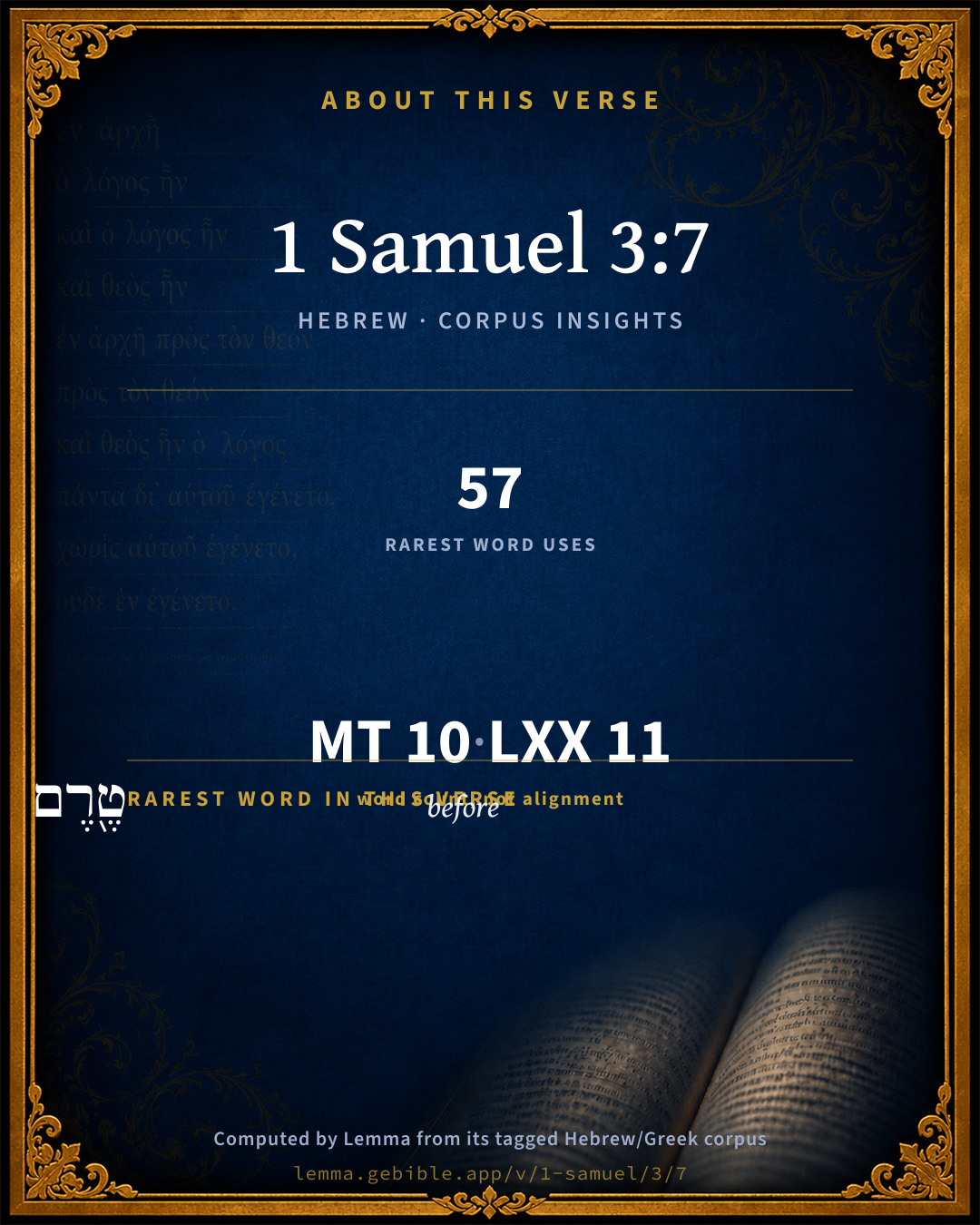
These counts appear in no published source. They are computed here, from the morphology-tagged text and Lemma’s own curated glosses. What Lemma adds →

10
words
8
distinct lemmas
Historical
section

Shared distinctive vocabulary

טֶ֖רֶם before H2962 occurs in 50 verses of the Hebrew Bible. Also found in:

Grammatical profile

  • 2 verbs
  • 4 nouns
  • 1 preposition
  • 2 adverbs
  • 1 particle

Verb forms

  • יָדַ֣ע Qal · Perfect
  • יִגָּלֶ֥ה Niphal · Imperfect

Repetition

Words recur within this verse — often emphatic in Hebrew:

  • טֶ֖רֶם before H2962 ×2
  • יְהוָ֑ה LORD H3068 ×2

Hebrew & Septuagint length

In English translation the verse runs 16 words from the Hebrew and 19 from the Septuagint (LXX English) — closely comparable.

A rough comparison of the two English renderings, which tokenize alike — not a word-level alignment.

Word counts can differ between the Hebrew and the Greek without any difference in meaning — e.g. the Hebrew direct-object marker אֵת has no separate Greek word, and Greek often adds the article ὁ.

In the original languages it is 10 Hebrew tokens and 11 Greek tokens — but the two are counted differently (Hebrew bundles its prefixes and suffixes into one token; the Greek is in lemma form), so that isn’t a like-for-like length.

Cross-references

2

Topical passages linked to 1 Samuel 3:7 in the Treasury of Scripture Knowledge — connected by theme and wording, ordered by reader-vote popularity; previews shown in the World English Bible.

  • Acts 19:2 He said to them, "Did you receive the Holy Spirit when you believed?" They said to him, "No, we haven't even heard that there is a Holy Spirit."
  • Jeremiah 9:24 but let him who glories glory in this, that he has understanding, and knows me, that I am Yahweh who exercises loving kindness, justice, and righteousness, in the earth: for in these things I delight, says Yahweh.

Cross-references courtesy of OpenBible.info (CC BY 4.0).

Hebrew and Greek witnesses Masoretic Hebrew ↔ Greek Septuagint

The same verse in the two great witnesses to the Old Testament, shown verse-for-verse.

These are two independent witnesses, not word-aligned to each other, and the Septuagint is shown in lemma (dictionary) form.

Hebrew 1 Samuel 3:7 Masoretic · Westminster Leningrad Codex

וּשְׁמוּאֵ֕ל טֶ֖רֶם יָדַ֣ע אֶת יְהוָ֑ה וְטֶ֛רֶם יִגָּלֶ֥ה אֵלָ֖יו דְּבַר יְהוָֽה

Now Samuel didn't yet know Yahweh, neither was the word of Yahweh yet revealed to him.

World English Bible · Public Domain

Greek LXX 1 Samuel 3:7 Septuagint · lemma form

καί σαμουηλ πρίν ἤ γιγνώσκω θεός καί ἀποκαλύπτω αὐτός ῥῆμα κύριος

And it was before Samuel knew the Lord, and before the word of the Lord was revealed to him.

LXX2012 (modern English Septuagint) · Public Domain

Hebrew: Westminster Leningrad Codex (CC BY 4.0). Greek: Septuagint (public domain); English from LXX2012 (modern English Septuagint) (Public Domain). How the Septuagint differs from the Hebrew →

Targum (Aramaic paraphrase)

1

The Targum is the ancient Jewish Aramaic paraphrase of the Hebrew Scriptures — an interpretive translation, not the Hebrew text itself. Onkelos (literal) and Pseudo-Jonathan (expansive) render the Torah, and Jonathan the Prophets. Coverage is partial: where no permissively-licensed English translation exists for a verse, only the Aramaic is shown. This is verse-level text, not a word-by-word alignment to the Hebrew.

  1. Targum Jonathan Prophets (Joshua–Malachi)
    וּשְׁמוּאֵל עַד לָא אֲלַף לְמִידַע אוּלְפַן מִן קֳדָם יְיָ וְעַד דְלָא אִתְגְלֵי לֵיהּ פִתְגַם נְבוּאָה דַיְיָ:

    (no public-domain English translation for this verse)

    Targum Jonathan — Aramaic: “Mikraot Gedolot” (public domain). English: “Sefaria Community Translation” (CC0 1.0 (public-domain dedication)); “London "Chaldee Paraphrase," 1871” (public domain). Text via Sefaria.

Commentary

Notes on 1 Samuel 3:7 from classic Christian and Jewish commentators (each source and its license shown beneath its notes). The classic Christian expositions comment on the surrounding passage and are grouped to its opening verse, so a note may address several verses; the Jewish commentaries on the Tanakh (Rashi and others) are per-verse, so they appear only where the commentator wrote on this verse.

Lemma curates 59 commentaries, every one of them public domain or Creative Commons licensed, each selected and text-cleaned for this edition rather than reprinted as found. About our sources →

Trapp's Complete Commentary

John Trapp

1Sa 3:7 Now Samuel did not yet know the LORD, neither was the word of the LORD yet revealed unto him.

Ver. 7. Now Samuel did not yet know the Lord,] i.e., He knew him not in that way peculiar to prophets: for otherwise he knew the Lord a far deal better than Eli’s two sons did, {1Sa 2:12} and yet he and they had all one tutor. But he hath his chair in heaven who teacheth the heart, saith a father.

John Trapp, A Commentary or Exposition upon All the Books of the Old and New Testament (1647–1656) — public domain. Text from a community e-Sword module.

The Biblical Illustrator

Joseph S. Exell

1Sa_3:7

Now Samuel did not yet know the Lord, neither was the word of the Lord yet revealed unto him.

Early religious impressions

A study of this story will show parents and teachers much which ought to be supremely helpful in their dealings with those young persons who come under their care.

I. There is, first, the period of conscientious routine. For a while every child born of Christian parents, and trained as Samuel was, will follow the traditions his father and mother have passed on down to him in course of education. What is it possible for any child now to do, as a follower of the Lord Jesus Christ, under the family rule? Young people can be taught to pray, to take the care of some practical schemes of usefulness, to study the Word of God diligently, to contribute money to religious causes, to become interested in the poor, to speak words of counsel and encouragement and warning to such as need direction or assistance. The grand old moralities are always within their reach; fidelities at school, courtesies to the aged consideration for the weak, keeping the Sabbath, aiding in household cares, and full obedience to all Gods commands. How far is this truly religious? Children differ extremely. Some of them become spiritual Christians quite early; some never know the date of any experience that might be considered regeneration; some are alert, imaginative, poetic, sensitive; others are slow, heavy, and run to rigid moralities with supreme delight and conscientious satisfaction. It is always right to do right, and God loves a virtuous, correct life. Of this we can be comfortably certain. As to the spiritual condition of Samuel at this period of his career, there is found one verse in the record which has given some trouble: Now Samuel did not yet know the Lord, neither was the word of the Lord yet revealed unto him. Evidently there passed a vivid and permanent change over this boys heart and history in that nights experience: God called him.

II. Awakened restlessness in children. There is a period in the history of almost every one who, reared in a Christian land, has been more or less directly under the pressure of the truth, in which he really faces the great question of his relation to God. And the effort is often an earnest one and is directed towards a positive decision concerning a religious life. This period you may recognise in yourself, or detect in others, almost always by certain unmistakable signs. There will be outward manifestations of solicitude which will show how seriously the soul contemplates its own experience. Skill, however, and especially patience, will be needed to understand these revelations of inward struggle. They often partake of the nature of strategy, and press their advance in the line of a precise contradiction. Then they will have to be read, like Hebrew syllables, from right to left. Every individual of us, in these communities lit with truth, comes one day to see that his path to heaven is unlike that of any other person, and henceforth he must journey on alone. That thought is revolutionary. But the thing to be remembered is this: And Eli perceived that the Lord had called the child. Men and women may forget this, and grow as sorrowfully amazed as was Mary when she rebuked Jesus for not paying more attention to her feelings. They ought to recollect those calm words: Wist ye not that I must be about my Fathers business? (C. S. Robinson, D. D.)

The Biblical Illustrator, edited by Joseph S. Exell (c. 1880s–1900s) — public domain. Text from a community e-Sword module.

Joseph Benson's Commentary

1Sa 3:7. Samuel did not yet know the Lord — How God was wont to teach and instruct men in his will. Neither was the word of the Lord yet revealed to him — He was not acquainted with the way wherein God made himself and his mind known unto the prophets, because he had never spoken to him before. So that he did not know how to distinguish between the voice of God and that of men. And this ignorance of Samuel served God’s design, as it gave Eli the fuller assurance of the truth of God’s call and message to Samuel.

Joseph Benson's Commentary on the Old and New Testaments (1811–1818) — public domain. Text from a community e-Sword module.

Tyndale Open Study Notes

Tyndale Open Resources

3:7 Samuel did not yet know the Lord: He lacked direct experience of the Lord. In contrast, Eli’s sons did not know the Lord (see study note on 2:12) in that they were morally and spiritually deficient.

Tyndale Open Study Notes — © Tyndale Open Resources, licensed CC BY-SA 4.0. Text via the HelloAO Bible API.

Geneva Bible (1599)

Geneva Bible translators

By vision.

Geneva Bible (1599) marginal notes — public domain. Text via Bolls.life.

Adam Clarke's Commentary

Verse 7. Samuel did not yet know the Lord] He had not been accustomed to receive any revelation from him. He knew and worshipped the God of Israel; but he did not know him as communicating especial revelation of His will.

Adam Clarke's Commentary on the Bible (1810–1826) — public domain. Text from a community e-Sword/MySword module.

The Cambridge Bible for Schools and Colleges

gen. ed. J. J. S. Perowne

7. Now Samuel, &c.] This verse explains why Samuel failed to recognise the Voice. ‘Knowing the Lord’ here denotes not the general religious knowledge of a pious Israelite, but the special knowledge communicated by a personal revelation. The phrase is used in a different sense in 1Sa_2:12.

The Cambridge Bible for Schools and Colleges (gen. ed. J. J. S. Perowne; Cambridge University Press, 1878–1918) — public domain. Text from a community e-Sword module.

John Gill's Exposition

Now Samuel did not yet know the Lord,.... He knew that Jehovah, the God of Israel, was the true God; he had spiritual knowledge of him, and knew somewhat of his word and worship, ways and ordinances, in which he had been instructed by Eli; wherefore, though the Targum is,"Samuel had not yet learned to know doctrine from the Lord;''it can only be understood, that he had not learnt it perfectly; somewhat he knew of it, but in an imperfect manner, being a child: but the sense of the word is, that as yet he was ignorant that God had used to speak with ordinary and familiar voice to men, as Maimonides says (s); he perhaps had never heard of any such thing, and much less was experimentally acquainted with it, that God ever did speak after such a manner to men, and could not distinguish between the voice of God and the voice of Eli:

neither was the word of the Lord yet revealed unto him; what of the written word that was in being he had, and read, as the law of Moses; but the meaning is, that no word of prophecy of the Lord was revealed unto him, as the Targum; he never had prophesied as yet, and knew not the form and manner of prophecy, as the above writer observes, or what methods God took to reveal himself, his mind and will, to men, at least not this by an audible voice.

(s) Moreh Nevochim, par. 2. c. 44.

John Gill's Exposition of the Whole Bible (1746–1763) — public domain (CC PDM 1.0). Text via the HelloAO Bible API.

Albert Barnes' Notes on the Bible

Did not yet know the Lord - i. e. in His supernatural communication, as follows at the end of the verse. The text rendering of this verse is better than that of the margin.

Albert Barnes' Notes on the Bible (1834–1885) — public domain. Text from a community e-Sword/MySword module.

Haydock's Catholic Bible Commentary

Him. He had not before an experimental knowledge of the manner in which God revealed his will to men. (Calmet)

George Leo Haydock (1774–1849), Haydock's Catholic Family Bible and Commentary, 1859 edition — public domain. Excludes Psalms (Douay-Rheims chapter numbering differs from Protestant) and Deuterocanonical books (Catholic canon only).

Matthew Poole's English Annotations

Either, first, He was not acquainted with God in that extraordinary or prophetical way. Or rather, secondly, He did not yet understand, any more than before, that it was not Eli, but God, who spake to him. And this ignorance of Samuel’s served God’s design, that his simplicity might give Eli the better assurance of the truth of God’s call and message to Samuel.

Matthew Poole's English Annotations on the Holy Bible (1683–1685) — public domain. Text from a community e-Sword/MySword module.

Whedon's Commentary on the Bible

Daniel D. Whedon

7. Samuel did not yet know the Lord — The first part of this verse is explained by the second. Samuel knew not the Lord in the way of receiving divine communications from him, for, as already stated, such communications were at that time rare.

Daniel D. Whedon (gen. ed.), Commentary on the Old and New Testaments (1874–1909) — public domain. Text from a community e-Sword module.

The Pulpit Commentary

But Eli was neither so inexperienced, nor so lost to all sense of Jehovah being the immediate ruler of Israel, as not to perceive, when Samuel came to him the third time, that the matter was Divine. Possibly he recalled to mind the visit of the man of God, and had some presage of what the message might be. At all events he bade Samuel lie calmly down again, because the best preparation for hearing God"s voice is obedience and trustful submission.

The Pulpit Commentary (1880–1919), ed. H.D.M. Spence-Jones & Joseph S. Exell — public domain. Text from a community e-Sword module.

John Wesley's Explanatory Notes

Did not know - He was not acquainted with God in that extraordinary or prophetical way. And this ignorance of Samuel's served God's design, that his simplicity might give Eli the better assurance of the truth of God's call, and message to Samuel.

John Wesley, Explanatory Notes Upon the Whole Bible (1754–1765) — public domain. Text via the GEBible commentary corpus.

unfoldingWord translationNotes

Door43 World Missions Community

nor had any message from Yahweh ever been revealed to him

This can be stated in active form. AT: "nor had Yahweh ever revealed any message to him" or "and Yahweh had never revealed any message to him" (See: Active or Passive)

translationWords

reveal

unfoldingWord translationNotes — © Distant Shores Media and the Door43 World Missions Community, licensed CC BY-SA 4.0. Source: git.door43.org/Door43/en_tn.

Rashi

Rabbi Shlomo Yitzchaki (Rashi)

[Shmuel] had not yet known Adonoy. He had not yet recognized the nature of the prophetic voice. Every time the word 'טֶרֶם' appears in Scripture, it means 'not yet,' as rendered by the Targum 'עַד לָא' [not yet]. It does not mean 'before.' This verse proves it. And another [proof of this] is the verse כִּי טֶרֶם תִּירְאוּן which is rendered as "that you do not yet fear," is a more explicit verse proving this. Also, וְכֹל שִֹיחַ הַשָֹּדֶה טֶרֶם יִהְיֶה בָאָרֶץ ["all plants of the field were not yet on the earth"].

Rashi on the Tanakh — English translations: “The Judaica Press complete Tanach with Rashi, translated by A. J. Rosenberg” (CC BY 4.0); “Pentateuch with Rashi's commentary by M. Rosenbaum and A.M. Silbermann, 1929-1934” (public domain); “The Metsudah Tanach series, Lakewood, N.J” (CC BY 4.0); and “The Book of Joshua, Metsudah Publications, 1997” (CC BY 4.0). Text via Sefaria.

Lesson kit

Teaching starters — assembled from the data on this page, not authored interpretation. Every prompt links to the verse data it draws on. Edit before teaching.

1 Samuel, in the Historical, opens this verse with 10 words (8 distinct Hebrew lemmas). Its most distinctive word is ṭerem (“before”). A historical commentator’s framing appears above. Read the whole chapter for the surrounding context.

Discussion questions

  1. What does “before” (ṭerem) contribute to the verse as a whole?
  2. Genesis 2:5 shares the word «before» with this verse. How do the two illuminate each other?
  3. “before” occurs 2× in this one verse. What is the effect of the repetition?
  4. The translations on this page render this verse differently — a whole-verse word diff, not a word-by-word alignment. What might account for the different wordings?
  5. The verb «יָדַ֣ע» is Qal Perfect. How does its form color the action?
  6. Reading how Trapp's Complete Commentary and The Biblical Illustrator read this verse, where do the two commentators agree and where do they part?

Things to notice

Reading settings

Reading text

Shown beneath each verse's original-language words.

Old Testament
Old Testament edition

Read the OT as the Masoretic Hebrew (MT) or the Greek Septuagint (LXX).

English shown for the Greek Septuagint (in the Hebrew ↔ Greek comparison).

Comparing translations? Open the Compare panel on any verse page to stack up to four side by side.