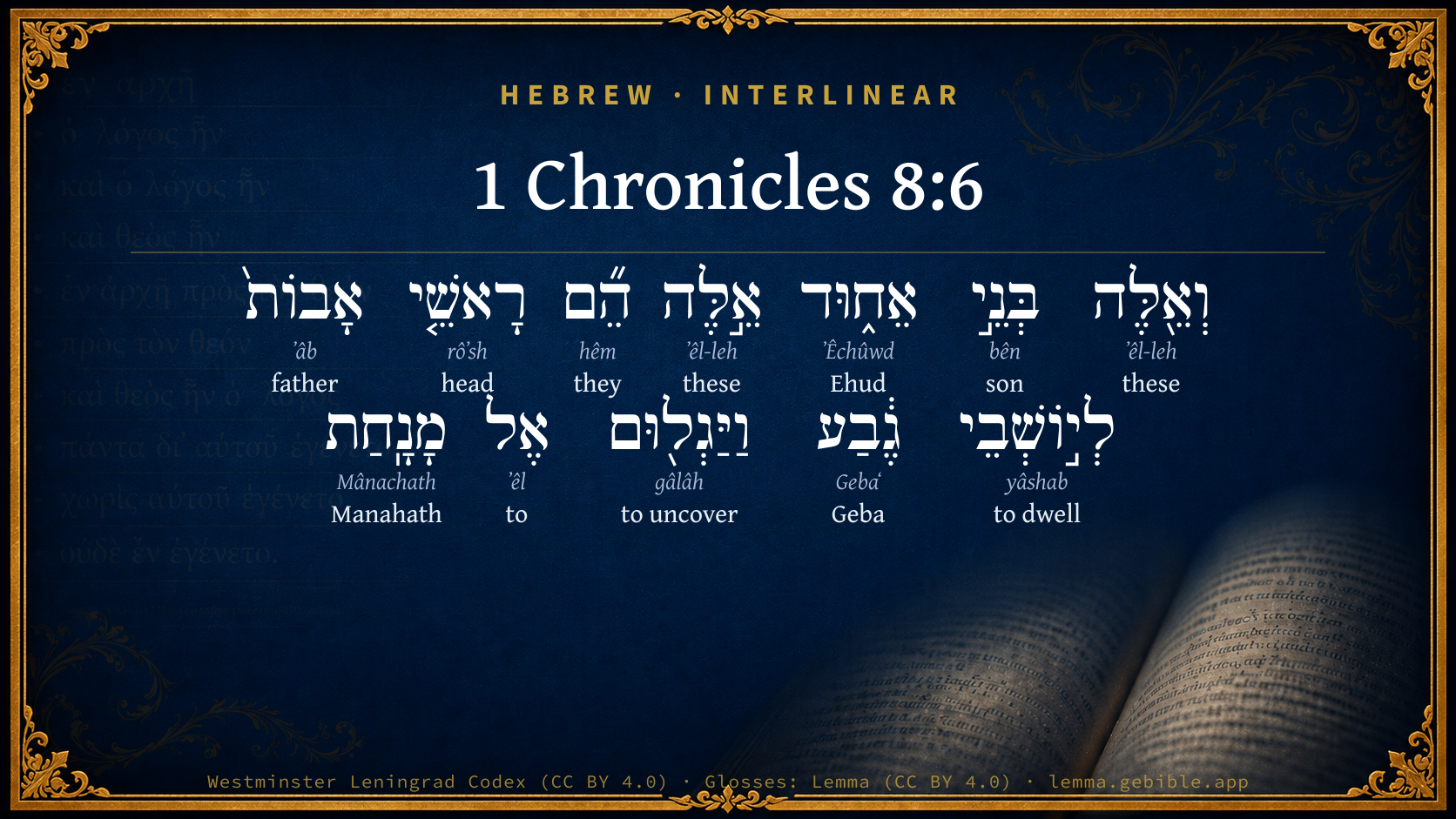
1 Chronicles 8:6

Hebrew (Westminster Leningrad Codex) 1 Chronicles 8:6 appears in the Hebrew Old Testament. The text above is from the Westminster Leningrad Codex. Each word links to its Strong’s number, a concise gloss, and parsing drawn from the Open Scriptures Hebrew Bible morphology. Click any word for its full Brown-Driver-Briggs (BDB) entry.
Download image
Cite this verse

1 Chronicles 8:6 (World English Bible). Public Domain. Lemma interlinear Bible study tool, https://lemma.gebible.app/v/1-chronicles/8/6.

Show BibTeX & RIS
BibTeX
RIS
English Translation
These are the sons of Ehud: these are the heads of fathers' [houses] of the inhabitants of Geba, and they carried them captive to Manahath:
World English Bible · Public Domain
Highlights
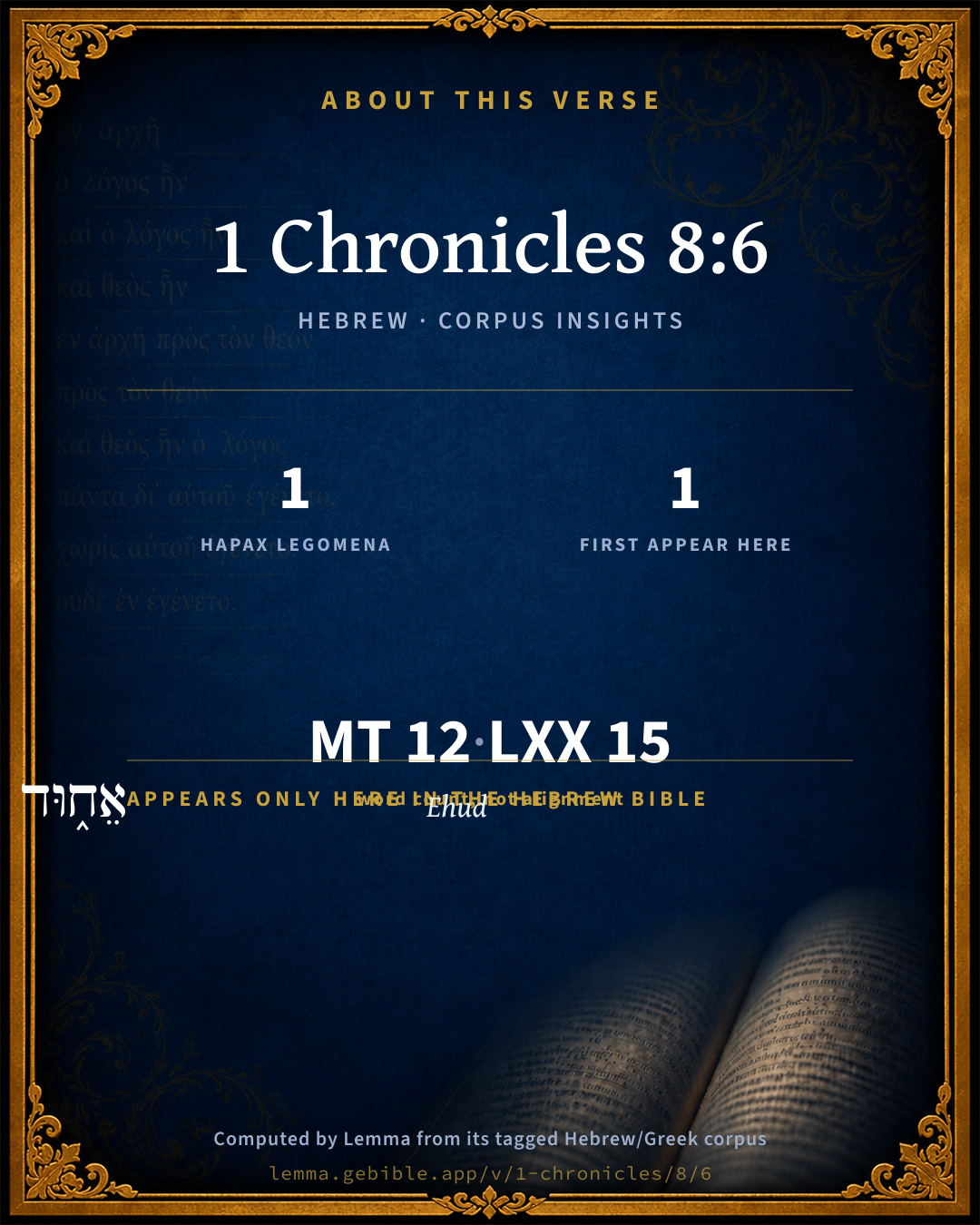
  • 1 hapax legomenon — only here in the Hebrew Bible
  • 1 first appearance in the Hebrew Bible
Full analysis ↓
Download a study sheet

One document with this verse’s original text, its word-by-word gloss line, the meaning frame, cross-references with their text, attributed commentary, and full source and license credits — printable, and it pastes into notes with its structure intact.

This verse Autodidact and up

Study sheet (.html) Plain text (.txt)

A passage Seminary Student

Up to 50 verses in one chapter. A passage sheet keeps up to 6 commentary sources and 12 cross-references per verse, in the order this page ranks them, and says so on the sheet whenever that leaves anything out. Ask for a single verse and you get the Autodidact verse sheet above.

Everything on this page stays free to read, with no account — the sheet is a download of what is already on screen, not access to it.

Want to remove ads? Support Godless Engineer
Compare translations 3

The same verse in 3 English versions, stacked beneath the original-language interlinear above. Click any original word for its lexicon entry.

Each is an independent rendering of the whole verse — the interlinear is not word-aligned to these translations.

Highlighted words mark where these versions differ — a whole-verse word diff, not a word-by-word alignment.

  • World English Bible Public Domain
    These are the sons of Ehud: these are the heads of fathers' [houses] of the inhabitants of Geba, and they carried them captive to Manahath:
  • King James Version Public Domain
    And these are the sons of Ehud: these are the heads of the fathers of the inhabitants of Geba, and they removed them to Manahath:
  • unfoldingWord Literal Text CC BY-SA 4.0
    And these the sons of Ehud—these, they heads of fathers among the dwellers of Geba, but they exiled them to Manahath:

unfoldingWord Literal Text — © unfoldingWord, licensed CC BY-SA 4.0. Word-aligned USFM3 via Door43 (git.door43.org/unfoldingWord/en_ult).

Versions to compare (up to 4)

3 of 4 selected

Show all 18 translations

Every available English version of this verse, each an independent rendering of the whole verse.

  • World English Bible Public Domain
    These are the sons of Ehud: these are the heads of fathers' [houses] of the inhabitants of Geba, and they carried them captive to Manahath:
  • Berean Standard Bible Public Domain
    These were the descendants of Ehud who were the heads of the families living in Geba and were exiled to Manahath:
  • Majority Standard Bible Public Domain
    These were the descendants of Ehud who were the heads of the families living in Geba and were exiled to Manahath:
  • King James Version Public Domain
    And these are the sons of Ehud: these are the heads of the fathers of the inhabitants of Geba, and they removed them to Manahath:
  • American Standard Version (1901) Public Domain
    And these are the sons of Ehud: these are the heads of fathers' `houses' of the inhabitants of Geba, and they carried them captive to Manahath:
  • Revised Version (1885) Public Domain
    And these are the sons of Ehud: these are the heads of fathers’ houses of the inhabitants of Geba, and they carried them captive to Manahath:
  • Geneva Bible (1599) Public Domain
    And these are the sonnes of Ehud: these were the chiefe fathers of those that inhabited Geba: and they were caryed away captiues to Monahath,
  • Douay-Rheims (1899) Public Domain
    These are the sons of Ahod, heads of families that dwelt in Gabaa, who were removed into Mrtnahsth.
  • Young's Literal Translation Public Domain
    And these `are' sons of Ehud: they are heads of fathers to the inhabitants of Geba, and they remove them unto Manahath;
  • Literal Standard Version CC BY-SA 4.0
    And these [are] sons of Ehud—they are heads of fathers to the inhabitants of Geba, and they remove them to Manahath:
  • Unlocked Literal Bible CC BY-SA 4.0
    These were the descendants of Ehud who were heads of fathers' houses for the inhabitants of Geba, who were compelled to move to Manahath:
  • unfoldingWord Literal Text CC BY-SA 4.0
    And these the sons of Ehud—these, they heads of fathers among the dwellers of Geba, but they exiled them to Manahath:
  • Darby Bible Public Domain
    -- And these are the sons of Ehud (these were the chief fathers of the inhabitants of Geba; and they carried them away to Manahath;
  • World Messianic Bible Public Domain
    These are the sons of Ehud. These are the heads of fathers’ households of the inhabitants of Geba, who were carried captive to Manahath:
  • Webster's Bible Public Domain
    And these are the sons of Ehud: these are the heads of the fathers of the inhabitants of Geba, and they removed them to Manahath:
  • Free Bible Version CC BY-SA 4.0
    These were the sons of Ehud, family heads living in Geba, and were exiled to Manahath:
  • Bible in Basic English Public Domain
    And these are the sons of Ehud, heads of families of those living in Geba: Iglaam and Alemeth
  • JPS Tanakh (1917) Public Domain
    And these are the sons of Ehud — these are the heads of fathers' houses of the inhabitants of Geba, and they were carried captive to Manahath;

Literal Standard Version (2020), Covenant Press — licensed CC BY-SA 4.0. Text via the HelloAO Bible API (eBible.org). Unlocked Literal Bible (unfoldingWord) — licensed CC BY-SA 4.0. Text via the HelloAO Bible API (eBible.org). unfoldingWord Literal Text — © unfoldingWord, licensed CC BY-SA 4.0. Word-aligned USFM3 via Door43 (git.door43.org/unfoldingWord/en_ult). Free Bible Version, Dr. Jonathan Gallagher — licensed CC BY-SA 4.0. Text via the HelloAO Bible API (eBible.org).

Word by word

More ways to search: Search by grammar → Find every occurrence → Compare this word →

Practice this passage: Drill this verse → Learn its vocabulary →

About this verse

These counts appear in no published source. They are computed here, from the morphology-tagged text and Lemma’s own curated glosses. What Lemma adds →

12
words
11
distinct lemmas
Historical
section

Notable vocabulary

1 hapax legomenon — a word that appears only here in the entire Hebrew Bible:

  • אֵח֑וּד Ehud H261

First appearance in Scripture

This word makes its first canonical appearance in the Hebrew Bible here:

  • אֵח֑וּד Ehud H261

Shared distinctive vocabulary

מָנָֽחַת Manahath H4506 occurs in 3 verses of the Hebrew Bible. Also found in:

Grammatical profile

  • 2 verbs
  • 6 nouns
  • 3 pronouns
  • 1 preposition

Verb forms

  • לְי֣וֹשְׁבֵי Qal · Participle Active
  • וַיַּגְל֖וּם Hiphil · Sequential Imperfect

Repetition

A word recurs within this verse — often emphatic in Hebrew:

  • וְאֵ֖לֶּה these H428 ×2

Hebrew & Septuagint length

In English translation the verse runs 25 words from the Hebrew and 24 from the Septuagint (LXX English) — closely comparable.

A rough comparison of the two English renderings, which tokenize alike — not a word-level alignment.

Word counts can differ between the Hebrew and the Greek without any difference in meaning — e.g. the Hebrew direct-object marker אֵת has no separate Greek word, and Greek often adds the article ὁ.

In the original languages it is 12 Hebrew tokens and 15 Greek tokens — but the two are counted differently (Hebrew bundles its prefixes and suffixes into one token; the Greek is in lemma form), so that isn’t a like-for-like length.

Cross-references

8

Topical passages linked to 1 Chronicles 8:6 in the Treasury of Scripture Knowledge — connected by theme and wording, ordered by reader-vote popularity; previews shown in the World English Bible.

  • Judges 3:20–30 Ehud came to him; and he was sitting by himself alone in the cool upper room. Ehud said, I have a message from God to you. He arose out of his seat.
  • 1 Chronicles 2:54 The sons of Salma: Bethlehem, and the Netophathites, Atroth Beth Joab, and half of the Manahathites, the Zorites.
  • Genesis 46:21 The sons of Benjamin: Bela, Becher, Ashbel, Gera, Naaman, Ehi, Rosh, Muppim, Huppim, and Ard.
  • Judges 4:1 The children of Israel again did that which was evil in the sight of Yahweh, when Ehud was dead.
  • 1 Chronicles 2:25 The sons of Jerahmeel the firstborn of Hezron were Ram the firstborn, and Bunah, and Oren, and Ozem, Ahijah.
  • 1 Chronicles 2:52 Shobal the father of Kiriath Jearim had sons: Haroeh, half of the Menuhoth.
  • 1 Chronicles 6:60 and out of the tribe of Benjamin, Geba with its suburbs, and Allemeth with its suburbs, and Anathoth with its suburbs. All their cities throughout their families were thirteen cities.
  • 1 Chronicles 7:10 The sons of Jediael: Bilhan. The sons of Bilhan: Jeush, and Benjamin, and Ehud, and Chenaanah, and Zethan, and Tarshish, and Ahishahar.

Cross-references courtesy of OpenBible.info (CC BY 4.0).

Hebrew and Greek witnesses Masoretic Hebrew ↔ Greek Septuagint

The same verse in the two great witnesses to the Old Testament, shown verse-for-verse.

These are two independent witnesses, not word-aligned to each other, and the Septuagint is shown in lemma (dictionary) form.

Hebrew 1 Chronicles 8:6 Masoretic · Westminster Leningrad Codex

וְאֵ֖לֶּה בְּנֵ֣י אֵח֑וּד אֵ֣לֶּה הֵ֞ם רָאשֵׁ֤י אָבוֹת֙ לְי֣וֹשְׁבֵי גֶ֔בַע וַיַּגְל֖וּם אֶל מָנָֽחַת

These are the sons of Ehud: these are the heads of fathers' [houses] of the inhabitants of Geba, and they carried them captive to Manahath:

World English Bible · Public Domain

Greek LXX 1 Chronicles 8:6 Septuagint · lemma form

οὗτος υἱός αωδ οὗτος εἰμί ἄρχων πατριά ὁ καταοἰκέω γαβεε καί μεταοἰκίζω αὐτός εἰς μαναχαθι

These were the sons of Aod: these are the heads of families to them that dwell in Gabee, and they removed them to Machanathi:

LXX2012 (modern English Septuagint) · Public Domain

Hebrew: Westminster Leningrad Codex (CC BY 4.0). Greek: Septuagint (public domain); English from LXX2012 (modern English Septuagint) (Public Domain). How the Septuagint differs from the Hebrew →

Commentary

Notes on 1 Chronicles 8:6 from classic Christian and Jewish commentators (each source and its license shown beneath its notes). The classic Christian expositions comment on the surrounding passage and are grouped to its opening verse, so a note may address several verses; the Jewish commentaries on the Tanakh (Rashi and others) are per-verse, so they appear only where the commentator wrote on this verse.

Lemma curates 59 commentaries, every one of them public domain or Creative Commons licensed, each selected and text-cleaned for this edition rather than reprinted as found. About our sources →

Ellicott's Commentary for English Readers

(6) And these are the sons of Ehud.—The Authorised Version makes no distinction between this Ehud and Ehud son of Gera, the famous Benjamite judge (Jdg_3:15). The difference in the Heb. is so slight, that perhaps we may assume an original identity of the two names. In that case we get a link between the sons of Ehud and the house of Gera, 1Ch_8:5. Others identify the present Ehud with the Abihud of 1Ch_8:3, which is possibly correct: (Comp. Nadab-Abinadab, Dan and Abidan, Num_1:11.)

These are the heads of the fathers.—Heads of father-houses, i.e., of groups of kindred families or clans. The Hebrew text of the rest of this verse, and 1Ch_8:7-8, is unusually obscure, partly owing to the construction, but chiefly because of the historical allusions which are no longer explicable with any certainty. Most interpreters assume a parenthesis after the words “and these are the sons of Ehud,” extending to the words “he removed them,” in 1Ch_8:7.

Uzza and Ahihud are then “the sons of Ehud” referred to in 1Ch_8:6.

Removed them.—Rather, carried them captive, or transported them. The same expression denotes the Babylonian exile or transportation, and was used in 1Ch_5:26 of the Assyrian removal of the trans-jordanic tribes.

A Bible Commentary for English Readers, edited by Charles John Ellicott (1878–1897) — public domain. Text from a community e-Sword module.

John Gill's Exposition

And Shaharaim,.... Who was either a son of Ahihud, or rather a brother of his, another son of Ehud:

begat children in the country of Moab; whither he might go on account of the famine, as Elimelech did, Rut 1:1, after he had sent them away; which some understand of those that were removed from Geba to Manahath, Ch1 8:6, but a different word is here used; and besides Shaharaim seems to be one of those that were removed. Kimchi takes Shilhootham, we render "had sent them away", to be the name of his first wife, of whom he begat children in Moab; but it seems best to render and interpret the words in connection with what follows: he begat children in Moab:

after he had sent them away; even Hushim and Baara his wives; after he had divorced them, for some reasons he had, he begat children of another wife, later mentioned.

John Gill's Exposition of the Whole Bible (1746–1763) — public domain (CC PDM 1.0). Text via the HelloAO Bible API.

Trapp's Complete Commentary

John Trapp

1Ch 8:6 And these [are] the sons of Ehud: these are the heads of the fathers of the inhabitants of Geba, and they removed them to Manahath:

Ver. 6. And these are the sons of Ehud.] Haply of that famous Ehud. {Jdg 3:15}

And they removed them.] The governors did; but when, how, or wherefore, we find not.

John Trapp, A Commentary or Exposition upon All the Books of the Old and New Testament (1647–1656) — public domain. Text from a community e-Sword module.

Joseph Benson's Commentary

1Ch 8:6. These are the sons of Ehud — These following, 1Ch 8:7, because he here speaks of them who were removed. He describes the sons of Benjamin by the places of their habitation, without an exact account of their parents; because their genealogies were broken by that almost total extirpation of this tribe, Judges 20.

Joseph Benson's Commentary on the Old and New Testaments (1811–1818) — public domain. Text from a community e-Sword module.

Keil & Delitzsch

C. F. Keil & F. Delitzsch

And Shaharaim,.... Who was either a son of Ahihud, or rather a brother of his, another son of Ehud:

begat children in the country of Moab; whither he might go on account of the famine, as Elimelech did, Rut 1:1, after he had sent them away; which some understand of those that were removed from Geba to Manahath, Ch1 8:6, but a different word is here used; and besides Shaharaim seems to be one of those that were removed. Kimchi takes Shilhootham, we render "had sent them away", to be the name of his first wife, of whom he begat children in Moab; but it seems best to render and interpret the words in connection with what follows: he begat children in Moab:

after he had sent them away; even Hushim and Baara his wives; after he had divorced them, for some reasons he had, he begat children of another wife, later mentioned.

Keil & Delitzsch — Biblical Commentary on the Old Testament (1861–1891) — public domain (CC PDM 1.0). Text via the HelloAO Bible API. (Old Testament only.)

Tyndale Open Study Notes

Tyndale Open Resources

8:6-28 This list reports the militia from the clans of Ehud (8:6-7) and Shaharaim (8:8-28), who lived in the vicinity of Jerusalem.

Tyndale Open Study Notes — © Tyndale Open Resources, licensed CC BY-SA 4.0. Text via the HelloAO Bible API.

Geneva Bible (1599)

Geneva Bible translators

Meaning, the inhabitants of the city of Geba.

Geneva Bible (1599) marginal notes — public domain. Text via Bolls.life.

Jamieson, Fausset & Brown

Robert Jamieson, A. R. Fausset & David Brown

these are the sons of Ehud--most probably the judge of Israel (Jdg 3:15). His descendants, who had at first been established in Geba in Benjamin, emigrated in a body under the direction of Gera (Ch1 8:7) to Manahath, where their increased numbers would find more ample accommodation. Manahath was within the territory of Judah.

Jamieson, Fausset & Brown — Commentary Critical and Explanatory on the Whole Bible (1871) — public domain (CC PDM 1.0). Text via the HelloAO Bible API.

The Cambridge Bible for Schools and Colleges

gen. ed. J. J. S. Perowne

6. And these are the sons of Ehud] Ehud (the deliverer of Israel from Moab) was descended from Gera (1Ch_8:5; Jdg_3:15). His genealogy is given somewhat fully.

they ramoved them] R.V. they carried them captive. Probably some words have fallen out; we cannot say who carried whom captive.

to Manahath] Targ. to Manahath to the land of the house of Esau.

The Cambridge Bible for Schools and Colleges (gen. ed. J. J. S. Perowne; Cambridge University Press, 1878–1918) — public domain. Text from a community e-Sword module.

Albert Barnes' Notes on the Bible

And they removed them to Manahath - “They” has no antecedent; and it is difficult to supply one. Almost all commentators suppose that there has been some corruption here, from which, however, we may gather that the “sons of Ehud” (or, perhaps, of Ahoah, 1Ch 8:4) were originally settled at Geba (Jos 18:24 note), but afterward removed to a place called Manahath, probably a town in the vicinity. Gera 1Ch 8:7 directed the movement.

Albert Barnes' Notes on the Bible (1834–1885) — public domain. Text from a community e-Sword/MySword module.

Haydock's Catholic Bible Commentary

Ahod, the judge, Judges iii. 15. --- Manahath; the Menuchat, in the tribe of Juda, (chap. ii. 54.) after the captivity. (Calmet) --- Abulensis thinks Manahath was in Moab, ver. 8. (Menochius)

George Leo Haydock (1774–1849), Haydock's Catholic Family Bible and Commentary, 1859 edition — public domain. Excludes Psalms (Douay-Rheims chapter numbering differs from Protestant) and Deuterocanonical books (Catholic canon only).

Matthew Poole's English Annotations

These are the sons; either those three last mentioned; or rather these following, 1Ch 8:7, because he here speaks of them who were removed, and they are said to be removed, 1Ch 8:7

He describes the sons of Benjamin by the places of their habitation, without an exact account of their parents, because their genealogies were broken by that almost total extirpation of this tribe, Jdg 20.

They removed them; either their fathers, or their heads and superiors, removed them; or they removed themselves; either because they were too numerous for that place, or because they desired to change their habitation, and hoped it would be for the better, and judged Manahath a more convenient place.

Matthew Poole's English Annotations on the Holy Bible (1683–1685) — public domain. Text from a community e-Sword/MySword module.

The Pulpit Commentary

Vers. 6, 7. Ehud. We are brought to a halt again by the sudden introduction of this name. Even if it stand for Abihud (ver. 3) or for Ahoah (ver. 4), why is it changed in so short an interval? It is impossible to establish order in these verses except by most gratuitous conjecture. But it may be supposed that the verses say that Ehud"s people once belonged to Manahath, that the heads of them removed them to Geba (Jos_18:24), and that he himself (query, Ehud? but commonly read Gera) removed them, and also Naaman, and Ahiah, and Gera (which look very much like the Naaman, Ahoah, and Gera of vers. 4, 5); and finally that after the removing "he" had two fresh sons, Uzza and Ahihud.

The Pulpit Commentary (1880–1919), ed. H.D.M. Spence-Jones & Joseph S. Exell — public domain. Text from a community e-Sword module.

John Wesley's Explanatory Notes

These - These following, ver. 7, because he here speaks of them who were removed. He describes the sons of Benjamin by the places of their habitation, without an exact account of their parents; because their genealogies were broken by that almost total extirpation of this tribe, Judg. xx, 29-48.

John Wesley, Explanatory Notes Upon the Whole Bible (1754–1765) — public domain. Text via the GEBible commentary corpus.

unfoldingWord translationNotes

Door43 World Missions Community

General Information:

All of the names here except Geba and Manahath are the names of men. Geba and Manahath are the names of towns. (See: How to Translate Names)

fathers' houses

extended families, people related to each other who usually lived in different houses, what the UDB calls "clans"

were compelled to move

"needed to move" or "had to move"

translationWords

descend

head

clan

Naaman

unfoldingWord translationNotes — © Distant Shores Media and the Door43 World Missions Community, licensed CC BY-SA 4.0. Source: git.door43.org/Door43/en_tn.

Rashi

Rabbi Shlomo Yitzchaki (Rashi)

And they exiled them to Manahath Who exiled them? He explains this in the [next] verse: And Naaman and Ahiah and Gera - he exiled them.

Manahath This is the name of a province, as it is written (above 2:52): “who ruled over half the Menuhoth,” and it is written (ibid. verse 54): “and half the Manahtites.”

Rashi on the Tanakh — English translations: “The Judaica Press complete Tanach with Rashi, translated by A. J. Rosenberg” (CC BY 4.0); “Pentateuch with Rashi's commentary by M. Rosenbaum and A.M. Silbermann, 1929-1934” (public domain); “The Metsudah Tanach series, Lakewood, N.J” (CC BY 4.0); and “The Book of Joshua, Metsudah Publications, 1997” (CC BY 4.0). Text via Sefaria.

Lesson kit

Teaching starters — assembled from the data on this page, not authored interpretation. Every prompt links to the verse data it draws on. Edit before teaching.

1 Chronicles, in the Historical, opens this verse with 12 words (11 distinct Hebrew lemmas). Its most distinctive word is ʼÊchûwd (“Ehud”). A historical commentator’s framing appears above. Read the whole chapter for the surrounding context.

Discussion questions

  1. What does “Ehud” (ʼÊchûwd) contribute to the verse as a whole?
  2. 1 word here appears nowhere else in the Hebrew Bible. Why might the author reach for such rare wording?
  3. This is the first place “Ehud” appears in Scripture (first appears here). What does its debut here establish?
  4. How does Genesis 36:23, which shares the word «Manahath», read alongside this verse?
  5. What does the repetition of “these” (2× in this one verse) do in this verse?
  6. These translations render this verse differently; the difference is in the English rendering, not the original. What questions does that raise?
  7. «לְי֣וֹשְׁבֵי» is a Qal Participle Active verb. How does that grammatical form shape the action described?
  8. Compare how Ellicott's Commentary for English Readers and John Gill's Exposition read this verse. Where do they agree or differ?

Things to notice

  • 1 word in this verse appears nowhere else in the Hebrew Bible.
  • 1 word makes its first canonical appearance in Scripture here.
  • This verse counts 12 Hebrew ↔ 15 Greek words.
  • These translations choose different wording for 10 words in this verse.
  • “these” occurs 2× in this single verse.

Reading settings

Reading text

Shown beneath each verse's original-language words.

Old Testament
Old Testament edition

Read the OT as the Masoretic Hebrew (MT) or the Greek Septuagint (LXX).

English shown for the Greek Septuagint (in the Hebrew ↔ Greek comparison).

Comparing translations? Open the Compare panel on any verse page to stack up to four side by side.