
Micah 1:6

Hebrew (Westminster Leningrad Codex) Micah 1:6 appears in the Hebrew Old Testament. The text above is from the Westminster Leningrad Codex. Each word links to its Strong’s number, a concise gloss, and parsing drawn from the Open Scriptures Hebrew Bible morphology. Click any word for its full Brown-Driver-Briggs (BDB) entry.
Download image
Cite this verse

Micah 1:6 (World English Bible). Public Domain. Lemma interlinear Bible study tool, https://lemma.gebible.app/v/micah/1/6.

Show BibTeX & RIS
BibTeX
RIS
English Translation
Therefore I will make Samaria like a rubble heap of the field, Like places for planting vineyards; And I will pour down its stones into the valley, And I will uncover its foundations.
World English Bible · Public Domain
Download a study sheet

One document with this verse’s original text, its word-by-word gloss line, the meaning frame, cross-references with their text, attributed commentary, and full source and license credits — printable, and it pastes into notes with its structure intact.

This verse Autodidact and up

Study sheet (.html) Plain text (.txt)

A passage Seminary Student

Up to 50 verses in one chapter. A passage sheet keeps up to 6 commentary sources and 12 cross-references per verse, in the order this page ranks them, and says so on the sheet whenever that leaves anything out. Ask for a single verse and you get the Autodidact verse sheet above.

Everything on this page stays free to read, with no account — the sheet is a download of what is already on screen, not access to it.

Want to remove ads? Support Godless Engineer
Compare translations 3

The same verse in 3 English versions, stacked beneath the original-language interlinear above. Click any original word for its lexicon entry.

Each is an independent rendering of the whole verse — the interlinear is not word-aligned to these translations.

Highlighted words mark where these versions differ — a whole-verse word diff, not a word-by-word alignment.

  • World English Bible Public Domain
    Therefore I will make Samaria like a rubble heap of the field, Like places for planting vineyards; And I will pour down its stones into the valley, And I will uncover its foundations.
  • King James Version Public Domain
    Therefore I will make Samaria as an heap of the field, and as plantings of a vineyard: and I will pour down the stones thereof into the valley, and I will discover the foundations thereof.
  • unfoldingWord Literal Text CC BY-SA 4.0
    “So I will make Samaria a ruin of the field, a planting place of a vineyard. And I will pour down her stones into the gorge, and her foundations I will uncover.

unfoldingWord Literal Text — © unfoldingWord, licensed CC BY-SA 4.0. Word-aligned USFM3 via Door43 (git.door43.org/unfoldingWord/en_ult).

Versions to compare (up to 4)

3 of 4 selected

Show all 18 translations

Every available English version of this verse, each an independent rendering of the whole verse.

  • World English Bible Public Domain
    Therefore I will make Samaria like a rubble heap of the field, Like places for planting vineyards; And I will pour down its stones into the valley, And I will uncover its foundations.
  • Berean Standard Bible Public Domain
    Therefore I will make Samaria a heap of rubble in the open field, a planting area for a vineyard. I will pour her stones into the valley and expose her foundations.
  • Majority Standard Bible Public Domain
    Therefore I will make Samaria a heap of rubble in the open field, a planting area for a vineyard. I will pour her stones into the valley and expose her foundations.
  • King James Version Public Domain
    Therefore I will make Samaria as an heap of the field, and as plantings of a vineyard: and I will pour down the stones thereof into the valley, and I will discover the foundations thereof.
  • American Standard Version (1901) Public Domain
    Therefore I will make Samaria as a heap of the field, `and' as places for planting vineyards; and I will pour down the stones thereof into the valley, and I will uncover the foundations thereof.
  • Revised Version (1885) Public Domain
    Therefore I will make Samaria as an heap of the field, and as the plantings of a vineyard: and I will pour down the stones thereof into the valley, and I will discover the foundations thereof.
  • Geneva Bible (1599) Public Domain
    Therefore I wil make Samaria as an heape of the fielde, and for the planting of a vineyard, and I will cause the stones thereof to tumble downe into the valley, and I will discouer the foundations thereof.
  • Douay-Rheims (1899) Public Domain
    And I will make Samaria as a heap of stones in the field when a vineyard is planted: and I will bring down the stones thereof into the valley, and will lay her foundations bare.
  • Young's Literal Translation Public Domain
    And I have set Samaria for a heap of the field, For plantations of a vineyard, And poured out into a valley her stones, And her foundations I uncover.
  • Literal Standard Version CC BY-SA 4.0
    “And I have set Samaria for a heap of the field, || For plantations of a vineyard, || And poured out into a valley her stones, || And her foundations I uncover.
  • Unlocked Literal Bible CC BY-SA 4.0
    “I will make Samaria a heap of ruins in the field, a place for planting vineyards, and I will pour her stones down into the valley and I will uncover her foundations.
  • unfoldingWord Literal Text CC BY-SA 4.0
    “So I will make Samaria a ruin of the field, a planting place of a vineyard. And I will pour down her stones into the gorge, and her foundations I will uncover.
  • Darby Bible Public Domain
    Therefore will I make Samaria as a heap of the field, as plantings of a vineyard; and I will pour down the stones thereof into the valley, and I will lay bare the foundations thereof.
  • World Messianic Bible Public Domain
    Therefore I will make Samaria like a rubble heap of the field, like places for planting vineyards; and I will pour down its stones into the valley, and I will uncover its foundations.
  • Webster's Bible Public Domain
    Therefore I will make Samaria as a heap of the field, and as plantings of a vineyard: and I will pour down her stones into the valley, and I will lay bare her foundations.
  • Free Bible Version CC BY-SA 4.0
    Therefore I will make Samaria a pile of rubble in a field, a place for planting vineyards. I will roll its stones down into the valley; I will lay bare its foundations.
  • Bible in Basic English Public Domain
    So I will make Samaria into a field and the plantings of a vine-garden: I will send its stones falling down into the valley, uncovering its bases.
  • JPS Tanakh (1917) Public Domain
    Therefore I will make Samaria a heap in the field, a place for the planting of vineyards; and I will pour down the stones thereof into the valley, and I will uncover the foundations thereof.

Literal Standard Version (2020), Covenant Press — licensed CC BY-SA 4.0. Text via the HelloAO Bible API (eBible.org). Unlocked Literal Bible (unfoldingWord) — licensed CC BY-SA 4.0. Text via the HelloAO Bible API (eBible.org). unfoldingWord Literal Text — © unfoldingWord, licensed CC BY-SA 4.0. Word-aligned USFM3 via Door43 (git.door43.org/unfoldingWord/en_ult). Free Bible Version, Dr. Jonathan Gallagher — licensed CC BY-SA 4.0. Text via the HelloAO Bible API (eBible.org).

Word by word

More ways to search: Search by grammar → Find every occurrence → Compare this word →

Practice this passage: Drill this verse → Learn its vocabulary →

לְעִ֥י
ʻîy
H5856
“to/for · ruin of”
Preposition + Noun, Common, Masculine, Singular, Construct
Part of Speech
Preposition + Noun
Type
Common
Gender
Masculine
Number
Singular
State
Construct
Full BDB Definition

Origin: from H5753

TWOT: 1577d

ruin, heap of ruins
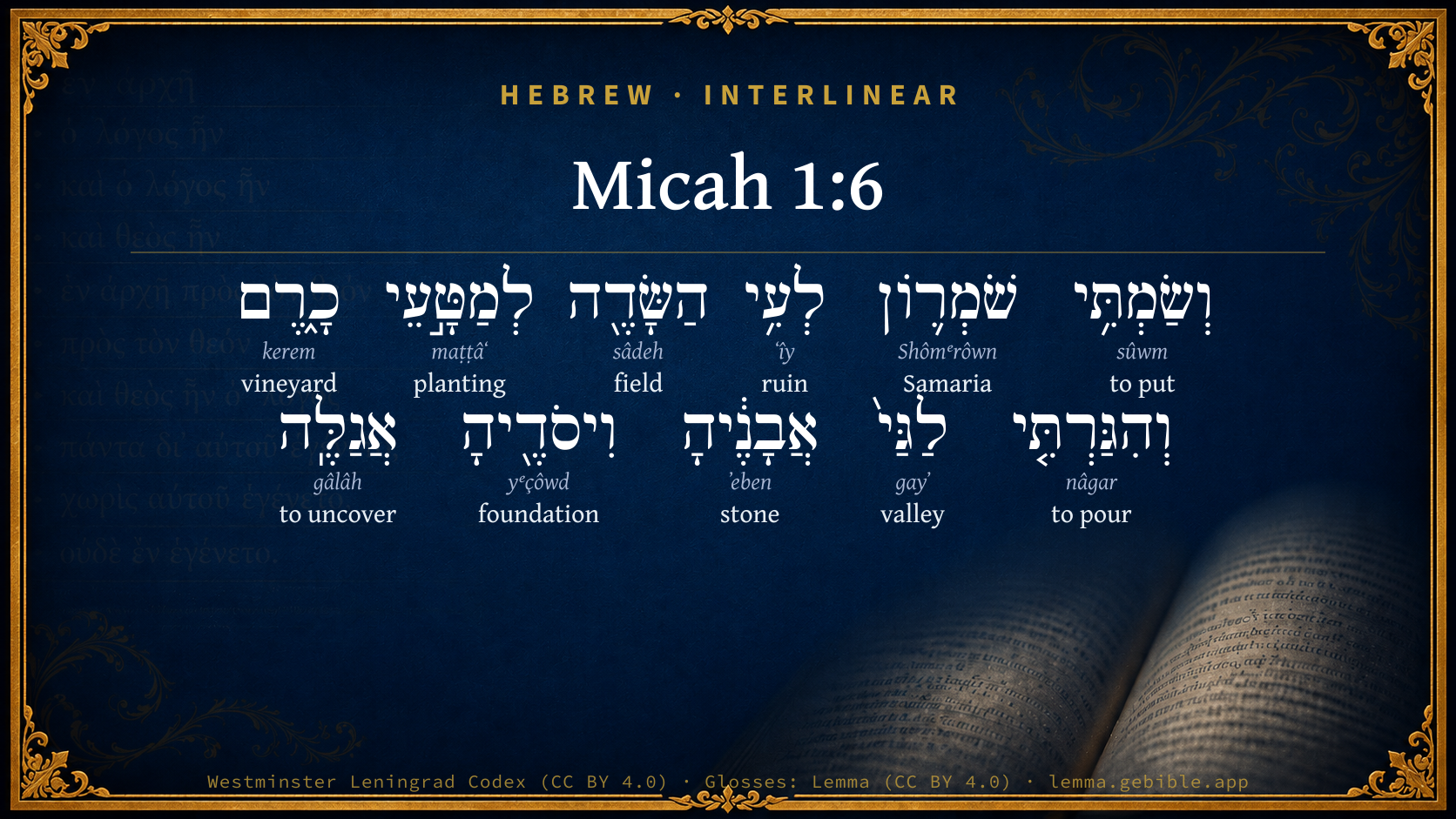
  1. וְשַׂמְתִּ֥י sûwm H7760 “and · to put” Conjunction + Verb, Qal, Sequential Perfect, 1st Person, Common, Singular
  2. שֹׁמְר֛וֹן Shômᵉrôwn H8111 “Samaria” Noun, Proper
  3. הַשָּׂדֶ֖ה sâdeh H7704 “the · field” Particle, Definite Article + Noun, Common, Masculine, Singular, Absolute
  4. לְמַטָּ֣עֵי maṭṭâʻ H4302 “to/for · plantings of” Preposition + Noun, Common, Masculine, Plural, Construct
  5. כָ֑רֶם kerem H3754 “vineyard” Noun, Common, Both, Singular, Absolute
  6. וְהִגַּרְתִּ֤י nâgar H5064 “and · to pour” Conjunction + Verb, Hiphil, Sequential Perfect, 1st Person, Common, Singular
  7. לַגַּי֙ gayʼ H1516 “to/for the · valley” Preposition, Determined + Noun, Common, Both, Singular, Absolute
  8. אֲבָנֶ֔יהָ ʼeben H68 “stones · her” Noun, Common, Feminine, Plural, Construct + Suffix, Personal, 3rd Person, Feminine, Singular
  9. וִיסֹדֶ֖יהָ yᵉçôwd H3247 “and · foundations · her” Conjunction + Noun, Common, Masculine, Plural, Construct + Suffix, Personal, 3rd Person, Feminine, Singular
  10. אֲגַלֶּֽה gâlâh H1540 “to uncover” Verb, Piel, Imperfect, 1st Person, Common, Singular

About this verse

These counts appear in no published source. They are computed here, from the morphology-tagged text and Lemma’s own curated glosses. What Lemma adds →

11
words
11
distinct lemmas
Prophets
section

Notable vocabulary

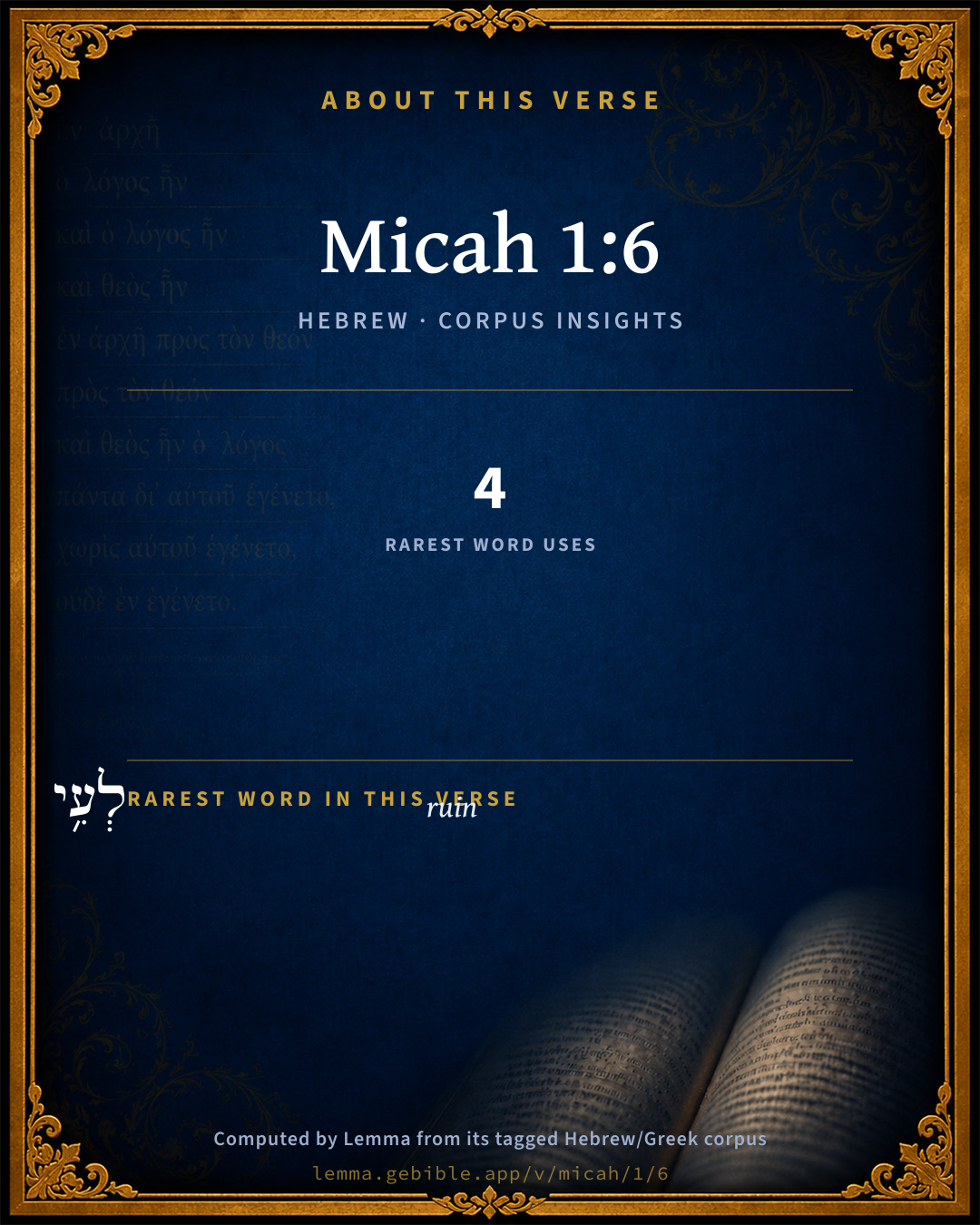
The rarest word here is לְעִ֥י ruin H5856 — appearing just 4 times in the whole Hebrew Bible.

Shared distinctive vocabulary

לְעִ֥י ruin H5856 occurs in 4 verses of the Hebrew Bible. Also found in:

Grammatical profile

  • 3 verbs
  • 8 nouns

Verb forms

  • וְשַׂמְתִּ֥י Qal · Sequential Perfect
  • וְהִגַּרְתִּ֤י Hiphil · Sequential Perfect
  • אֲגַלֶּֽה Piel · Imperfect

Hebrew & Septuagint length

In English translation the verse runs 33 words from the Hebrew and 34 from the Septuagint (LXX English) — closely comparable.

A rough comparison of the two English renderings, which tokenize alike — not a word-level alignment.

Word counts can differ between the Hebrew and the Greek without any difference in meaning — e.g. the Hebrew direct-object marker אֵת has no separate Greek word, and Greek often adds the article ὁ.

Cross-references

13

Topical passages linked to Micah 1:6 in the Treasury of Scripture Knowledge — connected by theme and wording, ordered by reader-vote popularity; previews shown in the World English Bible.

  • Ezekiel 13:14 So will I break down the wall that you have daubed with whitewash, and bring it down to the ground, so that the foundation of it shall be uncovered; and it shall fall, and you shall be consumed in the midst of it: and you shall know that I am Yahweh.
  • Micah 3:12 Therefore Zion for your sake will be plowed like a field, And Jerusalem will become heaps of rubble, And the mountain of the temple like the high places of a forest.
  • 2 Kings 19:25 Haven't you heard how I have done it long ago, and formed it of ancient times? now have I brought it to pass, that it should be yours to lay waste fortified cities into ruinous heaps.
  • Lamentations 4:1 How is the gold become dim! [how] is the most pure gold changed! The stones of the sanctuary are poured out at the head of every street.
  • Isaiah 25:2 For you have made of a city a heap, of a fortified city a ruin, a palace of strangers to be no city; it shall never be built.
  • Isaiah 25:12 The high fortress of your walls has he brought down, laid low, and brought to the ground, even to the dust.
  • Jeremiah 9:11 I will make Jerusalem heaps, a dwelling-place of jackals; and I will make the cities of Judah a desolation, without inhabitant.
  • Jeremiah 51:25 Behold, I am against you, destroying mountain, says Yahweh, which destroy all the earth; and I will stretch out my hand on you, and roll you down from the rocks, and will make you a burnt mountain.
  • Jeremiah 51:37 Babylon shall become heaps, a dwelling-place for jackals, an astonishment, and a hissing, without inhabitant.
  • Hosea 13:16 Samaria will bear her guilt; For she has rebelled against her God. They will fall by the sword. Their infants will be dashed in pieces, And their pregnant women will be ripped open."
  • Amos 5:11 Forasmuch therefore as you trample on the poor, And take taxes from him of wheat: You have built houses of hewn stone, But you will not dwell in them. You have planted pleasant vineyards, But you shall not drink their wine.
  • Habakkuk 3:13 You went forth for the salvation of your people, For the salvation of your anointed. You crushed the head of the land of wickedness. You stripped them head to foot. Selah.
  • Matthew 24:2 But he answered them, "Don't you see all of these things? Most assuredly I tell you, there will not be left here one stone on another, that will not be thrown down."

Cross-references courtesy of OpenBible.info (CC BY 4.0).

Hebrew and Greek witnesses Masoretic Hebrew ↔ Greek Septuagint

The same verse in the two great witnesses to the Old Testament, shown verse-for-verse.

These are two independent witnesses, not word-aligned to each other, and the Septuagint is shown in lemma (dictionary) form.

Hebrew Micah 1:6 Masoretic · Westminster Leningrad Codex

וְשַׂמְתִּ֥י שֹׁמְר֛וֹן לְעִ֥י הַשָּׂדֶ֖ה לְמַטָּ֣עֵי כָ֑רֶם וְהִגַּרְתִּ֤י לַגַּי֙ אֲבָנֶ֔יהָ וִיסֹדֶ֖יהָ אֲגַלֶּֽה

Therefore I will make Samaria like a rubble heap of the field, Like places for planting vineyards; And I will pour down its stones into the valley, And I will uncover its foundations.

World English Bible · Public Domain

Greek LXX Micah 1:6 Septuagint · lemma form

καί τίθημι σαμαρεία εἰς ὀπωροφυλάκιον ἀγρός καί εἰς φυτεία ἀμπελών καί κατασπάω εἰς χάος ὁ λίθος αὐτός καί ὁ θεμέλιον αὐτός ἀποκαλύπτω

Therefore I will make Samaria as a store-house of the fruits of the field, and as a planting of a vineyard: and I will utterly demolish her stones, and I will expose her foundations.

LXX2012 (modern English Septuagint) · Public Domain

On this verse, Haydock's Catholic Bible Commentary discusses the Septuagint’s reading. Read the note in Commentary ↓

Hebrew: Westminster Leningrad Codex (CC BY 4.0). Greek: Septuagint (public domain); English from LXX2012 (modern English Septuagint) (Public Domain). How the Septuagint differs from the Hebrew →

Targum (Aramaic paraphrase)

1

The Targum is the ancient Jewish Aramaic paraphrase of the Hebrew Scriptures — an interpretive translation, not the Hebrew text itself. Onkelos (literal) and Pseudo-Jonathan (expansive) render the Torah, and Jonathan the Prophets. Coverage is partial: where no permissively-licensed English translation exists for a verse, only the Aramaic is shown. This is verse-level text, not a word-by-word alignment to the Hebrew.

  1. Targum Jonathan Prophets (Joshua–Malachi)
    וַאֲשַׁוֵי שֹׁמְרוֹן לְיַגְרֵי חַקְלָן בֵּית צָדוּת מַצְבַת כְּרַם וְאֶרְמֵי לְחֵילָתָא אַבְנָהָא וְאַיְשָׁהָא אֶגְלֵי:

    (no public-domain English translation for this verse)

    Targum Jonathan — Aramaic: “Mikraot Gedolot” (public domain). English: “Sefaria Community Translation” (CC0 1.0 (public-domain dedication)); “London "Chaldee Paraphrase," 1871” (public domain). Text via Sefaria.

Commentary

Notes on Micah 1:6 from classic Christian and Jewish commentators (each source and its license shown beneath its notes). The classic Christian expositions comment on the surrounding passage and are grouped to its opening verse, so a note may address several verses; the Jewish commentaries on the Tanakh (Rashi and others) are per-verse, so they appear only where the commentator wrote on this verse.

Lemma curates 59 commentaries, every one of them public domain or Creative Commons licensed, each selected and text-cleaned for this edition rather than reprinted as found. About our sources →

Trapp's Complete Commentary

John Trapp

Mic 1:6 Therefore I will make Samaria as an heap of the field, [and] as plantings of a vineyard: and I will pour down the stones thereof into the valley, and I will discover the foundations thereof.

Ver. 6. Therefore I will make Samaria as an heap of the field] i.e. When stones are gathered out of a field they are laid together on heaps, so I will take course that where Samaria now is, there shall be nothing to be seen but heaps of stones and rubbish. God is the true προλιπορθος: "for thou hast made of a city a heap; of a defenced city a ruin: a palace of strangers to be no city; it shall never be built," Isa 25:2. Of Rome it was long since prophesied:

“ Tota eris in cineres, quasi nunquam Roma fuisses. ”

“The entire city will be in ashes, just as Rome never existed.”

Oh that God would hasten that day! Scipio foresaw it, and wept, sc. when he saw Carthage set all on fire by himself. In the greatness of the Turkish empire are swallowed up many kingdoms and countries; besides all those churches and places so much spoken of in Scripture, the Romans only excepted; yet, no doubt, for their many and mighty sins, time shall triumph over this so great a monarchy, when it shall but then live by fame, as others now do. Iam seges est ubi Troia fuit. Though thou build thy walls as high as heaven (said the oracle to wicked Phocas), yet sin, that lieth at the foundation, will one day overturn them.

And as plantings of a vineyard] That is, it shall be made a place fit for the planting of vines; it shall be utterly rased and harassed. A Lapide observeth the fitness of the expression here used, in that Samaria was situated on a hill that bore vines; and before it was a city it had been a vineyard: God threateneth to make it so again, and so to stain the pride of all its glory. See what a trouble town sin is. Surely did people but know what it will once cost them and cause to them, they dared not but be innocent.

And I will pour down the stones thereof into the valley] That is, into a bycorner. Clearing of stones is necessary to a vineyard, Isa 5:2, there being no possession that requireth more pains and care, as Cato hath observed.

And I will discover the foundation thereof] I will not leave a stone upon a stone, nor any footstep of so stately a city, that hath so long time been a cage of unclean birds, an Augean stable of abominable idolaters. God, as he hath loving respects to the places of his servants’ birth and abode, Psa 87:6 Isa 49:16, so he sets the marks of his wrath upon those places where foul sins have been perpetrated, as upon our abbeys and monasteries, whose very foundations are laid naked.

John Trapp, A Commentary or Exposition upon All the Books of the Old and New Testament (1647–1656) — public domain. Text from a community e-Sword module.

Joseph Benson's Commentary

Mic 1:6-7. Therefore I will make Samaria as a heap — A heap of ruins. And as plantings of a vineyard — As in planting vineyards men dig the earth, and cast it up in hillocks, so shall they make this city. The Vulgate reads, I will make Samaria as a heap of stones in a field, when a vineyard is planted. I will pour down the stones thereof, &c. — The stones of it shall be tumbled down, from the lofty eminence on which it is situated, into the valley beneath, and shall leave the foundations thereof naked and bare. All this, and what follows, was fulfilled by Shalmaneser, who made a conquest of Samaria. And all the graven images thereof — Whether made of gold, silver, brass, wood, or stone; shall be beaten to pieces — Shall be pulled out of their chapels, shrines, or repositories, by their conquering enemies, and shall be trampled upon and broken, either out of contempt, or that the rich materials of which they are made may be carried away. And all the hires thereof shall be burned with fire — The rich gifts, given for the honour and service of the idols by the deceived idolaters, shall be consumed. This seems to be spoken of the gifts sent to their temple by the Assyrians, whose worship they imitated. For she gathered it of the hire of a harlot, &c. — She got it by the gifts of idolaters, and it shall return to those idolaters again.

Joseph Benson's Commentary on the Old and New Testaments (1811–1818) — public domain. Text from a community e-Sword module.

Scofield Reference Notes

C. I. Scofield

Therefore

In Mic 1:6-16 the Assyrian invasion is described. Cf. 2Ki 17:1-18. This is the local circumstance which gives rise to the prophecy of the greater invasion in the last days. Mic 4:9-13 and of the Lord’s deliverance at Armageddon.; Rev 16:14; Rev 19:17.

The Scofield Reference Bible (1917 edition), notes by C. I. Scofield — public domain. Text from a community e-Sword module.

Tyndale Open Study Notes

Tyndale Open Resources

1:6-7 a heap of ruins: The Lord threatened to devastate his treasured cities. Assyria virtually annihilated Samaria in 724–722 BC in a horrendous three-year siege. • Samaria, like most cities, was built on a hill. Here, the stones of her walls crash into the valley below as they are violently dismantled. Ancient armies would systematically shatter city walls down to their foundation stones. • Samaria and Jerusalem were filled with carved images and sacred treasures put there by worshipers or taken as war booty. • Prostitution pictures Israel’s persistent spiritual and physical waywardness. This metaphor was regularly used by the Israelite prophets to express Israel’s abandonment of the Lord, her true husband, in order to obtain the blessings promised by the pagan gods. In addition, the worship of those gods often in fact involved sexual activity. • Elsewhere refers to the exile of Samaria into Assyria and its various provinces and conquered vassal states (722 BC). The same outcome was forecast for Jerusalem (3:12; Jer 26:18).

Tyndale Open Study Notes — © Tyndale Open Resources, licensed CC BY-SA 4.0. Text via the HelloAO Bible API.

Jamieson, Fausset & Brown

Robert Jamieson, A. R. Fausset & David Brown

Samaria's punishment is mentioned first, as it was to fall before Jerusalem.

as an heap of the field-- (Mic 3:12). Such a heap of stones and rubbish as is gathered out of fields, to clear them (Hos 12:11). Palestine is of a soil abounding in stones, which are gathered out before the vines are planted (Isa 5:2).

as plantings of a vineyard--as a place where vines are planted. Vineyards were cultivated on the sides of hills exposed to the sun. The hill on which Samaria was built by Omri, had been, doubtless, planted with vines originally; now it is to be reduced again to its original state (Kg1 16:24).

pour down--dash down the stones of the city into the valley beneath. A graphic picture of the present appearance of the ruins, which is as though "the buildings of the ancient city had been thrown down from the brow of the hill" [Scottish Mission of Inquiry, pp. 293,294].

discover the foundations--destroy it so utterly as to lay bare its foundations (Eze 13:14). Samaria was destroyed by Shalmaneser.

Jamieson, Fausset & Brown — Commentary Critical and Explanatory on the Whole Bible (1871) — public domain (CC PDM 1.0). Text via the HelloAO Bible API.

Adam Clarke's Commentary

Verse 6. I will make Samaria] I will bring it to desolation: and, instead of being a royal city, it shall be a place for vineyards. Newcome observes, that Samaria was situated on a hill, the right soil for a vineyard.

I will discover the foundations thereof.] I will cause its walls and fortifications to be razed to the ground.

Adam Clarke's Commentary on the Bible (1810–1826) — public domain. Text from a community e-Sword/MySword module.

John Calvin's Commentaries

Though Micah intended especially to devote his services to the Jews, as we have said yesterday, he yet, in the first place, passes judgment on Samaria; for it was his purpose afterwards to speak more fully against Jerusalem and the whole of Judea. And this state of the case ought to be borne in mind; for the Prophet does not begin with the Israelites, because he directs his discourse peculiarly to them; but his purpose was briefly to reprove them, and then to address more especially his own people, for it was for this purpose that he was called. Now, as he threatens destruction to Samaria and the whole kingdom of Israel on account of their corrupted forms of worship, we may hence learn how displeasing to God is superstition, and that he regards nothing so much as the true worship of his name. There is no reason here for men to advance this position — that they do not designedly sin; for God shows how he is to be worshipped by us. Whenever, then, we deviate in any thing from the rule which he has prescribed, we manifest, in that particular, our rebellion and obstinacy. Hence the superstitious ever act like fools with regard to God, for they will not submit to his word, so as to be thereby alone made wise.

And he says, I will set Samaria as an heap of the field, that is, such shall be the ruins that they shall differ nothing from the heaps of the fields: for husband men, we know, when they find stones in their fields, throw them into some corner, that they may not be in the way of the slough. Like such heaps then, as are seen in the fields, Samaria would be, according to what God declared. He then says, that the place would be empty, so that vines would be planted there; and, in the third place, that its stones would be scattered through the valley; as when one casts stones where there is a wide plain, they run and roll far and wide; so would be the scattering of Samaria according to what the Prophet says, it was to be like the rolling of stones in a wide field. He adds, in the fourth place, I will uncover her foundations, that is, I will entirely demolish it, so that a stone, as Christ says, may not remain on a stone, (Matthew 24:2.) We now perceive the import of the words; and we also perceive that the reason why the Prophet denounces on Samaria so severe a judgment was, because it had corrupted the legitimate worship of God with its own inventions; for it had devised, as we well know, many idols, so that the whole authority of the law had been abolished among the Israelites. It now follows —

John Calvin's Commentaries (1540-1563) — public domain. Text from the Calvin Translation Society English edition (1840s-50s) via the Christian Classics Ethereal Library (ccel.org). Calvin's coverage is partial (roughly two-thirds of the Bible); uncommented books and verses are honest gaps, never fabricated. The 19th-century editor's footnotes and remarks are omitted so the notes are faithfully Calvin's own voice.

Ellicott's Commentary for English Readers

(6) Samaria as an heap of the field.—Samaria was to be reduced to what it had been before the days of Ahab; the palatial city of the kings of the northern kingdom should return to the normal condition of a vineyard, which it had before Shemer sold it to Omri. The fruitfulness of its vines suggests one cause of its ruin. “Woe to the crown of pride, to the drunkards of Ephraim, whose glorious beauty is a fading flower, which are on the head of the fat valleys of them that are overcome with wine” (Isa_28:1).

A Bible Commentary for English Readers, edited by Charles John Ellicott (1878–1897) — public domain. Text from a community e-Sword module.

The Cambridge Bible for Schools and Colleges

gen. ed. J. J. S. Perowne

6. as a heap] Rather, into a heap (i.e. into ruins).

as plantings of a vineyard] Rather, into the plantings, &c. Samaria should remain so long in ruins, that vineyards should be laid out upon it (comp. Isa_28:1 ‘the fat valley of those who are smitten down with wine’).

I will pour down the stones] Samaria standing on a hill (see 1Ki_16:24). “There is every appearance of the ancient buildings having been destroyed, and their materials cast down from the brow of the hill, in order to clear the ground for cultivation; masses of stone are thus seen hanging on the steep sides of the hill, accidentally stopped in the progress of their descent by the rude dykes and terraces separating the fields.” “The materials of the ruins … are piled up in large heaps, or used in the construction of rude stone fences; many of these heaps of stone are seen in the plains at the foot of the hill.” Journal of a Deputation sent to the East by the Malta Prot. College, Vol. ii. p. 425.

discover] i.e. lay bare.

The Cambridge Bible for Schools and Colleges (gen. ed. J. J. S. Perowne; Cambridge University Press, 1878–1918) — public domain. Text from a community e-Sword module.

John Gill's Exposition

Therefore I will make Samaria as an heap of the field, and as plantings of a vineyard,.... As a field ploughed, and laid in heaps; see Mic 3:12; or as stones gathered out of a field, and out of a vineyard planted, and laid in a heap; so should this city become a heap of stones and rubbish, being utterly demolished; and this being done according to the will of God, and through his instigation of Shalmaneser king of Assyria to it, and by his providence succeeding his army that besieged it, is said to be done by him. With this agrees the Vulgate Latin version,

"I will make Samaria as a heap of stones in a field, when a vineyard is planted;''

see Isa 5:2; for the city, being destroyed, cannot be compared to the plants of a vineyard set in good order, beautiful and thriving; but, as to heaps of stones in a field, so to such in a vineyard; or to hillocks raised up there for the plants of vines; and if the comparison is to plants themselves, it must be to withered ones, that are good for nothing. The note of similitude as is not in the text; and the words may be read without it, "I will make Samaria an heap of the field, plantings of a vineyard" (t); that is, it shall be ploughed up, and made a heap of; turned into a field, and vines planted on it; for which its situation was very proper, being on a hill where vines used to be planted, and so should no more be inhabited as a city:

and I will pour down the stones thereof into the valley; the stones of the buildings and walls of the city, which, being on a hill, when pulled down, rolled into the valley; and with as much swiftness and force as waters run down a steep place, as in Mic 1:4; where the same word is used as here:

and I will discover the foundations thereof; which should be fused up, and left bare; not one stone should be upon another; so that there should be no traces and footsteps of the city remaining, and it should be difficult to know the place where it stood. This is expressive of the total desolation and utter destruction of it: this was not accomplished by Shalmaneser when he took it; for though he carried captive the inhabitants thereof, he put others in their room; but this was entirely fulfilled, not by Jonathan Maccabeus, though he is said (u) to besiege it, and level it with the ground; but by John Hyrcanus; and the account of the destruction of it by him, as given by Josephus (w), exactly answers to this prophecy, and, to Hos 13:16; where its desolation is also predicted; he says that Hyrcanus, having besieged it a year, took it; and, not content with this only, he utterly destroyed it, making brooks to run through it; and by digging it up, so that it fell into holes and caverns, insomuch that there were no signs nor traces of the city left. It was indeed afterwards rebuilt by Gabinius the Roman proconsul of Syria, and restored by Augustus Caesar to Herod, who adorned and fortified it, and called it by the name of Sebaste, in honour of Augustus (x); though Benjamin of Tudela pretends that Ahab's palace might be discerned there in his time, or the place known where it was, which is not likely; excepting this, his account is probable.

"From Luz (he says (y)) is one day's journey to Sebaste, which is Samaria; and still there may be perceived there the palace of Ahab king of Israel; and it is a fortified city on a very high hill, and in it are fountains; and is a land of brooks of water, and gardens, orchards, vineyards, and olive yards;''

but, since his time, it is become more ruinous. Mr. Maundrell, who some years ago was upon the spot, gives a fuller account of it;

"this great city (he says (z)) is now wholly converted into gardens; and all the tokens that remain, to testify that there has ever been such a place, are only on the north side, a large square piazza, encompassed with pillars; and, on the east, some poor remains of a great church, said to be built by the Empress Helena, over the place where St. John Baptist was both imprisoned and beheaded.''

So say others (a),

"the remains of Sebaste, or the ancient Samaria, though long ago laid in ruinous heaps, and a great part of it turned into ploughed land and garden ground, do still retain some monuments of its ancient grandeur, and of those noble edifices in it, with which King Herod caused it to be adorned;''

and then mention the large square piazza on the north, and the church on the east. It was twelve miles from Dothaim, and as many from Merran, and four from Atharoth, according to Eusebius (b); and was, as Josephus (c) says, a day's journey from Jerusalem. Sichem, called by the Turks Naplus, is now the metropolis of the country of Samaria; Samaria, or Sebaste, being utterly destroyed, as says Petrus a Valle (d), a traveller in those parts.

(t) "in acervum agri, in plantationem, vel plantationes vinae", Pagninus, Montanus, Tigurine version, Cocceius; as Junius & Tremellius, Piscator, Burkius. (u) Paschale Chronicon, p. 181. apud Reland. Palestina Illustrata, tom. 2. l. 3. p. 980. (w) Antiqu. l. 13. c. 10. sect. 3. (x) Ibid. l. 14. c. 5. sect. 3. &. l. 15. c. 7. sect. 3. & c. 8. sect. 5. (y) Itinerarium, p. 38. (z) Journey from Aleppo, &c. p. 59. Ed. 7. (a) Universal History, vol. 2. p. 439. (b) In voc. Dothaim, &c. (c) Antiqu. l. 15. c. 8. sect. 5. (d) Epist. 14. Morino apud Antiqu. Eccles. Oriental. p. 166.

John Gill's Exposition of the Whole Bible (1746–1763) — public domain (CC PDM 1.0). Text via the HelloAO Bible API.

Albert Barnes' Notes on the Bible

Therefore - (literally, “And”) I will make Samaria as an heap of the field, and as plantings of a vineyard Jerome: “The order of the sin was the order or the punishment.” Samaria’s sins were the earliest, the most obstinate, the most unbroken, bound up with its being as a state. On it then God’s judgments should first fall. It was a crown of pride Isa 28:1, resting on the head of the rich valleys, out of which it rose. Its soil is still rich . “The whole is now cultivated in terraces” , “to the summits” . Probably, since the sides of hills, open to the sun, were chosen for vineyards, it had been a vineyard, before Shemer sold it to Omri 1Ki 16:24. What it had been, that it was again to be. Its inhabitants cast forth, its houses and gorgeous palaces were to become heaps of stones, gathered out Isa 5:2 to make way for cultivation, or to become the fences of the vegetation, which should succeed to man.

There is scarce a sadder natural sight than the fragments of human habitation, tokens of man’s labor or his luxury, amid the rich beauty of nature when man himself is gone. For they are tracks of sin and punishment, man’s rebellion and God’s judgment, man’s unworthiness of the good natural gifts of God. A century or two ago, travelers “speak of the ground (the site of Samaria) as strewed with masses of ruins.” Now these too are gone. : “The stones of the temples and palaces of Samaria have been carefully removed from the rich soil, thrown together in heaps, built up in the rude walls of terraces, and rolled down into the valley below.” : “About midway of the ascent, the hill is surrounded by a narrow terrace of woodland like a belt. Higher up too are the marks of slighter terraces, once occupied perhaps by the streets of the ancient city.” Terrace-cultivation has succeeded to the terraced streets once thronged by the busy, luxurious, sinful, population.

And I will pour down the stones thereof into the valley - Of which it was the crest, and which it now proudly surveyed. God Himself would cause it to be poured down (he uses the word which he had just used of the vehemence of the cataract Mic 1:4). : “The whole face of this part of the hill suggests the idea that the, buildings of the ancient city had been thrown down from the brow of the hill. Ascending to the top, we went round the whole summit, and found marks of the same process everywhere.”

And I will discover the foundations thereof - The desolation is entire; not one stone left upon another. Yet the very words of threatening contain hope. It was to be not a heap only, but the plantings of a vineyard. The heaps betoken ruin; the vineyard, fruitfulness cared for by God. Destroyed, as what it was, and turned upside down, as a vineyard by the share, it should become again what God made it and willed it to be. It should again become a rich valley, but in outward desolation. Its splendid palaces, its idol temples, its houses of joy, should be but heaps and ruins, which are cleared away out of a vineyard, as only choking it. It was built in rebellion and schism, loose and not held together, like a heap of stones, having no cement of love, rent and torn in itself, having been torn both from God and His worship. It could be remade only by being wholly unmade. Then should they who believed be branches grafted in Him who said, “I am the Vine, ye are the branches” Joh 15:5.

Albert Barnes' Notes on the Bible (1834–1885) — public domain. Text from a community e-Sword/MySword module.

Haydock's Catholic Bible Commentary

Heap. Septuagint, "hut to keep the fruit." Hebrew, "hillock of the field," (Haydock) to be cultivated. (Grotius) --- Bare, by Salmanasar, 4 Kings xvii. 6. It was afterwards rebuilt, (Calmet) but completely levelled by Hircan. (Josephus, Antiquities xiii. 18.)

George Leo Haydock (1774–1849), Haydock's Catholic Family Bible and Commentary, 1859 edition — public domain. Excludes Psalms (Douay-Rheims chapter numbering differs from Protestant) and Deuterocanonical books (Catholic canon only).

Matthew Poole's English Annotations

Therefore; for these sins of Samaria, and the kingdom of Israel.

I will make; not by an immediate hand from heaven, but by the Assyrians under the conduct of Shalmaneser, they shall do it as my servants, saith the Lord.

Samaria as a heap of the field; much like Isa 25:2; that beautiful city shall be made, and so left, as a ruinous heap in the field.

And as plantings of a vineyard: in planting vineyards, they did dig up the earth, and cast it up in hillocks, cast out all the stones; so shall they make this city.

I will pour down the stones thereof into the valley: the city was built on a high hill, and a deep valley beneath it; now when it was sacked by the Assyrians, they pulled down the buildings, and cast the stones thereof into that valley; so God did by them throw down the stones of Samaria.

And I will discover the foundations thereof; raze the walls, fortresses, and public buildings of this city to the very foundations of it, nor leave one stone upon another, as Mat 24:2; Luk 19:44 desolation upon Samaria for her sin such a desolation as shall not leave the least footsteps of Samaria in the place where once it stood.

Matthew Poole's English Annotations on the Holy Bible (1683–1685) — public domain. Text from a community e-Sword/MySword module.

The Pulpit Commentary

I will make. This prophecy, therefore, was delivered before the destruction of Samaria in the fourth year of Hezekiah. As a heap of the field; or, into a heap of the field, like a heap of stones gathered off a cultivated field (comp. Isa_5:2) Septuagint, isopwrofulakion agrou , "the hut of a fruit watcher." As plantings of a vineyard; into the plantings, etc.; i.e. into mere terraces for vines. Such shall be the utter ruin of the city, that on its site vines shall be planted. The prophet here uses a description of complete destruction which is a regular formula in Assyrian inscriptions, where we read of cities being made into "a rubbish heap and a field." The expression occurs, e.g., in a monument of Tiglath-Pileser (see Schrader, "Keilinschr.," p. 449). I will pour down the stones thereof into the valley. Samaria stood on a hilly platform, (1Ki_16:24) with a sheer descent on every side, and when it was overthrown its stones were hurled into the valley surrounding it, as may be seen to this day. "When we looked down," says Tristram ("Land of Israel," p. 136), "at the gaunt columns rising out of the little terraced fields, and the vines clambering up the sides of the hill once covered by the palaces of proud Samaria, who could help recalling the prophecy of Micah? Not more literally have the denunciations on Tyre or on Babylon been accomplished. What though Sebaste rose, under Herod, to a pitch of greater splendour than even old Samaria, the effort was in vain, and the curse has been fully accomplished. In the whole range of prophetic history, I know of no fulfilment more startling to the eyewitness in its accuracy than this." Will discover; will lay. (Psa_137:7 Eze_13:14)

The Pulpit Commentary (1880–1919), ed. H.D.M. Spence-Jones & Joseph S. Exell — public domain. Text from a community e-Sword module.

John Wesley's Explanatory Notes

As an heap - As a heap of ruins. Of a vineyard - In planting vineyards, they dig up the earth, and cast it up in hillocks; so shall they make this city. Into the valley - The city was built on a high hill, and a deep valley beneath it. I will discover - I will raze the walls, fortresses, and public buildings of this city, to the very foundations.

John Wesley, Explanatory Notes Upon the Whole Bible (1754–1765) — public domain. Text via the GEBible commentary corpus.

unfoldingWord translationNotes

Door43 World Missions Community

I will make

Here "I" refers to Yahweh.

Samaria ... her stones ... her foundations ... her carved figures ... her gifts that she received ... her idols ... she gathered her gifts ... they will become

Yahweh speaks of Samaria as if the city were a woman. AT: "Samaria ... its stones ... the foundations of the buildings in the city ... the carved figures in the city ... the gifts that people gave to the temple in the city ... the idols in the city ... the people of the city became rich ... the gifts will become" (See: Metaphor)

I will pour her stones

Here "her" refers to the city of Samaria.

All her carved figures will be broken to pieces

This can be translated in active form. AT: "I will break all her carved figures to pieces" (See: Active or Passive)

all her gifts ... will be burned with fire

This can be translated in active form. AT: "I will burn with fire all the gifts that she received" (See: Active or Passive)

she received

"people gave her"

Since she gathered her gifts from the wages of prostitutes, they will become the wages of prostitutes again

Yahweh speaks of the people giving gifts to idols as if the people were hiring prostitutes. When the Assyrians destroy Samaria, they will take to Assyria the gifts the people of Samaria gave to their idols and give them as gifts to their own idols. (See: Metaphor and Assumed Knowledge and Implicit Information)

translationWords

Samaria

ruin

vineyard

stone

found

image

gift

false god

ruin

prostitute

unfoldingWord translationNotes — © Distant Shores Media and the Door43 World Missions Community, licensed CC BY-SA 4.0. Source: git.door43.org/Door43/en_tn.

Rashi

Rabbi Shlomo Yitzchaki (Rashi)

into a heap in the field Heb. לְעִי הַשָּׂדֶה. Jonathan renders: לִדְגוֹרִין דְּחַקְלָא, an expression of heaps. Cf. (Gen. 31:47) “יְגַר שַׂהֲדוּתָא, the heap of the testimony.”

and I will cast its stones down into the valley Heb. וְהִגַּרְתִּי, and I will drag, similar to (verse 4) “poured down (מֻגָּרִים) a steep place.”

Rashi on the Tanakh — English translations: “The Judaica Press complete Tanach with Rashi, translated by A. J. Rosenberg” (CC BY 4.0); “Pentateuch with Rashi's commentary by M. Rosenbaum and A.M. Silbermann, 1929-1934” (public domain); “The Metsudah Tanach series, Lakewood, N.J” (CC BY 4.0); and “The Book of Joshua, Metsudah Publications, 1997” (CC BY 4.0). Text via Sefaria.

Lesson kit

Teaching starters — assembled from the data on this page, not authored interpretation. Every prompt links to the verse data it draws on. Edit before teaching.

Micah, in the Prophets, opens this verse with 11 words (11 distinct Hebrew lemmas). Its most distinctive word is ʻîy (“ruin”). A historical commentator’s framing appears above. Read the whole chapter for the surrounding context.

Discussion questions

  1. The word ʻîy carries the sense “ruin.” How does it shape the verse?
  2. How does Psalms 79:1, which shares the word «ruin», read alongside this verse?
  3. The translations on this page render this verse differently — a whole-verse word diff, not a word-by-word alignment. What might account for the different wordings?
  4. «וְשַׂמְתִּ֥י» is a Qal Sequential Perfect verb. How does that grammatical form shape the action described?
  5. Compare how Trapp's Complete Commentary and Joseph Benson's Commentary read this verse. Where do they agree or differ?

Things to notice

Reading settings

Reading text

Shown beneath each verse's original-language words.

Old Testament
Old Testament edition

Read the OT as the Masoretic Hebrew (MT) or the Greek Septuagint (LXX).

English shown for the Greek Septuagint (in the Hebrew ↔ Greek comparison).

Comparing translations? Open the Compare panel on any verse page to stack up to four side by side.