Nahum 2:7

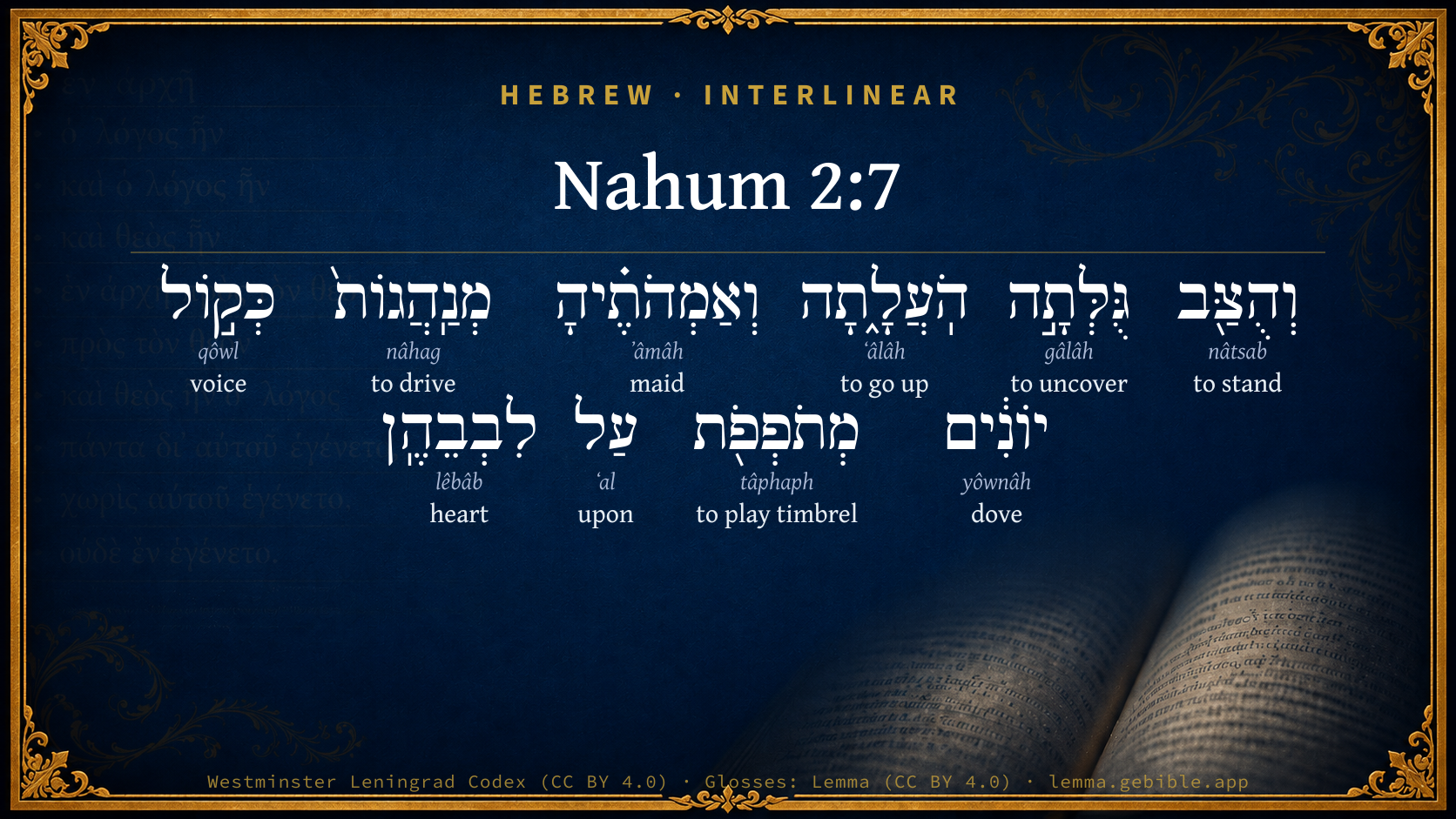
Hebrew (Westminster Leningrad Codex) Nahum 2:7 appears in the Hebrew Old Testament. The text above is from the Westminster Leningrad Codex. Each word links to its Strong’s number, a concise gloss, and parsing drawn from the Open Scriptures Hebrew Bible morphology. Click any word for its full Brown-Driver-Briggs (BDB) entry.
Download image
Cite this verse

Nahum 2:7 (World English Bible). Public Domain. Lemma interlinear Bible study tool, https://lemma.gebible.app/v/nahum/2/7.

Show BibTeX & RIS
BibTeX
RIS
English Translation
It is decreed: she is uncovered, she is carried away; and her handmaids moan as with the voice of doves, beating on their breasts.
World English Bible · Public Domain
Download a study sheet

One document with this verse’s original text, its word-by-word gloss line, the meaning frame, cross-references with their text, attributed commentary, and full source and license credits — printable, and it pastes into notes with its structure intact.

This verse Autodidact and up

Study sheet (.html) Plain text (.txt)

A passage Seminary Student

Up to 50 verses in one chapter. A passage sheet keeps up to 6 commentary sources and 12 cross-references per verse, in the order this page ranks them, and says so on the sheet whenever that leaves anything out. Ask for a single verse and you get the Autodidact verse sheet above.

Everything on this page stays free to read, with no account — the sheet is a download of what is already on screen, not access to it.

Want to remove ads? Support Godless Engineer
Compare translations 3

The same verse in 3 English versions, stacked beneath the original-language interlinear above. Click any original word for its lexicon entry.

Each is an independent rendering of the whole verse — the interlinear is not word-aligned to these translations.

Highlighted words mark where these versions differ — a whole-verse word diff, not a word-by-word alignment.

  • World English Bible Public Domain
    It is decreed: she is uncovered, she is carried away; and her handmaids moan as with the voice of doves, beating on their breasts.
  • King James Version Public Domain
    And Huzzab shall be led away captive, she shall be brought up, and her maids shall lead her as with the voice of doves, tabering upon their breasts.
  • unfoldingWord Literal Text CC BY-SA 4.0
    It is established: she is taken into exile; she is led away, and her female servants moan like the sound of doves, beating on their hearts.

unfoldingWord Literal Text — © unfoldingWord, licensed CC BY-SA 4.0. Word-aligned USFM3 via Door43 (git.door43.org/unfoldingWord/en_ult).

Versions to compare (up to 4)

3 of 4 selected

Show all 18 translations

Every available English version of this verse, each an independent rendering of the whole verse.

  • World English Bible Public Domain
    It is decreed: she is uncovered, she is carried away; and her handmaids moan as with the voice of doves, beating on their breasts.
  • Berean Standard Bible Public Domain
    It is decreed that the city be exiled and carried away; her maidservants moan like doves, and beat upon their breasts.
  • Majority Standard Bible Public Domain
    It is decreed that the city be exiled and carried away; her maidservants moan like doves, and beat upon their breasts.
  • King James Version Public Domain
    And Huzzab shall be led away captive, she shall be brought up, and her maids shall lead her as with the voice of doves, tabering upon their breasts.
  • American Standard Version (1901) Public Domain
    And it is decreed: she is uncovered, she is carried away; and her handmaids moan as with the voice of doves, beating upon their breasts.
  • Revised Version (1885) Public Domain
    And Huzzab is uncovered, she is carried away, and her handmaids mourn as with the voice of doves, tabering upon their breasts.
  • Geneva Bible (1599) Public Domain
    And Huzzab the Queene shalbe led away captiue, and her maides shall leade her as with the voyce of doues, smiting vpon their breastes.
  • Douay-Rheims (1899) Public Domain
    And the soldier is led away captive: and her bondwomen were led away mourning as doves, murmuring in their hearts.
  • Young's Literal Translation Public Domain
    And it is established -- she hath removed, She hath been brought up, And her handmaids are leading as the voice of doves, Tabering on their hearts.
  • Literal Standard Version CC BY-SA 4.0
    And it is established—she has removed, || She has been brought up, || And her handmaids are leading as the voice of doves, || Tabering on their hearts.
  • Unlocked Literal Bible CC BY-SA 4.0
    Huzzab is stripped of her clothes and is taken away; her female servants moan like doves, beating on their breasts.
  • unfoldingWord Literal Text CC BY-SA 4.0
    It is established: she is taken into exile; she is led away, and her female servants moan like the sound of doves, beating on their hearts.
  • Darby Bible Public Domain
    And it is decreed: she shall be uncovered, she shall be led away, and her maids shall moan as with the voice of doves, drumming upon their breasts.
  • World Messianic Bible Public Domain
    It is decreed: she is uncovered, she is carried away; and her servants moan as with the voice of doves, beating on their breasts.
  • Webster's Bible Public Domain
    \\2:6\\The gates of the rivers shall be opened, and the palace shall be dissolved.
  • Free Bible Version CC BY-SA 4.0
    “Queen” Nineveh is stripped, and led away into exile, with her servant girls mourning like doves, and beating their breasts.
  • Bible in Basic English Public Domain
    The river doorways are forced open, and the king's house is flowing away.
  • JPS Tanakh (1917) Public Domain
    (2-8) And the queen is uncovered, she is carried away, and her handmaids moan as with the voice of doves, tabering upon their breasts.

Literal Standard Version (2020), Covenant Press — licensed CC BY-SA 4.0. Text via the HelloAO Bible API (eBible.org). Unlocked Literal Bible (unfoldingWord) — licensed CC BY-SA 4.0. Text via the HelloAO Bible API (eBible.org). unfoldingWord Literal Text — © unfoldingWord, licensed CC BY-SA 4.0. Word-aligned USFM3 via Door43 (git.door43.org/unfoldingWord/en_ult). Free Bible Version, Dr. Jonathan Gallagher — licensed CC BY-SA 4.0. Text via the HelloAO Bible API (eBible.org).

Word by word

More ways to search: Search by grammar → Find every occurrence → Compare this word →

Practice this passage: Drill this verse → Learn its vocabulary →

מְתֹפְפֹ֖ת
tâphaph
H8608
“playing timbrel”
Verb, Poel, Participle Active, Feminine, Plural, Absolute
Part of Speech
Verb
Stem
Poel
Form
Participle Active
Gender
Feminine
Number
Plural
State
Absolute
Full BDB Definition

Origin: a primitive root

TWOT: 2536

to play or sound the timbrel, beat, play upon, drum (on a timbrel or other object) - (Qal) playing (participle) - (Poel) beating (participle)
  1. וְהֻצַּ֖ב nâtsab H5324 “and · to stand” Conjunction + Verb, Hophal, Perfect, 3rd Person, Masculine, Singular
  2. גֻּלְּתָ֣ה gâlâh H1540 “to uncover” Verb, Pual, Perfect, 3rd Person, Feminine, Singular
  3. הֹֽעֲלָ֑תָה ʻâlâh H5927 “to go up” Verb, Hophal, Perfect, 3rd Person, Feminine, Singular
  4. וְאַמְהֹתֶ֗יהָ ʼâmâh H519 “and · maids · her” Conjunction + Noun, Common, Feminine, Plural, Construct + Suffix, Personal, 3rd Person, Feminine, Singular
  5. מְנַֽהֲגוֹת֙ nâhag H5090 “driving” Verb, Piel, Participle Active, Feminine, Plural, Absolute
  6. כְּק֣וֹל qôwl H6963 “like/as · voice of” Preposition + Noun, Common, Masculine, Singular, Construct
  7. יוֹנִ֔ים yôwnâh H3123 “doves” Noun, Common, Feminine, Plural, Absolute
  8. עַל ʻal H5921 “upon” Preposition
  9. לִבְבֵהֶֽן lêbâb H3824 “hearts · their” Noun, Common, Masculine, Plural, Construct + Suffix, Personal, 3rd Person, Feminine, Plural

About this verse

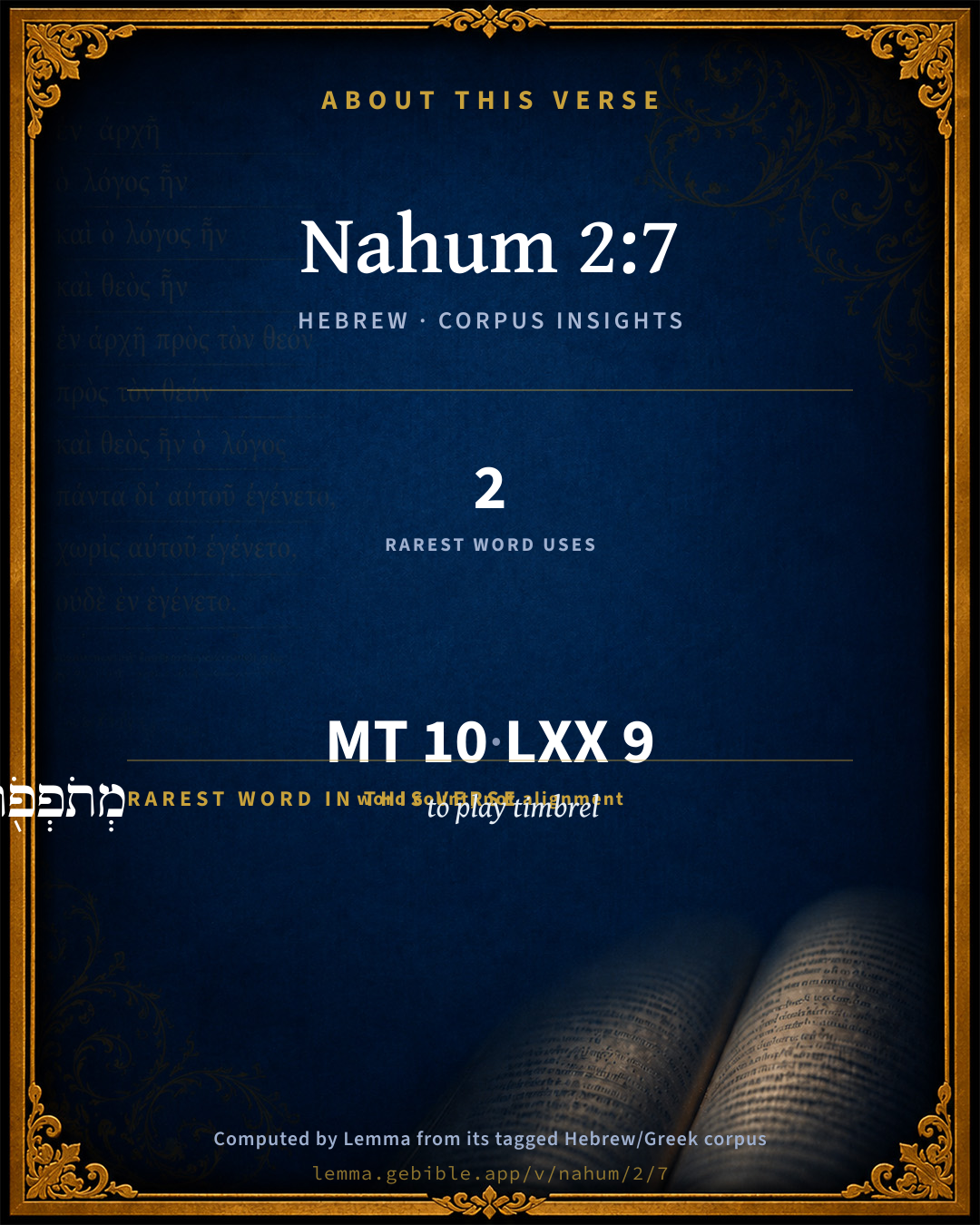
These counts appear in no published source. They are computed here, from the morphology-tagged text and Lemma’s own curated glosses. What Lemma adds →

10
words
10
distinct lemmas
Prophets
section

Notable vocabulary

The rarest word here is מְתֹפְפֹ֖ת to play timbrel H8608 — appearing just 2 times in the whole Hebrew Bible.

Shared distinctive vocabulary

מְתֹפְפֹ֖ת to play timbrel H8608 occurs in 2 verses of the Hebrew Bible. Also found in:

Grammatical profile

  • 5 verbs
  • 4 nouns
  • 1 preposition

Verb forms

  • וְהֻצַּ֖ב Hophal · Perfect
  • גֻּלְּתָ֣ה Pual · Perfect
  • הֹֽעֲלָ֑תָה Hophal · Perfect
  • מְנַֽהֲגוֹת֙ Piel · Participle Active
  • מְתֹפְפֹ֖ת Poel · Participle Active

Hebrew & Septuagint length

In English translation the verse runs 24 words from the Hebrew and 23 from the Septuagint (LXX English) — closely comparable.

A rough comparison of the two English renderings, which tokenize alike — not a word-level alignment.

Word counts can differ between the Hebrew and the Greek without any difference in meaning — e.g. the Hebrew direct-object marker אֵת has no separate Greek word, and Greek often adds the article ὁ.

In the original languages it is 10 Hebrew tokens and 9 Greek tokens — but the two are counted differently (Hebrew bundles its prefixes and suffixes into one token; the Greek is in lemma form), so that isn’t a like-for-like length.

Cross-references

5

Topical passages linked to Nahum 2:7 in the Treasury of Scripture Knowledge — connected by theme and wording, ordered by reader-vote popularity; previews shown in the World English Bible.

  • Isaiah 38:14 Like a swallow [or] a crane, so did I chatter; I did moan as a dove; my eyes fail [with looking] upward: Lord, I am oppressed, be my collateral.
  • Isaiah 59:11 We roar all like bears, and moan sore like doves: we look for justice, but there is none; for salvation, but it is far off from us.
  • Isaiah 32:12 They shall strike on the breasts for the pleasant fields, for the fruitful vine.
  • Luke 23:27 A great multitude of the people followed him, including women who also mourned and lamented him.
  • Luke 23:48 All the multitudes that came together to see this, when they saw the things that were done, returned home beating their breasts.

Cross-references courtesy of OpenBible.info (CC BY 4.0).

Hebrew and Greek witnesses Masoretic Hebrew ↔ Greek Septuagint

The same verse in the two great witnesses to the Old Testament, shown verse-for-verse.

These are two independent witnesses, not word-aligned to each other, and the Septuagint is shown in lemma (dictionary) form.

Hebrew Nahum 2:7 Masoretic · Westminster Leningrad Codex

וְהֻצַּ֖ב גֻּלְּתָ֣ה הֹֽעֲלָ֑תָה וְאַמְהֹתֶ֗יהָ מְנַֽהֲגוֹת֙ כְּק֣וֹל יוֹנִ֔ים מְתֹפְפֹ֖ת עַל לִבְבֵהֶֽן

It is decreed: she is uncovered, she is carried away; and her handmaids moan as with the voice of doves, beating on their breasts.

World English Bible · Public Domain

Greek LXX Nahum 2:7 Septuagint · lemma form

πύλη ὁ ποταμός δια ἀναοἴγω καί ὁ βασίλειον διαπίπτω

and the foundation has been exposed; and she has gone up, and her maidservants were led away as doves moaning in their hearts.

LXX2012 (modern English Septuagint) · Public Domain

On this verse, The Pulpit Commentary discusses the Septuagint’s reading. Read the note in Commentary ↓

Hebrew: Westminster Leningrad Codex (CC BY 4.0). Greek: Septuagint (public domain); English from LXX2012 (modern English Septuagint) (Public Domain). How the Septuagint differs from the Hebrew →

Targum (Aramaic paraphrase)

1

The Targum is the ancient Jewish Aramaic paraphrase of the Hebrew Scriptures — an interpretive translation, not the Hebrew text itself. Onkelos (literal) and Pseudo-Jonathan (expansive) render the Torah, and Jonathan the Prophets. Coverage is partial: where no permissively-licensed English translation exists for a verse, only the Aramaic is shown. This is verse-level text, not a word-by-word alignment to the Hebrew.

  1. Targum Jonathan Prophets (Joshua–Malachi)
    גִשְׁרֵי נַהֲרְוָתָא אִתְפְּסַקָא וּמַלְכָּא בְּהֵיכְלֵיהּ זָע:

    (no public-domain English translation for this verse)

    Targum Jonathan — Aramaic: “Mikraot Gedolot” (public domain). English: “Sefaria Community Translation” (CC0 1.0 (public-domain dedication)); “London "Chaldee Paraphrase," 1871” (public domain). Text via Sefaria.

Commentary

Notes on Nahum 2:7 from classic Christian and Jewish commentators (each source and its license shown beneath its notes). The classic Christian expositions comment on the surrounding passage and are grouped to its opening verse, so a note may address several verses; the Jewish commentaries on the Tanakh (Rashi and others) are per-verse, so they appear only where the commentator wrote on this verse.

Lemma curates 59 commentaries, every one of them public domain or Creative Commons licensed, each selected and text-cleaned for this edition rather than reprinted as found. About our sources →

Trapp's Complete Commentary

John Trapp

Nah 2:7 And Huzzab shall be led away captive, she shall be brought up, and her maids shall lead [her] as with the voice of doves, tabering upon their breasts.

Ver. 7. And Huzzab shall be led away captive] The queen; so called because she stood firm, and was best underlaid of any other, as was thought. Some render it, quae firma stabat, ducta est in exilium. She that was wont to stand at the king’s right hand, {as Psa 45:9} which is a place both of dignity and of safety. As Christ is at God’s right hand, Psa 110:1, so the Church is at his, Psa 45:9, and he hath led captivity captive, Eph 4:8, spoiled principalities and powers, made an open show of them, triumphing over them in himself, Col 2:15. This is the saints’ happiness: they are out of gunshot, more than conquerors, even triumphers, 2Co 2:14.

She shall be brought up] Whither she would not, to take horse or coach to go into captivity, as Queen Zenobia was brought in triumph to Rome, in golden fetters, by Aurelianus, the emperor.

And her maids shall lead her] Her maids of honour. The gyneceum or seraglio or harem shall fall into the hands of rude soldiers, and by them be hurried away into a far country. Neither is it without desert: for omne malum fere ex Gynaeceo; Women are many times means of such mischief, and for their miscarriages men "fall by the sword, and the mighty in the war; the gates also of the city lament and mourn," Isa 3:11; Isa 3:25-26, even for the ladies’ gallantry, whereof we have here an inventory. What a deal of trouble bred Jezebel in Israel, Athaliah in Judah, those two late turbulent queen mothers in Scotland and France! of which latter and her Cardinal Lorraine, one made this stinging distich,

“ Non audet Stygius Pluto tentare quod audet

Effraenis Monachus, plenaque fraudis anus. ”

As with the voice of doves] Mourning secretly to themselves, and groaning inwardly ( In morem columbaram mussitantium, Isa 38:14; Isa 59:11), as not suffered to bark at those that carry them captive (as Hecuba, Queen of Troy, did, and is therefore famed to be turned into a bitch), or to fill the air with complaints of their hard fortunes, as they call it, or to ease their grief by loud lamentations; but forced to smother it, and take it all to themselves, which is no small aggravation of it; for Expletur laehrymis egeriturque dolor (Ovid). Their tongues and their tears are women’s best weapons. Et hic fere lasciviae, luxus, et libidinis finis est, saith Gualther here. Lo such, for the most part, is the end of lasciviousness, luxury, and lust. Let women be warned.

Tabering upon their breasts] Not singing and playing on instruments, after their ladies, as once; but moaning and groaning and knocking their breasts, for the greatness of their grief and heaviness; whereof this is an excellent and eloquent description.

John Trapp, A Commentary or Exposition upon All the Books of the Old and New Testament (1647–1656) — public domain. Text from a community e-Sword module.

Joseph Benson's Commentary

Nah 2:7. And Huzzab shall be led away captive — By Huzzab the Chaldee understands the queen, who, without due respect to her royal dignity, should be hurried away, among other captives, into a strange land; and exposed, as they, to danger and insolence. And her maids — The ladies that waited on her in her state of royalty, shall now be her companions in her captivity; shall lead her — Shall support their sorrowful, weary, and fainting queen, spent with such travel as she had not been used to; with the voice of doves, tabering, &c. — Mourning like doves, and beating their breasts, instead of musical instruments. But, as the word Huzzab signifies a strong, or impregnable fortress, some understand thereby Nineveh itself. If this be the meaning of the term, Nineveh is here figuratively represented as a great princess carried captive, with her maids of honour attending her, and bewailing hers and their own condition, with every sign and expression of lamentation: whereby was denoted, that the lesser cities under her jurisdiction should be sharers with her in her calamity. Thus Babylon is represented by Isaiah as a tender and delicate lady, undergoing the hardships of a captivity, Isa 47:1-8.

Joseph Benson's Commentary on the Old and New Testaments (1811–1818) — public domain. Text from a community e-Sword module.

Tyndale Open Study Notes

Tyndale Open Resources

2:7 Because Nineveh’s exile had been decreed by God, it would certainly happen. • To beat their breasts was a common sign of mourning (see, e.g., Luke 18:13).

Tyndale Open Study Notes — © Tyndale Open Resources, licensed CC BY-SA 4.0. Text via the HelloAO Bible API.

Jamieson, Fausset & Brown

Robert Jamieson, A. R. Fausset & David Brown

Huzzab--the name of the queen of Nineveh, from a Hebrew root implying that she stood by the king (Psa 45:9), [VATABLUS]. Rather, Nineveh personified as a queen. She who had long stood in the most supreme prosperity. Similarly CALVIN. MAURER makes it not a proper name, and translates, "It is established," or "determined" (compare Gen 41:32). English Version is more supported by the parallelism.

led away captive--The Hebrew requires rather, "she is laid bare"; brought forth from the apartments where Eastern women remained secluded, and is stripped of her ornamental attire. Compare Isa 47:2-3, where the same image of a woman with face and legs exposed is used of a city captive and dismantled (compare Nah 3:5), [MAURER].

brought up--Her people shall be made to go up to Babylon. Compare the use of "go up" for moving from a place in Jer 21:2.

her maids . . . as . . . doves--As Nineveh is compared to a queen dethroned and dishonored, so she has here assigned to her in the image handmaids attending her with dove-like plaints (Isa 38:14; Isa 59:11. The image implies helplessness and grief suppressed, but at times breaking out). The minor cities and dependencies of Nineveh may be meant, or her captive women [JEROME]. GROTIUS and MAURER translate, for "lead her," "moan," or "sigh."

tabering--beating on their breasts as on a tambourine.

Jamieson, Fausset & Brown — Commentary Critical and Explanatory on the Whole Bible (1871) — public domain (CC PDM 1.0). Text via the HelloAO Bible API.

Adam Clarke's Commentary

Verse 7. And Huzzab shall be led away captive] Perhaps Huzzab means the queen of Nineveh, who had escaped the burning mentioned above by Diodorus. As there is no account of the queen being burnt, but only of the king, the concubines, and the eunuchs, we may, therefore, naturally conclude that the queen escaped; and is represented here as brought up and delivered to the conqueror; her maids at the same time bewailing her lot. Some think Huzzab signifies Nineveh itself.

Adam Clarke's Commentary on the Bible (1810–1826) — public domain. Text from a community e-Sword/MySword module.

John Calvin's Commentaries

There is some ambiguity in these words, and many interpreters think that הצב, estab, to be the name of the queen. The queen then they say, of the name of הצב, estab, is drawn away into exile; she is bidden to ascend, that she might migrate to a hostile land. But this view is too strained; nor was there any reason to suppose the word to be a proper name, except that there was a wish to say something, and that there was no other conjecture more probable. But I regard their opinion more correct, who refer this to the state of the kingdom; and there is here, I have no doubt, a personification, which is evident if we attend to the meaning. If any one prefers to regard the queen as intended, it would yet be better to take הצב, estab, in its proper and real meaning, — that the queen, previously hid in her palace, and hardly able, through being so delicate, to move a step, — that she was brought forth to the light; for גלה, gele, means to uncover, and also to cast out. If we render it, was made manifest, the Prophet alludes to hiding-places, and means that the queen did not go forth to the light, but was like delicate women who keep themselves within their chambers: but if we render it, Who is drawn forth into exile, it would be more suitable to one who was previously fixed in her dwelling. The word comes from יצב, itsab, to stand; but it is here in Hophal, הוצב, eustab,: it then signifies one who was before fixed and firmly settled, that is, in her concealment; she is drawn, he says, into exile. If then any one chooses to refer this to the person of the queen, the most suitable meaning would be, — that the queen, who before sat in the midst of her pleasures, shall be violently drawn into exile, and carried away to another country. And it is probable that the Prophet speaks of the queen, because it immediately follows, Her handmaids lead her as with the voice of doves, and smite on their breasts; that is, her maids, who before flattered her, shall laments and with sighing and tears, and mourning, shall lead away, as a captive, their own mistress. Thus the context would harmonize.

But, as I have said, their opinion seems right, who think that under the person of a woman the state of the kingdom is here described. She then, who before stood, or remained fixed, shall be drawn into captivity; or she, who before sat at leisure, shall be discovered; that is, she shall no more lie hid as hitherto in her retirement, but shall be forced to come abroad. And then, she shall ascend; that is, vanish away, for the verb is to be here taken metaphorically; she shall then vanish away, or be reduced to nothing. And as the Prophet sets a woman here before us, what follows agrees with this idea, — Her handmaids shall weep and imitate the doves in their moaning; that is, the whole people shall bewail the fate of the kingdom, when things shall be so changed, as when handmaids lead forth their own mistress, who had been before nourished in the greatest delicacies.

Now this accumulation of words was by no means in vain; for it was necessary to confirm, by many words, the faith of the Israelites and of the Jews respecting the near approach of the destruction of the city Nineveh, which would have been otherwise incredible; and of this we can easily form a judgment by our own experience. If any one at this day were to speak of mighty kings, whose splendor amazes the whole world, — if any one were to announce the ruin of the kingdom of one of them, it would appear like a fable. This then is the reason why the Prophet, by so many figures, sets forth an event which might have been expressed in few words, and confirms it by so many forms of speech, and even by such as are hyperbolical. He at length subjoins —

John Calvin's Commentaries (1540-1563) — public domain. Text from the Calvin Translation Society English edition (1840s-50s) via the Christian Classics Ethereal Library (ccel.org). Calvin's coverage is partial (roughly two-thirds of the Bible); uncommented books and verses are honest gaps, never fabricated. The 19th-century editor's footnotes and remarks are omitted so the notes are faithfully Calvin's own voice.

Ellicott's Commentary for English Readers

(7) And Huzzab shall be led away captive. . . .—Better, And it is decided. She is laid bare. She is removed away. And her maidens moan, as with the cry of doves, smiting on their breasts.

It is decided, or established—c’est un fait accompli. The Authorised Version apparently follows those Rabbinic commentators who treat the Hebrew expression hutstsab as the name of an Assyrian queen, or as a symbolical designation of Nineveh. The word is best regarded as a verb-form cognate to the expression rendered by the Authorised Version “of certainty,” “certain,” “true,” in Dan_2:48; Dan_3:24; Dan_7:16. Laid bare, the common figure of the virgin city put to shame by capture (comp. Isa_47:1-5). The “maidens” who “moan as with the cry of doves” (comp. Isa_38:14; Isa_59:11; Eze_7:16) are probably Nineveh’s dependent cities. These are represented as standing gazing on the awful catastrophe, groaning aloud and beating the breast (comp. Luk_23:48) in a horror of despair.

A Bible Commentary for English Readers, edited by Charles John Ellicott (1878–1897) — public domain. Text from a community e-Sword module.

The Cambridge Bible for Schools and Colleges

gen. ed. J. J. S. Perowne

7. And Huzzab] The word is altogether obscure, and Assyriology has not been able to throw any light upon it. Reference must be to the queen, but whether she be called by her name, or whether some epithet be applied to her is uncertain. The text even may be faulty. Some would read hazzab, “the lizard,” a creature which takes refuge in holes, fancying that the queen was so called because she was detected and dragged from her hiding-place. This poor witticism need not be attributed to the prophet. There is another word hazzab signifying “the litter” or palanquin (Isa_66:20), and in lieu of anything better one might be tempted to think that the litter might mean the woman or lady, just as in Arab. ḍḥa‘inah means a woman’s litter and then a woman.

shall be led away captive] is detected, or uncovered.

shall be brought up] she is brought up (or, out), her maids moaning as with the voice of doves, tabering upon their breasts (Jdt_8:5). The phrase “brought up” following “detected” probably means dragged out; R.V. carried away. To “taber” is to drum or beat. Beating the breast was a gesture of grief or despair, Luk_18:13; Luk_23:27; people also smote upon the thigh, Jer_31:19; Eze_21:12 (Heb. 21:17). The moaning of mourners is often compared to the complaint of the dove, see Ezek. Cambridge Bible, p. 49. In Assyrian the dove is called summatu, the mourner or complainer.

The Cambridge Bible for Schools and Colleges (gen. ed. J. J. S. Perowne; Cambridge University Press, 1878–1918) — public domain. Text from a community e-Sword module.

John Gill's Exposition

And Huzzab shall be led away captive,.... The Targum translates it the queen; and Jarchi and Aben Ezra, after R. Samuel, take it to be the name of the queen of Assyria; so called, as every queen might, from her standing at the king's right hand, Psa 45:9 who, when the royal palace was destroyed, was taken out, and carried captive with the rest, who before was in a well settled and tranquil state and condition: or perhaps the king himself is designed, who may be represented as a woman, as follows, for his effeminacy; conversing only with women; imitating their voice; wearing their apparel; and doing their work, spinning, &c. which is the character historians (l) give of the last king of the Assyrians: some (m) take it to be the idol Venus, worshipped by the Ninevites: though it may be meant either of the palace itself, as Kimchi's father, which was firm and well established; or rather Nineveh itself, thought to be stable and secure, the inhabitants of which should be carried into a strange land:

she shall be brought up; the queen, or the king, out of the palace or private retirement, where they were in peace and safety; or Nineveh, and the inhabitants of it, out of their secure state and condition:

and her maids shall lead her; her maids of honour, supporting her on the right hand and left, ready to sink and faint under her misfortunes: this may also be understood of towns and villages, and the inhabitants of them, that should go into captivity along with Nineveh:

as with the voice of doves, tabering upon their breasts; mourning like doves, inwardly and secretly, not daring to express their sorrow more publicly, because of their enemies; but knocking and beating upon their breasts, as men do upon tabrets or drums, thereby expressing the inward grief of their minds; see Eze 7:16.

(l) Diodor. Sicul. l. 2. p. 109, 110. (m) Gebhardus apud Burkium in loc.

John Gill's Exposition of the Whole Bible (1746–1763) — public domain (CC PDM 1.0). Text via the HelloAO Bible API.

Albert Barnes' Notes on the Bible

The first word should he rendered, “And it is decreed; She shall be laid bare. It is decreed.” All this took place, otherwise than man would have thought, because it was the will of God. She (the people of the city, under the figure of a captive woman) “shall be laid bare,” in shame, to her reproach; “she shall be brought up” , to judgment, or from Nineveh as being now sunk low and depressed; “and her maids,” the lesser cities, as female attendants on the royal city, and their inhabitants represented as women, both as put to shame and for weakness. The whole empire of Nineveh was overthrown by Nabopalassar. Yet neither was the special shame wanting, that the noble matrons and virgins were so led captives in shame and sorrow. “They shall lead her, as with the voice of doves,” moaning, yet, for fear, with a subdued voice.

Albert Barnes' Notes on the Bible (1834–1885) — public domain. Text from a community e-Sword/MySword module.

Haydock's Catholic Bible Commentary

Soldier. Hebrew hutsab, (Haydock) "the station" or guard; the queen, or the statue of the idol, with the women (Calmet) who prostituted themselves in its honour. (Sanct. xxxi.) --- Ninive and its dependances are taken. (Grotius)

George Leo Haydock (1774–1849), Haydock's Catholic Family Bible and Commentary, 1859 edition — public domain. Excludes Psalms (Douay-Rheims chapter numbering differs from Protestant) and Deuterocanonical books (Catholic canon only).

Matthew Poole's English Annotations

Huzzab: this is variously taken, but the most probable guess is, that it is meant of the queen, who kept close in the palace, or temple, as where she might be most safe in the strength and supposed sacredness of the place.

Shall be led away captive; without due respect to her royal dignity, shall be hurried into a strange land with other captives, and (as they) be exposed to danger and insolence.

Her maids, ladies that waited on her in her royal state, now shall be her companions in captivity.

Shall lead her; support their sorrowful, weary, and fainting queen, spent with such travel as she had not been used unto.

As with the voice of doves; sighing out the complaints they durst not speak out.

Tabering upon their breasts; these maids of honour should now in captivity strike on their breasts, but with such caution and fear of being discovered in their lamenting their state, as should be but like the noise of a taber lightly struck; or else, instead of musical instruments on which they were used to play, and to which they were used to sing, now they strike their own breasts, and sigh out their sorrows.

Matthew Poole's English Annotations on the Holy Bible (1683–1685) — public domain. Text from a community e-Sword/MySword module.

The Pulpit Commentary

And Huzzab. The Anglican rendering (which has the authority of the Jewish commentators, and is endorsed by Ewald and Ruckert) takes Huzzab as an appellative, either the name of the Queen of Nineveh, or a symbolical name for Nineveh itself, as Sheshach, Peked, and Merathaim were for Babylon, (see Jer_25:26 Jer_51:41 Eze_23:23) which was formed or adopted by Nahum for the purpose of describing its character. Huzzab may mean "established," "act firm", (Gen_28:12) and confident in its strength; pual from natsab, to set," "to fix" (Wordsworth). We may dismiss the idea that Huzzab is the name of the queen. Such a personage is unknown to history; and there is no reason why she should be mentioned rather than the king; and persona are not introduced by name in prophecy except for some very special reason,. (as Isa_44:28) The alternative rendering, "it is decreed," adopted by Keil, Pusey, and many modern commentators, is unexampled, and comes in baldly, and not at all according to the prophet"s manner. Henderson joins the clause with the proceiling, thus: "The palace is dissolved, though firmly established." The Septuagint gives, H upostasiv apekalufyh , "The hidden treasures are revealed," or, "The foundation is exposed;" Vulgate, Miles captivus abductus est. It seems best to take Huzzab as an appellative representing either Nineveh or Assyria, as the country between the Upper and Lower Zab (Rawlinson, in "Dictionary of the Bible"), or as meaning "firm," "bold." Thus Egypt is called Rahab, "arrogant"; (Isa_30:7) the King of Assyria, Jareb, "contentious"; (Hos_5:13) Jerusalem, Ariel, "God"s lion". (Isa_29:1) Shall be led away captive; better, is laid bare. She, the queen of nations, is stripped of her adornments and igno miniously treated. She shall be brought up. She is carried away into captivity. "Brought up" may mean brought up to judgment, as Nah_3:5 Isa_47:2, 3 (Pusey). Her maids shall lead her; rather, her handmaids moan. The inhabitants of Nineveh, personified as a queen, or the lesser cities of her empire, follow their mistress mourning. As with the voice of doves, (comp. Isa_38:14 Isa_59:11 Eze_7:16) "They shall not only show the outward tokens of sorrow, but shall mourn inwardly in their hearts, as the LXX renders the whole clause, kayw fyeggomenei en kardiaiv autwn "as down moaning in their hearts." Tabering; beating on a tabret. (For smiting the breast in token of sorrow, setup. Luk_18:13 Luk_23:48; Homer, "Il.," 18:31, Ceroi de pasai Sthyea peplhqonto .)

The Pulpit Commentary (1880–1919), ed. H.D.M. Spence-Jones & Joseph S. Exell — public domain. Text from a community e-Sword module.

John Wesley's Explanatory Notes

Huzzab - The queen. The voice of doves - Sighing out their complaints. Upon their breasts - Instead of musical instruments, on which they were used to play, now they only strike their breasts.

John Wesley, Explanatory Notes Upon the Whole Bible (1754–1765) — public domain. Text via the GEBible commentary corpus.

Rashi

Rabbi Shlomo Yitzchaki (Rashi)

The gates of the river—The gates of the cities, which are on the sides of the rivers.

and the palace has dissolved—It has quaked and trembled because of the stones of the catapult hurled against its walls, called bombe.

Rashi on the Tanakh — English translations: “The Judaica Press complete Tanach with Rashi, translated by A. J. Rosenberg” (CC BY 4.0); “Pentateuch with Rashi's commentary by M. Rosenbaum and A.M. Silbermann, 1929-1934” (public domain); “The Metsudah Tanach series, Lakewood, N.J” (CC BY 4.0); and “The Book of Joshua, Metsudah Publications, 1997” (CC BY 4.0). Text via Sefaria.

Lesson kit

Teaching starters — assembled from the data on this page, not authored interpretation. Every prompt links to the verse data it draws on. Edit before teaching.

Nahum, in the Prophets, opens this verse with 10 words (10 distinct Hebrew lemmas). Its most distinctive word is tâphaph (“to play timbrel”). A historical commentator’s framing appears above. Read the whole chapter for the surrounding context.

Discussion questions

  1. How does “to play timbrel” (tâphaph) shape what this verse is saying?
  2. Psalms 68:25 shares the word «to play timbrel» with this verse. How do the two illuminate each other?
  3. These translations render this verse differently. What is at stake in choosing one wording over another?
  4. The verb «וְהֻצַּ֖ב» is Hophal Perfect. How does its form color the action?
  5. Reading how Trapp's Complete Commentary and Joseph Benson's Commentary read this verse, where do the two commentators agree and where do they part?

Things to notice

Reading settings

Reading text

Shown beneath each verse's original-language words.

Old Testament
Old Testament edition

Read the OT as the Masoretic Hebrew (MT) or the Greek Septuagint (LXX).

English shown for the Greek Septuagint (in the Hebrew ↔ Greek comparison).

Comparing translations? Open the Compare panel on any verse page to stack up to four side by side.