
Jeremiah 52:30

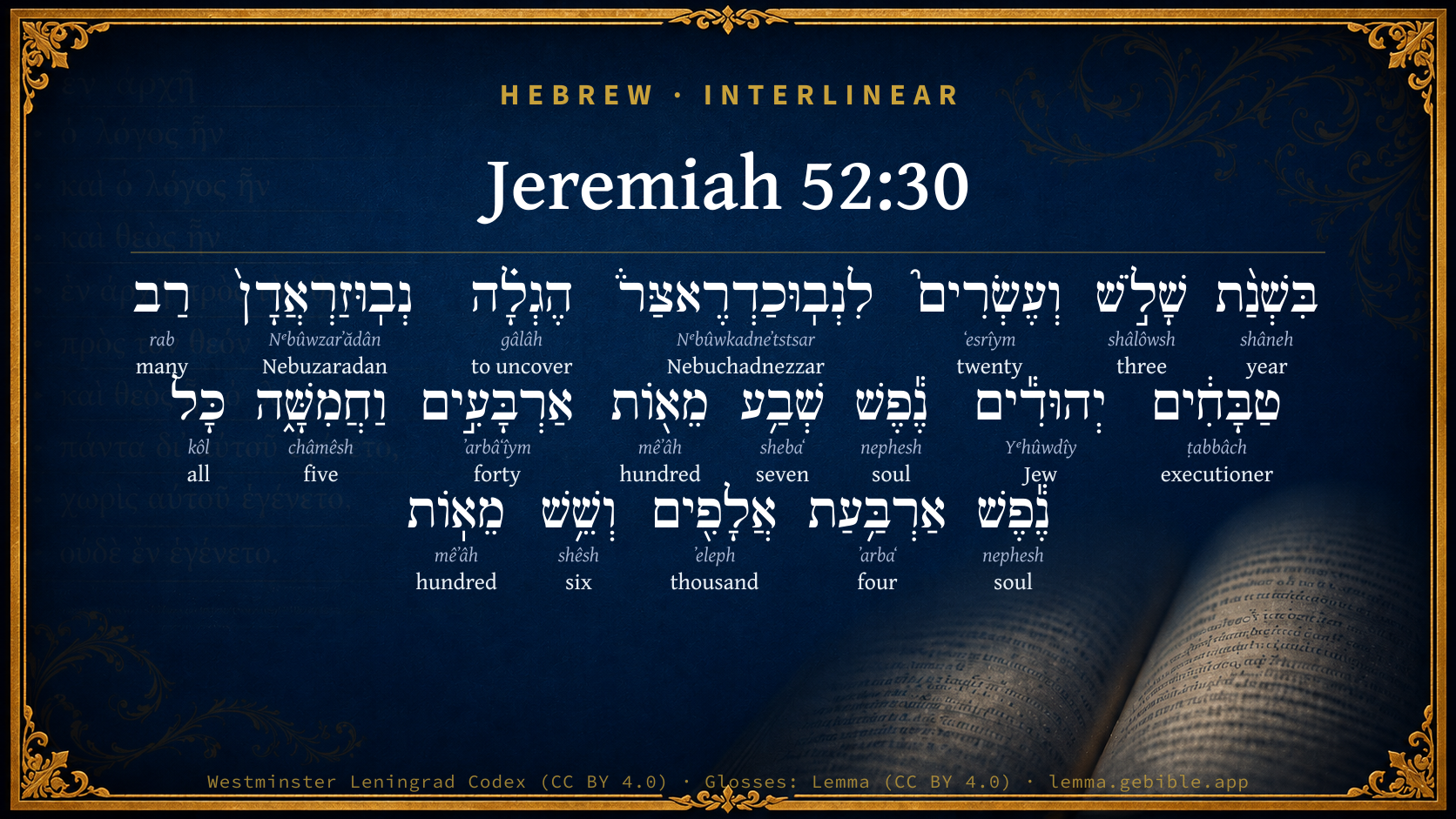
Hebrew (Westminster Leningrad Codex) Jeremiah 52:30 appears in the Hebrew Old Testament. The text above is from the Westminster Leningrad Codex. Each word links to its Strong’s number, a concise gloss, and parsing drawn from the Open Scriptures Hebrew Bible morphology. Click any word for its full Brown-Driver-Briggs (BDB) entry.
Download image
Cite this verse

Jeremiah 52:30 (World English Bible). Public Domain. Lemma interlinear Bible study tool, https://lemma.gebible.app/v/jeremiah/52/30.

Show BibTeX & RIS
BibTeX
RIS
English Translation
in the three and twentieth year of Nebuchadrezzar Nebuzaradan the captain of the guard carried away captive of the Jews seven hundred forty-five persons: all the persons were four thousand and six hundred.
World English Bible · Public Domain
Download a study sheet

One document with this verse’s original text, its word-by-word gloss line, the meaning frame, cross-references with their text, attributed commentary, and full source and license credits — printable, and it pastes into notes with its structure intact.

This verse Autodidact and up

Study sheet (.html) Plain text (.txt)

A passage Seminary Student

Up to 50 verses in one chapter. A passage sheet keeps up to 6 commentary sources and 12 cross-references per verse, in the order this page ranks them, and says so on the sheet whenever that leaves anything out. Ask for a single verse and you get the Autodidact verse sheet above.

Everything on this page stays free to read, with no account — the sheet is a download of what is already on screen, not access to it.

Want to remove ads? Support Godless Engineer
Compare translations 3

The same verse in 3 English versions, stacked beneath the original-language interlinear above. Click any original word for its lexicon entry.

Each is an independent rendering of the whole verse — the interlinear is not word-aligned to these translations.

Highlighted words mark where these versions differ — a whole-verse word diff, not a word-by-word alignment.

  • World English Bible Public Domain
    in the three and twentieth year of Nebuchadrezzar Nebuzaradan the captain of the guard carried away captive of the Jews seven hundred forty-five persons: all the persons were four thousand and six hundred.
  • King James Version Public Domain
    In the three and twentieth year of Nebuchadrezzar Nebuzaradan the captain of the guard carried away captive of the Jews seven hundred forty and five persons: all the persons were four thousand and six hundred.
  • unfoldingWord Literal Text CC BY-SA 4.0
    In the twenty-third year of Nebuchadnezzar, Nebuzaradan, the commander of the king’s bodyguards, exiled 745 Judean people. All the exiled people totaled 4, 600.

unfoldingWord Literal Text — © unfoldingWord, licensed CC BY-SA 4.0. Word-aligned USFM3 via Door43 (git.door43.org/unfoldingWord/en_ult).

Versions to compare (up to 4)

3 of 4 selected

Show all 18 translations

Every available English version of this verse, each an independent rendering of the whole verse.

  • World English Bible Public Domain
    in the three and twentieth year of Nebuchadrezzar Nebuzaradan the captain of the guard carried away captive of the Jews seven hundred forty-five persons: all the persons were four thousand and six hundred.
  • Berean Standard Bible Public Domain
    in Nebuchadnezzar’s twenty-third year, Nebuzaradan captain of the guard carried away 745 Jews. So in all, 4,600 people were taken away.
  • Majority Standard Bible Public Domain
    in Nebuchadnezzar’s twenty-third year, Nebuzaradan captain of the guard carried away 745 Jews. So in all, 4,600 people were taken away.
  • King James Version Public Domain
    In the three and twentieth year of Nebuchadrezzar Nebuzaradan the captain of the guard carried away captive of the Jews seven hundred forty and five persons: all the persons were four thousand and six hundred.
  • American Standard Version (1901) Public Domain
    in the three and twentieth year of Nebuchadrezzar Nebuzaradan the captain of the guard carried away captive of the Jews seven hundred forty and five persons: all the persons were four thousand and six hundred.
  • Revised Version (1885) Public Domain
    in the three and twentieth year of Nebuchadrezzar Nebuzaradan the captain of the guard carried away captive of the Jews seven hundred forty and five persons: all the persons were four thousand and six hundred.
  • Geneva Bible (1599) Public Domain
    In the three and twentieth yeere of Nebuchad-nezzar, Nebuzar-adan the chiefe stewarde caried away captiue of the Iewes seuen hundreth fourtie and fiue persons: all the persons were foure thousand and sixe hundreth.
  • Douay-Rheims (1899) Public Domain
    In the three and twentieth year of Nabuchodonosor, Nabuzardan the general carried away of the Jews seven hundred and forty-five souls. So all the souls were four thousand six hundred.
  • Young's Literal Translation Public Domain
    in the three and twentieth year of Nebuchadrezzar, hath Nebuzar-Adan chief of the guard removed of Jewish souls, seven hundred forty and five; all the souls `are' four thousand and six hundred.
  • Literal Standard Version CC BY-SA 4.0
    in the twenty-third year of Nebuchadnezzar, Nebuzar-Adan, chief of the guard, has removed of Jewish souls, seven hundred forty-five; all the souls [are] four thousand and six hundred.
  • Unlocked Literal Bible CC BY-SA 4.0
    In the twenty-third year of Nebuchadnezzar, Nebuzaradan, the commander of the king's bodyguards, exiled 745 Judean people. All the exiled people totaled 4,600.
  • unfoldingWord Literal Text CC BY-SA 4.0
    In the twenty-third year of Nebuchadnezzar, Nebuzaradan, the commander of the king’s bodyguards, exiled 745 Judean people. All the exiled people totaled 4, 600.
  • Darby Bible Public Domain
    in the twenty-third year of Nebuchadrezzar, Nebuzar-adan the captain of the body-guard carried away captive of the Jews seven hundred and forty-five persons: all the persons were four thousand six hundred.
  • World Messianic Bible Public Domain
    in the twenty-third year of Nebuchadnezzar, Nebuzaradan the captain of the guard carried away captive of the Jews seven hundred forty-five people. All the people numbered four thousand six hundred.
  • Webster's Bible Public Domain
    In the three and twentieth year of Nebuchadrezzar, Nebuzar-adan the captain of the guard carried away captive of the Jews seven hundred forty and five persons: all the persons were four thousand and six hundred.
  • Free Bible Version CC BY-SA 4.0
    In his twenty-third year of Nebuchadnezzar's reign, Nebuzaradan, the commander of the guard, took another 745 Judeans, making a total of 4,600.
  • Bible in Basic English Public Domain
    In the twenty-third year of Nebuchadrezzar, Nebuzaradan, the captain of the armed men, took away as prisoners seven hundred and forty-five of the Jews: all the persons were four thousand and six hundred.
  • JPS Tanakh (1917) Public Domain
    in the three and twentieth year of Nebuchadrezzar Nebuzaradan the captain of the guard carried away captive of the Jews seven hundred forty and five persons; all the persons were four thousand and six hundred.

Literal Standard Version (2020), Covenant Press — licensed CC BY-SA 4.0. Text via the HelloAO Bible API (eBible.org). Unlocked Literal Bible (unfoldingWord) — licensed CC BY-SA 4.0. Text via the HelloAO Bible API (eBible.org). unfoldingWord Literal Text — © unfoldingWord, licensed CC BY-SA 4.0. Word-aligned USFM3 via Door43 (git.door43.org/unfoldingWord/en_ult). Free Bible Version, Dr. Jonathan Gallagher — licensed CC BY-SA 4.0. Text via the HelloAO Bible API (eBible.org).

Word by word

More ways to search: Search by grammar → Find every occurrence → Compare this word →

Practice this passage: Drill this verse → Learn its vocabulary →

נְבֽוּזַרְאֲדָן֙
Nᵉbûwzarʼădân
H5018
“Nebuzaradan”
Noun, Proper
Part of Speech
Noun
Type
Proper
Full BDB Definition

Origin: of foreign origin

TWOT: None

Nebuzaradan = "Nebo has given seed" - a general of Nebuchadnezzar's army at the capture of Jerusalem
  1. בִּשְׁנַ֨ת shâneh H8141 “in/at · year of” Preposition + Noun, Common, Feminine, Singular, Construct
  2. שָׁלֹ֣שׁ shâlôwsh H7969 “three” Adjective, Cardinal number, Feminine, Singular, Absolute
  3. וְעֶשְׂרִים֮ ʻesrîym H6242 “and · twenty” Conjunction + Adjective, Cardinal number, Both, Plural, Absolute
  4. לִנְבֽוּכַדְרֶאצַּר֒ Nᵉbûwkadneʼtstsar H5019 “to/for · Nebuchadnezzar” Preposition + Noun, Proper
  5. הֶגְלָ֗ה gâlâh H1540 “to uncover” Verb, Hiphil, Perfect, 3rd Person, Masculine, Singular
  6. רַב rab H7227 “many of” Noun, Common, Masculine, Singular, Construct
  7. טַבָּחִ֔ים ṭabbâch H2876 “executioners” Noun, Common, Masculine, Plural, Absolute
  8. יְהוּדִ֕ים Yᵉhûwdîy H3064 “Jews” Noun, Gentilic, Masculine, Plural, Absolute
  9. נֶ֕פֶשׁ nephesh H5315 “soul” Noun, Common, Both, Singular, Absolute
  10. שְׁבַ֥ע shebaʻ H7651 “seven” Adjective, Cardinal number, Feminine, Singular, Absolute
  11. מֵא֖וֹת mêʼâh H3967 “hundred” Adjective, Cardinal number, Both, Plural, Absolute
  12. אַרְבָּעִ֣ים ʼarbâʻîym H705 “forty” Adjective, Cardinal number, Both, Plural, Absolute
  13. וַחֲמִשָּׁ֑ה châmêsh H2568 “and · five” Conjunction + Adjective, Cardinal number, Masculine, Singular, Absolute
  14. כָּל kôl H3605 “all of” Noun, Common, Masculine, Singular, Construct
  15. נֶ֕פֶשׁ nephesh H5315 “soul” Noun, Common, Both, Singular, Absolute
  16. אַרְבַּ֥עַת ʼarbaʻ H702 “four” Adjective, Cardinal number, Masculine, Singular, Construct
  17. אֲלָפִ֖ים ʼeleph H505 “thousand” Adjective, Cardinal number, Both, Plural, Absolute
  18. וְשֵׁ֥שׁ shêsh H8337 “and · six” Conjunction + Adjective, Cardinal number, Feminine, Singular, Absolute
  19. מֵאֽוֹת mêʼâh H3967 “hundred” Adjective, Cardinal number, Both, Plural, Absolute

About this verse

These counts appear in no published source. They are computed here, from the morphology-tagged text and Lemma’s own curated glosses. What Lemma adds →

20
words
18
distinct lemmas
Prophets
section

Notable vocabulary

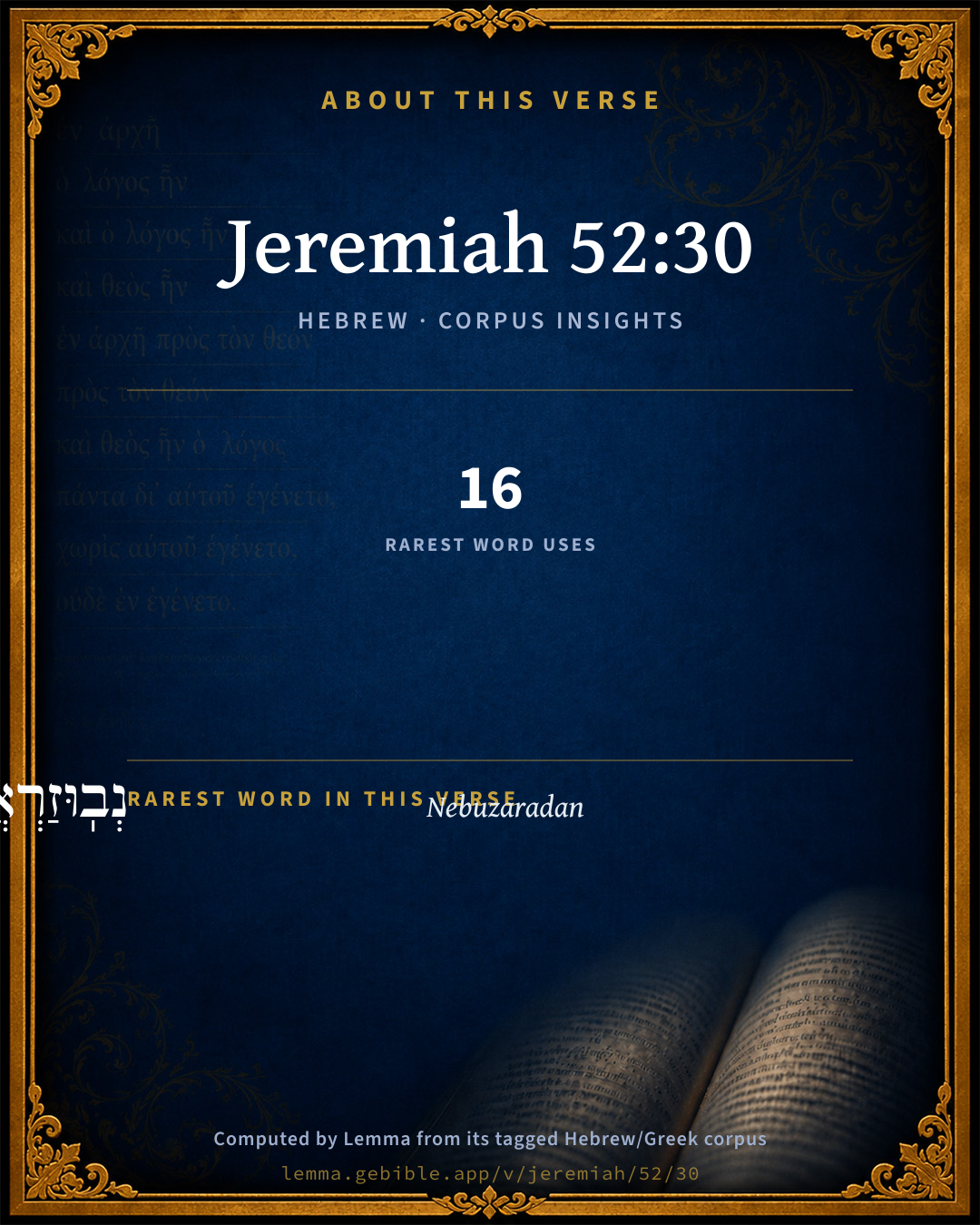
The rarest word here is נְבֽוּזַרְאֲדָן֙ Nebuzaradan H5018 — appearing just 16 times in the whole Hebrew Bible.

Shared distinctive vocabulary

נְבֽוּזַרְאֲדָן֙ Nebuzaradan H5018 occurs in 15 verses of the Hebrew Bible. Also found in:

Grammatical profile

  • 1 verb
  • 9 nouns
  • 10 adjectives

Verb forms

  • הֶגְלָ֗ה Hiphil · Perfect

Repetition

Words recur within this verse — often emphatic in Hebrew:

  • נֶ֕פֶשׁ soul H5315 ×2
  • מֵא֖וֹת hundred H3967 ×2

Cross-references

2

Topical passages linked to Jeremiah 52:30 in the Treasury of Scripture Knowledge — connected by theme and wording, ordered by reader-vote popularity; previews shown in the World English Bible.

  • Jeremiah 6:9 Thus says Yahweh of Hosts, They shall thoroughly glean the remnant of Israel as a vine: turn again your hand as a grape-gatherer into the baskets.
  • Jeremiah 52:15 Then Nebuzaradan the captain of the guard carried away captive of the poorest of the people, and the residue of the people who were left in the city, and those who fell away, who fell to the king of Babylon, and the residue of the multitude.

Cross-references courtesy of OpenBible.info (CC BY 4.0).

Hebrew and Greek witnesses Masoretic Hebrew ↔ Greek Septuagint

The same verse in the two great witnesses to the Old Testament, shown verse-for-verse.

These are two independent witnesses, not word-aligned to each other, and the Septuagint is shown in lemma (dictionary) form.

Hebrew Jeremiah 52:30 Masoretic · Westminster Leningrad Codex

בִּשְׁנַ֨ת שָׁלֹ֣שׁ וְעֶשְׂרִים֮ לִנְבֽוּכַדְרֶאצַּר֒ הֶגְלָ֗ה נְבֽוּזַרְאֲדָן֙ רַב טַבָּחִ֔ים יְהוּדִ֕ים נֶ֕פֶשׁ שְׁבַ֥ע מֵא֖וֹת אַרְבָּעִ֣ים וַחֲמִשָּׁ֑ה כָּל נֶ֕פֶשׁ אַרְבַּ֥עַת אֲלָפִ֖ים וְשֵׁ֥שׁ מֵאֽוֹת

in the three and twentieth year of Nebuchadrezzar Nebuzaradan the captain of the guard carried away captive of the Jews seven hundred forty-five persons: all the persons were four thousand and six hundred.

World English Bible · Public Domain

Greek LXX Structure differs

In the Septuagint, Jeremiah is about an eighth shorter than the Hebrew and arranges its material differently — the Oracles Against the Nations (Hebrew chapters 46–51) appear in the middle of the Greek book, after 25:13. Because the chapter and verse boundaries do not line up, a verse-for-verse comparison with the Hebrew is not shown.

A verse-for-verse comparison isn’t shown here because the chapters and verses don’t line up. Switch to the LXX edition with the MT / LXX toggle above to read the Greek directly.

Hebrew: Westminster Leningrad Codex (CC BY 4.0). Greek: Septuagint (public domain); English from a public-domain English Septuagint. How the Septuagint differs from the Hebrew →

Targum (Aramaic paraphrase)

1

The Targum is the ancient Jewish Aramaic paraphrase of the Hebrew Scriptures — an interpretive translation, not the Hebrew text itself. Onkelos (literal) and Pseudo-Jonathan (expansive) render the Torah, and Jonathan the Prophets. Coverage is partial: where no permissively-licensed English translation exists for a verse, only the Aramaic is shown. This is verse-level text, not a word-by-word alignment to the Hebrew.

  1. Targum Jonathan Prophets (Joshua–Malachi)
    בִּשְׁנַת עַסְרִין וּתְלַת לִנְבוּכַדְרֶאצַר אֶגְלֵי נְבוּזַרְאֲדָן רַב קָטוֹלַיָא יְהוּדָאִי נַפְשָׁתָא שְׁבַע מְאָה אַרְבְּעִין וַחֲמֵשׁ כָּל נַפְשָׁתָא אַרְבְּעָא אַלְפִין וְשִׁית מְאָה:

    (no public-domain English translation for this verse)

    Targum Jonathan — Aramaic: “Mikraot Gedolot” (public domain). English: “Sefaria Community Translation” (CC0 1.0 (public-domain dedication)); “London "Chaldee Paraphrase," 1871” (public domain). Text via Sefaria.

Commentary

Notes on Jeremiah 52:30 from classic Christian and Jewish commentators (each source and its license shown beneath its notes). The classic Christian expositions comment on the surrounding passage and are grouped to its opening verse, so a note may address several verses; the Jewish commentaries on the Tanakh (Rashi and others) are per-verse, so they appear only where the commentator wrote on this verse.

Lemma curates 59 commentaries, every one of them public domain or Creative Commons licensed, each selected and text-cleaned for this edition rather than reprinted as found. About our sources →

Jamieson, Fausset & Brown

Robert Jamieson, A. R. Fausset & David Brown

Not recorded in Kings or Chronicles. Probably it took place during the commotions that followed the death of Gedaliah (Jer 41:18; Kg2 25:26).

four thousand and six hundred--The exact sum-total of the numbers specified here, namely, three thousand twenty-three, eight hundred thirty-two, seven hundred forty-five, not including the general multitude and the women and children (Jer 52:15; Jer 39:9; Kg2 25:11).

Jamieson, Fausset & Brown — Commentary Critical and Explanatory on the Whole Bible (1871) — public domain (CC PDM 1.0). Text via the HelloAO Bible API.

Adam Clarke's Commentary

Verse 30. See Clarke on Jer 52:28.

Adam Clarke's Commentary on the Bible (1810–1826) — public domain. Text from a community e-Sword/MySword module.

Ellicott's Commentary for English Readers

(30) In the three and twentieth year of Nebuchadrezzar . . .—There is no record of this final deportation, five years after the capture of the city, in the historical books. It probably followed on the conquest of Egypt predicted in Jer_44:11; Jer_44:28, and included some of those who had emigrated to that country; perhaps also on that of the Moabites and Edomites, among whom many Jews had probably taken refuge. The total number, including the 10,000 who are not mentioned here (see Note on Jer_52:28), mounts up to 14,600. In Ezr_2:64-65 the number of those who returned from Babylon is given at 42,360, besides 7,337 male and female slaves, and this, as many remained behind in Babylon, is more than can be accounted for by the natural increase of population. Assuming the correctness of the numbers, we are led to the conclusion that after the exiles were settled in Babylon, and found themselves in a more favourable position than was at first anticipated (Jer_29:5-6), they were joined by friends and kindred, who hoped to be better off there than in the desolation and disorders of their own country.

A Bible Commentary for English Readers, edited by Charles John Ellicott (1878–1897) — public domain. Text from a community e-Sword module.

John Gill's Exposition

And it came to pass in the seven and thirtieth year of the captivity of Jehoiachin king of Judah,.... He was eighteen years of age when he was carried captive; so that he must be now fifty five years old; see Kg2 24:8;

in the twelfth month, in the five and twentieth day of the month; in the month Adar, which answers to part of February, and part of March: in Kg2 25:27; the favour shown by the king of Babylon to Jeconiah, after related, is said to be in the twenty seventh day of the month; it might have been determined and notified on the twenty fifth, but not executed till the twenty seventh; or it might be begun to be put in execution on the twenty fifth, and not finished till the twenty seventh, The Jews, in their chronicle, say (n) that Nebuchadnezzar died on the twenty fifth, and was buried; that, on the twenty sixth, Evilmerodach took him out of his grave, and dragged him about, to abolish his decrees, and to confirm what is said of him in Isa 14:19; and on the twenty seventh he brought Jeconiah out of prison; but this is no reconciliation at all; the former is best;

that Evilmerodach king of Babylon, in the first year of his reign; who succeeded Nebuchadnezzar, having reigned forty three years; this king is called by Ptolemy (o) Iloarudamus; by Abydenus (p) Evilmaluruch; by Josephus (q) Abilamarodach; but by Berosus (r) as here: his proper name was Merodach, a name of one of the Chaldean idols, Jer 50:2. "Evil" was a nickname, which signifies "foolish"; he was called "foolish Merodach", on account of his ill conduct, or bad life: as soon as he came to the throne, he

lifted up the head of Jehoiachin king of Judah, and brought him forth out of prison; that is, he changed his condition for the better; he raised him out of a low estate to a more honourable one; he brought him out of a state of imprisonment and misery into a state of liberty and honour; what was the reason of this is not easy to say. The Jews have a tradition, that Nebuchadnezzar, after seven years' madness, coming to himself, and to his kingdom, and understanding that his son Evilmerodach had been guilty of mal-administration during that time, and particularly that he rejoiced at his madness, cast him into prison, where he contracted a friendship with Jeconiah; and when he came to the throne, upon the death of his father, released him: but others think that Jeconiah being a comely young man, when he was brought a captive to Babylon, and about the age of this prince, he took a liking to him, and, pitying his case, showed him this favour, as soon as he had an opportunity.

(n) Seder Olam, c. 28. p. 81. (o) Canon, Ed. Bainbridge, p. 48. (p) Apud Euseb. Evangel. Praepar. l. 9. c. 41. p. 457. (q) Antiqu. l. 10. c. 11. sect. 8. (r) Apud Joseph. contr. Apion. l. 1. c. 20.

John Gill's Exposition of the Whole Bible (1746–1763) — public domain (CC PDM 1.0). Text via the HelloAO Bible API.

Matthew Poole's English Annotations

Of this we read nothing in holy writ; some judge it to have been upon occasion of Ishmael’s killing Gedaliah, but this was four years after the taking of the city, and we are not certain what at this time brought again the Chaldean forces.

Matthew Poole's English Annotations on the Holy Bible (1683–1685) — public domain. Text from a community e-Sword/MySword module.

John Wesley's Explanatory Notes

All the persons were four thousand and six hundred - How amazingly were the Jews diminished, that this handful was all who were carried captive!

John Wesley, Explanatory Notes Upon the Whole Bible (1754–1765) — public domain. Text via the GEBible commentary corpus.

Lesson kit

Teaching starters — assembled from the data on this page, not authored interpretation. Every prompt links to the verse data it draws on. Edit before teaching.

Jeremiah, in the Prophets, opens this verse with 20 words (18 distinct Hebrew lemmas). Its most distinctive word is Nᵉbûwzarʼădân (“Nebuzaradan”). A historical commentator’s framing appears above. Read the whole chapter for the surrounding context.

Discussion questions

  1. How does “Nebuzaradan” (Nᵉbûwzarʼădân) shape what this verse is saying?
  2. How does 2 Kings 25:8, which shares the word «Nebuzaradan», read alongside this verse?
  3. What does the repetition of “soul” (2× in this one verse) do in this verse?
  4. The translations on this page render this verse differently — a whole-verse word diff, not a word-by-word alignment. What might account for the different wordings?
  5. «הֶגְלָ֗ה» is a Hiphil Perfect verb. How does that grammatical form shape the action described?
  6. Compare how Jamieson, Fausset & Brown and Adam Clarke's Commentary read this verse. Where do they agree or differ?

Things to notice

Reading settings

Reading text

Shown beneath each verse's original-language words.

Old Testament
Old Testament edition

Read the OT as the Masoretic Hebrew (MT) or the Greek Septuagint (LXX).

English shown for the Greek Septuagint (in the Hebrew ↔ Greek comparison).

Comparing translations? Open the Compare panel on any verse page to stack up to four side by side.