
2 Kings 15:29

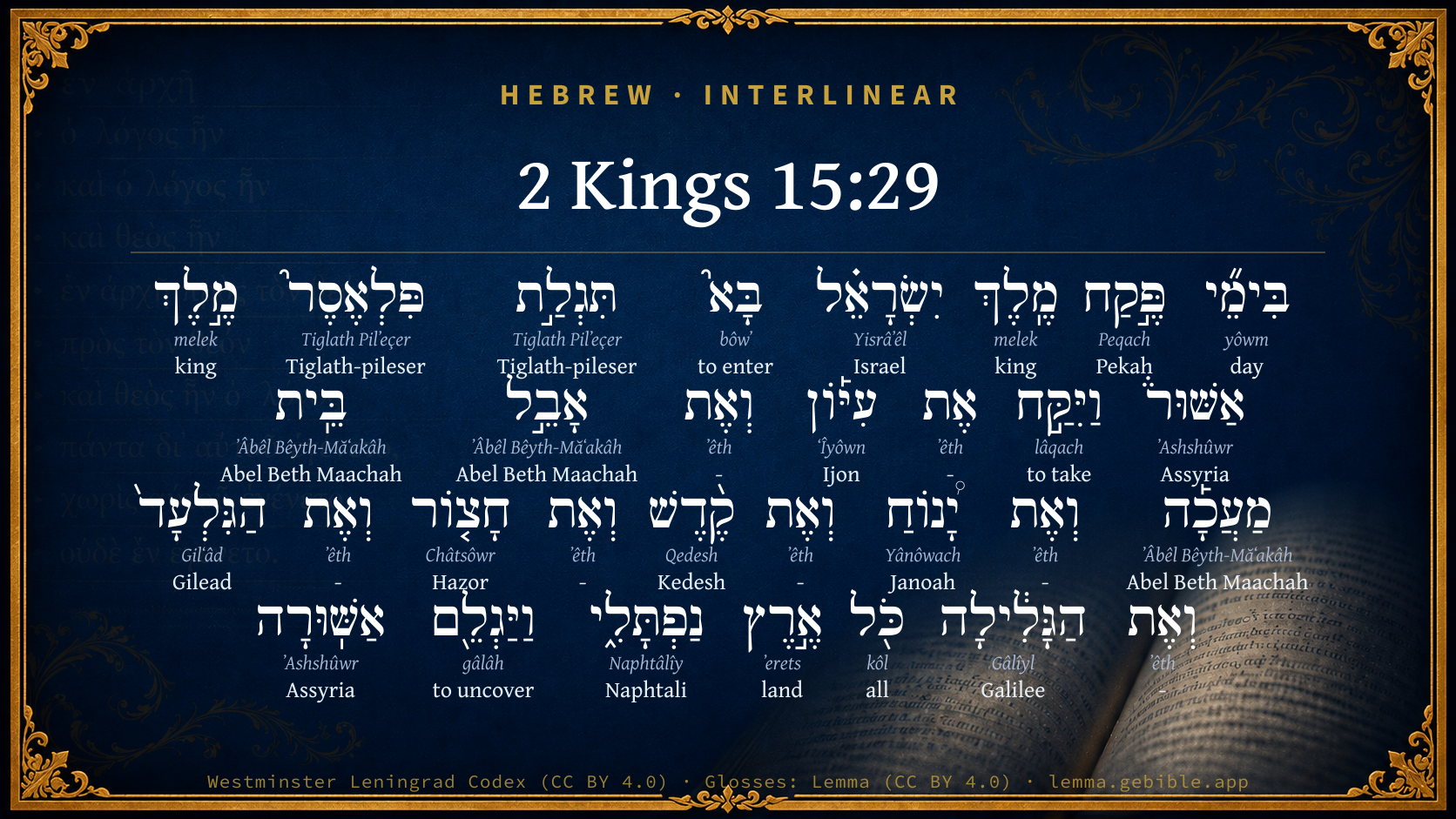
Hebrew (Westminster Leningrad Codex) 2 Kings 15:29 appears in the Hebrew Old Testament. The text above is from the Westminster Leningrad Codex. Each word links to its Strong’s number, a concise gloss, and parsing drawn from the Open Scriptures Hebrew Bible morphology. Click any word for its full Brown-Driver-Briggs (BDB) entry.
Download image
Cite this verse

2 Kings 15:29 (World English Bible). Public Domain. Lemma interlinear Bible study tool, https://lemma.gebible.app/v/2-kings/15/29.

Show BibTeX & RIS
BibTeX
RIS
English Translation
In the days of Pekah king of Israel came Tiglath Pileser king of Assyria, and took Ijon, and Abel Beth Maacah, and Janoah, and Kedesh, and Hazor, and Gilead, and Galilee, all the land of Naphtali; and he carried them captive to Assyria.
World English Bible · Public Domain
Highlights
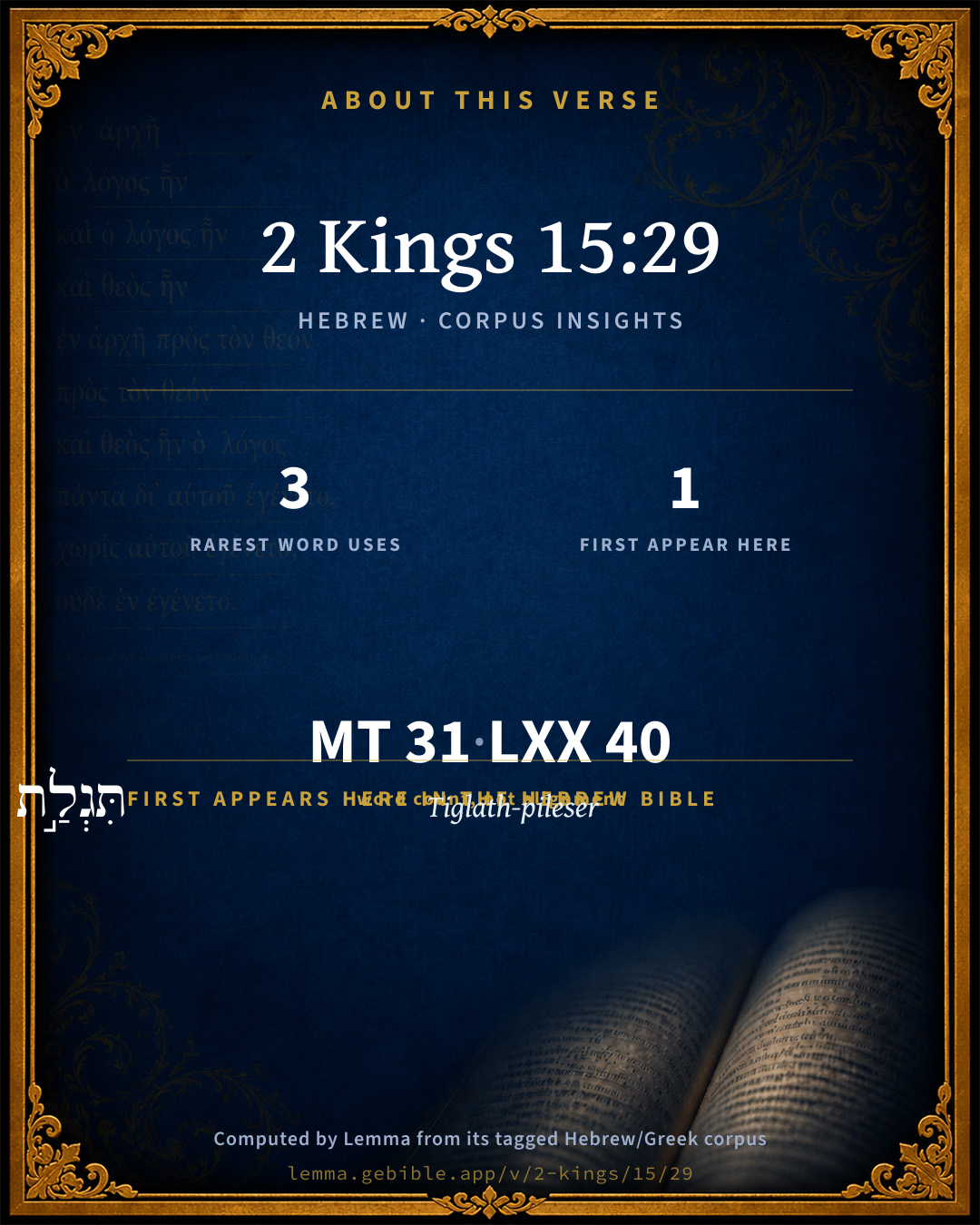
  • 1 first appearance in the Hebrew Bible
Full analysis ↓
Download a study sheet

One document with this verse’s original text, its word-by-word gloss line, the meaning frame, cross-references with their text, attributed commentary, and full source and license credits — printable, and it pastes into notes with its structure intact.

This verse Autodidact and up

Study sheet (.html) Plain text (.txt)

A passage Seminary Student

Up to 50 verses in one chapter. A passage sheet keeps up to 6 commentary sources and 12 cross-references per verse, in the order this page ranks them, and says so on the sheet whenever that leaves anything out. Ask for a single verse and you get the Autodidact verse sheet above.

Everything on this page stays free to read, with no account — the sheet is a download of what is already on screen, not access to it.

Want to remove ads? Support Godless Engineer
Compare translations 3

The same verse in 3 English versions, stacked beneath the original-language interlinear above. Click any original word for its lexicon entry.

Each is an independent rendering of the whole verse — the interlinear is not word-aligned to these translations.

Highlighted words mark where these versions differ — a whole-verse word diff, not a word-by-word alignment.

  • World English Bible Public Domain
    In the days of Pekah king of Israel came Tiglath Pileser king of Assyria, and took Ijon, and Abel Beth Maacah, and Janoah, and Kedesh, and Hazor, and Gilead, and Galilee, all the land of Naphtali; and he carried them captive to Assyria.
  • King James Version Public Domain
    In the days of Pekah king of Israel came Tiglathpileser king of Assyria, and took Ijon, and Abelbethmaachah, and Janoah, and Kedesh, and Hazor, and Gilead, and Galilee, all the land of Naphtali, and carried them captive to Assyria.
  • unfoldingWord Literal Text CC BY-SA 4.0
    In the days of Pekah, the king of Israel, Tiglath Pileser, the king of Assyria, came, and he took Ijon and Abel Beth Maacah and Janoah and Kedesh and Hazor and Gilead and Galilee, all of the land of Naphtali, and he exiled them to Assyria.

unfoldingWord Literal Text — © unfoldingWord, licensed CC BY-SA 4.0. Word-aligned USFM3 via Door43 (git.door43.org/unfoldingWord/en_ult).

Versions to compare (up to 4)

3 of 4 selected

Show all 18 translations

Every available English version of this verse, each an independent rendering of the whole verse.

  • World English Bible Public Domain
    In the days of Pekah king of Israel came Tiglath Pileser king of Assyria, and took Ijon, and Abel Beth Maacah, and Janoah, and Kedesh, and Hazor, and Gilead, and Galilee, all the land of Naphtali; and he carried them captive to Assyria.
  • Berean Standard Bible Public Domain
    In the days of Pekah king of Israel, Tiglath-pileser king of Assyria came and captured Ijon, Abel-beth-maacah, Janoah, Kedesh, Hazor, Gilead, and Galilee, including all the land of Naphtali, and he took the people as captives to Assyria.
  • Majority Standard Bible Public Domain
    In the days of Pekah king of Israel, Tiglath-pileser king of Assyria came and captured Ijon, Abel-beth-maacah, Janoah, Kedesh, Hazor, Gilead, and Galilee, including all the land of Naphtali, and he took the people as captives to Assyria.
  • King James Version Public Domain
    In the days of Pekah king of Israel came Tiglathpileser king of Assyria, and took Ijon, and Abelbethmaachah, and Janoah, and Kedesh, and Hazor, and Gilead, and Galilee, all the land of Naphtali, and carried them captive to Assyria.
  • American Standard Version (1901) Public Domain
    In the days of Pekah king of Israel came Tiglath-pileser king of Assyria, and took Ijon, and Abel-beth-maacah, and Janoah, and Kedesh, and Hazor, and Gilead, and Galilee, all the land of Naphtali; and he carried them captive to Assyria.
  • Revised Version (1885) Public Domain
    In the days of Pekah king of Israel came Tiglath-pileser king of Assyria, and took Ijon, and Abel-beth-maacah, and Janoah, and Kedesh, and Hazor, and Gilead, and Galilee, all the land of Naphtali; and he carried them captive to Assyria.
  • Geneva Bible (1599) Public Domain
    In the dayes of Pekah king of Israel came Tiglath Pileser king of Asshur, and tooke Iion, and Abel, Beth-maachah, and Ianoah, and Kedesh, and Hazor, and Gilead, and Galilah, and all the land of Naphtali, and caryed them away to Asshur.
  • Douay-Rheims (1899) Public Domain
    In the days of Phacee king of Israel came Theglathphalasar king of Assyria, and took Aion, and Abel Domum Maacha and Janoe, and Cedes, and Asor, and Galaad, and Galilee, and all the land of Nephtali: and carried them captives into Assyria.
  • Young's Literal Translation Public Domain
    In the days of Pekah king of Israel hath Tiglath-Pileser king of Asshur come, and taketh Ijon, and Abel-Beth-Maachah, and Janoah, and Kedesh, and Hazor, and Gilead, and Galilee, all the land of Naphtali, and removeth them to Asshur.
  • Literal Standard Version CC BY-SA 4.0
    In the days of Pekah king of Israel, Tiglath-Pileser king of Asshur has come, and takes Ijon, and Abel-Beth-Maachah, and Janoah, and Kedesh, and Hazor, and Gilead, and Galilee, all the land of Naphtali, and removes them to Asshur.
  • Unlocked Literal Bible CC BY-SA 4.0
    In the days of Pekah king of Israel, Tiglath-Pileser king of Assyria came and took Ijon, Abel Beth Maacah, Janoah, Kedesh, Hazor, Gilead, Galilee, and all the land of Naphtali. He carried away the people to Assyria.
  • unfoldingWord Literal Text CC BY-SA 4.0
    In the days of Pekah, the king of Israel, Tiglath Pileser, the king of Assyria, came, and he took Ijon and Abel Beth Maacah and Janoah and Kedesh and Hazor and Gilead and Galilee, all of the land of Naphtali, and he exiled them to Assyria.
  • Darby Bible Public Domain
    In the days of Pekah king of Israel, Tiglath-Pileser king of Assyria came and took Ijon, and Abel-Beth-Maachah, and Janoah, and Kedesh, and Hazor, and Gilead, and Galilee, all the land of Naphtali, and carried them captive to Assyria.
  • World Messianic Bible Public Domain
    In the days of Pekah king of Israel, Tiglath Pileser king of Assyria came and took Ijon, Abel Beth Maacah, Janoah, Kedesh, Hazor, Gilead, and Galilee, all the land of Naphtali; and he carried them captive to Assyria.
  • Webster's Bible Public Domain
    In the days of Pekah king of Israel came Tiglath-pileser king of Assyria, and took Ijon, and Abel-beth-maachah, and Janoah, and Kedesh, and Hazor, and Gilead, and Galilee, all the land of Naphtali, and carried them captive to Assyria.
  • Free Bible Version CC BY-SA 4.0
    During the reign of Pekah, king of Israel, Tiglath-pileser, king of Assyria, invaded and captured Ijon, Abel-beth-maacah, Janoah, Kedesh, Hazor, Gilead, Galilee, and all the land of Naphtali, and he took the people to Assyria as prisoners.
  • Bible in Basic English Public Domain
    In the days of Pekah, king of Israel, Tiglath-pileser, king of Assyria, came and took Ijon and Abel-beth-maacah and Janoah and Kedesh and Hazor and Gilead and Galilee and all the land of Naphtali; and he took the people away to Assyria.
  • JPS Tanakh (1917) Public Domain
    In the days of Pekah king of Israel came Tiglath-pileser king of Assyria, and took Ijon, and Abel-beth-maacah, and Janoah, and Kedesh, and Hazor, and Gilead, and Galilee, all the land of Naphtali; and he carried them captive to Assyria.

Literal Standard Version (2020), Covenant Press — licensed CC BY-SA 4.0. Text via the HelloAO Bible API (eBible.org). Unlocked Literal Bible (unfoldingWord) — licensed CC BY-SA 4.0. Text via the HelloAO Bible API (eBible.org). unfoldingWord Literal Text — © unfoldingWord, licensed CC BY-SA 4.0. Word-aligned USFM3 via Door43 (git.door43.org/unfoldingWord/en_ult). Free Bible Version, Dr. Jonathan Gallagher — licensed CC BY-SA 4.0. Text via the HelloAO Bible API (eBible.org).

Word by word

More ways to search: Search by grammar → Find every occurrence → Compare this word →

Practice this passage: Drill this verse → Learn its vocabulary →

עִיּ֡וֹן
ʻÎyôwn
H5859
“Ijon”
Noun, Proper
Part of Speech
Noun
Type
Proper
Full BDB Definition

Origin: from H5856

TWOT: None

Ijon = "a ruin" - a place in the north of Palestine belonging to the tribe of Naphtali
  1. בִּימֵ֞י yôwm H3117 “in/at · days of” Preposition + Noun, Common, Masculine, Plural, Construct
  2. פֶּ֣קַח Peqach H6492 “Pekah” Noun, Proper
  3. מֶֽלֶךְ melek H4428 “king of” Noun, Common, Masculine, Singular, Construct
  4. יִשְׂרָאֵ֗ל Yisrâʼêl H3478 “Israel” Noun, Proper
  5. בָּא֮ bôwʼ H935 “to enter” Verb, Qal, Perfect, 3rd Person, Masculine, Singular
  6. תִּגְלַ֣ת Tiglath Pilʼeçer H8407 “Tiglath-pileser” Noun, Proper
  7. פִּלְאֶסֶר֮ Tiglath Pilʼeçer H8407 “Tiglath-pileser” Noun, Proper
  8. מֶ֣לֶךְ melek H4428 “king of” Noun, Common, Masculine, Singular, Construct
  9. אַשּׁוּר֒ ʼAshshûwr H804 “Assyria” Noun, Proper
  10. וַיִּקַּ֣ח lâqach H3947 “and · to take” Conjunction + Verb, Qal, Sequential Imperfect, 3rd Person, Masculine, Singular
  11. אֶת ʼêth H853 “-” Particle, Direct Object
  12. וְאֶת ʼêth H853 “and · -” Conjunction + Particle, Direct Object
  13. אָבֵ֣ל ʼÂbêl Bêyth-Măʻakâh H62 “Abel Beth Maachah” Noun, Proper
  14. בֵּֽית ʼÂbêl Bêyth-Măʻakâh H62 “Abel Beth Maachah” Noun, Proper
  15. מַעֲכָ֡ה ʼÂbêl Bêyth-Măʻakâh H62 “Abel Beth Maachah” Noun, Proper
  16. וְאֶת ʼêth H853 “and · -” Conjunction + Particle, Direct Object
  17. יָ֠נוֹחַ Yânôwach H3239 “Janoah” Noun, Proper
  18. וְאֶת ʼêth H853 “and · -” Conjunction + Particle, Direct Object
  19. קֶ֨דֶשׁ Qedesh H6943 “Kedesh” Noun, Proper
  20. וְאֶת ʼêth H853 “and · -” Conjunction + Particle, Direct Object
  21. חָצ֤וֹר Châtsôwr H2674 “Hazor” Noun, Proper
  22. וְאֶת ʼêth H853 “and · -” Conjunction + Particle, Direct Object
  23. הַגִּלְעָד֙ Gilʻâd H1568 “the · Gilead” Particle, Definite Article + Noun, Proper
  24. וְאֶת ʼêth H853 “and · -” Conjunction + Particle, Direct Object
  25. הַגָּלִ֔ילָה Gâlîyl H1551 “the · Galilee · toward” Particle, Definite Article + Noun, Proper + Suffix, Demonstrative
  26. כֹּ֖ל kôl H3605 “all of” Noun, Common, Masculine, Singular, Construct
  27. אֶ֣רֶץ ʼerets H776 “land of” Noun, Common, Both, Singular, Construct
  28. נַפְתָּלִ֑י Naphtâlîy H5321 “Naphtali” Noun, Proper
  29. וַיַּגְלֵ֖ם gâlâh H1540 “and · to uncover · them” Conjunction + Verb, Hiphil, Sequential Imperfect, 3rd Person, Masculine, Singular + Suffix, Personal, 3rd Person, Masculine, Plural
  30. אַשּֽׁוּרָה ʼAshshûwr H804 “Assyria · toward” Noun, Proper + Suffix, Demonstrative

About this verse

These counts appear in no published source. They are computed here, from the morphology-tagged text and Lemma’s own curated glosses. What Lemma adds →

31
words
20
distinct lemmas
Historical
section

Notable vocabulary

The rarest word here is עִיּ֡וֹן Ijon H5859 — appearing just 3 times in the whole Hebrew Bible.

First appearance in Scripture

This word makes its first canonical appearance in the Hebrew Bible here:

  • תִּגְלַ֣ת Tiglath-pileser H8407

Shared distinctive vocabulary

עִיּ֡וֹן Ijon H5859 occurs in 3 verses of the Hebrew Bible. Also found in:

Grammatical profile

  • 3 verbs
  • 21 nouns
  • 7 particles

Verb forms

  • בָּא֮ Qal · Perfect
  • וַיִּקַּ֣ח Qal · Sequential Imperfect
  • וַיַּגְלֵ֖ם Hiphil · Sequential Imperfect

Repetition

Words recur within this verse — often emphatic in Hebrew:

  • אָבֵ֣ל Abel Beth Maachah H62 ×3
  • מֶֽלֶךְ king H4428 ×2
  • תִּגְלַ֣ת Tiglath-pileser H8407 ×2
  • אַשּׁוּר֒ Assyria H804 ×2

Hebrew & Septuagint length

In English translation the verse runs 43 words from the Hebrew and 44 from the Septuagint (LXX English) — closely comparable.

A rough comparison of the two English renderings, which tokenize alike — not a word-level alignment.

Word counts can differ between the Hebrew and the Greek without any difference in meaning — e.g. the Hebrew direct-object marker אֵת has no separate Greek word, and Greek often adds the article ὁ.

In the original languages it is 31 Hebrew tokens and 40 Greek tokens — but the two are counted differently (Hebrew bundles its prefixes and suffixes into one token; the Greek is in lemma form), so that isn’t a like-for-like length.

Cross-references

32

Topical passages linked to 2 Kings 15:29 in the Treasury of Scripture Knowledge — connected by theme and wording, ordered by reader-vote popularity; previews shown in the World English Bible.

  • 1 Chronicles 5:26 The God of Israel stirred up the spirit of Pul king of Assyria, and the spirit of Tilgath Pilneser king of Assyria, and he carried them away, even the Reubenites, and the Gadites, and the half-tribe of Manasseh, and brought them to Halah, and Habor, and Hara, and to the river of Gozan, to this day.
  • 2 Kings 17:6 In the ninth year of Hoshea the king of Assyria took Samaria, and carried Israel away to Assyria, and placed them in Halah, and on the Habor, the river of Gozan, and in the cities of the Medes.
  • Joshua 20:7 They set apart Kedesh in Galilee in the hill-country of Naphtali, and Shechem in the hill-country of Ephraim, and Kiriath Arba (the same is Hebron) in the hill-country of Judah.
  • 1 Kings 15:20 Ben Hadad listened to king Asa, and sent the captains of his armies against the cities of Israel, and struck Ijon, and Dan, and Abel Beth Maacah, and all Chinneroth, with all the land of Naphtali.
  • 2 Kings 16:7 So Ahaz sent messengers to Tiglath Pileser king of Assyria, saying, I am your servant and your son: come up, and save me out of the hand of the king of Syria, and out of the hand of the king of Israel, who rise up against me.
  • Joshua 11:1 It happened, when Jabin king of Hazor heard of it, that he sent to Jobab king of Madon, and to the king of Shimron, and to the king of Achshaph,
  • Joshua 19:37 and Kedesh, and Edrei, and En Hazor,
  • Judges 4:2 Yahweh sold them into the hand of Jabin king of Canaan, who reigned in Hazor; the captain of whose host was Sisera, who lived in Harosheth of the Gentiles.
  • 2 Samuel 20:14–15 He went through all the tribes of Israel to Abel, and to Beth Maacah, and all the Berites: and they were gathered together, and went also after him.
  • 1 Chronicles 5:6 Beerah his son, whom Tilgath Pilneser king of Assyria carried away captive: he was prince of the Reubenites.
  • 2 Chronicles 16:4 Ben Hadad listened to king Asa, and sent the captains of his armies against the cities of Israel; and they struck Ijon, and Dan, and Abel Maim, and all the store-cities of Naphtali.
  • Leviticus 26:32 I will bring the land into desolation; and your enemies that dwell therein will be astonished at it.
  • Leviticus 26:38–39 You will perish among the nations, and the land of your enemies will eat you up.
  • Numbers 32:1 Now the children of Reuben and the children of Gad had a very great multitude of cattle: and when they saw the land of Jazer, and the land of Gilead, that behold, the place was a place for cattle;
  • Numbers 32:40 Moses gave Gilead to Machir the son of Manasseh; and he lived therein.
  • Deuteronomy 3:15 I gave Gilead to Machir.
  • Deuteronomy 4:26–27 I call heaven and earth to witness against you this day, that you shall soon utterly perish from off the land whereunto you go over the Jordan to possess it; you shall not prolong your days on it, but shall utterly be destroyed.
  • Deuteronomy 28:25 Yahweh will cause you to be struck before your enemies; you shall go out one way against them, and shall flee seven ways before them: and you shall be tossed back and forth among all the kingdoms of the earth.
  • Deuteronomy 28:64–65 Yahweh will scatter you among all peoples, from the one end of the earth even to the other end of the earth; and there you shall serve other gods, which you have not known, you nor your fathers, even wood and stone.
  • Joshua 11:10 Joshua turned back at that time, and took Hazor, and struck the king of it with the sword: for Hazor before was the head of all those kingdoms.
  • Joshua 11:13 But as for the cities that stood on their mounds, Israel burned none of them, save Hazor only; that did Joshua burn.
  • Joshua 12:19 the king of Madon, one; the king of Hazor, one;
  • Joshua 16:6 and the border went out westward at Michmethath on the north; and the border turned about eastward to Taanath Shiloh, and passed along it on the east of Janoah;
  • 1 Kings 9:11 (now Hiram the king of Tyre had furnished Solomon with cedar trees and fir trees, and with gold, according to all his desire), that then king Solomon gave Hiram twenty cities in the land of Galilee.
  • 2 Kings 17:23 until Yahweh removed Israel out of his sight, as he spoke by all his servants the prophets. So Israel was carried away out of their own land to Assyria to this day.
  • 2 Chronicles 28:20–21 Tilgath Pilneser king of Assyria came to him, and distressed him, but didn't strengthen him.
  • Isaiah 1:7 Your country is desolate. Your cities are burned with fire. Strangers devour your land in your presence, And it is desolate, As overthrown by strangers.
  • Isaiah 7:20 In that day the Lord will shave with a razor that is hired in the parts beyond the River, even with the king of Assyria, the head and the hair of the feet; and it shall also consume the beard.
  • Isaiah 9:1–2 But there shall be no gloom to her who was in anguish. In the former time he brought into contempt the land of Zebulun and the land of Naphtali; but in the latter time has he made it glorious, by the way of the sea, beyond the Jordan, Galilee of the nations.
  • Amos 1:3 Thus says Yahweh: "For three transgressions of Damascus, yes, for four, I will not turn away its punishment; Because they have threshed Gilead with threshing instruments of iron;
  • Amos 1:13 Thus says Yahweh: "For three transgressions of the children of Ammon, yes, for four, I will not turn away its punishment; Because they have ripped open the pregnant women of Gilead, That they may enlarge their border.
  • Matthew 4:15–16 "The land of Zebulun and the land of Naphtali, Toward the sea, beyond the Jordan, Galilee of the Gentiles,

Cross-references courtesy of OpenBible.info (CC BY 4.0).

Hebrew and Greek witnesses Masoretic Hebrew ↔ Greek Septuagint

The same verse in the two great witnesses to the Old Testament, shown verse-for-verse.

These are two independent witnesses, not word-aligned to each other, and the Septuagint is shown in lemma (dictionary) form.

Hebrew 2 Kings 15:29 Masoretic · Westminster Leningrad Codex

בִּימֵ֞י פֶּ֣קַח מֶֽלֶךְ יִשְׂרָאֵ֗ל בָּא֮ תִּגְלַ֣ת פִּלְאֶסֶר֮ מֶ֣לֶךְ אַשּׁוּר֒ וַיִּקַּ֣ח אֶת עִיּ֡וֹן וְאֶת אָבֵ֣ל בֵּֽית מַעֲכָ֡ה וְאֶת יָ֠נוֹחַ וְאֶת קֶ֨דֶשׁ וְאֶת חָצ֤וֹר וְאֶת הַגִּלְעָד֙ וְאֶת הַגָּלִ֔ילָה כֹּ֖ל אֶ֣רֶץ נַפְתָּלִ֑י וַיַּגְלֵ֖ם אַשּֽׁוּרָה

In the days of Pekah king of Israel came Tiglath Pileser king of Assyria, and took Ijon, and Abel Beth Maacah, and Janoah, and Kedesh, and Hazor, and Gilead, and Galilee, all the land of Naphtali; and he carried them captive to Assyria.

World English Bible · Public Domain

Greek LXX 2 Kings 15:29 Septuagint · lemma form

ἐν ὁ ἡμέρα φακεε βασιλεύς ἰσραήλ ἔρχομαι θαγλαθφελλασαρ βασιλεύς ἀσσύριος καί λαμβάνω ὁ αιν καί ὁ αβελβαιθαμααχα καί ὁ ιανωχ καί ὁ κενεζ καί ὁ ασωρ καί ὁ γαλαάδ καί ὁ γαλιλαία πᾶς γῆ νεφθαλι καί ἀποοἰκίζω αὐτός εἰς ἀσσύριος

In the days of Phakee king of Israel came Thalgath-phellasar king of the Assyrians, and took Ain, and Abel, and Thamaacha, and Anioch, and Kenez, and Asor, and Galaa, and Galilee, even all the land of Nephthali, and carried them away to the Assyrians.

LXX2012 (modern English Septuagint) · Public Domain

On this verse, Albert Barnes' Notes on the Bible discusses the Septuagint’s reading. Read the note in Commentary ↓

Hebrew: Westminster Leningrad Codex (CC BY 4.0). Greek: Septuagint (public domain); English from LXX2012 (modern English Septuagint) (Public Domain). How the Septuagint differs from the Hebrew →

Targum (Aramaic paraphrase)

1

The Targum is the ancient Jewish Aramaic paraphrase of the Hebrew Scriptures — an interpretive translation, not the Hebrew text itself. Onkelos (literal) and Pseudo-Jonathan (expansive) render the Torah, and Jonathan the Prophets. Coverage is partial: where no permissively-licensed English translation exists for a verse, only the Aramaic is shown. This is verse-level text, not a word-by-word alignment to the Hebrew.

  1. Targum Jonathan Prophets (Joshua–Malachi)
    בְּיוֹמֵי פֶקַח מַלְכָּא דְיִשְׂרָאֵל אֲתָא תִּגְלַת פִּלְאֶסֶר מַלְכָּא דְאַתּוּר וּשְׁבָא יַת עִיוֹן וְיַת אָבֵל בֵּית מַעֲכָא וְיַת יָנוֹחַ וְיַת קֶדֶשׁ וְיַת חָצוֹר וְיַת גִלְעָדָא וְיַת גְלִילָא כֹּל אַרְעָא שֵׁבֶט נַפְתָּלִי וְאַגְלִינוּן לְאַתּוּר:

    (no public-domain English translation for this verse)

    Targum Jonathan — Aramaic: “Mikraot Gedolot” (public domain). English: “Sefaria Community Translation” (CC0 1.0 (public-domain dedication)); “London "Chaldee Paraphrase," 1871” (public domain). Text via Sefaria.

Commentary

Notes on 2 Kings 15:29 from classic Christian and Jewish commentators (each source and its license shown beneath its notes). The classic Christian expositions comment on the surrounding passage and are grouped to its opening verse, so a note may address several verses; the Jewish commentaries on the Tanakh (Rashi and others) are per-verse, so they appear only where the commentator wrote on this verse.

Lemma curates 59 commentaries, every one of them public domain or Creative Commons licensed, each selected and text-cleaned for this edition rather than reprinted as found. About our sources →

Trapp's Complete Commentary

John Trapp

2Ki 15:29 In the days of Pekah king of Israel came Tiglathpileser king of Assyria, and took Ijon, and Abelbethmaachah, and Janoah, and Kedesh, and Hazor, and Gilead, and Galilee, all the land of Naphtali, and carried them captive to Assyria.

Ver. 29. Came Tiglathpileser.] Which name of his signifieth, say some, the removing of captives: {a} others making him to be son to Pul, {2Ki 15:19} say that he was therefore called Tiglathpulassir. Why he came now against Israel, see Isa 7:1 2Ki 16:7.

And carried them captive.] Whither they were carried, see 1Ch 5:5-6. Neither ever returned they: see Isa 9:1.

{a} Captivitas. Mirabiles legationes. - Pagnin.

John Trapp, A Commentary or Exposition upon All the Books of the Old and New Testament (1647–1656) — public domain. Text from a community e-Sword module.

The Biblical Illustrator

Joseph S. Exell

2Ki_15:29

And carried them captive to Assyria.

Captivity

A very humbling expression! But this is an aspect of providence we cannot afford, if we be wise men, to ignore. Tiglath-pileser, King of Assyria, came and carried away all these people captive to Assyria--simply carried them. When men have lost their soul, their spirit, their fire, they are simply carted away like so many hundredweights and tons of dead matter. We are not men if we have lost manliness--in other words, if we have lost the indwelling Spirit of God, the force eternal, the seal Divine; we are not then conquered, because to be conquered would imply some measure of calculated and rational resistance--we are simply carried away, borne off, as men might carry dead matter. This is the lot of all nations that forget God: this is the lot of every man whose heart ceases to be the sanctuary of the living Spirit: he is but so much bulk; name him in pounds avoirdupois, report him in so many inches and feet of stature and girth;--he has grieved the Spirit; he has quenched the Spirit; henceforth he is to be driven as one of a herd of dumb cattle; he is to be carried as if he were but so much flesh. (J. Parker, D. D.)

The Biblical Illustrator, edited by Joseph S. Exell (c. 1880s–1900s) — public domain. Text from a community e-Sword module.

Joseph Benson's Commentary

2Ki 15:29. In the days of Pekah came Tiglath-pileser, king of Assyria, &c. — He is supposed by some to have been the son and successor of Sardanapalus, who restored the kingdom of Assyria, and possessed it after it bad been dismembered by Belesis and Arbaces: but our learned Prideaux, who begins his valuable connection of the Old and New Testaments at this period, makes him to be the same with Arbaces, who, together with Belesis, headed the conspiracy against Sardanapalus, and fixed his royal seat at Nineveh, the ancient residence of the Assyrian kings, as Belesis fixed his at Babylon, and there governed his newly-erected kingdom for nineteen years. And took Ijon, &c., and Gilead, and Galilee, and all Naphtali, and carried them captive to Assyria — Thus Pekah lost a great part of his kingdom. And by this judgment God punished him for his attempt upon Judah and Jerusalem. For it was then foretold by Isaiah, that within two or three years after he had made that attempt, before a child then born should be able to cry, My father, and my mother, the riches of Samaria should be taken away before the king of Assyria; and here we have the accomplishment of that prediction. It may be proper to observe here, that the kingdom of the ten tribes was not destroyed at one time. The first invasion of their country, and prelude to their destruction, was made by Pul, who took away an immense booty, and drained them of their wealth; probably also carrying captive some of the people that dwelt on the east of Jordan. The second was by this Tiglath-pileser, who carried away the inhabitants of the northern parts, with the Reubenites, Gadites, and half-tribe of Manasseh, 1Ch 5:26. The third and last was by Shalmaneser, who took Samaria, and carried into captivity the rest of the Israelites, 2Ki 17:1-23.

Joseph Benson's Commentary on the Old and New Testaments (1811–1818) — public domain. Text from a community e-Sword module.

Tyndale Open Study Notes

Tyndale Open Resources

15:29-30 With his second western campaign (734–732 BC), Tiglath-pileser . . . attacked Israel again. Pekah had allied himself with King Rezin of Aram in an ill-conceived anti-Assyrian coalition (see Isa 9:1). As a result of this invasion, Tiglath-pileser captured and conquered much of Israel’s northern and eastern territory. • Pekah’s doomed political policies caused dissension in Israel that led to his assassination by Hoshea, whose action was probably intended to placate the Assyrian king and preserve the northern kingdom. In his annals, Tiglath-pileser claimed that he put Hoshea on the throne and received his heavy tribute. • The twentieth year of Jotham, counting from the beginning of his co-regency with his father Uzziah in Judah, was 732 BC, the year of his death.

Tyndale Open Study Notes — © Tyndale Open Resources, licensed CC BY-SA 4.0. Text via the HelloAO Bible API.

Geneva Bible (1599)

Geneva Bible translators

For God stirred up Pul and Tiglath-Pileser against Israel for their sins, 1 Chron. 5:26.

Geneva Bible (1599) marginal notes — public domain. Text via Bolls.life.

Jamieson, Fausset & Brown

Robert Jamieson, A. R. Fausset & David Brown

PEKAH'S REIGN. (Kg2 15:27-31)

in the days of Pekah king of Israel came Tiglath-pileser--This monarch, who succeeded Pul on the throne of Assyria, is the only one of all the kings who does not give his genealogy, and is therefore supposed to have been an usurper. His annals have been discovered in the Nimroud mound, describing this expedition into Syria. The places taken are here mentioned as they occurred and were conquered in the progress of an invasion.

Jamieson, Fausset & Brown — Commentary Critical and Explanatory on the Whole Bible (1871) — public domain (CC PDM 1.0). Text via the HelloAO Bible API.

Adam Clarke's Commentary

Verse 29. Came Tiglath-pileser] He is supposed to have been the successor of Sardanapalus: Dean Prideaux makes him the same with Arbaces, called by AElian Thilgamus, and by Usher Ninus junior; who, together with Belesis, headed the conspiracy against Sardanapalus, and fixed his seat at Nineveh, the ancient residence of the Assyrian kings; as did Belesis, who is called, in Isa 39:1, Baladan, fix his at Babylon.

Took Ijon] These places belonged to Israel; and were taken by Ben-hadad, king of Syria, when he was in league with Asa, king of Judah. See 1Kg 15:20. They were regained by Jeroboam the second; and now they are taken from Israel once more by Tiglath-pileser. From 1Ch 5:26, we learn that Pul and Tiglath-pileser, kings of Assyria, carried away into captivity the two tribes of Reuben, and Gad, and the half tribe of Manasseh; all that belonged to Israel, on the other side of Jordan. These were never restored to Israel.

Adam Clarke's Commentary on the Bible (1810–1826) — public domain. Text from a community e-Sword/MySword module.

The Cambridge Bible for Schools and Colleges

gen. ed. J. J. S. Perowne

29. Tiglath-pileser king of Assyria] This is the second Assyrian king of this name; the first having flourished in the twelfth century b.c. For some of the facts connected with his history see note on verse 19 above. According to the Assyrian canon Tiglath-pileser reigned 18 years, from b.c. 745 to b.c. 727, and the conquests mentioned in this verse are supposed to have been made in b.c. 734.

Ijon] In the north of Palestine, in the tribe of Naphtali. It has been mentioned previously (1Ki_15:20) as ravaged by Benhadad’s captains. The towns here enumerated were exposed to the first attack of any enemy from the north.

Abel-beth-maachah] R.V. maacah. This city like Ijon lay in the extreme north of Israel, and was also plundered by Benhadad’s officers. It is spoken of as ‘a city and a mother in Israel’ (2Sa_20:19). It is elsewhere called Abel-maim.

Janoah] This place is mentioned nowhere else, and its site has not been determined. But, from the connexion in which it here occurs, it must have been situate in the northern part of the tribe of Naphtali.

Kedesh] This town was one of the cities of refuge, and situate in the tribe of Naphtali. Hence it is called Kedesh-Naphtali (Jdg_4:6). Here Barak lived, and in later times (1Ma_11:63; 1Ma_11:73) it is mentioned as the scene of a battle between Jonathan Maccabæus and the troops of Demetrius. The name indicates that from the first it was a ‘holy’ place.

Hazor] Another fortified city of the tribe of Naphtali. It stood on the high ground overlooking Lake Merom. It was a very important place before the Israelites entered Canaan (Jos_11:10). Jabin was the king thereof whose general Sisera was defeated by Deborah and Barak (Jdg_4:2; Jdg_4:17). It was strengthened by Solomon for the defence of his kingdom on the north (see 1Ki_9:15, note).

Gilead] The mountainous country on the east of the Jordan, extending from Bashan on the north to Moab and Ammon on the south.

Galilee] This name, though afterwards given to a wide district, was at first only applied to a portion of the country round about Kedesh-Naphtali. In it were the twenty cities which Solomon gave to Hiram king of Tyre, for helping him in his building of the temple, and his own house (1Ki_9:11). In the verse before us Galilee must refer only to the northern part of the district afterwards so named.

all the land of Naphtali] We can see, from this addition, where the ravages of Tiglath-pileser were made. He came into the northern portion of Israel on the west of Jordan, and on the east of the river overran a larger district, which from its mountainous character was more sparsely populated and so more easily reduced.

carried them captive to Assyria] This event is placed from the evidence of the Assyrian inscriptions in b.c. 734. To carry away great numbers of the population of a conquered district and settle them elsewhere was frequent with the Assyrian monarchs.

The Cambridge Bible for Schools and Colleges (gen. ed. J. J. S. Perowne; Cambridge University Press, 1878–1918) — public domain. Text from a community e-Sword module.

Albert Barnes' Notes on the Bible

Tiglath-Pileser is the first among the Assyrian monarchs of Scripture whom we can certainly identify with a king mentioned in the monuments. According to the Assyrian Dr. he reigned from 745 B.C. to 727 B.C.; and the monuments show us this energetic and powerful prince (though, probably, an usurper), building and repairing palaces, levying armies, and carrying on successful wars against Merodach-Baladan in Babylonia, Rezin at Damascus, Hiram at; Tyre, the Medes, the Armenians, the natives of Northern Mesopotamia, and the Arabs who bordered upon Egypt. His Assyrian name, Tiglat-pal-zira, is composed of the elements tiglat, “adoration,” pal, “son,” and zira, a word of uncertain meaning.

Ijon and Abel-beth-maachah - On the position of some of the towns mentioned in this verse see the marginal reference and Jos 19:36. Janoah is not the Janohah of Jos 16:6 (modern Yanun, southeast of Nablous), but a city (Hunin?) near the Sea of Merom. Gilead is, probably, to be limited here to a small district of Peraea, lying to the east of Lake Merom, and in later times known as Gaulanitis (the reading of Septuagint here). If so, we must suppose two expeditions of Tiglath-Pileser against Pekah, the first mentioned here, and the second recorded in Chronicles and Isaiah (see the marginal reference “q;” 2Ki 16:9 note).

Albert Barnes' Notes on the Bible (1834–1885) — public domain. Text from a community e-Sword/MySword module.

Haydock's Catholic Bible Commentary

CHAPTER XV.

Assyria, at the invitation of Achaz, chap. xvi. 7. --- Theglathphalasar is probably the same who is called Ninus the younger, or Thilgam, (Ælian. animal. xii. 21.) by profane writers. He re-established the kingdom of Nineve in part, after the city had been taken, under his father Sardanapalus, by Arbaces, founder of the empire of the Medes, and by Belesus, narbonassar, or Baladan, who reigned at Babylon. Such was the state of the eastern empires at this time. (Calmet) --- Aion, or Ahion, (3 Kings xv. 20.) perhaps the Enan of Ezechiel xlviii. 1. (Haydock) --- Moacha, whither Seba had retreatd, 2 Kings xx. 14. Hebrew Abel-beth-maacha. --- Galaad, comprising all the east of the Jordan. (Calmet) --- Nephthali, to the north-west. (Haydock) --- Thus the Galileans and Nephthali were transported into Assyria, to repeople it after the late ravages. The tribe in Galaad were fixed on the river Gozan, 1 Paralipomenon v. 26.

George Leo Haydock (1774–1849), Haydock's Catholic Family Bible and Commentary, 1859 edition — public domain. Excludes Psalms (Douay-Rheims chapter numbering differs from Protestant) and Deuterocanonical books (Catholic canon only).

Matthew Poole's English Annotations

Tiglath-pileser, or, Tilgath-pilneser, 2Ch 28:20, called in heathen authors Phulasar, or Phul-assur, the son of that Pul or Phul above, 2Ki 15:19.

Abel-beth-maachah; of which see 1Ki 15:20. Janoah; a city of Ephraim, Jos 16:6. Kedesh and Hazor; two cities of Naphtali, Jos 12:22; 19:36.

Gilead; all the land beyond Jordan, which was nigher to the Assyrian than the rest.

Galilee, to wit, the Upper Galilee, as may be gathered from the following words, all (or, even all)

the land of Naphtali; which seem to be added by way of explication or restriction, to show what Galilee he meant, even the Upper, in which Naphtali’s lot fell. See Poole "Isa 9:1".

Matthew Poole's English Annotations on the Holy Bible (1683–1685) — public domain. Text from a community e-Sword/MySword module.

Whedon's Commentary on the Bible

Daniel D. Whedon

29. Tiglath-pileser — From the various sources of information concerning this Assyrian monarch we learn that he was a usurper, and by a successful revolution became the founder of a new dynasty. He reigned about eighteen years, and was engaged most of the time in wars to recover the losses which the kingdom seems to have suffered through the weakness of his predecessors. His principal campaigns were in Babylonia, Syria, and Palestine. Unfortunately the monuments of this king, though numerous, have been wantonly defaced, mutilated, and in many instances destroyed, by his successors, and used to build and adorn later structures. Still they yield much evidence to confirm the Scripture records. Of his league with Ahaz, and his smiting the Syrian power, see 2Ki_16:7, ff.

Ijon — See note on 1Ki_15:20.

Abel-bethmaachah — See note on 2Sa_20:14. Janoah is identified by some with the Janohah of the tribe of Ephraim, (see Jos_16:6;) but as that lies far out of the line of Tiglath-pileser’s march, it is more commonly believed that this Janoah must have been in Northern Palestine, and not far from these other cities in connexion with which it is named; but no place of this name has yet been found in that locality,

Kedesh — See note on Jos_12:22.

Hazor — See note on Jos_11:1.

Gilead — The mountainous region east of the Jordan, (see note on Jdg_10:17,) from which, according to 1Ch_5:26, Tiglath-pileser carried away “the Reubenites, and the Gadites, and the half tribe of Manasseh.”

Galilee — This name, signifying a circle, seems to have been originally applied to a circular plain in the vicinity of Kedesh, and in the time of Joshua was limited to the region around that ancient sanctuary of Naphtali. Gradually the name came to indicate a larger region, till at this invasion of Tiglath-pileser it embraced all the land of Naphtali, for these words, not being connected by and with the preceding, we take to be explanatory of Galilee. At a later period Galilee became the name of one of the three provinces into which Palestine was divided, and embraced all northern Palestine between Samaria and Syria. Keil regards the enumeration of names in this verse as “purely historical, that is, following the actual order of the conquests.

Tiglath-pileser first took the several partly fortified cities adjacent to the Sea of Merom, then turned to Gilead, conquered this district, and on his return thence the remaining part of Galilee, namely, the whole land of Naphtali.”

Carried them captive — This was the second Assyrian captivity of any considerable number of Israelites, the first having been under Pul. (1Ch_5:26;) but in the reign of the next king, Hoshea, all northern Israel was carried into exile. 2Ki_17:6.

Daniel D. Whedon (gen. ed.), Commentary on the Old and New Testaments (1874–1909) — public domain. Text from a community e-Sword module.

The Pulpit Commentary

In the fiftieth year of Azariah King of Judah; really in the thirty-seventh year (see the comment on vers. 1, 8, and 27). Azariah is mentioned by Tiglath-pileser as contending with him in the year in which he took tribute from Menahem ("Eponym Canon," pp. 117-120), which is thought to have been B.C. 738. Apparently, he too was forced to pay tribute (ibid., pp. 117, 118, lines 2, 3) to the Assyrian monarch. Pekahiah the son of Menahem began to reign over Israel in Samaria, and reigned two years. So Josephus (l.s.c.). In the days of Pekah Feng of Israel came Tiglath-pileser King of Assyria. Tiglath-pileser"s records are not in the shape of annals, and are, moreover, in a very mutilated condition. He does not date events, like most Assyrian kings, by his regal years. His first expedition into Syria is thought, however, to have been in his third year, B.C. 743, but there is no evidence that, on this occasion, he proceeded further south than Damascus, where he took tribute from Rezin. Some years after this B.C. 738, according to Mr. G. Smith he penetrated to Palestine, wherehis chief enemy was Azariah King of Judah, who had united under his sway most of the tribes as far as Hamath. After chastising Azariah, he extended his dominion over most of the neighboring states and kingdoms; and it was at this time that (as related in ver. 19) he took tribute from Menahem. Subsequently (about B.C. 734) he made an expedition for the purpose of conquest, which receives very scant notice, in one inscription only. This is probably the expedition of the present passage. And took Ijon, and Abel-beth-maachah. These were places in the extreme north of the Israelite territory, in the vicinity of the Lake Merem, such as would naturally be among the first to fall before an Assyrian invader. (on their exact position, see the comment on 1Ki_15:20) And Janoah. Janoah is now generally regarded as identical with the modern Hunin, a village close by "an ancient fortress of great strength" (Robinson, "Later Researches," p. 371), in the hill country northwest of Merom. It is in a direct line between Abel-beth-maa-chah (Abil) and Kedesh (Cades), as we should expect from the present passage. And Kedesh, and Hazor. Kedesh is beyond all doubt the "Kedes" or "Cades," of today an important site in the same mountain district, rather more than six miles south of Hunin, and four from the "waters of Merom" (see Robinson, "Later Researches," pp. 366, 367). Hazer was in the near neighborhood of Kedesh, towards the south probably. The exact position is disputed. Robinson"s arguments in favor of El-Khu reibch are weighty; but the engineers employed by the Palestine Exploration Fund regard Khurbat-Harrah, between Kedesh and the Lake Merom, as a still more probable situation. And Gilead. "Gilead," in this connection, can scarcely be "the whole of the land to the east of the Jordan" (Keil, Bahr) the territory of Gad, Reuben, and Manasseh, not of Naphtali. It is more likely to be a small district near Merom, perhaps the eastern coast of the lake (Gesenius), which was afterwards a part of Gaulouitis. The LXX, instead of Galaad, have Galaan. And Galilee; Hebrew hlyliGh. (see the comment on 1Ki_9:11, p. 190) The inscription of Tiglath-pileser, which appears to allude to this expedition, mentions "Galhi," and "Abel" (probably Abel-beth-maachah) as conquered at this time, and "added to Assyria." The places were, it says, on the border of the land of Beth-Omri (Samaria) (see the "Eponym Canon," p. 123, lines 6, 7). And carried them captive to Assyria. Deportation of captives was largely practiced by Tiglath-pileser, as appears from the "Eponym Canon," pp. 118-120, and 122.

The Pulpit Commentary (1880–1919), ed. H.D.M. Spence-Jones & Joseph S. Exell — public domain. Text from a community e-Sword module.

unfoldingWord translationNotes

Door43 World Missions Community

In the days of Pekah king of Israel

It can be stated clearly that this refers to the time of Pekah's reign. AT: "In the days of the reign of Pekah king of Israel" or "During the time that Pekah was king of Israel" (See: Assumed Knowledge and Implicit Information)

Tiglath-Pileser

In 2 Kings 15:19 this man was called "Pul." (See: How to Translate Names)

Ijon ... Abel Beth Maacah ... Janoah ... Kedesh ... Hazor ... Gilead ... Galilee ... Naphtali

These are the names of cities or regions. (See: How to Translate Names)

He carried away the people to Assyria

Here "He" refers to Tiglath-Pileser and represents him and his army. Carrying the people to Assyria represents forcing them to go to Assyria. AT: "He and his army forced the people to go to Assyria (See: Synecdoche and Metaphor)

the people

It can be stated clearly which people these are. AT: "the people of those places" or "the people of Israel" (See: Assumed Knowledge and Implicit Information)

Hoshea ... Elah

These are men's names. (See: How to Translate Names)

a conspiracy

A conspiracy is a secret plan by a group to do harm to someone or something.

He attacked him and killed him

"Hoshea attacked Pekah and killed him"

became king in his place

The phrase "in his place" is a metaphor meaning "instead of him." AT: "became king instead of Pekah" (See: Metaphor)

in the twentieth year of Jotham son of Uzziah

It can be stated clearly that this is the twentieth year of his reign. AT: "In year 20 of the reign of Jotham son of Uzziah" (See: Assumed Knowledge and Implicit Information and Numbers)

they are written in the book of the events of the kings of Israel

This can be stated in active form. AT: "you can read about them in the book of the events of the kings of Israel" (See: Active or Passive)

translationWords

Assyria

Kedesh

Galilee

Naphtali

Hoshea

Jotham

unfoldingWord translationNotes — © Distant Shores Media and the Door43 World Missions Community, licensed CC BY-SA 4.0. Source: git.door43.org/Door43/en_tn.

Lesson kit

Teaching starters — assembled from the data on this page, not authored interpretation. Every prompt links to the verse data it draws on. Edit before teaching.

2 Kings, in the Historical, opens this verse with 31 words (20 distinct Hebrew lemmas). Its most distinctive word is ʻÎyôwn (“Ijon”). A historical commentator’s framing appears above. Read the whole chapter for the surrounding context.

Discussion questions

  1. What does “Ijon” (ʻÎyôwn) contribute to the verse as a whole?
  2. This is the first place “Tiglath-pileser” appears in Scripture (first appears here). What does its debut here establish?
  3. How does 1 Kings 15:20, which shares the word «Ijon», read alongside this verse?
  4. What does the repetition of “Abel Beth Maachah” (3× in this one verse) do in this verse?
  5. The translations on this page render this verse differently — a whole-verse word diff, not a word-by-word alignment. What might account for the different wordings?
  6. «בָּא֮» is a Qal Perfect verb. How does that grammatical form shape the action described?
  7. Compare how Trapp's Complete Commentary and The Biblical Illustrator read this verse. Where do they agree or differ?

Things to notice

Reading settings

Reading text

Shown beneath each verse's original-language words.

Old Testament
Old Testament edition

Read the OT as the Masoretic Hebrew (MT) or the Greek Septuagint (LXX).

English shown for the Greek Septuagint (in the Hebrew ↔ Greek comparison).

Comparing translations? Open the Compare panel on any verse page to stack up to four side by side.