
Isaiah 22:8

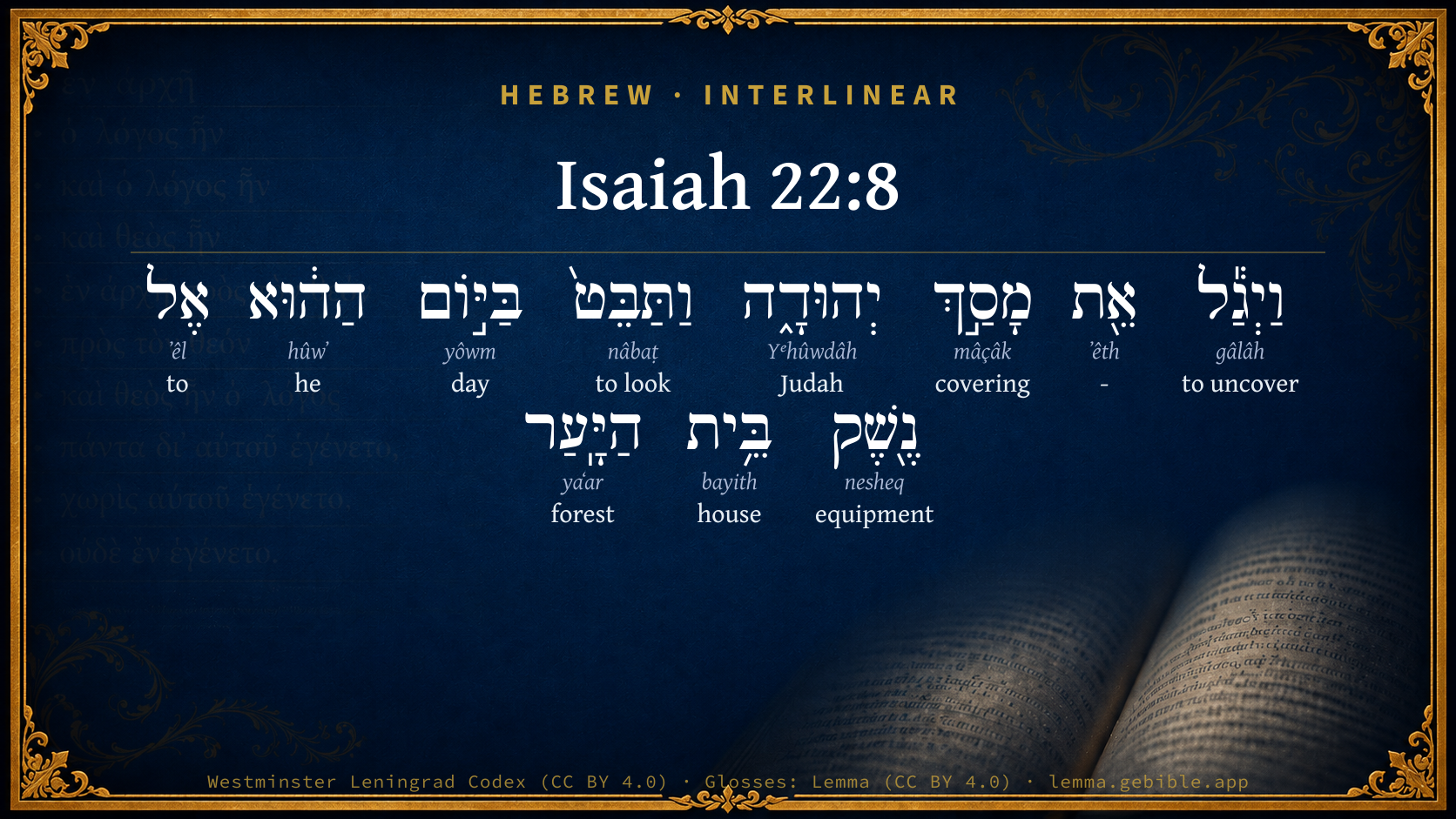
Hebrew (Westminster Leningrad Codex) Isaiah 22:8 appears in the Hebrew Old Testament. The text above is from the Westminster Leningrad Codex. Each word links to its Strong’s number, a concise gloss, and parsing drawn from the Open Scriptures Hebrew Bible morphology. Click any word for its full Brown-Driver-Briggs (BDB) entry.
Download image
Cite this verse

Isaiah 22:8 (World English Bible). Public Domain. Lemma interlinear Bible study tool, https://lemma.gebible.app/v/isaiah/22/8.

Show BibTeX & RIS
BibTeX
RIS
English Translation
He took away the covering of Judah; and you did look in that day to the armor in the house of the forest.
World English Bible · Public Domain
Download a study sheet

One document with this verse’s original text, its word-by-word gloss line, the meaning frame, cross-references with their text, attributed commentary, and full source and license credits — printable, and it pastes into notes with its structure intact.

This verse Autodidact and up

Study sheet (.html) Plain text (.txt)

A passage Seminary Student

Up to 50 verses in one chapter. A passage sheet keeps up to 6 commentary sources and 12 cross-references per verse, in the order this page ranks them, and says so on the sheet whenever that leaves anything out. Ask for a single verse and you get the Autodidact verse sheet above.

Everything on this page stays free to read, with no account — the sheet is a download of what is already on screen, not access to it.

Want to remove ads? Support Godless Engineer
Compare translations 3

The same verse in 3 English versions, stacked beneath the original-language interlinear above. Click any original word for its lexicon entry.

Each is an independent rendering of the whole verse — the interlinear is not word-aligned to these translations.

Highlighted words mark where these versions differ — a whole-verse word diff, not a word-by-word alignment.

  • World English Bible Public Domain
    He took away the covering of Judah; and you did look in that day to the armor in the house of the forest.
  • King James Version Public Domain
    And he discovered the covering of Judah, and thou didst look in that day to the armour of the house of the forest.
  • unfoldingWord Literal Text CC BY-SA 4.0
    And he removed the covering of Judah, and you looked on that day to the weaponry of the House of the Forest.

unfoldingWord Literal Text — © unfoldingWord, licensed CC BY-SA 4.0. Word-aligned USFM3 via Door43 (git.door43.org/unfoldingWord/en_ult).

Versions to compare (up to 4)

3 of 4 selected

Show all 18 translations

Every available English version of this verse, each an independent rendering of the whole verse.

  • World English Bible Public Domain
    He took away the covering of Judah; and you did look in that day to the armor in the house of the forest.
  • Berean Standard Bible Public Domain
    He has uncovered the defenses of Judah. On that day you looked to the weapons in the House of the Forest.
  • Majority Standard Bible Public Domain
    He has uncovered the defenses of Judah. On that day you looked to the weapons in the House of the Forest.
  • King James Version Public Domain
    And he discovered the covering of Judah, and thou didst look in that day to the armour of the house of the forest.
  • American Standard Version (1901) Public Domain
    And he took away the covering of Judah; and thou didst look in that day to the armor in the house of the forest.
  • Revised Version (1885) Public Domain
    And he took away the covering of Judah; and thou didst look in that day to the armour in the house of the forest.
  • Geneva Bible (1599) Public Domain
    And hee discouered the couering of Iudah: and thou didest looke in that day to the armour of the house of the forest.
  • Douay-Rheims (1899) Public Domain
    And the covering of Juda shall be discovered, and thou shalt see in that day the armoury of the house of the forest.
  • Young's Literal Translation Public Domain
    And one removeth the covering of Judah, And thou lookest in that day Unto the armour of the house of the forest,
  • Literal Standard Version CC BY-SA 4.0
    And one removes the covering of Judah, || And in that day you look || To the armor of the house of the forest,
  • Unlocked Literal Bible CC BY-SA 4.0
    He took away the protection of Judah; and you looked in that day to the weapons in the Palace of the Forest.
  • unfoldingWord Literal Text CC BY-SA 4.0
    And he removed the covering of Judah, and you looked on that day to the weaponry of the House of the Forest.
  • Darby Bible Public Domain
    And he uncovereth the covering of Judah: and thou didst look in that day to the armour in the house of the forest;
  • World Messianic Bible Public Domain
    He took away the covering of Judah; and you looked in that day to the armor in the house of the forest.
  • Webster's Bible Public Domain
    And he uncovered the coverings of Judah, and thou didst look in that day to the armor of the house of the forest.
  • Free Bible Version CC BY-SA 4.0
    Judah's defenses have been stripped away and so at that time you went looking for weapons in the Palace of the Forest.
  • Bible in Basic English Public Domain
    He took away the cover of Judah; and in that day you were looking with care at the store of arms in the house of the woods.
  • JPS Tanakh (1917) Public Domain
    And the covering of Judah was laid bare, that thou didst look in that day to the armour in the house of the forest.

Literal Standard Version (2020), Covenant Press — licensed CC BY-SA 4.0. Text via the HelloAO Bible API (eBible.org). Unlocked Literal Bible (unfoldingWord) — licensed CC BY-SA 4.0. Text via the HelloAO Bible API (eBible.org). unfoldingWord Literal Text — © unfoldingWord, licensed CC BY-SA 4.0. Word-aligned USFM3 via Door43 (git.door43.org/unfoldingWord/en_ult). Free Bible Version, Dr. Jonathan Gallagher — licensed CC BY-SA 4.0. Text via the HelloAO Bible API (eBible.org).

Word by word

More ways to search: Search by grammar → Find every occurrence → Compare this word →

Practice this passage: Drill this verse → Learn its vocabulary →

נֶ֖שֶׁק
nesheq
H5402
“equipment of”
Noun, Common, Masculine, Singular, Construct
Part of Speech
Noun
Type
Common
Gender
Masculine
Number
Singular
State
Construct
Full BDB Definition

Origin: from H5401

TWOT: 1436a

equipment, weapons, armoury - equipment, weapons - armoury
  1. וַיְגַ֕ל gâlâh H1540 “and · to uncover” Conjunction + Verb, Piel, Sequential Imperfect, 3rd Person, Masculine, Singular
  2. אֵ֖ת ʼêth H853 “-” Particle, Direct Object
  3. מָסַ֣ךְ mâçâk H4539 “covering of” Noun, Common, Masculine, Singular, Construct
  4. יְהוּדָ֑ה Yᵉhûwdâh H3063 “Judah” Noun, Proper
  5. וַתַּבֵּט֙ nâbaṭ H5027 “and · to look” Conjunction + Verb, Hiphil, Sequential Imperfect, 2nd Person, Masculine, Singular
  6. בַּיּ֣וֹם yôwm H3117 “in/at the · day” Preposition, Determined + Noun, Common, Masculine, Singular, Absolute
  7. הַה֔וּא hûwʼ H1931 “the · he” Particle, Definite Article + Pronoun, Personal, 3rd Person, Masculine, Singular
  8. אֶל ʼêl H413 “to” Preposition
  9. בֵּ֥ית bayith H1004 “house of” Noun, Common, Masculine, Singular, Construct
  10. הַיָּֽעַר yaʻar H3293 “the · forest” Particle, Definite Article + Noun, Common, Masculine, Singular, Absolute

About this verse

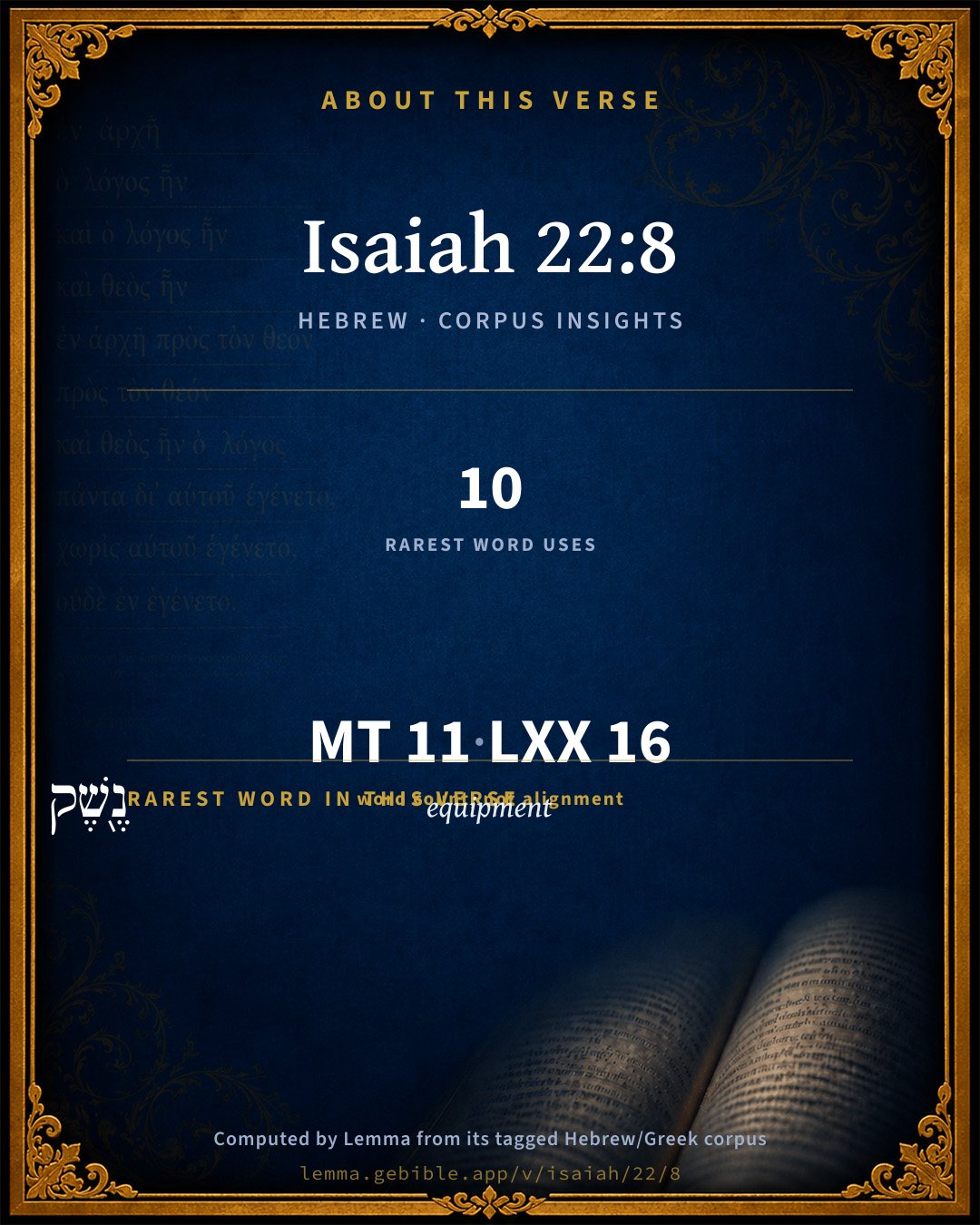
These counts appear in no published source. They are computed here, from the morphology-tagged text and Lemma’s own curated glosses. What Lemma adds →

11
words
11
distinct lemmas
Prophets
section

Notable vocabulary

The rarest word here is נֶ֖שֶׁק equipment H5402 — appearing just 10 times in the whole Hebrew Bible.

Shared distinctive vocabulary

נֶ֖שֶׁק equipment H5402 occurs in 10 verses of the Hebrew Bible. Also found in:

Grammatical profile

  • 2 verbs
  • 6 nouns
  • 1 pronoun
  • 1 preposition
  • 1 particle

Verb forms

  • וַיְגַ֕ל Piel · Sequential Imperfect
  • וַתַּבֵּט֙ Hiphil · Sequential Imperfect

Hebrew & Septuagint length

In English translation the verse runs 23 words from the Hebrew and 22 from the Septuagint (LXX English) — closely comparable.

A rough comparison of the two English renderings, which tokenize alike — not a word-level alignment.

Word counts can differ between the Hebrew and the Greek without any difference in meaning — e.g. the Hebrew direct-object marker אֵת has no separate Greek word, and Greek often adds the article ὁ.

In the original languages it is 11 Hebrew tokens and 16 Greek tokens — but the two are counted differently (Hebrew bundles its prefixes and suffixes into one token; the Greek is in lemma form), so that isn’t a like-for-like length.

Cross-references

5

Topical passages linked to Isaiah 22:8 in the Treasury of Scripture Knowledge — connected by theme and wording, ordered by reader-vote popularity; previews shown in the World English Bible.

  • 1 Kings 7:2 For he built the house of the forest of Lebanon; the length of it was one hundred cubits, and the breadth of it fifty cubits, and the height of it thirty cubits, on four rows of cedar pillars, with cedar beams on the pillars.
  • 1 Kings 10:17 [he made] three hundred shields of beaten gold; three minas of gold went to one shield: and the king put them in the house of the forest of Lebanon.
  • 1 Kings 14:27–28 King Rehoboam made in their place shields of brass, and committed them to the hands of the captains of the guard, who kept the door of the king's house.
  • Song of Solomon 4:4 Your neck is like David's tower built for an armory, Whereon there hang a thousand shields, All the shields of the mighty men.
  • Isaiah 36:1–3 Now it happened in the fourteenth year of king Hezekiah, that Sennacherib king of Assyria came up against all the fortified cities of Judah, and took them.

Cross-references courtesy of OpenBible.info (CC BY 4.0).

Hebrew and Greek witnesses Masoretic Hebrew ↔ Greek Septuagint

The same verse in the two great witnesses to the Old Testament, shown verse-for-verse.

These are two independent witnesses, not word-aligned to each other, and the Septuagint is shown in lemma (dictionary) form.

Hebrew Isaiah 22:8 Masoretic · Westminster Leningrad Codex

וַיְגַ֕ל אֵ֖ת מָסַ֣ךְ יְהוּדָ֑ה וַתַּבֵּט֙ בַּיּ֣וֹם הַה֔וּא אֶל נֶ֖שֶׁק בֵּ֥ית הַיָּֽעַר

He took away the covering of Judah; and you did look in that day to the armor in the house of the forest.

World English Bible · Public Domain

Greek LXX Isaiah 22:8 Septuagint · lemma form

καί ἀνακαλύπτω ὁ πύλη ιουδα καί ἐνβλέπω ὁ ἡμέρα ἐκεῖνος εἰς ὁ ἐκλεκτός οἶκος ὁ πόλις

And they shall uncover the gates of Juda, and they shall look in that day on the choice houses of the city.

LXX2012 (modern English Septuagint) · Public Domain

On this verse, Albert Barnes' Notes on the Bible discusses the Septuagint’s reading. Read the note in Commentary ↓

Hebrew: Westminster Leningrad Codex (CC BY 4.0). Greek: Septuagint (public domain); English from LXX2012 (modern English Septuagint) (Public Domain). How the Septuagint differs from the Hebrew →

Targum (Aramaic paraphrase)

1

The Targum is the ancient Jewish Aramaic paraphrase of the Hebrew Scriptures — an interpretive translation, not the Hebrew text itself. Onkelos (literal) and Pseudo-Jonathan (expansive) render the Torah, and Jonathan the Prophets. Coverage is partial: where no permissively-licensed English translation exists for a verse, only the Aramaic is shown. This is verse-level text, not a word-by-word alignment to the Hebrew.

  1. Targum Jonathan Prophets (Joshua–Malachi)
    וְגַלֵי יַת מַטְמוֹרִית בֵּית יְהוּדָה וְאִסְתְּכֵי בְּעִדָנָא הַהִיא עַל זְיַן בֵּית גִנְזֵי מַקְדְשָׁא:

    And he shall discover the covering of Judah, and he shall look at that time upon the arms of the house of the treasury of the sanctuary.

    Targum Jonathan — Aramaic: “Mikraot Gedolot” (public domain). English: “Sefaria Community Translation” (CC0 1.0 (public-domain dedication)); “London "Chaldee Paraphrase," 1871” (public domain). Text via Sefaria.

Commentary

Notes on Isaiah 22:8 from classic Christian and Jewish commentators (each source and its license shown beneath its notes). The classic Christian expositions comment on the surrounding passage and are grouped to its opening verse, so a note may address several verses; the Jewish commentaries on the Tanakh (Rashi and others) are per-verse, so they appear only where the commentator wrote on this verse.

Lemma curates 59 commentaries, every one of them public domain or Creative Commons licensed, each selected and text-cleaned for this edition rather than reprinted as found. About our sources →

Jamieson, Fausset & Brown

Robert Jamieson, A. R. Fausset & David Brown

he discovered the covering--rather, "the veil of Judah shall be taken off" [HORSLEY]: figuratively for, exposing to shame as a captive (Isa 47:3; Nah 3:5). Sennacherib dismantled all "the defensed cities of Judah" (Isa 36:1).

thou didst look--rather, "thou shalt look."

house of . . . forest--The house of armory built of cedar from the forest of Lebanon by Solomon, on a slope of Zion called Ophel (Kg1 7:2; Kg1 10:17; Neh 3:19). Isaiah says (Isa 22:8-13) his countrymen will look to their own strength to defend themselves, while others of them will drown their sorrows as to their country in feasting, but none will look to Jehovah.

Jamieson, Fausset & Brown — Commentary Critical and Explanatory on the Whole Bible (1871) — public domain (CC PDM 1.0). Text via the HelloAO Bible API.

Trapp's Complete Commentary

John Trapp

Isa 22:8 And he discovered the covering of Judah, and thou didst look in that day to the armour of the house of the forest.

Ver. 8. And he discovered the covering of Judah.] That is, he that is the enemy took the city; Hoc enim significat nudari operimentum - i.e., Protectionem Iudae; or, as others sense it, {a} God took away his protection, the rampart and defence of their country; {see Exo 32:25 Num 14:9 Mic 1:11} or the enemy destroyed the temple, wherein the Jews so foolishly confided. {Jer 7:4}

To the armour of the house.] To anything but whom they should have looked unto. Our hearts are topped full of harlotry, ready to shift and shark in every by corner for comfort; to hang their hopes on every hedge, rather than to roll themselves upon God, "the hope of Israel."

{a} Zeged., Diodat., Oecolamp.

John Trapp, A Commentary or Exposition upon All the Books of the Old and New Testament (1647–1656) — public domain. Text from a community e-Sword module.

Joseph Benson's Commentary

Isa 22:8-11. And he — Namely, the enemy Sennacherib, of whose invasion he seems to speak; discovered the covering of Judah — Took those fenced cities which were a covering or safeguard, both to the people of Judah and to Jerusalem. Thou didst look — Or, rather, as Dr. Waterland and Bishop Lowth render it, Thou shalt, or wilt look, &c. For the prophet is evidently predicting an invasion which was future, and the behaviour of the Jews on that occasion. He is showing beforehand some of the causes of these judgments, namely, the crimes and vices of the people; and first, in these verses, their inconsideration and want of faith. They would look, he says, to the armour of the house of the forest — But not to God. The history (2Ch 32:2, &c.) best explains this passage. From thence we learn, that the prince and the people were rather solicitous to seek for human defence, by fortifying their city, than for that which was divine, by having respect unto him who was their king and protector. The house of the forest is that mentioned 1Ki 7:2, where the armory was kept. See the note there. The prophet proceeds to foretel that they would see, that is, observe or consider, the breaches of the city of David — Namely, in order to the reparation of them, and to fortify the city; that they would gather the waters of the lower pool — In order that they might both deprive the enemy of water, and supply the city with it: of which see on 2Ch 32:3-4. That they would number the houses of Jerusalem — Namely, with a view to know their own strength, and the number of their people, that so they might lay the burdens more equally upon them, and make sufficient provision for them; that they would break down the houses — Namely, which stood upon or without the walls of their city, and which therefore would have given their enemies advantage against them, and have hindered the fortifying of the city. But, adds he, ye have not looked, or will not look, into the maker thereof — That is, of Jerusalem, mentioned in the foregoing verse; him that fashioned it — Hebrew, ויצרה, the former, or framer of it. God, who made it a city, and the place of his special presence and worship; which also he had undertaken to protect, on condition that the people would observe his commands; to whom, therefore, they should have had recourse in this time of their distress. The expression מרחוק, of old, or long ago, may be added to aggravate their sin in distrusting that God who had now, for a long time, given proof of his care and kindness in defending that city.

Joseph Benson's Commentary on the Old and New Testaments (1811–1818) — public domain. Text from a community e-Sword module.

Lange's Commentary on the Holy Scriptures

b) The punishment of defiance in sight of danger

Isa_22:8-14

8          And he [8]discovered the covering of Judah,

And thou didst look in that day

To the armour of the house of the forest.

9     Ye have seen also the breaches of the city of David,

That they are many:

And ye gathered together the waters of the lower pool.

10     And ye have numbered the houses of Jerusalem,

And the houses have ye broken down to fortify the wall.

11     Ye made also a 9dicth between the two walls

For the water of the old pool:

But ye have not looked unto the maker thereof,

Neither had respect unto him that fashioned it long ago.

12     And in that day did the Lord God of hosts call

To weeping, and to mourning,

And to baldness, and to girding with sackcloth;

13     And behold, joy and gladness,

Slaying oxen, and killing sheep,

Eating flesh, and drinking wine;

Let us eat and drink,

For to-morrow we shall die.

14     And it was revealed in mine ears by the Lord of hosts,

Surely this iniquity shall not be purged from you till ye die,

Saith the Lord God of hosts.

TEXTUAL AND GRAMMATICAL

Isa_22:11. The feminine suffixes in עִֹשֶיהָ (regarding the form comp. Ewald, § 256 b) and יֹצְרָהּ are to be regarded as neuters. יָצַר is the forming, shaping in idea, to which then עָשָׂה comes as the execution. In analogous places יצר stands therefore before עָשָׂה: Isa_43:7; Isa_45:18; Isa_46:11. However in Isa_37:26; Jer_33:2, the order is as here. We could say that the succession of ideas is conceived in the one case analytically, in the other, synthetically.

Isa_22:13. On these infinitive constructions comp. Isa_5:5; Isa_21:5.——The abnormal form שָׁתוֹת is in imitation of שָׁחֹט, comp. Hos_10:4.

EXEGETICAL AND CRITICAL

1. The inhabitants of Jerusalem are now no longer inspired by thoughtless presumption. They see themselves compelled by this new emergency to consider seriously their means of defence. First, they inspect the store of weapons in the arsenal (Isa_22:8). They examine the fortifications, and collect water in the lower pool (Isa_22:9). They pull down houses in order to repair the walls (Isa_22:10), and they form a new reservoir. But to Him who has caused this distress, and who alone can remove it, they do not turn their eyes (Isa_22:11). And when He brings upon them bitter misery (Isa_22:12), the only effect of it is that, with the recklessness of despair, they give themselves eagerly to pleasure, because all will soon be over (Isa_22:13). But this defiant spirit exhibited no longer in blindness, but in sight of danger, the Lord will not pardon. They must expiate it with their life (Isa_22:14).

2. And he discovered—long ago.

Isa_22:8-11. This section is closely connected with the preceding one, as the construction shows.—And he discovered. The subject of the verb is the Lord God of hosts in Isa_22:5. But, though the connection of the two sections is so intimate, a considerable interval of time must lie between them, as the transition from that blind presumption to the defiance in sight of danger here described, was hardly quite sudden. But for this close grammatical connection of the two sections one might be tempted to refer the first part (Isa_22:1-7) as a separate prediction to an earlier time. It would, in fact, have been possible for the Prophet to have combined in one prophecy this earlier prediction with a later one on account of a correspondence in subject-matter between the two. But it is most natural to regard the whole piece, Isa_22:1-14, as a single composition, and to suppose that the Prophet in the first part (Isa_22:1-7) transported himself back to an earlier juncture, because it served admirably as a foil to the later crisis which he describes (Isa_22:8-14). This later situation, which was the occasion of this whole prophecy before us, is here described by him as a basis for the complaints and denunciations of punishment which he utters, Isa_22:11 b and Isa_22:13 sq. We have therefore to understand the aorists, Isa_22:8 sqq., not as praeterita prophetica, but in their proper signification. We perceive from Isa_22:8 a, that the Lord at last took from the eyes of Judah the covering that caused blindness. גלה is here applied not to that which is hidden, but to that which hides, as frequently. Comp. Isa_47:2; Nah_3:5; Job_41:5. Judah then saw the necessity of preparing for war. They proceed therefore to the armory built by Solomon, of cedars, called the house of the forest of Lebanon (1Ki_7:2; 1Ki_10:17; 1Ki_10:21), which is probably identical with the בֵּית כֵּלִים39:2, in order to see how it stood with the apparatus bellicus. The primary meaning of נֶשֶׁק is tela. They next examine the fortifications of the city of David, and discover that there are many breaches in them. I do not think that under “the city of David” we are to understand the whole of Jerusalem, as Arnold appealing to Isa_29:1 maintains (HerzogR. Enc. XVIII., p. 593). “The city of David” is always the South-western elevated part of Jerusalem; and if this part alone is mentioned here, this need not surprise us, as we cannot expect that the Prophet should give an enumeration historically complete. We learn, moreover, from 2Ch_32:5, that Hezekiah fortified especially the proper city of David, or Zion. Another matter, which must be particularly attended to by those who defend a city, is to provide themselves with water, and to cut off the supply of it from the enemy. This is what the inhabitants of Jerusalem do. They collect, draw inwards the waters of the lower pool. In the valley of Gihon which borders Jerusalem on the west there are still two old pools; the upper (now Birket-el-Mamilla) and the lower (now Birket es-Sultân). Compare what is said on Isa_7:3. The account in 2Ch_32:3 sq., and that in the place before us supplement one another. In the former, mention is made only of the stopping of the reservoirs. Here, prominence is given to the other necessary step, the turning into the city of the water cut off from the enemy. קִבֵּץ cannot here denote merely collecting in the pool by hindering it from flowing away. For, first, the water, without flowing off, would have risen and been soon remarked by the enemy. Secondly, the water was needed in the city. I take, therefore, קִבֵּץ in the signification in which it is employed Joe_2:6; Nah_2:11, where it is said that faces קִבְּצוּ פָארוּר, i. e., draw in their brightness. Here, then, the meaning is that the inhabitants of Jerusalem drew the water into their city. In reference to Delitzsch’s remark that this must rather be expressed by אסף, I call attention to the fact that Joel expresses, Joe_2:10 and Joel 4:15, by אסף the same thought which he had in Joe_2:6 expressed by קבץ, whence it follows that in this place, too, קבץ can be used in the signification אסף. It may occasion surprise that Isa_22:10 interrupts the account regarding the reservoirs. But the Prophet evidently proceeds from the easier to the more difficult. The breaking down of the houses for the purpose of repairing the walls, was a greater work than drawing off the water of the lower pool into the wells or reservoirs already existing in the city. And the formation of a new pool between the walls, in order to empty the old one, might well appear the grandest work of all. The opinion of Drechsler, that the numbering of the houses was with a view to quartering the soldiers, is very strange. In Jer_33:4 it is supposed that houses were demolished in order to repair the fortifications. The מִקְוָה (only here, elsewhere מִקְוֶה) which (Isa_22:11) was prepared for the waters of “the old pool,” is very probably still in existence in the Birket-el-Batrak (the pool of the patriarchs) which the Franks after this passage and 2Ki_20:20; 2Ch_32:30; Sir_48:19, call the pool of Hezekiah. It lies within the present wall of the city east of the Yafa (Joppa) gate. It still receives its water from the Mamilla pool by means of a canal which enters the city south of the Yafa gate. (Comp. Arnold in Herz.,R. Enc. XVIII., p. 619, and especially C. W. Wilson’sOrdnance Survey of Jerusalem, 1865, and Warren’sRecovery of Jerusalem, 1872). In opposition to the new pool, the pool whose waters it received was called “the old pool.” The former name of the old pool was “the upper pool,” which is twice mentioned by Isaiah (Isa_7:3; Isa_36:2). The expression חֹמוֹתַיִם occurs besides only in Jer_39:4, and in the parallel passages Jer_52:7; 2Ki_25:4. In these places in the books of Jeremiah and Kings a double wall seems to be meant, which connected Zion and Ophel at the end of the Tyropœon. This does not suit well the situation of the pool of Hezekiah as before mentioned. It is uncertain whether we are to understand in the place before us a corner of a wall between the north wall of Zion and the wall going north-eastwards round Akra (Delitzsch after Robinson), or a second double wall situated near the Yafa gate. This precaution was certainly not in itself wrong. What was wrong in their conduct was that they fixed their eyes only on these measures of human prudence, and omitted to look with confidence to Him who had made all this, i. e., the whole situation, and had arranged it long ago. [The common view, which supposes God to be here described as the maker and fashioner of Jerusalem, has against it the analogy of Isa_37:26.—D. M.].

3. And in that day—of hosts.

Isa_22:12-14. We may ask how the Lord then called the inhabitants of Jerusalem to weeping, and to mourning, and to baldness (Isa_3:24), and to girding with sackcloth (Isa_20:2). The language is probably taken from the proclamations by which a general fast, a day of humiliation and prayer was ordained (1Ki_21:9; 1Ki_21:12). Such proclamations proceed proximately from the rulers, but ultimately from the Lord, who by the course of His providence renders them necessary. It is now also the Lord who so “makes and forms” everything that Israel, if it would give heed, would be called thereby to repentance. One thinks here very naturally of Isa_37:1 sqq., where it is related that Hezekiah, in consequence of the message of Rabshakeh, rent his clothes, covered himself with sackcloth, and sent deputies clothed with sackcloth to Isaiah. I would say that as Isa_22:8-11 recall to mind the defensive measures taken by Hezekiah (2Ch_32:2 sqq.), so what is said in Isa_22:12 reminds us of Isa_37:1 sqq. Hezekiah was better than the majority of his people. His own father was Ahaz, and his son was Manasseh. He formed between the two only a short episode, which stemmed indeed for a short time the flood of corruption, but which rendered the inundation under Manasseh all the more impetuous. We can therefore reasonably assume that at the very time when Hezekiah and his immediate attendants were exhibiting these signs of penitence there were very many people in Jerusalem who were doing that wherewith the Prophet (Isa_22:13) reproaches the Jews. They saw the danger. They were no longer blind as in Isa_22:1 sqq. They did not, however, let the perception of the danger move them to lay hold of the only hand that could save them, but in defiant resignation they refused this help. They made up their mind to go to destruction, but first they would enjoy life right heartily (Isa_22:13). The words אכול ושׁתו I prefer, with Drechsler, Knobel, and others, to take as words of the Jews, rather than with Delitzsch ascribe them to the Prophet. For, as words of the Prophet they are superfluous, while as words of the Jews they round off their speech. Moreover the form שָׁתוֹ makes the impression of being an abbreviation borrowed from popular usage. Isa_22:14. The perfect ונגלה cannot be taken as the aorist. It marks rather, as Drechsler correctly observes, the revelation as an abiding one, continuing to echo in the inner ear of the Prophet. כִּפֶּר (comp. Isa_6:7; Isa_27:9) properly to cover. According to the way in which this covering takes place the word denotes forgive, or atone. Here it seems to me to signify to forgive, for the mode of threatening excludes the thought of atonement. A recompense after death is not yet taught in the Old Testament. Punishments are inflicted in this life. If a man has to suffer punishment for guilt unpardoned, he has to bear the burden till it has destroyed him, till he is dead. עד till, declares, therefore, that up to death, all through life, they will have to bear the punishment of that sin. After death follows only Sheol in which there is no more life. [Isaiah himself seems clearly to teach the doctrine of a punishment after death, Isa_33:14; Isa_66:24. And in chapter 14 the Prophet represents the dwellers of Sheol as meeting the king of Babylon with taunts on his appearance among them. This supposes that there is life there. Though the inhabitants of Sheol are prevented from taking part in the affairs of the present life on earth, as Scripture affectingly testifies, this does not hinder their possession of consciousness and activity in the invisible world.—D. M.].

Footnotes:

[8]uncovered, took away.

[9]reservoir.

Lange's Commentary on the Holy Scriptures (Critical, Doctrinal, and Homiletical), ed. John Peter Lange, English translation edited by Philip Schaff (1864–1880) — public domain. Text from a community e-Sword module.

Tyndale Open Study Notes

Tyndale Open Resources

22:8-11 The inhabitants of Jerusalem planned for war by counting weapons, checking walls, and preparing a water supply. However, the people did not consider God’s plans (see 13:1–14:23). Although Hezekiah was very prominent in these efforts, the second person verbs are plural. Isaiah was apparently not singling out Hezekiah, as he did Hezekiah’s father Ahaz (7:1-4).

22:8 to the armory: This magnificent building was both an armory and a storage place for valuables (see 39:2; 1 Kgs 7:2-6).

Tyndale Open Study Notes — © Tyndale Open Resources, licensed CC BY-SA 4.0. Text via the HelloAO Bible API.

Geneva Bible (1599)

Geneva Bible translators

The secret place where the armor was: to wit, in the house of the forest, 1 Kings 7:2.

Geneva Bible (1599) marginal notes — public domain. Text via Bolls.life.

Matthew Henry's Commentary

What is meant by the covering of Judah, which in the beginning of this paragraph is said to be discovered, is not agreed. The fenced cities of Judah were a covering to the country; but these, being taken by the army of the Assyrians, ceased to be a shelter, so that the whole country lay exposed to be plundered. The weakness of Judah, its nakedness, and inability to keep itself, now appeared more than ever; and thus the covering of Judah was discovered. Its magazines and stores, which had been locked up, were now laid open for the public use. Dr. Lightfoot gives another sense of it, that by this distress into which Judah should be brought God would discover their covering (that is, uncloak their hypocrisy), would show all that was in their heart, as is said of Hezekiah upon another occasion, Ch2 32:31. Thus, by one means or other, the iniquity of Ephraim will be discovered and the sin of Samaria, Hos 7:1.

They were now in a great fright, and in this fright they manifested two things much amiss: -

I. A great contempt of God's goodness, and his power to help them. They made use of all the means they could think of for their own preservation; and it is not for doing this that they are blamed, but, in doing this, they did not acknowledge God. Observe,

1. How careful they were to improve all advantages that might contribute to their safety. When Sennacherib had made himself master of all the defenced cities of Judah, and Jerusalem was left as a cottage in a vineyard, they thought it was time to look about them. A council was immediately called, a council of war; and it was resolved to stand upon their defence, and not tamely to surrender. Pursuant to this resolve, they took all the prudent measures they could for their own security. We tempt God if, in times of danger, we do not the best we can for ourselves. (1.) They inspected the magazines and stores, to see if they were well stocked with arms and ammunition: They looked to the armour of the house of the forest, which Solomon built in Jerusalem for an armoury (Kg1 10:17), and thence they delivered out what they had occasion for. It is the wisdom of princes, in time of peace, to provide for war, that they may not have arms to seek when they should use them, and perhaps upon a sudden emergency. (2.) They viewed the fortifications, the breaches of the city of David; they walked round the walls, and observed where they had gone to decay for want of seasonable repairs, or were broken by some former attempts made upon them. These breaches were many; the more shame for the house of David that they suffered the city of David to lie neglected. They had probably often seen those breaches; but now they saw them to consider what course to take about them. This good we should get by public distresses, we should be awakened by them to repair our breaches, and amend what is amiss. (3.) They made sure of water for the city, and did what they could to deprive the besiegers of it: You gathered together the water of the lower pool, of which there was probably no great store, and of which therefore they were the more concerned to be good husbands. See what a mercy it is that, as nothing is more necessary to the support of human life than water, so nothing is more cheap and common; but it is bad indeed when that, as here, is a scarce commodity. (4.) They numbered the houses of Jerusalem, that every house might send in its quota of men for the public service, or contribute in money to it, which they raised by a poll, so much a head or so much a house. (5.) Because private property ought to give way to the public safety, those houses that stood in their way, when the wall was to be fortified, were broken down, which, in such a case of necessity, is no more an injury to the owner than blowing up houses in case of fire. (6.) They made a ditch between the outer and inner wall, for the greater security of the city; and they contrived to draw the water of the old pool to it, that they might have plenty of water themselves and might deprive the besiegers of it; for it seems that was the project, lest the Assyrian army should come and find much water (Ch2 32:4) and so should be the better able to prolong the siege. If it be lawful to destroy the forage of a country, much more to divert the streams of its waters, for the straitening and starving of an enemy.

2. How regardless they were of God in all these preparations: But you have not looked unto the Maker thereof (that is, of Jerusalem, the city you are so solicitous for the defence of) and of all the advantages which nature has furnished it with for its defence - the mountains round about it (Psa 125:2), and the rivers, which were such as the inhabitants might turn which way soever they pleased for their convenience. Note, (1.) It is God that made his Jerusalem, and fashioned it long ago, in his counsels. The Jewish writers, upon this place, say, There were seven things which God made before the world (meaning which he had in his eye when he made the world): the garden of Eden, the law, the just ones, Israel, the throne of glory, Jerusalem, and Messiah the Prince. The gospel church has God for its Maker. (2.) Whatever service we do, or endeavour to do, at any time to God's Jerusalem, must be done with an eye to him as the Maker of it; and he takes it ill if it be done otherwise. It is here charged upon them that they did not look to God. [1.] They did not design his glory in what they did. They fortified Jerusalem because it was a rich city and their own houses were in it, not because it was the holy city and God's house was in it. In all our cares for the defence of the church we must look more at God's interest in it than at our own. [2.] They did not depend upon him for a blessing upon their endeavours, saw no need of it, and therefore sought not to him for it, but thought their own powers and policies sufficient for them. Of Hezekiah himself it is said that he trusted in God (Kg2 18:5), and particularly upon this occasion (Ch2 32:8); but there were those about him, it seems, who were great statesmen and soldiers, but had little religion in them. [3.] They did not give him thanks for the advantages they had, in fortifying their city, from the waters of the old pool, which were fashioned long ago, as Kishon is called an ancient river, Jdg 5:21. Whatever in nature is at any time serviceable to us, we must therein acknowledge the goodness of the God of nature, who, when he fashioned it long ago, fitted it to be so, and according to whose ordinance it continues to this day. Every creature is that to us which God makes it to be; and therefore, whatever use it is of to us, we must look at him that fashioned it, bless him for it, and use it for him.

II. A great contempt of God's wrath and justice in contending with them, Isa 22:12-14. Here observe,

1. What was God's design in bringing this calamity upon them: it was to humble them, bring them to repentance, and make them serious. In that day of trouble, and treading down, and perplexity, the Lord did thereby call to weeping and mourning, and all the expressions of sorrow, even to baldness and girding with sackcloth; and all this to lament their sins (by which they had brought those judgments upon their land), to enforce their prayers (by which they might hope to avert the judgments that were breaking in), and to dispose themselves to a reformation of their lives by a holy seriousness and a tenderness of heart under the word of God. To this God called them by his prophet's explaining his providences, and by his providences awakening them to regard what his prophets said. Note, When God threatens us with his judgments he expects and requires that we humble ourselves under his mighty hand, that we tremble when the lion roars, and in a day of adversity consider.

2. How contrary they walked to this design of God (Isa 22:13): Behold, joy and gladness, mirth and feasting, all the gaiety and all the jollity imaginable. They were as secure and cheerful as they used to be, as if they had had no enemy in their borders or were in no danger of falling into his hands. When they had taken the necessary precautions for their security, then they set all deaths and dangers at defiance, and resolved to be merry, let come on them what would. Those that should have been among the mourners were among the wine-bibbers, the riotous eaters of flesh; and observe what they said, Let us eat and drink, for tomorrow we shall die. This may refer either to the particular danger they were now in, and the fair warning which the prophet gave them of it, or to the general shortness and uncertainty of human life, and the nearness of death at all times. This was the language of the profane scoffers who mocked the messengers of the Lord and misused his prophets. (1.) They made a jest of dying. "The prophet tells us we must die shortly, perhaps tomorrow, and therefore we should mourn and repent today; no, rather let us eat and drink, that we may be fattened for the slaughter, and may be in good heart to meet our doom; if we must have a short life, let it be a merry one." (2.) They ridiculed the doctrine of a future state on the other side death; for, if there were no such state, the apostle grants there would be something of reason in what they said, Co1 15:32. If, when we die, there were an end of us, it were good to make ourselves as easy and merry as we could while we live; but, if for all these things God shall bring us into judgment, it is at our peril if we walk in the way of our heart and the sight of our eyes, Ecc 11:9. Note, A practical disbelief of another life after this is at the bottom of the carnal security and brutish sensuality which are the sin, and shame, and ruin of so great a part of mankind, as of the old world, who were eating and drinking till the flood came.

3. How much God was displeased at it. He signified his resentment of it to the prophet, revealed it in his ears, to be by him proclaimed upon the house-top: Surely this iniquity shall not be purged from you till you die, Isa 22:14. It shall never be expiated with sacrifice and offering, any more than the iniquity of the house of Eli, Sa1 3:14. It is a sin against the remedy, a baffling of the utmost means of conviction and rendering them ineffectual; and therefore it is not likely they should ever repent of it or have it pardoned. The Chaldee reads it, It shall not be forgiven you till you die the second death. Those that walk contrary to them; with the froward he will show himself froward.

Matthew Henry's Commentary on the Whole Bible (1708–1710) — public domain (CC PDM 1.0). Text via the HelloAO Bible API.

Adam Clarke's Commentary

Verse 8. The armour - "The arsenal"] Built by Solomon within the city, and called the house of the forest of Lebanon; probably from the great quantity of cedar from Lebanon which was employed in the building. See 2Kg 7:2-3.

Adam Clarke's Commentary on the Bible (1810–1826) — public domain. Text from a community e-Sword/MySword module.

Ellicott's Commentary for English Readers

(8) And he discovered the covering of Judah—i.e., Jehovah removed the veil which till then had hidden the approaching danger from the eyes of the inhabitants, and laid bare their weakness to those of the invaders. The verbs which in the English version are in the past tense are really in a kind of prophetic present, painting the future as if actually passing before the prophet’s gaze.

The armour of the house of the forest.—More fully (as in 1Ki_7:2; 1Ki_10:17), “the house of the forest of Lebanon,” which appears to have been used as an arsenal, and to which the people now turn as their chief resource.

A Bible Commentary for English Readers, edited by Charles John Ellicott (1878–1897) — public domain. Text from a community e-Sword module.

The Cambridge Bible for Schools and Colleges

gen. ed. J. J. S. Perowne

8. he discovered the covering of Judah] Probably “exposed the defencelessness of the state.” The subj. may be Jehovah or the enemy, or it may be indefinite. The clause is virtually the protasis to the following “And when the defencelessness of Judah was exposed, thou didst look, &c.”

the house of the forest] of Lebanon (1Ki_7:2; 1Ki_10:17). It was evidently used as an arsenal.

8–11. The preparations for the siege. Cf. 2Ch_32:2-5; 2Ch_32:30; 2Ki_20:20.

The Cambridge Bible for Schools and Colleges (gen. ed. J. J. S. Perowne; Cambridge University Press, 1878–1918) — public domain. Text from a community e-Sword module.

John Gill's Exposition

And he discovered the covering of Judah,.... Either God himself, who uncloaked them of their hypocrisy, as Dr. Lightfoot; or took away his power and presence from them, and his protection of them, and discovered their weakness; or rather the enemy Sennacherib: and then by the covering is meant, not Jerusalem, nor the temple, as Jarchi and Kimchi, for neither of them came into his hands; but the fenced cities of Judah, which were the strength and protection of the country; these he took and dismantled, Kg2 18:13 and when this was done, it was high time for the Jews at Jerusalem to look about them, and provide for their defence and safety:

and thou, didst look in that day to the armour of the house of the forest; to see what store of armour they had, in what condition it was, and to take from hence, and furnish themselves and soldiers with it, to annoy the enemy, and defend themselves. This house of the forest is the same with the house of the forest of Lebanon; so called, not because built in it, for it was in Jerusalem, but because it was built of the wood of Lebanon; or because it was surrounded with trees, and had walks and groves belonging to it, resembling that forest. This was an armoury; here Solomon put his two hundred targets, and three hundred shields of beaten gold, Kg1 7:2 see also Sol 4:4.

John Gill's Exposition of the Whole Bible (1746–1763) — public domain (CC PDM 1.0). Text via the HelloAO Bible API.

Albert Barnes' Notes on the Bible

And he discovered - Hebrew, ויגל vayegal - ‘He made naked, or bare.’ The expression, ‘He discovered,’ means simply that it “was” uncovered, without designating the agent.

The covering of Judah - The word used here (מסך mâsak) denotes properly “a covering,” and is applied to the “curtain” or veil that was before the tabernacle Exo 26:36; Exo 39:38; and to the curtain that was before the gate of the court Exo 35:17; Exo 39:40. The Septuagint understands it of the “gates” of Judah, ‘They revealed the gates (τὰς πύλας tas pulas) of Judah.’ Many have understood it of the defenses, ramparts, or fortifications of Judah, meaning that they were laid open to public view, that is, were demolished. But the more probable meaning, perhaps, is, that the invading army exposed Judah to every kind of reproach; stripped off everything that was designed to be ornamental in the land; and thus, by the figure of exposing one to reproach and shame by stripping off all his clothes, exposed Judah in every part to reproach. Sennacherib actually came up against all the fortified cities of Judah, and took them and dismantled them 2Ki 18:13; Isa 36:1. The land was thus laid bare, and unprotected.

And thou didst look - Thou Judah; or the king of Judah. Thou didst cast thine eyes to that armory as the last resort, and as the only hope of defense.

To the armor - Or rather, perhaps, the “armory, the arsenal” (נשׁק nesheq). The Septuagint renders it, ‘To the choice houses of the city’ (compare Neh 3:19).

Of the house of the forest - This was built within the city, and was called the house of the forest of Lebanon, probably from the great quantity of cedar from Lebanon which was employed in building it 1Ki 7:2-8. In this house, Solomon laid up large quantities of munitions of war 1Ki 10:16-17; and this vast storehouse was now the principal reliance of Hezekiah against the invading forces of Sennacherib.

Albert Barnes' Notes on the Bible (1834–1885) — public domain. Text from a community e-Sword/MySword module.

Haydock's Catholic Bible Commentary

Covering. Hebrew masac, (Haydock) "shade," for the convenience of the people, 4 Kings xvi. 18. --- Forest, built by Solomon. Ezechias has also procured store of arms, which were now delivered out to the citizens.

George Leo Haydock (1774–1849), Haydock's Catholic Family Bible and Commentary, 1859 edition — public domain. Excludes Psalms (Douay-Rheims chapter numbering differs from Protestant) and Deuterocanonical books (Catholic canon only).

Matthew Poole's English Annotations

He; the enemy, Sennacherib, of whose invasion he seems to speak.

The covering of Judah: he took those fenced cities, which were a covering or safeguard both to the people of Judah, who fled to them, and to Jerusalem, which was begirt and defended by them.

Thou didst look in that day to the armour; thy hope and trust was wholly or chiefly placed in the arm of flesh. For although Hezekiah was commended for his trust in God, yet the generality of the people were guilty of distrust in God, and confidence in the creature.

The house of the forest; more fully called the house of the forest of Lebanon, 1Ki 7:2, not because it was built in Lebanon, for it was in Jerusalem; but either because it was built of the trees of Lebanon, for which cause the temple is called Lebanon, Zec 11:1, or for other reasons. See Poole "1Ki 7:2".

Matthew Poole's English Annotations on the Holy Bible (1683–1685) — public domain. Text from a community e-Sword/MySword module.

Whedon's Commentary on the Bible

Daniel D. Whedon

8-11. He discovered the covering of Judah — “He” is indefinite, but from the verses following it is quite evident that it refers to the Jews. The expression means, “The covering of Judah was removed.” The Jews become conscious of their own condition, and are alarmed.

Look… to the armour — To the arsenal of shields, etc., in the house of the forest, so named from its Lebanon cedars of which it was made.

Breaches — They look also to the bad condition of the walls, and to gathering from the outside lower pool adequate water supplies in the city.

Numbered the houses — To see which can best be spared to take down, the stone to be used for repairing the walls. Estimating expenses and asserting materials for wall building may have had something to do with this numbering.

Between the two walls — Or, pair of walls. This must mean that a basin was formed for collecting additional waters, a parallel wall to one then standing being reared for it.

Old pool — The upper Gihon, probably three fourths of a mile outside, west, and higher than the city within the walls. To all these preparations the Jews looked, on awaking to their condition. But unto the maker… him that fashioned, etc. — They did not look.

These words are to be taken as poetical equivalents for the Efficient Cause of all things. They were looking to arsenals, etc., but not to God. Long ago had God foreseen this, and ordered such a siege to punish and correct the Jews.

Daniel D. Whedon (gen. ed.), Commentary on the Old and New Testaments (1874–1909) — public domain. Text from a community e-Sword module.

The Pulpit Commentary

The covering of Judah was that which hid their weakness either from themselves or from the enemy probably the former. God drew this aside, and they suddenly saw their danger, and began to think how they could best defend themselves. Arms were the first things needed. The armor of the house of the forest. "The house of the forest" was probably that portion of the palace of Solomon which he had called "the house of the forest of Lebanon". (1Ki_7:2-5) This was, it would seem, used as an armor. (1Ki_10:17 1Ki_14:27 Isa_39:2)

Man"s trust in his weapons.

"Thou didst look in that day to the armor of the house of the forest." A sermon for the times, in which the highest science and inventive skill are devoted to the perfecting of the deadliest engines of war; and when men dare to say that "Providence is always on the side of the largest battalions." "Some trust in horses, and some in chariots, but we will trust in the Name of the Lord;" "A horse is a vain thing for safety;" "God is a Refuge for us.

I MEN TRUSTING IN WEAPONS ONLY. By the term "weapons" understanding all that belongs to armies, navies, fortifications, and the material forces on which nations depend (see vers. 9-11). So often we hear that Her navy is England"s defense;" "Her insular position is her security:" Great guns, powerful ships, efficient drill, brave hearts these, they say, guard Albion"s honor. But these are only things, and they have to be continually changed and renewed. We can never be quite sure that we are abreast of the war-engines or the war force of other nations, and trust in mere weapons involves keeping the nation at a perpetual strain. Again and again we are alarmed as somebody argues our insecurity because of the state of our army and navy and coaling-stations.

II MEN TRUSTING IS GOD ONLY. They should trust in God first and chiefly; but not only, if by that is meant letting the trust keep our hands idle, and put us on an expectation of miraculous deliverance. There have been times in the history of our race when men were required to do nothing, and simply to trust. In face of the Red Sea Moses said, Stand still, and see the salvation of the Lord." And Sennacherib"s army was overthrown without use of man"s military forces. But these are exceptional cases, designed to impress one side of truth.

III MAN MAKING HIS TRUST IN GOD APPEAR THROUGH THE USE OF HIS WEAPONS. This is, in every way, man"s most difficult work. It may be dangerous self-confidence to trust weapons only. It may be mere listlessness to trust God only. It is the essence of piety to brace ourselves to all noble and wise endeavor, and keep through all our doings a soul full of trustings in God. This is but illustration in the war-spheres of the universal rule, "Workout your own salvation with fear and trembling; for it is God which worketh in you, both to will and to do, of his good pleasure. R.T.

The Pulpit Commentary (1880–1919), ed. H.D.M. Spence-Jones & Joseph S. Exell — public domain. Text from a community e-Sword module.

John Wesley's Explanatory Notes

He - The enemy. Covering - He took those fenced cities, which were a covering or safe-guard both to the people of Judah, and to Jerusalem. The armour - Thy trust was placed in the arm of flesh. The forest - More fully called the house of the forest of Lebanon, 1 Kings vii, 2, not because it was built in Lebanon, for it was in Jerusalem; but because it was built of the trees of Lebanon.

John Wesley, Explanatory Notes Upon the Whole Bible (1754–1765) — public domain. Text via the GEBible commentary corpus.

Keil & Delitzsch

C. F. Keil & F. Delitzsch

When Judah, after being for a long time intoxicated with hope, shall become aware of the extreme danger in which it is standing, it will adopt prudent measures, but without God. "Then he takes away the covering of Judah, and thou lookest in that day to the store of arms of the forest-house; and ye see the breaches of the city of David, that there are many of them; and ye collect together the waters of the lower pool. And ye number the houses of Jerusalem, and pull down the houses, to fortify the wall. And ye make a basin between the two walls for the waters of the old pool; and ye do not look to Him who made it, neither do ye have regard to Him who fashioned it long ago." Mâsâk is the curtain or covering which made Judah blind to the threatening danger. Their looks are now directed first of all to the forest-house, built by Solomon upon Zion for the storing and display of valuable arms and utensils (nēshĕk, or rather, according to the Masora on Job 20:24, and the older editions, nĕshĕk), and so called because it rested upon four rows of cedar columns that ran all round (it was in the centre of the fore-court of the royal palace; see Thenius, das vorexil. Jerusalem, p. 13). They also noticed in the city of David, the southern and highest portion of the city of Jerusalem, the bad state of the walls, and began to think of repairing them. To this end they numbered the houses of the city, to obtain building materials for strengthening the walls and repairing the breaches, by pulling down such houses as were suitable for the purpose, and could be dispensed with (vattithtzu, from nâthatz, with the removal of the recompensative reduplication). The lower pool and the old pool, probably the upper, i.e., the lower and upper Gihon, were upon the western side of the city, the lower (Birket es-Sultan) to the west of Sion, the upper (Birket el-Mamilla) farther up to the west of Akra (Robinson, i. 483-486; V. Raumer, Pal. pp. 305-6). Kibbētz either means to collect in the pool by stopping up the outflow, or to gather together in the reservoirs and wells of the city by means of artificial canals. The latter, however, would most probably be expressed by אסף; so that the meaning that most naturally suggests itself is, that they concentrate the water, so as to be able before the siege to provide the city as rapidly as possible with a large supply. The word sâtham, which is used in the account of the actual measures adopted by Hezekiah when he was threatened with siege (Ch2 32:2-5), is a somewhat different one, and indicates the stopping up, not of the outflow but of the springs, and therefore of the influx. But in all essential points the measures adopted agree with those indicated here in the prophecy. The chronicler closes the account of Hezekiah's reign by still further observing that "Hezekiah also stopped the outflow of the upper Gihon, and carried the water westwards underground to the city of David" (Ch2 32:30, explanatory of Kg2 20:20). If the upper Gihon is the same as the upper pool, there was a conduit (teeâlâh), connected with the upper Gihon as early as the time of Ahaz, Isa 7:3. And Hezekiah's peculiar work consisted in carrying the water of the upper pool "into the city of David." The mikvâh between the two walls, which is here prospectively described by Isaiah, is connected with this water supply, which Hezekiah really carried out. There is still a pool of Hezekiah (also called Birket el-Batrak, pool of the patriarchs, the Amygdalon of Josephus) on the western side of the city, to the east of the Joppa gate. During the rainy season this pool is supplied by the small conduit which runs from the upper pool along the surface of the ground, and then under the wall against or near the Joppa gate. It also lies between two walls, viz., the wall to the north of Zion, and the one which runs to the north-east round the Akra (Robinson, i. 487-489). How it came to pass that Isaiah's words concerning "a basin between the two walls" were so exactly carried out, as though they had furnished a hydraulic plan, we do not know. But we will offer a conjecture at the close of the exposition. It stands here as one of those prudent measures which would be resorted to in Jerusalem in the anticipation of the coming siege; but it would be thought of too late, and in self-reliant alienation from God, with no look directed to Him who had wrought and fashioned that very calamity which they were now seeking to avert by all these precautions, and by whom it had been projected long, long before the actual realization. עשׂיה might be a plural, according to Isa 54:5; but the parallel יצרהּ favours the singular (on the form itself, from עשׂי = עשׂה, see Isa 42:5, and at Isa 5:12; Isa 1:30). We have here, and at Isa 37:26, i.e., within the first part of the book of Isaiah, the same doctrine of "ideas" that forms so universal a key-note of the second part, the authenticity of which has been denied. That which is realized in time has existed long before as a spiritual pattern, i.e., as an idea in God. God shows this to His prophets; and so far as prophecy foretells the future, whenever the event predicted is fulfilled, the prophecy becomes a proof that the event is the work of God, and was long ago the predetermined counsel of God. The whole of the Scripture presupposes this pre-existence of the divine idea before the historical realization, and Isaiah in Israel (like Plato in the heathen world) was the assiduous interpreter of this supposition. Thus, in the case before us, the fate of Jerusalem is said to have been fashioned "long ago" in God. But Jerusalem might have averted its realization, for it was no decretum absolutum. If Jerusalem repented, the realization would be arrested.

Keil & Delitzsch — Biblical Commentary on the Old Testament (1861–1891) — public domain (CC PDM 1.0). Text via the HelloAO Bible API. (Old Testament only.)

J. A. Alexander on Isaiah

Joseph Addison Alexander

“And He removed the covering of Judah, and thou didst look in that day to the armour of the house of the forest.” The first verb, which some connect with the enemy and others with Jehovah understood, is really indefinite and may be resolved into an English passive, the covering was removed. This expression has been variously explained. The analogous expression of taking away the veil from the heart (2Co 3:15-16) and the immediate mention of the measures used for the defence of the city, are perhaps decisive in favor of explaining the words to mean that the Jews’ own eyes were opened. It is best to understand here an abrupt apostrophe to Judah, a figure of perpetual occurrence in Isaiah. House of the forest is the designation of a house built by Solomon, and elsewhere called the house of the forest of Lebanon, because erected on that mountain, as some writers think, but according to the common opinion, because built of cedar-wood from Lebanon. This house is commonly supposed to have been either intended for an arsenal by Solomon himself, or converted into one by some of his successors, and to be spoken of in Neh 3:19. Looking to this arsenal implies dependence on its stores as the best means of defence against the enemy, unless we understand the words to signify inspection, which agrees well with what follows, but is not sufficiently sustained by the usage of the verb and preposition. In that day seems to mean at length, (i.e., when made aware of their danger).

Joseph Addison Alexander, The Prophecies of Isaiah (1846–1847; New York: Scribner, 1870–1878) — public domain. Text from a community e-Sword module.

unfoldingWord translationNotes

Door43 World Missions Community

General Information:

Isaiah continues to describe a time in the future when an army will attack the people of Jerusalem. Past tense verbs can be translated with future tense verbs. (See: Predictive Past)

He took away the protection of Judah

The abstract noun "protection" can be stated as a verb. AT: "Yahweh will take away everything that has protected the people of Judah" (See: Abstract Nouns)

you looked in that day to the weapons

Here the phrase "to look to" means to trust in something. AT: "to defend yourselves you will get the weapons" (See: Idiom)

Palace of the Forest

This was a part of the temple in Jerusalem where they stored their weapons.

you collected the water of the lower pool

The people will store water so that they will have enough to drink while their enemies surround the city. (See: Assumed Knowledge and Implicit Information)

translationWords

Judah

city of David

unfoldingWord translationNotes — © Distant Shores Media and the Door43 World Missions Community, licensed CC BY-SA 4.0. Source: git.door43.org/Door43/en_tn.

Rashi

Rabbi Shlomo Yitzchaki (Rashi)

And he bared (וַיְגַל), an expression of uncovering.

the covert of Judah That is the Temple, which shielded, protected, and covered them.

and you looked on that day for means of waging war.

to the weapons of the house of the forest They are the three hundred shields and two hundred body shields that Solomon made, and the king placed them in the house of the forest of Lebanon (I Kings 10:16).

Rashi on the Tanakh — English translations: “The Judaica Press complete Tanach with Rashi, translated by A. J. Rosenberg” (CC BY 4.0); “Pentateuch with Rashi's commentary by M. Rosenbaum and A.M. Silbermann, 1929-1934” (public domain); “The Metsudah Tanach series, Lakewood, N.J” (CC BY 4.0); and “The Book of Joshua, Metsudah Publications, 1997” (CC BY 4.0). Text via Sefaria.

Ibn Ezra

Rabbi Abraham ibn Ezra

And he discovered, etc. The veil was already taken away from the eyes of Judah, when the enemy was approaching; they saw immediately that they had no strength to resist. The third person ויגל, And he discovered might also be referred to God.

And thou didst look. Judah is addressed.

Ibn Ezra on the Tanakh — English translations: “Sefaria Community Translation” (CC0 1.0 (public-domain dedication)); “Yalkut, Sifsei Chachomim Chumash, Metsudah Publications, 2009” (CC BY 4.0); and “Commentary of Ibn Ezra on Isaiah - trans. by M. Friedlander, 1873” (public domain). Text via Sefaria.

Lesson kit

Teaching starters — assembled from the data on this page, not authored interpretation. Every prompt links to the verse data it draws on. Edit before teaching.

Isaiah, in the Prophets, opens this verse with 11 words (11 distinct Hebrew lemmas). Its most distinctive word is nesheq (“equipment”). A historical commentator’s framing appears above. Read the whole chapter for the surrounding context.

Discussion questions

  1. How does “equipment” (nesheq) shape what this verse is saying?
  2. How does 1 Kings 10:25, which shares the word «equipment», read alongside this verse?
  3. The translations on this page render this verse differently — a whole-verse word diff, not a word-by-word alignment. What might account for the different wordings?
  4. «וַיְגַ֕ל» is a Piel Sequential Imperfect verb. How does that grammatical form shape the action described?
  5. Compare how Jamieson, Fausset & Brown and Trapp's Complete Commentary read this verse. Where do they agree or differ?

Things to notice

Reading settings

Reading text

Shown beneath each verse's original-language words.

Old Testament
Old Testament edition

Read the OT as the Masoretic Hebrew (MT) or the Greek Septuagint (LXX).

English shown for the Greek Septuagint (in the Hebrew ↔ Greek comparison).

Comparing translations? Open the Compare panel on any verse page to stack up to four side by side.