
1 Samuel 14:11

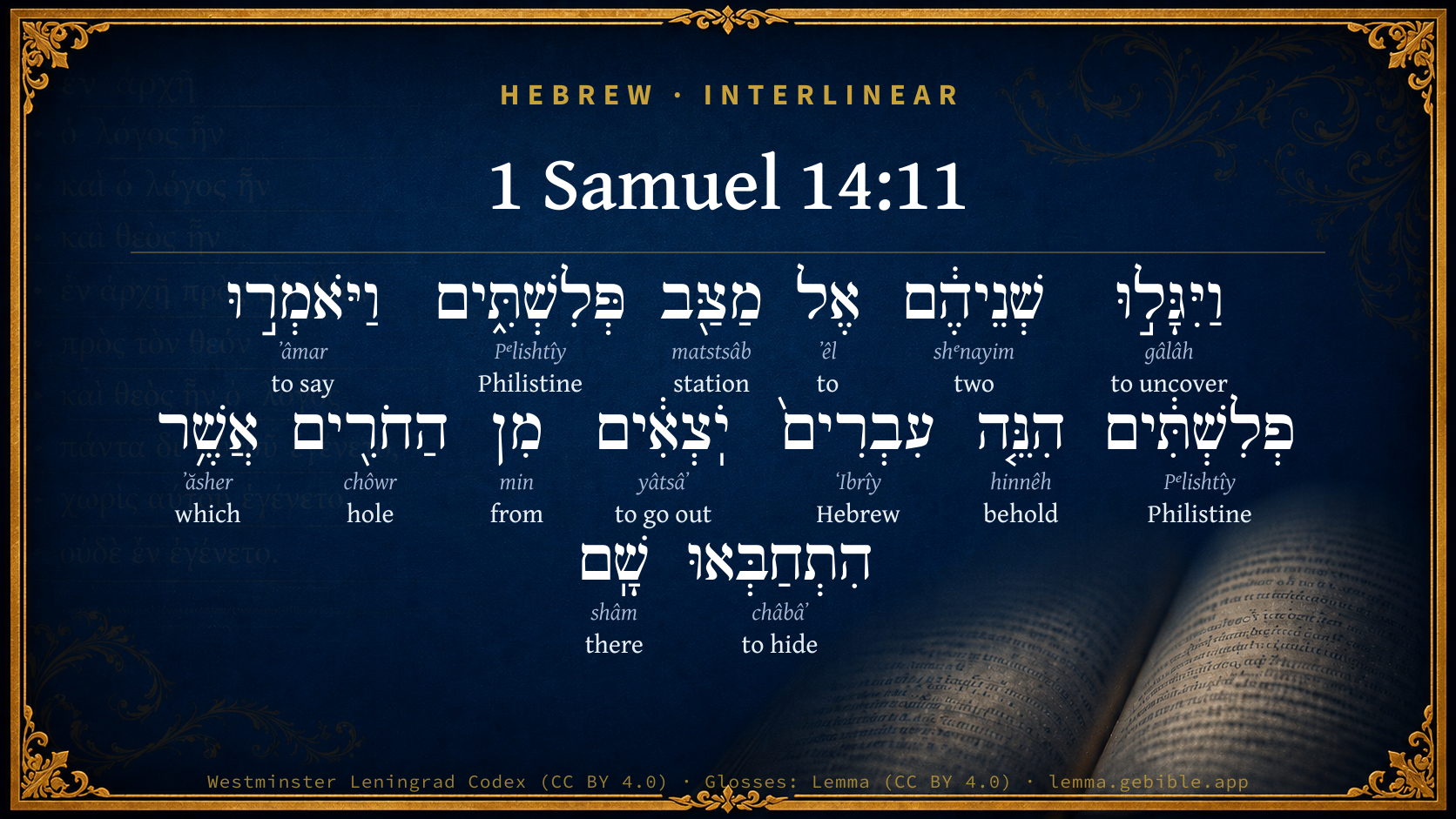
Hebrew (Westminster Leningrad Codex) 1 Samuel 14:11 appears in the Hebrew Old Testament. The text above is from the Westminster Leningrad Codex. Each word links to its Strong’s number, a concise gloss, and parsing drawn from the Open Scriptures Hebrew Bible morphology. Click any word for its full Brown-Driver-Briggs (BDB) entry.
Download image
Cite this verse

1 Samuel 14:11 (World English Bible). Public Domain. Lemma interlinear Bible study tool, https://lemma.gebible.app/v/1-samuel/14/11.

Show BibTeX & RIS
BibTeX
RIS
English Translation
Both of them disclosed themselves to the garrison of the Philistines: and the Philistines said, Behold, the Hebrews come forth out of the holes where they had hid themselves.
World English Bible · Public Domain
Highlights
  • 1 first appearance in the Hebrew Bible
Full analysis ↓
Download a study sheet

One document with this verse’s original text, its word-by-word gloss line, the meaning frame, cross-references with their text, attributed commentary, and full source and license credits — printable, and it pastes into notes with its structure intact.

This verse Autodidact and up

Study sheet (.html) Plain text (.txt)

A passage Seminary Student

Up to 50 verses in one chapter. A passage sheet keeps up to 6 commentary sources and 12 cross-references per verse, in the order this page ranks them, and says so on the sheet whenever that leaves anything out. Ask for a single verse and you get the Autodidact verse sheet above.

Everything on this page stays free to read, with no account — the sheet is a download of what is already on screen, not access to it.

Want to remove ads? Support Godless Engineer
Compare translations 3

The same verse in 3 English versions, stacked beneath the original-language interlinear above. Click any original word for its lexicon entry.

Each is an independent rendering of the whole verse — the interlinear is not word-aligned to these translations.

Highlighted words mark where these versions differ — a whole-verse word diff, not a word-by-word alignment.

  • World English Bible Public Domain
    Both of them disclosed themselves to the garrison of the Philistines: and the Philistines said, Behold, the Hebrews come forth out of the holes where they had hid themselves.
  • King James Version Public Domain
    And both of them discovered themselves unto the garrison of the Philistines: and the Philistines said, Behold, the Hebrews come forth out of the holes where they had hid themselves.
  • unfoldingWord Literal Text CC BY-SA 4.0
    And the two of them revealed themselves to the garrison of the Philistines. And the Philistines said, “Behold, Hebrews are coming out from the holes where they have hidden themselves there.”

unfoldingWord Literal Text — © unfoldingWord, licensed CC BY-SA 4.0. Word-aligned USFM3 via Door43 (git.door43.org/unfoldingWord/en_ult).

Versions to compare (up to 4)

3 of 4 selected

Show all 18 translations

Every available English version of this verse, each an independent rendering of the whole verse.

  • World English Bible Public Domain
    Both of them disclosed themselves to the garrison of the Philistines: and the Philistines said, Behold, the Hebrews come forth out of the holes where they had hid themselves.
  • Berean Standard Bible Public Domain
    So the two of them showed themselves to the outpost of the Philistines, who exclaimed, “Look, the Hebrews are coming out of the holes in which they were hiding!”
  • Majority Standard Bible Public Domain
    So the two of them showed themselves to the outpost of the Philistines, who exclaimed, “Look, the Hebrews are coming out of the holes in which they were hiding!”
  • King James Version Public Domain
    And both of them discovered themselves unto the garrison of the Philistines: and the Philistines said, Behold, the Hebrews come forth out of the holes where they had hid themselves.
  • American Standard Version (1901) Public Domain
    And both of them disclosed themselves unto the garrison of the Philistines: and the Philistines said, Behold, the Hebrews come forth out of the holes where they had hid themselves.
  • Revised Version (1885) Public Domain
    And both of them discovered themselves unto the garrison of the Philistines: and the Philistines said, Behold, the Hebrews come forth out of the holes where they had hid themselves.
  • Geneva Bible (1599) Public Domain
    So they both shewed themselues vnto the garison of the Philistims: and the Philistims said, See, the Ebrewes come out of the holes wherein they had hid themselues.
  • Douay-Rheims (1899) Public Domain
    So both of them discovered themselves to the garrison of the Philistines: and the Philistines said: Behold the Hebrews come forth out of the holes wherein they were hid.
  • Young's Literal Translation Public Domain
    And revealed are both of them unto the station of the Philistines, and the Philistines say, `Lo, Hebrews are coming out of the holes where they have hid themselves.'
  • Literal Standard Version CC BY-SA 4.0
    And both of them are revealed to the station of the Philistines, and the Philistines say, “Behold, Hebrews are coming out of the holes where they have hid themselves.”
  • Unlocked Literal Bible CC BY-SA 4.0
    So both of them revealed themselves to the garrison of the Philistines. The Philistines said, “Look, Hebrews are coming out of the holes where they have hidden themselves.”
  • unfoldingWord Literal Text CC BY-SA 4.0
    And the two of them revealed themselves to the garrison of the Philistines. And the Philistines said, “Behold, Hebrews are coming out from the holes where they have hidden themselves there.”
  • Darby Bible Public Domain
    And both of them shewed themselves to the garrison of the Philistines; and the Philistines said, Behold, the Hebrews come forth out of the holes where they had hid themselves.
  • World Messianic Bible Public Domain
    Both of them revealed themselves to the garrison of the Philistines; and the Philistines said, “Behold, the Hebrews are coming out of the holes where they had hidden themselves!”
  • Webster's Bible Public Domain
    And both of them discovered themselves to the garrison of the Philistines: and the Philistines said, Behold, the Hebrews come forth out of the holes where they had hid themselves.
  • Free Bible Version CC BY-SA 4.0
    So both of them let themselves be seen by the Philistine garrison. “Hey, look!” shouted the Philistines. “The Hebrews are coming out of the holes they were hiding in.”
  • Bible in Basic English Public Domain
    And they let the Philistine force see the two of them: and the Philistines said, Look! the Hebrews are coming out of the holes where they have taken cover.
  • JPS Tanakh (1917) Public Domain
    And both of them disclosed themselves unto the garrison of the Philistines; and the Philistines said: 'Behold Hebrews coming forth out of the holes where they hid themselves.'

Literal Standard Version (2020), Covenant Press — licensed CC BY-SA 4.0. Text via the HelloAO Bible API (eBible.org). Unlocked Literal Bible (unfoldingWord) — licensed CC BY-SA 4.0. Text via the HelloAO Bible API (eBible.org). unfoldingWord Literal Text — © unfoldingWord, licensed CC BY-SA 4.0. Word-aligned USFM3 via Door43 (git.door43.org/unfoldingWord/en_ult). Free Bible Version, Dr. Jonathan Gallagher — licensed CC BY-SA 4.0. Text via the HelloAO Bible API (eBible.org).

Word by word

More ways to search: Search by grammar → Find every occurrence → Compare this word →

Practice this passage: Drill this verse → Learn its vocabulary →

הַחֹרִ֖ים
chôwr
H2356
“the · holes”
Particle, Definite Article + Noun, Common, Masculine, Plural, Absolute
Part of Speech
Particle + Noun
Type
Common
Gender
Masculine
Number
Plural
State
Absolute
Full BDB Definition

Origin: the same as H2352

TWOT: 758a

hole, cave
  1. וַיִּגָּל֣וּ gâlâh H1540 “and · to uncover” Conjunction + Verb, Niphal, Sequential Imperfect, 3rd Person, Masculine, Plural
  2. שְׁנֵיהֶ֔ם shᵉnayim H8147 “two · their” Adjective, Cardinal number, Masculine, Dual, Construct + Suffix, Personal, 3rd Person, Masculine, Plural
  3. אֶל ʼêl H413 “to” Preposition
  4. מַצַּ֖ב matstsâb H4673 “station of” Noun, Common, Masculine, Singular, Construct
  5. פְּלִשְׁתִּ֑ים Pᵉlishtîy H6430 “Philistines” Noun, Gentilic, Masculine, Plural, Absolute
  6. וַיֹּאמְר֣וּ ʼâmar H559 “and · to say” Conjunction + Verb, Qal, Sequential Imperfect, 3rd Person, Masculine, Plural
  7. פְלִשְׁתִּ֔ים Pᵉlishtîy H6430 “Philistines” Noun, Gentilic, Masculine, Plural, Absolute
  8. הִנֵּ֤ה hinnêh H2009 “behold” Particle, Demonstrative
  9. עִבְרִים֙ ʻIbrîy H5680 “Hebrews” Noun, Gentilic, Masculine, Plural, Absolute
  10. יֹֽצְאִ֔ים yâtsâʼ H3318 “going out” Verb, Qal, Participle Active, Masculine, Plural, Absolute
  11. מִן min H4480 “from” Preposition
  12. אֲשֶׁ֥ר ʼăsher H834 “which” Particle, Relative
  13. הִתְחַבְּאוּ châbâʼ H2244 “to hide” Verb, Hithpael, Perfect, 3rd Person, Common, Plural
  14. שָֽׁם shâm H8033 “there” Adverb

About this verse

These counts appear in no published source. They are computed here, from the morphology-tagged text and Lemma’s own curated glosses. What Lemma adds →

15
words
14
distinct lemmas
Historical
section

Notable vocabulary

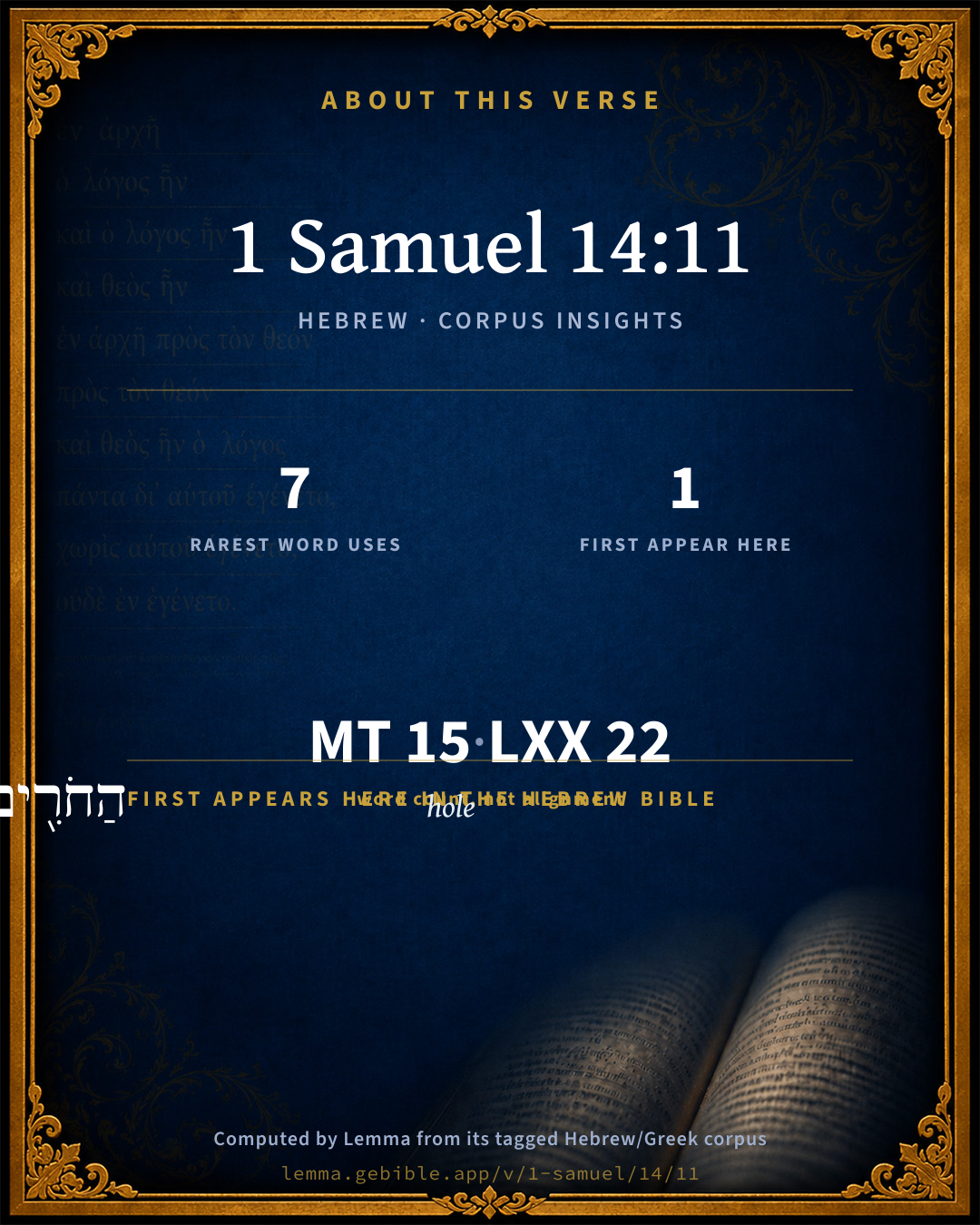
The rarest word here is הַחֹרִ֖ים hole H2356 — appearing just 7 times in the whole Hebrew Bible.

First appearance in Scripture

This word makes its first canonical appearance in the Hebrew Bible here:

  • הַחֹרִ֖ים hole H2356

Shared distinctive vocabulary

הַחֹרִ֖ים hole H2356 occurs in 7 verses of the Hebrew Bible. Also found in:

Grammatical profile

  • 4 verbs
  • 5 nouns
  • 1 adjective
  • 2 prepositions
  • 1 adverb
  • 2 particles

Verb forms

  • וַיִּגָּל֣וּ Niphal · Sequential Imperfect
  • וַיֹּאמְר֣וּ Qal · Sequential Imperfect
  • יֹֽצְאִ֔ים Qal · Participle Active
  • הִתְחַבְּאוּ Hithpael · Perfect

Repetition

A word recurs within this verse — often emphatic in Hebrew:

  • פְּלִשְׁתִּ֑ים Philistine H6430 ×2

Hebrew & Septuagint length

In English translation the verse runs 29 words from the Hebrew and 28 from the Septuagint (LXX English) — closely comparable.

A rough comparison of the two English renderings, which tokenize alike — not a word-level alignment.

Word counts can differ between the Hebrew and the Greek without any difference in meaning — e.g. the Hebrew direct-object marker אֵת has no separate Greek word, and Greek often adds the article ὁ.

In the original languages it is 15 Hebrew tokens and 22 Greek tokens — but the two are counted differently (Hebrew bundles its prefixes and suffixes into one token; the Greek is in lemma form), so that isn’t a like-for-like length.

Cross-references

3

Topical passages linked to 1 Samuel 14:11 in the Treasury of Scripture Knowledge — connected by theme and wording, ordered by reader-vote popularity; previews shown in the World English Bible.

  • 1 Samuel 13:6 When the men of Israel saw that they were in a strait (for the people were distressed), then the people did hide themselves in caves, and in thickets, and in rocks, and in coverts, and in pits.
  • 1 Samuel 14:22 Likewise all the men of Israel who had hid themselves in the hill-country of Ephraim, when they heard that the Philistines fled, even they also followed hard after them in the battle.
  • Judges 6:2 The hand of Midian prevailed against Israel; and because of Midian the children of Israel made them the dens which are in the mountains, and the caves, and the strongholds.

Cross-references courtesy of OpenBible.info (CC BY 4.0).

Hebrew and Greek witnesses Masoretic Hebrew ↔ Greek Septuagint

The same verse in the two great witnesses to the Old Testament, shown verse-for-verse.

These are two independent witnesses, not word-aligned to each other, and the Septuagint is shown in lemma (dictionary) form.

Hebrew 1 Samuel 14:11 Masoretic · Westminster Leningrad Codex

וַיִּגָּל֣וּ שְׁנֵיהֶ֔ם אֶל מַצַּ֖ב פְּלִשְׁתִּ֑ים וַיֹּאמְר֣וּ פְלִשְׁתִּ֔ים הִנֵּ֤ה עִבְרִים֙ יֹֽצְאִ֔ים מִן הַחֹרִ֖ים אֲשֶׁ֥ר הִתְחַבְּאוּ שָֽׁם

Both of them disclosed themselves to the garrison of the Philistines: and the Philistines said, Behold, the Hebrews come forth out of the holes where they had hid themselves.

World English Bible · Public Domain

Greek LXX 1 Samuel 14:11 Septuagint · lemma form

καί εἰςἔρχομαι ἀμφότεροι εἰς μεσσαβ ὁ ἀλλόφυλος καί λέγω ὁ ἀλλόφυλος ἰδού ὁ εβραῖος ἐκπορεύομαι ἐκ ὁ τρώγλη αὐτός ὅς κρύπτω ἐκεῖ

And they both went in to Messab of the Philistines; and the Philistines said, Behold, the Hebrews come forth out of their Caves, where they had hidden themselves.

LXX2012 (modern English Septuagint) · Public Domain

Hebrew: Westminster Leningrad Codex (CC BY 4.0). Greek: Septuagint (public domain); English from LXX2012 (modern English Septuagint) (Public Domain). How the Septuagint differs from the Hebrew →

Targum (Aramaic paraphrase)

1

The Targum is the ancient Jewish Aramaic paraphrase of the Hebrew Scriptures — an interpretive translation, not the Hebrew text itself. Onkelos (literal) and Pseudo-Jonathan (expansive) render the Torah, and Jonathan the Prophets. Coverage is partial: where no permissively-licensed English translation exists for a verse, only the Aramaic is shown. This is verse-level text, not a word-by-word alignment to the Hebrew.

  1. Targum Jonathan Prophets (Joshua–Malachi)
    וְאִתְגְלִיאוּ תַרְוֵיהוֹן לְאִסְטַרְטְגֵי פְלִשְׁתָּאֵי וַאֲמָרוּ פְלִשְׁתָּאֵי הָא יְהוּדָאֵי נַפְקִין מִן חוֹרָאֵי דְאִטַמָרוּ תַמָן:

    (no public-domain English translation for this verse)

    Targum Jonathan — Aramaic: “Mikraot Gedolot” (public domain). English: “Sefaria Community Translation” (CC0 1.0 (public-domain dedication)); “London "Chaldee Paraphrase," 1871” (public domain). Text via Sefaria.

Commentary

Notes on 1 Samuel 14:11 from classic Christian and Jewish commentators (each source and its license shown beneath its notes). The classic Christian expositions comment on the surrounding passage and are grouped to its opening verse, so a note may address several verses; the Jewish commentaries on the Tanakh (Rashi and others) are per-verse, so they appear only where the commentator wrote on this verse.

Lemma curates 59 commentaries, every one of them public domain or Creative Commons licensed, each selected and text-cleaned for this edition rather than reprinted as found. About our sources →

Trapp's Complete Commentary

John Trapp

1Sa 14:11 And both of them discovered themselves unto the garrison of the Philistines: and the Philistines said, Behold, the Hebrews come forth out of the holes where they had hid themselves.

Ver. 11. Behold, the Hebrews come forth out of the holes,] i.e., Out of their lurking places, {1Sa 14:22} or trenches.

John Trapp, A Commentary or Exposition upon All the Books of the Old and New Testament (1647–1656) — public domain. Text from a community e-Sword module.

Joseph Benson's Commentary

1Sa 14:11-12. Both of them discovered themselves — At the bottom of the rocks. Come up to us, &c. — A speech of contempt and derision. The Lord hath delivered them, &c. — Jonathan, hearing those of the garrison make use of the very words which he had fixed on as a sign of victory, immediately concluded that God had influenced their minds and tongues, and thereby caused them to use the words, and would certainly render his designed attempt successful. And he piously and modestly ascribes the success, which he now foresees, to God only. And he does not say, into our hand, but into the hand of Israel; for he sought not his own glory, but the public good. His faith being thus strengthened, nothing can stand against him: he climbs the rock upon all four, though he had nothing to cover him, none to second him, nor any probability of any thing but death before him.

Joseph Benson's Commentary on the Old and New Testaments (1811–1818) — public domain. Text from a community e-Sword module.

Tyndale Open Study Notes

Tyndale Open Resources

14:11 Hebrews: See study note on 13:3. • crawling out of their holes: See 13:6.

Tyndale Open Study Notes — © Tyndale Open Resources, licensed CC BY-SA 4.0. Text via the HelloAO Bible API.

Geneva Bible (1599)

Geneva Bible translators

Thus they spake contemptuously and by derision.

Geneva Bible (1599) marginal notes — public domain. Text via Bolls.life.

Jamieson, Fausset & Brown

Robert Jamieson, A. R. Fausset & David Brown

Behold, the Hebrews come forth out of the holes--As it could not occur to the sentries that two men had come with hostile designs, it was a natural conclusion that they were Israelite deserters. And hence no attempt was made to hinder their ascent, or stone them.

Jamieson, Fausset & Brown — Commentary Critical and Explanatory on the Whole Bible (1871) — public domain (CC PDM 1.0). Text via the HelloAO Bible API.

Ellicott's Commentary for English Readers

(11) And the Philistines said . . . —Easily might the sentinels of the outpost have rolled stones down the steep cliff, and hurled back the daring assailants; but they treated them with utter contempt, probably thinking to take them alive if ever they succeeded in scaling the slippery cliff.

A Bible Commentary for English Readers, edited by Charles John Ellicott (1878–1897) — public domain. Text from a community e-Sword module.

The Cambridge Bible for Schools and Colleges

gen. ed. J. J. S. Perowne

11. the holes where they had hid themselves] See 1Sa_13:6. Travellers speak of numerous caverns in the limestone rocks of the district.

The Cambridge Bible for Schools and Colleges (gen. ed. J. J. S. Perowne; Cambridge University Press, 1878–1918) — public domain. Text from a community e-Sword module.

John Gill's Exposition

And both of them discovered themselves unto the garrison of the Philistines,.... They passed over the valley that lay between Michmash and Gibeah, and presented themselves at the bottom of the hill or rock on which the garrison was, to the open view of it; and who might easily discern who they were, that they were Hebrews, as they did, as follows:

and the Philistines said, behold, the Hebrews came forth out of the holes where they had hid themselves, being in want of provisions, and almost starved, and so obliged to come out to seek for sustenance; see Sa1 14:6.

John Gill's Exposition of the Whole Bible (1746–1763) — public domain (CC PDM 1.0). Text via the HelloAO Bible API.

Haydock's Catholic Bible Commentary

Philistines, probably on the northern rock, as they afterwards climbed up that on the south, (Calmet) where they had not been discovered. (Salien)

George Leo Haydock (1774–1849), Haydock's Catholic Family Bible and Commentary, 1859 edition — public domain. Excludes Psalms (Douay-Rheims chapter numbering differs from Protestant) and Deuterocanonical books (Catholic canon only).

Matthew Poole's English Annotations

Therefore Jonathan chose that rocky and unusual way, that the Philistines might suppose they did not come from Saul’s camp to fight with them, but rather out of the caves and holes of the rocks, from which their necessity had now driven them.

Matthew Poole's English Annotations on the Holy Bible (1683–1685) — public domain. Text from a community e-Sword/MySword module.

The Pulpit Commentary

Both of them discovered themselves. They had crept up the precipice unseen, but at some convenient spot near the top they so placed themselves that the garrison must see them, and waited there till their presence was observed. Behold, the Hebrews. There is no article in the Hebrew. What the Philistines say is, See! Hebrews come out of the holes wherein they had hid themselves.

The Pulpit Commentary (1880–1919), ed. H.D.M. Spence-Jones & Joseph S. Exell — public domain. Text from a community e-Sword module.

unfoldingWord translationNotes

Door43 World Missions Community

revealed themselves to the garrison of the Philistines

"allowed the Philistine soldiers to see them"

the garrison

the army camp

coming out of the holes where they have hidden themselves

The Philistines implied that the Hebrews had been hiding in holes in the ground like animals. (See: Metaphor)

we will show you something

This is an idiom that means "we will teach you a lesson." (See: Idiom)

has given them into the hand of Israel

Here "hand" refers to power to defeat the Philistines. AT: "will enable Israel to defeat them" (See: Metonymy)

translationWords

reveal

Philistines

Hebrew

armor

hand

Israel

unfoldingWord translationNotes — © Distant Shores Media and the Door43 World Missions Community, licensed CC BY-SA 4.0. Source: git.door43.org/Door43/en_tn.

Lesson kit

Teaching starters — assembled from the data on this page, not authored interpretation. Every prompt links to the verse data it draws on. Edit before teaching.

1 Samuel, in the Historical, opens this verse with 15 words (14 distinct Hebrew lemmas). Its most distinctive word is chôwr (“hole”). A historical commentator’s framing appears above. Read the whole chapter for the surrounding context.

Discussion questions

  1. What does “hole” (chôwr) contribute to the verse as a whole?
  2. This is the first place “hole” appears in Scripture (first appears here). What does its debut here establish?
  3. How does 2 Kings 12:9, which shares the word «hole», read alongside this verse?
  4. What does the repetition of “Philistine” (2× in this one verse) do in this verse?
  5. These translations render this verse differently; the difference is in the English rendering, not the original. What questions does that raise?
  6. «וַיִּגָּל֣וּ» is a Niphal Sequential Imperfect verb. How does that grammatical form shape the action described?
  7. Compare how Trapp's Complete Commentary and Joseph Benson's Commentary read this verse. Where do they agree or differ?

Things to notice

Reading settings

Reading text

Shown beneath each verse's original-language words.

Old Testament
Old Testament edition

Read the OT as the Masoretic Hebrew (MT) or the Greek Septuagint (LXX).

English shown for the Greek Septuagint (in the Hebrew ↔ Greek comparison).

Comparing translations? Open the Compare panel on any verse page to stack up to four side by side.