Jeremiah 32:11

Hebrew (Westminster Leningrad Codex) Jeremiah 32:11 appears in the Hebrew Old Testament. The text above is from the Westminster Leningrad Codex. Each word links to its Strong’s number, a concise gloss, and parsing drawn from the Open Scriptures Hebrew Bible morphology. Click any word for its full Brown-Driver-Briggs (BDB) entry.
Download image
Cite this verse

Jeremiah 32:11 (World English Bible). Public Domain. Lemma interlinear Bible study tool, https://lemma.gebible.app/v/jeremiah/32/11.

Show BibTeX & RIS
BibTeX
RIS
English Translation
So I took the deed of the purchase, both that which was sealed, containing the terms and conditions, and that which was open;
World English Bible · Public Domain
Download a study sheet

One document with this verse’s original text, its word-by-word gloss line, the meaning frame, cross-references with their text, attributed commentary, and full source and license credits — printable, and it pastes into notes with its structure intact.

This verse Autodidact and up

Study sheet (.html) Plain text (.txt)

A passage Seminary Student

Up to 50 verses in one chapter. A passage sheet keeps up to 6 commentary sources and 12 cross-references per verse, in the order this page ranks them, and says so on the sheet whenever that leaves anything out. Ask for a single verse and you get the Autodidact verse sheet above.

Everything on this page stays free to read, with no account — the sheet is a download of what is already on screen, not access to it.

Want to remove ads? Support Godless Engineer
Compare translations 3

The same verse in 3 English versions, stacked beneath the original-language interlinear above. Click any original word for its lexicon entry.

Each is an independent rendering of the whole verse — the interlinear is not word-aligned to these translations.

Highlighted words mark where these versions differ — a whole-verse word diff, not a word-by-word alignment.

  • World English Bible Public Domain
    So I took the deed of the purchase, both that which was sealed, containing the terms and conditions, and that which was open;
  • King James Version Public Domain
    So I took the evidence of the purchase, both that which was sealed according to the law and custom, and that which was open:
  • unfoldingWord Literal Text CC BY-SA 4.0
    Next I took the deed of purchase that was sealed, following the command and the statutes, as well as the unsealed deed.

unfoldingWord Literal Text — © unfoldingWord, licensed CC BY-SA 4.0. Word-aligned USFM3 via Door43 (git.door43.org/unfoldingWord/en_ult).

Versions to compare (up to 4)

3 of 4 selected

Show all 18 translations

Every available English version of this verse, each an independent rendering of the whole verse.

  • World English Bible Public Domain
    So I took the deed of the purchase, both that which was sealed, containing the terms and conditions, and that which was open;
  • Berean Standard Bible Public Domain
    Then I took the deed of purchase—the sealed copy with its terms and conditions, as well as the open copy—
  • Majority Standard Bible Public Domain
    Then I took the deed of purchase—the sealed copy with its terms and conditions, as well as the open copy—
  • King James Version Public Domain
    So I took the evidence of the purchase, both that which was sealed according to the law and custom, and that which was open:
  • American Standard Version (1901) Public Domain
    So I took the deed of the purchase, both that which was sealed, `according to' the law and custom, and that which was open:
  • Revised Version (1885) Public Domain
    So I took the deed of the purchase, both that which was sealed, according to the law and custom, and that which was open:
  • Geneva Bible (1599) Public Domain
    So I tooke the booke of the possession, being sealed according to the Lawe, and custome, with the booke that was open,
  • Douay-Rheims (1899) Public Domain
    And I took the deed of the purchase that was sealed, and the stipulations, and the ratifications with the seals that were on the outside.
  • Young's Literal Translation Public Domain
    And I take the purchase-book, the sealed one, according to law and custom, and the open one.
  • Literal Standard Version CC BY-SA 4.0
    and I take the purchase scroll, the sealed one, according to law and custom, and the open one;
  • Unlocked Literal Bible CC BY-SA 4.0
    Next I took the deed of purchase that was sealed, following the command and the statutes, as well as the unsealed deed.
  • unfoldingWord Literal Text CC BY-SA 4.0
    Next I took the deed of purchase that was sealed, following the command and the statutes, as well as the unsealed deed.
  • Darby Bible Public Domain
    And I took the writing of the purchase, that which was sealed [according to] the law and the statutes, and that which was open;
  • World Messianic Bible Public Domain
    So I took the deed of the purchase, both that which was sealed, containing the terms and conditions, and that which was open;
  • Webster's Bible Public Domain
    So I took the evidence of the purchase, both that which was sealed according to the law and custom, and that which was open:
  • Free Bible Version CC BY-SA 4.0
    Then I took the deed of sale, both the sealed original containing the terms and conditions, and the unsealed copy,
  • Bible in Basic English Public Domain
    So I took the paper witnessing the business, one copy rolled up and stamped, and one copy open:
  • JPS Tanakh (1917) Public Domain
    So I took the deed of the purchase, both that which was sealed, containing the terms and conditions, and that which was open;

Literal Standard Version (2020), Covenant Press — licensed CC BY-SA 4.0. Text via the HelloAO Bible API (eBible.org). Unlocked Literal Bible (unfoldingWord) — licensed CC BY-SA 4.0. Text via the HelloAO Bible API (eBible.org). unfoldingWord Literal Text — © unfoldingWord, licensed CC BY-SA 4.0. Word-aligned USFM3 via Door43 (git.door43.org/unfoldingWord/en_ult). Free Bible Version, Dr. Jonathan Gallagher — licensed CC BY-SA 4.0. Text via the HelloAO Bible API (eBible.org).

Word by word

More ways to search: Search by grammar → Find every occurrence → Compare this word →

Practice this passage: Drill this verse → Learn its vocabulary →

הַמִּקְנָ֑ה
miqnâh
H4736
“the · purchase”
Particle, Definite Article + Noun, Common, Feminine, Singular, Absolute
Part of Speech
Particle + Noun
Type
Common
Gender
Feminine
Number
Singular
State
Absolute
Full BDB Definition

Origin: from H4735

TWOT: 2039c

purchase - purchase - purchase-price - possession (gained by purchase)
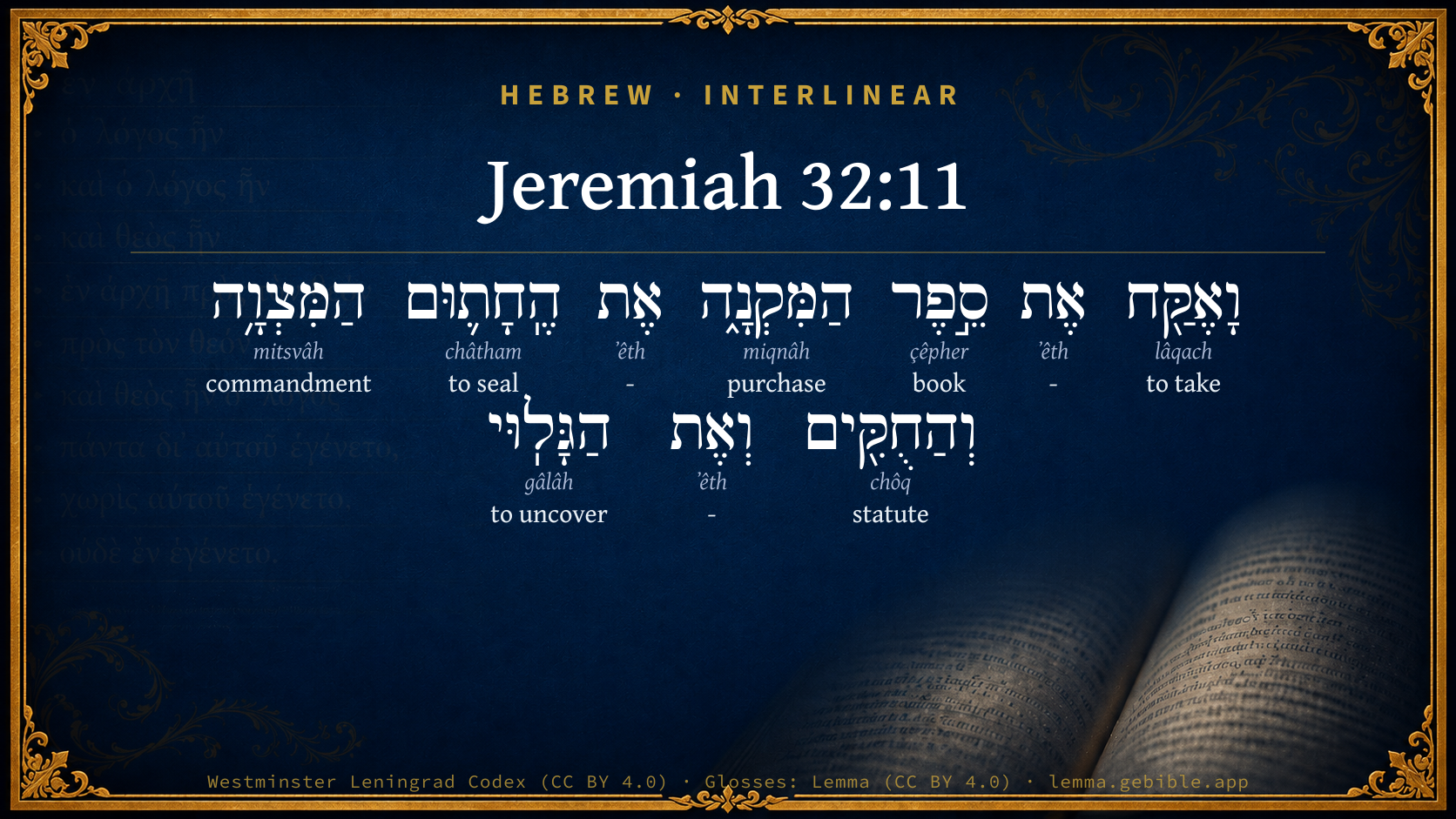
  1. וָאֶקַּ֖ח lâqach H3947 “and · to take” Conjunction + Verb, Qal, Sequential Imperfect, 1st Person, Common, Singular
  2. אֶת ʼêth H853 “-” Particle, Direct Object
  3. סֵ֣פֶר çêpher H5612 “book of” Noun, Common, Masculine, Singular, Construct
  4. אֶת ʼêth H853 “-” Particle, Direct Object
  5. הֶֽחָת֛וּם châtham H2856 “the · sealed” Particle, Definite Article + Verb, Qal, Participle Passive, Masculine, Singular, Absolute
  6. הַמִּצְוָ֥ה mitsvâh H4687 “the · commandment” Particle, Definite Article + Noun, Common, Feminine, Singular, Absolute
  7. וְהַחֻקִּ֖ים chôq H2706 “and · the · statutes” Conjunction + Particle, Definite Article + Noun, Common, Masculine, Plural, Absolute
  8. וְאֶת ʼêth H853 “and · -” Conjunction + Particle, Direct Object
  9. הַגָּלֽוּי gâlâh H1540 “the · uncovered” Particle, Definite Article + Verb, Qal, Participle Passive, Masculine, Singular, Absolute

About this verse

These counts appear in no published source. They are computed here, from the morphology-tagged text and Lemma’s own curated glosses. What Lemma adds →

10
words
8
distinct lemmas
Prophets
section

Notable vocabulary

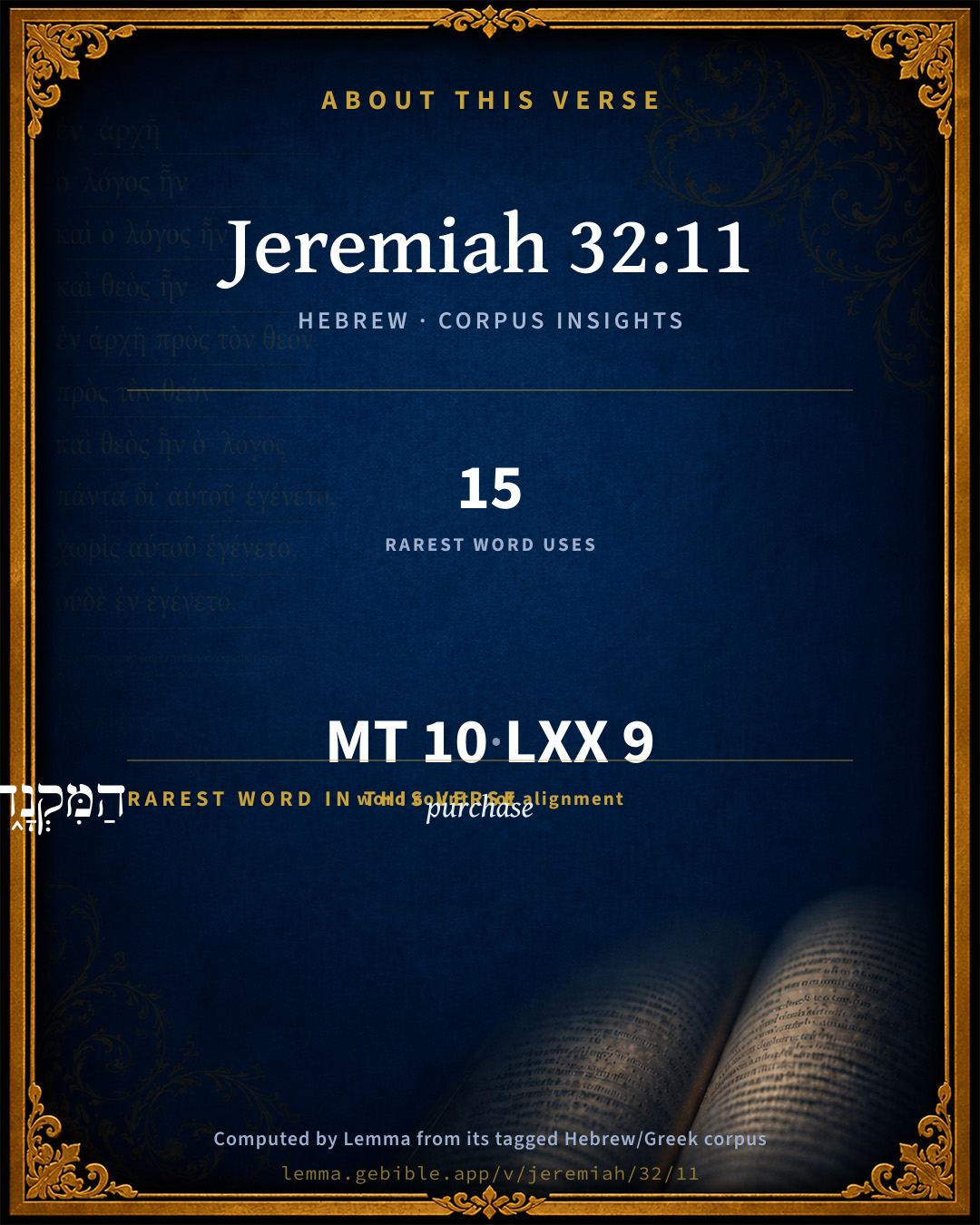
The rarest word here is הַמִּקְנָ֑ה purchase H4736 — appearing just 15 times in the whole Hebrew Bible.

Shared distinctive vocabulary

הַמִּקְנָ֑ה purchase H4736 occurs in 13 verses of the Hebrew Bible. Also found in:

Grammatical profile

  • 3 verbs
  • 4 nouns
  • 3 particles

Verb forms

  • וָאֶקַּ֖ח Qal · Sequential Imperfect
  • הֶֽחָת֛וּם Qal · Participle Passive
  • הַגָּלֽוּי Qal · Participle Passive

Hebrew & Septuagint length

In the original languages it is 10 Hebrew tokens and 9 Greek tokens — but the two are counted differently (Hebrew bundles its prefixes and suffixes into one token; the Greek is in lemma form), so that isn’t a like-for-like length.

Cross-references

3

Topical passages linked to Jeremiah 32:11 in the Treasury of Scripture Knowledge — connected by theme and wording, ordered by reader-vote popularity; previews shown in the World English Bible.

  • Luke 2:27 He came in the Spirit into the temple. When the parents brought in the child, Jesus, that they might do concerning him according to the custom of the law,
  • Acts 26:3 especially because you are expert in all customs and questions which are among the Jews. Therefore I beg you to hear me patiently.
  • 1 Corinthians 11:16 But if any man seems to be contentious, we have no such custom, neither do God's assemblies.

Cross-references courtesy of OpenBible.info (CC BY 4.0).

Hebrew and Greek witnesses Masoretic Hebrew ↔ Greek Septuagint

The same verse in the two great witnesses to the Old Testament, shown verse-for-verse.

These are two independent witnesses, not word-aligned to each other, and the Septuagint is shown in lemma (dictionary) form.

Hebrew Jeremiah 32:11 Masoretic · Westminster Leningrad Codex

וָאֶקַּ֖ח אֶת סֵ֣פֶר הַמִּקְנָ֑ה אֶת הֶֽחָת֛וּם הַמִּצְוָ֥ה וְהַחֻקִּ֖ים וְאֶת הַגָּלֽוּי

So I took the deed of the purchase, both that which was sealed, containing the terms and conditions, and that which was open;

World English Bible · Public Domain

Greek LXX Structure differs

In the Septuagint, Jeremiah is about an eighth shorter than the Hebrew and arranges its material differently — the Oracles Against the Nations (Hebrew chapters 46–51) appear in the middle of the Greek book, after 25:13. Because the chapter and verse boundaries do not line up, a verse-for-verse comparison with the Hebrew is not shown.

A verse-for-verse comparison isn’t shown here because the chapters and verses don’t line up. Switch to the LXX edition with the MT / LXX toggle above to read the Greek directly.

Hebrew: Westminster Leningrad Codex (CC BY 4.0). Greek: Septuagint (public domain); English from a public-domain English Septuagint. How the Septuagint differs from the Hebrew →

Targum (Aramaic paraphrase)

1

The Targum is the ancient Jewish Aramaic paraphrase of the Hebrew Scriptures — an interpretive translation, not the Hebrew text itself. Onkelos (literal) and Pseudo-Jonathan (expansive) render the Torah, and Jonathan the Prophets. Coverage is partial: where no permissively-licensed English translation exists for a verse, only the Aramaic is shown. This is verse-level text, not a word-by-word alignment to the Hebrew.

  1. Targum Jonathan Prophets (Joshua–Malachi)
    וּנְסֵיבֵית יַת שִׁטְרָא דִזְבִינָא יַת דִכְתִיב בְּעִיץ וַחֲתֵים כְּהִלְכָתָא וְכִדַחֲזָא וְיַת שִׁטְרָא פְּתִיחָא:

    (no public-domain English translation for this verse)

    Targum Jonathan — Aramaic: “Mikraot Gedolot” (public domain). English: “Sefaria Community Translation” (CC0 1.0 (public-domain dedication)); “London "Chaldee Paraphrase," 1871” (public domain). Text via Sefaria.

Commentary

Notes on Jeremiah 32:11 from classic Christian and Jewish commentators (each source and its license shown beneath its notes). The classic Christian expositions comment on the surrounding passage and are grouped to its opening verse, so a note may address several verses; the Jewish commentaries on the Tanakh (Rashi and others) are per-verse, so they appear only where the commentator wrote on this verse.

Lemma curates 59 commentaries, every one of them public domain or Creative Commons licensed, each selected and text-cleaned for this edition rather than reprinted as found. About our sources →

Trapp's Complete Commentary

John Trapp

Jer 32:11 So I took the evidence of the purchase, [both] that which was sealed [according] to the law and custom, and that which was open:

Ver. 11. So I took the evidence of the purchase, both that which was sealed, &c.] There were then two copies of these contracts and covenants, for preventing of later claims and quarrels.

John Trapp, A Commentary or Exposition upon All the Books of the Old and New Testament (1647–1656) — public domain. Text from a community e-Sword module.

Tyndale Open Study Notes

Tyndale Open Resources

32:11-12 According to custom, a copy of the deed was made. The two documents were entrusted to the care of Jeremiah’s secretary, Baruch. This was done publicly, in the courtyard of the guardhouse.

Tyndale Open Study Notes — © Tyndale Open Resources, licensed CC BY-SA 4.0. Text via the HelloAO Bible API.

Geneva Bible (1599)

Geneva Bible translators

According to the custom the instrument or evidence was sealed up with the common seal, and a copy thereof remained, which contained the same in effect, but was not so authentical as the other, but was left open to be seen if anything should be called into doubt.

Geneva Bible (1599) marginal notes — public domain. Text via Bolls.life.

Jamieson, Fausset & Brown

Robert Jamieson, A. R. Fausset & David Brown

evidence . . . sealed . . . open--Two deeds were drawn up in a contract of sale; the one, the original copy, witnessed and sealed with the public seal; the other not so, but open, and therefore less authoritative, being but a copy. GATAKER thinks that the purchaser sealed the one with his own seal; the other he showed to witnesses that they might write their names on the back of it and know the contents; and that some details, for example, the conditions and time of redemption were in the sealed copy, which the parties might not choose to be known to the witnesses, and which were therefore not in the open copy. The sealed copy, when opened after the seventy years' captivity, would greatly confirm the faith of those living at that time. The "law and custom" refer, probably, not merely to the sealing up of the conditions and details of purchase, but also to the law of redemption, according to which, at the return to Judea, the deed would show that Jeremiah had bought the field by his right as next of kin (Lev 25:13-16), [LUDOVICUS DE DIEU].

Jamieson, Fausset & Brown — Commentary Critical and Explanatory on the Whole Bible (1871) — public domain (CC PDM 1.0). Text via the HelloAO Bible API.

John Calvin's Commentaries

The Prophet adds, that he wrote a book, that is, the writing of the purchase; for ספר sepher, means in Hebrew, not only a volume, but what we call a document, and the Latins tablets, (tabulas) Then he says that the writing of the purchase was made, and then it was sealed, not as we do by appending a seal to it, but it was closed up, as the custom then was. He also adds, according to the law and custom; and at last he says that another writing was made which remained open; and it is thought that the open writing means what we call a copy; and so the sealed writing was deposited in a chest, and the open copy could be referred to at any time. Though the Prophet alludes to a common custom, yet I doubt not but that he wrote this prophecy on rolls, one sealed and the other open, in order that those who were then living might receive some benefit from his doctrine, and also that the authentic copy, or the original itself, might remain for posterity, as we shall hereafter see. And doubtless God not only intended to strengthen the hope of the faithful after the completed time of exile, as this prophecy would he dormant for seventy years; but he designed also that it should be then of use, so as to be a support to them in their sufferings. There was also another benefit to be derived from this prophecy, even that the Jews while in exile might begin to entertain hope, and remembering this vision, might feel assured that God would be their Deliverer, according to what he had promised.

This then was the reason why two writings of the purchase were made, the sealed and the open. The open had a present benefit, as it would make the faithful to go more willingly into exile, and calmly to submit to the chastisement allotted to them by God; and for this reason the Prophecy was to be open to all. It was also sealed, in order that after the lapse of seventy years it might animate the godly, and inspire them with the hope of their promised deliverance. This, therefore, is the reason, as I think, why the Prophet relates that he made a writing and sealed it, and then that he made another writing which remained open.

John Calvin's Commentaries (1540-1563) — public domain. Text from the Calvin Translation Society English edition (1840s-50s) via the Christian Classics Ethereal Library (ccel.org). Calvin's coverage is partial (roughly two-thirds of the Bible); uncommented books and verses are honest gaps, never fabricated. The 19th-century editor's footnotes and remarks are omitted so the notes are faithfully Calvin's own voice.

Ellicott's Commentary for English Readers

(11) Both that which was sealed . . . and that which was open.—We are left to conjecture why there were two documents, and why one was sealed and the other open. Possibly, as in modern transactions, one was simply a duplicate copy of the other, the sealed document being the formal evidence of purchase kept by the buyer, and the other left with the vendor for reference. The more probable explanation, however, is that the unsealed document, which the witnesses did not subscribe or see, contained details which did not concern the witnesses, the price paid (though the mention of the witnesses before the weighing of the money militates against this view), the conditions of resumption by the vendor, possibly some reference to the period of seventy years, at the end of which, and not before, the heirs of Jeremiah might expect to enter on possession.

According to the law and custom.—Better, to wit, the agreement and the conditions. The whole transaction may be compared, as an example of ancient conveyancing, with the transfer of the field and cave of Machpelah in Genesis 23

A Bible Commentary for English Readers, edited by Charles John Ellicott (1878–1897) — public domain. Text from a community e-Sword module.

The Cambridge Bible for Schools and Colleges

gen. ed. J. J. S. Perowne

11. both that which was sealed … and that which was open] but not implying two documents to be kept separate. They were the two parts of a whole. See on Jer_32:10.

according to the law and custom] better, with mg. containing the terms and conditions. The former Dr. however renders the injunction, viz. to the seller, bidding him hand over the property, while the latter are the conditions on which it is purchased.

The Cambridge Bible for Schools and Colleges (gen. ed. J. J. S. Perowne; Cambridge University Press, 1878–1918) — public domain. Text from a community e-Sword module.

John Gill's Exposition

And I gave the evidence of the purchase,.... Both that which was sealed and that which was open; both the original and the copy; or the whole, as signed, sealed, and witnessed:

unto Baruch the son of Neriah, the son of Maaseiah; this Baruch, as appears from other places in this book, was one that attended on Jeremiah, was his scribe or amanuensis, and did business for him of one kind or another, and is described here by his pedigree; and it was the more necessary now to make use of him in this affair, because the prophet was confined, and could not go out of the court of the prison; to him he gave the above deed:

in the sight of Hanameel mine uncle's son; of whom the purchase was made: the word "son" is not in the text, which has led some to think that both were present at this bargain, both the uncle and the uncle's son; or that Hanameel was both uncle and uncle's son to Jeremiah, as Jarchi; but there is no need to suppose that; the word "son" may easily be supplied from what is before said:

and in the presence of the witnesses that subscribed the book of the purchase; the same that the prophet subscribed; so that the book the witnesses subscribed was not a separate book, as some have thought; for there was but one book or deed in all, besides the copy that was taken of it:

before all the Jews that sat in the court of the prison; where Jeremiah was; and who probably came to visit him, and to hear the word of the Lord from his mouth; unless we can suppose that these were fellow prisoners, or were set as spies upon him, to watch him what he said and did.

John Gill's Exposition of the Whole Bible (1746–1763) — public domain (CC PDM 1.0). Text via the HelloAO Bible API.

Haydock's Catholic Bible Commentary

Outside. "There was another copy left open for inspection, (ver. 14.) which custom still prevails," says St. Jerome. (Haydock)

George Leo Haydock (1774–1849), Haydock's Catholic Family Bible and Commentary, 1859 edition — public domain. Excludes Psalms (Douay-Rheims chapter numbering differs from Protestant) and Deuterocanonical books (Catholic canon only).

Matthew Poole's English Annotations

It is most probable that, upon such bargains and sales amongst the Jews, two instruments were made, the one sealed up, to be kept by the purchaser, the other open, to be showed to the judges, and by them ratified, and that this was the law and custom ordinarily amongst the Jews upon purchases; both which Jeremiah kept, the one for his use, the other to produce in court for ratification. There is no certainty in the guesses that some others make why there were two copies: nothing appeareth but that the prophet bought this little purchase with the same rites and circumstances that men ordinarily in that country made purchases in times of peace and civil order.

Matthew Poole's English Annotations on the Holy Bible (1683–1685) — public domain. Text from a community e-Sword/MySword module.

John Wesley's Explanatory Notes

I took - It is probable, that upon such sales among the Jews, two instruments were made, the one sealed up, to be kept by the purchaser, the other open, to be shewed to the Judges, and by them ratified.

John Wesley, Explanatory Notes Upon the Whole Bible (1754–1765) — public domain. Text via the GEBible commentary corpus.

Rashi

Rabbi Shlomo Yitzchaki (Rashi)

the deed of the purchase The deed of the sale.

that which was signed, etc. With its signature as it was signed according so the law and the statute.

and that which was open Which was confirmed in the court by word of its witnesses, and the judges wrote and signed a judicial confirmation. This is the confirmation of the deeds to make the matter open and publicized lest the witnesses die, and our Rabbis explained this concerning a plain, open document and a folded one in Baba Bathra (160b).

Rashi on the Tanakh — English translations: “The Judaica Press complete Tanach with Rashi, translated by A. J. Rosenberg” (CC BY 4.0); “Pentateuch with Rashi's commentary by M. Rosenbaum and A.M. Silbermann, 1929-1934” (public domain); “The Metsudah Tanach series, Lakewood, N.J” (CC BY 4.0); and “The Book of Joshua, Metsudah Publications, 1997” (CC BY 4.0). Text via Sefaria.

Lesson kit

Teaching starters — assembled from the data on this page, not authored interpretation. Every prompt links to the verse data it draws on. Edit before teaching.

Jeremiah, in the Prophets, opens this verse with 10 words (8 distinct Hebrew lemmas). Its most distinctive word is miqnâh (“purchase”). A historical commentator’s framing appears above. Read the whole chapter for the surrounding context.

Discussion questions

  1. How does “purchase” (miqnâh) shape what this verse is saying?
  2. Genesis 17:12 shares the word «purchase» with this verse. How do the two illuminate each other?
  3. The translations on this page render this verse differently — a whole-verse word diff, not a word-by-word alignment. What might account for the different wordings?
  4. The verb «וָאֶקַּ֖ח» is Qal Sequential Imperfect. How does its form color the action?
  5. Reading how Trapp's Complete Commentary and Tyndale Open Study Notes read this verse, where do the two commentators agree and where do they part?

Things to notice

Reading settings

Reading text

Shown beneath each verse's original-language words.

Old Testament
Old Testament edition

Read the OT as the Masoretic Hebrew (MT) or the Greek Septuagint (LXX).

English shown for the Greek Septuagint (in the Hebrew ↔ Greek comparison).

Comparing translations? Open the Compare panel on any verse page to stack up to four side by side.