Jeremiah 29:4

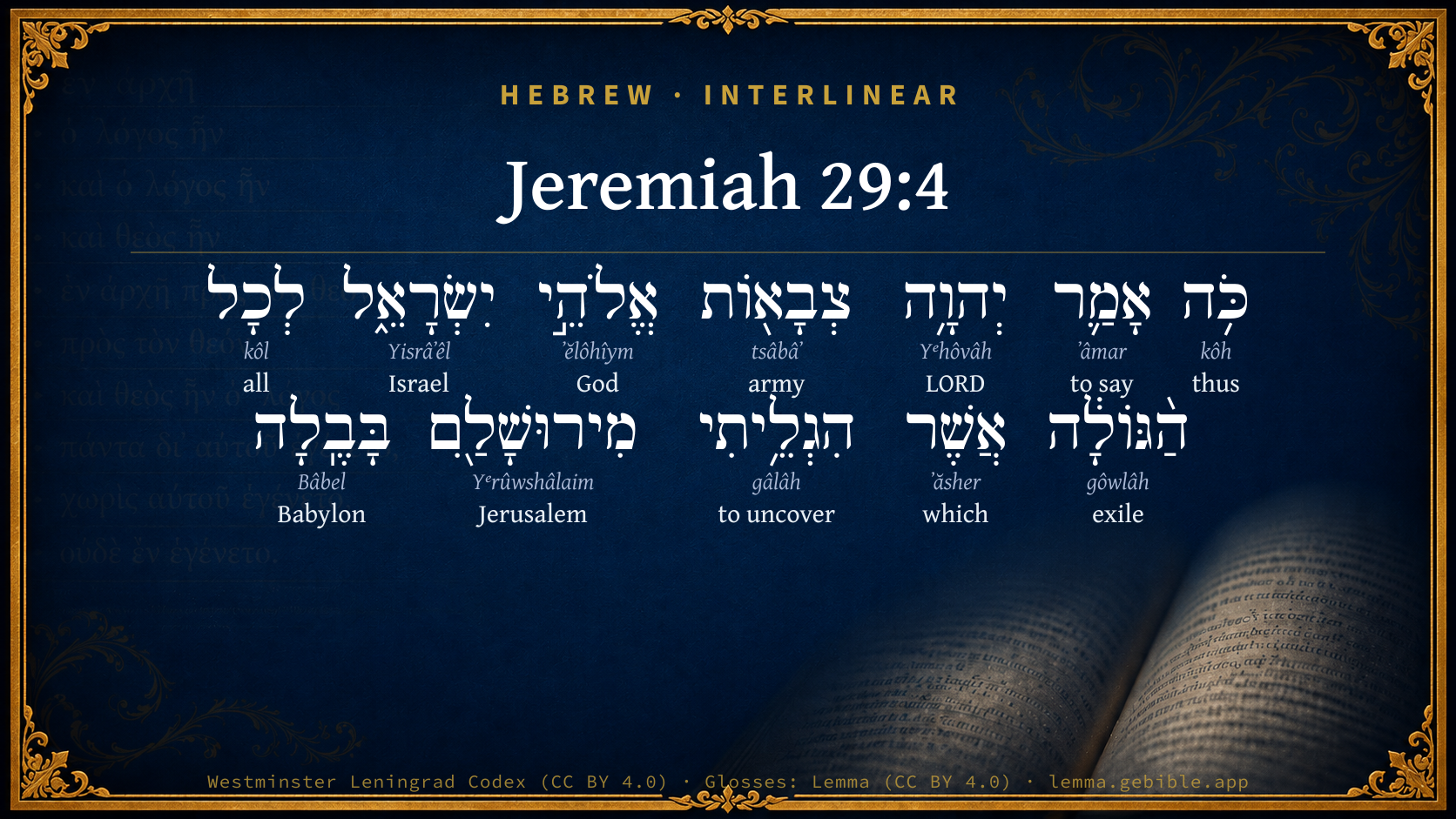
Hebrew (Westminster Leningrad Codex) Jeremiah 29:4 appears in the Hebrew Old Testament. The text above is from the Westminster Leningrad Codex. Each word links to its Strong’s number, a concise gloss, and parsing drawn from the Open Scriptures Hebrew Bible morphology. Click any word for its full Brown-Driver-Briggs (BDB) entry.
Download image
Cite this verse

Jeremiah 29:4 (World English Bible). Public Domain. Lemma interlinear Bible study tool, https://lemma.gebible.app/v/jeremiah/29/4.

Show BibTeX & RIS
BibTeX
RIS
English Translation
Thus says Yahweh of Hosts, the God of Israel, to all the captivity, whom I have caused to be carried away captive from Jerusalem to Babylon:
World English Bible · Public Domain
Download a study sheet

One document with this verse’s original text, its word-by-word gloss line, the meaning frame, cross-references with their text, attributed commentary, and full source and license credits — printable, and it pastes into notes with its structure intact.

This verse Autodidact and up

Study sheet (.html) Plain text (.txt)

A passage Seminary Student

Up to 50 verses in one chapter. A passage sheet keeps up to 6 commentary sources and 12 cross-references per verse, in the order this page ranks them, and says so on the sheet whenever that leaves anything out. Ask for a single verse and you get the Autodidact verse sheet above.

Everything on this page stays free to read, with no account — the sheet is a download of what is already on screen, not access to it.

Want to remove ads? Support Godless Engineer
Compare translations 3

The same verse in 3 English versions, stacked beneath the original-language interlinear above. Click any original word for its lexicon entry.

Each is an independent rendering of the whole verse — the interlinear is not word-aligned to these translations.

Highlighted words mark where these versions differ — a whole-verse word diff, not a word-by-word alignment.

  • World English Bible Public Domain
    Thus says Yahweh of Hosts, the God of Israel, to all the captivity, whom I have caused to be carried away captive from Jerusalem to Babylon:
  • King James Version Public Domain
    Thus saith the LORD of hosts, the God of Israel, unto all that are carried away captives, whom I have caused to be carried away from Jerusalem unto Babylon;
  • unfoldingWord Literal Text CC BY-SA 4.0
    The scroll said, “Yahweh of hosts, God of Israel, says this to all the captives whom I caused to be exiled from Jerusalem to Babylon,

unfoldingWord Literal Text — © unfoldingWord, licensed CC BY-SA 4.0. Word-aligned USFM3 via Door43 (git.door43.org/unfoldingWord/en_ult).

Versions to compare (up to 4)

3 of 4 selected

Show all 18 translations

Every available English version of this verse, each an independent rendering of the whole verse.

  • World English Bible Public Domain
    Thus says Yahweh of Hosts, the God of Israel, to all the captivity, whom I have caused to be carried away captive from Jerusalem to Babylon:
  • Berean Standard Bible Public Domain
    This is what the LORD of Hosts, the God of Israel, says to all the exiles who were carried away from Jerusalem to Babylon:
  • Majority Standard Bible Public Domain
    This is what the LORD of Hosts, the God of Israel, says to all the exiles who were carried away from Jerusalem to Babylon:
  • King James Version Public Domain
    Thus saith the LORD of hosts, the God of Israel, unto all that are carried away captives, whom I have caused to be carried away from Jerusalem unto Babylon;
  • American Standard Version (1901) Public Domain
    Thus saith Jehovah of hosts, the God of Israel, unto all the captivity, whom I have caused to be carried away captive from Jerusalem unto Babylon:
  • Revised Version (1885) Public Domain
    Thus saith the LORD of hosts, the God of Israel, unto all the captivity, whom I have caused to be carried away captive from Jerusalem unto Babylon:
  • Geneva Bible (1599) Public Domain
    Thus hath the Lord of hostes the God of Israel spoken vnto all that are caryed away captiues, whome I haue caused to be caryed away captiues from Ierusalem vnto Babel:
  • Douay-Rheims (1899) Public Domain
    Thus saith the Lord of hosts the God of Israel, to all that are carried away captives, whom I have caused to be carried away from Jerusalem to Babylon:
  • Young's Literal Translation Public Domain
    `Thus said Jehovah of Hosts, God of Israel, to all the removal that I removed from Jerusalem to Babylon,
  • Literal Standard Version CC BY-SA 4.0
    “Thus said YHWH of Hosts, God of Israel, to all the expulsion that I removed from Jerusalem to Babylon:
  • Unlocked Literal Bible CC BY-SA 4.0
    The scroll said, “Yahweh of hosts, God of Israel, says this to all the captives whom I caused to be exiled from Jerusalem to Babylon,
  • unfoldingWord Literal Text CC BY-SA 4.0
    The scroll said, “Yahweh of hosts, God of Israel, says this to all the captives whom I caused to be exiled from Jerusalem to Babylon,
  • Darby Bible Public Domain
    Thus saith Jehovah of hosts, the God of Israel, unto all the captivity, whom I have caused to be carried away from Jerusalem unto Babylon:
  • World Messianic Bible Public Domain
    The LORD of Hosts, the God of Israel, says to all the captives whom I have caused to be carried away captive from Jerusalem to Babylon:
  • Webster's Bible Public Domain
    Thus saith the LORD of hosts, the God of Israel, to all that are carried away captives, whom I have caused to be carried away from Jerusalem to Babylon;
  • Free Bible Version CC BY-SA 4.0
    This is what the Lord Almighty, the God of Israel, says to all the exiles who were taken from Jerusalem to Babylon:
  • Bible in Basic English Public Domain
    This is what the Lord of armies, the God of Israel, has said to all those whom I have taken away prisoners from Jerusalem to Babylon:
  • JPS Tanakh (1917) Public Domain
    Thus saith the LORD of hosts, the God of Israel, unto all the captivity, whom I have caused to be carried away captive from Jerusalem unto Babylon:

Literal Standard Version (2020), Covenant Press — licensed CC BY-SA 4.0. Text via the HelloAO Bible API (eBible.org). Unlocked Literal Bible (unfoldingWord) — licensed CC BY-SA 4.0. Text via the HelloAO Bible API (eBible.org). unfoldingWord Literal Text — © unfoldingWord, licensed CC BY-SA 4.0. Word-aligned USFM3 via Door43 (git.door43.org/unfoldingWord/en_ult). Free Bible Version, Dr. Jonathan Gallagher — licensed CC BY-SA 4.0. Text via the HelloAO Bible API (eBible.org).

Word by word

More ways to search: Search by grammar → Find every occurrence → Compare this word →

Practice this passage: Drill this verse → Learn its vocabulary →

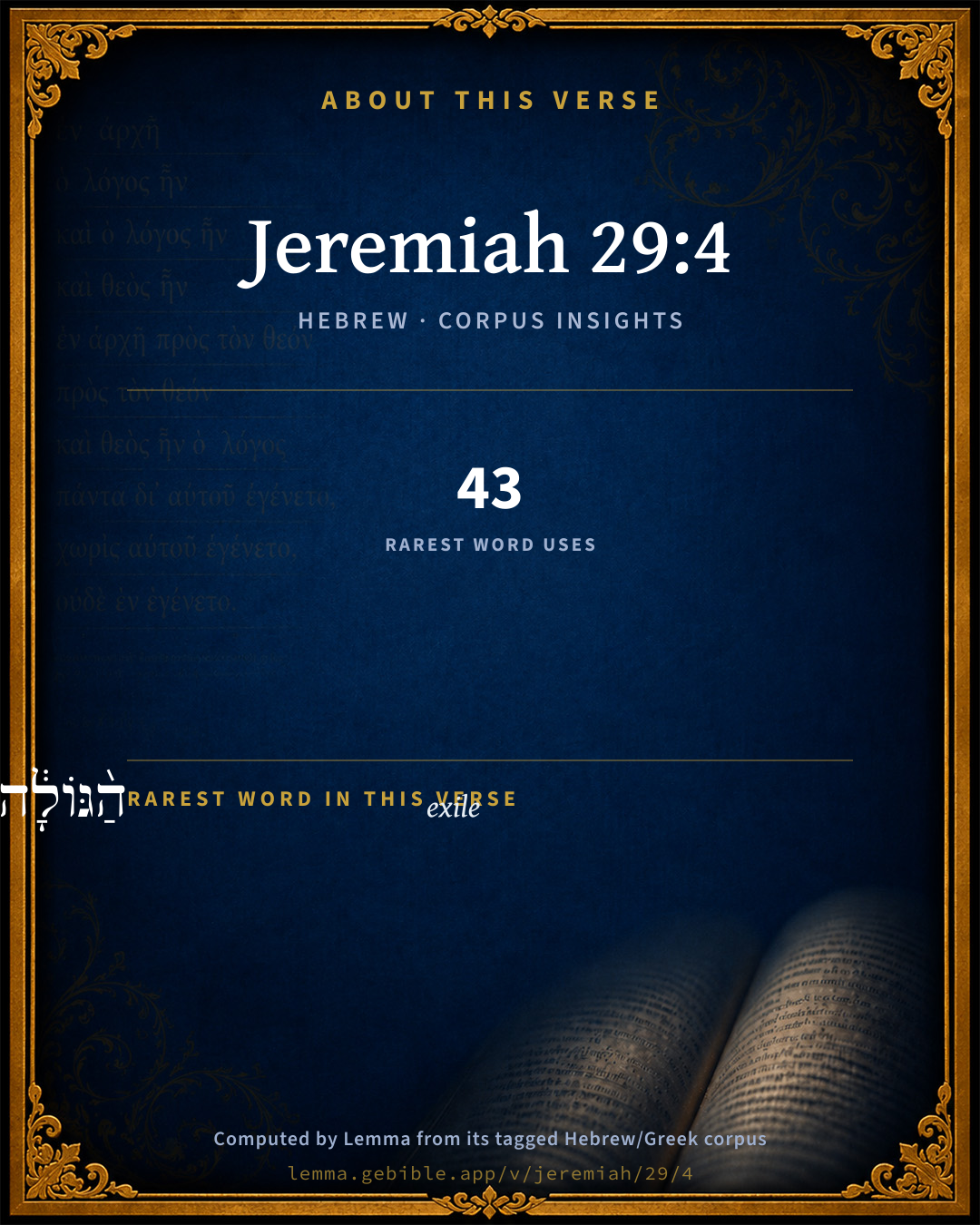
הַ֨גּוֹלָ֔ה
gôwlâh
H1473
“the · exile”
Particle, Definite Article + Noun, Common, Feminine, Singular, Absolute
Part of Speech
Particle + Noun
Type
Common
Gender
Feminine
Number
Singular
State
Absolute
Full BDB Definition

Origin: active participle of H1540

TWOT: 350a

exiles, exile, captivity - exiles (collective) - exile, captivity (abstract)
  1. כֹּ֥ה kôh H3541 “thus” Adverb
  2. אָמַ֛ר ʼâmar H559 “to say” Verb, Qal, Perfect, 3rd Person, Masculine, Singular
  3. יְהוָ֥ה Yᵉhôvâh H3068 “LORD” Noun, Proper
  4. צְבָא֖וֹת tsâbâʼ H6635 “armies” Noun, Common, Both, Plural, Absolute
  5. אֱלֹהֵ֣י ʼĕlôhîym H430 “God(s) of” Noun, Common, Masculine, Plural, Construct
  6. יִשְׂרָאֵ֑ל Yisrâʼêl H3478 “Israel” Noun, Proper
  7. לְכָל kôl H3605 “to/for · all of” Preposition + Noun, Common, Masculine, Singular, Construct
  8. אֲשֶׁר ʼăsher H834 “which” Particle, Relative
  9. הִגְלֵ֥יתִי gâlâh H1540 “to uncover” Verb, Hiphil, Perfect, 1st Person, Common, Singular
  10. מִירוּשָׁלִַ֖ם Yᵉrûwshâlaim H3389 “from · Jerusalem” Preposition + Noun, Proper
  11. בָּבֶֽלָה Bâbel H894 “Babylon · toward” Noun, Proper + Suffix, Demonstrative

About this verse

These counts appear in no published source. They are computed here, from the morphology-tagged text and Lemma’s own curated glosses. What Lemma adds →

12
words
12
distinct lemmas
Prophets
section

Shared distinctive vocabulary

הַ֨גּוֹלָ֔ה exile H1473 occurs in 42 verses of the Hebrew Bible. Also found in:

Grammatical profile

  • 2 verbs
  • 8 nouns
  • 1 adverb
  • 1 particle

Verb forms

  • אָמַ֛ר Qal · Perfect
  • הִגְלֵ֥יתִי Hiphil · Perfect

Cross-references

6

Topical passages linked to Jeremiah 29:4 in the Treasury of Scripture Knowledge — connected by theme and wording, ordered by reader-vote popularity; previews shown in the World English Bible.

  • Jeremiah 24:5 Thus says Yahweh, the God of Israel: Like these good figs, so will I regard the captives of Judah, whom I have sent out of this place into the land of the Chaldeans, for good.
  • Isaiah 10:5–6 Ho Assyrian, the rod of my anger, the staff in whose hand is my indignation!
  • Isaiah 45:7 I form the light, and create darkness; I make peace, and create evil. I am Yahweh, who does all these things.
  • Isaiah 59:1–2 Behold, Yahweh's hand is not shortened, that it can't save; neither his ear heavy, that it can't hear:
  • Amos 3:6 Does the trumpet alarm sound in a city, Without the people being afraid? Does evil happen to a city, And Yahweh hasn't done it?
  • Isaiah 5:5 Now I will tell you what I will do to my vineyard. I will take away its hedge, and it will be eaten up. I will break down its wall of it, and it will be trampled down.

Cross-references courtesy of OpenBible.info (CC BY 4.0).

Hebrew and Greek witnesses Masoretic Hebrew ↔ Greek Septuagint

The same verse in the two great witnesses to the Old Testament, shown verse-for-verse.

These are two independent witnesses, not word-aligned to each other, and the Septuagint is shown in lemma (dictionary) form.

Hebrew Jeremiah 29:4 Masoretic · Westminster Leningrad Codex

כֹּ֥ה אָמַ֛ר יְהוָ֥ה צְבָא֖וֹת אֱלֹהֵ֣י יִשְׂרָאֵ֑ל לְכָל הַ֨גּוֹלָ֔ה אֲשֶׁר הִגְלֵ֥יתִי מִירוּשָׁלִַ֖ם בָּבֶֽלָה

Thus says Yahweh of Hosts, the God of Israel, to all the captivity, whom I have caused to be carried away captive from Jerusalem to Babylon:

World English Bible · Public Domain

Greek LXX Structure differs

In the Septuagint, Jeremiah is about an eighth shorter than the Hebrew and arranges its material differently — the Oracles Against the Nations (Hebrew chapters 46–51) appear in the middle of the Greek book, after 25:13. Because the chapter and verse boundaries do not line up, a verse-for-verse comparison with the Hebrew is not shown.

A verse-for-verse comparison isn’t shown here because the chapters and verses don’t line up. Switch to the LXX edition with the MT / LXX toggle above to read the Greek directly.

Hebrew: Westminster Leningrad Codex (CC BY 4.0). Greek: Septuagint (public domain); English from a public-domain English Septuagint. How the Septuagint differs from the Hebrew →

Targum (Aramaic paraphrase)

1

The Targum is the ancient Jewish Aramaic paraphrase of the Hebrew Scriptures — an interpretive translation, not the Hebrew text itself. Onkelos (literal) and Pseudo-Jonathan (expansive) render the Torah, and Jonathan the Prophets. Coverage is partial: where no permissively-licensed English translation exists for a verse, only the Aramaic is shown. This is verse-level text, not a word-by-word alignment to the Hebrew.

  1. Targum Jonathan Prophets (Joshua–Malachi)
    כִּדְנַן אֲמַר יְיָ צְבָאוֹת אֱלָהָא דְיִשְׂרָאֵל לְכָל גַלְוָתָא דְאַגְלֵיתִי מִירוּשְׁלֵם לְבָבֶל:

    (no public-domain English translation for this verse)

    Targum Jonathan — Aramaic: “Mikraot Gedolot” (public domain). English: “Sefaria Community Translation” (CC0 1.0 (public-domain dedication)); “London "Chaldee Paraphrase," 1871” (public domain). Text via Sefaria.

Commentary

Notes on Jeremiah 29:4 from classic Christian and Jewish commentators (each source and its license shown beneath its notes). The classic Christian expositions comment on the surrounding passage and are grouped to its opening verse, so a note may address several verses; the Jewish commentaries on the Tanakh (Rashi and others) are per-verse, so they appear only where the commentator wrote on this verse.

Lemma curates 59 commentaries, every one of them public domain or Creative Commons licensed, each selected and text-cleaned for this edition rather than reprinted as found. About our sources →

Trapp's Complete Commentary

John Trapp

Jer 29:4 Thus saith the LORD of hosts, the God of Israel, unto all that are carried away captives, whom I have caused to be carried away from Jerusalem unto Babylon;

Ver. 4. Thus saith the Lord of hosts.] It was God, then, that dictated this letter to the prophet; neither is it of private, that is, of human interpretation, but the holy man wrote it as he was moved thereunto by the Holy Ghost. {2Pe 1:20-21}

John Trapp, A Commentary or Exposition upon All the Books of the Old and New Testament (1647–1656) — public domain. Text from a community e-Sword module.

Joseph Benson's Commentary

Jer 29:4-7. Thus saith the Lord, Build ye houses, and plant gardens, &c. — It appears by the advice which the prophet here gives, that many of the captive Jews neglected to cultivate and plant the places allotted to them about Babylon; because they were not willing to bestow cost and pains for the advantage of others; since they flattered themselves that they were soon to return into Judea: and therefore, Jeremiah here admonishes them that their continuance in their captivity would be long enough for them, their sons and their grandsons, to enjoy the fruit of their labours there; and that, therefore, if they regarded their own ease and accommodation, they should set about making the places of their captivity as convenient and agreeable to them as they could. And seek the peace of the city, &c. —

Pray and desire, and do all that lies in your power, that Babylon may enjoy peace, and remain in safety, because you yourselves must be partakers of its prosperity or adversity, as it is appointed by God for you to remain there seventy years. The word peace here, as elsewhere, signifies safety and plenty of all things. Observe here, reader, it is the duty of all private persons to submit to the government that protects them, and to pray for the prosperity of it: see Ezr 6:10; 1Ti 2:1-2. And if the governing powers are persecutors or enemies to the truth, it must be left to God to execute upon them the judgments he has denounced against tyrants and oppressors; which judgments the Jews expected that God would execute upon Babylon in due time, Psa 137:8-9.

Joseph Benson's Commentary on the Old and New Testaments (1811–1818) — public domain. Text from a community e-Sword module.

Keil & Delitzsch

C. F. Keil & F. Delitzsch

At Jer 29:4 the contents of the letter begin. Jeremiah warns the people to prepare for a lengthened sojourn in Babylonia, and exhorts them to settle down there. Jer 29:5. "Build houses and dwell (therein), and plant gardens and eat the fruit of them. Jer 29:6. Take wives and beget sons and daughters, and take for your sons wives and give your daughters to husbands, that they may bear sons and daughters; and increase there and not diminish. Jer 29:7. And seek the safety of the city whither I have carried you captive, and pray for it to Jahveh, and in its safety shall be safety to you." The imperatives "increase and not diminish" give the consequence of what has been said just before. "The city whither I have carried you captive" is not precisely Babylon, but every place whither separate companies of the exiles have been transported. And pray for the city whither you are come, because in this you further your own welfare, instead of looking for advantage to yourselves from the fall of the Chaldean empire, from the calamity of your heathen fellow-citizens. - With this is suitably joined immediately the warning against putting trust in the delusive hopes held out by the false prophets. "For thus saith Jahve of hosts, the God of Israel: Let not your prophets, that are in the midst of you, and your soothsayers, deceive you, and hearken not to your dreams which ye cause to be dreamed; for falsely they prophesy to you in my name; I have not sent them, saith Jahveh." מחלמים is somewhat singular, since we have no other example of the Hiph. of חלם in its sig. dream (in Isa 38:16 the Hiph. of the same root means to preserve in good health); but the Hiph. may here express the people's spontaneity in the matter of dreams: which ye cause to be dreamed for you (Hitz.). Thus there would be no need to alter the reading into חלמים; a precedent for the defective spelling being found in מעזרים, Ch2 28:23. What the false prophets gave out is not expressly intimated, but may be gathered from the context Jer 29:10, namely, that the yoke of Babylon would soon be broken and captivity come to an end. - This warning is justified in Jer 29:10-14, where God's decree is set forth. The deliverance will not come about till after seventy years; but then the Lord will fulfil to His people His promise of grace. Jer 29:10. "For thus saith Jahveh: When as seventy years are fulfilled for Babylon, I will visit you, and perform to you my good word, to bring you back to this place. Jer 29:11. For I know the thoughts that I think toward you, saith Jahveh, thoughts of peace and not for evil, to give you (a) destiny and hope. Jer 29:12. And ye will call upon me, and go and pray unto me, and I will hear you. Jer 29:13. And ye will seek me, and find me, if ye search for me with all your heart. Jer 29:14. And I will let myself be found of you, saith Jahve, and will turn your captivity, and gather you out of all the peoples and from all the places whither I have driven you, saith Jahveh, and will bring you again to the place whence I have carried you away." - לפי מלאת, according to the measure of the fulfilment of seventy years for Babel. These words point back to Jer 25:11., and we must reckon from the date of that prediction. פּקד c. accus. sig. to visit in a good sense, to look favourably on one and take his part. "My good word" is expounded by the following infinitive clause. Jer 29:11. "I know my thoughts" is not to be taken, as by Jerome, J. D. Mich., etc., as in contrast with the false prophets: I know, but they do not. This antithesis is not in keeping with what follows. The meaning is rather: Although I appoint so long a term for the fulfilment of the plan of redemption, yet fear not that I have utterly rejected you; I know well what my design is in your regard. My thoughts toward you are thoughts of God, not of evil. Although now I inflict lengthened sufferings on you, yet this chastisement but serves to bring about your welfare in the future (Chr. B. Mich., Graf, etc.). - To give you אחרית, lit., last, i.e., issue or future, and hope. For this sig. cf. Job 8:7; Pro 5:4, etc. This future destiny and hope can, however, only be realized if by the sorrows of exile you permit yourselves to be brought to a knowledge of your sins, and return penitent to me. Then ye will call on me and pray, and I will hear you. "And ye will go," Jer 29:12, is not the apodosis to "ye will call," since there is no further explanation of it, and since the simple הלך can neither mean to go away satisfied nor to have success. "Go" must be taken with what follows: go to the place of prayer (Ew., Umbr., Gr. Ng.). In Jer 29:13 אתי is to be repeated after "find." Jer 29:12 and Jer 29:13 are a renewal of the promise, Deu 4:29-30; and Jer 29:14 is a brief summary of the promise, Deu 30:3-5, whence is taken the graphic expression שׁוּב את־שׁבוּת; see on that passage. - Thereafter in

Keil & Delitzsch — Biblical Commentary on the Old Testament (1861–1891) — public domain (CC PDM 1.0). Text via the HelloAO Bible API. (Old Testament only.)

Geneva Bible (1599)

Geneva Bible translators

To wit, the Lord, whose work this was.

Geneva Bible (1599) marginal notes — public domain. Text via Bolls.life.

Adam Clarke's Commentary

Verse 4. Thus saith the Lord of hosts] This was the commencement of the letter.

Adam Clarke's Commentary on the Bible (1810–1826) — public domain. Text from a community e-Sword/MySword module.

Ellicott's Commentary for English Readers

(4) Thus saith the Lord of hosts . . .—We have here the nearest parallel in the Old Testament to the Epistles which make up so large a portion of the New, the very text of a written letter sent to those with whom the teacher was no longer able to hold personal communication. It obviously furnished the type which was followed by the writer of the apocryphal letter from Jeremiah in Baruch 6.

A Bible Commentary for English Readers, edited by Charles John Ellicott (1878–1897) — public domain. Text from a community e-Sword module.

The Cambridge Bible for Schools and Colleges

gen. ed. J. J. S. Perowne

4–9. See introd. note to section. Instead of looking for an immediate return to Palestine, which would cause the exiles to sit loose to the country where they found themselves, they were to be interested in its welfare and to make homes for themselves. Otherwise they would not only fail to obtain any influence, but would soon dwindle away.

The Cambridge Bible for Schools and Colleges (gen. ed. J. J. S. Perowne; Cambridge University Press, 1878–1918) — public domain. Text from a community e-Sword module.

John Gill's Exposition

Thus saith the Lord of hosts, the God of Israel,.... For the letter was written by the order of the Lord, was endited by him, and was sent in his name, the prophet was only his amanuensis; and the titles which the Lord here takes are worthy of notice: "the Lord of hosts": of the armies above and below, that does according to his pleasure in heaven and in earth, with whom nothing is impossible; who could easily destroy the enemies of his people, and deliver them, either immediately by his power, or mediately by means of armies on earth, whom he could assemble, and send at pleasure; or by legions of angels at his command: "the God of Israel"; their covenant God; who still continued to be so, notwithstanding their sins and transgressions, and though in captivity in a foreign land; and a good him this, to preserve them from the idolatry of the country they were in, and to observe unto them that he only was to be worshipped by them:

unto all that are carried away captives: or, "to all of the captivity"; or, "to the whole captivity" (r); high and low, rich and poor; this letter was an interesting one to them all:

whom I have caused to be carried away from Jerusalem unto Babylon; for though their sins and iniquities were the moving, meritorious, and procuring causes of their captivity; and Nebuchadnezzar and his army the instruments; yet God was the efficient cause: the Chaldeans could never have carried them captive, if the Lord had not willed it, or had not done it by them; for there is no "evil of this kind in a city, and the Lord hath not done it", Amo 3:6.

(r) "universae migrationi", Schmidt; "omni transmigrationi", Pagninus, Montanus.

John Gill's Exposition of the Whole Bible (1746–1763) — public domain (CC PDM 1.0). Text via the HelloAO Bible API.

Albert Barnes' Notes on the Bible

As the exile was God’s doing for their good, they were to make the best of their position, and acquire wealth and influence; whereas if they were always restlessly looking out for the opportunity of returning home, they would rapidly fall into poverty and dwindle away.

Jer 29:7

Seek the peace of the city ... - Not only because their welfare for seventy years was bound up with that of Babylon, but because it would have degraded their whole moral nature to have lived as conspirators, banded together against the country that was for the time their home.

Albert Barnes' Notes on the Bible (1834–1885) — public domain. Text from a community e-Sword/MySword module.

Matthew Poole's English Annotations

So as this letter was not wrote from himself, advising them charitably, but he had commission from God, by whom he mindeth them, as the principal efficient cause they were ordered to be carried away by, though their own sins were the meritorious cause, and Nebuchadnezzar with his captains and soldiers where the instrumental cause.

Matthew Poole's English Annotations on the Holy Bible (1683–1685) — public domain. Text from a community e-Sword/MySword module.

Whedon's Commentary on the Bible

Daniel D. Whedon

4. Whom I have caused to be carried away — Thus laying the firm foundation for their faith and contentment with their providential allotment. In any place where God sends his people they ought to be content.

Daniel D. Whedon (gen. ed.), Commentary on the Old and New Testaments (1874–1909) — public domain. Text from a community e-Sword module.

unfoldingWord translationNotes

Door43 World Missions Community

Yahweh of hosts, God of Israel, says this to all the captives

When people wrote letters in that society, they would write their name first, then the name of the person to whom they were writing, and then the main part of the letter. Yahweh speaks of himself by name as if he were writing the letter himself.

Yahweh of hosts ... says this

Jeremiah often uses these words to introduce an important message from Yahweh. See how you translated this in Jeremiah 6:6.

Build houses and live in them. Plant gardens and eat their fruit

Yahweh is telling them they will be there for a long time. (See: Assumed Knowledge and Implicit Information)

translationWords

Yahweh of hosts

God

Israel

Babylon

life

fruit

unfoldingWord translationNotes — © Distant Shores Media and the Door43 World Missions Community, licensed CC BY-SA 4.0. Source: git.door43.org/Door43/en_tn.

Lesson kit

Teaching starters — assembled from the data on this page, not authored interpretation. Every prompt links to the verse data it draws on. Edit before teaching.

Jeremiah, in the Prophets, opens this verse with 12 words (12 distinct Hebrew lemmas). Its most distinctive word is gôwlâh (“exile”). A historical commentator’s framing appears above. Read the whole chapter for the surrounding context.

Discussion questions

  1. How does “exile” (gôwlâh) shape what this verse is saying?
  2. 2 Kings 24:14 shares the word «exile» with this verse. How do the two illuminate each other?
  3. The translations on this page render this verse differently — a whole-verse word diff, not a word-by-word alignment. What might account for the different wordings?
  4. The verb «אָמַ֛ר» is Qal Perfect. How does its form color the action?
  5. Reading how Trapp's Complete Commentary and Joseph Benson's Commentary read this verse, where do the two commentators agree and where do they part?

Things to notice

Reading settings

Reading text

Shown beneath each verse's original-language words.

Old Testament
Old Testament edition

Read the OT as the Masoretic Hebrew (MT) or the Greek Septuagint (LXX).

English shown for the Greek Septuagint (in the Hebrew ↔ Greek comparison).

Comparing translations? Open the Compare panel on any verse page to stack up to four side by side.