

Proverbs 20:19

Hebrew (Westminster Leningrad Codex) Proverbs 20:19 appears in the Hebrew Old Testament. The text above is from the Westminster Leningrad Codex. Each word links to its Strong’s number, a concise gloss, and parsing drawn from the Open Scriptures Hebrew Bible morphology. Click any word for its full Brown-Driver-Briggs (BDB) entry.
Download image
Cite this verse

Proverbs 20:19 (World English Bible). Public Domain. Lemma interlinear Bible study tool, https://lemma.gebible.app/v/proverbs/20/19.

Show BibTeX & RIS
BibTeX
RIS
English Translation
He who goes about as a tale-bearer reveals secrets; Therefore don't keep company with him who opens wide his lips.
World English Bible · Public Domain
Download a study sheet

One document with this verse’s original text, its word-by-word gloss line, the meaning frame, cross-references with their text, attributed commentary, and full source and license credits — printable, and it pastes into notes with its structure intact.

This verse Autodidact and up

Study sheet (.html) Plain text (.txt)

A passage Seminary Student

Up to 50 verses in one chapter. A passage sheet keeps up to 6 commentary sources and 12 cross-references per verse, in the order this page ranks them, and says so on the sheet whenever that leaves anything out. Ask for a single verse and you get the Autodidact verse sheet above.

Everything on this page stays free to read, with no account — the sheet is a download of what is already on screen, not access to it.

Want to remove ads? Support Godless Engineer
Compare translations 3

The same verse in 3 English versions, stacked beneath the original-language interlinear above. Click any original word for its lexicon entry.

Each is an independent rendering of the whole verse — the interlinear is not word-aligned to these translations.

Highlighted words mark where these versions differ — a whole-verse word diff, not a word-by-word alignment.

  • World English Bible Public Domain
    He who goes about as a tale-bearer reveals secrets; Therefore don't keep company with him who opens wide his lips.
  • King James Version Public Domain
    He that goeth about as a talebearer revealeth secrets: therefore meddle not with him that flattereth with his lips.
  • unfoldingWord Literal Text CC BY-SA 4.0
    One who goes about a gossip reveals a secret, and with one who opens his lips do not associate yourself.

unfoldingWord Literal Text — © unfoldingWord, licensed CC BY-SA 4.0. Word-aligned USFM3 via Door43 (git.door43.org/unfoldingWord/en_ult).

Versions to compare (up to 4)

3 of 4 selected

Show all 18 translations

Every available English version of this verse, each an independent rendering of the whole verse.

  • World English Bible Public Domain
    He who goes about as a tale-bearer reveals secrets; Therefore don't keep company with him who opens wide his lips.
  • Berean Standard Bible Public Domain
    He who reveals secrets is a constant gossip; avoid the one who babbles with his lips.
  • Majority Standard Bible Public Domain
    He who reveals secrets is a constant gossip; avoid the one who babbles with his lips.
  • King James Version Public Domain
    He that goeth about as a talebearer revealeth secrets: therefore meddle not with him that flattereth with his lips.
  • American Standard Version (1901) Public Domain
    He that goeth about as a tale-bearer revealeth secrets; Therefore company not with him that openeth wide his lips.
  • Revised Version (1885) Public Domain
    He that goeth about as a talebearer revealeth secrets: therefore meddle not with him that openeth wide his lips.
  • Geneva Bible (1599) Public Domain
    He that goeth about as a slanderer, discouereth secrets: therefore meddle not with him that flattereth with his lips.
  • Douay-Rheims (1899) Public Domain
    Meddle not with him that revealeth secrets, and walketh deceitfully, and openeth wide his lips.
  • Young's Literal Translation Public Domain
    A revealer of secret counsels is the busybody, And for a deceiver `with' his lips make not thyself surety.
  • Literal Standard Version CC BY-SA 4.0
    The busybody is a revealer of secret counsels, || And do not make yourself guarantor for a deceiver [with] his lips.
  • Unlocked Literal Bible CC BY-SA 4.0
    A gossip reveals secrets and so you should not associate with people who talk too much.
  • unfoldingWord Literal Text CC BY-SA 4.0
    One who goes about a gossip reveals a secret, and with one who opens his lips do not associate yourself.
  • Darby Bible Public Domain
    He that goeth about talebearing revealeth secrets; therefore meddle not with him that openeth his lips.
  • World Messianic Bible Public Domain
    He who goes about as a tale-bearer reveals secrets; therefore don’t keep company with him who opens wide his lips.
  • Webster's Bible Public Domain
    He that goeth about as a tale-bearer revealeth secrets; therefore meddle not with him that flattereth with his lips.
  • Free Bible Version CC BY-SA 4.0
    A gossip goes around revealing secrets; stay away from people who talk a lot.
  • Bible in Basic English Public Domain
    He who goes about talking of the business of others gives away secrets: so have nothing to do with him whose lips are open wide.
  • JPS Tanakh (1917) Public Domain
    He that goeth about as a talebearer revealeth secrets; therefore meddle not with him that openeth wide his lips.

Literal Standard Version (2020), Covenant Press — licensed CC BY-SA 4.0. Text via the HelloAO Bible API (eBible.org). Unlocked Literal Bible (unfoldingWord) — licensed CC BY-SA 4.0. Text via the HelloAO Bible API (eBible.org). unfoldingWord Literal Text — © unfoldingWord, licensed CC BY-SA 4.0. Word-aligned USFM3 via Door43 (git.door43.org/unfoldingWord/en_ult). Free Bible Version, Dr. Jonathan Gallagher — licensed CC BY-SA 4.0. Text via the HelloAO Bible API (eBible.org).

Word by word

More ways to search: Search by grammar → Find every occurrence → Compare this word →

Practice this passage: Drill this verse → Learn its vocabulary →

About this verse

These counts appear in no published source. They are computed here, from the morphology-tagged text and Lemma’s own curated glosses. What Lemma adds →

8
words
8
distinct lemmas
Wisdom
section

Notable vocabulary

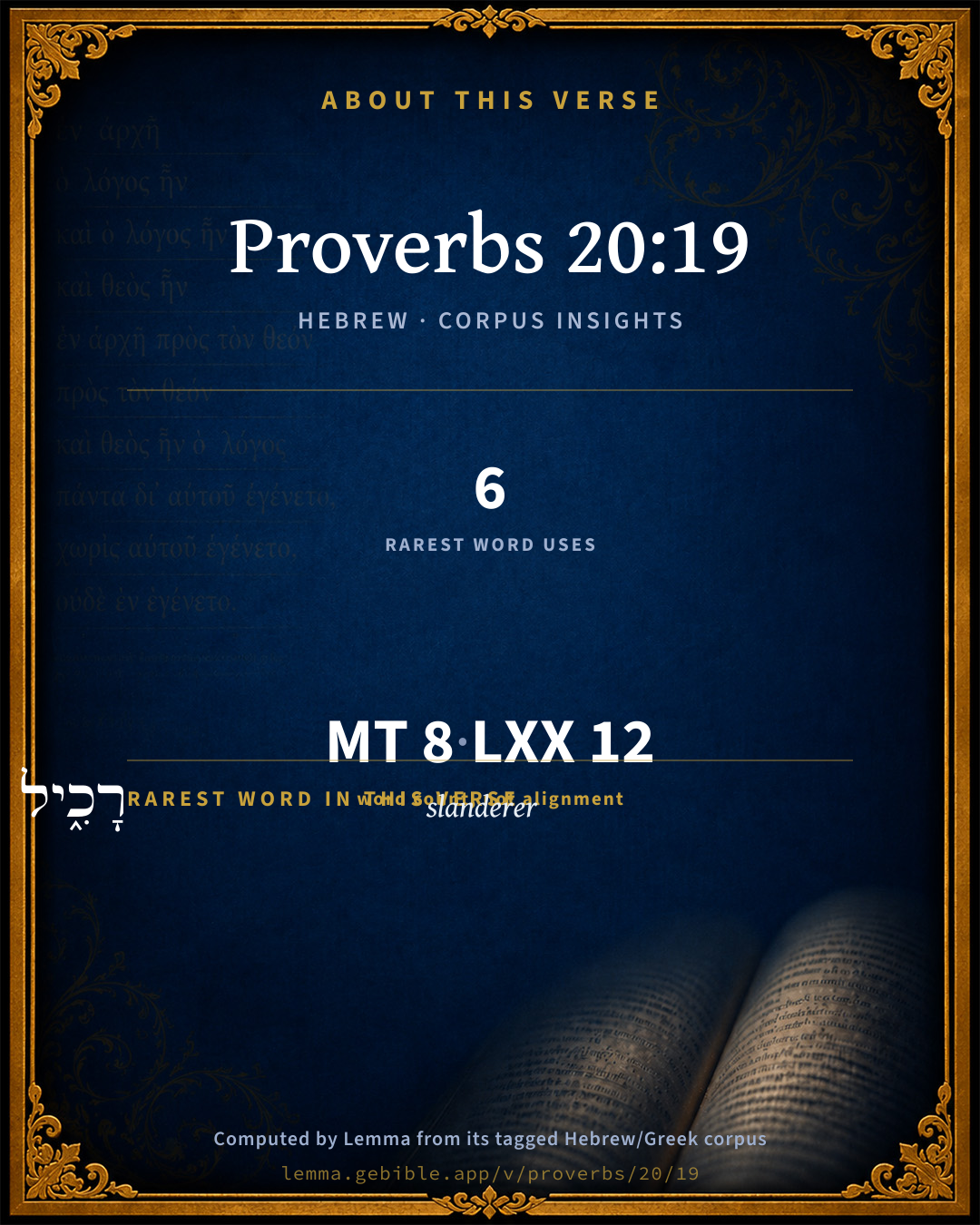
The rarest word here is רָכִ֑יל slanderer H7400 — appearing just 6 times in the whole Hebrew Bible.

Shared distinctive vocabulary

רָכִ֑יל slanderer H7400 occurs in 6 verses of the Hebrew Bible. Also found in:

Grammatical profile

  • 4 verbs
  • 3 nouns
  • 1 particle

Verb forms

  • גּֽוֹלֶה Qal · Participle Active
  • הוֹלֵ֣ךְ Qal · Participle Active
  • וּלְפֹתֶ֥ה Qal · Participle Active
  • תִתְעָרָֽב Hithpael · Imperfect

Hebrew & Septuagint length

In the original languages it is 8 Hebrew tokens and 12 Greek tokens — but the two are counted differently (Hebrew bundles its prefixes and suffixes into one token; the Greek is in lemma form), so that isn’t a like-for-like length.

Cross-references

8

Topical passages linked to Proverbs 20:19 in the Treasury of Scripture Knowledge — connected by theme and wording, ordered by reader-vote popularity; previews shown in the World English Bible.

  • Proverbs 11:13 One who brings gossip betrays a confidence, But one who is of a trustworthy spirit is one who keeps a secret.
  • Proverbs 13:3 He who guards his mouth guards his soul. One who opens wide his lips comes to ruin.
  • Proverbs 18:8 The words of a gossip are like dainty morsels: They go down into a person's innermost parts.
  • Romans 16:18 For those who are such don't serve our Lord, Jesus Christ, but their own belly; and by their smooth and flattering speech, they deceive the hearts of the innocent.
  • Leviticus 19:16 "'You shall not go up and down as a slanderer among your people; neither shall you stand against the life of your neighbor. I am Yahweh.
  • Proverbs 24:21 My son, fear Yahweh and the king. Don't join those who are rebellious:
  • Proverbs 16:29 A man of violence entices his neighbor, And leads him in a way that is not good.
  • Proverbs 26:20–22 For lack of wood a fire goes out; Without gossip, a quarrel dies down.

Cross-references courtesy of OpenBible.info (CC BY 4.0).

Hebrew and Greek witnesses Masoretic Hebrew ↔ Greek Septuagint

The same verse in the two great witnesses to the Old Testament, shown verse-for-verse.

These are two independent witnesses, not word-aligned to each other, and the Septuagint is shown in lemma (dictionary) form.

Hebrew Proverbs 20:19 Masoretic · Westminster Leningrad Codex

גּֽוֹלֶה סּ֭וֹד הוֹלֵ֣ךְ רָכִ֑יל וּלְפֹתֶ֥ה שְׂ֝פָתָ֗יו לֹ֣א תִתְעָרָֽב

He who goes about as a tale-bearer reveals secrets; Therefore don't keep company with him who opens wide his lips.

World English Bible · Public Domain

Greek LXX Proverbs 20:19 Septuagint · lemma form

ἐλεημοσύνη καί ἀλήθεια φυλακή βασιλεύς καί περικυκλόω ἐν δικαιοσύνη ὁ θρόνος αὐτός

No English rendering of this Greek verse — the small residue in the structurally divergent books.

Hebrew: Westminster Leningrad Codex (CC BY 4.0). Greek: Septuagint (public domain); English from a public-domain English Septuagint. How the Septuagint differs from the Hebrew →

Commentary

Notes on Proverbs 20:19 from classic Christian and Jewish commentators (each source and its license shown beneath its notes). The classic Christian expositions comment on the surrounding passage and are grouped to its opening verse, so a note may address several verses; the Jewish commentaries on the Tanakh (Rashi and others) are per-verse, so they appear only where the commentator wrote on this verse.

Lemma curates 59 commentaries, every one of them public domain or Creative Commons licensed, each selected and text-cleaned for this edition rather than reprinted as found. About our sources →

Trapp's Complete Commentary

John Trapp

Pro 20:19 He that goeth about [as] a talebearer revealeth secrets: therefore meddle not with him that flattereth with his lips.

Ver. 9. He that goeth about as a talebearer.] Therefore make not such of thy counsel: for if they can give counsel, yet they can keep none. {See Trapp on "Pro 11:13"}

Therefore meddle not with him that flattereth.] Tale carriers and flatterers are neither of them fit counsellors. These will say as you say, be it right or wrong; those will tell abroad all that you say, and more too, to do you a mischief. The good Emperor Aurelius was even bought and sold by such evil counsellors; and Augustus complained when Varus was dead, that he had none now left that would deal plainly and faithfully with him.

John Trapp, A Commentary or Exposition upon All the Books of the Old and New Testament (1647–1656) — public domain. Text from a community e-Sword module.

The Biblical Illustrator

Joseph S. Exell

Pro_20:19

Meddle not with him that flattereth with his lips.

On keeping away people we dont want

Not all insects are welcome visitors to plants; there are unbidden guests who do harm. To their visits there are often obstacles. Stiff hairs, impassably slippery or viscid stems, moats in which the intruders drown, and other structural peculiarities, whose origin may have had no reference to insects, often justify themselves by saving the plant. Even more interesting, however, is the preservation of some acacias and other shrubs by a bodyguard of ants, which, innocent themselves, ward off the attacks of the deadly leaf-cutters. In some cases the bodyguard has become almost hereditarily accustomed to the plants, and the plants to them, for they are found in constant companionship, and the plants exhibit structures which look almost as if they had been made as shelters for the ants. On some of our European trees similar little homes or domatia constantly occur, and shelter small insects, which do no harm to the trees, but cleanse them from injurious fungi. (J. Arthur Thomson, M. A.)

The Biblical Illustrator, edited by Joseph S. Exell (c. 1880s–1900s) — public domain. Text from a community e-Sword module.

Tyndale Open Study Notes

Tyndale Open Resources

20:19 This perspective on the gossip is repeated in 11:13.

Tyndale Open Study Notes — © Tyndale Open Resources, licensed CC BY-SA 4.0. Text via the HelloAO Bible API.

Matthew Henry's Commentary

Two sorts of people are dangerous to be conversed with: - 1. Tale-bearers, though they are commonly flatterers, and by fair speeches insinuate themselves into men's acquaintance. Those are unprincipled people that go about carrying stories, that make mischief among neighbours and relations, that sow in the minds of people jealousies of their governors, of their ministers, and of one another, that reveal secrets which they are entrusted with or which by unfair means they come to the knowledge of, under pretence of guessing at men's thoughts and intentions, tell that of them which is really false. "Be not familiar with such; do not give them the hearing when they tell their tales and reveal secrets, for you may be sure that they will betray your secrets too and tell tales of you." 2. Flatterers, for they are commonly tale-bearers. If a man fawn upon you, compliment and commend you, suspect him to have some design upon you, and stand upon your guard; he would pick that out of you which will serve him to make a story of to somebody else to your prejudice; therefore meddle not with him that flatters with his lips. Those too dearly love, and too dearly buy, their own praise, that will put confidence in a man and trust him with a secret or business because he flatters them.

Matthew Henry's Commentary on the Whole Bible (1708–1710) — public domain (CC PDM 1.0). Text via the HelloAO Bible API.

Jamieson, Fausset & Brown

Robert Jamieson, A. R. Fausset & David Brown

Those who love to tell news will hardly keep secrets.

flattereth . . . lips--(compare Margin; Pro 1:10).

meddle . . . him--literally, "join," or "associate with."

Jamieson, Fausset & Brown — Commentary Critical and Explanatory on the Whole Bible (1871) — public domain (CC PDM 1.0). Text via the HelloAO Bible API.

Ellicott's Commentary for English Readers

(19) Flattereth with his lips.—Rather, is open with his lips, cannot keep them shut.

A Bible Commentary for English Readers, edited by Charles John Ellicott (1878–1897) — public domain. Text from a community e-Sword module.

The Cambridge Bible for Schools and Colleges

gen. ed. J. J. S. Perowne

19. flattereth with] Rather, openeth wide, R.V.; dilatat labia sua, Vulg.; has his mouth always open as a tattling gossip. Comp. the prohibition of the Law, Lev_19:16, and St Paul’s rebuke of “tattlers” and “busybodies,” 1Ti_5:13.

The Cambridge Bible for Schools and Colleges (gen. ed. J. J. S. Perowne; Cambridge University Press, 1878–1918) — public domain. Text from a community e-Sword module.

John Gill's Exposition

He that goeth about as a talebearer revealeth secrets,.... Or, "he that revealeth secrets goeth about as a talebearer"; a man that has really got the secrets of others out of them respecting themselves and families, and the affairs of them, or however pretends he master of them; goes about telling his tales from house to house, to the great prejudice of those whose secrets he is entrusted with, or pretends to be; and to the great prejudice of those to whom he tells them, as well as to his own; this is contrary to the law of Moses, and the rules of Christianity, Lev 19:16;

therefore meddle not with him that flattereth with his lips; or "mingle not with him" (g); do not associate with him, do not keep him company, have nothing to say to him or do with him; for when he flatters you, and highly praises and extols you, he has a design upon you to get what he can out of you, in order to expose you elsewhere; therefore suspect him, be upon your guard, shun him and avoid him. It may be applied to false teachers, and their deceptions with good words and fair speeches; the word used signifies to deceive with the lips; see Rom 16:18; and well agrees with the parasites of Rome, Rev 18:23.

(g) "non miscebis te", Pagninus, Montanus; "ne misceas te", Baynus, Mercerus; "ne admisceto te", Junius & Tremellius, Piscator; "ne commiscearis", Michaelis; "ne admisceas te", Schultens.

John Gill's Exposition of the Whole Bible (1746–1763) — public domain (CC PDM 1.0). Text via the HelloAO Bible API.

Albert Barnes' Notes on the Bible

Flattereth - literally, “The man who opens his lips,” who has no reticence; such a man, with or without intending it, does the work of a talebearer.

Albert Barnes' Notes on the Bible (1834–1885) — public domain. Text from a community e-Sword/MySword module.

Haydock's Catholic Bible Commentary

Lips. And speaketh much. These people are unworthy of our friendship.

George Leo Haydock (1774–1849), Haydock's Catholic Family Bible and Commentary, 1859 edition — public domain. Excludes Psalms (Douay-Rheims chapter numbering differs from Protestant) and Deuterocanonical books (Catholic canon only).

Matthew Poole's English Annotations

He that goeth about as a tale-bearer revealeth secrets; he that delighteth in and accustometh himself to the practice of spreading tales or evil reports, will not forbear to publish the greatest secrets which are committed to his trust. Or, as others render it, and as the words lie in the Hebrew text,

He that revealeth secrets, ( contrary to his promise or the trust reposed in him, you may by that token be assured that,)

he doth and will go about as a tale-bearer. He who divulgeth secrets cannot or will not forbear to publish other things, and so is not fit to be trusted with any thing.

Therefore, to prevent that mischief Heb. and. So the following sentence is not inferred from the former, but only added to it.

Meddle not with him, avoid frequent and familiar society and conversation with him, that flattereth with his lips; by which artifice he seeks to gain thy affections, and to fish out all thy secrets, which he may impart to others, whom he may oblige hereby, and so render his company more acceptable.

Matthew Poole's English Annotations on the Holy Bible (1683–1685) — public domain. Text from a community e-Sword/MySword module.

Whedon's Commentary on the Bible

Daniel D. Whedon

19. A talebearer — A scandalmonger. Comp. Pro_11:13.

Meddle not with him that flattereth — Associate not with a man who cannot keep his mouth shut; a contemptible blabber. Comp. Pro_13:3.

Daniel D. Whedon (gen. ed.), Commentary on the Old and New Testaments (1874–1909) — public domain. Text from a community e-Sword module.

The Pulpit Commentary

He that goeth about as a talebearer revealeth secrets. Almost the same proverb occurs in Pro_11:13, The gadding gossiper is sure to let out any secret entrusted to him; therefore, it is implied, be careful in what you say to him. Meddle not with him that flattereth with his lips; rather, that openeth wide his lips that cannot keep his mouth shut, a babbler, as Pro_13:3 (where see note). The Vulgate erroneously makes one sentence of the verse, "With him who reveals secrets, and walketh deceitfully, and openeth wide his lips, have no dealings." Talmud, "When I utter a word, it hath dominion over me; but when I utter it not, I have dominion over it." Says the Persian poet, "The silent man hath his shoulders covered with the garment of security.

Xenocrates used to say that he sometimes was "sorry for having spoken, never for having kept silence" (Cahen).

The Pulpit Commentary (1880–1919), ed. H.D.M. Spence-Jones & Joseph S. Exell — public domain. Text from a community e-Sword module.

Keil & Delitzsch

C. F. Keil & F. Delitzsch

19 He that goeth out gossiping revealeth a secret;

And the babbler have nothing to do.

Luther otherwise (like Hitzig) -

Be not complicated with him who revealeth a secret,

And with the slanderer, and with the false (better: loquacious) mouth,

so that ל and the warning apply to the threefold description, a rendering which Kimchi also, and Immanuel, and others at least suggest. But in connection with Pro 11:13, the first line has the force of a judicium, which includes the warning to entrust nothing to a babbler which ought to be kept silent. Write גּולה סּוד, as found in Codd. and old Edd., with Munach on the penultima, on which the tone is thrown back, and Dagesh to ס, after the rule of the דחיק (Gesen. 20, 2a), altogether like קונה לב, Pro 15:32. 19b the Venet. translates after the first meaning of the word by Kimchi, τῷ ἀπαταιῶνι τοῖς χείλεσι, to him who slanders and befools, for it thus improves Theodotion's τῷ ἀπατῶντι τὰ χείλη αὐτοῦ. But פּתה means, Job 5:2 - cf. Hos 7:11 - not him who befools another, but him who is befooled, is slandered, by another (Aben Ezra: שׁיפתוהו אחרים), with which שׂפתיו here does not agree. But now he who is easily befooled is called פּתה, as being open to influence (susceptible), patens; and if this particip. is used, as here, transitively, and, on account of the object שׂפתיו standing near cannot possibly be equivalent to מפתּה, the usage of the language also just noticed is against it, then it means patefaciens or dilatans (cf. הפתּה, Gen 9:27, Targ. אפתּי = הרחיב), and places itself as synon. to פשׂק, Pro 13:3; thus one is called who does not close his mouth, who cannot hold his mouth, who always idly babbles, and is therefore, because he can keep nothing to himself, a dangerous companion. The Complut. rightly translates: μετὰ πλατύνοντος τὰ ἑαυτοῦ μὴ μίχθητι χείλη.

Keil & Delitzsch — Biblical Commentary on the Old Testament (1861–1891) — public domain (CC PDM 1.0). Text via the HelloAO Bible API. (Old Testament only.)

Bridges on Proverbs

Charles Bridges

Never let us forget that all intercourse of social life must be based on love. Any breach of this is highly displeasing to God. Witness the talebearer. Unhappily he has much time on his hands unemployed for any good purpose. Hence he spends it on other people’s business; ferreting out secrets, or diving into family arrangements. All this is material for scandal, or for idleness. In his visit he talks of the affairs of the last family. His present visit will furnish matter for idle talk in the next house. And thus his name describes his work, indulging an impertinent curiosity; making a tale of everything he sees or hears. It is the business of his life, for which all other business is sacrificed, as if the whole man were one tongue, as if, in its restless babbling, it had discovered the grand secret of perpetual motion. Such a one — meddle not with him. We would not wish him to look over our wall; much less to enter into our houses; least of all, to associate with our family circle, where his whole employment would be, either to draw out, or to put in, what "was not convenient."†1

The flagrant blot, however, in this contemptible, yet dangerous character, is his unfaithfulness — going about — revealing secrets. (Pro 11:13 .) This is peculiarly offensive to a God of truth. Even when matters have been given to him under a seal, his restless irritation breaks through the feeble bond. He ’dismantles and rends the robe from the privacies of human intercourse. Who entrusts a secret to his friend, goes thither as to a sanctuary; and to violate the rites of that, is sacrilege and profanation of friendship.’†2 Never let us think this to be a trifle. Never let us undertake a trust without the most resolute determination of Christian faithfulness.

Observe his other names — flattering with his lips. Thus he insinuates himself into the secrets of the unwary, and gains his materials for talebearing; flattering the present at the expense of the absent. Watch and pray earnestly against this deadly evil. Keep thine own vineyard carefully.†3 Else if thine eye be abroad, when it ought to be at home, it will be, like "the vineyard of the slothful, full of thorns and nettles" (Pro 24:30-31 ); like the ’curious people,’ whom Augustine rebuked, who ’pry into another’s heart and life, but are slothful to amend their own.’†4 Be diligent in your own calling, serving the Lord and his church. Study the obligation of Christian character, according to the standard of the Divine Exemplar, whose every word was fraught with the flowing of love. Oh! how many in self-indulgence and forgetfulness of their own obligations, because they have no employment for their hands, set their tongues to work! (1Ti 5:13 .) Such men bring, as it were, the plague of flies with them (Exo 8:24 ); buzzing from house to house, from one neighbor to another, all the report of evil heard or done. A sharp reproof is their just desert, and an effectual means of driving them away. (Pro 25:23 .)

Footnotes:

†1 ’Hic niger est: hunc tu, Romane, caveto’ — is the indignant warning of the Roman Satirist. — Hor. Sat. lib. i. 4, 81-85.

†2 Bp. Taylor’s Sermon on the Good and Evil Tongue.

†3 Mark the complaint, Song of Son 1:6 . Compare our Lord’s probing advice, Mat 7:3-5 .

†4 Confess. book x. c. 3.

Charles Bridges, An Exposition of the Book of Proverbs (1846) — public domain. Text from a community e-Sword module.

Kretzmann's Popular Commentary

Paul E. Kretzmann

v. 19. He that goeth about as a talebearer, making it his business to carry gossip and slander, revealeth secrets; therefore meddle not with him that flattereth with his lips. cf Pro 11:13; Pro 13:3.

Paul E. Kretzmann, Popular Commentary of the Bible (1921–1924) — public domain. Text from a community e-Sword module.

unfoldingWord translationNotes

Door43 World Missions Community

A gossip

This means someone who gossips a lot.

you should not associate with

"you should not be friends with"

If a person curses

This means if a someone express a desire that bad things will happen to someone else.

his lamp will be snuffed out in the middle of darkness

This speaks of a person dying suddenly and unexpectedly as if his life were a lamp snuffed out in the dark. AT: "his life will end as suddenly as the light of a lamp that is snuffed out in the dark" or "he will die suddenly" (See: Metaphor)

his lamp will be snuffed out

This can be stated in active form. AT: "his lamp will go out" (See: Active or Passive)

his lamp

This refers to a lamp with a burning flame. Here the lamp's flame is referred to as the lamp itself. AT: "the flame of his lamp" (See: Synecdoche)

snuffed out

to cause a flame to go out

translationWords

gossip

reveal

curse

lamp

darkness

unfoldingWord translationNotes — © Distant Shores Media and the Door43 World Missions Community, licensed CC BY-SA 4.0. Source: git.door43.org/Door43/en_tn.

Rashi

Rabbi Shlomo Yitzchaki (Rashi)

with one who divulges secrets, one who gossips, or with one who entices with his lips who speaks smoothly to seduce you and entice you.

Rashi on the Tanakh — English translations: “The Judaica Press complete Tanach with Rashi, translated by A. J. Rosenberg” (CC BY 4.0); “Pentateuch with Rashi's commentary by M. Rosenbaum and A.M. Silbermann, 1929-1934” (public domain); “The Metsudah Tanach series, Lakewood, N.J” (CC BY 4.0); and “The Book of Joshua, Metsudah Publications, 1997” (CC BY 4.0). Text via Sefaria.

Lesson kit

Teaching starters — assembled from the data on this page, not authored interpretation. Every prompt links to the verse data it draws on. Edit before teaching.

Proverbs, in the Wisdom, opens this verse with 8 words (8 distinct Hebrew lemmas). Its most distinctive word is râkîyl (“slanderer”). A historical commentator’s framing appears above. Read the whole chapter for the surrounding context.

Discussion questions

  1. What does “slanderer” (râkîyl) contribute to the verse as a whole?
  2. How does Leviticus 19:16, which shares the word «slanderer», read alongside this verse?
  3. These translations render this verse differently; the difference is in the English rendering, not the original. What questions does that raise?
  4. «גּֽוֹלֶה» is a Qal Participle Active verb. How does that grammatical form shape the action described?
  5. Compare how Trapp's Complete Commentary and The Biblical Illustrator read this verse. Where do they agree or differ?

Things to notice

Reading settings

Reading text

Shown beneath each verse's original-language words.

Old Testament
Old Testament edition

Read the OT as the Masoretic Hebrew (MT) or the Greek Septuagint (LXX).

English shown for the Greek Septuagint (in the Hebrew ↔ Greek comparison).

Comparing translations? Open the Compare panel on any verse page to stack up to four side by side.