
1 Samuel 4:22

Hebrew (Westminster Leningrad Codex) 1 Samuel 4:22 appears in the Hebrew Old Testament. The text above is from the Westminster Leningrad Codex. Each word links to its Strong’s number, a concise gloss, and parsing drawn from the Open Scriptures Hebrew Bible morphology. Click any word for its full Brown-Driver-Briggs (BDB) entry.
Download image
Cite this verse

1 Samuel 4:22 (World English Bible). Public Domain. Lemma interlinear Bible study tool, https://lemma.gebible.app/v/1-samuel/4/22.

Show BibTeX & RIS
BibTeX
RIS
English Translation
She said, The glory is departed from Israel; for the ark of God is taken.
World English Bible · Public Domain
Download a study sheet

One document with this verse’s original text, its word-by-word gloss line, the meaning frame, cross-references with their text, attributed commentary, and full source and license credits — printable, and it pastes into notes with its structure intact.

This verse Autodidact and up

Study sheet (.html) Plain text (.txt)

A passage Seminary Student

Up to 50 verses in one chapter. A passage sheet keeps up to 6 commentary sources and 12 cross-references per verse, in the order this page ranks them, and says so on the sheet whenever that leaves anything out. Ask for a single verse and you get the Autodidact verse sheet above.

Everything on this page stays free to read, with no account — the sheet is a download of what is already on screen, not access to it.

Want to remove ads? Support Godless Engineer
Compare translations 3

The same verse in 3 English versions, stacked beneath the original-language interlinear above. Click any original word for its lexicon entry.

Each is an independent rendering of the whole verse — the interlinear is not word-aligned to these translations.

Highlighted words mark where these versions differ — a whole-verse word diff, not a word-by-word alignment.

  • World English Bible Public Domain
    She said, The glory is departed from Israel; for the ark of God is taken.
  • King James Version Public Domain
    And she said, The glory is departed from Israel: for the ark of God is taken.
  • unfoldingWord Literal Text CC BY-SA 4.0
    Now she said “the glory has departed from Israel” because the Box of God had been taken.

unfoldingWord Literal Text — © unfoldingWord, licensed CC BY-SA 4.0. Word-aligned USFM3 via Door43 (git.door43.org/unfoldingWord/en_ult).

Versions to compare (up to 4)

3 of 4 selected

Show all 18 translations

Every available English version of this verse, each an independent rendering of the whole verse.

  • World English Bible Public Domain
    She said, The glory is departed from Israel; for the ark of God is taken.
  • Berean Standard Bible Public Domain
    “The glory has departed from Israel,” she said, “for the ark of God has been captured.”
  • Majority Standard Bible Public Domain
    “The glory has departed from Israel,” she said, “for the ark of God has been captured.”
  • King James Version Public Domain
    And she said, The glory is departed from Israel: for the ark of God is taken.
  • American Standard Version (1901) Public Domain
    And she said, The glory is departed from Israel; for the ark of God is taken.
  • Revised Version (1885) Public Domain
    And she said, The glory is departed from Israel; for the ark of God is taken.
  • Geneva Bible (1599) Public Domain
    She sayde againe, The glory is departed from Israel: for the Arke of God is taken.
  • Douay-Rheims (1899) Public Domain
    And she said: The glory is departed from Israel, because the ark of God was taken.
  • Young's Literal Translation Public Domain
    And she saith, `Honour hath removed from Israel, for the ark of God hath been taken.'
  • Literal Standard Version CC BY-SA 4.0
    And she says, “Glory has removed from Israel, for the Ark of God has been taken.”
  • Unlocked Literal Bible CC BY-SA 4.0
    She said, “The glory has gone away from Israel, because the ark of God has been captured.”
  • unfoldingWord Literal Text CC BY-SA 4.0
    Now she said “the glory has departed from Israel” because the Box of God had been taken.
  • Darby Bible Public Domain
    And she said, The glory is departed from Israel, for the ark of God is taken.
  • World Messianic Bible Public Domain
    She said, “The glory has departed from Israel; for God’s ark has been taken.”
  • Webster's Bible Public Domain
    And she said, The glory hath departed from Israel: for the ark of God is taken.
  • Free Bible Version CC BY-SA 4.0
    She said, “The glory has left Israel, for the Ark of God has been captured.”
  • Bible in Basic English Public Domain
    And she said, The glory is gone from Israel, for the ark of God has been taken.
  • JPS Tanakh (1917) Public Domain
    And she said: 'The glory is departed from Israel; for the ark of God is taken.'

Literal Standard Version (2020), Covenant Press — licensed CC BY-SA 4.0. Text via the HelloAO Bible API (eBible.org). Unlocked Literal Bible (unfoldingWord) — licensed CC BY-SA 4.0. Text via the HelloAO Bible API (eBible.org). unfoldingWord Literal Text — © unfoldingWord, licensed CC BY-SA 4.0. Word-aligned USFM3 via Door43 (git.door43.org/unfoldingWord/en_ult). Free Bible Version, Dr. Jonathan Gallagher — licensed CC BY-SA 4.0. Text via the HelloAO Bible API (eBible.org).

Word by word

More ways to search: Search by grammar → Find every occurrence → Compare this word →

Practice this passage: Drill this verse → Learn its vocabulary →

גָּלָ֥ה
gâlâh
H1540
“to uncover”
Verb, Qal, Perfect, 3rd Person, Masculine, Singular
Part of Speech
Verb
Stem
Qal
Form
Perfect
Person
3rd Person
Gender
Masculine
Number
Singular
Full BDB Definition

Origin: a primitive root

TWOT: 350

to uncover, remove - (Qal) - to uncover - to remove, depart - to go into exile - (Niphal) - (reflexive) - to uncover oneself - to discover or show oneself - to reveal himself (of God) - (passive) - to be uncovered - to be disclosed, be discovered - to be revealed - to be removed - (Piel) - to uncover (nakedness) - nakedness - general - to disclose, discover, lay bare - to make known, show, reveal - (Pual) to be uncovered - (Hiphil) to carry away into exile, take into exile - (Hophal) to be taken into exile - (Hithpael) - to be uncovered - to reveal oneself
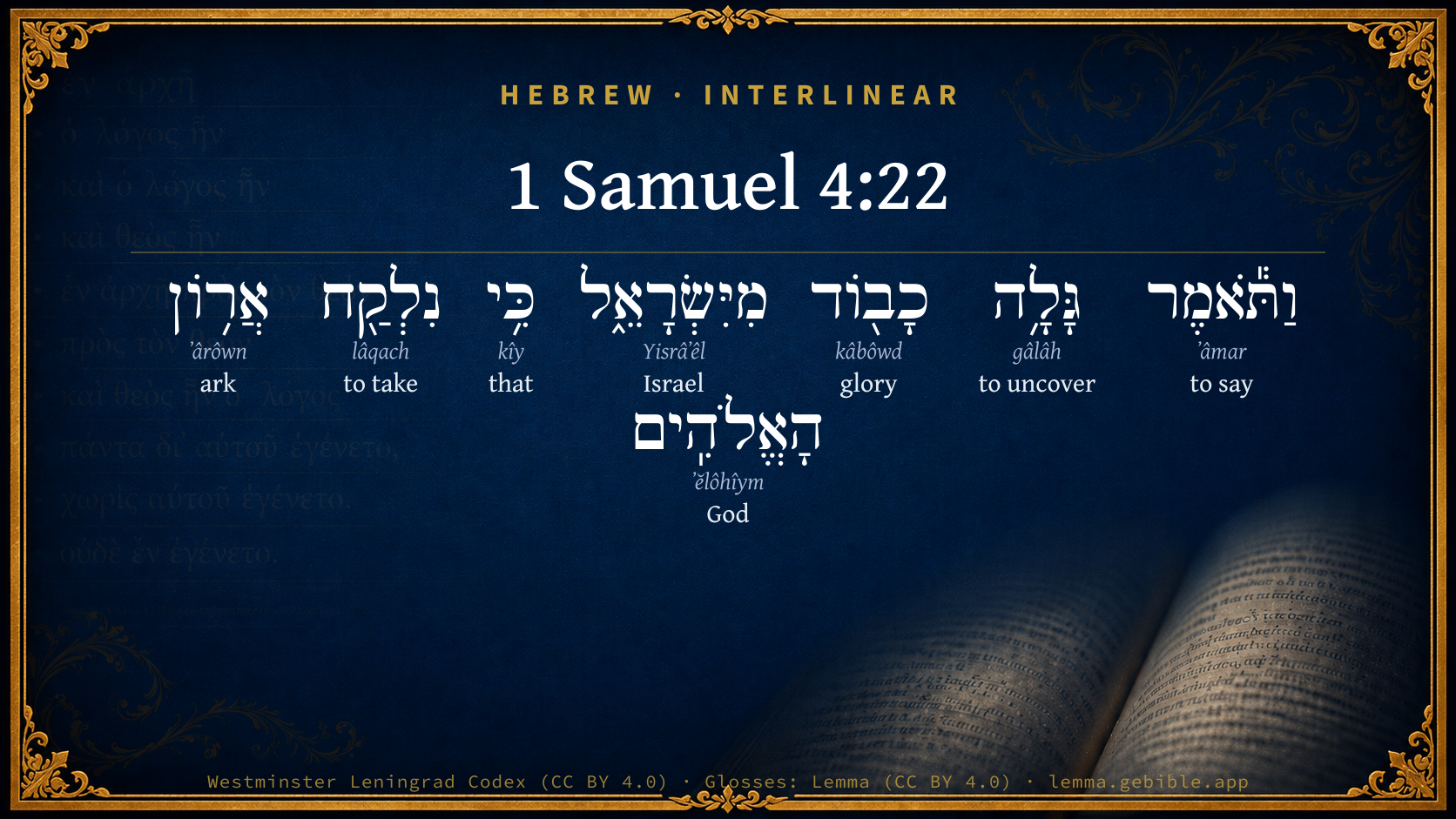
  1. וַתֹּ֕אמֶר ʼâmar H559 “and · to say” Conjunction + Verb, Qal, Sequential Imperfect, 3rd Person, Feminine, Singular
  2. כָב֖וֹד kâbôwd H3519 “glory” Noun, Common, Both, Singular, Absolute
  3. מִיִּשְׂרָאֵ֑ל Yisrâʼêl H3478 “from · Israel” Preposition + Noun, Proper
  4. כִּ֥י kîy H3588 “that” Conjunction
  5. נִלְקַ֖ח lâqach H3947 “to take” Verb, Niphal, Perfect, 3rd Person, Masculine, Singular
  6. אֲר֥וֹן ʼârôwn H727 “ark of” Noun, Common, Both, Singular, Construct
  7. הָאֱלֹהִֽים ʼĕlôhîym H430 “the · God(s)” Particle, Definite Article + Noun, Common, Masculine, Plural, Absolute

About this verse

These counts appear in no published source. They are computed here, from the morphology-tagged text and Lemma’s own curated glosses. What Lemma adds →

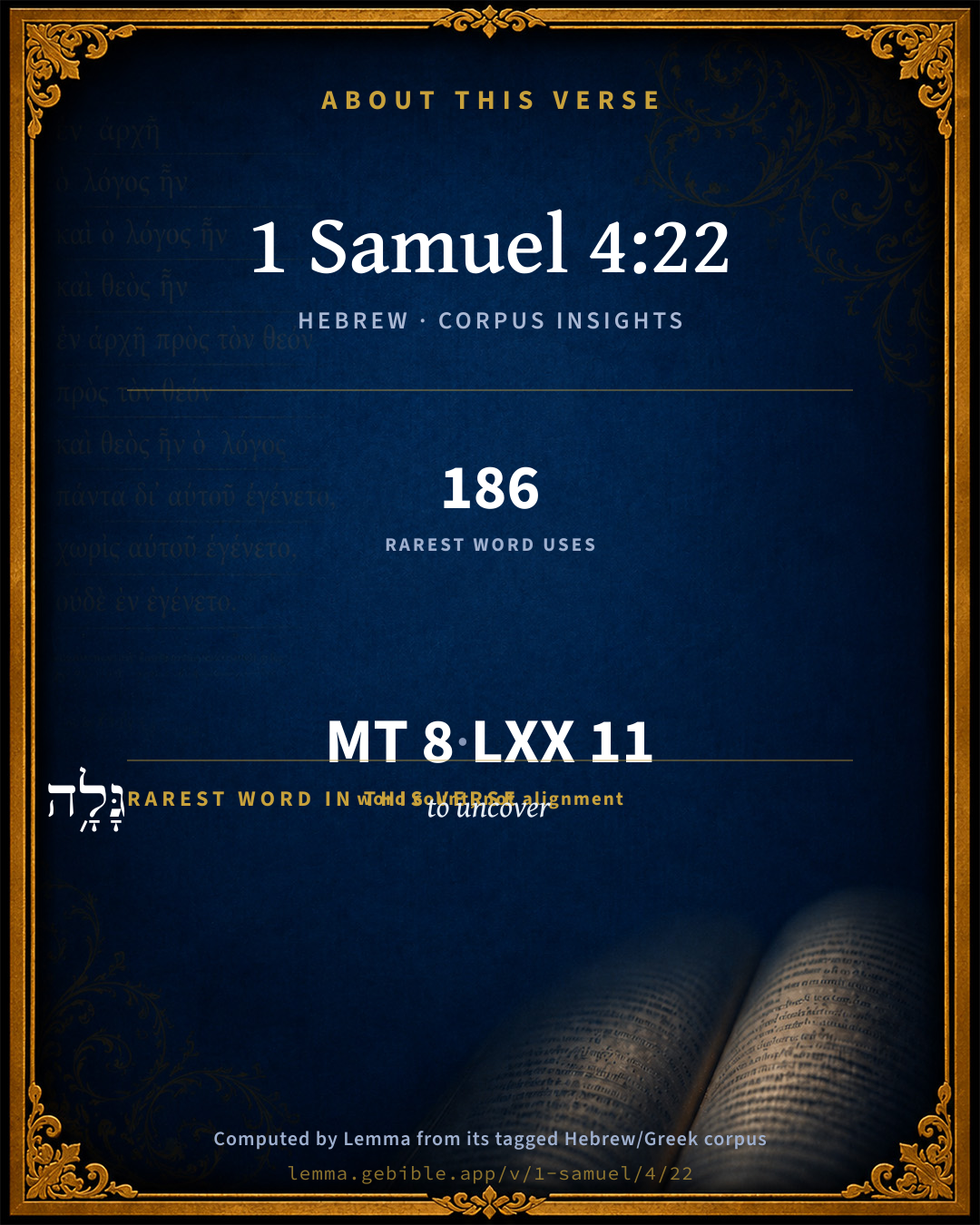
8
words
8
distinct lemmas
Historical
section

Grammatical profile

  • 3 verbs
  • 4 nouns
  • 1 conjunction

Verb forms

  • וַתֹּ֕אמֶר Qal · Sequential Imperfect
  • גָּלָ֥ה Qal · Perfect
  • נִלְקַ֖ח Niphal · Perfect

Hebrew & Septuagint length

In English translation the verse runs 15 words from the Hebrew and 18 from the Septuagint (LXX English) — closely comparable.

A rough comparison of the two English renderings, which tokenize alike — not a word-level alignment.

Word counts can differ between the Hebrew and the Greek without any difference in meaning — e.g. the Hebrew direct-object marker אֵת has no separate Greek word, and Greek often adds the article ὁ.

In the original languages it is 8 Hebrew tokens and 11 Greek tokens — but the two are counted differently (Hebrew bundles its prefixes and suffixes into one token; the Greek is in lemma form), so that isn’t a like-for-like length.

Cross-references

2

Topical passages linked to 1 Samuel 4:22 in the Treasury of Scripture Knowledge — connected by theme and wording, ordered by reader-vote popularity; previews shown in the World English Bible.

  • Psalms 137:5–6 If I forget you, Jerusalem, Let my right hand forget its skill.
  • John 2:17 His disciples remembered that it was written, "Zeal for your house will eat me up."

Cross-references courtesy of OpenBible.info (CC BY 4.0).

Hebrew and Greek witnesses Masoretic Hebrew ↔ Greek Septuagint

The same verse in the two great witnesses to the Old Testament, shown verse-for-verse.

These are two independent witnesses, not word-aligned to each other, and the Septuagint is shown in lemma (dictionary) form.

Hebrew 1 Samuel 4:22 Masoretic · Westminster Leningrad Codex

וַתֹּ֕אמֶר גָּלָ֥ה כָב֖וֹד מִיִּשְׂרָאֵ֑ל כִּ֥י נִלְקַ֖ח אֲר֥וֹן הָאֱלֹהִֽים

She said, The glory is departed from Israel; for the ark of God is taken.

World English Bible · Public Domain

Greek LXX 1 Samuel 4:22 Septuagint · lemma form

καί εἶπον ἀποοἰκίζω δόξα ἰσραήλ ἐν ὁ λαμβάνω ὁ κιβωτός κύριος

And they said, The glory of Israel is departed, forasmuch as the ark of the Lord is taken.

LXX2012 (modern English Septuagint) · Public Domain

Hebrew: Westminster Leningrad Codex (CC BY 4.0). Greek: Septuagint (public domain); English from LXX2012 (modern English Septuagint) (Public Domain). How the Septuagint differs from the Hebrew →

Targum (Aramaic paraphrase)

1

The Targum is the ancient Jewish Aramaic paraphrase of the Hebrew Scriptures — an interpretive translation, not the Hebrew text itself. Onkelos (literal) and Pseudo-Jonathan (expansive) render the Torah, and Jonathan the Prophets. Coverage is partial: where no permissively-licensed English translation exists for a verse, only the Aramaic is shown. This is verse-level text, not a word-by-word alignment to the Hebrew.

  1. Targum Jonathan Prophets (Joshua–Malachi)
    וַאֲמָרַת גְלָה יְקָרָא מִיִשְׂרָאֵל אֲרֵי אִשְׁתְּבֵי אֲרוֹנָא דַיָי:

    (no public-domain English translation for this verse)

    Targum Jonathan — Aramaic: “Mikraot Gedolot” (public domain). English: “Sefaria Community Translation” (CC0 1.0 (public-domain dedication)); “London "Chaldee Paraphrase," 1871” (public domain). Text via Sefaria.

Commentary

Notes on 1 Samuel 4:22 from classic Christian and Jewish commentators (each source and its license shown beneath its notes). The classic Christian expositions comment on the surrounding passage and are grouped to its opening verse, so a note may address several verses; the Jewish commentaries on the Tanakh (Rashi and others) are per-verse, so they appear only where the commentator wrote on this verse.

Lemma curates 59 commentaries, every one of them public domain or Creative Commons licensed, each selected and text-cleaned for this edition rather than reprinted as found. About our sources →

Trapp's Complete Commentary

John Trapp

1Sa 4:22 And she said, The glory is departed from Israel: for the ark of God is taken.

Ver. 22. The glory is departed.] This comes in twice; the other of her father and husband is but once named.

John Trapp, A Commentary or Exposition upon All the Books of the Old and New Testament (1647–1656) — public domain. Text from a community e-Sword module.

The Biblical Illustrator

Joseph S. Exell

1Sa_4:22

Ichabod, the glory is departed from Israel: for the ark of God is taken.

Ichabod

zhere was a dark cloud over Israels firmament. It was a night of gloom; but amidst the revelry and excitement of sin, few could hear the hearings of the commonwealth, or discern the signs of the times that betokened national disaster. At length catastrophe came. The independence of the people was broken. The ark of God--the visible representation of Divine majesty--was in the hands of the Philistines. The outward form, the last remaining evidence of national religion, was lost. It indicates lamentable ignorance on the part of the elders of Israel, when they proposed to bring the ark of God to the field of battle--as if their God was Dot in all places, and able to help those who called upon him in faith. We do not wonder that when Eli beheld Israels sun setting in such darkness his own flickering light paled and died away. Precious in the sight of God is the death of His saints, but it was a sad scene in Israel when the ark of God was taken, and the pious priest who had ministered so long before it, gave up the ghost under the heavy tidings. Truly was Ichabod, the glory is departed, the appropriate name of Israel. The ark of God was taken! And Israel, who had staked at! their remaining piety within its mystic timbers, were left without their God. Their glory departed. It was the ebbing of their national religion. It was the blight on their spiritual profession. It sealed their estrangement from their God. There may have been, as we know there were, solitary instances of godliness remaining. There were Elkanahs and Hannahs, and such as they, who lived in sequestered nooks, and who kept alive a witness for the Lord. There was a Samuel in the deserted Tabernacle, in whose piety the hopes of the believing lay infolded, expecting from his growth the revival of religion and the recovery of independence. But meanwhile oppression, sin, and impiety afflicted the land. The people seemed for a season left to the sad fruits of their own ungodly course. This dark episode is suggestive of several important lessons.

1. It reveals the character of believers in perilous times. They tremble for the ark of God. When sin increases, piety degenerates, and the judgments of God alarm, believers tremble for the ark. In times of rebuke, and blasphemy, and sin, the genuine believer trembles for the cause of Christ. His dearest earthly interest is there. His Saviours interest is there. The welfare of the soul is there. More than any other terrestrial object does the ark of God concern him. For its preservation does he pray and toil, and weep and watch.

2. We learn also the danger of a mere profession of religion. To have no more than the outward form is to be as Israel were when they thought the ark would save them from the Philistines. Over how many professors has this mournful title been inscribed! They surrounded the ark of God, reverenced its mystic symbols, were enrolled in the membership of the Church, partook of its sacraments, rejoiced in its sanctuaries, and hoped for heaven; but having a name to live while they were dead, neglecting the one thing needful--a personal interest in Christ--they realised at last only the miserable wail, Ichabod, as they sunk into a lost eternity.

3. We learn also the advantage of personal piety in perilous times. Though Eli shared the judgment which overspread Israel and ruined his house, it was well with that aged saint when he fell down dead at the gate of Shiloh. He was saved, yet so as by fire. And though the wife of Phinehas shared the woe which afflicted the land and desolated her home--though an accumulation of sorrows and her painful solicitude at once oppressed her--it was well with her in dying. Her piety was her blessing. We doubt not that there were even in the army on the field a faithful few who were prepared to die, who mourned the infatuation of their brethren, and who rested on the Lord. To such, death on a field of battle would be their entrance into the saints everlasting rest. Amidst the ungodliness and spiritual carelessness which often mark soldiers in a camp, it is blessed to know that some have kept the faith and died in Christ. Along with our sad memories of the winter before Sebastopol, we have comfortable thoughts of some who, while they fought bravely and fell in their countrys service, passed away to glory. Of one, and he did not stand alone, it is told that after being twelve hours in the trenches, or out all night on picket, he visited hospitals and prayed with the dying, distributed tracts and exhorted the living. The man of prayer was a captain of courage; and amidst the gloom of that memorable night, a sudden moonbeam revealed Hedley Vicars waving his sword and crying, This way 97th! Another moment and he was lying in his blood. But so striking had been his personal consistency, that his brave men could testify that it was well with their captain then. (R. Steel.)

Ichabod

These histories have a permanent meaning, and an up-to-date application. God deals with the Church today as He dealt with Israel in days gone by. The spiritual Israel is akin to the natural and the national Israel. Well, the Church of God, the chosen seed, is doubtless suffering defeat. I doubt very much if the Church of God is even holding its own today: I believe in the final triumph of Christianity, I am sure that Christ will reign from sea to sea, and from the river to the ends of the earth; but I confess that if I look candidly and without prejudice at the signs of the times I am bound to say that here and there if not everywhere, Israel is getting the worst of it, and the Church of God is being beaten slowly back. Be sure of this; the fault is not with God. You know the advice of these elders of Israel. They decided that the ark of the covenant of the Lord, which was resident at Shiloh, should be brought, and that the battle should be renewed with this as the standard. Surely victory would then result. The mischief was deeper than the elders of Israel imagined; it was not to be cured by the presence even of the ark of the covenant of God. That seemed only to add to the disaster, for itself was taken prisoner, and the two licentious sons of Eli, who bore it into the battle, who, we may believe, fought bravely for its preservation, were slain hard by the outspread wings of the golden cherubim. Wherein did the mistake of these people consist? I think we shall find that it was a three-fold error.

I. In the first place, they acted on human impulse, instead of on Divine command. A distinct command is recorded, that when once Israel was settled in the land of promise the ark, with the Tabernacle, should remain at a fixed place. It was not to be brought to the people. The people were to be humble enough to come to it. In this case, therefore, if they were not distinctly disobeying Gods command, they were acting without a Divine injunction, and this is always a dangerous venture. We may he as disobedient by acting without a command as we can be by actually running in the face of a distinct injunction. We cannot be too precise. Let us do what God hath bidden us, and none other. Let there be no alteration of Gods way. Add not to the ordinances, nor detract from them. Make no addition to, or adulteration in the doctrines. Do not imagine that enthusiasm will suffice. You Christian workers, there are a hundred plans for doing work for God today of which we have to ask first of all, Has God appointed this? If we enquire of the Lord before we go down to the battle, and before we take any weapon in our hands, certain of those things which are most approved by men will be found not to have the warrant of Scripture, and to be therefore mere wooden swords, which, whereas they may inspire some enthusiasm, mainly because they are our own manufacture, will be broken at the first onslaught of the foe. So much for Israels first mistake. Let us not do likewise.

I. Secondly, and still more seriously, they substituted the symbolical for the spiritual. Therein they grieved the Spirit of God, therein they played the fool exceedingly, after the fashion of the dog in the fable, who let go his goodly joint of meat that he might grasp the shadow. Now, it must be admitted that the ark was, by Divine institution, a symbol of Gods presence. The contents also pointed in the same direction; but these people, elders though they were--and who can wonder that the multitude went wrong when their leaders were astray?--these people confused the symbol with the Presence itself. This superstition was the natural result of the decay of religion. I venture to say that the Israelites in this case were little better than the Philistines themselves. The Philistines, if I mistake not, had images of their gods in the battle by way of standards and flags, and Israel seems to have said, We must have a standard, too, we must cherish in our midst a symbol of our God. They craved for something tangible and visible. Nor are we less guilty who forget that our religion is altogether spiritual, that our warfare and its weapons are spiritual. We are not less guilty who mistake forms for internal power. We are not less blameworthy who, having a form of godliness, deny the power thereof. How careful some are of the externals. I believe in creeds, but oh, it is an awful thing to have a creed only. A religion of the head does not cleanse the heart, a religion that touches only externals evidently does not affect the internals, and the heart and the soul are the things with which we have to do. Thank God for the Sabbath, but a rigid observance of the Sabbath is not enough; we want to be in the Spirit on the Lords Day.

III. But there was another mistake, deeper than either of these. They failed to perceive that sin was the secret of defeat, sin on the part of Elis two sons, sin on his own part, and sin, if I mistake not, which was shared in by all the people, for there is an indication in Psa_78:1-72, which speaks of that time, that the people were estranged from God. This it was that weakened their arms, and prevented their success. Even Balaam could not curse Gods people, though he longed to do it. Why? Because there was no iniquity in them, because God Himself beheld no perverseness in them. Therefore Balaam had to say, The Lord his God is with him, and the shout of a king is among them. These people shouted, but it was not the shout of a king; it was the shout of presumption, and therefore closely preceded and heralded a disastrous defeat. A worldly Church is nigh unto cursing. A grieved God means a conquered Church. I tell you the ark itself is valueless if there be an Achan in the camp. Do you know that in this same place God wrought wondrously a little later. Read the story, at your leisure, in chap. 7. It is only a chapter or two further on than this, but oh how the scene has changed. Ichabod then gave place to Ebenezer. The days of the Church will brighten and her power be as of yore when she comes back to primitive practices and doctrines, and to the old-time holiness, and to zeal for God, love for souls, and reverence for the Holy Ghost. (Thomas Spurgeon.)

The concern of the pious for religion in peril

The person by whom this mournful language was uttered, was the wife of one who, by descent and occupation, had been associated with the momentous office of the priesthood of ancient Israel. That people were engaged in war with the neighbouring nation of the Philistines, their persevering and inveterate foe.

I. First, we propose to notice the properties of true religion, as indicated by the symbol, under which it is represented. The glory of Israel, of which the pious mother spake, was the ark of God; so called, from the place which it occupied in the ritual of Levitical worship, and because, on account of that place, it became necessarily the token of the whole economy and general interests of religion. The religion possessed by Israel was, really and truly, its glory.

1. Following this mode of illustration, you will observe, first, that the ark was associated with immediate and visible displays of the Divine presence. Above the ark were the mysterious figures of the cherubim, overshadowing it with their outstretched wings, and between the cherubim was the Shechinah, that luminous cloud denominated the cloud of glory which betokened the Divine presence, and from which, in audible voice, God uttered His will and His promises to the priests whom He had chosen. In the economy of the Gospel, the presence of God has been possessed, not indeed, you must remember, by outward and visible signs and tokens, but spiritually, and with a spiritual clearness, which, in the present state, cannot be surpassed. That presence is vouchsafed in the work of the Son of God, the Lord Jesus Christ, and in the operations and influences of the Divine Spirit, whose office it is to apply the work of the Lord Jesus to the minds of men. And therefore it is, that the ancient symbol is used in reference to them both.

2. Observe, secondly, the ark was identified with the Divinely appointed mediation for the pardon of human sin. The covering or lid of the ark was denominated the mercy seat, because the priest, by Divine command, sprinkled upon it the blood of the sacrifices, which had been offered in propitiatory atonement for sin. He then, according to the same command, interceded, that for the sake of the blood so presented before God, pardon and favour with Him might be obtained. Now this whole arrangement will be found directly typical of the one Saviour, as revealed under the economy of the Gospel; and the victim, and the priest and the mercy seat were all made to terminate and concentrate in Him. The mediation in this manner set forth--a mediation precisely adapted to the circumstances and wants of man, and preserving its efficacy unexhausted in all successive ages--this is the supreme and permanent glory of the Gospel. Apart from it, the glory of that Gospel would indeed be but dim and cloudy; and when you observe the mode of its indication, and the value of its influence, you will doubtless again recognise how well your religion is represented by the ancient symbol, and how richly it deserves the appellation of the glory.

3. Again, you will observe, that the ark was the instrument of Divine protection, in behalf of the people who possessed and who rightly applied to it. On various occasions in the history of Israel, we find that it was connected with marvellous preservation, deliverance, and victory. Now, the religion of the Gospel is directly the agent of God, in imparting protection and deliverance to man. If the Gospel be viewed in a political aspect, we are sure that it is to the nations now, what the ark once was to Israel of old. We might, without any difficulty, show from multiplied evidence, that, for the sake of His truth, God has been pleased in this manner to protect and to shield us, in our own land; and there is abundant reason also to conclude, that just in proportion as the nations of the earth become imbued with the vital spirit of Christianity, they become protected against the very elements which would naturally operate to subvert and to destroy. If the Gospel be viewed in a spiritual aspect--in relation to the interests of the souls of men, we know how, by its mediatorial power and grace, brought home through the agency of the Spirit, men are guarded against the various adversaries, by whom, from time to time, their progress in the present world is assailed--how they triumph over the last enemy, and how they are exalted to the final inheritance of heaven, where they will abide in triumph, in bliss, and in glory, for over and ever.

II. Let us now proceed to notice the danger in which the interests of religion, like the ancient symbol, may appear to be involved. There are not a few circumstances occurring from time to time, when the religion of the Gospel appears, according to human judgment, in its various interests, to be in jeopardy, in danger of dishonourable defeat and injury.

1. And you will observe, first, that apparent danger to the interests of religion arises from the efforts of avowed and open adversaries to its claims. From the commencement of its career, to such efforts the Gospel has been exposed. In its earliest period, it encountered the malignant hostility of the Jews, who, mistaking alike the nature of their own system and of the Gospel, crucified the Lord of Glory, and when He had triumphantly risen from the dead and ascended to heaven, breathed out threatenings and slaughter against the Church, that they might overwhelm it.

2. We observe, that apparent danger also arises to the interests of Christianity, from the evils which exist and are cherished, within its own internal sphere. The danger to the ark of God as much arose from the habits and dispositions of the Israelites themselves, as from the array and hostile exertions of the Philistines. We very briefly notice what we fear from the internal aspect of the Gospel, so as to constitute its existing or its anticipated danger.

(1) And there are the errors by which the doctrines or truths of the Gospel are compromised, or substantially abandoned.

(2) Again, we may mention the discords by which the union of those who profess the Gospel is jarred, and broken.

(3) There are, again, the worldly conformities, by which the line of separation between the professed disciples of the Gospel, and the votaries of sin, is diminished, and rendered well-nigh imperceptible. And thus it is, that there is jeopardy to that, which we ought to keep, and not to part with for worlds. And when to these evils we add the external adversaries, which have already passed before your view, there appears a combination, which may well strike the timid with terror, while it subdues even the boldest into a spirit of solemnity and awe.

III. We now proceed to observe the emotions which the apparent danger to the interests of religion must properly produce.

1. The emotions of the mother of the infant, whose case is here recorded, were those of fear and of grief, for fear and grief ended her own life; and she perpetuated her impassioned emotion in the name which she gave to her offspring: she named the child Ichabod, saying, The glory is departed from Israel; and she said, The glory is departed from Israel, for the ark of God is taken. Emotions of the same class--those of fear and grief--may well fill the hearts of Christians, when they look upon the apparent danger to their religion in itself, and without regard to those consoling considerations, to which it will be our duty to allude. Recognising the value of Christianity in all respects to every class of human character and human interests, we cannot contemplate the probability of any injury being done to it, but in a view of immense and almost inconceivable magnitude. Were we to have placed before us the prospect of the downfall of religion in our own land, what a sad and mournful catastrophe would then be before us! If our ark were taken, what would then remain? Think you, that we should long retain the possession of the riches, by which we have been adorned, and hold our high station among the surrounding nations of the earth.

2. But, having noticed the nature of these emotions, we must now observe the manner, in which they may be soothed. The ark of God, notwithstanding the calamity which had happened to it, had a power with it, which secured its essential preservation. You read its history and the history of the attendant power which directed it, in the chapters which follow, until it came back in triumph unto the nation, to whom it appertained. You are doubtless aware also, with regard to Him, whose power is with His Church in the Gospel, that He has announced positive intentions respecting it, that it shall go on conquering and to conquer, that it shall survive and overcome all the efforts which are made to injure and to blast it, and that it shall at last receive an empire over the whole universe. This great intention, which forms a part of the purpose of the Father, has been sealed by the blood of the Son, and by the promise and the influence of the Spirit. Amidst all that appears ominous and dark in the times which are before us, we are to rest upon these truths, with encouragement and with hope.

3. Observe, finally, the deportment to which these emotions should prompt. While we exercise this consoling reliance upon the purpose and upon the promise of God, we are not to forget the importance of employing those means which are placed within our grasp, and which it is our bounden duty to use, in order that we ourselves may be instrumental in meeting the danger, and in attributing victory to the cause and to the empire of the Redeemer.

(1) Allow me to suggest that there ought to be on our part, and on the part of all professing Christians, a careful removal of those imperfections, by which we may have been tainted and corrupted. Has there been any compromise, or abandonment of the doctrines and truths of the Gospel? Then let us return to a faithful and stedfast adherence to those doctrines, and contend earnestly for the faith once delivered to the saints, holding fast the form of sound words. Has there been a display of discord and disunion?

(2) Again: with this removal of the existing imperfections of the Church, there must also be great zeal in behalf of the unconverted.

(3) And then again, there is required also an importunity of prayer. (J. Parsons.)

Despair of religion sometimes mistaken

It is certainly something that we are perfectly familiar with that precious memorials become popular idols, and come in course of time to be bound up of necessity with the ideas of safety and of progress and even of spiritual liberty and truth. When the flame of the temple of Vesta went out upon the Roman Forum, those who had known that it had been in existence for centuries said, The glory has departed from Rome; and when it has happened from time to time that some central ceremony has been suspended or some special relic has been destroyed, there have always been at once certain people to arise and to utter some despair of the Divine Commonwealth, and to suppose that just in the existence of a material and perishable object there lies some sort of guarantee of the Divine favour and of the Divine help. The great days in the history of religion are the days when God teaches us the failure and illusion of all this, that God rests nothing upon the perishable and upon the material, only on faith in Him and obedience to His will in righteousness. (Silvester Horne, M. A.)

.

The Biblical Illustrator, edited by Joseph S. Exell (c. 1880s–1900s) — public domain. Text from a community e-Sword module.

Geneva Bible (1599)

Geneva Bible translators

She uttered her great sorrow by repeating her words.

Geneva Bible (1599) marginal notes — public domain. Text via Bolls.life.

John Gill's Exposition

And she said,.... Repeating what she had said before, for the confirmation of it, or as correcting what the women had said; and so may be rendered:

but she said; giving her own and only reason for the name of the child:

the glory is departed from Israel, for the ark of God is taken; so when the word, worship, and ordinances of God are removed from a people, the glory is gone from them; the God of glory is no more seen among them, who is so glorious in his nature, perfections, and works; and Christ, the Lord of life and glory, is no more held forth unto them in the glories of his person, offices, and grace; and the glorious Gospel of Christ is no more preached unto them, so full of glorious doctrines and promises; and the glorious ordinances of it no more administered: and, when this is the case, the glory is departed from a people; and which is owing to their formality, lukewarmness, unfruitfulness, negligent attendance on the worship of God, contempt of the word and ordinances, and an unbecoming walk and conversation.

Next: 1 Samuel Chapter 5

John Gill's Exposition of the Whole Bible (1746–1763) — public domain (CC PDM 1.0). Text via the HelloAO Bible API.

Albert Barnes' Notes on the Bible

The lesson of the ruin brought upon Churches by the covetousness and profligacy of their priests, which is here taught us so forcibly, and which has been again and again illustrated in Jews and Christians, is too solemn and important to be overlooked. When the glory of holiness departs from what should be a holy community, the glory of God’s presence has already departed, and the outward tokens of His protection may be expected to depart soon likewise. (Compare Eze 10:18; Eze 11:23; Rev 2:5.) But though particular congregations may fall, our Lord’s promise will never fail his people Mat 28:20.

Albert Barnes' Notes on the Bible (1834–1885) — public domain. Text from a community e-Sword/MySword module.

Matthew Poole's English Annotations

This is repeated to show her piety, and that the public and spiritual loss lay heavier upon her spirit than her personal or domestic calamity.

Matthew Poole's English Annotations on the Holy Bible (1683–1685) — public domain. Text from a community e-Sword/MySword module.

John Wesley's Explanatory Notes

The ark - This is repeated to shew, her piety, and that the public loss lay heavier upon her spirit, than her personal or domestic calamity.

John Wesley, Explanatory Notes Upon the Whole Bible (1754–1765) — public domain. Text via the GEBible commentary corpus.

Lesson kit

Teaching starters — assembled from the data on this page, not authored interpretation. Every prompt links to the verse data it draws on. Edit before teaching.

1 Samuel, in the Historical, opens this verse with 8 words (8 distinct Hebrew lemmas). Its most distinctive word is gâlâh (“to uncover”). A historical commentator’s framing appears above. Read the whole chapter for the surrounding context.

Discussion questions

  1. How does “to uncover” (gâlâh) shape what this verse is saying?
  2. Psalms 137:5–6 shares this passage’s theme. How do the two illuminate each other?
  3. The translations on this page render this verse differently — a whole-verse word diff, not a word-by-word alignment. What might account for the different wordings?
  4. The verb «וַתֹּ֕אמֶר» is Qal Sequential Imperfect. How does its form color the action?
  5. Reading how Trapp's Complete Commentary and The Biblical Illustrator read this verse, where do the two commentators agree and where do they part?

Things to notice

Reading settings

Reading text

Shown beneath each verse's original-language words.

Old Testament
Old Testament edition

Read the OT as the Masoretic Hebrew (MT) or the Greek Septuagint (LXX).

English shown for the Greek Septuagint (in the Hebrew ↔ Greek comparison).

Comparing translations? Open the Compare panel on any verse page to stack up to four side by side.