
Leviticus 18:17

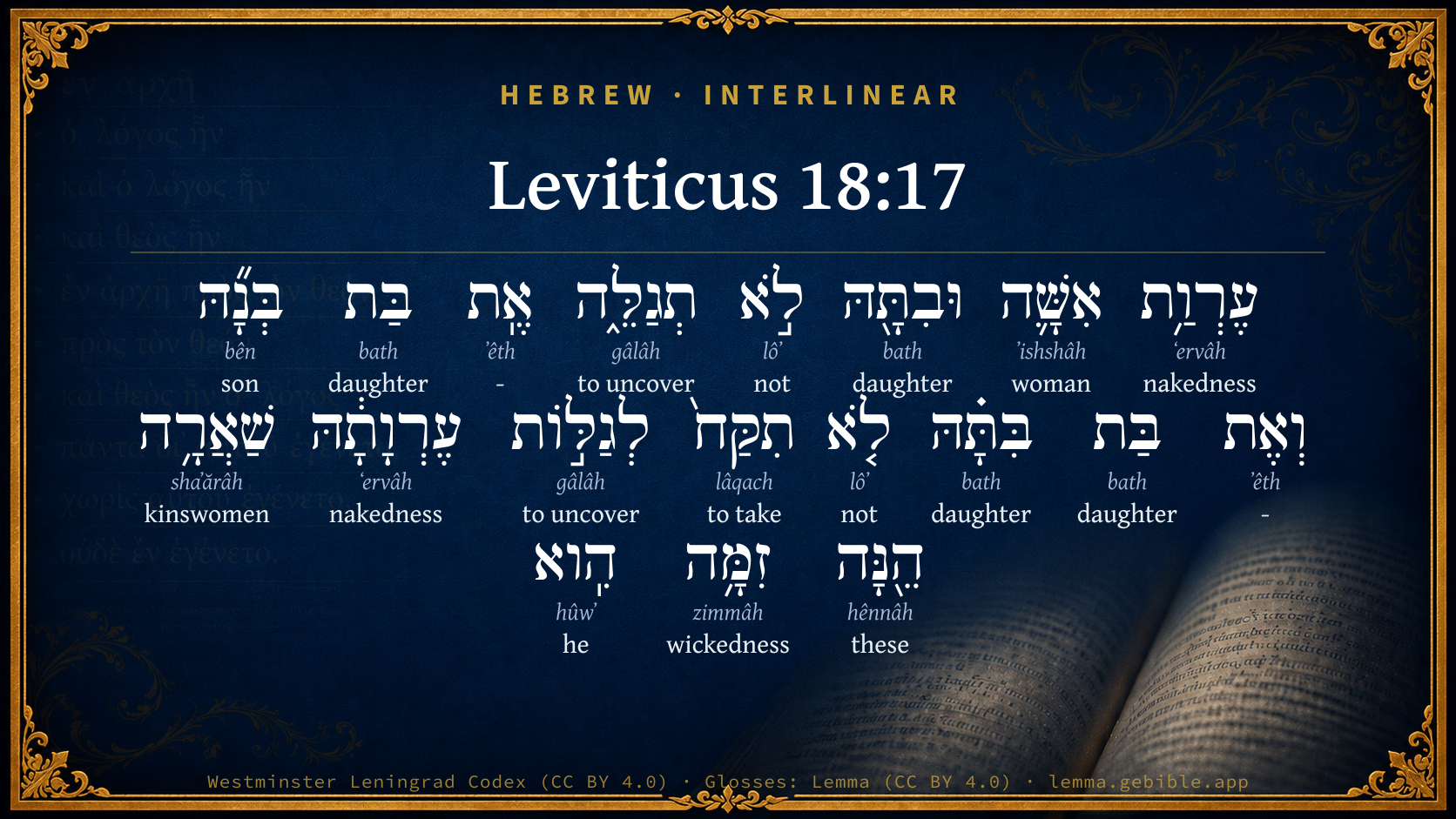
Hebrew (Westminster Leningrad Codex) Leviticus 18:17 appears in the Hebrew Old Testament. The text above is from the Westminster Leningrad Codex. Each word links to its Strong’s number, a concise gloss, and parsing drawn from the Open Scriptures Hebrew Bible morphology. Click any word for its full Brown-Driver-Briggs (BDB) entry.
Download image
Cite this verse

Leviticus 18:17 (World English Bible). Public Domain. Lemma interlinear Bible study tool, https://lemma.gebible.app/v/leviticus/18/17.

Show BibTeX & RIS
BibTeX
RIS
English Translation
"'You shall not uncover the nakedness of a woman and her daughter. You shall not take her son's daughter, or her daughter's daughter, to uncover her nakedness; they are near kinswomen: it is wickedness.
World English Bible · Public Domain
Highlights
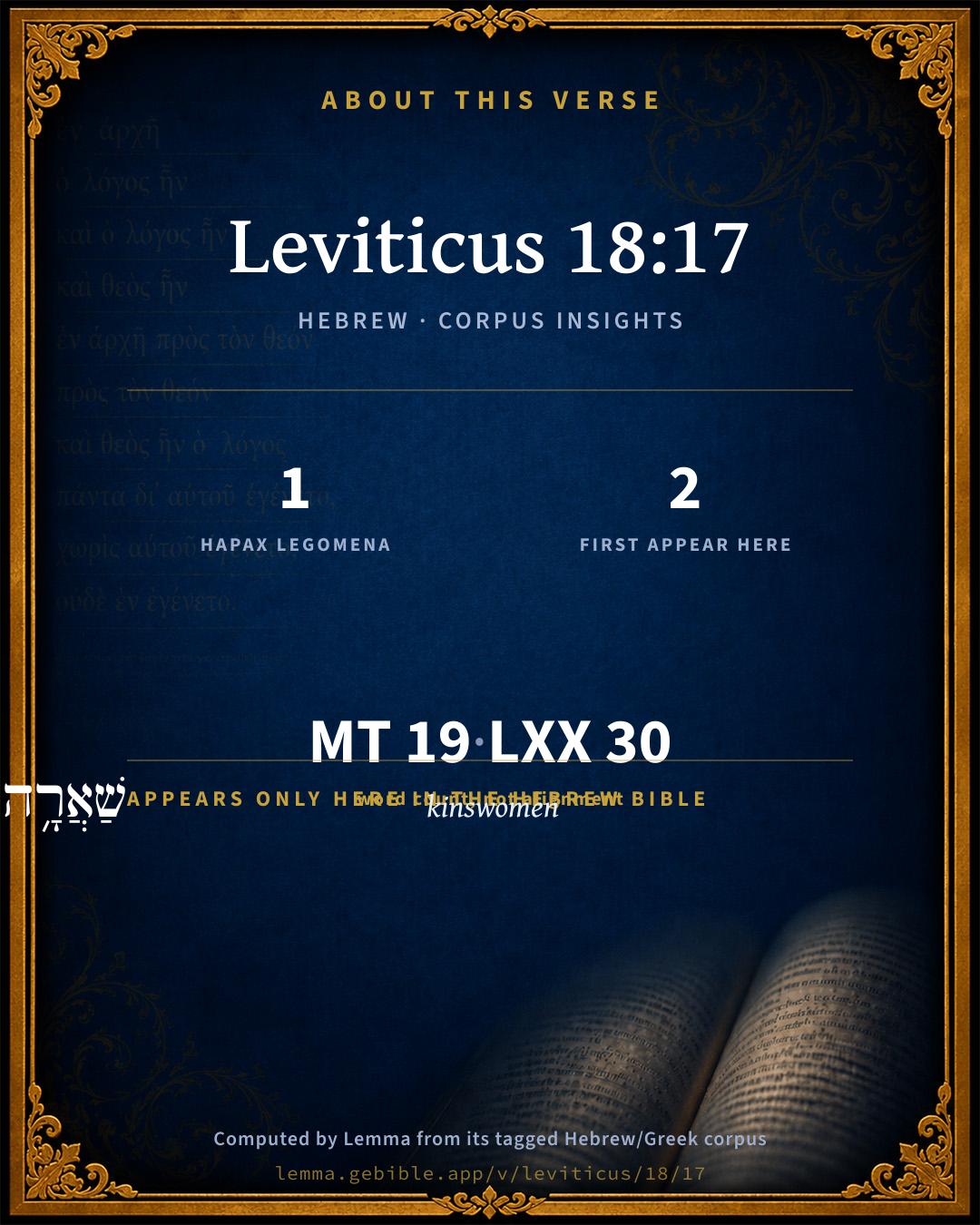
  • 1 hapax legomenon — only here in the Hebrew Bible
  • 2 first appearances in the Hebrew Bible
Full analysis ↓
Download a study sheet

One document with this verse’s original text, its word-by-word gloss line, the meaning frame, cross-references with their text, attributed commentary, and full source and license credits — printable, and it pastes into notes with its structure intact.

This verse Autodidact and up

Study sheet (.html) Plain text (.txt)

A passage Seminary Student

Up to 50 verses in one chapter. A passage sheet keeps up to 6 commentary sources and 12 cross-references per verse, in the order this page ranks them, and says so on the sheet whenever that leaves anything out. Ask for a single verse and you get the Autodidact verse sheet above.

Everything on this page stays free to read, with no account — the sheet is a download of what is already on screen, not access to it.

Want to remove ads? Support Godless Engineer
Compare translations 3

The same verse in 3 English versions, stacked beneath the original-language interlinear above. Click any original word for its lexicon entry.

Each is an independent rendering of the whole verse — the interlinear is not word-aligned to these translations.

Highlighted words mark where these versions differ — a whole-verse word diff, not a word-by-word alignment.

  • World English Bible Public Domain
    "'You shall not uncover the nakedness of a woman and her daughter. You shall not take her son's daughter, or her daughter's daughter, to uncover her nakedness; they are near kinswomen: it is wickedness.
  • King James Version Public Domain
    Thou shalt not uncover the nakedness of a woman and her daughter, neither shalt thou take her son's daughter, or her daughter's daughter, to uncover her nakedness; for they are her near kinswomen: it is wickedness.
  • unfoldingWord Literal Text CC BY-SA 4.0
    The nakedness of a woman and her daughter, you shall not uncover. The daughter of her son or the daughter of her daughter, you shall not take to uncover her nakedness. They are flesh. It is depravity.

unfoldingWord Literal Text — © unfoldingWord, licensed CC BY-SA 4.0. Word-aligned USFM3 via Door43 (git.door43.org/unfoldingWord/en_ult).

Versions to compare (up to 4)

3 of 4 selected

Show all 18 translations

Every available English version of this verse, each an independent rendering of the whole verse.

  • World English Bible Public Domain
    "'You shall not uncover the nakedness of a woman and her daughter. You shall not take her son's daughter, or her daughter's daughter, to uncover her nakedness; they are near kinswomen: it is wickedness.
  • Berean Standard Bible Public Domain
    You must not have sexual relations with both a woman and her daughter. You are not to marry her son’s daughter or her daughter’s daughter and have sexual relations with her. They are close relatives; it is depraved.
  • Majority Standard Bible Public Domain
    You must not have sexual relations with both a woman and her daughter. You are not to marry her son’s daughter or her daughter’s daughter and have sexual relations with her. They are close relatives; it is depraved.
  • King James Version Public Domain
    Thou shalt not uncover the nakedness of a woman and her daughter, neither shalt thou take her son's daughter, or her daughter's daughter, to uncover her nakedness; for they are her near kinswomen: it is wickedness.
  • American Standard Version (1901) Public Domain
    Thou shalt not uncover the nakedness of a woman and her daughter; thou shalt not take her son's daughter, or her daughter's daughter, to uncover her nakedness; they are near kinswomen: it is wickedness.
  • Revised Version (1885) Public Domain
    Thou shalt not uncover the nakedness of a woman and her daughter; thou shalt not take her son’s daughter, or her daughter’s daughter, to uncover her nakedness; they are near kinswomen: it is wickedness.
  • Geneva Bible (1599) Public Domain
    Thou shalt not discouer the shame of the wife and of her daughter, neither shalt thou take her sonnes daughter, nor her daughters daughter, to vncouer her shame: for they are thy kinsfolkes, and it were wickednesse.
  • Douay-Rheims (1899) Public Domain
    Thou shalt not uncover the nakedness of thy wife and her daughter. Thou shalt not take her son's daughter or her daughter's daughter, to discover her shame: because they are her flesh, and such copulation is incest.
  • Young's Literal Translation Public Domain
    `The nakedness of a woman and her daughter thou dost not uncover; her son's daughter, and her daughter's daughter thou dost not take to uncover her nakedness; they `are' her relations; it `is' wickedness.
  • Literal Standard Version CC BY-SA 4.0
    You do not uncover the nakedness of a woman and her daughter, nor do you take her son’s daughter and her daughter’s daughter, to uncover her nakedness; they [are] her relations; it [is] wickedness.
  • Unlocked Literal Bible CC BY-SA 4.0
    Do not sleep with a woman and her daughter, or with her son's daughter or her daughter's daughter. They are close relatives to her, and sleeping with them would be wicked.
  • unfoldingWord Literal Text CC BY-SA 4.0
    The nakedness of a woman and her daughter, you shall not uncover. The daughter of her son or the daughter of her daughter, you shall not take to uncover her nakedness. They are flesh. It is depravity.
  • Darby Bible Public Domain
    The nakedness of a woman and her daughter shalt thou not uncover; thou shalt not take her son's daughter, nor her daughter's daughter, to uncover her nakedness: they are her near relations: it is wickedness.
  • World Messianic Bible Public Domain
    “‘You shall not uncover the nakedness of a woman and her daughter. You shall not take her son’s daughter, or her daughter’s daughter, to uncover her nakedness. They are near kinswomen. It is wickedness.
  • Webster's Bible Public Domain
    Thou shalt not uncover the nakedness of a woman and her daughter, neither shalt thou take her son's daughter, or her daughter's daughter, to uncover her nakedness; for they are her near kinswomen: it is wickedness.
  • Free Bible Version CC BY-SA 4.0
    Don't have sex with both a woman and her daughter. Don't have sex with her son's daughter or her daughter's daughter. They are her close relatives. That is something I loathe.
  • Bible in Basic English Public Domain
    You may not take as wife a woman and her daughter, or her son's daughter or her daughter's daughter, for they are of one family: it is an act of shame.
  • JPS Tanakh (1917) Public Domain
    Thou shalt not uncover the nakedness of a woman and her daughter; thou shalt not take her son's daughter, or her daughter's daughter, to uncover her nakedness: they are near kinswomen; it is lewdness.

Literal Standard Version (2020), Covenant Press — licensed CC BY-SA 4.0. Text via the HelloAO Bible API (eBible.org). Unlocked Literal Bible (unfoldingWord) — licensed CC BY-SA 4.0. Text via the HelloAO Bible API (eBible.org). unfoldingWord Literal Text — © unfoldingWord, licensed CC BY-SA 4.0. Word-aligned USFM3 via Door43 (git.door43.org/unfoldingWord/en_ult). Free Bible Version, Dr. Jonathan Gallagher — licensed CC BY-SA 4.0. Text via the HelloAO Bible API (eBible.org).

Word by word

More ways to search: Search by grammar → Find every occurrence → Compare this word →

Practice this passage: Drill this verse → Learn its vocabulary →

שַׁאֲרָ֥ה
shaʼărâh
H7608
“kinswomen”
Noun, Common, Feminine, Singular, Absolute
Part of Speech
Noun
Type
Common
Gender
Feminine
Number
Singular
State
Absolute
Full BDB Definition

Origin: from H7607

TWOT: 2308a

kinswomen
  1. עֶרְוַ֥ת ʻervâh H6172 “nakedness of” Noun, Common, Feminine, Singular, Construct
  2. אִשָּׁ֛ה ʼishshâh H802 “woman” Noun, Common, Feminine, Singular, Absolute
  3. וּבִתָּ֖הּ bath H1323 “and · daughter · her” Conjunction + Noun, Common, Feminine, Singular, Construct + Suffix, Personal, 3rd Person, Feminine, Singular
  4. לֹ֣א lôʼ H3808 “not” Particle, Negative
  5. תְגַלֵּ֑ה gâlâh H1540 “to uncover” Verb, Piel, Imperfect, 2nd Person, Masculine, Singular
  6. אֶֽת ʼêth H853 “-” Particle, Direct Object
  7. בַּת bath H1323 “daughter of” Noun, Common, Feminine, Singular, Construct
  8. בְּנָ֞הּ bên H1121 “son · her” Noun, Common, Masculine, Singular, Construct + Suffix, Personal, 3rd Person, Feminine, Singular
  9. וְאֶת ʼêth H853 “and · -” Conjunction + Particle, Direct Object
  10. בַּת bath H1323 “daughter of” Noun, Common, Feminine, Singular, Construct
  11. בִּתָּ֗הּ bath H1323 “daughter · her” Noun, Common, Feminine, Singular, Construct + Suffix, Personal, 3rd Person, Feminine, Singular
  12. לֹ֤א lôʼ H3808 “not” Particle, Negative
  13. תִקַּח֙ lâqach H3947 “to take” Verb, Qal, Imperfect, 2nd Person, Masculine, Singular
  14. לְגַלּ֣וֹת gâlâh H1540 “to uncover” Preposition + Verb, Piel, Infinitive Construct
  15. עֶרְוָתָ֔הּ ʻervâh H6172 “nakedness · her” Noun, Common, Feminine, Singular, Construct + Suffix, Personal, 3rd Person, Feminine, Singular
  16. הֵ֖נָּה hênnâh H2007 “these” Pronoun, Personal, 3rd Person, Feminine, Plural
  17. זִמָּ֥ה zimmâh H2154 “wickedness” Noun, Common, Feminine, Singular, Absolute
  18. הִֽוא hûwʼ H1931 “he” Pronoun, Personal, 3rd Person, Feminine, Singular

About this verse

These counts appear in no published source. They are computed here, from the morphology-tagged text and Lemma’s own curated glosses. What Lemma adds →

19
words
12
distinct lemmas
Pentateuch
section

Notable vocabulary

1 hapax legomenon — a word that appears only here in the entire Hebrew Bible:

  • שַׁאֲרָ֥ה kinswomen H7608

First appearance in Scripture

These words make their first canonical appearance in the Hebrew Bible here:

  • שַׁאֲרָ֥ה kinswomen H7608
  • זִמָּ֥ה wickedness H2154

Shared distinctive vocabulary

זִמָּ֥ה wickedness H2154 occurs in 27 verses of the Hebrew Bible. Also found in:

Grammatical profile

  • 3 verbs
  • 10 nouns
  • 2 pronouns
  • 4 particles

Verb forms

  • תְגַלֵּ֑ה Piel · Imperfect
  • תִקַּח֙ Qal · Imperfect
  • לְגַלּ֣וֹת Piel · Infinitive Construct

Repetition

Words recur within this verse — often emphatic in Hebrew:

  • וּבִתָּ֖הּ daughter H1323 ×4
  • עֶרְוַ֥ת nakedness H6172 ×2
  • תְגַלֵּ֑ה to uncover H1540 ×2
  • לֹ֣א not H3808 ×2

Hebrew & Septuagint length

In English translation the verse runs 34 words from the Hebrew and 35 from the Septuagint (LXX English) — closely comparable.

A rough comparison of the two English renderings, which tokenize alike — not a word-level alignment.

Word counts can differ between the Hebrew and the Greek without any difference in meaning — e.g. the Hebrew direct-object marker אֵת has no separate Greek word, and Greek often adds the article ὁ.

In the original languages it is 19 Hebrew tokens and 30 Greek tokens — but the two are counted differently (Hebrew bundles its prefixes and suffixes into one token; the Greek is in lemma form), so that isn’t a like-for-like length.

Cross-references

3

Topical passages linked to Leviticus 18:17 in the Treasury of Scripture Knowledge — connected by theme and wording, ordered by reader-vote popularity; previews shown in the World English Bible.

  • Leviticus 20:14 "'If a man takes a wife and her mother, it is wickedness: they shall be burned with fire, both he and they; that there may be no wickedness among you.
  • Deuteronomy 27:23 Cursed be he who lies with his mother-in-law. All the people shall say, Amen.
  • Amos 2:7 They trample on the dust of the earth on the head of the poor, And deny justice to the oppressed; And a man and his father use the same maiden, to profane my holy name;

Cross-references courtesy of OpenBible.info (CC BY 4.0).

Hebrew and Greek witnesses Masoretic Hebrew ↔ Greek Septuagint

The same verse in the two great witnesses to the Old Testament, shown verse-for-verse.

These are two independent witnesses, not word-aligned to each other, and the Septuagint is shown in lemma (dictionary) form.

Hebrew Leviticus 18:17 Masoretic · Westminster Leningrad Codex

עֶרְוַ֥ת אִשָּׁ֛ה וּבִתָּ֖הּ לֹ֣א תְגַלֵּ֑ה אֶֽת בַּת בְּנָ֞הּ וְאֶת בַּת בִּתָּ֗הּ לֹ֤א תִקַּח֙ לְגַלּ֣וֹת עֶרְוָתָ֔הּ שַׁאֲרָ֥ה הֵ֖נָּה זִמָּ֥ה הִֽוא

"'You shall not uncover the nakedness of a woman and her daughter. You shall not take her son's daughter, or her daughter's daughter, to uncover her nakedness; they are near kinswomen: it is wickedness.

World English Bible · Public Domain

Greek LXX Leviticus 18:17 Septuagint · lemma form

ἀσχημοσύνη γυνή καί θυγάτηρ αὐτός οὐ ἀποκαλύπτω ὁ θυγάτηρ ὁ υἱός αὐτός καί ὁ θυγάτηρ ὁ θυγάτηρ αὐτός οὐ λαμβάνω ἀποκαλύπτω ὁ ἀσχημοσύνη αὐτός οἰκεῖος γάρ σύ εἰμί ἀσέβημα εἰμί

The nakedness of a woman and her daughter shall you not uncover; her son's daughter, and her daughter's daughter, shall you not take, to uncover their nakedness, for they are your kinswomen: it is impiety.

LXX2012 (modern English Septuagint) · Public Domain

On this verse, Haydock's Catholic Bible Commentary discusses the Septuagint’s reading. Read the note in Commentary ↓

Hebrew: Westminster Leningrad Codex (CC BY 4.0). Greek: Septuagint (public domain); English from LXX2012 (modern English Septuagint) (Public Domain). How the Septuagint differs from the Hebrew →

Targum (Aramaic paraphrase)

2

The Targum is the ancient Jewish Aramaic paraphrase of the Hebrew Scriptures — an interpretive translation, not the Hebrew text itself. Onkelos (literal) and Pseudo-Jonathan (expansive) render the Torah, and Jonathan the Prophets. Coverage is partial: where no permissively-licensed English translation exists for a verse, only the Aramaic is shown. This is verse-level text, not a word-by-word alignment to the Hebrew.

  1. Targum Onkelos Torah (Genesis–Deuteronomy)
    עֶרְיַת אִתְּתָא וּבְרַתָּהּ לָא תְגַלֵי יָת בַּת בְּרָהּ וְיָת בַּת בְּרַתָּהּ לָא תִסַב לְגַלָאָה עֶרְיָתָהּ קָרִיבָן אִנוּן עֵצַת חִטְאִין הִיא

    (no public-domain English translation for this verse)

    Targum Onkelos — Aramaic: “Onkelos Genesis” (public domain); “Onkelos Exodus” (public domain); “Onkelos Leviticus” (public domain); “Onkelos Numbers” (public domain); “Onkelos Deuteronomy” (public domain). English: “Sefaria Community Translation” (CC0 1.0 (public-domain dedication)); “J.W. Etheridge. The Targums of Onkelos and Jonathan Ben Uzziel on the Pentateuch. London: Longmans, Green, 1862” (public domain). Text via Sefaria.

  2. Targum Pseudo-Jonathan Torah (Genesis–Deuteronomy)
    עֶרְיַית אִתָּא וּבְרַתָּהּ לָא תִבְזֵי יַת בְּרַת בְּרָהּ וְיַת בְּרַת בְּרַתָּהּ לָא תִיסַב לְבַזָאָה עִרְיְיתָהּ קְרִיבַת בִּישְרָא הִינוּן זְנוּ הוּא

    The nakedness of a woman and of her daughter thou shalt not dishonour, neither shalt thou take her son's daughter or the daughter of her daughter, to dishonour their nakedness; for they are of kin to her flesh; it is corruption.

    Targum Pseudo-Jonathan — Aramaic: “Targum Jonathan on Genesis” (public domain); “Targum Jonathan on Exodus” (public domain); “Targum Jonathan on Leviticus” (public domain); “Targum Jonathan on Numbers” (public domain); “Targum Jonathan on Deuteronomy” (public domain). English: “The Targum of Jonathan ben Uzziel, trans. J. W. Etheridge, London, 1862” (public domain). Text via Sefaria.

Commentary

Notes on Leviticus 18:17 from classic Christian and Jewish commentators (each source and its license shown beneath its notes). The classic Christian expositions comment on the surrounding passage and are grouped to its opening verse, so a note may address several verses; the Jewish commentaries on the Tanakh (Rashi and others) are per-verse, so they appear only where the commentator wrote on this verse.

Lemma curates 59 commentaries, every one of them public domain or Creative Commons licensed, each selected and text-cleaned for this edition rather than reprinted as found. About our sources →

Trapp's Complete Commentary

John Trapp

Lev 18:17 Thou shalt not uncover the nakedness of a woman and her daughter, neither shalt thou take her son’s daughter, or her daughter’s daughter, to uncover her nakedness; [for] they [are] her near kinswomen: it [is] wickedness.

Ver. 17. It is wickedness.] Wickedness with a witness; and yet avowed for lawful by some odious upstart sectaries, who teach that those marriages are most laudable that are betwixt persons nearest in blood, brother and sister, father and daughter, mother and son, &c. This they shame not to set forth in print. {a}

{a} Hist. Davidis Georg., pp. 28, 29; Little Non-such, pp. 5-7.

John Trapp, A Commentary or Exposition upon All the Books of the Old and New Testament (1647–1656) — public domain. Text from a community e-Sword module.

Joseph Benson's Commentary

Lev 18:17. A woman and her daughter — If a man married a widow that had a daughter, he was not allowed to marry this daughter, either while the mother was alive or after her death.

Joseph Benson's Commentary on the Old and New Testaments (1811–1818) — public domain. Text from a community e-Sword module.

Tyndale Open Study Notes

Tyndale Open Resources

18:17 As with all examples listed in ch 18, marrying a woman together with her daughter or granddaughter was prohibited because of the disruption it would cause in the family order. It would violate the intimacy of the family group by forcing a wife to compete for her husband’s affections against a much younger woman. The penalty for this act was death by burning (20:14).

Tyndale Open Study Notes — © Tyndale Open Resources, licensed CC BY-SA 4.0. Text via the HelloAO Bible API.

Ellicott's Commentary for English Readers

(17) A woman and her daughter.—That is, if a man marries a widow who has a daughter by a former husband, or if he forms an alliance with a woman who has a daughter out of wedlock, he is forbidden to marry also the daughter. But though this prohibition is directed against a peculiar form of polygamy. there can hardly be any doubt that, as the administrators of the law during the second Temple interpreted it, if he married either of them and she died, he could not marry the other any more, and that this prohibition did not apply to cases of illicit commerce. Criminal intercourse with one did not preclude him from marrying the other. For contracting the kind of polygamy here forbidden, the offenders were punished with death by fire. (See Lev_20:14.)

A Bible Commentary for English Readers, edited by Charles John Ellicott (1878–1897) — public domain. Text from a community e-Sword module.

John Gill's Exposition

Thou shall not uncover the nakedness of a woman and her daughter,.... That is, if a man marries a woman, and she has a daughter, which is the man's daughter-in-law, after the death of his wife he may not marry this daughter; for this daughter is of the same flesh with her mother, who became one flesh with the man she married, and therefore his relation to her daughter is too near to marry her: Jarchi says, if he does not marry the woman, but only deflower her, it is free for him to marry her daughter; but Aben Ezra says, if he has lain with the mother, the daughter is forbidden; however, if he married either of them, the other was forbidden; he could not marry them both, neither in the lifetime of them both, nor after the death of either of them:

neither shalt thou take her son's daughter, or her daughter's daughter, to uncover her nakedness; not any of her granddaughters, either in the line of her son or daughter; that is, might not lie with either of them, or marry them, and much less then marry her own daughter, these being a further remove from her:

for they are her near kinswomen; one or other of them, even every one of them, "the rest" and residue "of her" (r), of her flesh, who together made one flesh with her; and therefore not to be married to her husband, either in her life, or after her death:

it is wickedness: a very great wickedness, abominable in the sight of God, and to be detested by man as vile and impious; it is whoredom, as the Targum of Jonathan renders it.

(r) "reliquiae sunt ipsae", Tigurine version.

John Gill's Exposition of the Whole Bible (1746–1763) — public domain (CC PDM 1.0). Text via the HelloAO Bible API.

Haydock's Catholic Bible Commentary

Daughter, together, or successively; even if she were the child of another husband. --- Incest. Hebrew, "a crime." Aquila, "an abomination." Septuagint, "an impiety."

George Leo Haydock (1774–1849), Haydock's Catholic Family Bible and Commentary, 1859 edition — public domain. Excludes Psalms (Douay-Rheims chapter numbering differs from Protestant) and Deuterocanonical books (Catholic canon only).

Matthew Poole's English Annotations

Of a woman and her daughter, to wit, thy step-daughter, and so thy step-son’s daughter, &c.

It is wickedness; because they are very near to thy wife by consanguinity, as coming directly from her; and therefore they are as near to thee by affinity, which binds as much as consanguinity; the wife, who is only related by affinity, being nearer to a man than any other by consanguinity, they two being made one flesh, and therefore the same distance is to be observed in both of them.

Matthew Poole's English Annotations on the Holy Bible (1683–1685) — public domain. Text from a community e-Sword/MySword module.

Whedon's Commentary on the Bible

Daniel D. Whedon

17. A woman and her daughter — This verse prohibits the successive marriage of a man with a woman and her daughter or granddaughter on account of their near blood relationship.

Wickedness — This word zimmah is elsewhere generally translated lewdness, and signifies a gross violation of decency or principle.

Daniel D. Whedon (gen. ed.), Commentary on the Old and New Testaments (1874–1909) — public domain. Text from a community e-Sword module.

The Pulpit Commentary

The ninth form of incest prohibited is intercourse with a stepdaughter, or step-granddaughter, or mother-in-law. The expression made use of, Thou shalt not uncover the nakedness of a woman and her daughter, covers the case of a man"s own daughter, and it is singular that it is only in this incidental manner that it is specifically named. But it has been already disposed of by the general command, None of you shall approach to any that is near of kin to him, to uncover their nakedness.

The daughter being nearest of kin, this command was sufficient without further specification. The niece and probably the wife"s sister are forbidden by the same general rule (see following note).

The Pulpit Commentary (1880–1919), ed. H.D.M. Spence-Jones & Joseph S. Exell — public domain. Text from a community e-Sword module.

Keil & Delitzsch

C. F. Keil & F. Delitzsch

Marriage with a woman and her daughter, whether both together or in succession, is described in Deu 27:20 as an accursed lying with the mother-in-law; whereas here it is the relation to the step-daughter which is primarily referred to, as we may see from the parallel prohibition, which is added, against taking the daughter of her son or daughter, i.e., the granddaughter-in-law. Both of these were crimes against blood-relationship which were to be punished with death in the case of both parties (Lev 20:14), because they were "wickedness," זמּה, lit., invention, design, here applied to the crime of licentiousness and whoredom (Lev 19:29; Jdg 20:6; Job 31:11).

Keil & Delitzsch — Biblical Commentary on the Old Testament (1861–1891) — public domain (CC PDM 1.0). Text via the HelloAO Bible API. (Old Testament only.)

unfoldingWord translationNotes

Door43 World Missions Community

translationWords

evil

life

unfoldingWord translationNotes — © Distant Shores Media and the Door43 World Missions Community, licensed CC BY-SA 4.0. Source: git.door43.org/Door43/en_tn.

Rashi

Rabbi Shlomo Yitzchaki (Rashi)

ערות אשה ובתה THE NAKEDNESS OF A WOMAN AND HER DAUGHTER [THOU SHALT NOT UNCOVER] — Scripture forbids this only if the union with the first of these (whether it be the woman or her daughter) came about through a legal marriage. That is why Scripture uses the term לא תקח, the expression employed for "taking to wife in a legal way". Similarly with reference to the punishment for such a union it states, (Leviticus 20:14) "And if a man take (יקח) a wife and her mother, [it is wickedness; they shall be burnt with fire]" — an expression for "taking" to wife in a legal way. But if one has raped a woman he is permitted to marry her daughter (Yevamot 97a).

שארה הנה means, they are closely related to one another.

זמה means, an evil plan, as the Targum renders it‎ עצת חטאין, "a sinful plan"; the term is used because it is your evil inclination which counsels you to sin.

Rashi on the Tanakh — English translations: “The Judaica Press complete Tanach with Rashi, translated by A. J. Rosenberg” (CC BY 4.0); “Pentateuch with Rashi's commentary by M. Rosenbaum and A.M. Silbermann, 1929-1934” (public domain); “The Metsudah Tanach series, Lakewood, N.J” (CC BY 4.0); and “The Book of Joshua, Metsudah Publications, 1997” (CC BY 4.0). Text via Sefaria.

Ramban (Nachmanides)

Rabbi Moshe ben Nachman (Ramban / Nachmanides)

IT IS ‘ZIMAH’ (LEWDNESS). Onkelos translated: “it is a sinful plan,” and Rashi commented thereon, “because your evil inclination counsels you to sin.” But I know of no sense to this, for with regard to all forbidden relations and all other transgressions, it is the evil inclination that counsels one to sin! [Why then is this verse prohibiting intercourse with a woman and her daughter, singled out by the use of this expression?] But the meaning of the matter is that the term zimah is derived from the expression, as ‘zamam’ (he had purposed) to do unto his brother. A proper thought is called m’zimah, as it said, And no ‘m’zimah’ (purpose) can be withholden from Thee, and lewdness that is thought of in secret is called zimah, similar to that which it is said, If my heart have been enticed unto a woman, 31:9. and Scripture concludes, For that were ‘zimah’ (a heinous crime); yea, it were an iniquity to be punished by the judges., Verse 11. Similarly, ‘v’zimatheich’ (thy lewdness) and thy harlotries; and ‘zimath’ (the lewdness of) thy harlotry, denoting these illicit acts committed in private and in public. In my opinion Scripture states it is ‘zimah’, in the case of [sexual relationships with] a woman and her daughter, and also a woman and her mother, in order to condemn the matter, saying that when one lies with the one, who is his wife, he thinks of the other one on account of their relationship and likeness, and thus lying with both of them is a cause of lewdness to him. This matter is similar to that which the Rabbis have mentioned: “And I will purge out from among you the rebels, and them that transgress against Me. These are the children [who are the offspring] of nine different dispositions [in their parents] etc.” It is for this reason that Scripture states here, the nakedness of a woman and her daughter etc., and similarly it says, And if a man take with his wife also her mother, it is lewdness, and does not say “the nakedness of your wife’s daughter, or your wife’s mother, you shalt not uncover” [but rather mentions them in each case together, by saying: the nakedness of a woman and her mother, or the nakedness of a woman and her daughter, in order to indicate that the prohibition is on account of thinking of the two together]. And the explanation of the verses here is as follows: At the beginning of the section He said, None of you shall approach to any that is ‘sh’eir’ (near of) flesh to him, to uncover their nakedness, thus prohibiting [sexual intercourse with] those who are near of flesh to him, and He stated the reason for this to be, for theirs is thine own nakedness, Verse 10. and so now [in Verse 17 before us] where He prohibits the wife’s relations, He states ‘sha’arah heinah’ (they are near kinswomen), meaning to say that they are also forbidden because they [the women] are near of flesh to each other, and lying with both of them would be lewdness, as I have explained. Similarly Scripture states, and each hath lewdly defiled his daughter-in-law, meaning that he defiled her to her husband, for even when she will be with her husband, she will think of his father because of their likeness. Now Scripture calls lying with animals tevel hu, denoting [as Rashi explained] “the mingling [from the root balal] of the human semen with that of the animal,” and so it also says of lying with a daughter-in-law that they have done ‘tevel,’ meaning that father and son will become joined to her as one person, and she will lie with both of them together in thought.

Ramban (Nachmanides) on the Tanakh — English translation: “Commentary on the Torah by Ramban (Nachmanides). Translated and annotated by Charles B. Chavel. New York, Shilo Pub. House, 1971-1976” (CC BY 4.0). Text via Sefaria.

Lesson kit

Teaching starters — assembled from the data on this page, not authored interpretation. Every prompt links to the verse data it draws on. Edit before teaching.

Leviticus, in the Pentateuch, opens this verse with 19 words (12 distinct Hebrew lemmas). Its most distinctive word is shaʼărâh (“kinswomen”). A historical commentator’s framing appears above. Read the whole chapter for the surrounding context.

Discussion questions

  1. How does “kinswomen” (shaʼărâh) shape what this verse is saying?
  2. 1 word here appears nowhere else in the Hebrew Bible. Why might the author reach for such rare wording?
  3. 2 words make their first appearance in Scripture here. What does this debut establish?
  4. How does Leviticus 19:29, which shares the word «wickedness», read alongside this verse?
  5. What does the repetition of “daughter” (4× in this one verse) do in this verse?
  6. These translations render this verse differently. What is at stake in choosing one wording over another?
  7. «תְגַלֵּ֑ה» is a Piel Imperfect verb. How does that grammatical form shape the action described?
  8. Compare how Trapp's Complete Commentary and Joseph Benson's Commentary read this verse. Where do they agree or differ?

Things to notice

  • 1 word in this verse appears nowhere else in the Hebrew Bible.
  • 2 words make their first canonical appearance in Scripture here.
  • This verse counts 19 Hebrew ↔ 30 Greek words.
  • These translations choose different wording for 11 words in this verse.
  • “daughter” occurs 4× in this single verse.

Reading settings

Reading text

Shown beneath each verse's original-language words.

Old Testament
Old Testament edition

Read the OT as the Masoretic Hebrew (MT) or the Greek Septuagint (LXX).

English shown for the Greek Septuagint (in the Hebrew ↔ Greek comparison).

Comparing translations? Open the Compare panel on any verse page to stack up to four side by side.