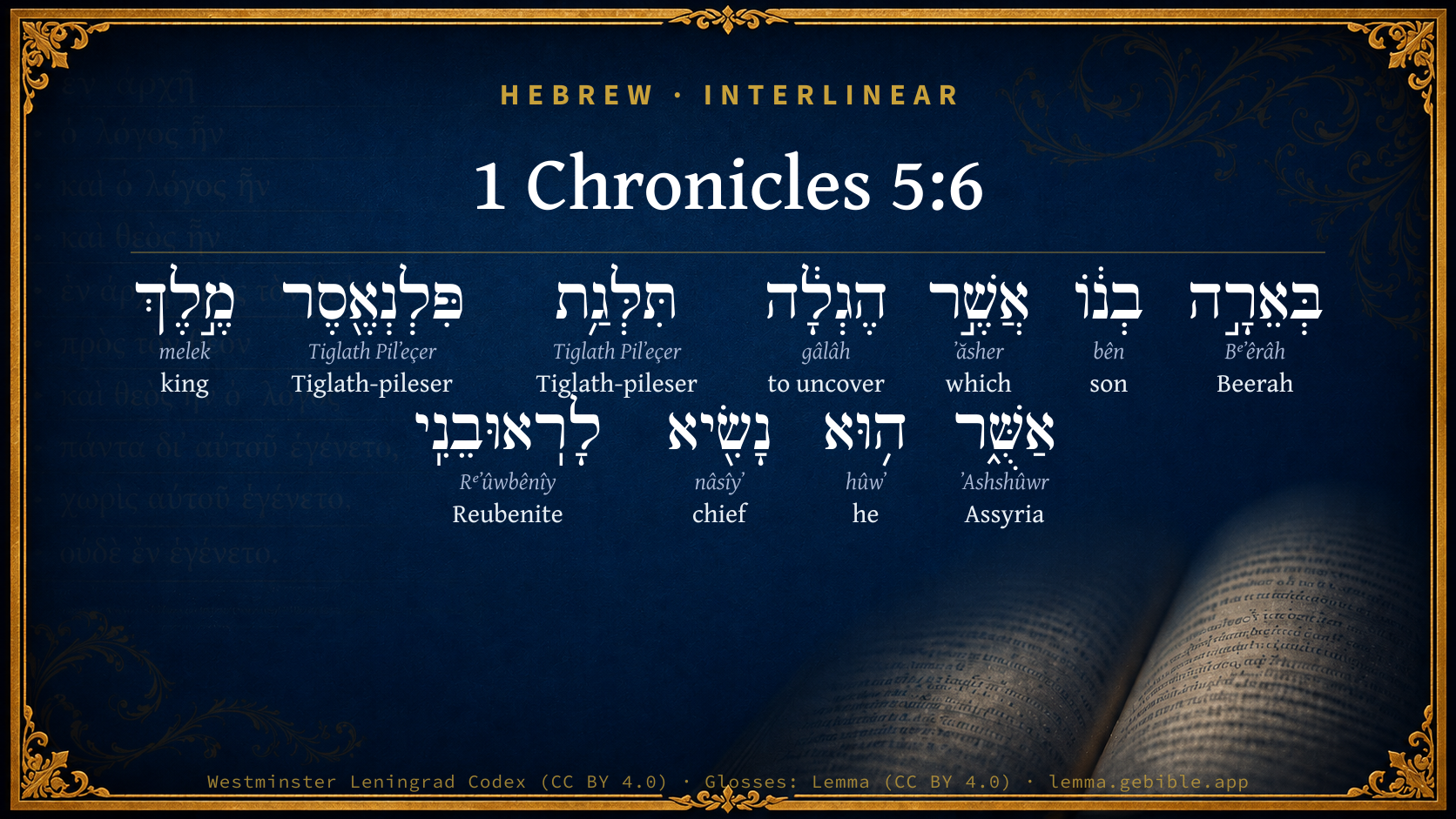
1 Chronicles 5:6

Hebrew (Westminster Leningrad Codex) 1 Chronicles 5:6 appears in the Hebrew Old Testament. The text above is from the Westminster Leningrad Codex. Each word links to its Strong’s number, a concise gloss, and parsing drawn from the Open Scriptures Hebrew Bible morphology. Click any word for its full Brown-Driver-Briggs (BDB) entry.
Download image
Cite this verse

1 Chronicles 5:6 (World English Bible). Public Domain. Lemma interlinear Bible study tool, https://lemma.gebible.app/v/1-chronicles/5/6.

Show BibTeX & RIS
BibTeX
RIS
English Translation
Beerah his son, whom Tilgath Pilneser king of Assyria carried away captive: he was prince of the Reubenites.
World English Bible · Public Domain
Highlights
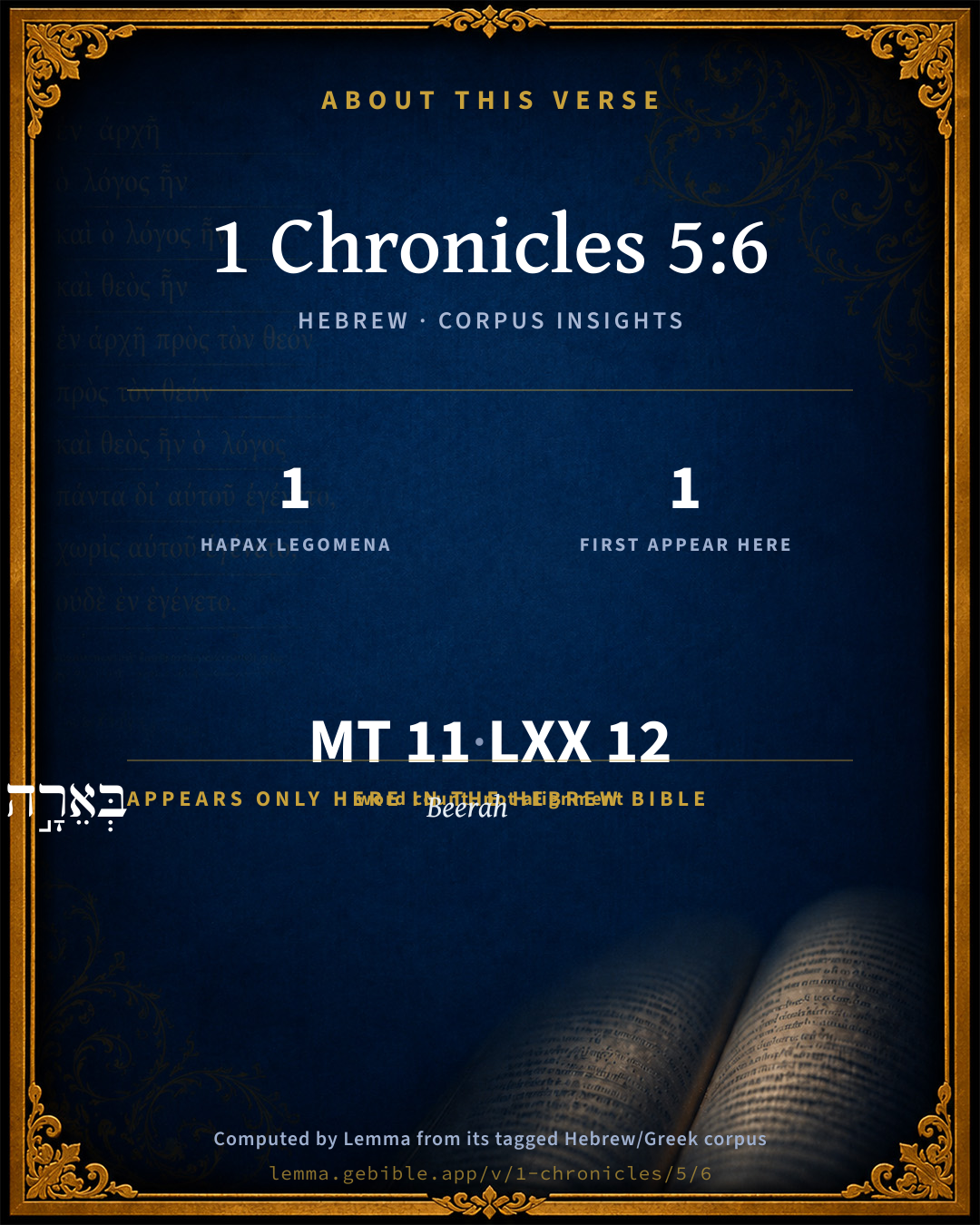
  • 1 hapax legomenon — only here in the Hebrew Bible
  • 1 first appearance in the Hebrew Bible
Full analysis ↓
Download a study sheet

One document with this verse’s original text, its word-by-word gloss line, the meaning frame, cross-references with their text, attributed commentary, and full source and license credits — printable, and it pastes into notes with its structure intact.

This verse Autodidact and up

Study sheet (.html) Plain text (.txt)

A passage Seminary Student

Up to 50 verses in one chapter. A passage sheet keeps up to 6 commentary sources and 12 cross-references per verse, in the order this page ranks them, and says so on the sheet whenever that leaves anything out. Ask for a single verse and you get the Autodidact verse sheet above.

Everything on this page stays free to read, with no account — the sheet is a download of what is already on screen, not access to it.

Want to remove ads? Support Godless Engineer
Compare translations 3

The same verse in 3 English versions, stacked beneath the original-language interlinear above. Click any original word for its lexicon entry.

Each is an independent rendering of the whole verse — the interlinear is not word-aligned to these translations.

Highlighted words mark where these versions differ — a whole-verse word diff, not a word-by-word alignment.

  • World English Bible Public Domain
    Beerah his son, whom Tilgath Pilneser king of Assyria carried away captive: he was prince of the Reubenites.
  • King James Version Public Domain
    Beerah his son, whom Tilgathpilneser king of Assyria carried away captive: he was prince of the Reubenites.
  • unfoldingWord Literal Text CC BY-SA 4.0
    Beerah, his son, whom Tilgath Pileser, the king of Assyria, exiled. He a leader of the Reubenite.

unfoldingWord Literal Text — © unfoldingWord, licensed CC BY-SA 4.0. Word-aligned USFM3 via Door43 (git.door43.org/unfoldingWord/en_ult).

Versions to compare (up to 4)

3 of 4 selected

Show all 18 translations

Every available English version of this verse, each an independent rendering of the whole verse.

  • World English Bible Public Domain
    Beerah his son, whom Tilgath Pilneser king of Assyria carried away captive: he was prince of the Reubenites.
  • Berean Standard Bible Public Domain
    and Beerah his son, whom Tiglath-pileser king of Assyria carried into exile. Beerah was a leader of the Reubenites.
  • Majority Standard Bible Public Domain
    and Beerah his son, whom Tiglath-pileser king of Assyria carried into exile. Beerah was a leader of the Reubenites.
  • King James Version Public Domain
    Beerah his son, whom Tilgathpilneser king of Assyria carried away captive: he was prince of the Reubenites.
  • American Standard Version (1901) Public Domain
    Beerah his son, whom Tilgath-pilneser king of Assyria carried away captive: he was prince of the Reubenites.
  • Revised Version (1885) Public Domain
    Beerah his son, whom Tilgath-pilneser king of Assyria carried away captive: he was prince of the Reubenites.
  • Geneva Bible (1599) Public Domain
    Beerah his sonne: whom Tilgath Pilneeser King of Asshur caryed away: he was a prince of the Reubenites.
  • Douay-Rheims (1899) Public Domain
    Beera his son, whom Thelgathphalnasar king of the Assyrians carried away captive, and he was prince in the tribe of Ruben.
  • Young's Literal Translation Public Domain
    Beerah his son, whom Tilgath-Pilneser king of Asshur removed; he `is' prince of the Reubenite.
  • Literal Standard Version CC BY-SA 4.0
    Beerah his son, whom Tilgath-Pilneser king of Asshur removed; he [is] prince of the Reubenite.
  • Unlocked Literal Bible CC BY-SA 4.0
    Baal's son was Beerah, whom Tiglath-Pileser king of Assyria took into exile. Beerah was a leader in the tribe of Reuben.
  • unfoldingWord Literal Text CC BY-SA 4.0
    Beerah, his son, whom Tilgath Pileser, the king of Assyria, exiled. He a leader of the Reubenite.
  • Darby Bible Public Domain
    Beerah his son, whom Tilgath-Pilneser king of Assyria carried away captive: he was prince of the Reubenites.
  • World Messianic Bible Public Domain
    and Beerah his son, whom Tilgath Pilneser king of Assyria carried away captive. He was prince of the Reubenites.
  • Webster's Bible Public Domain
    Beerah his son, whom Tilgath-pilneser king of Assyria carried away captive: he was prince of the Reubenites.
  • Free Bible Version CC BY-SA 4.0
    and Beerah his son, the one whom Tiglath-Pileser the king of Assyria took into exile. He (Beerah) was a leader of the Reubenites.
  • Bible in Basic English Public Domain
    Beerah his son, whom Tiglath-pileser, king of Assyria, took away as a prisoner: he was chief of the Reubenites.
  • JPS Tanakh (1917) Public Domain
    Beerah his son, whom Tillegath-pilneser king of Assyria carried away captive; he was prince of the Reubenites.

Literal Standard Version (2020), Covenant Press — licensed CC BY-SA 4.0. Text via the HelloAO Bible API (eBible.org). Unlocked Literal Bible (unfoldingWord) — licensed CC BY-SA 4.0. Text via the HelloAO Bible API (eBible.org). unfoldingWord Literal Text — © unfoldingWord, licensed CC BY-SA 4.0. Word-aligned USFM3 via Door43 (git.door43.org/unfoldingWord/en_ult). Free Bible Version, Dr. Jonathan Gallagher — licensed CC BY-SA 4.0. Text via the HelloAO Bible API (eBible.org).

Word by word

More ways to search: Search by grammar → Find every occurrence → Compare this word →

Practice this passage: Drill this verse → Learn its vocabulary →

About this verse

These counts appear in no published source. They are computed here, from the morphology-tagged text and Lemma’s own curated glosses. What Lemma adds →

11
words
10
distinct lemmas
Historical
section

Notable vocabulary

1 hapax legomenon — a word that appears only here in the entire Hebrew Bible:

  • בְּאֵרָ֣ה Beerah H880

First appearance in Scripture

This word makes its first canonical appearance in the Hebrew Bible here:

  • בְּאֵרָ֣ה Beerah H880

Shared distinctive vocabulary

תִּלְּגַ֥ת Tiglath-pileser H8407 occurs in 6 verses of the Hebrew Bible. Also found in:

Grammatical profile

  • 1 verb
  • 8 nouns
  • 1 pronoun
  • 1 particle

Verb forms

  • הֶגְלָ֔ה Hiphil · Perfect

Repetition

A word recurs within this verse — often emphatic in Hebrew:

  • תִּלְּגַ֥ת Tiglath-pileser H8407 ×2

Hebrew & Septuagint length

In English translation the verse runs 18 words from the Hebrew and 18 from the Septuagint (LXX English) — the same length.

A rough comparison of the two English renderings, which tokenize alike — not a word-level alignment.

Word counts can differ between the Hebrew and the Greek without any difference in meaning — e.g. the Hebrew direct-object marker אֵת has no separate Greek word, and Greek often adds the article ὁ.

In the original languages it is 11 Hebrew tokens and 12 Greek tokens — but the two are counted differently (Hebrew bundles its prefixes and suffixes into one token; the Greek is in lemma form), so that isn’t a like-for-like length.

Cross-references

4

Topical passages linked to 1 Chronicles 5:6 in the Treasury of Scripture Knowledge — connected by theme and wording, ordered by reader-vote popularity; previews shown in the World English Bible.

  • 1 Chronicles 5:26 The God of Israel stirred up the spirit of Pul king of Assyria, and the spirit of Tilgath Pilneser king of Assyria, and he carried them away, even the Reubenites, and the Gadites, and the half-tribe of Manasseh, and brought them to Halah, and Habor, and Hara, and to the river of Gozan, to this day.
  • 2 Chronicles 28:20 Tilgath Pilneser king of Assyria came to him, and distressed him, but didn't strengthen him.
  • 2 Kings 15:29 In the days of Pekah king of Israel came Tiglath Pileser king of Assyria, and took Ijon, and Abel Beth Maacah, and Janoah, and Kedesh, and Hazor, and Gilead, and Galilee, all the land of Naphtali; and he carried them captive to Assyria.
  • 2 Kings 16:7 So Ahaz sent messengers to Tiglath Pileser king of Assyria, saying, I am your servant and your son: come up, and save me out of the hand of the king of Syria, and out of the hand of the king of Israel, who rise up against me.

Cross-references courtesy of OpenBible.info (CC BY 4.0).

Hebrew and Greek witnesses Masoretic Hebrew ↔ Greek Septuagint

The same verse in the two great witnesses to the Old Testament, shown verse-for-verse.

These are two independent witnesses, not word-aligned to each other, and the Septuagint is shown in lemma (dictionary) form.

Hebrew 1 Chronicles 5:6 Masoretic · Westminster Leningrad Codex

בְּאֵרָ֣ה בְנ֔וֹ אֲשֶׁ֣ר הֶגְלָ֔ה תִּלְּגַ֥ת פִּלְנְאֶ֖סֶר מֶ֣לֶךְ אַשֻּׁ֑ר ה֥וּא נָשִׂ֖יא לָרֽאוּבֵנִֽי

Beerah his son, whom Tilgath Pilneser king of Assyria carried away captive: he was prince of the Reubenites.

World English Bible · Public Domain

Greek LXX 1 Chronicles 5:6 Septuagint · lemma form

υἱός αὐτός βεηρα ὅς μεταοἰκίζω θαγλαθφαλνασαρ βασιλεύς ασσουρ οὗτος ἄρχω ὁ ρουβην

his son Beel, whom Thagla-phallasar king of Assyria carried away captive: he is the chief of the Rubenites.

LXX2012 (modern English Septuagint) · Public Domain

Hebrew: Westminster Leningrad Codex (CC BY 4.0). Greek: Septuagint (public domain); English from LXX2012 (modern English Septuagint) (Public Domain). How the Septuagint differs from the Hebrew →

Commentary

Notes on 1 Chronicles 5:6 from classic Christian and Jewish commentators (each source and its license shown beneath its notes). The classic Christian expositions comment on the surrounding passage and are grouped to its opening verse, so a note may address several verses; the Jewish commentaries on the Tanakh (Rashi and others) are per-verse, so they appear only where the commentator wrote on this verse.

Lemma curates 59 commentaries, every one of them public domain or Creative Commons licensed, each selected and text-cleaned for this edition rather than reprinted as found. About our sources →

Trapp's Complete Commentary

John Trapp

1Ch 5:6 Beerah his son, whom Tilgathpilneser king of Assyria carried away [captive]: he [was] prince of the Reubenites.

Ver. 6. He was prince of the Reubenites.] But not the father of the prophet Hosea, as some have held. {a}

{a} Lyra.

John Trapp, A Commentary or Exposition upon All the Books of the Old and New Testament (1647–1656) — public domain. Text from a community e-Sword module.

Tyndale Open Study Notes

Tyndale Open Resources

5:6 Tiglath-pileser was king of Assyria (744–727 BC); he attacked the tribes of Transjordan during King Pekah’s reign (752–732 BC), taking the people into captivity (see 5:25-26; 2 Kgs 15:29).

Tyndale Open Study Notes — © Tyndale Open Resources, licensed CC BY-SA 4.0. Text via the HelloAO Bible API.

Geneva Bible (1599)

Geneva Bible translators

To wit, in the time of Uzziah King of Israel, 2 Kings 15:23.

Geneva Bible (1599) marginal notes — public domain. Text via Bolls.life.

Adam Clarke's Commentary

Verse 6. Beerah his son] After their separation from the house of David the ten tribes continued to have princes of the tribes; and this continued till the time that Tiglath-pileser carried them captives into Assyria. At that time Beerah was their prince or chief; and with him this species of dominion or precedency terminated. According to the Targum, Beerah was the same as Baruch the prophet.

Adam Clarke's Commentary on the Bible (1810–1826) — public domain. Text from a community e-Sword/MySword module.

The Cambridge Bible for Schools and Colleges

gen. ed. J. J. S. Perowne

6. Tilgath-pilneser] called Tiglath-pileser (2Ki_15:29), and no doubt identical with Pul (ib. 2Ki_15:19). See F. Hommel in Hastings’ Bible Dict., Assyria, p. 185. The Chronicler is therefore in error in speaking of Pul and Tilgath-pilneser as two persons; cp. 1Ch_5:26.

The Cambridge Bible for Schools and Colleges (gen. ed. J. J. S. Perowne; Cambridge University Press, 1878–1918) — public domain. Text from a community e-Sword module.

John Gill's Exposition

And his brethren by their families,.... Either the brethren of Beerah, or the rest of the posterity of Reuben:

(when the genealogy of their generations was reckoned;) either in the times of Jotham and Jeroboam, Ch1 5:17 or at the time of their captivity, as in the preceding verse:

were the chief, Jehiel, and Zechariah; these were the principals or heads of their families.

John Gill's Exposition of the Whole Bible (1746–1763) — public domain (CC PDM 1.0). Text via the HelloAO Bible API.

Haydock's Catholic Bible Commentary

Beera, This tribe continued to have princes of their own, after the division of the kingdom. Beera was in power when Thelgathphalnasar, or Theglathphalasar, took five tribes into captivity, 4 Kings xv. 29. Only twelve generations are mentioned to fill up about 750 years, from the leaving of Egypt. (Calmet) --- But Enoch must have lived much sooner, as the Israelites continued in that country at least 215 years. The princes are probably not all specified, as on other occasions. (Haydock)

George Leo Haydock (1774–1849), Haydock's Catholic Family Bible and Commentary, 1859 edition — public domain. Excludes Psalms (Douay-Rheims chapter numbering differs from Protestant) and Deuterocanonical books (Catholic canon only).

Whedon's Commentary on the Bible

Daniel D. Whedon

6. Tilgath-pilneser — A corrupt orthography, probably by careless copyists, of Tiglath-pileser. See on 2Ki_15:29.

Daniel D. Whedon (gen. ed.), Commentary on the Old and New Testaments (1874–1909) — public domain. Text from a community e-Sword module.

Keil & Delitzsch

C. F. Keil & F. Delitzsch

And his brethren by their families,.... Either the brethren of Beerah, or the rest of the posterity of Reuben:

(when the genealogy of their generations was reckoned;) either in the times of Jotham and Jeroboam, Ch1 5:17 or at the time of their captivity, as in the preceding verse:

were the chief, Jehiel, and Zechariah; these were the principals or heads of their families.

Keil & Delitzsch — Biblical Commentary on the Old Testament (1861–1891) — public domain (CC PDM 1.0). Text via the HelloAO Bible API. (Old Testament only.)

Scofield Reference Notes

C. I. Scofield

Tilgathpilneser

Or, Tiglathpileser, 2Ki 15:29; 2Ki 16:7.

The Scofield Reference Bible (1917 edition), notes by C. I. Scofield — public domain. Text from a community e-Sword module.

Rashi

Rabbi Shlomo Yitzchaki (Rashi)

whom Tillegath Pilneser exiled He preceded Sannecherib, and this was their sequence: Pul was [king] when Menahem the son of Gadi was crowned (II Kings 15:19f.), and (ibid. verse 29): “...in the days of Pekah the son of Remaliah, Tiglath Pileser the king of Assyria came,” and in the days of Hoshea the son of Elah, Shalmaneser the king of Assyria came (ibid. 17:3), and in the days of Hezekiah was Sannecherib (ibid. 18:13), but our Rabbis explained (Sanh. 94a) that Pul and all the rest of them are identical with Sannecherib.

he was the prince of the Reubenites at the time that Tiglath Pileser exiled him.

Rashi on the Tanakh — English translations: “The Judaica Press complete Tanach with Rashi, translated by A. J. Rosenberg” (CC BY 4.0); “Pentateuch with Rashi's commentary by M. Rosenbaum and A.M. Silbermann, 1929-1934” (public domain); “The Metsudah Tanach series, Lakewood, N.J” (CC BY 4.0); and “The Book of Joshua, Metsudah Publications, 1997” (CC BY 4.0). Text via Sefaria.

Lesson kit

Teaching starters — assembled from the data on this page, not authored interpretation. Every prompt links to the verse data it draws on. Edit before teaching.

1 Chronicles, in the Historical, opens this verse with 11 words (10 distinct Hebrew lemmas). Its most distinctive word is Bᵉʼêrâh (“Beerah”). A historical commentator’s framing appears above. Read the whole chapter for the surrounding context.

Discussion questions

  1. The word Bᵉʼêrâh carries the sense “Beerah.” How does it shape the verse?
  2. This verse holds 1 word here found nowhere else in the Hebrew Bible. What might the rare word draw attention to?
  3. The word “Beerah” first appears here in Scripture. What is being introduced at this debut?
  4. 2 Kings 15:29 shares the word «Tiglath-pileser» with this verse. How do the two illuminate each other?
  5. “Tiglath-pileser” occurs 2× in this one verse. What is the effect of the repetition?
  6. These translations render this verse differently. What is at stake in choosing one wording over another?
  7. The verb «הֶגְלָ֔ה» is Hiphil Perfect. How does its form color the action?
  8. Reading how Trapp's Complete Commentary and Tyndale Open Study Notes read this verse, where do the two commentators agree and where do they part?

Things to notice

  • 1 word in this verse appears nowhere else in the Hebrew Bible.
  • 1 word makes its first canonical appearance in Scripture here.
  • This verse counts 11 Hebrew ↔ 12 Greek words.
  • These translations choose different wording for 12 words in this verse.
  • “Tiglath-pileser” occurs 2× in this single verse.

Reading settings

Reading text

Shown beneath each verse's original-language words.

Old Testament
Old Testament edition

Read the OT as the Masoretic Hebrew (MT) or the Greek Septuagint (LXX).

English shown for the Greek Septuagint (in the Hebrew ↔ Greek comparison).

Comparing translations? Open the Compare panel on any verse page to stack up to four side by side.